

Submitted:
16 October 2017
Posted:
16 October 2017
You are already at the latest version
Abstract
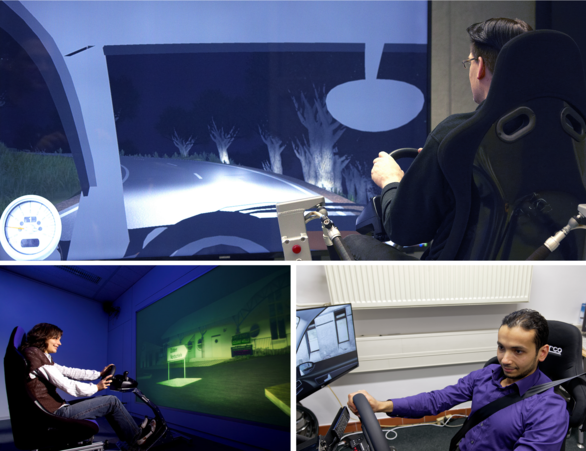
Automotive manufacturers and suppliers develop new vehicle systems, such as Advanced Driver Assistance Systems (ADAS), to increase traffic safety and driving comfort. ADAS are technologies that provide drivers with essential information or take over demanding driving tasks. More complex and intelligent vehicle systems are being developed toward fully autonomous and cooperative driving. Apart from the technical development challenges, training of drivers with these complex vehicle systems represents an important concern for automotive manufacturers. This paper highlights the new evolving requirements concerning the training of drivers with future complex vehicle systems. In accordance with these requirements, a new training concept is introduced, and a prototype of a training platform is implemented for utilization in future driving schools. The developed training platform has a scalable and modular architecture so that more than one driving simulator can be networked to a common driving instructor unit. The participating driving simulators provide fully immersive visualization to the drivers by utilizing head-mounted displays instead of conventional display screens and projectors. The driving instructor unit consists of a computer with a developed software tool for training session control, monitoring, and evaluation. Moreover, the driving instructor can use a head-mounted display to participate interactively within the same virtual environment of any selected driver. A simulation model of an autonomous driving system was implemented and integrated in the participating driving simulators. Using this simulation model, training sessions were conducted with the help of a group of test drivers and professional driving instructors to prove the validity of the developed concept and show the usability of the implemented training platform.
Keywords:
driver assistance systems
; autonomous and cooperative driving
; driving schools
; driving simulators
; multiple head-mounted displays
; shared virtual environments
Copyright: This open access article is published under a Creative Commons CC BY 4.0 license, which permit the free download, distribution, and reuse, provided that the author and preprint are cited in any reuse.


