

Submitted:
09 September 2016
Posted:
09 September 2016
Read the latest preprint version here
Abstract
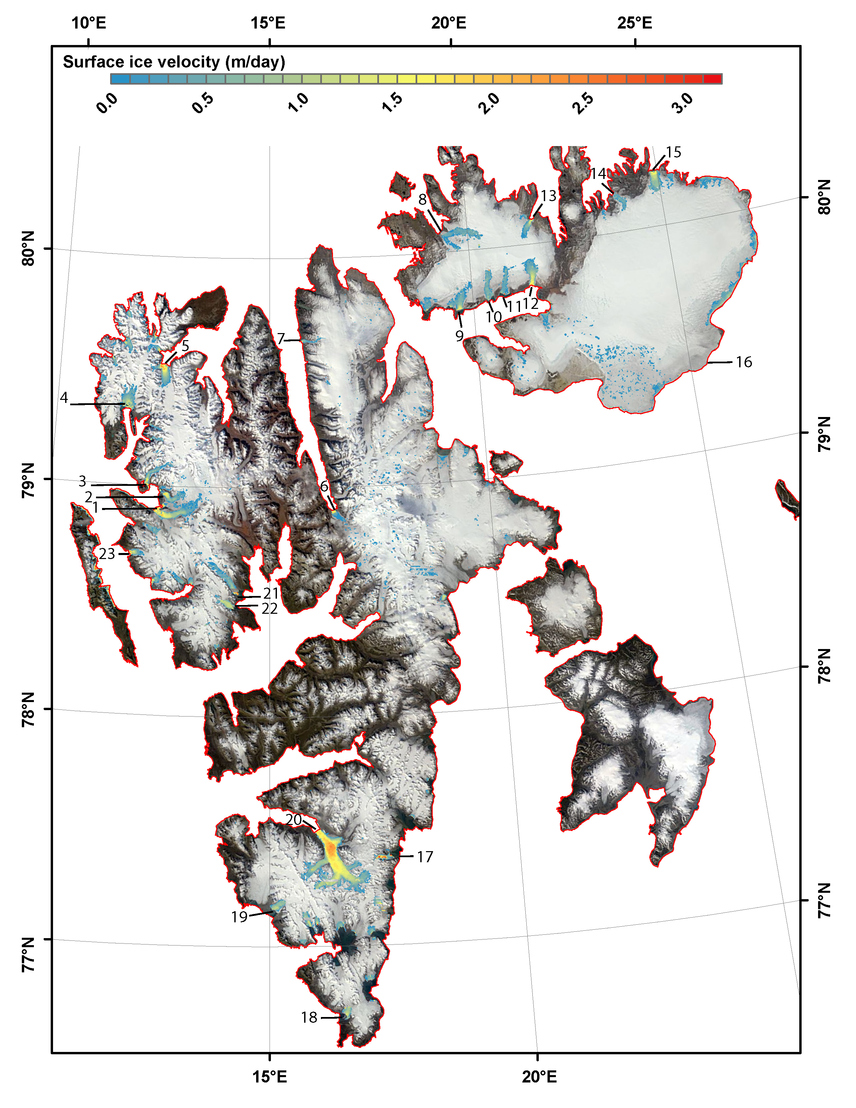
Glacier dynamics play an important role in the mass balance of many glaciers, ice caps and ice sheets. In this study we exploit Radarsat-2 (RS-2) Wide Fine (WF) data to determine the surface speed of Svalbard glaciers in the winters of 2012/2013 and 2013/2014 using Synthetic Aperture RADAR (SAR) offset and speckle tracking. The RS-2 WF mode combines the advantages of the large spatial coverage of the Wide mode (150 x 150 km) and the high pixel resolution (9m) of the Fine mode and thus has a major potential for glacier velocity monitoring from space through offset and speckle tracking. Faster flowing glaciers (1.95 md-1 - 2.55 md-1) which are studied in more detail are Nathorstbreen, Kronebreen, Kongsbreen and Monacobreen. Using our Radarsat-2 Wide Fine dataset, we compare the performance of two SAR tracking algorithms, namely the GAMMA Remote Sensing Software and a custom written MATLAB script that has primarily been used in the Canadian Arctic. Both algorithms provide comparable results, especially for the faster flowing glaciers and the termini of slower tidewater glaciers. A comparison of the WF data to RS-2 Ultrafine and Wide mode data reveals the superiority of RS-2 WF data over the Wide mode data.
Keywords:
SAR offset and speckle tracking
; glacier velocity
; Radarsat-2 Wide Fine
; Svalbard
Copyright: This open access article is published under a Creative Commons CC BY 4.0 license, which permit the free download, distribution, and reuse, provided that the author and preprint are cited in any reuse.