




Preprint servers are platforms that provide access to early versions of scholarly articles known as preprints. They are part of the wider preprint infrastructure aimed at facilitating open research practices such as transparent community peer review and fast dissemination of scientific information through open access. Researchers can upload and share manuscripts publicly before or alongside formal peer review.
In this article, we’ll explore the history of preprint servers, how they work, the major servers by discipline, how to choose a preprint server, and the benefits of using one.
A brief history of preprint servers
Although the history of preprint dissemination dates back to the 1960s, it wasn’t until 1991 that the first major preprint server, arXiv, was launched, focusing on physics and mathematics. bioRxiv (2013) and medRxiv (2019) extended the model to biology and health sciences respectively, highlighting the relatively slow but sustained growth of preprint posting over decades.
Further highlighting the growth of preprint culture was the establishment of multidisciplinary preprint servers. During the 2010s, scientific research became increasingly cross-disciplinary, and broader audiences took an interest in the latest research developments through the global accessibility made possible by open access. Preprints.org launched in 2016 as a multidisciplinary server dedicated to making early versions of research outputs permanently available and citable across a wide range of topics, addressing these shifting research and readership trends.
Further to this, Preprints.org had a key role to play in the COVID-19 pandemic, accelerating the dissemination of key data and findings. At the same time, the COVID-19 pandemic proved to drive a big change in preprint adoption across disciplines, demonstrating the value of rapid, open sharing of research.
How preprint servers work
The submission process for preprint servers may vary slightly across platforms, but for Preprints.org it remains simple and is as follows. Researchers submit a manuscript (along with any data and supplementary files). Preprints do not undergo traditional peer review but are subject to basic screening checks before posting. After moderation, which is typically completed within 24 hours during working days unless additional information is required, Preprints.org assigns the manuscript a DOI and posts it publicly on the server.
Preprints are posted online under a Creative Commons (CC BY) 4.0 license. This means that the work can be freely downloaded, distributed, and reused, provided that the author and preprint are cited in any reuse. This allows the maximum visibility for the work whilst ensuring authors are appropriately credited. Authors can post updated versions of their research manuscript as their work progresses.
Major servers by discipline
Demand for preprints has resulted in different preprint servers catering for specific disciplines. Here are some of the key platforms and the research areas they cover.
- arXiv – Physics, Mathematics, Computer Science, etc.
- bioRxiv – Life Sciences
- medRxiv – Health Sciences
- ChemRxiv – Chemical Sciences
- SSRN – All disciplines (historically focused on social sciences)
- Preprints.org – All disciplines
Some disciplines have established norms around the use of specific servers, whilst others are still developing preprint culture.
How preprint adoption differs across disciplines
According to Dimensions records of total preprint publications in 2025 (see image below), there is a clear distinction between preprint culture within the sciences and other disciplines such as Philosophy and Religious Studies, Education, and Law and Lega Studies. The top 5 disciplines for preprint posting include Information and Computing Sciences, Physical Sciences, Mathematical Sciences, Engineering, and Biomedical and Clinical Sciences. Preprint culture is more established within the sciences. This is largely because of the need for accelerated access to pioneering research and data.
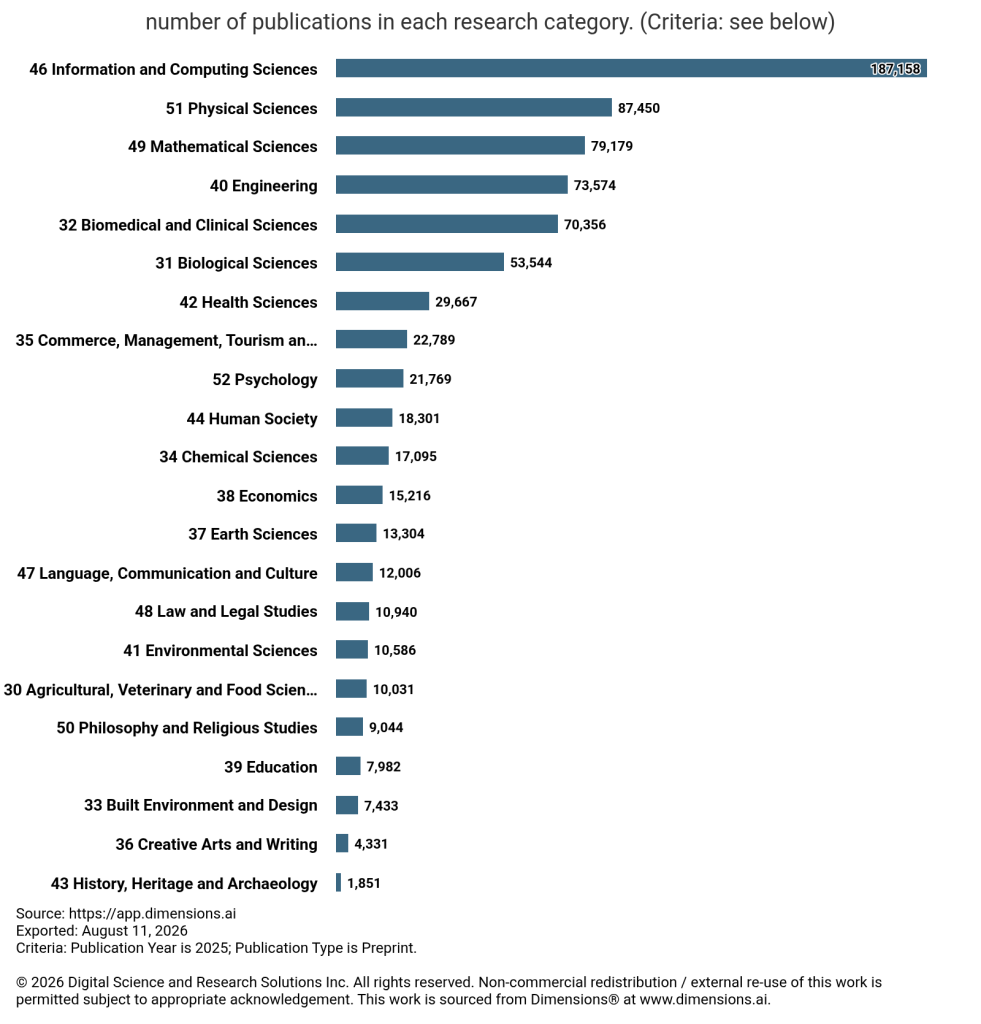
Still, preprint posting figures across other disciplines are still respectable and in many cases on an upward trend, highlighting the growing adoption of preprint culture across disciplines.
For more information, see our article on why preprinting appeals to researchers now more than ever.
How to choose a preprint server
Preprint platforms for researchers are varied, making choosing the right preprint server dependent on many factors. Key criteria to consider when asking yourself where to post a preprint include disciplinary fit, moderation speed, DOI assignation, open access terms and licensing, and compatibility with any target journal’s preprint policy.
Discipline-specific preprint platforms for researchers ensure a good fit for certain topics, but they may vary in terms of other factors such as speed of posting and visibility. Multidisciplinary preprint severs such as Preprints.org have the benefit of bringing a broader range of readers to topics that might have attracted smaller, more localised traffic streams on discipline-specific preprint servers.
You also want to ensure that long-term accessibility, discoverability, preservation, and useability of your research is guaranteed. Platforms like Preprints.org ensure this through immediate DOI assignment upon posting and Creative Commons licensing.

Benefits of using a preprint server
There are numerous key benefits for authors using a preprint server. Here are the main ones:
- Immediate open access for global readers;
- Establishment of research priority via timestamped DOI;
- No delays due to prolonged review periods;
- Early community feedback;
- Increased visibility;
- Inclusion on CV and grant applications.
For more information, see our article on the benefits of posting a preprint for authors. For those wishing to get started on their preprint journey with Preprints.org, learn more about how to submit a preprint.