




With ASAPbio’s Preprint Policy Framework, it makes sense to take a moment and explain what it means for researchers.
The academic publishing landscape is constantly evolving, and so are preprint policies. At Preprints.org, we’re committed to keeping our community informed about developments that shape the way research is shared. A newly released Preprint Policy Framework marks a major step toward consistent, open practices for sharing preprints and advancing open science communication.
On July 16, 2025, ASAPbio and Creative Commons, working alongside major research funders such as the Gates Foundation, the Chan Zuckerberg Initiative, and other leading funding and research organizations, launched this framework to provide a common standard for how preprints should be shared. This collaborative effort is designed to bring greater consistency, clarity, and openness to preprint policies across the global research ecosystem.
Nine funders have already signaled their alignment with parts or all of its recommendations, including the Gates Foundation, Wellcome Trust, and Aligning Science Across Parkinson’s.
Key recommendations from the ASAPbio Preprint Policy Framework
The framework outlines six best-practice components to help funders and research organizations align their policies for more open, reusable, timely, and rigorous research communication:
- Open deposition: Preprints should be posted to public servers with persistent identifiers (e.g., DOI), free for both authors and readers.
- Author copyright retention: Unless waived by CC0 or other specific agreements, authors should keep copyright to their work.
- Open licensing: Use of CC BY (or CC0) to maximize reuse and accessibility.
- Timely posting: Upload preprints before or at the time of journal submission to ensure early visibility.
- Funder acknowledgement: Recognizing the funding source in the text or metadata of the preprint.
- Resource availability: Statements describing how to access related data, code, software, protocols, and materials.
A growing number of prominent funders, including the Gates Foundation, Wellcome Trust, and Aligning Science Across Parkinson’s, have already adopted many or all of these principles.
Most require (or strongly encourage) preprint posting, CC BY licensing, and transparency about data and materials, signaling a shift from preprints being “optional” to becoming a core expectation in research workflows.
While some differences remain (e.g., not all funders require copyright retention or the same level of resource sharing), the framework provides a shared foundation for strengthening these policies over time.
Policies from the first nine supporting funders
To help researchers quickly compare funder requirements, we’ve created the table below summarizing how the nine participating funders align with each of the six framework components. This overview makes it easier to check compliance and identify best practices before preparing your next submission.
Policies on preprints from the first nine funders participating
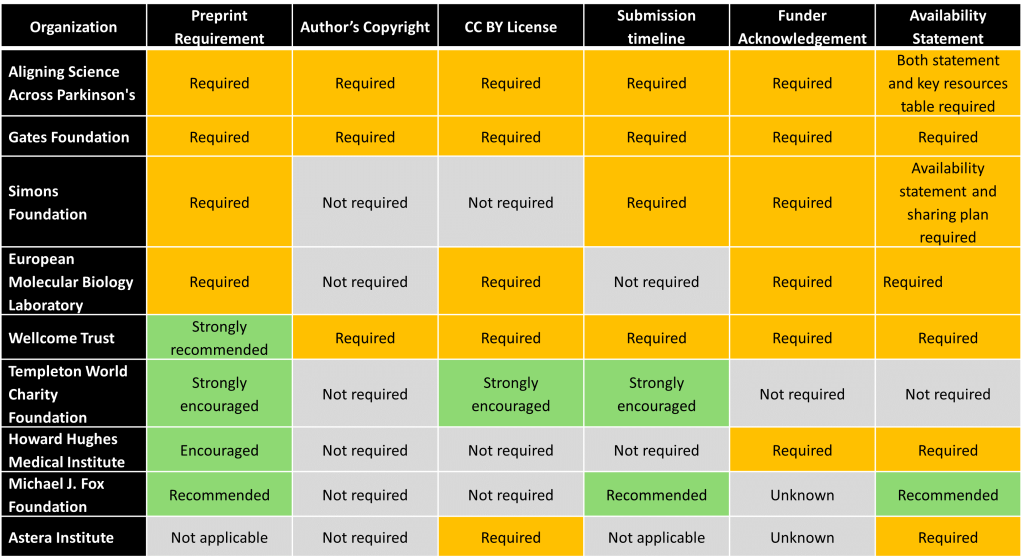
Why the ASAPbio framework matters for Preprints.org authors
This ASAPbio framework reinforces what we’ve believed at Preprints.org: preprints are essential research infrastructure. At Preprints.org, we already align with many of these principles. This makes it straightforward for authors to meet their funder’s expectations while posting their work as preprints:
- Every submission receives a persistent identifier (DOI)
- All content is free to post and access
- All preprints are licensed under CC BY to ensure maximum reuse
- Authors are encouraged to submit preprints at any stage before journal acceptance
- We encourage funder acknowledgements and resource availability statements to increase the reach and reusability of your work
By staying aligned with evolving policies like the Preprint Policy Framework, we ensure our authors can share their work confidently, knowing it meets the standards of leading global funders and institutions.
Ready to make your research policy-ready?
Whether you’re preparing a research for a journal or simply want to share your findings with the world, Preprints.org offers a trusted, multidisciplinary platform built on openness, accessibility, and global reach.
Submit your work today and joining a growing community of over 350,000 researchers worldwide committed to open science. Learn more about our policies.
Read the full announcement and details from ASAPbio.