


Citations are a way of assessing the authority of a research paper. The more citations a piece of research has, the more this speaks of the quality, impact, and reliability of the findings. As with conventional research papers, the academic community also view citations as a signal of how preprints are engaged with by researchers. So, how to cite preprints?
There are best practices to be aware of, especially if you’re a young researcher who wants to become familiar with the preprints publishing landscape. We’ll dive into these practices, as well as how to increase citations by boosting visibility for your own preprints.
The growing authority of preprints
Preprints have a long history. In 1961, the National Institutes of Health launched a project called “Information Exchange Groups.” The purpose of these groups was to circulate research quickly, a process facilitated by bypassing peer review and sometimes even conventional editing.
These groups were met with resistance from certain journals and publishers, and eventually the groups shut down. However, the principle of making research available quickly persisted, beginning with arXiv in 1991 and later with the launch of ClinMedNetPrints.org in 1999 by the British Medical Journal, one of the first preprint servers dedicated to clinical research.
Since then, the authority of preprints as a form of research sharing has been steadily growing, facilitated by the rise of open access and increasing recognition of alternative publishing pathways.
Evidence of increasing preprint relevance
Preprints are now becoming an essential part of scholarly communication. Naturally, researchers are starting to ask whether journals allow preprints to be cited in formal publications. The short answer is yes; preprints may be referenced. Across major publishers, the prevailing policy is more supportive than prohibitive now.
For example, Nature states in its editorial policies that “Preprints may be cited in the reference list of articles under consideration at Nature Portfolio journals.” Science notes that “Related papers posted at a preprint server must be cited.” The BMJ provides detailed instructions on how preprints should be cited, as shown below.
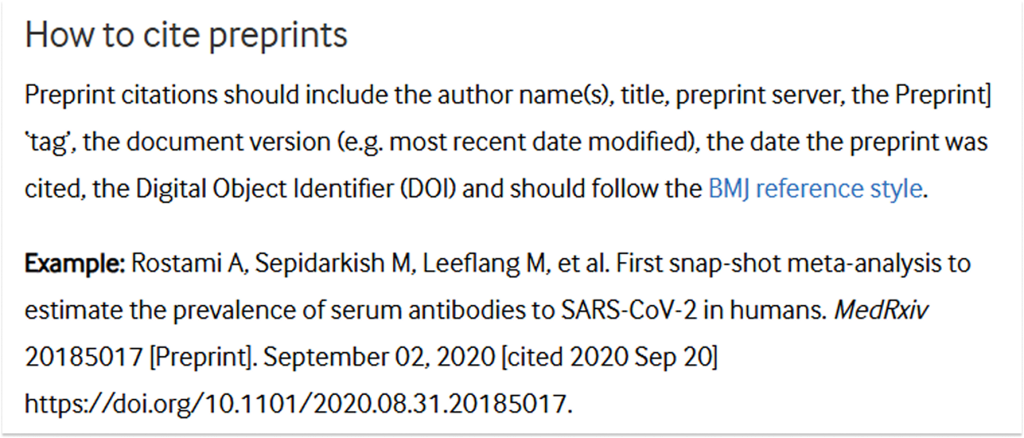
Beyond policy acceptance, researchers are also asking whether posting a preprint can influence the visibility and reach of their work. In a study by Authorea, they concluded that preprints they had published received 269% more citations than the average citation rate for all publications over the same time period. The study identifies easy manuscript correction in the form of versioning and growing preprint influence on grant applications as significant reasons for the rise in preprint citation.
The COVID-19 pandemic also had a big influence on preprint citation trends. Distributing preprints prior to formal publication appeared to help COVID-19 research reach a wider audience. Out of 184 journals, 129 were found to have a higher median citation count for COVID-19 preprints than traditional COVID-19 paper submissions.
Furthermore, among the 2,015,997 citations received by COVID-19 papers across these journals, preprint-distributed papers demonstrated 542,715 citations, representing a substantial 26.92%.
The COVID-19 pandemic was a rare occurrence, but it dramatically impacted publishing trends. It highlighted the need for fast and effective research that could be circulated and cited instantly.
Now we know more about their growing authority, let’s look at how to cite preprints.
Best practices for citing preprints
When citing preprints, you should follow certain practices.
- Always cite the most recent or final version if it was updated or later published in a journal.
- Check the content first—preprints may contain errors.
- Use a unique, traceable identifier, such as a DOI. DOIs are used by most preprint servers and ensure long-term accessibility to research.
- Include preprint platform name, version, URL, and article type.
Knowing how to cite preprints ensures that other researchers and experts know that you’ve consulted preprints in the construction of your argument. This is important because the findings in preprints are ultimately provisional. By acknowledging this, you avoid over-emphasizing the reliability of such findings, thus protecting your own work from absoluteness.
To make things easier, platforms like Preprints.org simplify correct citation by assigning DOIs, displaying citation formats, and linking to published versions.
Tips to increase citations and boost visibility
As a researcher, you don’t just want to know how to cite other preprints. Equally, you’ll want to receive your own citations too. You can increase your citations and boost the visibility of your research in a couple of ways.
The first way is by using social media. Preprints are instantly accessible online, making their dissemination on social media channels a matter of one or two clicks. On the page of each preprint you’ll find a share button. Use this to distribute your research on channels such as LinkedIn, Facebook, and X.
Social media channels are effective for communicating your research to the public and various academic communities. To create an engaging post, try summarizing the key, impactful findings of your research in a clear, interesting way that resonates with audiences. Use hashtags to align your content with certain interests. Add eye-catching infographics if possible. Don’t forget to publish your posts at peak times to further maximize visibility.
The second way of increasing citations is to cite related research works. Citing other preprints related to your subject area fosters discussion and collaboration with the research community. By doing so, not only do you help advance the knowledge base for your research field, but you connect your work to a larger theoretical narrative, helping bring increased visibility. More researchers will feel inclined to engage with your work, increasing the possibility of increased citations.
Benefit from increased citations with Preprints.org
Posting a preprint may be the key to increasing your citation impact. Especially if you’re a young researcher hoping to establish yourself.
At Preprints.org, we empower researchers to freely and instantly share their work with a global audience, helping you gain early feedback, boost visibility, and accelerate discovery. Join over 350,000 researchers advancing open science on our accessible, multidisciplinary platform. Ready to submit? Upload your preprint today and make your work quickly discoverable.
Just exploring? Browse over 100,000 preprints across disciplines and stay ahead of the latest research.


