
Submitted:
26 November 2026
Posted:
27 November 2026
You are already at the latest version
Abstract
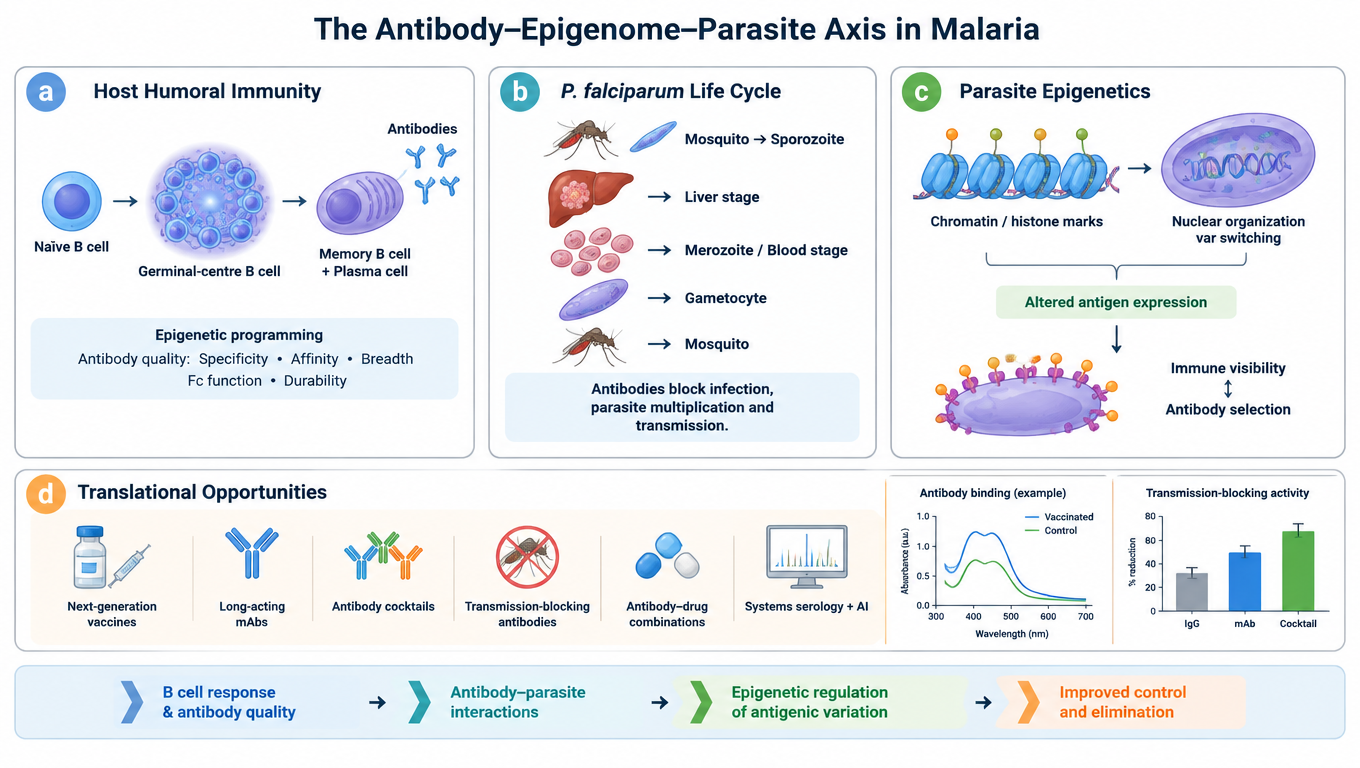
Malaria immunity is shaped by a complex interplay between host antibody responses and the developmental and antigenic plasticity of Plasmodium parasites. Recent advances including the RTS,S/AS01 and R21/Matrix-M vaccines and long-acting monoclonal anti-bodies such as CIS43LS, L9LS and MAM01 highlight the potential of antibody-mediated interventions for malaria prevention. However, protection remains variable and often incomplete, emphasizing that antibody specificity, affinity, breadth, functional activity and durability are as important as antibody abundance. Antibodies act at multiple stages of the parasite life cycle, from sporozoite invasion and liver infection to erythrocytic growth and transmission. Transmission-blocking antibodies targeting sexual-stage antigens including Pfs48/45 and Pfs230 offer additional opportunities to interrupt parasite development. A key challenge is understanding how these responses can remain effective against a parasite capable of antigenic variation and epigenetic adaptation. Plasmodium falciparum uses chromatin organization, histone modifications and transcriptional switching to regulate virulence and variant surface antigen expression, potentially facilitating escape from antibody recognition. Emerging evidence also suggests that host epigenetic regulation may influence B cell differentiation, germinal centre responses, plasma cell formation and immune memory although its direct contribution to malaria vaccine efficacy remains un-clear. This review presents an integrated antibody-epigenome-parasite framework, examining naturally acquired and vaccine-induced immunity, antigenic diversity, immune escape and host-parasite epigenetic interactions. Systems serology, B cell profiling, structure-guided antigen design, monoclonal antibodies, multistage vaccines and transmission-blocking strategies have also been explored. Understanding this interconnected biology may guide the development of broader, more durable and functionally effective interventions for malaria prevention and control.
Keywords:
Malaria
; Plasmodium vivax
; malaria vaccines
; monoclonal antibodies
; transmission-blocking immunity
; parasite epigenetics
; B cell epigenetics
; immune evasion
; systems serology
; antigenic variation
; antibody therapeutics
Copyright: This open access article is published under a Creative Commons CC BY 4.0 license, which permit the free download, distribution, and reuse, provided that the author and preprint are cited in any reuse.