
Submitted:
26 November 2026
Posted:
27 November 2026
You are already at the latest version
Abstract
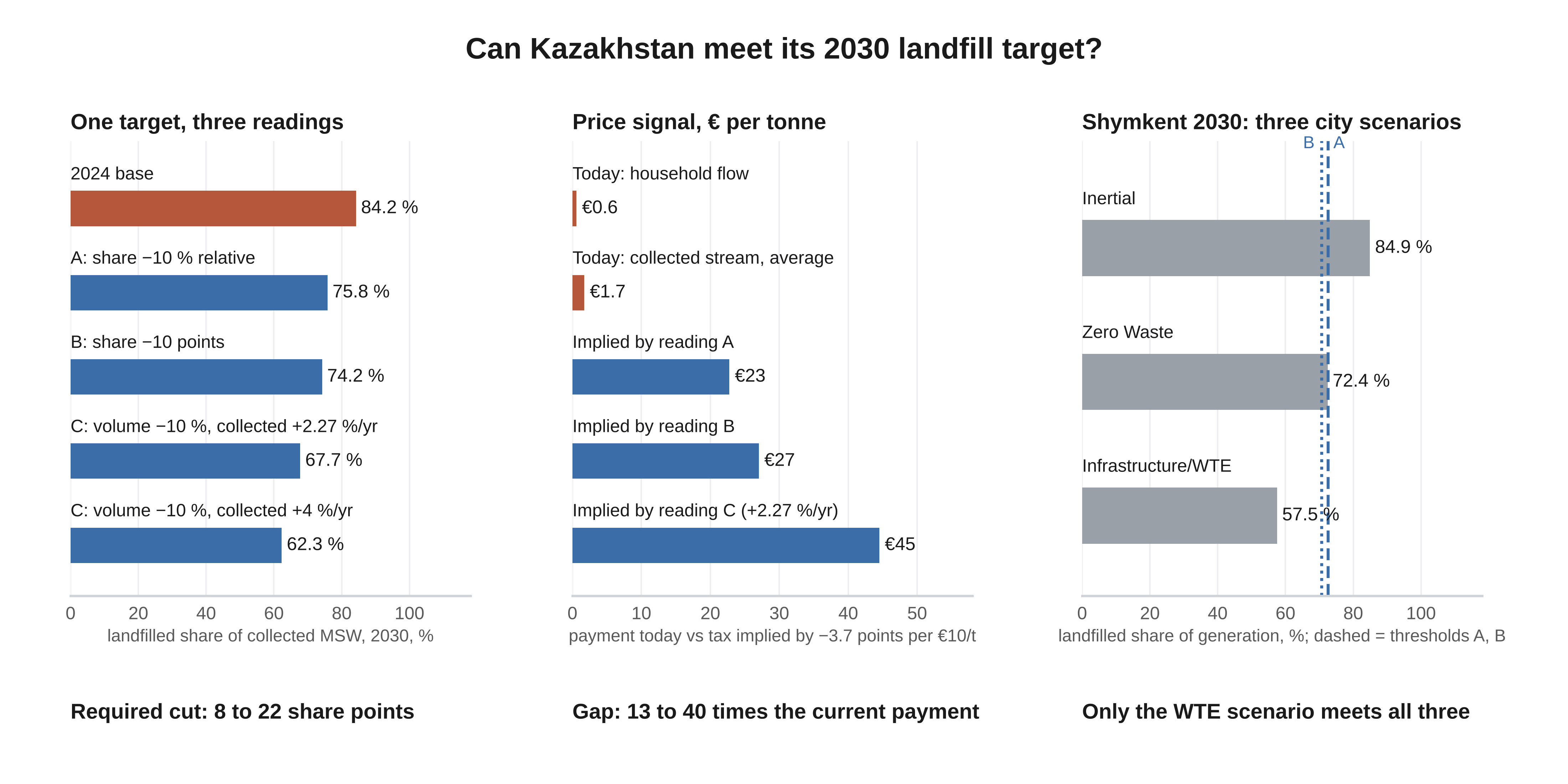
Kazakhstan’s waste-management concept for 2026–2030 requires municipal waste sent to landfill to fall by 10% by 2030 against 2025, in a country where about 84% of collected waste is landfilled and the disposal payment on household waste is below one euro per tonne. A systematic search under a registered protocol (48 studies in 51 reports) served as the data-collection step of an evidence map, from which every ex-post quantitative effect on landfilled tonnage or share was extracted and transferred, as share-point changes, to the national baseline and to the city of Shymkent. The map contains no ex-post evaluation of an environmental outcome of any landfill tax or pay-as-you-throw scheme, and one for a ban. The target is defined as a share in the concept’s indicator table and as a volume in its expected results, and the admissible readings require reductions of 8 to 22 share points. Even the weakest implies a price signal of about €23 per tonne, thirteen to forty times the current one, or the treatment capacity that accompanied every effect in the corpus. In Shymkent only the infrastructure scenario of the city’s plan meets every reading of the target. Defining the indicator is the first legal step.
Keywords:
landfill tax
; landfill ban
; pay-as-you-throw
; waste hierarchy
; municipal solid waste
; policy transfer
; evidence-gap map
; waste policy evaluation
; Kazakhstan
; Shymkent
Copyright: This open access article is published under a Creative Commons CC BY 4.0 license, which permit the free download, distribution, and reuse, provided that the author and preprint are cited in any reuse.