
Submitted:
26 November 2026
Posted:
27 November 2026
You are already at the latest version
Abstract
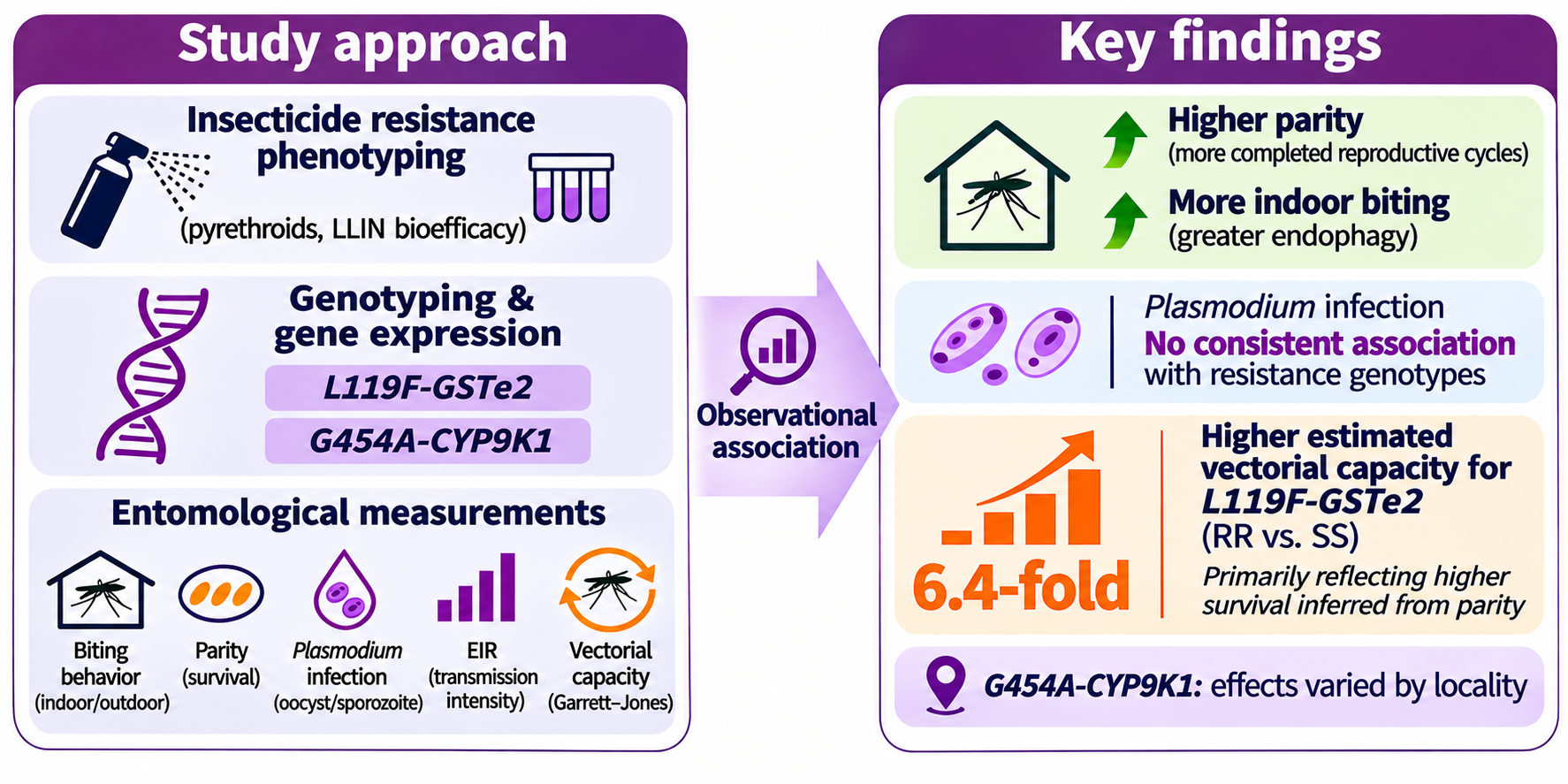
Insecticide resistance is generally expected to impose fitness costs that may limit its contribution to malaria transmission. We investigated this assumption in Anopheles funestus populations from three forested localities in Cameroon by examining associations between two metabolic resistance markers, L119F-GSTe2 and G454A-CYP9K1, and key components of vectorial capacity. Mosquito populations exhibited high levels of pyrethroid resistance, with evidence of P450-mediated mechanisms and reduced bioefficacy of pyrethroid-only nets. Resistance genotypes showed no consistent association with Plasmodium infection, indicating that resistance was not systematically associated with increased parasite infection rates. In contrast, homozygous resistant mosquitoes exhibited higher parity rates and a greater propensity for indoor biting than their susceptible counterparts. Given the exponential contribution of mosquito survival to transmission potential, the higher parity rates observed among resistant mosquitoes correspond to an estimated 6.4-fold higher vectorial capacity for L119F-GSTe2 homozygous resistant mosquitoes compared with susceptible mosquitoes, whereas associations involving G454A-CYP9K1 varied across sites. These findings suggest that metabolic resistance may contribute to sustained malaria transmission not necessarily by increasing susceptibility to Plasmodium infection, but through its association with parity-derived estimates of survival and indoor biting behavior, potentially undermining the effectiveness of insecticide-treated nets.
Keywords:
Anopheles funestus
; insecticide resistance
; metabolic resistance
; biting behavior
; malaria transmission
; vectorial capacity
1. Introduction
Over the past decade, progress in malaria control has stalled across sub-Saharan Africa, with the disease persisting as a major public health burden despite widespread deployment of vector control interventions such as of long-lasting insecticidal nets (LLINs) and indoor residual spraying (IRS) [1]. This stagnation coincides with the rapid spread of insecticide resistance in major vector species across endemic regions, including Cameroon [2].
Although the molecular and biochemical mechanisms underlying insecticide resistance, particularly metabolic detoxification pathways and target-site mutations, have been extensively characterized, considerably less attention has been paid to their ecological and behavioral consequences [3]. Growing evidence indicates that insecticide resistance can influence key determinants of vectorial capacity, potentially undermine the effectiveness of vector control interventions and sustain malaria transmission. Because vectorial capacity is highly sensitive to adult mosquito survival and biting frequency, even modest changes in longevity or host contact frequency can substantially influence malaria transmission intensity. Thus, resistance-driven shifts in mosquito behavior or life-history traits may have greater epidemiological significance than their effects on parasite development alone [4,5].
Metabolic resistance, in particular, is an energy-demanding process that may impose physiological trade-offs affecting traits directly linked to transmission, including longevity, host-seeking behavior, feeding success, and biting activity. Such changes may alter mosquito-human interactions, for example by increasing indoor biting (endophagy) or shifting feeding times, thereby influencing transmission dynamics [6,7]. Anopheles funestus, one of the most efficient malaria vectors in sub-Saharan Africa, provides a valuable model to investigate these dynamics, as resistance in this species is largely driven by metabolic mechanisms. Two key resistance markers have recently been characterized in this species including the L119F-GSTe2 mutation associated with DDT resistance and cross-resistance to pyrethroids, and the G454A-CYP9K1 mutation conferring pyrethroid resistance [8,9]. Although widely distributed in West and Central Africa, their effects on mosquito behavior and transmission patterns in natural populations remain poorly understood. Previous studies suggest that the L119F-GSTe2 mutation may be associated with increased Plasmodium infection, raising the possibility that metabolic resistance enhances transmission potential [10,11]. Most recently, homozygous L119F-GSTe2 resistant An. funestus from Elendé (Centre Region) and Mibellon (Adamawa Region) were shown to be two to three times more likely to carry sporozoites than susceptible mosquitoes, whereas G454A-CYP9K1 homozygous resistant mosquitoes tended to be less infected [12]. These studies, however, relied on indoor-resting collections and infection status alone, leaving unresolved whether metabolic resistance also alters the biting behavior and survival of vectors, the components to which vectorial capacity is most sensitive.
Vectorial capacity integrates the components of transmission that depend on mosquito behavior and survival, which are distinct from vector competence [13,14]. Here, we asked which of these components are associated with metabolic resistance. Using the L119F-GSTe2 and G454A-CYP9K1 markers in An. funestus from three forested localities of southern Cameroon, we related resistance genotypes to Plasmodium infection, biting location and timing, parity and entomological inoculation rates, and combined these traits into a genotype-specific estimate of vectorial capacity.
2. Results
This section may be divided by subheadings. It should provide a concise and precise description of the experimental results, their interpretation, as well as the experimental conclusions that can be drawn.
2.1. Anopheles Funestus Predominate and Highly Resistant to Pyrethroids, Reducing the Bioefficacy of Standard Long-Lasting Insecticidal Net
A total of 6020 mosquitoes were collected across the three sites, of which 97.62% belonged to the genus Anopheles. The An. gambiae complex was the dominant taxon in Emana-Benyagda (61.93%). Molecular identification revealed An. gambiae as the only member of the complex detected in Emana-Benyagda and Nkolfeb, whereas in Ezenlassi, An. gambiae accounted for 70% (n = 70) of identified specimens, compared with 30% (n = 30) for An. coluzzii (Figure S1). The An. funestus group predominated in Ezenlassi (85.96%) and Nkolfeb (83.50%). Molecular identification confirmed An. funestus s.s. (hereafter An. funestus) as the predominant species of the An. funestus group in all three sites (88.72-100%; Figure S1) and all subsequent analyses focused exclusively on this species.
Anopheles funestus populations exhibited resistance to all pyrethroids tested (permethrin, deltamethrin and alpha-cypermethrin) and DDT across all study sites. At diagnostic doses, mortality rates ranged from 3.57% (deltamethrin in Nkolfeb) to 84.38% (DDT in Emana-Benyagda). Possible resistance to bendiocarb was detected in Ezenlassi and Nkolfeb (95.3% mortality), whereas full susceptibility was observed in Emana-Benyagda. In contrast, full susceptibility to the organophosphates pirimiphos-methyl and malathion was observed across all sites (Figure 1a).
Resistance intensity assays revealed moderate to high levels of pyrethroid resistance. Populations from Nkolfeb and Emana-Benyagda exhibited mortality below 98% at 5× the diagnostic concentration, indicating moderate resistance intensity. In contrast mosquito population form Ezenlassi displayed high resistance intensity to deltamethrin and alpha-cypermethrin, with mortality remaining below 98% even at 10× the diagnostic concentration (Figure 1b).
Pre-exposure to piperonyl butoxide (PBO) restored full susceptibility to pyrethroids across all sites, suggesting a major contribution of cytochrome P450-mediated detoxification to the observed resistance (Figure 1c).
Consistent with these findings, cone bioassays revealed a marked reduction in the bioefficacy of standard pyrethroid-only LLINs, with 24h-mortality rates ranging from 0% to 34.88%. In contrast, PBO-based nets exhibited substantially high bioefficacy, with Olyset Plus® and the roof panel of PermaNet®3.0 roof achieving rates above the 80% WHO optimal threshold, whereas Veeralin® induced lower mortality. The marked difference in induced mortality between the pyrethroid-only side panels (0-33%) and the PBO-pyrethroid roof (95.2-100%) of PermaNet® 3.0 provide further evidence of the contribution of P450-mediated detoxification to pyrethroid resistance (Figure 2a and b).
Among dual-active ingredient nets, Royal Guard® induced moderate mortality (61.5-66%), whereas Interceptor G2® (8.8-15.0%) and PermaNet® Dual (4.1-11.1%) achieved substantially low 24h-mortality rates (Figure 2a and b).
All tested nets induced 100% mortality in the susceptible An. funestus FANG susceptible strain, supporting the validity of the assays.
2.2. Widespread Enrichment of Resistance Alleles and Metabolic Gene Overexpression Underpin Pyrethroid Resistance in Anopheles Funestus
Genotyping of the two metabolic resistance markers revealed distinct patterns of genotype distribution across the study sites. For L119F-GSTe2, genotype distributions were relatively similar across sites, with homozygous resistant (RR) individuals accounting for 31.0-40.5% of mosquitoes. In contrast, G454A-CYP9K1 exhibited pronounced geographical variation, with the RR genotype predominating in in Ezenlassi (96%), compared with 46.8% in Emana-Benyagda and 48.1% in Nkolfeb. Significant deviations from Hardy-Weinberg equilibrium, characterized by deficits in observed heterozygous, were detected for both markers across study sites (p < 0.001), except for G454A-CYP9K1 in Ezenlassi (Figure 3a).
The L119F-GSTe2 resistance allele occurred at moderate frequencies (0.47-0.57), with a significant variation among study sites (Pearson’s χ², 2 df: χ² = 28.05; p < 0.001). In contrast, the G454A-CYP9K1 resistance allele approached fixation in Ezenlassi (0.98), while remaining common in Nkolfeb (0.61) and Emana-Benyagda (0.61), with significant variation among sites (Pearson’s χ², 2df: χ² = 128.51; p < 0.001) (Figure 3b).
Transcriptional profiling by RT-qPCR variation in the expression of the metabolic resistance-associated genes GSTe2 and CYP9K1 across the three study sites. In Ezenlassi, both genes were significantly overexpressed compared with the susceptible FANG reference strain population, in unexposed mosquitoes and those exposed to either insecticide (Dunnett’s test, p < 0.05). In Nkolfeb, CYP9K1 was significantly overexpressed relative to FANG under all three exposure conditions, whereas GSTe2 overexpression was significant following insecticide exposure. In Emana-Benyagda, neither gene showed a statistically significant difference in expression compared to FANG, although CYP9K1 expression was 2.4 to 2.9-fold higher. In Ezenlassi, expression levels of both genes differed significantly among exposure conditions, with the highest expression observed following alpha-cypermethrin exposure (One way ANOVA, GSTe2: p < 0.001; CYP9K1: p = 0.019). No significant differences in expression among exposure conditions were detected in Nkolfeb or Emana-Benyagda (p > 0.36) (Figure 4).
2.3. Metabolic Resistance Markers Are Not Consistently Associated with Plasmodium Infection
Plasmodium infection was detected the three An. funestus populations. Oocyst infection rate varied considerably among sites, reaching 87.3% in Nkolfeb, 34.8% in Ezenlassi and 20.9% in Emana-Benyagda, with P. falciparum accounting for more than 83% of infections across all sites. Overall, sporozoite rates were19.7%, 12.8% and 8.7%, respectively. Within-site comparisons revealed no significant differences in sporozoite rates between indoor and outdoor collections in Ezenlassi (11.8% vs 16.0%, P = 0.29) or Emana-Benyagda (7.7% vs 9.8%, P = 0.62). In contrast, the sporozoite rate was significantly higher outdoors than indoors in Nkolfeb (35.7% vs 16.1%; χ² = 5.53, df 1: p = 0.02) (Table 1).
The association between metabolic resistance markers and Plasmodium infection was generally weak and heterogeneous across study sites and parasite developmental stages. For the L119F-GSTe2 mutation, a significant association between genotype and whole-mosquito infection status was observed only in Ezenlassi (χ² = 9.91, df = 2; p = 0.007), where RR individuals had significantly higher infection rates than RS (27.0% vs 18.4%; p = 0.04) and SS (12.7%; p = 0.004) genotypes. In contrast, no significant association was observed in Nkolfeb (χ² = 0.83; p = 0.66) or Emana-Benyagda (χ² = 4.92; p = 0.09). Nevertheless, a pairwise comparison in Emana-Benyagda indicated a higher infection rate in RR than in RS individuals (p = 0.04).
For the G454A-CYP9K1 mutation, no significant association with Plasmodium infection was detected in either Emana-Benyagda (χ² = 0.07; p = 0.97) or Nkolfeb (χ² = 2.06; p = 0.36; Freeman–Halton exact test, p = 0.41). Similarly, comparisons between carriers of the resistant allele (RR + RS) and susceptible homozygotes (SS) revealed no significant differences in infection odds (Emana-Benyagda: OR = 1.03, 95% CI 0.41-2.59, p = 1.00; Nkolfeb: OR = 0.27, 0.03-2.24, p = 0.28); pooled across sites, RR vs SS: OR = 0.70, 95% CI 0.29-1.67; p = 0.43 (Figure 5c). Ezenlassi was excluded from the G454A-CYP9K1 association analyses because the RR genotype was nearly fixed (96%) and no SS mosquitoes were detected.
At the oocyst stage, no significant association between L119F-GSTe2 genotypes and infection status was detected at any study site (Ezenlassi: χ² = 0.96, p = 0.62; Nkolfeb: χ² = 0.33, p = 0.85; Emana-Benyagda: χ² = 3.35, p = 0.19). Consistently, the pooled analysis showed no significant difference in oocyst infection odds between RR and SS mosquitoes (pooled RR vs SS: OR = 1.41, 95% CI 0.80-2.47; p = 0.24). Likewise, G454A-CYP9K1 genotypes were not significantly associated with oocyst infection in Emana-Benyagda (χ² = 0.12; p = 0.94) or Nkolfeb (χ² = 1.83; p = 0.40), with no significant association in the pooled analysis (pooled RR vs SS: OR = 0.72, 95% CI 0.29–1.78; p = 0.49) (Figure 5a, d).
At the sporozoite stage, association with L119F-GSTe2 varied among sites. A significant association was again observed in Ezenlassi (χ² = 12.99; p = 0.002), where RR mosquitoes had higher sporozoite rates than RS and SS individuals (20.1% vs 7.2% and 9.2%; Fisher’s exact test, p = 0.001 and p = 0.03, respectively). However, the comparison between resistant allele carriers (RR + RS) and SS mosquitoes was not statistically significant. No significant association between L119F-GSTe2 genotypes and sporozoite infection was observed in Nkolfeb (χ² = 0.21; p = 0.90) or Emana-Benyagda (χ² = 3.34; p = 0.19). Nevertheless, pooled analysis indicated significant higher odds of sporozoite infection in RR than in SS mosquitoes (Mantel-Haenszel OR = 1.81, 95% CI 1.01-3.24; p = 0.047; Figure 5b, d).
For the G454A-CYP9K1, no significant association with sporozoite infection was detected in either Emana-Benyagda (χ² = 0.07; p = 0.97) or Nkolfeb (χ² = 5.49; p = 0.06). However, pairwise comparisons in Nkolfeb revealed a significantly lower sporozoite infection rate in RR than in RS mosquitoes (14.8% vs 34.1%; Fisher’s exact test, p = 0.03), although no significant difference was detected when resistant-allele carriers (RR + RS) were compared with SS mosquitoes (p = 0.82). Consistently, the pooled Mantel-Haenszel analysis showed no significant difference in sporozoite infection odds between RR and SS mosquitoes (OR = 0.77, 95% CI 0.32-1.85; p = 0.56) (Figure 5b, d).
Joint analysis of L119F-GSTe2 and G454A-CYP9K1 genotypes revealed no significant associations with Plasmodium infection at any developmental stage in Emana-Benyagda or Nkolfeb. In Emana-Benyagda, genotype distributions did not differ significantly according to oocyst infection (χ² = 1.12, p = 0.997), sporozoite infection (χ² = 4.43, p = 0.82), or whole-mosquito infection status (χ² = 3.85, p = 0.87). Similar results were obtained in Nkolfeb for oocyst (χ² = 2.26, p = 0.97), sporozoite (χ² = 5.38, p = 0.72), and whole-mosquito infection (χ² = 7.21, p = 0.51). Pooled analyses comparing double homozygous resistant (RR/RR) with double homozygous susceptible (SS/SS) mosquitoes showed no significant associations with oocyst infection (OR = 0.94, 95% CI 0.25-3.51; p = 0.93), sporozoite infection (OR = 0.50, 95% CI 0.08-3.26; p = 0.48), or whole-mosquito infection (OR = 0.50, 95% CI 0.15-1.73; p = 0.28) (Figure 5).
2.4. Resistance Genotypes Are Associated with Indoor Biting and Variation in Biting Activity
Anopheles funestus populations exhibited predominantly endophagic behaviour across all three study sites, with significantly higher indoor than outdoor human biting rates (HBRs). In Ezenlassi, indoor and outdoor HBRs were 50.70 and 39.30 bites/person/night (b/p/n), respectively, with 56.3% of bites occurring indoors (rate ratio = 1.29, p < 0.001). A similar pattern was observed in Emana-Benyagda, where indoor HBR was 27.57 b/p/n compared with 18.80 b/p/n outdoors (59.5% indoor biting; rate ratio = 1.47, p < 0.001). The strongest indoor biting predominance was recorded in Nkolfeb, with 15.38 b/p/n indoors versus 5.88 b/p/n outdoors (72.4% indoor biting; rate ratio = 2.62, p < 0.001) (Table 1).
Indoor biting was significantly associated with metabolic resistance genotypes, although the strength of these associations varied across markers and study sites. For L119F-GSTe2, genotype distributions differed significantly between indoor and outdoor collections in Ezenlassi (χ² = 30.19, p < 0.001) and Emana-Benyagda (χ² = 8.77, p = 0.01), but not in Nkolfeb (χ² = 4.72, p = 0.09). Nevertheless, homozygous resistant (RR) mosquitoes had significantly higher odds of being collected indoors than homozygous susceptible (SS) mosquitoes in all three sites: Ezenlassi (OR = 3.19, 95% CI 2.04-5.00, p < 0.001), Emana-Benyagda (OR = 1.76, 95% CI 1.21-2.56, p = 0.003) and Nkolfeb (OR = 2.53, 95% CI 1.08-5.95, p = 0.038). A similar association was observed for G454A-CYP9K1, with significant differences in genotype distribution between indoor and outdoor collections in Emana-Benyagda (χ² = 15.91, p < 0.001), but not in Nkolfeb (χ² = 4.85, p = 0.09). Pairwise comparisons nevertheless revealed significantly higher odds of indoor biting among RR than SS mosquitoes in both Emana-Benyagda (OR = 2.80, 95% CI 1.68-4.68, p < 0.001) and Nkolfeb (OR = 2.16, 95% CI 1.07-4.37, p = 0.042). When both resistance markers were considered jointly, a significant association between combined genotypes and biting location was detected in Emana-Benyagda (χ² = 39.61, p < 0.001), whereas no significant overall association was observed in Nkolfeb (Figure 6b, c).
Genotype-specific HBR estimates further revealed differences in the contribution of resistant and susceptible mosquitoes to human biting. For L119F-GSTe2, RR mosquitoes in Ezenlassi exhibited significantly higher estimated indoor HBRs than RS (p < 0.05) and SS (p < 0.01) mosquitoes. Similarly, resistant-allele carriers (RR + RS) showed higher estimated indoor and overall biting rates than SS mosquitoes (p < 0.001), whereas no significant difference was observed outdoors. In Emana-Benyagda, although the overall comparison among genotypes was not significant, resistant-allele carriers exhibited higher estimated indoor and overall HBRs than SS mosquitoes (p < 0.05). No significant differences in genotype-specific HBRs were detected in Nkolfeb for L119F-GSTe2 (p > 0.05). For G454A-CYP9K1, resistant-allele carriers also exhibited significantly higher estimated indoor HBRs than SS mosquitoes in Emana-Benyagda (p < 0.001) and Nkolfeb (p < 0.05), with no significant differences observed outdoors. These findings indicate that resistant genotypes generally contributed more to indoor human biting, although the magnitude of this contribution varied among sites and resistance markers (Figure 6a).
Temporal biting activity was concentrated predominantly during the second half of the night (00:00-06:00), with site-specific differences in peak biting times and genotype-associated patterns. At the population level, biting activity followed a predominantly unimodal distribution, peaking at 05:00-06:00 in Ezenlassi, 04:00-05:00 in Emana-Benyagda and 03:00-04:00 in Nkolfeb, with consistently higher biting intensity indoors (Figure S2). Genotype-specific analyses revealed additional variation in biting patterns (Figure S3e -Figure S5). In Ezenlassi, L119F-GSTe2 RR mosquitoes exhibited an earlier biting peak (03:00-04:00) than SS (04:00-05:00) and RS (05:00-06:00) mosquitoes, while resistant-allele carriers collectively showed increasing biting activity towards a late-night peak (05:00-06:00). In Nkolfeb, biting patterns were predominantly unimodal across genotypes, with peaks occurring between 02:00 and 05:00 and relatively limited differentiation among resistance genotypes. In contrast, more heterogeneous patterns were observed in Emana-Benyagda, where RR and RS mosquitoes exhibited bimodal or multimodal biting activity, including early-night (21:00-00:00) and late-night (03:00-05:00) peaks, whereas SS mosquitoes displayed a predominantly unimodal pattern peaking around 02:00-03:00. When both markers were considered jointly, resistant genotypes and resistant-allele carriers generally exhibited greater variability in their temporal biting patterns, particularly in Emana-Benyagda, while more homogeneous patterns were observed in Nkolfeb (Figure S3e -Figure S5).
2.5. Metabolic Resistance Is Linked to Enhanced Mosquito Longevity Potential
Parity rates varied among study sites, ranging from 39.7% in Nkolfeb to 62.1% in Ezenlassi. Associations between parity status and metabolic resistance genotypes were detected, although their magnitude and statistical significance varied across sites and markers (Figure 7a).
For L119F-GSTe2, genotype distributions differed significantly between parous and nulliparous females in Nkolfeb (χ² = 7.39; p = 0.025) and Emana-Benyagda (χ² = 6.89; p = 0.032), with a borderline association in Ezenlassi (χ² = 5.87; p = 0.053). In Ezenlassi and Emana-Benyagda, RR mosquitoes had significantly higher odds of being parous than SS mosquitoes (OR = 1.61, 95% CI 1.01-2.56, p = 0.045; and OR = 2.12, 95% CI 1.15-3.91, p = 0.022, respectively). Similarly, resistant-allele carriers (RR + RS) had higher odds of parity than SS mosquitoes, with a significant association observed in Ezenlassi (OR = 1.68, 95% CI 1.09-2.57; p = 0.020). In Nkolfeb, RR mosquitoes showed a higher parity rate than RS mosquitoes (50% vs 20%), although the comparison with SS mosquitoes did not reach statistical significance (OR = 2.50, 95% CI 0.97-6.41; p = 0.067). When data were pooled across sites, RR mosquitoes had significantly higher odds of being parous than SS mosquitoes (OR = 1.87, 95% CI 1.33-2.63; p < 0.001) (Figure 7b).
For G454A-CYP9K1, a significant association between genotype and parity status was observed in Emana-Benyagda (χ² = 11.16; p = 0.004), where both RR and RS mosquitoes had significantly higher odds of parity than SS mosquitoes (RR: OR = 2.85, 95% CI 1.52-5.32, p = 0.001; RS: OR = 2.12, 95% CI 1.02-4.39, p = 0.047). In contrast, no significant association was detected in Nkolfeb (χ² = 2.79; p = 0.25), despite differences in the observed parity rates among genotypes (Figure 7b).
When both markers were analyzed jointly, combined genotype distributions were significantly associated with parity status in Emana-Benyagda (χ² = 21.63; p = 0.006). Mosquitoes homozygous resistant at both loci (RR/RR) had markedly higher odds of being parous than double homozygous susceptible mosquitoes (SS/SS) (OR = 6.36, 95% CI 2.31-17.51; p < 0.001). In Nkolfeb, the corresponding association was not statistically significant, with a wide confidence interval reflecting substantial uncertainty (OR = 4.29, 95% CI 0.44-41.37; p = 0.37). Across sites, the pooled analysis indicated higher odds of parity among RR/RR than SS/SS mosquitoes (OR = 5.88, 95% CI 2.31-14.94; p < 0.001) (Figure 7b).
2.7. Resistance Genotypes Are Associated with Higher Entomological Inoculation Rates
At the population level, entomological inoculation rates (EIRs) did not differ significantly between indoor and outdoor collections at any study site (p ≥ 0.63). The highest EIRs were recorded in Ezenlassi (5.98 and 6.27 infective bites/person/night indoors and outdoors, respectively), followed by Nkolfeb (2.48 and 2.10) and Emana-Benyagda (2.12 and 1.84) (Table 1).
Genotype-specific EIR estimates revealed associations with metabolic resistance markers that varied across study sites and biting locations. For L119F-GSTe2, RR mosquitoes in Ezenlassi contributed significantly more to the estimated indoor EIR than RS and SS mosquitoes (p < 0.001), whereas no significant differences were detected in outdoor collections. Resistant-allele carriers (RR + RS) also showed higher estimated EIRs than SS mosquitoes in the overall analysis and when biting locations were considered separately (p < 0.05). In contrast, no significant genotype-associated differences in EIR were detected in Nkolfeb (p > 0.05).
In Emana-Benyagda, the estimated EIR was higher among L119F-GSTe2 RR than SS mosquitoes, although the overall difference did not reach statistical significance (p = 0.06). When stratified by biting location, RR mosquitoes collected indoors exhibited significantly higher estimated EIRs than SS mosquitoes (p = 0.02), whereas the corresponding outdoor comparison was not significant. Similarly, resistant-allele carriers had higher estimated EIRs than SS mosquitoes (p = 0.003), with the difference primarily associated with indoor collections.
For G454A-CYP9K1, significant differences in genotype-specific EIR estimates were detected in Emana-Benyagda, where RR mosquitoes exhibited higher estimated EIRs than SS mosquitoes (p = 0.02), particularly in outdoor collections. Resistant-allele carriers also contributed more to the estimated EIR than SS mosquitoes (p < 0.0001), with the largest difference observed outdoors. In Nkolfeb, although no significant overall difference was detected among individual genotypes, resistant-allele carriers exhibited higher estimated EIRs than SS mosquitoes (p = 0.01), particularly in indoor collections, with a significant difference also observed in the overall comparison (p = 0.03).
When both markers were analyzed jointly, no significant overall association between combined resistance genotypes and EIR was detected in Nkolfeb (p = 0.07). Nevertheless, mosquitoes carrying resistant alleles at both loci showed higher estimated EIRs than double homozygous susceptible (SS/SS) mosquitoes (p < 0.01). In Emana-Benyagda, no measurable EIR was recorded for the double homozygous resistant (RR/RR) genotype. However, mosquitoes carrying resistant alleles at both loci exhibited significantly higher estimated EIRs than SS/SS mosquitoes (p < 0.001), particularly in indoor collections.
2.8. Metabolic Resistance Genotypes Are Associated with Increase Estimated Vectorial Capacity
To assess the potential implications of metabolic resistance for malaria transmission, relative vectorial capacity was estimated by integrating genotype-specific parity rates, used to infer daily survival probabilities, and oocyst infection rates, used as a proxy for vector competence (Figure 8). Oocyst infection ratios did not differ significantly between homozygous resistant (RR) and homozygous susceptible (SS) mosquitoes (pooled RR/SS ratio = 1.33, 95% CI 0.87-2.46 for L119F-GSTe2; 1.04, 95% CI 0.56-2.58 for G454A-CYP9K1; Figure 8b), suggesting no detectable genotype-associated difference in this proxy for vector competence. In contrast, parity-derived daily survival estimates were higher in RR than in SS mosquitoes in four of the five marker-site combinations evaluated. Under the assumed 11-day extrinsic incubation period of P. falciparum, the model predicted that approximately 8-20% of RR mosquitoes, compared with 1-10% of SS mosquitoes, would survive to the completion of parasite development (Figure 8a).
Because mosquito survival contributes exponentially to vectorial capacity, these differences translated into a substantially greater estimated post-incubation infective lifespan among resistant mosquitoes. For L119F-GSTe2, the pooled RR/SS ratio of expected infective lifespan was 4.80 (95% CI 2.00-11.80), resulting in a 6.49-fold higher estimated vectorial capacity among RR than SS mosquitoes (95% CI 2.51-19.0; p < 0.001). Site-specific estimates consistently favored RR mosquitoes across all three study sites (Figure 8a, b). For G454A-CYP9K1, the pooled ratio of expected infective lifespan was 4.16 (95% CI 1.01–20.9), whereas the estimated vectorial capacity ratio was 4.31 (95% CI 0.95–27.2; p = 0.06). However, the direction and magnitude of the association varied markedly between sites, with an estimated RR/SS ratio of 14.6 in Emana-Benyagda compared with 0.4 in Nkolfeb, indicating substantial site-specific variability (Figure 8a, b).
3. Discussion
This study demonstrates that widespread metabolic insecticide resistance in An. funestus is associated with traits that may sustain malaria transmission in southern Cameroon, with important operational implications for vector control. Recent evidence indicates that the escalation of insecticide resistance across Africa is now a primary factor limiting the effectiveness of vector control tools and contributing to the stagnation of malaria control efforts [15]. The convergence of high vector abundance, indicators of increased survival, behavioral variation, reduced insecticide susceptibility, and reduced LLINs bioefficacy highlights an increasing mismatch between current interventions and vector biology.
Mosquito vector populations were dominated by An. funestus and An. gambiae, consistent with previous reports from Cameroon and other African settings demonstrating that these species account for the vast majority of malaria transmission [11,16,17,18]. The predominance of An. funestus in Ezenlassi and Nkolfeb likely reflects the availability of permanent and stable breeding habitats, whereas the dominance of An. gambiae in Emana-Benyagda is consistent with environmental modifications that favor the formation of temporary larval habitats, as previously reported [19,20]. This ecological heterogeneity reinforces the need for context-specific control strategies.
Vector biting behavior further undermines intervention effectiveness. The strong endophagic behavior of An. funestus confirms its high vectorial efficiency, as widely documented across Sub-Saharan Africa [11,16]. Moreover, the persistence of host-seeking activity into the early morning hours, a phenomenon increasingly reported in several African settings, may reflect behavioral responses to sustained vector control efforts. Such temporal shifts are increasingly recognized as a key driver of residual transmission, allowing vectors to evade LLIN protection despite high coverage [21,22,23].
A major finding of this study is the widespread occurrence of metabolic resistance observed in An. funestus. The resistance profile observed with high pyrethroid resistance and preserved susceptibility to organophosphate, is consistent with patterns reported across Cameroon and sub-Saharan Africa, showing a continued escalation of resistance intensity [24,25,26]. This pattern reflects a continent-wide trend, where P450-mediated detoxification has emerged as the dominant resistance mechanism in An. funestus [9,11,15,27]. The high frequency of L119F-GSTe2 and near fixation of G454A-CYP9K1 in Ezenlassi, together with increased expression of both genes and the restoration of pyrethroid susceptibility following PBO pre-exposure, strangly support the involvement of metabolic resistance mechanisms. Notably, An. funestus from Elendé, a village less than 2 km from Ezenlassi, was fully susceptible to 5× and 10× pyrethroid doses in 2021, and more than half of the mosquitoes were still homozygous for the susceptible G454A-CYP9K1 allele. In contrast, the Ezenlassi population survived 10× doses of deltamethrin and alpha-cypermethrin and was almost fixed for the resistant allele in our survey. Although differences in the generation tested (F0 vs F1) and in sampling methods may contribute, this contrast suggests a rapid local escalation of pyrethroid resistance, as recently documented in Mibellon and elsewhere in Cameroon [12].
Operationally, this resistance translated into a marked loss of efficacy of standard LLINs. Recent multi-country studies have similarly reported that pyrethroid-only nets are increasingly ineffective in high-resistance settings, contributing to persistent malaria transmission despite high intervention coverage [28,29,30]. Findings from this study further align with WHO recommendations supporting deployment of PBO-based nets in areas of metabolic resistance. However, the reduced performance of some next-generation nets contrasts with experimental hut studies showing strong effectiveness of dual active ingredient nets in reducing malaria incidence [31,32,33,34]. This discrepancy likely reflects methodological differences (cone assays vs experimental hut trials) and highlights the importance of evaluating interventions under realistic field conditions. Additionally, delayed mortality effects reported elsewhere highlight those conventional assays may underestimate intervention impact [35,36].
Importantly, metabolic resistance was not consistently associated with increased parasite infection, in line with previous report of heterogeneous associations between resistance genotypes on parasite development reported across mosquito species and resistance mechanisms [37]. However, contrasting evidence exists: L119F-GSTe2 has been associated with increased infection in some settings [10,11], while CYP9K1-related mechanisms may reduce infection through enhanced oxidative stress [38,39]. These inconsistencies suggest that resistance-infection interactions are context-dependent and influenced by genetic background and environment. The most recent evidence from Cameroon illustrates both directions: in Elendé and Mibellon, L119F-GSTe2 RR mosquitoes were 2.1-3.3 times more likely to carry sporozoites than SS mosquitoes, whereas G454A-CYP9K1 RR mosquitoes tended to be less infected than susceptible ones [12]. Our data are consistent with both trends, with more sporozoite-positive RR mosquitoes in Ezenlassi, less than 2 km from Elendé, a marginal pooled effect of L119F-GSTe2 on sporozoite infection, and fewer infected G454A-CYP9K1 RR than RS mosquitoes in Nkolfeb. However, neither marker was associated with oocyst infection. Because sporozoite positivity depends on survival through the extrinsic incubation period as well as on parasite susceptibility, the higher sporozoite rates of L119F-GSTe2 RR mosquitoes may partly reflect differences in survival rather enhanced vector competence alone.
In contrast, resistance showed strong and consistent associations with behavioral and survival traits. Resistant mosquitoes were more likely to be parous, suggesting a potential survival advantage, consistent with previous reports [40]. They also exhibited increased indoor biting and altered temporal biting patterns, similar to observations in Kenya [41,42], in Benin [43] and in Zambia [44], although this contrasts with experimental hut studies reporting increased exophily [28]. These discrepancies highlight the complexity of behavioral responses to resistance. Our parity data also provide indirect field evidence consistent with the hypothesis, recently proposed to explain the association between resistance escalation and sporozoite infection in An. funestus, that more resistant mosquitoes live long enough to complete the extrinsic incubation period of the parasite [12].
Crucially, resistant genotypes contributed disproportionately to malaria transmission. Higher estimated EIRs among resistant mosquitoes, particularly indoors, are consistent with findings from Elendé (Cameroon) [11] and suggest that metabolic resistance may contribute to sustained transmission through its association with survival and indoor biting rather than enhanced parasite development. This shifts the conceptual framework: metabolic resistance does not necessarily increase vector competence, but may enhance estimated vectorial capacity through ecological and demographic mechanisms.
Integrating survival and competence into an estimate of vectorial capacity makes this argument quantitative. Because the mean life expectancy of An. funestus is close to or shorter than the extrinsic incubation period of P. falciparum [45], only a small fraction of mosquitoes lives long enough to transmit, and modest gains in survival therefore translate into large gains in transmission potential: L119F-GSTe2 RR mosquitoes had an estimated 6.4-fold higher vectorial capacity than SS mosquitoes, without significant difference in oocyst infection rates, used here as a proxy for vector competence. This field estimate mirrors laboratory evidence that L119F-GSTe2 resistant An. funestus live longer [40], and that deltamethrin-resistant Aedes albopictus, particularly a strain with purely metabolic resistance, have higher vectorial capacity than susceptible mosquitoes despite similar competence [46]. However, these findings contrast with the absence of an association between L119F-GSTe2 and parity observed in Elendé [11] and the younger age structure of phenotypically resistant An. gambiae reported in Guinea [47], suggesting that the fitness consequences of resistance may depend on ecological context and insecticide exposure. A companion laboratory study using genotype-defined strains, measuring fecundity, development, biting behavior and post-exposure survival, will allow all components of vectorial capacity to be quantified directly.
From an operational perspective, these findings have major implications. First, pyrethroid-only LLINs are unlikely to provide adequate control in high-resistance settings. Second, while PBO-based nets remain effective, their long-term sustainability is uncertain. Third, the heterogeneity in performance of next-generation nets underscores the need for context-specific evaluation. The continued susceptibility to organophosphates supports the use of IRS as a complementary strategy, as recommended in other studies [48,49].
More broadly, the persistence of high transmission reflects a transition from simple insecticide failure to a complex system involving resistance, behavioral adaptation, and ecological heterogeneity. This calls for adaptive, data-driven control strategies integrating entomological surveillance, resistance monitoring, and behavioral metrics. Emerging tools such as spatial emanators may also be required to address residual transmission [50,51]. These findings underscore the urgent need for integrated, locally adapted vector control strategies that address both physiological resistance mechanisms and the behavioral resilience of malaria vectors. Such approaches will be essential for sustaining malaria control gains and reducing transmission in similarly high-resistance settings across Africa.
Several limitations should however be considered when interpreting these findings. Sample sizes varied considerably across sites, infection stages, and genotype categories. For instance, the G454A-CYP9K1 marker could not be assessed at Ezenlassi, where the resistant allele was close to fixation and no SS mosquitoes were found, and some subgroups comprised relatively few individuals. This heterogeneity in statistical power may partly explains difference in statistical significance across sites, although genuine site-specific variation cannot be excluded. In addition, the numerous site- and marker-specific comparisons performed throughout this study were not adjusted for multiple testing. Therefore, associations with p-values close to the significance threshold should be interpreted cautiously and considered as exploratory rather than definitive. Moreover, the cross-sectional design, with a limited sampling effort at each site (10-30 person-nights per collection position), also restricts our ability to capture seasonal variation in resistance-behavior-transmission relationships. Larger, multi-seasonal studies across a broader network of sites will be needed to confirm the generalizability of the genotype-specific effects on biting behavior and vectorial capacity reported. Finally, vectorial capacity was estimated rather than measured. Parity is an indirect proxy of survival that assumes a stationary population and a constant gonotrophic cycle, oocyst infection rates are an indirect proxy of competence, and individual biting frequency, the difference in vectorial capacity could be greater, because tis parameter enters the Garrett-Joner equation squared. However, genotype-specific individual biting frequency was not directly measurer in this study.
4. Materials and Methods
4.1. Study Design and Sites
A cross-sectional entomological survey was conducted in three rural forested localities of the Centre Region of Cameroon: Ezenlassi (3°42’17.208’’N, 11°34’4.475’’E), Nkolfeb (3°59’9’’N, 11°23’35’’E), and Emana-Benyagda (4°15’35.8’’N, 11°36’41.9’’E). These sites are characterized by an equatorial climate and extensive use of long-lasting insecticidal nets. Sampling was conducted between 2023 and 2025 during peak transmission periods.
Housing is predominantly traditional, consisting of mud-walled structures roofed with corrugated metal sheets. Most houses often lack ceilings and have multiple openings that facilitate mosquito entry and indoor resting. The surrounding environments, characterized by fish ponds, marshy areas, and small rivers with permanent or seasonal flow, creates abundant breeding habitats for malaria vectors, particularly those belonging to the An. funestus group, while breeding sites of An. gambiae species were mainly represented by man-made sun-exposed water bodies.
4.2. Nocturnal Mosquito Collection and Parity Determination
Human Landing Catches (HLC) were conducted indoors and outdoors from 18:00 to 06:00 using rotating collectors, to minimize sampling bias. Collected mosquitoes were retained in their collection tubes and stored in humidified bags, to preserve mosquito viability. In total, the sampling effort amounted to 112 person-nights (56 indoors and 56 outdoors), corresponding to 10, 30 and 16 person-nights per collection position in Ezenlassi, Emana-Benyagda and Nkolfeb, respectively.
The following day, collected mosquitoes were morphologically identified using standard taxonomic keys and non-Anopheles specimens were discarded [52,53]. Female An. funestus were dissected under a stereomicroscope and their physiological age was determined by examining ovarian tracheoles according to Detinova’s method. Individuals were classified as parous if they had completed at least one gonotrophic cycle, and as nulliparous otherwise [54].
4.3. Resting Mosquito Sampling and Rearing
Indoor resting mosquitoes were collected by electric aspirations between 06:00 and 08:00, before windows were opened, to minimize mosquito escape. Collected female mosquitoes were sorted according to feeding status. Semi-gravid and gravid females were maintained in cages for oviposition, while unfed females were killed and individually preserved in tubes containing desiccant. Male mosquitoes were discarded.
Fully gravid females were induced to oviposit using the forced oviposition method described by Morgan JC, Irving H, Okedi LM, Steven A and Wondji CS [55]. Eggs were allowed to hatch in mineral water, and the resulting F₁ progeny was reared under standard insectary conditions (25 ± 2 °C; 80 ± 10% relative humidity, a 12h:12h light: dark photoperiod). F₀ carcasses from oviposited females were individually preserved at -20 °C for subsequent molecular analyses. Emerged adults were maintained in cages and provided with a 10% glucose solution until insecticide susceptibility and LLIN bioefficacy assays were conducted.
4.4. Insecticide Susceptibility and Resistance Intensity
Insecticide susceptibility assays were conducted on 2-5-day-old F1 females following WHO guidelines [56]. Mosquitoes were tested against pyrethroids (permethrin 0.75%, deltamethrin 0.05% and alpha-cypermethrin 0.05%), organochlorines (DDT 4%), carbamates (bendiocarb 0.1%), and organophosphates (pirimiphos-methyl 0.25% and malathion 4%).
The quality of insecticide-impregnated papers was verified prior to testing using the insecticide-susceptible An. funestus FANG strain. For each insecticide, a subset of 80 to 100 mosquitoes per insecticide were exposed for 1 hour, with parallel controls exposed to untreated papers. Knockdown was recorded at the end of exposure, and mortality was assessed after 24 hours. When resistance to pyrethroids was noticed, its intensity was assessed by exposing mosquitoes to 5x and, where necessary, 10x the diagnostic concentration using the same protocol. To assess the role of cytochrome P450-mediated detoxification, synergist assays were performed using 4% piperonyl butoxide (PBO), with mosquitoes pre-exposed for 1 hour before to pyrethroid exposure.
Dead mosquitoes were preserved in silica gel, whereas survivors were stored in RNAlater at -80 °C for subsequent transcriptional analysis of metabolic resistance genes (GSTe2 and CYP9K1).
4.5. Long-Lasting Insecticidal Nets Bioefficacy Assays
Cone bioassays were performed according to WHO guidelines [57] to assess the bioefficacy of commonly used LLINs, including standard pyrethroid-only nets (Super® Net, Olyset® Net, PermaNet® 2.0, DuraNet®, Royal Sentry®, PermaNet® 3.0 side panels), PBO-based nets (Olyset® Plus, PermaNet® 3.0 roof, Veeralin®), and next-generation nets (Interceptor G2®, PermaNet® Dual, Royal Guard®).The susceptible An. funestus FANG strain was tested in parallel as a reference.
For each net type, four replicates of ten unfed F1 female An. funestus (2-5 days old) were exposed to net samples for 3 minutes, with untreated netting serving as a control. Knockdown was recorded immediately post-exposure, and mosquitoes were maintained on 10% sugar solution. Mortality was assessed at 24 hours for all net types and additionally at 72 hours for Interceptor G2® and PermaNet® Dual, to account for the delayed action of chlorfenapyr.
Experiments were conducted under controlled insectary conditions (25 ± 2 °C; 80 ± 10% relative humidity).
4.6. Molecular Identification of Anopheles Species and Detection of Plasmodium Infection
Both An. funestus and the An. gambiae complex were initially included to describe the vector composition at each study site. However, analyses investigating the impact of insecticide resistance on vector traits were restricted to An. funestus, the primary target species of this study, for which validated metabolic resistance markers are available. Heads-thoraces and abdomens were separated for sporozoite and oocyst detection, respectively. Genomic DNA was extracted separately from each body section using the Livak method [58]. DNA concentration and purity were assessed using a NanoDrop™ spectrophotometer (Thermo Scientific, Wilmington, USA).
DNA extracted from the head-thoraces or abdomens was used for species identification. Members of the An. funestus group were identified using the cocktail polymerase chain reaction (PCR) assay described by Koekemoer LL, Kamau L, Hunt RH and Coetzee M [59], whereas species within the An. gambiae complex were identified using the SINE-PCR method of Santolamazza F, Mancini E, Simard F, Qi Y, Tu Z and della Torre A [60].
Plasmodium infection in An. funestus was detected using TaqMan real-time PCR [61]. Infection rates (IR) were calculated for both parasite stages. The entomological inoculation rate (EIR) was estimated as: EIR = HBR × Sporozoite Rate (SR). Indoor and outdoor EIRs were calculated separately.
4.7. Genotyping of Insecticide Metabolic Resistance Markers
Two metabolic resistance markers in An. funestus, L119F-GSTe2 and the G454A-CYP9K1, were genotyped using DNA extracted separately from head-thoraces and abdomen samples. Additional DNA samples from mosquitoes collected indoors and outdoors, as well as from parous and nulliparous individuals, were also genotyped. The L119F-GSTe2 and G454A-CYP9K1 alleles were detected using allele-specific PCR (AS-PCR) assays, as described by Tchouakui M, Riveron JM, Djonabaye D, Tchapga W, Irving H, Soh Takam P, Njiokou F and Wondji CS [40] and [8], Djoko Tagne CS, Kouamo MFM, Tchouakui M, Muhammad A, Mugenzi LJL, Tatchou-Nebangwa NMT, Thiomela RF, Gadji M, Wondji MJ, Hearn J, Desire MH, Ibrahim SS and Wondji CS [9], respectively (Table S1). Allele frequencies were calculated using standard population genetic methods [62].
4.8. Metabolic Resistance Gene Expression Analysis
The expression profiles of GSTe2 and CYP9K1, two genes, consistently associated with pyrethroid resistance in An. funestus [8,9], were assessed using quantitative reverse transcription PCR (qRT-PCR). Analyses were performed on mosquitoes exposed to permethrin (1×) and alpha-cypermethrin (1×), as well as on unexposed controls. Gene expression levels were normalized relative to those of the susceptible FANG strain.
Two housekeeping genes, ribosomal protein S7 (RSP7, AFUN007153-RA) and Actin 5C (AFUN006819), were used for normalization. Total RNA was extracted and used for cDNA synthesis. The GSTe2 and CYP9K1 genes were amplified from three biological replicates of 10 mosquitoes per pool, including the FANG strain, following the protocol described by [27]. Relative gene expression was calculated using the 2−∆∆CT method [63] and compared among experimental groups.
4.9. Data Management and Statistical Analysis
Statistical analyses were performed in RStudio (version 2025.05.1+513). The following entomological parameters were considered: the Human Biting Rate (HBR), the infection rate, the entomological inoculation rate (EIR) and the parity rate as calculated by Fondjo E, Toto JC, Tchouakui M, Eyisap WE, Patchoke S, Menze B, Njeambosay B, Zeukeug F, Ngomdjum RT, Mandeng E, Elanga-Ndille E, Kopya E, Binyang JA, Ndo C, Tene-Fossog B, Tedjou A, Nchoutpouen E, Tchouine F, Achu D, Ambrose K, Hedje J, Kouambeng C, Carlson J, Zohdy S and Chabi J [16]
Within each site, genotype distributions were compared between groups (indoor vs outdoor, parous vs nulliparous, infected vs uninfected) with Pearson’s χ² test (2 df), and pairwise genotype comparisons with Fisher’s exact test. Odds ratios (OR) and their 95% confidence intervals (CIs) were calculated using Woolf’s method. The Haldane-Anscombe correction was applied by adding 0.5 to every cell of the table when any cell contained zero [64]. Estimates were pooled across sites using the Mantel-Haenszel method, and heterogeneity between sites was assessed using the Breslow-Day test. Hardy-Weinberg equilibrium was assessed separately for each resistance marker within each study site using an exact test. Allele frequencies were calculated from genotype counts and compared across study sites using Pearson’s χ² test. Indoor and outdoor human biting rates were compared using an exact Poisson test of the rate ratio, while sporozoite rates were compared using Fisher’s exact test. Entomological inoculation rates (EIRs) were compared using a Wald test of the logarithm of the indoor to outdoor EIR ratio, with variance estimated using the delta method.
Relative vectorial capacity was estimated using the Garrett-Jones framework, VC = m a² b pⁿ/(-ln p) [13], as recently applied to insecticide-resistant mosquito strains [46]. Vector density (m) and aggressivity (a) were assumed equal across genotypes. Consequently, differences in relative vectorial capacity between RR and SS mosquitoes were estimated from genotype-specific vector competence (b) and daily survival (p), assuming a constant extrinsic parasite incubation period (n = 11 days). Daily survival was estimated from genotype-specific parity rates (P) as p = P^(1/3), assuming a 3-day gonotrophic cycle, and life expectancy as 1/-ln p [45,65]. Genotype-specific oocyst infection rates were used as a proxy for susceptibility to Plasmodium infection, acknowledging that oocyst positivity does not fully capture vector competence or subsequent parasite development to the sporozoite stage. 95% confidence intervals were estimated suing a parametric bootstrap with 10,000 resamples of parity and infection counts. Site-specific estimates were pooled using inverse-variance weighting of the log-transformed vectorial capacity ratios. Sensitivity analyses explored gonotrophic cycles duration of 2-4 days and extrinsic incubation periods of 9-14 days. Genotype-specific survival following experimental insecticide exposure was not be included in the model.
Gene expression in each field group was compared with the FANG strain by one-way ANOVA followed by Dunnett’s test [66], and the effect of insecticide exposure was assessed by one-way ANOVA among the three field groups, followed by Tukey’s HSD test. Statistical significance was set at p < 0.05.
For insecticide susceptibility assays, mosquitoes were classified as susceptible when mortality was ≥ 98%, probably resistant when mortality ranged between 90-97%, and resistant when mortality was < 90% [56]. For resistance intensity assays, mortality ≥ 98% at 5× diagnostic doses indicated low-intensity resistance, and further testing at 10× was unnecessary. Mortality < 98% at 5× suggested moderate to high-intensity resistance and required assessment at 10× doses. Mortality ≥ 98% at 10× confirmed moderate resistance, while < 98% indicated high-intensity resistance [56]. For synergist bioassays, the involvement of metabolic resistance was interpreted according to WHO guidelines [56]. Metabolic resistance was considered absent when mortality in the synergist plus insecticide group did not exceed that observed with the insecticide alone. It was considered fully involved when mortality was ≥ 98%, and partially involved when mortality exceeded that of the insecticide-only treatment but remained < 98% [56].
For LLIN bioefficacy assays, nets were classified as effective when mortality was ≥ 80%, moderately effective for mortality between 50-79%, and ineffective when mortality was < 50%. Allele frequencies were calculated using the formula: f(R) = (2nRR+nRS)/2N where n is the number of mosquitoes of a given genotype and N is the total number of mosquitoes analysed.
4.10. Ethical Considerations
The study was approved by the National Committee of Ethics in Research for Human Health (CNERSH), and all necessary administrative permits were obtained from local authorities prior to its initiation. All volunteers involved in human landing catches provided written informed consent to participate and received malaria chemoprophylaxis free of charge and were followed up for one month after the end of the collection period. Any volunteer presenting with a malaria symptom during this period was diagnosed and treated free of charge.
4.11. Declaration of Generative AI Use
During the preparation of this manuscript, the authors used ChatGPT (OpenAI, GPT-6) to assist in the design and generation of the graphical abstract illustrating the study approach and key findings.
The prompts used included: “Propose three graphical abstract designs based on the manuscript findings”; “Include insecticide resistance phenotyping, molecular analyses, biting behavior, parity, Plasmodium infection, entomological inoculation rates, and vectorial capacity”; “Highlight the estimated 6.4-fold higher vectorial capacity associated with L119F-GSTe2 resistance and the site-dependent associations involving G454A-CYP9K1”; and “Refine the graphical abstract layout, icons, labels, and visual presentation.”
The authors reviewed and edited the AI-generated output to ensure scientific accuracy and consistency with the manuscript and take full responsibility for the content of this publication.
5. Conclusion
This study shows that metabolic insecticide resistance in Anopheles funestus may influence malaria transmission beyond its effect on insecticide survival. Mosquitoes homozygous for the resistant L119F-GSTe2 marker showed higher parity rates and a greater tendency to bite indoors. These traits were associated with an estimated 6.4-fold increase in vectorial capacity compared with susceptible mosquitoes. This difference was mainly driven by higher survival probabilities inferred from parity rates, rather than increased Plasmodium infection. By contrast, the effects associated with G454A-CYP9K1 varied between sites, highlighting the potential influence of local conditions. These findings underline the need to look beyond conventional insecticide resistance indicators when assessing malaria transmission risk. Integrating resistance profiles with mosquito survival, biting behavior and transmission-related parameters could improve entomological surveillance and support more locally adapted vector control strategies. In areas where pyrethroid resistance is widespread, reliance on pyrethroid-only interventions may be insufficient, reinforcing the need for complementary control tools.
Supplementary Materials
The following supporting information can be downloaded at the website of this paper posted on Preprints.org.
Author Contributions
Conceptualization, C.N.; methodology, C.N., D.T., P.F.S.; formal analysis, D.T., C.S.T.D. C.N.; investigation, D.T., P.F.S., C.N.N., S.N., R.N., J.P.A.; writing-original draft preparation, D.T.; writing-review and editing, P.F.S., A.J.M.M., C.N., C.W.; funding acquisition, C.N. All authors have read and agreed to the published version of the manuscript.
Funding
This research was funded by a Wellcome Trust International Intermediate Fellowship (220720/Z/20/Z) to C.N.
Institutional Review Board Statement
The study was approved by the National Committee of Ethics in Research for Human Health N° 2023/04/1531/CE/CNERSH/SP and N° 2024/09/1720/CE/CNERSH/SP.
Informed Consent Statement
Informed consent was obtained from all subjects involved in the study.
Data Availability Statement
Data are available upon reasonable request from the corresponding author.
Acknowledgments
We are grateful to the populations of our study sites for their participation in the study.
Conflicts of Interest
The authors declare no conflicts of interest.
References
- Oxborough, R.M.; Chilito, K.C.F.; Tokponnon, F.; Messenger, L.A. Malaria vector control in sub-Saharan Africa: complex trade-offs to combat the growing threat of insecticide resistance. Lancet Planet Health 2024, 8, e804–e812. [Google Scholar] [CrossRef] [PubMed]
- World Health Organization. World malaria report 2025: addressing the threat of antimalarial drug resistance; World Health Organization: Geneva, 2025. [Google Scholar]
- Nagi, S.C.; Ingham, V.A. A multi-omic meta-analysis reveals novel mechanisms of insecticide resistance in malaria vectors. Commun. Biol. 2025, 8, 790. [Google Scholar] [CrossRef] [PubMed]
- Suh, P.F.; Elanga-Ndille, E.; Tchouakui, M.; Sandeu, M.M.; Tagne, D.; Wondji, C.; Ndo, C. Impact of insecticide resistance on malaria vector competence: a literature review. Malar. J. 2023, 22, 19. [Google Scholar] [CrossRef] [PubMed]
- Juache-Villagrana, A.E.; Pando-Robles, V.; Garcia-Luna, S.M.; Ponce-Garcia, G.; Fernandez-Salas, I.; Lopez-Monroy, B.; Rodriguez-Sanchez, I.P.; Flores, A.E. Assessing the Impact of Insecticide Resistance on Vector Competence: A Review. Insects 2022, 13. [Google Scholar] [CrossRef] [PubMed]
- Barik, T.K.; Achari, T.S.; Nayak, B.; Pandit, R.S.; Murmu, L.K.; Sahu, B.; Kamaraju, R. Impact of insecticide resistance on controlling mosquito vectors and its potential contribution to behavioural modifications. Malar. J. 2025, 25, 25. [Google Scholar] [CrossRef] [PubMed]
- Carrillo-Bustamante, P.; Costa, G.; Lampe, L.; Levashina, E.A. Evolutionary modelling indicates that mosquito metabolism shapes the life-history strategies of Plasmodium parasites. Nat. Commun. 2023, 14, 8139. [Google Scholar] [CrossRef] [PubMed]
- Riveron, J.M.; Yunta, C.; Ibrahim, S.S.; Djouaka, R.; Irving, H.; Menze, B.D.; Ismail, H.M.; Hemingway, J.; Ranson, H.; Albert, A.; Wondji, C.S. A single mutation in the GSTe2 gene allows tracking of metabolically based insecticide resistance in a major malaria vector. Genome Biol. 2014, 15, R27. [Google Scholar] [CrossRef] [PubMed]
- Djoko Tagne, C.S.; Kouamo, M.F.M.; Tchouakui, M.; Muhammad, A.; Mugenzi, L.J.L.; Tatchou-Nebangwa, N.M.T.; Thiomela, R.F.; Gadji, M.; Wondji, M.J.; Hearn, J.; et al. A single mutation G454A in the P450 CYP9K1 drives pyrethroid resistance in the major malaria vector Anopheles funestus reducing bed net efficacy. Genetics 2025, 229, 1–40. [Google Scholar] [CrossRef] [PubMed]
- Tchouakui, M.; Chiang, M.C.; Ndo, C.; Kuicheu, C.K.; Amvongo-Adjia, N.; Wondji, M.J.; Tchoupo, M.; Kusimo, M.O.; Riveron, J.M.; Wondji, C.S. A marker of glutathione S-transferase-mediated resistance to insecticides is associated with higher Plasmodium infection in the African malaria vector Anopheles funestus. Sci. Rep. 2019, 9, 5772. [Google Scholar] [CrossRef] [PubMed]
- Natchema, S.F.B.; Tchouakui, M.; Menze, B.D.; Mugenzi, L.M.J.; Fofie, D.; Nguiffo-Nguete, D.; Nkengazong, L.; Tombi, J.; Wondji, C.S. Entomological longitudinal surveys in two contrasted eco-climatic settings in Cameroon reveal a high malaria transmission from Anopheles funestus associated with GSTe2 metabolic resistance. BMC Infect. Dis. 2023, 23, 738. [Google Scholar] [CrossRef] [PubMed]
- Natchema Soh Fonkou, B.; Tchouakui, M.; Menze, B.; Tombi, J.; Wondji, C.S. Escalating pyrethroid resistance in Anopheles funestus increases Plasmodium transmission. Malar. J. 2026, 25. [Google Scholar] [CrossRef] [PubMed]
- Garrett-Jones, C. Prognosis for Interruption of Malaria Transmission through Assessment of the Mosquito’s Vectorial Capacity. Nature 1964, 204, 1173–1175. [Google Scholar] [CrossRef] [PubMed]
- Rivero, A.; Vezilier, J.; Weill, M.; Read, A.F.; Gandon, S. Insecticide control of vector-borne diseases: when is insecticide resistance a problem? PLoS Pathog. 2010, 6, e1001000. [Google Scholar] [CrossRef] [PubMed]
- Wangrawa, D.W.; Odero, J.O.; Baldini, F.; Okumu, F.; Badolo, A. Distribution and insecticide resistance profile of the major malaria vector Anopheles funestus group across the African continent. Med. Vet. Entomol. 2024, 38, 119–137. [Google Scholar] [CrossRef] [PubMed]
- Fondjo, E.; Toto, J.C.; Tchouakui, M.; Eyisap, W.E.; Patchoke, S.; Menze, B.; Njeambosay, B.; Zeukeug, F.; Ngomdjum, R.T.; Mandeng, E.; et al. High vector diversity and malaria transmission dynamics in five sentinel sites in Cameroon. Malar. J. 2023, 22, 123. [Google Scholar] [CrossRef] [PubMed]
- Antonio-Nkondjio, C.; Kerah, C.H.; Simard, F.; Awono-Ambene, P.; Chouaibou, M.; Tchuinkam, T.; Fontenille, D. Complexity of the malaria vectorial system in Cameroon: contribution of secondary vectors to malaria transmission. J. Med. Entomol. 2006, 43, 1215–1221. [Google Scholar] [CrossRef]
- Sinka, M.E.; Bangs, M.J.; Manguin, S.; Coetzee, M.; Mbogo, C.M.; Hemingway, J.; Patil, A.P.; Temperley, W.H.; Gething, P.W.; Kabaria, C.W.; et al. The dominant Anopheles vectors of human malaria in Africa, Europe and the Middle East: occurrence data, distribution maps and bionomic precis. Parasit. Vectors 2010, 3, 117. [Google Scholar] [CrossRef] [PubMed]
- Kamdem, C.; Tene Fossog, B.; Simard, F.; Etouna, J.; Ndo, C.; Kengne, P.; Bousses, P.; Etoa, F.X.; Awono-Ambene, P.; Fontenille, D.; et al. Anthropogenic habitat disturbance and ecological divergence between incipient species of the malaria mosquito Anopheles gambiae. PLoS ONE 2012, 7, e39453. [Google Scholar] [CrossRef] [PubMed]
- Doumbe-Belisse, P.; Kopya, E.; Ngadjeu, C.S.; Sonhafouo-Chiana, N.; Talipouo, A.; Djamouko-Djonkam, L.; Awono-Ambene, H.P.; Wondji, C.S.; Njiokou, F.; Antonio-Nkondjio, C. Urban malaria in sub-Saharan Africa: dynamic of the vectorial system and the entomological inoculation rate. Malar. J. 2021, 20, 364. [Google Scholar] [CrossRef] [PubMed]
- Sherrard-Smith, E.; Skarp, J.E.; Beale, A.D.; Fornadel, C.; Norris, L.C.; Moore, S.J.; Mihreteab, S.; Charlwood, J.D.; Bhatt, S.; Winskill, P.; et al. Mosquito feeding behavior and how it influences residual malaria transmission across Africa. Proc. Natl. Acad. Sci. U S A 2019, 116, 15086–15095. [Google Scholar] [CrossRef] [PubMed]
- Moiroux, N.; Gomez, M.B.; Pennetier, C.; Elanga, E.; Djenontin, A.; Chandre, F.; Djegbe, I.; Guis, H.; Corbel, V. Changes in Anopheles funestus biting behavior following universal coverage of long-lasting insecticidal nets in Benin. J. Infect. Dis. 2012, 206, 1622–1629. [Google Scholar] [CrossRef] [PubMed]
- Sangbakembi-Ngounou, C.; Costantini, C.; Longo-Pendy, N.M.; Ngoagouni, C.; Akone-Ella, O.; Rahola, N.; Cornelie, S.; Kengne, P.; Nakoune, E.R.; Komas, N.P.; Ayala, D. Diurnal biting of malaria mosquitoes in the Central African Republic indicates residual transmission may be “out of control”. Proc. Natl. Acad. Sci. U S A 2022, 119, e2104282119. [Google Scholar] [CrossRef] [PubMed]
- Menze, B.D.; Riveron, J.M.; Ibrahim, S.S.; Irving, H.; Antonio-Nkondjio, C.; Awono-Ambene, P.H.; Wondji, C.S. Multiple Insecticide Resistance in the Malaria Vector Anopheles funestus from Northern Cameroon Is Mediated by Metabolic Resistance Alongside Potential Target Site Insensitivity Mutations. PLoS ONE 2016, 11, e0163261. [Google Scholar] [CrossRef] [PubMed]
- Hancock, P.A.; Hendriks, C.J.M.; Tangena, J.A.; Gibson, H.; Hemingway, J.; Coleman, M.; Gething, P.W.; Cameron, E.; Bhatt, S.; Moyes, C.L. Mapping trends in insecticide resistance phenotypes in African malaria vectors. PLoS Biol. 2020, 18, e3000633. [Google Scholar] [CrossRef] [PubMed]
- Ranson, H.; Lissenden, N. Insecticide Resistance in African Anopheles Mosquitoes: A Worsening Situation that Needs Urgent Action to Maintain Malaria Control. Trends Parasitol. 2016, 32, 187–196. [Google Scholar] [CrossRef] [PubMed]
- Riveron, J.M.; Irving, H.; Ndula, M.; Barnes, K.G.; Ibrahim, S.S.; Paine, M.J.; Wondji, C.S. Directionally selected cytochrome P450 alleles are driving the spread of pyrethroid resistance in the major malaria vector Anopheles funestus. Proc. Natl. Acad. Sci. U S A 2013, 110, 252–257. [Google Scholar] [CrossRef] [PubMed]
- Menze, B.D.; Kouamo, M.F.; Wondji, M.J.; Tchapga, W.; Tchoupo, M.; Kusimo, M.O.; Mouhamadou, C.S.; Riveron, J.M.; Wondji, C.S. An Experimental Hut Evaluation of PBO-Based and Pyrethroid-Only Nets against the Malaria Vector Anopheles funestus Reveals a Loss of Bed Nets Efficacy Associated with GSTe2 Metabolic Resistance. Genes 2020, 11. [Google Scholar] [CrossRef] [PubMed]
- Protopopoff, N.; Mosha, J.F.; Lukole, E.; Charlwood, J.D.; Wright, A.; Mwalimu, C.D.; Manjurano, A.; Mosha, F.W.; Kisinza, W.; Kleinschmidt, I.; Rowland, M. Effectiveness of a long-lasting piperonyl butoxide-treated insecticidal net and indoor residual spray interventions, separately and together, against malaria transmitted by pyrethroid-resistant mosquitoes: a cluster, randomised controlled, two-by-two factorial design trial. Lancet 2018, 391, 1577–1588. [Google Scholar] [CrossRef] [PubMed]
- Staedke, S.G.; Gonahasa, S.; Dorsey, G.; Kamya, M.R.; Maiteki-Sebuguzi, C.; Lynd, A.; Katureebe, A.; Kyohere, M.; Mutungi, P.; Kigozi, S.P.; et al. Effect of long-lasting insecticidal nets with and without piperonyl butoxide on malaria indicators in Uganda (LLINEUP): a pragmatic, cluster-randomised trial embedded in a national LLIN distribution campaign. Lancet 2020, 395, 1292–1303. [Google Scholar] [CrossRef] [PubMed]
- Bayili, K.; N’do, S.; Namountougou, M.; Sanou, R.; Ouattara, A.; Dabire, R.K.; Ouedraogo, A.G.; Malone, D.; Diabate, A. Evaluation of efficacy of Interceptor((R)) G2, a long-lasting insecticide net coated with a mixture of chlorfenapyr and alpha-cypermethrin, against pyrethroid resistant Anopheles gambiae s.l. in Burkina Faso. Malar. J. 2017, 16, 190. [Google Scholar] [CrossRef] [PubMed]
- Tiono, A.B.; Ouedraogo, A.; Ouattara, D.; Bougouma, E.C.; Coulibaly, S.; Diarra, A.; Faragher, B.; Guelbeogo, M.W.; Grisales, N.; Ouedraogo, I.N.; et al. Efficacy of Olyset Duo, a bednet containing pyriproxyfen and permethrin, versus a permethrin-only net against clinical malaria in an area with highly pyrethroid-resistant vectors in rural Burkina Faso: a cluster-randomised controlled trial. Lancet 2018, 392, 569–580. [Google Scholar] [CrossRef] [PubMed]
- Mosha, J.F.; Kulkarni, M.A.; Lukole, E.; Matowo, N.S.; Pitt, C.; Messenger, L.A.; Mallya, E.; Jumanne, M.; Aziz, T.; Kaaya, R.; et al. Effectiveness and cost-effectiveness against malaria of three types of dual-active-ingredient long-lasting insecticidal nets (LLINs) compared with pyrethroid-only LLINs in Tanzania: a four-arm, cluster-randomised trial. Lancet 2022, 399, 1227–1241. [Google Scholar] [CrossRef] [PubMed]
- Accrombessi, M.; Cook, J.; Dangbenon, E.; Yovogan, B.; Akpovi, H.; Sovi, A.; Adoha, C.; Assongba, L.; Sidick, A.; Akinro, B.; et al. Efficacy of pyriproxyfen-pyrethroid long-lasting insecticidal nets (LLINs) and chlorfenapyr-pyrethroid LLINs compared with pyrethroid-only LLINs for malaria control in Benin: a cluster-randomised, superiority trial. Lancet 2023, 401, 435–446. [Google Scholar] [CrossRef] [PubMed]
- Oxborough, R.M.; N’Guessan, R.; Jones, R.; Kitau, J.; Ngufor, C.; Malone, D.; Mosha, F.W.; Rowland, M.W. The activity of the pyrrole insecticide chlorfenapyr in mosquito bioassay: towards a more rational testing and screening of non-neurotoxic insecticides for malaria vector control. Malar. J. 2015, 14, 124. [Google Scholar] [CrossRef] [PubMed]
- Viana, M.; Hughes, A.; Matthiopoulos, J.; Ranson, H.; Ferguson, H.M. Delayed mortality effects cut the malaria transmission potential of insecticide-resistant mosquitoes. Proc. Natl. Acad. Sci. U S A 2016, 113, 8975–8980. [Google Scholar] [CrossRef] [PubMed]
- Hillyer, J.F.; Barreau, C.; Vernick, K.D. Efficiency of salivary gland invasion by malaria sporozoites is controlled by rapid sporozoite destruction in the mosquito haemocoel. Int. J. Parasitol. 2007, 37, 673–681. [Google Scholar] [CrossRef] [PubMed]
- Mugenzi, L.M.J.; Tekoh, T.A.; Ntadoun, S.T.; Chi, A.D.; Gadji, M.; Menze, B.D.; Tchouakui, M.; Irving, H.; Wondji, M.J.; Weedall, G.D.; et al. Association of a rapidly selected 4.3kb transposon-containing structural variation with a P450-based resistance to pyrethroids in the African malaria vector Anopheles funestus. PLoS Genet 2024, 20, e1011344. [Google Scholar] [CrossRef] [PubMed]
- Felix, R.C.; Muller, P.; Ribeiro, V.; Ranson, H.; Silveira, H. Plasmodium infection alters Anopheles gambiae detoxification gene expression. BMC Genom. 2010, 11, 312. [Google Scholar] [CrossRef] [PubMed]
- Tchouakui, M.; Riveron, J.M.; Djonabaye, D.; Tchapga, W.; Irving, H.; Soh Takam, P.; Njiokou, F.; Wondji, C.S. Fitness Costs of the Glutathione S-Transferase Epsilon 2 (L119F-GSTe2) Mediated Metabolic Resistance to Insecticides in the Major African Malaria Vector Anopheles funestus. Genes 2018, 9. [Google Scholar] [CrossRef] [PubMed]
- Ototo, E.N.; Mbugi, J.P.; Wanjala, C.L.; Zhou, G.; Githeko, A.K.; Yan, G. Surveillance of malaria vector population density and biting behaviour in western Kenya. Malar. J. 2015, 14, 244. [Google Scholar] [CrossRef] [PubMed]
- Odero, J.I.; Abong’o, B.; Moshi, V.; Ekodir, S.; Harvey, S.A.; Ochomo, E.; Gimnig, J.E.; Achee, N.L.; Grieco, J.P.; Oria, P.A.; Monroe, A. Early morning anopheline mosquito biting, a potential driver of malaria transmission in Busia County, western Kenya. Malar. J. 2024, 23, 66. [Google Scholar] [CrossRef] [PubMed]
- Moiroux, N.; Damien, G.B.; Egrot, M.; Djenontin, A.; Chandre, F.; Corbel, V.; Killeen, G.F.; Pennetier, C. Human exposure to early morning Anopheles funestus biting behavior and personal protection provided by long-lasting insecticidal nets. PLoS ONE 2014, 9, e104967. [Google Scholar] [CrossRef] [PubMed]
- Chanda, B.; Mbata, K.J.; Chanda, J.; Hamainza, B.; Littrell, M.; Wagman, J. Daytime and public space exposure to Anopheles funestus bites in Western Province, Zambia: implications for malaria surveillance and control. Malar. J. 2025, 24, 128. [Google Scholar] [CrossRef] [PubMed]
- Adugna, T.; Getu, E.; Yewhelew, D. Parous rate and longevity of anophelines mosquitoes in bure district, northwestern Ethiopia. PLoS ONE 2022, 17, e0263295. [Google Scholar] [CrossRef] [PubMed]
- Guo, Y.; Hu, K.; Zhou, J.; Xie, Z.; Zhao, Y.; Zhao, S.; Gu, J.; Zhou, X.; Yan, G.; James, A.A.; Chen, X.G. The dynamics of deltamethrin resistance evolution in Aedes albopictus has an impact on fitness and dengue virus type-2 vectorial capacity. BMC Biol. 2023, 21, 194. [Google Scholar] [CrossRef] [PubMed]
- Collins, E.; Vaselli, N.M.; Sylla, M.; Beavogui, A.H.; Orsborne, J.; Lawrence, G.; Wiegand, R.E.; Irish, S.R.; Walker, T.; Messenger, L.A. The relationship between insecticide resistance, mosquito age and malaria prevalence in Anopheles gambiae s.l. from Guinea. Sci. Rep. 2019, 9, 8846. [Google Scholar] [CrossRef] [PubMed]
- Sherrard-Smith, E.; Griffin, J.T.; Winskill, P.; Corbel, V.; Pennetier, C.; Djenontin, A.; Moore, S.; Richardson, J.H.; Muller, P.; Edi, C.; et al. Systematic review of indoor residual spray efficacy and effectiveness against Plasmodium falciparum in Africa. Nat. Commun. 2018, 9, 4982. [Google Scholar] [CrossRef] [PubMed]
- Oxborough, R.M. Trends in US President’s Malaria Initiative-funded indoor residual spray coverage and insecticide choice in sub-Saharan Africa (2008-2015): urgent need for affordable, long-lasting insecticides. Malar. J. 2016, 15, 146. [Google Scholar] [CrossRef] [PubMed]
- Achee, N.L.; Bangs, M.J.; Farlow, R.; Killeen, G.F.; Lindsay, S.; Logan, J.G.; Moore, S.J.; Rowland, M.; Sweeney, K.; Torr, S.J.; et al. Spatial repellents: from discovery and development to evidence-based validation. Malar. J. 2012, 11, 164. [Google Scholar] [CrossRef] [PubMed]
- Ochomo, E.O.; Gimnig, J.E.; Awori, Q.; Abong’o, B.; Oria, P.; Ashitiba, N.K.; Polo, B.; Moshi, V.; Otanga, H.; Adung’o, F.; et al. Effect of a spatial repellent on malaria incidence in an area of western Kenya characterised by high malaria transmission, insecticide resistance, and universal coverage of insecticide treated nets (part of the AEGIS Consortium): a cluster-randomised, controlled trial. Lancet 2025, 405, 147–156. [Google Scholar] [CrossRef] [PubMed]
- Gillies, M.T.; De Meillon, B. The Anophelinae of Africa south of the Sahara (Ethiopian zoogeographical region); 1968. [Google Scholar]
- Gillies, M.T.; Coetzee, M. A supplement to the Anophelinae of Africa South of the Sahara. Publ. S Afr. Inst. Med. Res. 1987, 55, 1–143. [Google Scholar]
- Detinova, T.S.; Beklemishev, V.N.; Bertram, D. Méthodes a appliquer pour classer par groupes d’âge les diptères présentant une importance médicale: notamment certains vecteurs du paludisme. No Title. 1963.
- Morgan, J.C.; Irving, H.; Okedi, L.M.; Steven, A.; Wondji, C.S. Pyrethroid resistance in an Anopheles funestus population from Uganda. PLoS ONE 2010, 5, e11872. [Google Scholar] [CrossRef] [PubMed]
- World Health Organization. Manual for monitoring insecticide resistance in mosquito vectors and selecting appropriate interventions; World Health Organization, 2022. [Google Scholar]
- World Health Organization. Guidelines for laboratory and field-testing of long-lasting insecticidal nets; World Health Organization, 2013. [Google Scholar]
- Livak, K.J. Organization and mapping of a sequence on the Drosophila melanogaster X and Y chromosomes that is transcribed during spermatogenesis. Genetics 1984, 107, 611–634. [Google Scholar] [CrossRef] [PubMed]
- Koekemoer, L.L.; Kamau, L.; Hunt, R.H.; Coetzee, M. A cocktail polymerase chain reaction assay to identify members of the Anopheles funestus (Diptera: Culicidae) group. Am. J. Trop. Med. Hyg. 2002, 66, 804–811. [Google Scholar] [CrossRef] [PubMed]
- Santolamazza, F.; Mancini, E.; Simard, F.; Qi, Y.; Tu, Z.; della Torre, A. Insertion polymorphisms of SINE200 retrotransposons within speciation islands of Anopheles gambiae molecular forms. Malar. J. 2008, 7, 163. [Google Scholar] [CrossRef] [PubMed]
- Bass, C.; Nikou, D.; Blagborough, A.M.; Vontas, J.; Sinden, R.E.; Williamson, M.S.; Field, L.M. PCR-based detection of Plasmodium in Anopheles mosquitoes: a comparison of a new high-throughput assay with existing methods. Malar. J. 2008, 7, 177. [Google Scholar] [CrossRef] [PubMed]
- Hartl, D.; Clark, A. Principles of population genetics, 4th edn; Sinauer Associates: Sunderland, MA, USA, 2007. [Google Scholar]
- Schmittgen, T.D.; Livak, K.J. Analyzing real-time PCR data by the comparative C(T) method. Nat. Protoc. 2008, 3, 1101–1108. [Google Scholar] [CrossRef] [PubMed]
- Wigginton, J.E.; Cutler, D.J.; Abecasis, G.R. A note on exact tests of Hardy-Weinberg equilibrium. Am. J. Hum. Genet 2005, 76, 887–893. [Google Scholar] [CrossRef] [PubMed]
- Davidson, G. Estimation of the survival-rate of anopheline mosquitoes in nature. Nature 1954, 174, 792–793. [Google Scholar] [CrossRef] [PubMed]
- Dunnett, C.W. A multiple comparison procedure for comparing several treatments with a control. J. Am. Stat. Assoc. 1955, 50, 1096–1121. [Google Scholar] [CrossRef]
Figure 1.
Resistance profile to insecticide in Anopheles funestus populations. (a) susceptibility tests; (b) Intensity tests; (c) Synergist tests. Error bars represent standard errors on mean (SEM).
Figure 1.
Resistance profile to insecticide in Anopheles funestus populations. (a) susceptibility tests; (b) Intensity tests; (c) Synergist tests. Error bars represent standard errors on mean (SEM).
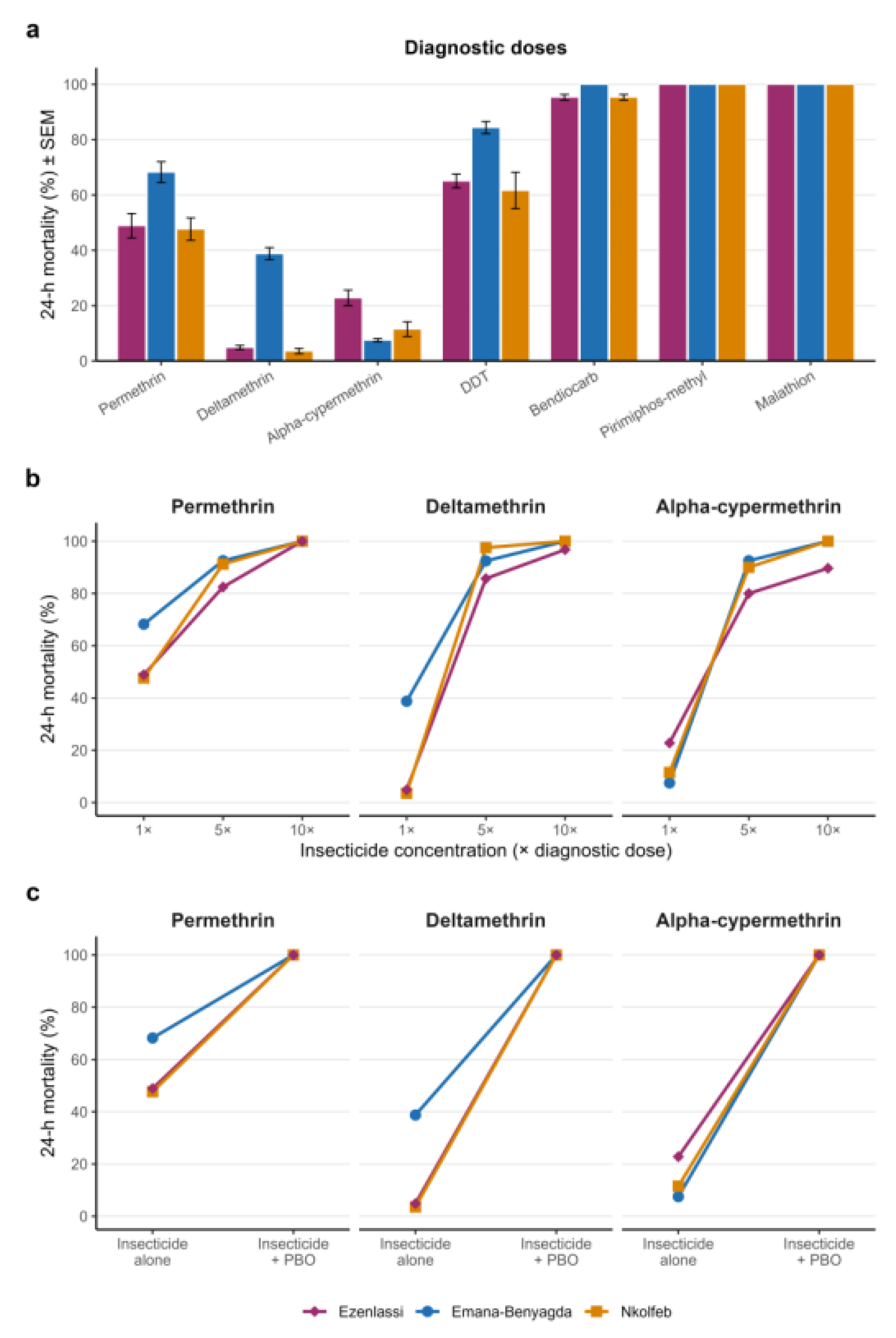
Figure 2.
Bioefficacy of different long lasting insecticidal nets against Anopheles funestus populations surveyed. (a) Mortality by net and field population; (b) Mean mortality heatmap.
Figure 2.
Bioefficacy of different long lasting insecticidal nets against Anopheles funestus populations surveyed. (a) Mortality by net and field population; (b) Mean mortality heatmap.
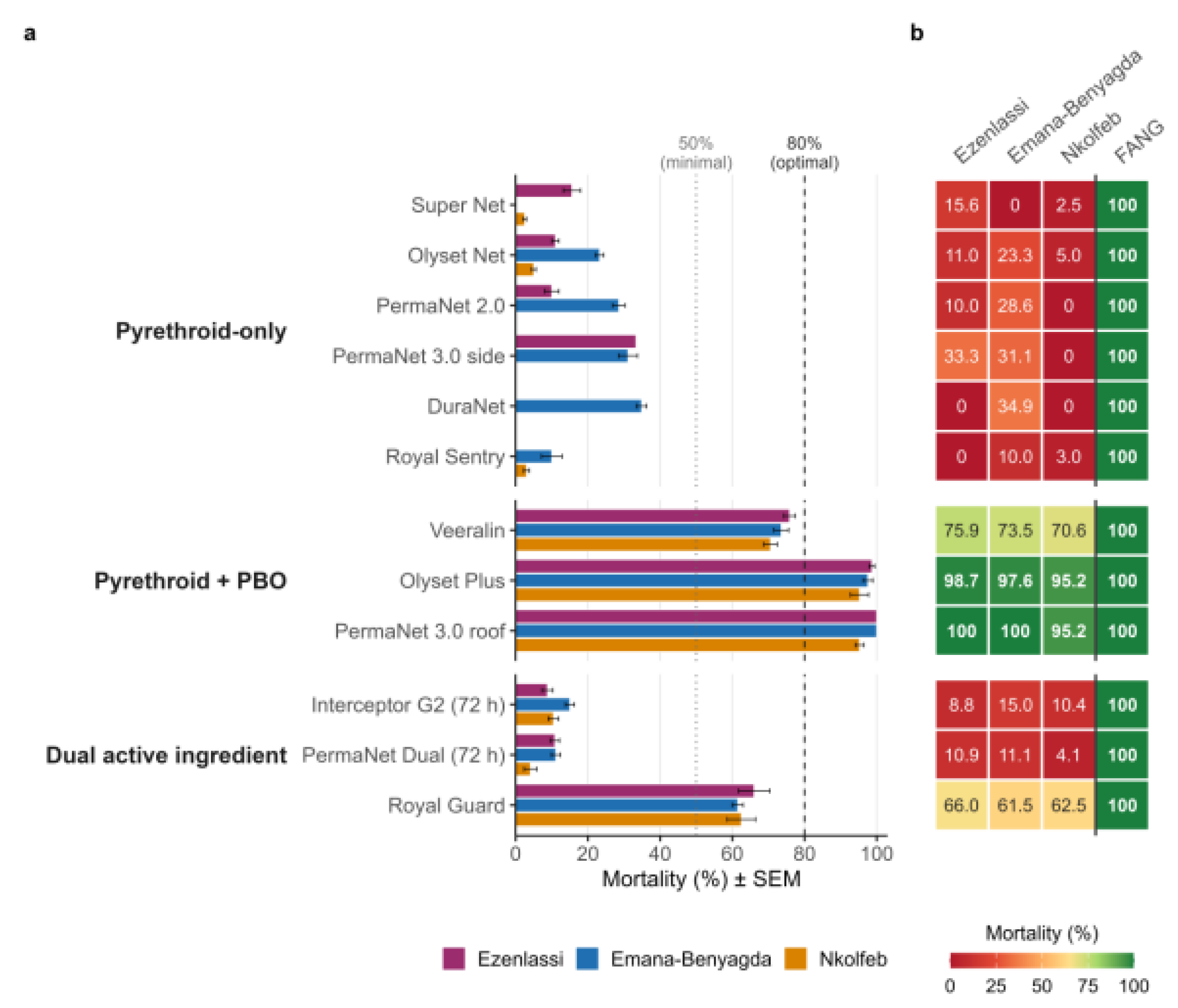
Figure 3.
Genotype and allele frequencies of the L119F-GSTe2 and G454A-CYP9K1 metabolic resistance markers in Anopheles funestus populations. (a) Genotype frequencies (%) determined by allele-specific PCR. P-values are from the exact test for Hardy-Weinberg equilibrium; (b) Frequencies of the resistant (R) and susceptible (S) alleles. P-values compare R allele frequencies across study sites (Pearson’s χ² test); n: number of mosquitoes genotyped.
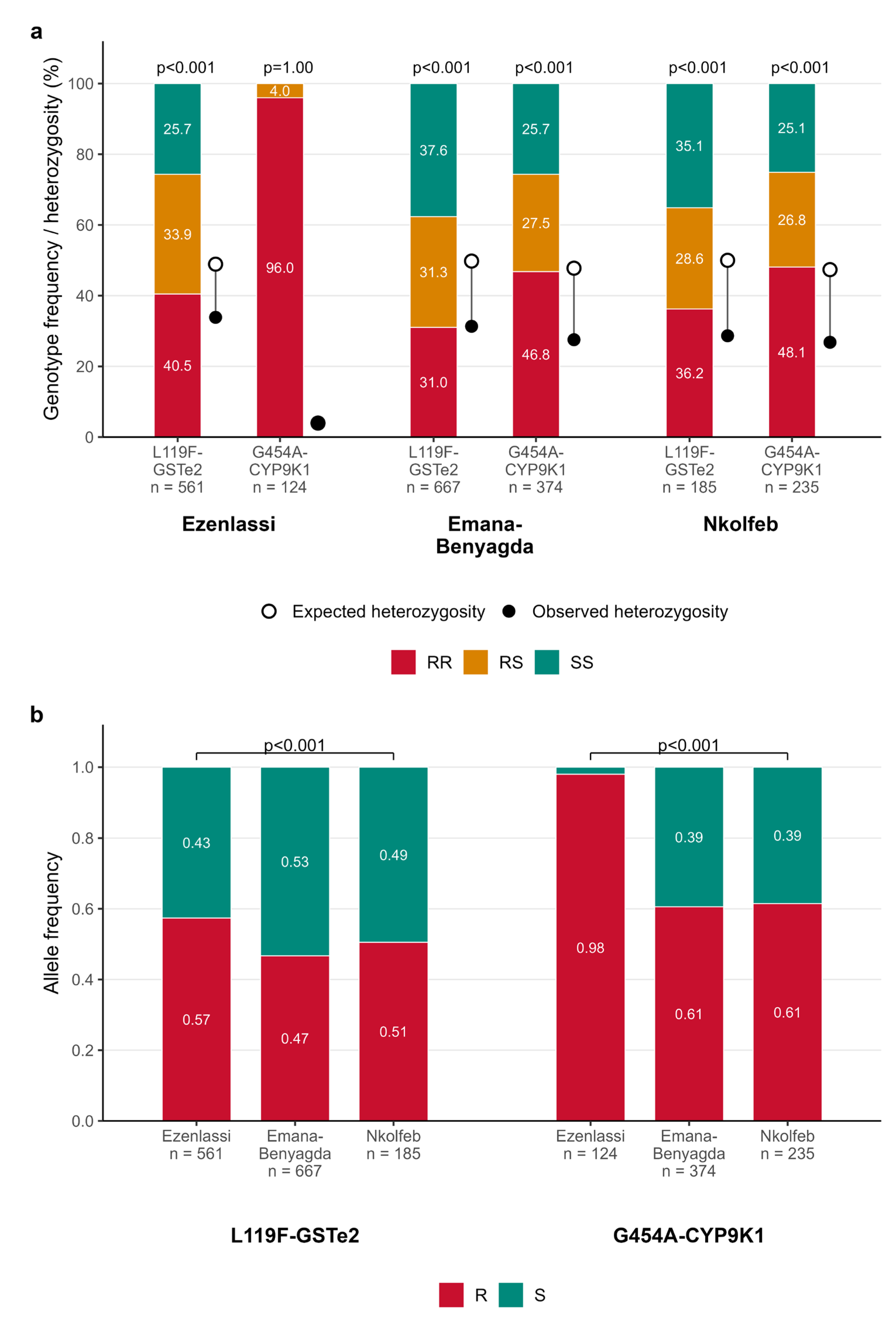
Figure 4.
Relative expression of the metabolic-associated genes GSTe2 and CYP9K1 in Anopheles funestus populations from three study sites. Bars show mean fold change ± standard deviation (SD) from three biological replicates (n=3), relative to the susceptible FANG reference strain. For comparison with FANG, bars labelled “a” indicate not statistically significant difference, whereas bars labelled “b” indicate a significant difference (Dunnett’s test, P < 0.05). P-value displayed above each gene indicate the overall difference in expression among unexposed, permethrin-exposed and Alpha-cypermethrin-exposed (One-way ANOVA).
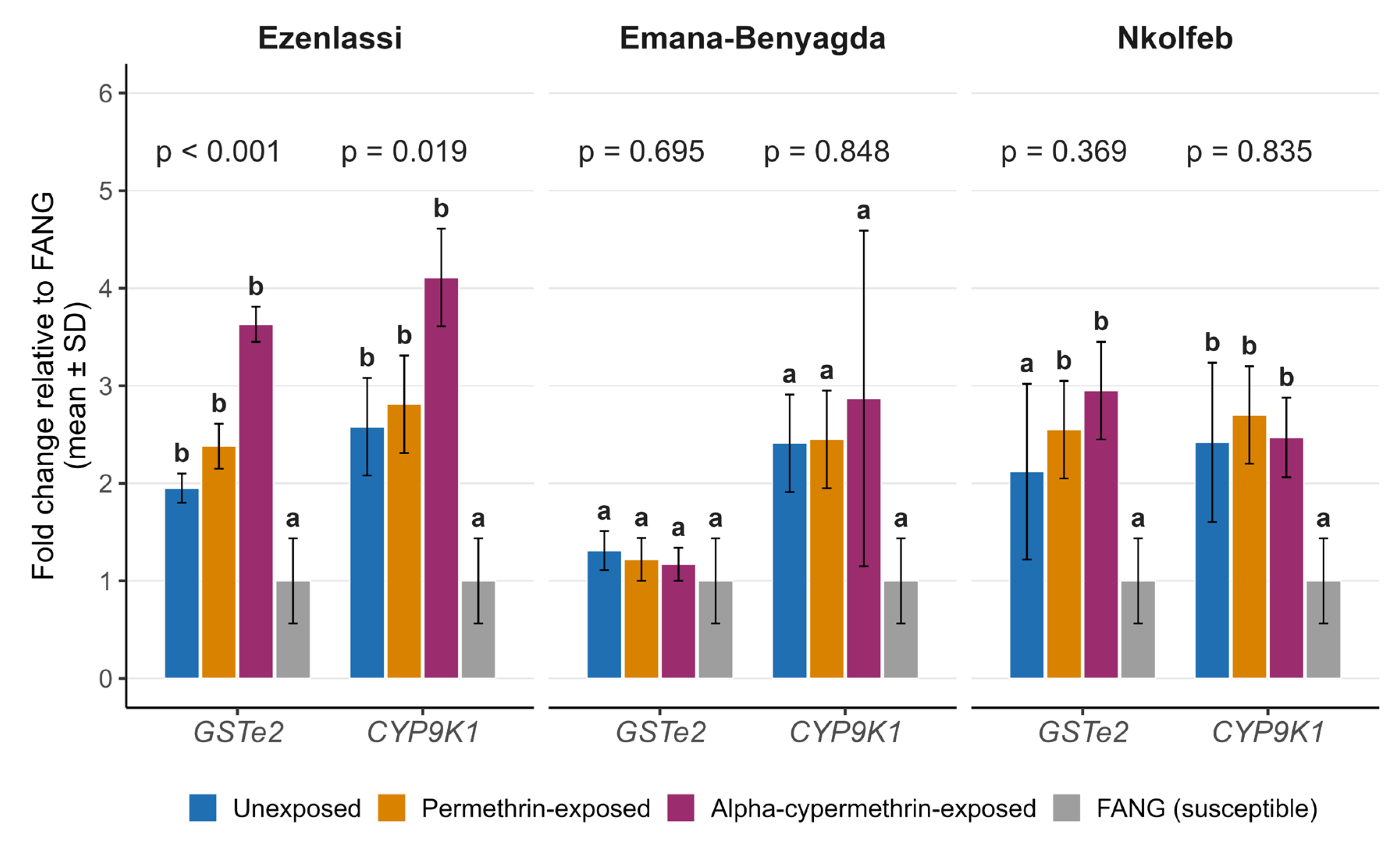
Figure 5.
Association of the metabolic resistance markers L119F-GSTe2 and G454A-CYP9K1 with Plasmodium infection in Anopheles funestus. (a) Oocyst infection; (b) sporozoite infection; (c) whole-mosquito (oocyst + sporozoite) infection. Points represent genotype-specific infection rates (%) with 95% confidence intervals calculated using the Wilson score method. Solid lines represent individual resistance markers, whereas dashed lines represent combined genotypes ranging from SS/SS to RR/RR. (d) Pooled odds ratios (ORs) of infection comparing homozygous resistant and susceptible mosquitoes (RR vs SS for individual markers and RR/RR vs SS/SS for combined genotypes), estimated using the Mantel-Haenszel method, with 95% confidence intervals. Open symbols and † denote significant heterogeneity in site-specific odds ratios (Breslow-Day test, p < 0.05), indicating that the corresponding pooled estimates should be interpreted with caution.
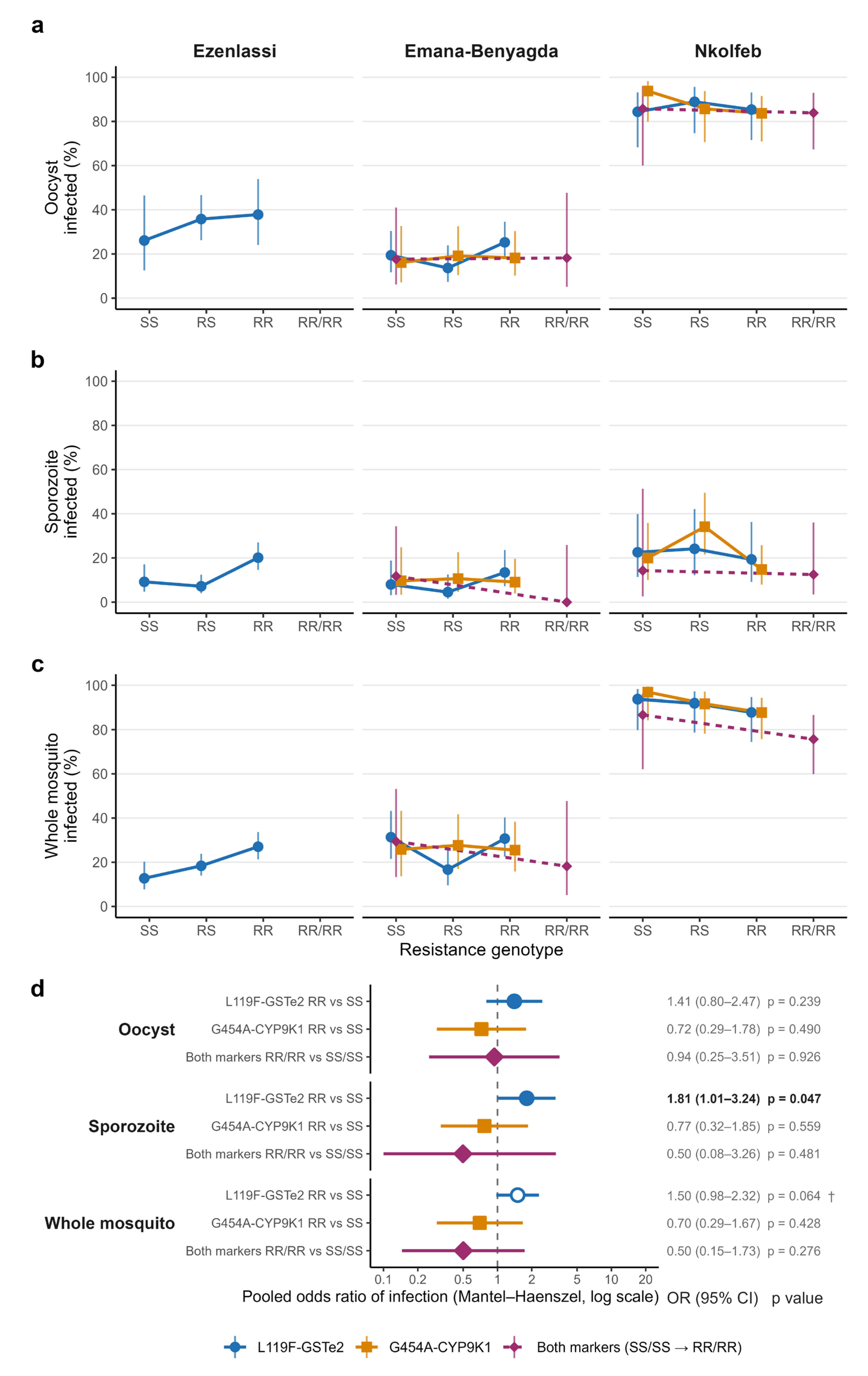
Figure 6.
Association betweenL119F-GSTe2 and G454A-CYP9K1 resistance markers and indoor versus outdoor biting behavior in Anopheles funestus. (a)Percentage of mosquitoes collected indoors for each resistance genotype, with 95% confidence intervals. (b) Distribution of resistance genotypes among mosquitoes collected indoors and outdoors at each study site. (c) Odds ratios (ORs) of indoor versus outdoor biting for homozygous resistant (RR) compared with homozygous susceptible (SS) mosquitoes, resistant-allele carriers (RR + RS) compared with SS mosquitoes, and combined resistance genotypes (RR/RR versus SS/SS). Points represent ORs, and horizontal lines indicate 95% confidence intervals. Site-specific and pooled estimates are shown, with pooled ORs calculated using the Mantel-Haenszel method.
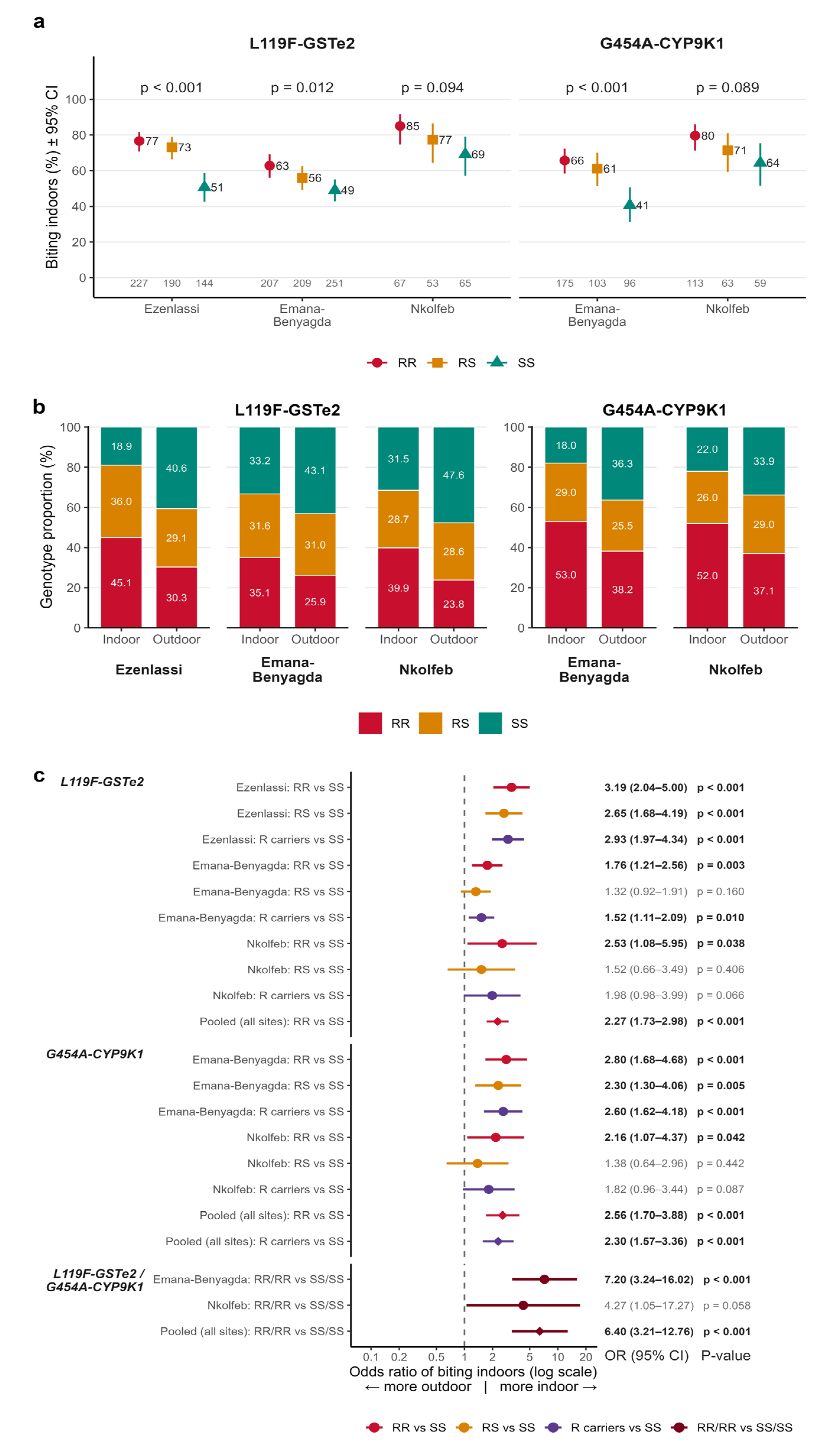
Figure 7.
Association ofL119F-GSTe2 and G454A-CYP9K1 resistance markers with parity status in Anopheles funestus. (a)Genotype-specific parity rates (%) across study sites, with 95% confidence intervals. (b) Odds ratios (ORs) of parity comparing homozygous resistant (RR) and heterozygous (RS) mosquitoes with homozygous susceptible (SS) mosquitoes, resistant-allele carriers (RR + RS) with SS mosquitoes, and combined resistant genotypes (RR/RR) with combined susceptible genotypes (SS/SS). Points represent ORs, and horizontal lines indicate 95% confidence intervals. Site-specific and pooled estimates are presented, with pooled ORs calculated using the Mantel-Haenszel method. The vertical dashed line indicates no association (OR = 1).
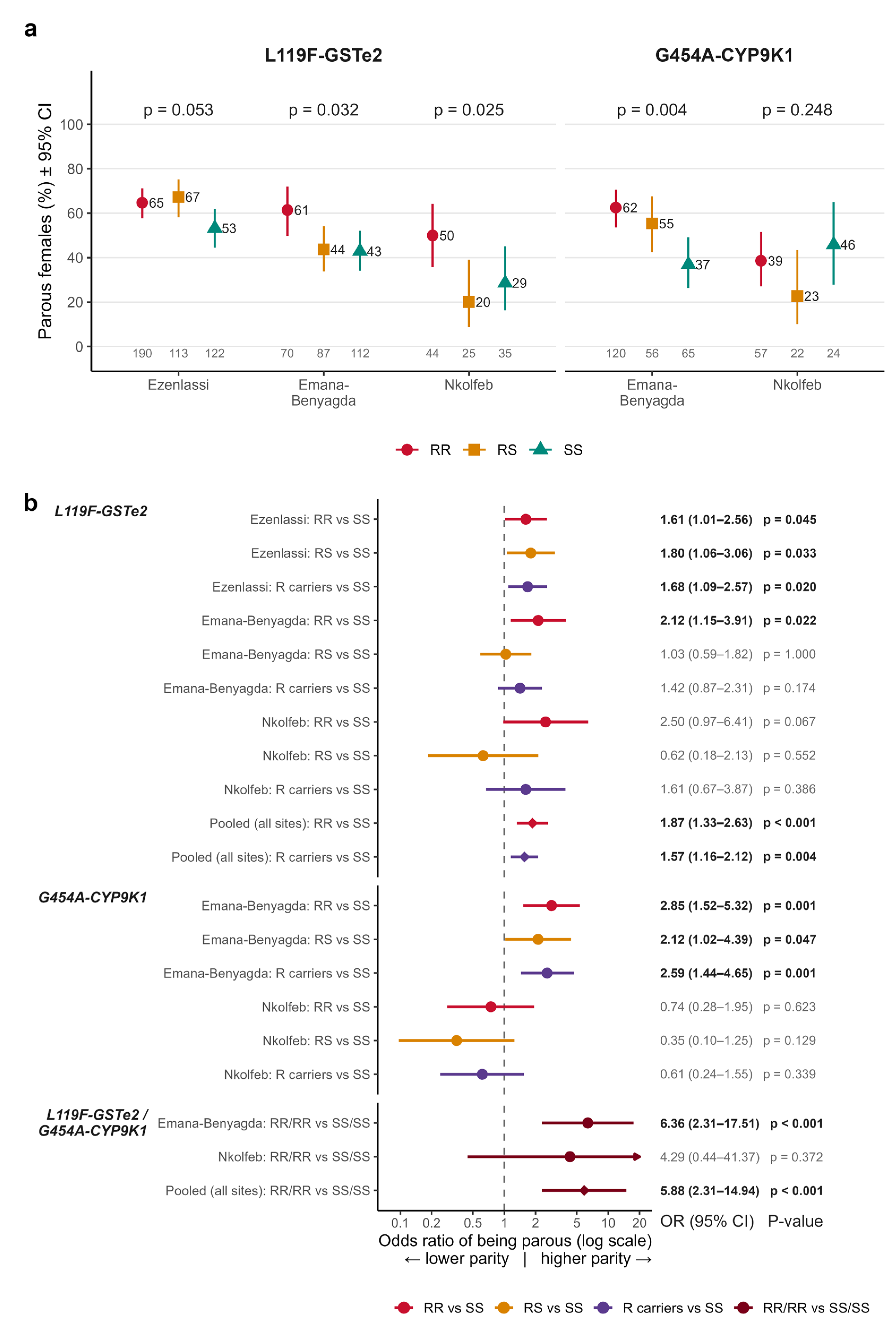
Figure 8.
Association of metabolic resistance genotypes with estimated vectorial capacity in Anopheles funestus, primarily driven by parity-derived survival rather than differences in oocyst infection. (a) Modelled survival curves of homozygous susceptible (SS, green) and homozygous resistant (RR, red) An. funestus mosquitoes carrying the L119F-GSTe2 or G454A-CYP9K1 resistance markers at each study site. Daily survival probabilities were estimated from genotype-specific parity rates, assuming a three-day gonotrophic cycle. The vertical dashed line indicates the assumed 11-day extrinsic incubation period (EIP) of P. falciparum. The shaded area beyond the EIP represents the expected post-incubation infective lifespan, with annotations indicating the RR/SS ratio. (b) Decomposition of the estimated RR/SS vectorial capacity ratio into the contributions of oocyst infection rate (used as a proxy for vector competence) and expected infective lifespan. Estimates were pooled across study sites. Points represent pooled ratios, and horizontal lines indicate 95% confidence intervals obtained by parametric bootstrap (10,000 resamples). The vertical dashed line indicates no difference between resistant and susceptible mosquitoes (RR/SS = 1). *p < 0.05; ****p < 0.001.
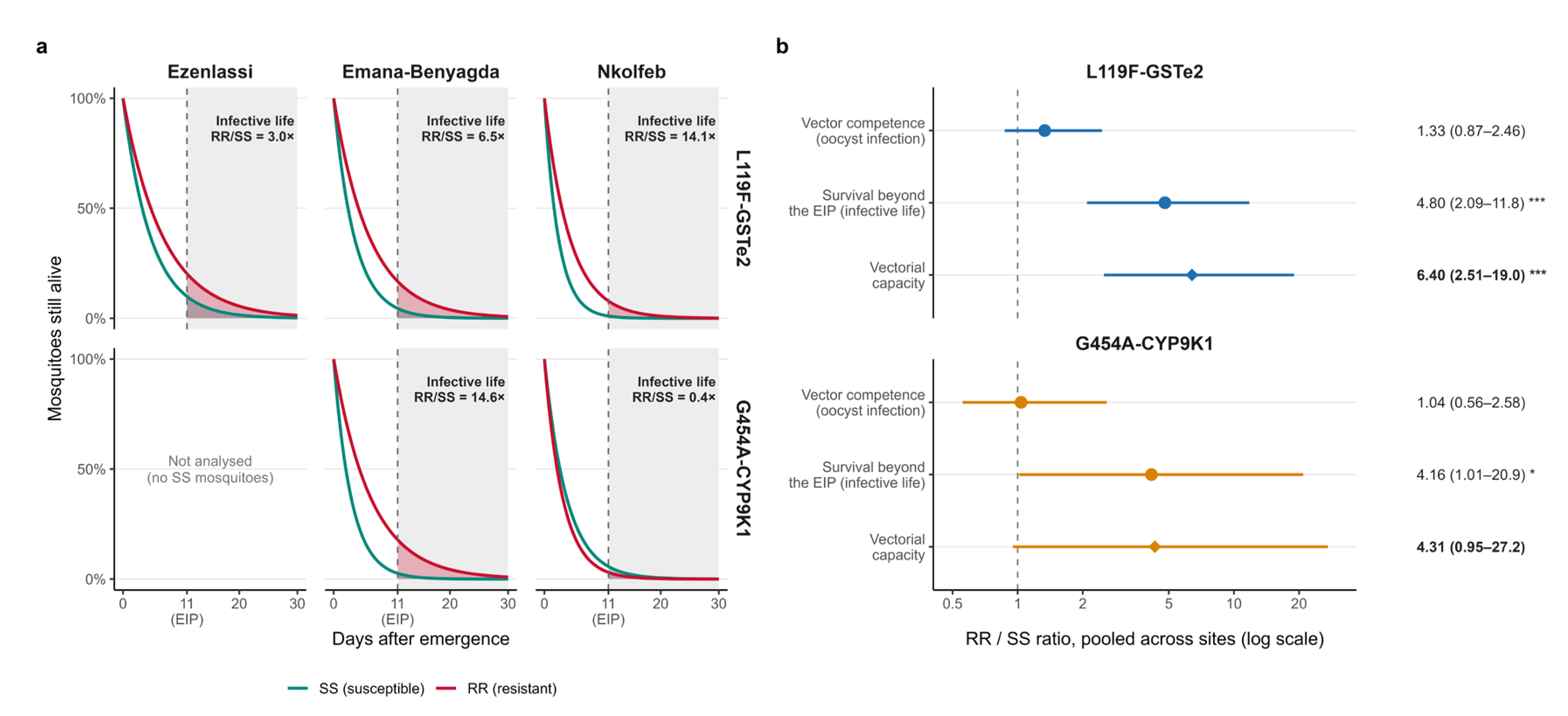

Table 1.
Transmission indices of Anopheles funestus across study sites.
| Site |
Biting place |
N | Human nights | HBR (b/p/n) | p | Analyzed (TaqMan) | n | SR (%) | p | EIR (ib/p/n) | p |
| Ezenlassi | Indoor | 507 | 10 | 50.70 | <0.001 | 305 | 36 | 11.80 | 0.29 | 5.98 | 0.87 |
| Outdoor | 393 | 10 | 39.30 | 94 | 15 | 15.96 | 6.27 | ||||
| Emana-Benyagda | Indoor | 827 | 30 | 27.57 | <0.001 | 91 | 7 | 7.69 | 0.62 | 2.12 | 0.77 |
| Outdoor | 564 | 30 | 18.80 | 92 | 9 | 9.78 | 1.84 | ||||
| Nkolfeb | Indoor | 246 | 16 | 15.38 | <0.001 | 124 | 20 | 16.13 | 0.02 | 2.48 | 0.63 |
| Outdoor | 94 | 16 | 5.88 | 28 | 10 | 35.71 | 2.10 |
N: number of mosquitoes collected by human landing catch; HBR: human biting rate (N/human nights); b/p/n: bites/person/night; n: number of sporozoite-positive mosquitoes (TaqMan assay); SR: sporozoite rate (n/number analyzed); EIR: entomological inoculation rate (HBR × SR); ib/p/n: infective bites/person/night; P-values refer to indoor versus outdoor comparisons within each study site: HBRs were compared using an exact Poisson test of the rate ratio, sporozoite rates using Pearson’s χ² test, and EIRs using a Wald test of the log-transformed indoor-to-outdoor EIR ratio, with variance estimated by the delta method.
Disclaimer/Publisher’s Note: The statements, opinions and data contained in all publications are solely those of the individual author(s) and contributor(s) and not of MDPI and/or the editor(s). MDPI and/or the editor(s) disclaim responsibility for any injury to people or property resulting from any ideas, methods, instructions or products referred to in the content. |
© 2026 by the authors. Licensee MDPI, Basel, Switzerland. This article is an open access article distributed under the terms and conditions of the Creative Commons Attribution (CC BY) license (http://creativecommons.org/licenses/by/4.0/).
Copyright: This open access article is published under a Creative Commons CC BY 4.0 license, which permit the free download, distribution, and reuse, provided that the author and preprint are cited in any reuse.