
Submitted:
26 November 2026
Posted:
27 November 2026
You are already at the latest version
Abstract
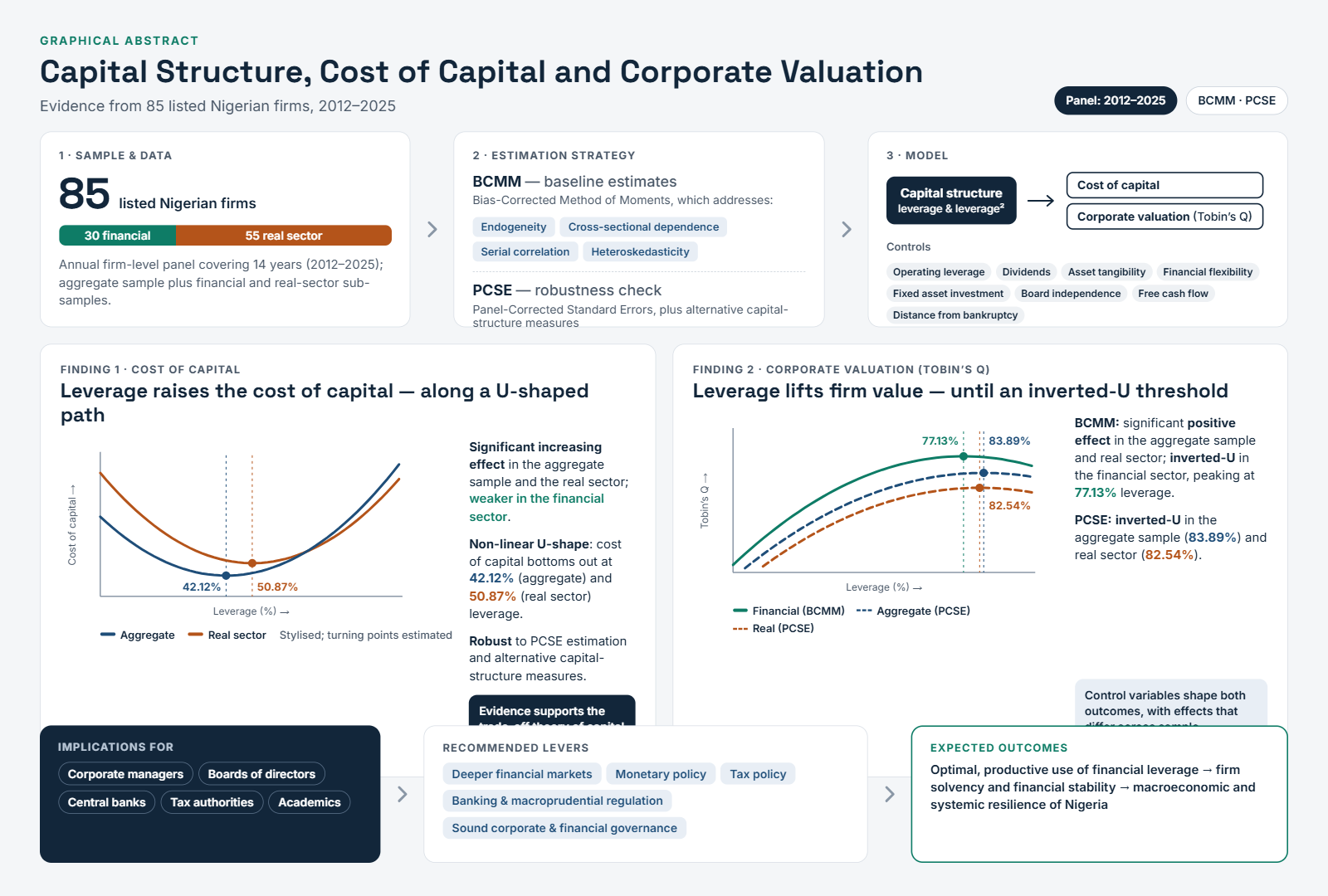
Capital structure remains a strategic financial management decision of firms with profound implications for firms’ long-term financial stability, competitiveness, and chances of corporate survival. Therefore, this study examines how capital structure has influenced the cost of capital and corporate valuation of 85 listed Nigerian firms, comprising 30 financial sector firms and 55 real sector. The study period covered 2012-2025. The Biased-Corrected Method of Moments (BCMM) estimator, which addresses endogeneity, cross-sectional dependence, serial correlation, and heteroskedasticity, was used to generate the baseline parameter estimates. Additionally, the Panel-Corrected Standard Error (PCSE) estimator was used as an alternative to assess the robustness and sensitivity of the baseline estimates. The empirical results reveal that capital structure has a significant increasing effect on the cost of capital in the aggregate sample and the real sector sub-sample, whereas this effect is weaker in the financial sector sub-sample. Furthermore, the empirical results indicate that capital structure has a significant non-linear, U-shaped relationship with the cost of capital in the aggregate sample and the real sector sub-sample, with turning points of 42.12% and 50.87%, respectively. The results provide empirical evidence supporting the trade-off theory. These findings are robust and less sensitive to alternative estimation techniques and capital structure measurement choices. Conversely, using BCMM estimates, capital structure has a significant positive effect on corporate valuation in the aggregate sample and in the real sector sub-sample, and a significant non-linear inverted U-shaped relationship with corporate valuation, proxied by Tobin’s Q, in the financial sector, with a 77.13% inflection point. However, the PCSE estimates confirm a significant non-linear inverted U-shaped relationship with corporate valuation in the aggregate sample and the real sector sub-sample, with thresholds of 83.89% and 82.54%, respectively. The explanatory control variables, such as operating leverage, dividends, asset tangibility, financial flexibility, fixed asset investments, board independence, free cash flow, and distance from bankruptcy, impact the cost of capital and corporate valuation, with varying effects across sample compositions. The study has implications for corporate managers, boards of directors, central banks, tax authorities, and academics. The study recommends deeper financial markets, monetary policy, tax, banking, and macroprudential regulations, and sound corporate and financial governance to ensure productive and optimal deployment of financial leverage, sustainable financial stability and solvency of Nigerian firms, and macroeconomic and systemic stability and resilience of the Nigerian state.
Keywords:
capital structure
; cost of capital
; corporate valuation
; WACC
; Tobin’s Q
; Nigeria
Copyright: This open access article is published under a Creative Commons CC BY 4.0 license, which permit the free download, distribution, and reuse, provided that the author and preprint are cited in any reuse.