
Submitted:
25 November 2026
Posted:
26 November 2026
You are already at the latest version
Abstract
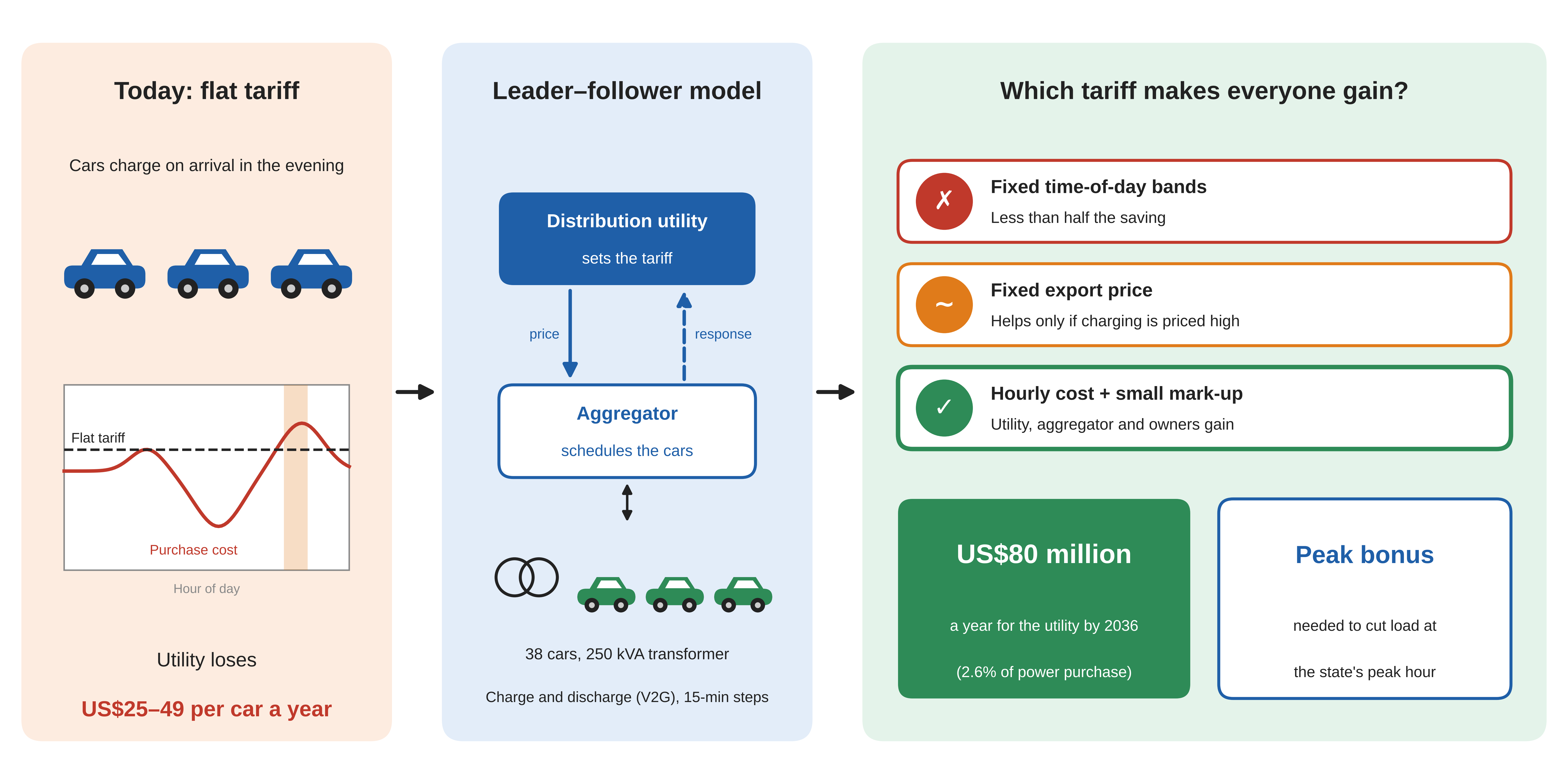
Electric cars already make up 10% of new car registrations in the area of the Bangalore Electricity Supply Company (BESCOM), India, and vehicle-to-grid (V2G) technology could let them return power to the grid at costly hours. Because BESCOM is a regulated, loss-making single buyer, the tariff decides whether V2G helps or hurts its other consumers. This study builds a leader-follower (Stackelberg) model in which BESCOM sets the tariff and an aggregator schedules 38 cars on a 250 kVA distribution transformer by linear programming, in 15-minute steps over three seasonal days. Inputs are measured transformer load, hourly purchase prices, tariffs notified in 2025, Kerala's V2G export rule, 950 days of hourly load at 81 substations and BESCOM's audited accounts. Today's flat tariffs make unmanaged evening charging a loss for BESCOM of US\(25-49 per car a year. Fixed time-of-day bands capture less than half of the available saving, and a fixed export price helps only when charging is priced high enough. A tariff linked to the hourly purchase cost, with a mark-up of up to 2.6 US cents per kWh, leaves BESCOM, the aggregator and owners all better off and is worth about US\)80 million a year by 2036. Energy prices alone do not reduce load at the state's peak hour; a small availability payment does.
Keywords:
vehicle-to-grid
; electricity tariff design
; distribution company
; aggregator
; Stackelberg game
; bilevel optimisation
; electric vehicles
; India
Copyright: This open access article is published under a Creative Commons CC BY 4.0 license, which permit the free download, distribution, and reuse, provided that the author and preprint are cited in any reuse.