
Submitted:
25 November 2026
Posted:
26 November 2026
You are already at the latest version
Abstract
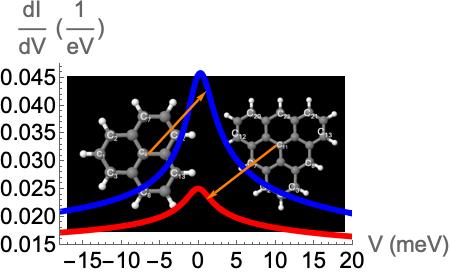
The Kondo resonance in the two smallest triangulenes C13H9 and C22H12 adsorbed on Au(111) is investigated using an effective ionic Hamiltonian and a Green’s-function formalism. We extend our work for U→∞ to a finite value of U determined by the difference between the HOMO and LUMO states. The molecular electronic structure enters through Dyson orbitals formulated in second quantization and evaluated from Hartree–Fock many-electron states. These orbitals describe electron-addition and electron-removal amplitudes between adjacent molecular charge sectors and determine the hybridization amplitudes coupling the molecule to the metallic substrate. The resulting advanced Green’s functions are calculated using an equation-of-motion method expanded up to fourth order that accounts for the molecule–metal correlations responsible for the Kondo resonance. The framework is applied to the distinct spin-(1/2) and spin-1 ground states of C13H9 and C22H12, to examine how their molecular transition amplitudes influence the spectral response and to provide a meaningful comparison with experimentally measured Kondo lineshapes. Contribution of LUMO and HOMO levels to the Kondo resonance results in an improved agreement between the measured and calculated lineshapes and allows an accurate estimate of relevant physical parameters, providing insight into the physics governing the resonance.
Keywords:
C13H9 (2T)
; C22H12 (3T)
; triangulene
; Kondo resonance
; many-body
; multi-orbital
; second quantization Dyson orbitals
; Green’s functions
Copyright: This open access article is published under a Creative Commons CC BY 4.0 license, which permit the free download, distribution, and reuse, provided that the author and preprint are cited in any reuse.