
Submitted:
24 November 2026
Posted:
25 November 2026
You are already at the latest version
Abstract
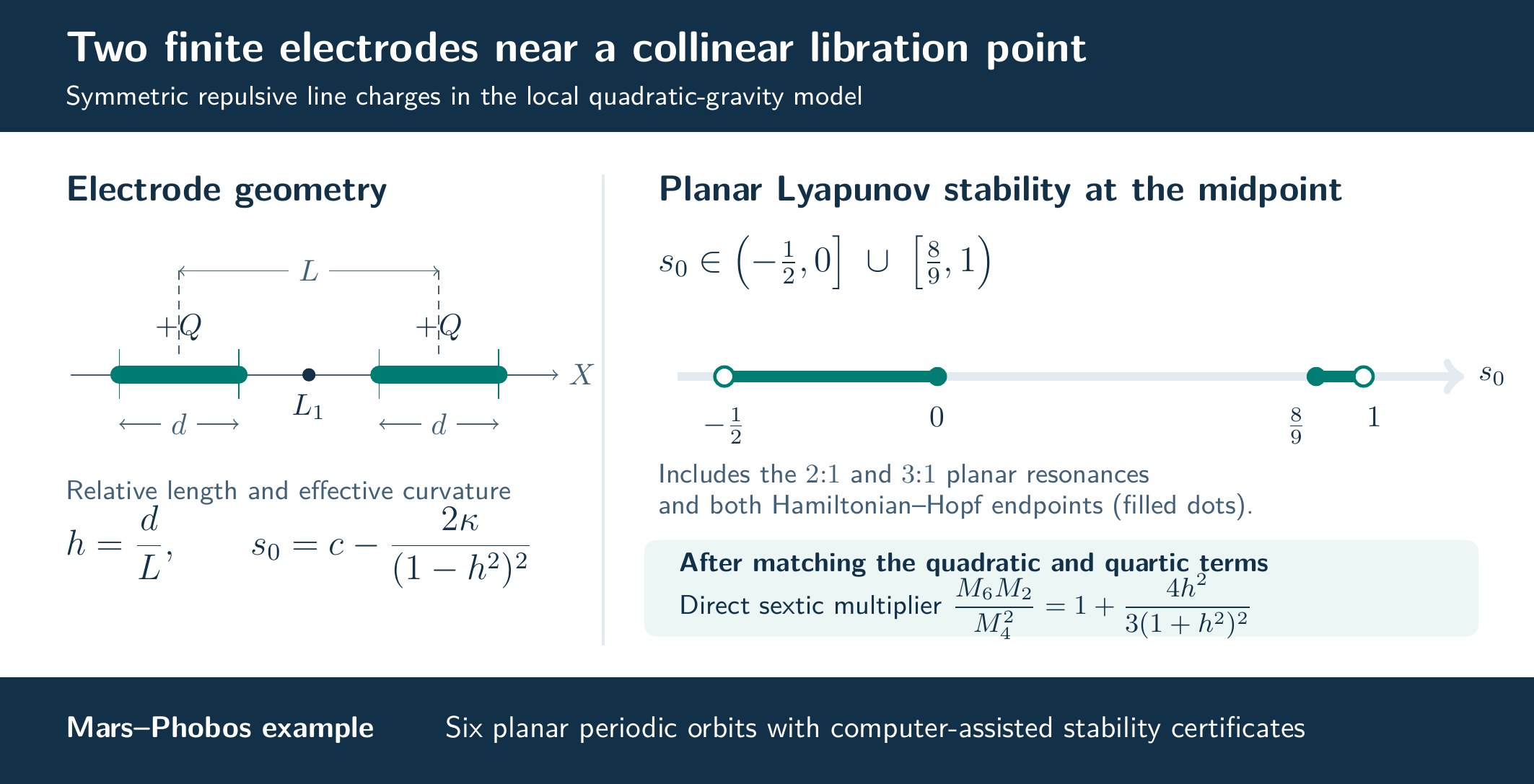
We study a charged test particle near a collinear libration point in the presence of two identical finite rectilinear electrodes. The electrodes are modelled as prescribed uniform line charges and the gravitational field is approximated to quadratic order. The full electrostatic potential is retained. We classify the equilibria, derive their bifurcation thresholds and describe the opening of Hill passages through critical Jacobi levels. An exact source-moment identity gives the planar Lyapunov-stability set $-\tfrac12<s_0\leq0$ or \( \tfrac89\leq s_0<1 \), where \( s_0 \) is the effective curvature parameter. This classification includes the \( 2{:}1 \) and \( 3{:}1 \) resonances and the two Hamiltonian--Hopf endpoints. At matched quadratic and quartic orders, the direct sextic coefficient scale changes by a factor that depends explicitly on electrode length. For a Mars--Phobos example, we compute resonant periodic expansions and continue elliptic and hyperbolic mixed-mode branches on nine common Jacobi levels. Interval enclosures establish nonlinear orbital stability of six primary planar orbits. Finite manifold samples locate two regions for a subsequent search for reversible heteroclinic intersections. The analysis quantifies the effect of electrode length on local stability and the geometry of energetically accessible transport.
Keywords:
restricted three-body problem
; electrostatic interaction
; Hill regions
; Lyapunov stability
; resonant normal forms
; periodic orbits
; invariant manifolds
Copyright: This open access article is published under a Creative Commons CC BY 4.0 license, which permit the free download, distribution, and reuse, provided that the author and preprint are cited in any reuse.