
Submitted:
24 November 2026
Posted:
25 November 2026
You are already at the latest version
Preprints on COVID-19 and SARS-CoV-2
Abstract
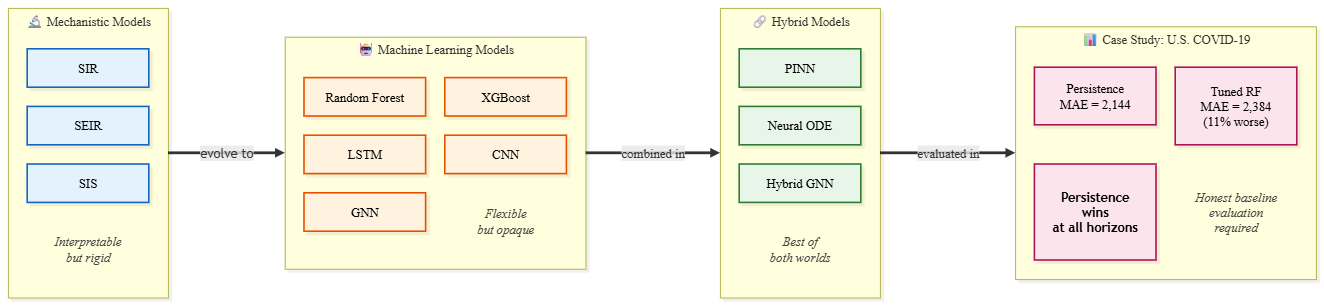
Although the parameters are interpretable, mechanistic compartmental models (SIR, SEIR, SIS) are not realistic for complex, rapidly changing epidemics because they assume homogeneous mixing and constant parameters. Machine learning (ML) can learn nonlinear dynamics and can assimilate heterogeneous mobility, environmental, clinical and socioeconomic data. This narrative overview focuses on the use of ML to develop compartment, stochastic, network-based and agent-based models, as well as spatiotemporal forecasting, mobility-driven transmission, risk mapping of epidemics, planning for healthcare resources, and simulation of policies, with a particular focus on hybrid mechanistic–data-driven models that maintain the interpretability of epidemiology. The difficulties of purely data-driven approaches are illustrated using a supplemental case study of the performance of persistence, linear autoregression, and random forests for 7-day-smoothed daily COVID-19 cases in the United States over a 228-day test period. All models achieve an R² ≈ 0.98 for a 1-day forecast horizon when hyperparameter tuning is done independently for each horizon. At each horizon, however, none did as well as the persistence baseline. The best-tuned random forest had an MAE of 2,384 at 1 day, while persistence had an MAE of 2,144 (11% worse); at 14 days, the random forest was 35% worse. All six comparisons supported persistence in favor of Diebold–Mariano intervals and block-bootstrap intervals. This illustrative example shows that informative covariates, hybrid structures and careful evaluation are necessary in order to outperform simple baselines for generic learners. Other subjects covered are uncertainty quantification, interpretability, data bias, privacy, and governance. We think the best route to real-time public health decision support is hybrid systems that report uncertainty, are open, and are subject to simple baselines.
Keywords:
epidemic forecasting
; mechanistic–data-driven hybrid models
; machine learning
; compartmental models
; uncertainty quantification
; COVID-19
Copyright: This open access article is published under a Creative Commons CC BY 4.0 license, which permit the free download, distribution, and reuse, provided that the author and preprint are cited in any reuse.