

Submitted:
24 November 2026
Posted:
25 November 2026
You are already at the latest version
Abstract
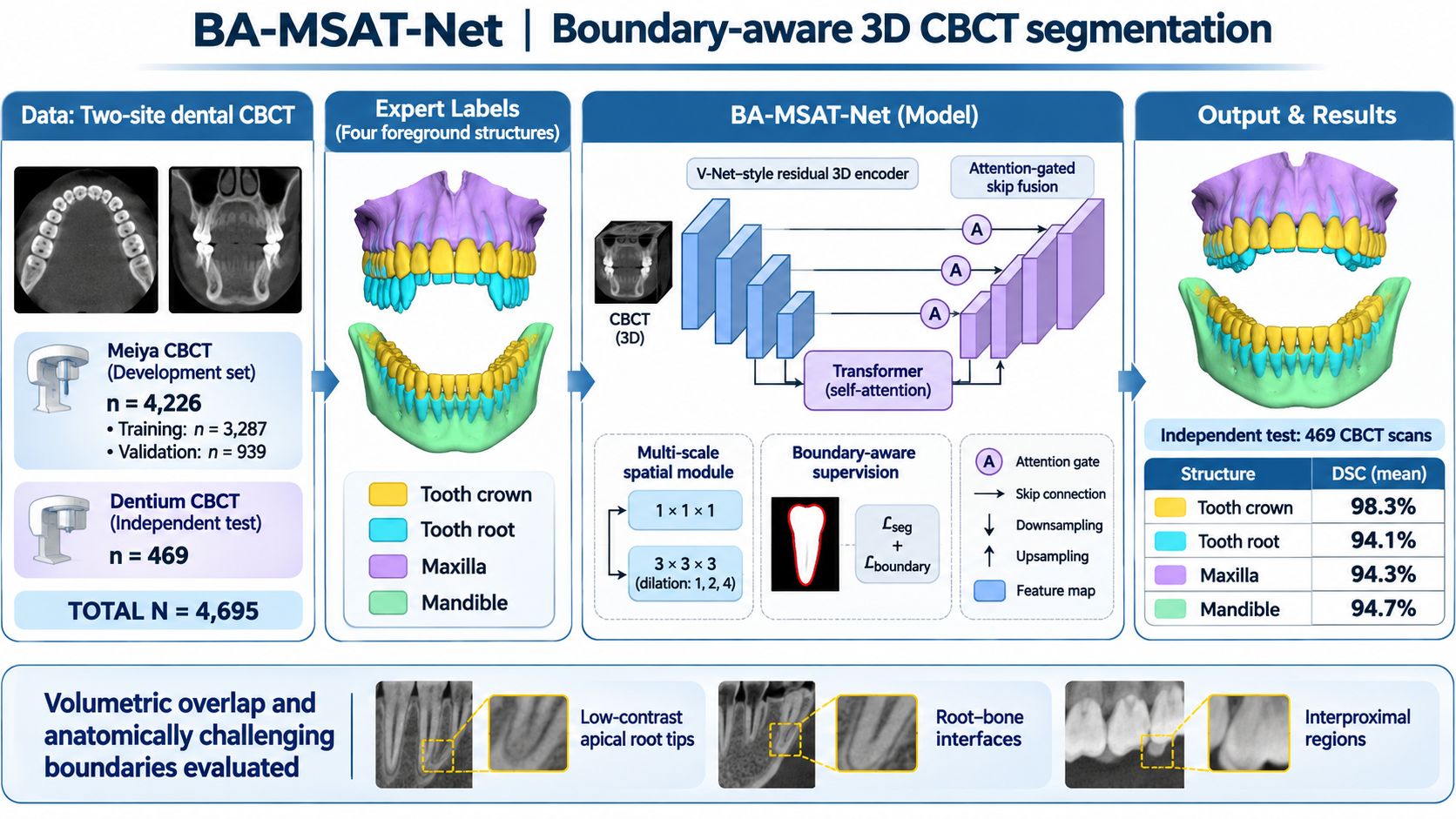
Accurate three-dimensional (3D) segmentation of tooth crowns, tooth roots, maxilla and mandible in cone-beam computed tomography (CBCT) remains challenging because of low-contrast anatomical boundaries and complex spatial relationships. We developed BA-MSAT-Net, a boundary-aware 3D convolution, multi-scale contextual feature extraction, bottleneck Transformer-based self-attention, attention-gated skip connections, and boundary supervision. Specifically, residual volumetric encoding and multi-scale spatial modeling were used to extract local anatomical details and heterogeneous contextual information. The dataset comprised 4,695 CBCT scans from two clinical centers, including 3,287 training scans, 939 validation scans, and 469 independent test scans from a second center. We compared BA-MSAT-Net with other models and evaluated anatomical subregions, simulated image degradation, model efficiency, and architectural ablations. BA-MSAT-Net generally achieved higher segmentation performance. This framework supports multi-structure CBCT analysis, independent validation and has potential clinical applications.
Keywords:
imaging
; software and workflows
; machine learning
Copyright: This open access article is published under a Creative Commons CC BY 4.0 license, which permit the free download, distribution, and reuse, provided that the author and preprint are cited in any reuse.