
Submitted:
24 November 2026
Posted:
25 November 2026
You are already at the latest version
Abstract
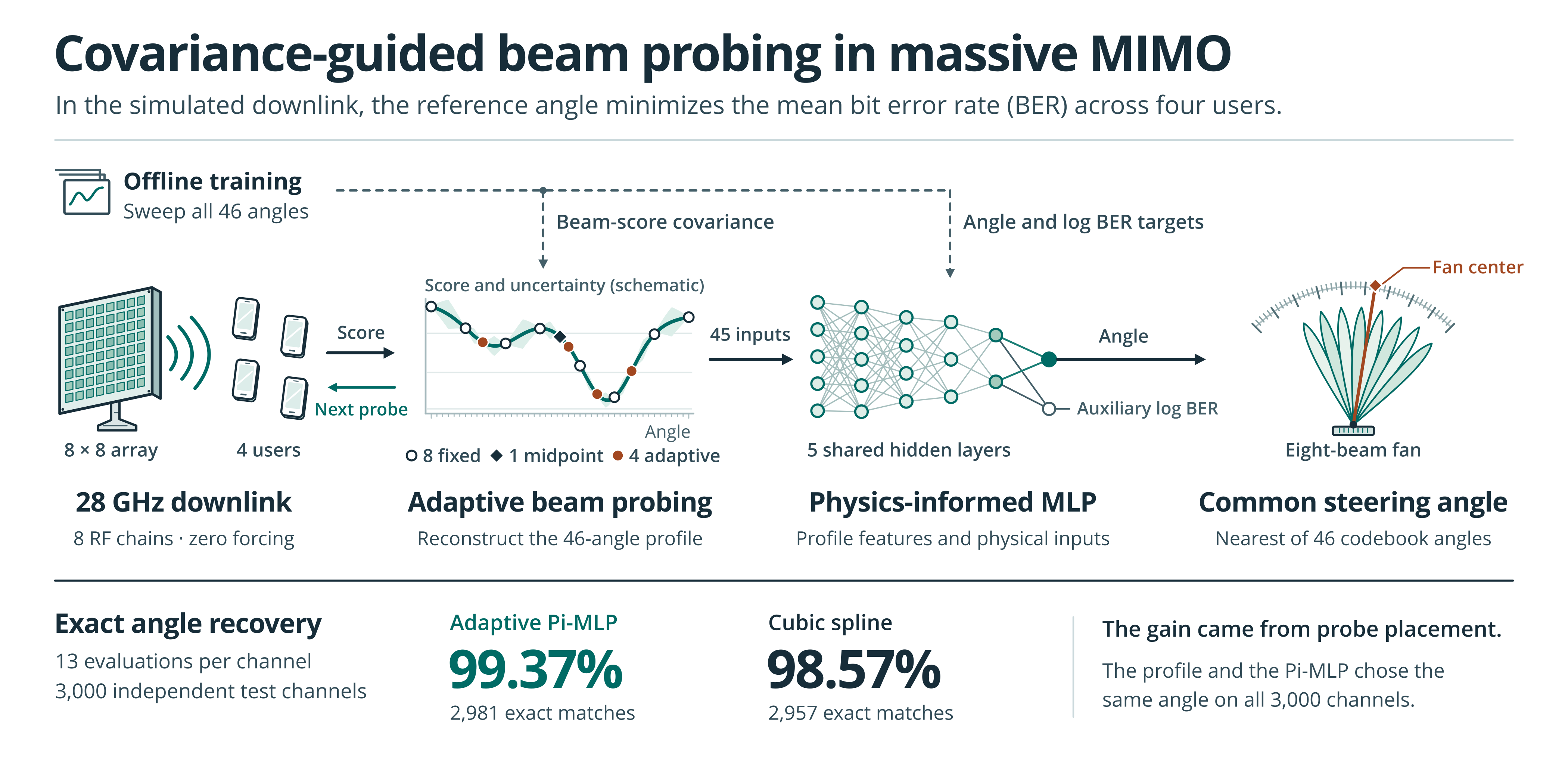
Beam management in millimeter-wave massive multiple-input multiple-output systems selects a steering angle from a finite codebook. The benefit of a learned predictor is unclear unless a control receives the same beam measurements. The aim is to determine how often the angle that minimizes the mean user bit error rate (BER) is recovered from few beam evaluations. An adaptive physics-informed multilayer perceptron (Pi-MLP) is proposed as a covariance-guided probing procedure with a fixed budget of beam evaluations. A covariance of beam scores that is learned from training channels guides the additional probes and the reconstructed profile is supplied to a five-layer network with angle and BER outputs. The evaluation uses a simulated 28 GHz downlink with 64 antennas, four users, 46 candidate angles and zero-forcing precoding. With 13 evaluations, the reference angle is recovered on 2,981 of 3,000 test channels, against 2,957 for a cubic spline with the same evaluations at every step. With 18 evaluations, both recover 2,996. Across six channel shifts, 3,576 of 3,600 angles are recovered with 13 evaluations, against 3,544 for the spline. Eight methods that use channel features alone recover at most 103 of 1,000 angles. The profile estimate and the complete network select identical angles, so the gain is attributed to the placement of the probes. The selected angle matters under the stated precoder, because zero forcing with minimum radiated power makes 45 of the 46 candidate angles equivalent. A small adaptive probing budget is therefore sufficient for near-exhaustive angle selection under this precoder.
Keywords:
massive MIMO
; hybrid beamforming
; beam management
; codebook beam selection
; adaptive beam probing
; confidence-bound acquisition
; physics-informed learning
; bit error rate
; spectral efficiency
; millimeter-wave communications
Copyright: This open access article is published under a Creative Commons CC BY 4.0 license, which permit the free download, distribution, and reuse, provided that the author and preprint are cited in any reuse.