

Submitted:
22 November 2026
Posted:
25 November 2026
You are already at the latest version
Abstract
Recalibration that helps retrospectively can fail once deployed. We introduce the reliability horizon, a deployment protocol that requires a calibration gain to survive three checks: a balanced audit across lead times, utility guardrails, and independent temporal validation. On 1,481 resolved Polymarket markets, including 633 observed at every horizon, calibration shows no detected degradation from one day to six months. Metaculus shows the same pattern. Kalshi degrades sharply with horizon, and the protocol returns RECALIBRATE, with the gain persisting on later events. For nine language-model forecasters, small retrospective ensemble gains fail multiplicity correction and are not confirmed on 111 later events or 312 frozen prospective outcomes. The protocol blocks deployment. Smoother Platt and beta maps reduce log-score penalties but do not change this decision. Synthetic controls detect injected defects in 91.7% of runs at the prospective sample size, and power analysis quantifies the effects that remain unresolved. The protocol recalibrates persistent defects that pass temporal and utility checks and leaves forecasts alone when those checks do not establish a benefit.
Keywords:
forecast recalibration
; probabilistic forecasting
; temporal validation
; prediction markets
; large language models
1. Introduction
A recalibration map that improves calibration on historical data is not, by itself, a reason to deploy it. Calibration varies with domain and lead time [1], dynamic benchmarks require timestamp-valid evaluation [3,13,32], and a map that improves calibration can still worsen a proper score or fail under temporal shift [11,16]. Practitioners need a rule that answers a deployment question, not only an estimation question.
We separate three claims that are often merged:
- Trend: does calibration change with lead time?
- Equivalence: is any change practically negligible?
- Benefit: does a fitted correction improve forecasts on future events without harming utility?
These claims require different evidence. Markets visible six months before resolution are a selected subset of those visible one day before resolution. Holding event identity fixed controls that composition change; it does not automatically make horizon differences negligible or justify a correction. Deployment additionally requires an out-of-sample gain that persists through time. Recent time-gated financial evaluation [5] and replayable forecasting environments [9] strengthen the case for testing that last step explicitly.
-
Contributions.
- A deployment protocol. Cross-fitted screening, Holm-controlled multiplicity, log-score and decision-loss guardrails, and independent temporal validation produce explicit recalibrate, skip, or reject decisions.
- A balanced-panel audit. The same 633 markets are compared at five horizons, removing changing market composition from the within-panel comparison.
- Validation in both directions. Kalshi and a synthetic distortion demonstrate detection of persistent miscalibration. Language-model ensembles show why positive retrospective intervals are insufficient grounds for deployment.
- A frozen prospective registry. Predictions for 390 markets are locked before resolution, with maturity checks and bounds for pending outcomes.
1.1. Related Work
- Calibration of crowds and models. Prediction-market calibration varies by domain and horizon [1]. ForecastBench, leakage-focused evaluation, and live prediction-market benchmarks make temporal validity central to language-model forecasting [3,13,32]. FutureX and Foresight Arena extend live evaluation [40,53], while Forecast-Dojo reconstructs dated evidence trajectories for replay [9]. WorldReasoner evaluates reasoning validity [25]; a martingale audit instead examines coherence along the probability path [35]. These address complementary questions to whether a fitted correction earns deployment.
- Recalibration methods. Isotonic, Platt, and beta calibration fit corrections to probability estimates [7,48]. Calibration-error estimators address the uncertainty in measuring those estimates [21,38]. We compare correctors on the same cross-fitted ensemble forecasts and evaluate both reliability and scoring utility. The 2026 Beta-Bernoulli Calibrator learns from outcomes and human forecasts to represent uncertainty over event likelihood [23]; it is distinct from the classical beta map evaluated here. CHAIN changes evidence weighting, aggregation, and fusion inside forecasting [30], rather than only remapping completed forecasts.
- Deployment under shift. Proper scoring rules measure forecast quality beyond binned calibration [11]; temporal-shift analysis and equivalence testing address persistence and practical tolerance [16,27]. Our focus is the go-or-no-go decision for a fitted correction: estimation, utility, and independent time checks form one deployment protocol. Operational studies of time-series foundation models likewise emphasize regime-specific deployment rather than a universal best forecaster [44]. Our gate concerns the correction, not selection of the underlying forecasting model.
- Auditing a proposed intervention. Benchmark construction separates the capability being measured from the machinery used to measure it [8,51]. Adjacent audits distinguish a score’s decision authority from its downstream value [15,26], and a correct proof’s local objectives from its later maintenance outcome [10]. Here, the corresponding distinction is between historical calibration improvement and temporally validated forecast utility.
2. Setup and Temporal Validity
- Data. The crowd audit covers resolved Polymarket markets with at least k volume. The balanced subset contains 633 markets observed at 1d, 1w, 1m, 3m, and 6m before resolution. The model analysis retains 318 markets after dated-input screening; a later-event holdout contains 111 events. A separate frozen prospective registry contains 390 markets, of which 312 have resolved at the analysis. Metaculus (389 markets) and Kalshi (183) provide venue-level comparisons, not extra model-training data. Table 1 distinguishes markets from repeated forecast rows.
- Panel composition. The balanced panel fixes event identity across horizons and represents of the full sample. It favors longer-lived, more liquid markets (Table 2). Excluded markets show similar near-term ECE (Appendix A); they remain relevant to generalization beyond the panel.
- Model information. Models receive the market question, background context from a snapshot of news and reference documents dated no later than , and a structured forecasting prompt. They receive neither market prices nor crowd forecasts, and prediction-market data are not part of the retrieval input. Retrospective events resolve in January–June 2026; prospective events resolve in June–September 2026. The panel includes the Nova model lineage described in its family and model reports [4,14,39].Table 1. Analysis flow. Markets and repeated forecast rows are distinct units.
Analysis Markets Repeated rows Note Polymarket crowd, full – k volume Polymarket crowd, balanced 633 five horizons Model retrospective, valid 318 market-horizons Later-event holdout 111 – independent later events Frozen prospective 390 312 resolved predictions frozen Table 2. Balanced versus excluded Polymarket markets. The balanced panel comprises of the full sample.Table 2. Balanced versus excluded Polymarket markets. The balanced panel comprises of the full sample.Property Balanced (633) Excluded (848) Mean resolution probability Median volume k k Politics Crypto/finance Sports Other Table 3. Training cutoffs recorded for the evaluated model snapshots.Model Tier Training cutoff GPT-5.6 Luna Efficient April 2026 Claude Haiku 4.5 Efficient March 2026 Nova 2 Lite Efficient February 2026 GPT-5.6 Terra Balanced April 2026 Claude Sonnet 5 Balanced March 2026 Nova Premier Balanced February 2026 GPT-5.6 Sol Flagship April 2026 Claude Opus 5 Flagship March 2026 gpt-oss-120b Flagship/anchor January 2026 - Across snapshots, 18– of retrospective events resolve after the recorded training cutoff. Every prospective event resolves after every cutoff, and its prediction is frozen before resolution. These checks exclude future retrieval documents and post-resolution querying, respectively. A training cutoff before resolution need not precede a historical forecast timestamp; frozen predictions provide the independent temporal test. Dated context is an input constraint, not a substitute for outcome validation. Related grounding and retrieval systems also treat context selection as a separate engineering layer [2,12].

3. Method
-
Forecasts and estimands. For event e resolving at and horizon h, the forecast time is . The crowd comparison uses . For a tier T, we first average probabilities, , then fit and score a recalibrator on that ensemble. We do not average model-level metrics. With ten equal-width bins,

- Fitting and inference. Five-fold cross-fitting evaluates isotonic, Platt, and beta recalibration, with probabilities clipped to . Each of bootstrap draws resamples complete markets, preserving horizons and model membership, reconstructs the ensemble, and refits the cross-fitted map. Reliability CIs are percentile intervals; ECE equivalence uses intervals, with BCa sensitivity [34]. Frozen prospective maps are fitted once on 318 retrospective markets and applied without refitting. Section 3.1 specifies the tests, family correction, and metric signs.
- Deployment rule. Reliability comes first. The three model tiers use a Holm-controlled screen [18]; single-forecast controls require a positive reliability interval. A gain proceeds to the utility gates only after passing this screen. Passing log-score and decision-loss noninferiority produces candidate; independent temporal confirmation produces recalibrate. Historical model experiments also require frozen prospective confirmation. Table 4 fixes decision precedence at every stage.
- Practical tolerances. We use ECE, nats of log-score loss, and mean weighted-loss units under with threshold . These are interpretable operational tolerances, not universal noise floors. Margin sensitivity and the near-calibrated 1d regime are discussed in Section 3.1. FinBench similarly connects uncertainty assessment to decision-relevant proper scores [5]; we additionally require an independently validated gain before approving a correction.
3.1. Inference and Decision Precedence
-
Ensemble estimand and bootstrap. Within each tier, probabilities are averaged for each market-horizon cell before recalibration. Each draw resamples complete markets with all available horizons and models, reconstructs the ensemble, refits the map by five-fold cross-fitting, and scores the held-out predictions. The reliability interval is the 2.5th–97.5th percentile of replicates. Prospective evaluation applies a fixed map; its bootstrap does not fit a new prospective calibrator. The pool begins with 354 markets and retains 318 after input-date screening; no missing forecast is imputed. The short-versus-long repeated-measures test uses market as the repeated unit, with .Reliability is nonlinear in averaged probabilities because bin membership and squared errors change after aggregation. Near agreement between pooled and average individual point estimates is therefore not an identity. The efficient ensemble CI differs from the mean of individual CI endpoints, approximately . Leave-one-out checks reconstruct both the ensemble and its recalibration map.
-
Multiplicity and decision precedence. The three primary reliability tests form one Holm family, with adjusted values . Pointwise CIs estimate effect uncertainty; they are not simultaneous intervals and cannot override the familywise screen. Downstream checks test stability but cannot promote a tier that fails the primary screen.On an independent validation set, an unresolved reliability interval returns skip. Only an established gain proceeds to utility, where failure to establish noninferiority returns reject. This is a deployment decision, not a claim that harm exceeds the tolerance. Exploratory model-by-horizon analyses use Benjamini–Hochberg control.
-
Bootstrap tails and equivalence. The efficient log-score tail fraction is
-
Metric and margin interpretation. Mean NLL is . Positive means higher probability on realized outcomes. The ECE margin is two percentage points of average bin discrepancy. At 1d, raw ECE is , bounding even a perfect ECE correction below . Raw reliability is about , leaving little room for a reliability gain. Near-calibration makes unnecessary fitting a poor deployment choice.A -nat loss equals and about bits. It reduces geometric mean probability on outcomes by . The observed within-horizon log-score SD is – nats, making this roughly a small standardized change. Under , mean loss units equals one additional false negative per 100 decisions, or one additional false positive per 50, with other outcomes unchanged. It is not necessarily a decision-threshold change for an individual forecast.
4. Results
4.1. Crowd Calibration Is Venue-Specific
On the 633-market balanced Polymarket panel, Friedman () and Page () tests detect no horizon effect. All simultaneous pairwise intervals include zero. The largest contrast is 6m minus 1d, ECE (CI ): direct horizon equivalence fails at () and passes at (). We therefore report no detected trend, not equivalence at the tighter margin.
Table 5.
Balanced-panel horizon audit. Trend p is Page’s test.
| Venue | Markets | ECE range | Trend p | Max contrast CI] |
|---|---|---|---|---|
| Polymarket | 633 | – | ||
| Metaculus | 389 | – | ||
| Kalshi | 183 | – |
Recalibration itself falls within ECE of a no-op at every horizon: all pointwise intervals lie within the margin, including the BCa checks (Table A1). At 1d, decision loss worsens by (CI ), within the chosen tolerance. Excluded short-lived markets have similar near-term ECE; panel composition and estimator checks appear in Appendix A.
4.2. The Protocol Detects and Corrects Persistent Miscalibration
Kalshi supplies the positive case. Reliability improves by (CI ) on 183 retrospective markets and by (CI ) on 67 later events. Both intervals exclude zero, and utility checks pass: the protocol returns recalibrate (Table 6).
The stage-one decision-loss change is (CI ), within the tolerance. The correction passes the reliability screen, preserves utility, and carries its gain into independent later events. This is a venue-level temporal-holdout result; the model evaluation additionally requires frozen prospective confirmation.
4.3. The Protocol Blocks Gains That Do Not Persist
Table 7.
LLM ensemble reliability screen. Two pointwise intervals exclude zero, but no tier passes Holm correction. Raw p values test ; effect intervals are pointwise .
Table 7.
LLM ensemble reliability screen. Two pointwise intervals exclude zero, but no tier passes Holm correction. Raw p values test ; effect intervals are pointwise .
| Tier | CI] | Raw p | Holm p |
|---|---|---|---|
| Efficient | |||
| Balanced | |||
| Flagship |
The efficient ensemble has pointwise (CI ). Taken one at a time, efficient and flagship intervals exclude zero. Across the three-tier family, none passes (all adjusted ). The smallest raw value, , exceeds the first Holm threshold, . The deployment screen returns skip.
Independent checks reinforce that decision:
- Ensemble dependence. Dropping Claude Haiku 4.5 removes the positive efficient interval: , CI .
- Later events. On 111 events, efficient (CI ) and (CI ). Log-score deterioration is significant relative to zero, and noninferiority fails.
- Frozen prospective evaluation. On 312 resolved outcomes, every tier’s reliability interval includes zero (Table 9).
- Smoother maps. Platt and beta reduce the isotonic log-score penalty, but neither establishes a reliability gain (Table 8).
The efficient retrospective gain is concentrated at 1d–1m, not 3m–6m ( versus ; interaction ). Its log-score bootstrap tail fraction is (Section 3.1). Individual-model and leave-one-out estimates appear in Appendix B. This dependence motivates checking the ensemble rather than treating additional models as independent confirmations, a distinction also central to common-mode verification audits [45].
Figure 1.
The protocol blocks a correction that looks positive in hindsight. A: Pointwise reliability CIs; no tier passes the familywise test. B: The efficient ensemble across evaluations. Reliability CIs are ; the retrospective log-score CI is , and validation log-score CIs are . The dashed line marks the utility tolerance; deployment also requires reliability and temporal confirmation.
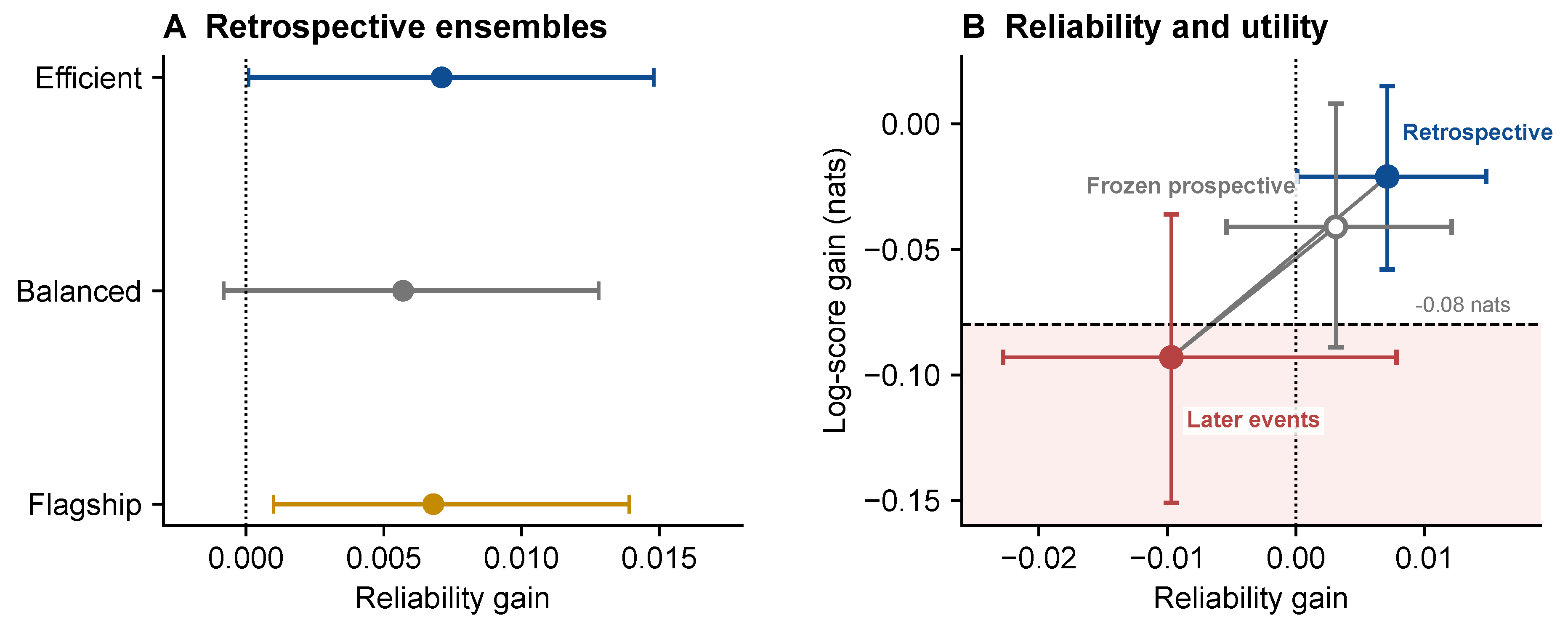
Table 8.
Smoother maps reduce score penalties but do not rescue deployment. Efficient ensemble, 318 retrospective markets.
Table 8.
Smoother maps reduce score penalties but do not rescue deployment. Efficient ensemble, 318 retrospective markets.
| Recalibrator | CI] | CI] |
|---|---|---|
| Isotonic | ||
| Platt | ||
| Beta |
A rule that deployed the efficient map solely because its retrospective pointwise interval excludes zero would have approved a correction with a measured -nat score loss on later events. This is the deployment failure the protocol prevents. The later reliability estimate changes sign, but its interval includes zero and the retrospective estimate; the significant deterioration is in log score.
Frozen prospective efficient reliability is (CI ), returning skip. Reliability takes precedence: the utility interval does not turn an unresolved gain into reject. The decision holds across maturity, cohort, and pending-outcome checks (Appendix C).
Table 9.
Frozen prospective results on 312 resolved markets. Every reliability interval includes zero, yielding skip.
Table 9.
Frozen prospective results on 312 resolved markets. Every reliability interval includes zero, yielding skip.
| Forecast set | CI] | CI] |
|---|---|---|
| Efficient | ||
| Balanced | ||
| Flagship | ||
| Anchor | – | |
| Crowd | – |
5. Operating Characteristics
The Kalshi result establishes a positive temporal-validation path. Synthetic controls quantify how often the full procedure detects an injected defect at the sample sizes used in the model experiment.
- Synthetic control. We inject the known logistic distortion . At 318 events, the stage-one reliability gain is (CI ). With 300 simulated prospective events, the full two-stage procedure returns recalibrate in of runs. At the actual prospective size of 312, its detection rate is . For a smaller effect of , detection is . The contrast is sharp: high detection for the injected larger defect, low detection for the small effect that matches the retrospective model signal.
Figure 2.
Positive controls distinguish persistent defects from small unresolved effects. A: Kalshi reliability gains with CIs remain positive on later events. B: Full-protocol detection rates for the synthetic logistic distortion and a smaller effect; n is the simulated validation size. Percentages are operating characteristics of the evaluated simulation settings.
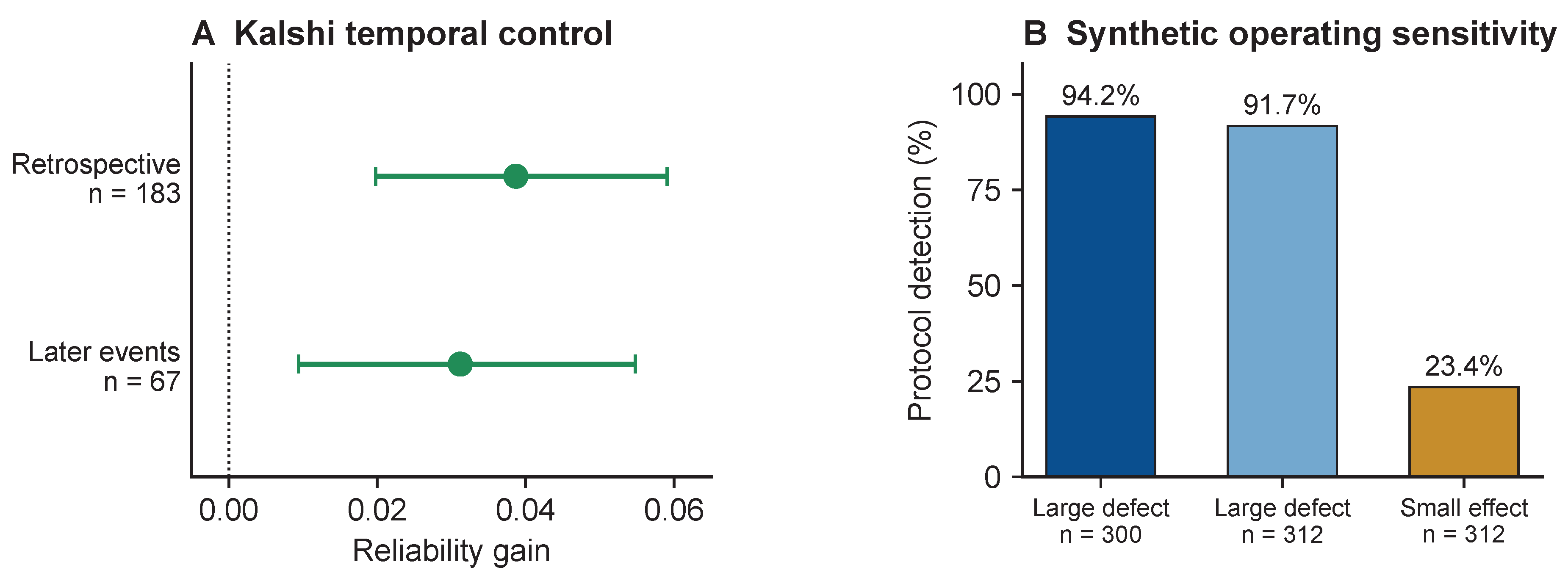
Table 10.
Power diagnostics. Detection thresholds target power for the stated endpoint; simulation rates concern the full two-stage procedure.
Table 10.
Power diagnostics. Detection thresholds target power for the stated endpoint; simulation rates concern the full two-stage procedure.
| Setting | Markets | Diagnostic |
|---|---|---|
| Later-event reliability | 111 | minimum effect about |
| Prospective reliability | 312 | minimum effect about |
| Later-event log score | 111 | minimum effect about nats |
| Synthetic larger defect | 300 prospective | detection |
| Synthetic larger defect | 312 prospective | detection |
| Synthetic small effect () | 312 prospective | detection |
At 312 validation events, the protocol detects the injected larger defect in of runs but the small effect in only . The retrospective model signal is below the -power reliability thresholds of at 111 markets and at 312 markets. In contrast, the measured later-event score loss of nats exceeds the -nat log-score detection threshold, and its interval excludes zero. Score deterioration is established; deterioration beyond the tolerance is not, because the interval straddles that margin. Log-score tolerances from to nats do not change the model deployment decision: reliability and temporal confirmation still fail.
6. Discussion
- Selective, not negative. The same protocol recalibrates Kalshi, leaves Polymarket and Metaculus alone, and blocks LLM maps that look positive in hindsight. An audit that always or never recommends correction cannot discriminate between these cases. This one gives different answers when the evidence differs. The contribution is a deployment decision, not a blanket verdict on recalibration.
- Why both endpoints. A flexible map can shrink binned reliability error while assigning very low probability to realized outcomes. Kalshi combines persistent reliability gain with passing utility checks. The model ensembles do not establish a temporal reliability gain, and the efficient map incurs a significant later log-score loss. Platt and beta reduce the retrospective score penalty but do not rescue the deployment case. Better behavior on one metric does not waive the other gates. The same distinction motivates audited reward drafting [43] and transaction-level checks in coding agents [20]: a useful intermediate signal must still satisfy the acceptance conditions of the system that uses it.
- Relevance to temporal foundation models. Post-hoc calibration creates an additional deployment decision for a foundation forecaster. The reliability horizon is a portable gate for that step. Balanced comparison controls composition, cross-fitting limits optimism, leave-one-out exposes ensemble dependence, and frozen evaluation tests persistence. Together, these checks distinguish an attractive historical correction from one that deserves deployment. The principle applies beyond the specific isotonic, Platt, and beta maps tested here. Uncertainty-aware calibrators and evidence-level forecasting methods [23,30] can also be assessed with temporal and utility gates, although neither method is evaluated in this study.
- Temporal context is not temporal benefit. Operational incident retrieval, continual repair memory, and temporal-validity memory evaluation study different ways of carrying information across time [6,17,41]. They motivate a useful separation: retaining or filtering historical information is one design choice; showing that it improves the next decision is another. The reliability horizon makes that second question explicit for recalibration. Self-healing orchestrators likewise place recovery inside a bounded runtime procedure [19]; a forecast correction needs its own acceptance rule rather than inheriting approval from the surrounding agent.
- Match the audit to the failure. Forecasting applications span economic time series [44,52] and environmental forecasts [36,50]; related damage-assessment systems use pre- and post-event imagery [22]. The appropriate evidence depends on the failure being tested. Matched-access interventional tests isolate procedure [37]; prosodic contrast sets test information absent from transcript-only judgments [31]; formal-specification studies distinguish failure modes and preserve witnesses before repair [29,33]. Our audit fixes event composition and freezes predictions because its target is a correction’s persistence, not the forecaster’s reasoning or general competence.
- Limitations. Balanced-panel selection favors long-lived markets. Six-month prospective outcomes are sparse (8 of 21 resolved). As-of-date retrieval excludes future documents, not knowledge in model weights; frozen prediction removes post-resolution querying. Tolerances are operational and application-specific, and small reliability effects remain below the available panels’ detection thresholds. Margin and maturity sensitivities preserve the deployment decision.
- Takeaway. Do not deploy a recalibration map because its retrospective calibration metric improves. Require the gain to survive multiplicity, utility, and independent time. The Kalshi correction passes that test; the evaluated LLM corrections do not.
7. Reproducibility
The reproducibility package contains a pinned Python environment, deterministic analysis scripts, per-row temporal-validity decisions, prospective registration and freeze timestamps, cached snapshots for all three venues, inference settings and prompts, and machine-readable table and figure values. All analyses regenerate without new model API calls; the package has been checked in a clean environment. The ensemble estimand, cross-fitting, market-level bootstrap, interval levels, and decision precedence are specified above. Replayable dated environments [9] and commitment-based forecast registries [40] offer complementary ways to separate reproducible historical evaluation from predictions fixed before outcomes.
Appendix A. Crowd Robustness and Panel Selection
Table A1.
Raw-minus-recalibrated ECE. Both interval constructions are pointwise ; the last column is an empirical bootstrap tail diagnostic, not a null-calibrated TOST p-value.
Table A1.
Raw-minus-recalibrated ECE. Both interval constructions are pointwise ; the last column is an empirical bootstrap tail diagnostic, not a null-calibrated TOST p-value.
| Horizon | ECE | Percentile CI | BCa CI | Tail fraction |
|---|---|---|---|---|
| 1d | ||||
| 1w | ||||
| 1m | ||||
| 3m | ||||
| 6m |
At 1d the bootstrap distribution has skewness . BCa adjustment changes the percentile endpoints without changing the within-margin conclusion. A quantile near a margin does not, by itself, establish the calibration of a tail-based test. Raw-minus-recalibrated ECE equivalence and cross-horizon equivalence answer different questions.
Table A2.
Direct maximum-contrast horizon equivalence. The simultaneous upper bound is ECE.
| ECE margin | TOST p | Horizon-equivalence conclusion |
|---|---|---|
| – | not established | |
| not established | ||
| not established | ||
| established |
Balanced markets are longer-lived and more actively traded, with fewer crypto/finance markets. Excluded short-lived markets have ECE at 1d and at 1m. The available-horizon full-sample sensitivity also detects no trend (). This is corroborative evidence, not the same repeated-market estimand as the balanced test. Selection still limits extrapolation to newly created or short-lived markets.
Table A3.
Estimator sensitivity on the balanced Polymarket panel.
| Estimator | ECE range | Friedman p | Pattern changes? |
|---|---|---|---|
| Equal-width, 10 bins | – | – | |
| Equal-width, 15 bins | – | no | |
| Equal-mass, 10 bins | – | no | |
| Debiased ECE [21] | – | no | |
| Kernel estimate | – | no |
Table A4.
Cross-venue ECE on each balanced panel.
| Venue | 1d | 1w | 1m | 3m | 6m |
|---|---|---|---|---|---|
| Polymarket | |||||
| Metaculus | |||||
| Kalshi |
Appendix B. Ensemble Heterogeneity and Recalibrator Choice
We display raw tests and percentile intervals separately; pointwise interval exclusion is not familywise significance. Efficient consists of GPT-5.6 Luna, Claude Haiku 4.5, and Nova 2 Lite; balanced consists of GPT-5.6 Terra, Claude Sonnet 5, and Nova Premier; flagship consists of GPT-5.6 Sol, Claude Opus 5, and gpt-oss-120b. The last is additionally scored as the open-weight anchor, not as a tenth model. Intervals characterize these evaluated ensembles, not a population of capability classes.
Table A5.
Cross-fitted individual-model estimates. These diagnostic intervals do not replace the primary ensemble-family tests.
Table A5.
Cross-fitted individual-model estimates. These diagnostic intervals do not replace the primary ensemble-family tests.
| Model | Tier | CI] | CI] |
|---|---|---|---|
| GPT-5.6 Luna | Efficient | ||
| Claude Haiku 4.5 | Efficient | ||
| Nova 2 Lite | Efficient | ||
| GPT-5.6 Terra | Balanced | ||
| Claude Sonnet 5 | Balanced | ||
| Nova Premier | Balanced | ||
| GPT-5.6 Sol | Flagship | ||
| Claude Opus 5 | Flagship | ||
| gpt-oss-120b | Flagship/anchor |
Table A6.
Efficient-ensemble leave-one-model-out sensitivity.
| Dropped model | CI] | Pointwise CI above zero? |
|---|---|---|
| None | yes | |
| GPT-5.6 Luna | yes | |
| Claude Haiku 4.5 | no | |
| Nova 2 Lite | yes |
Platt and beta reduce the log-score penalty, consistent with smoother corrections, but also reduce the estimated reliability gain. Clipped versus unclipped isotonic maps differ by about – nats at horizons where more than of forecasts have or . The clipping-related change accounts for of the total log-score penalty at 1d and at 6m. This comparison describes the fitted maps; it does not establish that clipping alone causes the temporal result.
Appendix C. Temporal Validation and Prospective Robustness
Table A7.
Later-event evaluation (111 markets). Every reliability interval crosses zero, so all set-specific decisions are skip. Every log-score lower bound is below nats.
Table A7.
Later-event evaluation (111 markets). Every reliability interval crosses zero, so all set-specific decisions are skip. Every log-score lower bound is below nats.
| Forecast set | CI] | CI] |
|---|---|---|
| Efficient | ||
| Balanced | ||
| Flagship | ||
| Anchor |
Efficient’s later log-score interval is wholly negative, establishing score deterioration relative to zero, but straddles : failure of noninferiority does not establish deterioration greater than that tolerance. The reliability CI contains the retrospective estimate; neither a significant reliability reversal nor zero true benefit follows from the point-estimate sign.
Table A8.
Prospective efficient-ensemble sensitivity. All intervals cross zero.
| Analysis | Resolved n | CI] |
|---|---|---|
| All observed | 312 | |
| Mature short horizons | 189 | |
| Long horizons only | 123 | |
| Original cohort | 198 | |
| Extension cohort | 114 |
Table A9.
Bounds assigning all 74 pending outcomes in the direction least or most favorable to recalibration. Each decision remains skip.
Table A9.
Bounds assigning all 74 pending outcomes in the direction least or most favorable to recalibration. Each decision remains skip.
| Pending-outcome scenario | Efficient CI] |
|---|---|
| Raw favored | |
| Observed only | |
| Recalibration favored |
Table A10.
Prospective registry maturity at the September 15, 2026 analysis.
| Horizon | Registered | Resolved | Pending | Censored |
|---|---|---|---|---|
| 1d | 33 | 33 | 0 | 0 |
| 1w | 63 | 62 | 1 | 0 |
| 1m | 99 | 94 | 4 | 1 |
| 3m | 158 | 112 | 43 | 3 |
| 6m | 21 | 8 | 13 | 0 |
| m | 16 | 3 | 13 | 0 |
| Total | 390 | 312 | 74 | 4 |
The 123 resolved long-horizon markets comprise 112 at 3m, 8 at 6m, and 3 beyond 6m. Thus most long-horizon evidence is three-month evidence; the pending-outcome checks do not make six-month coverage mature.
References
- Le, Nam Anh. Decomposing crowd wisdom: Domain-specific calibration dynamics in prediction markets. arXiv 2026, arXiv:2602.19520. [Google Scholar] [CrossRef]
- Indukuri, Shashank; Agrawal, Adarsh. Grounded optimization: A layered engineering framework for reducing LLM hallucination in automated personal document rewriting. arXiv 2026, arXiv:2607.01457. [Google Scholar] [CrossRef]
- Karger, Ezra; Bastani, Houtan; Chen, Yueh-Han; Jacobs, Zachary; Halawi, Danny; Zhang, Fred; Tetlock, Philip E. Forecastbench: A dynamic benchmark of AI forecasting capabilities. International Conference on Learning Representations, 2025. [Google Scholar]
- Amazon Artificial General Intelligence. Amazon nova 2: Multimodal reasoning and generation models. Technical report, Amazon, 2025a; Available online: https://www.amazon.science/publications/amazon-nova-2-multimodal-reasoning-and-generation-models.
- Ghosh, Rishab; Devarakonda, Vinay. FinBench: Time-gated calibration and uncertainty benchmarking for agentic financial forecasting. arXiv 2026, arXiv:2607.16229. [Google Scholar] [CrossRef]
- Agrawal, Adarsh; Babu, Rahul Suresh. Incident memory: Training-free operational memory through sequential pattern mining and velocity-stratified retrieval. arXiv 2026, arXiv:2609.01616. [Google Scholar] [CrossRef]
- Niculescu-Mizil, Alexandru; Caruana, Rich. Predicting good probabilities with supervised learning. In Proceedings of the 22nd International Conference on Machine Learning, 2005; pp. pages 625–632. [Google Scholar]
- Vidgen, Bertie; Agrawal, Adarsh; Ahmed, A. M.; Akinwande, V.; Al-Nuaimi, N.; Alfaraj, N.; et al. Introducing v0.5 of the AI safety benchmark from MLCommons. arXiv 2024a, arXiv:2404.12241. [Google Scholar] [CrossRef]
- Ye, Liqin; Wang, Haorui; Ahmed, Fardin; Zhang, Rongzhi; He, Yuan; Lin, Ziyuan; Yin, Yanbin; Peng, Jing; Galarnyk, Michael; Chava, Sudheer; Zhang, Chao. Forecast-Dojo: Replayable environments for benchmarking and training LLM forecasting agents. arXiv 2026, arXiv:2609.28876. [Google Scholar] [CrossRef]
- Agrawal, Adarsh. ParetoProof: When does pareto selection improve lean proof maintenance? Preprints.org 2026a. Version 1. [Google Scholar] [CrossRef]
- Gneiting, Tilmann; Raftery, Adrian E. Strictly proper scoring rules, prediction, and estimation. J. Am. Stat. Assoc. 2007, 102(477), 359–378. [Google Scholar] [CrossRef]
- Agrawal, Adarsh; Indukuri, Shashank. Schema-first retrieval: Embedding catalogs for natural language analytics. arXiv 2026, arXiv:2606.28387. [Google Scholar] [CrossRef]
- Paleka, Daniel; Goel, Shashwat; Geiping, Jonas; Tramèr, Florian. Pitfalls in evaluating language model forecasters. arXiv 2025, arXiv:2506.00723. [Google Scholar]
- Amazon Artificial General Intelligence. Amazon nova premier: Technical report and model card. Technical report, Amazon, 2025b; Available online: https://cdn.amazon.science/e5/e6/ccc5378c42dca467d1abe1628ec9/amazon-nova-premier-technical-report-and-model-card.pdf.
- Agrawal, Adarsh. When scores do not steer: Auditing process credit in verifier-guided repair. Preprints.org 2026b. Version 1. [Google Scholar] [CrossRef]
- Rahman, Naimur; Tabassum, Naazreen. Modeling and controlling deployment reliability under temporal distribution shift. arXiv 2026, arXiv:2604.02351. [Google Scholar] [CrossRef]
- Agrawal, Adarsh. ProofDebt: When does memory improve continual software repair? Preprints.org 2026c. Version 1. [Google Scholar] [CrossRef]
- Holm, Sture. A simple sequentially rejective multiple test procedure. Scand. J. Stat. 1979, 6(2), 65–70. [Google Scholar]
- Suresh Babu, Rahul; Agrawal, Adarsh. Self-healing agentic orchestrators for reliable tool-augmented large language model systems. arXiv 2026, arXiv:2606.01416. [Google Scholar] [CrossRef]
- Agrawal, Adarsh. ActionProof: Verifying multi-step coding-agent transactions. Preprint. 2026d. Available online: https://addarshh.github.io/papers/action-proof/action-proof.pdf.
- Kumar, Ananya; Liang, Percy S.; Ma, Tengyu. Verified uncertainty calibration. In Advances in Neural Information Processing Systems; 2019; volume 32. [Google Scholar]
- Feng, Weicong; Agrawal, Adarsh; Ling, Haibin; Blasch, Erik; Adiles-Cruz, Erika; Schrader, Paul T.; Wei, Jie. DDDAS probability learning for natural disaster change detection. In Dynamic Data Driven Applications Systems; DDDAS/Infosymbiotics for Reliable AI 2024; Springer, 2026; volume 15514, pp. pages 90–99. [Google Scholar] [CrossRef]
- Dai, Hui; Teehan, Ryan; Torabian, Parsa; Ren, Mengye. Aligning LLMs with human uncertainty: A Beta-Bernoulli calibrator for LLM forecasting. arXiv 2026, arXiv:2605.27668. [Google Scholar] [CrossRef]
- Vidgen, Bertie; Agrawal, Adarsh; Ahmed, A. M.; Akinwande, V.; Al-Nuaimi, N.; Alfaraj, N.; et al. (Eds.) introducing v0.5 of the AI safety benchmark from MLCommons. In arXiv; 2024. [Google Scholar]
- Chi, Yizhou; Chamoun, Eric; Ding, Zifeng; Vlachos, Andreas. WorldReasoner: Evaluating whether language model agents forecast events with valid reasoning. arXiv 2026, arXiv:2606.11816. [Google Scholar]
- Agrawal, Adarsh. When process credit cannot matter: Auditing decision authority in verifier-guided repair. Preprint. 2026e. Available online: https://addarshh.github.io/papers/branch-credit/branch-credit-camera-ready.pdf.
- Lakens, Daniël. Equivalence tests: A practical primer for t tests, correlations, and meta-analyses. Soc. Psychol. Personal. Sci. 2017, 8(4), 355–362. [Google Scholar] [CrossRef]
- Amazon Artificial General Intelligence. Amazon nova sonic: Technical report and model card. Technical report, Amazon, 2025c; Available online: https://www.amazon.science/publications/amazon-nova-sonic-technical-report-and-model-card.
- Agrawal, Adarsh. When do counterexamples improve formal specifications? failure-mode and substrate dependence in test-to-spec refinement. Preprint. 2026f. Available online: https://addarshh.github.io/papers/test2spec2proof/test2spec2proof.pdf.
- Liu, Wenjin; Wang, Chenxi; Lu, Yue; Cui, Zhe; Luo, Haoran. CHAIN: Calibrated LLM forecasting via causal-temporal hypergraph inference. arXiv 2026, arXiv:2609.36689. [Google Scholar] [CrossRef]
- Agrawal, Adarsh. Text judges can’t hear: Prosodic contrast sets expose systematic bias in voice AI evaluation. Preprint. 2026g. Available online: https://addarshh.github.io/papers/text-judges-cant-hear/text-judges-cant-hear.pdf.
- Cheng, Pu; Liu, Juncheng; Long, Yunshen. PolyBench: Benchmarking LLM forecasting and trading capabilities on live prediction market data. arXiv 2026, arXiv:2604.14199. [Google Scholar]
- Agrawal, Adarsh. When correctness feedback erases evidence: Phase-separated completeness auditing in Verus. Preprints.org 2026h. Version 1. [Google Scholar] [CrossRef]
- Efron, Bradley. Better bootstrap confidence intervals. J. Am. Stat. Assoc. 1987, 82(397), 171–185. [Google Scholar] [CrossRef]
- Agrawal, Adarsh. Do LLM forecasts change their minds coherently? NeurIPS Workshop on Foundation Models for Temporal Systems. 2026i. Available online: https://neurips.cc/virtual/2026/loc/sydney/175035.
- Kurki, Lauri; Cabrera, Yaniel; Karanko, Samu. Probability calibration for precipitation nowcasting. arXiv 2025, arXiv:2510.00594. [Google Scholar]
- Agrawal, Adarsh. Procedure, not causal vocabulary: A matched-access test of interventional reasoning in foundation models. Preprint. 2026j. Available online: https://addarshh.github.io/papers/clamp-order-propagate/clamp-order-propagate.pdf.
- Roelofs, Rebecca; Cain, Nicholas; Shlens, Jonathon; Mozer, Michael C. Mitigating bias in calibration error estimation. In Proceedings of the 25th International Conference on Artificial Intelligence and Statistics, 2022; pp. pages 4036–4054. [Google Scholar]
- Amazon Artificial General Intelligence. The amazon nova family of models: Technical report and model card. Technical report, Amazon. 2024. Available online: https://www.amazon.science/publications/the-amazon-nova-family-of-models-technical-report-and-model-card.
- Nechepurenko, Maksym; Shuvalov, Pavel. Foresight arena: An on-chain benchmark for evaluating AI forecasting agents. arXiv 2026, arXiv:2605.00420. [Google Scholar]
- Agrawal, Adarsh. When does temporal validity help agent memory? a practical evaluation across memory regimes. Preprint. 2026k. Available online: https://addarshh.github.io/papers/belief-lifecycle/belief-lifecycle-preprint.pdf.
- Lu, Janna. Evaluating LLMs on real-world forecasting against expert forecasters. arXiv 2025, arXiv:2507.04562. [Google Scholar]
- Agrawal, Adarsh. TurboGRPO: Audited speculative reward drafting for efficient GRPO training. Preprint. 2026l. Available online: https://addarshh.github.io/papers/turbogrpo/turbogrpo.pdf.
- Soni, Kavin; Das, Debanshu; Guduguntla, Vamshi. Assessing the operational viability of foundation models for time series forecasting. arXiv 2026, arXiv:2605.24381. [Google Scholar] [CrossRef]
- Agrawal, Adarsh. Three agents are not three verifiers: Measuring common-mode failure in LLM verification. 2026m. Available online: https://openreview.net/forum?id=Klbp3xuEkw.
- Nel, Lukas. Do large language models know what they don’t know? KalshiBench: A new benchmark for evaluating epistemic calibration via prediction markets. arXiv 2025, arXiv:2512.16030. [Google Scholar]
- Amazon Artificial General Intelligence. Amazon nova multimodal embeddings: Technical report and model card. Technical report, Amazon, 2025d; Available online: https://www.amazon.science/publications/amazon-nova-multimodal-embeddings-technical-report-and-model-card.
- Kull, Meelis; Filho, Telmo Silva; Flach, Peter. Beta calibration: A well-founded and easily implemented improvement on logistic calibration for binary classifiers. Proc. 20th Int. Conf. Artif. Intell. Stat. 2017, volume 54, pages 623–631. Available online: https://proceedings.mlr.press/v54/kull17a.html.
- Agrawal, Adarsh; Li, J. Mitigating bias in AI using Debias-GAN. NVIDIA GTC Conference, 2022. [Google Scholar]
- Murphy, Conor; Towe, Ross; Jonathan, Philip. Calibration of medium-range metocean forecasts for the north sea. arXiv 2025, arXiv:2503.21488. [Google Scholar]
- Vidgen, Bertie; Agrawal, Adarsh; Ahmed, A. M.; Akinwande, V.; Al-Nuaimi, N.; Alfaraj, N.; et al. How to construct AI safety benchmarks. 2024c. [Google Scholar] [CrossRef]
- Adarsh Agrawal, A. V.; Garg, Nikhil. Time series forecasting of producer price index, using ARIMA. Int. J. Sci. Res. (IJSR) 2018, 7(7), 1019–1024. [Google Scholar]
- Zeng, Zhiyuan; et al. FutureX: An advanced live benchmark for LLM agents in future prediction. arXiv 2025, arXiv:2508.11987. [Google Scholar]
- Agrawal, Adarsh. The reliability horizon: A temporal stress test for forecast recalibration. NeurIPS Workshop on Foundation Models for Temporal Systems. 2026n. Available online: https://neurips.cc/virtual/2026/loc/sydney/175058.
- Vidgen, Bertie; Agrawal, Adarsh; Ahmed, A. M.; Akinwande, V.; Al-Nuaimi, N.; Alfaraj, N.; et al. Introducing v0.5 of the AI safety benchmark from MLCommons. 2024, 2024d. Available online: https://arxiv.org/abs/2404.12241.
Table 4.
Deployment protocol. A positive pointwise interval cannot bypass the familywise screen. Candidate is an intermediate state, not approval.
Table 4.
Deployment protocol. A positive pointwise interval cannot bypass the familywise screen. Candidate is an intermediate state, not approval.
| Stage | Requirement | Outcome |
|---|---|---|
| Screen | Holm-controlled reliability gain across model tiers; positive CI for a single control | Pass: utility gates; fail: skip |
| Utility | lower bounds above nats for log score and for decision loss | Pass: candidate;fail: reject |
| Temporal | Gain and utility re-established on independent later events; frozen confirmation for model forecasts | Pass: recalibrate |
| Precedence | Unresolved reliability at any evaluation | skip |
| Precedence | Established gain but utility gate fails | reject |
Table 6.
Kalshi: a persistent defect passes the temporal-holdout protocol. All displayed CIs are .
| Evaluation | n | CI] | CI] | Decision |
|---|---|---|---|---|
| Retrospective | 183 | candidate | ||
| Later events | 67 | recalibrate |
Disclaimer/Publisher’s Note: The statements, opinions and data contained in all publications are solely those of the individual author(s) and contributor(s) and not of MDPI and/or the editor(s). MDPI and/or the editor(s) disclaim responsibility for any injury to people or property resulting from any ideas, methods, instructions or products referred to in the content. |
© 2026 by the authors. Licensee MDPI, Basel, Switzerland. This article is an open access article distributed under the terms and conditions of the Creative Commons Attribution (CC BY) license (http://creativecommons.org/licenses/by/4.0/).
Copyright: This open access article is published under a Creative Commons CC BY 4.0 license, which permit the free download, distribution, and reuse, provided that the author and preprint are cited in any reuse.