
Submitted:
24 November 2026
Posted:
25 November 2026
You are already at the latest version
Abstract
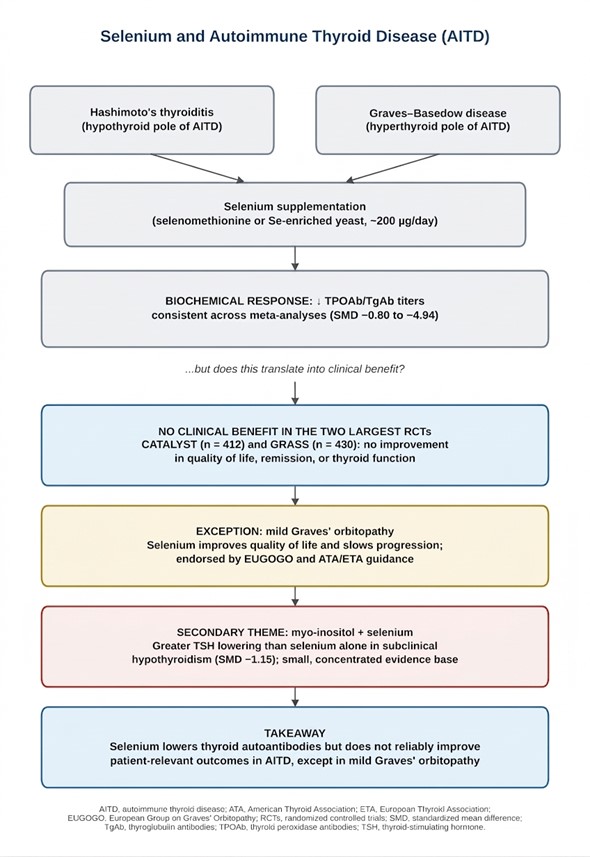
Autoimmune thyroid disease (AITD), comprising Hashimoto’s thyroiditis (HT) and Graves–Basedow disease (GBD), is the leading cause of acquired thyroid dysfunction, and selenium is essential for selenoprotein-mediated antioxidant defense in the thyroid. This scoping review, reported according to PRISMA-ScR, mapped the human evidence on selenium and, secondarily, myo-inositol across the AITD spectrum in adults. PubMed/MEDLINE, Scopus, Web of Science, Embase, Google Scholar, and ClinicalTrials.gov were searched (January 1996–October 2026), and methodological quality was appraised with standardized tools. Of 139 records identified (75 after deduplication), 43 sources were charted: 20 primary studies, 17 systematic reviews/meta-analyses, and 6 narrative reviews. Selenium consistently lowered thyroid peroxidase antibody titers in HT (pooled standardized mean differences, −0.80 to −4.94). However, the two largest randomized controlled trials, in HT (n = 412) and GBD (n = 430), showed no benefit on quality of life, remission, or thyroid function. A reproducible clinical benefit was confirmed only in mild Graves’ orbitopathy. Myo-inositol plus selenium lowered thyrotropin more than selenium alone in subclinical hypothyroidism, although this evidence is limited. Thus, selenium lowers thyroid autoantibodies without patient-relevant benefit in AITD, except in mild Graves’ orbitopathy; trials in early-stage disease with validated quality-of-life outcomes are needed.
Keywords:
selenium
; autoimmune thyroid disease
; Hashimoto’s thyroiditis
; Graves–Basedow disease
; Graves’ orbitopathy
; myo-inositol
; scoping review
1. Introduction
Autoimmune thyroid disease (AITD) is the most common organ-specific autoimmune disorder and the leading cause of hypothyroidism and hyperthyroidism in iodine-replete populations [1,2]. It comprises two clinically opposite but mechanistically related entities. In Hashimoto’s thyroiditis (HT), also termed chronic lymphocytic or chronic autoimmune thyroiditis, lymphocytic infiltration and autoantibodies against thyroid peroxidase (TPOAb) and thyroglobulin (TgAb) accompany progressive glandular destruction. In Graves–Basedow disease (GBD), stimulating antibodies against the thyroid-stimulating hormone (TSH) receptor (TRAb) drive unregulated hormone secretion and, in a substantial minority of patients, Graves’ orbitopathy (GO), also known as thyroid eye disease [1,2,3].
A meta-analysis of 48 studies from 19 countries estimated a global adult prevalence of HT of 7.5% (95% confidence interval [CI] 5.7–9.6%), 17.5% in women versus 6.0% in men, ranging from 14.2% in Africa to 5.8% in Asia [4]. The lifetime risk of GBD is approximately 3% in women and 0.5% in men [5,6]. Both conditions impose a substantial burden on health-related quality of life (QoL) [2,3].
Selenium is incorporated as selenocysteine into 25 human selenoproteins [7], and the thyroid has one of the highest selenium concentrations per gram of tissue [8,9]. Glutathione peroxidases (GPx) and thioredoxin reductases (TXNRD) protect thyrocytes from the hydrogen peroxide generated during hormone synthesis; iodothyronine deiodinases types 1–3 (DIO1–3) regulate thyroid hormone activation and inactivation; and selenoprotein S (SELENOS) modulates inflammatory cytokine signaling [8,10,11]. Selenium deficiency has therefore been hypothesized to permit oxidative and inflammatory injury that favors thyroid autoimmunity, whereas repletion might exert an immunomodulatory, antibody-lowering effect [8,11], although human data on immune effects remain limited [12].
Selenium intake varies with soil geochemistry, from less than 10 µg/day in low-selenium regions of China to several thousand µg/day in seleniferous areas of India, Venezuela, and the United States [13,14], and suboptimal status is widespread across Europe [15]. The therapeutic window is narrow: the European Food Safety Authority (EFSA) has set a tolerable upper intake level (UL) of 255 µg/day for adults [16]; in a Danish randomized trial, 300 µg/day for 5 years increased all-cause mortality over 10 years of follow-up, whereas 100–200 µg/day did not [17], although cohort studies associate higher selenium status with lower mortality [18].
Epidemiological data support a selenium–AITD link. In two Chinese counties with contrasting soil selenium (n = 6152), autoimmune thyroiditis, subclinical hypothyroidism, and goiter were more prevalent in the low-selenium county [19], and serum selenium was lower in Danish patients with newly diagnosed GBD than in population controls [20].
Supplementation, usually as selenomethionine (SeMet) or selenium-enriched yeast at 100–200 µg/day, has produced heterogeneous results [10]. Several meta-analyses report lower TPOAb titers in HT, whereas others conclude that the certainty of evidence is low and that antibody reduction has not translated into better QoL or slower progression [21,22]. The two largest double-blind, placebo-controlled randomized controlled trials (RCTs) illustrate this tension: in HT, selenium lowered TPOAb without improving QoL at 12 months [23], whereas in GBD it had no effect on remission, TRAb, or QoL [24]. A guideline-endorsed benefit exists only for mild GO, based chiefly on one European RCT [25,26,27].
Myo-inositol (MI), alone or combined with selenium, has also been studied. Small trials suggest that MI may enhance the effect of selenium on TSH and autoantibodies in subclinical hypothyroidism (SCH) due to HT, and recent work has explored comorbid migraine [28,29,30].
Existing reviews have generally addressed a single phenotype, intervention, or outcome [21,31,32], and no synthesis has mapped the human evidence on selenium and MI across both poles of AITD while appraising its methodological quality. We therefore conducted a scoping review to (i) map the evidence published between 1996 and 2026 on selenium status or supplementation and AITD in adults, including HT, GBD, and GO; (ii) map the evidence on MI, alone or with selenium; (iii) appraise the methodological quality of primary studies and systematic reviews; and (iv) identify consistencies, contradictions, and gaps to inform research and practice.
2. Materials and Methods
2.1. Protocol and Reporting Framework
This review followed the methodological frameworks of Arksey and O’Malley, Levac et al., and the Joanna Briggs Institute (JBI) [33,34,35] and is reported according to the Preferred Reporting Items for Systematic reviews and Meta-Analyses extension for Scoping Reviews (PRISMA-ScR) [36]. A scoping design was chosen because the aim was to map the breadth, nature, and consistency of evidence across heterogeneous designs rather than to estimate a single pooled effect. The protocol was registered in the International Platform of Registered Systematic Review and Meta-analysis Protocols (INPLASY); registration number INPLASY2026110064; DOI: 10.37766/inplasy2026.11.0064.
2.2. Eligibility Criteria
2.3. Information Sources and Search Strategy
Records were identified by two routes. The initial record set (n = 96) was derived from bibliographic searches conducted by the authors on selenium, micronutrients, and thyroid autoimmunity. This set was complemented by a structured search of PubMed/MEDLINE, Scopus, Web of Science (Core Collection), Embase, Google Scholar, and ClinicalTrials.gov covering 1 January 1996 to 31 October 2026, together with backward citation chasing of the largest trials (n = 43). In abbreviated form, the search string combined (“selenium” OR “selenomethionine” OR “selenium-enriched yeast” OR “myo-inositol”) AND (“autoimmune thyroid disease” OR “Hashimoto*” OR “chronic autoimmune thyroiditis” OR “Graves*” OR “Basedow*” OR “thyroid autoimmunity” OR “thyroid peroxidase antibod*” OR “thyroglobulin antibod*” OR “TSH-receptor antibod*”). The full strategy is provided in Supplementary Methods S1.
2.4. Selection of Sources of Evidence
After the removal of duplicates, full texts were assessed against the PCC criteria. Co-publications of the same dataset were counted once. The selection process is summarized in Figure 1.
2.5. Data Charting Process
A standardized form captured, for each source, the citation, country/setting, design, sample size and population, AITD phenotype, exposure (form, dose, duration), comparator, outcomes, and principal quantitative findings. Charting was performed by the corresponding author, and every extracted value was cross-checked line by line against the source text in a second verification pass.
2.6. Critical Appraisal of Individual Sources
Although critical appraisal is optional under PRISMA-ScR [36], an abbreviated appraisal was performed to weight the evidence in the Discussion. RCTs were appraised with the Cochrane Risk-of-Bias tool, version 2 (RoB 2) [38], across five domains (randomization process, deviations from intended interventions, missing outcome data, outcome measurement, and selective reporting), with an overall judgment of low risk, some concerns, or high risk. Non-randomized studies (cohort, cross-sectional, case–control, and genome-wide association studies [GWAS]) received a judgment informed by the Risk of Bias in Non-randomized Studies of Interventions (ROBINS-I) tool [39] (confounding, selection, and information bias), rated as low, moderate, serious, or critical.
Systematic reviews and meta-analyses (SR/MA) were appraised with an abbreviated version of A MeaSurement Tool to Assess systematic Reviews 2 (AMSTAR-2) [40] (protocol registration, search comprehensiveness, justification of designs, risk-of-bias assessment of primary studies, meta-analytic methods, consideration of risk of bias in interpretation, and publication bias), rated as high, moderate, low, or critically low confidence. Judgments for the 37 primary studies and SR/MA are presented in Supplementary Table S1; narrative reviews were not appraised. Appraisal informed interpretation but was not used to exclude sources.
2.7. Synthesis of Results
Given the heterogeneity of populations, interventions, and outcome definitions, no quantitative pooling was undertaken, consistent with scoping-review methodology [33,34]. Findings were synthesized narratively and tabulated by phenotype (HT/hypothyroid-phase versus GBD/hyperthyroid-phase AITD) and exposure (selenium alone versus combined with MI). When several meta-analyses reported pooled estimates for the same outcome, these were presented side by side without re-pooling because their primary studies overlapped.
3. Results
3.1. Selection of Sources of Evidence
A total of 139 records were identified: 96 from the initial bibliographic searches and 43 from the structured search and citation chasing. After the removal of duplicate records (n = 64), 75 unique records were assessed in full text. Two were removed as non-independent (a co-published summary of a Cochrane review and a trial protocol), leaving 73 independent sources. Of these, 43 met the full PCC criteria and were charted (20 primary studies, 17 SR/MA, and 6 narrative reviews), and 30 did not and were not charted; 15 of the latter are cited as background in the Introduction and Discussion (Figure 1). Methodological, guideline, and other references cited for specific facts were identified outside this process and are not part of the evidence base.
3.2. Characteristics of the Evidence Base
The charted sources were published between 2010 and 2026, and 24 of 43 (55.8%) appeared from 2022 onward. Twenty-five (58.1%) addressed HT or AITD in general, including reviews that compared selenium with other supplements (classified by their predominant focus); 8 (18.6%) addressed GBD or GO; and 10 (23.3%) addressed MI, alone or with selenium (Figure 2). Study size ranged from 21 to 8756 participants (Table 2, Table 3 and Table 5).
3.3. Selenium in Hashimoto’s Thyroiditis and Autoimmune Thyroid Disease in General
Table 2 summarizes the 25 sources addressing selenium (without MI as the primary focus) in HT or AITD in general.
Abbreviations: 4. free thyroxine; GBD, Graves–Basedow disease; GO, Graves’ orbitopathy; GRADE, Grading of Recommendations Assessment, Development and Evaluation; GWAS, genome-wide association study; HT, Hashimoto’s thyroiditis; LT4, levothyroxine; MA, meta-analysis; MD, mean difference; MI, myo-inositol; mo., months; NHANES, National Health and Nutrition Examination Survey; NR, not reported; OR, odds ratio; QoL, quality of life; RCT, randomized controlled trial; RR, risk ratio; Se, selenium; SeMet, selenomethionine; SMD, standardized mean difference; SR, systematic review; TgAb, thyroglobulin antibodies; THRT, thyroid hormone replacement therapy; ThyPRO-39, 39-item Thyroid-related Patient-Reported Outcome questionnaire; TPOAb, thyroid peroxidase antibodies; TSH, thyroid-stimulating hormone; VAT1L, vesicle amine transport 1 like; WMD, weighted mean difference; y, years.
The most consistent signal was a reduction in TPOAb titers, with pooled standardized mean differences (SMDs) ranging from −0.80 to −4.94 across meta-analyses (Figure 3).
The most comprehensive of these, rated high on our abbreviated AMSTAR-2 appraisal, reported an SMD of −0.96 (95% CI −1.36 to −0.56; 29 cohorts, 2358 participants) irrespective of levothyroxine (LT4) therapy, and a small TSH reduction confined to patients without thyroid hormone replacement therapy (THRT) (SMD −0.21, 95% CI −0.43 to −0.02; 7 cohorts, 869 participants) [47].
SeMet appeared more effective than sodium selenite or selenium-enriched yeast [48,55]. In contrast, other meta-analyses rated the certainty of any clinically meaningful benefit, on thyroid function, QoL, or ultrasound echogenicity, as low to very low and did not support routine supplementation [21,53].
The pragmatic, multicenter, double-blind Chronic Autoimmune Thyroiditis Quality of Life Selenium Trial (CATALYST; n = 412) addressed this tension directly. Selenium-enriched yeast (200 µg/day) lowered TPOAb at 12 months (1995 vs. 2344 kIU/L; p = 0.016) but did not improve the composite score of the 39-item Thyroid-related Patient-Reported Outcome questionnaire (ThyPRO-39; 28.8 vs. 28.0; p = 0.602), the LT4 dose, or the free triiodothyronine (FT3)/free thyroxine (FT4) ratio [23].
A large retrospective cohort from a global federated health-records network reported higher TPOAb and all-cause mortality with selenium (risk ratio [RR] 1.38, 95% CI 1.09–2.03), a counterintuitive finding that probably reflects confounding by indication [43]. Observational data are nonetheless consistent with an association: in NHANES, each log2-unit increase in dietary selenium was associated with 35% lower odds of HT (odds ratio [OR] 0.65, 95% CI 0.51–0.83) [45].
3.4. Selenium in Graves–Basedow Disease and Graves’ Orbitopathy
Table 3 summarizes the eight sources addressing selenium in GBD and GO.
The evidence diverges by phenotype. In Graves’ hyperthyroidism, the Graves’ selenium supplementation (GRASS) trial (n = 430; 24–30 months), the largest and longest RCT in this population, found no effect of 200 µg/day selenium on non-remission (54.6% vs. 53.3%; OR 1.0, 95% CI 0.7–1.5; p = 0.98), TRAb, or QoL [24]. Among participants without GO at baseline, incident GO was numerically more frequent with selenium (11 vs. 5 participants; OR 2.2, 95% CI 0.8–6.6; p = 0.14), which offers no support for a preventive effect [24]. Smaller, mostly open-label trials reported greater antibody reduction or higher remission rates when selenium, with or without L-carnitine, was added to methimazole (MMI) [62,63], suggesting that trial size and rigor, rather than biological plausibility, determine the apparent effect.
In GO, the evidence is more consistent. In a European RCT (n = 159), sodium selenite 100 µg twice daily for 6 months improved QoL, reduced ocular involvement, and slowed the progression of mild GO [25], and a meta-analysis of four RCTs (233 participants) confirmed improvements in the Clinical Activity Score (CAS) and GO-specific QoL [32]. Accordingly, the European Group on Graves’ Orbitopathy (EUGOGO) recommends selenium for mild active GO in selenium-deficient areas, and the American Thyroid Association (ATA) and European Thyroid Association (ETA) consensus states that it may be considered in this setting [26,27]. Table 4 summarizes the pooled estimates and the headline results of the two largest RCTs.
Appraisal ratings are detailed in Supplementary Table S1. AMSTAR-2, A MeaSurement Tool to Assess systematic Reviews 2; CATALYST, Chronic Autoimmune Thyroiditis Quality of Life Selenium Trial; CI, confidence interval; GRASS, Graves’ selenium supplementation trial; HT, Hashimoto’s thyroiditis; LT4, levothyroxine; MA, meta-analysis; MI, myo-inositol; mo., months; OR, odds ratio; QoL, quality of life; RoB 2, Cochrane Risk-of-Bias tool, version 2; SCH, subclinical hypothyroidism; Se, selenium; SeMet, selenomethionine; SMD, standardized mean difference; THRT, thyroid hormone replacement therapy; ThyPRO-39, 39-item Thyroid-related Patient-Reported Outcome questionnaire; TPOAb, thyroid peroxidase antibodies; TRAb, thyroid-stimulating hormone receptor antibodies; TSH, thyroid-stimulating hormone.
3.5. Myo-Inositol, Alone or Combined with Selenium
Table 5 summarizes the 10 sources addressing MI. This literature is small, and several of its foundational studies come from the same research group.

Table 5.
Myo-inositol, alone or combined with selenium: summary of included sources (n = 10).
| Study [ref.] | Design | Participants (n) | Intervention | Main finding |
|---|---|---|---|---|
| Nordio and Pajalich, 2013 [28] | RCT, double-blind | 48 (46 analyzed) | MI 600 mg + Se 83 µg/d vs. Se, 6 mo. | TSH −31% (4.4 to 3.1 mIU/L; p < 0.01) with MI + Se; no change with Se alone |
| Nordio and Basciani, 2017a [67] | RCT | 168 | MI 600 mg + Se 83 µg/d vs. Se, 6 mo. | TSH 4.22 to 3.26 mIU/L (p ≤ 0.001) with MI + Se; no change with Se alone |
| Nordio and Basciani, 2017b [68] | Single-arm, pre–post | 87 (86 analyzed) | MI 600 mg + Se 83 µg/d, 6 mo. | TSH 4.32 to 3.12 mIU/L; TPOAb and TgAb also decreased (p ≤ 0.001) |
| Ferrari et al., 2017 [69] | Single-arm, pre–post | 21 | MI 1200 mg + Se 166 µg/d, 6 mo. | TSH 2.01 to 1.36 mIU/L (p < 0.05); TgAb −61% (p = 0.041); CXCL10 decreased |
| Payer et al., 2022 [70] | Prospective, uncontrolled, multicenter | 148 | MI 600 mg + Se 83 µg/d, 6 mo. | TSH 4.4 to 3.8 mIU/L (p < 0.001); TPOAb −21 and TgAb −46 IU/L (p < 0.001) |
| Pace et al., 2020 [71] | Retrospective cohort, 3 groups | 101 | SeMet 83 µg/d ± MI 600 mg/d vs. untreated, 12 mo. | TSH −38% (MI + Se) and −31% (Se alone); TSH increased in untreated patients |
| Krysiak et al., 2023 [72] | Matched observational pilot | 145 (5 groups of 29) | MI 2 g/d vs. SeMet 200 µg/d vs. vitamin D vs. untreated, ~6 mo. | TPOAb change −24% (SeMet) and −23% (MI) vs. untreated (p < 0.05) |
| Di Lorenzo et al., 2026 [30] | Retrospective cohort, pre–post | 163 | MI + Se, 6 mo. | TSH 3.60 to 2.80 mIU/L (p < 0.001); monthly migraine days 14 to 11 (p < 0.001) |
| Zuhair et al., 2024 [29] | SR/MA (3 studies) | 288 | MI 600 mg + Se 83 µg/d vs. Se, 6 mo. | TSH SMD −1.15 (95% CI −1.60 to −0.69); TgAb SMD −0.51 |
| Stanchev et al., 2026 [66] | SR/MA (same 3 studies) with TSA | 288 | MI 600 mg + Se vs. Se, ≥6 mo. | TSH SMD −1.26 (95% CI −1.51 to −1.00; I² = 0%); TgAb finding at risk of type I error (TSA) |
TSH values reported in µIU/mL in the original sources are expressed in the equivalent unit mIU/L. Abbreviations: CI, confidence interval; CXCL10, C-X-C motif chemokine ligand 10; d, day; MA, meta-analysis; MI, myo-inositol; mo., months; RCT, randomized controlled trial; Se, selenium; SeMet, selenomethionine; SMD, standardized mean difference; SR, systematic review; TgAb, thyroglobulin antibodies; TPOAb, thyroid peroxidase antibodies; TSA, trial sequential analysis; TSH, thyroid-stimulating hormone.
In SCH due to HT, MI (usually 600 mg/day) plus selenium (usually 83 µg/day) lowered TSH more than selenium alone in a meta-analysis of three studies (n = 288; SMD −1.15, 95% CI −1.60 to −0.69) [29], a result reproduced by an updated meta-analysis of the same three studies with trial sequential analysis (SMD −1.26, 95% CI −1.51 to −1.00) [66] (Figure 4).
A single-arm study reported a decrease in the T-helper 1 chemokine C-X-C motif chemokine ligand 10 (CXCL10) with combined therapy in euthyroid autoimmune thyroiditis [69], and a retrospective cohort linked the TSH reduction achieved with MI plus selenium to fewer migraine days in patients with HT and migraine [30]. However, most studies lacked a placebo or untreated comparator, and the single-arm designs were rated at serious or critical risk of bias (Supplementary Table S1), which limits generalizability.
3.6. Critical Appraisal Summary
Among SR/MA, confidence (abbreviated AMSTAR-2) ranged from critically low (one review that treated single-arm studies as controlled comparisons) to high (three reviews: the Cochrane review and two meta-analyses in chronic autoimmune thyroiditis [21,47,55]); most were rated low or moderate. Among primary studies, risk of bias (abbreviated RoB 2 or ROBINS-I) was low only for three RCTs: CATALYST, GRASS, and the EUGOGO trial in mild GO [23,24,25]. Most older and smaller trials raised some concerns or carried a high or serious risk of bias, mainly owing to open-label or quasi-randomized designs and, in the MI literature, the near-absence of placebo or untreated comparators (Supplementary Table S1).
4. Discussion
4.1. Principal Findings
This scoping review mapped 43 sources on selenium and, secondarily, MI in AITD and identified a consistent pattern: selenium reliably lowers thyroid autoantibody titers, particularly TPOAb in HT and, more variably, antibodies in GBD, yet this biochemical effect has not translated into patient-relevant benefit (QoL, remission, or normalization of thyroid function) in any adequately powered RCT.
The dissociation is clearest in the two largest trials, CATALYST and GRASS, which together enrolled 842 adults across both poles of AITD and found no clinical benefit despite confirmed biochemical response [23,24]. A consistent clinical signal exists only for mild GO, in which an RCT and a subsequent meta-analysis support modest improvements in disease activity and QoL [25,32], as reflected in current guidance [26,27].
4.2. Comparison with Previous Systematic Reviews and Meta-Analyses
Our findings help to reconcile an evidence base that has appeared contradictory largely because successive reviews pooled different, partly overlapping sets of small trials (Table 6). The Cochrane review and the Winther et al. meta-analysis concluded that the evidence was too sparse and too short-term to support routine use [21,55]; this conclusion remains valid for patient-centered outcomes, although the trial base has grown substantially.
More recent and larger meta-analyses have emphasized the robust antibody-lowering effect [47]; our contribution is to set that signal directly against the subsequently published CATALYST results [23], a comparison that antibody-focused meta-analyses cannot make. The two MI meta-analyses pooled the same three studies, largely from one research group [29,66], and, compared with earlier narrative reviews of GBD [65], we add the GRASS trial [24] and a standardized critical appraisal.
4.3. Mechanistic Considerations and the Biochemical–Clinical Dissociation
Several non-exclusive explanations deserve testing. First, TPOAb and TgAb may be markers of disease activity rather than causal drivers of the symptoms and functional impairment that determine QoL, so that lowering their titers need not improve how patients feel or function [2,10]. Second, most trials, including CATALYST and GRASS, enrolled patients with established disease [23,24]; any immunomodulatory effect of selenium may operate earlier, during the initiation of autoimmunity, a window that remains untested. Third, selenium status may matter more than supplementation per se: observational studies link low status to AITD [19,20,45], whereas in CATALYST stratification by baseline selenium status did not modify the null QoL result [23], consistent with a ceiling effect once selenoproteins are saturated [17].
4.4. Hashimoto’s Thyroiditis Versus Graves–Basedow Disease: A Differential Pattern
By mapping both phenotypes together, this review reveals a gradient that single-condition reviews could not show: the antibody-lowering signal is more consistent and larger in HT than in GBD, in which the largest trial found no effect [24].
Within GBD, the evidence further diverges by target tissue: hyperthyroidism itself appears unresponsive to selenium, whereas mild GO shows a modest, reproducible, guideline-endorsed benefit [25,26,32]. GRASS, however, found no preventive effect against incident GO, with a non-significant trend in the opposite direction [24], suggesting that the benefit is specific to treating established mild disease. Selenium may therefore act on antioxidant and inflammatory pathways in orbital fibroblasts that are distinct from the TRAb-driven mechanisms of thyroid hyperfunction [10], a hypothesis best addressed by mechanistic and translational research.
4.5. Strengths and Limitations
The main strengths of this review are its breadth, as it maps selenium evidence across the full AITD spectrum together with the MI literature within a single PRISMA-ScR framework, and its phenotype-stratified critical appraisal, which allows each body of evidence to be weighted by its rigor. Several limitations should be acknowledged. First, the narrative, non-pooled synthesis cannot provide a single quantitative estimate of effect; readers are therefore referred to the most robust meta-analysis for each outcome (Table 4 and Table 6). Second, only sources with an English full text were charted, so relevant evidence published in other languages may have been missed. Third, critical appraisal relied on abbreviated versions of RoB 2, ROBINS-I, and AMSTAR-2, which are less discriminating than the full instruments. Fourth, data were charted by a single author, although every extracted value was verified against the source text in a second pass. Finally, the MI evidence base is too small and too concentrated within one research group to support firm conclusions.
4.6. Gaps and Recommendations for Future Research
Three priorities emerge. First, no trial has tested selenium in the earliest phase of AITD, for example in antibody-positive euthyroid individuals; an adequately powered long-term trial with incident thyroid dysfunction as the primary outcome would address the early-intervention hypothesis. Second, the MI-plus-selenium combination requires a large, multicenter, placebo-controlled trial conducted independently of the groups that generated the foundational evidence. Third, in GO, the minimum effective and safe dose and duration should be defined, and the benefit should be tested in moderate-to-severe disease, where evidence remains sparse [26,27]. Across all three, validated thyroid-specific QoL instruments, such as ThyPRO, should be co-primary endpoints alongside biochemical measures, given that the two do not reliably move together.
5. Conclusions
Selenium supplementation consistently lowers thyroid autoantibody titers in AITD, particularly TPOAb in HT, but this biochemical effect does not reliably translate into better QoL, remission, or thyroid function, as shown most clearly by the two largest RCTs in HT and GBD. A reproducible clinical benefit is supported only in mild GO. The MI-plus-selenium literature is promising but too limited and methodologically concentrated to inform practice. Future studies should prioritize early-phase intervention and validated patient-centered outcomes.
Supplementary Materials
The following supporting information can be downloaded at the website of this paper posted on Preprints.org. Supplementary Methods S1: Detailed search strategy; Table S1: Domain-level critical appraisal of the 37 primary studies and systematic reviews/meta-analyses included in data charting; Table S2: Records excluded as content-identical duplicates or non-independent co-publications. References [S1–S3] are cited in the Supplementary Materials.
Author Contributions
Conceptualization, H.V.-U.; methodology, H.V.-U. and A.C.P.; validation, H.V.-U., A.C.P., M.V.P.-F., A.F.G.-R and H.D.V.-S.; formal analysis, H.V.-U., H.D.V.-S; investigation, H.V.-U. and M.V.P.-F.; data curation, H.V.-U. and H.D.V.-S.; writing—original draft preparation, H.V.-U.; writing—review and editing, H.V.-U., A.C.P., E.C.P.-B., A.F.G.-R, and H.D.V.-S.; visualization, H.V.-U., E.C.P.-B. and M.V.P.-F.; supervision, A.C.P.; project administration, H.V.-U. and E.C.P.-B. All authors have read and agreed to the published version of the manuscript.
Funding
This research received no external funding.
Institutional Review Board Statement
Not applicable. This study is a scoping review of previously published literature and did not involve new data collection from humans or animals.
Informed Consent Statement
Not applicable.
Data Availability Statement
Acknowledgments
None.
AI usage statement
During the preparation of this manuscript, the authors used Claude (Anthropic; Claude Sonnet 4.5 and Claude Opus 5.5 models) to assist in adapting the manuscript to the journal's author guidelines, verifying the bibliographic details of the references, and editing the language. The authors have reviewed and edited the output and take full responsibility for the content of this publication.
Conflicts of Interest
The authors declare no conflicts of interest.
Abbreviations
The following abbreviations are used in this manuscript:
| AITD | autoimmune thyroid disease |
| AMSTAR-2 | A MeaSurement Tool to Assess systematic Reviews 2 |
| ATA | American Thyroid Association |
| ATD | antithyroid drugs |
| CAS | Clinical Activity Score |
| CATALYST | Chronic Autoimmune Thyroiditis Quality of Life Selenium Trial |
| CI | confidence interval |
| CXCL10 | C-X-C motif chemokine ligand 10 |
| DIO1–3 | iodothyronine deiodinases types 1–3 |
| EFSA | European Food Safety Authority |
| ETA | European Thyroid Association |
| EUGOGO | European Group on Graves’ Orbitopathy |
| FT3 | free triiodothyronine |
| FT4 | free thyroxine |
| GBD | Graves–Basedow disease |
| GO | Graves’ orbitopathy |
| GPx | glutathione peroxidases |
| GRADE | Grading of Recommendations Assessment, Development and Evaluation |
| GRASS | Graves’ selenium supplementation trial |
| GWAS | genome-wide association study |
| HR | hazard ratio |
| HT | Hashimoto’s thyroiditis |
| INPLASY | International Platform of Registered Systematic Review and Meta-analysis Protocols |
| JBI | Joanna Briggs Institute |
| LT4 | levothyroxine |
| MA | meta-analysis |
| MD | mean difference |
| MI | myo-inositol |
| MMI | methimazole |
| NHANES | National Health and Nutrition Examination Survey |
| OR | odds ratio |
| PCC | Population–Concept–Context |
| PRISMA-ScR | Preferred Reporting Items for Systematic reviews and Meta-Analyses extension for Scoping Reviews |
| QoL | quality of life |
| RCT | randomized controlled trial |
| RoB 2 | Cochrane Risk-of-Bias tool, version 2 |
| ROBINS-I | Risk of Bias in Non-randomized Studies of Interventions |
| RR | risk ratio |
| SCH | subclinical hypothyroidism |
| Se | selenium |
| SELENOS | selenoprotein S |
| SeMet | selenomethionine |
| SMD | standardized mean difference |
| SR | systematic review |
| SR/MA | systematic reviews/meta-analyses |
| TgAb | thyroglobulin antibodies |
| THRT | thyroid hormone replacement therapy |
| ThyPRO-39 | 39-item Thyroid-related Patient-Reported Outcome questionnaire |
| TPOAb | thyroid peroxidase antibodies |
| TRAb | thyroid-stimulating hormone receptor antibodies |
| TSA | trial sequential analysis |
| TSH | thyroid-stimulating hormone |
| TXNRD | thioredoxin reductases |
| UL | tolerable upper intake level |
| WMD | weighted mean difference |
References
- Vargas-Uricoechea, H. Molecular Mechanisms in Autoimmune Thyroid Disease. Cells 2023, 12, 918. [Google Scholar] [CrossRef]
- Duntas, L.H.; Effraimidis, G. Hashimoto’s thyroiditis: two decades on. Lancet Diabetes Endocrinol. 2026, 14, 1032–1050. [Google Scholar] [CrossRef]
- Miller-Wilson, L.-A.; Mandal, E.; Tollefsen, K.M.; Ronnebaum, S.; Norregaard, S.; Chen, J. Graves’ disease: review of disease characteristics, burden, and treatments. Front. Endocrinol. 2026, 17, 1884624. [Google Scholar] [CrossRef]
- Hu, X.; Chen, Y.; Shen, Y.; Tian, R.; Sheng, Y.; Que, H. Global prevalence and epidemiological trends of Hashimoto’s thyroiditis in adults: A systematic review and meta-analysis. Front. Public Health 2022, 10, 1020709. [Google Scholar] [CrossRef]
- Smith, T.J.; Hegedüs, L. Graves’ Disease. N. Engl. J. Med. 2016, 375, 1552–1565. [Google Scholar] [CrossRef]
- Kahaly, G.J.; Bartalena, L.; Hegedüs, L.; Leenhardt, L.; Poppe, K.; Pearce, S.H. 2018 European Thyroid Association Guideline for the Management of Graves’ Hyperthyroidism. Eur. Thyroid J. 2018, 7, 167–186. [Google Scholar] [CrossRef]
- Kryukov, G.V.; Castellano, S.; Novoselov, S.V.; Lobanov, A.V.; Zehtab, O.; Guigó, R.; Gladyshev, V.N. Characterization of Mammalian Selenoproteomes. Science 2003, 300, 1439–1443. [Google Scholar] [CrossRef]
- Schomburg, L. Selenium, selenoproteins and the thyroid gland: interactions in health and disease. Nat. Rev. Endocrinol. 2012, 8, 160–171. [Google Scholar] [CrossRef]
- Gorini, F.; Sabatino, L.; Pingitore, A.; Vassalle, C. Selenium: An Element of Life Essential for Thyroid Function. Molecules 2021, 26, 7084. [Google Scholar] [CrossRef]
- Duntas, L.H. The caprices of a trace element: selenium’s considerable effects on Hashimoto’s thyroiditis, though few on Graves’ disease. Eur. Thyroid J. 2026, 15, ETJ260009. [Google Scholar] [CrossRef]
- Santos, L.R.; Neves, C.; Melo, M.; Soares, P. Selenium and Selenoproteins in Immune Mediated Thyroid Disorders. Diagnostics 2018, 8, 70. [Google Scholar] [CrossRef]
- Fairweather-Tait, S.J.; Filippini, T.; Vinceti, M. Selenium status and immunity. Proc. Nutr. Soc. 2023, 82, 32–38. [Google Scholar] [CrossRef]
- Imran, M.; Chen, Z.; Mehmood, A.; Rukh, S.; Weixie, W.; Asghar, W.; Iftikhar, F. Distribution of Selenium in Soils and Human Health. In Selenium and Human Health; IntechOpen: London, UK, 2023. [Google Scholar]
- Stillings; Selenium, L.L. Critical Mineral Resources of the United States—Economic and Environmental Geology and Prospects for Future Supply; Schulz, K.J., DeYoung, J.H., Jr., Seal, R.R., II, Bradley, D.C., Eds.; U.S. Geological Survey Professional Paper 1802: Reston, VA, USA; U.S. Geological Survey, 2017; pp. Q1–Q55. [Google Scholar]
- Stoffaneller, R.; Morse, N.L. A Review of Dietary Selenium Intake and Selenium Status in Europe and the Middle East. Nutrients 2015, 7, 1494–1537. [Google Scholar] [CrossRef]
- EFSA Panel on Nutrition; Novel Foods and Food Allergens (NDA); Turck, D.; Bohn, T.; Castenmiller, J.; de Henauw, S.; Hirsch-Ernst, K.-I.; Knutsen, H.K.; Maciuk, A.; Mangelsdorf, I.; McArdle, H.J.; Peláez, C.; Pentieva, K.; Siani, A.; Thies, F.; Tsabouri, S.; Vinceti, M.; Aggett, P.; Crous Bou, M.; Cubadda, F.; Ciccolallo, L.; de Sesmaisons Lecarré, A.; Fabiani, L.; Titz, A.; Naska, A. Scientific opinion on the tolerable upper intake level for selenium. EFSA J. 2023, 21, e07704. [Google Scholar] [CrossRef]
- Rayman, M.P.; Winther, K.H.; Pastor-Barriuso, R.; Cold, F.; Thvilum, M.; Stranges, S.; Guallar, E.; Cold, S. Effect of long-term selenium supplementation on mortality: Results from a multiple-dose, randomised controlled trial. Free Radic. Biol. Med. 2018, 127, 46–54. [Google Scholar] [CrossRef]
- Cui, Z.; Xie, R.; Lu, X.; Schomburg, L.; Brenner, H.; Schöttker, B. Associations of selenium status with all-cause and cause-specific mortality: a systematic review and meta-analysis of cohort studies. Redox Biol. 2025, 85, 103755. [Google Scholar] [CrossRef]
- Wu, Q.; Rayman, M.P.; Lv, H.; Schomburg, L.; Cui, B.; Gao, C.; Chen, P.; Zhuang, G.; Zhang, Z.; Peng, X.; Li, H.; Zhao, Y.; He, X.; Zeng, G.; Qin, F.; Hou, P.; Shi, B. Low Population Selenium Status Is Associated With Increased Prevalence of Thyroid Disease. J. Clin. Endocrinol. Metab. 2015, 100, 4037–4047. [Google Scholar] [CrossRef]
- Bülow Pedersen, I.; Knudsen, N.; Carlé, A.; Schomburg, L.; Köhrle, J.; Jørgensen, T.; Rasmussen, L.B.; Ovesen, L.; Laurberg, P. Serum selenium is low in newly diagnosed Graves’ disease: a population-based study. Clin. Endocrinol. 2013, 79, 584–590. [Google Scholar] [CrossRef]
- Winther, K.H.; Wichman, J.E.M.; Bonnema, S.J.; Hegedüs, L. Insufficient documentation for clinical efficacy of selenium supplementation in chronic autoimmune thyroiditis, based on a systematic review and meta-analysis. Endocrine 2017, 55, 376–385. [Google Scholar] [CrossRef]
- Wichman, J.; Winther, K.H.; Bonnema, S.J.; Hegedüs, L. Selenium Supplementation Significantly Reduces Thyroid Autoantibody Levels in Patients with Chronic Autoimmune Thyroiditis: A Systematic Review and Meta-Analysis. Thyroid 2016, 26, 1681–1692. [Google Scholar] [CrossRef]
- Larsen, C.B.; Winther, K.H.; Cramon, P.K.; Rasmussen, Å.K.; Feldt-Rasmussen, U.; Knudsen, N.J.; Bjorner, J.B.; Schomburg, L.; Demircan, K.; Chillon, T.S.; Gram, J.; Hansen, S.G.; Brandt, F.; Nygaard, B.; Watt, T.; Hegedüs, L.; Bonnema, S.J. Selenium supplementation and placebo are equally effective in improving quality of life in patients with hypothyroidism. Eur. Thyroid J. 2024, 13, e230175. [Google Scholar] [CrossRef]
- Cramon, P.K.; Winther, K.H.; Boesen, V.B.; Larsen, C.B.; Bjorner, J.B.; Nordqvist, S.F.; Forman, J.L.; Juul, A.B.; Bach-Mortensen, P.; Knudsen, N.; Nolsøe, R.L.; Vilsbøll, T.; Andries, A.; Gram, J.; Nygaard, B.; Demircan, K.; Chillon, T.S.; Schomburg, L.; Hegedüs, L.; Bonnema, S.J.; Feldt-Rasmussen, U.; Rasmussen, Å.K.; Watt, T. Selenium supplementation in individuals with newly diagnosed Graves’ hyperthyroidism: a double-blind, multi-centre RCT. Eur. Thyroid J. 2026, 15, ETJ250264. [Google Scholar] [CrossRef]
- Marcocci, C.; Kahaly, G.J.; Krassas, G.E.; Bartalena, L.; Prummel, M.; Stahl, M.; Altea, M.A.; Nardi, M.; Pitz, S.; Boboridis, K.; Sivelli, P.; von Arx, G.; Mourits, M.P.; Baldeschi, L.; Bencivelli, W.; Wiersinga, W. European Group on Graves’ Orbitopathy. Selenium and the Course of Mild Graves’ Orbitopathy. N. Engl. J. Med. 2011, 364, 1920–1931. [Google Scholar] [CrossRef]
- Bartalena, L.; Kahaly, G.J.; Baldeschi, L.; Dayan, C.M.; Eckstein, A.; Marcocci, C.; Marinò, M.; Vaidya, B.; Wiersinga, W.M.; EUGOGO. The 2021 European Group on Graves’ orbitopathy (EUGOGO) clinical practice guidelines for the medical management of Graves’ orbitopathy. Eur. J. Endocrinol. 2021, 185, G43–G67. [Google Scholar] [CrossRef]
- Burch, H.B.; Perros, P.; Bednarczuk, T.; Cooper, D.S.; Dolman, P.J.; Leung, A.M.; Mombaerts, I.; Salvi, M.; Stan, M.N. Management of Thyroid Eye Disease: A Consensus Statement by the American Thyroid Association and the European Thyroid Association. Thyroid 2022, 32, 1439–1470. [Google Scholar] [CrossRef]
- Nordio, M.; Pajalich, R. Combined Treatment with Myo-Inositol and Selenium Ensures Euthyroidism in Subclinical Hypothyroidism Patients with Autoimmune Thyroiditis. J. Thyroid Res. 2013, 2013, 424163. [Google Scholar] [CrossRef]
- Zuhair, V.; Shaikh, A.T.; Shafi, N.; Babar, A.; Khan, A.; Sadiq, A.; Ashraf, M.A.; Nihan, K.; Hamza, M.; Khalid, B.; Haya Fatima, S.; Arshad, M.A.; Ali, E. Role of Supplementation with Selenium and Myo-Inositol Versus Selenium Alone in Patients of Autoimmune Thyroiditis: A Systematic Review and Meta-Analysis. Clin. Med. Insights Endocrinol. Diabetes 2024, 17, 11795514241300998. [Google Scholar] [CrossRef]
- Di Lorenzo, C.; Nordio, M.; Brongo, F.; Casillo, F.; Basciani, S.; Sebastianelli, G.; Serrao, M.; Di Lorenzo, G.; Coppola, G. Myoinositol and Selenium (MYSE) Supplementation Is Associated with Favorable Changes in Thyroid Parameters and Migraine Outcomes in Patients with Migraine and Hashimoto’s Thyroiditis: A Retrospective Cohort Study. Nutrients 2026, 18, 1554. [Google Scholar] [CrossRef]
- Vargas-Uricoechea, H.; Castellanos-Pinedo, A.; Urrego-Noguera, K.; Pinzón-Fernández, M.V.; Meza-Cabrera, I.A.; Vargas-Sierra, H. Effectiveness of Selenium Supplementation in the Treatment of Graves–Basedow Disease: A Scoping Review. Med. Sci. 2025, 13, 241. [Google Scholar] [CrossRef]
- Sharabati, I.; Qafesha, R.M.; Hindawi, M.D.; Amro, S.; Ayesh, B.M. The efficacy and safety of selenium supplementation versus placebo in the treatment of Graves’ orbitopathy: A systematic review and meta-analysis of randomised controlled trials. Clin. Endocrinol. 2024, 101, 669–681. [Google Scholar] [CrossRef]
- Arksey, H.; O’Malley, L. Scoping studies: towards a methodological framework. Int. J. Soc. Res. Methodol. 2005, 8, 19–32. [Google Scholar] [CrossRef]
- Levac, D.; Colquhoun, H.; O’Brien, K.K. Scoping studies: advancing the methodology. Implement. Sci. 2010, 5, 69. [Google Scholar] [CrossRef]
- Peters, M.D.J.; Godfrey, C.; McInerney, P.; Munn, Z.; Tricco, A.C.; Khalil, H. Chapter 11: Scoping Reviews. In JBI Manual for Evidence Synthesis; Aromataris, E., Munn, Z., Eds.; JBI: Adelaide, Australia, 2020. [Google Scholar]
- Tricco, A.C.; Lillie, E.; Zarin, W.; O’Brien, K.K.; Colquhoun, H.; Levac, D.; Moher, D.; Peters, M.D.J.; Horsley, T.; Weeks, L.; Hempel, S.; Akl, E.A.; Chang, C.; McGowan, J.; Stewart, L.; Hartling, L.; Aldcroft, A.; Wilson, M.G.; Garritty, C.; Lewin, S.; Godfrey, C.M.; Macdonald, M.T.; Langlois, E.V.; Soares-Weiser, K.; Moriarty, J.; Clifford, T.; Tunçalp, Ö.; Straus, S.E. PRISMA Extension for Scoping Reviews (PRISMA-ScR): Checklist and Explanation. Ann. Intern. Med. 2018, 169, 467–473. [Google Scholar] [CrossRef]
- Peters, M.D.J.; Godfrey, C.M.; Khalil, H.; McInerney, P.; Parker, D.; Soares, C.B. Guidance for conducting systematic scoping reviews. Int. J. Evid. Based Healthc. 2015, 13, 141–146. [Google Scholar] [CrossRef]
- Sterne, J.A.C.; Savović, J.; Page, M.J.; Elbers, R.G.; Blencowe, N.S.; Boutron, I.; Cates, C.J.; Cheng, H.-Y.; Corbett, M.S.; Eldridge, S.M.; Emberson, J.R.; Hernán, M.A.; Hopewell, S.; Hróbjartsson, A.; Junqueira, D.R.; Jüni, P.; Kirkham, J.J.; Lasserson, T.; Li, T.; McAleenan, A.; Reeves, B.C.; Shepperd, S.; Shrier, I.; Stewart, L.A.; Tilling, K.; White, I.R.; Whiting, P.F.; Higgins, J.P.T. RoB 2: a revised tool for assessing risk of bias in randomised trials. BMJ 2019, 366, l4898. [Google Scholar] [CrossRef]
- Sterne, J.A.C.; Hernán, M.A.; Reeves, B.C.; Savović, J.; Berkman, N.D.; Viswanathan, M.; Henry, D.; Altman, D.G.; Ansari, M.T.; Boutron, I.; Carpenter, J.R.; Chan, A.-W.; Churchill, R.; Deeks, J.J.; Hróbjartsson, A.; Kirkham, J.; Jüni, P.; Loke, Y.K.; Pigott, T.D.; Ramsay, C.R.; Regidor, D.; Rothstein, H.R.; Sandhu, L.; Santaguida, P.L.; Schünemann, H.J.; Shea, B.; Shrier, I.; Tugwell, P.; Turner, L.; Valentine, J.C.; Waddington, H.; Waters, E.; Wells, G.A.; Whiting, P.F.; Higgins, J.P.T. ROBINS-I: a tool for assessing risk of bias in non-randomised studies of interventions. BMJ 2016, 355, i4919. [Google Scholar] [CrossRef]
- Shea, B.J.; Reeves, B.C.; Wells, G.; Thuku, M.; Hamel, C.; Moran, J.; Moher, D.; Tugwell, P.; Welch, V.; Kristjansson, E.; Henry, D.A. AMSTAR 2: a critical appraisal tool for systematic reviews that include randomised or non-randomised studies of healthcare interventions, or both. BMJ 2017, 358, j4008. [Google Scholar] [CrossRef]
- Hu, Y.; Feng, W.; Chen, H.; Shi, H.; Jiang, L.; Zheng, X.; Liu, X.; Zhang, W.; Ge, Y.; Liu, Y.; Cui, D. Effect of selenium on thyroid autoimmunity and regulatory T cells in patients with Hashimoto’s thyroiditis: A prospective randomized-controlled trial. Clin. Transl. Sci. 2021, 14, 1390–1402. [Google Scholar] [CrossRef]
- Anastasilakis, A.D.; Toulis, K.A.; Nisianakis, P.; Goulis, D.G.; Kampas, L.; Valeri, R.-M.; Oikonomou, D.; Tzellos, T.G.; Delaroudis, S. Selenomethionine treatment in patients with autoimmune thyroiditis: a prospective, quasi-randomised trial. Int. J. Clin. Pract. 2012, 66, 378–383. [Google Scholar] [CrossRef]
- Toraih, E.A.; Yaghi, S.; Ardis, C.; Tran, L.; Abdelmaksoud, A.; Elshazli, R.M.; Hussein, M.H.; Patel, H.; Elmorsy, E.M.; Jishu, J.A.; Aiash, H.; Fawzy, M.S. Clinical Outcomes of Selenium Supplementation in Hashimoto’s Thyroiditis Without Selenium Deficiency: A Large-Scale Retrospective Cohort Study. Endocrinol. Diabetes Metab. 2026, 9, e70239. [Google Scholar] [CrossRef]
- Acik, H.; Aydin, Y. The Impact of Selenium Deficiency and Supplementation on Hashimoto’s Thyroiditis: A Clinical Evaluation. Endocr. Metab. Immune Disord. Drug Targets 2026, 26, e18715303424962. [Google Scholar] [CrossRef]
- Zheng, G.; Cai, Y.; Guo, Y.; Song, F.; Hu, Y.; Li, L.; Zhu, L. The association between dietary selenium intake and Hashimoto’s thyroiditis among US adults: National Health and Nutrition Examination Survey (NHANES), 2007–2012. J. Endocrinol. Investig. 2023, 46, 1385–1395. [Google Scholar] [CrossRef]
- Upmale-Engela, S.; Vaivode, I.; Peculis, R.; Litvina, H.; Zake, T.; Skesters, A.; Gogins, D.; Rovite, V.; Konrade, I. Genetic and Environmental Factors in Autoimmune Thyroid Disease: Exploring Associations with Selenium Levels and Novel Loci in a Latvian Cohort. Curr. Issues Mol. Biol. 2024, 46, 2553–2565. [Google Scholar] [CrossRef]
- Huwiler, V.V.; Maissen-Abgottspon, S.; Stanga, Z.; Mühlebach, S.; Trepp, R.; Bally, L.; Bano, A. Selenium Supplementation in Patients with Hashimoto Thyroiditis: A Systematic Review and Meta-Analysis of Randomized Clinical Trials. Thyroid 2024, 34, 295–313. [Google Scholar] [CrossRef]
- Zhang, H.; Yang, Y.; Liu, S.; Yang, Y.; Liu, Z. Clinical efficacy of selenium supplementation in patients with Hashimoto thyroiditis: A systematic review and meta-analysis. Medicine 2025, 104, e44043. [Google Scholar] [CrossRef]
- Peng, B.; Wang, W.; Gu, Q.; Wang, P.; Teng, W.; Shan, Z. Effects of different supplements on Hashimoto’s thyroiditis: a systematic review and network meta-analysis. Front. Endocrinol. 2024, 15, 1445878. [Google Scholar] [CrossRef]
- Kong, X.-Q.; Qiu, G.-Y.; Yang, Z.-B.; Tan, Z.-X.; Quan, X.-Q. Clinical efficacy of selenium supplementation in patients with Hashimoto thyroiditis: A systematic review and meta-analysis. Medicine 2023, 102, e33791. [Google Scholar] [CrossRef]
- Wang, P.; Chen, B.; Huang, Y.; Li, J.; Cao, D.; Chen, Z.; Li, J.; Ran, B.; Yang, J.; Wang, R.; Wei, Q.; Dong, Q.; Liu, L. Selenium intake and multiple health-related outcomes: an umbrella review of meta-analyses. Front. Nutr. 2023, 10, 1263853. [Google Scholar] [CrossRef]
- Zuo, Y.; Li, Y.; Gu, X.; Lei, Z. The correlation between selenium levels and autoimmune thyroid disease: a systematic review and meta-analysis. Ann. Palliat. Med. 2021, 10, 4398–4408. [Google Scholar] [CrossRef]
- Qiu, Y.; Xing, Z.; Xiang, Q.; Yang, Q.; Zhu, J.; Su, A. Insufficient evidence to support the clinical efficacy of selenium supplementation for patients with chronic autoimmune thyroiditis. Endocrine 2021, 73, 384–397. [Google Scholar] [CrossRef]
- Fan, Y.; Xu, S.; Zhang, H.; Cao, W.; Wang, K.; Chen, G.; Di, H.; Cao, M.; Liu, C. Selenium Supplementation for Autoimmune Thyroiditis: A Systematic Review and Meta-Analysis. Int. J. Endocrinol. 2014, 2014, 904573. [Google Scholar] [CrossRef]
- van Zuuren, E.J.; Albusta, A.Y.; Fedorowicz, Z.; Carter, B.; Pijl, H. Selenium supplementation for Hashimoto’s thyroiditis. Cochrane Database Syst. Rev. 2013, 2013, CD010223. [Google Scholar] [CrossRef]
- Toulis, K.A.; Anastasilakis, A.D.; Tzellos, T.G.; Goulis, D.G.; Kouvelas, D. Selenium Supplementation in the Treatment of Hashimoto’s Thyroiditis: A Systematic Review and a Meta-analysis. Thyroid 2010, 20, 1163–1173. [Google Scholar] [CrossRef]
- Ventura, M.; Melo, M.; Carrilho, F. Selenium and Thyroid Disease: From Pathophysiology to Treatment. Int. J. Endocrinol. 2017, 2017, 1297658. [Google Scholar] [CrossRef]
- de Souza, L.S.L.; Campos, R.O.; Braga Filho, J.S.; de Jesus, J.S.; Anunciação, S.M.; Cassemiro, J.F.; Rende, P.R.F.; Hecht, F.; Ramos, H.E. Selenium nutritional status and thyroid dysfunction. Arch. Endocrinol. Metab. 2025, 69, e230348. [Google Scholar] [CrossRef]
- Li, S.; Xu, Q.; Wang, S.; Peng, H.; Liu, Y. Recent advances of trace elements in autoimmune thyroid disease. Front. Immunol. 2025, 16, 1662521. [Google Scholar] [CrossRef]
- Samuel, C.G.; Singh, P.; Abdullahi, H.; Ibrahim, I. Unlocking the Therapeutic Potential: Selenium and Myo-Inositol Supplementation in Thyroid Disorders—Efficacy and Future Directions. Life 2025, 15, 1500. [Google Scholar] [CrossRef]
- Bano, I.; Hassan, M.F.; Kieliszek, M. A Comprehensive Review of Selenium as a Key Regulator in Thyroid Health. Biol. Trace Elem. Res. 2025, 203, 6466–6480. [Google Scholar] [CrossRef]
- Rossi, M.; Meomartino, L.; Zavattaro, M.; Selvatico, G.; Rossetto Giaccherino, R.; Pagano, L. Adding L-Carnitine and Selenium to Methimazole in Graves’ Disease: A Prospective Randomized Trial on Thyroid Markers and Quality of Life. Nutrients 2025, 17, 2693. [Google Scholar] [CrossRef]
- Xu, B.; Wu, D.; Ying, H.; Zhang, Y. A pilot study on the beneficial effects of additional selenium supplementation to methimazole for treating patients with Graves’ disease. Turk. J. Med. Sci. 2019, 49, 715–722. [Google Scholar] [CrossRef]
- Zheng, H.; Wei, J.; Wang, L.; Wang, Q.; Zhao, J.; Chen, S.; Wei, F. Effects of Selenium Supplementation on Graves’ Disease: A Systematic Review and Meta-Analysis. Evid. Based Complement Altern. Med. 2018, 2018, 3763565. [Google Scholar] [CrossRef]
- Fatourechi, V.; Heshmati, H.M. Selenium and Graves’ Disease. Acta Med. Iran. 2024, 62, 6–14. [Google Scholar]
- Stanchev, P.; Kraeva, M.; Petrov, P.-P.; Penchev, P. Myo-Inositol Plus Selenium vs. Selenium Alone in Hashimoto’s Thyroiditis with Subclinical Hypothyroidism: A Systematic Review and Updated Meta-Analysis with Trial Sequential Analysis. J. Clin. Med. 2026, 15, 3179. [Google Scholar] [CrossRef]
- Nordio, M.; Basciani, S. Myo-inositol plus selenium supplementation restores euthyroid state in Hashimoto’s patients with subclinical hypothyroidism. Eur. Rev. Med. Pharmacol. Sci. 2017, 21((2) Suppl., 51–59. [Google Scholar]
- Nordio, M.; Basciani, S. Treatment with Myo-Inositol and Selenium Ensures Euthyroidism in Patients with Autoimmune Thyroiditis. Int. J. Endocrinol. 2017, 2017, 2549491. [Google Scholar] [CrossRef]
- Ferrari, S.M.; Fallahi, P.; Di Bari, F.; Vita, R.; Benvenga, S.; Antonelli, A. Myo-inositol and selenium reduce the risk of developing overt hypothyroidism in patients with autoimmune thyroiditis. Eur. Rev. Med. Pharmacol. Sci. 2017, 21((2) Suppl., 36–42. [Google Scholar]
- Payer, J.; Jackuliak, P.; Kužma, M.; Džupon, M.; Vaňuga, P. Supplementation with myo-inositol and Selenium improves the clinical conditions and biochemical features of women with or at risk for subclinical hypothyroidism. Front. Endocrinol. 2022, 13, 1067029. [Google Scholar] [CrossRef]
- Pace, C.; Tumino, D.; Russo, M.; Le Moli, R.; Naselli, A.; Borzì, G.; Malandrino, P.; Frasca, F. Role of selenium and myo-inositol supplementation on autoimmune thyroiditis progression. Endocr. J. 2020, 67, 1093–1098. [Google Scholar] [CrossRef]
- Krysiak, R.; Kowalcze, K.; Szkróbka, W.; Okopień, B. Sexual Function and Depressive Symptoms in Young Women with Euthyroid Hashimoto’s Thyroiditis Receiving Vitamin D, Selenomethionine and Myo-Inositol: A Pilot Study. Nutrients 2023, 15, 2815. [Google Scholar] [CrossRef]
Figure 1.
PRISMA-ScR flow diagram of source identification, screening, eligibility assessment, and inclusion. Abbreviations: GRASS, Graves’ selenium supplementation trial; PCC, Population–Concept–Context; PRISMA-ScR, Preferred Reporting Items for Systematic reviews and Meta-Analyses extension for Scoping Reviews.
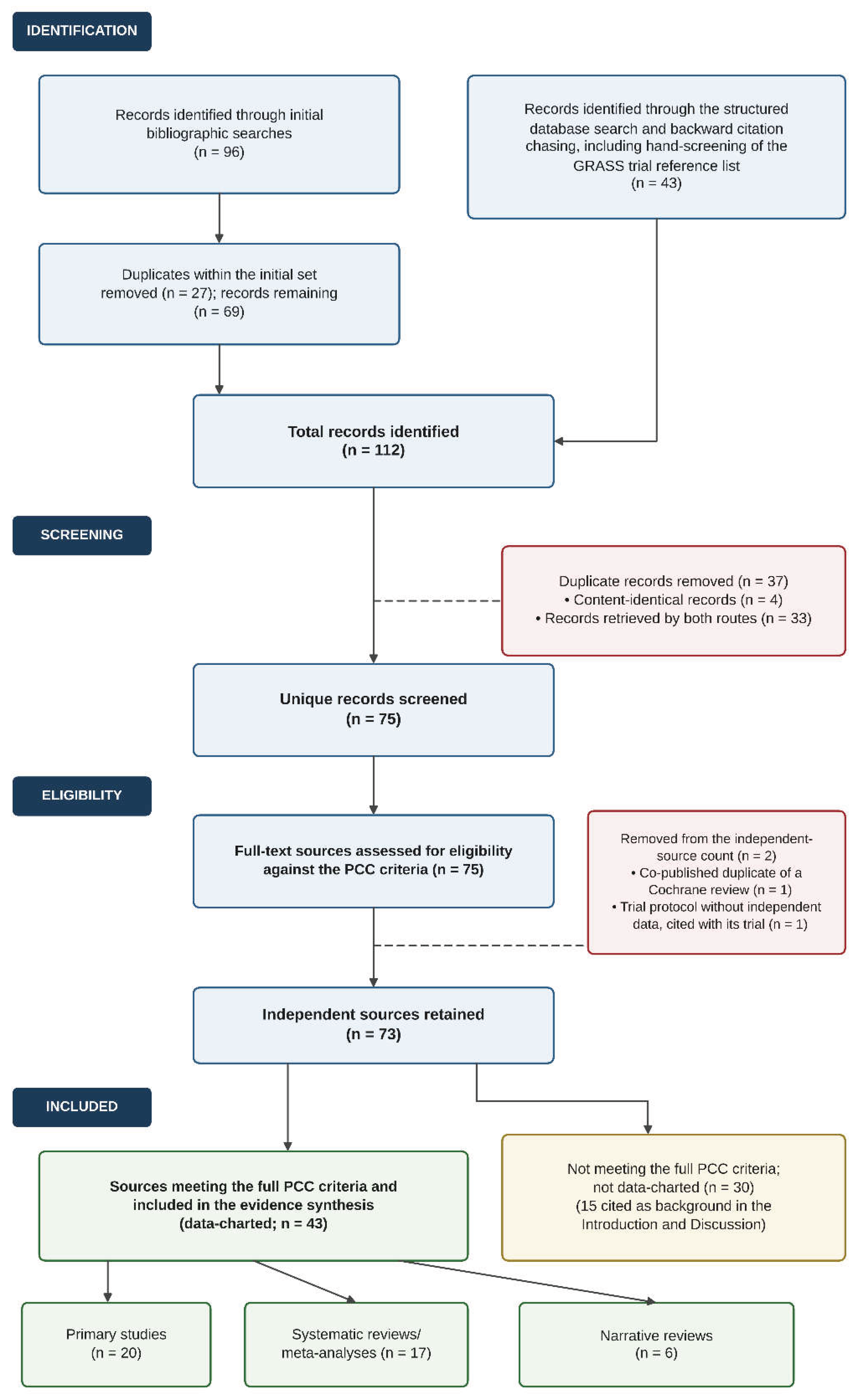
Figure 2.
(A) Publication year of the 43 included sources by clinical focus. (B) Evidence map of study design by clinical focus; bubble size is proportional to the number of sources. AITD, autoimmune thyroid disease; GBD, Graves–Basedow disease; SR/MA, systematic reviews/meta-analyses.
Figure 2.
(A) Publication year of the 43 included sources by clinical focus. (B) Evidence map of study design by clinical focus; bubble size is proportional to the number of sources. AITD, autoimmune thyroid disease; GBD, Graves–Basedow disease; SR/MA, systematic reviews/meta-analyses.
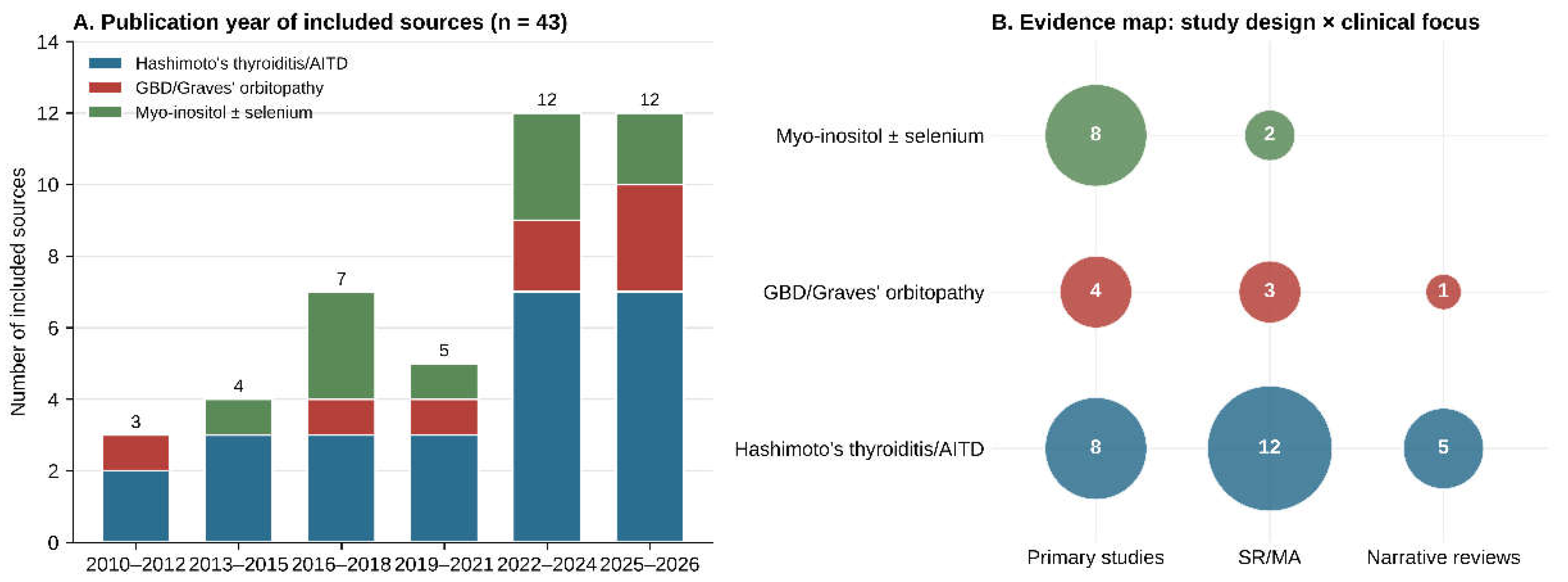
Figure 3.
Pooled standardized mean differences (SMDs) with 95% confidence intervals (CIs) for thyroid peroxidase antibodies (TPOAb) with selenium versus placebo or control in Hashimoto’s thyroiditis, as reported by individual meta-analyses [47,48,49,54].
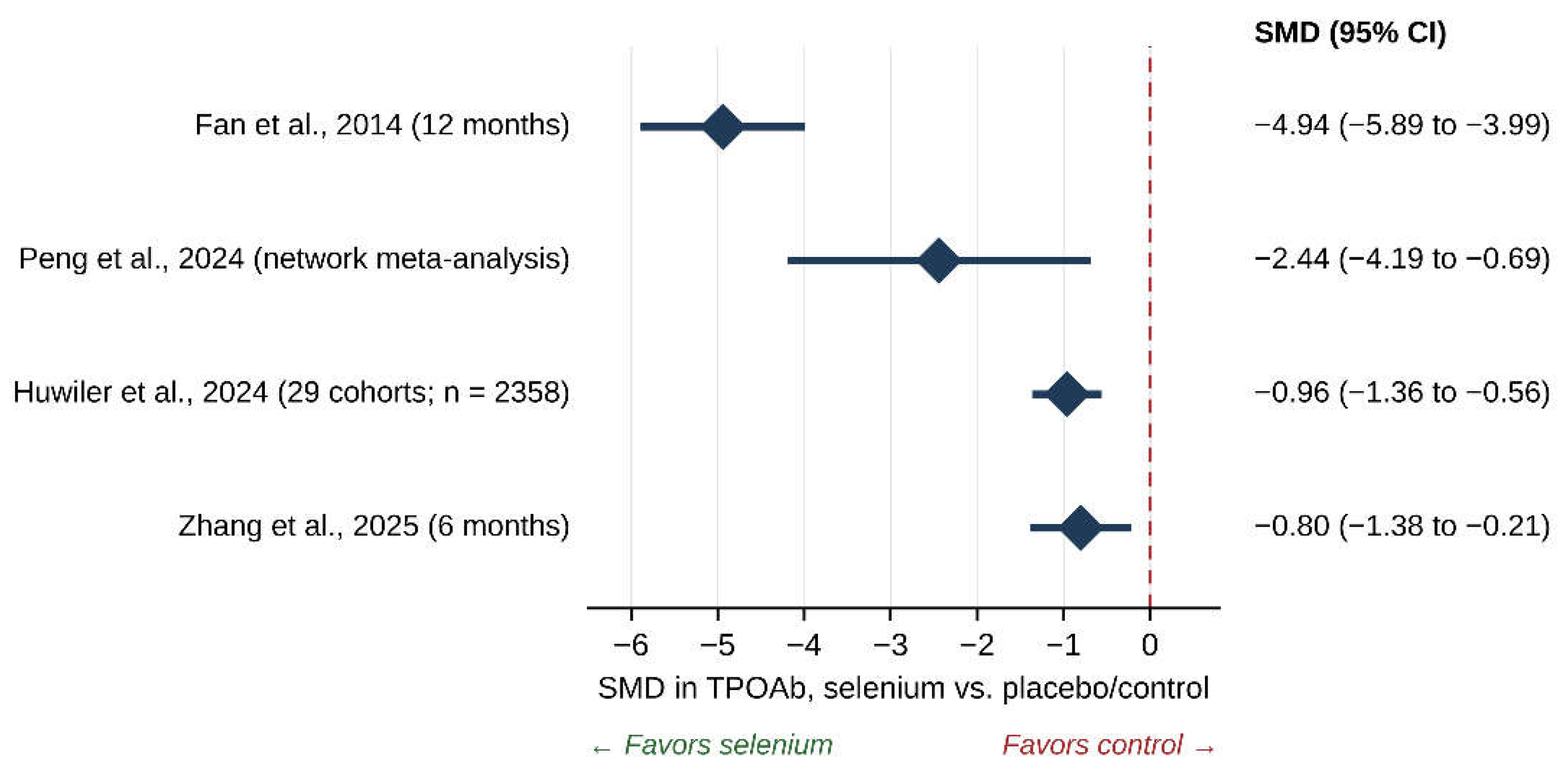
Figure 4.
Pooled standardized mean differences (SMDs) with 95% confidence intervals (CIs) for thyroid-stimulating hormone (TSH) with myo-inositol (MI) plus selenium (Se) versus Se alone in subclinical hypothyroidism due to Hashimoto’s thyroiditis [29,66]; the Se-versus-placebo estimate in patients without thyroid hormone replacement therapy (THRT) is shown for reference [47].
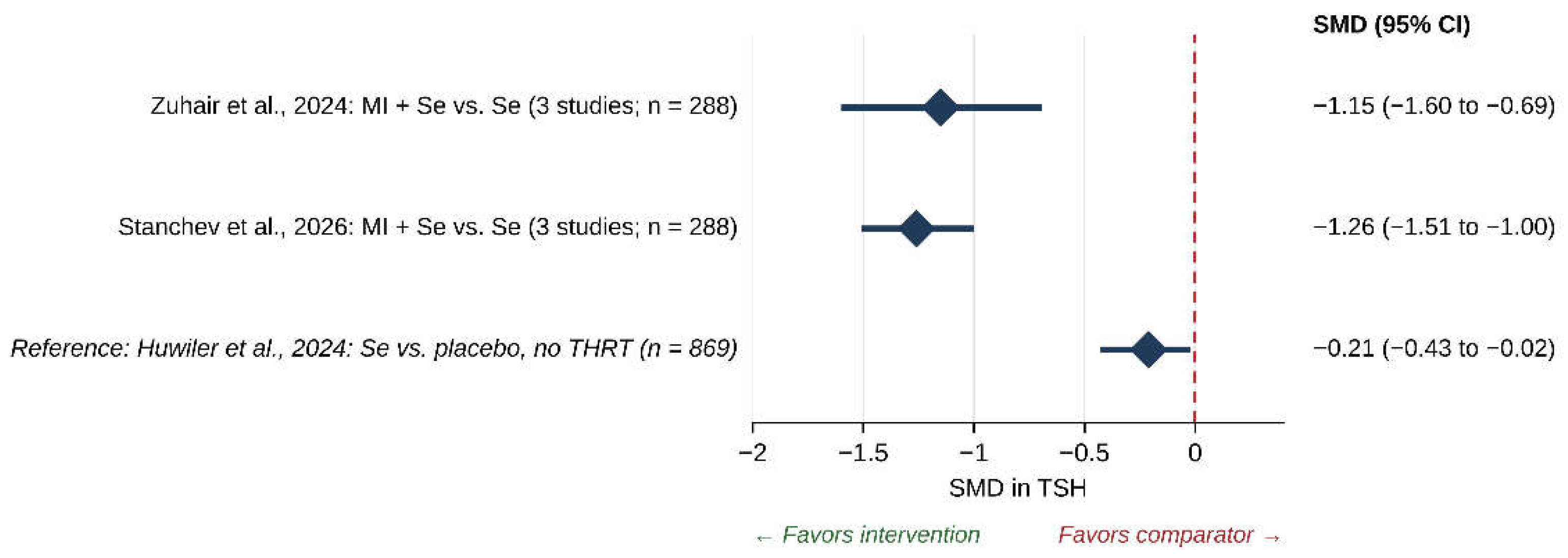
Figure 5.
Schematic linking selenium status to thyroidal selenoprotein function and the biochemical–clinical dissociation observed in the CATALYST and GRASS trials [8,11,23,24,25]. Abbreviations: AITD, autoimmune thyroid disease; CATALYST, Chronic Autoimmune Thyroiditis Quality of Life Selenium Trial; DIO1–3, iodothyronine deiodinases types 1–3; GPx, glutathione peroxidases; GRASS, Graves’ selenium supplementation trial; H₂O₂, hydrogen peroxide; RCTs, randomized controlled trials; SELENOS, selenoprotein S; TgAb, thyroglobulin antibodies; TPOAb, thyroid peroxidase antibodies; TXNRD, thioredoxin reductases.
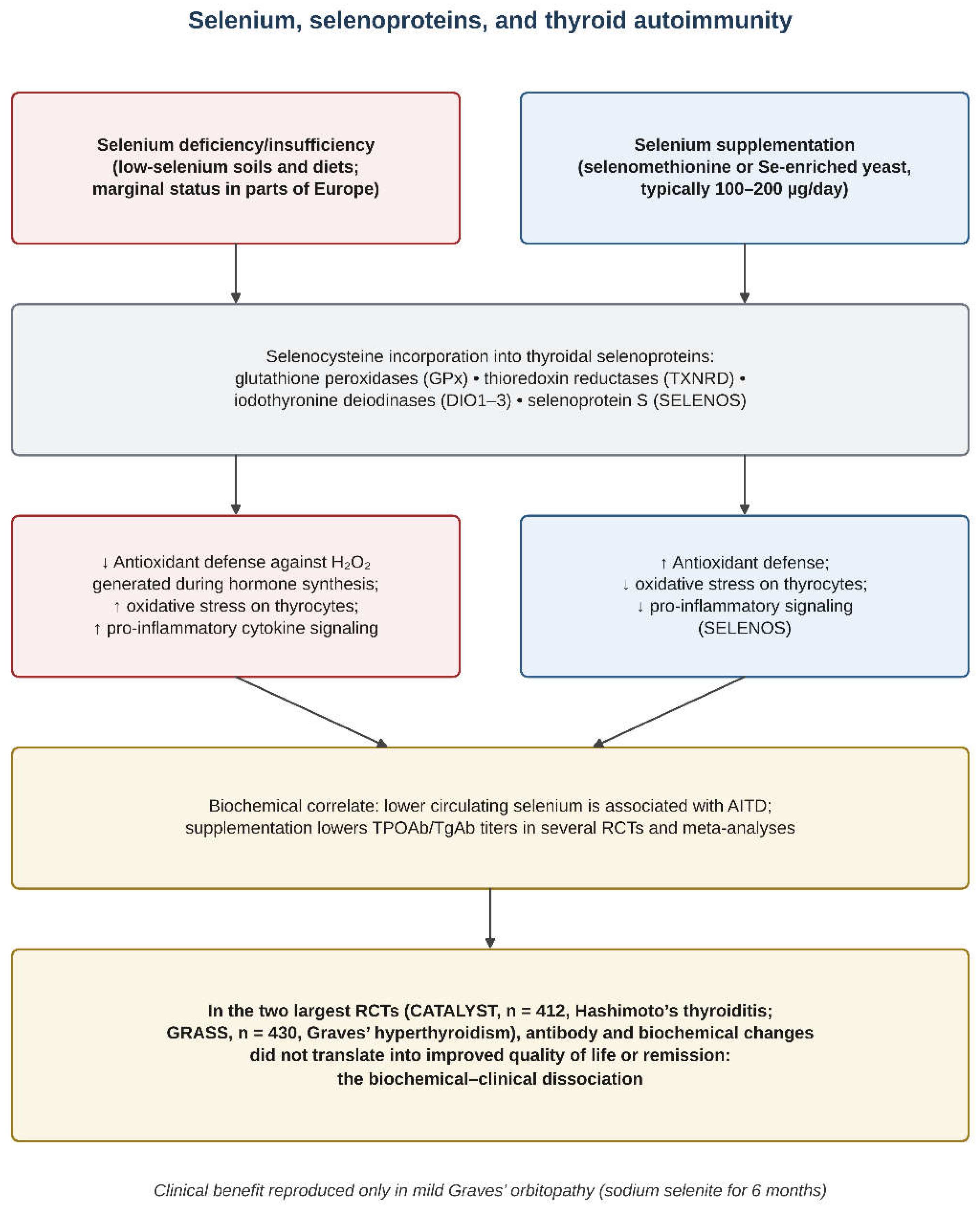
Table 1.
Eligibility criteria according to the Population–Concept–Context (PCC) framework.
| Component | Definition |
|---|---|
| Population | Adults (≥18 years) of either sex. Studies conducted exclusively in children or adolescents, pregnant women, or animal/in vitro models were excluded from the primary evidence synthesis (used only as mechanistic background, if at all). |
| Concept | Selenium status (dietary intake, serum/plasma concentration, selenoprotein expression) or selenium supplementation, alone or with MI, in relation to any clinically relevant feature of AITD: diagnosis/prevalence, autoantibodies (TPOAb, TgAb, TRAb), thyroid function (TSH, FT4, FT3), disease activity/remission, QoL, or GO. |
| Context | Any clinical, population-based, or laboratory-adjacent human research setting, without geographic restriction. Both hypothyroid-phase (HT and synonyms) and hyperthyroid-phase AITD (GBD and synonyms, including GO) were eligible. |
| Study designs | RCTs, non-randomized interventional studies, cohort, case–control, and cross-sectional studies, GWAS, and SR/MA were eligible for data charting. Narrative reviews were retained for comparative discussion. Conference abstracts were eligible only in the absence of a full-text publication. |
| Language | English full text required for primary evidence; non-English sources used only for mechanistic or epidemiological context. |
| Publication window | 1 January 1996 to 31 October 2026. |
Abbreviations: AITD, autoimmune thyroid disease; FT3, free triiodothyronine; FT4, free thyroxine; GBD, Graves–Basedow disease; GO, Graves’ orbitopathy; GWAS, genome-wide association studies; HT, Hashimoto’s thyroiditis; MI, myo-inositol; QoL, quality of life; RCTs, randomized controlled trials; SR/MA, systematic reviews/meta-analyses; TgAb, thyroglobulin antibodies; TPOAb, thyroid peroxidase antibodies; TRAb, thyroid-stimulating hormone receptor antibodies; TSH, thyroid-stimulating hormone.
Table 2.
Selenium in Hashimoto’s thyroiditis and autoimmune thyroid disease in general: summary of included sources (n = 25).
Table 2.
Selenium in Hashimoto’s thyroiditis and autoimmune thyroid disease in general: summary of included sources (n = 25).
| Study [ref.] | Design | Participants (n) | Selenium exposure | Main finding |
|---|---|---|---|---|
| Larsen et al., 2024 (CATALYST) [23] | RCT, multicenter, double-blind | 412 | Se-yeast 200 µg/d + LT4 vs. placebo, 12 mo. | No difference in ThyPRO-39 composite score (28.8 vs. 28.0; p = 0.602); lower TPOAb with Se (1995 vs. 2344 kIU/L; p = 0.016) |
| Hu et al., 2021 [41] | RCT, open-label, untreated control | 90 (43 Se, 47 control) | Se-yeast 200 µg/d, 6 mo. | Decrease in TPOAb (Δ −28.4 vs. 0 IU/mL) and TgAb (Δ −48.8 vs. +18.3 IU/mL) at 6 mo. (both p = 0.001); TSH also decreased |
| Anastasilakis et al., 2012 [42] | Quasi-randomized, 3 arms | 86 | SeMet 200 µg/d for 3 or 6 mo. vs. control | No significant change in TPOAb at 3 mo. (p = 0.88) or 6 mo. (p = 0.62) |
| Toraih et al., 2026 [43] | Retrospective cohort, propensity-matched | 2347 per group | Se (dose NR) vs. none; 5-y follow-up | More patients with elevated TPOAb at 5 y (7.9% vs. 5.3%; p < 0.01); higher all-cause mortality (RR 1.38, 95% CI 1.09–2.03) |
| Acik and Aydin, 2026 [44] | Retrospective cohort | 270 HT, 350 controls; 60 Se-deficient treated | Sodium selenite 20 µg/d or SeMet 200 µg/d, 6 mo. | TPOAb rose after Se (190.4 to 216.0 U/mL; p = 0.01); no change in TSH |
| Zheng et al., 2023 [45] | Cross-sectional (NHANES 2007–2012) | 8756 | Dietary Se intake | Each log2-unit increase associated with lower odds of HT (OR 0.65, 95% CI 0.51–0.83) |
| Wu et al., 2015 [19] | Cross-sectional, population-based | 6152 | Serum Se (adequate- vs. low-Se county) | Higher serum Se associated with lower odds of autoimmune thyroiditis (OR 0.47, 95% CI 0.35–0.65) |
| Upmale-Engela et al., 2024 [46] | GWAS, case–control | 102 HT, 148 GBD, 2442 controls | Serum Se; no supplementation | Lower serum Se in GBD than in controls (71.8 vs. 88.2 µg/L; p = 0.0004); HT associated with the VAT1L locus (OR 4.9) |
| Huwiler et al., 2024 [47] | SR/MA of RCTs (35 studies, 42 cohorts) | 2358 (TPOAb analysis) | Se 60–400 µg/d, 2–12 mo. | TPOAb SMD −0.96 (95% CI −1.36 to −0.56; I² = 90%); TSH SMD −0.21 without THRT; no effect on FT4 or TgAb |
| Zhang et al., 2025 [48] | SR/MA (21 RCTs) | 1610 | SeMet, sodium selenite, or Se-yeast, 3–12 mo. | TPOAb SMD −0.46 at 3 mo. and −0.80 at 6 mo.; SeMet more effective than other forms |
| Peng et al., 2024 [49] | Network MA (10 studies) | 40–168 per study | Se, vitamin D, MI, or Se + MI vs. placebo | Se vs. placebo: TPOAb SMD −2.44 and TgAb SMD −2.76 (both significant) |
| Kong et al., 2023 [50] | SR/MA (7 controlled trials) | 342 | SeMet 200 µg/d (± MI), 3–6 mo. | TPOAb WMD −284.00 at 6 mo. (p < 0.05); no change at 3 mo. |
| Wang et al., 2023 [51] | Umbrella review (76 MAs) | 96 outcomes | Dietary or supplemental Se | SeMet 200 µg/d reduced TPOAb in HT; 90.79% of MAs rated low or very low quality (GRADE) |
| Zuo et al., 2021 [52] | SR/MA (17 RCTs) | 1911 | Se compounds ± ATD | TPOAb MD −150.25 (p < 0.00001); no effect on TSH or TgAb |
| Qiu et al., 2021 [53] | SR/MA (23 trials) | 2394 | Se 80–200 µg/d ± LT4, 3–12 mo. | Lower TPOAb with LT4 at 3–6 mo. (MD −236.88 to −407.17); no change in TSH; evidence insufficient for routine use |
| Winther et al., 2017 [21] | SR/MA (9 trials) | 679 | Se 80–200 µg/d ± LT4 | No effect on TSH, QoL, or echogenicity in LT4-untreated patients; very low to low certainty (GRADE) |
| Wichman et al., 2016 [22] | SR/MA (16 trials) | NR | Se ± LT4, 3–12 mo. | TPOAb WMD −271 at 3 mo. in LT4-treated and −512 in untreated patients (both p < 0.0001) |
| Fan et al., 2014 [54] | SR/MA (9 RCTs) | 787 | Se 200 µg/d (SeMet, selenite, or yeast) | TPOAb SMD −4.94 (95% CI −5.89 to −3.99) at 12 mo. |
| van Zuuren et al., 2013 [55] | Cochrane SR (4 RCTs; not pooled) | 463 | Se 200 µg/d ± LT4 | SeMet reduced TPOAb in two trials (I² = 99%); sodium selenite + LT4 improved well-being (RR 4.67, 95% CI 1.61–13.50) |
| Toulis et al., 2010 [56] | SR/MA (4 RCTs) | 259 | Se 200 µg/d + LT4, 3 mo. | TPOAb WMD −271.09 (95% CI −421.98 to −120.19); improved mood/well-being (RR 2.79) |
| Ventura et al., 2017 [57] | Narrative review | — | SeMet or sodium selenite 80–300 µg/d | Summarizes an early RCT in which Se lowered TPOAb by 40% vs. 10% with placebo |
| de Souza et al., 2025 [58] | Narrative review | — | Se 80–200 µg/d ± MI | Summarizes an RCT in which SeMet lowered TPOAb by 46% (3 mo.) and 55.5% (6 mo.) vs. 21% and 27% with LT4 alone |
| Li et al., 2025 [59] | Narrative review | — | Trace elements, including Se | Summarizes lower serum Se in HT than in controls (p < 0.001) |
| Samuel et al., 2025 [60] | Narrative review | — | Se 83–200 µg/d ± MI | Summarizes MI + Se data (e.g., TSH 4.32 to 3.12 mIU/L over 6 mo.) |
| Bano et al., 2025 [61] | Narrative review | — | Se 100–200 µg/d (up to 400 µg/d) | Summarizes the EUGOGO trial: 200 µg/d reduced GO severity and improved QoL |
Sources are grouped as primary studies, systematic reviews/meta-analyses, and narrative reviews.
Table 3.
Selenium in Graves–Basedow disease and Graves’ orbitopathy: summary of included sources (n = 8).
Table 3.
Selenium in Graves–Basedow disease and Graves’ orbitopathy: summary of included sources (n = 8).
| Study [ref.] | Design | Participants (n) | Selenium exposure | Main finding |
|---|---|---|---|---|
| Cramon et al., 2026 (GRASS) [24] | RCT, multicenter, double-blind | 430 | Se 200 µg/d + ATD, 24–30 mo. | Non-remission 54.6% vs. 53.3% with placebo (OR 1.0, 95% CI 0.7–1.5; p = 0.98); no effect on TRAb or QoL |
| Marcocci et al., 2011 [25] | RCT, double-blind, 3 arms | 159 (mild GO) | Sodium selenite 100 µg twice daily, 6 mo. | Improved QoL (p < 0.001), less eye involvement, and slower GO progression (both p = 0.01) vs. placebo |
| Rossi et al., 2025 [62] | RCT, open-label | 60 | MMI + L-SeMet 83 µg/d + L-carnitine 500 mg/d vs. MMI | Higher spontaneous remission (OR 11.22, 95% CI 3.35–46.11); earlier TRAb negativity (HR 2.35) |
| Xu et al., 2019 [63] | Pilot RCT | 103 (95 completed) | MMI 30 mg/d + Se 600 µg/d vs. MMI, 6 mo. | Greater decreases in FT3, FT4, TRAb, TPOAb, and TgAb with Se (all p < 0.05) |
| Sharabati et al., 2024 [32] | SR/MA (4 RCTs) | 233 | Sodium selenite 100 µg twice daily or Se glycinate 200 µg/d, 6 mo. | CAS MD −1.27 (95% CI −1.68 to −0.85); improved GO-QOL (RR 2.54) at 6 mo. |
| Zheng et al., 2018 [64] | SR/MA (10 RCTs) | 796 | Se 100–300 µg/d + MMI, 3–9 mo. | FT4 WMD −0.86 (95% CI −1.20 to −0.53) at 3 mo.; effects persisted at 6 but not at 9 mo. |
| Vargas-Uricoechea et al., 2025 [31] | Scoping review (15 studies) | 11 GBD and 4 GO studies | Se 60–300 µg/d (± MMI), 4 wk–5 y | ≥1 significant favorable outcome in 9/11 GBD and 4/4 GO studies |
| Fatourechi and Heshmati, 2024 [65] | Narrative review | — | Se 100–300 µg/d + MMI; selenite 100 µg twice daily in GO | Summarizes a Danish RCT (n = 491) showing higher all-cause mortality with 300 µg/d but not with 100–200 µg/d |
Abbreviations: 3. free triiodothyronine; FT4, free thyroxine; GBD, Graves–Basedow disease; GO, Graves’ orbitopathy; GO-QOL, Graves’ orbitopathy quality-of-life questionnaire; GRASS, Graves’ selenium supplementation trial; HR, hazard ratio; L-SeMet, L-selenomethionine; MA, meta-analysis; MD, mean difference; MMI, methimazole; mo., months; OR, odds ratio; QoL, quality of life; RCT, randomized controlled trial; RR, risk ratio; Se, selenium; SR, systematic review; TgAb, thyroglobulin antibodies; TPOAb, thyroid peroxidase antibodies; TRAb, thyroid-stimulating hormone receptor antibodies; WMD, weighted mean difference; wk, weeks; y, years.
Table 4.
Pooled effect estimates from meta-analyses and headline results of the two largest randomized controlled trials (in autoimmune thyroiditis, HT, and Graves’ hyperthyroidism).
Table 4.
Pooled effect estimates from meta-analyses and headline results of the two largest randomized controlled trials (in autoimmune thyroiditis, HT, and Graves’ hyperthyroidism).
| Source [ref.] | Population | Outcome | Estimate (95% CI) | Appraisal and comments |
|---|---|---|---|---|
| Fan et al., 2014 [54] | Autoimmune thyroiditis | TPOAb, 12 mo. | SMD −4.94 (−5.89 to −3.99) | AMSTAR-2: low; large effect from an older, smaller evidence base |
| Peng et al., 2024 [49] | HT | TPOAb, Se vs. placebo | SMD −2.44 (−4.19 to −0.69) | AMSTAR-2: low; network MA, wide CI from indirect comparisons |
| Huwiler et al., 2024 [47] | HT (29 cohorts; n = 2358) | TPOAb, overall | SMD −0.96 (−1.36 to −0.56) | AMSTAR-2: high; I² = 90% |
| Huwiler et al., 2024 [47] | HT without THRT (7 cohorts; n = 869) | TSH, Se vs. placebo | SMD −0.21 (−0.43 to −0.02) | Statistically, but not clearly clinically, significant |
| Zhang et al., 2025 [48] | HT | TPOAb, 6 mo. | SMD −0.80 (−1.38 to −0.21) | AMSTAR-2: moderate; SeMet more effective than sodium selenite |
| Zuhair et al., 2024 [29] | HT with SCH (3 studies; n = 288) | TSH, MI + Se vs. Se | SMD −1.15 (−1.60 to −0.69) | AMSTAR-2: low; studies largely from one research group |
| Stanchev et al., 2026 [66] | HT with SCH (same 3 studies; n = 288) | TSH, MI + Se vs. Se | SMD −1.26 (−1.51 to −1.00) | AMSTAR-2: moderate; I² = 0%; small evidence base |
| CATALYST [23] | HT, LT4-treated (n = 412) | ThyPRO-39 composite, 12 mo. | 28.8 vs. 28.0; p = 0.602 | RoB 2: low; TPOAb reduced (p = 0.016) without QoL benefit |
| GRASS [24] | Graves’ hyperthyroidism (n = 430) | Non-remission (primary outcome) | OR 1.0 (0.7–1.5); p = 0.98 | RoB 2: low; no effect on TRAb or QoL |
Table 6.
Comparison of this scoping review with selected previous systematic reviews and meta-analyses.
Table 6.
Comparison of this scoping review with selected previous systematic reviews and meta-analyses.
| Previous review [ref.] | Scope | Principal conclusion | Acknowledged limitations | How this review extends it |
|---|---|---|---|---|
| van Zuuren et al., 2013 (Cochrane) [55] | Se supplementation in HT (4 RCTs) | SeMet reduced TPOAb in two trials; sodium selenite + LT4 improved well-being in one trial; evidence insufficient for decision making | Four RCTs at unclear to high risk of bias; no data on QoL or LT4 dose | Adds a decade of RCTs, including CATALYST (n = 412), and extends the synthesis to GBD and MI |
| Winther et al., 2017 [21] | Se in chronic autoimmune thyroiditis | No effect on TSH, QoL, or ultrasound echogenicity; very low to low certainty | Few trials; LT4-treated subgroup could not be meta-analyzed | Contrasts this conclusion with the larger Huwiler et al. meta-analysis and CATALYST |
| Wichman et al., 2016 [22] | Se and thyroid autoantibodies in chronic autoimmune thyroiditis | TPOAb reduced at 3 mo. in LT4-treated and untreated patients | Short follow-up; antibody reduction not linked to clinical outcomes | Tests whether the antibody signal translates into patient-relevant outcomes in longer RCTs |
| Huwiler et al., 2024 [47] | Se in HT (29 cohorts; n = 2358 for TPOAb) | TPOAb reduced overall; TSH reduced only without THRT; moderate certainty | High heterogeneity for TPOAb (I² = 90%) | Juxtaposes the antibody effect with the null QoL result of CATALYST |
| Peng et al., 2024 [49] | Se, vitamin D, MI, and Se + MI in HT (network MA) | Se most effective for antibody reduction among the supplements compared | Transitivity assumptions across small, heterogeneous trials | Positions MI + Se within the broader selenium literature |
| Fatourechi and Heshmati, 2024 [65] | Se in GBD and GO (narrative review) | Inconsistent benefit in hyperthyroidism; benefit in mild GO; mortality signal at 300 µg/d | Non-systematic methods; no formal quality appraisal | Adds the GRASS trial (n = 430) and applies PRISMA-ScR methods with critical appraisal |
| Zuhair et al., 2024 [29] | MI + Se vs. Se in HT with SCH | MI + Se superior to Se alone for TSH reduction (3 studies; n = 288) | Only three small studies, largely from one research group | Treats this concentration as a certainty-limiting factor and calls for independent replication |
Abbreviations: CATALYST, Chronic Autoimmune Thyroiditis Quality of Life Selenium Trial; d, day; GBD, Graves–Basedow disease; GO, Graves’ orbitopathy; GRASS, Graves’ selenium supplementation trial; HT, Hashimoto’s thyroiditis; LT4, levothyroxine; MA, meta-analysis; MI, myo-inositol; mo., months; PRISMA-ScR, Preferred Reporting Items for Systematic reviews and Meta-Analyses extension for Scoping Reviews; QoL, quality of life; RCT, randomized controlled trial; SCH, subclinical hypothyroidism; Se, selenium; SeMet, selenomethionine; THRT, thyroid hormone replacement therapy; TPOAb, thyroid peroxidase antibodies; TSH, thyroid-stimulating hormone.
Disclaimer/Publisher’s Note: The statements, opinions and data contained in all publications are solely those of the individual author(s) and contributor(s) and not of MDPI and/or the editor(s). MDPI and/or the editor(s) disclaim responsibility for any injury to people or property resulting from any ideas, methods, instructions or products referred to in the content. |
© 2026 by the authors. Licensee MDPI, Basel, Switzerland. This article is an open access article distributed under the terms and conditions of the Creative Commons Attribution (CC BY) license (http://creativecommons.org/licenses/by/4.0/).
Copyright: This open access article is published under a Creative Commons CC BY 4.0 license, which permit the free download, distribution, and reuse, provided that the author and preprint are cited in any reuse.