

Submitted:
21 November 2026
Posted:
25 November 2026
You are already at the latest version
Abstract
The International Computation Centre (ICC) was established by a Convention signed in Paris on 6 December 1951 under UNESCO auspices and in force from 28 November 1961. Its preamble justified the Centre by “mathematical problems [...] which involve extremely complicated calculations”, and its Article II gave equal weight to research, education and a computation service. Transformed from 1969 and renamed the Intergovernmental Bureau for Informatics (IBI) in 1974, the organisation had 43 member states in 1985 and was dissolved in 1988. Historians have studied the genesis of the ICC and the information politics of the IBI separately; the place of applied mathematics across the transition has not been examined. I formulate three falsifiable hypotheses, define indicators and exact tests for them, and apply them to sources available online: the Convention and its ratification record in the UN Treaty Series, catalogue records of ICC and IBI symposia (1959–1974), the final report of the 1978 SPIN conference, the IBI’s 1985 self-presentation, its 1986 training plan, and data on membership of the Non-Aligned Movement (NAM). Three of the first eleven parties (1952–1962), including two of the ten whose acceptance brought the Convention into force, were founding NAM members. The ICC organised symposia on management and on the economics of data processing as early as 1965, alongside its mathematical meetings. In 1985, 34 of the 43 IBI member states were active NAM members and three were observers. Mathematical classes account for 3 of 6 classifiable units in 1959–1968 and none of 11 in 1978–1988 (two-sided Fisher exact test, p = 0.018); restricted to international conferences only, the difference is not significant (p = 0.17). Of the 77 activities in the IBI’s 1986 regional training plan, one concerns numerical analysis. The evidence points to a disciplinary shift, but a conclusive test will require work in the UNESCO Archives, which the paper specifies.
Keywords:
history of applied mathematics
; numerical analysis
; scientific computing
; International Computation Centre
; Intergovernmental Bureau for Informatics
; Non-Aligned Movement
; UNESCO
MSC: 01A60; 01A74; 68-03
Résumé. Le Centre international de calcul (ICC), institué par une convention signée à Paris le 6 décembre 1951 et entrée en vigueur le 28 novembre 1961, devient en 1974 le Bureau intergouvernemental pour l’informatique (IBI), dissous en 1988. Cet article formule trois hypothèses sur le recul des mathématiques appliquées au cours de cette transition et sur la place des États non alignés, définit des indicateurs et des tests exacts, et les applique à des sources vérifiables en ligne. Dès 1965, l’ICC organise des colloques de gestion et d’économie de l’informatique. En 1985, 34 des 43 États membres de l’IBI sont membres actifs du Mouvement des non-alignés. Les unités mathématiques passent de 3 sur 6 (1959–1968) à 0 sur 11 (1978–1988) ; restreinte aux seules conférences, la différence n’est pas significative. Les résultats sont compatibles avec un déplacement disciplinaire, sans l’établir.
1. Introduction
Histories of numerical analysis and scientific computing in the second half of the twentieth century are mostly written from North American, Western European and Soviet institutions. When historians study computing in the countries of the Non-Aligned Movement (NAM) and other states of the South, they usually examine hardware policy, protectionism or informational sovereignty. The mathematical practices, the numerical methods and the multilateral institutions that were meant to share computing capacity receive less attention.
The International Computation Centre (ICC), renamed the Intergovernmental Bureau for Informatics (IBI) in 1974, allows the two to be studied together. Its Convention, signed in Paris on 6 December 1951, opens by stating “that there are mathematical problems at the present time in many branches of science which involve extremely complicated calculations”, and that recent machines made possible calculations that “would have been practically impossible in the past” [33]. Article II gave the Centre a “triple function” of scientific research, education, and a consultative and computation service, of equal importance. Under the first heading the Centre was to “work out a programme for the study, on an international level, of pure science problems, in so far as these problems concern computation”, and it was to meet first the needs of member states “which may have limited resources” [30,33].
The literature covers the two ends of this history separately. Nofre showed how transatlantic scientific and industrial rivalries between 1946 and 1961 reduced the plan for an international computing laboratory to a service centre with limited means [21]. Mahoney and Pohle analysed the IBI of the 1970s and 1980s in terms of information geopolitics, transborder data flows and the debates on a New World Information and Communication Order [16,23,24]. Neither line of work asks when and how applied mathematics and scientific computing left the agenda of the ICC–IBI, or how this relates to the growing share of non-aligned states among its members. Three hypotheses, each of which the sources could refute, frame the analysis:
- (disciplinary shift). The share of activities and meetings in applied mathematics and numerical analysis falls between the ICC phase (1959–1968) and the IBI phase (1978–1988), while the share of administrative informatics, management and information policy rises.
- (North–South asymmetry in authorship). In the mathematical phase of the ICC (1959–1968), most authors published in the ICC Bulletin and in the symposium proceedings were affiliated with Western European and North American institutions, although several non-aligned states were parties to the Convention.
- (decoupling of national demand and multilateral programme). Around the 1978 SPIN conference, national assessments still included scientific and university computing, while the operational programme of the IBI concentrated on state administration, data-flow policy and technology transfer to administrations.
After a section on sources and methods (Section 2), the paper follows the chronology. Section 3 covers the treaty, its first parties and the meetings held up to 1968, among them a management track opened in 1965. Section 4 turns to SPIN I, the programme of 1985, the training plan of 1986 and the membership of 1985, and reports the tests of . The limits of the study and the archival work it calls for are discussed in Section 5.
2. Sources and Methods
2.1. Corpora and Access
Table 1 lists the corpora and what could be read of each. I used only material available online, and I say so in the text whenever a statement rests on a secondary or tertiary source.
2.2. Coding Scheme and Periods
Each documentary unit (a symposium or conference, a section of the SPIN I report, or an activity line of the 1985 statement) is assigned to one class of a partition fixed in advance:
- (numerical analysis and continuous applied mathematics): numerical solution of partial, ordinary, integral and integro-differential equations, numerical linear algebra, approximation, computational physics or statistics;
- (discrete mathematics and optimisation): graph theory, combinatorics, mathematical programming, operations research;
- (foundations of computing and languages): symbolic and programming languages, compilation, automata, logical design;
- (non-mathematical informatics, management and policy): economics of data processing, management planning, administrative computing, computer law, industrial policy, transborder data flows;
- (undetermined): units whose title or description does not identify a dominant technical domain.
A unit that spans two classes goes to the class of its main object; borderline cases are tested in sensitivity analyses (Section 4.5). Dated units fall into three windows:
The 1968/1969 boundary marks the start of the transformation directed by Fermín A. Bernasconi; the 1977/1978 boundary marks SPIN I.
2.3. Estimators
For and , let be the number of units in class k, the number of undetermined units, and . For ,
Reporting shows how much information is lost to undetermined units. Each proportion receives a Wilson interval at level [38], which keeps its coverage for small N and for :
For , the mathematical classes are pooled, , and compared with in a table crossing (first row) and (second row), with . Homogeneity is tested with the two-sided Fisher exact test, with the conditional maximum-likelihood estimate of the odds ratio and its exact 95% interval [1]. In the diagonal case with , all tables with the observed margins have top-left entry and probability , so that
because when the table has the same margins and the same probability as the observed one. This diagonal case does not arise in Table 4, where , but it does for any corpus that omits the 1965 management meetings: with restricted to the four mathematical and language symposia, the table gives , which overstates the evidence. Whenever and , and only the lower bound of the interval is informative. A small p means that the counts are hard to reconcile with stable thematic shares; it does not identify a cause.
Four sensitivity checks are made: (A) adding to M; (B) recoding the borderline 1965 management-planning symposium from to ; (C) restricting the comparison to international conferences, against , so that document type is held constant; (D) recoding the generic SPIN I heading on national capacity for use (“Amélioration des capacités nationales d’utilisation”) from to , in addition to “Applications de l’informatique” already coded .
Coding reliability is to be assessed by blind recoding of a stratified 20% sample by a second coder, with Cohen’s coefficient [3]
where counts units placed in class j by the first coder and k by the second, and is the sample size; if , only is reported.
2.4. Indicators of Non-Aligned Participation
Definition
(NAM status). For a state i and a year t, let be its year of admission to the NAM as a full member and the year in which its active participation ended ( if it did not). For the period studied () a single interval suffices; Chile’s return to the NAM in 1992 [2] lies outside it. The status is
Definition
(Participation shares). For a non-empty set of member states in year t,
For a fixed cohort , the accession curve records when the active members of that cohort joined the NAM.
Definition
(Continuity and diversity). For sets with , the Jaccard index is . The relation between the parties of 1952–1962 (A) and the members of 1985 (B) is drawn as a bipartite graph with an edge between the two copies of each state in . For regions with shares , the Shannon index is (with ) and the evenness is .
Two further indicators are defined for the full test. For , the NAM share of authors is , defined when the number of authors with an identified affiliation is at least one, and tested with a one-sided binomial test of against . For , if marks the themes of the national study of state i and those of the IBI programme,
where is the Jaccard distance and flags a state that asks for scientific computing when the programme contains none.
2.5. Algorithms
Algorithm 1 gives the coding and estimation procedure and Algorithm 2 the NAM indicators. Both are implemented in a Python script based on SciPy [27], supplied with the data (Appendix Section 7).
| Algorithm 1:Coding and estimation for |
|
| Algorithm 2:NAM indicators for a membership list |
|
3. The ICC Phase (1951–1968)
3.1. Treaty Architecture
The governance clauses of the Convention reflect its scientific orientation. Each member state was to be represented in the General Assembly by a delegate “preferably with scientific qualifications” (Art. V), and the six elected members of the Executive Council were to be chosen from pairs of candidates nominated by each state, one for scientific qualifications and one for administrative experience (Art. VI) [33]. Under Article XIV, the Convention entered into force once ten states had become parties, which happened on 28 November 1961 [33].
The financial annex indexed contributions to each state’s share of the UNESCO budget in five groups, from US$2,000 (Group A, under 0.50%) to US$20,000 (Group E, 15% or more) [33]. With a ceiling at US$20,000 and without the United States and the United Kingdom [21], the budget depended on a small number of European contributors. Whether this structure contributed to the financial crisis of 1985–1988 is a hypothesis that the budget records would have to test (Section 5).
3.2. First Parties and the Non-Aligned States
The list of parties in the UN Treaty Series records eleven states between 1952 and 1962 (Table 2) [33]. Ceylon, France, the United Arab Republic, Libya and Argentina became parties by acceptance without having signed. The deposit of the United Arab Republic was treated as an unconditional acceptance of Egypt’s 1951 signature, and the Convention entered into force for Cuba on 27 March 1962 by signature without reservation as to acceptance [33]. The Convention thus had thirteen signatories: the twelve states named in the signature block of the digitised volume (Belgium, Egypt, Ecuador, Greece, Iraq, Israel, Italy, Japan, Liberia, Mexico, the Netherlands and Turkey), several of whose signature dates are not legible in that copy, and Cuba, which signed without reservation on 27 March 1962 [33].
Of the ten parties whose acceptance brought the Convention into force on 28 November 1961, two were founding NAM members at Belgrade in September 1961 (Ceylon and the United Arab Republic); with Cuba, party from March 1962, three of the first eleven parties were founding members: , Wilson 95% interval . With Libya, admitted in 1964, the share rises to . At the 1973 Algiers summit Argentina joined the NAM and Mexico attended as an observer [34]. Few of these states were still members in 1985. Six of the eleven parties (Argentina, Cuba, Egypt, France, Italy, Mexico) appear in the 1985 list, which gives , and the index between the thirteen signatories and the 1985 members is . Figure 1 draws the corresponding graph . Table 2 and the left side of the figure give NAM status in 1973 because the Algiers summit of that year is the last before the organisation took the name IBI (1974), and its participant list records both new members and observers [34].
3.3. Scientific Meetings and the Management Track of 1965
UNESCO set up a provisional ICC in Rome in September 1957, with the assistance of the Italian Institute of Higher Mathematics [32]. The ICC Bulletin began in 1962 [20]. In the mid-1960s the Centre was directed by the French mathematician Claude Berge [22].
Table 3 lists the seven meetings identified in catalogue records and in the secondary literature. The 1960 volume, catalogued under the Provisional ICC [11], contains among others a paper by Peter Henrici on the propagation of round-off error in initial value problems [8] and one by K. Hain and F. Hertweck on difference methods with automatic step-length control [7]. The proceedings of the 1966 graph-theory symposium, edited by Pierre Rosenstiehl, include the planarity-testing algorithm of Lempel, Even and Cederbaum [14,26].
Example
(A contribution: planarity testing). A graph is planar if it can be drawn in the plane without edge crossings. For a simple planar graph with , Euler’s formula implies , which gives a constant-time rejection test for dense graphs. The algorithm presented at the 1966 Rome symposium [14] decides planarity in general by adding vertices one at a time in a suitable order and checking whether the partial embedding can be extended.
Two of the seven meetings, both in 1965, dealt with the economics of data processing and with management planning [5,15,18]. The turn away from numerical analysis cannot therefore be dated simply to the transformation of 1969. By 1965 the ICC was already running managerial activities next to its mathematical ones.
3.4. What Can Be Said About
requires the affiliations printed in the ICC Bulletin and in the four mathematical volumes, which could not be read online. The few contributions identified here (Henrici; Hain and Hertweck, recorded in the repository of the Max Planck Society [7]; Lempel, Even and Cederbaum) are too few, and too selectively found, to estimate . remains untested. The NAM share of the early parties ( in 1961) is the benchmark against which can later be compared.
4. The IBI Phase (1969–1988)
4.1. Reorientation and SPIN I
The transformation that began in 1969 was followed by a reorganisation in 1971–1972 and an expansion from 1973 [31]; it was directed by the Argentine general manager Fermín A. Bernasconi [24,36]. In window the organisation held a World Conference on Informatics in Government in Florence in October 1972 [36] and a second symposium on the economics of informatics in Mainz on 16–20 September 1974, again edited by A. B. Frielink [6]. The name Intergovernmental Bureau for Informatics was adopted under a resolution of the General Assembly held in Paris on 11–13 December 1974; by 1985 the Executive Council was composed of representatives of 30% of the member states [9]. Figure 2 places these events beside the ICC symposia and the NAM summits.
SPIN I, organised jointly by UNESCO and the IBI, met at Torremolinos from 28 August to 6 September 1978, with delegates from 76 UNESCO member states, 25 of which were also IBI members [28]. The report of its two commissions has seven sections: training of personnel; evaluation and acquisition of techniques, industrial capacity, research and development; information on informatics (Commission I); applications of informatics; improvement of national capacity to use informatics; informatics and socio-cultural development; transnational data flows (Commission II) [28]. None of these headings names mathematics, numerical analysis or scientific computing. The subject indexing of the main working document in UNESDOC, however, includes “computer science education”, “research and development” and “scientific innovations” [29]. Since I have read neither the body of the report nor the national studies, the most that can be said is that these subjects did not structure the report.
4.2. The 1985 Programme
In 1985 the IBI presented itself at an IFAC conference in Lisbon [9]. The text describes informatics as a means to reduce “the technological abyss dividing the industrialized and developing countries”. It states that “the informatization of a country is a process that must be controlled by the government”, as an infrastructure “for the efficient management of a Nation-State”. It lists eight activity lines: sectoral and regional research (agriculture, education, health); the Special Programme of Informatics for Development (SPINDE); world conferences on transborder data flow policies, the first in Rome in June 1980 and a second in Rome on 26–29 June (the year is not given in the text); the bibliographic information system IBIS; support for national informatics structures; technical missions, training seminars and expert sessions; “vertical” transfer of technology for the computerisation of national administrations; and “horizontal” regional pilot projects [9]. Neither mathematics nor numerical, scientific computing or university occurs anywhere in it.
4.3. The 1986 Training Plan
The plan of activities for 1986 of the IBI Regional Centre for Informatics Training (CREI), based in Madrid, lists 77 courses, seminars and meetings in Spain, Portugal and Latin America [4]. Most concern administrative, legal, sectoral or managerial uses of informatics (justice, taxation, ports, health, public administration, office automation, legal informatics). A search of the titles gives the following counts:
- one activity explicitly in numerical analysis, “Simulación y análisis numérico con ordenador” (Peru): , Wilson 95% interval ;
- four activities if computing for statisticians and system dynamics are added (Argentina, Venezuela, Chile): ;
- three activities on university-level informatics (a master’s course in Spain and activities in Colombia and Honduras): .
These counts cover one regional centre in one year and are kept out of the test, whose units are of another kind. Within that centre, at least, numerical analysis had become a marginal subject.
4.4. Membership in 1985
At its peak in 1985 the IBI had 43 member states: three in Europe (France, Italy, Spain), 18 in sub-Saharan Africa, nine Arab states and 13 in Latin America [36]. This list is not referenced in its source and should be checked against the General Assembly records. The Shannon index of the regional composition is and the evenness .
Two entries in the tertiary NAM lists have to be corrected. First, Chile joined the NAM in 1971, but after the coup of September 1973 the Movement excluded the military government in practice by not inviting it; Chile returned only at the Jakarta summit in 1992 [2]. Under Definition 1, Chile was not an active member in 1985. Second, the United Arab Emirates are listed as admitted in 1970 [37], which precedes the creation of the federation in December 1971; they do not appear in the participant list of the 1973 Algiers summit as reproduced in [34], which is only negative evidence. Their year of admission is therefore left undetermined; they are counted as a member in 1985, and a sensitivity check excludes them.
With these corrections, 34 of the 43 states were active NAM members in 1985, three were observers (Brazil, Costa Rica, Mexico) and six were neither (France, Italy, Spain; Chile; Haiti, a member from 2006; Venezuela, a member from 1989) (Table 5 in Appendix Section 8). Hence
with Wilson 95% intervals. Counting Chile gives ; excluding the United Arab Emirates gives . Brazil and Mexico attended the 1973 Algiers summit as observers, and so did Venezuela [34]; if Venezuela still held that status in 1985, . Costa Rica is listed as an observer country by the NAM Centre for South-South Technical Cooperation and by the Indian Ministry of External Affairs [17,19], but these lists describe the present and the date of that status is unknown; without Costa Rica, . All 18 sub-Saharan African and all nine Arab members were NAM members; the 13 Latin American members comprised seven members, three observers and three non-members (Figure 3, right). For the 33 active members whose admission year is known, rises from 11 in 1961 to 20 in 1964, 22 in 1970, 27 in 1973, 29 in 1976, 31 in 1979 and 33 in 1983 (Figure 3, left). The curve records admissions to the NAM, not to the ICC or the IBI, for which dated membership lists were not available.
4.5. Test of
The corpus combines the seven meetings (Table 3), the two meetings (Florence 1972, Mainz 1974) and fifteen units (the seven SPIN I sections and the eight activity lines of 1985): , of which 19 are classifiable (the generic SPIN I heading “Applications de l’informatique” is coded on the same footing as “Formation de personnel”, because the heading alone does not identify a technical domain). Table 4 gives the counts, shares and tests; Figure 4 shows the shares.
For check C, the conferences are Florence 1972, Mainz 1974, SPIN I 1978 and the two Rome conferences on transborder data flows (all ) [6,9,28,36]. Including the 1965 meetings removes the zero in that a narrower corpus would produce. The primary test and checks A, B and D give . When document type is held constant (check C), the direction is the same, from 50% (67% with ) to 0%, but with units in the M versus table ( when is included) the difference is not significant at the 5% level. The data therefore support without establishing it: the tests that reach significance compare different types of document, and the one test that holds document type constant has too few units.
4.6. Crisis and Dissolution (1985–1988)
5. Discussion
Two situations stand out. Up to 1966 the ICC held meetings in numerical analysis and graph theory, and non-aligned states were among the parties to its Convention, although nothing is known yet about their place among the authors. In 1985 about four-fifths of the IBI’s members belonged to the NAM, while its stated programme, its conferences and the courses of its Madrid centre were concerned with public administration and data-flow policy and almost never with numerical analysis. The present material does not say why. The change may have answered the requests of member states, reflected choices made by the secretariat in Rome, or followed from the spread of computers in universities, which made a shared numerical laboratory less necessary.
A related question is whether national institutions took over the role that the multilateral organisation had given up. The case of Argentina, an IBI member, suggests where to look: the Escuela Superior Latinoamericana de Informática (ESLAI), a computer science school, was created in 1986 and closed in 1990 [35]; according to an unreferenced statement in [36], the IBI and the Argentine government had created in 1983 the foundation from which the school emerged. Comparable studies of national scientific-computing institutions in other member states would show whether such initiatives relied on, or bypassed, the IBI.
The limits of the study are the following.
- Units and coding. Titles and headings capture stated priorities, not the content of generic training or pilot lines (–, and in sensitivity check D). The significant tests compare different types of document; blind recoding by an independent second historian is needed before can be reported.
- . Author affiliations in the ICC Bulletin and the four mathematical volumes have to be extracted from physical or full-text copies.
- . Computing and requires reading the national studies prepared for SPIN I and the body of its final report.
- Membership. The 1985 list comes from an unreferenced tertiary source; NAM admission years are partly tertiary; observer status in 1985 (Venezuela, Costa Rica) and the UAE admission year are not established; dated annual lists of ICC and IBI members are needed to compute for every year.
The archival programme follows from these limits: the records of the IBI General Assembly and Executive Council (membership lists, budgets, programme debates), the complete runs of the ICC Bulletin and of IBI periodicals, and the SPIN I national studies, all held in or catalogued by the UNESCO Archives [13,25]. Budget records would also allow to be weighted by expenditure rather than by counts of units, and would test the hypothesis that the contribution scale of 1951 made the organisation dependent on a few European contributors.
6. Conclusion
The ICC was founded on a mathematical justification, with governance rules that favoured scientific delegates and a mandate to serve states with limited resources. Its first parties included three founding members of the NAM. Between 1959 and 1966 it organised meetings in numerical analysis, programming languages and graph theory, and from 1965 it also organised meetings on management and the economics of data processing. By 1985 the IBI was an organisation whose members were mostly NAM states and whose programme dealt with informatics policy, administration and data flows. On the sources available online, the shift appears to have started before 1969, in 1965, and to have been almost complete by the mid-1980s. Whether it was as clear-cut as these counts suggest will be settled only by the records of the IBI’s governing bodies and by the author lists of the ICC’s own publications.
7. Data Schema
pilot_corpus.csv has one row per unit with the fields unit_id, window, year, corpus, unit_type, conference (yes/no), title, class, coding_note and source (bibliography key). conference_subcorpus_T23.csv lists the five international conferences of (unit_id, window, year, title, class, source). crei_1986_plan.csv lists the 77 activities with three binary flags (c1_narrow, c1_broad, university_cs). ibi_members_1985.csv has the fields state, region, nam_status_1985, nam_join_year and note; icc_founding_parties.csv and icc_signatories.csv record the 1952–1962 parties and the 13 signatories. From the anc/ directory, the script is run as python3 analysis.py data ../fig results.json (or uv run analysis.py data ../fig results.json).
8. NAM Status of the IBI Member States in 1985
9. Archival and Documentary References Checked Online

Table 6.
References located online on 21 November 2026.
| Item | Reference and status |
|---|---|
| IBI, authority record | UNESCO Archives AtoM, https://atom.archives.unesco.org/bureau-intergouvernemental-pour-linformatique-ibi; page requires JavaScript, content not read |
| IBI Liquidation Committee | UNESCO Archives AtoM, https://atom.archives.unesco.org/intergovernmental-bureau-for-informatics-liquidation-commitee (spelling as in the catalogue URL); not read |
| SPIN I, main working document | UNESDOC, https://unesdoc.unesco.org/ark:/48223/pf0000030212_fre; subject indexing read |
| SPIN I, final report | Copy held by CERIST, Algiers [28]; summary and table of contents read |
| 1951 Convention | UNTS vol. 425, no. 6119 [33]; preamble, Arts. II, V, VI, XIV, annex and list of parties read |
Data Availability Statement
The coded units (pilot_corpus.csv, conference_subcorpus_T23.csv), the 1986 training plan (crei_1986_plan.csv), the membership data (ibi_members_1985.csv, icc_founding_parties.csv, icc_signatories.csv) and the script analysis.py, which produces all figures and numerical results, are provided as supplementary files.
Conflicts of Interest
The author declares no conflicts of interest.
References
- Agresti, A. Categorical Data Analysis, 3rd ed.; Wiley: Hoboken, NJ, 2013. [Google Scholar]
- Alburquerque, G.; Figueroa, A.; Fuenzalida, M. J.; Roco, F. La dictadura militar chilena, los exiliados y Cuba ante el Movimiento de Países No Alineados: actores estatales y no estatales en la arena internacional. Izquierdas 2018, 38, 39–60. Available online: https://dialnet.unirioja.es/descarga/articulo/7469168.pdf. [CrossRef]
- Cohen, J. A coefficient of agreement for nominal scales. Educ. Psychol. Meas. 1960, 20(1), 37–46. [Google Scholar] [CrossRef]
- Centro Regional del IBI para la Enseñanza de la Informática: plan inicial de actividades para 1986. Rev. Interam. De Bibl. 1985, 8(2), 89–95. Available online: https://revistas.udea.edu.co/index.php/RIB/article/view/329277.
- Frielink, A. B. (Ed.) Economics of Automatic Data Processing . In Papers presented at the International Symposium organized by the International Computation Centre; Rome, North-Holland, Amsterdam, 19–22 October 1965. [Google Scholar]
- Frielink, A. B. (Ed.) Economics of Informatics . In Proceedings of the IBI-ICC International Symposium, Mainz; North-Holland, Amsterdam, American Elsevier: New York, 16–20 September 1974. [Google Scholar]
- Hain, K.; Hertweck, F. Numerical integration of ordinary differential equations by difference methods with automatic determination of steplength. [11], pp. 122–128. Available online: https://hdl.handle.net/11858/00-001M-0000-0027-9E1E-E.
- Henrici, P. The propagation of round-off error in the numerical solution of initial value problems involving ordinary differential equations of the second order, in: [11]. pp. 275–291. Available online: https://netlib.sandia.gov/bibnet/authors/h/henrici-peter.pdf.
- Intergovernmental Bureau for Informatics; The Intergovernmental Bureau for Informatics (IBI). Informatics, the dawn of a new era (special contribution), in: Systems Analysis Applied to Water and Related Land Resources. IFAC; Lisbon, 1985; pp. 279–281. Available online: https://ic.unicamp.br/~stolfi/EXPORT/projects/bitcoin/docs/ICC_Bulletin_v3_UNICAMP/IBI-ICC-history.pdf.
- Symposium on the Numerical Treatment of Partial Differential Equations with Real Characteristics Proceedings of the Rome Symposium. Birkhäuser, Basel, 1959.
- Provisional International Computation Centre. In Symposium on the Numerical Treatment of Ordinary Differential Equations, Integral and Integro-Differential Equations Proceedings of the Rome Symposium (20–24 September 1960), Birkhäuser, Basel, 1960.
- International Computation Centre, Symbolic Languages in Data Processing. Proceedings of the Symposium organized and edited by the International Computation Centre, Rome, March 26–31, 1962; Gordon and Breach, New York, 1962. [Google Scholar]
- Kiper, R. Intergovernmental Bureau for Informatics. Liquidation Committee, UNESCO Archives AtoM catalogue. 2011. Available online: https://atom.archives.unesco.org/intergovernmental-bureau-for-informatics-liquidation-commitee.
- Lempel, A.; Even, S.; Cederbaum, I. An algorithm for planarity testing of graphs; Volume 26, pp. 215–232.
- Long Range Planning . In ternational Symposium / Programmes à long terme. Journées internationales d’étude [International Symposium on Long Range Planning for Management, Paris, 1965], sponsored by the International Computation Centre; Gordon and Breach, New York, 1967.
- Mahoney, E. The Intergovernmental Bureau for Informatics: an international organization within the changing world political economy. In The Political Economy of Information; Mosco, V., Wasko, J., Eds.; University of Wisconsin Press: Madison, 1988. [Google Scholar]
- Ministry of External Affairs, Government of India, Foreign Service Institute, Members and other participants of NAM Movement. Available online: https://fsi.mea.gov.in/Images/pdf/Members-and-other-participants.pdf (accessed on 21 November 2026).
- Announcements of meetings: International Symposium on Long Range Planning for Management. Management Science, 1965; 11, pp. C42–C44. [CrossRef]
- Non-Aligned Movement Centre for South-South Technical Cooperation (NAM CSSTC), Jakarta, Observer countries. Available online: https://www.csstc.org/?p=1764 (accessed on 21 November 2026).
- Bull. Int. Comput. Cent. Nat. 1962, 195, 231. Available online: https://www.nature.com/articles/195231c0.
- Nofre, D. Managing the technological edge: the UNESCO International Computation Centre and the limits to the transfer of computer technology, 1946–61. Ann. Sci. 2014, 71(3), 410–431. [Google Scholar] [CrossRef] [PubMed]
- Plutniak, S. Assyrian merchants meet nuclear physicists: history of the early contributions from social sciences to computer science. The case of automatic pattern detection in graphs (1950s–1970s). Interdiscip. Sci. Rev. 2021, 46(4), 547–568. [Google Scholar] [CrossRef]
- Pohle, J. “Going digital”. A historical perspective on early international cooperation in informatics. In From NWICO to WSIS: 30 Years of Communication Geopolitics; Frau-Meigs, D., Nicey, J., Palmer, M., Pohle, J., Tupper, P., Eds.; Intellect: Bristol, 2012; pp. 107–121. [Google Scholar]
- Pohle, J. From a global informatics order to informatics for development: the rise and fall of the Intergovernmental Bureau for Informatics, paper presented at the IAMCR Conference, Dublin; SSRN working paper (18 pp.); 25–29 June 2013. [Google Scholar] [CrossRef]
- Pohle, J.; Kiper, R. Intergovernmental Bureau for Informatics, UNESCO Archives AtoM catalogue. 2011. Available online: https://atom.archives.unesco.org/bureau-intergouvernemental-pour-linformatique-ibi.
- Rosenstiehl, P. (Ed.) Théorie des graphes Journées internationales d’étude / Theory of Graphs. International Symposium, Rome, juillet 1966, Dunod, Paris; Gordon and Breach, New York, 1967. [Google Scholar]
- Virtanen, P.; et al. SciPy 1.0: fundamental algorithms for scientific computing in Python. Nat. Methods 2020, 17(3), 261–272. [Google Scholar] [CrossRef] [PubMed]
- UNESCO. Rapport final. Intergovernmental Bureau for Informatics, Conférence intergouvernementale sur les stratégies et les politiques en informatique 1978. Available online: https://biblio.cerist.dz/hrbdonf5214/ouvrages/00000000000000591229000000_2.pdf. [CrossRef]
- Intergovernmental Conference on Strategies and Policies for Informatics, Intergovernmental Bureau for Informatics, Les stratégies et les politiques en informatique (document de travail principal), Torremolinos; UNESDOC, 1978; Available online: https://unesdoc.unesco.org/ark:/48223/pf0000030212_fre.
- Tractatenblad van het Koninkrijk der Nederlanden 1952, no. 147; Convention instituant le Centre international de calcul / Convention for the establishment of the International Computation Centre. Paris, 6 December 1951. Available online: https://zoek.officielebekendmakingen.nl/trb-1952-147.pdf.
- Union of International Associations, Intergovernmental Bureau for Informatics (IBI), Yearbook of International Organizations, open entry 1100039569. Available online: https://uia.org/s/or/en/1100039569 (accessed on 21 November 2026).
- UNESCO; Handbook. International Conference on Information Processing, Unesco House, Paris, 15–20 June 1959, UNESCO, Paris. 1959.
- United Nations, Treaty Series. 1963, vol. 425. Available online: https://treaties.un.org/doc/Publication/UNTS/Volume%20425/v425.pdf.
- th Summit of the Non-Aligned Movement, Wikipedia. (list of participants). Available online: https://en.wikipedia.org/wiki/4th_Summit_of_the_Non-Aligned_Movement (accessed on 21 November 2026).
- Escuela Superior Latinoamericana de Informática, Wikipedia. Available online: https://en.wikipedia.org/wiki/Escuela_Superior_Latinoamericana_de_Inform%C3%A1tica (accessed on 21 November 2026).
- Intergovernmental Bureau for Informatics, Wikipedia. Available online: https://en.wikipedia.org/wiki/Intergovernmental_Bureau_for_Informatics (accessed on 21 November 2026).
- Non-Aligned Movement, Wikipedia. (members, years of admission and summits). Available online: https://en.wikipedia.org/wiki/Non-Aligned_Movement (accessed on 21 November 2026).
- Wilson, E. B. Probable inference, the law of succession, and statistical inference. J. Am. Stat. Assoc. 1927, 22(158), 209–212. [Google Scholar] [CrossRef]
| 1 |
Figure 1.
Bipartite graph between the parties of 1952–1962 [33] and the IBI member states of 1985 [36]. Left colours: NAM status in 1973; right colours: NAM status in 1985 [2,19,34,37]. The 37 other members of 1985 are aggregated.
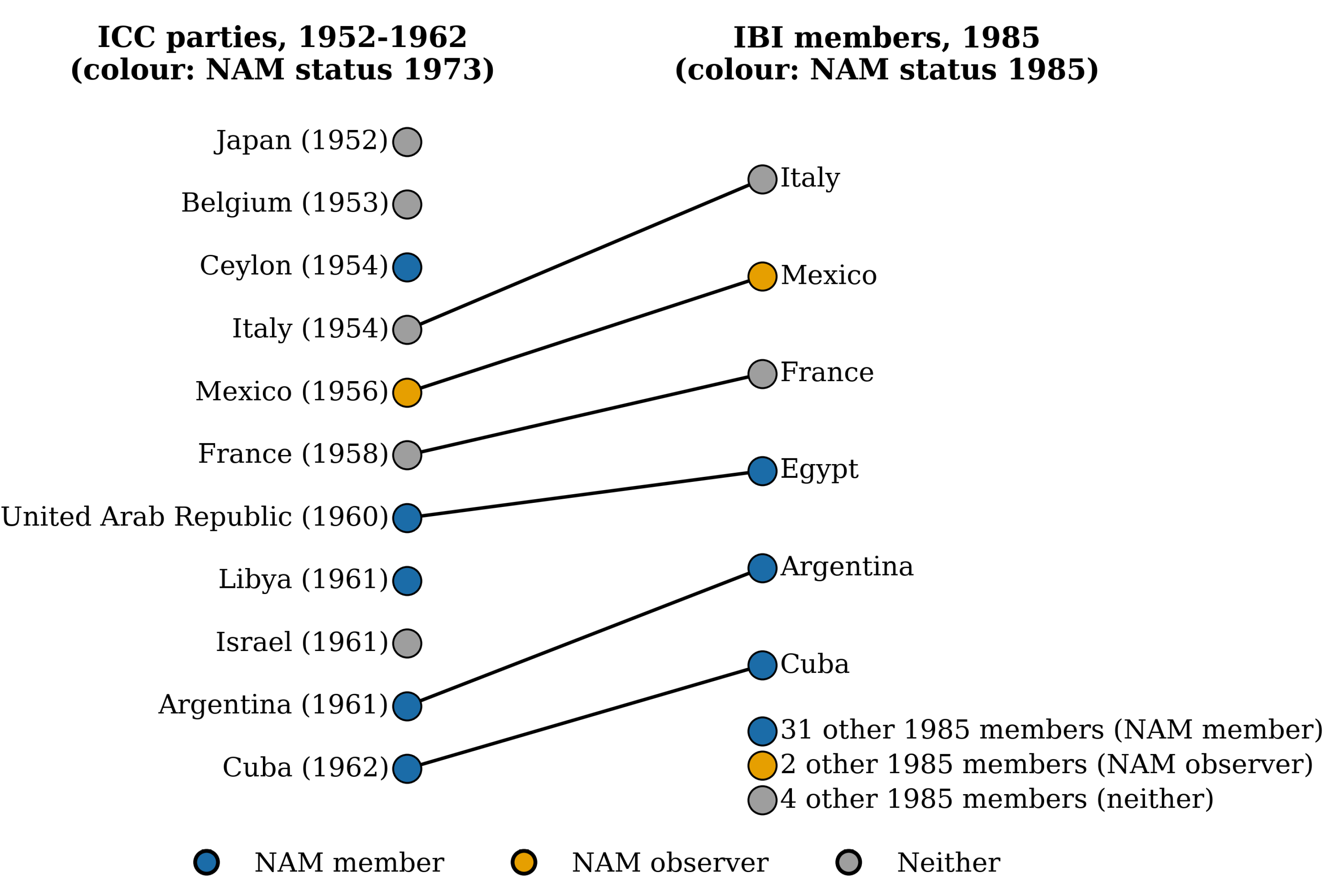
Figure 2.
Chronology of the ICC and the IBI, 1951–1988: institutional milestones, meetings by class, NAM summits (1961–1986) and windows –. Sources: [5,6,9,10,11,12,15,26,28,32,33,36,37].
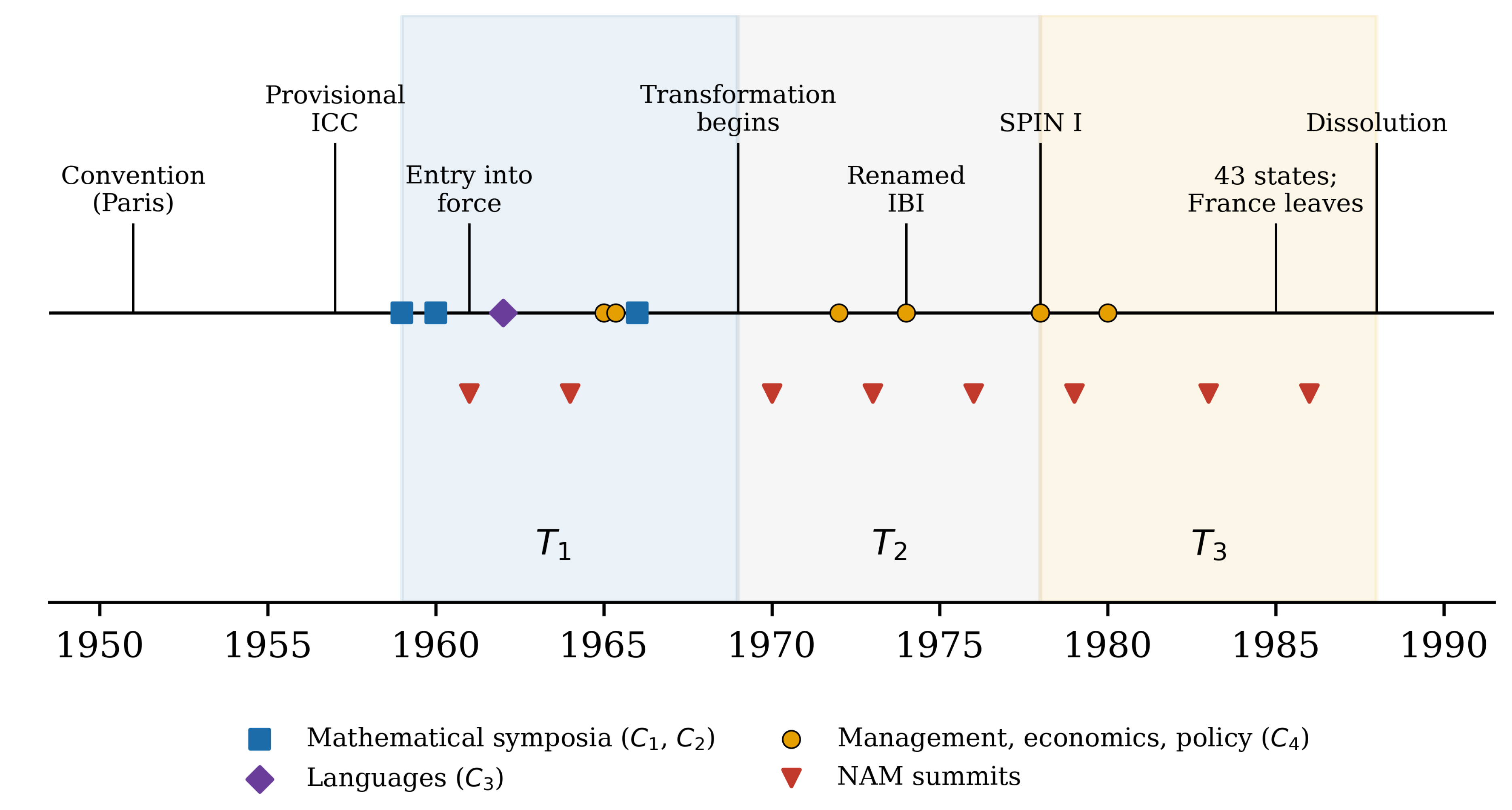
Figure 3.
Left: accession curve for the 33 active NAM members among the 1985 IBI states whose admission year is known; vertical lines mark NAM summits. Right: NAM status of the 1985 members by region. Data: Appendix Section 8.
Figure 3.
Left: accession curve for the 33 active NAM members among the 1985 IBI states whose admission year is known; vertical lines mark NAM summits. Right: NAM status of the 1985 members by region. Data: Appendix Section 8.
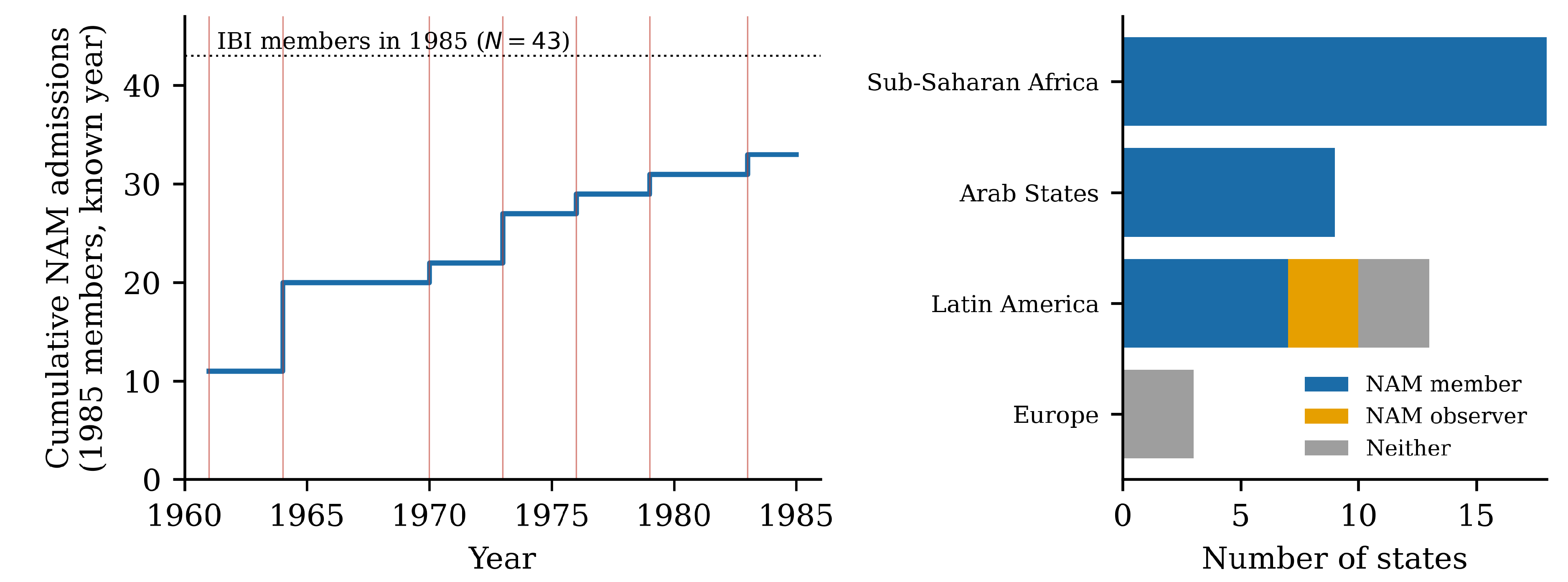
Figure 4.
Class shares by window, with Wilson 95% intervals.
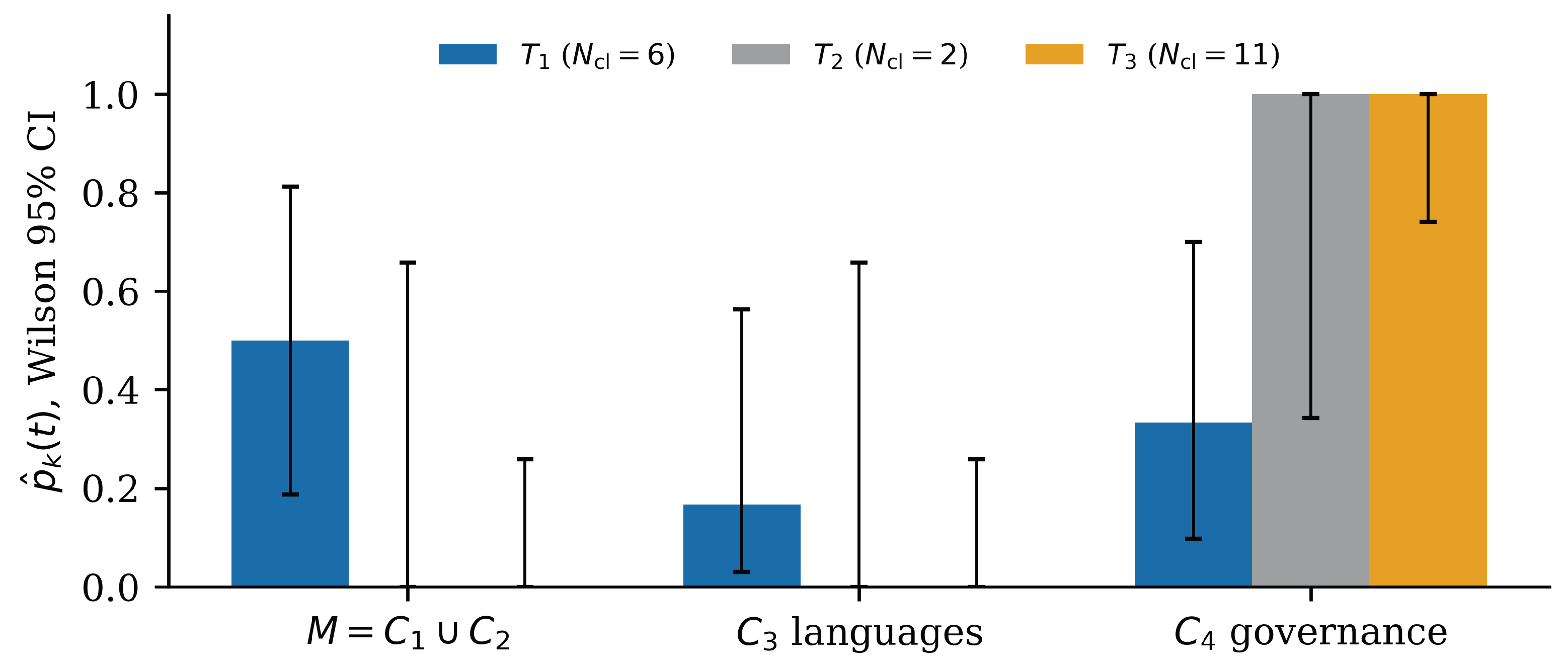
Table 1.
Corpora, variables and access status.
| Corpus | Content used | Variables | Access in this study |
|---|---|---|---|
| 1951 Convention [30,33] | Preamble, Arts. II, V, VI, XIV, financial annex, list of parties | Mandate, governance, contribution scale, parties 1952–1962 | Text read in UNTS vol. 425, no. 6119; signature dates partly illegible in the digitised copy. |
| Symposia 1959–1974 [5,6,10,11,12,15,26] | Library catalogue records; three individual papers | Topic, date, place, publisher | Records only; tables of contents and affiliations not readable online. |
| SPIN I (1978) [28,29] | Final report: summary and table of contents; subject indexing of the main working document | Commission sections, participation | Body of the report and national studies not read. |
| IBI statement (1985) [9] | Three-page text presented at an IFAC conference in Lisbon | Principles, activity lines | Read in full. |
| IBI training plan (1986) [4] | Plan of the IBI Regional Centre for Informatics Training (CREI), Madrid | 77 activity titles | Read in full. |
| Membership (auxiliary) [2,19,34,36,37] | 1985 IBI member list; NAM admission years and observers | NAM status in 1985, region | The 1985 list is unreferenced in its source; several NAM dates are tertiary (Appendix Section 8). |
Table 2.
Parties to the ICC Convention, 1952–1962, from UNTS vol. 425 [33], with NAM status in 1973 and IBI membership in 1985.
Table 2.
Parties to the ICC Convention, 1952–1962, from UNTS vol. 425 [33], with NAM status in 1973 and IBI membership in 1985.
| State | Date of party status | NAM status, 1973 | IBI member, 1985 | |
|---|---|---|---|---|
| 1 | Japan | 10 June 1952 | – | no |
| 2 | Belgium | 21 July 1953 | – | no |
| 3 | Ceylon | 16 March 1954 | member (1961) | no |
| 4 | Italy | 12 April 1954 | – | yes |
| 5 | Mexico | 16 March 1956 | observer | yes |
| 6 | France | 18 November 1958 | – | yes |
| 7 | United Arab Republic | 19 May 1960 | member (1961) | yes (Egypt) |
| 8 | Libya | 16 February 1961 | member (1964) | no |
| 9 | Israel | 7 August 1961 | – | no |
| 10 | Argentina | 28 November 1961 | member (1973) | yes |
| 11 | Cuba | 27 March 1962 | member (1961) | yes |
Table 3.
Units of window (1959–1968) and their coding.
| Year | Meeting (place; publication) | Class |
|---|---|---|
| 1959 | Numerical treatment of partial differential equations with real characteristics (Rome; Birkhäuser, 1959) [10] | |
| 1960 | Numerical treatment of ordinary differential equations, integral and integro-differential equations (Rome, 20–24 Sept.; Birkhäuser, 1960, 679 pp.) [11] | |
| 1962 | Symbolic languages in data processing (Rome, 26–31 March; Gordon and Breach, 1962, 849 pp.) [12] | |
| 1965 | Economics of automatic data processing (Rome, 19–22 Oct.; ed. A. B. Frielink; North-Holland, 1965) [5] | |
| 1965 | Long range planning for management (Paris, 20–24 Sept.; under ICC auspices; Gordon and Breach, 1967, 531 pp.) [15,18] | |
| 1966 | Theory of graphs (Rome, July; ed. P. Rosenstiehl; Dunod and Gordon and Breach, 1967, 416 pp.) [26] | |
| 1966 | Les applications du calcul dans les sciences de l’homme (Rome, July; ICC support) [22] |
Borderline with (operations research); recoded to in sensitivity check B. The records consulted for the 1959 volume do not name its organiser; its attribution to the provisional ICC follows the chronology and should be checked against the volume.
Table 4.
Class counts, shares (Wilson 95% intervals) and exact two-sided Fisher tests.
| (1959–1968) | (1969–1977) | (1978–1988) | |
|---|---|---|---|
| / / () | 7 / 1 / 6 (0.143) | 2 / 0 / 2 (0) | 15 / 4 / 11 (0.267) |
| (2, 1, 1, 2) | (0, 0, 0, 2) | (0, 0, 0, 11) | |
| 0.500 [0.188, 0.812] | 0 [0, 0.658] | 0 [0, 0.259] | |
| 0.167 [0.030, 0.564] | 0 [0, 0.658] | 0 [0, 0.259] | |
| 0.333 [0.097, 0.700] | 1 [0.342, 1] | 1 [0.741, 1] | |
| Primary, M vs , vs : , ; , 95% CI | |||
| A, vs : , ; CI | |||
| B, Paris 1965 recoded : , ; CI | |||
| C, conferences only, vs , M vs : , ; CI | |||
| C, conferences only, vs : , ; CI | |||
| D, SPIN-2b also recoded : , ; CI | |||
Table 5.
NAM status in 1985 of the 43 IBI member states (year of NAM admission in parentheses).
| Region | States |
|---|---|
| Sub-Saharan Africa (18; all members) | Benin (1964), Burkina Faso (1973), Cameroon (1964), Congo (1964), Gabon (1970), Ghana (1961), Guinea (1961), Ivory Coast (1973), Liberia (1964), Madagascar (1973), Mali (1961), Niger (1973), Nigeria (1964), São Tomé and Príncipe (1976), Senegal (1964), Swaziland (1970), Togo (1964), Zaire (1961) |
| Arab States (9; all members) | Algeria (1961), Egypt (1961), Iraq (1961), Jordan (1964), Lebanon (1961), Morocco (1961), Syria (1964), Tunisia (1961), United Arab Emirates (year undetermined) |
| Latin America (13) | Members (7): Argentina (1973), Bolivia (1979), Colombia (1983), Cuba (1961), Ecuador (1983), Nicaragua (1979), Panama (1976). Observers (3): Brazil, Costa Rica, Mexico. Neither (3): Chile (joined 1971; excluded in practice after 1973), Haiti (member from 2006), Venezuela (member from 1989) |
| Europe (3) | France, Italy, Spain |
Membership list: [36] (unreferenced there). Admission years: [37]; Argentina’s admission at the 1973 Algiers summit: [34]. Brazil, Mexico and Venezuela were observers at that summit [34]; Costa Rica’s observer status is from current lists [17,19], date unknown. Status in 1985 is assumed unchanged except for Venezuela, coded as neither; both cases are covered by sensitivity checks. The year 1970 given in [37] precedes the creation of the federation (December 1971); the UAE are absent from the participant list of the 1973 Algiers summit reproduced in [34], which is only negative evidence. [2]; Chile’s 1971 admission year is from [37].
Disclaimer/Publisher’s Note: The statements, opinions and data contained in all publications are solely those of the individual author(s) and contributor(s) and not of MDPI and/or the editor(s). MDPI and/or the editor(s) disclaim responsibility for any injury to people or property resulting from any ideas, methods, instructions or products referred to in the content. |
© 2026 by the authors. Licensee MDPI, Basel, Switzerland. This article is an open access article distributed under the terms and conditions of the Creative Commons Attribution (CC BY) license (http://creativecommons.org/licenses/by/4.0/).
Copyright: This open access article is published under a Creative Commons CC BY 4.0 license, which permit the free download, distribution, and reuse, provided that the author and preprint are cited in any reuse.