
Submitted:
23 November 2026
Posted:
25 November 2026
You are already at the latest version
Abstract
Second-grade figs can be valorized through sequential food-processing strategies that improve agricultural biomass utilization. This study evaluated hydroalcoholic extraction from Black Mission figs (Ficus carica L.) followed by jam production using the recovered residual biomass. Three independent batches, each containing 1 kg of sanitized fresh figs, underwent maceration for five days. The extract, residual biomass, and jam were characterized for physicochemical properties, total phenolic content (TPC), and DPPH antioxidant capacity. Each batch yielded 1435 ± 13 mL of extract, with an apparent volumetric recovery of 95.6 ± 0.4%, and 920 ± 7.5 g of residual biomass. The extract contained 21.50 ± 0.05% (v/v) alcohol, 62.33 ± 0.89 mg gallic acid equivalents (GAE)/L of TPC, and 423.81 ± 6.77 µmol Trolox equivalents (TE)/L of DPPH capacity. The residual biomass was converted into 1275 ± 8.2 g of jam per batch, with 65.18 ± 0.04 °Brix and pH 4.62 ± 0.02. The jam contained 181.74 ± 1.69 mg GAE/kg and showed a DPPH capacity of 327.67 ± 3.86 µmol TE/kg. These results demonstrate the technical feasibility of obtaining two food products sequentially from second-grade fig biomass and support its potential valorization within a circular bioeconomy.
Keywords:
food-grade processing
; agricultural by-products
; total phenolic content
; antioxidant capacity
; DPPH assay
; polyphenols
; resource utilization
1. Introduction
The transition from linear production models toward a circular bioeconomy has become an important strategy for addressing the environmental, economic, and social challenges associated with the inefficient use of biological resources. Rather than considering agricultural biomass as waste after its primary use, the circular bioeconomy promotes its continued utilization through processes that improve resource efficiency, reduce waste generation, and create additional value from renewable feedstocks [1,2]. Within this framework, food biorefineries have emerged as integrated approaches for transforming agricultural biomass into multiple value-added products through the sequential recovery and utilization of different fractions [3]. Biomass valorization therefore represents an important component of agro-industrial development, supporting resource optimization and the diversification of production systems through the generation of food ingredients, bioactive compounds, biomaterials, and other bio-based products [1,4].
Despite the increasing interest in circular bioeconomy strategies, food loss and waste remain significant challenges for food systems. Fruits and vegetables are particularly susceptible to losses because of their perishability and because a considerable proportion of harvested produce may not meet commercial quality standards owing to cosmetic defects, irregular size, mechanical damage, or non-uniform appearance [5,6]. Nevertheless, these characteristics do not necessarily indicate nutritional deterioration or a loss of suitability for food processing. Fruits that do not meet fresh-market requirements may retain valuable nutritional and phytochemical constituents and therefore represent an underutilized resource for food processing and biomass valorization [7,8,9]. Developing strategies to reincorporate these materials into productive chains can contribute to improving resource utilization and reducing the amount of agricultural material discarded after harvest [4,9].
To improve the utilization of agricultural biomass, increasing attention has been directed toward cascade biorefinery strategies, in which raw materials are sequentially processed to recover multiple products according to their technological and economic value [10,11,12,13]. These strategies generally prioritize the recovery of valuable fractions, including phenolic compounds, pigments, pectins, and other functional constituents, before directing the remaining biomass toward additional food, material, or energy applications [10,11,12,13]. Unlike conventional processing approaches in which a substantial fraction of the raw material may remain unused after obtaining a primary product, cascade biorefineries seek to increase the overall utilization of biological resources through integrated processing schemes. This approach is particularly relevant to fruit-processing systems, where different fractions may contain compounds with nutritional, functional, or technological potential [3,4,10,11,12,13].
Among fruit crops, Ficus carica L. has attracted considerable scientific interest because of its nutritional composition and diverse phytochemical constituents [14,15,16]. Figs contain phenolic acids, flavonoids, anthocyanins, carotenoids, dietary fiber, organic acids, vitamins, and minerals, although their composition varies according to cultivar, ripening stage, environmental conditions, and postharvest handling [14,15,16,17,18]. These constituents contribute to the nutritional and functional characteristics of the fruit and have been associated with different biological activities reported in the literature [16,17,18,19]. However, fresh figs are highly perishable commodities because of their delicate epidermis, high moisture content, and susceptibility to mechanical damage during harvesting, transportation, and commercialization [14,18,20]. Consequently, fruits that do not meet commercial quality standards may be sold at reduced prices or discarded despite retaining characteristics that make them suitable for food processing. Their utilization therefore represents an opportunity to develop integrated valorization strategies that combine the recovery of valuable constituents with the production of additional food products [7,13,20].
Hydroalcoholic extraction represents a potential approach for recovering soluble phytochemical constituents from fruit matrices, particularly phenolic compounds and other antioxidant-associated substances. The extraction efficiency and composition of the resulting extracts depend on factors such as solvent composition, extraction conditions, and the characteristics of the raw material [16,17,21,22]. Nevertheless, solid residues generated after extraction may still contain moisture, dietary fiber, and other fruit components with potential technological applications. Their subsequent incorporation into food products could extend the utilization of the original raw material rather than limiting its processing to the recovery of an extract [10,13,23]. In this context, fruit-based products such as jams provide a potential application for residual biomass, provided that the resulting material exhibits suitable physicochemical characteristics for processing [13,20,23]. The sequential combination of hydroalcoholic extraction and jam production may therefore provide an integrated food-oriented strategy for obtaining multiple products from a single agricultural resource.
Although previous studies have investigated the phytochemical composition of figs, the extraction of their bioactive compounds, and the valorization of fruit-processing by-products, these aspects have frequently been addressed independently [14,15,16,17,18,19,20,21,22,23]. Further research is needed on integrated food-oriented strategies that combine the recovery of soluble compounds from fresh figs with the subsequent utilization of the remaining solid fraction as a raw material for another food product. In particular, the sequential use of second-grade figs through hydroalcoholic extraction followed by jam production represents a potential approach to extending raw-material utilization within a circular bioeconomy framework. Therefore, this study aimed to evaluate a sequential valorization strategy for second-grade Black Mission figs (Ficus carica L.), involving hydroalcoholic extraction and the subsequent conversion of the recovered residual biomass into fig jam. Process performance and the physicochemical and bioactive characteristics of the starting material, intermediate fractions, and final products were characterized to assess the feasibility of this integrated food-processing approach.
2. Materials and Methods
2.1. Plant Material and Experimental Site
Fresh fruits of Ficus carica L. cv. Black Mission were harvested in July 2023 from the experimental orchard of the Universidad Politécnica de la Región Laguna (UPRL), located in Ejido Santa Teresa, San Pedro de las Colonias, Coahuila, Mexico (25°47′25.44″ N, 103°11′42.00″ W). The orchard comprised approximately 500 four-year-old trees managed under the agronomic practices routinely implemented at the university experimental field. The study was conducted under the semi-arid environmental conditions characteristic of the Comarca Lagunera region.
Fruits were manually harvested at commercial maturity and classified according to their commercial quality. Second-grade fruits were defined as those exhibiting minor external defects, including superficial mechanical damage, slight skin blemishes, irregular shape, or non-uniform appearance, while maintaining intact pulp and showing no evidence of microbial decay, insect infestation, fermentation, or severe physiological deterioration. Although unsuitable for fresh-market commercialization, these fruits were considered suitable for food processing and selected as the raw material for the cascade valorization process. The second-grade classification was based exclusively on external appearance and commercial criteria rather than on nutritional quality. Thus, the selected fruits were considered suitable for food processing despite not meeting the visual standards required for fresh-market commercialization.
Following classification, the fruits were transported on the same day to the Food Laboratory of UPRL. They were washed with potable water and sanitized by immersion in a 200 mg L⁻¹ sodium hypochlorite solution for 2 min. Subsequently, the fruits were rinsed with distilled water, allowed to drain at room temperature, and immediately processed.
2.2. Experimental Design
The study was designed to characterize a sequential, food-grade cascade valorization process for second-grade Ficus carica L. cv. Black Mission fruits. Three independent processing batches (B1, B2, and B3) were conducted, each starting with 1,000 g of sanitized fresh figs. Each batch underwent the complete processing sequence, comprising two consecutive stages: (i) hydroalcoholic extraction using a food-grade ethanol–water solution and (ii) conversion of the recovered residual fruit biomass into fig jam.
Each independently processed batch was considered an experimental unit (n = 3). The three batches were processed separately, and the resulting hydroalcoholic extract, residual biomass, and final jam were individually recorded and characterized. Process performance was evaluated by measuring the recovered extract volume, residual biomass mass, final jam mass, and the physicochemical and bioactive characteristics of the corresponding sample matrices.
Analytical determinations were performed in technical triplicate for each batch, whenever applicable. These repeated measurements were obtained from the corresponding batch samples and averaged to obtain a single analytical value per experimental unit. Technical replicates were not considered independent experimental observations. Accordingly, the independent sample size for process characterization was three processing batches (n = 3).
The study was conducted under identical processing conditions, without comparisons among extraction treatments or jam formulations. Therefore, the three independent batches were used to assess batch-to-batch variability and characterize process performance through descriptive statistical analysis.
2.3. Cascade Food-Grade Biorefinery Process
The cascade valorization process was based on the sequential utilization of second-grade fresh figs to obtain two food-grade products from the same initial raw material. The process comprised four main stages: (i) fruit selection and sanitization; (ii) hydroalcoholic extraction of soluble fruit constituents; (iii) solid–liquid separation and recovery of the residual biomass; and (iv) conversion of the recovered residual biomass into fig jam.
The complete process was independently conducted for each of the three experimental batches (B1, B2, and B3), starting with 1,000 g of sanitized fresh figs per batch. During the first processing stage, the fruits were subjected to hydroalcoholic maceration to obtain a liquid extract containing soluble constituents. Following solid–liquid separation, the liquid fraction was collected for subsequent characterization, whereas the retained solid fraction was weighed and reserved for further processing.
In the second valorization stage, the recovered residual biomass was used as the principal fruit-based ingredient for jam production. Honey and refined sugar were incorporated into the residual biomass, followed by thermal processing to obtain the final product. The residual biomass was processed without an intermediate drying or storage step, maintaining the sequential connection between extraction and food production.
The main material input and output streams were recorded separately for each batch, including the initial fresh fruit mass, hydroalcoholic solvent volume, recovered extract volume, residual biomass mass, formulation ingredients, and final jam mass. These measurements provided the basis for calculating process recovery and product yield indicators and for describing material utilization throughout the cascade sequence.
The overall processing sequence and the principal material streams are schematically presented in Figure 1.
2.4. Hydroalcoholic Extraction
Hydroalcoholic extraction was performed using sanitized fresh second-grade Ficus carica L. cv. Black Mission fruits through a food-grade maceration procedure. For each of the three independent processing batches, 1,000 g of sanitized fruits were weighed using an analytical balance (Entris II BCE2202-1S, Sartorius AG, Göttingen, Germany) and transferred into a 3-L food-grade polypropylene container fitted with an airtight screw cap.
Food-grade ethanol (39% v/v) (Alcohol Potable, Alvisa Alcohol Group, Guadalajara, Jalisco, Mexico) was added to each batch at a nominal volume of 1,500 mL, corresponding to a fruit-to-solvent ratio of 1:1.5 (w/v). The actual solvent volumes recorded for batches B1, B2, and B3 were 1,492, 1,508, and 1,501 mL, respectively. The mixture was manually homogenized for approximately 2 min using a food-grade stainless-steel spatula to ensure adequate contact between the solvent and fruit tissues. The containers were then hermetically sealed and maintained under static maceration for 5 days at 25 ± 2 °C, protected from direct light.
At the end of the maceration period, the liquid phase was separated from the residual solid biomass using a 304 stainless-steel sieve with a mesh opening of 1.0 mm. The recovered hydroalcoholic extract was transferred into 500-mL amber borosilicate glass bottles, hermetically sealed, and stored at 4 ± 1 °C until physicochemical and bioactive characterization. The residual solid biomass retained after separation was immediately weighed and reserved for subsequent jam production without an intermediate drying or storage step.
The recovered extract volume and residual biomass mass were recorded independently for each processing batch. These measurements were subsequently used to calculate the corresponding process recovery indicators.
2.5. Production of Fig Jam from the Recovered Residual Biomass
The residual biomass obtained after hydroalcoholic extraction was immediately used for jam production without intermediate drying or storage. This procedure allowed the subsequent utilization of the remaining fruit matrix within the proposed cascade valorization process.
For each independent processing batch, the recovered fig biomass was weighed using an analytical balance (Entris II BCE2202-1S, Sartorius AG, Göttingen, Germany) and transferred to a 5-L cooking vessel made of 304 stainless steel. Subsequently, 230 g of bee honey obtained from a local producer in the Comarca Lagunera region and 230 g of refined cane sugar (Zulka®, Zucarmex S.A.P.I. de C.V., Los Mochis, Sinaloa, Mexico) were added to each batch. No commercial pectin, artificial colorants, preservatives, flavor enhancers, or acidifying agents were incorporated.
The mixture was manually homogenized using a food-grade stainless-steel spatula and heated on an electric hot plate (Cimarec™, Thermo Fisher Scientific Inc., Waltham, MA, USA), with continuous stirring to promote uniform heating and prevent localized overheating. Cooking was carried out at 90 ± 2 °C for approximately 35 min, until the mixture reached a soluble solids concentration close to 65 °Brix.
The cooking endpoint was monitored by periodically measuring soluble solids using a digital refractometer (RX-5000α, ATAGO Co., Ltd., Tokyo, Japan). Once the target concentration was reached, the jam was removed from the heat and immediately filled into previously sterilized 250-mL amber glass jars, leaving approximately 5 mm of headspace. The jars were hermetically sealed while hot and allowed to cool naturally to room temperature.
The finished product was stored at 4 ± 1 °C until physicochemical characterization.
2.6. Physicochemical Characterization
The physicochemical and bioactive characteristics of fresh figs, the hydroalcoholic extract, the recovered residual biomass, and the final fig jam were evaluated to characterize the materials generated throughout the cascade valorization process. Analytical determinations were performed in triplicate for each independent processing batch. The three analytical replicates were averaged to obtain one value per batch. Therefore, the independent experimental sample size for process characterization was three batches (n = 3), and technical replicates were not considered independent experimental observations.
2.6.1. Basic Physicochemical Characterization
Moisture content was determined gravimetrically by drying samples in an oven at 105 °C until constant weight was achieved. This determination was performed on fresh figs, recovered residual biomass, and final fig jam. Dry matter content was calculated from the corresponding moisture values using the following equation:
Dry matter (%) = 100 - Moisture (%)
The pH was measured using a benchtop pH meter (Orion Star A211, Thermo Fisher Scientific Inc., Waltham, MA, USA), previously calibrated with buffer solutions at pH 4.00 and 7.00. Soluble solids content was determined at 20 °C using a digital refractometer (RX-5000α, ATAGO Co., Ltd., Tokyo, Japan). Both measurements were performed on fresh figs, hydroalcoholic extract, recovered residual biomass, and final fig jam.
The alcoholic strength of the hydroalcoholic extract was determined using an Alcolyzer Plus (Anton Paar GmbH, Graz, Austria), following the manufacturer’s instructions, and expressed as percentage of alcohol by volume (% v/v).
Titratable acidity of the final jam was determined by titration with 0.1 N sodium hydroxide using phenolphthalein as the endpoint indicator, according to AOAC Official Method 942.15. Results were expressed as grams of citric acid per 100 g of product.
Water activity (a_w) of the final jam was measured at 25 °C using a water activity meter (AquaLab 4TE, Meter Group Inc., Pullman, WA, USA).
2.6.2. Color Measurement
The color characteristics of the hydroalcoholic extract and final fig jam were evaluated using a CR-400 Chroma Meter (Konica Minolta Sensing Inc., Osaka, Japan). Color was expressed according to the CIELAB color system as L* (lightness), a* (red–green coordinate), and b* (yellow–blue coordinate).
2.6.3. Total Phenolic Content and Antioxidant Capacity
Total phenolic content (TPC) was determined using the Folin–Ciocalteu colorimetric method, based on the procedure described by Singleton et al. [24]. Absorbance was measured at 765 nm using a UV–Visible spectrophotometer (Evolution 220, Thermo Fisher Scientific Inc., Madison, WI, USA). TPC was determined in fresh figs, hydroalcoholic extract, recovered residual biomass, and final fig jam. Results were expressed as milligrams of gallic acid equivalents per kilogram of fresh weight (mg GAE/kg FW) for solid matrices and milligrams of gallic acid equivalents per liter (mg GAE/L) for the hydroalcoholic extract.
Antioxidant capacity was evaluated using the DPPH (2,2-diphenyl-1-picrylhydrazyl) radical scavenging assay, based on the method described by Brand-Williams et al. [25]. Absorbance was measured at 517 nm. This determination was performed on the hydroalcoholic extract, recovered residual biomass, and final fig jam. Results were expressed as micromoles of Trolox equivalents per kilogram of fresh weight (µmol TE/kg FW) for solid matrices and micromoles of Trolox equivalents per liter (µmol TE/L) for the hydroalcoholic extract.
2.7. Statistical Analysis
All process and analytical determinations were evaluated using three independent processing batches (B1, B2, and B3), which constituted the experimental units (n = 3). Analytical measurements were performed in technical triplicate for each batch, and the mean of the technical replicates was used to obtain one value per batch. Technical replicates were not treated as independent experimental observations.
Results were expressed as the mean ± standard deviation (SD) of the three independent processing batches. Descriptive statistics were used to characterize batch-to-batch variability in the physicochemical properties, total phenolic content, antioxidant capacity, and process performance of the materials obtained at each stage of the cascade valorization process.
Process performance indicators, including volumetric extract recovery, residual biomass recovery, and jam yield, were calculated from the corresponding recorded input and output masses or volumes. These indicators were used to describe material recovery and product generation throughout the sequential processing stages.
Descriptive statistical analyses and calculations of process performance indicators were performed using STATISTICA software, version 14 (TIBCO Software Inc.). Because the study focused on the characterization of three independent processing batches under identical processing conditions, rather than on comparisons among experimental treatments, no inferential statistical tests, including analysis of variance or multiple-comparison procedures, were applied. The results were therefore interpreted descriptively.
2.8. Process Yield and Material Recovery
Material recovery and product yield were evaluated throughout the sequential processing of second-grade figs. For each independent processing batch, the initial mass of fresh fruit, the volume of hydroalcoholic solvent used, the recovered extract volume, and the mass of residual biomass obtained after extraction were recorded. During jam production, the amounts of honey and refined sugar added to the residual biomass and the final mass of the resulting jam were also recorded.
The volumetric recovery of the hydroalcoholic extract was calculated as the ratio between the recovered extract volume and the initial solvent volume, according to Equation (1):
where ER is the volumetric extract recovery (%), Ve is the recovered extract volume (mL), and Vi is the initial extraction solvent volume (mL). This indicator represents the apparent volumetric recovery of the extraction stage and does not represent the extraction efficiency of individual bioactive compounds.
ER (%) = (Ve / Vi) × 100
Residual biomass recovery was calculated in relation to the initial fresh fruit mass, according to Equation (2):
where BR is the residual biomass recovery (%), Mr is the mass of recovered residual biomass (g), and Mf is the initial fresh fruit mass (g).
BR (%) = (Mr / Mf) × 100
The yield of jam production was expressed as the mass of final jam obtained per kilogram of recovered residual biomass, according to Equation (3):
where JY is the jam yield (g kg⁻¹ of recovered residual biomass), Mj is the final jam mass (g), and Mr is the mass of recovered residual biomass used for jam production (g). Because honey and refined sugar were incorporated during formulation, this indicator represents the amount of final product generated per unit of residual biomass rather than the recovery of fig-derived material.
JY (g kg⁻¹) = (Mj / Mr) × 1000
2.9. Sustainability Approach
The proposed processing strategy was developed in accordance with circular bioeconomy principles and the food-grade cascade biorefinery concept, emphasizing the sequential utilization of second-grade figs to improve raw material utilization and reduce the amount of residual biomass requiring disposal.
The approach involved the recovery of a hydroalcoholic extract from fresh figs, followed by the direct use of the remaining solid biomass for jam production. This sequential processing strategy was designed to obtain two value-added food products from a single agricultural resource, thereby extending the utilization of the original raw material.
The sustainability-oriented performance of the process was assessed qualitatively based on the sequential utilization of fig biomass, the recovery of the residual solid fraction, and the generation of multiple food products. The material recovery and product yield indicators described in Section 2.8 were used to characterize biomass utilization throughout the processing stages. No life cycle assessment (LCA), carbon footprint analysis, or quantitative environmental impact assessment was conducted. Therefore, the sustainability implications of the proposed process are discussed in terms of resource utilization and the potential to reduce processing residues, rather than as quantified environmental benefits.
3. Results
3.1. Biomass Flow, Process Efficiency, and Characterization of Starting and Residual Materials
The cascade valorization process enabled the sequential production of a hydroalcoholic extract and fig jam from second-grade fresh figs. Each processing batch started with 1,000 g of fresh fruit and an average of 1,500.3 ± 8.0 mL of food-grade ethanol (39% v/v). After five days of maceration, the recovered hydroalcoholic extract averaged 1,435 ± 13 mL, corresponding to an apparent volumetric recovery of 95.6 ± 0.4%. The solid fraction remaining after extraction averaged 920 ± 7.5 g, representing 92.0 ± 0.8% of the initial fresh fruit mass.
The recovered residual biomass was subsequently used for jam production, with the addition of 230 g of honey and 230 g of refined sugar per batch. The final jam mass averaged 1,275 ± 8.2 g, equivalent to a product yield of 1,386 ± 2.7 g per kilogram of recovered residual biomass.
The physicochemical characterization of the starting fruit and recovered residual biomass is presented in Table 1. Fresh figs exhibited a moisture content of 24.88 ± 0.13%, whereas the residual biomass showed a substantially higher moisture content of 76.47 ± 0.15%. Soluble solids decreased from 21.84 ± 0.10 °Brix in fresh figs to 18.96 ± 0.16 °Brix in the residual biomass. The pH also decreased from 5.42 ± 0.01 to 5.09 ± 0.005 following extraction.
Values are expressed as mean ± standard deviation of three independent processing batches (n = 3). Technical replicates were averaged within each batch. FW: fresh weight; GAE: gallic acid equivalents; QE: quercetin equivalents; C3G: cyanidin-3-glucoside equivalents. “Not determined” indicates that the corresponding assay was not recorded for that matrix in the database.
Regarding bioactive compounds, the fresh fruit contained 420.81 ± 2.68 mg GAE/kg FW of total phenolic compounds, 166.71 ± 1.20 mg QE/kg FW of total flavonoids, and 92.26 ± 1.83 mg C3G/kg FW of total anthocyanins. The recovered residual biomass retained measurable concentrations of total phenolic compounds (286.64 ± 5.23 mg GAE/kg FW) and exhibited an antioxidant capacity of 551.45 ± 13.85 µmol TE/kg FW.
These findings show that the solid fraction remaining after hydroalcoholic extraction retained measurable bioactive compounds and could be used as a secondary raw material for the production of fig jam within the proposed cascade valorization strategy.
3.2. Physicochemical Characterization of the Hydroalcoholic Extract
The physicochemical characteristics of the hydroalcoholic extract obtained from second-grade fresh figs are presented in Table 2.
The extract exhibited a pH of 6.00 ± 0.02 and a soluble solids content of 20.0 ± 0.2 °Brix. Its alcoholic strength was approximately 21.5% (v/v), reflecting the composition of the recovered extract after maceration and solid–liquid separation.
3.3. Physicochemical Characterization of Fig Jam Produced from the Residual Biomass
The physicochemical and bioactive characteristics of the fig jam obtained from the recovered residual biomass are summarized in Table 3. The final product exhibited a pH of 4.62 ± 0.02 and a soluble solids content of 65.18 ± 0.04 °Brix. Moisture content was 34.07%, while water activity (a_w) averaged 0.844 ± 0.001. Titratable acidity was 0.43 ± 0.01 g citric acid/100 g of product.
The jam showed L*, a*, and b* color coordinates of 28.11 ± 0.17, 8.48 ± 0.06, and 5.06 ± 0.08, respectively. Regarding its bioactive composition, total phenolic content reached 181.74 ± 1.69 mg GAE/kg FW. Total flavonoids and anthocyanins were 69.88 ± 0.10 mg QE/kg FW and 35.07 ± 0.57 mg C3G/kg FW, respectively. The antioxidant capacity determined by the DPPH assay was 327.67 ± 3.86 µmol TE/kg FW.
These results demonstrate that the recovered residual fig biomass could be used as a raw material for jam production, yielding a product that retained measurable phenolic compounds, flavonoids, anthocyanins, and antioxidant capacity after thermal processing.
3.4. Changes in Bioactive Composition During the Second Processing Stage
The bioactive composition of the recovered residual biomass and the final fig jam showed measurable differences following the thermal processing stage. Total phenolic content decreased from 286.64 ± 5.23 mg GAE/kg FW in the residual biomass to 181.74 ± 1.69 mg GAE/kg FW in the final jam. Similarly, antioxidant capacity, determined by the DPPH assay, decreased from 551.45 ± 13.85 to 327.67 ± 3.86 µmol TE/kg FW.
These differences corresponded to reductions of approximately 36.6% in total phenolic content and 40.6% in DPPH antioxidant capacity, based on the concentrations expressed per unit of fresh weight. However, these changes should be interpreted as differences in concentration between the two matrices rather than as direct estimates of compound degradation or retention, because honey and refined sugar were incorporated during jam formulation, changing the composition and mass of the final product.
Despite these differences, the final jam retained measurable concentrations of phenolic compounds and antioxidant capacity. This indicates that the residual biomass remained a source of detectable bioactive constituents after its transformation into a food product, supporting its use in the proposed cascade valorization process.
3.5. Color Characteristics of Fig Jam
The color characteristics of the fig jam obtained from the recovered residual biomass were evaluated using the CIELAB color system. The final product exhibited L*, a*, and b* values of 28.11 ± 0.17, 8.48 ± 0.06, and 5.06 ± 0.08, respectively (Table 3).
The relatively low L* value indicates a dark appearance, while the positive a* and b* coordinates reflect red and yellow components, respectively. These color attributes describe the appearance of the final product obtained through the thermal processing of the residual fig biomass with honey and refined sugar.
3.6. Overall Assessment of the Cascade Valorization Strategy
The results obtained across the successive processing stages demonstrate the feasibility of using second-grade Black Mission figs as a raw material for the production of two food products. The initial hydroalcoholic extraction generated a liquid fraction with measurable phenolic content and antioxidant capacity, while the recovered solid fraction retained detectable bioactive compounds and was subsequently used for jam production.
The sequential use of both fractions allowed the utilization of the same initial fruit material in two processing stages. In particular, the residual biomass was not discarded after extraction but incorporated into a second food-production process, together with honey and refined sugar. This approach illustrates the potential of cascade processing to improve the productive utilization of second-grade fruit biomass.
Although the present study did not include a quantitative life cycle assessment or an economic evaluation, the results provide a process-level demonstration of sequential biomass utilization. Further research should assess the economic feasibility, storage stability, and environmental performance of this strategy under larger-scale processing conditions.
4. Discussion
4.1. Biomass Flow, Process Efficiency, and Initial Material Characterization
The results demonstrate the feasibility of sequentially processing second-grade Black Mission figs to obtain two food-grade products from the same initial raw material. The apparent volumetric recovery of the hydroalcoholic extract (95.6 ± 0.4%) indicates that most of the initial solvent volume was recovered after maceration. However, this value should not be interpreted as extraction efficiency or as the recovery of bioactive compounds, since it represents the ratio between the recovered extract volume and the initial solvent volume. Similarly, residual biomass recovery (92.0 ± 0.8%) represents the mass of the solid fraction collected relative to the initial fresh fruit mass. These indicators describe different aspects of process performance and should not be interpreted as a complete mass balance.
The sequential utilization of biomass fractions is consistent with the cascade biorefinery approach reported in recent studies. Durán-Aranguren et al. [10] demonstrated the sequential valorization of orange residues through the recovery of bioactive compounds and pectin, followed by the fermentation of sugar-rich residual streams. Their process converted approximately 85% of the initial biomass through successive valorization steps. Similarly, Valle et al. [11] developed a cascade strategy for grape stalks that enabled the recovery of several valuable fractions, including polyphenols and structural biopolymers. Maggiore and Setti [12] also proposed a locally oriented biorefinery approach for pomegranate pomace, demonstrating the sequential recovery of oil, pectin, and antioxidant-rich fractions. Although these studies involved different feedstocks and processing technologies, they support the principle that successive utilization of biomass fractions can expand the range of products obtained from a single agricultural resource.
In the present study, the recovered fig biomass was not discarded after hydroalcoholic extraction but was incorporated into a second food-processing stage. The final jam mass averaged 1,275 ± 8.2 g per batch, corresponding to 1,386 ± 2.7 g per kilogram of recovered residual biomass. This value represents the mass of the formulated product and includes the addition of honey and refined sugar; therefore, it should not be interpreted as a yield derived exclusively from fig biomass. This distinction is relevant when assessing process performance because the incorporation of additional ingredients increases the final product mass while modifying its overall composition. The use of fruit-processing by-products as feedstocks for value-added applications has been identified as a relevant strategy for improving biomass utilization within integrated biorefinery systems [4].
The physicochemical differences between fresh figs and the recovered residual biomass further illustrate the changes associated with the first processing stage. Moisture content increased from 24.88 ± 0.13% in fresh figs to 76.47 ± 0.15% in the residual biomass, whereas soluble solids decreased from 21.84 ± 0.10 to 18.96 ± 0.16 °Brix. The pH also decreased from 5.42 ± 0.01 to 5.09 ± 0.005. These differences indicate that the residual fraction had a physicochemical profile distinct from that of the original fruit after maceration and solid–liquid separation. Nevertheless, the present results do not allow the contribution of individual extraction mechanisms to be quantified. As highlighted in reviews of fruit-processing by-product valorization, the composition and potential applications of residual fractions depend on both the characteristics of the original biomass and the processing conditions applied [4].
Overall, these findings support the feasibility of a food-oriented cascade valorization strategy for second-grade figs. The process combined the recovery of a hydroalcoholic fraction with the subsequent use of the remaining solid material for jam production, extending the utilization of the original fruit. However, the recovery indicators should be interpreted as process-specific measurements rather than evidence of complete material conversion or quantified environmental benefits.
4.2. Physicochemical and Bioactive Characteristics of the Hydroalcoholic Extract
The hydroalcoholic extract obtained from second-grade Black Mission figs exhibited a pH of 5.05 ± 0.02 and a soluble solids content of 18.22 ± 0.20 °Brix. Its alcoholic strength was 21.50 ± 0.05% (v/v), lower than the initial ethanol concentration of 39% (v/v) used for maceration. This difference indicates that the composition of the recovered liquid fraction changed during contact with the fresh fruit. The transfer of water from the fruit matrix into the hydroalcoholic medium may have contributed to the reduction in alcoholic strength; however, this mechanism was not directly quantified in the present study. The resulting extract should therefore be characterized according to its measured final composition rather than the initial solvent formulation.
The extract also contained measurable concentrations of total phenolic compounds (62.33 ± 0.89 mg GAE/L), total flavonoids (27.87 ± 0.40 mg QE/L), and total anthocyanins (15.94 ± 0.25 mg C3G/L). These findings are consistent with the recognized phytochemical diversity of Ficus carica, whose fruits contain several classes of phenolic compounds, including phenolic acids, flavonoids, and anthocyanins. Their occurrence and relative abundance may vary according to cultivar, fruit maturity, geographical origin, and processing conditions [16,17]. Recent research has further characterized the diverse phytochemical composition of fig fruits, identifying multiple classes of compounds associated with their antioxidant potential [26].
The extraction of these compounds depends strongly on solvent characteristics and extraction conditions. Ethanol–water mixtures are commonly considered suitable food-compatible systems for recovering phenolic compounds because solvent polarity influences the solubility and transfer of different phytochemical groups. Recent reviews have highlighted the importance of solvent composition, extraction time, temperature, and extraction technology in determining phenolic recovery from plant-derived materials [21,22,23]. In particular, the study by Zulfiqar et al. [26] demonstrated that solvent type and extraction time significantly influenced the phytochemical content and antioxidant activity of fig extracts. Although their experimental conditions and analytical basis differ from those used in the present work, their findings reinforce the importance of extraction parameters when interpreting the composition of fig-derived extracts.
Regarding antioxidant capacity, the hydroalcoholic extract showed a DPPH value of 423.81 ± 6.77 µmol TE/L. This result provides complementary evidence of the presence of compounds capable of scavenging DPPH radicals under the assay conditions. Nevertheless, the Folin–Ciocalteu and DPPH assays represent different analytical responses: total phenolic content estimates the reducing capacity associated with phenolic compounds, whereas DPPH evaluates radical-scavenging activity. Consequently, their results should be interpreted as complementary indicators rather than as interchangeable measurements or direct evidence of the contribution of individual compounds.
Overall, the results confirm that hydroalcoholic maceration produced a liquid fraction containing measurable phenolic compounds, flavonoids, anthocyanins, and in vitro antioxidant capacity. The use of food-grade ethanol also provides a relevant basis for the potential incorporation of the extract into food-oriented valorization strategies. However, the present characterization was based on spectrophotometric assays and does not identify or quantify individual phenolic molecules. Further chromatographic characterization would be necessary to establish the specific compounds recovered and to evaluate their potential contribution to the functional properties of the extract.
4.3. Physicochemical Characteristics and Food Applications of Fig Jam
The physicochemical characterization of the fig jam obtained from the recovered residual biomass provides evidence of its potential use as a food ingredient after the hydroalcoholic extraction stage. The final product exhibited a soluble solids content of 65.18 ± 0.04 °Brix, indicating a concentrated formulation resulting from thermal processing and the incorporation of honey and refined sugar. This value is consistent with the high soluble solids concentrations commonly associated with concentrated fruit spreads and jams. However, soluble solids alone do not establish product stability, which also depends on factors such as pH, water activity, formulation, packaging, and storage conditions.
The jam presented a pH of 4.62 ± 0.02, a moisture content of 34.07 ± 0.00%, and a water activity of 0.844 ± 0.001. These parameters describe the physicochemical characteristics of the final product and are relevant to understanding its behavior during storage. In particular, the measured water activity indicates that the product contains less available water than the original residual biomass. Nevertheless, neither water activity nor pH should be considered independently sufficient to establish microbiological stability or shelf life, which would require dedicated microbiological and storage evaluations.
The use of fruit-processing residues as ingredients in spreadable products has gained attention as a food-oriented valorization strategy. Almaghlouth et al. [27] demonstrated the feasibility of incorporating second-grade date fruit by-products and nonstandard sweet potato tubers into functional jam formulations, showing that materials with limited commercial value can be redirected toward value-added food products. Similarly, Viegas et al. [28] developed apple pomace-based jam using hydrocolloids and evaluated the effects of processing conditions on gelation and rheological properties. More recently, Nouska et al. [29] formulated fruit-based spreads using apple, tomato, and grape pomaces, demonstrating that fruit-processing residues can be incorporated into products with measurable physicochemical and bioactive characteristics. Although the raw materials and formulations differ from those used in the present study, these investigations support the potential of fruit-derived residual biomass as a component of value-added food formulations.
An important aspect of the present formulation is that the recovered fig biomass was processed with honey and refined sugar without the addition of commercial pectin, colorants, preservatives, or flavor enhancers. This demonstrates the feasibility of obtaining the final product using the ingredients and processing conditions described in this study. Nevertheless, the present work did not include rheological or textural measurements; therefore, specific conclusions regarding gel strength, spreadability, or structural properties cannot be established. Such characteristics would be relevant in future formulation studies, particularly to determine the contribution of the residual fig matrix and its naturally occurring polysaccharides to product consistency.
The final jam also retained measurable concentrations of total phenolic compounds (181.74 ± 1.69 mg GAE/kg FW), flavonoids (69.88 ± 0.10 mg QE/kg FW), anthocyanins (35.07 ± 0.57 mg C3G/kg FW), and antioxidant capacity (327.67 ± 3.86 µmol TE/kg FW). These results indicate that the product retained detectable bioactive constituents after thermal processing. Their significance within the cascade strategy is discussed further in Section 4.4.
Overall, the results demonstrate that the solid fraction remaining after hydroalcoholic extraction can be incorporated into a second food-processing stage to produce a concentrated fig-based spread. This application extends the utilization of second-grade figs beyond the initial extraction step and provides an additional route for using the recovered biomass as a food ingredient. Further work should evaluate textural properties, microbiological quality, and storage stability before considering commercial-scale application.
4.4. Changes in Bioactive Compounds During Jam Processing
The comparison between the recovered residual biomass and the final fig jam revealed differences in the concentrations of total phenolic compounds and antioxidant capacity after the second processing stage. Total phenolic content decreased from 286.64 ± 5.23 mg GAE/kg FW in the residual biomass to 181.74 ± 1.69 mg GAE/kg FW in the jam, corresponding to a difference of approximately 36.6%. Similarly, DPPH antioxidant capacity decreased from 551.45 ± 13.85 to 327.67 ± 3.86 µmol TE/kg FW, representing a difference of approximately 40.6%.
These differences should be interpreted cautiously because the jam formulation involved the addition of honey and refined sugar to the recovered residual biomass. Consequently, the composition and total mass of the material changed between the two processing stages. Since the results are expressed on a fresh-weight basis, the lower concentrations measured in the final product may reflect, at least in part, the incorporation of these additional ingredients and the resulting change in matrix composition. Therefore, the observed differences cannot be attributed exclusively to thermal degradation, nor can they be interpreted as quantitative losses or retention percentages of bioactive compounds.
Nevertheless, thermal processing is recognized as an important factor influencing the stability and analytical recovery of fruit-derived bioactive compounds. Temperature and exposure time can promote the degradation, oxidation, hydrolysis, or structural transformation of certain phenolic compounds and anthocyanins. However, the response is dependent on the chemical structure of the compounds, the food matrix, and the processing conditions. Wu et al. [30] highlighted that thermal treatments can produce both losses and changes in the extractability and bioaccessibility of natural antioxidants in fruits and vegetables. In the case of figs, the composition of phenolic compounds and other secondary metabolites is also influenced by postharvest processing and product formulation [16,17].
The DPPH results provide an additional indication of the differences between the two matrices. The lower antioxidant capacity measured in the jam may be associated with changes in the concentration and analytical availability of radical-scavenging compounds during formulation and heating. However, DPPH is an in vitro assay that measures radical-scavenging activity under specific analytical conditions; it does not identify individual antioxidant molecules or establish their behavior in biological systems. Accordingly, the observed difference should be understood as a change in the measured antioxidant response rather than direct evidence of the destruction of a specific group of compounds.
Despite these differences, the final jam retained measurable total phenolic content and DPPH antioxidant capacity after thermal processing. This finding is relevant to the proposed cascade strategy because it demonstrates that the recovered solid fraction can be transformed into a food product while maintaining detectable bioactive characteristics. Previous research on fig-derived products has also reported the persistence of phenolic compounds and antioxidant activity after processing, although the magnitude of these changes varies according to cultivar, formulation, and processing conditions [16,17].
Overall, the results indicate that the second processing stage modified the measured bioactive profile of the residual fig biomass, while the final product retained detectable phenolic compounds and antioxidant capacity. A more definitive evaluation of compound degradation or retention would require a complete mass balance of the target bioactive compounds, together with measurements before and after processing on a consistent dry-matter or total-batch basis. Such an approach would help distinguish concentration changes caused by formulation from actual chemical losses during thermal processing.
4.5. Color Characteristics and Product Quality
The color measurements of the fig jam provide additional information about the visual characteristics of the product obtained from the recovered residual biomass. The final formulation exhibited L*, a*, and b* values of 28.11 ± 0.17, 8.48 ± 0.06, and 5.06 ± 0.08, respectively. The relatively low L* value indicates a dark appearance, whereas the positive a* and b* coordinates indicate red and yellow contributions to the overall color, respectively. Together, these parameters describe a dark reddish-brown appearance in the final product.
Color is an important quality attribute of fruit jams because it reflects the characteristics of the raw material and may be modified during thermal processing and storage. Recent studies have used the CIELAB system to characterize color changes in fruit-based products and to evaluate the influence of formulation and storage conditions on their visual properties [31]. Prisacaru et al. [31], for example, reported changes in the color parameters of commercial apricot, cherry, raspberry, and strawberry jams during storage, demonstrating that the original color of fruit products can change over time depending on storage temperature and duration. Similarly, research on apple pomace-based jam has used the same CIELAB coordinates to characterize the resulting product and assess the influence of formulation and processing conditions on its color [28].
In the present study, the dark appearance of the fig jam may be associated with the natural pigmentation of the fruit-derived residual biomass and the thermal treatment applied during jam preparation. Non-enzymatic browning reactions, including Maillard reactions and sugar caramelization, may also contribute to color development during heating. However, these mechanisms were not directly evaluated, and their individual contributions cannot be established from the color measurements alone. The final color should therefore be interpreted as the combined outcome of the initial biomass characteristics, formulation ingredients, and thermal processing conditions.
The color coordinates provide a reproducible description of the final product and complement its physicochemical characterization. Nevertheless, because color was not monitored throughout processing or during storage, the present results do not establish the extent of color change caused by heating or the stability of the product over time. Future studies should evaluate color evolution under defined storage conditions, together with instrumental and microbiological quality parameters, to determine the stability of the jam during its intended shelf life.
Overall, the CIELAB measurements confirm that the residual fig biomass can be transformed into a product with measurable and well-defined color characteristics. This finding complements the physicochemical and bioactive results and supports the potential use of second-grade Black Mission figs in a sequential food valorization strategy.
5. Conclusions
This study demonstrated the technical feasibility of a sequential valorization strategy for second-grade Black Mission figs (Ficus carica L.), integrating hydroalcoholic extraction with the subsequent production of jam from the recovered fruit biomass. From an initial 1,000 g of fresh figs per batch, the process yielded 1435 ± 13 mL of hydroalcoholic extract and 920 ± 7.5 g of residual biomass, corresponding to an apparent extract volumetric recovery of 95.6 ± 0.4% and a residual biomass mass recovery of 92.0 ± 0.8%. The recovered extract contained 21.50 ± 0.05% (v/v) alcohol, 62.33 ± 0.89 mg GAE/L of total phenolic compounds, and a DPPH antioxidant capacity of 423.81 ± 6.77 µmol TE/L.
The residual biomass was successfully incorporated into a jam formulation, producing 1275 ± 8.2 g of final product per batch, including the added honey and refined sugar. The jam exhibited 65.18 ± 0.04 °Brix, a pH of 4.62 ± 0.02, and a water activity of 0.844 ± 0.001. Total phenolic content and DPPH antioxidant capacity were 181.74 ± 1.69 mg GAE/kg fresh weight and 327.67 ± 3.86 µmol TE/kg fresh weight, respectively. Although these concentrations were lower than those measured in the residual biomass before jam preparation, the differences cannot be attributed exclusively to thermal degradation because the formulation involved the addition of other ingredients and changes in product mass.
Overall, the findings provide experimental evidence that commercially downgraded figs can serve as raw materials for two successive food-processing applications rather than being discarded after a single extraction stage. Nevertheless, the study was limited to three independent processing batches and did not assess product shelf life, microbiological stability, economic feasibility, or environmental impacts. Further research should address these aspects, establish comprehensive mass balances, and evaluate process scalability to determine the practical contribution of this approach to a circular bioeconomy.
Author Contributions
Conceptualization, J.L.R.-P. and J.G.L.-O.; methodology, J.L.R.-P., J.G.L.-O. and R.S.-L.; investigation, J.G.L.-O., J.L.R.-P. and R.Z.-V.; formal analysis, J.L.R.-P. and R.Z.-V.; data curation, J.L.R.-P. and J.G.L.-O.; writing—original draft preparation, J.L.R.-P.; writing—review and editing, J.L.R.-P., J.G.L.-O., R.S.-L., R.Z.-V., M.G.C.-V., E.Z.-V., O.A.S.-E., M.V.P.-G. and J.A.R.-H.; supervision, J.L.R.-P. and J.A.R.-H.; project administration, J.L.R.-P. and J.A.R.-H. All authors have read and agreed to the published version of the manuscript.
Funding
This research received no external funding.
Institutional Review Board Statement
Not applicable.
Informed Consent Statement
Not applicable.
Data Availability Statement
The data presented in this study are available from the corresponding author upon reasonable request.
Acknowledgments
The authors acknowledge the Universidad Politécnica de la Región Laguna (UPRL) for providing the facilities and infrastructure required to conduct this research.
Conflicts of Interest
The authors declare no conflicts of interest.
Abbreviations
The following abbreviations are used in this manuscript:
| CIELAB | CIELAB | Commission Internationale de l’Éclairage Lab* color space |
| DPPH | DPPH | 2,2-Diphenyl-1-picrylhydrazyl |
| FW | FW | Fresh weight |
| GAE | GAE | Gallic acid equivalents |
| QE | QE | Quercetin equivalents |
| SD | SD | Standard deviation |
| TE | TE | Trolox equivalents |
| TPC | TPC | Total phenolic content |
References
- Pal, P.; Singh, A.K.; Srivastava, R.K.; Rathore, S.S.; Sahoo, U.K.; Subudhi, S.; Sarangi, P.K.; Prus, P. Circular bioeconomy in action: Transforming food wastes into renewable food resources. Foods 2024, 13, 3007. [Google Scholar] [CrossRef]
- Stegmann, P.; Londo, M.; Junginger, M. The circular bioeconomy: Its elements and role in European bioeconomy clusters. Resour. Conserv. Recycl. X 2020, 6, 100029. [Google Scholar] [CrossRef]
- Ubando, A.T.; Felix, C.B.; Chen, W.-H. Biorefineries in circular bioeconomy: A comprehensive review. Bioresour. Technol. 2020, 299, 122585. [Google Scholar] [CrossRef]
- Błaszczyk, A.; Sady, S.; Pachołek, B.; Jakubowska, D.; Grzybowska-Brzezińska, M.; Krzywonos, M.; Popek, S. Sustainable management strategies for fruit processing byproducts for biorefineries: A review. Sustainability 2024, 16, 1717. [Google Scholar] [CrossRef]
- United Nations Environment Programme (UNEP). Food Waste Index Report 2024: Think Eat Save: Tracking Progress to Halve Global Food Waste; UNEP: Nairobi, Kenya, 2024; Available online: https://wedocs.unep.org/bitstreams/5c6e505d-e1d3-4731-b5b8-4ecb9693a056/download (accessed on 29 July 2026).
- Food and Agriculture Organization of the United Nations (FAO). Tackling Food Loss and Waste: A Triple Win Opportunity; FAO: Rome, Italy, 2022; Available online: https://www.fao.org/newsroom/detail/FAO-UNEP-agriculture-environment-food-loss-waste-day-2022/en (accessed on 29 July 2026).
- Domínguez, I.; Astudillo-Pascual, M.A.; Tudor, R.; del Río, J.L.; Ortiz-Somovilla, V.; Cantos-Villar, E. From waste to nutrition: Valorization strategies for surplus and ugly produce within the Food Use and Waste Hierarchy. Front. Nutr. 2026, 13, 1868657. [Google Scholar] [CrossRef]
- Organisation for Economic Co-operation and Development (OECD). Achieving Food Loss and Waste Reduction: From Targets to Action; OECD Publishing: Paris, France, 2025; Available online: https://www.oecd.org/en/publications/achieving-food-loss-and-waste-reduction_edd99594-en (accessed on 29 July 2026).
- Astari, A.D.; Gheewala, S.H. Valorization of food loss and waste: Sustainability practices to support circular economy. J. Sustain. Energy Environ. 2022, 13, 75–83. [Google Scholar]
- Durán-Aranguren, D.D.; Yamakawa, C.K.; Ordeñana, J.; Sierra, R.; Posada, J.A.; Mussatto, S.I. An Experimental Cascade Biorefinery from Orange Residues: Sequential Recovery of Bioactive Compounds, Pectin, and Fermentation of Sugar-Rich Side Streams Using Conventional and Non-Conventional Yeasts. Biomass Bioenergy 2025, 193, 107514. [Google Scholar] [CrossRef]
- Valle, C.; Grillo, G.; Calcio Gaudino, E.; Ponsetto, P.; Mazzoli, R.; Bonavita, G.; Vitale, P.; Pessione, E.; Garcia-Moruno, E.; Costantini, A.; Cravotto, G.; Tabasso, S. Grape Stalks Valorization towards Circular Economy: A Cascade Biorefinery Strategy. ChemSusChem 2025, 18, e202402536. [Google Scholar] [CrossRef]
- Maggiore, I.; Setti, L. New Biorefinery Approach for the Valorization of Fruit Processing Waste at a Local Scale: Pomegranate Pomace as Case Study. In Waste and Biomass Valorization; 2024. [Google Scholar] [CrossRef]
- Sharma, S.; Sharma, U.; Sharma, N.; Rana, V.S.; Thakur, S.; Kumar, A.; Kumar, R. Exploring the Valorization of Fruit Bio-Waste for Sustainable Utilization in Agro-Food Industries: A Comprehensive Review. Food Biosci. 2025, 63, 105768. [Google Scholar] [CrossRef]
- Hosseini, E.; Tsegay, Z.T.; Smaoui, S.; Varzakas, T. Chemical Structure, Composition, Bioactive Compounds, and Pattern Recognition Techniques in Figs (Ficus carica L.) Quality and Authenticity: An Updated Review. J. Food Compos. Anal. 2025, 137, 106863. [Google Scholar] [CrossRef]
- Wang, Y.; Liu, X.; Chen, S.; Wang, Q.; Jin, B.; Wang, L. Functions, Accumulation, and Biosynthesis of Important Secondary Metabolites in the Fig Tree (Ficus carica). Front. Plant Sci. 2024, 15, 1397874. [Google Scholar] [CrossRef]
- Zhang, Q.; Peng, Y.; Li, F.; Xu, Y.; Zhang, Q.; Wu, D.; Chen, M.; Lin, S.; Qin, W. An Updated Review of Composition, Health Benefits, and Applications of Phenolic Compounds in Ficus carica L. eFood 2024, 5, e154. [Google Scholar] [CrossRef]
- Sandhu, A.K.; Islam, M.; Edirisinghe, I.; Burton-Freeman, B. Phytochemical Composition and Health Benefits of Figs (Fresh and Dried): A Review of Literature from 2000 to 2022. Nutrients 2023, 15, 2623. [Google Scholar] [CrossRef]
- Singh, J.P.; Singh, B.; Kaur, A. Polyphenols in Fig: A Review on Their Characterisation, Biochemistry during Ripening, Antioxidant Activity and Health Benefits. Int. J. Food Sci. Technol. 2022, 57, 3333–3342. [Google Scholar] [CrossRef]
- Hajam, T.A.; Saleem, H. Phytochemistry, Biological Activities, Industrial and Traditional Uses of Fig (Ficus carica): A Review. Chem.-Biol. Interact. 2022, 368, 110237. [Google Scholar] [CrossRef]
- Teruel-Andreu, C.; Andreu-Coll, L.; López-Lluch, D.; Sendra, E.; Hernández, F.; Cano-Lamadrid, M. Ficus carica Fruits, By-Products and Derived Products as Potential Sources of Bioactive Compounds: A Review. Agronomy 2021, 11, 1834. [Google Scholar] [CrossRef]
- Al-Hawamdeh, M.; Alu’datt, M.H.; Ghafoor, K.; Alhamad, M.N.; Al-Mahasneh, M.A.; Rababah, T.; Ereifej, K.; Vasantha Rupasinghe, H.P. Recent Advances in Green Extraction of Phenolic Compounds from Agri-Food By-Products and Their Health Benefits. Molecules 2024, 29, 2215. [Google Scholar] [CrossRef]
- Nunes, M.A.; Paiva, A.; Simões, M.; Rosa, E.; Costa, A.S.G.; Oliveira, M.B.P.P. Green and Sustainable Recovery of Bioactive Compounds from Food By-Products—A Review. Food Res. Int. 2023, 172, 113140. [Google Scholar] [CrossRef]
- Panzella, L.; Moccia, F.; Nasti, R.; Marzorati, S.; Verotta, L.; Napolitano, A. Valorization of Fruit and Vegetable By-Products for a Sustainable Food Industry: Current Advances and Future Perspectives. Curr. Opin. Food Sci. 2024, 58, 101245. [Google Scholar] [CrossRef]
- Singleton, V.L.; Orthofer, R.; Lamuela-Raventós, R.M. Analysis of Total Phenols and Other Oxidation Substrates and Antioxidants by Means of Folin-Ciocalteu Reagent. In Methods in Enzymology; Packer, L., Ed.; Academic Press: San Diego, CA, USA, 1999; Volume 299, pp. 152–178. [Google Scholar] [CrossRef]
- Brand-Williams, W.; Cuvelier, M.E.; Berset, C. Use of a Free Radical Method to Evaluate Antioxidant Activity. LWT—Food Sci. Technol. 1995, 28, 25–30. [Google Scholar] [CrossRef]
- Zulfiqar, S.; Butt, M.S.; Chatha, A.; Hafiz, M.S. Phytochemical Content and Antioxidant Activities of Ficus carica Extracts. Int. J. Anal. Chem. 2026, 2026, 3209992. [Google Scholar] [CrossRef]
- Almaghlouth, B.J.; Alqahtani, N.K.; Alnabbat, K.I.; Mohamed, H.A.; Alnemr, T.M.; Habib, H.M. Valorization of Second-Grade Date Fruit Byproducts and Nonstandard Sweet Potato Tubers to Produce Novel Biofortified Functional Jam. Foods 2023, 12, 1906. [Google Scholar] [CrossRef]
- Viegas, Â.; Alegria, M.J.; Raymundo, A. Sustainable Jam with Apple Pomace: Gelling, Rheology, and Composition Analysis. Gels 2024, 10, 580. [Google Scholar] [CrossRef]
- Nouska, C.; Ciurla, L.; Patras, A.; Biliaderis, C.G.; Lazaridou, A. Physicochemical and Sensory Evaluation of Spreads Derived from Fruit Processing By-Products. Foods 2025, 14, 2224. [Google Scholar] [CrossRef]
- Wu, Y.; Liu, Y.; Jia, Y.; Feng, C.-H.; Zhang, H.; Ren, F.; Zhao, G. Effects of Thermal Processing on Natural Antioxidants in Fruits and Vegetables. Food Res. Int. 2024, 192, 114797. [Google Scholar] [CrossRef]
- Prisacaru, A.E.; Ghinea, C.; Albu, E.; Pădureț, S. Storage Impact on the Physicochemical and Microbiological Stability of Apricot, Cherry, Raspberry, and Strawberry Jams. Foods 2025, 14, 1695. [Google Scholar] [CrossRef]
Figure 1.
Schematic representation of the cascade food-grade biorefinery process applied to second-grade Black Mission figs (Ficus carica L.), including fruit selection and sanitization, hydroalcoholic extraction, solid–liquid separation, and conversion of the recovered residual biomass into fig jam.
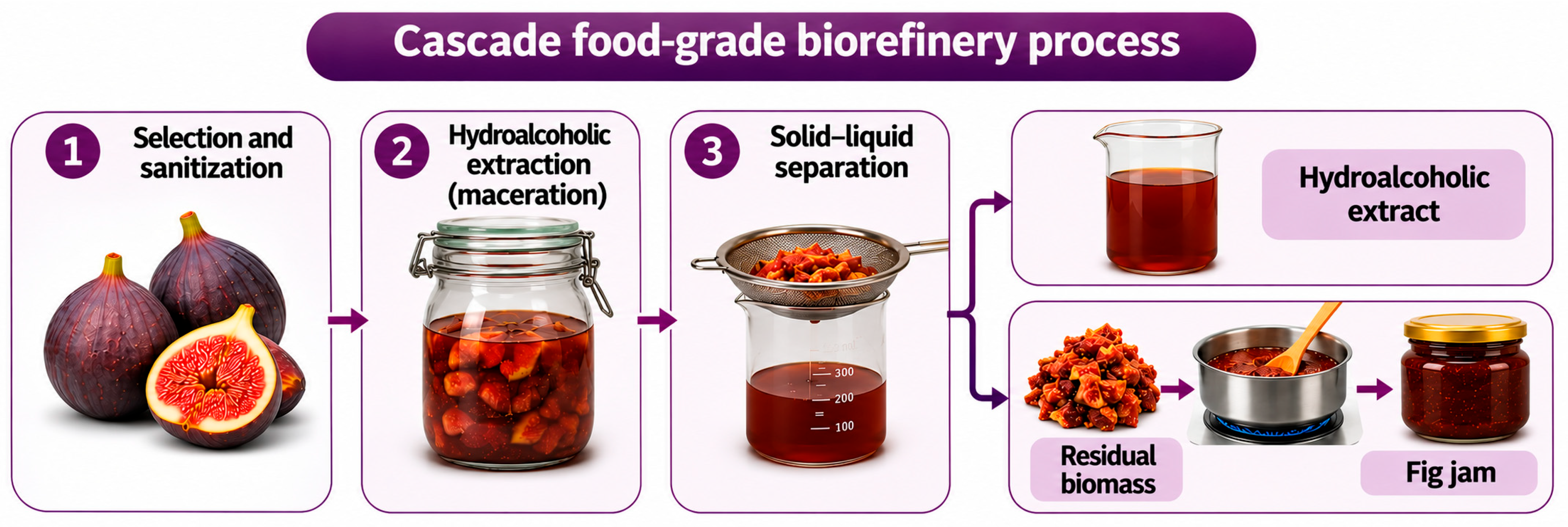

Table 1.
Physicochemical and bioactive characteristics of fresh figs and recovered residual biomass.
Table 1.
Physicochemical and bioactive characteristics of fresh figs and recovered residual biomass.
| Parameter | Unit | Fresh figs | Residual biomass |
| Moisture | % | 24.88 ± 0.13 | 76.47 ± 0.15 |
| Dry matter | % | 75.12 ± 0.13 | 23.53 ± 0.15 |
| pH | — | 5.42 ± 0.01 | 5.095 ± 0.005 |
| Soluble solids | °Brix | 21.84 ± 0.10 | 18.96 ± 0.16 |
| Water activity (a_w) | — | 0.965 ± 0.001 | 0.955 ± 0.001 |
| Titratable acidity | g/100 g | 0.374 ± 0.008 | 0.358 ± 0.005 |
| Density | g/mL | 1.077 ± 0.002 | 1.019 ± 0.002 |
| Lightness (L*) | — | 34.83 ± 0.10 | 31.60 ± 0.21 |
| Red–green coordinate (a*) | — | 14.19 ± 0.14 | 10.23 ± 0.03 |
| Yellow–blue coordinate (b*) | — | 6.78 ± 0.07 | 7.04 ± 0.05 |
| Total phenolic content | mg GAE/kg FW | 420.81 ± 2.68 | 286.64 ± 5.23 |
| Total flavonoids | mg QE/kg FW | 166.71 ± 1.20 | Not determined |
| Total anthocyanins | mg C3G/kg FW | 92.26 ± 1.83 | Not determined |
| Antioxidant capacity (DPPH) | µmol TE/kg FW | Not determined | 551.45 ± 13.85 |
Table 2.
Physicochemical and bioactive characteristics of the hydroalcoholic extract obtained from second-grade Black Mission figs.
Table 2.
Physicochemical and bioactive characteristics of the hydroalcoholic extract obtained from second-grade Black Mission figs.
| Parameter | Unit | Mean ± SD |
| pH | — | 5.05 ± 0.02 |
| Soluble solids | °Brix | 18.22 ± 0.20 |
| Alcohol content | % (v/v) | 21.50 ± 0.05 |
| Total phenolic content | mg GAE/L | 62.33 ± 0.89 |
| Total flavonoids | mg QE/L | 27.87 ± 0.40 |
| Total anthocyanins | mg C3G/L | 15.94 ± 0.25 |
| Antioxidant capacity (DPPH) | µmol TE/L | 423.81 ± 6.77 |
Values are expressed as mean ± standard deviation of three independent processing batches (n = 3). Technical replicates were averaged within each batch.
Table 3.
Physicochemical and bioactive characteristics of fig jam.
| Parameter | Unit | Mean ± SD |
| pH | — | 4.62 ± 0.02 |
| Soluble solids | °Brix | 65.18 ± 0.04 |
| Moisture | % | 34.07 ± 0.00 |
| Water activity (a_w) | — | 0.844 ± 0.001 |
| Titratable acidity | g citric acid/100 g | 0.43 ± 0.01 |
| Lightness (L*) | — | 28.11 ± 0.17 |
| Red–green coordinate (a*) | — | 8.48 ± 0.06 |
| Yellow–blue coordinate (b*) | — | 5.06 ± 0.08 |
| Total phenolic content | mg GAE/kg FW | 181.74 ± 1.69 |
| Total flavonoids | mg QE/kg FW | 69.88 ± 0.10 |
| Total anthocyanins | mg C3G/kg FW | 35.07 ± 0.57 |
| Antioxidant capacity (DPPH) | µmol TE/kg FW | 327.67 ± 3.86 |
FW: fresh weight. Values are expressed as mean ± standard deviation among three independent batches (n = 3), after averaging technical replicates within each batch.
Disclaimer/Publisher’s Note: The statements, opinions and data contained in all publications are solely those of the individual author(s) and contributor(s) and not of MDPI and/or the editor(s). MDPI and/or the editor(s) disclaim responsibility for any injury to people or property resulting from any ideas, methods, instructions or products referred to in the content. |
© 2026 by the authors. Licensee MDPI, Basel, Switzerland. This article is an open access article distributed under the terms and conditions of the Creative Commons Attribution (CC BY) license (http://creativecommons.org/licenses/by/4.0/).
Copyright: This open access article is published under a Creative Commons CC BY 4.0 license, which permit the free download, distribution, and reuse, provided that the author and preprint are cited in any reuse.