
Submitted:
23 November 2026
Posted:
25 November 2026
You are already at the latest version
Abstract
Laser‐assisted drug delivery may enhance the cutaneous effects of topical agents applied after ablative fractional resurfacing, but clinical data on the combined delivery of hyaluronic acid, ascorbic acid, and sodium DNA are scarce. In this prospective, single‐center, single‐arm pilot study (ClinicalTrials.gov NCT07376148), 30 adults with moderate facial photoaging (Fitzpatrick skin types I–III) received one session of fractional CO2 laser followed immediately by topical application of the three agents. Skin quality was graded with the Scientific Assessment Scale of Skin Quality (SASSQ; 0–24 points) and satisfaction with three FACE‐Q Aesthetics domains at baseline, 1 week, 1 month, and 3 months. All participants completed follow‐up. The total SASSQ score decreased from 18.63 ± 2.55 at baseline to 3.73 ± 1.93 at 3 months (80.0% reduction; p < 0.001), and every participant improved by at least 1 point in all six parameters. The median total FACE‐Q score increased from 4.5 to 12.0 (p < 0.001), and no parameter worsened in any participant. This approach was associated with sustained improvement in facial skin quality and high satisfaction; however, the uncontrolled design with unblinded assessment precludes isolating the contribution of the topical agents, and randomized split‐face trials with blinded evaluation are needed.
Keywords:
fractional CO2 laser
; laser‐assisted drug delivery
; hyaluronic acid
; ascorbic acid
; sodium DNA
; photoaging
; skin quality
; patient‐reported outcome measures
1. Introduction
The skin is the largest organ of the human body, with a surface area of approximately 1.8–2 m2, and its principal function is to protect the organism from the external environment [1]. This barrier function resides mainly in the stratum corneum, the outermost layer of the epidermis [2,3]. As a result, only 1–5% of a topically applied drug crosses intact skin to exert a local effect. Molecules penetrate through intercellular, transcellular, or transappendageal routes, and their absorption depends on the concentration gradient, solubility, and diffusion coefficient: molecules of high molecular weight diffuse slowly, whereas lipophilic compounds diffuse more rapidly [4].
Physical methods that bypass the stratum corneum, such as dermabrasion, microneedling, pressure waves, vacuum, radiofrequency, and lasers, can increase transdermal delivery [4,5,6]. Among them, ablative fractional lasers such as the 10,600 nm CO2 and 2940 nm Er:YAG devices have been the most extensively studied for laser-assisted drug delivery (LADD) [5,6,7]. These lasers create columns of thermal injury, known as microscopic treatment zones, that serve as channels for topically applied molecules. The channels close progressively as fibrin, inflammatory mediators, and migrating keratinocytes fill them; consequently, absorption is enhanced when the drug is applied within 6 h of irradiation, peaks within the first 30 min, and is no longer increased after 24 h [4]. Ablative fractional lasers are used to treat atrophic and hypertrophic scars [4,5,6,7,8,9,10,11], dyschromia and photoaging [3,11], and actinic keratosis and squamous and basal cell carcinomas [12]. Adverse effects such as erythema, vesiculation, crusting, and scarring are associated with high fluences and densities and are less frequent with fractional than with fully ablative resurfacing [5,12,13].
Several agents with potential benefit for photoaged skin have been delivered through laser channels. L-ascorbic acid (vitamin C) is a water-soluble antioxidant that scavenges free radicals and acts as a cofactor in numerous enzymatic reactions [14,15]; it is used to treat photoaging [16] and hyperpigmentation [11,16]. Fractional CO2 laser increases its transdermal absorption and stimulates collagen production [15,17,18], an effect that is enhanced in combination with vitamin E [18].
Hyaluronic acid is a glycosaminoglycan composed of repeating disaccharide units of D-glucuronic acid and N-acetyl-D-glucosamine, with a molecular weight of up to 2 × 10⁷ Da. It is abundant in embryonic tissue and in the extracellular matrix of adult connective tissue and has articular, ophthalmic, vascular, neurological, and cutaneous applications [19,20]. During wound healing, it modulates inflammation; promotes neovascularization, endothelial proliferation, and re-epithelialization; and reduces wound contraction during the first 4 weeks [21,22,23], without toxic effects [19,22]. Its capacity to retain water and reinforce the skin barrier reduces age-related wrinkling when it is delivered through ablative fractional laser channels [24,25,26]. Highly polymerized sodium DNA, a double-stranded polynucleotide that penetrates the stratum corneum, protects cells from oxidative stress induced by chronic ultraviolet exposure, stabilizes dermal components, preserves superficial hydration, enhances DNA repair, and increases resistance to ultraviolet-induced cell death [27,28].
Photoaging manifests as loss of elasticity and radiance, fine and coarse wrinkles, deepening of facial folds, and dyspigmentation. According to the Glogau classification, these changes may begin to appear in the third decade of life, depending on skin characteristics and risk factors [29], and typically become moderate from the fourth decade onward [29,30]. Ablative fractional resurfacing is considered the treatment of choice for rejuvenation in Fitzpatrick skin types I–III [13,29].
Although combining these three agents is mechanistically appealing, evidence on their joint delivery through fractional CO2 laser channels is scarce, and objective data from validated photonumeric scales are virtually absent for Mexican patients. We therefore conducted a prospective pilot study to evaluate the efficacy and safety of topical hyaluronic acid, ascorbic acid, and sodium DNA applied immediately after a single session of fractional CO2 laser for the objective improvement of facial photoaging. We hypothesized that this approach would produce objective improvement in facial skin quality.
2. Materials and Methods
2.1. Study Design and Ethics
This prospective, single-center, single-arm, before–after pilot study (phase IV) was conducted at the Oculoplastics Department of the Instituto de Oftalmologia Fundacion Conde de Valenciana I.A.P., Mexico City, Mexico. Participants were enrolled and followed between 14 November 2025 and 31 July 2026. The protocol was approved by the institution’s Research Committee (CI-013-2025), Research Ethics Committee (CEI-2025/05/04), and Biosafety Committee (CB-013-2025) and was registered at ClinicalTrials.gov (NCT07376148). The study was conducted in accordance with the Declaration of Helsinki and, under Article 17, Section II, of the Regulations of the Mexican General Health Law on Health Research, was classified as research involving greater than minimal risk. All participants provided written informed consent before any study procedure, and participants whose photographs are shown provided additional written consent for the publication of identifiable images. This study is reported in accordance with the Transparent Reporting of Evaluations with Nonrandomized Designs (TREND) statement [35]; the completed TREND checklist is provided as a separate file, and the participant flow diagram is shown in Figure S1.
2.2. Participants
Participants were recruited from the outpatient clinic of the Oculoplastics Department. Inclusion criteria were age older than 30 years; Fitzpatrick skin type I–III; moderate signs of facial aging, defined as a total Scientific Assessment Scale of Skin Quality (SASSQ) score ≥12; and willingness to participate. Exclusion criteria were Fitzpatrick skin type IV–VI; local infection or inflammatory disease; lesions suspicious for malignancy; known allergy to hyaluronic acid, ascorbic acid, or sodium DNA; history of keloids or hypertrophic scarring; active herpes labialis; autoimmune disease with photosensitivity; contraindication to intravenous sedation (American Society of Anesthesiologists physical status III–IV or difficult airway); and pregnancy or lactation. Loss to follow-up and any local or systemic adverse reaction were predefined elimination criteria. As this was a pilot study, the sample size was set at 30 participants, in accordance with Browne’s rule [31] and the range of 20–40 participants proposed by Kieser and Wassmer [32].
2.3. Intervention
The topical formulation was prepared from two single-use commercial vials (Toskani, Barcelona, Spain): one containing highly polymerized sodium DNA (2.5 mL) and one containing ascorbic acid and hyaluronic acid (3 mL). The contents were drawn into a sterile 10-mL syringe and homogenized by gentle agitation.
During the 2 weeks before treatment, participants washed the face twice daily with a bar or foaming cleanser for sensitive skin (Cetaphil®, Galderma, Zug, Switzerland), applied a facial moisturizing lotion twice daily (CeraVe®, L’Oréal, Clichy, France) and a sunscreen (TiZO2®, SPF 40; Fallene, West Norriton, PA, USA) every 4 h, and avoided sun exposure during the final week. Oral Polypodium leucotomos extract (Heliocare 360°®, Cantabria Labs, Madrid, Spain; 500 mg once daily) was started 3 days before treatment, and herpes prophylaxis with valacyclovir (two 500-mg tablets daily) was given on the 2 days before and on the day of the procedure.
All treatments were performed by the same physician (D.B.M.-L.) under intravenous sedation administered in every case by the same anesthesiologist, using fentanyl 2 µg/kg and midazolam 0.02 mg/kg. After cleansing with a superoxidized solution containing hypochlorous acid, sodium hypochlorite, and hydrogen peroxide (Microdacyn®, Aerobal, Lerma, Mexico) and drying of the skin, the whole face was treated with a fractional CO2 laser (eCO2™, Lutronic, Goyang, Republic of Korea) using a standardized technique and the following parameters: 120-µm tip, 4–8 mm2 scan area, 20 mJ pulse energy, 25 W power, and 75–100 spots/cm2 density. The topical mixture was applied immediately afterward over the entire treated surface, within the period of maximal channel permeability [4].
From the following day and for 2 weeks, participants applied a repair ointment (Eucerin Aquaphor®, Beiersdorf, Hamburg, Germany) twice daily and sunscreen every 4 h and took Polypodium leucotomos extract once daily; valacyclovir was continued for 2 additional days, and sun exposure was avoided for 3 weeks.
2.4. Outcome Measures
Skin quality was assessed with the SASSQ, a validated photonumeric scale [33] that grades six parameters (elasticity, rhytids, roughness, pigmentation, erythema, and pore size) from 0 (absent) to 4 (very severe). The total score ranges from 0 to 24, with lower scores indicating better skin quality. A decrease of ≥1 point in a parameter was predefined as clinically meaningful improvement. Patient satisfaction was assessed with three domains of the FACE-Q Aesthetics module [34] (appearance/naturalness, healthy skin, and facial rejuvenation), each rated from 1 (very dissatisfied) to 4 (very satisfied); the aggregate score ranged from 3 to 12, with higher scores indicating greater satisfaction.
Participants attended five visits. At baseline, consent was obtained; standardized photographs were taken with fixed framing, lighting, and distance; the SASSQ and FACE-Q were administered; and skin preparation was prescribed. The second visit was the treatment session. At the third, fourth, and fifth visits (1 week, 1 month, and 3 months after treatment), both scales were repeated, adverse effects were specifically queried, and follow-up photographs were taken. All assessments were performed by the treating physician. Age, sex, Fitzpatrick skin type, and self-reported comorbidities were also recorded.
2.5. Statistical Analysis
Continuous variables are presented as mean ± standard deviation (SD) and as median with interquartile range (IQR), calculated by linear interpolation; categorical variables are presented as frequencies and percentages. The normality of the age distribution was assessed with the Shapiro–Wilk test. Because SASSQ and FACE-Q scores are ordinal with few categories, the primary analysis used the Friedman test for related samples, with Kendall’s coefficient of concordance (W) as the effect size. Post hoc pairwise comparisons were performed with the Wilcoxon signed-rank test with Bonferroni correction for the six possible pairwise comparisons among the four time points; effect sizes were expressed as Rosenthal’s r, and 95% confidence intervals (CIs) for mean differences were estimated by bootstrap resampling with 10,000 replicates. Repeated-measures analysis of variance (ANOVA), the analysis prespecified in the protocol, was retained as a sensitivity analysis, with Mauchly’s test of sphericity, Greenhouse–Geisser correction when sphericity was not met, and partial eta squared (ηp2) as the effect size. Independent subgroups were compared with the Mann–Whitney U test (two groups) or the Kruskal–Wallis H test (three groups). Correlations were assessed with Spearman’s coefficient (ρ), and the internal consistency of the six SASSQ parameters was assessed with Cronbach’s α. Statistical significance was set at p < 0.05. Analyses were performed with IBM SPSS Statistics version 31.0 (IBM Corp., Armonk, NY, USA).
3. Results
3.1. Study Population
All 30 enrolled participants received the intervention and completed the five study visits, with no losses to follow-up, no eliminations, and no missing data across the 720 scheduled SASSQ and 360 FACE-Q measurements. Baseline characteristics are summarized in Table 1. Mean age was 55.8 ± 13.3 years (range 30–77; Shapiro–Wilk p = 0.115), and 26 participants (86.7%) were women. Fifteen participants (50.0%) had skin type II, 14 (46.7%) type III, and 1 (3.3%) type I. Fourteen (46.7%) had at least one comorbidity, most commonly systemic hypertension (n = 8; 26.7%). The mean baseline SASSQ total score was 18.63 ± 2.55 (range 13–24), consistent with moderate-to-severe photodamage, and the internal consistency of the six parameters was adequate (Cronbach’s α = 0.80). The median baseline FACE-Q total score was 4.5 (IQR 3.0–6.0), and only 3 of the 90 baseline domain ratings fell within a satisfied category.
3.2. Skin Quality (SASSQ)
The total SASSQ score decreased monotonically from 18.63 ± 2.55 at baseline to 15.20 ± 2.23 at 1 week, 8.83 ± 2.05 at 1 month, and 3.73 ± 1.93 at 3 months (Friedman χ2 = 89.42, df = 3, p < 0.001; W = 0.994) (Table 2; Figure 1). Compared with baseline, the mean reduction was 3.43 points (95% CI 2.90–3.93) at 1 week, 9.80 points (95% CI 9.20–10.43) at 1 month, and 14.90 points (95% CI 14.37–15.47) at 3 months, corresponding to 18.4%, 52.6%, and 80.0% of the baseline value (Table 3). The change was not uniform over time: 23.0% of the total 3-month reduction occurred during the first week, 42.7% between week 1 and month 1, and 34.2% between months 1 and 3. Each interval contributed a significant change (week 1 to month 1, mean difference −6.37; month 1 to month 3, −5.10; both p < 0.001).
All six parameters decreased significantly (Table 2; Figure 2). At 3 months, the reductions relative to baseline were 90.1% for erythema, 82.2% for pigmentation, 80.8% for roughness, 78.3% for pore size, 76.9% for elasticity, and 73.1% for rhytids. All post hoc comparisons with baseline remained significant after Bonferroni correction (Table 3). The only comparison close to the significance threshold was rhytids at 1 week (mean difference −0.23; 95% CI −0.40 to −0.10; Z = −2.65; p = 0.049; r = 0.48); the remaining 20 comparisons reached p < 0.001, with r values between 0.71 and 0.91.
At 3 months, 29 participants (96.7%) had a total SASSQ score ≤6, and all were below the inclusion threshold of 12 points. Individual reductions ranged from 12 to 19 points (mean 14.90 ± 1.60; median 15, IQR 14–16), indicating a homogeneous response.
3.3. Clinically Meaningful Improvement
Every participant met the predefined criterion of clinically meaningful improvement (≥1 point) in all six parameters at 3 months (Table 4). At 1 week, the proportion of responders varied across parameters, from 23.3% for rhytids to 83.3% for elasticity, whereas at 1 month it ranged from 96.7% to 100%. Representative clinical photographs are shown in Figure 3.
3.4. Patient Satisfaction (FACE-Q)
Satisfaction increased progressively in the three FACE-Q domains (Table 5; Figure 4). The median total score rose from 4.5 (IQR 3.0–6.0) at baseline to 7.5 (IQR 6.0–9.0) at 1 week, 9.0 (IQR 9.0–12.0) at 1 month, and 12.0 (IQR 12.0–12.0) at 3 months (Friedman χ2 = 83.58, p < 0.001; W = 0.929), with a mean increase of 6.97 ± 1.63 points. At baseline, 2 participants (6.7%) were satisfied with their appearance, none with the health of their skin, and 1 (3.3%) with facial rejuvenation. At 3 months, all 30 participants were satisfied in all three domains, 26–27 (86.7–90.0%) were very satisfied, and 26 (86.7%) reached the maximum total score of 12 points, compared with none at baseline.
3.5. Sensitivity and Subgroup Analyses
Repeated-measures ANOVA reproduced the conclusions of the primary nonparametric analysis for every variable (all p < 0.001; ηp2 0.849–0.972) (Table S1); sphericity was not met for elasticity, pigmentation, and erythema. The 3-month reduction in the total SASSQ score did not differ by sex (women 14.77 ± 1.68 vs. men 15.75 ± 0.50 points; p = 0.089), skin type (I–II 14.94 ± 1.84 vs. III 14.86 ± 1.35 points; p = 0.898), age group (p = 0.620), or presence of comorbidity (14.43 ± 1.83 vs. 15.31 ± 1.30 points; p = 0.117) (Table S2). The baseline SASSQ score correlated moderately with the magnitude of the reduction (ρ = 0.65; p < 0.001), whereas no significant correlation was found between the reduction and age (ρ = 0.17; p = 0.373) or the change in satisfaction (ρ = 0.18; p = 0.336).
3.6. Safety
No SASSQ parameter worsened in any participant at any follow-up visit (0 of 540 post-treatment parameter–participant observations). No participant withdrew or was eliminated because of an adverse reaction, and no rescue treatment for thermal injury or allergic reaction was required. Moderate or greater erythema was present in 29 participants (96.7%) at baseline and at 1 week, in 5 (16.7%) at 1 month, and in none at 3 months, when 22 participants (73.3%) were free of erythema. Adverse events were specifically queried and recorded at every follow-up visit. Apart from transient post-procedural erythema, which was assessed as an expected effect of the procedure, no adverse events associated with the intervention were recorded.
4. Discussion
In this pilot study, topical hyaluronic acid, ascorbic acid, and sodium DNA applied immediately after a single session of fractional CO2 laser were associated with objective improvement in facial skin quality that continued to increase throughout the 3-month follow-up. The 14.90-point reduction in the total SASSQ score, equivalent to 80.0% of the baseline value, was consistent across all six parameters and all participants, with effect sizes close to the theoretical maximum for both Kendall’s W and ηp2.
The time course is the most informative finding from a pathophysiological standpoint. Only 23.0% of the total reduction occurred during the first week, compared with 42.7% between week 1 and month 1 and 34.2% between months 1 and 3. This pattern is consistent with the remodeling kinetics of ablative fractional laser, in which an early inflammatory and re-epithelialization phase is followed by neocollagenesis that extends over several weeks [5,13]. It also explains why rhytids barely reached significance at 1 week (23.3% responders) but improved in all participants by 3 months: post-procedural edema and erythema transiently mask surface topography and limit the value of the 1-week assessment as an estimate of the treatment effect. Erythema illustrates the same overlap. The proportion of participants with moderate or greater erythema was identical at baseline and at 1 week (96.7%), fell to 16.7% at 1 month, and was 0% at 3 months. This apparent early stability does not reflect a lack of response but the coexistence of the inflammatory erythema expected after fractional ablation with baseline photodamage-related erythema, which the SASSQ cannot distinguish. This limitation was not addressed in the original description of the scale [33] and is relevant when it is used to evaluate ablative devices.
Our findings agree in direction with previous evidence. Haedersdal et al. showed that fractional CO2 laser substantially increases the penetration of topical drugs through ablation channels [5], and Hsiao et al. documented enhanced skin permeation of ascorbic acid 2-glucoside with minimal skin disruption [17]. Waibel et al. found that laser-assisted delivery of a vitamin C, vitamin E, and ferulic acid serum shortened postoperative recovery and increased β-fibroblast growth factor expression [18], a plausible biological substrate for the progressive improvement observed from the second week onward. For hyaluronic acid, a meta-analysis by Zhang et al. concluded that its combination with fractional CO2 laser outperforms laser alone for atrophic acne scars [25], and Fanian et al. reported improvement in superficial wrinkles and overall skin quality with an injectable hyaluronic acid-based micro-filler in a randomized controlled multicenter study [24]. Muskat et al. identified the heterogeneity of treatment protocols as the main obstacle to firm recommendations [11].
The present study adds a simultaneous evaluation of three agents with complementary mechanisms, namely ascorbic acid as a cofactor for collagen synthesis and scavenger of reactive oxygen species [14,15], hyaluronic acid acting on hydration, barrier function, and inflammation [19,20,21], and sodium DNA acting on the repair of ultraviolet-induced genomic damage [27,28], using a validated photonumeric instrument in a Mexican population, for which published data are scarce. This same conceptual appeal is also the main interpretive limitation: because the agents were applied as a single mixture, no differential contribution can be attributed to any of them.
Satisfaction followed an upward trajectory parallel to the objective improvement, with 86.7% of participants reaching the maximum FACE-Q score at 3 months. The absence of a correlation between the magnitude of objective change and the change in satisfaction is more plausibly explained by the marked ceiling effect of the instrument, which leaves no residual variance to correlate, than by a true dissociation between the two dimensions. This observation reinforces a recommendation from the FACE-Q literature [34]: using a reduced subset of items without Rasch conversion to the 0–100 metric compromises sensitivity to change and comparability across studies.
No differences were found by sex, skin type, age group, or comorbidity, although power was limited, particularly for sex (only four men). The moderate positive correlation between the baseline score and the 3-month reduction admits two complementary interpretations: greater room for improvement in more severely photodamaged skin, and regression to the mean, which is difficult to exclude with bounded ordinal scales and unblinded assessment. In addition, the range restriction imposed by the inclusion criterion limits extrapolation to mild photodamage.
The safety profile was favorable: no parameter worsened in 540 post-treatment observations, there were no losses or eliminations, and no participant required rescue treatment. Valacyclovir prophylaxis, pretreatment skin preparation, and conservative fluence and density settings reasonably contributed to this result, in line with recommendations for CO2 laser resurfacing [13]. Adverse events were specifically queried and recorded at each follow-up visit, and apart from the transient erythema expected after fractional ablation, which was attributed to the procedure itself, no adverse events were identified; in particular, no infection, herpetic reactivation, scarring, or post-inflammatory hyperpigmentation occurred.
Strengths of this study include complete accrual of the planned sample, absence of losses over 3 months, standardization of the intervention (single operator, fixed device parameters, and a uniform care regimen), and the use of a validated photonumeric instrument with adequate internal consistency. The agreement between the primary nonparametric analysis and the sensitivity ANOVA supports the robustness of the conclusions to the choice of statistical model.
4.1. Limitations and Future Directions
The main limitation is the absence of a control group. In a single-arm design, the observed improvement reflects the combined effect of the laser, the topical agents, the photoprotection and moisturizing regimen, and natural evolution, without the possibility of separating them. Because ablative fractional laser alone has proven efficacy for skin rejuvenation [13,29], the hypothesis that drug delivery provides additional benefit cannot be considered confirmed.
Second, assessments were performed by a single unblinded observer who also delivered the treatment. The risk of detection bias is visible in the data themselves: all parameter–participant comparisons moved in the same direction, without a single worsening in 540 observations, a uniformity compatible both with a large true effect and with assessor expectation. Addressing this requires not a larger sample but independent assessment of the standardized photographs by observers unaware of the treatment and of the time point, presented in random order.
Third, the SASSQ was validated in aged female facial skin [33] and lacks an established minimal clinically important difference, so the 1-point criterion used here is conventional; satisfaction was assessed with 3 of the 42 FACE-Q items without Rasch transformation; the 3-month follow-up does not establish the durability of the effect; and the small, predominantly female, single-center sample restricted to skin types I–III limits external validity, particularly for skin types IV–VI, which carry a much higher risk of post-inflammatory hyperpigmentation.
These results provide the parameters needed to design a controlled trial: an SD of 1.60 points around a mean reduction of 14.90 points allows estimation of the sample size required to detect differences between split-face sides treated with laser alone or with laser-assisted delivery. A randomized split-face design with blinded assessment of standardized photographs by independent observers, 6- to 12-month follow-up, and instrumental measurements (corneometry, cutometry, or colorimetry) would be the natural next step.
5. Conclusions
In this pilot study, topical hyaluronic acid, ascorbic acid, and sodium DNA applied immediately after a single session of fractional CO2 laser were associated with a sustained and clinically relevant objective improvement in all six evaluated domains of facial skin quality, accompanied by high patient satisfaction and a favorable safety profile. The single-arm design with an unblinded assessor precludes attributing the improvement to drug delivery beyond the effect of the laser itself. The magnitude and consistency of the changes justify a randomized split-face trial with blinded assessment, for which this study provides the necessary effect and variability estimates.
Supplementary Materials
The following supporting information can be downloaded at the website of this paper posted on Preprints.org. Figure S1: Participant flow diagram; Table S1: Repeated-measures analysis of variance of SASSQ and FACE-Q scores (sensitivity analysis); Table S2: Subgroup analyses of the 3-month reduction in the total SASSQ score.
Author Contributions
Conceptualization, D.B.M.-L. and A.N.-C.; methodology, D.B.M.-L. and A.N.-C.; investigation, D.B.M.-L.; data curation, D.B.M.-L.; formal analysis, D.B.M.-L.; visualization, D.B.M.-L.; resources, M.d.L.R.-C. and A.N.-C.; writing—original draft preparation, D.B.M.-L.; writing—review and editing, A.N.-C.; supervision, M.d.L.R.-C. and A.N.-C. All authors have read and agreed to the published version of the manuscript.
Funding
This research received no external funding. The study was supported by institutional funds of the Instituto de Oftalmología Fundación Conde de Valenciana I.A.P.
Institutional Review Board Statement
The study was conducted in accordance with the Declaration of Helsinki and approved by the Research Committee (protocol code CI-013-2025), the Research Ethics Committee (protocol code CEI-2025/05/04), and the Biosafety Committee (protocol code CB-013-2025) of the Instituto de Oftalmologia Fundacion Conde de Valenciana I.A.P., Mexico City, Mexico (date of approval: 09 may 2025). The trial was registered at ClinicalTrials.gov (NCT07376148) on 21 January 2026.
Informed Consent Statement
Informed consent was obtained from all subjects involved in the study. Written informed consent for the publication of identifiable images was obtained from the participants whose photographs are shown.
Data Availability Statement
The data presented in this study are available on request from the corresponding author. The data are not publicly available because they contain information that could compromise the privacy of research participants.
Acknowledgments
During the preparation of this manuscript, the authors declare that no artificial-intelligence tool was used to generate the scientific content, images, or data of this manuscript.
Conflicts of Interest
The authors declare no conflicts of interest.
Abbreviations
The following abbreviations are used in this manuscript:
| ANOVA | Analysis of variance |
| CI | Confidence interval |
| IQR | Interquartile range |
| LADD | Laser-assisted drug delivery |
| SASSQ | Scientific Assessment Scale of Skin Quality |
| SD | Standard deviation |
References
- de Szalay, S.; Wertz, P.W. Protective barriers provided by the epidermis. Int. J. Mol. Sci. 2023, 24, 3145. [Google Scholar] [CrossRef] [PubMed]
- Zaleski-Larsen, L.A.; Fabi, S.G. Laser-assisted drug delivery. Dermatol. Surg. 2016, 42, 919–931. [Google Scholar] [CrossRef] [PubMed]
- Sklar, L.R.; Burnett, C.T.; Waibel, J.S.; Moy, R.L.; Ozog, D.M. Laser assisted drug delivery: a review of an evolving technology. Lasers Surg. Med. 2014, 46, 249–262. [Google Scholar] [CrossRef] [PubMed]
- Alegre-Sánchez, A.; Jiménez-Gómez, N.; Boixeda, P. Vehiculización de fármacos asistida por láser [Laser-assisted drug delivery]. Actas Dermosifiliogr. 2018, 109, 858–867. [Google Scholar] [CrossRef] [PubMed]
- Haedersdal, M.; Sakamoto, F.H.; Farinelli, W.A.; Doukas, A.G.; Tam, J.; Anderson, R.R. Fractional CO2 laser-assisted drug delivery. Lasers Surg. Med. 2010, 42, 113–122. [Google Scholar] [CrossRef] [PubMed]
- Scott, J.A.; Banga, A.K. Cosmetic devices based on active transdermal technologies. Ther. Deliv. 2015, 6, 1089–1099. [Google Scholar] [CrossRef] [PubMed]
- Franz, T.J. Kinetics of cutaneous drug penetration. Int. J. Dermatol. 1983, 22, 499–505. [Google Scholar] [CrossRef] [PubMed]
- Mohamed, H.A.; Mohammed, G.F.; Gomaa, A.H.; Eyada, M.M. Carbon dioxide laser plus topical 5-fluorouracil: a new combination therapeutic modality for acral vitiligo. J. Cosmet. Laser Ther. 2015, 17, 216–223. [Google Scholar] [CrossRef] [PubMed]
- Seo, H.M.; Choi, J.Y.; Min, J.; Kim, W.S. Carbon dioxide laser combined with botulinum toxin A for patients with periorbital syringomas. J. Cosmet. Laser Ther. 2016, 18, 149–153. [Google Scholar] [CrossRef] [PubMed]
- Waibel, J.S.; Rudnick, A. Laser-assisted delivery to treat facial scars. Facial Plast. Surg. Clin. N. Am. 2017, 25, 105–117. [Google Scholar] [CrossRef] [PubMed]
- Muskat, A.; Kost, Y.; Balazic, E.; Cohen, J.L.; Kobets, K. Laser-assisted drug delivery in the treatment of scars, rhytids, and melasma: a comprehensive review of the literature. Aesthetic Surg. J. 2023, 43, NP181–NP198. [Google Scholar] [CrossRef] [PubMed]
- Ibrahim, O.; Wenande, E.; Hogan, S.; Arndt, K.A.; Haedersdal, M.; Dover, J.S. Challenges to laser-assisted drug delivery: applying theory to clinical practice. Lasers Surg. Med. 2018, 50, 20–27. [Google Scholar] [CrossRef] [PubMed]
- Fitzpatrick, R.E. Maximizing benefits and minimizing risk with CO2 laser resurfacing. Dermatol. Clin. 2002, 20, 77–86. [Google Scholar] [CrossRef] [PubMed]
- Njus, D.; Kelley, P.M.; Tu, Y.J.; Schlegel, H.B. Ascorbic acid: the chemistry underlying its antioxidant properties. Free Radic. Biol. Med. 2020, 159, 37–43. [Google Scholar] [CrossRef] [PubMed]
- Boo, Y.C. Ascorbic acid (vitamin C) as a cosmeceutical to increase dermal collagen for skin antiaging purposes: emerging combination therapies. Antioxidants 2022, 11, 1663. [Google Scholar] [CrossRef] [PubMed]
- Farris, P.K. Topical vitamin C: a useful agent for treating photoaging and other dermatologic conditions. Dermatol. Surg. 2005, 31, 814–818. [Google Scholar] [CrossRef] [PubMed]
- Hsiao, C.Y.; Huang, C.H.; Hu, S.; Ko, Y.S.; Sung, H.C.; Chen, C.C.; et al. Fractional carbon dioxide laser treatment to enhance skin permeation of ascorbic acid 2-glucoside with minimal skin disruption. Dermatol. Surg. 2012, 38, 1284–1293. [Google Scholar] [CrossRef] [PubMed]
- Waibel, J.S.; Mi, Q.S.; Ozog, D.; Qu, L.; Zhou, L.; Rudnick, A.; et al. Laser-assisted delivery of vitamin C, vitamin E, and ferulic acid formula serum decreases fractional laser postoperative recovery by increased beta fibroblast growth factor expression. Lasers Surg. Med. 2016, 48, 238–244. [Google Scholar] [CrossRef] [PubMed]
- Abatangelo, G.; Vindigni, V.; Avruscio, G.; Pandis, L.; Brun, P. Hyaluronic acid: redefining its role. Cells 2020, 9, 1743. [Google Scholar] [CrossRef] [PubMed]
- Iaconisi, G.N.; Lunetti, P.; Gallo, N.; Cappello, A.R.; Fiermonte, G.; Dolce, V.; et al. Hyaluronic acid: a powerful biomolecule with wide-ranging applications: a comprehensive review. Int. J. Mol. Sci. 2023, 24, 10296. [Google Scholar] [CrossRef] [PubMed]
- Bhowmick, S.; Rother, S.; Zimmermann, H.; Lee, P.S.; Moeller, S.; Schnabelrauch, M.; et al. Biomimetic electrospun scaffolds from main extracellular matrix components for skin tissue engineering application: the role of chondroitin sulfate and sulfated hyaluronan. Mater. Sci. Eng. C 2017, 79, 15–22. [Google Scholar] [CrossRef] [PubMed]
- Murphy, S.V.; Skardal, A.; Song, L.; Sutton, K.; Haug, R.; Mack, D.L.; et al. Solubilized amnion membrane hyaluronic acid hydrogel accelerates full-thickness wound healing. Stem Cells Transl. Med. 2017, 6, 2020–2032. [Google Scholar] [CrossRef] [PubMed]
- Weinstein-Oppenheimer, C.R.; Brown, D.I.; Coloma, R.; Morales, P.; Reyna-Jeldes, M.; Díaz, M.J.; et al. Design of a hybrid biomaterial for tissue engineering: biopolymer-scaffold integrated with an autologous hydrogel carrying mesenchymal stem-cells. Mater. Sci. Eng. C 2017, 79, 821–830. [Google Scholar] [CrossRef] [PubMed]
- Fanian, F.; Deutsch, J.J.; Bousquet, M.T.; Boisnic, S.; Andre, P.; Catoni, I.; et al. A hyaluronic acid-based micro-filler improves superficial wrinkles and skin quality: a randomized prospective controlled multicenter study. J. Dermatol. Treat. 2023, 34, 2216323. [Google Scholar] [CrossRef] [PubMed]
- Zhang, J.; Xu, F.; Lin, H.; Ma, Y.; Hu, Y.; Meng, Q.; et al. Efficacy of fractional CO2 laser therapy combined with hyaluronic acid dressing for treating facial atrophic acne scars: a systematic review and meta-analysis of randomized controlled trials. Lasers Med. Sci. 2023, 38, 214. [Google Scholar] [CrossRef] [PubMed]
- Ge, S.; Chung, H.J.; Weiss, R.A. Histologic effects of fractional lasers and energy-based devices on intradermally injected hyaluronic acid filler for improving skin smoothness. Lasers Surg. Med. 2025, 57, 96–100. [Google Scholar] [CrossRef] [PubMed]
- Yarosh, D.B.; Rosenthal, A.; Moy, R. Six critical questions for DNA repair enzymes in skincare products: a review in dialog. Clin. Cosmet. Investig. Dermatol. 2019, 12, 617–624. [Google Scholar] [CrossRef] [PubMed]
- Cafardi, J.A.; Elmets, C.A. T4 endonuclease V: review and application to dermatology. Expert Opin. Biol. Ther. 2008, 8, 829–838. [Google Scholar] [CrossRef] [PubMed]
- Holck, D.E.; Ng, J.D. Facial skin rejuvenation. Curr. Opin. Ophthalmol. 2003, 14, 246–252. [Google Scholar] [CrossRef] [PubMed]
- Palomar-Llatas, F.; Castellano-Rioja, E.; Arantón-Areosa, L.; Fornes-Pujalte, B.; Palomar-Albert, D.; Díez-Fornes, P.; et al. Abordaje de las lesiones cutáneas más frecuentes en el envejecimiento [Management of the most frequent skin lesions in aging]. Enferm. Dermatol. 2020, 14(39). [Google Scholar] [CrossRef]
- Browne, R.H. On the use of a pilot sample for sample size determination. Stat. Med. 1995, 14, 1933–1940. [Google Scholar] [CrossRef] [PubMed]
- Kieser, M.; Wassmer, G. On the use of the upper confidence limit for the variance from a pilot sample for sample size determination. Biom. J. 1996, 38, 941–949. [Google Scholar] [CrossRef]
- Eiben-Nielson, C.; Kerscher, M. Development and validation of a global photonumeric scale for evaluating skin quality of aged female facial skin. J. Cosmet. Dermatol. 2021, 20, 4032–4039. [Google Scholar] [CrossRef] [PubMed]
- Gallo, L.; Kim, P.; Yuan, M.; Gallo, M.; Thoma, A.; Voineskos, S.H.; et al. Best practices for FACE-Q Aesthetics research: a systematic review of study methodology. Aesthetic Surg. J. 2023, 43, NP674–NP686. [Google Scholar] [CrossRef] [PubMed]
- Des Jarlais, D.C.; Lyles, C.; Crepaz, N.; TREND Group. Improving the reporting quality of nonrandomized evaluations of behavioral and public health interventions: the TREND statement. Am. J. Public Health 2004, 94, 361–366. [Google Scholar] [CrossRef] [PubMed]
Figure 1.
Total SASSQ score across the four assessments. The bold line shows the median and the shaded band the interquartile range; the 30 individual trajectories are shown in gray. The dashed line marks the inclusion threshold of 12 points. SASSQ, Scientific Assessment Scale of Skin Quality.
Figure 1.
Total SASSQ score across the four assessments. The bold line shows the median and the shaded band the interquartile range; the 30 individual trajectories are shown in gray. The dashed line marks the inclusion threshold of 12 points. SASSQ, Scientific Assessment Scale of Skin Quality.
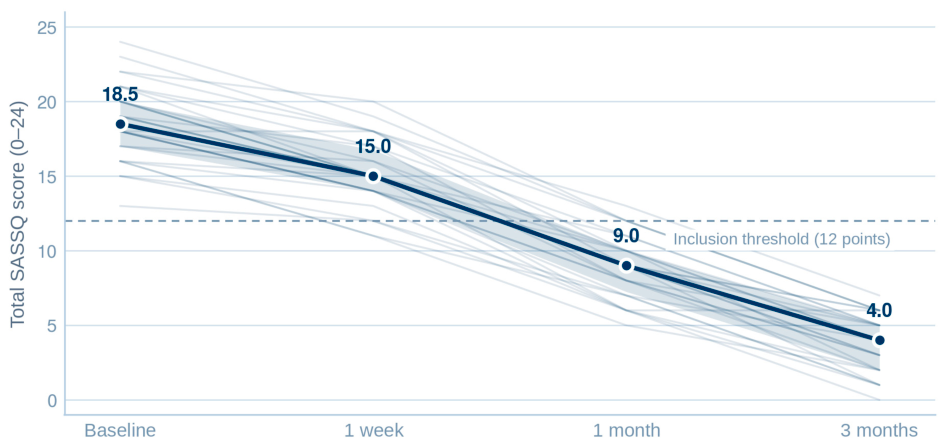
Figure 2.
Change in the six SASSQ parameters. Median with interquartile range (n = 30). Δ, mean difference between baseline and 3 months; p values from the Wilcoxon signed-rank test versus baseline with Bonferroni correction.
Figure 2.
Change in the six SASSQ parameters. Median with interquartile range (n = 30). Δ, mean difference between baseline and 3 months; p values from the Wilcoxon signed-rank test versus baseline with Bonferroni correction.
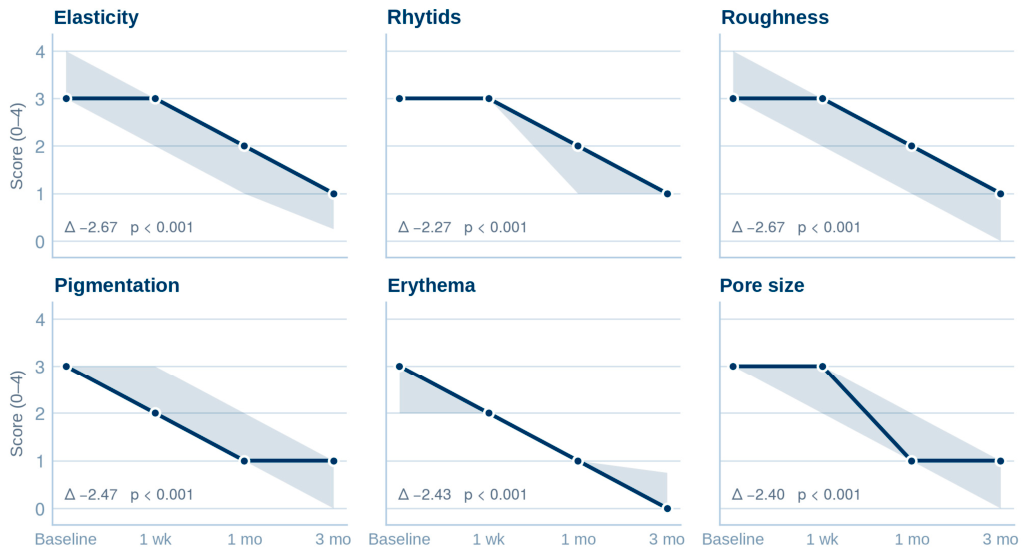
Figure 3.
Clinical appearance of six representative participants before treatment (A, C, E, G, I, K) and 3 months after treatment (B, D, F, H, J, L). Photographs were obtained with standardized framing, lighting, and distance. A more uniform and less pigmented skin tone, softening of wrinkles, and a more hydrated overall appearance are observed in all cases. Panel L also shows improvement in the appearance, relief, and pigmentation of an upper eyelid scar. Images are published with the participants’ written consent.
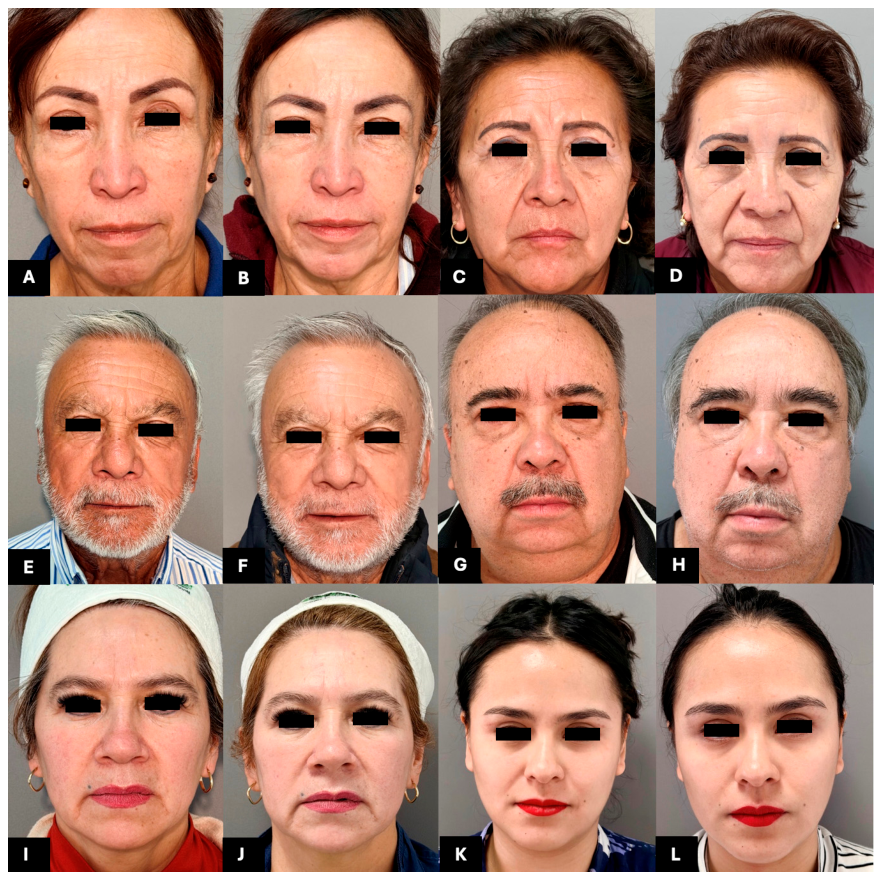
Figure 4.
Distribution of satisfaction levels in the three FACE-Q Aesthetics domains during follow-up (percentage of participants, n = 30). Bars diverge from the boundary between dissatisfaction and satisfaction.
Figure 4.
Distribution of satisfaction levels in the three FACE-Q Aesthetics domains during follow-up (percentage of participants, n = 30). Bars diverge from the boundary between dissatisfaction and satisfaction.
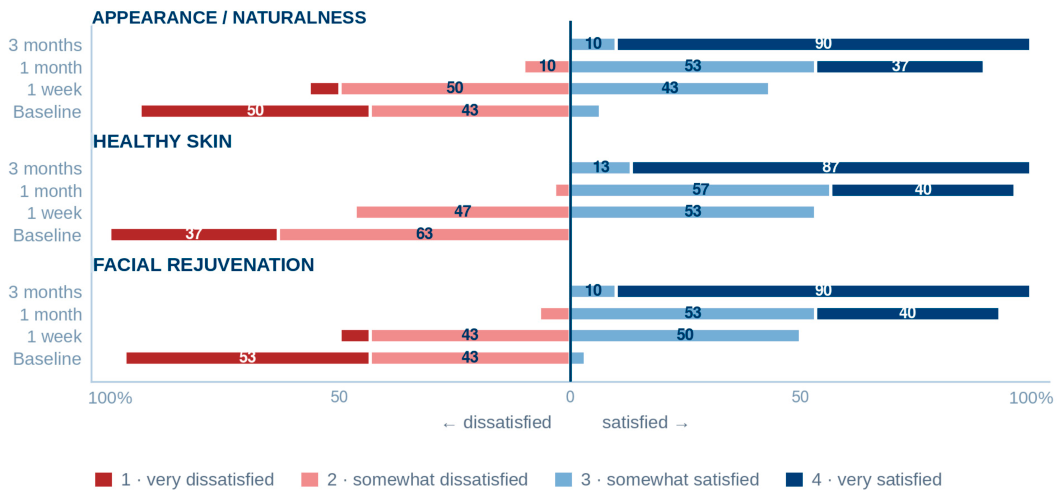

Table 1.
Baseline demographic and clinical characteristics of the study population (n = 30).
| Characteristic | Value |
|---|---|
| Age, years, mean ± SD | 55.8 ± 13.3 |
| Age, years, median (IQR) | 55 (50–66) |
| Age, years, range | 30–77 |
| 30–49 years, n (%) | 8 (26.7) |
| 50–64 years, n (%) | 12 (40.0) |
| ≥65 years, n (%) | 10 (33.3) |
| Female, n (%) | 26 (86.7) |
| Male, n (%) | 4 (13.3) |
| Fitzpatrick skin type I, n (%) | 1 (3.3) |
| Fitzpatrick skin type II, n (%) | 15 (50.0) |
| Fitzpatrick skin type III, n (%) | 14 (46.7) |
| Any comorbidity, n (%) | 14 (46.7) |
| Systemic hypertension, n (%) | 8 (26.7) |
| Hypothyroidism, n (%) | 3 (10.0) |
| Type 2 diabetes mellitus, n (%) | 2 (6.7) |
| Baseline total SASSQ score, mean ± SD | 18.63 ± 2.55 |
| Baseline total SASSQ score, median (IQR) | 18.5 (17.0–20.0) |
| Baseline total SASSQ score, range | 13–24 |
| Baseline total FACE-Q score, median (IQR) | 4.5 (3.0–6.0) |
| Completed 3-month follow-up, n (%) | 30 (100.0) |
SD, standard deviation; IQR, interquartile range; SASSQ, Scientific Assessment Scale of Skin Quality (0–24 points; higher scores indicate greater impairment); FACE-Q, FACE-Q Aesthetics (3–12 points; higher scores indicate greater satisfaction).
Table 2.
SASSQ scores by parameter and time point, and Friedman test for related samples.
| SASSQ Parameter | Baseline | 1 Week | 1 Month | 3 Months | χ2 | p | W |
|---|---|---|---|---|---|---|---|
| Elasticity | 3.47 ± 0.51 3.0 (3.0–4.0) |
2.63 ± 0.56 3.0 (2.0–3.0) |
1.57 ± 0.50 2.0 (1.0–2.0) |
0.80 ± 0.55 1.0 (0.2–1.0) |
84.66 | < 0.001 | 0.941 |
| Rhytids | 3.10 ± 0.61 3.0 (3.0–3.0) |
2.87 ± 0.51 3.0 (3.0–3.0) |
1.77 ± 0.57 2.0 (1.0–2.0) |
0.83 ± 0.46 1.0 (1.0–1.0) |
86.00 | < 0.001 | 0.956 |
| Roughness | 3.30 ± 0.65 3.0 (3.0–4.0) |
2.57 ± 0.63 3.0 (2.0–3.0) |
1.57 ± 0.50 2.0 (1.0–2.0) |
0.63 ± 0.49 1.0 (0.0–1.0) |
85.30 | < 0.001 | 0.948 |
| Pigmentation | 3.00 ± 0.64 3.0 (3.0–3.0) |
2.43 ± 0.50 2.0 (2.0–3.0) |
1.40 ± 0.50 1.0 (1.0–2.0) |
0.53 ± 0.51 1.0 (0.0–1.0) |
85.80 | < 0.001 | 0.953 |
| Erythema | 2.70 ± 0.65 3.0 (2.0–3.0) |
2.20 ± 0.48 2.0 (2.0–2.0) |
1.13 ± 0.43 1.0 (1.0–1.0) |
0.27 ± 0.45 0.0 (0.0–0.8) |
85.42 | < 0.001 | 0.949 |
| Pore size | 3.07 ± 0.52 3.0 (3.0–3.0) |
2.50 ± 0.57 3.0 (2.0–3.0) |
1.40 ± 0.56 1.0 (1.0–2.0) |
0.67 ± 0.48 1.0 (0.0–1.0) |
84.95 | < 0.001 | 0.944 |
| Total SASSQ score | 18.63 ± 2.55 18.5 (17.0–20.0) |
15.20 ± 2.23 15.0 (14.0–16.8) |
8.83 ± 2.05 9.0 (7.2–10.0) |
3.73 ± 1.93 4.0 (2.0–5.0) |
89.42 | < 0.001 | 0.994 |
In each cell, the first line shows the mean ± standard deviation and the second the median with interquartile range. χ2, Friedman statistic with 3 degrees of freedom; W, Kendall’s coefficient of concordance (0–1). Each parameter is scored from 0 to 4 and the total score from 0 to 24; lower scores indicate better skin quality.
Table 3.
Post hoc comparisons of SASSQ scores versus baseline (Wilcoxon signed-rank test).
| SASSQ Parameter | Comparison | Mean Difference (95% CI) | Z | p * | r |
|---|---|---|---|---|---|
| Elasticity | Baseline → 1 week | −0.83 (−0.97 to −0.70) | −5.00 | < 0.001 | 0.91 |
| Baseline → 1 month | −1.90 (−2.10 to −1.70) | −5.00 | < 0.001 | 0.91 | |
| Baseline → 3 months | −2.67 (−2.87 to −2.43) | −4.95 | < 0.001 | 0.90 | |
| Rhytids | Baseline → 1 week | −0.23 (−0.40 to −0.10) | −2.65 | 0.049 | 0.48 |
| Baseline → 1 month | −1.33 (−1.53 to −1.13) | −4.88 | < 0.001 | 0.89 | |
| Baseline → 3 months | −2.27 (−2.43 to −2.10) | −4.98 | < 0.001 | 0.91 | |
| Roughness | Baseline → 1 week | −0.73 (−0.87 to −0.57) | −4.69 | < 0.001 | 0.86 |
| Baseline → 1 month | −1.73 (−1.90 to −1.53) | −4.98 | < 0.001 | 0.91 | |
| Baseline → 3 months | −2.67 (−2.87 to −2.47) | −4.95 | < 0.001 | 0.90 | |
| Pigmentation | Baseline → 1 week | −0.57 (−0.73 to −0.40) | −4.12 | < 0.001 | 0.75 |
| Baseline → 1 month | −1.60 (−1.80 to −1.40) | −4.92 | < 0.001 | 0.90 | |
| Baseline → 3 months | −2.47 (−2.67 to −2.27) | −4.92 | < 0.001 | 0.90 | |
| Erythema | Baseline → 1 week | −0.50 (−0.67 to −0.33) | −3.87 | < 0.001 | 0.71 |
| Baseline → 1 month | −1.57 (−1.77 to −1.37) | −4.88 | < 0.001 | 0.89 | |
| Baseline → 3 months | −2.43 (−2.63 to −2.23) | −4.92 | < 0.001 | 0.90 | |
| Pore size | Baseline → 1 week | −0.57 (−0.77 to −0.37) | −3.90 | < 0.001 | 0.71 |
| Baseline → 1 month | −1.67 (−1.87 to −1.47) | −4.94 | < 0.001 | 0.90 | |
| Baseline → 3 months | −2.40 (−2.60 to −2.20) | −4.92 | < 0.001 | 0.90 | |
| Total SASSQ score | Baseline → 1 week | −3.43 (−3.93 to −2.90) | −4.74 | < 0.001 | 0.86 |
| Baseline → 1 month | −9.80 (−10.43 to −9.20) | −4.81 | < 0.001 | 0.88 | |
| Baseline → 3 months | −14.90 (−15.47 to −14.37) | −4.82 | < 0.001 | 0.88 |
* p values corrected with the Bonferroni method for the six possible pairwise comparisons among the four time points. 95% CI, 95% confidence interval estimated by bootstrap resampling with 10,000 replicates; r, Rosenthal’s coefficient (|Z|/√n).
Table 4.
Participants with an improvement of at least 1 point from baseline, by parameter and time point.
Table 4.
Participants with an improvement of at least 1 point from baseline, by parameter and time point.
| Parameter | 1 Week, n (%) | 1 Month, n (%) | 3 Months, n (%) |
|---|---|---|---|
| Elasticity | 25 (83.3) | 30 (100.0) | 30 (100.0) |
| Rhytids | 7 (23.3) | 29 (96.7) | 30 (100.0) |
| Roughness | 22 (73.3) | 30 (100.0) | 30 (100.0) |
| Pigmentation | 17 (56.7) | 30 (100.0) | 30 (100.0) |
| Erythema | 15 (50.0) | 29 (96.7) | 30 (100.0) |
| Pore size | 16 (53.3) | 30 (100.0) | 30 (100.0) |
| Total SASSQ score (≥1 point) | 29 (96.7) | 30 (100.0) | 30 (100.0) |
| Appearance / naturalness (FACE-Q) | 21 (70.0) | 29 (96.7) | 30 (100.0) |
| Healthy skin (FACE-Q) | 24 (80.0) | 29 (96.7) | 30 (100.0) |
| Facial rejuvenation (FACE-Q) | 23 (76.7) | 29 (96.7) | 30 (100.0) |
For SASSQ parameters, improvement denotes a decrease of at least 1 point; for FACE-Q domains, an increase of at least 1 point.
Table 5.
FACE-Q Aesthetics domain scores by time point, expressed as median and interquartile range, and Friedman test.
Table 5.
FACE-Q Aesthetics domain scores by time point, expressed as median and interquartile range, and Friedman test.
| FACE-Q Domain | Baseline | 1 Week | 1 Month | 3 Months | χ2 | p | W |
|---|---|---|---|---|---|---|---|
| Appearance / naturalness | 1.5 (1.0–2.0) | 2.0 (2.0–3.0) | 3.0 (3.0–4.0) | 4.0 (4.0–4.0) | 81.91 | < 0.001 | 0.910 |
| Healthy skin | 2.0 (1.0–2.0) | 3.0 (2.0–3.0) | 3.0 (3.0–4.0) | 4.0 (4.0–4.0) | 81.38 | < 0.001 | 0.904 |
| Facial rejuvenation | 1.0 (1.0–2.0) | 2.5 (2.0–3.0) | 3.0 (3.0–4.0) | 4.0 (4.0–4.0) | 81.80 | < 0.001 | 0.909 |
| Total FACE-Q score | 4.5 (3.0–6.0) | 7.5 (6.0–9.0) | 9.0 (9.0–12.0) | 12.0 (12.0–12.0) | 83.58 | < 0.001 | 0.929 |
Each domain is scored from 1 (very dissatisfied) to 4 (very satisfied); the total score ranges from 3 to 12. Higher scores indicate greater satisfaction. χ2, Friedman statistic with 3 degrees of freedom; W, Kendall’s coefficient of concordance.
Disclaimer/Publisher’s Note: The statements, opinions and data contained in all publications are solely those of the individual author(s) and contributor(s) and not of MDPI and/or the editor(s). MDPI and/or the editor(s) disclaim responsibility for any injury to people or property resulting from any ideas, methods, instructions or products referred to in the content. |
© 2026 by the authors. Licensee MDPI, Basel, Switzerland. This article is an open access article distributed under the terms and conditions of the Creative Commons Attribution (CC BY) license (http://creativecommons.org/licenses/by/4.0/).
Copyright: This open access article is published under a Creative Commons CC BY 4.0 license, which permit the free download, distribution, and reuse, provided that the author and preprint are cited in any reuse.