

Submitted:
23 November 2026
Posted:
25 November 2026
You are already at the latest version
Abstract
The process of obtaining methanol by catalytic hydrogenation of carbon dioxide (CO₂) is a promising way to continue syntheses in the production of chemicals. This paper analyzes comparatively the catalysts Cu/Zn/Al and Cu/Zn/Zr, thus presenting the influence of the catalyst composition on physico-chemical properties and catalytic performance. The review includes the synthesis techniques, compositional traits, copper distribution and reactivity, interactions between metals and oxides, CO₂ activation, and suggested chemical reactions. A particular examination focuses on the impact of Al-and-Zr oxide phases on the selectivity for methanol production, carbon dioxide conversion, catalyst efficiency and durability, along with the simultaneous reaction of water gas shift. The published results shall be critically assessed, taking into account differences in catalyst preparation, reaction conditions and performance evaluation methods that may limit direct comparisons. The evaluation underscores the significance of grasping structure-activity linkages to inform catalyst development and pinpoints principal obstacles involving active site profiling, preference enhancement, and sustained durability. This benchmarking offers a foundation for determining research priorities to develop effective Cu-based catalysts for hydrogenating CO₂ into methanol.
Keywords:
catalysts
; methanol
; carbon dioxide hydrogenation
; catalytic activity
1. Introduction
The increasing amount of greenhouse gases, particularly carbon dioxide (CO₂), in the atmosphere has become a problem and concern of global environmental interest in terms of climate change. Thus, the development of effective technologies for carbon capture and use has attracted considerable attention as a potential approach to reducing net greenhouse gas emissions, turning CO₂ into valuable chemicals [1,2,3,4]. Among the various ways of using CO₂, catalytic hydrogenation is a promising strategy for the production of fuels and chemical intermediates, in particular methanol. Methanol is an important chemical with applications in the production of formaldehyde, acetic acid and other chemical derivatives. It is also being investigated as an alternative fuel, an energy carrier and a raw material for emerging low-carbon technologies [1,4]. The catalytic hydrogenation of CO₂ to methanol proceeds according to the following overall reactions:
Moreover, the reverse reaction of water gas displacement, known as the reverse water-gas shift (RWGS), can also occur, wherein carbon dioxide is converted into carbon monoxide in the presence of hydrogen:
The process is also constrained by thermodynamic equilibrium and competing reactions, Including the reverse process in water gas conversion, along with the necessity to achieve high catalytic efficiency, methanol selectivity, and long-term stability. The environmental advantages of this procedure also hinge on the availability of low-carbon hydrogen and the source of CO₂ raw materials [5,6]. Methods such as deposition-precipitation techniques, impregnation through initial wetting, and colloidal deposition have been thoroughly investigated for preparing copper-containing catalysts that are deposited on a support [7,8]. Improving the activity of catalytic catalysts could facilitate operations in less demanding conditions, potentially lowering both production costs and operating pressure. Creating multifunctional catalysts that convert methanol intermediates into useful products concurrently might alter reaction results, steering the emphasis toward product creation, according to the Le Chatelier principle, indicates. This method also enables incorporating multiple procedures, including CO₂ capture followed by conversion, into a unified technological system. At the same time, the development of new methods of preparation of catalysts is an important research direction, aiming to simplify the synthesis process by obtaining, in a single stage, catalytic materials starting from precursors and reaching catalysts with forms and properties suitable for industrial applications [9,10,11,12,13].
The Cu/ZnO/Al₂O₃ catalyst is one of the most important catalytic systems used in the chemical industry, being widely applied in the synthesis of synthetic gas methanol, consisting mainly of carbon monoxide (CO), carbon dioxide (CO₂) and hydrogen (H₂). Its industrial use is due to high catalytic activity, favorable selectivity for the formation of methanol and appropriate stability under controlled operating conditions. This ternary system is a representative example of synergy between the components of a heterogeneous catalyst, its performance being superior to that of the individual components [14,15]. Copper-containing catalysts are frequently examined for methanol production owing to their capacity to activate hydrogen and encourage the hydrogenation of intermediates derived from CO₂. Specifically, materials containing copper and zinc oxide, known as Cu/ZnO-based, garnered special attention because of the complementary effects between copper and zinc oxide, which affect copper distribution, surface reactivity, and the creation of active interface locations. The inclusion of Al₂O₃ can aid in structural reinforcement, minimize porosity, and enhance resistance against particle expansion, rendering Cu/Zn/Al catalysts a key benchmark for methanol synthesis. Nonetheless, their effectiveness continues to be significantly influenced by the catalyst composition, manufacturing conditions, treatment after reduction, and reaction settings. From a compositional point of view, the catalyst consists of copper (Cu), zinc oxide (ZnO) and aluminum oxide (Al₂O₃), each component contributing in a specific way to the physico-chemical properties and catalytic behavior of the material. Copper is the main active component, being involved in the activation of reactants and in the transformation of adsorbed species on the catalyst surface. Zinc oxide acts as a promoter, influencing copper dispersion, electronic surface properties, and the formation of Cu–ZnO interfaces [16]. At the same time, Al₂O₃ mainly contributes to structural stability and maintenance of the dispersion of the component phases, limiting the agglomeration and growth of copper particles during operation. An essential aspect of this system is the interactions between copper and zinc oxide. The close contact between the two components favors the formation of interfacial sites that influence adsorption and transformation of reactants. Specialty studies show that catalytic activity does not depend exclusively on the specific copper surface, but also on the nature and structure of Cu–ZnO interfaces, as well as the chemical state of the zinc species present near the active phase [17]. However, the exact nature of the active sites and the relative contribution of the different Zn species continue to be investigated, as the structure of the catalyst surface may change under the reaction conditions.
Catalysts including copper, zinc oxide, and zirconium oxide (Cu/ZnO/ZrO₂) represent a viable substitute for the typical Cu/ZnO/Al₂O₃ systems being investigated for improving activity and selectivity in the synthesis of methanol, in particular by hydrogenation of carbon dioxide (CO₂). Introducing ZrO₂ allows modifying the physico-chemical attributes of the catalyst and the interrelations between components, ultimately influencing how the material behaves during reactions. Research indicates that the catalytic performance is significantly influenced by the composition, preparation method, and nature of the interfaces between copper and oxide supports [18]. In these setups, copper (Cu) serves as the primary reactive element, playing a role in the activation of hydrogen and the conversion of intermediate substances. Zinc oxide (ZnO) aids in the distribution of copper and the creation of active interfaces, whereas zirconium oxide (ZrO₂) affects CO₂ adsorption, the surface's acidity and basicity, and the interactions between metals and oxides. The mentioned effects might stimulate the creation and change of intermediates in methanol synthesis, such as formate and bicarbonate species. Research comparing these aspects has demonstrated that the composition of copper-containing oxides can affect both the selectivity for methanol production and the durability of the catalyst throughout its use [19]. An important parameter in the development of Cu/ZnO/ZrO₂ catalysts is the ratio of ZnO to ZrO₂. Its modification can influence the material structure, active phase dispersion and interfacial properties. For example, a study on co-precipitation prepared catalysts showed that the progressive replacement of ZnO with ZrO₂ significantly alters the properties of the materials and a particular optimized formulation attained a methanol output of 725 grams per kilogram of catalyst per hour at 50 bars under the tested experimental conditions. This result highlights the importance of optimizing the composition, without implying that the same formulation will be optimal in all reaction conditions [20,21]. Moreover, the approach for preparation and the heat treatments utilized can influence the quantity of copper particles, their level of dispersion, and the strength of interactions among the components. Ensuring a balanced distribution of the active phase and creating favorable interfaces between ZnO and ZrO₂ will boost catalytic performance. If the ZrO₂ content is excessive or the phase distribution is poor, it can alter the accessibility of active sites. Therefore, the influence of zirconium should be evaluated alongside the overall composition of the catalyst and operational variables [21,22]. To conclude, Cu/ZnO/ZrO₂ catalysts exhibit significant promise for hydrogenating CO₂ into methanol, thanks to the ability to modify surface characteristics and the relationships among the constituent phases. While they might offer benefits under certain circumstances, their performance is particularly influenced by the Zn/Zr ratio, copper distribution, brewing method, and reaction conditions. To design materials with enhanced productivity, selectivity, and stability, it is essential to understand the relationship between structure and catalytic activity. This assessment offers a comparative analysis of Cu/Zn/Al and Cu/Zn/Zr catalysts for CO₂ reduction to methanol. Specifically, emphasis is placed on synthesis methodologies, physicochemical attributes, spatial features, reaction processes, and catalytic efficacy, covering CO₂ conversion, methanol preference, output capacity, and durability. The impact of catalyst composition and preparation techniques on activity structures is critically assessed, taking into consideration variations in reaction conditions and evaluation methods, as differences in these factors affect the comparison of reported outcomes. Finally, current challenges and future research directions are discussed to identify opportunities for developing more active, selective and stable catalysts for sustainable methanol production.
2. Discussion and Results
2.1. CO₂ Hydrogenation to Methanol: Reaction Mechanism
The conversion of carbon dioxide (CO₂) into methanol (CH₃OH) through catalysis is an exciting route for transforming atmospheric carbon dioxide into useful chemicals and energy sources. This procedure includes carbon dioxide (CO₂) interacting with hydrogen (H₂), facilitated by appropriate catalysts, typically under elevated temperatures and pressures. To comprehend the reaction mechanism is crucial for explaining catalytic behavior, identifying influencing factors on methanol formation, and assessing process selectivity. Various route options have been suggested; the pathway facilitated by the instructors is typically regarded as one of the primary routes, while the reverse reaction of the water-gas balance shift (reversed water-gas shift, or RWGS) is a competing pathway that contributes to CO formation. The nature of active centers, the adsorption and activation of reactants, along with the stabilization of reaction intermediates, are all crucial factors in assessing the overall reaction performance. The most studied routes for obtaining methanol by reduction include the following reaction mechanisms: the intermediate mechanisms of HCOO, r-HCOO, RWGS+CO-Hydrogenation, and trans-COOH are all involved in this process [23]. Special consideration is given to the effects of the catalyst's composition and interactions with metal oxides on the reaction mechanism in the case of catalytic systems such as Cu/Zn/Al and Cu/Zn/Zr, particularly.
2.1.1. Catalytic Mechanism of Conversion CO₂ in Methanol in the Presence of Cu/ZnO/Al₂O₃ Catalysts
The catalytic hydrogenation of CO₂ in methanol using the Cu/ZnO/Al₂O₃ catalyst has attracted considerable attention due to the industrial relevance of this catalytic system and its potential for sustainable CO₂ recovery. The specific characteristics of active sites and the fundamental reaction mechanism continue to be debated by scientists, especially regarding how metallic copper and zinc oxide interact synergistically at the metal–oxide interface. Several routes of reaction were proposed, including the formate-mediated path, the change of –gas reverse (RWGS) gas followed by CO hydrogenation and carboxyl path, the former path being generally considered one of the most relevant mechanisms for the formation of methanol [24]. The catalytic effectiveness is notably impacted by the physico-chemical attributes of the catalyst, the copper's oxidation state, the nature of the Cu–ZnO junction, and the reaction circumstances.
Grabow and Mavrikakis [25] noted that the main CO2 reduction to methanol mechanism involves the formate pathway. They also showed that the conversion of CO follows an alternative reaction path, both involving successive obtaining of formaldehyde and methoxy intermediates, and the speed determinant stage being influenced by the composition of the reactant flux, respectively by the relative concentration of the CO₂ and CO components. All this has been demonstrated using DFT calculations and microkinetic modelling for Cu/ZnO/Al₂O₃ type investigation.
Pacchioni [17] categorizes the literature on CO2 hydrogenation on the industrial catalyst Cu/ZnO/Al2O3 in three key ways, emphasizing the associative format mechanism as the primary pathway for methanol synthesis. Within this pathway, surface-activated adsorbed CO2 molecules react with hydrogen atoms resulting from the dissociation of H2 on copper nanoparticles to generate the formed intermediate (HCOO*). The subsequent hydrogenation of this intermediate constitutes the speed-determining stage (RDS). Concurrently, the dissociative route (RWGS), which includes the formation of CO* and H2O through hydrocarboxyl intermediates (COOH*), operates as a secondary mechanism that is more prevalent at higher temperatures because of its endothermic nature. Rather, the third approach, the trans-COO* mechanism, is based on DFT theoretical calculations for ideal Cu(111) surfaces and is still an unverified hypothesis regarding industrial catalysts. Therefore, although the atomic nature of the active sites remains controversial due to the structural dynamics of the catalyst under working conditions, the reaction mechanism by the formate path is well founded and considered the main route in the synthesis of methanol.
According to the kinetic study conducted by Lin and Bhan [26], the CO2 hydrogenation on copper-based catalysts Cu/ZnO/Al2O3 occurs through a branched reaction network, in which the synthesis of methanol and the reaction of RWGS are carried out on parallel and independent routes directly from CO2. Utilizing Donder reversibility formalisms, the authors confirmed that a sequential path is thermodynamically forbidden under the stated working conditions. From a kinetic point of view, the direct rate of formation of methanol shows a dependence of order 1 on the partial pressure of hydrogen, while the reaction of RWGS is of order 0, indicating a determinant speed stage (RDS) that requires two additional atoms of adsorbed hydrogen (H*) and a deficit of them on the surface. In addition, in situ titration with CH2Cl2 (methylene chloride) confirmed the invariance of the density of the active sites, proving that the evolution of speeds derives exclusively from intrinsic kinetics, while the water generated as a by-product preferentially and strongly inhibits the synthesis of methanol.
Laudenschleger et al. [15] demonstrated that the reaction mechanism and the nature of the active sites are directly governed by the composition of the gaseous feeding mixture. In industrial conditions with mixtures containing CO2, the synthesis of methanol is predominantly carried out by the formate mechanism, in which oxygenated intermediates adsorbed on the surface (especially the formed species) exert a partial oxidation effect on the zinc atoms migrated on the metallic copper particles, generating cationic interfacial sites of type Cu0–Znδ+. By reversible in situ poisoning with base probes (such as NH3 or methylamines), the authors confirmed that these Cu0–Znδ+ interfacial sites constitute the active centers on which hydrogenation of the formate occurs. By contrast, when switching to an exclusive CO/H2 feeder (in the absence of CO2 and water), the catalyst surface returns to a completely reduced state (surface alloy Cu0–Zn0), and the reaction changes its mechanism to the formalil path, which is less effective kinetic, thus confirming that the presence of CO2 is essential for generating and stabilizing the optimal oxidation state of the interfacial zinc.
Wu et al. [27] analyzed the reaction mechanism and the nature of the active phase, showing that the CO2 hydrogenation to methanol is carried out preferentially through the format path, which is strongly favored kinetic and energetic in relation to the dissociative path RWGS. The analysis was based on calculations from the density functional theory (DFT) on Cu(211) surface models. The authors proved that under the reaction conditions, the surface of the Zn/Cu alloy undergoes spontaneous hydroxylation (generated by cleavage of the H2COOH* intermediate or by water interaction with surface oxygen), forming the active phase ZnOH/Cu, more thermodynamically stable than the interfaces Zn/Cu or ZnO/Cu. Mechanically, the presence of hydroxyl groups on interfacial zinc significantly reduces the activation barriers of the speed-determining stages of hydrogenation of the format and of the methoxy species, increasing the speed constants of these stages by up to 2–3 orders of magnitude relative to non-hydroxylated surfaces. At the same time, it is highlighted that moderate grouping coverage, controlled by the CO2/H2 supply ratio, is critical for promoting the reaction without blocking the sites needed for CO2 adsorption.
In the study by Zabilskiy et al. [28], the synergistic interaction between copper and zinc during catalytic hydrogenation of CO2 at methanol is investigated by spectro-microscopic operando techniques (spectroscopy FTIR and XAS). The authors demonstrated that the reaction mechanism is governed by the interface between the copper and zinc phases (MSI), where the format species (HCOO*) generated by CO2 activation preferentially bind to the zinc atoms at the interface. This distinctive interfacial synergy involving metallic copper activating and supplying hydrogen atoms via spillover, and the zinc at the interface maintains oxygenated intermediates — significantly speeds up the conversion of the format to methanol, enhancing reaction selectivity and avoiding unnecessary dehydrogenation or breakdown.
The synthesis study by San et al. [29] outlines the CO2 hydrogenation to methanol reaction catalyzed by the industrial catalyst Cu/ZnO/Al2O3, with the associative mechanism involving the hydroxyl (HCOO*) intermediate being predominant, where the adsorption and activation of CO2 occur at the active sites at the Cu-ZnO interface, facilitated by the interaction between Cu0 and Cu+ species. The interactive synergy between copper and zinc oxide diminishes the observed activation energy threshold for the creation of intermediate forms and prevents the secondary reversal of the water gas (RWGS) displacement reaction, promoting sequential hydrogenation towards methanol. In this ternary system, Al2O3 performs the role of predominately structural promoter, performing as a mechanical stabilizer to maintain the high dispersion of metallic copper nanoparticles and prevent their agglomeration or sintering under thermal reaction conditions. To provide a comparative overview of the mechanistic evolution in CO2 hydrogenation at methanol, Table 1 systematizes the main literature findings on the reaction path, the speed determinant steps and the nature of the active sites for the Cu/ZnO/Al2O3 catalyst.
2.1.2. Catalytic Mechanism of Conversion CO₂ in Methanol in the Presence of Cu/ZnO/ZrO2 Catalysts
In the context of the development of high-performance catalysts for the synthesis of methanol, the elucidation of reaction mechanisms and the understanding of the interactions between the active metal phase, in particular copper (Cu), and zirconium oxide media (ZrO₂) are fundamental aspects, as these interactions influence the dispersion and stability of active species, favour the activation of CO₂ molecules and the stabilisation of reaction intermediates, and thus contributing to improving catalytic activity and selectivity by harnessing synergistic effects at the Cu–ZrO₂ interface [30,31,32].
San et al. [29] emphasize that for the Cu/ZnO/ZrO2 system, the incorporation of zirconium dioxide enhances catalytic efficiency through various interface effects. Surface sites of ZrO2 with basic characteristics intensify the adsorption and activation of CO2 molecules, while robust electronic interactions between CuO and ZrO2 create a deficiency of electrons in copper, this enhances the attraction for hydrogen and oxygenated intermediates. Simultaneously, the enhanced hydrophobicity and the elevated thermal stability of the ZrO2 support inhibit the deterioration of the catalytic structure, decreasing the activation energy for the initial reaction phase (hydrogenation of the methanol format) and guaranteeing enhanced selectivity and output in methanol, surpassing those achieved by alumina-based systems.
In the study carried out by Wang et al. [33], the hydrogenation of CO₂ to methanol on ternary catalysts Cu/ZnO/ZrO₂ (CZZ) is described as being governed by a single quarterly/interfacial synergy, the reaction being predominantly carried out by the associative path of the format. Spectro-kinetic investigations in situ (DRIFTS at 3 MPa) and DFT calculations demonstrate that the ZnO–ZrO₂ interface is the main active center for CO₂ chemisorption, which is the main active center for the CO chemisorption, accumulation of carbonate species and their rapid transformation into formed intermediates (HCOO*), the interaction between ZnO and ZrO₂ stimulating the formation of oxygen vacations and significantly reducing the format activation barrier from 0.85 eV to 0.66 eV. In parallel, the metal copper domains (Cu⁰) fulfill the indispensable role of molecular hydrogen dissociation and supply of H* atoms by spillover phenomenon to the oxide interface, feeding sequential hydrogenation of the species formed at methoxy (H₃CO*) and finally methanol (CH₃OH). This dual-purpose mechanism, involving interface activation of CO₂ molecules by the ZnO–ZrO₂ junction and reactive hydrogen provided by Cu⁰ particles, achieves a high CO₂ conversion rate (18.2%) and superior methanol selectivity (80.2%) under relatively mild reaction conditions.
In the landmark study by Larmier et al. [34], the mechanism of CO₂ hydrogenation to methanol over copper-zirconium-based (Cu/ZrO₂) catalysts is elucidated through a comprehensive experimental and theoretical approach, combining in situ DRIFTS spectroscopy, solid-state NMR (¹H-¹³C HETCOR and CP-MAS with ¹³CO₂ and D₂ isotopic labeling), and DFT calculations on Cu₃₈/m-ZrO₂ interface models. The authors show that methanol and carbon monoxide are key products of the concurrent (independently generated, not through a sequential route via CO as an intermediate), primarily produced via the coupling process. The CO₂ molecules are preferentially activated at the bifunction Cu/ZrO₂ in a bent conformation (bent), in which the carbon atom binds directly to the surface of the metallic copper nanoparticle (Cu⁰), and the two oxygen atoms interact strongly with the Lewis Zr⁴⁺ acid centers on the support (adsorption energy ΔE = -179 kJ mol⁻¹, which is the mainst accompanied by a transfer of electronic load from copper to CO₂). Molecular hydrogen is exoenergetically dissociated on the Cu⁰ domains, and the H* adatoms migrate through the spillover to the interface, where they hydrogenate the zirconium-anchored formed species (HCOO-ZrO₂) first into an acetal intermediate (H₂C(O)₂*), then into methoxy species (H₃CO*) and finally into methanol. The study points out that the existence of the bifunction Cu/ZrO₂ is absolutely indispensable for the completion of the catalytic cycle, as neither isolated copper nanoparticles nor unpromoted zirconium support have the ability to convert the formed species into methoxy under reaction conditions.
In the study by Wang et al. [34], the reaction mechanism and structure-activity relationships in the hydrogenation of CO2 to methanol on copper and zirconium catalysts (Cu–ZrO2) were investigated by DRIFTS in situ spectroscopy under real reaction conditions (3 MPa, 220 °C). The authors established that the catalytic process is predominantly derived from the associative mechanism of the format: i) initially, CO2 molecules are prompted to form carbonate surface species by the oxygen vacancies within the ZrO2 network; ii) Molecular hydrogen H2 dissociates energetically from metallic copper domains, and subsequently, the produced H* atoms diffuse via the hydrogen spillover mechanism across the metal-oxide interface to the ZrO2 surface; iii) The interaction between carbonate species and hydrogen atoms provided through spillover produces the formed intermediates (HCOO*), which then undergo hydrogenation to form methoxy species (H3CO*) and water, marking the rate-determining step (RDS). The research indicates that the interaction strength between Cu and ZrO2 is the key factor affecting the catalytic performance, exceeding in importance the total surface area, the area of the copper metal surface (SCu) or the concentration of oxygen vacations taken individually. A robust intermolecular connection enhances hydrogen flow via spillover and diminishes the energy hurdle at the hydrogenation phase of the process, thereby guaranteeing efficient transformation and specificity in methanol synthesis.
In the study carried out by Luo et al. [36], the mechanism of hydrogenation of CO₂ to methanol on ternary catalysts Cu-ZnO-ZrO₂ (CZZ) is elucidated by in situ DRIFTS investigations and advanced structural analysis, and showing that the reaction is predominantly via the associative path of the format (CO₂* → CO₃* → HCOO* → H₂CO* → CH₃O* → CH₃OH), without the formation of intermediate CO* species on the surface of the catalyst. The authors demonstrate that high catalytic activity is governed by a trimetallic interfacial synergy, in which the Cu-ZnOx atomic interface with nanometer-level contacts, along with the CuZn alloy phase and the Cu⁺ cationic species, constitute the essential active sites. In this framework, the interaction between zinc oxide and zirconium dioxide (ZnO-ZrO₂) stimulates the generation of oxygen vacations, increasing the adsorption and activation capacity of CO₂ in the form of carbonate and stabilizing the resulting formed species (HCOO*-Zn). In turn, copper (Cu⁰) domains have the essential role of dissociating molecular hydrogen (H₂) into H* adatoms, facilitating the sequential hydrogenation of oxide-anchored intermediates to methoxy species (CH₃O*) and finally to methanol. In addition, the study highlights that the molar ratio Cu/Zn/Zr (optimized to the composition of CZZ 5:4:1) is critical for performance: a low copper content leads to excessive accumulation of the format and poisoning of active sites, while an insufficient amount of ZnO weakens the interaction with ZrO₂, making it difficult to initially activate CO₂ molecules. Table 2 offers a detailed examination of advanced zirconium-based systems (Cu/ZnO/ZrO₂ and Cu/ZrO₂), focusing on how surface basicity, oxygen vacancies, and swift water desorption impact hydrogenation efficiency and catalytic durability.
Figure 1 shows a schematic comparison between the reaction mechanisms of CO2 hydrogenation to methanol on catalytic systems Cu/ZnO/Al2O3 and Cu/ZnO/ZrO2, highlighting the interfacial ways of activating CO2 (format path), the dissociation of H2 on Cu0 particles, as well as the structural role of alumina compared to the chemical promoter function of zirconia.
2.2. Cu/Zn/Al and Cu/Zn/Zr Catalysts: Synthesis, Structure, and Physicochemical Properties
The way these catalysts, such as Cu/Zn/Al and Cu/Zn/Zr, are prepared significantly impacts their physico-chemical attributes and catalytic efficiency when used to convert carbon dioxide into methanol. Factors including metal composition, the type of precursor, precipitation conditions, pH, temperature, and calcination treatment affect the crystal size, copper distribution, specific surface area, and the interactions between the metal and the oxide. Multiple synthesis strategies have been described in the literature, incorporating co-precipitation, impregnation, and sol-gel approaches [37,38]. Among these methods, co-precipitation is commonly used to produce homogeneous composite oxide catalysts, whereas impregnation permits the targeted deposition of active metal components onto pre-existing oxide supports. Sol gel methods provide extra opportunities for managing material homogeneity and porosity [39]. Thus, selecting the synthesis route is crucial for adjusting the structural and surface properties of Cu/Zn/Al and Cu/Zn/Zr catalysts, as well as their activity, selectivity for methanol, and stability during CO₂ hydrogenation. The methods for obtaining the catalysts are presented schematically in Figure 2.
2.2.1. Cu/Zn/Al Catalyst: Synthesis, Structure, and Physico-Chemical Properties
Co-Precipitation Method
Baltes et al. [40] presented the method of preparation by co-precipitation of the CuO/ZnO/Al2O3 catalyst. The optimal conditions identified by the authors consist of co-precipitation at pH 6–8 and 70 °C, followed by a maturation of 20–60 min at pH controlled and a gentle calcination at 250–300 °C. This sequence optimises the specific surface area of the metallic copper (SCu) and the density of the active Cu–ZnO interfaces required to achieve maximum yields in the synthesis of methanol.
The study conducted by Prasetyaningsih et al. [41] on the preparation of copper and zinc based catalysts by co-precipitation consists of the slow dosing and mixing of aqueous solutions of metal nitrates 0,1 M Cu(NO3)2 and 0,1 M Zn(NO3)2 with a solution of sodium carbonate 1,0 M Na2CO3 as a precipitating agent in a reactor with magnetic mixing maintained at a constant temperature of 65 °C and a strictly controlled pH around 7,023. A controlled, gradual addition is essential to prevent rapid crystallite nucleus formation and particle agglomeration. The hydroxy-carbon precipitate obtained is dried at 110 °C for 24 h and subsequently calcined in the air at 350 °C for 1 h (heating ramp of 5 °C/min), allowing thermal decomposition of the precursors (red, aurichalcite) in crystallized oxide phases of CuO and ZnO.
The study by Behrens et al. [42] demonstrates that the preparation of hydroxy-carbon ternary precursors of Cu, Zn and Al for Cu/ZnO/Al₂O₃ catalysts through the conventional nitrate route is governed by an unfavorable sequential precipitation — in which Cu²⁺ completely precipitates at pH ~3 in the form of gerhardtite [Cu₂(OH)₃NO₃], Cu/ZnO and Zn²⁺ and Al³⁺ precipitate only at pH ~ 5 —, which is why it is indispensable to use the technique of co-precipitation at constant pH (pH 6,5, 65 °C) by micro-drop method, which forces the simultaneous solidification of cations in a metastable amorphous phase (zincian georgeite) which is restructured by maturation in zinc malachite [(Cu, Cu)Zn)₂(OH)₂CO₃]; at the same time, the authors show that the temperature rise above 50–60 °C lowers the precipitation threshold of Zn²⁺ with a pH unit (allowing full precipitation in neutral/slightly acidic environment without copper oxolation to tenorite at pH > 9), and the replacement of nitrates with the formed changes hydrolysis by buffering and complexing effects, which is not generating a new phase of basic hydroxy-format [(Cu,Zn)₂(OH)₃(HCOO)], a higher degree of substitution of zinc copper in zinc malachite, smaller Cu⁰ metal crystallites (4.4 nm versus 5.5 nm), a larger metal surface area (S_Cu = 36.9 m²/g vs. 36,1 m²/g) and higher productivity in the synthesis of methanol (12,3 vs. 11,6 mmol_MeOH/g_cath).
Impregnation Method
In the impregnation method presented by Prasetyaningsih et al. [41], aqueous solutions of copper and zinc nitrates are directly impregnated onto a preformed solid support of gamma-Al2O3 (initially with a specific surface area of 207 m2/g), resulting in a final weight ratio of 12:8:80 parts for copper, zinc, and aluminum, respectively. After depositing the soluble precursors on the alumina support, the material is dried at 110 °C (24 h) and calcined at 350 °C (1 h), converting the salts into CuO/ZnO oxide nanodomens anchored in the pores of the support, generating a high specific surface (151.4 m2/g) and a net superior catalytic activity.
In the study conducted by Yanti et al. [43], the preparation of the Cu/ZnO/Al2O3 catalyst by the solid-state impregnation method of gamma-Al2O3 (using a stable solution of the active Cu-Zn phase, immersion for 1 h drying at 120 °C for 8 h and calcination at 360 °C for 2 h) is compared directly with the method of co-precipitation at 50 °C (maturation 30 min, drying at 80 °C and ignition at 350 °C for 5 h), demonstrating that the impregnation route generates a specific area of superior BET 113,62 m2/g vs. 43,26 m2/g for the co-precipitated variant and 64,75 m2/g for the commercial catalyst), with smaller CuO crystal sizes (35,92 nm versus 43,89 nm) and a crystallographically undetectable amorphous/ZnO phase, preventing pore blockage and ensuring a maximum methanol yield of 1,25 wt% (at 260 °C and 14 bar), superior to the co-precipitated variant (0,96t at 250 °C) and comparable to that of the reference commercial catalyst (1,26 wt% at 230 °C).
In the study by Wang et al. [44], the preparation of the Cu-ZnO/catalystn-Al₂O₃ was carried out by a sequential strategy which first involved the synthesis of alumina nanobaghette support (n-Al₂O₃) by the steam-assisted wet gel method (steam-assisted solid wet-gel method) — consisting of precipitation of aqueous solution of Al(NO₃)₃·9H₂O with NH₄OH (15%) at pH 5,0, followed by hydrothermal treatment of the wet gel in a Teflon container sealed at 200 °C for 48 h, washing, centrifuging, drying at 60 °C (24 h) and calcination in the air at 600 °C (5 h) followed by CuZnO active phase deposition by the impregnation method at incipient humidity (incipient wetness impregnation) using Cu and Zn nitrate precursors (at a fixed mass ratio Cu:ZnO = 2:1), overnight drying at 60 °C and a final calcination in the air at 400 °C for 4 h.
Sol-Gel and Other Synthesis Methods
In the study carried out by Ye et al. [45], the preparation of ternary catalysts Cu–Zn–Al by sol-gel method for the transposition reaction of water gas (Water–Gas Shift) consists in dissolving soluble precursors of metallic nitrates of Cu, Zn and Al in an aqueous/alcoholic solvent in the presence of a chelating and complexing agent (such as citric acid), and followed by hydrolysis and condensation reactions that convert the solution into a colloidal soil and then into a homogeneous three-dimensional gel in which the metal cations are fixed at the atomic level allowing moderate-temperature drying and ignition (350–450 °C) to remove the organic matrix and to obtain a meso-porous oxide compound characterised by an exceptional dispersion of Cu⁰ metal nanoparticles, a high specific surface area and an increased density of the interfacial active sites Cu–ZnO stabilised against sintering by the structural alumina phase.
Angelo et al. [46], in the study they presented the preparation of the ternary catalyst Cu/ZnO/Al2O3 (with a composition of 30 wt% Cu, 41 wt% ZnO and 21 wt% Al2O3, having a molar ratio ZnO/Al2O3 = 2). The synthesis was assessed comparatively by the pseudo sol-gel method consisting of individual dissolution of copper, zinc and aluminum acetates in propionic acid at 140 °C (0,12 M Cu, 0,07 M Zn and Al), reflux of the mixture for 24 h and vacuum distillation of propionic acid to obtain a resin. In a parallel, the catalyst was prepared by the method of co-precipitation at pH 6,0–6,5 and 60–65 °C (using a 1 M solution of copper nitrate, nitrate or zinc oxide and aluminum nitrate, precipitated with a 1,6 M solution of Na2CO3, followed by maturation for 3,5 h in the mother liquid, filtration, filtration washing and drying at 100 °C for 5 days). Both routes were completed by air calcination at 300, 400 or 500 °C (for 4 hours with a ramp of 2 °C/min). Both results showed that the co-precipitation method generates a specific area BET net superior (99–124 m2/g versus 30–42 m2/g for sol-gel) and a considerably higher pore volume (0.43–0.51 cm3/g versus 0.09–0.10 cm3/g) ensuring better dispersion of the active phase and higher catalytic activity in the CO2 hydrogenation reaction to methanol.
In the study carried out by Bahmani et al. [47], the preparation of the nanoscale ternary catalyst Cu/ZnO/Al2O3 (molar ratio Cu:Zn:Al = 60:30:10) was carried out by co-precipitation of copper and zinc hydroxy-carbonates in the presence of a colloidal hydrated aluminium hydroxide soil, obtained by peptizing a sodium aluminate solution (NaAlO2, 1.0 M) with nitric acid (HNO3 56%, respectively molar ratio HNO3/NaAlO2 = 2.5) under light heating. This colloidal soil was added drop by drop to the mixture of copper nitrate and zinc nitrate solutions (1.0 M), followed by co-precipitation at constant pH of 6.5 maintained with a solution of Na2CO3, suspension maturation up to color change from blue to green, filtration, washing and drying at 105 °C, respectively as well as the final calcination in the air at 320 °C for 3.5 h with a heating ramp of 3 °C/min. This synthetic route prevents the formation of the inactive phase of the hydrotalcite type in favor of zinc malachite (optimal precursor), generating a acicular/filamentous morphology of fine needles type (10 × 150 nm) a small size of CuO nanoparticles (4.4 nm) and a superior net copper metal surface area, which ensures increased thermal stability and high catalytic activity in synthesis of synthetic gas methanol at 50 bar and 230 °C.
2.2.2. Cu/Zn/Zr Catalyst: Synthesis, Structure, and Physico-Chemical Properties
Co-Precipitation Method
In the study carried out by Wang et al. [33], the preparation of ternary catalysts With–ZnO–ZrO₂ three-dimensional order macroporous (3DOM, molar ratio Cu:Zn:Zr = 5:2:3) was carried out by the method of the colloidal crystal template (colloidal crystal template method), and what involved immersion of the monodispersed spheres of methyl polymethacrylate (PMMA) for 6 h in an aqueous solution of Cu, Zn and Zr nitrates in the presence of citric acid (as a complexing agent) and ethylene glycol, followed by filtration, and drying at 60 °C (12 h) and calcination at 450 °C for 6 h in the air with variable thermal ramps (1–8 K/min) for removing the polymer template and generating the macroporous structure 3DOM (pores of ~120 nm) with t-ZrO₂ nanoparticles (3.5 nm) and ZnO finely dispersed on the copper skeleton while non-porous binary and conventional reference samples were synthesised by co-precipitation at pH 6,5 with ammonium hydroxide or sodium carbonate.
In the study by Polierer et al. [48], the preparation of ternary catalysts Cu/ZnO/ZrO₂ (molar ratio Cu:Zn:Zr = 60:30:10 and 57:29:14 wt%, respectively) for direct synthesis of dimethyl ether (DME) from CO₂-rich synthesis gas was performed by continuous co-precipitation method in a micro-mixer with joined incident jets (Y-mixer) at a pH of 6,9 at the output. The process started by ultra-fast mixing at a flow rate of 150 mL/min per flow, at ambient temperature, of the solution of metallic nitrates of Cu, Zn and Zr with a solution of 1.01 M of NaHCO₃. The colloidal suspensions obtained were matured for 2 hours at 40 °C or 60 °C in a mantle reactor (where the initial amorphous zinc georange is restructured into aurichalcite and zinc malachite). Subsequently the precipitates were filtered, flushing until complete removal of nitrates, drying at 110 °C (16 h) and calcination in the air at 350 °C for 4 h (with a ramp of 3 K/min). This continuous route ensures superior homogeneity of the distribution of oxide phases on the surface, high BET specific surfaces (110–125 m²/g), a superficial area of the superior net metallic copper (24–27 m²/g) and smaller CuO crystallites (3–4 nm) compared to the conventional semi-discontinuous ultrasonic assisted co-precipitation.
Impregnation Method and Another Methods
In the study carried out by Marcos et al. [49], the preparation of Cu-ZnO/ZrO2 oxide catalysts was carried out by deposition of copper and zinc oxide phases on two meso-porous supports of t-ZrO2 with different crystallographic polymorphism (ZrO₂-I and ZrO₂-II). Zirconium supports were first synthesised by a polymer surfactant-assisted route (Pluronic® P-123) of zirconyl nitrate followed by either reflux treatment (generating the pure tetragonal phase t-ZrO2 for ZrO₂-I) or hydrothermal treatment (generating a mixture of 87% monoclinic phase m-ZrO2 and 13% tetragonal phase for ZrO₂-II). Subsequently, the active phases were deposited simultaneously by the method of impregnation to incipient humidity (simultaneous incipient-wetness impregnation), using aqueous solutions of copper and zinc nitrates adjusted to a final load of 30% Cu and 15 wt% Zn on the support. The obtained precursors were dried at 80 °C for 24 h and calcined in the air at 500 °C for 3 h using a heating ramp of 3° C/min. The results showed that pure tetragonal support (t-ZrO2) provides a specific surface area and a higher metal copper surface, reducing activation energy and favoring the conversion of bidentate-format into methoxy species for superior yield in the synthesis of methanol.
In the study carried out by Borovinskaya et al. [21], the preparation of CuO/ZnO/ZrO2 ternary catalytic systems intended for the conversion of CO2/H2 to methanol was compared with three distinct synthetic routes: co-precipitation (classical and assisted by surfactant) synthesis in a single pot (one-pot synthesis) and wet impregnation (wet impregnation). Conventional container was carried out at 65 °C and a constant pH of 7.0 by adding a 1 M solution of Na2CO3 over the aqueous mixture of nitrates of Cu, Zn and Zr (total concentration of 1 M) followed by maturation at 90 °C for 12 or 48 h, and while the surfactant-assisted variant used cetyltrimethylammonium bromide (CTAB) and sodium hydroxide (NaOH) to modify the texture and porosity of precipitates. Synthesis in a single pot (one-pot) involved the simultaneous dissolution of metal nitrates in water and direct evaporation of the solvent until solid oxides were obtained, respectively whereas the wet impregnation method consisted of the gradual addition of ZrO(OH)2 zirconium hydroxide preformed in the copper and zinc nitrate solution. After the final drying and calcination, it was found that the impregnation and one-mode can generate smaller CuO crystals (8–10 nm) compared to the coprecipitation method (10–15 nm), and all variants with type IV nitrogen adsorption isotherms with H3 hysteresis characteristic of meso/microporous. At the same time, the thermal programmed reduction analyses (TPR) have shown that a higher proportion of ZnO (60 wt.%) favours exclusive formation of the highly dispersed CuO phase at the expense of the massive phase (bulk), mitigating sinterization and optimising the reducibility of active metallic particles.
In the study by Stangeland et al. [50], the preparation of catalytic systems based on Cu/ZnO/ZrO2 was carried out by a combined strategy of constant pH co-precipitation and subsequent impregnation of oxide promoters (Zr or Zn) for fine adjustment of interfacial sites. Initially, binary precursors (such as CuZn and CuZr) were synthesized by co-precipitation of an aqueous solution of metal nitrates at a constant pH of 6.5 maintained with a solution of sodium carbonate (Na2CO3), under energetic stir at 65 °C in a sealed cell under continuous flow of N2. The obtained precipitates were matured in the parent liquid for 14 h at 65 °C, then filtered, thoroughly washed with deionized water, dried overnight at 90 °C and calcined in the air at 350 °C or 500 °C for 3 h. For the generation of ternary compositions Cu/ZnO/ZrO2, the pre-calcinated catalyst CuZn-350 was impregnated with a solution of zirconium nitrate to obtain a content of 1 mol% Zr (samples Zr/CuZn-350), while the CuZr-350 catalyst was impregnated analogously with a solution of zinc nitrate to introduce 1 mol% Zn (s Zn/CuZr-350), while the CuZr-350 catalyst both variants are subsequently dried and re-calcinated at 350 °C for 3 h. The results showed that impregnation with ZrO2 of the Cu/ZnO system amplifies catalytic activity by generating active Cu-ZrO2 interfacial sites in the CO2 conversion, while the introduction of ZnO over Cu/ZrO2 inhibits these interfacial sites, the performance being determined by the nature of the copper–oxide interaction rather than strictly by the metal surface area.
Next, in Table 3 summarizes comparatively the main structural and physico-chemical characteristics of Cu/Zn/Al and Cu/Zn/Zr catalysts.
Overall, the synthesized data demonstrate that while the preparation method (such as continuous co-precipitation, sol-gel method or impregnation on nanostructured supports) strictly controls the dispersion and size of Cu0 crystals, the nature of the oxide support Al2O3 acting predominantly as a structural stabilizer against sinterization and ZrO2 as a chemical promoter generating active interfacial sites, decisively determines the activity and selectivity of catalysts in the process of CO2 hydrogenation. As regards the industrial application of Cu-based catalysts for CO2 hydrogenation, the main challenges lie in their progressive deactivation by thermal sintering and clumping of metal nanoparticles, partial oxidation of active copper sites under the action of secondary water generated in large quantities during the reaction, and degradation of dynamic interface synergy between metal and oxide media (ZnO or ZrO2) as a result of phase segregation and restructuring, as well as in diminution of selectivity in methanol caused by competition with the parasitic reaction of reverse water-gas shift (RWGS) [51].
2.3. Catalitic Performances
In terms of catalytic performance, systems based on Cu/ZnO/ZrO2 stand out through a superior net selectivity in methanol (reaching 80–91% at moderate temperatures of 200–240 °C), due to the suppression of the parasitic reaction RWGS, reduced hydrophilia of zirconia and the absence of acid sites. Conversely, conventional Al2O3 catalysts frequently achieve initial conversions of CO2 and higher productivity (STY) under high pressure (30–50 bar), respectively but the presence of acid sites on alumina favors the partial dehydration of methanol in dimethyl ether (DME) at temperatures above 250 °C. Thus, while Al2O3 offers high capacity for processing and physical stabilization against sintering, ZrO2 effectively optimizes the format's reaction path by generating active interfaces Cu-ZrO2 and oxygen vacations on the tetragonal phase ZrO2, maximizing the yield directly in methanol.
|
Catalyst System |
Reaction Conditions (T, P, Space Velocity) | CO2 Conversion (XCO2) | CH3OH Selectivity (SCH3OH) | Methanol Productivity / Yield (STY) | Ref. |
| Cu/ZnO/Al2O3 | 280 °C, 50 bar GHSV = 10,000 h⁻¹ |
23.0% | 33.0% | 331 g MeOH/kgcat·h | [46] |
| Cu/ZnO/Al2O3 | 230 °C, 50 bar GHSV = 17,250 h⁻¹ |
(CO+CO₂) Conv: 40–45% | 94.0–95.0% | 54 mol MeOH/kgcat·h (~1.728 g/g cat·h) | [47] |
| Cu/ZnO/Al2O3 | 300 °C, 3.0 MPa (30 bar) GHSV = 7,800 mL/g·h |
19.8% | 12.6% (at 300 °C) | 1.31 mmol MeOH/g (up to 3.0 mmol/g·h at 20% loading) | [44] |
| Cu/ZnO/ ZrO2 | 220 °C (493 K), 3.0 MPa WHSV = 4,500 mL/g·h |
18.2% | 80.2% | 103 mgMeOH/g·h (~3.53 mmol/g·h) | [33] |
| Cu/ZnO/ZrO2 | 240 °C, 3.0 MPa WHSV = 4,500 mL/g·h |
13.0% | 43.0% | 113 mgMeOH/gcat·h (3.53 mmol/g·h) | [36] |
| Cu/ZnO/ZrO2 | 230 °C, 30 bar GHSV = 38,000 cm³/g·h |
Differential kinetic regime | Significantly enhanced by ZrO2 impregnation | 15.6 mmolMeOH/gcat·h | [50] |
| Cu/ZnO/ZrO2 | 250 °C, 30 bar GHSV = 184.6 mL/min·g |
6.9–12.3% (up to 18.4% at 300 °C) | 66.0–72.0% (up to 91% at 200 °C) | 76.0 gMeOH/kgcat·h (up to 201 g/kg cat·h at 300 °C) | [49] |
3. Conclusions
The textural properties and catalytic performance of Cu-based systems are strongly dictated by the preparation parameters (constant pH co-precipitation, temperature control of maturation and calcination), which control the formation of hydroxy-carbon precursor phases (such as zinc malachite) and ensure high dispersion of Cu0 crystals with structural network defects (strain lattice). Catalytic activity does not depend only on the raw metal surface of copper, but is governed by the strong metal-support interaction and interface synergy - manifested by the formation of Cu-Zn0 surface alloys, partially oxidized species Znδ+, metastable layers of ZnOx or direct interfacial sites Cu-ZrO2. Conversion of CO2 to methanol follows predominantly the path of the format (pathway formats), in which adsorption and activation of CO2 molecules take place at the level of oxide supports or oxide-oxide interfaces (e.g. ZnO-ZrO2), while Cu nanoparticles facilitate the dissociation of H2 and the hydrogenation of species formed into methoxy and methanol species. Also, the differentiated role of promoters (Al2O3 vs. ZrO2) is important. While Al2O3 mainly functions as a physical spacer and structural stabilizer that prevents thermal sintering of copper particles, ZrO2 brings direct chemical advantages through increased basicity, reduced hydrophilia (preventing the deactivation caused by secondary water) and active participation of the metal-support interface, pure tetragonal phase (t-ZrO2) providing the lowest activation energy. In terms of catalytic performance, systems based on Cu/ZnO/ZrO₂ offer considerably higher methanol selectivity (80–91%) by suppressing the parasitic reaction RWGS and optimizing the format path on active interfaces, while Al₂O₃-based catalysts provide initial conversions and high-pressure (STY) productivity but they are limited by the secondary formation of dimethyl ether (DME) caused by the acidity of the support.
Author Contributions
Conceptualization, A.O. and A.M.; methodology, M.I. and A.O.; validation, M.I., A.M. and O.A.; formal analysis, M.I, M.B., A.O.; investigation, M.I., A.O., E.G.U. and A.M.; writing—original draft preparation, M.I., E.G.U., M.B. and O.A.; supervision, A.M.; project administration, I.M..; All authors have read and agreed to the published version of the manuscript.
Funding
National Authority for Scientific Research (Romania) (ANCS) provided financial support for this work by the project RO-HydroHub “Romanian Hydrogen and New Energy Technologies Hub”, contract nr. G2025-113330/ 2025, SMIS code: 351358, financed from European funds via the POCIDIF 2021-2027 Program and the projects PN 23 15 01 03 and PN 23 15 01 04, Contract no. 20N/2023.
Conflicts of Interest
The authors declare no conflicts of interest.
References
- Zhong, J.; Yang, X.; Wu, Z.; Liang, B.; Huang, Y.; Zhang, T. State of the art and perspectives in heterogeneous catalysis of CO₂ hydrogenation to methanol. Chem. Soc. Rev. 2020, 49, 1385–1413. [Google Scholar] [CrossRef]
- Jiang, X.; Nie, X.; Guo, X.; Song, C.; Chen, J. G. Recent advances in carbon dioxide hydrogenation to methanol via heterogeneous catalysis. Chem. Rev. 2020, 120(15), 7984–8034. [Google Scholar] [CrossRef]
- Porosoff, M. D.; Yan, B.; Chen, J. G. Catalytic reduction of CO2 by H2 for synthesis of CO, methanol and hydrocarbons: challenges and opportunities. Energy Environ. Sci. 2016, 9(1), 62–73. [Google Scholar] [CrossRef]
- Etim, U. J.; Song, Y.; Zhong, Z. Improving the Cu/ZnO-based catalysts for carbon dioxide hydrogenation to methanol, and the use of methanol as a renewable energy storage media. Front. Energy Res. 2020, 8, 545431. [Google Scholar] [CrossRef]
- Schwiderowski, P.; Ruland, H.; Muhler, M. Current developments in CO₂ hydrogenation towards methanol: A review related to industrial application. Curr. Opin. Green Sustain. Chem. 2022, 38, 100688. [Google Scholar] [CrossRef]
- Bonura, G.; Cordaro, M.; Cannilla, C.; Arena, F.; Frusteri, F. The changing nature of the active site of Cu-Zn-Zr catalysts for the CO₂ hydrogenation reaction to methanol. Appl. Catal. B Environ. 2014, 152–153, 152–161. [Google Scholar] [CrossRef]
- Hu, Q.; Fan, G.; Yang, L.; Li, F. Aluminum-doped zirconia-supported copper nanocatalysts: Surface synergistic catalytic effects in the gas-phase hydrogenation of esters. ChemCatChem 2014, 6, 3501–3510. [Google Scholar] [CrossRef]
- Marcos, F. C. F.; Lin, L.; Betancourt, L. E.; Senanayake, S. D.; Rodriguez, J. A.; Assaf, J. M.; Giudici, R.; Assaf, E. M. Insights into the methanol synthesis mechanism via CO₂ hydrogenation over Cu-ZnO-ZrO₂ catalysts: Effects of surfactant/Cu-Zn-Zr molar ratio. J. CO₂ Util. 2020, 41, 101215. [Google Scholar] [CrossRef]
- Zhang, X.; Zhang, G.; Song, C.; Guo, X. Catalytic conversion of carbon dioxide to methanol: Current status and future perspective. Front. Energy Res. 2021, 8, 621119. [Google Scholar] [CrossRef]
- Jiang, X.; Koizumi, N.; Guo, X.-W.; Song, C.-S. Bimetallic Pd-Cu catalysts for selective CO2 hydrogenation to methanol. Appl. Catal. B Environ. 2015, 170, 173–185. [Google Scholar] [CrossRef]
- Dang, S.-S.; Yang, H.-Y.; Gao, P.; Wang, H.; Li, X.-P.; Wei, W. A review of research progress on heterogeneous catalysts for methanol synthesis from carbon dioxide hydrogenation. Catal. Today 2019b, 330, 61–75. [Google Scholar] [CrossRef]
- Nie, X.-W.; Li, W.-H.; Jiang, X.; Guo, X.-W.; Song, C.-S. Recent advances in catalytic CO2 hydrogenation to alcohols and hydrocarbons. Adv. Catal. 2019, 65, 121–233. [Google Scholar] [CrossRef]
- Das, S.; Perez-Ramırez, J.; Gong, J.-L.; Dewangan, N.; Hidajat, K.; Gates, B. C. Core-shell structured catalysts for thermocatalytic, photocatalytic, and electrocatalytic conversion of CO2. Chem. Soc. Rev. 2020, 49, 2937–3004. [Google Scholar] [CrossRef]
- Beck, A.; et al. The Enigma of Methanol Synthesis by Cu/ZnO/Al₂O₃-Based Catalysts. Chem. Rev. 2024, 124(8), 4543–4678. [Google Scholar] [CrossRef]
- Laudenschleger, D.; Ruland, H.; Muhler, M. Identifying the nature of the active sites in methanol synthesis over Cu/ZnO/Al₂O₃ catalysts. Nat. Commun. 2020, 11, 3898. [Google Scholar] [CrossRef]
- Mierczyński, P.; Maniecki, T. P.; Chalupka, K.; Maniukiewicz, W.; Jóźwiak, W. K. Cu/ZnₓAlᵧO𝓏 supported catalysts (ZnO:Al₂O₃ = 1, 2, 4) for methanol synthesis. Catal. Today 2011, 176(1), 21–27. [Google Scholar]
- Pacchioni, G. From CO₂ to Methanol on Cu/ZnO/Al₂O₃ Industrial Catalyst. What Do We Know about the Active Phase and the Reaction Mechanism? ACS Catal. 2024, 14(4), 2730–2745. [Google Scholar] [CrossRef]
- Fulham, G. J.; Wu, X.; Liu, W.; Marek, E. J. Mechanistic insights into the role of zinc oxide, zirconia and ceria supports in Cu-based catalysts for CO₂ hydrogenation to methanol. Chem. Eng. J. 2024, 480, 147732. [Google Scholar] [CrossRef]
- Wang, Y. H.; Gao, W. G.; Li, K. Z. Strong evidence of the role of H₂O in affecting methanol selectivity from CO₂ hydrogenation over Cu–ZnO–ZrO₂. Chem 2020, 6, 419–430. [Google Scholar]
- Gao, P.; Zhong, L. S.; Zhang, L. N. Yttrium oxide modified Cu/ZnO/Al₂O₃ catalysts via hydrotalcite-like precursors for CO₂ hydrogenation to methanol. Catal. Sci. Technol. 2015, 5, 4365–4377. [Google Scholar] [CrossRef]
- Borovinskaya, E. S.; Trebbin, S.; Alscher, F. Synthesis, modification, and characterization of CuO/ZnO/ZrO₂ mixed metal oxide catalysts for CO₂/H₂ conversion. Catalysts 2019, 9, 1037. [Google Scholar] [CrossRef]
- Guo, X. M.; Mao, D. S.; Lu, G. Z. CO₂ hydrogenation to methanol over Cu/ZnO/ZrO₂ catalysts prepared via a route of solid-state reaction. Catal. Commun. 2011, 12, 1095–1098. [Google Scholar] [CrossRef]
- Oubraham, A.; Iordache, M.; Ungureanu, G. E.; Marinoiu, A. A CONCISE ANALYSIS FOR REACTION MECHANISMS REGARDING THE GREEN METHANOL SYNTHESIS USING Copper-Based Catalysts. Smart Energy Sustain. Environ. 2026, 29(1), 33–44. [Google Scholar] [CrossRef]
- Ren, M.; Zhang, Y.; Wang, X.; Qiu, H. Catalytic hydrogenation of CO2 to methanol: a review. Catalysts 2022, 12(4), 403. [Google Scholar] [CrossRef]
- Grabow, L. C.; Mavrikakis, M. Mechanism of methanol synthesis on Cu through CO2 and CO hydrogenation. Acs Catal. 2011, 1(4), 365–384. [Google Scholar] [CrossRef]
- Lin, T. C.; Bhan, A. Rates and reversibility of CO2 hydrogenation on Cu-based catalysts. In Department of Chemical Engineering and Materials Science, University of Minnesota; OSTI, 2023. [Google Scholar]
- Wu, X. K.; Xia, G. J.; Huang, Z.; Rai, D. K.; Zhao, H.; Zhang, J.; Wang, Y. G. Mechanistic insight into the catalytically active phase of CO2 hydrogenation on Cu/ZnO catalyst. Appl. Surf. Sci. 2020, 525, 146481. [Google Scholar] [CrossRef]
- Zabilskiy, M.; Sushkevich, V. L.; Palagin, D.; Newton, M. A.; Krumeich, F.; van Bokhoven, J. A. The unique interplay between copper and zinc during catalytic carbon dioxide hydrogenation to methanol. Nat. Commun. 2020, 11(1), 2409. [Google Scholar] [CrossRef]
- San, X.; Li, X.; Jin, Q.; Dai, B.; Zhang, L.; Meng, D.; Qi, J. Comprehensive insight into Cu-based catalysts for CO2 hydrogenation to methanol. Sustain. Mater. Technol. 2025, 45, e01437. [Google Scholar] [CrossRef]
- Niu, J.; Liu, H.; Jin, Y.; Fan, B.; Qi, W.; Ran, J. Comprehensive review of Cu-based CO2 hydrogenation to CH3OH: Insights from experimental work and theoretical analysis. Int. J. Hydrogen Energy 2022, 47(15), 9183–9200. [Google Scholar] [CrossRef]
- Yu, J.; Liu, S.; Mu, X.; Yang, G.; Luo, X.; Lester, E.; Wu, T. Cu-ZrO2 catalysts with highly dispersed Cu nanoclusters derived from ZrO2@ HKUST-1 composites for the enhanced CO2 hydrogenation to methanol. Chem. Eng. J. 2021, 419, 129656. [Google Scholar] [CrossRef]
- Arena, F.; Italiano, G.; Barbera, K.; Bordiga, S.; Bonura, G.; Spadaro, L.; Frusteri, F. Solid-state interactions, adsorption sites and functionality of Cu-ZnO/ZrO2 catalysts in the CO2 hydrogenation to CH3OH. Appl. Catal. A General. 2008, 350(1), 16–23. [Google Scholar] [CrossRef]
- Wang, Y.; Kattel, S.; Gao, W.; Li, K.; Liu, P.; Chen, J. G.; Wang, H. Exploring the ternary interactions in Cu–ZnO–ZrO2 catalysts for efficient CO2 hydrogenation to methanol. Nat. Commun. 2019, 10(1), 1166. [Google Scholar] [CrossRef]
- Larmier, K.; Liao, W. C.; Tada, S.; Lam, E.; Verel, R.; Bansode, A.; Copéret, C. CO2-to-methanol hydrogenation on zirconia-supported copper nanoparticles: reaction intermediates and the role of the metal–support interface. Angew. Chem. Int. Ed. 2017, 56(9), 2318–2323. [Google Scholar] [CrossRef]
- Wang, Y. H.; Gao, W. G.; Wang, H.; Zheng, Y. E.; Na, W.; Li, K. Z. Structure–activity relationships of Cu–ZrO2 catalysts for CO2 hydrogenation to methanol: interaction effects and reaction mechanism. RSC Adv. 2017, 7(14), 8709–8717. [Google Scholar] [CrossRef]
- Luo, P.; Shi, P.; Yan, Z.; Han, J.; Wang, J.; Li, Y.; Li, C. Ternary synergistic interaction of Cu-ZnO-ZrO2 promoting CO2 hydrogenation to methanol. Appl. Catal. A General. 2025, 689, 120006. [Google Scholar] [CrossRef]
- Deraz, N. M. The comparative jurisprudence of catalysts preparation methods: I. Precipitation and impregnation methods. J. Ind. Environ. Chem. 2018, 2(1), 19–21. [Google Scholar]
- Munnik, P.; De Jongh, P. E.; De Jong, K. P. Recent developments in the synthesis of supported catalysts. Chem. Rev. 2015, 115(14), 6687–6718. [Google Scholar] [CrossRef]
- Yunes, S.; Kenvin, J.; Gil, A. On the genesis of a catalyst: A brief review with an experimental case study. Eng 2023, 4(3), 2375–2406. [Google Scholar] [CrossRef]
- Baltes, C.; Vukojević, S.; Schüth, F. Correlations between synthesis, precursor, and catalyst structure and activity of a large set of CuO/ZnO/Al2O3 catalysts for methanol synthesis. J. Catal. 2008, 258(2), 334–344. [Google Scholar] [CrossRef]
- Prasetyaningsih, Y.; Hendriyana, H.; Susanto, H. Influence of impregnation and coprecipitation method in preparation of Cu/ZnO catalyst for methanol synthesis. J. Eng. Technol. Sci. 2016, 48(4), 442–450. [Google Scholar] [CrossRef]
- Behrens, M.; Brennecke, D.; Girgsdies, F.; Kißner, S.; Trunschke, A.; Nasrudin, N.; Schlögl, R. Understanding the complexity of a catalyst synthesis: Co-precipitation of mixed Cu, Zn, Al hydroxycarbonate precursors for Cu/ZnO/Al2O3 catalysts investigated by titration experiments. Appl. Catal. A General. 2011, 392(1-2), 93–102. [Google Scholar] [CrossRef]
- Yanti, F. M.; Valentino, N.; Juwita, A. R.; Murti, S. S.; Pertiwi, A.; Rahmawati, N.; Noda, R. Methanol production from biomass syngas using Cu/ZnO/Al2O3 catalyst. In AIP Conference Proceedings; AIP Publishing LLC, April 2020; Vol. 2223, No. 1, p. 020006. [Google Scholar]
- Wang, L.; Etim, U. J.; Zhang, C.; Amirav, L.; Zhong, Z. CO2 activation and hydrogenation on Cu-ZnO/Al2O3 nanorod catalysts: an in situ FTIR study. Nanomaterials 2022, 12(15), 2527. [Google Scholar] [CrossRef]
- Ye, J.; Song, S.; Cui, Z.; Wu, P.; Zhang, Y.; Luo, W.; Li, X. Facile Synthesis of Efficient and Robust Cu–Zn–Al Catalysts by the Sol–Gel Method for the Water–Gas Shift Reaction. Ind. Eng. Chem. Res. 2023, 62(38), 15386–15394. [Google Scholar] [CrossRef]
- Angelo, L.; Kobl, K.; Tejada, L. M. M.; Zimmermann, Y.; Parkhomenko, K.; Roger, A. C. Study of CuZnMO x oxides (M= Al, Zr, Ce, CeZr) for the catalytic hydrogenation of CO2 into methanol. Comptes Rendus. Chim. 2015, 18(3), 250–260. [Google Scholar] [CrossRef]
- Bahmani, M.; Farahani, B. V.; Sahebdelfar, S. Preparation of high-performance nano-sized Cu/ZnO/Al2O3 methanol synthesis catalyst via aluminum hydrous oxide sol. Appl. Catal. A General. 2016, 520, 178–187. [Google Scholar] [CrossRef]
- Polierer, S.; Guse, D.; Wild, S.; Herrera Delgado, K.; Otto, T. N.; Zevaco, T. A.; Pitter, S. Enhanced direct dimethyl ether synthesis from CO2-rich syngas with Cu/ZnO/ZrO2 catalysts prepared by continuous co-precipitation. Catalysts 2020, 10(8), 816. [Google Scholar] [CrossRef]
- Marcos, F. C.; Cavalcanti, F. M.; Petrolini, D. D.; Lin, L.; Betancourt, L. E.; Senanayake, S. D.; Assaf, E. M. Effect of operating parameters on H2/CO2 conversion to methanol over Cu-Zn oxide supported on ZrO2 polymorph catalysts: Characterization and kinetics. Chem. Eng. J. 2022, 427, 130947. [Google Scholar] [CrossRef]
- Stangeland, K.; Navarro, H. H.; Huynh, H. L.; Tucho, W. M.; Yu, Z. Tuning the interfacial sites between copper and metal oxides (Zn, Zr, In) for CO2 hydrogenation to methanol. Chem. Eng. Sci. 2021, 238, 116603. [Google Scholar] [CrossRef]
- Kar, S.; Kothandaraman, J.; Goeppert, A.; Prakash, G. S. Advances in catalytic homogeneous hydrogenation of carbon dioxide to methanol. J. CO2 Util. 2018, 23, 212–218. [Google Scholar] [CrossRef]
Figure 1.
Schematically illustrates a comparison of the reaction mechanisms for CO2 hydrogenation to methanol.
Figure 1.
Schematically illustrates a comparison of the reaction mechanisms for CO2 hydrogenation to methanol.
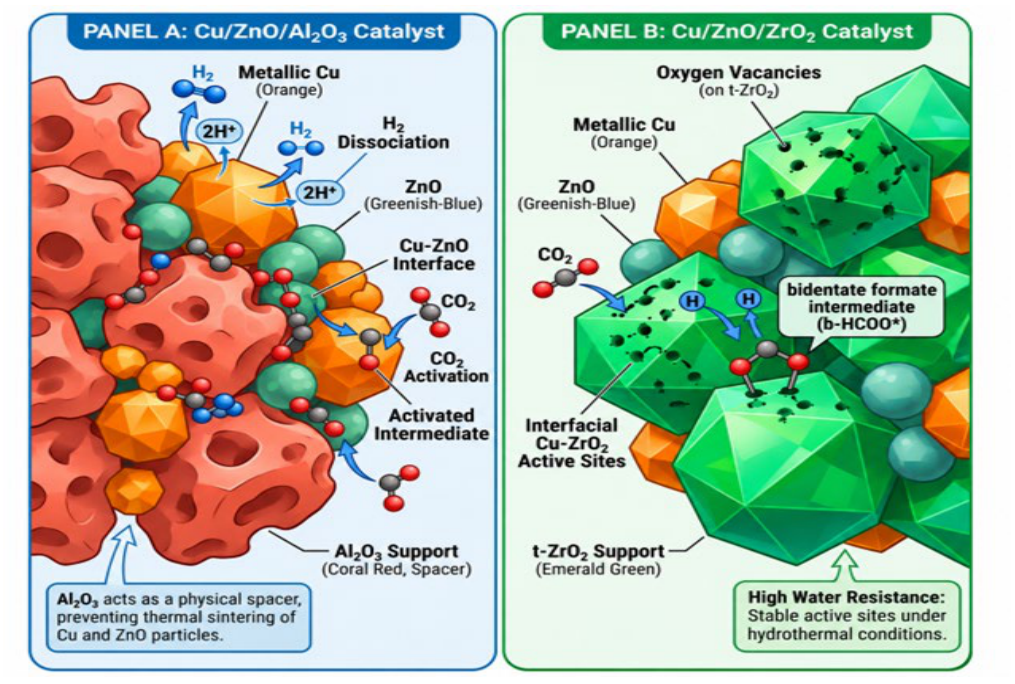
Figure 2.
Schematic representation of preparation methods for Cu/ZnO/Al₂O₃ and Cu/ZnO/ZrO₂ catalysts.
Figure 2.
Schematic representation of preparation methods for Cu/ZnO/Al₂O₃ and Cu/ZnO/ZrO₂ catalysts.
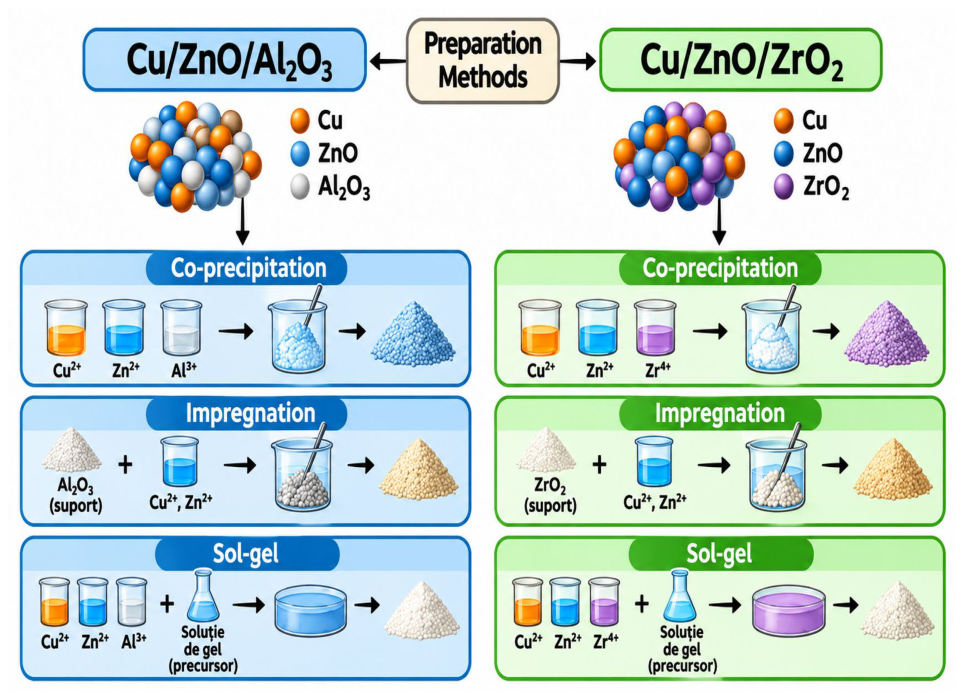

Table 1.
Comparative analysis of mechanistic pathways and active site dynamics in CO₂ hydrogenation over industrial Cu/ZnO/Al₂O₃ catalyst.
Table 1.
Comparative analysis of mechanistic pathways and active site dynamics in CO₂ hydrogenation over industrial Cu/ZnO/Al₂O₃ catalyst.
| Proposed Reaction Mechanism | Rate-Determining Step (RDS) | Active Site State and Role of Al₂O₃ | Ref. |
| Formate Pathway (dominant); secondary RWGS; COOH* pathway (assisted by OH/H₂O). | Formate hydrogenation (HCOO* → HCOOH*) and methoxy species hydrogenation (H₃CO* → CH₃OH). | Cu⁰/Cu⁺ synergy; cationic sites at the Cu–ZnO interface; Al₂O₃ acts as a structural promoter (stabilizes dispersion). | [29] |
| Formate Pathway (associative); RWGS (dissociative at high T); trans-COOH* pathway (hypothetical). | Formate hydrogenation to dioxymethylene (HCOO* → H₂COO*). | Dynamic surface structure (Cu⁰–Zn⁰ alloy, Znδ+ species, or ZnOₓ overlayer); Al₂O₃ maintains porosity. | [17] |
| Branched network: parallel, independent pathways directly from CO₂; sequential CO → CH₃OH pathway is thermodynamically forbidden. | Methanol RDS requires 2 additional H* atoms compared to RWGS (1st order in P_H₂). | Constant site density; H* surface deficit; strong kinetic inhibition by byproduct water. | [26] |
| Formate mechanism in the presence of CO₂; switch to Formyl pathway in dry CO/H₂ feed. | Methylation / hydrogenation of oxygenated intermediates on interfacial sites. | Cationic interfacial Cu⁰–Znδ+ sites maintained via CO₂-induced partial oxidation. | [15] |
| Interfacial Formate (HCOO–Zn):* accelerated hydrogenation at the alloy/oxide interface. | Hydrogenation of Zn-anchored interfacial formate by H* dissociated on Cu (spillover). | Dynamic Cu–ZnO interface; transient formation of zinc formate under reaction stream. | [28] |
| Formate pathway: net-favored energetically and kinetically over the RWGS pathway. | Hydrogenation of formate (HCOO* → HCOOH*) and methoxy species. | Active ZnOH/Cu phase reduces energy barriers in the RDS by 2–3 orders of magnitude. | [27] |
| Kinetic coexistence: formate pathway from CO₂ proceeds in parallel with CO hydrogenation. | Formic acid hydrogenation (HCOOH* → H₂COOH*) at high CO₂; methoxy hydrogenation (H₃CO* → CH₃OH) at high CO. | Modeled on Cu(111); microkinetics accurately describe performance over industrial Cu/ZnO/Al₂O₃. | [25] |
Table 2.
Comparative analysis of mechanistic pathways and active site dynamics in CO₂ hydrogenation over ZrO₂-promoted Cu catalysts (Cu/ZnO/ZrO₂ & Cu/ZrO₂).
Table 2.
Comparative analysis of mechanistic pathways and active site dynamics in CO₂ hydrogenation over ZrO₂-promoted Cu catalysts (Cu/ZnO/ZrO₂ & Cu/ZrO₂).
| Proposed Reaction Mechanism | Rate-Determining Step (RDS) | Active Site State and Role of ZrO2 | Ref. |
| Formate Pathway (associative); surface basicity of ZrO₂ enhances CO₂ adsorption, while its hydrophobicity accelerates H₂O desorption. | Formate hydrogenation (HCOO* → HCOOH*) and methoxy hydrogenation (H₃CO* → CH₃OH). | Synergistic Cu–ZnO–ZrO₂ interfaces; oxygen vacancies (VO) lower activation barriers; ZrO₂ prevents Cu/Zn re-oxidation and thermal sintering. | [29] |
| Formate Pathway (associative: CO₂* → CO₃* → HCOO* → H₂CO* → CH₃O* → CH₃OH); no surface CO* intermediate formed. | Formate hydrogenation to methoxy (HCOO* → H₃CO*) on the oxide interface; H₂ dissociation on Cu⁰. | Ternary Cu–ZnO–ZrO₂ synergy; atomic Cu–ZnOₓ interface and CuZn alloy provide active sites; ZnO–ZrO₂ interaction generates oxygen vacancies. | [36] |
| Formate Pathway (associative); CO₂ activated as carbonate at the ZnO–ZrO₂ interface, hydrogenated by Cu⁰-supplied H* spillover. | Formate hydrogenation (HCOO* → H₂COO*) at the ZnO–ZrO₂ interface; activation energy lowered from 0.85 eV to 0.66 eV. | Trimetallic synergy; ZnO–ZrO₂ interface acts as primary CO₂ activation and HCOO* stabilization site; Cu⁰ provides H* via spillover. | [33] |
| Formate Pathway (associative); bent CO₂ bound at Cu/ZrO₂ interface (C on Cu⁰, O on Lewis acid Zr⁴⁺); parallel CO formation. | Acetal-like species (H₂C(O)₂*) hydrogenation to H₂COOH* (ΔG* = 105 kJ/mol). | Bifunctional Cu/ZrO₂ interface; Cu⁰ dissociates H₂, Zr⁴⁺ Lewis acid sites bind CO₂/formate; interfacial transfer of H* enables methoxy formation. | [34] |
| Formate Pathway (associative); CO₂ chemisorbed on ZrO₂ oxygen vacancies as carbonates, hydrogenated by H* spillover from Cu⁰. | Hydrogenation of formate (HCOO*) to methoxy species (H₃CO*). | Interfacial Cu–ZrO₂ interaction determines spillover rate and catalyst activity, overriding total surface area or S_Cu alone. | [35] |
Table 3.
Comparative Table: Synthesis Methods, Structure, and Physicochemical Properties of Cu-Based Catalysts.
Table 3.
Comparative Table: Synthesis Methods, Structure, and Physicochemical Properties of Cu-Based Catalysts.
|
Catalyst System |
Synthesis Method and Conditions |
Structure and Precursor Phase Evolution | Physicochemical Properties and Performance | Ref. |
| Cu/ZnO/Al2O3 | • Constant pH co-precipitation (7.0, 70 °C, Na₂CO₃) • Aging: 20–60 min • Mild calcination: 250–300 °C (3 h) |
• Precursor: zincian malachite / rosasite • Spherical Cu⁰ (~10 nm) on ZnO matrix • Calcination >350 °C causes sintering |
•SBET: up to 110 m²/g • SCu0: 25–30 m²/g • Linear correlation between SCu0 & activity • Al³⁺ prevents thermal sintering |
[40] |
| Cu/ZnO/Al2O3 | • Constant pH co-precipitation (pH 6.5, 65 °C) • Compared: Nitrate vs. Formate route • Aging: 3 h, calcination: 330 °C |
• Nitrates: amorphous georgeite (prevents gerhardtite) • Formates: basic hydroxy-formate• Formate route: smaller Cu⁰ crystallites (4.4 vs. 5.5 nm) |
• SCu: 36.9 m²/g (formate) vs. 36.1 m²/g (nitrate) • Superior MeOH productivity (12.3 mmol/g·h) |
[42] |
| Cu/ZnO/Al2O3 | • Pseudo Sol-Gel (acetates in propionic acid) • Co-precipitation (Na₂CO₃, pH 6.0–6.5) • Calcination: 300–500 °C |
• Co-precipitation: mesoporous, high CuO/ZnO dispersion • Sol-gel: dense structure, reduced surface area |
• SBET: Co-precipitation (99–124 m²/g) vs. Sol-Gel (30–42 m²/g) • Pore volume: 0.43–0.51 cm³/g vs. 0.09–0.10 cm³/g • Co-precipitation shows far superior activity |
[46] |
| Cu/ZnO/Al2O3 (and Cu/ZnO) |
• Co-precipitation (0.1 M nitrates + 1 M Na₂CO₃, pH 7.0, 65 °C) • Calcination: 350 °C (1 h) |
• Precursor: tenorite, zincite, rosasite, aurichalcite • Calcination yields crystalline CuO & ZnO• |
SBET: 61.6 m²/g (50:50), 77.0 m²/g (60:30:10) • Low CO conversion (~5–10% at 170 °C, 20 bar) |
[41] |
| Cu/ZnO/Al2O3 | • Impregnation on preformed gamma-Al₂O₃ (12:8:80 wt%) • Drying: 110 °C, calcination: 350 °C |
• CuO and ZnO nanodomains on gamma-Al₂O₃ surface • Prevents massive CuO agglomeration• |
SBET: 151.4 m²/g • CO conversion: 69–70% (superior active site accessibility) |
[41] |
| Cu/ZnO/Al2O3 | • Co-precipitation at pH 6.5 via hydrous Al(OH)₃ sol • Drying: 105 °C, calcination: 320 °C (3.5 h) |
• Suppresses inactive hydrotalcite phase • Acicular morphology (fine needles 10 × 150 nm) • Extremely small CuO crystallites (4.4 nm)• |
SBET: 124.9 m²/g; Vpore: 0.54 cm³/g • SCu0: 43.1 m²/g (high dispersion) • High stability & activity at 50 bar, 230 °C |
[47] |
| Cu/ZnO/Al2O3 | • Impregnation on gamma-Al₂O₃ (calcination 360 °C) • Co-precipitation (calcination 350 °C) |
• Impregnation: smaller CuO crystallites (35.9 vs. 43.9 nm) • Prevents pore blockage; amorphous ZnO on support |
• SBET: Impregnated (113.6 m²/g) vs. Co-precipitated (43.3 m²/g) • MeOH yield: 1.25 wt% vs. 0.96 wt% (260 °C, 14 bar) |
[43] |
| Cu/ZnO/Al2O3 | • Incipient wetness impregnation on alumina nanorods (n-Al₂O₃) • Calcination: 400 °C (4 h); Cu:ZnO = 2:1 |
• Mesoporous nanorod structure (250–300 nm) • Homogeneous CuO & ZnO dispersion |
• SBET: 89.4 m²/g; Vpore: 0.50 cm³/g • CO₂ conversion: 19.8%; MeOH STY: 1.31 mmol/g·h |
[44] |
| Cu/ZnO/Al2O3 | • Citric acid-assisted Sol-Gel (chelating agent) • Drying & calcination: 350–450 °C |
• Homogeneous atomic mixing in 3D gel network • Mesoporous Cu⁰/ZnO–Al₂O₃ composite |
• Excellent Cu⁰ dispersion, high \(SBET\ • Enhanced H₂ adsorption/dissociation capacity • Superior thermal stability against sintering |
[45] |
| Cu/ZnO/ ZrO2 | • 3DOM colloidal template (PMMA spheres + citric acid) • Drying: 60 °C, calcination: 450 °C (6 h) |
• 3DOM macroporous structure (pores ~120 nm) • Cu wall decorated with ZnO (15–36 nm) & t-ZrO₂ (3.5 nm) |
• SBET: 32–35 m²/g • CO₂ conversion: 18.2%; MeOH selectivity: 80.2% • ZnO–ZrO₂ interfaces activate CO₂ |
[33] |
| Cu/ZnO/ZrO2 | • Co-precipitation at pH 7.0 (65 °C, 1 M Na₂CO₃) • Aging: 90 °C (12–48 h), air calcination |
• Large CuO crystallites (10.2–15.5 nm) • Meso/microporous structure (type IV isotherm, H3) |
• SBET: 22 m²/g (60:30:10), 33 m²/g (30:60:10) • Tpeak reduction: 290–325 °C (bulk + dispersed phases) • 60 wt% ZnO promotes highly dispersed phase |
[21] |
| Cu/ZnO/ZrO2 | • Co-precipitation with CTAB + NaOH as precipitant • Hydrothermal treatment & calcination |
• CuO crystallites: 13.8 nm • Layered pores (H3-type hysteresis) |
• Low SBET: 10 m²/g (despite surfactant) • TPR reduction shifted to higher temperatures |
[21] |
| Cu/ZnO/ZrO2 | • Simultaneous dissolution of nitrates in water • Direct evaporation to dryness, oxide calcination |
• Small CuO crystallites (8.6 nm) • Uniform atomic mixing on ZrO₂ matrix |
• SBET: 25 m²/g (type IV isotherm) • Predominantly highly dispersed CuO (α-peak at 255 °C) |
[21] |
| Cu/ZnO/ZrO2 | • Addition of preformed ZrO(OH)₂ into Cu/Zn nitrates • Drying & oxide calcination |
• Small CuO crystallites (9.9 nm) on zirconia • Meso/microporous structure |
• SBET: 24 m²/g (H3 hysteresis) • Dominant bulk CuO phase Tpeak: 278–290 °C) |
[21] |
| Cu/ZnO/ZrO2 | • Continuous co-precipitation in Y-mixer (pH 6.9, 150 mL/min) • Continuous aging: 40/60 °C (2 h), calcination: 350 °C |
• Amorphous georgeite converted to aurichalcite & malachite • Excellent surface phase distribution homogeneity |
• SBET: 110–125 m²/g; SCu0: 24–27 m²/g • Extremely small CuO crystallites (3–4 nm) • Superior DME yield from CO₂-rich syngas |
[48] |
| Cu/ZnO/ZrO2 | • Co-precipitation at pH 6.5 (CuZn, CuZr) calcined at 350 °C • Subsequent impregnation with 1 mol% Zr or Zn (350 °C) |
• Fine-tuning of Cu–ZrO₂ and Cu–ZnO interfacial sites | • ZrO₂ on Cu/ZnO creates active Cu–ZrO₂ sites for CO₂ • Zn on Cu/ZrO₂ inhibits interfacial sites • Activity directly depends on metal-support interaction nature |
[50] |
| Cu/ZnO/ZrO2 | • Simultaneous impregnation on t-ZrO₂ (refluxed) and m-ZrO₂ (hydrothermal) • Loading: 30% Cu, 15% Zn; calcination: 500 °C. |
• Uniform CuO/ZnO dispersion on zirconia • t-ZrO₂ provides superior metal-support interaction |
• t-ZrO₂: higher SBET (69.5 vs. 41.5 m²/g) and SCu0 (55 vs. 47 m²/g) • Lowers activation energy (Ea) and favors methoxy species |
[49] |
Disclaimer/Publisher’s Note: The statements, opinions and data contained in all publications are solely those of the individual author(s) and contributor(s) and not of MDPI and/or the editor(s). MDPI and/or the editor(s) disclaim responsibility for any injury to people or property resulting from any ideas, methods, instructions or products referred to in the content. |
© 2026 by the authors. Licensee MDPI, Basel, Switzerland. This article is an open access article distributed under the terms and conditions of the Creative Commons Attribution (CC BY) license.
Copyright: This open access article is published under a Creative Commons CC BY 4.0 license, which permit the free download, distribution, and reuse, provided that the author and preprint are cited in any reuse.