
Submitted:
21 November 2026
Posted:
24 November 2026
You are already at the latest version
Abstract
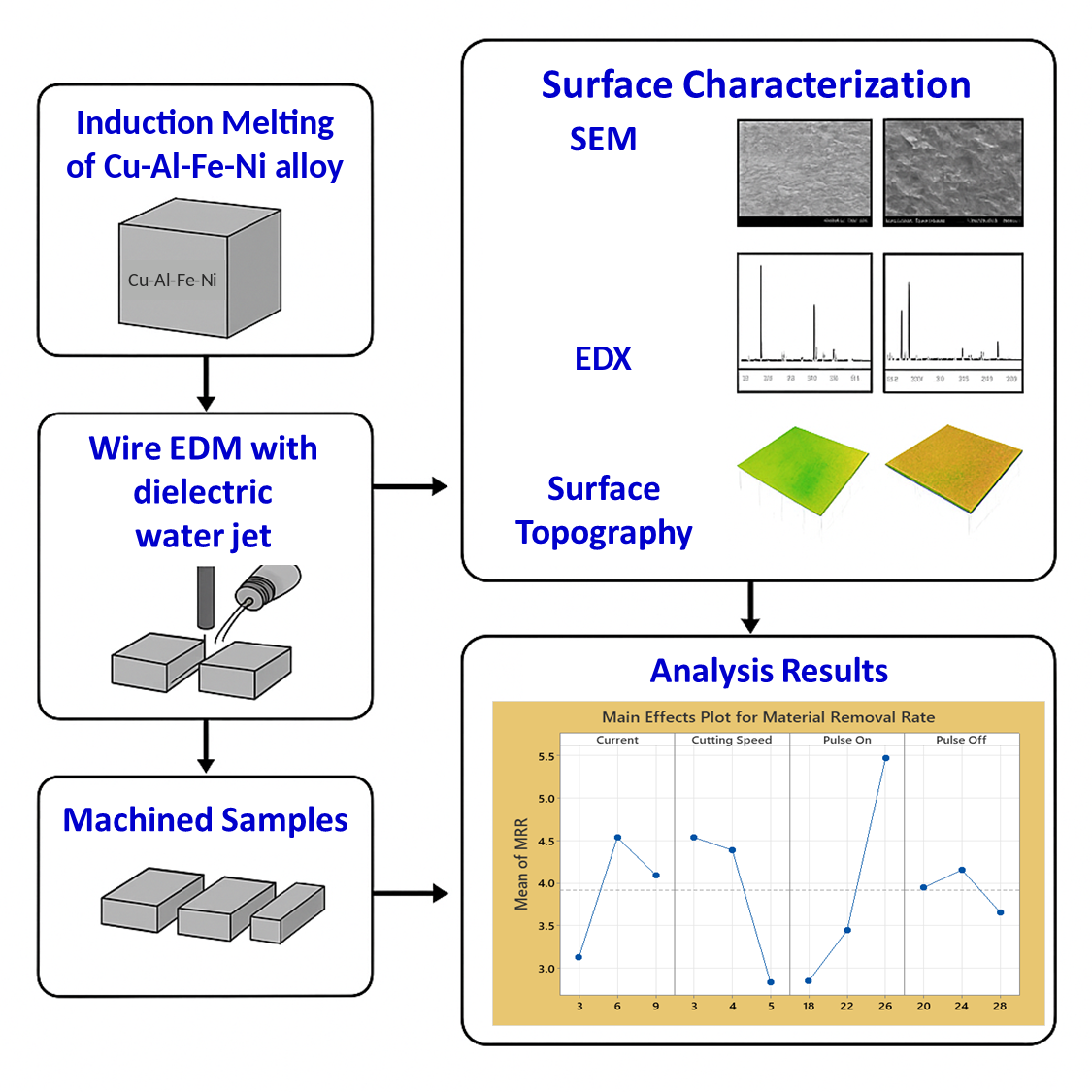
Shape memory alloys (SMAs) are distinguished from other metallic alloys by their ability to recover their original shape after deformation, owing to a reversible, temperature-driven transformation between martensite and austenite. Cu-Al-Fe-Ni belongs to the family of high-temperature shape memory alloys (HTSMAs) and offers a low-cost alternative to NiTi, the most widely used SMA, which is expensive and difficult to machine. Conventional machining is largely ineffective for SMAs because it induces undesirable changes in their microstructure and properties, while non-conventional processes require careful parameter tuning to preserve the shape memory characteristics. This work investigates the wire electrical discharge machining (WEDM) of a vacuum-induction-melted Cu-Al-Fe-Ni SMA and optimises current, cutting speed, pulse-on time and pulse-off time with respect to material removal rate (MRR) and surface roughness (Ra). The experiments were designed using a Taguchi L9 orthogonal array and analysed using grey relational analysis (GRA). The optimal setting was current 6 A, cutting speed 4 mm/min, pulse-on time 26 µs and pulse-off time 20 µs (Run 5), yielding the highest MRR of 6.578 mm³/min and the lowest Ra of 1.617 µm among the nine runs. Relative to the lowest observed MRR (2.564 mm³/min, Run 9), MRR increased by 156.6%; relative to the highest observed Ra (2.791 µm, Run 2), Ra decreased by 42.1%. Scanning electron microscopy (SEM) and 3D surface topography revealed the formation of voids, debris and craters on the machined surfaces.
Keywords:
shape memory alloy
; wire EDM
; vacuum induction melting
; Taguchi
; grey relational analysis
; surface integrity
Copyright: This open access article is published under a Creative Commons CC BY 4.0 license, which permit the free download, distribution, and reuse, provided that the author and preprint are cited in any reuse.