

Submitted:
23 November 2026
Posted:
24 November 2026
You are already at the latest version
Abstract
Previous studies proposed separate generalized coordinate systems for research and expression, each consisting of an object coordinate, a feature or perspective coordinate, and a result coordinate. When spatially aligned within a shared globe-like framework—with the object-related coordinates near the South Pole, the feature- and perspective-related coordinates along the equatorial region, and the result-related coordinates near the North Pole—the two systems form the Dual Research–Expression Academic Map (DREAM), a superordinate framework for coordinating Generalized Research (GR) and Generalized Expression (GE). Navigating either map involves three linked operations: Generalized Adjustment (ADJ) of the object, progression along the Main-node Analytical Path (MAP) or Main-node Expressing Path (MEP), and re-anchoring (Ra). Within these paths, the Generalized Analytical Method (GAM) and Generalized Expressing Method (GEM), respectively, provide superordinate methods for selecting and organizing specific analytical and expression methods. This paper clarifies the structure, methodology, and application of DREAM primarily through schematic illustrations and an example demonstrating the connection between research and expression.
Keywords:
DREAM
; generalized coordinate system
; generalized analytical method
; generalized research
; generalized expression
; research–expression coordination
1. Introduction
Academic activity involves closely related research and expression. As pointed out by Day (1998), scientific work must be communicated in a form that makes clear what was done, why and how it was done, and what was learned, with reproducibility as a central requirement. Schulte (2003) viewed the Scientific writing and the scientific method as a parallel “hourglass” structure”.
For the expression side, there is a large number of general guidance for scientific and academic writing (cf. Day, 1998; Cargill & O’Connor, 2013; Mensh & Kording, 2017; McIntyre, 1997; Sollaci & Pereira, 2004) and more specific guidance for writing undergraduate, master’s, and doctoral theses (cf. Dunleavy, 2003; Evans et al., 2014; Lipson, 2005; Murray, 2006; Wu & Bai, 2020; Wu, 2026a).
For the research side, a large number of guidelines also exist (cf. Booth et al., 2024; Creswell & Creswell, 2023; O’Leary, 2021). Pearl (2000) systematically developed scientific method for causality analysis, which may be used in various disciplines. The concrete professional research methods for a special discipline or research direction often have specialized courses, papers, and monographs. The entry on scientific method by Hepburn and Andersen (2021) lists 124 references at the end, spanning from 1628 to 2019.
Generally speaking, both research and scientific writing involve the research problem, the purpose or motivation of the work, and research method, the results or finding, and conclusion. The results should be discussed scientifically, so in many papers there is a discussion section between the results and conclusion. Research involves the formulation of questions, the analysis of objects, the acquisition of evidence, and the formation of knowledge; academic expression involves the organization, representation, interpretation, and dissemination of research content. The two are usually regarded as mutually sequential activities, that is, research is carried out first, and research results are then expressed through papers, reports, or other forms. However, actual academic activity does not always follow such a one-way process. The understanding formed during research needs to be organized and tested through expression, while conceptual ambiguity, argumentative gaps, or insufficient evidence that appear during expression may also prompt researchers to re-examine research objects, analytical methods, and existing results. Therefore, research and expression not only have a sequential relationship but also a relationship of mutual influence and mutual promotion. Despite long history development of both research and scientific or academic writing, how to uniformly organize research and expression from a higher-level or superordinate framework remains worthy of further exploration.
In response to this need, the author of this paper has previously developed generalized methodological systems for research and expression, respectively. In terms of research, the Generalized Coordinate System (GCS), Generalized Analytical Method (GAM), and Generalized Analytical Pathway (GAP) were proposed, and on this basis the Generalized Research (GR) framework was formed (Wu, 2026a, 2026b). GCS organizes research activities through three basic coordinates: analytical object (O), analytical feature (F) , and analytical result (Res); GAM provides higher-level analytical methods based on analytical feature and their specific analytical contents, including Local Analysis (LA) and Cross Analysis (CA). GAP further organizes operations such as adjustment of analytical objects, main-node analytical path, and re-anchoring of results. In terms of expression, the author established the Generalized Expression Coordinate System (GECS), and on this basis proposed the Generalized Expression (GE) framework (Wu, 2026d). GE starts from expression object, expression perspective, and expression result, providing a higher-level framework for the organization, representation, and communication of academic content. The previously proposed Generalized Research–Expression Model (GREM) preliminarily explored the connection between research and rhetorical modes (Wu, 2026e).
On the basis of the above research, the author further proposed the Dual Research–Expression Academic Map (DREAM), aiming to place generalized research and generalized expression within a spatial framework that can be mutually referenced and coordinated ((Wu, 2026f). The basic idea of DREAM is to spatialize the research coordinates described by GCS and the expression coordinates described by GECS, respectively, forming a Research Map and an Expression Map. The two maps have a similar overall organizational structure: research objects (RO) and expression objects (EO) are located in the starting areas (south pole) of their respective maps, analytical features (RF) and expression perspectives (EP) constitute the main intermediate activity areas (equatorial region), and research results (RRes) and expression results (ERes) are located in the corresponding result areas (north pole). By superimposing, rotating, and locally aligning the two maps, DREAM proposes three levels of correspondence: correspondence of the overall coordinate structure, selective matching between specific analytical characteristics and expression perspectives, and local matching between specific analytical content and expression content. This study also interprets the activity pathways of generalized research and generalized expression as map navigation, and further discusses synchronous or asynchronous advancement, mutual feedback, and the resulting parallel spindle structure between research and expression.
Previous DREAM research established a spatial connection between research and expression, providing a preliminary framework for the unified examination of the two. However, to further develop DREAM from a theoretical conception into a higher-level or superordinate framework that is easy to understand and practically use, it is still necessary to provide a more systematic explanation of its basic structure, methodological system, and application methods. The purpose of this paper is to use a large number of schematic displays to clarify the DREAM model.
2. Generalized Coordinate System and Map
In this section, the Generalized Coordinate System (GCS) and Map are presented in a symmetric way for both research and expression.
2.1. Generalized Research Coordinate System and the Research Map
The generalized coordinate system, as shown in Figure 1, is composed of an axis for analytical object, an axis for analytical feature, and an axis for analytical results.
The analytical object, as illustrated in Figure 2, is the object to be considered in research, or to be studied or thought about. The analytical object is the starting coordinate in the generalized coordinate system.
The analytical feature, as displayed in Figure 3, is the perspective or direction to be selected or used when studying or considering an analytical object. The analytical feature is superordinate, which may determine how the traditional research method is selected. The traditional method usually includes methodology, tools used, research steps to be followed, how results or data are treated, and the rational of the research, which all have the characteristics of diversity and selectability, while the eight analytical features are fixed properties.
Each of the eight analytical features may involve an undetermined number of concrete analytical contents (CACs), some typical examples of which are presented in Figure 4. For the first analytical feature, morphology, typical CACs include shape, external contour, boundary morphology, surface topography, and spatial distribution. These examples are not exhaustive, and the boundaries between individual CACs may not always be clear-cut. For instance, external contour and boundary morphology may share certain characteristics.
The exact meaning of each concrete analytical content is not always clear and may remain undetermined until it is associated with a qualitative characteristic (e.g., spherical for shape), a quantitative characteristic (e.g., the radius of a spherical object), or a knowledge formulation (e.g., a mathematical formula describing a boundary contour). These qualitative characteristics, quantitative characteristics, and knowledge formulations may come from existing knowledge or be obtained as analytical results within the Generalized Coordinate System (GCS). The three types of analytical results are schematically illustrated in Figure 5, using typical research on an airplane as an example.
For each concrete analytical content, the possible qualitative characteristics may be extensive and non-exhaustive. For instance, stability is a concrete analytical content of the analytical feature State. Its qualitative characteristics may include stable, unstable, neutrally stable, statically unstable, stable under small disturbances, and unstable under large disturbances, among others. In terms of quantitative characteristics, stability may be characterized by the magnitudes of the amplitudes and frequencies of unstable waves, as well as the values of parameters that jointly describe stability. At the level of knowledge formulation, one may use or establish a mechanism to explain instability, develop a theory for determining stability conditions, or establish a method for controlling stability.
Figure 6, Figure 7 and Figure 8 give more examples or types of qualitative characteristics, quantitative characteristics and knowledge formulations.
The generalized coordinates have so far been presented in their literal forms. We now arrange the three coordinates at different positions on a globe-like map. For the Research Map, we use RO for the analytical object, RF for the analytical feature, and RRes for the analytical results. The prefix R distinguishes these research coordinates from the corresponding expression coordinates, which use the prefix E and will be introduced in Section 2.2. The Research Map can therefore be denoted as:
RMap ≡ (RO, RF, RRes).
The front and back views of the Research Map are shown in Figure 9 and Figure 10, respectively. The object-related coordinate is positioned near the South Pole, the feature-related coordinate occupies the broad equatorial region, and the result-related coordinate is positioned near the North Pole. The equatorial region is intentionally designed to be the broadest part of the map.
Research has often been described using an hourglass model. In this model, research (or the structure of a research paper) moves from a broad background toward a specific, narrowly focused study, and then expands again toward broader discussion and implications (Hill et al., 1982; Swales, 1990; Schulte, 2003; Fetters & Freshwater, 2015). However, the Research Map emphasizes a different structure: a focused research object expands into multiple analytical perspectives before converging toward research results. This expansion and convergence process gives the Research Map a spindle-shaped structure, as illustrated in Figure 11.
2.2. Generalized Expression Coordinate System and Expression Map
The Generalized Expression Coordinate System (GECS), as shown in Figure 12, consists of three axes corresponding to the Expression Object (EO), Expression Perspective (EP), and Expression Result (ERes).
The Expression Object (EO), as illustrated in Figure 13, is the object selected for expression and serves as the starting coordinate in the Generalized Expression Coordinate System.
An Expression Perspective (EP) is a superordinate perspective selected or adopted when expressing an Expression Object (EO). It may determine how we approach and construct an expression. The eight proposed Expression Perspectives, as listed in Figure 14, are intended to cover as many expression situations as possible.
The eight Expression Perspectives provide general entry points for expression, each of which can be further specified through more concrete Expression Positions or positions (CEPs). Each perspective may involve an undetermined number of CEPs, some typical examples of which are presented in Figure 15. An expression task may select one or several CEPs within a single perspective or combine CEPs from multiple perspectives. For instance, a paragraph in a paper may use description (EP11) to describe the number and distribution of tables in a classroom, while using a figure (EP24) to illustrate their distribution.
Concrete Expression Positions (CEPs) within the Discourse Mode Perspective include description, comparison, contrast, analogy, cause and effect, and others. These are also commonly referred to as rhetorical modes. The modes presented in Figure 15 are not exhaustive and may be further expanded through the duality-mode operation discussed by Wu (2025).
Rhetorical modes are widely used in writing, speaking, and teaching. Figure 16 provides an example of their application in a course presentation on the topic “The Nature of Memory.”
The Expression Structure Perspective (EP3) has three concrete expression positions: expression-point configuration, expression organization, and expression ordering. Each position includes several specific cases, as illustrated in Figure 17. Figure 18 provides further examples of expression-point configuration.
The Expression Level Perspective (EP5) specifies the level at which an expression is developed. Expression level characterizes the depth and degree of development of an expression. In Wu (2026c), it is presented as a five-level expression staircase, ranging from sensory expression to knowledge-enlightenment expression, as illustrated in Figure 19.
More details about the concrete expression positions within the other Expression Perspectives can be found in Appendix A of Wu (2026d).
The Expression Result (ERes) denotes the realized expression product or communicative artifact produced through an expression process. Expression results may take various forms, depending on the expression task and intended audience. They may range from a piece of oral communication, a sentence, a paragraph, or a section of written material to a complete paper, thesis, book, proposal, report, presentation (PPT), webpage, and other communicative products. Examples of expression results are illustrated in Figure 20.
The generalized coordinates for expression have so far been presented in their literal forms. We now arrange the three coordinates at different positions on a globe-like map. For the Expression Map, we use EO for the Expression Object, EP for the Expression Perspective, and ERes for the Expression Result. The prefix E distinguishes these expression coordinates from the corresponding research coordinates, which use the prefix R and were introduced in Section 2.1. The Expression Map can therefore be denoted as:
EMap ≡ (EO, EP, ERes).
The object-related coordinate is positioned near the South Pole, the perspective-related coordinate occupies the broad equatorial region, and the result-related coordinate is positioned near the North Pole. The equatorial region is intentionally designed to be the broadest part of the map.
Similarly, on the expression side, a focused Expression Object expands into multiple Expression Perspectives before converging toward Expression Results. This expansion and convergence process gives the Expression Map a spindle-shaped structure, as illustrated in Figure 23.
3. Generalized Adjustment of the Analytical Object and Expression Object
Before conducting research or constructing an expression, the initial object may need to be adjusted according to the requirements of the specific task. Generalized Adjustment (ADJ) was originally introduced for research (Wu, 2026b). Here we show these operations can be applied to both analytical objects and expression objects.
3.1. Generalized Adjustment of the Analytical Object
Adjustment of an analytical object serves the purpose for transforming an initial analytical object O0 into an analytical object O suitable for the current research task. Instead of doing this arbitrarily, we use relevant analytical features Fi and their concrete analytical contents Fij to do adjustment and this is called generalized adjustment. As shown in Figure 24, there are six adjustment operations: delimitation, simplification, modelling, decomposition, combination, and granularity adjustment.
1. Delimitation (ADJ1)
Delimitation may be used to reset the scope and boundaries of the analytical object according to the research task. For example, when studying an aircraft wing, its external contour and boundary morphology may be used to delimit the wing geometry, including its planform and sweep angle, as illustrated in Figure 25.
2. Simplification (ADJ2)
Simplification selects the main contents relevant to the current research task while temporarily neglecting secondary details. For example, in aerodynamic research, actual air may be simplified to a gas mixture mainly consisting of nitrogen and oxygen, and further approximated as a single ideal gas, as illustrated in Figure 26.
3. Modeling (ADJ3)
Modeling replaces the initial analytical object with a substitute object that retains the key contents required by the current research task. For example, when studying the orbital motion of a planetary system, celestial bodies with actual sizes and internal structures may be represented by point masses retaining their masses and spatial positions, as illustrated in Figure 27.
4. Decomposition (ADJ4)
Decomposition divides a relatively complex analytical object into smaller objects according to relevant analytical features. For example, an aircraft may be decomposed into its wing, fuselage, tail, and engines according to composition, or into flight control, propulsion, and load-bearing subsystems according to function, as illustrated in Figure 28.
5. Combination (ADJ5)
Combination reorganizes multiple initial analytical objects into one whole according to the research task, using relevant analytical features and their concrete contents. For example, the heart, blood vessels, and local circulation may be combined into the human circulatory system based on their common blood-circulation function, as illustrated in Figure 29.
6. Granularity Adjustment (ADJ6)
Granularity adjustment changes the analytical level of an object according to the research task, so that the object is neither too broad nor too detailed. For example, aircraft research may move from the overall aircraft level to the wing-component level and then to a local flow region, as illustrated in Figure 30.
3.2. Generalized Adjustment of the Expression Object
Similar to analytical objects, expression objects may also be adjusted according to specific expression tasks. The six operations introduced for analytical objects can also be extended to expression objects. Delimitation determines the scope of the content to be expressed. Simplification retains the main information. Modeling represents complex content through an appropriate expression model. Decomposition divides a complex expression object into smaller parts. Combination organizes multiple expression objects into a unified whole. Granularity adjustment changes the level of detail or the informational granularity of the expression object. These six operations are illustrated in Figure 31.
Generalized adjustment of expression objects may be conducted independently or in coordination with the adjustment of analytical objects. The two types of adjustment serve research and expression tasks, respectively, and provide suitable starting objects for subsequent Generalized Research (GR) and Generalized Expression (GE).
4. Generalized Analytical Method (GAM) and Generalized Expressing Method (GEM)
The Generalized Analytical Method (GAM) and the Generalized Expressing Method (GEM) provide superordinate frameworks for research and expression, respectively. GAM determines which analytical features and concrete analytical contents are selected and how different analytical positions are connected. GEM determines which Expression Perspectives and concrete expression contents are selected and how they are combined. Both methods provide a superordinate framework within which conventional or task-specific research and expression methods can be selected (Wu, 2026a, 2026d).
4.1. Generalized Analytical Method (GAM) for Research
The Generalized Analytical Method (GAM) consists of two basic operations: Local Analysis (LA) and Cross Analysis (CA). Local Analysis selects one analytical feature Fi and one or more concrete analytical contents Fij within that feature. Cross Analysis selects two or more different analytical features Fi and Fj (i ≠ j) and establishes relations between these features or between their respective concrete analytical contents Fik and Fjl.
The two complementary views of GAM are illustrated in Figure 32 and Figure 33. Figure 32 presents the two basic operations of GAM, namely Local Analysis (LA) and Cross Analysis (CA), including their respective selections of analytical features (Fi) and concrete analytical contents (Fij). Figure 33 summarizes the overall structure of GAM, showing the relationship between the analytical object, analytical operations, and analytical results, as well as the method hierarchy and the analytical space.
Note that GAM determines the analytical positions and relations to be examined, while traditional research methods provide selectable implementation pathways for completing the corresponding analytical tasks. These traditional methods may include theoretical analysis, experimental investigation, numerical simulation, observation, and other disciplinary methods. The selection depends on the analytical content and the specific research task.
By combining different analytical features and concrete analytical contents, GAM opens a broad analytical space. The eight analytical features provide 28 possible pairwise combinations at the feature level, while further selection and combination of concrete analytical contents expands the number of possible analytical positions and their correspondences.
4.2. Generalized Expressing Method (GEM) for Expression
The Generalized Expressing Method (GEM) provides a superordinate framework for constructing expression through selected expression perspectives and their concrete expression positions or contents. GEM consists of two basic operations: Local Expression (LE) and Cross Expression (CE). Local Expression operates within a single expression perspective, whereas Cross Expression jointly uses concrete positions or contents from two or more different expression perspectives.
The overall structure of GEM, including Local Expression (LE) and Cross Expression (CE) and their corresponding selections of expression perspectives and concrete expression positions or contents, is illustrated in Figure 34.
Local Expression (LE) selects one expression perspective and one or more concrete expression contents within that perspective. For example, within the Discourse Mode Perspective EP1, an expression may use description alone or combine description, comparison, and contrast. Within the Academic Representation Perspective EP2, an expression may use natural language alone or combine natural language, figures, and mathematical expressions. The selection depends on the expression task.
Cross Expression (CE) selects concrete expression contents from two or more different expression perspectives and uses them together in constructing the same expression. For example, when expressing a research result, one may combine comparison from the Discourse Mode Perspective EP1, a figure from the Academic Representation Perspective EP2, and a two-point configuration from the Expression Structure Perspective EP3. These different perspectives contribute to the construction of the same expression.
Local Expression and Cross Expression may coexist. An expression task may select several concrete expression contents within one perspective and simultaneously incorporate contents from other perspectives. Not every expression task needs to involve all eight expression perspectives. The selection and combination depend on the content to be expressed, the intended audience, and the expression purpose.
5. Main-Node Analytical Path (MAP) and Main-node Expressing Path (MEP)
The previous sections have introduced the generalized coordinate systems, generalized object adjustment, and the two superordinate methods, GAM and GEM. This section further organizes these elements into two main-node paths for research and expression, respectively: the Main-node Analytical Path (MAP) and the Main-node Expressing Path (MEP). MAP connects the analytical object, GAM, specific research methods, and analytical results, while MEP connects the expression object, GEM, expression implementation, and expression results. These two paths provide the basic operational sequences for conducting research and constructing expression within the unified framework.
5.1. Main-Node Analytical Path (MAP) for Research
The Main-node Analytical Path (MAP) connects the analytical object O, the Generalized Analytical Method (GAM), and the analytical result Res. It can be expressed as:
MAP(C) ≡ O ⇒ GAM ⇒ Specific Research Method ⇒ Res
Here, O denotes the analytical object entering the current analysis, GAM determines the analytical features and concrete analytical contents to be examined, and Res denotes the results obtained through the analysis. As illustrated in Figure 35 where LA is used for GAM, the main-node analytical path includes the selection of an analytical object, the analytical operation, the selection of a specific research method, and the formation of analytical results.
For example, when a galaxy is selected as the analytical object, Local Analysis may focus on morphology (F1) and further examine its shape (F11). Specific research methods, such as observation, simulation, or theoretical analysis, may then be selected according to the research task. The resulting analysis may provide qualitative characteristics, such as whether the galaxy is elliptical or spiral; quantitative characteristics, such as its axial ratio; or knowledge formulations, such as a mathematical expression for its density profile ρ(r). This example is illustrated in Figure 36.
As illustrated in Figure 37 where CA is used for GAM, the main-node analytical path also includes the selection of an analytical object, the analytical operation, the selection of a specific research method, and the formation of analytical results.
For example, when studying an aircraft, one may examine the relationship between its external contour F12 and its functional effectiveness and performance F54. Specific research methods may include wind tunnel testing, numerical simulation, and theoretical analysis. The resulting analytical contents may include a qualitative characteristic, such as a wasp-waist design; quantitative characteristics, such as lift, drag, and lift-to-drag ratio; and a knowledge formulation, such as the transonic area rule. This example is illustrated in Figure 38.
5.2. Main-Node Expressing Path (MEP) for Expression
The Main-node Expressing Path (MEP) connects the Expression Object (EO), Expression Perspective (EP), and Expression Result (ERes). It can be expressed as:
MEP(Cᴱ) ≡ EO ⇒ EP ⇒ Implementation ⇒ ERes
Here, EO denotes the object or content to be expressed, EP specifies the perspectives selected for constructing the expression, and ERes denotes the resulting expression product or communicative artifact. Within EP, the Generalized Expressing Method (GEM) provides two basic operations: Local Expression (LE) and Cross Expression (CE). These operations may be used separately or together. After selecting the relevant expression perspectives and concrete expression positions, an appropriate expression implementation is chosen according to the expression task.
The MEP and its main implementation stages are schematically illustrated in Figure 39. Expression implementation may involve handwriting, word processing (e.g., Word), typesetting (e.g., LaTeX), AI-assisted expression (e.g., ChatGPT), and multimedia production (e.g., slides, audio, and video). These implementation approaches may be selected separately or combined according to the requirements of the expression task.
The expression result may take different forms, including research articles, theses, book chapters, research reports, technical reports, conference reports, presentations, lecture materials, posters, webpages, videos, podcasts, interactive resources, and other communicative artifacts. The selection of the expression form depends on the expression object, the intended audience, and the purpose of communication.
Thus, MEP provides a general pathway from an expression object to a realized expression result. GEM determines the expression perspectives and concrete expression positions to be considered, while specific expression techniques and implementation tools remain selectable. Local Expression and Cross Expression may be used separately or together to construct the required expression.
6. Re-Anchoring of Coordinate to New Object
The main-node analytical path and the main-node expressing path introduced in Section 5 do not necessarily terminate when analytical or expression results are obtained. When an existing coordinate for research or expression becomes the focus of a new task, it can be re-determined as a new object and enter the corresponding main-node path again. This operation is called re-anchoring. Re-anchoring allows existing research results and expression results to become starting points for further research or expression.
6.1. Re-Anchoring for Research
In research, an analytical feature, a concrete analytical content, a qualitative characteristic, a quantitative characteristic, or a knowledge formulation may become the focus of further analysis. In this case, the selected coordinate content C is re-determined as a new analytical object O′ and enters the Main-node Analytical Path (MAP) again:
where C ∈ {F, Fij, S, Q, X}. Here, C denotes the selected generalized coordinate in the current analysis, and O′ denotes its new role as an analytical object. As illustrated in Figure 40, the existing analytical content is re-anchored as a new object, which then enters MAP for another round of analysis. If the newly obtained result again becomes the focus of further research, the same operation can be repeated, forming recursive re-anchoring.
Ra(C) ≡ C → O′ → MAP
Re-anchoring can involve different types of analytical coordinate contents. For example, an analytical feature such as morphology (F) may become a new analytical object; a concrete analytical content such as shape (Fij) may be further studied; a qualitative characteristic such as streamlined (S) may become the focus of further investigation; a set of anomalous pressure data may be re-anchored as a quantitative analytical object (Q); and an existing knowledge formulation, such as the Pythagorean theorem (X), may become a new object of research. These representative cases are summarized in Figure 41.
The original nature of these coordinates does not change through re-anchoring. What changes is their role in a new analytical task. Thus, analytical features, concrete analytical contents, and existing analytical results can all become new analytical objects and enter MAP again when further investigation is required.
6.2. Re-Anchoring for Expression
Re-anchoring for expression means selecting existing expression results or content from external sources for further expression. The selected expression content (EC) is re-designated as a new Expression Object (EO′) and enters the Main-node Expressing Path (MEP) again:
Ra(EC) ≡ EC → EO′ → MEP
EC may come from one’s own existing results, such as research articles, reports, theses, and presentations, or from external sources, such as books, documents, and databases. Once selected as EO′, the content enters MEP again, where appropriate Expression Perspectives and expression implementation methods are selected to produce a new expression result. If this new result requires further development, it may in turn become a new Expression Object, forming a recursive re-anchoring process, as illustrated in Figure 42.
Re-anchoring for expression has two typical applications, as illustrated in Figure 43. The first is re-expressing one’s existing results. For example, a report may be developed into a research article; a thesis may be transformed into a journal article or conference paper; a presentation may be reorganized into a report or article; and a draft article may be further revised or expanded into a new version. The second is constructing new content from external sources. This may involve excerpting or quotation, paraphrasing, and reorganizing or synthesizing information from different sources. These operations allow existing materials to be selected, transformed, and incorporated into new expression according to the requirements of the current task, with appropriate acknowledgment of the sources.
Thus, re-anchoring provides a way to continue both research and expression from existing contents. In research, selected analytical coordinate contents become new analytical objects and re-enter MAP. In expression, existing results or external materials become new expression objects and re-enter MEP. Although the two processes deal with different types of content, they share the same basic operation of changing the role of existing content to support further development.
7. Generalized Research (GR) and Generalized Expression (GE)
The previous sections have introduced the generalized adjustment operations, the Main-node Analytical Path (MAP), the Main-node Expressing Path (MEP), and re-anchoring. This section further organizes these elements into two complete frameworks: Generalized Research (GR) and Generalized Expression (GE). GR is organized through the Generalized Analytical Pathway (GAP), while GE is organized through the Generalized Expressing Pathway (GEP).
7.1. Generalized Analytical Pathway (GAP) and Generalized Research
The Generalized Analytical Pathway (GAP) consists of three links: Generalized Adjustment (ADJ), Main-node Analytical Path (MAP), and re-anchoring (Ra). It can be expressed as:
GAP(C) ≡ ADJ // MAP(C) // Ra
The Main-node Analytical Path connects the analytical object, Generalized Analytical Method (GAM), specific research method, and analytical results:
MAP(C) ≡ O ⇒ GAM ⇒ Specific Research Method ⇒ Res
Research conducted through GAP is defined as Generalized Research (GR):
GR ≡ GAP(C).
The GR framework starts from an original analytical object. Generalized Adjustment (ADJ) first transforms the original object into an analytical object suitable for the current research task. This adjustment involves six operations: delimitation, simplification, modeling, decomposition, combination, and granularity adjustment.
After adjustment, the analytical object enters the Main-node Analytical Path (MAP), which connects the analytical object, Generalized Analytical Method (GAM), specific research method, and analytical results. After the analytical positions and operations have been determined, an appropriate specific research method is selected according to the research task and discipline. The analysis then produces analytical results, which may take the form of qualitative characteristics (S), quantitative characteristics (Q), or knowledge formulations (X). The overall GR framework is illustrated in Figure 44.
The analytical results do not necessarily terminate the research process. When an existing analytical feature, concrete analytical content, or analytical result requires further investigation, it may be re-anchored as a new analytical object through Ra and enter GAP again. The same process may be repeated whenever further analysis is required.
Thus, GR organizes the research process through generalized adjustment, generalized analysis, specific research methods, and re-anchoring. It provides a general framework for adjusting research objects, selecting analytical positions, implementing specific research methods, obtaining analytical results, and continuing research from existing results.
7.2. Generalized Expression Pathway (GEP) and Generalized Expression
The Generalized Expression Pathway (GEP) consists of three links: Generalized Adjustment (ADJ), Main-node Expressing Path (MEP), and re-anchoring (Ra). It can be expressed as:
GEP(C) ≡ ADJ // MEP(C) // Ra
The Main-node Expressing Path connects the expression object, Generalized Expression Method (GEM), specific implementation method, and expression results:
MEP(Cᴱ) ≡ EO ⇒ EP ⇒ Implementation ⇒ ERes
Expression conducted through GEP is defined as Generalized Expression (GE):
GE ≡ GEP(CE).
The GE framework starts from an original expression object. Generalized Adjustment (ADJ) first transforms the original object into an expression object suitable for the current expression task. This adjustment involves six operations: delimitation, simplification, modeling, decomposition, combination, and granularity adjustment.
After adjustment, the expression object enters the Main-node Expressing Path (MEP), which connects the expression object, Generalized Expression Method (GEM), specific implement method, and expression results. The expression task then produces expression results. A simplified GE framework is illustrated in Figure 45. The overall GE framework is illustrated in Figure 46.
Expression does not necessarily terminate when an initial expression result has been produced. When further revision, expansion, or transformation is required, an existing expression result may be re-anchored as a new Expression Object (EO′) and enter MEP again. For example, an existing report may be developed into a research article, a presentation may be reorganized into a report, or an existing article may be revised into a new version.
Thus, GE organizes expression through generalized adjustment, the selection and combination of expression perspectives, expression implementation, and re-anchoring. It provides a general framework for constructing expression products and further developing them when required.
8. DREAM Model
The previous sections have introduced Generalized Research (GR) and Generalized Expression (GE), including their respective coordinate systems, superordinate analytical and expressing methods, and corresponding pathways. The Dual Research–Expression Academic Map (DREAM) brings these two frameworks together through the Research Map and Expression Map introduced in Section 2. The Research Map organizes research objects, research features, and research results, while the Expression Map organizes expression objects, expression perspectives, and expression results. Although the two maps retain their distinct coordinate meanings, they can be considered together through spatial alignment, navigation, and selective matching.
8.1. Overall Structure of DREAM
The duality in the Dual Research–Expression Academic Map (DREAM) has two related meanings. First, the Research Map and the Expression Map have symmetrical or analogous structures, with corresponding components on the two sides. Second, the two maps can be brought together to establish mappings between their components, allowing corresponding components to be selectively matched, as shown in Figure 47. The research side and the expression side can be navigated independently or considered together. Research and expression may proceed concurrently, and their interaction allows each side to inform and improve the other through reciprocal feedback.
8.2. Spatial Alignment and Matching of the Two Maps
When the two maps are considered together, their object-related coordinates can be aligned in the southern region, their feature- and perspective-related coordinates in the broad equatorial region, and their result-related coordinates in the northern region.
Selected Research Feature regions and Expression Perspective regions can be brought into correspondence. Figure 48 illustrates an arrangement in which several regions with the same index are paired, such as RF1 ↔ EP1 and RF6 ↔ EP6. The navigation path starts from the common object-related region, passes through selected intermediate regions, and proceeds toward the result-related region.
The matching is not restricted to regions with the same index. The two maps can be rotated relative to each other to establish alternative correspondences. Figure 49 illustrates how different Research Features can be aligned with different Expression Perspectives, such as RF1 ↔ EP2, RF2 ↔ EP3, and RF5 ↔ EP6.
In general, the matching between research and expression can be represented as RFi ↔ EPj, where i and j need not be equal. Given eight general Research Features and eight general Expression Perspectives, there are 64 possible feature–perspective pairings.
These pairings represent possible combinations rather than fixed correspondences. Their selection depends on the research task, expression requirements, and communication purpose. A Research Feature may be matched with different Expression Perspectives, and an Expression Perspective may be used in connection with different Research Features.
8.3. Local Matching Between Concrete Contents
Matching can also be conducted at a more specific level. Each Research Feature and Expression Perspective contains multiple concrete contents. A selected Concrete Analytical Content (CAC) may therefore be matched with one or more Concrete Expression Positions (CEPs). This matching can be represented as:
RFij ↔ EPkl
Composition (RF2) provides an example of such matching. It contains concrete analytical contents such as basic unit, constituent module, hierarchical composition, functional module, material composition, phase composition, sample composition, stage composition, and amount of matter or scale of composition. The Academic Representation Perspective (EP2), in turn, includes concrete expression positions such as natural language, numbers, figures and tables, and mathematical expressions. Their possible matching is illustrated in Figure 50.
For example, the composition of an object may be described using natural language, quantified using numbers, illustrated through figures and tables, or represented using mathematical expressions. Different analytical contents may require different expression positions, while a single analytical content may be expressed through multiple forms.
The current GR framework contains 58 Concrete Analytical Contents (CACs), while the GE framework contains 75 Concrete Expression Positions (CEPs). If every CAC is considered in combination with every CEP, the total number of potential pairings is:
58 × 75 = 4,350
These represent potential pairings rather than necessarily useful or required matches. Only selected combinations are relevant to a particular task. The appropriate matching depends on the analytical results, expression requirements, available evidence, and intended audience.
8.4. A DREAM Example: From Research to Expression
A freely falling ball provides a simple example of how GR and GE can be connected through DREAM. The research task is to investigate the falling motion of a ball and express the resulting knowledge in an understandable form. Here we do not consider how the specific research method is used.
Figure 51 gives an overview of this example. On the research side, GR addresses three basic questions: What is studied? How is it analyzed? What are the results? On the expression side, GE addresses three corresponding questions: What is expressed? From which perspectives? How is it organized? Research–expression matching connects the two sides and produces an expression result.
These analytical results are then selected as the Expression Object (EO) on the expression side. Eight Expression Perspectives (EPs) are selected to organize and communicate the results. Their specific roles in constructing the expression are illustrated in Figure 52.
The resulting Expression Result (ERes) is a complete academic expression consisting of explanatory text, a mathematical formulation, and a scientific illustration. This example shows how research results can become an expression object and how multiple expression perspectives can be combined to construct an expression result. The matching does not require every Research Feature to correspond to an Expression Perspective. Only the perspectives relevant to the expression task are selected. The process may also proceed in the opposite direction. If the expression reveals that an analytical result is insufficiently explained or supported, further research may be required. Conversely, new analytical results may require changes to the expression. Through this reciprocal feedback, GR and GE can develop together before the final work is communicated.
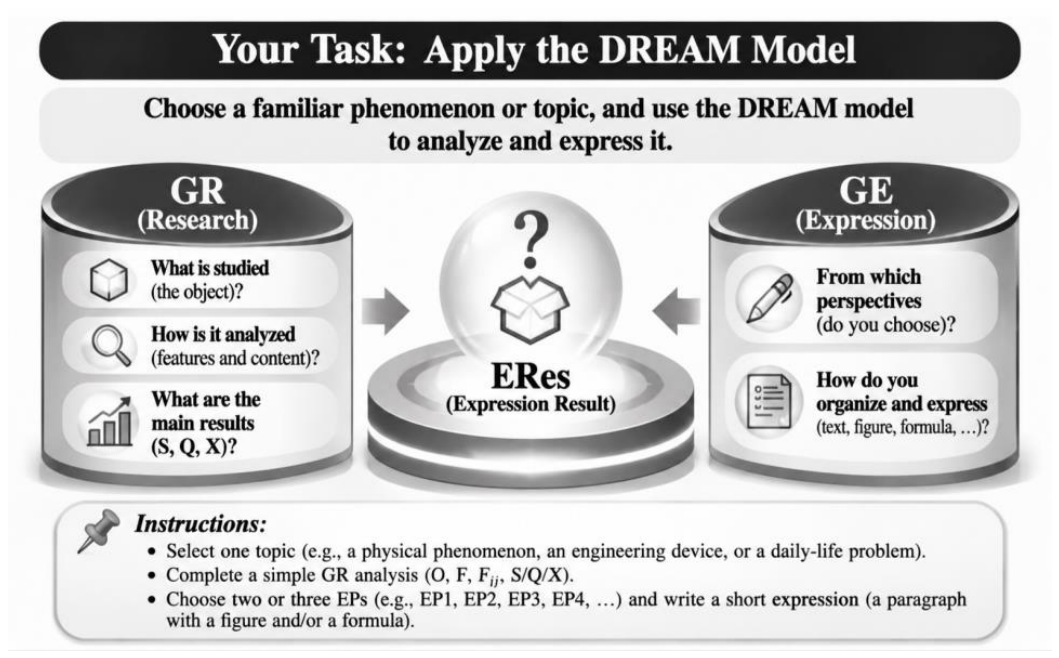
Figure 53 provides a simplified schematic illustration of how the DREAM model can be applied. The task involves two main parts. On the research side, a familiar topic is selected, the analytical object (O) is identified, and an analytical feature (F) and a concrete analytical content (Fij) are selected. The main analytical results are then obtained in three forms: qualitative characteristics (S), quantitative characteristics (Q), and knowledge formulations (X). On the expression side, two or three relevant Expression Perspectives (EPs), such as EP1, EP2, EP3, or EP4, are selected to organize the analytical results into a short expression. The expression may take the form of a paragraph accompanied by a figure and/or a formula.
Acknowledgments
The author acknowledges the assistance of MA Xin-Yu and Wu Yu-Qin in developing and refining the diagrams. AI tools were used to assist with language editing and the preparation of schematic illustrations. The author reviewed the material and takes responsibility for the final manuscript.
References
- Booth, W. C.; Colomb, G. G.; Williams, J. M.; Bizup, J.; FitzGerald, W. T. The craft of research, 5th ed.; University of Chicago Press, 2024. [Google Scholar]
- Cargill, M.; O’Connor, P. Writing scientific research articles: Strategy and steps, 2nd ed.; Wiley-Blackwell, 2013. [Google Scholar]
- Creswell, J. W.; Creswell, J. D. Research design: Qualitative, quantitative, and mixed methods approaches, 6th ed.; SAGE, 2023. [Google Scholar]
- Day, R. A. How to write and publish a scientific paper, 5th ed.; Oryx Press, 1998. [Google Scholar]
- Dunleavy, P. Authoring a PhD: How to plan, draft, write and finish a doctoral thesis or dissertation; Palgrave Macmillan, 2003. [Google Scholar]
- Evans, D.; Gruba, P.; Zobel, J. How to write a better thesis, 3rd ed.; Springer, 2014. [Google Scholar]
- Fetters, M. D.; Freshwater, D. Publishing a methodological mixed methods research article. Journal of Mixed Methods Research 2015, 9(3), 203–213. [Google Scholar] [CrossRef]
- Hepburn, B.; Andersen, H. Scientific method. In The Stanford Encyclopedia of Philosophy. Metaphysics Research Lab, Stanford University.; Zalta, E. N., Ed.; 2021; Available online: https://plato.stanford.edu/entries/scientific-method/.
- Hill, S. S.; Soppelsa, B. F.; West, G. K. Teaching ESL students to read and write experimental-research papers. TESOL Quarterly 1982, 16(3), 333–347. [Google Scholar] [CrossRef]
- Lipson, C. How to write a B.A. thesis: A practical guide from your first ideas to your finished paper; University of Chicago Press, 2005. [Google Scholar]
- McIntyre, M. E. Lucidity and science I: Writing skills and the pattern perception hypothesis. Interdisciplinary Science Reviews 1997, 22(3), 199–216. [Google Scholar] [CrossRef]
- Mensh, B.; Kording, K. Ten simple rules for structuring papers. PLoS Computational Biology 2017, 13(9), e1005619. [Google Scholar] [CrossRef] [PubMed]
- Murray, R. How to write a thesis, 2nd ed.; Open University Press, 2006. [Google Scholar]
- O’Leary, Z. The essential guide to doing your research project, 4th ed.; SAGE, 2021. [Google Scholar]
- Pearl, J. Causality: Models, reasoning, and inference; Cambridge University Press, 2000. [Google Scholar]
- Schulte, B. A. Scientific writing & the scientific method: Parallel “hourglass” structure in form & content. The American Biology Teacher 2003, 65(8), 591–594. [Google Scholar] [CrossRef]
- Sollaci, L. B.; Pereira, M. G. The introduction, methods, results, and discussion (IMRAD) structure: A fifty-year survey. Journal of the Medical Library Association 2004, 92(3), 364–371. [Google Scholar] [PubMed]
- Swales, J. M. Genre analysis: English in academic and research settings; Cambridge University Press, 1990. [Google Scholar]
- Wu, Z.-N. Duality-based mode operations and pyramid multilayer mapping for rhetorical modes [Preprint]. arXiv 2025. [Google Scholar] [CrossRef]
- Wu, Z.-N.; Bai, C.-Y. Thesis writing; (in Chinese). Beihang University Press, 2020. [Google Scholar]
- Wu, Z.-N. Generalized Analytical Method (GAM) Based on the Generalized Coordinate System (GCS); Preprints.org., 2026a. [Google Scholar] [CrossRef]
- Wu, Z.-N. Generalized Analytical Pathway (GAP) and Generalized Research (GR); Preprints.org., 2026b. [Google Scholar] [CrossRef]
- Wu, Z.-N. The Generalized Coordinate System for Rhetorical Modes. In Preprints.org 2026.; 2026c. [Google Scholar] [CrossRef]
- Wu, Z.-N. Generalized Expression (GE) Based on the Generalized Expression Coordinate System (GECS); Preprints.org., 2026d. [Google Scholar] [CrossRef]
- Wu, Z.-N. Generalized Research–Expression Model (GREM); Preprints.org., 2026e. [Google Scholar] [CrossRef]
- Wu, Z.-N. The Dual Research–Expression Academic Map (DREAM): Maps, Navigation, and Matching of Generalized Research and Generalized Expression Preprints. 2026f. [Google Scholar] [CrossRef]
Figure 1.
GCS for research.
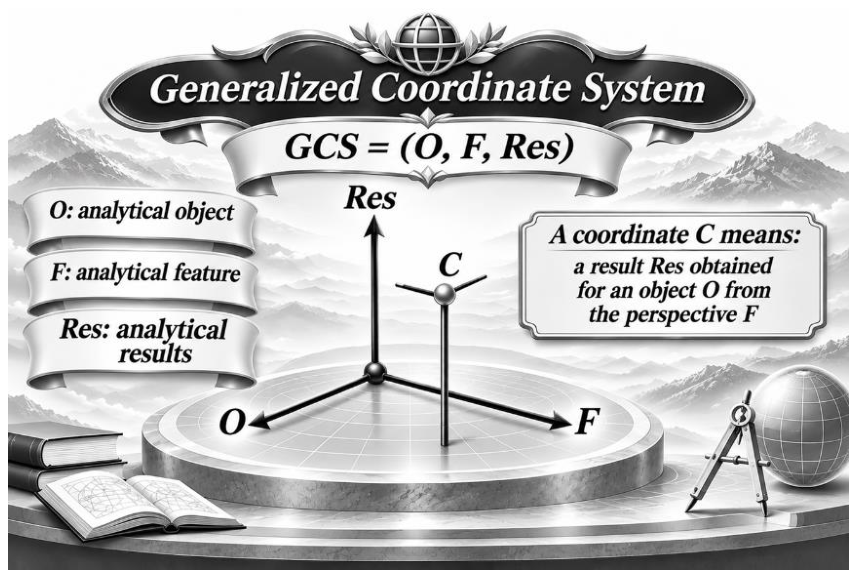
Figure 2.
Analytical object.
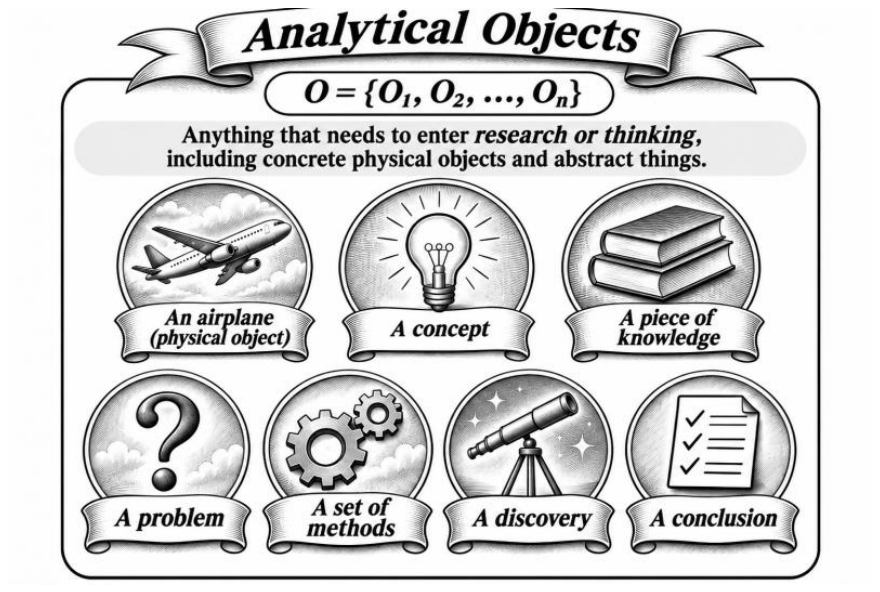
Figure 3.
Eight analytical features.
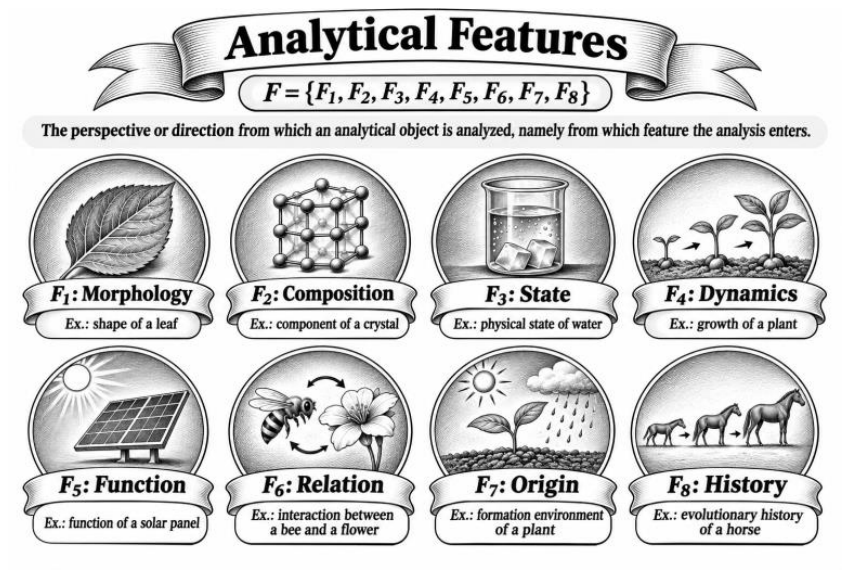
Figure 4.
Concrete analytical contents (CAC).
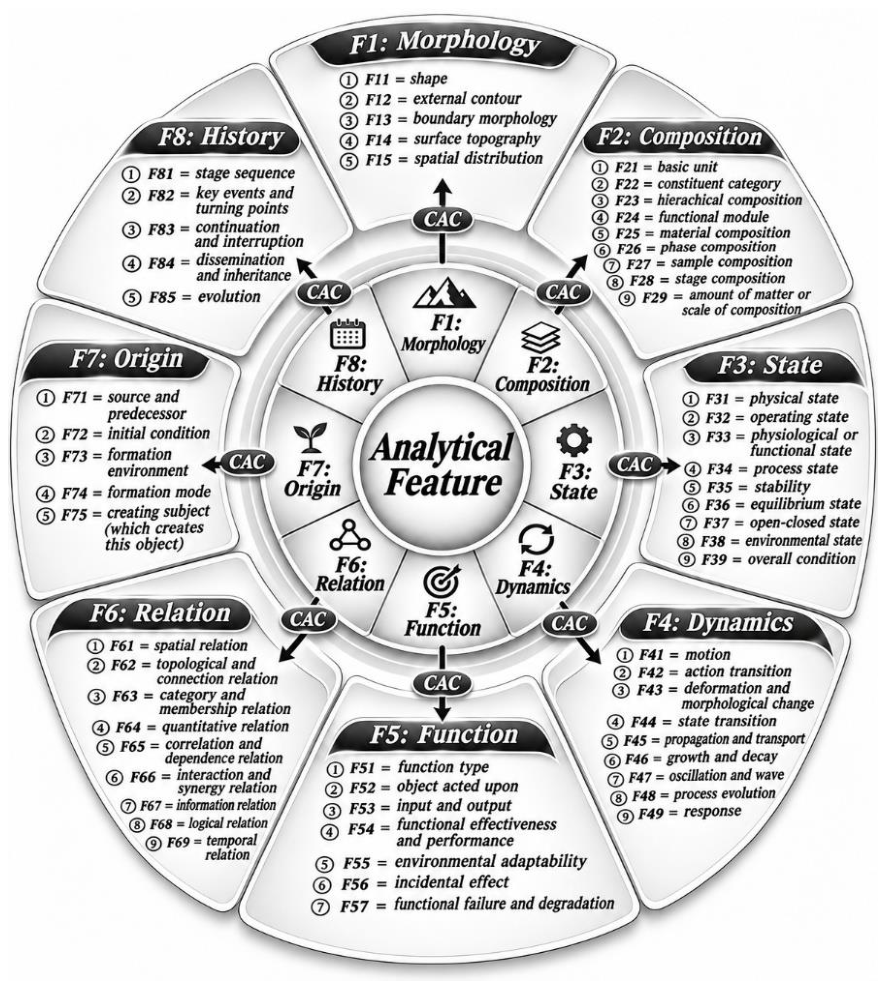
Figure 5.
Three types of analytical results.
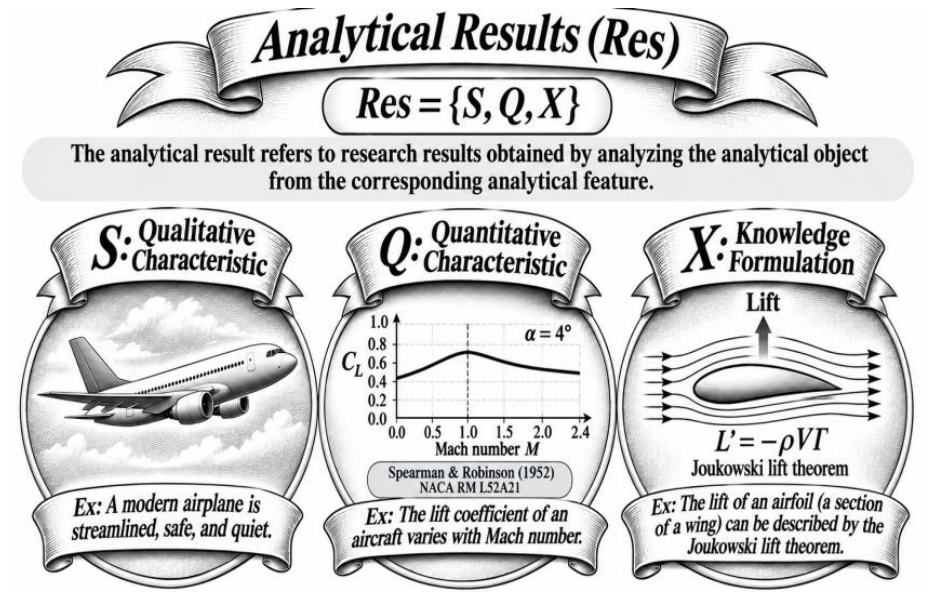
Figure 6.
Examples of qualitative characteristics.
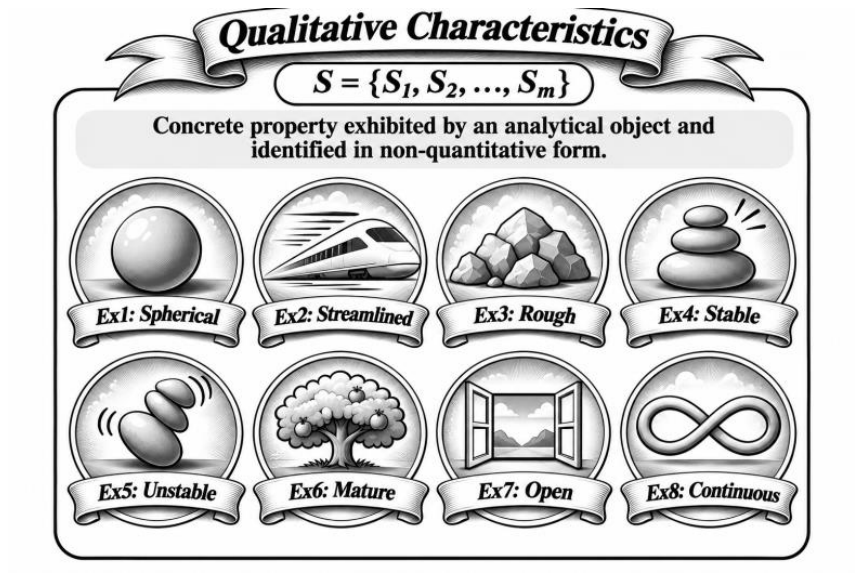
Figure 7.
Examples and types of quantitative characteristics.
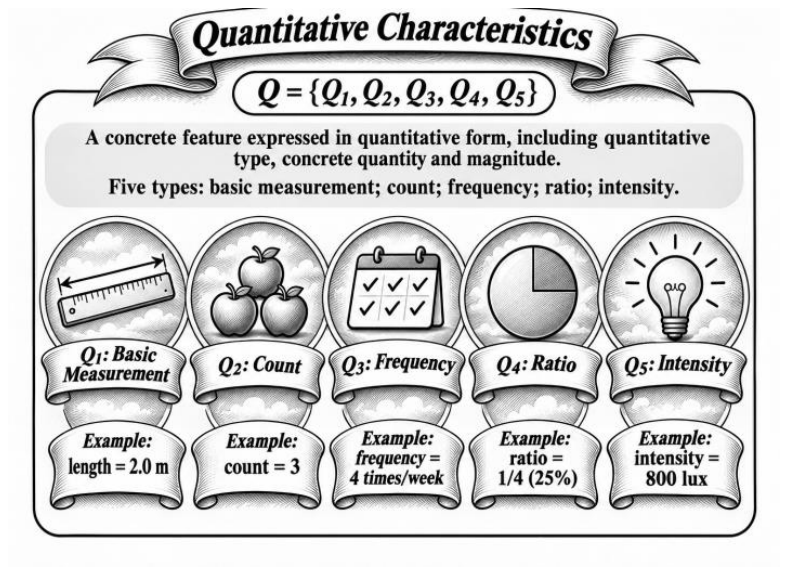
Figure 8.
Examples and types of knowledge formulation.
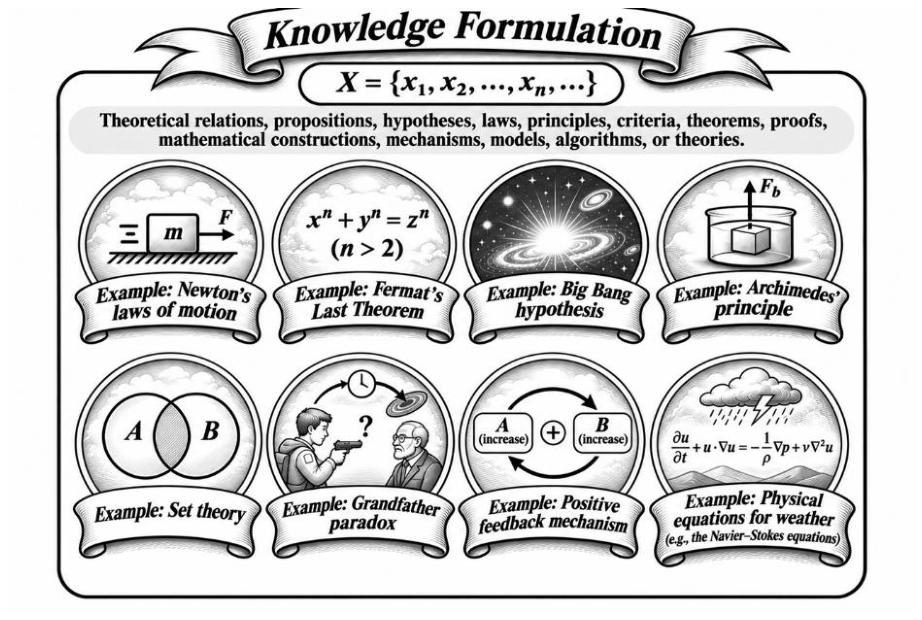
Figure 9.
Research map: front view.
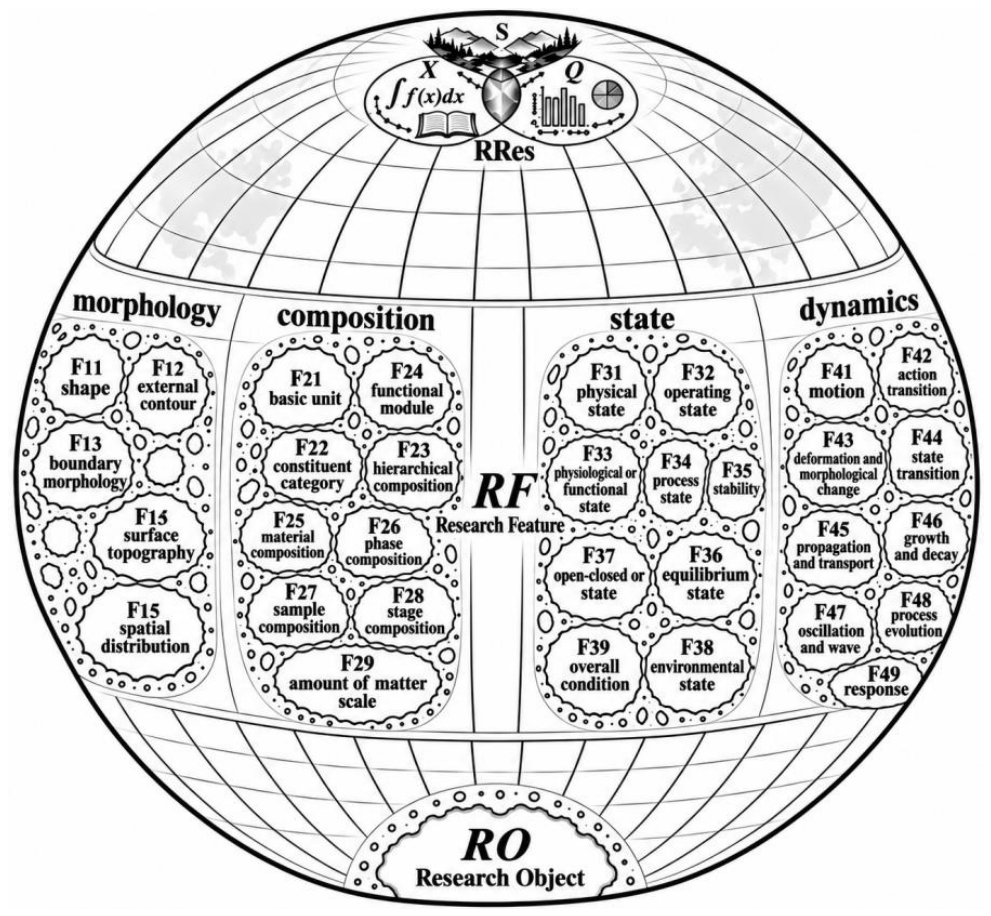
Figure 10.
Research map: back view.
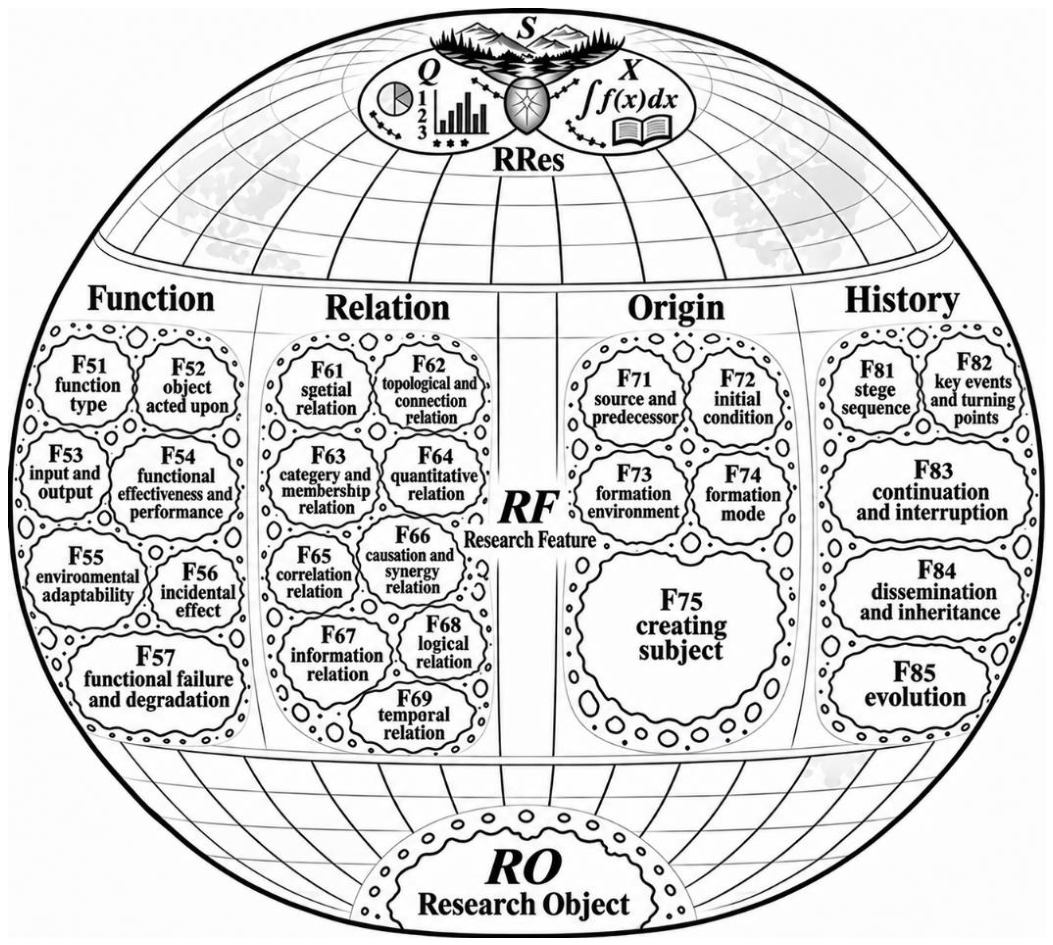
Figure 11.
Spindle Model of Generalized Research.
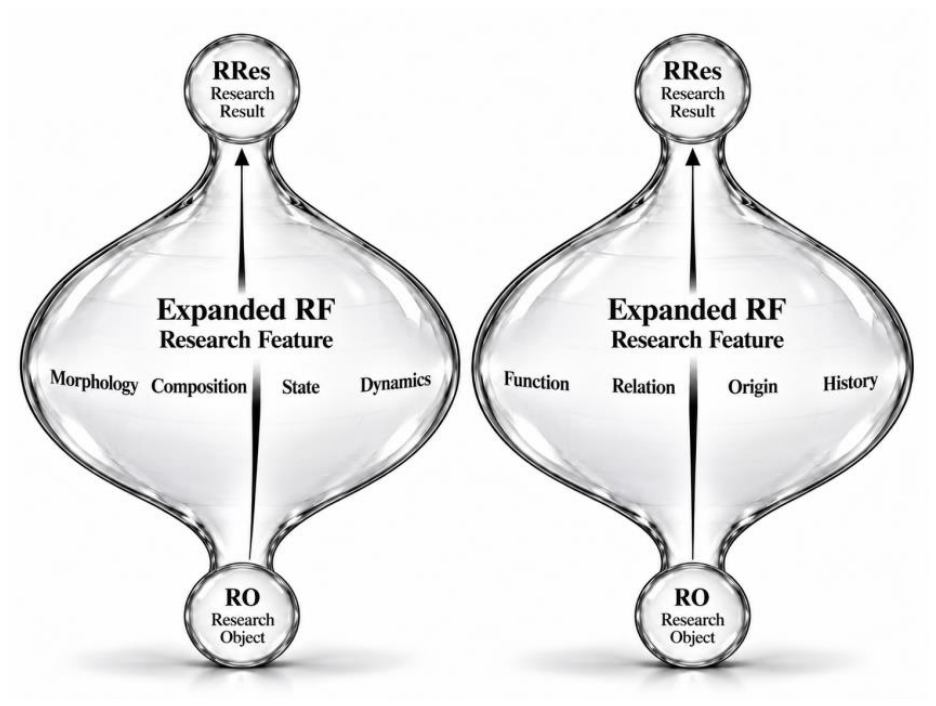
Figure 12.
GECS for expression.
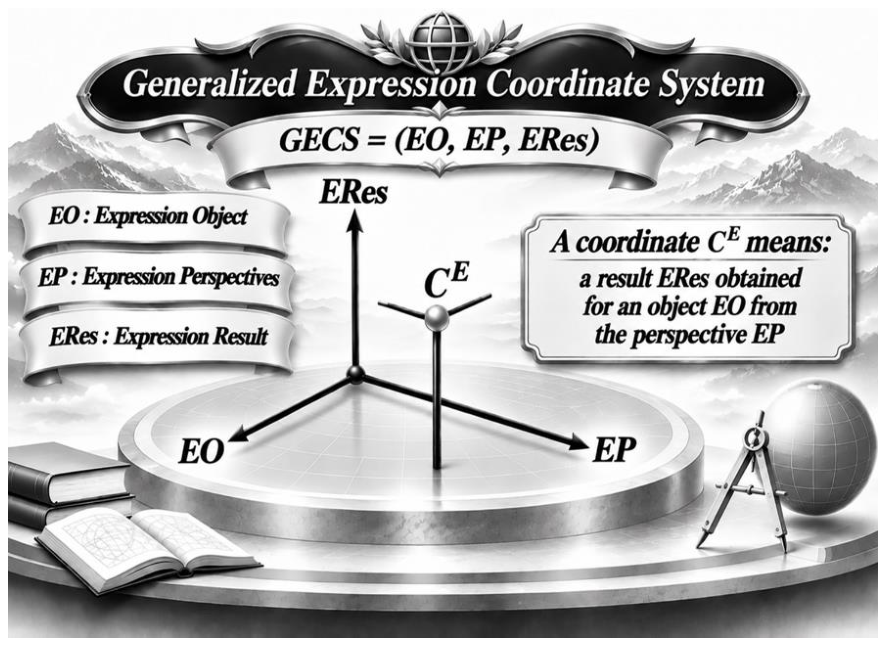
Figure 13.
Expression object.
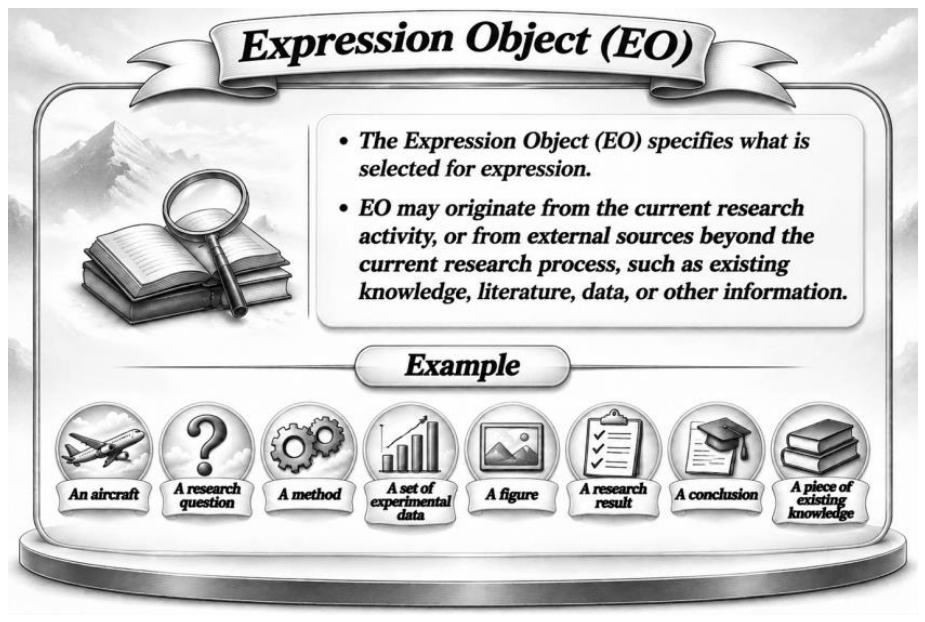
Figure 14.
Eight expression perspectives.
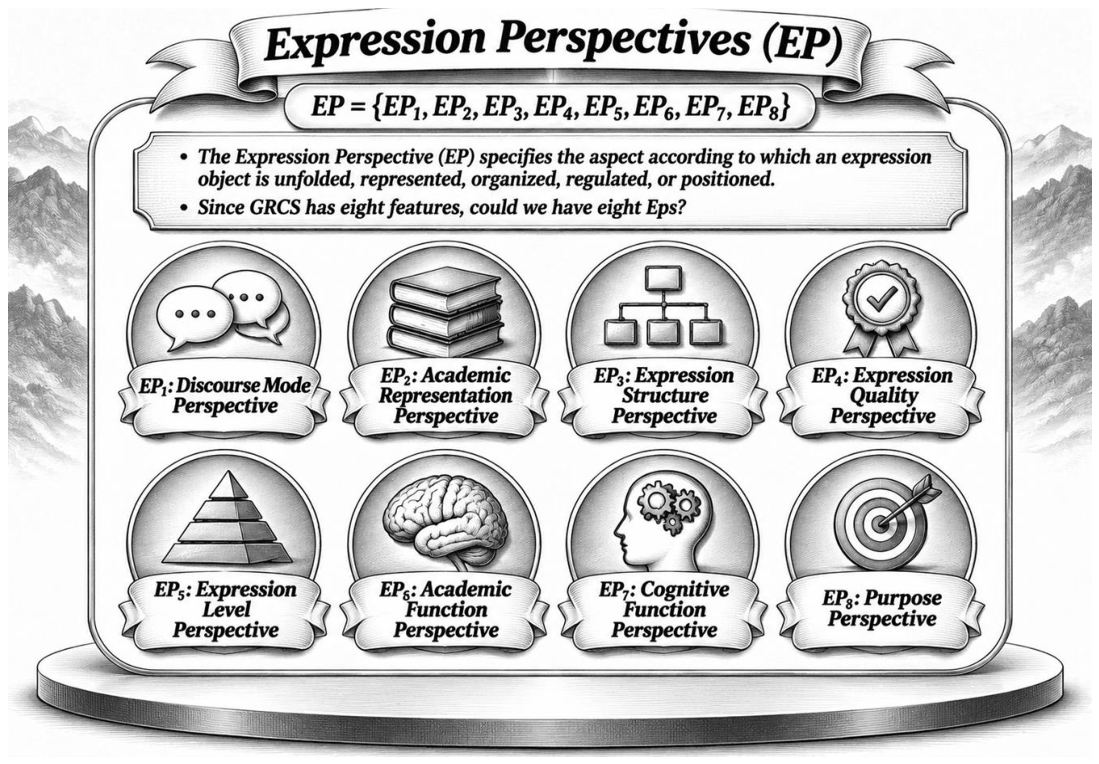
Figure 15.
Concrete expression positions (CEP).
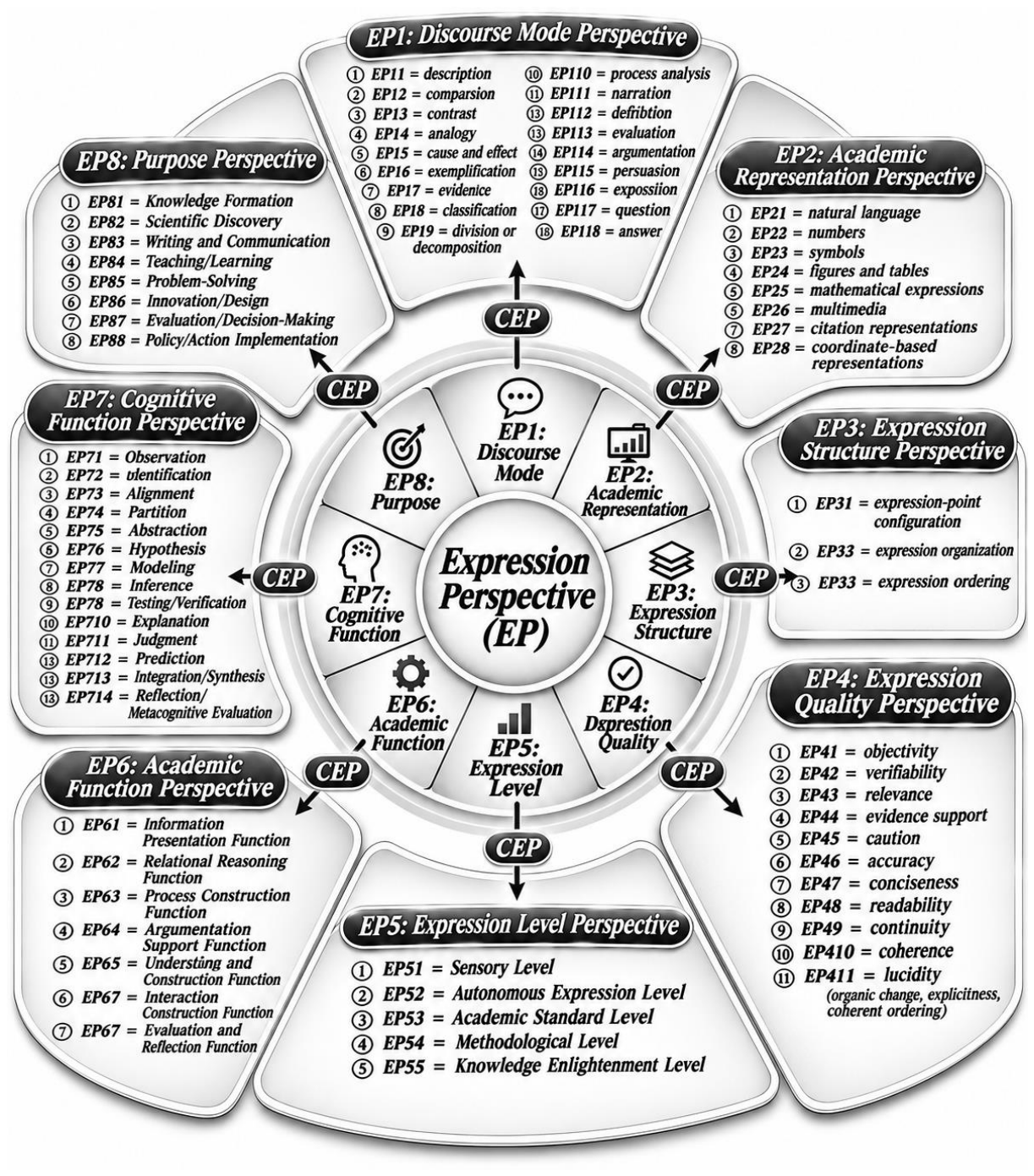
Figure 16.
“The Nature of Memory”: a course presentation using a combination of rhetorical modes (adapted and updated from Figure 8 in Wu, 2025).
Figure 16.
“The Nature of Memory”: a course presentation using a combination of rhetorical modes (adapted and updated from Figure 8 in Wu, 2025).
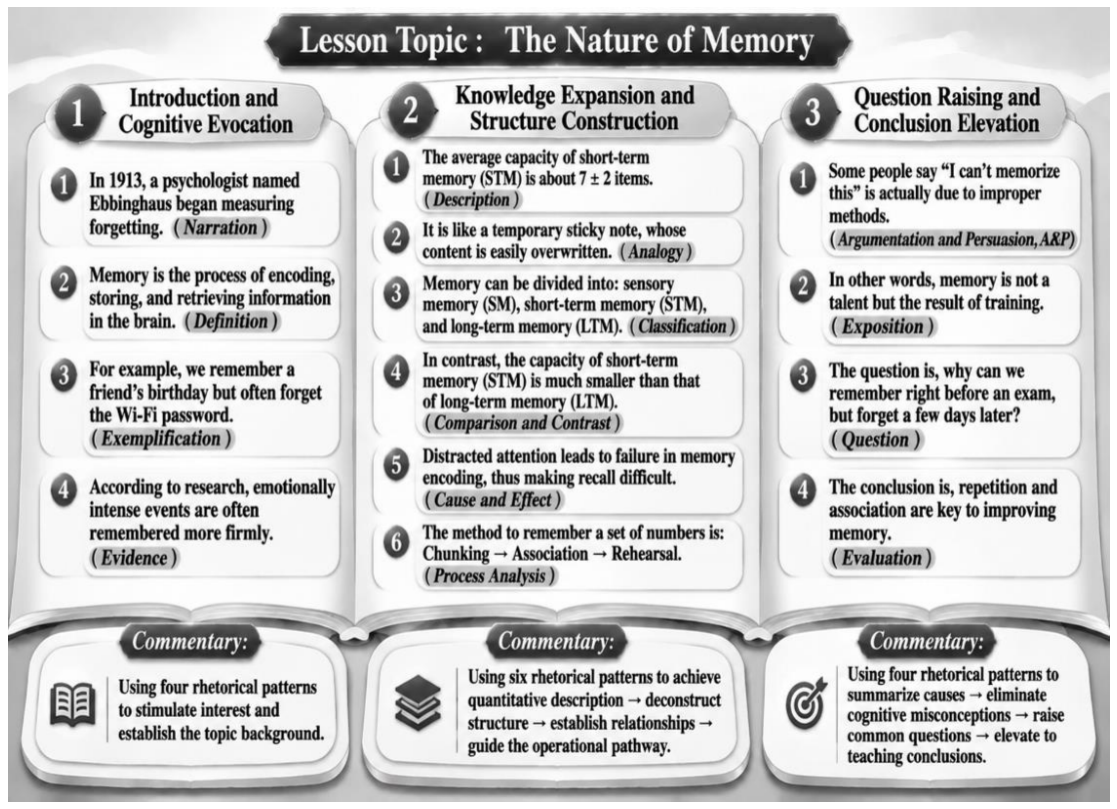
Figure 17.
The three concrete expression positions of the expression structure perspective (EP3) .
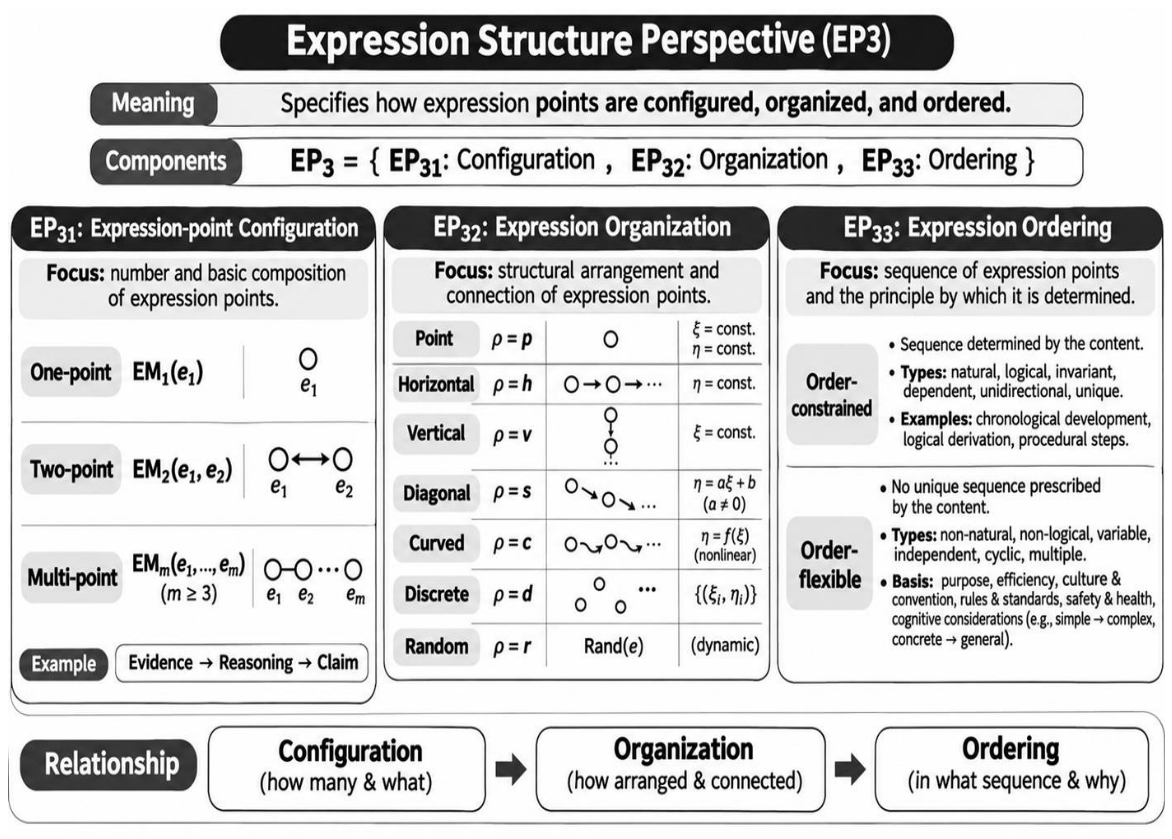
Figure 18.
Expression-point configuration examples.
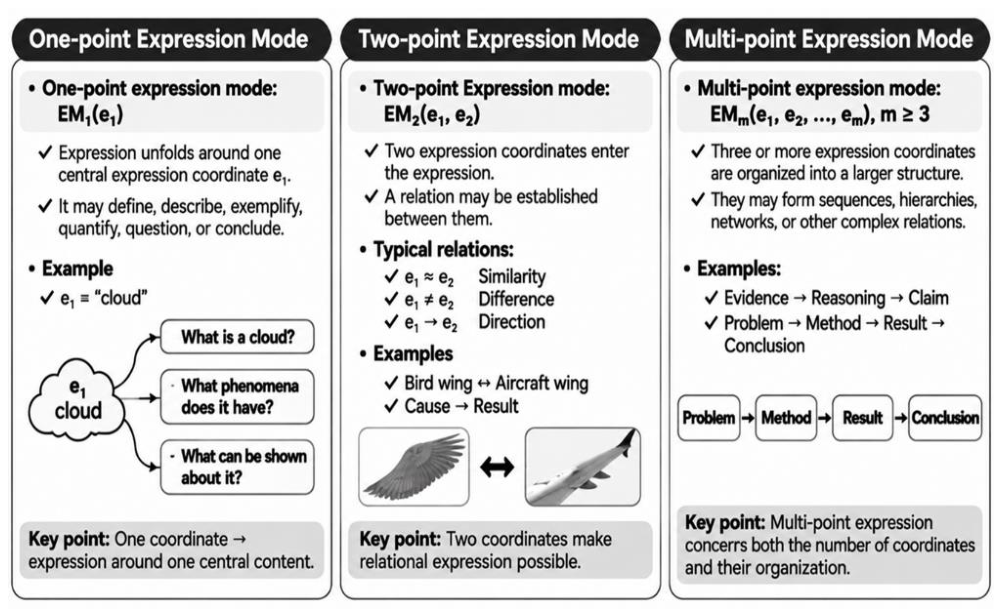
Figure 19.
The five concrete expression positions for expression level perspective.
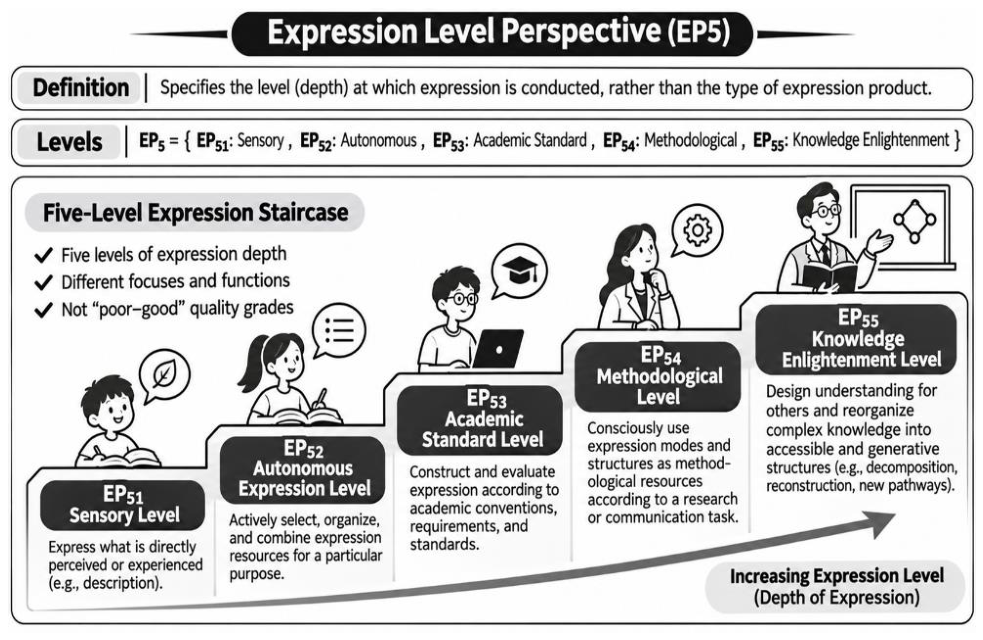
Figure 20.
Various expression results.
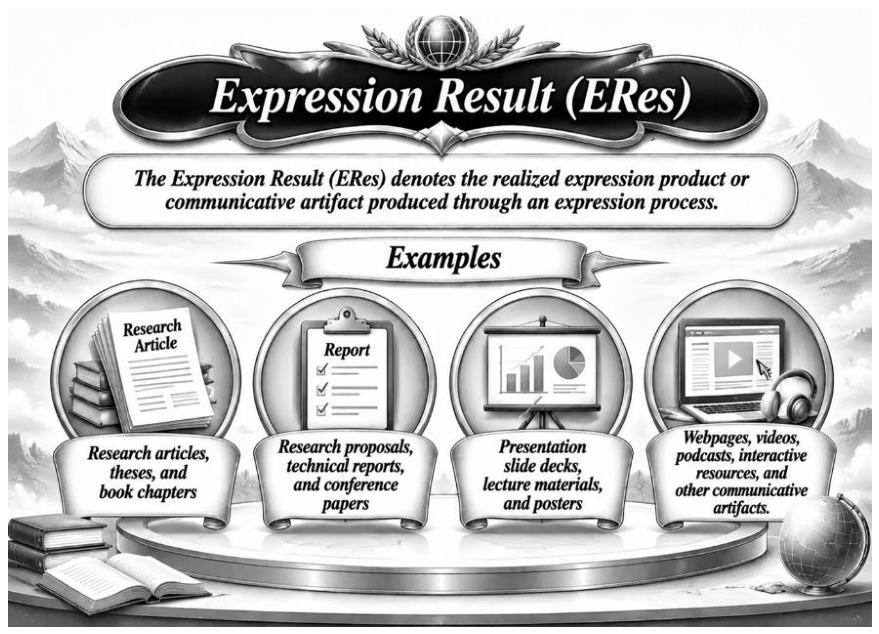
Figure 21.
Expression map: front view.
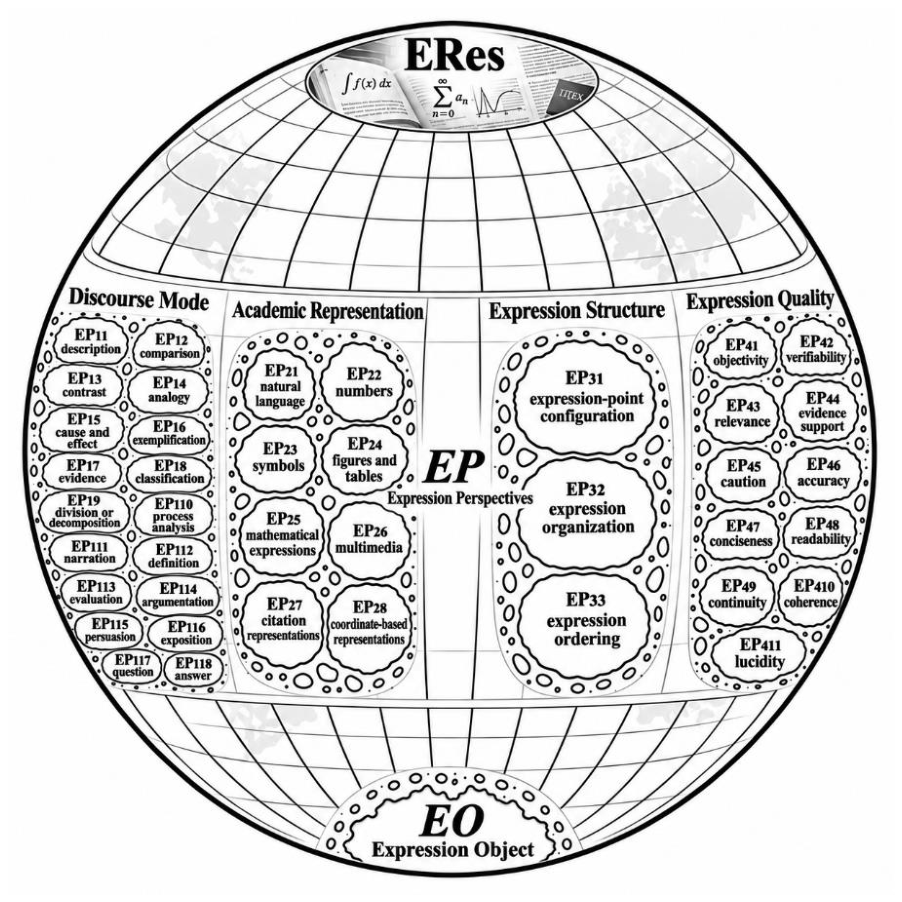
Figure 22.
Expression map: back view.
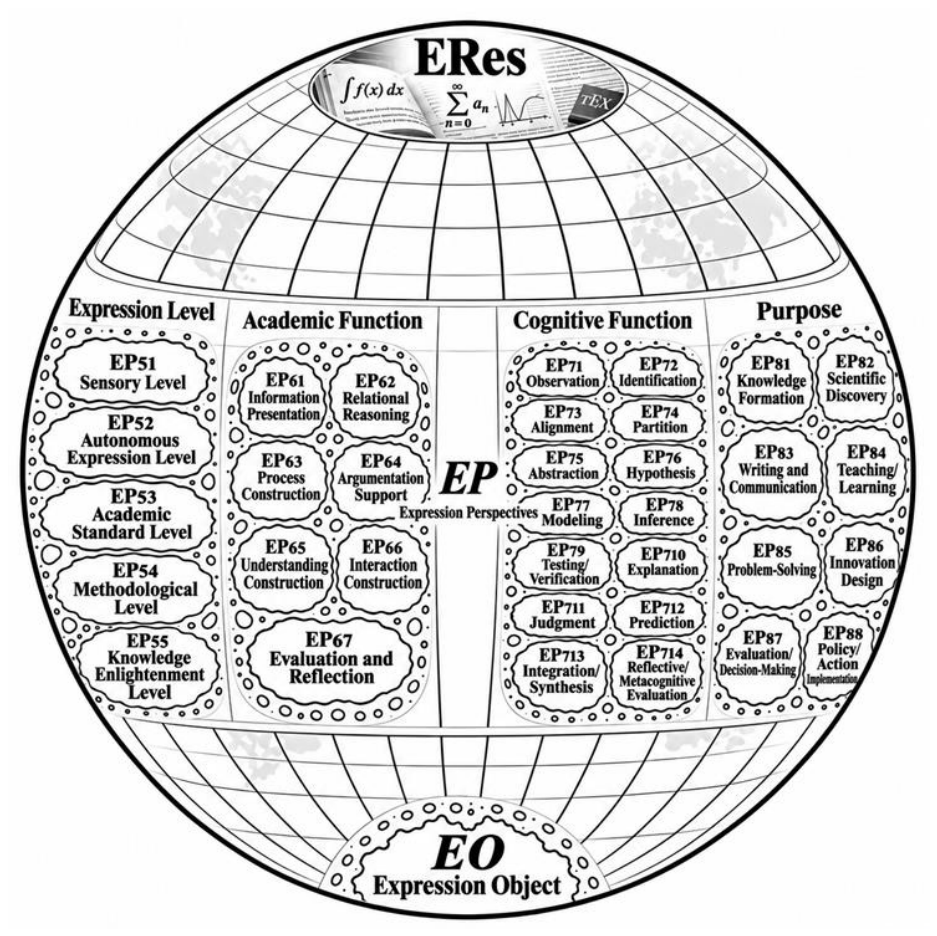
Figure 23.
Spindle Model of Generalized Expression.
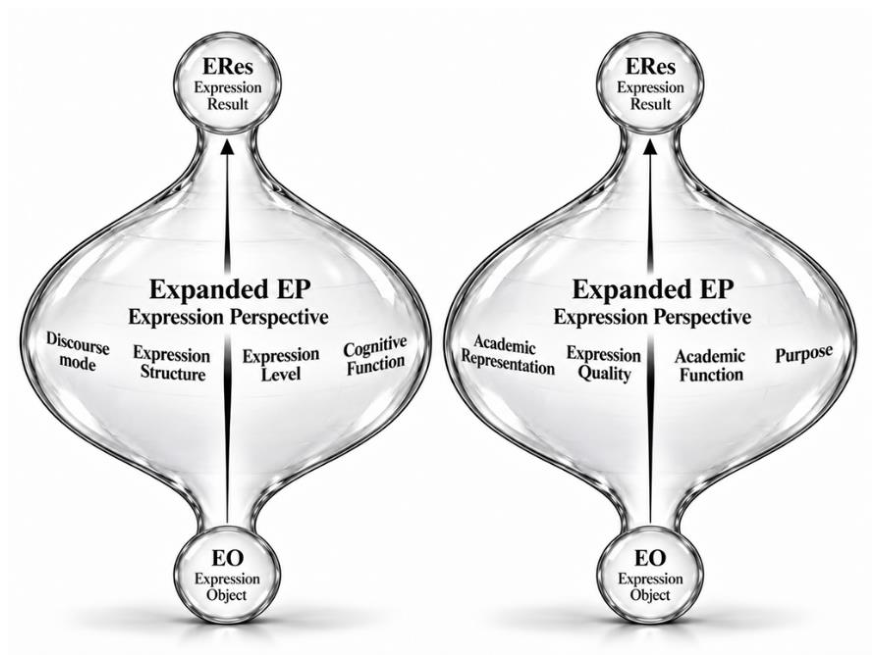
Figure 24.
Six generalized adjustment operations for analytical objects.
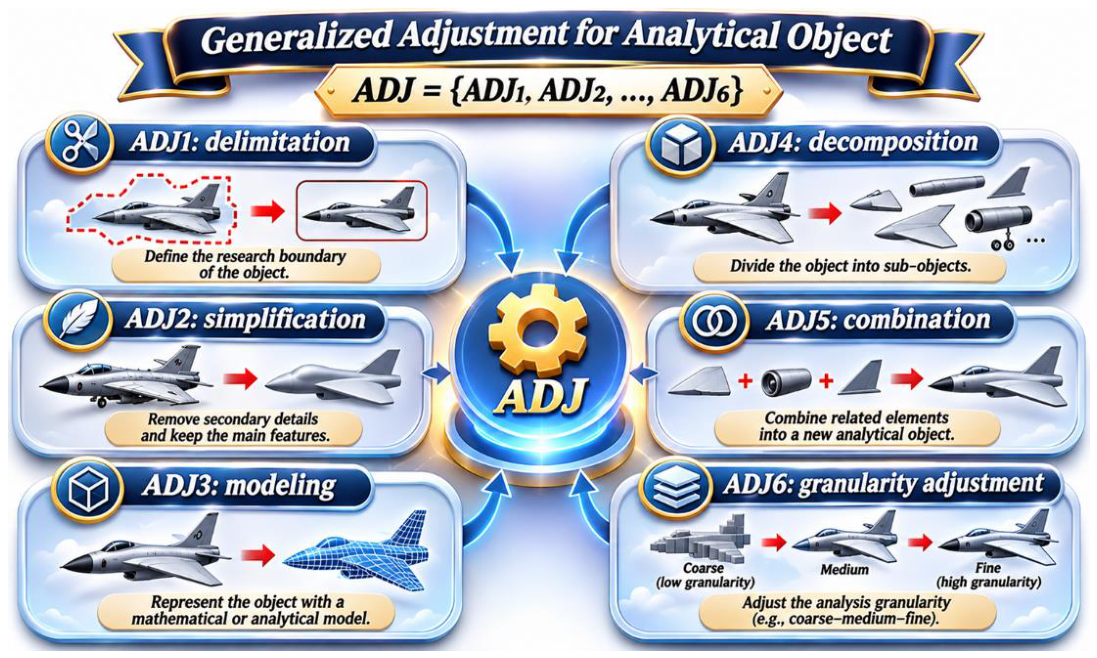
Figure 25.
Delimitation of an analytical object using relevant analytical features and contents.
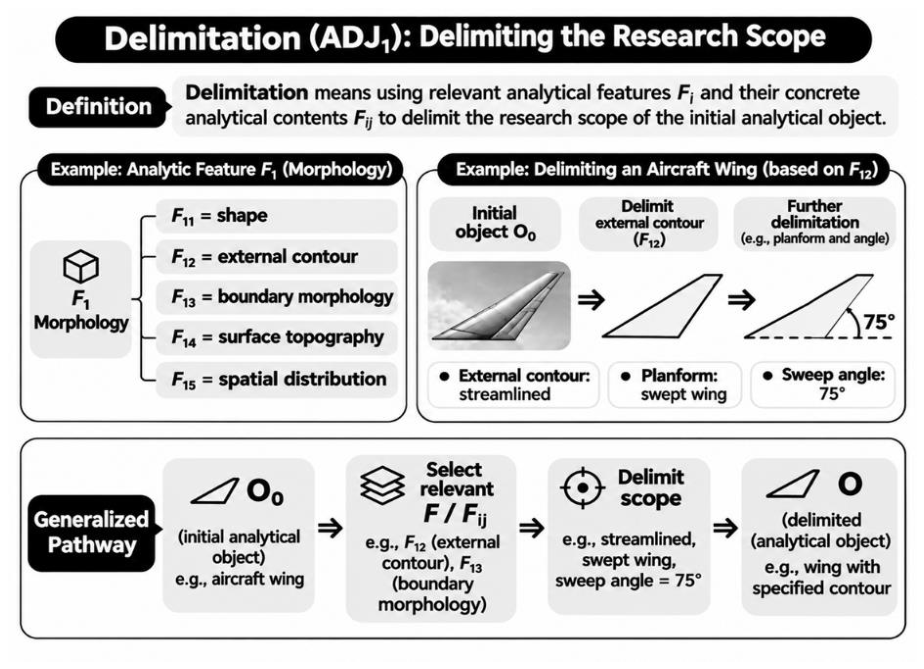
Figure 26.
Simplification of an analytical object by retaining its main contents.
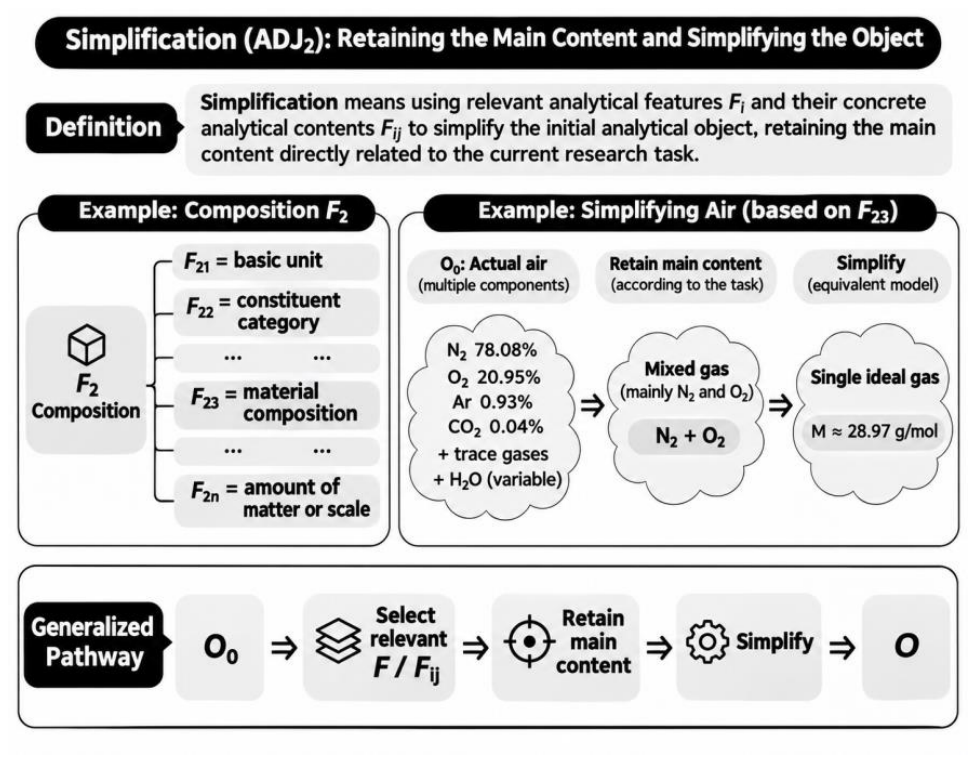
Figure 27.
Modeling an analytical object using a substitute object.
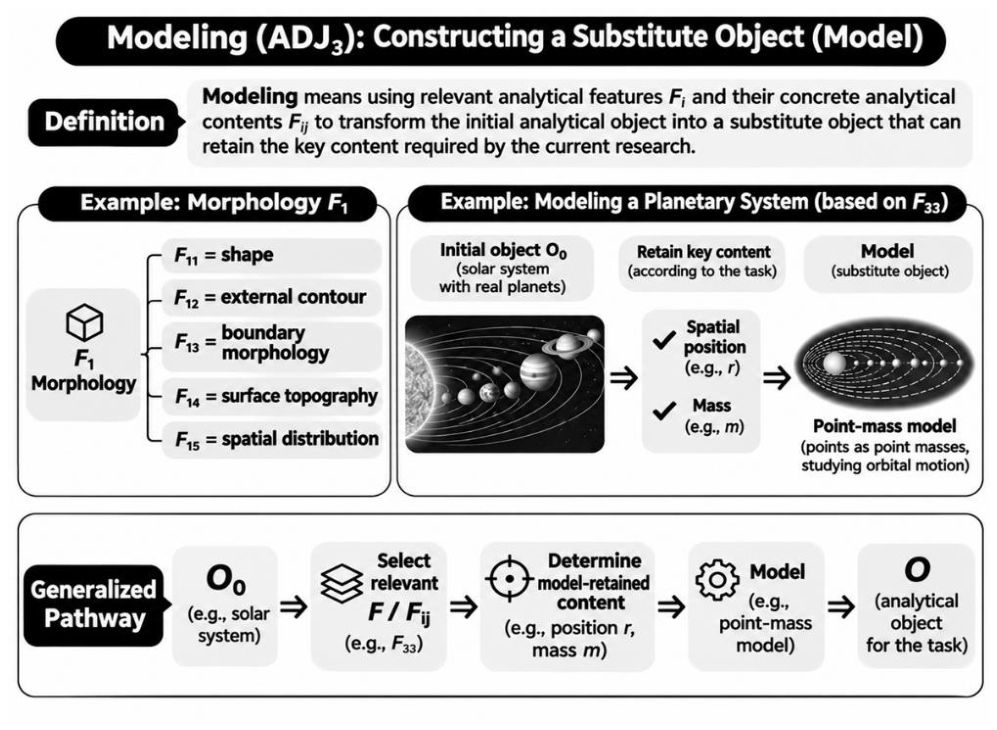
Figure 28.
Decomposition of an analytical object into smaller objects.
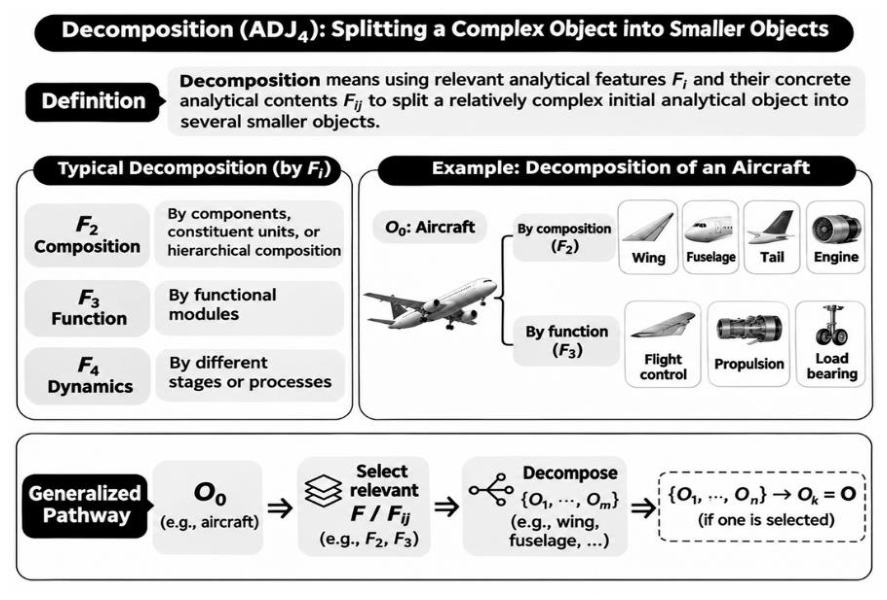
Figure 29.
Combination of multiple analytical objects into a unified object.
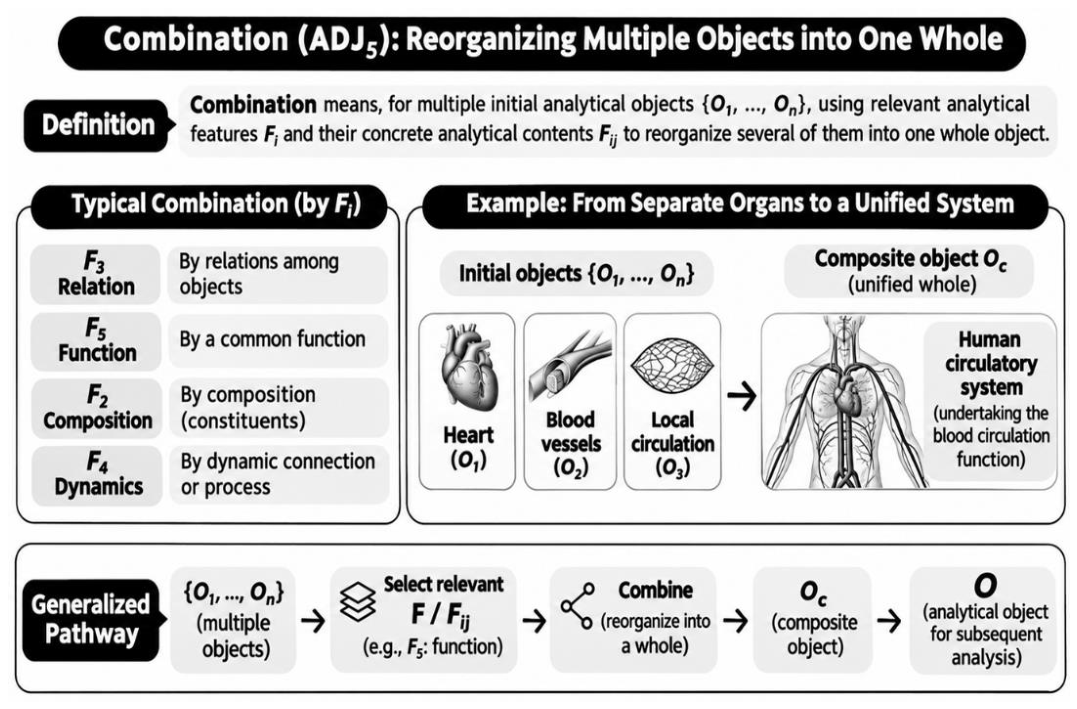
Figure 30.
Granularity adjustment across different analytical levels of an object.
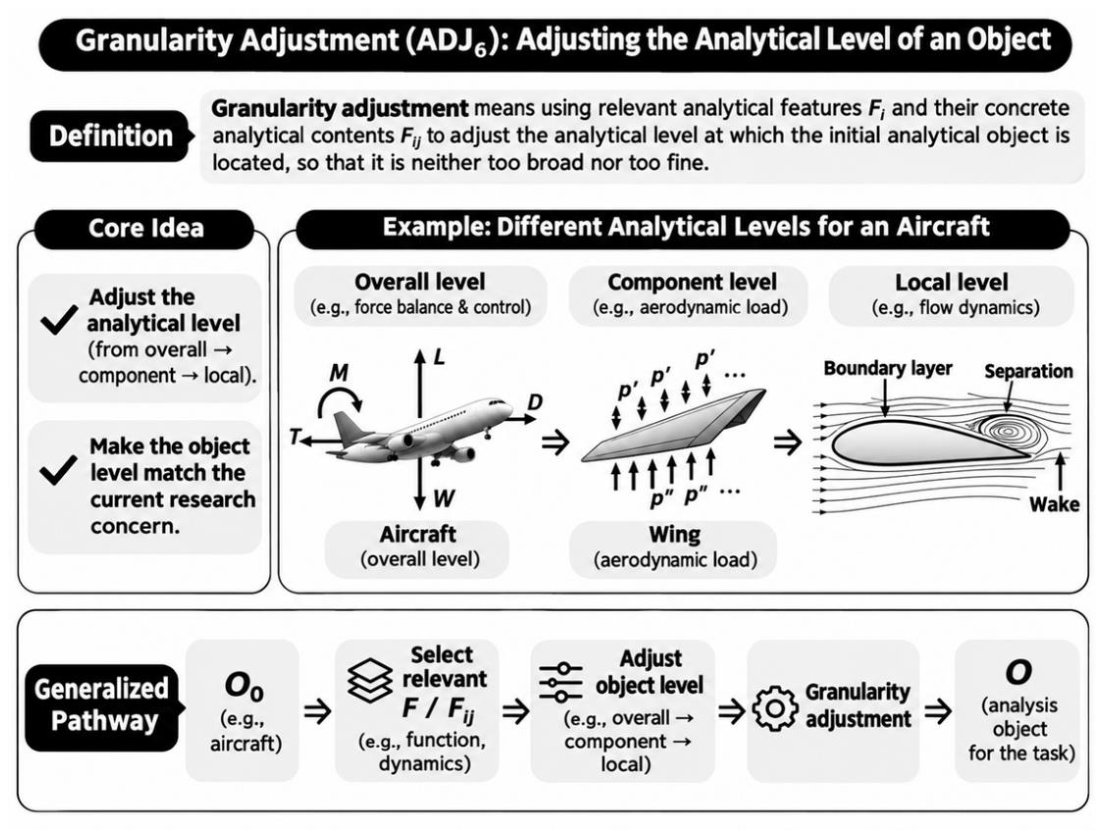
Figure 31.
Six generalized adjustment operations for expression objects.
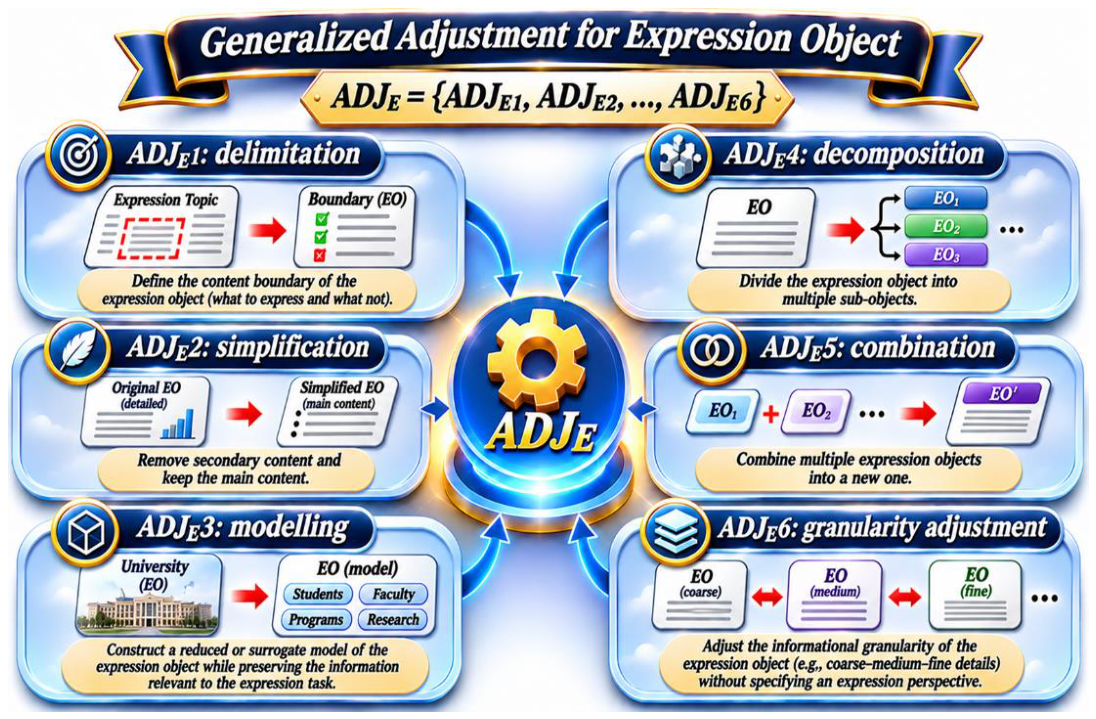
Figure 32.
Generalized Analytical Method (GAM): Local Analysis (LA), Cross Analysis (CA).
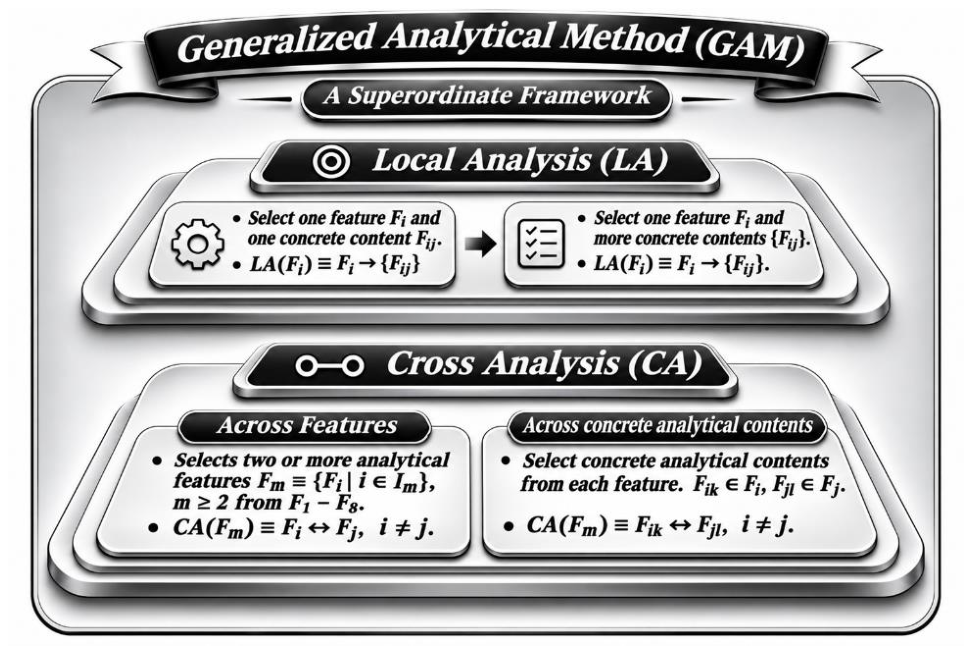
Figure 33.
Overall structure of the Generalized Analytical Method (GAM).
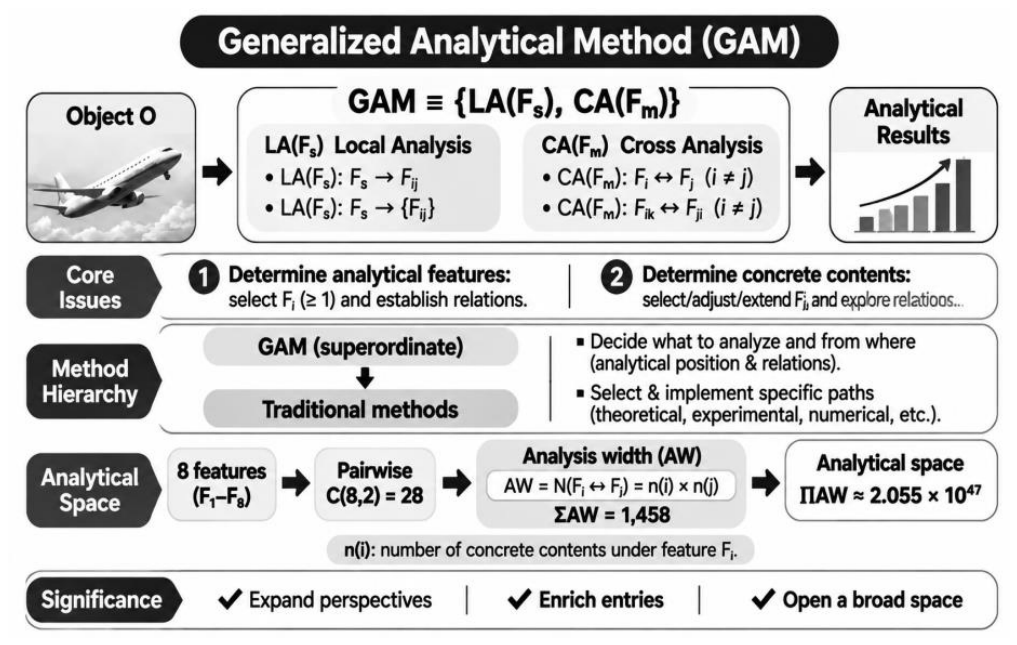
Figure 34.
Generalized Expressing Method (GEM): Local Expression (LE) and Cross Expression (CE).
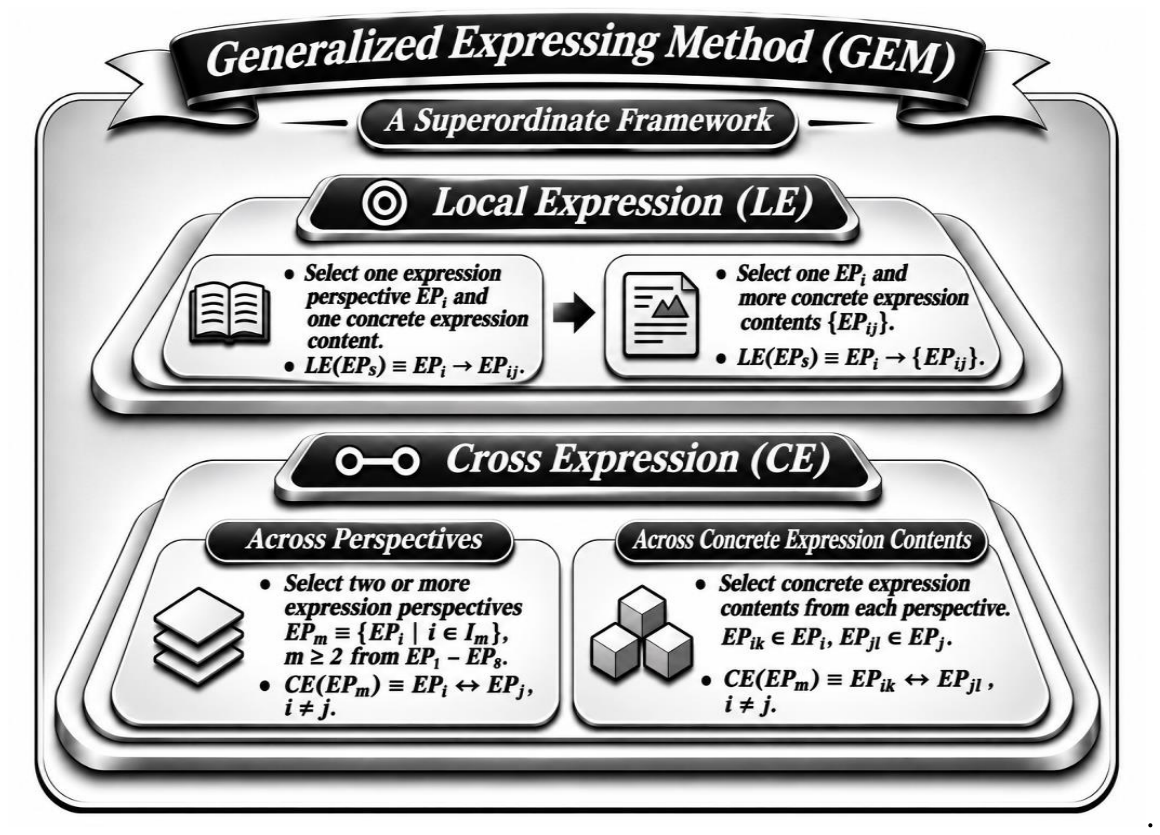
Figure 35.
Main-node Analytical Path (MAP) using Local Analysis (LA) within GAM.
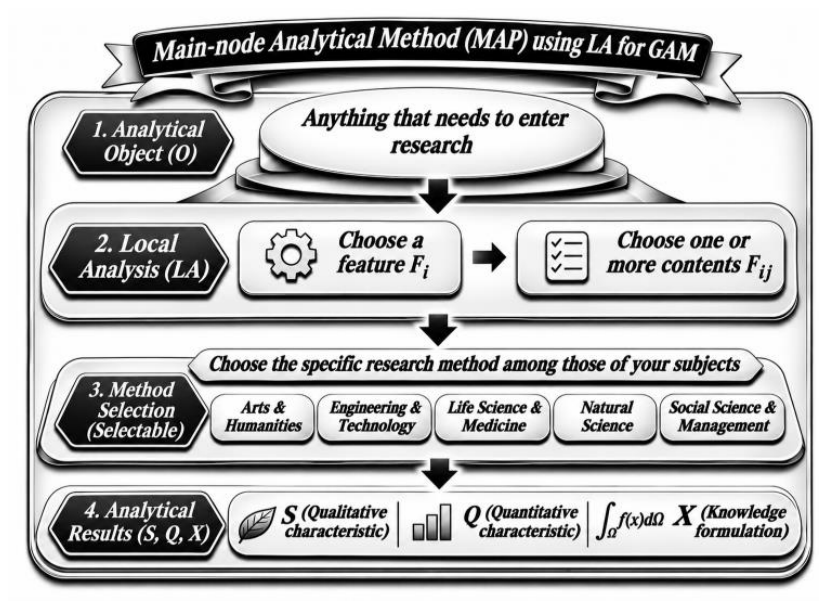
Figure 36.
Example of MAP using LA: morphological analysis of a galaxy.
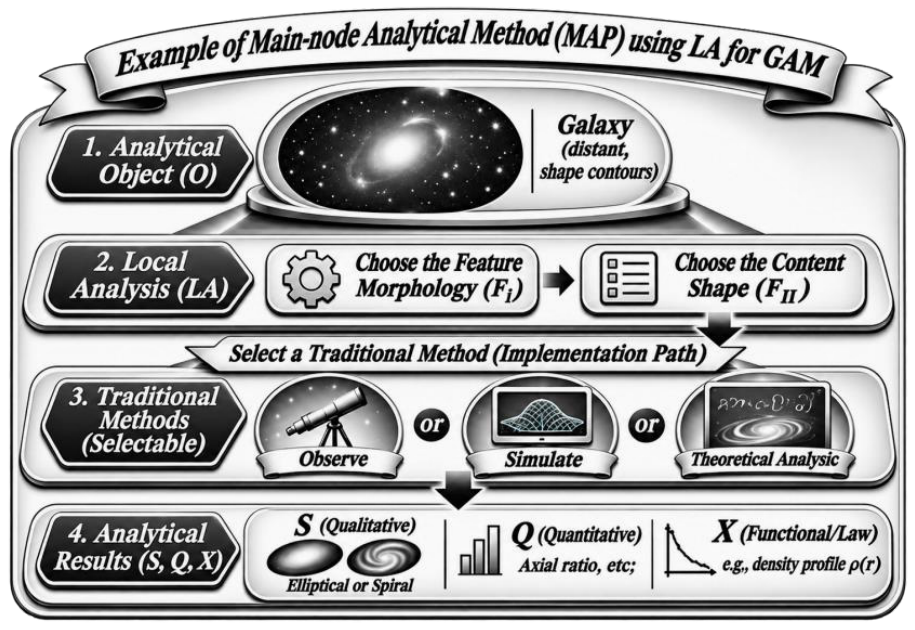
Figure 37.
Main-node Analytical Path (MAP) using Cross Analysis (CA) within GAM.
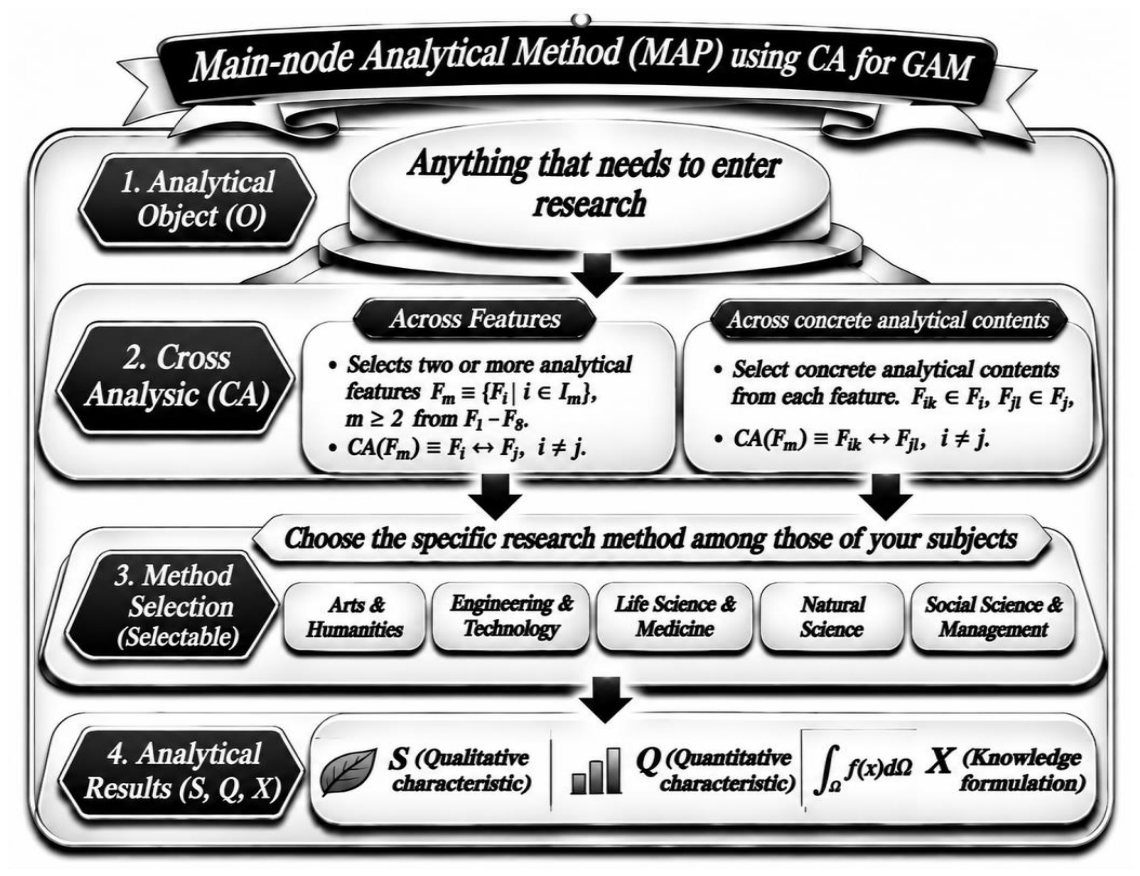
Figure 38.
Example of MAP using CA: analysis of the relationship between an aircraft’s external contour and functional effectiveness and performance.
Figure 38.
Example of MAP using CA: analysis of the relationship between an aircraft’s external contour and functional effectiveness and performance.
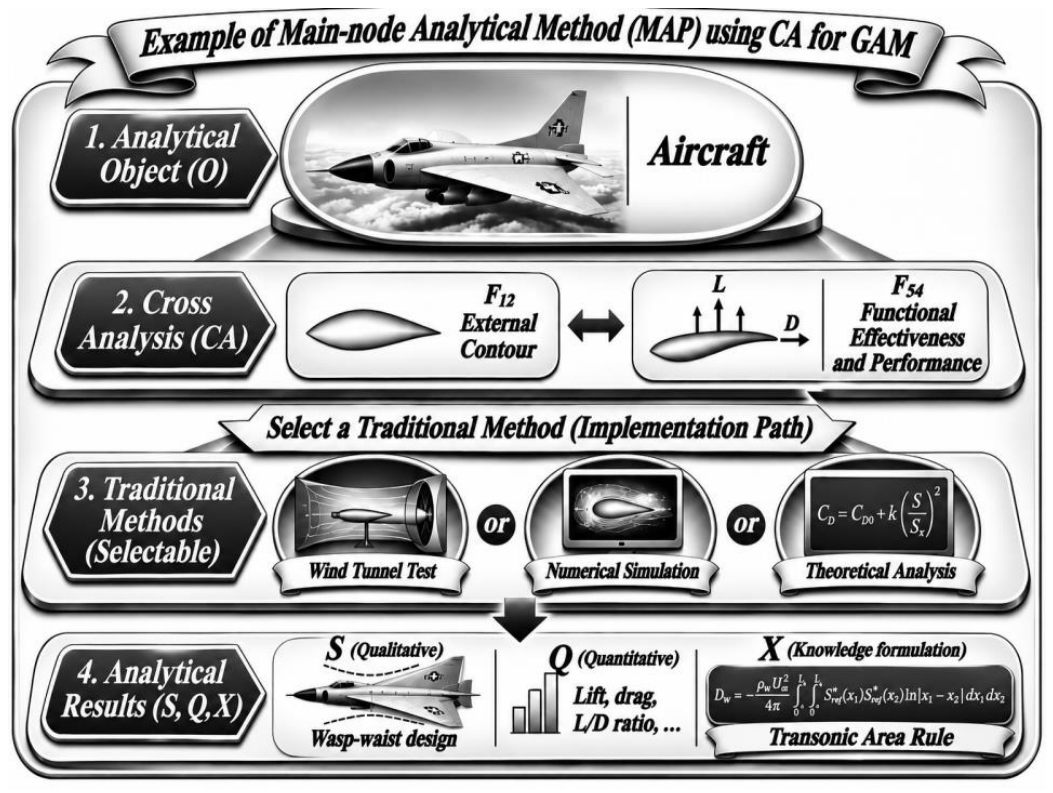
Figure 39.
Main-node Expressing Path (MEP): from Expression Object through Expression Perspectives to Expression Result.
Figure 39.
Main-node Expressing Path (MEP): from Expression Object through Expression Perspectives to Expression Result.
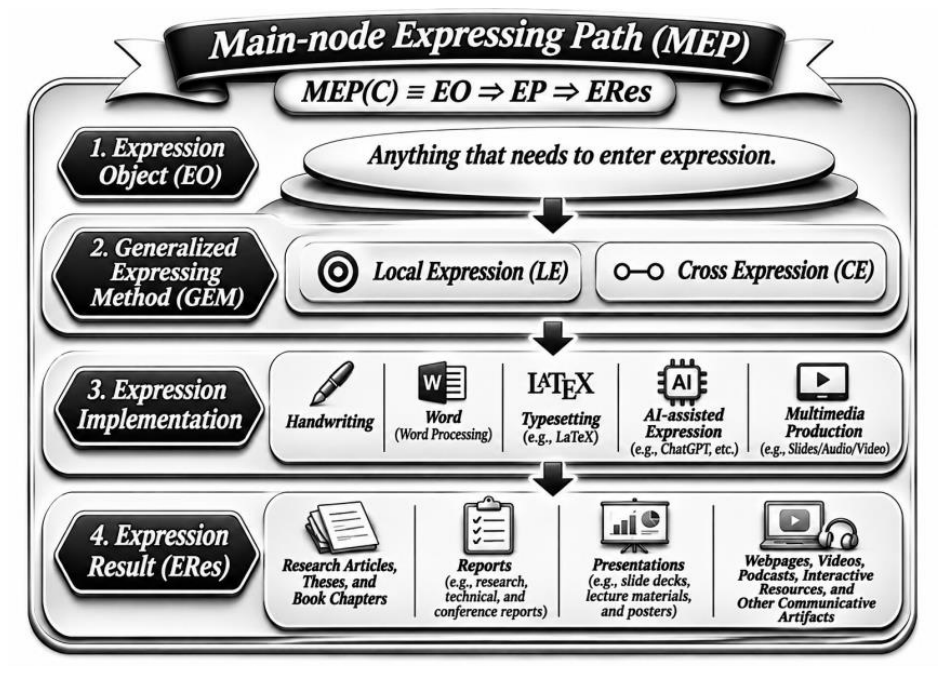
Figure 40.
Re-Anchoring and recursive re-anchoring in research.
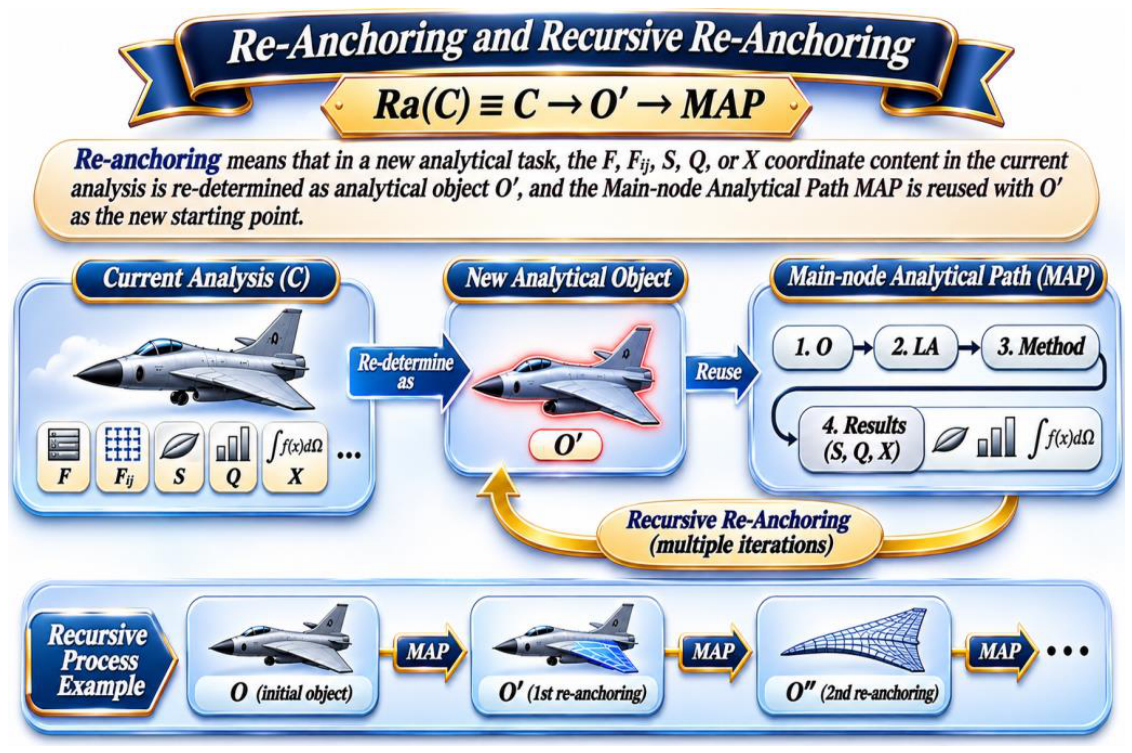
Figure 41.
Representative cases of re-anchoring analytical coordinate contents as new objects.
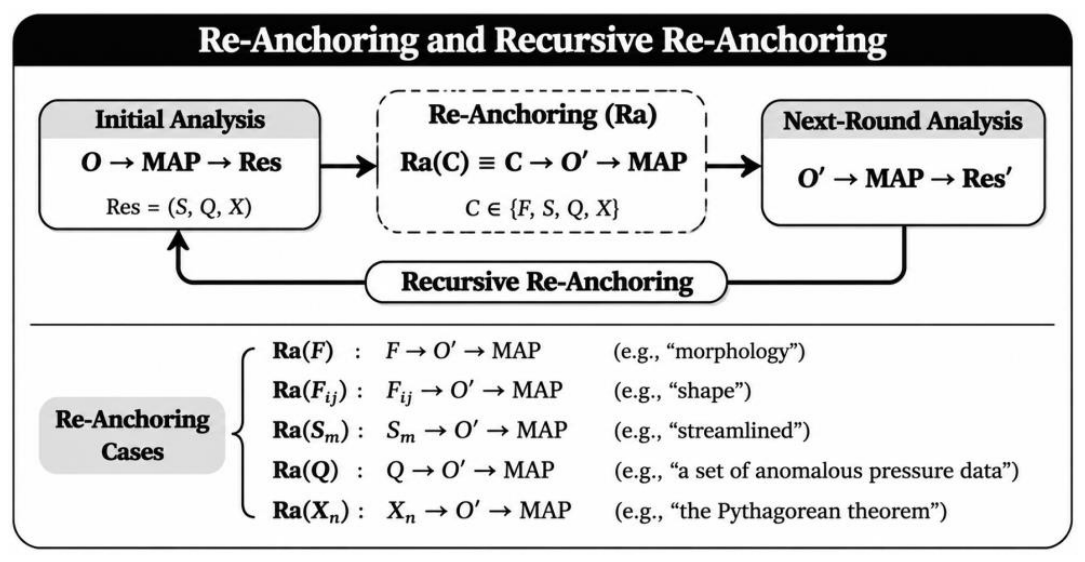
Figure 42.
Re-Anchoring and recursive re-anchoring in expression.
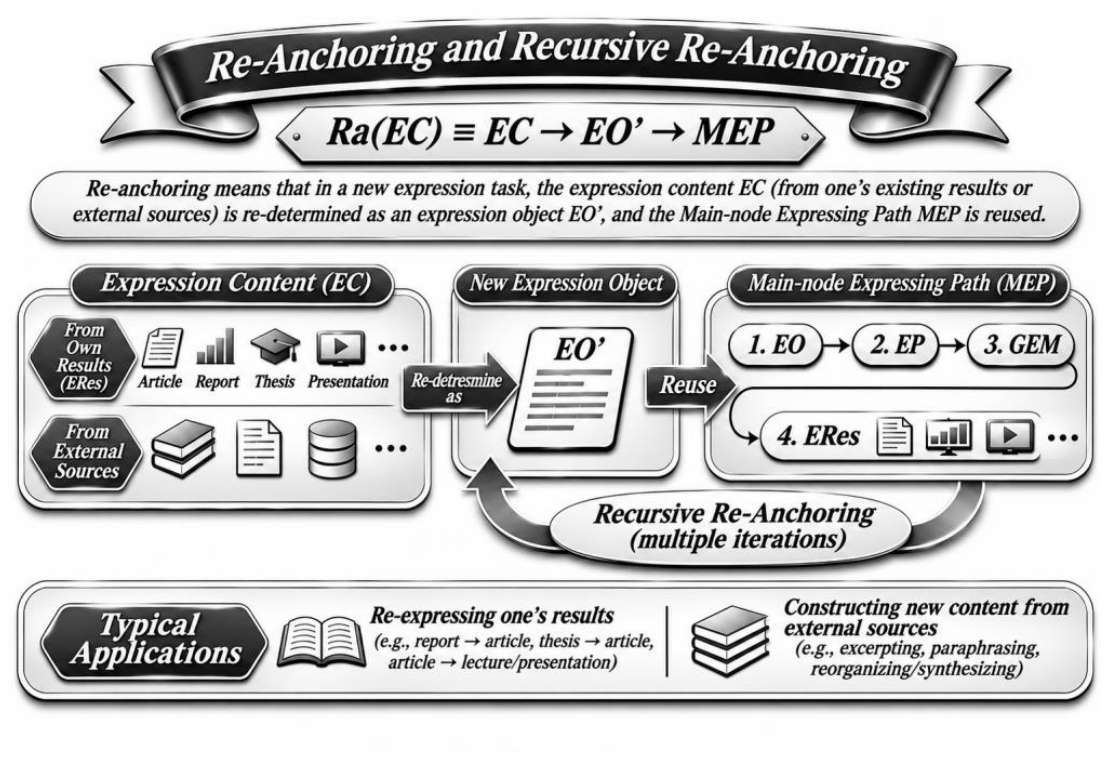
Figure 43.
Typical applications of re-anchoring for expression.
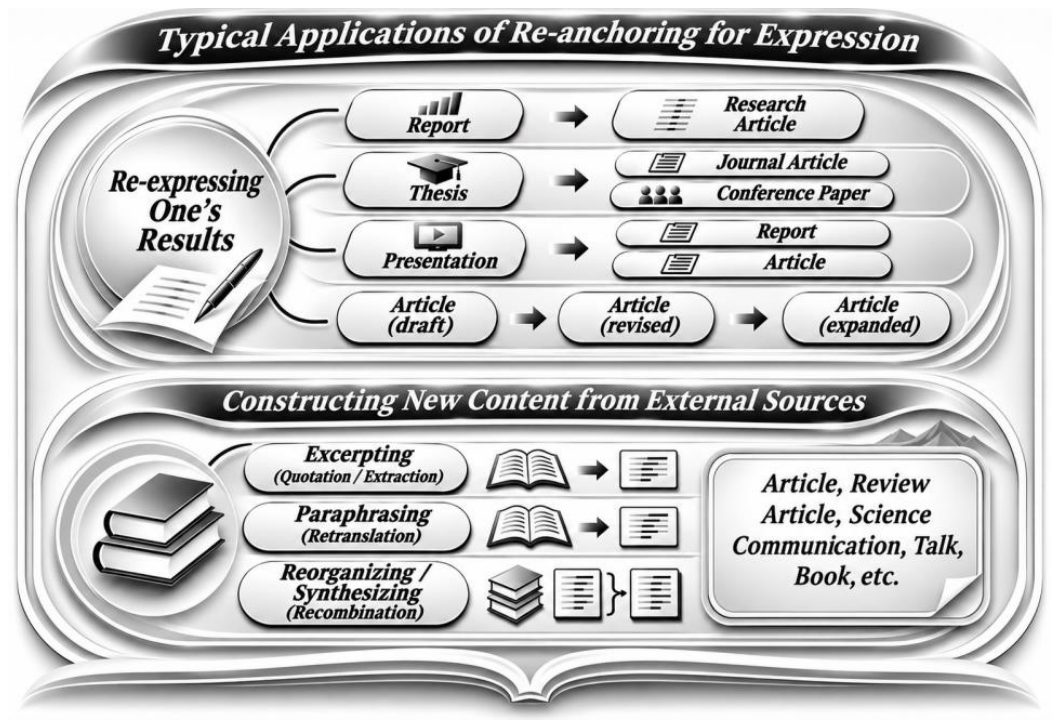
Figure 44.
Generalized Research (GR) framework based on the Generalized Analytical Pathway (GAP).
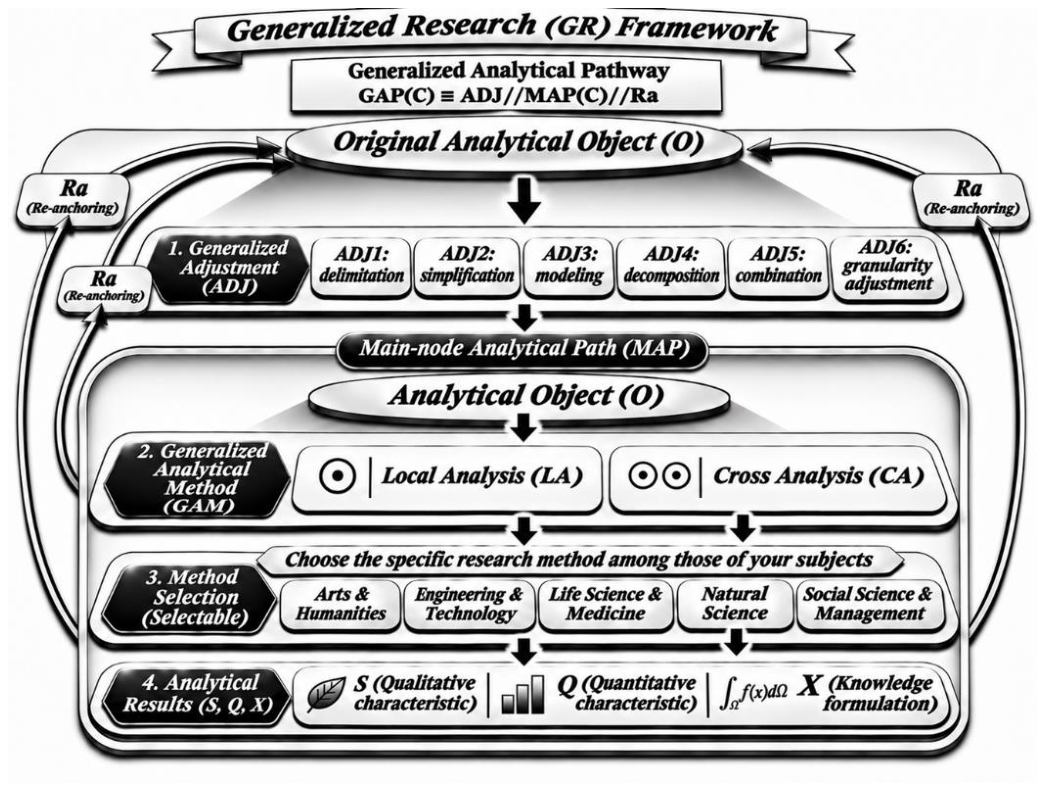
Figure 45.
Generalized Expression (GE) simplified.
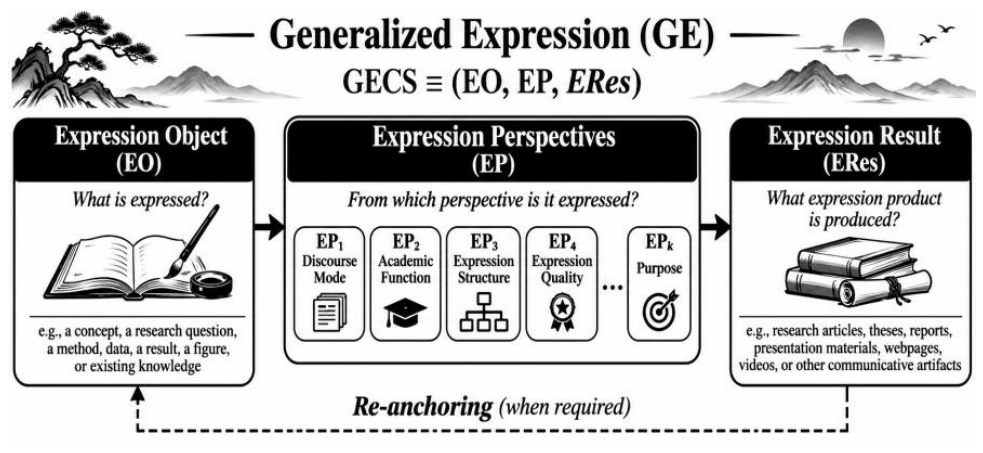
Figure 46.
Generalized Expression (GE) framework based on the Generalized Expression Pathway (GEP).
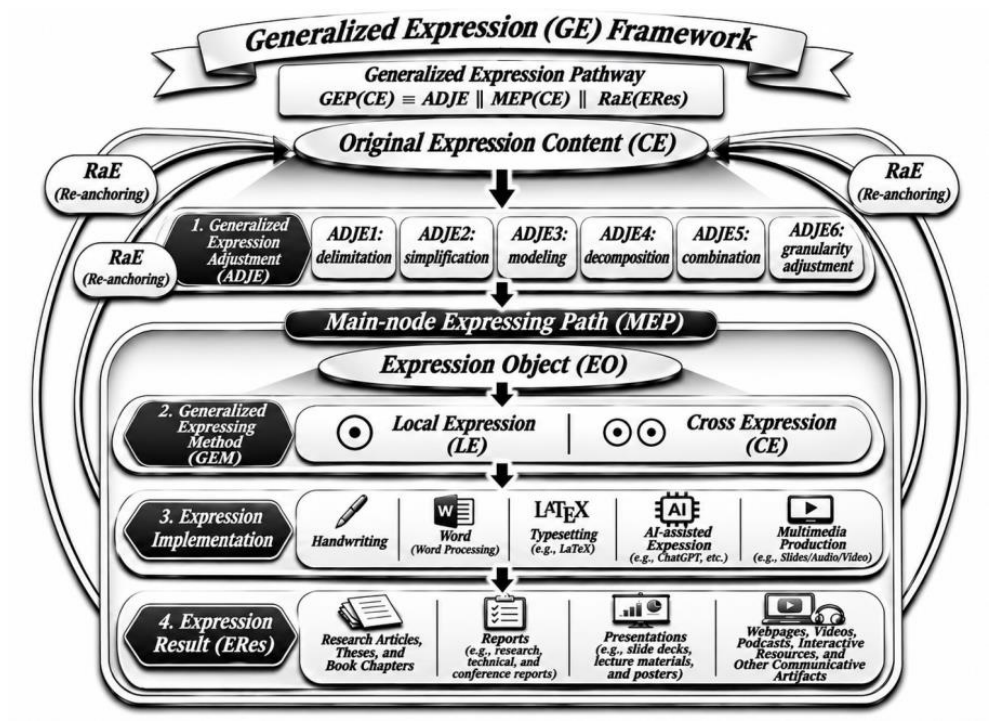
Figure 47.
Overall structure of DREAM: the Research Map and Expression Map connected through selective matching, navigation, and reciprocal feedback.
Figure 47.
Overall structure of DREAM: the Research Map and Expression Map connected through selective matching, navigation, and reciprocal feedback.
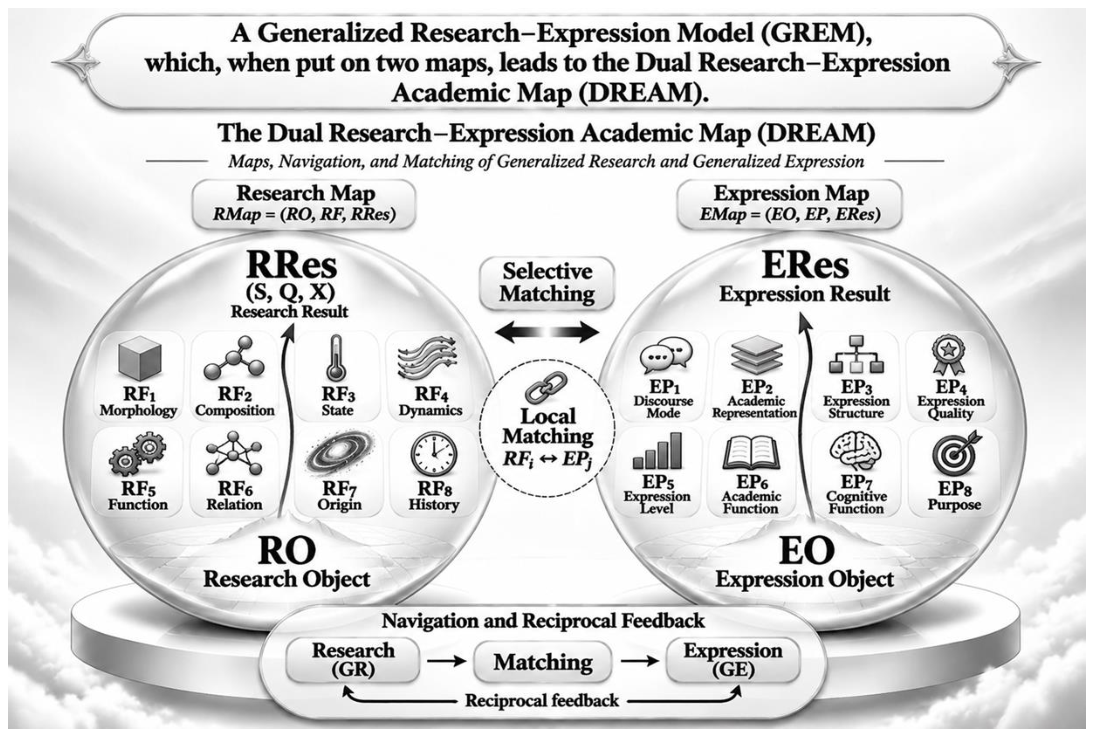
Figure 48.
Navigation and same-index matching on the dual research–expression map.
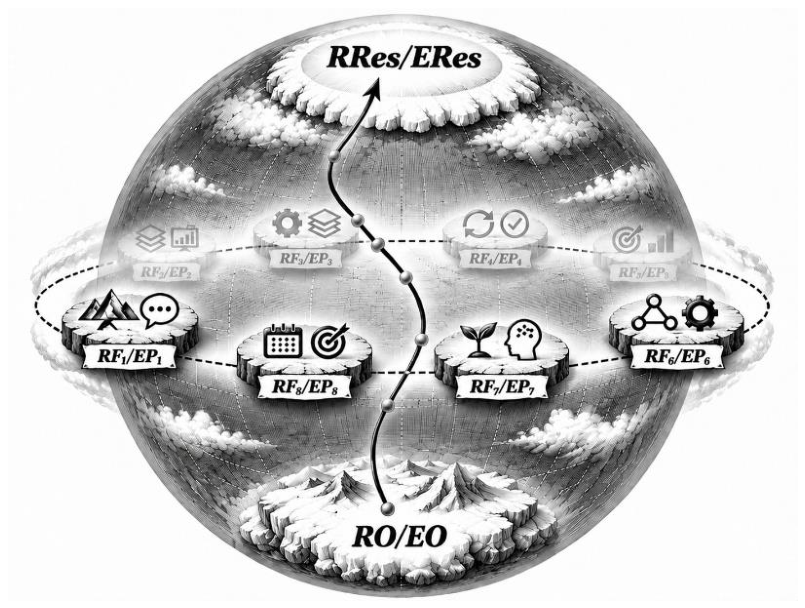
Figure 49.
Alternative matching between Research Features and Expression Perspectives after relative rotation of the maps.
Figure 49.
Alternative matching between Research Features and Expression Perspectives after relative rotation of the maps.
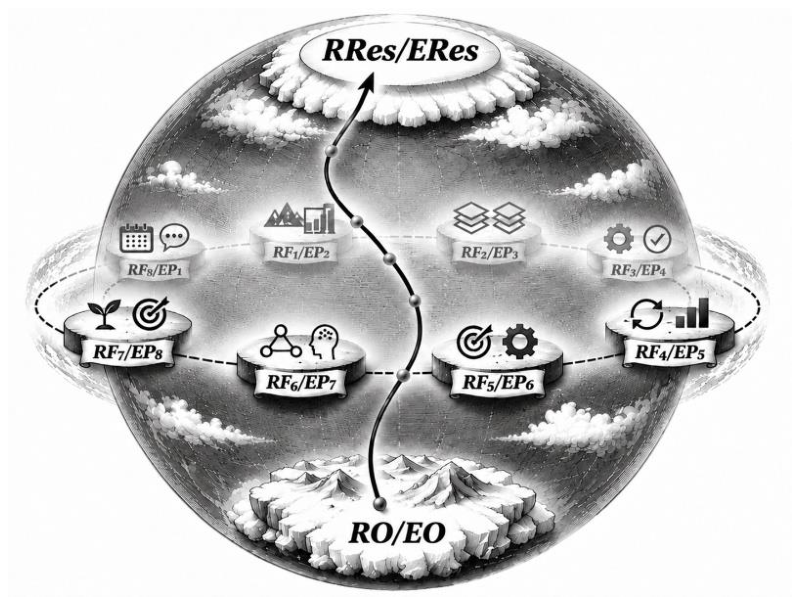
Figure 50.
Local matching between concrete analytical contents in Composition (RF2) and concrete expression contents in Academic Representation (EP2).
Figure 50.
Local matching between concrete analytical contents in Composition (RF2) and concrete expression contents in Academic Representation (EP2).
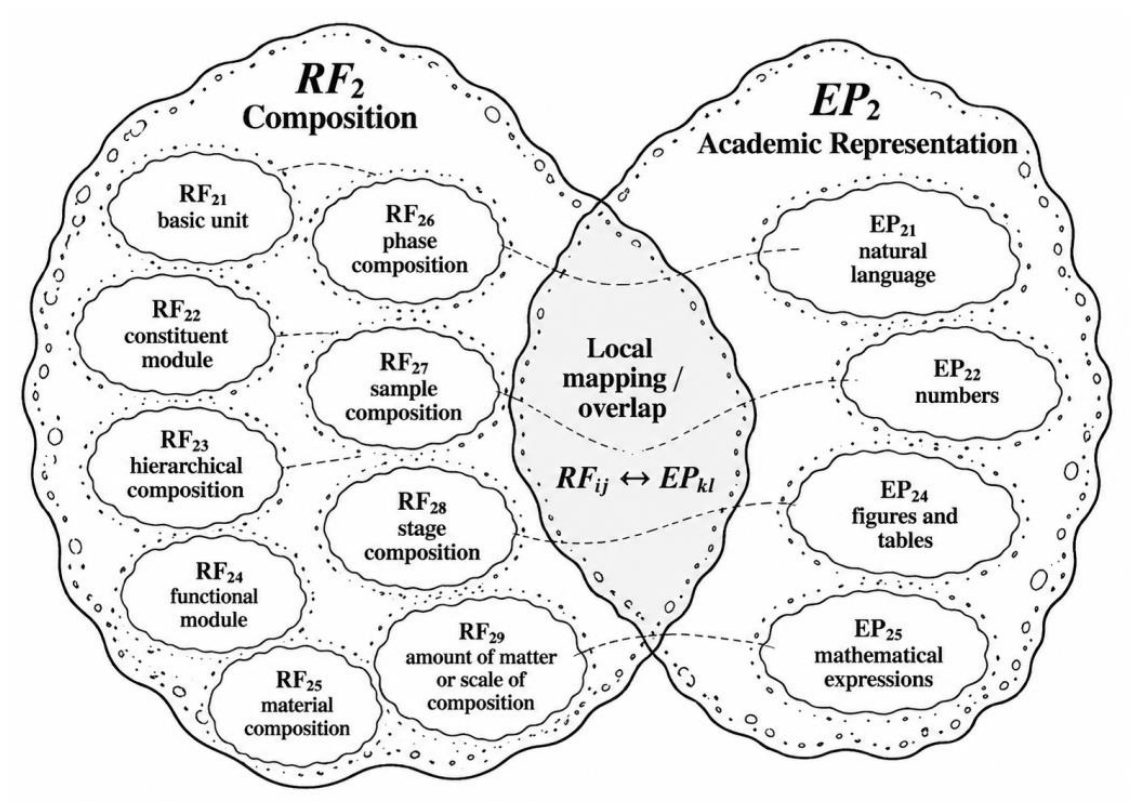
Figure 51.
Overview of DREAM applied to the case of a freely falling ball.
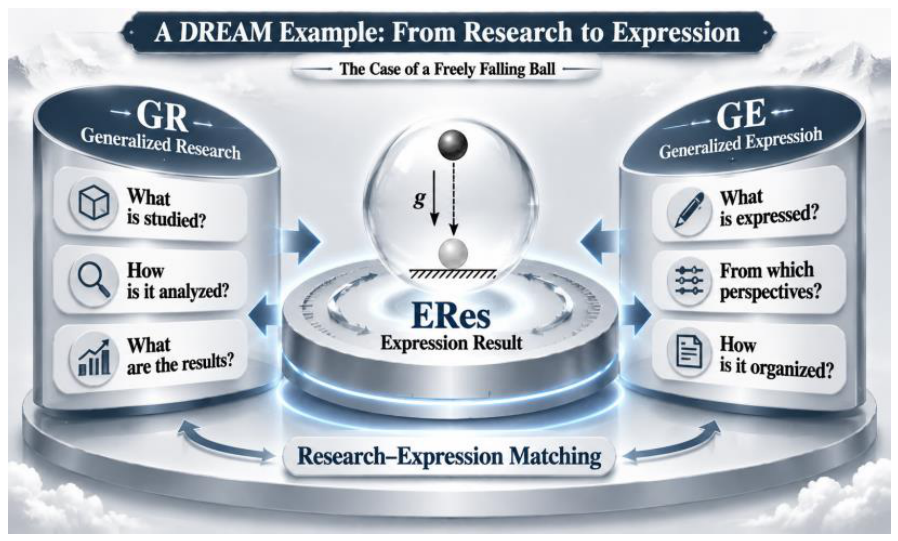
Figure 52.
Detailed GR–GE matching for the freely falling ball example.
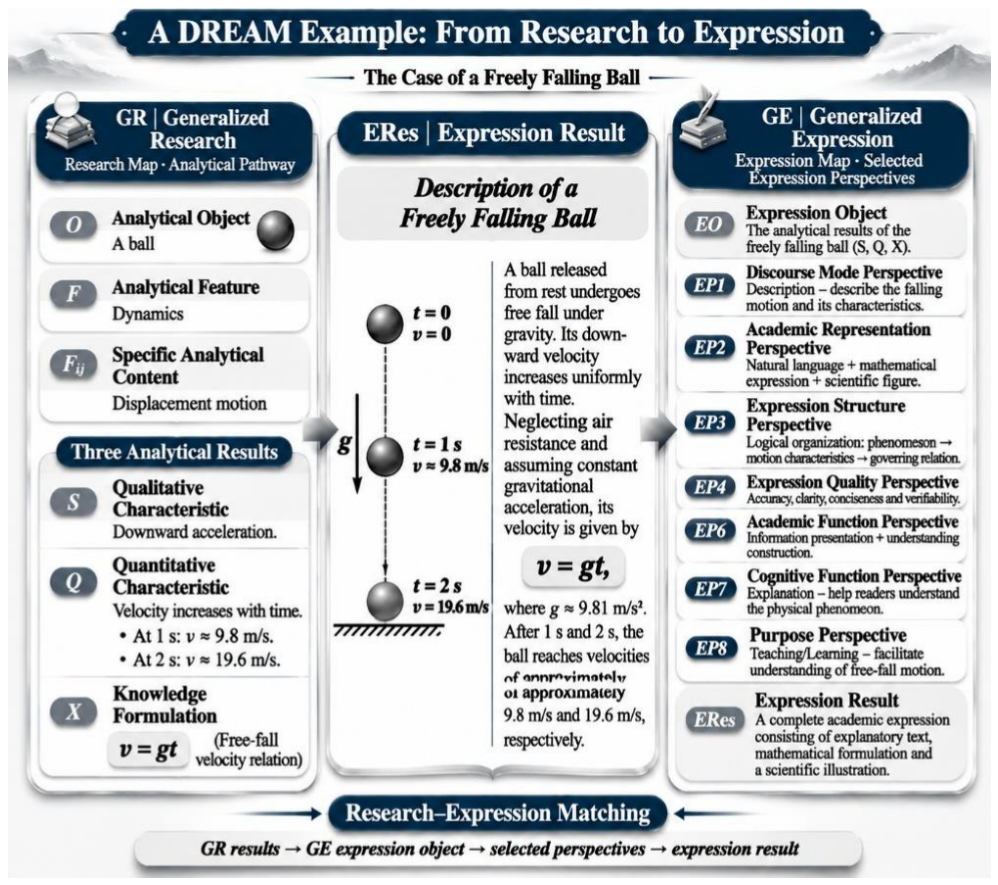
Figure 53.
A task for applying the DREAM model to a familiar phenomenon or topic.
Disclaimer/Publisher’s Note: The statements, opinions and data contained in all publications are solely those of the individual author(s) and contributor(s) and not of MDPI and/or the editor(s). MDPI and/or the editor(s) disclaim responsibility for any injury to people or property resulting from any ideas, methods, instructions or products referred to in the content. |
© 2026 by the authors. Licensee MDPI, Basel, Switzerland. This article is an open access article distributed under the terms and conditions of the Creative Commons Attribution (CC BY) license (http://creativecommons.org/licenses/by/4.0/).
Copyright: This open access article is published under a Creative Commons CC BY 4.0 license, which permit the free download, distribution, and reuse, provided that the author and preprint are cited in any reuse.