
Submitted:
22 November 2026
Posted:
24 November 2026
You are already at the latest version
Abstract
Spatial intelligence, the ability to perceive, reconstruct, reason about, predict, and act within dynamic three-dimensional environments, is a unifying goal for robotics, autonomous driving, and embodied AI. Existing surveys treat its components, from video language models to Vision-Language-Action (VLA) models, in isolation, obscuring how progress at one capability carries over to the next. This review provides a unified, critical analysis of the full pipeline from pixels to actions. We introduce the Pixels-to-Actions (P2A) hierarchy, a six-level taxonomy: (L1) visual perception, (L2) temporal perception, (L3) spatial and 4D understanding, (L4) spatiotemporal reasoning, (L5) predictive world modeling, and (L6) embodied action. For each level, we analyze architectures, spatiotemporal tokenization, multi-sensor inputs, and training paradigms. We examine whether stronger geometric grounding and temporal reasoning translate into better prediction and action, and formalize streaming spatial intelligence as a unifying target. We extend the analysis to medical imaging, remote sensing, AR/VR, surveillance, and digital twins, and compare datasets, benchmarks, and metrics from video question answering to closed-loop evaluation. We distill ten open problems, including weak spatial grounding in multimodal models, limited physical commonsense, costly long-horizon reasoning, fragmented benchmarks, and insufficient safety evaluation. A continuously updated repository of the reviewed literature is available at https://github.com/binayksingh/Awesome-Pixels-to-Actions.
Keywords:
spatial intelligence
; spatiotemporal understanding
; 4D scene understanding
; world models
; embodied perception
; vision-language-action models
; multimodal large language models
; multi-modal perception
; autonomous driving
; streaming spatial intelligence
1. Introduction
Computer vision has long been organized around isolated tasks. Detection, tracking, depth estimation, and video classification were each studied with their own models, datasets, and metrics. Two developments are dissolving these boundaries. The first is the rise of foundation models: large networks pretrained on web-scale image, video, and text data that transfer across tasks with little or no adaptation [1,2,3,4]. The second is a shift in what vision is expected to deliver. A robot or an autonomous vehicle does not need a bounding box for its own sake. It needs to know where things are in three dimensions, how they are moving, what will happen next, and what it should do about it [5,6,7].
The term spatial intelligence has come to describe this combined capability [8,9]. It spans perceiving the scene, reconstructing its geometry, tracking its dynamics, reasoning about it in language, forecasting its evolution, and acting within it. Each of these capabilities now has a fast-growing literature of its own. Video large language models (Video LLMs) answer open-ended questions about long videos [10,11,12]. Feed-forward reconstruction models recover camera poses and dense geometry from unposed images in a single pass [13,14]. Generative world models synthesize plausible futures conditioned on actions [15,16,17]. Vision-Language-Action (VLA) models map camera input and language instructions directly to robot motor commands [7,18,19,20].
These strands are converging in practice. VLA models increasingly borrow video-pretrained encoders and world-model objectives [21,22,23]. End-to-end driving systems stack detection, tracking, occupancy, and motion forecasting into a single differentiable planner [6,24]. Multimodal LLMs are being probed for metric spatial reasoning that once required explicit 3D pipelines [8,25,26]. The review literature, however, has not followed this convergence. Existing surveys each cover one slice of the pipeline, as Table 1 shows. Video-LLM surveys rarely discuss geometry [27,28,29]. Reconstruction and world-model surveys rarely discuss language or action [9,30]. VLA surveys, including recent ones on driving, efficiency, and data [31,32,33], treat perception mostly as a fixed upstream encoder [34,35,36,37,38,39]. Even reviews within a single level, such as the recent systematic review of transformer-based video object detection [40], stop where the next level begins.
This fragmentation hides the question that matters most for deployed systems: does progress at one capability actually carry over to the capabilities that depend on it? A detector that is better on COCO [41] is not automatically a better perception front end for a driving planner. A Video LLM that scores well on question-answering benchmarks is not automatically a better high-level planner for a robot. Answering such questions requires a single frame of reference that spans the whole pipeline.
This review offers that frame of reference. We organize the field into a six-level capability hierarchy, which we call the Pixels-to-Actions (P2A) hierarchy, shown in Figure 1, in which each level builds on the outputs of the levels below it:
- L1, visual perception: recognizing and localizing content in individual frames, including open-vocabulary detection and segmentation (Section 4).
- L2, temporal perception: associating content across frames through tracking, point tracking, and video object segmentation (Section 5).
- L3, spatial and 4D understanding: recovering depth, camera motion, 3D structure, and its change over time (Section 6).
- L4, spatiotemporal reasoning: answering questions about, and grounding language in, space and time (Section 7).
- L5, predictive world modeling: forecasting future scene states, trajectories, or observations (Section 8).
- L6, embodied action: mapping observations and instructions to actions in robotics and autonomous driving (Section 9).
The levels are not a strict pipeline. Many modern systems skip levels, merge them, or learn them jointly. The hierarchy is instead an analytical lens. It lets us ask, for any model, which capabilities it claims, which it inherits from pretrained components, and which it is actually evaluated on.
Figure 2 illustrates the representative inputs and outputs of each level and how they connect.
1.1. Contributions
This review makes four contributions:
- A unified taxonomy. We propose the P2A hierarchy of Figure 1 as a common frame for perception, reconstruction, reasoning, prediction, and action research, and we place more than 200 representative works within it.
- A level-by-level analysis. For each level, we compare architectures, spatiotemporal representations and tokenization strategies, sensor inputs, and training paradigms, and we highlight the design choices that recur across levels (Section 3,Section 4,Section 5,Section 6,Section 7,Section 8,Section 9). We also show how these capabilities transfer to medical imaging, remote sensing, AR/VR, surveillance, and digital twins (Section 10), and we condense the review into a practitioner’s decision guide (Figure 8).
- A cross-level analysis and a unifying target. We examine the evidence on whether improvements at lower levels transfer to higher ones, and where the field relies on assumption rather than evidence. We then formalize streaming spatial intelligence, in which one bounded, persistent state supports perception, geometry, reasoning, prediction, and action online, as a unifying target for the field (Section 12).
- An evaluation audit and research agenda. We compare datasets, benchmarks, and metrics across all levels, give formal definitions of more than 25 metrics, tabulate the statistics of widely used datasets, and summarize the human–model gaps reported by recent spatial intelligence benchmarks (Sections 7-11). We then distill ten open problems in spatial intelligence, each tied to the levels it involves, with concrete research directions (Section 13).
1.2. Organization
Our Figure 3 shows the structure of the review. Our Section 2 defines the scope of the paper. Section 3 covers the shared building blocks. Section 4,Section 5,Section 6,Section 7,Section 8,Section 9 review the six levels in order, and Section 10 covers applications beyond robotics and driving. Section 11 compares evaluation practice, Section 12 analyzes cross-level transfer, Section 13 discusses open challenges and future directions, and Section 14 concludes.
2. Scope
This review covers learning-based models that process visual sequences, meaning video, multi-frame, multi-view, or embodied observation streams, and that address at least one of the six capability levels in Figure 1. Single-image methods are included only when they serve as a component of a spatiotemporal system, for example as the perception front end of a tracker, a driving stack, or a VLA model. We cover both general-purpose video and two embodied application domains, robotics and autonomous driving, because these domains impose the strictest requirements on spatial accuracy, temporal consistency, and closed-loop behavior. Section 10 then extends the analysis to medical imaging, remote sensing, egocentric AR/VR, surveillance, and digital twins.
Three topics are deliberately out of scope. Classical geometric vision without a learned component is discussed only as background. Pure text-to-video generation is covered only where it is used as a world model for prediction or planning. Non-visual embodied sensing, such as audio or tactile-only policies, is mentioned only when fused with vision.
Figure 4 places the most influential works in time and shows how activity has moved up the hierarchy.
4. L1: Visual Perception
Visual perception answers the first question any embodied system must answer: what is in view, and where is it in the image? Although L1 is the most mature level, it has changed in two ways that matter for the levels above it. Detectors have become set predictors whose object queries can be carried across time and lifted into 3D. They have also become open-vocabulary, so that the set of recognizable categories is defined by language at inference time rather than fixed at training time.
4.1. From Anchors to Queries
Two-stage detectors such as Faster R-CNN [101] and one-stage detectors such as YOLO [102] predict boxes relative to dense anchors and remove duplicates with non-maximum suppression. Mask R-CNN [103] added instance masks to the same framework. DETR [50] replaced this pipeline with a transformer decoder that outputs a fixed set of object queries, trained with bipartite matching so that no post-processing is needed. Deformable DETR [104] reduced its slow convergence with sparse multi-scale attention, and DINO [105] improved it further with denoising training and better query initialization. RT-DETR [106] showed that query-based detectors can match the speed of YOLO-style detectors. Mask2Former [107] applied the same query design to semantic, instance, and panoptic segmentation in one architecture.
Formulation.
DETR predicts a fixed set of N outputs , each with class probabilities and a box . Ground truth y is padded with “no object” (⌀) to size N. Training first finds the optimal one-to-one assignment over permutations with the Hungarian algorithm,
and then minimizes the loss over the matched pairs,
The generalized IoU loss is , where C is the smallest box enclosing both b and . Open-vocabulary detectors [57,108,109] replace the fixed classifier with similarities between region features and text embeddings of arbitrary category names, , so that the label set is defined at inference time.
The query formulation matters beyond L1. An object query is a compact, identity-bearing representation that can be propagated to the next frame (L2), lifted into 3D through camera geometry (L3), and passed to a planner (L6). This is why query-based detection is the common ancestor of MOTR-style tracking [85], DETR3D-style multi-camera detection [110], and query-based driving stacks such as UniAD [6].
4.2. Open-Vocabulary and Promptable Perception
Contrastive vision–language pretraining made it possible to detect categories that never appeared in the training labels. GLIP [57] reformulated detection as phrase grounding and trained on grounding and detection data jointly. OWL-ViT [108] attached lightweight detection heads to a CLIP-style encoder. Grounding DINO [109] fused language into every stage of a DINO detector and became a widely used open-set detector for downstream systems. YOLO-World [111] brought open-vocabulary detection to real-time speeds. Florence-2 [112] unified detection, grounding, segmentation, and captioning behind a single text-prompted sequence-to-sequence interface.
The Segment Anything Model (SAM) [3] introduced promptable segmentation: given a point, a box, or a mask, it returns a high-quality mask for any object. SAM was trained on SA-1B, which contains 1.1 billion masks on 11 million images. It is class-agnostic and is typically paired with an open-vocabulary detector that supplies the prompts. Together, such detectors and SAM form a de facto open-world perception front end used throughout L2–L6.
4.3. Context and Co-Occurrence
Objects in driving scenes rarely appear in isolation. Pedestrians co-occur with crosswalks, cyclists with bicycle lanes, and traffic cones with work zones. Detectors that model these relations can recover small, occluded, or rare objects that appearance alone misses. Recent work fuses contextual features to detect co-occurring objects in autonomous driving [113] and combines contextual cues with unknown-aware contrastive learning, so that the detector also handles objects outside the training categories [114]. Co-occurrence is a simple form of the relational reasoning that L4 makes explicit, which makes such context-aware detectors a natural bridge between L1 and the higher levels.
4.4. Multi-Sensor Perception
Embodied systems rarely rely on RGB alone. Large driving datasets such as nuScenes [5] provide synchronized cameras and LiDAR at scale. LiDAR detectors such as PointPillars [48] and CenterPoint [115] operate on point clouds and provide accurate metric localization. Camera-only multi-view detectors such as DETR3D [110] and BEVFormer [58] predict 3D boxes from surround-view images. BEVFusion [116] fuses camera and LiDAR features in a shared bird’s-eye-view space. Event cameras, which report per-pixel brightness changes with microsecond latency and high dynamic range, are a promising complement for fast motion and difficult lighting [117], but remain rare in the foundation-model literature. These multi-sensor detectors already sit at the boundary between L1 and L3, since their outputs are metric 3D rather than image-plane boxes.
Table 3 summarizes representative L1 models and how each relates to the levels above.
4.5. Critical Assessment
Three limitations of L1 propagate upward. First, standard benchmarks such as COCO [41] and LVIS [118] evaluate single images, so they do not reward the temporal stability that trackers and planners need. A detector that flickers between frames can score well on COCO and still destabilize an L2 tracker. Second, open-vocabulary and unknown-aware detectors [114] are evaluated mainly on category recognition, not on the metric localization accuracy that matters for grasping or collision avoidance. Third, when multimodal LLMs are used as perception front ends, they can hallucinate objects that are not present [119]. This failure mode is rarely measured in the downstream L4–L6 benchmarks where such models are deployed. In short, L1 metrics measure frame-level accuracy, while the levels above need temporally stable, metrically accurate, and calibrated perception.
Key takeaways
(i) Query-based detectors produce identity-bearing object tokens that L2, L3, and L6 reuse. (ii) Open-vocabulary detection combined with promptable segmentation has become the default open-world perception front end. (iii) Frame-level benchmarks do not reward the temporal stability, metric accuracy, and calibration that the higher levels need.
5. L2: Temporal Perception
Temporal perception connects observations across frames. It establishes that the car in frame t is the same car in frame , that a point on a cup has moved by a certain number of pixels, or that a segmented object persists while briefly occluded. L2 supplies the identities and correspondences on which 4D reconstruction (L3), event-level reasoning (L4), and trajectory forecasting (L5) all depend.
5.1. Video Object Detection
Video object detection (VOD) uses neighboring frames to improve per-frame detection under motion blur, defocus, and occlusion. Early methods warped features with optical flow, as in flow-guided feature aggregation (FGFA) [120], or aggregated proposal features across the whole sequence, as in SELSA [121]. Transformer-based VOD replaces these hand-designed aggregation steps with attention over object queries or features from multiple frames. A recent systematic review of transformer-based VOD [40] found that the literature remains concentrated on ImageNet VID [122], that efficiency is reported inconsistently, and that temporal modeling designs are rarely compared under matched conditions. These findings echo the evaluation gaps we identify across all levels in Section 11.
5.2. Multi-Object Tracking
Multi-object tracking (MOT) assigns persistent identities to detected objects. The tracking-by-detection paradigm, represented by SORT [123], DeepSORT [124], and ByteTrack [59], links detections with motion models and appearance features. ByteTrack showed that associating low-confidence detections, rather than discarding them, substantially reduces identity loss under occlusion. Query-based trackers such as TrackFormer [125] and MOTR [85] carry DETR object queries from frame to frame, so that detection and association are learned jointly. This end-to-end design is the template later adopted by driving stacks that track agents through the same queries used for planning [6]. MOT benchmarks such as MOT17 [126] increasingly report HOTA [127], which balances detection and association accuracy more evenly than earlier metrics.
Formulation.
Tracking-by-detection solves, at each frame, an assignment between existing tracks and new detections . SORT [123] predicts each track’s box with a constant-velocity Kalman filter and builds a cost matrix that later trackers extend with appearance similarity:
where are appearance embeddings and each row and column of has at most one entry equal to one. Query-based trackers [85,125] remove the explicit assignment and update a set of track queries recurrently,
where is a transformer decoder over frame features and are fresh queries for newly appearing objects. Matched queries keep their identity across frames, so association is learned rather than hand-designed.
5.3. Dense Correspondence and Point Tracking
Optical flow estimates per-pixel motion between consecutive frames. RAFT [51] set the modern template with iterative refinement over an all-pairs correlation volume. Flow, however, cannot follow a point through occlusion or over long horizons. The tracking-any-point (TAP) formulation addresses this by tracking arbitrary query points across entire videos and predicting when they are occluded. PIPs [128] revived the particle-video idea with learned iterative updates. The TAP-Vid benchmark [129] standardized evaluation, and TAPIR [130] combined per-frame matching with temporal refinement. CoTracker [64] tracks many points jointly with a transformer, exploiting the fact that nearby points move coherently. SpatialTracker [131] lifts point tracks into 3D, a clear example of an L2 method moving into L3. Point tracks have also become an input or supervision signal for robot policies, as discussed in Section 9.
Formulation.
Optical flow estimates a displacement field such that . RAFT computes a 4D correlation volume from feature maps and refines the flow with a recurrent update , trained with an exponentially weighted sequence loss
Point tracking generalizes flow to a query point followed over all frames, predicting a trajectory together with visibility [64,129]. A typical objective combines a robust position loss on visible frames with a visibility cross-entropy,
where is a Huber or penalty.
5.4. Video Object Segmentation
Video object segmentation (VOS) propagates object masks through a video. Memory-based methods dominate. XMem [99] uses separate sensory, working, and long-term memories to handle long videos, and Cutie [132] adds object-level memory reading to improve robustness to distractors. SAM 2 [66] extends promptable segmentation to video with a streaming memory, so that a single click can segment and track an object across a whole video. Memory-based VOS reads from stored keys and values of past frames with an affinity-weighted readout for each query location , which is the same operation as Equation (1) applied over time. Standard benchmarks include DAVIS [133] and YouTube-VOS [134]. Combined with an open-vocabulary detector for prompts, SAM 2 turns L1 open-world perception into L2 open-world tracking with little additional engineering.
Table 4 summarizes representative L2 models and their temporal mechanisms.
5.5. Critical Assessment
L2 methods are evaluated almost entirely in image space. Identity switches, point-track accuracy, and mask overlap are all measured in pixels, while the levels above need correspondences in metric 3D. Tracking benchmarks also tend to use short clips with limited camera motion, which understates the difficulty of long-horizon, egocentric video of the kind robots and vehicles produce. Finally, trackers are usually evaluated with ground-truth or fixed detectors, which hides how L1 errors compound into L2 identity failures. The trend toward 3D point tracking [131] and joint geometry-and-motion estimation [135,136] is a promising response, and it leads directly into L3.
Key takeaways
(i) Tracking has moved from hand-designed association to learned track queries and streaming memory. (ii) Point tracking and promptable video segmentation extend open-world perception over time. (iii) Evaluation remains in image space and on short clips, whereas higher levels need metric 3D correspondence over long horizons.
6. L3: Spatial and 4D Understanding
L3 recovers the geometry of the scene: the depth of each pixel, the motion of the camera, the 3D structure of the environment, and how that structure changes over time. This is the level at which image-plane perception becomes metric. It is also the level that has changed most rapidly in the past three years, as learned feed-forward models have begun to replace optimization-based pipelines.
6.1. Monocular Depth Foundation Models
Monocular depth estimation was transformed by training on large mixtures of datasets. MiDaS [137] introduced scale- and shift-invariant losses that allow training across datasets with incompatible depth scales, and DPT [138] adapted vision transformers to dense prediction. Depth Anything [65] scaled this recipe with more than 62 million pseudo-labeled images, and Depth Anything V2 [139] replaced real labels with synthetic ones to sharpen fine detail. Marigold [140] repurposed a pretrained image diffusion model as a depth estimator, showing that generative priors encode geometry. Metric3D [141] addressed the scale ambiguity of monocular depth by conditioning on camera intrinsics to predict metric depth. These models are now common inputs to spatial reasoning in MLLMs [25,26] and to 3D-aware VLA models [142].
Formulation.
Mixed-dataset depth training must cope with unknown scale and shift. With the predicted and the ground-truth (inverse) depth at pixel i, MiDaS [137] first aligns the prediction in closed form and then penalizes the residual,
Metric models instead use a scale-invariant log loss with ,
where makes the loss fully scale-invariant and reduces it to a log-space mean squared error.
6.2. From Structure-from-Motion to Feed-Forward Reconstruction
Classical pipelines recover camera poses and 3D points by feature matching and bundle adjustment, as in COLMAP [143], or by real-time visual SLAM, as in ORB-SLAM3 [144]. DROID-SLAM [56] made the SLAM back end differentiable and learned its correspondences, greatly improving robustness. These pipelines remain accurate but are brittle under low texture, little camera motion, and dynamic objects.
Classical reconstruction minimizes the reprojection error over camera poses and 3D points by bundle adjustment,
where is perspective division, the intrinsics, the observed keypoint, and the set of visible point–camera pairs. DUSt3R [13] took a different approach. It regresses a dense 3D point map for a pair of images directly, in a shared coordinate frame, with no known camera parameters. MASt3R [145] added dense matching features to the same framework. VGGT [14] generalized this to many views at once, predicting cameras, depth, point maps, and tracks in a single forward pass of a large transformer. DUSt3R regresses a point map with per-pixel confidence and trains with a confidence-weighted, normalized regression loss
where and z are scale normalizers and the term prevents the trivial solution . Camera poses and depth then follow from the point maps. These models reduce reconstruction from an optimization problem to an inference problem. For downstream levels, this means geometry can be computed online, from casual video, at a fixed computational cost.
6.3. Dynamic Scenes and 4D Reconstruction
Static reconstruction assumes the world does not move. Real scenes contain people, vehicles, and manipulated objects. Neural radiance fields (NeRF) [52] and 3D Gaussian splatting (3DGS) [62] provide high-fidelity scene representations, and their dynamic extensions add time. D-NeRF [146] learns a deformation field from a canonical space, 4D Gaussian splatting [147] models deformation of Gaussian primitives for real-time rendering, and Dynamic 3D Gaussians [148] obtain dense 3D tracking as a by-product of persistent Gaussians. For reference, NeRF renders the colour of a ray by sampling K points with densities , colours , and spacings ,
while 3DGS alpha-composites the N depth-sorted Gaussians that overlap a pixel,
with opacity and projected 2D mean and covariance . Dynamic variants make these quantities functions of time, for example through a deformation [146,147]. These per-scene optimization methods produce excellent reconstructions but are slow to fit.
Feed-forward approaches to dynamic geometry are emerging. MonST3R [135] fine-tunes DUSt3R on dynamic videos so that it estimates per-frame geometry in the presence of motion. MegaSaM [136] combines learned priors with differentiable bundle adjustment to recover camera and depth from casual dynamic videos. CUT3R [100] maintains a recurrent state that is updated with each new frame, enabling continuous online 4D reconstruction. A recent survey organizes this rapidly growing area into five levels of 4D spatial intelligence [9]; our L3 corresponds roughly to its first three levels.
6.4. Occupancy and Driving-Centric Geometry
Autonomous driving uses a different geometric representation. Rather than meshes or point maps, driving stacks predict 3D semantic occupancy: which voxels around the vehicle are occupied, and by what. TPVFormer [149] represents occupancy with three orthogonal feature planes, and SurroundOcc [150] predicts dense occupancy from surround-view cameras. Occ3D [86] provides a large-scale benchmark. Occupancy captures arbitrarily shaped obstacles that bounding boxes miss. It is also the representation predicted by occupancy world models at L5 [151].
Table 5 compares representative L3 models by output, inference mode, and support for dynamic scenes.
6.5. Critical Assessment
The move to feed-forward geometry is the most consequential L3 development for embodied AI, because it makes metric 3D available at inference time without per-scene optimization. Three gaps remain. First, most feed-forward models are trained and evaluated on static or mildly dynamic scenes, and their accuracy on cluttered, fast-moving, egocentric video is less well characterized. Second, metric scale is still fragile without known intrinsics or additional sensors, which limits direct use for control. Third, L3 benchmarks measure reconstruction error, not the downstream value of geometry. Whether an extra centimeter of depth accuracy matters for an L4 spatial question or an L6 grasp is seldom tested. We return to this question in Section 12.
Key takeaways
(i) Feed-forward models such as DUSt3R, VGGT, and CUT3R make metric geometry available at inference time without per-scene optimization. (ii) Dynamic scenes and metric scale remain fragile. (iii) Benchmarks measure reconstruction error rather than the downstream value of geometry for reasoning and action.
7. L4: Spatiotemporal Reasoning
L4 is where language enters. Spatiotemporal reasoning covers answering questions about videos, localizing events described in language, and reasoning about spatial relations, distances, and layouts. The dominant model family is the multimodal large language model (MLLM) extended to video. This level is also where the gap between fluent language output and grounded spatial understanding is most visible.
7.1. Video Large Language Models
The first Video LLMs attached frozen image or video encoders to instruction-tuned LLMs. VideoChat [152], Video-LLaMA [153], and Video-ChatGPT [10] sampled a few frames, encoded each with a CLIP-style encoder, and pooled or projected the features into the LLM. Video-LLaVA [154] aligned image and video representations before projection so that one model could handle both. Subsequent work scaled data and context. LLaVA-OneVision [11] trained a single model across single images, multiple images, and video. LLaVA-Video [12] showed the value of large synthetic video instruction datasets. Qwen2-VL and Qwen2.5-VL [67,94] introduced dynamic resolution and multimodal rotary position encodings, and proprietary models such as Gemini 1.5 [155] process context windows long enough to hold hours of video. Broader overviews of this family are available in dedicated surveys [27,28].
Formulation.
A Video LLM samples of the T frames, encodes each into N visual tokens, and projects them into the language model. The answer is generated autoregressively by Equation (5). The context budget is the binding constraint:
where and are the spatial and temporal compression ratios. For example, one hour of video at 1 frame per second with 196 tokens per frame yields more than 700,000 visual tokens before compression, which is why the long-video strategies below trade spatial detail () against temporal coverage ().
7.2. Long-Video Understanding
Long videos challenge Video LLMs because the number of visual tokens exceeds any practical context window. Three strategies are common. Compression reduces each frame to very few tokens: LLaMA-VID [91] represents each frame with a context token and a content token. Memory stores a compact summary that is updated as the video streams: MovieChat [92] consolidates similar adjacent tokens into a long-term memory. Context extension trains the language backbone to accept far more tokens: LongVA [156] transfers long-context ability from text to vision. Each strategy trades off differently between the ability to find brief events and the ability to follow long-range structure. Benchmarks such as EgoSchema [157], Video-MME [158], and LongVideoBench [159] were designed to require reasoning over long time spans.
7.3. Temporal Grounding
Temporal grounding localizes the moment in a video that matches a language query. Classical datasets include Charades-STA [160], ActivityNet Captions [161], and QVHighlights [162]. General-purpose Video LLMs perform poorly at precise timestamp prediction, because frame sampling and pooling discard explicit time. TimeChat [163] binds timestamps to frame features, and VTimeLLM [164] uses boundary-aware multi-stage training. A dedicated survey covers this sub-area in depth [29]. Formally, given a query ℓ and a video, the model predicts an interval and is scored by temporal IoU with the ground truth ,
Temporal grounding is the L4 counterpart of L2 tracking. It asks when rather than which.
7.4. Spatial Reasoning in Multimodal Models
Spatial reasoning asks about distances, sizes, directions, and layouts. MLLMs trained on web image–text data are notably weak at these questions. SpatialVLM [25] generated large-scale metric spatial question–answer pairs by lifting images to 3D with off-the-shelf depth and segmentation, and showed that training on such data improves quantitative spatial answers. SpatialRGPT [26] added region-level depth inputs to support grounded spatial queries. 3D-LLM [165] and LEO [166] feed 3D scene representations directly into the language model, evaluated on benchmarks such as ScanQA [167]. The VSI-Bench study [8] tested MLLMs on video-based visual–spatial questions about indoor scenes. It found that models trail humans substantially and that spatial reasoning, rather than perception or language, is the main bottleneck. It also found that standard linguistic prompting techniques such as chain-of-thought do not reliably help, while prompting the model to build an explicit cognitive map does. This result is direct evidence for the cross-level argument of this review: language-level reasoning does not substitute for an explicit spatial representation.
7.5. The Spatial Intelligence Benchmark Wave
Since 2025, a wave of benchmarks has targeted spatial intelligence in MLLMs directly. Together they make the gap between language fluency and spatial understanding measurable. MMSI-Bench [70] requires reasoning across multiple views of a scene and attributes failures to grounding, overlap matching and scene reconstruction, situation transformation, and spatial logic. SpaCE-10 [71] decomposes spatial intelligence into ten atomic and eight compositional abilities and identifies counting as a major bottleneck for compositional reasoning. SpatialScore [72] aggregates 30 spatial tasks and shows that both fine-tuning data and a training-free tool-using agent improve results. SFI-Bench [73] moves from where objects are to what they are for, testing whether models combine spatial memory with functional and affordance reasoning. Two further benchmarks change the evaluation setting itself. OVO-S-Bench [74] answers each question using only the video seen so far, a streaming protocol, and SpatialWorld [75] evaluates agents that must act to gather spatial information in interactive environments.
Table 6 collects the human–model gaps reported by these benchmarks. Three findings recur across them. First, the best models remain far below human performance, with gaps of roughly 25 to 55 accuracy points on question answering and low success rates on interactive tasks. Second, allocentric mapping, meaning the construction of a viewpoint-independent layout, is a consistent bottleneck [8,74]. Third, OVO-S-Bench reports that chain-of-thought reasoning can amplify spatial errors when it is not anchored to the video stream, and that streaming and spatially fine-tuned models can underperform their own base backbones [74]. These results strengthen the central argument of this review: L4 reasoning does not substitute for an explicit L3 spatial representation.
7.6. Physical and Causal Reasoning
A further strand tests whether models understand how objects behave. CLEVRER [168] poses descriptive, explanatory, predictive, and counterfactual questions about synthetic collisions. CATER [169] tests object permanence and long-term tracking under containment. Physion [170] compares model and human predictions of physical outcomes. Perception Test [171] and MVBench [172] include tasks on object permanence, motion direction, and action order in real video. Driving-specific benchmarks such as NuScenes-QA [173] and DriveLM [174] pose perception, prediction, and planning questions in traffic scenes, connecting L4 to L5 and L6.
Table 7 summarizes representative L4 models, grouped by the reasoning dimension they target.
7.7. Critical Assessment
L4 has the most benchmarks and the least agreement on what they measure. Many video QA benchmarks can be partly solved from a single frame or from language priors, so high scores do not guarantee temporal reasoning. Spatial reasoning results show that MLLMs often fail at precisely the metric and relational judgments that L5 and L6 rely on [8]. Object hallucination [119] adds a further risk when L4 models are used as planners. Finally, L4 models are mostly evaluated on passive, third-person video. Embodied systems instead see egocentric, continuously moving viewpoints, as captured in Ego4D [175], and must answer questions online rather than after watching the whole clip.
Key takeaways
(i) Video LLMs answer open-ended questions but remain weak at metric spatial and precise temporal reasoning. (ii) Recent benchmarks report large human–model gaps, with allocentric mapping as a recurring bottleneck. (iii) Explicit spatial representations help more than purely linguistic reasoning.
8. L5: Predictive World Modeling
A world model predicts how the environment will evolve, usually conditioned on the agent’s actions. Prediction is what separates understanding a scene from being able to plan in it. L5 spans a wide range of output spaces, from the future trajectories of a few agents to full future video, and a correspondingly wide range of model families.
8.1. Latent World Models for Control
The modern notion of a learned world model comes from model-based reinforcement learning. Ha and Schmidhuber [45] trained a compact latent model of an environment and evolved a controller inside it. Dreamer [53] learned behaviors by backpropagating through imagined latent trajectories, and DreamerV3 [176] showed that one configuration can master many domains. TD-MPC2 [177] combined a learned latent model with model-predictive control and scaled it to many continuous-control tasks. These models predict in a learned latent space rather than in pixels. That makes them efficient, but their predictions are hard to inspect and evaluate directly.
Formulation.
A world model approximates the action-conditioned distribution of future observations . Latent models such as Dreamer factorize it with a recurrent state-space model (RSSM),
trained by maximizing an evidence lower bound that balances reconstruction against a KL term between the posterior and the prior :
where is the reward. A policy is then learned from imagined rollouts in latent space [53,176].
8.2. Trajectory and Motion Forecasting
In autonomous driving, prediction traditionally means forecasting the future trajectories of surrounding agents. Scene Transformer [178] predicts the joint future of all agents with a single masked-sequence model. Motion Transformer (MTR) [179] combines global intention queries with local refinement, and Wayformer [180] studies efficient attention-based fusion of map and agent inputs. Because the future is multimodal, forecasters output K trajectories with probabilities and are commonly trained with a winner-takes-all regression plus a classification loss on the best mode :
These models are evaluated on the Waymo Open Motion Dataset [181] and Argoverse 2 [182]. They consume L2 tracks and L3 maps as structured inputs. They therefore depend directly on the quality of the levels below, a dependency that is usually removed in evaluation by supplying ground-truth tracks.
8.3. Generative Video and Occupancy World Models
A newer family predicts the future directly in observation space. GAIA-1 [15] tokenizes driving video, actions, and text and models them autoregressively to generate realistic future driving scenes. DriveDreamer [183] and Vista [184] use diffusion models to generate controllable driving futures. OccWorld [151] predicts future 3D occupancy rather than pixels, which keeps the output in the metric representation planners use. Outside driving, UniSim [185] learns an action-conditioned simulator of real-world interaction, and Genie [16] learns playable environments from unlabeled internet video by inferring latent actions. Large video generators have been presented as general-purpose world simulators [186], and platforms such as Cosmos [17] release pretrained world models for physical AI. Stable Video Diffusion [187] provides an open video prior that many of these systems build on. A recent survey covers 3D and 4D world modeling in detail [30].
Formulation.
Most generative world models are trained as conditional diffusion models. A clean future clip (or its latent) is noised as with and noise level s, and a network learns to predict the noise given the conditioning :
Autoregressive world models such as GAIA-1 instead tokenize frames with a VQ encoder and apply Equation (5) over interleaved video, action, and text tokens [15].
8.4. Predictive Representation Learning
A third route treats prediction as a pretraining objective rather than a product. V-JEPA [81] predicts masked video regions in a learned feature space, avoiding the cost of modeling every pixel. V-JEPA 2 [68] scales this approach and adds an action-conditioned variant that is used for planning in robot manipulation. With a context encoder , a target encoder updated as an exponential moving average of , a predictor , and a mask m over space–time regions, the objective is
where denotes stop-gradient. This line of work blurs the line between L5 and the foundations of Section 3: the same predictive objective yields both a representation and a world model.
Table 8 groups representative L5 world models by prediction space and generator.
8.5. Critical Assessment
The central problem at L5 is evaluation. Generative world models are usually judged by visual fidelity metrics such as FID or FVD, which reward plausible-looking frames rather than physically correct dynamics. A model can generate convincing video in which objects interpenetrate, vanish, or violate momentum. Physical reasoning benchmarks [168,170] exist but are rarely used to evaluate video world models. A second problem is the gap between prediction quality and decision quality. The question that matters for L6 is whether planning with a world model improves closed-loop behavior. Visual fidelity is reported routinely, whereas decision value is evaluated only in some works, for example by training policies in a learned simulator [185] or reporting planning results from predicted occupancy [151], and with differing protocols. A third problem is cost. Pixel-space generation is expensive, which limits the use of generative world models inside real-time control loops. Latent and occupancy-space prediction [68,151] is a pragmatic response.
Key takeaways
(i) World models range from latent state-space models to video and occupancy generators. (ii) Visual-fidelity metrics such as FID and FVD do not test physical correctness or planning value. (iii) Prediction in latent or occupancy space is a practical route to real-time use.
9. L6: Embodied Action
L6 closes the loop. An embodied model must turn observations and goals into actions whose consequences it then observes. This section reviews Vision-Language-Action (VLA) models for robot manipulation and navigation, and the parallel development of end-to-end and language-model-based autonomous driving. Several surveys cover VLA models in depth from the action side [34,35,36,37,38,39]. Here we focus on how L6 models consume, inherit, or bypass the capabilities of L1–L5.
9.1. From Language Planners to Vision-Language-Action Models
Early systems used large language models as high-level planners over a fixed library of skills. SayCan [61] scored candidate skills by combining LLM likelihood with learned affordance values. Code as Policies [188] had an LLM write robot control programs that called perception and motion primitives. VoxPoser [189] had an LLM compose 3D value maps that a motion planner then optimized. PaLM-E [190] injected continuous visual and state observations directly into a large language model. In these designs, L1–L3 perception is an explicit external module, and the language model operates at L4.
End-to-end policies took the opposite approach. CLIPort [191] and Perceiver-Actor [192] learned language-conditioned manipulation from demonstrations, the latter over a voxelized 3D scene. Gato [193] and VIMA [194] treated control as sequence modeling over multimodal tokens. RT-1 [18] trained a transformer policy on about 130,000 real-robot episodes covering more than 700 tasks. RT-2 [7] then fine-tuned a large pretrained vision–language model to output discretized actions as text tokens, coining the term VLA and showing that web-scale vision–language knowledge transfers to robotic control. Open X-Embodiment [195] pooled data from many labs into more than one million trajectories across 22 robot embodiments. Octo [196] and OpenVLA [19] released open generalist policies trained on this data; OpenVLA is a 7-billion-parameter VLA trained on 970,000 trajectories.
9.2. Action Representations
The most important design choice in a VLA model is how actions are represented. Figure 6 shows the common anatomy and the three main families of action heads, and Table 9 lists representative models.
Discrete binned tokens, used by RT-2 and OpenVLA, let a language model emit actions with its native vocabulary but limit precision and control frequency. FAST [197] compresses action chunks with a frequency-domain transform before tokenization, improving efficiency for high-frequency control. Continuous generative heads avoid quantization altogether. Diffusion Policy [63] models multimodal action distributions with a denoising process, and Action Chunking with Transformers (ACT) [198] predicts short action sequences for fine bimanual manipulation. VLA models increasingly attach such heads to a VLM backbone. [20] uses a flow-matching action expert, CogACT [199] uses a diffusion action module conditioned on VLM features, and RDT-1B [200] is a large diffusion transformer for bimanual control. [201] extends co-training to open-world generalization in new homes. Gemini Robotics [69] and GR00T N1 [202] pair a slower reasoning model with a faster action module, a dual-system design.
Formulation.
Most VLA models are trained by behavior cloning on demonstrations , where is an action chunk. The objective is the negative log-likelihood of the expert actions,
and the three head families of Figure 6 differ in how is parameterized. Discrete tokens. Each action dimension is mapped to one of K uniform bins,
and the resulting tokens are predicted with Equation (5); RT-2 and OpenVLA use [7,19]. Diffusion heads apply Equation (24) to the action chunk, with the observation and instruction as conditioning [63]. Flow-matching experts learn a velocity field that transports Gaussian noise to actions along a straight path , , with the conditional flow-matching loss
and generate actions by integrating from to 1 in a few steps. Sign and time conventions differ across papers; uses a variant of this objective [20].
9.3. Spatiotemporal Inputs to VLA Models
Most VLA models observe one or a few recent RGB frames and inherit their perception entirely from a VLM pretrained on static image–text pairs. This is a direct consequence of the cross-level structure described in this review: L6 capability is bounded by what the inherited L1–L4 representation encodes. Several lines of work try to improve this inheritance.
Video and world-model pretraining.
GR-1 [21] pretrains a policy as a video predictor on large-scale human video before fine-tuning on robot data, and GR-2 [22] scales this approach. LAPA [23] learns latent actions from unlabeled video, so that internet video without action labels can supervise a VLA. 3D-VLA [203] couples a 3D-aware VLA with a generative world model that imagines goal states. These works bring L5 objectives directly into L6 training.
Explicit geometry.
Navigation.
Vision-and-language navigation (VLN) [46] requires memory of a traversed environment. NaVid [204] uses a video-based VLM that conditions on the entire history of observations to plan the next step, without maps or depth. Simulation platforms such as Habitat [49] are the main evaluation environments.
9.4. Autonomous Driving
Autonomous driving has followed a parallel path. Modular stacks pass detections, tracks, maps, and forecasts between hand-designed interfaces. End-to-end driving instead optimizes the full stack for planning. TransFuser [205] fuses camera and LiDAR with transformers for imitation-learned driving in CARLA [44]. UniAD [6] chains query-based detection, tracking, mapping, motion forecasting, occupancy prediction, and planning in a single network, so that every level from L1 to L6 is trained toward the planning objective. VAD [24] replaces dense rasterized representations with vectorized ones for efficiency.
End-to-end planners are typically trained with an imitation term on the future ego trajectory plus auxiliary terms from the lower levels,
where the auxiliary losses supervise the intermediate L1–L5 outputs. In UniAD [6], these intermediate tasks are trained jointly with planning, which makes Equation (29) a concrete instance of cross-level coupling. A dedicated survey compares more than twenty driving VLA systems and traces their shift from explanation-oriented to reasoning-oriented designs [31]. Language models entered driving in two roles. As reasoning modules, they explain scenes and propose high-level decisions: DriveVLM [206] uses a VLM for scene description, analysis, and hierarchical planning, combined with a conventional planner in a hybrid system, and DriveLM [174] structures driving as graph-based question answering. As end-to-end drivers, they output trajectories directly: LMDrive [207] follows language instructions in closed-loop simulation, and EMMA [208] maps raw camera input to trajectories and other driving outputs with a single multimodal model. Driving world models such as GAIA-1 [15] and OccWorld [151] are increasingly used to generate training data or to evaluate plans.
9.5. Evaluation and Simulation-to-Real Transfer
L6 evaluation is difficult because performance depends on the environment’s response. In driving, open-loop metrics on nuScenes [5], such as the L2 distance to the logged trajectory, were shown to be unreliable: a simple model using only ego-vehicle state can match sophisticated perception-based planners on these metrics [209]. This finding accelerated the shift toward closed-loop and pseudo-closed-loop benchmarks such as CARLA-based Bench2Drive [210] and the data-driven NAVSIM [211]. In manipulation, real-robot evaluation is slow and hard to reproduce. Simulated suites such as CALVIN [212] and LIBERO [213] are widely used, and SIMPLER [214] builds simulated environments designed so that simulated success rates track real-world rankings of policies. Large real-world datasets such as BridgeData V2 [215] and DROID [216] broaden training diversity. A recent survey argues that this data and evaluation infrastructure, rather than model architecture, is now the main bottleneck for VLA progress, and highlights the trade-off between realism and cost in data engines [33]. Domain randomization [217] remains a standard technique for transferring policies trained in simulation to real hardware.
9.6. Critical Assessment
L6 is where errors from every lower level accumulate, and where they become physical. Three issues stand out. First, most VLA models observe a single frame or a very short history, so the spatiotemporal capabilities of L2–L5 are largely unused at deployment. Second, success-rate evaluation in manipulation is heterogeneous across labs, robots, and task definitions, which makes cross-paper comparison unreliable. Third, safety is rarely evaluated directly. Driving benchmarks report collisions and infractions, but robot manipulation benchmarks seldom report near-misses, unsafe contacts, or behavior under distribution shift. The cost of these gaps grows as VLA models move from laboratory benchmarks into homes and factories.
Key takeaways
(i) The action representation (discrete tokens, diffusion, or flow matching) is the main design axis of VLA models. (ii) Most VLA models observe only one or a few frames, leaving L2–L5 capabilities largely unused. (iii) Evaluation is heterogeneous and rarely reports safety, so closed-loop testing is essential.
10. Applications Beyond Robotics and Driving
Robotics and autonomous driving have driven most of the work reviewed so far, but the same P2A capabilities are being adopted across imaging domains. These domains stress different levels of the hierarchy. Table 10 summarizes, for each domain, which levels matter most and which representative methods transfer.
10.1. Medical Imaging and Surgical Video
Medical imaging relies heavily on L1 and L3. Promptable segmentation has transferred quickly: MedSAM [218] adapts the Segment Anything model to a wide range of medical modalities, and memory-based video segmentation (Section 5) is a natural fit for tracking anatomy across ultrasound, endoscopy, and multi-slice volumes. In robotic surgery, the scene is a deforming 4D structure. EndoNeRF [219] reconstructs deformable tissue from stereo endoscopic video with neural rendering, a direct application of the dynamic L3 methods in Section 6. Surgical robots are also an emerging L6 domain, in which the closed-loop safety concerns of Section 13 apply with particular force.
10.2. Remote Sensing and Earth Observation
Satellite and aerial imagery is spatiotemporal by nature: the same location is revisited over time, often across many spectral bands. SatMAE [220] extends masked autoencoding (Equation (2)) to temporal and multi-spectral satellite data, which is the remote-sensing counterpart of video pretraining at the foundations level. GeoChat [221] brings grounded vision–language reasoning (L4) to remote sensing, answering region-level questions about high-resolution imagery. Change detection, disaster monitoring, and land-use forecasting map onto L2 (temporal correspondence) and L5 (prediction), and benefit from the same multi-sensor fusion discussed in Section 4.
10.3. Egocentric Vision, AR, and VR
Augmented and virtual reality require exactly the streaming spatial intelligence formalized in Section 12: a head-worn device must localize itself, map its surroundings, recognize objects, and answer queries online, under strict power limits. Ego4D [175] provides large-scale egocentric video, and the Aria Digital Twin dataset [222] pairs egocentric recordings with ground-truth 3D geometry, poses, and object states, enabling joint evaluation of L1–L3 on the same data. Recent egocentric spatial benchmarks [8,74] show that MLLMs remain far from the spatial competence these devices need.
10.4. Intelligent Surveillance and Smart Cities
Surveillance combines long-horizon L2 tracking with L4 event understanding. Weakly supervised anomaly detection in surveillance video [223] established a widely used benchmark for detecting rare events from video-level labels. Co-occurrence and context reasoning [113,114] and open-vocabulary detection (Section 4) are particularly relevant because surveillance scenes contain many interacting objects and unanticipated categories. Long-video MLLMs (Section 7) offer natural-language search over hours of footage, but their hallucination risk [119] is a serious concern in this setting.
10.5. Digital Twins, SLAM, and Large-Scale Mapping
Digital twins of buildings, factories, and cities require accurate, updatable 3D models. Block-NeRF [224] scaled neural rendering to city blocks by composing many local radiance fields. Gaussian splatting has been integrated into dense SLAM, as in SplaTAM [225] and Gaussian Splatting SLAM [226], combining L3 reconstruction with real-time tracking. Feed-forward reconstruction [14,100] promises to make such twins cheaper to build and update, and occupancy world models [151] suggest how they might be used to simulate future states rather than only record current ones.
11. Datasets, Benchmarks, and Metrics
Evaluation practice shapes what a field optimizes. Table 11 lists widely used datasets and benchmarks at each level together with their typical metrics and evaluation setting. Reading the table across levels reveals four patterns that are easy to miss when each level is studied alone.
Pattern 1: Lower levels are evaluated in isolation.
L1 and L2 benchmarks score frames and image-plane tracks. L5 forecasting benchmarks usually provide ground-truth tracks and maps as input. As a result, almost no standard benchmark measures how perception errors propagate into prediction errors. End-to-end driving benchmarks are the main exception, because they evaluate the whole stack.
Pattern 2: Fidelity metrics substitute for utility.
At L3 and L5, models are scored by reconstruction error, FID, or FVD. These metrics measure how close an output is to the data, not whether it improves a downstream decision. A world model can achieve better FVD while being less useful for planning.
Pattern 3: Open-loop evaluation persists where closed-loop is needed.
The driving community learned that open-loop planning metrics can be misleading [209]. The same lesson has not yet been absorbed in L4 and L5, where models intended for decision-making are evaluated on recorded data only.
Pattern 4: Benchmarks are fragmented within levels.
VLA papers report success rates on different robots, tasks, and simulators, often with custom protocols. Video LLMs are evaluated on overlapping but non-identical suites of QA benchmarks. This makes it difficult to attribute gains to specific design choices, a problem also noted for video object detection [40].
These patterns motivate the cross-level analysis in the next section and several of the recommendations in Section 13.
Figure 7 summarizes this evaluation landscape at a glance.
11.1. Dataset Statistics
Table 12 gives the scale, sensors, viewpoint, and annotation types of widely used datasets at each level, as reported in their original papers. Two patterns stand out. First, scale falls sharply as one moves up the hierarchy: L1 datasets contain hundreds of thousands of annotated images, whereas robot datasets contain tens of thousands to about a million trajectories collected at high cost. Second, very few datasets carry annotations for more than one level on the same data, which is one reason cross-level transfer is rarely measured (Section 12). Ego-view: E = egocentric or vehicle-mounted; T = third-person.
11.2. Model Size and Open Resources
Deployability depends on model size and on whether code and weights are available. Table 13 lists both for representative models at each level, as reported by their authors in papers, official repositories, or official model cards (November 2026). Two observations follow. First, model sizes span from tens of millions of parameters at L1–L3 to tens of billions at L4–L6, so the higher levels are far harder to run on embedded hardware (OP6 in Table 16). Second, most perception, geometry, and open VLA models release code and weights, whereas several influential world models and VLA models (Genie, GAIA-1, RT-2) do not, which limits independent evaluation. Parameter counts are rarely reported in a uniform way, and several papers report none; we mark these as “n.r.” rather than estimate them.
11.3. Metric Definitions
Because the same quantity is often reported under different names and conventions, we collect the definitions of the main metrics in Table 11 here. Table 14 summarizes them, and the equations below give their standard forms. Unless stated otherwise, higher is better (↑).
11.3.1. L1: Detection and Segmentation
Intersection over union compares a predicted region with the ground truth B:
A detection is a true positive (TP) if its IoU with an unmatched ground-truth object exceeds a threshold . Sorting detections by confidence gives precision and recall at each rank, and average precision is the area under the interpolated precision–recall curve. The COCO protocol averages over 101 recall points, C classes, and ten IoU thresholds:
The nuScenes detection score (NDS) [5] combines mAP, computed with center-distance rather than IoU matching, with five true-positive error terms (translation, scale, orientation, velocity, and attribute error):
11.3.2. L2: Tracking, Correspondence, and Video Segmentation
Multiple object tracking accuracy (MOTA) aggregates false negatives, false positives, and identity switches (IDSW) over all frames t:
IDF1 measures how long trajectories keep the correct identity, using identity-level true positives, false positives, and false negatives from a global one-to-one trajectory matching:
HOTA [127] evaluates detection and association at each localization threshold . For a true-positive match c, the association score is the IoU between the predicted and ground-truth trajectories that c belongs to:
can be written as , which separates detection quality from association quality.
For point tracking on TAP-Vid [129], let be the set of visible ground-truth points and pixel thresholds after resizing frames to . The position accuracy, occlusion accuracy, and Average Jaccard are
where is the set of all query points and frames, and a prediction is a TP at threshold if it is predicted visible, is visible, and lies within pixels.
Video object segmentation uses the region similarity , the mask IoU, and the contour accuracy , the F-measure between predicted and ground-truth boundary pixels and :
where denotes the mean over objects and frames. Optical flow is evaluated by the mean endpoint error over the pixel domain :
11.3.3. L3: Depth, Pose, and Reconstruction
With predicted depth and ground truth over M valid pixels, after any scale (and shift) alignment required by the protocol,
Camera trajectories are compared after a similarity alignment between estimated poses and ground truth . The absolute trajectory error (ATE) and the relative pose error (RPE) over interval are
Reconstructed point clouds are compared to ground truth with the symmetric Chamfer distance:
Novel-view synthesis by NeRF and 3DGS is reported with PSNR, together with the structural similarity SSIM and the learned perceptual distance LPIPS:
Semantic occupancy [86] is scored by the mean IoU over C semantic classes, computed over voxels:
11.3.4. L4: Reasoning and Grounding
Multiple-choice video QA uses plain accuracy over Q questions:
For numerical spatial answers, such as distances or sizes, VSI-Bench [8] uses mean relative accuracy over a set of thresholds :
Temporal grounding reports the fraction of queries whose top-n predictions include one with tIoU (Equation (20)) of at least m:
11.3.5. L5: Prediction and Generation
Generated frames and videos are compared to real data through the Fréchet distance between Gaussian fits and of deep features. FID uses Inception image features; FVD uses features of a pretrained video network (I3D):
Neither metric checks physical correctness or action-consistency, which is the core concern raised in Section 8. For trajectory forecasting with K predicted modes over horizon H,
and the miss rate is the fraction of A agents for which no mode ends within a distance threshold (2 m on Argoverse):
11.3.6. L6: Planning, Control, and Safety
Open-loop planning on nuScenes reports the average L2 distance between planned and logged ego positions and the collision rate over horizon H:
Because a model using only the ego state can achieve competitive values of Equation (50) [209], closed-loop metrics are preferred. The CARLA driving score averages, over N routes, the route completion multiplied by an infraction penalty , where is the penalty coefficient of infraction type j and its count on route i:
NAVSIM’s predictive driver model score (PDMS) [211] multiplies two hard constraints, no at-fault collision (NC) and drivable-area compliance (DAC), by a weighted average of ego progress (EP), time-to-collision (TTC), and comfort (C):
In manipulation and navigation, success rate is with binary success . Navigation additionally reports success weighted by path length (SPL), with shortest-path length and executed path length :
Finally, for safety-critical use, a model’s confidence should match its accuracy. The expected calibration error partitions n predictions into M confidence bins :
Calibration is reported routinely for classifiers but rarely for VLA policies or world models, a gap we return to in Section 13.
12. Cross-Level Analysis: Does Progress Propagate?
The organizing assumption of a layered view is that better lower levels make better higher levels. Much of the field acts on this assumption: VLA models adopt the strongest available VLM, driving stacks adopt the strongest available detector, and world models adopt the strongest available video generator. This section asks what evidence supports the assumption. Table 15 summarizes the main cross-level links for which published evidence exists, together with what that evidence shows and what it leaves open.
12.1. Three Transfer Hypotheses
The evidence can be organized around three hypotheses about what higher levels need from lower ones.
H1: Geometry improves action.
Models that receive explicit 3D information, whether as voxels [192], depth-derived position encodings [142], or 3D scene tokens [166,203], tend to report better spatial generalization than 2D baselines. For spatial question answering, VSI-Bench [8] provides some of the clearest evidence: prompting a model to build an explicit cognitive map improves its spatial answers, while purely linguistic reasoning does not. However, most comparisons in manipulation are not controlled. 3D-aware models often also differ in data, architecture size, and training recipe. The arrival of fast feed-forward geometry [14,100] makes properly controlled comparisons feasible for the first time, because geometry can now be added to an existing VLA without a slow reconstruction step.
H2: Reasoning improves action.
RT-2 [7] showed that VLM pretraining lets a robot policy follow instructions involving concepts never seen in robot data, which is evidence that L4 semantic knowledge transfers to L6. Dual-system designs [69,202] and language-based driving planners [206,208] rest on the same premise. What is less clear is whether improvements on L4 benchmarks predict improvements in control. We are not aware of a study that systematically correlates a VLM’s video QA or spatial QA scores with the success rate of the VLA built on it. Given the weak metric spatial reasoning of current MLLMs [8], this correlation may be weaker than often assumed.
12.1.0.3. H3: Prediction improves action.
Video-predictive pretraining [21,22], latent actions from video [23], and action-conditioned feature prediction [68] have all been reported to improve policy learning, especially when robot data are scarce. Model-based reinforcement learning has long shown the value of world models for control in simulation [176,177]. The open question is which properties of a world model matter. Visual fidelity is the property most often reported, yet it is the least directly connected to action. Physical consistency, controllability, and calibrated uncertainty are more plausible determinants of control quality, but they are rarely measured.
12.2. Why Transfer Is Hard to Measure
Three structural factors make cross-level transfer difficult to establish.
First, interfaces are inconsistent. L1–L2 outputs are image-plane boxes and tracks; L3 outputs are metric point maps; L4 outputs are text; L5 outputs are pixels, occupancy, or latents; L6 outputs are motor commands. Each interface discards information, and the losses compound. End-to-end models avoid explicit interfaces but make attribution harder.
Second, evaluation removes the dependency. L5 forecasting is usually evaluated with ground-truth tracks; L6 policies are usually evaluated with a fixed pretrained backbone. Neither setting reveals how an improvement in the lower level would change the higher-level result.
Third, compute and data are confounded. Higher-level models are usually built on the newest lower-level components and trained on more data than their predecessors. Without matched ablations, it is impossible to separate the effect of a better lower level from the effect of more data or a larger model.
12.3. An Emerging Frame: Streaming Spatial Intelligence
The cross-level view suggests a unifying target for the next generation of models, which we call streaming spatial intelligence. An embodied agent receives observations one at a time, cannot revisit the past except through what it has stored, and must answer or act at every step under a fixed compute budget. Formally, at each time t the agent maintains a bounded state and produces an output , which may be an answer, a forecast, or an action:
where is the state update, the readout, ℓ an optional instruction, B the memory budget, and the time between observations. Offline video benchmarks relax both constraints by giving the model the whole clip at once, which overstates what a deployed system can do.
Equation (55) connects all six levels. Streaming memory already exists at L2 (SAM 2 [66]) and L3 (CUT3R [100]). Streaming evaluation has reached L4 (OVO-S-Bench [74]) and interactive evaluation has reached the L4–L6 boundary (SpatialWorld [75]). Latent world models at L5 are streaming by construction (Equation (21)), and L6 policies run in this regime at deployment. What is missing is a model and a benchmark that hold one persistent state across all levels: one that tracks objects, updates geometry, answers questions, forecasts, and acts from the same memory . The early streaming results are a warning. Models fine-tuned for streaming or for spatial QA can underperform their own base models in the streaming setting [74], so this target will not be reached by fine-tuning offline models alone.
12.4. Toward Cross-Level Evaluation
We suggest three practices that would make cross-level claims testable. (i) Swap tests: report a higher-level result with two or more lower-level components of known, different quality, holding everything else fixed. (ii) Propagated-error benchmarks: evaluate L5 forecasting and L6 planning on perceived rather than ground-truth inputs, as end-to-end driving benchmarks already do. (iii) Utility metrics: report, alongside fidelity metrics, at least one downstream measure, such as planning success with a world model or grasp success with a depth model. None of these practices requires new datasets; they require only that existing benchmarks be used in combination.
12.5. A Practitioner’s Decision Guide
Researchers building applied systems often need a starting point rather than a full survey. Figure 8 condenses the level-by-level review into a decision guide: starting from what a system must output, it points to the method families reviewed here that are reasonable first choices under common conditions. The guide reflects the evidence summarized in this review, not new experiments, and its suggestions should be checked against the target data and deployment constraints.
13. Ten Open Problems and Future Directions
The level-by-level review, the applications, and the cross-level analysis point to ten open problems, listed in Table 16. Each problem is tied to the P2A levels it involves and to the evidence in this review that motivates it. The subsections below group the problems into six themes and suggest concrete research directions for each.
13.1. Spatial and Temporal Grounding in Multimodal Models (OP1, OP2)
MLLMs describe scenes fluently but struggle with metric distances, relative directions, precise timestamps, and object counts over time [8,163]. They can also report objects that are not present [119]. These weaknesses matter most when MLLMs act as planners for L6.
Directions: (i) feed MLLMs explicit geometric and temporal structure, such as point maps from feed-forward reconstruction [14], persistent object tracks [66], or cognitive maps, rather than relying on implicit learning from pixels; (ii) design position encodings that carry metric rather than ordinal space–time information; (iii) evaluate spatial and temporal grounding with answers that can be checked against geometry, not only multiple-choice accuracy, building on the benchmarks in Table 6; (iv) anchor chain-of-thought reasoning to visual evidence, since unanchored reasoning can amplify spatial errors [74].
13.2. Physical Commonsense and Useful World Models (OP3, OP4)
Video world models generate plausible-looking futures that may violate object permanence, solidity, or conservation of momentum. Physical reasoning benchmarks [168,169,170] show that such failures are common, but they are rarely used to evaluate world models or VLA policies.
Directions: (i) evaluate world models on physical-consistency tests alongside FVD; (ii) predict in structured spaces, such as occupancy, object states, or feature space, where physical constraints are easier to impose and check [68,151]; (iii) combine learned dynamics with differentiable physics or simulation where the domain allows it.
13.3. Streaming and Efficient Long-Horizon Models (OP5, OP6)
Embodied agents operate continuously, while most models process fixed clips. Long-video MLLMs compress aggressively [91,92] or require very long contexts [155,156], and pixel-space world models are too slow for real-time control. Most VLA models therefore see only the current frame. Efficiency for VLA models specifically, across model design, training, and data collection, is surveyed in [32].
Directions: (i) streaming architectures with persistent state, building on recurrent reconstruction [100], memory-based segmentation [66], and linear-time sequence models [96,98]; (ii) level-aware memory, in which geometric, semantic, and control-relevant information are stored at different rates and resolutions; (iii) reporting latency, memory, and energy on embedded hardware as standard practice, not only accuracy.
13.4. Cross-Level and Reproducible Benchmarks (OP7, OP8)
As Section 11 showed, each level has its own benchmarks, metrics, and settings, and few benchmarks measure how errors propagate between levels. Within levels, especially in VLA research, protocols vary so much that results are hard to compare.
Directions: (i) adopt the swap tests, propagated-error evaluation, and utility metrics proposed in Section 12; (ii) build multi-level benchmarks in which the same scenes carry annotations for perception, tracking, geometry, language queries, future states, and actions; (iii) standardize VLA evaluation through shared simulated suites calibrated against real-world outcomes [214] and through common reporting of tasks, embodiments, and trial counts.
13.5. Multi-Sensor and Robust Perception (OP9)
Foundation models are overwhelmingly trained on RGB images and video, while deployed systems also use depth, LiDAR, radar, event cameras, and thermal imaging [116,117]. These sensors provide robustness to lighting, weather, and fast motion that RGB alone cannot, but they are poorly represented in pretraining data and largely absent from L4–L6 foundation models.
Directions: (i) modality-agnostic tokenizers that let a single sequence model consume heterogeneous sensors; (ii) pretraining objectives that use cross-sensor consistency as free supervision; (iii) robustness benchmarks that vary weather, lighting, and sensor failure across levels, not only at L1.
13.6. Uncertainty and Safety for Autonomous Systems (OP10)
Safety-critical deployment requires calibrated uncertainty [230], detection of out-of-distribution inputs, and predictable failure behavior. These properties are reported for some driving systems but rarely for VLA models or world models. Hallucinated perception, physically implausible prediction, and overconfident action can each cause harm, and their effects compound across levels.
Directions: (i) propagate uncertainty explicitly from perception through prediction to planning, rather than passing point estimates between levels; (ii) report safety metrics, such as collisions, unsafe contacts, and constraint violations, in all closed-loop L6 evaluations; (iii) stress-test VLA models under distribution shift, adversarial instructions, and sensor degradation before claiming generalization.
13.7. Summary of Research Priorities
Across these themes, one priority recurs: the field needs to measure capabilities where they are used, not only where they are produced. Geometry should be judged by its value for reasoning and action, world models by their value for planning, and MLLMs by their value as grounded planners. A shift from level-local to cross-level evaluation would make it possible to tell which advances in perception, reconstruction, reasoning, and prediction actually move embodied systems forward.
14. Conclusions
This review has examined spatiotemporal understanding as a single pipeline from pixels to actions. We proposed the Pixels-to-Actions (P2A) hierarchy, a six-level capability taxonomy: visual perception, temporal perception, spatial and 4D understanding, spatiotemporal reasoning, predictive world modeling, and embodied action. We used it to organize more than 200 representative works. At each level, we compared architectures, spatiotemporal representations, sensor inputs, and training paradigms, and we identified the limitations that propagate upward.
Three conclusions stand out. First, the levels are converging technically. Object queries, vision–language alignment, spatiotemporal tokenization, and predictive pretraining now recur from detection to robot control. Second, feed-forward geometry and video-predictive pretraining are the two developments most likely to strengthen embodied action, because they make metric structure and dynamics available at inference time and with little labeled data. Third, the evidence that progress transfers across levels remains thin. Most benchmarks evaluate levels in isolation, rely on fidelity rather than utility metrics, or remove the dependency on lower levels by design.
Recent spatial intelligence benchmarks confirm this picture: even the strongest multimodal models remain far below human performance, especially at allocentric mapping and in streaming and interactive settings. We therefore proposed streaming spatial intelligence, one bounded and persistent state serving all six levels online, as a unifying target. We also recommend that future work evaluate capabilities where they are used, and we summarized ten open problems (Table 16) as a concrete agenda. Swap tests, propagated-error benchmarks, and downstream utility metrics would make cross-level claims testable with existing data. Combined with progress on spatial grounding in multimodal models, physically consistent world models, efficient long-horizon memory, multi-sensor perception, and systematic safety evaluation, such practices would move the field from capable components toward reliable spatial intelligence.
To support further work, we maintain a continuously updated repository of the literature reviewed here, organized by the six levels of the taxonomy, at https://github.com/binayksingh/Awesome-Pixels-to-Actions.
Author Contributions
Conceptualization, B.K.S. and N.D.V.L.; methodology, B.K.S.; investigation, B.K.S.; formal analysis, B.K.S.; data curation, B.K.S.; visualization, B.K.S.; writing—original draft preparation, B.K.S.; writing—review and editing, B.K.S. and N.D.V.L.; supervision, N.D.V.L.; validation, N.D.V.L. All authors have read and agreed to the published version of the manuscript.
Funding
This research received no external funding.
Institutional Review Board Statement
Not applicable.
Informed Consent Statement
Not applicable.
Data Availability Statement
No new data were created or analyzed in this study. The curated list of reviewed literature is available at https://github.com/binayksingh/Awesome-Pixels-to-Actions.
Acknowledgments
The authors used Claude (Anthropic) to support drafting and figure generation. The authors reviewed all output and take full responsibility for the content of this publication.
Conflicts of Interest
The authors declare no conflicts of interest.
Abbreviations
The following abbreviations are used in this manuscript:
| 3DGS | 3D Gaussian Splatting |
| BEV | Bird’s-Eye View |
| DETR | DEtection TRansformer |
| LLM | Large Language Model |
| MLLM | Multimodal Large Language Model |
| MOT | Multi-Object Tracking |
| NeRF | Neural Radiance Field |
| QA | Question Answering |
| SLAM | Simultaneous Localization and Mapping |
| Sim2Real | Simulation-to-Real transfer |
| SSM | State Space Model |
| VLA | Vision-Language-Action |
| VLM | Vision-Language Model |
| VLN | Vision-and-Language Navigation |
| VOS | Video Object Segmentation |
| VTG | Video Temporal Grounding |
References
- Radford, A.; Kim, J.W.; Hallacy, C.; Ramesh, A.; Goh, G.; Agarwal, S.; Sastry, G.; Askell, A.; Mishkin, P.; Clark, J.; et al. Learning Transferable Visual Models From Natural Language Supervision. Proc. ICML 2021, Vol. 139, PMLR, 8748–8763. [Google Scholar]
- Oquab, M.; Darcet, T.; Moutakanni, T.; Vo, H.V.; Szafraniec, M.; Khalidov, V.; Fernandez, P.; Haziza, D.; Massa, F.; El-Nouby, A.; et al. DINOv2: Learning Robust Visual Features without Supervision. In Trans. Mach. Learn. Res.; 2024. [Google Scholar]
- Kirillov, A.; Mintun, E.; Ravi, N.; Mao, H.; Rolland, C.; Gustafson, L.; Xiao, T.; Whitehead, S.; Berg, A.C.; Lo, W.Y.; et al. Segment Anything. Proc. IEEE/CVF ICCV 2023, 4015–4026. [Google Scholar] [CrossRef]
- Liu, H.; Li, C.; Wu, Q.; Lee, Y.J. Visual Instruction Tuning. In Proceedings of the NeurIPS, 2023. [Google Scholar]
- Caesar, H.; Bankiti, V.; Lang, A.H.; Vora, S.; Liong, V.E.; Xu, Q.; Krishnan, A.; Pan, Y.; Baldan, G.; Beijbom, O. nuScenes: A Multimodal Dataset for Autonomous Driving. In Proceedings of the IEEE/CVF CVPR, 2020. [Google Scholar] [CrossRef]
- Hu, Y.; Yang, J.; Chen, L.; Li, K.; Sima, C.; Zhu, X.; Chai, S.; Du, S.; Lin, T.; Wang, W.; et al. Planning-Oriented Autonomous Driving. In Proceedings of the IEEE/CVF CVPR, 2023; pp. 17853–17862. [Google Scholar] [CrossRef]
- Zitkovich, B.; Yu, T.; Xu, S.; Xu, P.; Xiao, T.; Xia, F.; Wu, J.; Wohlhart, P.; Welker, S.; Wahid, A.; et al. RT-2: Vision-Language-Action Models Transfer Web Knowledge to Robotic Control. Proc. CoRL 2023, Vol. 229, 2165–2183. [Google Scholar]
- Yang, J.; Yang, S.; Gupta, A.W.; Han, R.; Fei-Fei, L.; Xie, S. Thinking in Space: How Multimodal Large Language Models See, Remember, and Recall Spaces. In Proceedings of the IEEE/CVF CVPR, 2025; pp. 10632–10643. [Google Scholar]
- Cao, Y.; Lu, J.; Huang, Z.; Shen, Z.; Zhao, C.; Hong, F.; Chen, Z.; Li, X.; Wang, W.; Liu, Y.; et al. Reconstructing 4D Spatial Intelligence: A Survey. arXiv 2025, arXiv:2507.21045. [Google Scholar]
- Maaz, M.; Rasheed, H.; Khan, S.; Khan, F.S. Video-ChatGPT: Towards Detailed Video Understanding via Large Vision and Language Models. Proc. ACL 2024, 12585–12602. [Google Scholar] [CrossRef]
- Li, B.; Zhang, Y.; Guo, D.; Zhang, R.; Li, F.; Zhang, H.; Zhang, K.; Zhang, P.; Li, Y.; Liu, Z.; et al. LLaVA-OneVision: Easy Visual Task Transfer. Trans. Mach. Learn. Res. 2025. [Google Scholar] [CrossRef]
- Zhang, Y.; Wu, J.; Li, W.; Li, B.; Ma, Z.; Liu, Z.; Li, C. LLaVA-Video: Video Instruction Tuning With Synthetic Data. Trans. Mach. Learn. Res. 2025. [Google Scholar] [CrossRef]
- Wang, S.; Leroy, V.; Cabon, Y.; Chidlovskii, B.; Revaud, J. DUSt3R: Geometric 3D Vision Made Easy. In Proceedings of the IEEE/CVF CVPR, 2024; pp. 20697–20709. [Google Scholar] [CrossRef]
- Wang, J.; Chen, M.; Karaev, N.; Vedaldi, A.; Rupprecht, C.; Novotny, D. VGGT: Visual Geometry Grounded Transformer. In Proceedings of the IEEE/CVF CVPR, 2025. [Google Scholar]
- Hu, A.; Russell, L.; Yeo, H.; Murez, Z.; Fedoseev, G.; Kendall, A.; Shotton, J.; Corrado, G. GAIA-1: A Generative World Model for Autonomous Driving. arXiv 2023, arXiv:2309.17080. [Google Scholar]
- Bruce, J.; Dennis, M.D.; Edwards, A.; Parker-Holder, J.; Shi, Y.; Hughes, E.; Lai, M.; Mavalankar, A.; Steigerwald, R.; Apps, C.; et al. Genie: Generative Interactive Environments. Proc. ICML 2024, Vol. 235, 4603–4623. [Google Scholar]
- NVIDIA. Cosmos World Foundation Model Platform for Physical AI. arXiv 2025, arXiv:2501.03575. [Google Scholar]
- Brohan, A.; Brown, N.; Carbajal, J.; Chebotar, Y.; Dabis, J.; Finn, C.; Gopalakrishnan, K.; Hausman, K.; Herzog, A.; Hsu, J.; et al. RT-1: Robotics Transformer for Real-World Control at Scale. In Proceedings of the RSS, 2023. [Google Scholar] [CrossRef]
- Kim, M.J.; Pertsch, K.; Karamcheti, S.; Xiao, T.; Balakrishna, A.; Nair, S.; Rafailov, R.; Foster, E.P.; Sanketi, P.R.; Vuong, Q.; et al. OpenVLA: An Open-Source Vision-Language-Action Model. Proc. CoRL 2024, Vol. 270, 2679–2713. [Google Scholar]
- Black, K.; Brown, N.; Driess, D.; Esmail, A.; Equi, M.R.; Finn, C.; Fusai, N.; Groom, L.; Hausman, K.; Ichter, B.; et al. π0: A Vision-Language-Action Flow Model for General Robot Control. In Proceedings of the RSS, 2025. [Google Scholar] [CrossRef]
- Wu, H.; Jing, Y.; Cheang, C.; Chen, G.; Xu, J.; Li, X.; Liu, M.; Li, H.; Kong, T. Unleashing Large-Scale Video Generative Pre-training for Visual Robot Manipulation. In Proceedings of the ICLR, 2024. [Google Scholar]
- Cheang, C.L.; Chen, G.; Jing, Y.; Kong, T.; Li, H.; Li, Y.; Liu, Y.; Wu, H.; Xu, J.; Yang, Y.; et al. GR-2: A Generative Video-Language-Action Model with Web-Scale Knowledge for Robot Manipulation. arXiv 2024, arXiv:2410.06158. [Google Scholar]
- Ye, S.; Jang, J.; Jeon, B.; Joo, S.; Yang, J.; Peng, B.; Mandlekar, A.; Tan, R.; Chao, Y.W.; Lin, B.Y.; et al. Latent Action Pretraining from Videos. In Proceedings of the ICLR, 2025. [Google Scholar]
- Jiang, B.; Chen, S.; Xu, Q.; Liao, B.; Chen, J.; Zhou, H.; Zhang, Q.; Liu, W.; Huang, C.; Wang, X. VAD: Vectorized Scene Representation for Efficient Autonomous Driving. In Proceedings of the IEEE/CVF ICCV, 2023; pp. 8340–8350. [Google Scholar] [CrossRef]
- Chen, B.; Xu, Z.; Kirmani, S.; Ichter, B.; Sadigh, D.; Guibas, L.; Xia, F. SpatialVLM: Endowing Vision-Language Models with Spatial Reasoning Capabilities. In Proceedings of the IEEE/CVF CVPR, 2024; pp. 14455–14465. [Google Scholar]
- Cheng, A.C.; Yin, H.; Fu, Y.; Guo, Q.; Yang, R.; Kautz, J.; Wang, X.; Liu, S. SpatialRGPT: Grounded Spatial Reasoning in Vision-Language Models. Proc. NeurIPS 2024, Vol. 37, 135062–135093. [Google Scholar] [CrossRef]
- Tang, Y.; Bi, J.; Xu, S.; Song, L.; Liang, S.; Wang, T.; Zhang, D.; An, J.; Lin, J.; Zhu, R.; et al. Video Understanding with Large Language Models: A Survey. IEEE Trans. Circuits Syst. Video Technol. 2025. [Google Scholar] [CrossRef]
- Zou, H.; Luo, T.; Xie, G.; Zhang, V.X.J.; Lv, F.; Wang, G.; Chen, J.; Wang, Z.; Zhang, H.; Zhang, H. From Seconds to Hours: Reviewing MultiModal Large Language Models on Comprehensive Long Video Understanding. arXiv 2024, arXiv:2409.18938. [Google Scholar]
- Wu, J.; Liu, W.; Liu, Y.; Liu, M.; Nie, L.; Lin, Z.; Chen, C.W. A Survey on Video Temporal Grounding with Multimodal Large Language Model. IEEE Trans. Pattern Anal. Mach. Intell. 2026, 48, 1521–1541. [Google Scholar] [CrossRef]
- Kong, L.; Yang, W.; Mei, J.; Liu, Y.; Liang, A.; Zhu, D.; Lu, D.; Yin, W.; Hu, X.; Jia, M.; et al. 3D and 4D World Modeling: A Survey. arXiv 2025, arXiv:2509.07996. [Google Scholar]
- Jiang, S.; Huang, Z.; Qian, K.; Luo, Z.; Zhu, T.; Zhong, Y.; Tang, Y.; Kong, M.; Wang, Y.; Jiao, S.; et al. A Survey on Vision-Language-Action Models for Autonomous Driving. arXiv 2025, arXiv:2506.24044. [Google Scholar]
- Yu, Z.; Wang, B.; Zeng, P.; Zhang, H.; Zhang, J.; Wang, Z.; Gao, L.; Song, J.; Sebe, N.; Shen, H.T. A Survey on Efficient Vision-Language-Action Models. arXiv 2025, arXiv:2510.24795. [Google Scholar]
- Wang, Z.; Wang, B.; Zhang, H.; Du, T.; Chen, T.; Sun, G.; He, Y.; Shen, Z.; Ye, W.; Li, A. Vision-Language-Action in Robotics: A Survey of Datasets, Benchmarks, and Data Engines. arXiv 2026, arXiv:2604.23001. [Google Scholar]
- Ma, Y.; Song, Z.; Zhuang, Y.; Hao, J.; King, I. A Survey on Vision-Language-Action Models for Embodied AI. IEEE Trans. Neural Netw. Learn. Syst. 2025. Early Access. arXiv:2405.14093. [CrossRef]
- Zhong, Y.; Bai, F.; Cai, S.; Huang, X.; Chen, Z.; Zhang, X.; Wang, Y.; Guo, S.; Guan, T.; Lui, K.N.; et al. A Survey on Vision-Language-Action Models: An Action Tokenization Perspective. arXiv 2025, arXiv:2507.01925. [Google Scholar]
- Sapkota, R.; Cao, Y.; Roumeliotis, K.I.; Karkee, M. Vision-Language-Action (VLA) Models: Concepts, Progress, Applications and Challenges. arXiv 2025, arXiv:2505.04769. [Google Scholar]
- Zhang, D.; Sun, J.; Hu, C.; Wu, X.; Yuan, Z.; Zhou, R.; Shen, F.; Zhou, Q. Pure Vision Language Action (VLA) Models: A Comprehensive Survey. arXiv 2025, arXiv:2509.19012. [Google Scholar]
- Shao, R.; Li, W.; Zhang, L.; Zhang, R.; Liu, Z.; Chen, R.; Nie, L. Large VLM-based Vision-Language-Action Models for Robotic Manipulation: A Survey. arXiv 2025, arXiv:2508.13073. [Google Scholar]
- Xu, C.; Zhang, S.; Liu, Y.; Sun, B.; Chen, W.; Xu, B.; Liu, Q.; Wang, J.; Wang, S.; Luo, S.; et al. An Anatomy of Vision-Language-Action Models: From Modules to Milestones and Challenges. arXiv 2025, arXiv:2512.11362. [Google Scholar]
- Keravnos, Y.; Ioannou, A.; Papadopoulos, A.; Papadopoulou Lesta, V. Efficiency and Temporal Reasoning in Transformer-Based Video Object Detection: A Systematic Review. J. Imaging 2026, 12, 419. [Google Scholar] [CrossRef]
- Lin, T.Y.; Maire, M.; Belongie, S.; Hays, J.; Perona, P.; Ramanan, D.; Dollár, P.; Zitnick, C.L. Microsoft COCO: Common Objects in Context. In Proceedings of the ECCV, 2014; pp. 740–755. [Google Scholar] [CrossRef]
- Vaswani, A.; Shazeer, N.; Parmar, N.; Uszkoreit, J.; Jones, L.; Gomez, A.N.; Kaiser; Polosukhin, I. Attention Is All You Need. In Proceedings of the NeurIPS, 2017; Vol. 30. [Google Scholar]
- Carreira, J.; Zisserman, A. Quo Vadis, Action Recognition? A New Model and the Kinetics Dataset. In Proceedings of the IEEE CVPR, 2017. [Google Scholar] [CrossRef]
- Dosovitskiy, A.; Ros, G.; Codevilla, F.; López, A.; Koltun, V. CARLA: An Open Urban Driving Simulator. In Proceedings of the CoRL, Proceedings of Machine Learning Research, 2017; Vol. 78, pp. 1–16. [Google Scholar]
- Ha, D.; Schmidhuber, J. Recurrent World Models Facilitate Policy Evolution. In Proceedings of the NeurIPS, 2018. [Google Scholar]
- Anderson, P.; Wu, Q.; Teney, D.; Bruce, J.; Johnson, M.; Sünderhauf, N.; Reid, I.; Gould, S.; van den Hengel, A. Vision-and-Language Navigation: Interpreting Visually-Grounded Navigation Instructions in Real Environments. In Proceedings of the IEEE/CVF CVPR, 2018; pp. 3674–3683. [Google Scholar]
- Feichtenhofer, C.; Fan, H.; Malik, J.; He, K. SlowFast Networks for Video Recognition. In Proceedings of the IEEE/CVF ICCV, 2019. [Google Scholar] [CrossRef]
- Lang, A.H.; Vora, S.; Caesar, H.; Zhou, L.; Yang, J.; Beijbom, O. PointPillars: Fast Encoders for Object Detection from Point Clouds. In Proceedings of the IEEE/CVF CVPR, 2019; pp. 12697–12705. [Google Scholar]
- Savva, M.; Kadian, A.; Maksymets, O.; Zhao, Y.; Wijmans, E.; Jain, B.; Straub, J.; Liu, J.; Koltun, V.; Malik, J.; et al. Habitat: A Platform for Embodied AI Research. In Proceedings of the IEEE/CVF ICCV, 2019; pp. 9339–9347. [Google Scholar]
- Carion, N.; Massa, F.; Synnaeve, G.; Usunier, N.; Kirillov, A.; Zagoruyko, S. End-to-End Object Detection with Transformers. In Proceedings of the ECCV, 2020. [Google Scholar] [CrossRef]
- Teed, Z.; Deng, J. RAFT: Recurrent All-Pairs Field Transforms for Optical Flow. In Proceedings of the ECCV, 2020. [Google Scholar] [CrossRef]
- Mildenhall, B.; Srinivasan, P.P.; Tancik, M.; Barron, J.T.; Ramamoorthi, R.; Ng, R. NeRF: Representing Scenes as Neural Radiance Fields for View Synthesis. In Proceedings of the ECCV, 2020. [Google Scholar] [CrossRef]
- Hafner, D.; Lillicrap, T.; Ba, J.; Norouzi, M. Dream to Control: Learning Behaviors by Latent Imagination. In Proceedings of the ICLR, 2020. [Google Scholar]
- Dosovitskiy, A.; Beyer, L.; Kolesnikov, A.; Weissenborn, D.; Zhai, X.; Unterthiner, T.; Dehghani, M.; Minderer, M.; Heigold, G.; Gelly, S.; et al. An Image is Worth 16x16 Words: Transformers for Image Recognition at Scale. In Proceedings of the ICLR, 2021. [Google Scholar]
- Bertasius, G.; Wang, H.; Torresani, L. Is Space-Time Attention All You Need for Video Understanding? Proc. ICML 2021, Vol. 139, 813–824. [Google Scholar]
- Teed, Z.; Deng, J. DROID-SLAM: Deep Visual SLAM for Monocular, Stereo, and RGB-D Cameras. Proc. NeurIPS 2021, Vol. 34, 16558–16569. [Google Scholar]
- Li, L.H.; Zhang, P.; Zhang, H.; Yang, J.; Li, C.; Zhong, Y.; Wang, L.; Yuan, L.; Zhang, L.; Hwang, J.N.; et al. Grounded Language-Image Pre-Training. In Proceedings of the IEEE/CVF CVPR, 2022; pp. 10965–10975. [Google Scholar] [CrossRef]
- Li, Z.; Wang, W.; Li, H.; Xie, E.; Sima, C.; Lu, T.; Qiao, Y.; Dai, J. BEVFormer: Learning Bird’s-Eye-View Representation from Multi-Camera Images via Spatiotemporal Transformers. In Proceedings of the ECCV, 2022. [Google Scholar] [CrossRef]
- Zhang, Y.; Sun, P.; Jiang, Y.; Yu, D.; Weng, F.; Yuan, Z.; Luo, P.; Liu, W.; Wang, X. ByteTrack: Multi-Object Tracking by Associating Every Detection Box. In Proceedings of the ECCV, 2022. [Google Scholar] [CrossRef]
- Tong, Z.; Song, Y.; Wang, J.; Wang, L. VideoMAE: Masked Autoencoders are Data-Efficient Learners for Self-Supervised Video Pre-Training. In Proceedings of the NeurIPS, 2022. [Google Scholar]
- Ichter, B.; Brohan, A.; Chebotar, Y.; Finn, C.; Hausman, K.; Herzog, A.; Ho, D.; Ibarz, J.; Irpan, A.; Jang, E.; et al. Do As I Can, Not As I Say: Grounding Language in Robotic Affordances. Proc. CoRL 2022, Vol. 205, 287–318. [Google Scholar]
- Kerbl, B.; Kopanas, G.; Leimkühler, T.; Drettakis, G. 3D Gaussian Splatting for Real-Time Radiance Field Rendering. ACM Trans. Graph. 2023, 42. [Google Scholar] [CrossRef]
- Chi, C.; Feng, S.; Du, Y.; Xu, Z.; Cousineau, E.; Burchfiel, B.C.M.; Song, S. Diffusion Policy: Visuomotor Policy Learning via Action Diffusion. In Proceedings of the RSS, 2023. [Google Scholar] [CrossRef]
- Karaev, N.; Rocco, I.; Graham, B.; Neverova, N.; Vedaldi, A.; Rupprecht, C. CoTracker: It is Better to Track Together. In Proceedings of the ECCV, 2024. [Google Scholar] [CrossRef]
- Yang, L.; Kang, B.; Huang, Z.; Xu, X.; Feng, J.; Zhao, H. Depth Anything: Unleashing the Power of Large-Scale Unlabeled Data. In Proceedings of the IEEE/CVF CVPR, 2024; pp. 10371–10381. [Google Scholar] [CrossRef]
- Ravi, N.; Gabeur, V.; Hu, Y.T.; Hu, R.; Ryali, C.; Ma, T.; Khedr, H.; Rädle, R.; Rolland, C.; Gustafson, L.; et al. SAM 2: Segment Anything in Images and Videos. In Proceedings of the ICLR, 2025; pp. 28085–28128. [Google Scholar]
- Bai, S.; Chen, K.; Liu, X.; Wang, J.; Ge, W.; Song, S.; Dang, K.; Wang, P.; Wang, S.; Tang, J.; et al. Qwen2.5-VL Technical Report. arXiv 2025, arXiv:2502.13923. [Google Scholar]
- Assran, M.; Bardes, A.; Fan, D.; Garrido, Q.; Howes, R.; Komeili, M.; Muckley, M.; Rizvi, A.; Roberts, C.; Sinha, K.; et al. V-JEPA 2: Self-Supervised Video Models Enable Understanding, Prediction and Planning. arXiv 2025, arXiv:2506.09985. [Google Scholar]
- Gemini Robotics Team. Gemini Robotics: Bringing AI into the Physical World. arXiv 2025, arXiv:2503.20020. [Google Scholar]
- Yang, S.; Xu, R.; Xie, Y.; Yang, S.; Li, M.; Lin, J.; Zhu, C.; Chen, X.; Duan, H.; Yue, X.; et al. MMSI-Bench: A Benchmark for Multi-Image Spatial Intelligence. In Proceedings of the ICLR, 2026. [Google Scholar]
- Gong, Z.; Li, W.; Ma, X.; Li, S.; Wang, Z.; Li, S.; Ji, J.; Yang, X.; Luo, G.; Yan, J.; et al. SpaCE-10: A Comprehensive Benchmark for Multimodal Large Language Models in Compositional Spatial Intelligence. In Proceedings of the ICLR, 2026. [Google Scholar]
- Wu, H.; Huang, X.; Chen, Y.; Zhang, Y.; Wang, Y.; Xie, W. SpatialScore: Towards Comprehensive Evaluation for Spatial Intelligence. In Proceedings of the IEEE/CVF CVPR, 2026; pp. 31029–31041. [Google Scholar]
- Zhang, L.; Yang, J.; Krishnan, S.; Majmudar, J.; Ge, X.; Puri, P.; Saraf, P.; Bhargava, S.; Piraviperumal, D.; Ling, Y.; et al. From Where Things Are to What They Are For: Benchmarking Spatial-Functional Intelligence in Multimodal LLMs. In Proceedings of the IEEE/CVF CVPR, 2026; pp. 12052–12063. [Google Scholar]
- Li, Y.; Liu, P.; Zang, Y.; Shi, Z.; Fu, Q.; Hao, H.; Lu, J. OVO-S-Bench: A Hierarchical Benchmark for Streaming Spatial Intelligence in Multimodal LLMs. arXiv Accepted at EMNLP 2026. 2026, arXiv:2606.03890. [Google Scholar]
- Gao, H.; Qu, H.; Tang, J.; Wang, J.; Huang, Z.; Qiao, H.; Huang, S.; Yang, J.; Li, Y.; Yuan, H.; et al. SpatialWorld: Benchmarking Interactive Spatial Reasoning of Multimodal Agents in Real-World Tasks. arXiv 2026, arXiv:2606.09669. [Google Scholar]
- Liu, Z.; Lin, Y.; Cao, Y.; Hu, H.; Wei, Y.; Zhang, Z.; Lin, S.; Guo, B. Swin Transformer: Hierarchical Vision Transformer Using Shifted Windows. In Proceedings of the IEEE/CVF ICCV, 2021; pp. 10012–10022. [Google Scholar] [CrossRef]
- He, K.; Chen, X.; Xie, S.; Li, Y.; Dollár, P.; Girshick, R. Masked Autoencoders Are Scalable Vision Learners. In Proceedings of the IEEE/CVF CVPR, 2022; pp. 16000–16009. [Google Scholar] [CrossRef]
- Arnab, A.; Dehghani, M.; Heigold, G.; Sun, C.; Lučić, M.; Schmid, C. ViViT: A Video Vision Transformer. In Proceedings of the IEEE/CVF ICCV, 2021; pp. 6836–6846. [Google Scholar] [CrossRef]
- Liu, Z.; Ning, J.; Cao, Y.; Wei, Y.; Zhang, Z.; Lin, S.; Hu, H. Video Swin Transformer. In Proceedings of the IEEE/CVF CVPR, 2022; pp. 3202–3211. [Google Scholar] [CrossRef]
- Wang, Y.; Li, K.; Li, X.; Yu, J.; He, Y.; Chen, G.; Pei, B.; Zheng, R.; Xu, J.; Wang, Z.; et al. InternVideo2: Scaling Foundation Models for Multimodal Video Understanding. In Proceedings of the ECCV, 2024. [Google Scholar] [CrossRef]
- Bardes, A.; Garrido, Q.; Ponce, J.; Chen, X.; Rabbat, M.; LeCun, Y.; Assran, M.; Ballas, N. Revisiting Feature Prediction for Learning Visual Representations from Video. In Trans. Mach. Learn. Res.; 2024. [Google Scholar]
- Zhai, X.; Mustafa, B.; Kolesnikov, A.; Beyer, L. Sigmoid Loss for Language Image Pre-Training. In Proceedings of the IEEE/CVF ICCV, 2023; pp. 11975–11986. [Google Scholar] [CrossRef]
- Alayrac, J.B.; Donahue, J.; Luc, P.; Miech, A.; Barr, I.; Hasson, Y.; Lenc, K.; Mensch, A.; Millican, K.; Reynolds, M.; et al. Flamingo: A Visual Language Model for Few-Shot Learning. In Proceedings of the NeurIPS, 2022. [Google Scholar]
- Li, J.; Li, D.; Savarese, S.; Hoi, S. BLIP-2: Bootstrapping Language-Image Pre-training with Frozen Image Encoders and Large Language Models. Proc. ICML 2023, Vol. 202, PMLR, 19730–19742. [Google Scholar]
- Zeng, F.; Dong, B.; Zhang, Y.; Wang, T.; Zhang, X.; Wei, Y. MOTR: End-to-End Multiple-Object Tracking with TRansformer. In Proceedings of the ECCV, 2022. [Google Scholar] [CrossRef]
- Tian, X.; Jiang, T.; Yun, L.; Mao, Y.; Yang, H.; Wang, Y.; Wang, Y.; Zhao, H. Occ3D: A Large-Scale 3D Occupancy Prediction Benchmark for Autonomous Driving. Proc. NeurIPS Datasets Benchmarks Track 2023, Vol. 36, 64318–64330. [Google Scholar] [CrossRef]
- van den Oord, A.; Vinyals, O.; Kavukcuoglu, K. Neural Discrete Representation Learning. In Proceedings of the NeurIPS, 2017; pp. 6306–6315. [Google Scholar]
- Esser, P.; Rombach, R.; Ommer, B. Taming Transformers for High-Resolution Image Synthesis. In Proceedings of the IEEE/CVF CVPR, 2021; pp. 12873–12883. [Google Scholar] [CrossRef]
- Yu, L.; Lezama, J.; Gundavarapu, N.B.; Versari, L.; Sohn, K.; Minnen, D.; Cheng, Y.; Birodkar, V.; Gupta, A.; Gu, X.; et al. Language Model Beats Diffusion – Tokenizer is Key to Visual Generation. In Proceedings of the ICLR, 2024. [Google Scholar]
- Bolya, D.; Fu, C.Y.; Dai, X.; Zhang, P.; Feichtenhofer, C.; Hoffman, J. Token Merging: Your ViT But Faster. In Proceedings of the ICLR, 2023. [Google Scholar]
- Li, Y.; Wang, C.; Jia, J. LLaMA-VID: An Image is Worth 2 Tokens in Large Language Models. In Proceedings of the ECCV, 2024. [Google Scholar] [CrossRef]
- Song, E.; Chai, W.; Wang, G.; Zhang, Y.; Zhou, H.; Wu, F.; Chi, H.; Guo, X.; Ye, T.; Zhang, Y.; et al. MovieChat: From Dense Token to Sparse Memory for Long Video Understanding. In Proceedings of the IEEE/CVF CVPR, 2024; pp. 18221–18232. [Google Scholar]
- Su, J.; Ahmed, M.; Lu, Y.; Pan, S.; Bo, W.; Liu, Y. RoFormer: Enhanced Transformer with Rotary Position Embedding. Neurocomputing 2024, 568, 127063. [Google Scholar] [CrossRef]
- Wang, P.; Bai, S.; Tan, S.; Wang, S.; Fan, Z.; Bai, J.; Chen, K.; Liu, X.; Wang, J.; Ge, W.; et al. Qwen2-VL: Enhancing Vision-Language Model’s Perception of the World at Any Resolution. arXiv 2024, arXiv:2409.12191. [Google Scholar]
- Dao, T.; Fu, D.Y.; Ermon, S.; Rudra, A.; Ré, C. FlashAttention: Fast and Memory-Efficient Exact Attention with IO-Awareness. In Proceedings of the NeurIPS, 2022. [Google Scholar]
- Gu, A.; Dao, T. Mamba: Linear-Time Sequence Modeling with Selective State Spaces. In Proceedings of the COLM, 2024. [Google Scholar]
- Zhu, L.; Liao, B.; Zhang, Q.; Wang, X.; Liu, W.; Wang, X. Vision Mamba: Efficient Visual Representation Learning with Bidirectional State Space Model. Proc. ICML 2024, Vol. 235, 62429–62442. [Google Scholar]
- Li, K.; Li, X.; Wang, Y.; He, Y.; Wang, Y.; Wang, L.; Qiao, Y. VideoMamba: State Space Model for Efficient Video Understanding. In Proceedings of the ECCV, 2024. [Google Scholar] [CrossRef]
- Cheng, H.K.; Schwing, A.G. XMem: Long-Term Video Object Segmentation with an Atkinson-Shiffrin Memory Model. In Proceedings of the ECCV, 2022. [Google Scholar] [CrossRef]
- Wang, Q.; Zhang, Y.; Holynski, A.; Efros, A.A.; Kanazawa, A. Continuous 3D Perception Model with Persistent State. In Proceedings of the IEEE/CVF CVPR, 2025; pp. 10510–10522. [Google Scholar] [CrossRef]
- Ren, S.; He, K.; Girshick, R.; Sun, J. Faster R-CNN: Towards Real-Time Object Detection with Region Proposal Networks. In Proceedings of the NeurIPS, 2015; pp. 91–99. [Google Scholar]
- Redmon, J.; Divvala, S.; Girshick, R.; Farhadi, A. You Only Look Once: Unified, Real-Time Object Detection. In Proceedings of the IEEE CVPR, 2016. [Google Scholar] [CrossRef]
- He, K.; Gkioxari, G.; Dollár, P.; Girshick, R. Mask R-CNN. In Proceedings of the IEEE ICCV, 2017. [Google Scholar] [CrossRef]
- Zhu, X.; Su, W.; Lu, L.; Li, B.; Wang, X.; Dai, J. Deformable DETR: Deformable Transformers for End-to-End Object Detection. In Proceedings of the ICLR, 2021. [Google Scholar]
- Zhang, H.; Li, F.; Liu, S.; Zhang, L.; Su, H.; Zhu, J.; Ni, L.M.; Shum, H.Y. DINO: DETR with Improved DeNoising Anchor Boxes for End-to-End Object Detection. In Proceedings of the ICLR, 2023. [Google Scholar]
- Zhao, Y.; Lv, W.; Xu, S.; Wei, J.; Wang, G.; Dang, Q.; Liu, Y.; Chen, J. DETRs Beat YOLOs on Real-time Object Detection. Proc. IEEE/CVF CVPR 2024, 16965–16974. [Google Scholar] [CrossRef]
- Cheng, B.; Misra, I.; Schwing, A.G.; Kirillov, A.; Girdhar, R. Masked-Attention Mask Transformer for Universal Image Segmentation. In Proceedings of the IEEE/CVF CVPR, 2022; pp. 1290–1299. [Google Scholar] [CrossRef]
- Minderer, M.; Gritsenko, A.; Stone, A.; Neumann, M.; Weissenborn, D.; Dosovitskiy, A.; Mahendran, A.; Arnab, A.; Dehghani, M.; Shen, Z.; et al. Simple Open-Vocabulary Object Detection with Vision Transformers. In Proceedings of the ECCV, 2022. [Google Scholar] [CrossRef]
- Liu, S.; Zeng, Z.; Ren, T.; Li, F.; Zhang, H.; Yang, J.; Jiang, Q.; Li, C.; Yang, J.; Su, H.; et al. Grounding DINO: Marrying DINO with Grounded Pre-training for Open-Set Object Detection. In Proceedings of the ECCV; Lecture Notes in Computer Science, 2024; Vol. 15105. [Google Scholar] [CrossRef]
- Wang, Y.; Guizilini, V.C.; Zhang, T.; Wang, Y.; Zhao, H.; Solomon, J. DETR3D: 3D Object Detection from Multi-view Images via 3D-to-2D Queries. In Proceedings of the CoRL, Proceedings of Machine Learning Research, 2021; Vol. 164, pp. 180–191. [Google Scholar]
- Cheng, T.; Song, L.; Ge, Y.; Liu, W.; Wang, X.; Shan, Y. YOLO-World: Real-Time Open-Vocabulary Object Detection. In Proceedings of the IEEE/CVF CVPR, 2024; pp. 16901–16911. [Google Scholar]
- Xiao, B.; Wu, H.; Xu, W.; Dai, X.; Hu, H.; Lu, Y.; Zeng, M.; Liu, C.; Yuan, L. Florence-2: Advancing a Unified Representation for a Variety of Vision Tasks. In Proceedings of the IEEE/CVF CVPR, 2024; pp. 4818–4829. [Google Scholar]
- Singh, B.K.; Da Vitoria Lobo, N. Context-Aware Feature-Fusion for Co-occurring Object Detection in Autonomous Driving. In Proceedings of the Eighth Workshop on Precognition: Seeing through the Future, IEEE/CVF CVPR Workshops, 2026. [Google Scholar]
- Singh, B.K.; Da Vitoria Lobo, N. Contextually Enhanced Unknown Aware Contrastive Learning-Based Co-Occurring Object Detection. IEEE Access 2026, 14, 163030–163045. [Google Scholar] [CrossRef]
- Yin, T.; Zhou, X.; Krähenbühl, P. Center-Based 3D Object Detection and Tracking. In Proceedings of the IEEE/CVF CVPR, 2021; pp. 11784–11793. [Google Scholar] [CrossRef]
- Liu, Z.; Tang, H.; Amini, A.; Yang, X.; Mao, H.; Rus, D.L.; Han, S. BEVFusion: Multi-Task Multi-Sensor Fusion with Unified Bird’s-Eye View Representation. In Proceedings of the IEEE ICRA, 2023; pp. 2774–2781. [Google Scholar]
- Gallego, G.; Delbrück, T.; Orchard, G.; Bartolozzi, C.; Taba, B.; Censi, A.; Leutenegger, S.; Davison, A.J.; Conradt, J.; Daniilidis, K.; et al. Event-Based Vision: A Survey. IEEE Trans. Pattern Anal. Mach. Intell. 2022, 44, 154–180. [Google Scholar] [CrossRef]
- Gupta, A.; Dollár, P.; Girshick, R. LVIS: A Dataset for Large Vocabulary Instance Segmentation. In Proceedings of the IEEE/CVF CVPR, 2019; pp. 5356–5364. [Google Scholar] [CrossRef]
- Li, Y.; Du, Y.; Zhou, K.; Wang, J.; Zhao, W.X.; Wen, J.R. Evaluating Object Hallucination in Large Vision-Language Models. In Proceedings of the EMNLP; 2023; pp. 292–305. [Google Scholar] [CrossRef]
- Zhu, X.; Wang, Y.; Dai, J.; Yuan, L.; Wei, Y. Flow-Guided Feature Aggregation for Video Object Detection. In Proceedings of the IEEE ICCV, 2017. [Google Scholar] [CrossRef]
- Wu, H.; Chen, Y.; Wang, N.; Zhang, Z. Sequence Level Semantics Aggregation for Video Object Detection. In Proceedings of the IEEE/CVF ICCV, 2019. [Google Scholar] [CrossRef]
- Russakovsky, O.; Deng, J.; Su, H.; Krause, J.; Satheesh, S.; Ma, S.; Huang, Z.; Karpathy, A.; Khosla, A.; Bernstein, M.; et al. ImageNet Large Scale Visual Recognition Challenge. Int. J. Comput. Vis. 2015, 115, 211–252. [Google Scholar] [CrossRef]
- Bewley, A.; Ge, Z.; Ott, L.; Ramos, F.; Upcroft, B. Simple Online and Realtime Tracking. In Proceedings of the IEEE ICIP, 2016; pp. 3464–3468. [Google Scholar] [CrossRef]
- Wojke, N.; Bewley, A.; Paulus, D. Simple Online and Realtime Tracking with a Deep Association Metric. In Proceedings of the IEEE ICIP, 2017; pp. 3645–3649. [Google Scholar] [CrossRef]
- Meinhardt, T.; Kirillov, A.; Leal-Taixé, L.; Feichtenhofer, C. TrackFormer: Multi-Object Tracking with Transformers. In Proceedings of the IEEE/CVF CVPR, 2022; pp. 8844–8854. [Google Scholar] [CrossRef]
- Milan, A.; Leal-Taixé, L.; Reid, I.; Roth, S.; Schindler, K. MOT16: A Benchmark for Multi-Object Tracking. arXiv 2016, arXiv:1603.00831. [Google Scholar]
- Luiten, J.; Ošep, A.; Dendorfer, P.; Torr, P.; Geiger, A.; Leal-Taixé, L.; Leibe, B. HOTA: A Higher Order Metric for Evaluating Multi-object Tracking. Int. J. Comput. Vis. 2021, 129, 548–578. [Google Scholar] [CrossRef]
- Harley, A.W.; Fang, Z.; Fragkiadaki, K. Particle Video Revisited: Tracking Through Occlusions Using Point Trajectories. In Proceedings of the ECCV, 2022. [Google Scholar] [CrossRef]
- Doersch, C.; Gupta, A.; Markeeva, L.; Recasens, A.; Smaira, L.; Aytar, Y.; Carreira, J.; Zisserman, A.; Yang, Y. TAP-Vid: A Benchmark for Tracking Any Point in a Video. Proc. NeurIPS Datasets Benchmarks Track 2022, Vol. 35, 13610–13626. [Google Scholar] [CrossRef]
- Doersch, C.; Yang, Y.; Vecerik, M.; Gokay, D.; Gupta, A.; Aytar, Y.; Carreira, J.; Zisserman, A. TAPIR: Tracking Any Point with Per-Frame Initialization and Temporal Refinement. In Proceedings of the IEEE/CVF ICCV, 2023; pp. 10061–10072. [Google Scholar]
- Xiao, Y.; Wang, Q.; Zhang, S.; Xue, N.; Peng, S.; Shen, Y.; Zhou, X. SpatialTracker: Tracking Any 2D Pixels in 3D Space. In Proceedings of the IEEE/CVF CVPR, 2024; pp. 20406–20417. [Google Scholar] [CrossRef]
- Cheng, H.K.; Oh, S.W.; Price, B.; Lee, J.Y.; Schwing, A. Putting the Object Back into Video Object Segmentation. In Proceedings of the IEEE/CVF CVPR, 2024; pp. 3151–3161. [Google Scholar]
- Pont-Tuset, J.; Perazzi, F.; Caelles, S.; Arbeláez, P.; Sorkine-Hornung, A.; Van Gool, L. The 2017 DAVIS Challenge on Video Object Segmentation. arXiv 2017, arXiv:1704.00675. [Google Scholar]
- Xu, N.; Yang, L.; Fan, Y.; Yang, J.; Yue, D.; Liang, Y.; Price, B.; Cohen, S.; Huang, T. YouTube-VOS: Sequence-to-Sequence Video Object Segmentation. In Proceedings of the ECCV, 2018. [Google Scholar] [CrossRef]
- Zhang, J.; Herrmann, C.; Hur, J.; Jampani, V.; Darrell, T.; Cole, F.; Sun, D.; Yang, M.H. MonST3R: A Simple Approach for Estimating Geometry in the Presence of Motion. In Proceedings of the ICLR, 2025. [Google Scholar]
- Li, Z.; Tucker, R.; Cole, F.; Wang, Q.; Jin, L.; Ye, V.; Kanazawa, A.; Holynski, A.; Snavely, N. MegaSaM: Accurate, Fast and Robust Structure and Motion from Casual Dynamic Videos. Proc. IEEE/CVF CVPR 2025, 10486–10496. [Google Scholar] [CrossRef]
- Ranftl, R.; Lasinger, K.; Hafner, D.; Schindler, K.; Koltun, V. Towards Robust Monocular Depth Estimation: Mixing Datasets for Zero-Shot Cross-Dataset Transfer. IEEE Trans. Pattern Anal. Mach. Intell. 2022, 44, 1623–1637. [Google Scholar] [CrossRef]
- Ranftl, R.; Bochkovskiy, A.; Koltun, V. Vision Transformers for Dense Prediction. In Proceedings of the IEEE/CVF ICCV, 2021; pp. 12179–12188. [Google Scholar] [CrossRef]
- Yang, L.; Kang, B.; Huang, Z.; Zhao, Z.; Xu, X.; Feng, J.; Zhao, H. Depth Anything V2. Proc. NeurIPS 2024. [Google Scholar] [CrossRef]
- Ke, B.; Obukhov, A.; Huang, S.; Metzger, N.; Daudt, R.C.; Schindler, K. Repurposing Diffusion-Based Image Generators for Monocular Depth Estimation. Proc. IEEE/CVF CVPR 2024, 9492–9502. [Google Scholar] [CrossRef]
- Yin, W.; Zhang, C.; Chen, H.; Cai, Z.; Yu, G.; Wang, K.; Chen, X.; Shen, C. Metric3D: Towards Zero-shot Metric 3D Prediction from A Single Image. In Proceedings of the IEEE/CVF ICCV, 2023; pp. 9043–9053. [Google Scholar] [CrossRef]
- Qu, D.; Song, H.; Chen, Q.; Yao, Y.; Ye, X.; Gu, J.; Wang, Z.; Ding, Y.; Zhao, B.; Wang, D.; et al. SpatialVLA: Exploring Spatial Representations for Visual-Language-Action Models. In Proceedings of the RSS, 2025. [Google Scholar] [CrossRef]
- Schönberger, J.L.; Frahm, J.M. Structure-from-Motion Revisited. In Proceedings of the IEEE CVPR, 2016; pp. 4104–4113. [Google Scholar] [CrossRef]
- Campos, C.; Elvira, R.; Rodríguez, J.J.G.; Montiel, J.M.M.; Tardós, J.D. ORB-SLAM3: An Accurate Open-Source Library for Visual, Visual–Inertial, and Multimap SLAM. IEEE Trans. Robot. 2021, 37, 1874–1890. [Google Scholar] [CrossRef]
- Leroy, V.; Cabon, Y.; Revaud, J. Grounding Image Matching in 3D with MASt3R. In Proceedings of the ECCV, 2024. [Google Scholar] [CrossRef]
- Pumarola, A.; Corona, E.; Pons-Moll, G.; Moreno-Noguer, F. D-NeRF: Neural Radiance Fields for Dynamic Scenes. In Proceedings of the IEEE/CVF CVPR, 2021; pp. 10318–10327. [Google Scholar] [CrossRef]
- Wu, G.; Yi, T.; Fang, J.; Xie, L.; Zhang, X.; Wei, W.; Liu, W.; Tian, Q.; Wang, X. 4D Gaussian Splatting for Real-Time Dynamic Scene Rendering. Proc. IEEE/CVF CVPR 2024, 20310–20320. [Google Scholar] [CrossRef]
- Luiten, J.; Kopanas, G.; Leibe, B.; Ramanan, D. Dynamic 3D Gaussians: Tracking by Persistent Dynamic View Synthesis. In Proceedings of the 3DV, 2024. [Google Scholar]
- Huang, Y.; Zheng, W.; Zhang, Y.; Zhou, J.; Lu, J. Tri-Perspective View for Vision-Based 3D Semantic Occupancy Prediction. In Proceedings of the IEEE/CVF CVPR, 2023; pp. 9223–9232. [Google Scholar]
- Wei, Y.; Zhao, L.; Zheng, W.; Zhu, Z.; Zhou, J.; Lu, J. SurroundOcc: Multi-Camera 3D Occupancy Prediction for Autonomous Driving. In Proceedings of the IEEE/CVF ICCV, 2023; pp. 21729–21740. [Google Scholar] [CrossRef]
- Zheng, W.; Chen, W.; Huang, Y.; Zhang, B.; Duan, Y.; Lu, J. OccWorld: Learning a 3D Occupancy World Model for Autonomous Driving. In Proceedings of the ECCV, 2024. [Google Scholar] [CrossRef]
- Li, K.; He, Y.; Wang, Y.; Li, Y.; Wang, W.; Luo, P.; Wang, Y.; Wang, L.; Qiao, Y. VideoChat: Chat-Centric Video Understanding. arXiv 2023, arXiv:2305.06355. [Google Scholar]
- Zhang, H.; Li, X.; Bing, L. Video-LLaMA: An Instruction-tuned Audio-Visual Language Model for Video Understanding. Proc. EMNLP Syst. Demonstr. 2023, 543–553. [Google Scholar] [CrossRef]
- Lin, B.; Ye, Y.; Zhu, B.; Cui, J.; Ning, M.; Jin, P.; Yuan, L. Video-LLaVA: Learning United Visual Representation by Alignment Before Projection. Proc. EMNLP 2024, 5971–5984. [Google Scholar] [CrossRef]
- Gemini Team; Google. Gemini 1.5: Unlocking multimodal understanding across millions of tokens of context. arXiv 2024, arXiv:2403.05530. [Google Scholar]
- Zhang, P.; Zhang, K.; Li, B.; Zeng, G.; Yang, J.; Zhang, Y.; Wang, Z.; Tan, H.; Li, C.; Liu, Z. Long Context Transfer from Language to Vision. Trans. Mach. Learn. Res. 2025. [Google Scholar] [CrossRef]
- Mangalam, K.; Akshulakov, R.; Malik, J. EgoSchema: A Diagnostic Benchmark for Very Long-form Video Language Understanding. In Proceedings of the NeurIPS Datasets and Benchmarks Track, 2023. [Google Scholar]
- Fu, C.; Dai, Y.; Luo, Y.; Li, L.; Ren, S.; Zhang, R.; Wang, Z.; Zhou, C.; Shen, Y.; Zhang, M.; et al. Video-MME: The First-Ever Comprehensive Evaluation Benchmark of Multi-modal LLMs in Video Analysis. Proc. IEEE/CVF CVPR 2025, 24108–24118. [Google Scholar] [CrossRef]
- Wu, H.; Li, D.; Chen, B.; Li, J. LongVideoBench: A Benchmark for Long-context Interleaved Video-Language Understanding. In Proceedings of the NeurIPS Datasets and Benchmarks Track, 2024. [Google Scholar]
- Gao, J.; Sun, C.; Yang, Z.; Nevatia, R. TALL: Temporal Activity Localization via Language Query. In Proceedings of the IEEE ICCV, 2017; pp. 5267–5275. [Google Scholar]
- Krishna, R.; Hata, K.; Ren, F.; Fei-Fei, L.; Niebles, J.C. Dense-Captioning Events in Videos. In Proceedings of the IEEE ICCV, 2017; pp. 706–715. [Google Scholar]
- Lei, J.; Berg, T.L.; Bansal, M. Detecting Moments and Highlights in Videos via Natural Language Queries. In Proceedings of the NeurIPS, 2021. [Google Scholar]
- Ren, S.; Yao, L.; Li, S.; Sun, X.; Hou, L. TimeChat: A Time-sensitive Multimodal Large Language Model for Long Video Understanding. In Proceedings of the IEEE/CVF CVPR, 2024; pp. 14313–14323. [Google Scholar]
- Huang, B.; Wang, X.; Chen, H.; Song, Z.; Zhu, W. VTimeLLM: Empower LLM to Grasp Video Moments. In Proceedings of the IEEE/CVF CVPR, 2024; pp. 14271–14280. [Google Scholar]
- Hong, Y.; Zhen, H.; Chen, P.; Zheng, S.; Du, Y.; Chen, Z.; Gan, C. 3D-LLM: Injecting the 3D World into Large Language Models. In Proceedings of the NeurIPS, 2023. [Google Scholar]
- Huang, J.; Yong, S.; Ma, X.; Linghu, X.; Li, P.; Wang, Y.; Li, Q.; Zhu, S.C.; Jia, B.; Huang, S. An Embodied Generalist Agent in 3D World. Proc. ICML 2024, Vol. 235, PMLR, 20413–20451. [Google Scholar]
- Azuma, D.; Miyanishi, T.; Kurita, S.; Kawanabe, M. ScanQA: 3D Question Answering for Spatial Scene Understanding. In Proceedings of the IEEE/CVF CVPR, 2022; pp. 19129–19139. [Google Scholar]
- Yi, K.; Gan, C.; Li, Y.; Kohli, P.; Wu, J.; Torralba, A.; Tenenbaum, J.B. CLEVRER: Collision Events for Video Representation and Reasoning. In Proceedings of the ICLR, 2020. [Google Scholar]
- Girdhar, R.; Ramanan, D. CATER: A diagnostic dataset for Compositional Actions & TEmporal Reasoning. In Proceedings of the ICLR, 2020. [Google Scholar]
- Bear, D.M.; Wang, E.; Mrowca, D.; Binder, F.; Tung, H.Y.; RT, P.; Holdaway, C.; Tao, S.; Smith, K.; Sun, F.Y.; et al. Physion: Evaluating Physical Prediction from Vision in Humans and Machines. In Proceedings of the NeurIPS Datasets and Benchmarks Track, 2021. [Google Scholar]
- Pătrăucean, V.; Smaira, L.; Gupta, A.; Recasens, A.; Markeeva, L.; Banarse, D.; Koppula, S.; Heyward, J.; Malinowski, M.; Yang, Y.; et al. Perception Test: A Diagnostic Benchmark for Multimodal Video Models. Proc. NeurIPS Datasets Benchmarks Track 2023, Vol. 36, 42748–42761. [Google Scholar] [CrossRef]
- Li, K.; Wang, Y.; He, Y.; Li, Y.; Wang, Y.; Liu, Y.; Wang, Z.; Xu, J.; Chen, G.; Luo, P.; et al. MVBench: A Comprehensive Multi-modal Video Understanding Benchmark. In Proceedings of the IEEE/CVF CVPR, 2024. [Google Scholar]
- Qian, T.; Chen, J.; Zhuo, L.; Jiao, Y.; Jiang, Y.G. NuScenes-QA: A Multi-modal Visual Question Answering Benchmark for Autonomous Driving Scenario. Proc. AAAI 2024, Vol. 38, 4542–4550. [Google Scholar] [CrossRef]
- Sima, C.; Renz, K.; Chitta, K.; Chen, L.; Zhang, H.; Xie, C.; Beißwenger, J.; Luo, P.; Geiger, A.; Li, H. DriveLM: Driving with Graph Visual Question Answering. In Proceedings of the ECCV, 2024. [Google Scholar] [CrossRef]
- Grauman, K.; Westbury, A.; Byrne, E.; Chavis, Z.; Furnari, A.; Girdhar, R.; Hamburger, J.; Jiang, H.; Liu, M.; Liu, X.; et al. Ego4D: Around the World in 3,000 Hours of Egocentric Video. In Proceedings of the IEEE/CVF CVPR, 2022; pp. 18995–19012. [Google Scholar]
- Hafner, D.; Pasukonis, J.; Ba, J.; Lillicrap, T. Mastering Diverse Control Tasks through World Models. Nature 2025, 640, 647–653. [Google Scholar] [CrossRef]
- Hansen, N.; Su, H.; Wang, X. TD-MPC2: Scalable, Robust World Models for Continuous Control. In Proceedings of the ICLR, 2024. [Google Scholar]
- Ngiam, J.; Vasudevan, V.; Caine, B.; Zhang, Z.; Chiang, H.T.L.; Ling, J.; Roelofs, R.; Bewley, A.; Liu, C.; Venugopal, A.; et al. Scene Transformer: A Unified Architecture for Predicting Future Trajectories of Multiple Agents. In Proceedings of the ICLR, 2022. [Google Scholar]
- Shi, S.; Jiang, L.; Dai, D.; Schiele, B. Motion Transformer with Global Intention Localization and Local Movement Refinement. Proc. NeurIPS 2022, Vol. 35, 6531–6543. [Google Scholar] [CrossRef]
- Nayakanti, N.; Al-Rfou, R.; Zhou, A.; Goel, K.; Refaat, K.S.; Sapp, B. Wayformer: Motion Forecasting via Simple & Efficient Attention Networks. In Proceedings of the IEEE ICRA, 2023; pp. 2980–2987. [Google Scholar]
- Ettinger, S.; Cheng, S.; Caine, B.; Liu, C.; Zhao, H.; Pradhan, S.; Chai, Y.; Sapp, B.; Qi, C.R.; Zhou, Y.; et al. Large Scale Interactive Motion Forecasting for Autonomous Driving: The Waymo Open Motion Dataset. In Proceedings of the IEEE/CVF ICCV, 2021; pp. 9710–9719. [Google Scholar]
- Wilson, B.; Qi, W.; Agarwal, T.; Lambert, J.; Singh, J.; Khandelwal, S.; Pan, B.; Kumar, R.; Hartnett, A.; Kaesemodel Pontes, J.; et al. Argoverse 2: Next Generation Datasets for Self-Driving Perception and Forecasting. In Proceedings of the NeurIPS Datasets and Benchmarks Track, 2021. [Google Scholar]
- Wang, X.; Zhu, Z.; Huang, G.; Chen, X.; Zhu, J.; Lu, J. DriveDreamer: Towards Real-world-driven World Models for Autonomous Driving. In Proceedings of the ECCV, 2024. [Google Scholar] [CrossRef]
- Gao, S.; Yang, J.; Chen, L.; Chitta, K.; Qiu, Y.; Geiger, A.; Zhang, J.; Li, H. Vista: A Generalizable Driving World Model with High Fidelity and Versatile Controllability. In Proceedings of the NeurIPS, 2024. [Google Scholar]
- Yang, S.; Du, Y.; Ghasemipour, K.; Tompson, J.; Kaelbling, L.; Schuurmans, D.; Abbeel, P. Learning Interactive Real-World Simulators. In Proceedings of the ICLR, 2024. [Google Scholar]
- Brooks, T.; Peebles, B.; Holmes, C.; DePue, W.; Guo, Y.; Jing, L.; Schnurr, D.; Taylor, J.; Luhman, T.; Luhman, E.; et al. Video Generation Models as World Simulators. OpenAI Technical Report. 2024. [Google Scholar]
- Blattmann, A.; Dockhorn, T.; Kulal, S.; Mendelevitch, D.; Kilian, M.; Lorenz, D.; Levi, Y.; English, Z.; Voleti, V.; Letts, A.; et al. Stable Video Diffusion: Scaling Latent Video Diffusion Models to Large Datasets. arXiv 2023, arXiv:2311.15127. [Google Scholar]
- Liang, J.; Huang, W.; Xia, F.; Xu, P.; Hausman, K.; Ichter, B.; Florence, P.; Zeng, A. Code as Policies: Language Model Programs for Embodied Control. In Proceedings of the IEEE ICRA, 2023; pp. 9493–9500. [Google Scholar]
- Huang, W.; Wang, C.; Zhang, R.; Li, Y.; Wu, J.; Fei-Fei, L. VoxPoser: Composable 3D Value Maps for Robotic Manipulation with Language Models. Proc. CoRL 2023, Vol. 229, 540–562. [Google Scholar]
- Driess, D.; Xia, F.; Sajjadi, M.S.M.; Lynch, C.; Chowdhery, A.; Ichter, B.; Wahid, A.; Tompson, J.; Vuong, Q.; Yu, T.; et al. PaLM-E: An Embodied Multimodal Language Model. Proc. ICML 2023, Vol. 202, 8469–8488. [Google Scholar]
- Shridhar, M.; Manuelli, L.; Fox, D. CLIPort: What and Where Pathways for Robotic Manipulation. Proc. CoRL 2021, Vol. 164, 894–906. [Google Scholar]
- Shridhar, M.; Manuelli, L.; Fox, D. Perceiver-Actor: A Multi-Task Transformer for Robotic Manipulation. Proc. CoRL 2022, Vol. 205, 785–799. [Google Scholar]
- Reed, S.; Zolna, K.; Parisotto, E.; Gómez Colmenarejo, S.; Novikov, A.; Barth-Maron, G.; Giménez, M.; Sulsky, Y.; Kay, J.; Springenberg, J.T.; et al. A Generalist Agent. Trans. Mach. Learn. Res. 2022. [Google Scholar] [CrossRef]
- Jiang, Y.; Gupta, A.; Zhang, Z.; Wang, G.; Dou, Y.; Chen, Y.; Fei-Fei, L.; Anandkumar, A.; Zhu, Y.; Fan, L. VIMA: Robot Manipulation with Multimodal Prompts. Proc. ICML 2023, Vol. 202, 14975–15022. [Google Scholar]
- Open X-Embodiment Collaboration. Open X-Embodiment: Robotic Learning Datasets and RT-X Models. In Proceedings of the IEEE ICRA, 2024.
- Octo Model Team. Octo: An Open-Source Generalist Robot Policy. In Proceedings of the RSS, 2024. [Google Scholar] [CrossRef]
- Pertsch, K.; Stachowicz, K.; Ichter, B.; Driess, D.; Nair, S.; Vuong, Q.; Mees, O.; Finn, C.; Levine, S. FAST: Efficient Action Tokenization for Vision-Language-Action Models. In Proceedings of the RSS, 2025. [Google Scholar] [CrossRef]
- Zhao, T.Z.; Kumar, V.; Levine, S.; Finn, C. Learning Fine-Grained Bimanual Manipulation with Low-Cost Hardware. In Proceedings of the RSS, 2023. [Google Scholar] [CrossRef]
- Li, Q.; Liang, Y.; Wang, Z.; Luo, L.; Chen, X.; Liao, M.; Wei, F.; Deng, Y.; Xu, S.; Zhang, Y.; et al. CogACT: A Foundational Vision-Language-Action Model for Synergizing Cognition and Action in Robotic Manipulation. arXiv 2024, arXiv:2411.19650. [Google Scholar]
- Liu, S.; Wu, L.; Li, B.; Tan, H.; Chen, H.; Wang, Z.; Xu, K.; Su, H.; Zhu, J. RDT-1B: a Diffusion Foundation Model for Bimanual Manipulation. In Proceedings of the ICLR, 2025. [Google Scholar]
- Intelligence, Physical. π0.5: A Vision-Language-Action Model with Open-World Generalization. Proc. CoRL 2025, Vol. 305, 17–40. [Google Scholar]
- NVIDIA. GR00T N1: An Open Foundation Model for Generalist Humanoid Robots. arXiv 2025, arXiv:2503.14734. [Google Scholar]
- Zhen, H.; Qiu, X.; Chen, P.; Yang, J.; Yan, X.; Du, Y.; Hong, Y.; Gan, C. 3D-VLA: A 3D Vision-Language-Action Generative World Model. Proc. ICML 2024, Vol. 235, 61229–61245. [Google Scholar]
- Zhang, J.; Wang, K.; Xu, R.; Zhou, G.; Hong, Y.; Fang, X.; Wu, Q.; Zhang, Z.; Wang, H. NaVid: Video-based VLM Plans the Next Step for Vision-and-Language Navigation. In Proceedings of the RSS, 2024. [Google Scholar] [CrossRef]
- Chitta, K.; Prakash, A.; Jaeger, B.; Yu, Z.; Renz, K.; Geiger, A. TransFuser: Imitation With Transformer-Based Sensor Fusion for Autonomous Driving. IEEE Trans. Pattern Anal. Mach. Intell. 2023, 45, 12878–12895. [Google Scholar] [CrossRef]
- Tian, X.; Gu, J.; Li, B.; Liu, Y.; Wang, Y.; Zhao, Z.; Zhan, K.; Jia, P.; Lang, X.; Zhao, H. DriveVLM: The Convergence of Autonomous Driving and Large Vision-Language Models. In Proceedings of the CoRL; Proceedings of Machine Learning Research, 2024; Vol. 270, pp. 4698–4726. [Google Scholar]
- Shao, H.; Hu, Y.; Wang, L.; Song, G.; Waslander, S.L.; Liu, Y.; Li, H. LMDrive: Closed-Loop End-to-End Driving with Large Language Models. Proc. IEEE/CVF CVPR 2024, 15120–15130. [Google Scholar] [CrossRef]
- Hwang, J.J.; Xu, R.; Lin, H.; Hung, W.C.; Ji, J.; Choi, K.; Huang, D.; He, T.; Covington, P.; Sapp, B.; et al. EMMA: End-to-End Multimodal Model for Autonomous Driving. Trans. Mach. Learn. Res. 2025. [Google Scholar] [CrossRef]
- Zhai, J.T.; Feng, Z.; Du, J.; Mao, Y.; Liu, J.J.; Tan, Z.; Zhang, Y.; Ye, X.; Wang, J. Rethinking the Open-Loop Evaluation of End-to-End Autonomous Driving in nuScenes. arXiv 2023, arXiv:2305.10430. [Google Scholar]
- Jia, X.; Yang, Z.; Li, Q.; Zhang, Z.; Yan, J. Bench2Drive: Towards Multi-Ability Benchmarking of Closed-Loop End-To-End Autonomous Driving. In Proceedings of the NeurIPS Datasets and Benchmarks Track, 2024. [Google Scholar]
- Dauner, D.; Hallgarten, M.; Li, T.; Weng, X.; Huang, Z.; Yang, Z.; Li, H.; Gilitschenski, I.; Ivanovic, B.; Pavone, M.; et al. NAVSIM: Data-Driven Non-Reactive Autonomous Vehicle Simulation and Benchmarking. In Proceedings of the NeurIPS Datasets and Benchmarks Track, 2024. [Google Scholar]
- Mees, O.; Hermann, L.; Rosete-Beas, E.; Burgard, W. CALVIN: A Benchmark for Language-Conditioned Policy Learning for Long-Horizon Robot Manipulation Tasks. IEEE Robot. Autom. Lett. 2022, 7, 7327–7334. [Google Scholar] [CrossRef]
- Liu, B.; Zhu, Y.; Gao, C.; Feng, Y.; Liu, Q.; Zhu, Y.; Stone, P. LIBERO: Benchmarking Knowledge Transfer for Lifelong Robot Learning. In Proceedings of the NeurIPS Datasets and Benchmarks Track, 2023. [Google Scholar]
- Li, X.; Hsu, K.; Gu, J.; Mees, O.; Pertsch, K.; Walke, H.R.; Fu, C.; Lunawat, I.; Sieh, I.; Kirmani, S.; et al. Evaluating Real-World Robot Manipulation Policies in Simulation. Proc. CoRL 2024, Vol. 270, 3705–3728. [Google Scholar]
- Walke, H.R.; Black, K.; Zhao, T.Z.; Vuong, Q.; Zheng, C.; Hansen-Estruch, P.; He, A.W.; Myers, V.; Kim, M.J.; Du, M.; et al. BridgeData V2: A Dataset for Robot Learning at Scale. Proc. CoRL 2023, Vol. 229, 1723–1736. [Google Scholar]
- Khazatsky, A.; Pertsch, K.; Nair, S.; Balakrishna, A.; Dasari, S.; Karamcheti, S.; Nasiriany, S.; Srirama, M.K.; Chen, L.Y.; Ellis, K.; et al. DROID: A Large-Scale In-The-Wild Robot Manipulation Dataset. In Proceedings of the RSS, 2024. [Google Scholar]
- Tobin, J.; Fong, R.; Ray, A.; Schneider, J.; Zaremba, W.; Abbeel, P. Domain Randomization for Transferring Deep Neural Networks from Simulation to the Real World. In Proceedings of the IEEE/RSJ IROS, 2017. [Google Scholar]
- Ma, J.; He, Y.; Li, F.; Han, L.; You, C.; Wang, B. Segment Anything in Medical Images. Nat. Commun. 2024, 15, 654. [Google Scholar] [CrossRef]
- Wang, Y.; Long, Y.; Fan, S.H.; Dou, Q. Neural Rendering for Stereo 3D Reconstruction of Deformable Tissues in Robotic Surgery. In Proceedings of the MICCAI, 2022. [Google Scholar] [CrossRef]
- Cong, Y.; Khanna, S.; Meng, C.; Liu, P.; Rozi, E.; He, Y.; Burke, M.; Lobell, D.B.; Ermon, S. SatMAE: Pre-training Transformers for Temporal and Multi-Spectral Satellite Imagery. Proc. NeurIPS 2022, Vol. 35, 197–211. [Google Scholar] [CrossRef]
- Kuckreja, K.; Danish, M.S.; Naseer, M.; Das, A.; Khan, S.; Khan, F.S. GeoChat: Grounded Large Vision-Language Model for Remote Sensing. In Proceedings of the IEEE/CVF CVPR, 2024; pp. 27831–27840. [Google Scholar]
- Pan, X.; Charron, N.; Yang, Y.; Peters, S.; Whelan, T.; Kong, C.; Parkhi, O.; Newcombe, R.; Ren, Y.C. Aria Digital Twin: A New Benchmark Dataset for Egocentric 3D Machine Perception. In Proceedings of the IEEE/CVF ICCV, 2023; pp. 20133–20143. [Google Scholar]
- Sultani, W.; Chen, C.; Shah, M. Real-World Anomaly Detection in Surveillance Videos. In Proceedings of the IEEE/CVF CVPR, 2018. [Google Scholar] [CrossRef]
- Tancik, M.; Casser, V.; Yan, X.; Pradhan, S.; Mildenhall, B.; Srinivasan, P.P.; Barron, J.T.; Kretzschmar, H. Block-NeRF: Scalable Large Scene Neural View Synthesis. In Proceedings of the IEEE/CVF CVPR, 2022; pp. 8248–8258. [Google Scholar]
- Keetha, N.; Karhade, J.; Jatavallabhula, K.M.; Yang, G.; Scherer, S.; Ramanan, D.; Luiten, J. SplaTAM: Splat Track & Map 3D Gaussians for Dense RGB-D SLAM. In Proceedings of the IEEE/CVF CVPR, 2024; pp. 21357–21366. [Google Scholar]
- Matsuki, H.; Murai, R.; Kelly, P.H.J.; Davison, A.J. Gaussian Splatting SLAM. In Proceedings of the IEEE/CVF CVPR, 2024; pp. 18039–18048. [Google Scholar]
- Geiger, A.; Lenz, P.; Urtasun, R. Are We Ready for Autonomous Driving? The KITTI Vision Benchmark Suite. In Proceedings of the IEEE CVPR, 2012; pp. 3354–3361. [Google Scholar] [CrossRef]
- Dai, A.; Chang, A.X.; Savva, M.; Halber, M.; Funkhouser, T.; Nießner, M. ScanNet: Richly-Annotated 3D Reconstructions of Indoor Scenes. In Proceedings of the IEEE CVPR, 2017; pp. 5828–5839. [Google Scholar] [CrossRef]
- Xiao, J.; Shang, X.; Yao, A.; Chua, T.S. NExT-QA: Next Phase of Question-Answering to Explaining Temporal Actions. In Proceedings of the IEEE/CVF CVPR, 2021; pp. 9777–9786. [Google Scholar]
- Kendall, A.; Gal, Y. What Uncertainties Do We Need in Bayesian Deep Learning for Computer Vision? In Proceedings of the NeurIPS, 2017; Vol. 30. [Google Scholar]
Figure 1.
The Pixels-to-Actions (P2A) hierarchy: the six capability levels used to organize this review. Each level consumes the representations produced below it, on top of shared foundations and sensor inputs. The dashed arrow marks the cross-level transfer question examined in Section 12: whether gains at lower levels propagate to prediction and action.
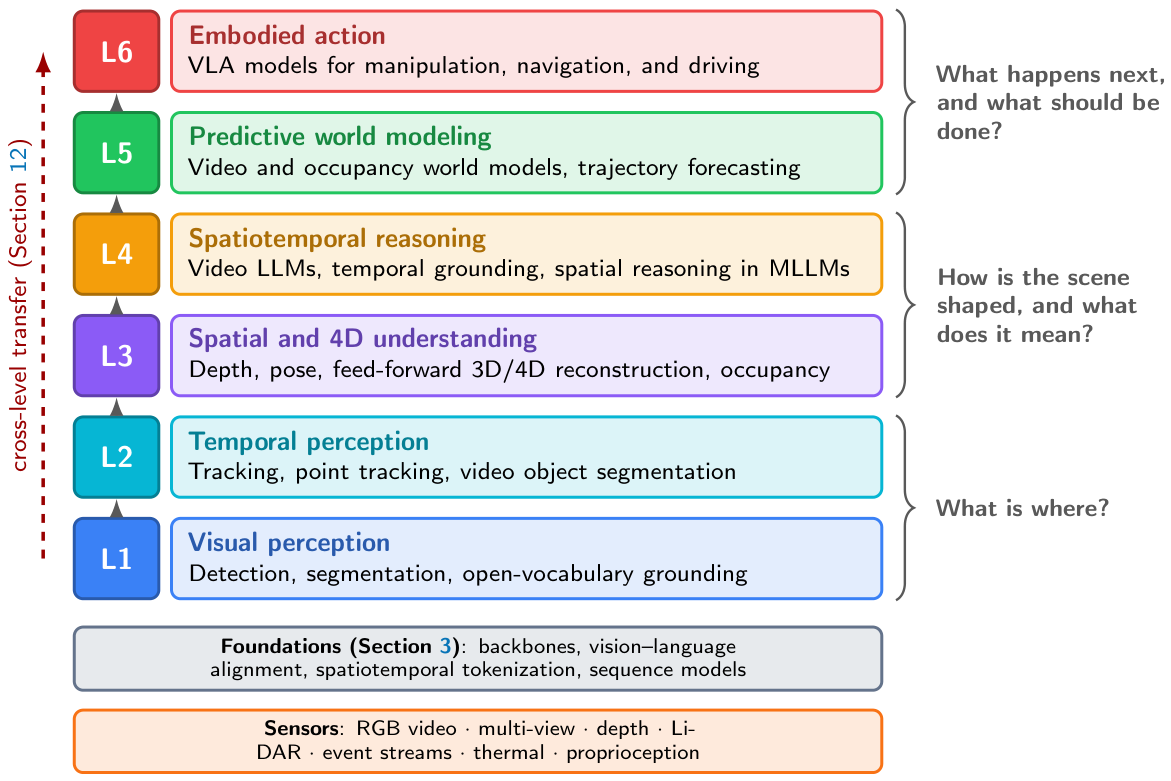
Figure 2.
Pictorial overview of the six levels of the P2A hierarchy. Perception (L1–L2) produces identity-bearing object tokens and memories; spatial and 4D understanding (L3) lifts them into a metric scene; reasoning (L4) grounds language in space and time; world models (L5) imagine action-conditioned futures; and embodied policies (L6) output actions for manipulation and driving. Each row lists the representative output used by the levels above.
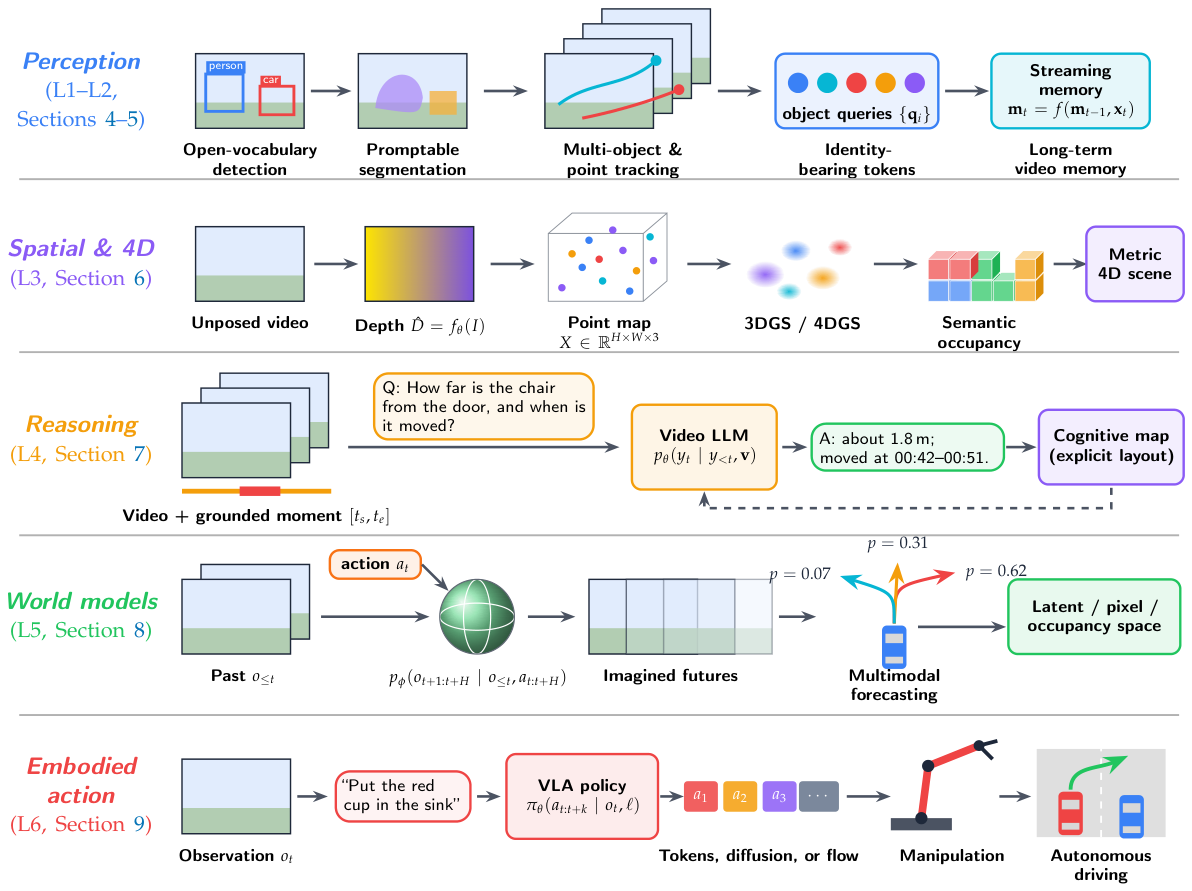
Figure 3.
Roadmap of this review. After the introduction, scope, and shared foundations, Section 4, Section 5, Section 6, Section 7, Section 8 and Section 9 review the six capability levels in order, and Section 10 extends them to applications beyond robotics and driving. The review then compares evaluation practice and metrics, analyzes cross-level transfer, and closes with open challenges and conclusions.

Figure 4.
Milestones in spatiotemporal understanding, 2017–2026, by year of publication and colour-coded by capability level. Activity has shifted from task-specific models (left) to promptable, feed-forward, and generalist foundation models (right), with L3–L6 milestones concentrated after 2023 and, in 2026, a wave of spatial intelligence benchmarks (up to November 2026).
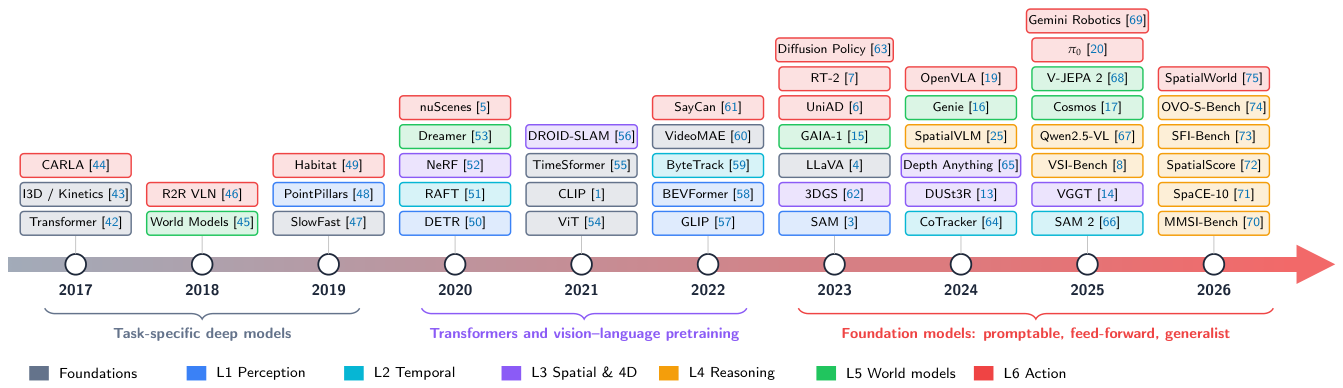
Figure 5.
A generic template shared by most models reviewed here. Level-specific models differ mainly in the tokenizer, whether an alignment module and language model are present, how memory is handled, and which task heads are attached.
Figure 5.
A generic template shared by most models reviewed here. Level-specific models differ mainly in the tokenizer, whether an alignment module and language model are present, how memory is handled, and which task heads are attached.
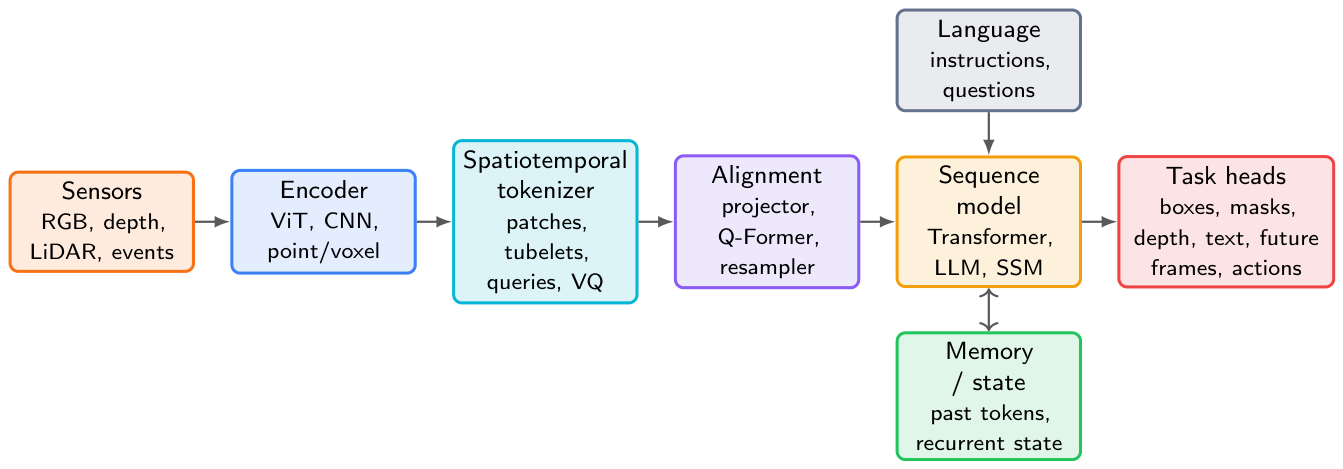
Figure 6.
Anatomy of a Vision-Language-Action (VLA) model. A pretrained VLM backbone fuses camera, language, and optional proprioceptive and 3D inputs. Actions are produced by one of three head families: (a) discrete action tokens, (b) diffusion heads, or (c) flow-matching action experts. Several models add an auxiliary video or latent prediction objective, bringing L5 world modeling into L6 training.
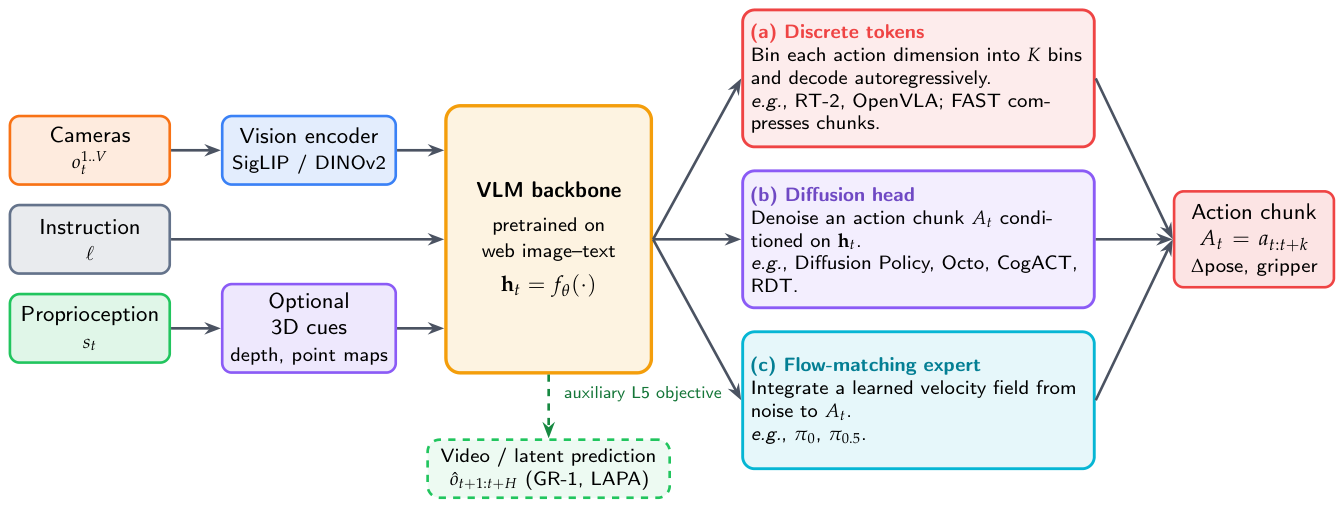
Figure 7.
Evaluation landscape of the P2A hierarchy: representative benchmarks, metrics, and evaluation settings at each level (details in Table 11,Table 14). Lower levels are evaluated offline and in isolation; online (streaming) evaluation has only recently appeared at L4, and closed-loop evaluation exists only at L6. This gap is the evaluation counterpart of the cross-level transfer problem discussed in Section 12.
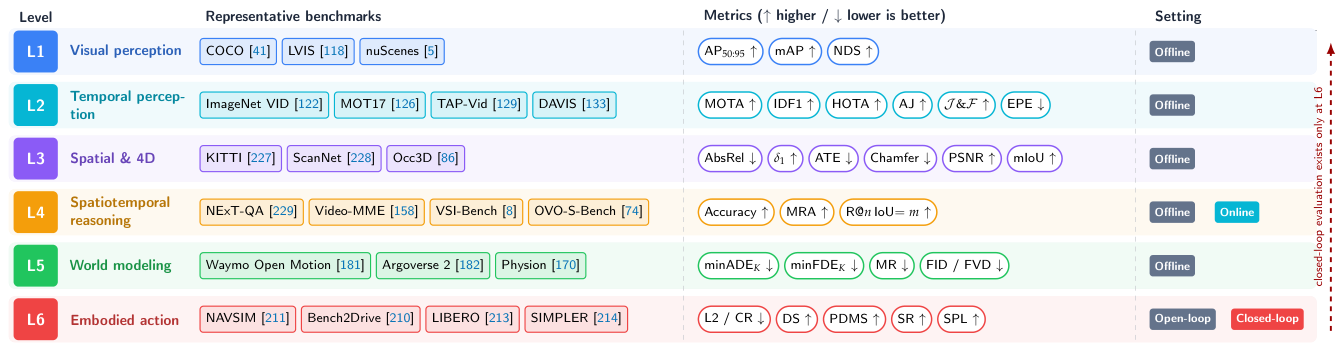
Figure 8.
Practitioner’s decision guide. Starting from what a system must output, the guide points to method families reviewed in this article as reasonable starting points. It is not a ranking: the best choice depends on data, compute, and latency budgets, and should be checked against the benchmarks in Table 11 and the open problems in Table 16.
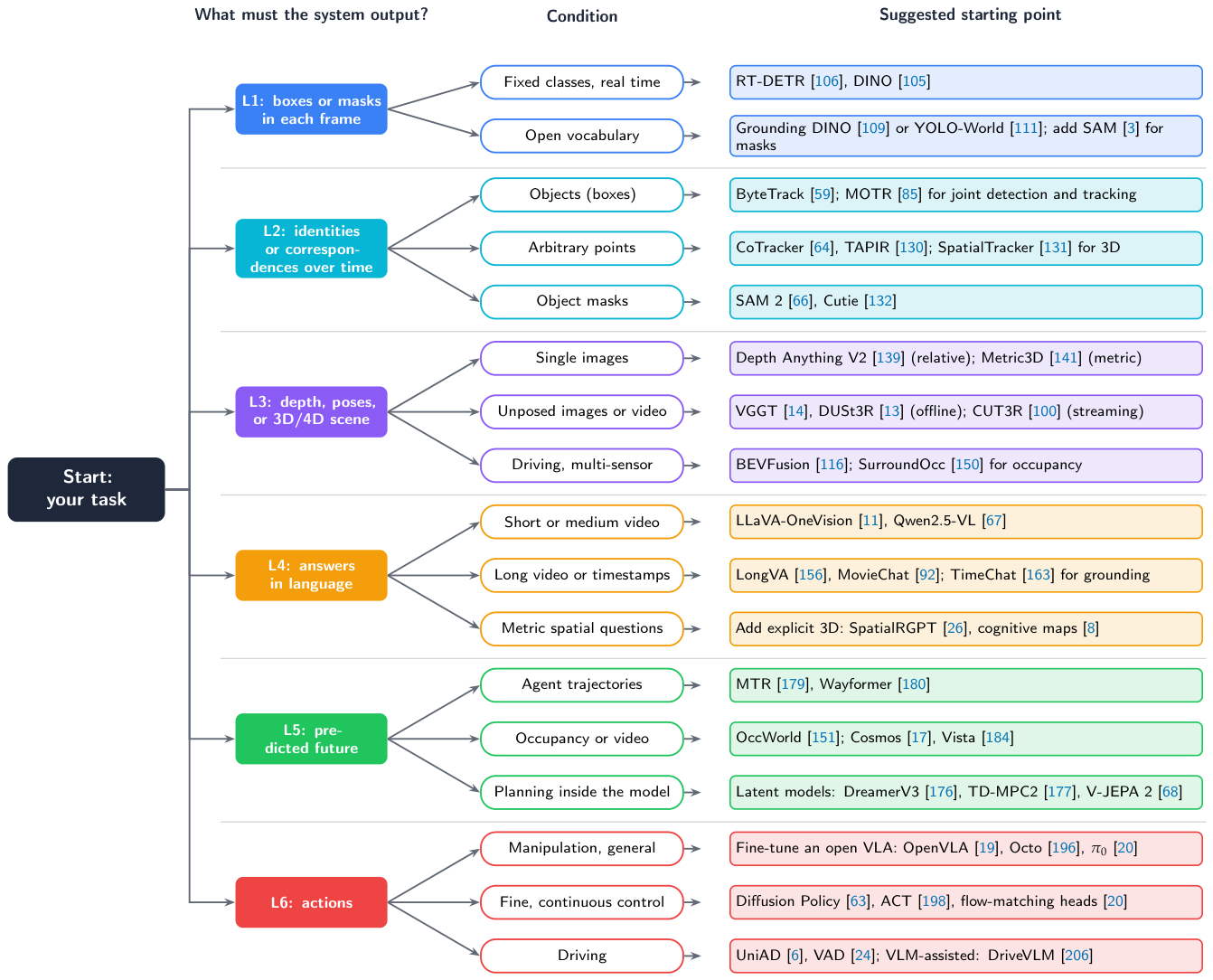

Table 1.
Coverage of representative recent surveys across the six capability levels used in this review. • = primary focus; ∘ = partial coverage. L1: visual perception; L2: temporal perception; L3: spatial and 4D understanding; L4: spatiotemporal reasoning; L5: predictive world modeling; L6: embodied action.
| Survey | Focus | L1 | L2 | L3 | L4 | L5 | L6 |
|---|---|---|---|---|---|---|---|
| Keravnos et al. [40] | Efficient transformer video object detection | • | • | ||||
| Tang et al. [27] | Video understanding with LLMs | ∘ | • | ||||
| Zou et al. [28] | Long-video understanding with MLLMs | • | |||||
| Wu et al. [29] | Video temporal grounding with MLLMs | • | |||||
| Cao et al. [9] | 4D spatial intelligence reconstruction | ∘ | • | ∘ | |||
| Kong et al. [30] | 3D and 4D world modeling | ∘ | • | ||||
| Ma et al. [34] | VLA models for embodied AI | ∘ | ∘ | • | |||
| Zhong et al. [35] | VLA models, action tokenization | ∘ | • | ||||
| Shao et al. [38] | VLM-based VLA for manipulation | • | |||||
| Jiang et al. [31] | VLA models for autonomous driving | ∘ | • | ||||
| Yu et al. [32] | Efficient VLA models | • | |||||
| Wang et al. [33] | VLA datasets, benchmarks, data engines | ∘ | • | ||||
| This review | Full pipeline with cross-level analysis | • | • | • | • | • | • |
Table 2.
Spatiotemporal tokenization strategies and the levels at which they are most common.
| Strategy | What a token represents | Strengths and limitations | Main levels |
|---|---|---|---|
| Per-frame patches | A 2D image patch at one time step | Reuses image encoders; token count grows linearly with frames | L1, L4 |
| Tubelets | A short space–time cube | Fewer tokens, implicit short-range motion; fixed temporal stride | L2, L4 |
| Object queries | A learned slot bound to an object or region | Compact, persistent identity across frames; needs set matching | L1, L2, L6 |
| BEV / occupancy | A cell in a metric ground-plane or 3D grid | Explicit geometry, sensor fusion; memory-heavy at high resolution | L3, L5, L6 |
| Discrete VQ codes | An index into a learned codebook | Unifies vision and language generation; quantization loses detail | L5, L6 |
| Compressed / pooled | A merged or selected subset of tokens | Enables hour-long context; may drop small or brief events | L4 |
| Action tokens | A discretized or latent control command | Lets an LLM emit actions; resolution and frequency trade-offs | L6 |
Table 3.
Representative L1 models. OV: open-vocabulary. All entries are peer-reviewed.
| Model | Year | Paradigm | Input | OV | Relevance to higher levels |
|---|---|---|---|---|---|
| Faster R-CNN [101] | 2015 | Two-stage, anchors | RGB | – | Region features reused in early video detectors (L2) |
| DETR [50] | 2020 | Set prediction, queries | RGB | – | Object queries propagated in tracking and driving (L2, L6) |
| DINO [105] | 2023 | Denoising DETR | RGB | – | Backbone of Grounding DINO |
| RT-DETR [106] | 2024 | Real-time DETR | RGB | – | Latency budget for closed-loop systems |
| Mask2Former [107] | 2022 | Query-based segmentation | RGB | – | Universal masks; basis of video segmentation |
| GLIP [57] | 2022 | Grounding as detection | RGB, text | Language-conditioned boxes | |
| OWL-ViT [108] | 2022 | CLIP + detection heads | RGB, text | Open-set object proposals for robots | |
| Grounding DINO [109] | 2024 | Language-fused DETR | RGB, text | Prompt source for SAM; used in VLA pipelines | |
| YOLO-World [111] | 2024 | Real-time OV YOLO | RGB, text | OV detection within real-time budgets | |
| SAM [3] | 2023 | Promptable segmentation | RGB, prompts | – | Extended to video in SAM 2 (L2) |
| Florence-2 [112] | 2024 | Unified seq2seq | RGB, text | Single interface for many L1 tasks | |
| BEVFusion [116] | 2023 | Camera–LiDAR BEV fusion | Multi-view, LiDAR | – | Metric 3D perception for driving (L3, L6) |
Table 4.
Representative L2 models and their temporal mechanisms.
| Model | Year | Task | Temporal mechanism | Note |
|---|---|---|---|---|
| FGFA [120] | 2017 | VOD | Flow-warped feature aggregation | Short-range; flow cost dominates |
| SELSA [121] | 2019 | VOD | Sequence-level proposal aggregation | Order-free global context |
| ByteTrack [59] | 2022 | MOT | Two-stage association incl. low-score boxes | Strong baseline; detector-dependent |
| MOTR [85] | 2022 | MOT | Track queries carried across frames | Joint detection and association |
| RAFT [51] | 2020 | Optical flow | Iterative all-pairs refinement | Two-frame only |
| TAPIR [130] | 2023 | Point tracking | Per-frame matching + temporal refinement | Handles occlusion |
| CoTracker [64] | 2024 | Point tracking | Joint transformer over many tracks | Exploits track correlation |
| SpatialTracker [131] | 2024 | 3D point tracking | Tracks lifted with monocular depth | Bridges L2 and L3 |
| XMem [99] | 2022 | VOS | Multi-store memory | Long videos |
| SAM 2 [66] | 2025 | Promptable VOS | Streaming memory attention | Open-world masks over time |
Table 5.
Representative L3 models. FF: feed-forward inference; Opt.: per-scene optimization; Dyn.: handles dynamic scenes.
Table 5.
Representative L3 models. FF: feed-forward inference; Opt.: per-scene optimization; Dyn.: handles dynamic scenes.
| Model | Year | Output | FF/Opt. | Dyn. | Note |
|---|---|---|---|---|---|
| Depth Anything V2 [139] | 2024 | Relative depth | FF | – | Synthetic-label training; sharp detail |
| Metric3D [141] | 2023 | Metric depth | FF | – | Camera-aware canonical space |
| Marigold [140] | 2024 | Relative depth | FF (diffusion) | – | Generative prior for geometry |
| DROID-SLAM [56] | 2021 | Poses, depth | Opt. (learned) | – | Differentiable bundle adjustment |
| DUSt3R [13] | 2024 | Pairwise point maps | FF + global align | – | Unposed, uncalibrated input |
| VGGT [14] | 2025 | Cameras, depth, points, tracks | FF | – | Many views in one pass |
| MonST3R [135] | 2025 | Per-frame point maps | FF + align | Dynamic-scene DUSt3R | |
| CUT3R [100] | 2025 | Online point maps | FF (recurrent) | Persistent state, streaming | |
| 4D-GS [147] | 2024 | Dynamic radiance field | Opt. | Real-time rendering | |
| SurroundOcc [150] | 2023 | 3D semantic occupancy | FF | – | Multi-camera driving |
Table 6.
Human–model gaps on recent spatial intelligence benchmarks, as reported by the benchmark authors (latest versions available in November 2026). Model names and scores change quickly; values are given to illustrate the size of the gap, not as a leaderboard. Top model = highest score highlighted by the benchmark authors (MMSI-Bench: GPT-5; SpatialScore: Gemini-3-Pro; OVO-S-Bench: Gemini-3.1-Pro; SpatialWorld: GPT-5). OVO-S-Bench human score is with access to the video up to the question (prefix access); the paper also reports 86.6 when humans answer from memory in the streaming setting. SpatialWorld value is the average task success rate stated in the paper’s abstract.
| Benchmark | Setting | Scale | Top model | Human | Main bottleneck reported |
|---|---|---|---|---|---|
| VSI-Bench [8] | Offline egocentric video | Indoor scenes | Large gap reported | Spatial reasoning; cognitive maps help | |
| MMSI-Bench [70] | Multi-image QA | 1000 questions | 41.9 | 97.2 | Grounding, scene reconstruction |
| SpatialScore [72] | Aggregated QA, 30 tasks | ≈5000 questions | 60.1 | 86.6 | Broad spatial weaknesses |
| OVO-S-Bench [74] | Streaming egocentric video | 1680 questions | 59.2 | 92.2 | Allocentric mapping |
| SpaCE-10 [71] | Compositional QA | >5000 QA pairs | Well below human | Counting | |
| SFI-Bench [73] | Spatial-functional video QA | >1500 questions | – | Integrating memory, function, knowledge | |
| SpatialWorld [75] | Interactive agents | 760 tasks | 17.4% success | – | Exploration, long-horizon planning |
Table 7.
Representative L4 models, grouped by the reasoning dimension they target.
| Model | Year | Focus | Key mechanism | Limitation noted |
|---|---|---|---|---|
| Video-ChatGPT [10] | 2024 | General video QA | Spatial and temporal pooling of CLIP features | Few frames; weak timing |
| Video-LLaVA [154] | 2024 | Unified image/video | Alignment before projection | Short clips |
| LLaVA-OneVision [11] | 2025 | Single/multi-image, video | Shared training curriculum | Token budget per frame |
| Qwen2.5-VL [67] | 2025 | General, long video | Dynamic resolution, multimodal RoPE | Metric spatial accuracy untested at scale |
| MovieChat [92] | 2024 | Long video | Token consolidation memory | Loses brief events |
| LongVA [156] | 2025 | Long video | Long-context transfer from text | High memory cost |
| TimeChat [163] | 2024 | Temporal grounding | Timestamp-aware frame encoding | Coarse boundaries |
| SpatialVLM [25] | 2024 | Metric spatial QA | Synthetic 3D-lifted QA data | Depends on depth estimator |
| SpatialRGPT [26] | 2024 | Region spatial QA | Depth plug-in, region prompts | Single images |
| LEO [166] | 2024 | 3D scene QA, embodied | 3D object tokens in LLM | Requires 3D input |
Table 8.
Representative L5 world models by prediction space.
| Model | Year | Prediction space | Generator | Action-cond. | Domain |
|---|---|---|---|---|---|
| DreamerV3 [176] | 2025 | Latent state | Recurrent SSM | Games, control | |
| TD-MPC2 [177] | 2024 | Latent state | MLP dynamics + MPC | Continuous control | |
| MTR [179] | 2022 | Agent trajectories | Transformer | – | Driving |
| GAIA-1 [15] | 2023 | Video tokens | Autoregressive + diffusion decoder | Driving | |
| Vista [184] | 2024 | Video | Latent diffusion | Driving | |
| OccWorld [151] | 2024 | 3D occupancy | Autoregressive transformer | Driving | |
| UniSim [185] | 2024 | Video | Diffusion | Real-world interaction | |
| Genie [16] | 2024 | Video tokens | Latent-action transformer | Games from internet video | |
| Cosmos [17] | 2025 | Video | Diffusion and autoregressive | Physical AI, general | |
| V-JEPA 2 [68] | 2025 | Feature space | Predictor transformer | Video, manipulation |
Table 9.
Representative L6 robot policies and VLA models by action representation.
| Model | Year | Backbone | Action representation | Spatiotemporal input |
|---|---|---|---|---|
| RT-1 [18] | 2023 | EfficientNet + transformer | Discrete bins | Short frame history |
| RT-2 [7] | 2023 | Large VLM | Discrete bins as text | Single frame |
| Octo [196] | 2024 | Transformer | Diffusion head | Short history, multi-camera |
| OpenVLA [19] | 2024 | Llama 2 + DINOv2/SigLIP | Discrete bins | Single frame |
| Diffusion Policy [63] | 2023 | CNN or transformer | Continuous (diffusion) | Short history |
| ACT [198] | 2023 | Transformer (CVAE) | Continuous chunks | Multi-camera |
| [20] | 2025 | VLM + action expert | Continuous (flow matching) | Multi-camera, proprioception |
| FAST [197] | 2025 | VLM | Compressed tokens (DCT) | As base VLA |
| GR-1 [21] | 2024 | GPT-style transformer | Continuous | Video-pretrained, predicts frames |
| LAPA [23] | 2025 | VLM | Latent actions | Learned from unlabeled video |
| SpatialVLA [142] | 2025 | VLM | Adaptive spatial grid tokens | Depth-derived 3D encoding |
| 3D-VLA [203] | 2024 | 3D-LLM | Action tokens | 3D input, imagined goals |
Table 10.
Application domains beyond robotics and driving, the P2A levels they rely on most, and representative transferable methods.
Table 10.
Application domains beyond robotics and driving, the P2A levels they rely on most, and representative transferable methods.
| Domain | Key levels | Representative methods | Main open issue |
|---|---|---|---|
| Medical imaging, surgery | L1, L3, L6 | MedSAM [218], EndoNeRF [219], SAM 2 [66] | Deformable 4D tissue; safety of surgical autonomy |
| Remote sensing | L2, L4, L5 | SatMAE [220], GeoChat [221] | Multi-spectral, irregular revisit times; forecasting |
| Egocentric, AR/VR | L1–L4 | Ego4D [175], Aria Digital Twin [222], CUT3R [100] | Streaming under power limits |
| Surveillance, smart cities | L1, L2, L4 | UCF-Crime [223], context-aware detection [113] | Rare events; hallucination; privacy |
| Digital twins, SLAM | L3, L5 | Block-NeRF [224], SplaTAM [225], GS-SLAM [226] | Scale; keeping the twin up to date |
Table 11.
Representative datasets and benchmarks by level. Setting: Off = offline evaluation on recorded data; Online = answers use only past frames (streaming); CL = closed-loop in simulation; Real = real-world trials.
Table 11.
Representative datasets and benchmarks by level. Setting: Off = offline evaluation on recorded data; Online = answers use only past frames (streaming); CL = closed-loop in simulation; Real = real-world trials.
| Level | Benchmark | Modality | Typical metrics | Setting | What it does not measure |
|---|---|---|---|---|---|
| L1 | COCO [41] | RGB images | AP | Off | Temporal stability |
| LVIS [118] | RGB images | AP (rare/common/freq.) | Off | Metric localization | |
| nuScenes detection [5] | Multi-view, LiDAR, radar | mAP, NDS | Off | Downstream planning value | |
| L2 | ImageNet VID [122] | RGB video | mAP | Off | Efficiency, long horizons |
| MOT17 [126] | RGB video | HOTA, IDF1, MOTA | Off | 3D identity, ego-motion | |
| TAP-Vid [129] | RGB video | AJ, , OA | Off | 3D correspondence | |
| DAVIS [133], YouTube-VOS [134] | RGB video | Off | Open-vocabulary prompts | ||
| L3 | KITTI [227] | Stereo, LiDAR | AbsRel, | Off | Dynamic objects at scale |
| ScanNet [228] | RGB-D video | Depth, pose, reconstruction error | Off | Outdoor, dynamic scenes | |
| Occ3D [86] | Multi-view | mIoU | Off | Future occupancy | |
| L4 | NExT-QA [229] | RGB video | Accuracy | Off | Metric spatial reasoning |
| EgoSchema [157] | Egocentric video | Accuracy | Off | Online (streaming) answers | |
| Video-MME [158] | Video, subtitles, audio | Accuracy | Off | Grounded evidence | |
| Charades-STA [160], QVHighlights [162] | RGB video | R@IoU, mAP | Off | Long videos | |
| VSI-Bench [8] | Egocentric indoor video | Accuracy, MRA | Off | Outdoor, dynamic scenes | |
| MMSI-Bench [70] | Multi-image | Accuracy | Off | Temporal dynamics | |
| OVO-S-Bench [74] | Streaming egocentric video | Accuracy | Online | Action, interaction | |
| SFI-Bench [73] | Egocentric indoor video | Accuracy | Off | Outdoor scenes | |
| L5 | Waymo Open Motion [181] | Tracks, maps | minADE, minFDE, mAP | Off | Perception errors (GT inputs) |
| Argoverse 2 [182] | Tracks, maps, sensors | minADE, minFDE, MR | Off | Interaction with ego plan | |
| Physion [170] | Synthetic video | Prediction accuracy vs. humans | Off | Real-world dynamics | |
| L6 | nuScenes planning [5] | Multi-view | L2 error, collision rate | Off | Closed-loop behavior [209] |
| NAVSIM [211] | Multi-view, LiDAR | PDM score | Pseudo-CL | Long-horizon reactivity | |
| Bench2Drive [210] | CARLA sensors | Driving score, success rate | CL | Real-world transfer | |
| CALVIN [212], LIBERO [213] | Simulated RGB(-D) | Success rate, task chain length | CL | Real-robot transfer | |
| SIMPLER [214] | Simulated RGB | Success rate, sim–real correlation | CL | Safety, contact quality | |
| R2R [46] (Habitat [49]) | RGB(-D) | SR, SPL | CL | Dynamic obstacles | |
| SpatialWorld [75] | Simulated, text actions | Success, efficiency | CL | Low-level control |
Table 12.
Statistics of representative datasets, as reported by their authors. Counts are approximate where marked (≈).
Table 12.
Statistics of representative datasets, as reported by their authors. Counts are approximate where marked (≈).
| Level | Dataset | Year | Sensors | View | Scale | Annotations |
|---|---|---|---|---|---|---|
| L1 | COCO [41] | 2014 | RGB images | T | ≈328K images; 80 categories | Boxes, instance masks, captions |
| LVIS [118] | 2019 | RGB images | T | COCO images; >1000 categories | Long-tail instance masks | |
| KITTI [227] | 2012 | Stereo, LiDAR, GPS/IMU | E | 7481 training images (detection) | 3D boxes, stereo disparity, flow, odometry | |
| L2 | ImageNet VID [122] | 2015 | RGB video | T | 3862 train / 555 val videos; 30 classes | Per-frame boxes |
| MOT17 [126] | 2016 | RGB video | T/E | 14 sequences (7 train, 7 test) | Tracked pedestrian boxes, identities | |
| DAVIS 2017 [133] | 2017 | RGB video | T | 150 sequences | Multi-object masks | |
| YouTube-VOS [134] | 2018 | RGB video | T | 4453 videos; 94 categories | Object masks | |
| L3 | ScanNet [228] | 2017 | RGB-D video | E | 1513 scans of 707 indoor spaces | Camera poses, meshes, semantic labels |
| nuScenes [5] | 2020 | 6 cameras, 1 LiDAR, 5 radars | E | 1000 scenes of 20 s | 3D boxes (23 classes), attributes, maps | |
| Occ3D [86] | 2023 | Multi-view, LiDAR | E | Built on nuScenes and Waymo | Dense 3D semantic occupancy | |
| L4 | ActivityNet Captions [161] | 2017 | RGB video | T | ≈20K videos; ≈100K sentences | Timestamped event captions |
| Charades-STA [160] | 2017 | RGB video | T | ≈18K moment–sentence pairs | Temporal grounding | |
| QVHighlights [162] | 2021 | RGB video | T | ≈10K videos and queries | Moments, saliency scores | |
| NExT-QA [229] | 2021 | RGB video | T | ≈5.4K videos; ≈52K QA | Causal and temporal QA | |
| Ego4D [175] | 2022 | Head-worn RGB (+ audio, IMU, 3D in subsets) | E | 3670 h; 931 camera wearers | Episodic memory, forecasting, interaction | |
| Video-MME [158] | 2025 | Video, subtitles, audio | T/E | 900 videos; 2700 QA | Multiple-choice QA, short to long | |
| VSI-Bench [8] | 2025 | Egocentric RGB video | E | 288 videos; >5000 QA | Visual–spatial QA | |
| L5 | Waymo Open Motion [181] | 2021 | Tracks, HD maps | E | >100K scenarios; ≈570 h | Agent trajectories, interactions |
| Argoverse 2 (forecasting) [182] | 2021 | Tracks, HD maps | E | 250K scenarios of 11 s | Agent trajectories | |
| CLEVRER [168] | 2020 | Synthetic video | T | 20K videos; >300K questions | Descriptive, explanatory, predictive, counterfactual QA | |
| L6 | RT-1 data [18] | 2023 | RGB | E | ≈130K episodes; >700 tasks | Language-labeled demonstrations |
| Open X-Embodiment [195] | 2024 | RGB(-D), proprioception | E | >1M trajectories; 22 embodiments | Demonstrations from 60 datasets | |
| BridgeData V2 [215] | 2023 | RGB(-D) | E | ≈60K trajectories; 24 environments | Language-labeled demonstrations | |
| DROID [216] | 2024 | Multi-view RGB(-D) | E | ≈76K trajectories; ≈350 h; 564 scenes | In-the-wild demonstrations | |
| LIBERO [213] | 2023 | Simulated RGB | E | 130 tasks in 4 suites | Procedurally generated tasks | |
| R2R [46] | 2018 | RGB(-D) panoramas | E | 7189 paths; 90 buildings; 21,567 instructions | Navigation instructions |
Table 13.
Reported model size and availability of code and weights. Sizes are as reported by the authors for released or described variants; n.r. = not reported by the authors. = released; P = partially released; ✗ = not released.
Table 13.
Reported model size and availability of code and weights. Sizes are as reported by the authors for released or described variants; n.r. = not reported by the authors. = released; P = partially released; ✗ = not released.
| Level | Model | Parameters (as reported) | Code | Weights | Note |
|---|---|---|---|---|---|
| L1 | Grounding DINO [109] | T: 172M; L: 341M | P | T and B weights; L not released | |
| SAM [3] | n.r. (ViT-B/L/H backbones) | ||||
| YOLO-World [111] | S: 13M; L: 48M (re-parameterized) | ||||
| Florence-2 [112] | B: 0.23B; L: 0.77B | P | Code shipped with model files | ||
| L2 | CoTracker [64] | n.r. | |||
| SAM 2 [66] | 38.9M (tiny) to 224.4M (large) | ||||
| L3 | Depth Anything V2 [139] | 24.8M (small) to 1.3B (giant) | P | Giant not yet released | |
| DUSt3R [13] | n.r. (ViT-L encoder, ViT-B decoder) | Non-commercial licence | |||
| VGGT [14] | ≈1.2B | ||||
| CUT3R [100] | n.r. (ViT-L encoder, ViT-B decoders) | ||||
| L4 | LLaVA-OneVision [11] | 0.5B, 7B, 72B | |||
| Qwen2.5-VL [67] | 3B, 7B, 72B | ||||
| LongVA [156] | 7B | ||||
| Video-LLaVA [154] | 7B | ||||
| L5 | Cosmos [17] | 4B to 14B | Open model licence | ||
| V-JEPA 2 [68] | 300M (ViT-L) to 1B (ViT-g) | ||||
| Genie [16] | 11B | ✗ | ✗ | ||
| GAIA-1 [15] | Total n.r.; world model 6.5B | ✗ | ✗ | ||
| L6 | OpenVLA [19] | 7B | |||
| Octo [196] | 27M (small), 93M (base) | ||||
| [20] | 3.3B | Released after publication | |||
| RDT-1B [200] | 1.2B | ||||
| RT-2 [7] | 5B to 55B | ✗ | ✗ | ||
| CogACT [199] | 7.6B |
Table 14.
Summary of evaluation metrics by level. ↑: higher is better; ↓: lower is better.
| Level | Metric | Dir. | Equation | Measures |
|---|---|---|---|---|
| L1 | AP, mAP, | ↑ | (30)–(31) | Detection precision–recall over IoU thresholds |
| L1 | NDS | ↑ | (32) | nuScenes 3D detection quality incl. box attributes |
| L2 | MOTA | ↑ | (33) | Errors normalized by number of ground-truth objects |
| L2 | IDF1 | ↑ | (34) | Identity-preserving matches |
| L2 | HOTA (DetA, AssA) | ↑ | (35) | Balanced detection and association accuracy |
| L2 | , OA, AJ | ↑ | (36) | Point-tracking position and occlusion accuracy |
| L2 | ↑ | (37) | Mask region and boundary accuracy | |
| L2 | EPE | ↓ | (38) | Optical-flow endpoint error |
| L3 | AbsRel, RMSE | ↓ | (39) | Depth error |
| L3 | ↑ | (39) | Fraction of pixels within ratio 1.25 | |
| L3 | ATE, RPE | ↓ | (40) | Camera trajectory error |
| L3 | Chamfer distance | ↓ | (41) | Point-cloud reconstruction error |
| L3 | PSNR, SSIM, LPIPS | (42) | Novel-view synthesis quality | |
| L3 | mIoU | ↑ | (43) | Semantic occupancy accuracy |
| L4 | Accuracy | ↑ | (44) | Multiple-choice video QA |
| L4 | MRA | ↑ | (45) | Numerical spatial answers (VSI-Bench) |
| L4 | R@n, IoU; mIoU | ↑ | (20), (46) | Temporal grounding |
| L5 | FID, FVD | ↓ | (47) | Distribution distance of generated frames/videos |
| L5 | , | ↓ | (48) | Best-of-K trajectory error |
| L5 | Miss rate | ↓ | (49) | Fraction of agents with no close mode |
| L6 | L2 error, collision rate | ↓ | (50) | Open-loop planning (use with caution) |
| L6 | Driving score | ↑ | (51) | Closed-loop route completion with penalties |
| L6 | PDMS | ↑ | (52) | NAVSIM pseudo-closed-loop score |
| L6 | SR, SPL | ↑ | (53) | Task success; path-efficiency-weighted success |
| L6 | ECE | ↓ | (54) | Calibration of confidence (safety) |
Table 15.
Evidence for cross-level transfer. Each row is a dependency of a higher level on a lower one.
Table 15.
Evidence for cross-level transfer. Each row is a dependency of a higher level on a lower one.
| Link | Representative evidence | What is shown | What remains open |
|---|---|---|---|
| L1 → L2 | ByteTrack [59], MOTR [85] | Tracking-by-detection depends strongly on detector recall; joint query-based training couples the two | How open-vocabulary detectors affect identity stability over long videos |
| L2 → L3 | SpatialTracker [131], MonST3R [135], VGGT [14] | Correspondence and geometry are increasingly predicted jointly | Whether joint models outperform cascades on highly dynamic scenes |
| L3 → L4 | SpatialVLM [25], SpatialRGPT [26], VSI-Bench [8] | Depth-derived data and explicit spatial maps improve metric spatial answers | Whether gains hold on dynamic outdoor video and in online settings |
| L1–L4 → L6 | RT-2 [7], OpenVLA [19] | Web-pretrained VLMs transfer semantic knowledge to control; fused DINOv2 and SigLIP features are used for better spatial grounding | Whether VLM benchmark gains predict policy gains |
| L3 → L6 | Perceiver-Actor [192], SpatialVLA [142] | Explicit 3D inputs or 3D position encodings help manipulation | Controlled comparisons with matched data and compute |
| L5 → L6 | GR-1 [21], LAPA [23], V-JEPA 2 [68] | Video-predictive pretraining and latent actions improve or enable policy learning | Whether world-model fidelity (FVD) correlates with control quality |
| L1–L5 → L6 (driving) | UniAD [6], AD-MLP [209] | Planning-oriented joint training of perception, prediction, and planning helps; but open-loop metrics can be matched without perception | Closed-loop attribution of planning gains to individual modules |
Table 16.
Ten open problems in spatial intelligence identified by this review.
| ID | Open problem | Levels | Evidence in this review |
|---|---|---|---|
| OP1 | Metric spatial grounding in multimodal models | L3→L4 | Large human–model gaps; allocentric mapping bottleneck (Table 6) |
| OP2 | Precise temporal grounding and evidence-anchored reasoning | L2→L4 | Coarse timestamps; unanchored chain-of-thought amplifies errors (Section 7) |
| OP3 | Physically consistent world models | L5 | Plausible but physically wrong generations (Section 8) |
| OP4 | Utility-based evaluation of world models for decision-making | L5→L6 | FID/FVD do not measure planning value (Section 11.3) |
| OP5 | Streaming spatial intelligence with one persistent, bounded state | L1–L6 | Equation (55); streaming models underperform their backbones |
| OP6 | Efficient long-horizon models on embedded hardware | L4–L6 | Most VLA models see only the current frame (Section 9) |
| OP7 | Cross-level benchmarks with multi-level annotations on the same data | L1–L6 | Few datasets annotate more than one level (Table 12) |
| OP8 | Standardized, reproducible evaluation of VLA policies | L6 | Heterogeneous robots, tasks, and protocols (Section 11) |
| OP9 | Multi-sensor foundation models (depth, LiDAR, event, thermal) | L1–L3 | Foundation models are trained almost entirely on RGB (Section 4) |
| OP10 | Calibrated uncertainty propagated from perception to action | L1→L6 | Calibration rarely reported for VLA or world models (Section 11.3) |
Disclaimer/Publisher’s Note: The statements, opinions and data contained in all publications are solely those of the individual author(s) and contributor(s) and not of MDPI and/or the editor(s). MDPI and/or the editor(s) disclaim responsibility for any injury to people or property resulting from any ideas, methods, instructions or products referred to in the content. |
© 2026 by the authors. Licensee MDPI, Basel, Switzerland. This article is an open access article distributed under the terms and conditions of the Creative Commons Attribution (CC BY) license (http://creativecommons.org/licenses/by/4.0/).
Copyright: This open access article is published under a Creative Commons CC BY 4.0 license, which permit the free download, distribution, and reuse, provided that the author and preprint are cited in any reuse.