
Submitted:
21 November 2026
Posted:
24 November 2026
You are already at the latest version
Abstract
Medical artificial intelligence increasingly depends on collaboration across distributed healthcare data environments, yet model performance, fairness, and interpretability remain constrained by the completeness of the decision-relevant information available for learning. This study examines that problem in organ transplantation, a time-critical, interorganizational healthcare supply chain in which transplant centers, clinicians, laboratories, and coordinating institutions possess different elements of patient and allocation information. Using publicly reported Organ Procurement and Transplantation Network and Scientific Registry of Transplant Recipients data, we present a retrospective descriptive case study of policy changes correcting race-inclusive estimated glomerular filtration rate calculations in kidney allocation. The deceased-donor kidney transplant rate among Black adult waitlisted candidates increased from 20.8 per 100 patient-years in 2021 to 26.1 in 2023 and 26.5 in 2024; 14,701 waiting-time modifications restored a median 1.7 years of waiting time to affected registrations. Although aggregate observational data preclude causal attribution, the case illustrates how deficiencies in decision-relevant information can have measurable implications for equitable organ allocation. We argue that federated medical AI offers a promising architecture for learning across distributed clinical data while preserving institutional data stewardship, privacy, and human oversight. Data completeness must therefore accompany privacy-preserving collaboration if federated AI is to support equitable transplant optimization.
Keywords:
federated learning
; medical artificial intelligence
; data completeness
; organ transplantation
; health equity
; clinical decision support
1. Introduction
Artificial intelligence (AI) offers substantial opportunities to improve healthcare decision support, but its effectiveness and fairness depend upon the information, institutional assumptions, and governance structures underlying its application. Algorithmic systems may process large volumes of clinical information with increasing sophistication while remaining unable to recognize consequential information that was never captured, was systematically mis-specified, or reflects embedded institutional biases. These limitations are particularly important in time-sensitive healthcare settings where decisions involve scarce resources, competing clinical priorities, and significant ethical consequences.
Organ transplantation provides a compelling setting in which to examine these challenges. Kidney allocation depends upon coordination among organ procurement organizations, transplant centers, clinicians, laboratories, and national allocation institutions, each possessing different elements of decision-relevant information. Viewed through a supply chain economics lens, transplantation is not simply a sequence of clinical transactions but an interconnected system in which outcomes emerge from the coordination of organizations, processes, resources, incentives, and institutional constraints across the full chain of activity [1].
1.1. Problem Statement
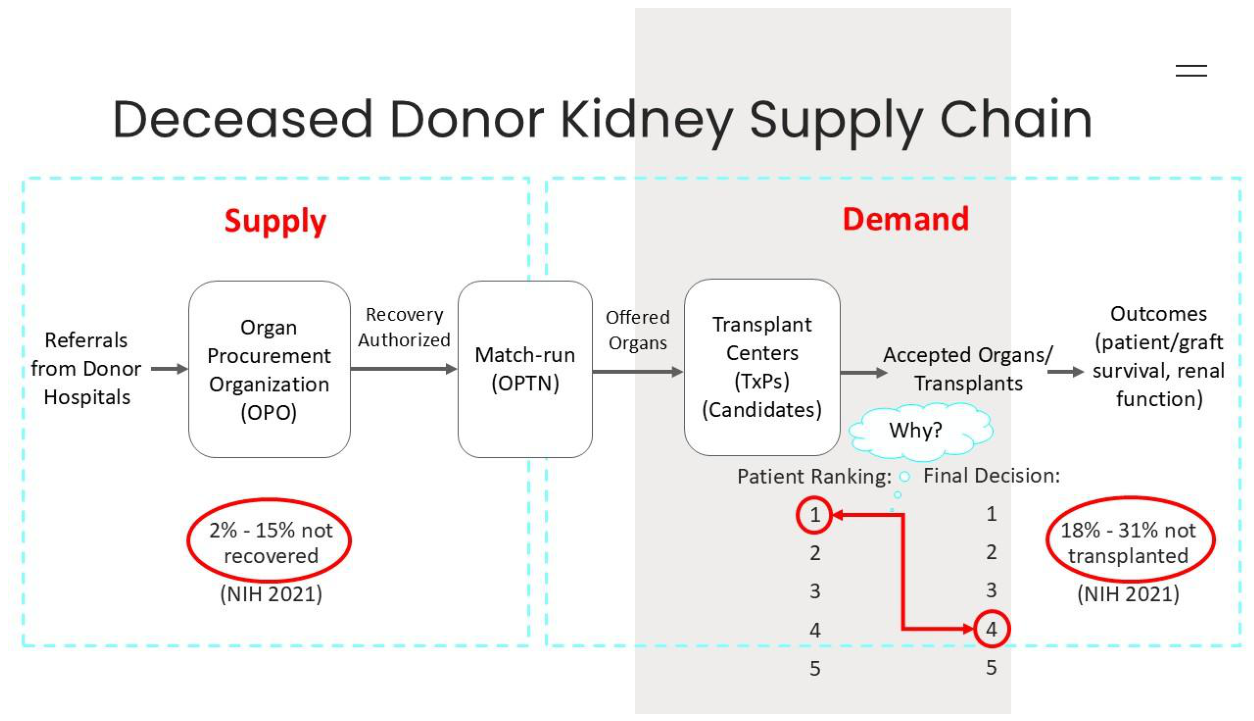
Despite advances in AI, kidney allocation remains dependent upon decisions made across multiple organizations using information that may be incomplete, inconsistently documented, or unavailable to other participants. National allocation rules establish priorities and generate organ offers based on candidate and donor characteristics, but an offer does not necessarily result in transplantation. Transplant centers must evaluate clinical suitability, candidate availability, organ quality, and other time-sensitive considerations before accepting an offer. A center may therefore decline an organ offered to a higher-priority candidate, allowing the allocation process to proceed to other eligible candidates. Such outcomes do not necessarily indicate inappropriate departures from allocation rules. Rather, the information gap arises when the clinical and contextual rationale for these consequential decisions is not captured in sufficiently structured, interoperable form to support subsequent analysis. Figure 1 illustrates this distinction between allocation priority, clinical decision-making, and the information potentially unavailable to the broader system.
Reducing information silos could improve the timeliness and consistency of organ allocation. Organ Procurement Organizations (OPOs) coordinate organ recovery and placement activities, while Transplant Centers (TxPs) evaluate organ offers and perform transplantation. National allocation and matching functions are administered through the Organ Procurement and Transplantation Network (OPTN). These organizations perform distinct but interdependent roles and may possess different elements of time-sensitive information. For example, a TxP may know that a candidate is temporarily unavailable or clinically unsuitable for a particular organ before that information is reflected in shared allocation records. The resulting offer may be declined, requiring additional coordination and consuming valuable time. The broader concern is not simply that information is dispersed across institutions, but that clinically meaningful context may remain unavailable or insufficiently documented for learning across the allocation network.
Information deficiencies can also arise from assumptions embedded within the data used to determine allocation priority. Estimated glomerular filtration rate (eGFR) is a clinical measure used to estimate kidney function, with lower values generally indicating more severe impairment. Historically, some eGFR equations included a race-based adjustment that could produce higher estimated kidney function values for Black patients than otherwise comparable patients. Because kidney function helps determine eligibility for waiting-time credit, this adjustment could delay recognition of qualifying kidney disease and disadvantage affected candidates. The subsequent OPTN policy corrections therefore provide a documented example of how an institutional assumption embedded within decision-relevant information can influence access to transplantation [7,8].
1.2. Primary Thesis
The thesis of this paper is that improving the completeness, transparency, and interoperability of decision-relevant information can strengthen the equity and effectiveness of AI-supported organ allocation. Allocation systems depend not only upon standardized clinical variables and formal priority rules, but also upon contextual judgments made by clinicians and institutions. When consequential information is omitted, mis-specified, or inadequately documented, algorithmic systems may reproduce those deficiencies rather than identify them. More complete information could enable decision-support tools to identify patterns, evaluate potential disparities, and provide more consistent recommendations, while preserving appropriate clinical discretion. Such systems should not be understood as autonomous moral agents. Their objectives, constraints, and recommendations reflect human choices, and final responsibility for ethically consequential decisions must remain with accountable human decision-makers.
The latest technologies, such as 5G cellular, blockchain, Internet of Things (IoT) devices, radio-frequency identification (RFID), and various secure encryption schemes, are sufficiently proven, mature, and robust to allow for confidence in their application with added leverage from the application of AI, big data analytics, and machine learning for modeling, optimizing, and operationalizing organ transplant supply chains. However, current technology implementations remain at the organizational level at best, with limited upstream and downstream data links. We call for an open standard system architecture to allow various stakeholders to access shared real-time, inter-organizational organ supply chain data on rules-based consensus. This architecture should leverage contemporary technologies, transparency, and information-sharing practices to reduce complexity, improve donor matching and temporal efficiency, and promote consistent, equitable outcomes.
Within such an architecture, federated learning (FL) offers a complementary approach to the tension between interorganizational learning and patient-data stewardship. Rather than requiring participating healthcare organizations to pool raw clinical data in a centralized repository, FL enables models to be trained collaboratively across distributed institutional datasets while the underlying patient records remain locally controlled. This architecture is particularly relevant to organ transplantation, where OPOs, TxPs, laboratories, clinicians, and coordinating institutions possess different elements of decision-relevant information and operate under distinct privacy, governance, and technical constraints. Federated medical AI could therefore enable system-level learning from distributed transplant data while reducing the need to transfer sensitive patient-level records across organizational boundaries [2,3,4].
A practical application would involve TxPs collaboratively training models on locally retained information about organ offers, acceptance and decline decisions, candidate availability, clinical suitability, and subsequent transplantation outcomes. Rather than pooling identifiable patient records, participating centers could contribute model updates to a shared analytical process. Such collaboration could help identify whether particular patterns of organ offer declines, documentation deficiencies, or allocation outcomes vary systematically across institutions or patient populations. These patterns would not independently establish discrimination or inappropriate clinical decisions, but they could identify areas warranting further investigation. Federated learning is therefore relevant not because it replaces existing allocation rules, but because it may enable broader examination of distributed clinical decision making that is difficult to study using isolated institutional datasets.
Federation, however, does not resolve the information-completeness problem examined in this study. A privacy-preserving learning architecture can only learn from information that participating institutions actually capture, structure, and make available to the collaborative process. Missing clinical context, inconsistent variable definitions, heterogeneous data representations, or undocumented rationales for consequential human decisions can therefore persist within a federated system and constrain model validity, fairness, and interpretability. The central proposition of this paper consequently precedes the choice between centralized and federated learning; privacy-preserving collaboration cannot compensate for decision-relevant information that was never recorded [4,5,6].
The distinction is especially important when information deficiencies originate in institutional policy rather than technical data availability. Federated learning would not, by itself, have identified or corrected the race-inclusive eGFR adjustment examined in this study. That correction required clinical reassessment, institutional recognition of the underlying inequity, and formal changes to allocation policy. Nevertheless, federated analytical systems could potentially assist in detecting unexplained disparities or recurring information deficiencies across participating institutions, thereby informing subsequent human investigation and policy review. The value of federation is thus conditional upon both the information available for learning and the institutional capacity to recognize and correct problematic assumptions embedded within it.
To illustrate the operational consequences of decision-relevant information deficiencies, this study examines a recent policy correction within the U.S. kidney allocation system. The analysis considers changes surrounding Organ Procurement and Transplantation Network (OPTN) policies eliminating race-inclusive estimated glomerular filtration rate (eGFR) calculations and retrospectively restoring waiting-time credit to Black candidates previously disadvantaged by those calculations. This episode provides a documented case in which an institutional correction to systematically mis-specified information was followed by measurable changes in transplant access. Although the policy intervention was explicitly intended to improve equitable access, its implementation illustrates how consequential information deficiencies can become embedded within allocation systems and how correcting them can alter subsequent outcomes [7,8].
2. Literature Review
2.1. Ethical AI and Human Agency
The broader ethical implications of implementing AI in organ transplantation include concerns about privacy, autonomy, and justice. “Ill-conceived mathematical models now micromanage the economy, from advertising to prison…They’re opaque, unquestioned, and unaccountable, and they operate at a scale to sort, target, or optimize millions of people. By confusing their finding with on-the-ground reality most of them create pernicious WMD (weapons of math destruction) feedback loops” [9] (p. 12). As AI systems become more prevalent, it is crucial to balance technological advancements with safeguards that protect individual rights and promote transparency.
Ethical ramifications of use of AI include bias, transparency, and trust. The impartiality and reliability of AI algorithms are contingent on the quality of training data used, raising concerns about potential algorithmic biases perpetuating existing inequalities or discriminatory practices. “Ethical heuristics applied to individual action would need to rank immediate consequences of action with respect to their likelihood of having ethically relevant secondary outcomes” [10] (p. 90). Furthermore, distrust in decision-making processes and the legitimacy of transplant decisions might be jeopardized by opaque or unintelligible AI systems. “Truthfulness, particularly when it comes to political questions, is very much in the eye of the beholder…many people would say that the technologists who built it were biased, and they would complain the data used to train it was biased and they just wouldn’t accept it” [11] (p. 260).
The increasing complexity of AI systems necessitates the integration of ethical subroutines that enable them to make moral decisions, effectively transforming them into “artificial moral agents.” However, there is a risk that these decision support tools could become “crutches for users who will substitute the machines’ output for their own critical thinking.” Humanity already experiences inherent tension in moral agency, where individuals often grapple with the conflict between selfish and altruistic motivations, and the freedom to choose between right and wrong actions. While AI systems cannot truly act ethically, as they lack capacity for moral reasoning, their behavior must be carefully programmed to align with ethical principles and account for potential conflicts between their goals and the welfare of others [10].
In organ transplantation, these ethical concerns become operational questions about which information is captured, how allocation priorities are established, and whether consequential clinical decisions can be explained and evaluated. Algorithmic consistency alone cannot establish fairness when the variables or institutional assumptions underlying an allocation system are themselves problematic. Nor can human oversight guarantee that such deficiencies will be recognized, particularly when they are embedded within routine clinical calculations or established organizational practices. Ethical AI-supported allocation therefore requires mechanisms for identifying information deficiencies, evaluating potential disparities, and maintaining accountable human review rather than relying exclusively upon either algorithmic outputs or individual clinical judgment.
2.2. Digital Infrastructure and Provenance
Ever-increasing processing power and speed are allowing for more advanced encryption algorithms to be developed. Using standard commercial protocols and distributed ledger schemes such as blockchain, it is now possible to establish rules-based access for various organ supply chain stakeholders. This enables a necessary step-change in supply chain visibility, allowing agreed central coordinators to manage or mitigate risks and avoid disruptions like those frequently witnessed. With the implementation of 5G and IoT devices in “Industry 4.0,” the exponential increase in connectivity is feeding real-time data to the cloud. Big data is now a reality, with organizations collecting more information than they can process. AI will continue to add value, but without significant systemic change, these value-adds will be limited to intraorganizational or intra-industry use. More broadly, emerging digital technologies can strengthen supply-chain coordination by improving traceability, information integrity, and visibility across organizational boundaries, particularly where multiple independent actors must rely upon a shared record of transactions and resource movements [12,13]. Just as the internet relied on protocols to create an open-source platform for data sharing, a similar digital architecture is needed for secure organ supply chain data sharing [14,15,16,17].
According to a study by Ivanov et al. [18], early adoption of technological innovations in supply chain management can lead to improved business models and collaboration mechanisms. The study proposes a digitalization framework for managing supply-chain risk and emphasizes the importance of data quality for effective decision-making. Digital technology, Industry 4.0, blockchain, and real-time data analytics have the potential to improve decision-making and manage disruptions, resilience, and ripple effects in supply chains. The systemic advantages of blockchain in addressing chain of custody have been demonstrated. In 2014, Maersk tracked a shipment of perishable goods from East Africa to Europe and discovered the shipment required stamps and approvals from up to 30 people, including over 200 different interactions and communications. One San Francisco firm was even able to provide evidence of a pharmaceutical blockchain solution that is completely compliant with the Drug Supply Chain Security Act [14]. Timely and effective pandemic response requires these track and trace capabilities be implemented for network partner visibility while also attenuating the effects of risk and opportunism.
For organ transplantation, these technologies address complementary but distinct dimensions of information infrastructure. Interoperable standards support consistent representation and exchange of clinical information, while provenance and traceability mechanisms can strengthen confidence in the origin and integrity of records. Neither capability, however, ensures that decision-relevant information has been captured completely or that institutional assumptions embedded within those records are appropriate. Moreover, improving information exchange does not necessarily require unrestricted centralization of sensitive patient data. These considerations motivate the examination of federated learning as a complementary architecture for collaborative analysis across distributed clinical institutions.
2.3. Federated Learning in Medical AI
Federated learning (FL) has emerged as a distributed machine-learning architecture for healthcare environments in which institutional, legal, ethical, or privacy constraints limit conventional pooling of patient data. Participating institutions train models locally and exchange model parameters or updates for aggregation rather than routinely transferring the underlying raw clinical records. This approach can expand the diversity of data available for collaborative medical AI while allowing hospitals and other data custodians to retain greater control over sensitive information. A recent systematic review identified applications across numerous clinical specialties and data types, although real-world deployment remains limited relative to proof-of-concept research [2,4].
Importantly, federated learning changes the location and movement of data but does not eliminate underlying data quality or governance problems. Healthcare datasets differ across institutions in patient populations, clinical practices, record-keeping conventions, variable definitions, completeness, and technological infrastructure. Such heterogeneous data can impair model convergence, generalizability, and fairness across participating institutions and patient subgroups. Privacy likewise remains a design problem rather than an automatic property of federation; information may be inferred from shared model updates, while differential privacy, secure aggregation, encryption, and related protections can introduce computational or performance tradeoffs [4,5,19].
These limitations are particularly relevant when the purpose of federated medical AI is equitable clinical decision support. A federated model may preserve local custody of patient records while still reproducing disparities if consequential information is absent, systematically mis-specified, or unevenly represented across participating sites. Effective federated medical AI therefore requires attention not only to privacy-preserving computation but also to data completeness, interoperability, fairness, interpretability, and governance. The kidney allocation setting examined here provides a useful empirical context for that broader problem because decision-relevant information is distributed across organizations and deficiencies in the representation of patients can directly influence access to a scarce critical resource [4,5,6,19].
For transplant decision support, these considerations suggest a specific distinction between federated prediction and federated evaluation. The former could support collaborative modeling of outcomes such as organ offer acceptance, transplant utilization, or candidate availability. The latter could examine whether predictive errors, missing variables, documentation practices, or allocation outcomes differ systematically across institutions and patient subgroups. Neither application would automatically establish the causes of observed disparities, but both could provide evidence for targeted clinical and institutional review. This distinction is central to the present study, which examines an information deficiency that required policy correction rather than a failure of computational capacity.
3. Materials and Methods: Retrospective Policy Case Study
This study employs a retrospective descriptive policy case study to examine how deficiencies in decision-relevant information can affect kidney allocation outcomes. Using publicly available aggregate data from the Organ Procurement and Transplantation Network (OPTN) and the Scientific Registry of Transplant Recipients (SRTR), the analysis documents changes surrounding the January 5, 2023 OPTN policy requiring transplant programs to restore waiting-time credit to Black kidney candidates previously disadvantaged by race-inclusive estimated glomerular filtration rate (eGFR) calculations. The case is selected because the policy directly addressed a documented informational deficiency embedded within the allocation system, providing an opportunity to examine the relationship between information correction, allocation priority, and subsequent transplant access.
3.1. Data Sources and Policy Intervention
The empirical analysis draws exclusively on publicly available aggregate data reported by the OPTN and the SRTR. These national reporting systems provide longitudinal measures of kidney waitlist composition, transplantation rates, organ utilization, and allocation outcomes. The analysis focuses on two related OPTN policy interventions. Effective July 27, 2022, OPTN prohibited use of race-inclusive eGFR calculations for determining kidney transplant waiting-time eligibility. Effective January 5, 2023, OPTN additionally required transplant programs to review Black or African American candidates and submit waiting-time modifications for candidates whose eligibility had previously been delayed by race-inclusive eGFR calculations. The latter policy therefore provides a retrospective correction of decision-relevant information embedded in the allocation system rather than merely a prospective change in calculation methodology [7,8].
3.2. Descriptive Analytical Procedures and Outcomes
The analysis compares publicly reported annual kidney allocation indicators from 2021 through 2024. Calendar year 2021 serves as the pre-policy baseline, while 2022 is treated as a transition year because the prospective race-neutral eGFR requirement took effect on July 27, 2022. Calendar year 2023 represents the first full year following implementation of the January 5, 2023 waiting-time modification policy, and 2024 provides a subsequent observation of the reported outcomes.
The primary outcome is the annual deceased-donor kidney transplant (DDKT) rate among Black adult waitlisted candidates, reported by SRTR as the number of deceased-donor transplants per 100 patient-years of waiting. Secondary indicators include completed waiting-time modifications, the median waiting time restored, subsequent transplantation among candidates receiving modifications, and kidney nonuse rates. Published annual values are compared across the observation period, with percentage changes calculated relative to the preceding year and the 2021 baseline. Reported waiting-time modifications and transplantation outcomes are examined to describe the implementation of the policy correction and its relationship to observed allocation patterns.
The analysis is descriptive rather than causal. It does not estimate a treatment effect, construct an untreated comparison group, or isolate the influence of the policy changes from other contemporaneous developments. Instead, the case documents how a recognized information deficiency was corrected within a national allocation system and examines the measurable outcomes reported during and following that correction.
3.3. Case Selection and Interpretation
The eGFR policy episode was selected as an illustrative case because it provides a documented example of how systematically mis-specified information can become embedded within consequential allocation decisions. The July 2022 policy eliminated prospective use of race-inclusive eGFR calculations, while the January 2023 policy required retrospective correction of affected candidates’ waiting-time records. Together, these interventions demonstrate that information quality is not merely a technical concern but can reflect institutional assumptions with distributive consequences.
The analysis considers three dimensions of the case: the documented informational deficiency, the institutional process through which that deficiency was corrected, and the allocation outcomes reported during and after implementation. The observed changes are interpreted as descriptive evidence of the operational significance of information quality rather than as estimates of the independent causal effects of the policy interventions.
3.4. Limitations of the Empirical Design
This case study is subject to several limitations. The analysis relies on publicly reported aggregate data rather than candidate-level observations, limiting the ability to account for individual clinical and demographic characteristics or to examine the decision processes underlying specific organ offers and acceptances. The national implementation of the policy changes also precludes identification of an untreated comparison group, while the timing of the July 2022 and January 2023 interventions complicates efforts to distinguish their separate effects. Changes in transplant volumes, organ availability, allocation practices, post-pandemic conditions, and other contemporaneous developments may have contributed to the observed outcomes.
Accordingly, the analysis does not establish that the policy corrections independently caused the subsequent changes in transplant access. Nor does it demonstrate that federated learning would have prevented or corrected the original information deficiency. Rather, the case illustrates how institutional assumptions embedded within decision-relevant information can influence allocation processes and why identifying such deficiencies remains essential when developing AI-supported clinical decision systems.
3.5. Generative Artificial Intelligence Assistance
Generative artificial intelligence was used as a research-support tool during manuscript development. ChatGPT (OpenAI) assisted with refinement of the descriptive case-study design, identification and synthesis of relevant literature, interpretation and presentation of publicly reported OPTN and SRTR data, development of conceptual frameworks and figures, and iterative drafting and editing of manuscript text. All empirical data, calculations, source materials, citations, interpretations, and AI-generated outputs were independently reviewed, verified, and revised by the authors. Generative AI was not used to generate or alter the underlying empirical data, and final responsibility for the study design, analysis, interpretation, and manuscript content rests entirely with the authors.
4. Results
4.1. Changes in Deceased-Donor Kidney Transplant Access
The annual DDKT rate among Black adult waitlisted candidates increased across the four-year observation period, but the magnitude of change differed notably around the policy interventions. The rate increased from 20.8 deceased-donor transplants per 100 patient-years in 2021, the clean pre-policy baseline, to 22.3 in the 2022 transition year, representing an increase of approximately 7.2%. Following implementation of the retrospective waiting-time modification policy in January 2023, the rate increased to 26.1 per 100 patient-years, approximately 17.0% above the 2022 rate and 25.5% above the 2021 baseline. In 2024, the rate remained elevated at 26.5, approximately 18.8% above 2022 and 27.4% above the 2021 baseline [20,21,22,23].
The trajectory is consistent with an acceleration in transplant access following correction of previously mis-specified allocation information. Importantly, the increase did not immediately reverse in the subsequent year: the 2024 rate remained slightly above the 2023 level. Although these aggregate observations cannot establish that the policy intervention independently caused the increase, the timing, direction, magnitude, and persistence of the change are consistent with the study’s information-quality proposition.

| Year | Policy Period |
DDKT Rate per 100 Patient-Years |
Change from Prior Year |
Change from 2021 |
| 2021 | Pre-policy baseline | 20.8 | — | — |
| 2022 | Transition year | 22.3 | +7.2% | +7.2% |
| 2023 | First full post-correction year | 26.1 | +17.0% | +25.5% |
| 2024 | Second post-correction year | 26.5 | +1.5% | +27.4% |
4.2. Mechanism Evidence: Restoration of Waiting-Time Information
The policy intervention produced a substantial documented correction to the information determining allocation priority. Between January 5, 2023 and January 3, 2024, OPTN processed 14,701 waiting-time modifications associated with candidates previously affected by race-inclusive eGFR calculations. These modifications affected 13,528 patients and restored a median of 1.7 years of waiting time to modified registrations. Approximately half of modified registrations received between one and three additional years of waiting-time credit. By January 4, 2024, 2,709 candidates receiving a waiting-time modification had subsequently received a deceased-donor kidney transplant, while another 158 had received a living-donor transplant [24].
These observations provide evidence of the mechanism underlying the broader pre/post pattern. The intervention did not merely alter an abstract allocation rule; it changed decision-relevant information contained within individual candidate records and therefore altered the priority assigned to affected candidates. Moreover, implementation itself revealed the importance of data completeness. OPTN reported 781 submitted modifications that remained unprocessed as of January 4, 2024, with reasons including missing dates or laboratory values and other documentation deficiencies. Thus, even within a policy specifically designed to correct a historical information problem, incomplete supporting data remained capable of impeding the correction process. This experience closely parallels the broader concern motivating the present study: allocation systems cannot fully incorporate clinically or ethically relevant considerations when the underlying decision context is absent, incomplete, or insufficiently structured for subsequent analysis [24].
Table 2.
Documented Effects of the OPTN Waiting-Time Modification Process [24].
Table 2.
Documented Effects of the OPTN Waiting-Time Modification Process [24].
| Indicator | Observed Result |
| Processed waiting-time modifications | 14,701 |
| Patients receiving ≥1 processed modification | 13,528 |
| Median waiting time restored | 1.7 years |
| Modified candidates subsequently receiving DDKT | 2,709 |
| Modified candidates subsequently receiving living-donor transplant | 158 |
| Modifications unprocessed as of Jan. 4, 2024 | 781 |
| Active kidney programs completing required review | 230 |
4.3. Contextual Evidence from Kidney Utilization
The increase in transplant access among Black candidates did not occur during a period of improving kidney utilization across the transplant system. SRTR reported that the proportion of deceased-donor kidneys recovered for transplantation but ultimately not transplanted increased from 26.7% in 2022 to 27.9% in 2023. The 2023 level represented a then-record nonuse rate despite a record 28,142 kidney transplants performed nationally. Kidney nonuse subsequently increased further to 29.3% in 2024 [21,22,23].
This countervailing trend is relevant to interpretation of the allocation findings. The post-policy increase in the DDKT rate among Black candidates cannot be characterized simply as the consequence of a contemporaneous system-wide improvement in the utilization of available kidneys, because utilization efficiency as measured by organ nonuse moved in the opposite direction. Other secular changes may nevertheless have contributed to the increase in transplantation and cannot be excluded using aggregate data. The contrasting trends therefore do not establish causality, but they strengthen the interpretation that the observed improvement in access among Black candidates was not merely an artifact of uniformly improving kidney utilization throughout the transplant system.
5. Discussion
5.1. Interpretation of the Policy Case Study
The empirical results provide qualified support for the paper’s central proposition that the information embedded within allocation systems can materially shape supply-chain outcomes. The observed pattern is notable in three respects. First, the DDKT rate among Black candidates increased modestly between the clean 2021 baseline and the 2022 transition year, but the magnitude of improvement accelerated substantially following implementation of the retrospective waiting-time modification policy. Second, the higher transplant rate persisted into 2024 rather than reverting toward its pre-policy level. Third, the improvement occurred while national kidney nonuse increased, suggesting that the observed change cannot be explained simply by a contemporaneous improvement in overall organ utilization.
The waiting-time modification data provide an observable mechanism connecting information correction with allocation priority. Race-inclusive eGFR calculations had embedded systematically distorted information within the allocation process by delaying waiting-time eligibility for affected Black candidates. The subsequent OPTN intervention required transplant programs to reconstruct relevant historical information and modify candidate records accordingly. Restoring a median 1.7 years of waiting time across thousands of affected registrations changed the informational state upon which allocation decisions were subsequently made. The finding that documentation deficiencies prevented or delayed processing of hundreds of additional modifications further demonstrates that information completeness is not peripheral to allocation performance; it is an operational input into the allocation process itself.
These findings do not demonstrate that systematically documenting physicians’ rationales for deviating from standard allocation rankings would produce effects equivalent to the eGFR correction. The two information problems differ clinically and institutionally, and physician discretion remains essential in transplantation. Rather, the policy case study illustrates a narrower but important empirical point: when decision-relevant information used within the kidney allocation system is systematically incomplete or mis-specified, correcting that information can coincide with meaningful changes in who receives access to transplantation. This strengthens the case for examining other consequential information gaps within the transplant supply chain, including the currently limited documentation of contextual physician decision-making emphasized in this study.
5.2. Human Judgment, Accountability, and AI-Supported Allocation
The empirical findings reinforce the importance of distinguishing between algorithmic consistency and ethical agency. Correcting the information used by an allocation system can improve the informational basis upon which recommendations and priorities are generated, but it does not transfer moral responsibility from human decision-makers to technology. Autonomous or algorithmic systems do not independently possess moral agency; their objectives, constraints, training data, and decision rules reflect choices made by human designers, managers, clinicians, and governing institutions. Accountability for the design, deployment, interpretation, and consequences of these systems therefore remains human.
This distinction is particularly important in organ transplantation because clinically appropriate exceptions cannot always be reduced to standardized rules. Physicians must retain the ability to contextualize unusual cases and exercise judgment when algorithmic recommendations fail to capture relevant clinical circumstances. The objective of greater data completeness is therefore not to eliminate discretion or require rigid adherence to algorithmic rankings. Rather, richer documentation can make consequential deviations more interpretable and auditable, allowing future decision-support systems to distinguish legitimate contextual judgment from systematic patterns that may unintentionally reproduce inequity.
The eGFR policy episode illustrates this distinction. The allocation problem was not that clinicians or algorithms lacked the capacity to make calculations; rather, a systematically problematic assumption had become embedded within those calculations. Once recognized, human institutions altered the rule, reconstructed affected records, and restored waiting-time credit. AI-supported allocation should follow the same principle. Technology can improve consistency, identify patterns, and surface potential disparities, while human actors remain responsible for determining which information is ethically and clinically appropriate and accountable for exercising judgment when exceptions are warranted.
5.3. Federated Medical AI, Data Completeness, and Supply Chain Transparency
The findings reinforce a broader implication for federated medical AI. Information quality and privacy-preserving information connectivity are complementary rather than interchangeable. Technologies such as secure cloud architectures, blockchain, IoT devices, RFID, advanced encryption, and real-time analytics can improve traceability, provenance, and interorganizational visibility [12,13,25]. Federated learning adds a distinct capability by allowing participating institutions to contribute to collaborative model development without routinely transferring their underlying patient-level records to a common repository. For organ transplantation, this offers a potentially important means of reconciling system-level learning with privacy, security, institutional data stewardship, and the distributed structure of clinical information [2,3,4].
The distinction between federation and completeness is nevertheless fundamental. OPOs, TxPs, clinicians, laboratories, and coordinating institutions operate under severe temporal constraints while possessing different pieces of clinically relevant information. Federated learning can reduce the need to centralize those distributed records, but it cannot infer decision context that participating institutions never captured or transform inconsistently defined information into useful clinical meaning without additional standardization and governance. A technically sophisticated federated system trained on incomplete or systematically inaccurate information may therefore preserve privacy while reproducing informational distortions across the network. In this sense, federation changes how institutions learn from distributed data; it does not eliminate the need to determine what information should exist in the first place.
The eGFR policy episode provides an empirical illustration of why this distinction matters. The relevant failure was not primarily an inability to move or computationally process data. Rather, a systematically problematic informational assumption had been embedded within the representation of kidney function used for allocation priority. Correcting that representation and reconstructing affected historical records coincided with materially different allocation outcomes. The implication for federated medical AI is that privacy-preserving collaboration should be evaluated not only by predictive performance or the amount of data retained locally, but also by whether participating institutions contribute sufficiently complete, clinically meaningful, and equitable representations of the populations and decisions being modeled [4,5,6,19].
In practical terms, participating TxPs could retain local patient-level records while contributing to a shared model of organ offer decisions and outcomes. A federated evaluation layer could then examine model performance, documentation completeness, and potential disparities across institutions and demographic groups. For example, unusually high rates of organ offer declines or systematically missing clinical variables at particular centers could prompt review of whether observed differences reflect legitimate clinical constraints, inconsistent documentation, or institutional practices requiring attention. Such findings would be diagnostic signals rather than automated judgments of inequity. Clinicians and governing institutions would remain responsible for determining whether corrective action is warranted. This approach would make federated learning useful not merely for predicting outcomes, but also for identifying where the information underlying consequential decisions may require further examination.
A federated transplant architecture would therefore require multiple complementary layers. Secure federated learning could support collaborative model development across participating organizations; interoperable data standards would establish common meanings for decision-relevant variables; secure aggregation, encryption, differential privacy, and related safeguards could reduce disclosure risks; and provenance technologies could preserve credible records of data origin, model updates, allocation events, and consequential human decisions. Human-centered governance would remain necessary above these technical layers to determine appropriate model objectives, evaluate fairness across institutions and patient populations, interpret recommendations, authorize exceptions, and maintain accountability for final allocation decisions. The objective is consequently not a fully autonomous allocation system, but a privacy-preserving learning infrastructure capable of informing accountable human judgment across a distributed healthcare network [3,4,6,19].
5.4. Future Research
The descriptive case-study findings provide a foundation for more granular investigation of how data completeness, distributed clinical information, and federated decision support affect organ allocation outcomes. A logical next stage is to determine whether physicians’ rationales for deviations from allocation rankings can be systematically captured and represented while preserving clinical discretion, patient privacy, and human oversight. Candidate-level observational research could examine whether such deviations vary systematically with patient demographics, clinical characteristics, geography, TxPs, or other institutional factors. This would identify which presently unstructured or unavailable decision context is sufficiently consequential to warrant inclusion in future AI-supported allocation systems.
Federated learning provides a potential architecture for extending this research across participating institutions without requiring unrestricted centralization of patient-level records. A proof-of-concept study could establish participating TxPs as federated clients that retain local clinical data while contributing model updates to a collaboratively trained decision-support model. The research design could compare local-only, centralized, and federated approaches under different levels of decision-relevant data completeness, using common measures of predictive performance, calibration, fairness across patient subgroups and institutions, communication cost, and robustness to heterogeneous or missing information. A complementary federated evaluation component could examine whether patterns of missing documentation, organ-offer declines, or model errors differ systematically across participating centers. These comparisons would help distinguish limitations attributable to distributed learning architecture from those arising from incomplete or systematically mis-specified information. Importantly, any resulting disparities would require clinical and institutional investigation rather than automated attribution of inappropriate decision-making [3,4,5,19].
Where access to sufficiently granular historical data remains limited, simulation and synthetic-data modeling offer a complementary pathway. Empirically grounded synthetic datasets could represent patient characteristics, organ availability, institutional constraints, alternative allocation rules, and heterogeneous institutional data environments while permitting controlled manipulation of informational completeness. Researchers could then test how missing variables, uneven documentation, non-independent data distributions, privacy protections, or different aggregation strategies affect equity, efficiency, temporal performance, and organ utilization. Such experiments would help distinguish failures attributable to the learning architecture from those attributable to the information supplied to it [4,5,19].
Finally, technical performance should be evaluated alongside governance and human factors. Future research should examine clinician trust, interpretability, appropriate override mechanisms, accountability for model-supported decisions, cybersecurity threats, privacy leakage, and regulatory requirements for collaboration across institutional boundaries. The ultimate research objective is therefore broader than optimizing a federated model. It is to determine how data completeness, privacy-preserving computation, interoperable infrastructure, and accountable human judgment can jointly support equitable transplant allocation in realistic clinical environments [4,6,19].
6. Conclusions
This study provides conceptual and empirical evidence that data completeness is not merely a technical attribute of organ allocation systems but an operational determinant of supply-chain outcomes. The retrospective policy case study examined here documents that correction of systematically mis-specified decision-relevant information was followed by a substantial and persistent improvement in deceased-donor kidney transplant access among the population directly affected by that information deficiency. The DDKT rate among Black adult waitlisted candidates increased from 20.8 transplants per 100 patient-years in the 2021 pre-policy baseline to 26.1 in 2023 and 26.5 in 2024. During implementation, OPTN processed 14,701 waiting-time modifications affecting 13,528 patients and restored a median 1.7 years of waiting time, while documentation deficiencies continued to impede processing of some candidate corrections. These findings do not establish isolated causal effects of the eGFR policies, but their timing, magnitude, persistence, and observable information-correction mechanism provide qualified empirical support for the proposition that the informational architecture of kidney allocation materially affects allocation outcomes.
The implications extend beyond the specific eGFR policy intervention. Organ transplantation is an interorganizational, time-sensitive, life-critical supply chain in which allocation quality depends upon the completeness and interoperability of information distributed across OPOs, TxPs, clinicians, and coordinating institutions. The case illustrates why AI-supported allocation systems must be evaluated not only for predictive accuracy and computational efficiency, but also for their capacity to identify potential information deficiencies and disparities requiring further investigation. Federated learning offers a promising architecture for collaborative prediction and evaluation across locally controlled clinical datasets, potentially expanding the ability to examine distributed decision-making without unrestricted centralization of sensitive patient records. Yet federation cannot recover information never captured, independently determine whether institutional assumptions are equitable, or substitute for accountable human judgment. Equitable transplant optimization therefore requires complementary attention to data completeness, privacy-preserving computation, interoperable infrastructure, and institutional governance. The challenge is not simply to build more capable medical AI, but to ensure that the information from which it learns is sufficiently complete, clinically meaningful, and ethically appropriate to support the decisions it is intended to inform [4,5,6].
Author Contributions
L.W.: conceptualization, methodology, visualization, writing—original draft preparation; L.J.: methodology, visualization, writing—reviewing and editing; C.C.: methodology, writing—reviewing and editing; D.S.: methodology, writing—reviewing and editing; E.G.: methodology, writing—reviewing and editing. All authors have read and agreed to the published version of the manuscript.
Funding
This research was funded in part by a Bloch Social Impact Research Fellowship, at the Henry W. Bloch School of Management, at the University of Missouri-Kansas City and the Center for Science, Technology, and Society at the Missouri University of Science and Technology.
Institutional Review Board Statement
Not applicable. This study used publicly available aggregate data and did not involve interaction with human participants, identifiable private information, or animals.
Informed Consent Statement
Not applicable.
Data Availability Statement
This study analyzes publicly available aggregate data reported by the Organ Procurement and Transplantation Network (OPTN) and the Scientific Registry of Transplant Recipients (SRTR). No patient-level or restricted-access data were used. The public reports and data sources supporting the analysis are identified in the manuscript and reference list.
Acknowledgments
Preliminary conceptual discussions were held with Drs. Jingyao Huang and Chris Garmon, both of the Henry W. Bloch School of Management, at the University of Missouri-Kansas City. During the preparation of this manuscript, the authors used ChatGPT (OpenAI; multiple model versions during manuscript development) for research-design refinement, literature support, interpretation and presentation of publicly available data, development of conceptual graphics, and drafting and editing assistance. The authors reviewed, verified, and edited the output and take full responsibility for the content of this publication.
Conflicts of Interest
The authors declare no conflict of interest.
References
- Wigger, L. Supply Chain Economics: A Fresh Lens for Holistic Analysis. J. Econ. Issues 2024, 58, 440–446. [CrossRef]
- Teo, Z.L.; Jin, L.; Li, S.; Miao, D.; Zhang, X.; Ng, W.Y.; Tan, T.F.; Lee, D.M.; Chua, K.J.; Heng, J.; et al. Federated Machine Learning in Healthcare: A Systematic Review on Clinical Applications and Technical Architecture. Cell Rep. Med. 2024, 5, 101419. [CrossRef]
- Kuo, T.-T.; Gabriel, R.A.; Koola, J.; Schooley, R.T.; et al. Distributed Cross-Learning for Equitable Federated Models—Privacy-Preserving Prediction on Data from Five California Hospitals. Nat. Commun. 2025, 16, 1371. [CrossRef]
- Bakas, S.; Li, X.; Shah, P.; Roth, H.R. Federated Learning in Healthcare: From Research to Real-World Deployment. Annu. Rev. Biomed. Eng. 2026, 28, 163–186. [CrossRef]
- Zhang, F.; Kreuter, D.; Chen, Y.; Dittmer, S.; Tull, S.; Shadbahr, T.; et al. Recent Methodological Advances in Federated Learning for Healthcare. Patterns 2024, 5, 101006. [CrossRef]
- Eden, R.; Chukwudi, I.; Bain, C.; Barbieri, S.; Callaway, L.; de Jersey, S.; et al. A Scoping Review of the Governance of Federated Learning in Healthcare. npj Digit. Med. 2025, 8, 427. [CrossRef]
- Organ Procurement and Transplantation Network. Establish OPTN Requirement for Race-Neutral eGFR Calculations. Available online: https://optn.transplant.hrsa.gov/policies-bylaws/public-comment/establish-optn-requirement-for-race-neutral-egfr-calculations/ (accessed on 31 August 2026).
- Organ Procurement and Transplantation Network. Modify Waiting Time for Candidates Affected by Race-Inclusive eGFR Calculations. Available online: https://optn.transplant.hrsa.gov/policies-bylaws/public-comment/modify-waiting-time-for-candidates-affected-by-race-inclusive-estimated-glomerular-filtration-rate-egfr-calculations/ (accessed on 31 August 2026).
- O’Neil, C. Weapons of Math Destruction; Penguin Books: New York, NY, USA, 2017.
- Wallach, W.; Allen, C. Moral Machines: Teaching Robots Right from Wrong; Oxford University Press: New York, NY, USA, 2009. [CrossRef]
- Metz, C. Genius Makers: The Mavericks Who Brought AI to Google, Facebook, and the World; Dutton: New York, NY, USA, 2021.
- Hasan, A.S.M.T.; Haque, R.U.; Wigger, L.; Vatterott, A. Trusted Traceability Service: A Novel Approach to Securing Supply Chains. Electronics 2025, 14, 1985. [CrossRef]
- Vatterott, A.G.; Wigger, L.D., Jr. From Disruption to Convergence: A Constructal Semantic Analysis of Multidisciplinary Supply Chain Research During the Early COVID-19 Pandemic. Supply Chain Manag. Res. 2026, 026020002. [CrossRef]
- Scott, T.; Post, A.L.; Quick, J.; Rafiqi, S. Evaluating Feasibility of Blockchain Application for DSCSA Compliance. SMU Data Sci. Rev. 2018, 1, 4.
- Xu, H.; Zhang, L.; Onireti, O.; Fang, Y.; Buchanan, W.B.; Imran, M.A. BeepTrace: Blockchain-Enabled Privacy-Preserving Contact Tracing for COVID-19 Pandemic and Beyond. arXiv 2020, arXiv:2005.10103.
- Yadav, S.; Luthra, S.; Garg, D. Internet of Things (IoT) Based Coordination System in Agri-Food Supply Chain: Development of an Efficient Framework Using DEMATEL-ISM. Oper. Manag. Res. 2020, 13, 1–27.
- Zhuckovskaya, I.F.; Panshin, I.V.; Markhaichuk, M.M. Digitalization of Labor as a Key Factor in the Development of Logistic Activities in the Conditions of COVID-19. In Proceedings of the International Conference Digital Age: Traditions, Modernity and Innovations (ICDATMI 2020); Atlantis Press, 2020; pp. 284–291.
- Ivanov, D.; Dolgui, A.; Sokolov, B. The Impact of Digital Technology and Industry 4.0 on the Ripple Effect and Supply Chain Risk Analytics. Int. J. Prod. Res. 2019, 57, 829–846.
- Zhang, F.; Zhai, D.; Bai, G.; Jiang, J.; Ye, Q.; Ji, X.; Liu, X. Towards Fairness-Aware and Privacy-Preserving Enhanced Collaborative Learning for Healthcare. Nat. Commun. 2025, 16, 2852. [CrossRef]
- Lentine, K.L.; Smith, J.M.; Hart, A.; et al. OPTN/SRTR 2021 Annual Data Report: Kidney. Am. J. Transplant. 2023, 23, S21–S120. [CrossRef]
- Lentine, K.L.; Smith, J.M.; Miller, J.M.; et al. OPTN/SRTR 2022 Annual Data Report: Kidney. Am. J. Transplant. 2024, 24, S19–S118. [CrossRef]
- Lentine, K.L.; Smith, J.M.; Lyden, G.R.; et al. OPTN/SRTR 2023 Annual Data Report: Kidney. Am. J. Transplant. 2025, 25, S21–S138. [CrossRef]
- Lentine, K.L.; Smith, J.M.; Lyden, G.R.; et al. OPTN/SRTR 2024 Annual Data Report: Kidney. Am. J. Transplant. 2026, 26, in press. [CrossRef]
- Organ Procurement and Transplantation Network. Data Report: Monitoring of Waiting Time Modifications for Candidates Affected by Race-Inclusive eGFR Calculations. OPTN Minority Affairs Committee, 15 April 2024. Available online: https://www.hrsa.gov/sites/default/files/hrsa/optn/data_report_minority_affairs_committee_20240415.pdf (accessed on 31 August 2026).
- Wigger, L.; Vatterott, A. Challenges in Digitalization for Holistic and Transparent Supply Chains During Crises. Telecom 2026, 7, 33. [CrossRef]
Figure 1.
Simplified deceased-donor kidney allocation process illustrating the distinction between allocation priority, transplant-center acceptance decisions, and potentially undocumented clinical decision context.
Figure 1.
Simplified deceased-donor kidney allocation process illustrating the distinction between allocation priority, transplant-center acceptance decisions, and potentially undocumented clinical decision context.
Disclaimer/Publisher’s Note: The statements, opinions and data contained in all publications are solely those of the individual author(s) and contributor(s) and not of MDPI and/or the editor(s). MDPI and/or the editor(s) disclaim responsibility for any injury to people or property resulting from any ideas, methods, instructions or products referred to in the content. |
© 2026 by the authors. Licensee MDPI, Basel, Switzerland. This article is an open access article distributed under the terms and conditions of the Creative Commons Attribution (CC BY) license (http://creativecommons.org/licenses/by/4.0/).
Copyright: This open access article is published under a Creative Commons CC BY 4.0 license, which permit the free download, distribution, and reuse, provided that the author and preprint are cited in any reuse.