
Submitted:
21 November 2026
Posted:
24 November 2026
You are already at the latest version
Abstract
Every model runs on a machine it did not design. This is changing. Language models write RTL, tune kernels and orchestrate EDA flows. They are beginning to help design the chips that train and serve them. As models improve chips and chips train stronger models, intelligence may scale beyond software alone. We treat the chip as the physical layer of recursive self-improvement, describe the co-evolution of model, software stack and silicon as a dynamical system, and propose the Levels of Self-Scaling Intelligence L0–L6, from design assistance, autonomous optimization and end-to-end design to self-improvement and cross-layer co-evolution, with recursive self-expansion and open-ended autonomous evolution as the horizon. Across over 400 works, we find that in three years language models have covered most of the ground within a single layer, yet decisions that cross layer boundaries are still mostly made by people, and very few works close the loop between silicon and intelligence. The loop breaks in three places: silicon feedback is slow and sparse, agents' horizons and training environments are confined to a single layer, and the ecosystem is fragmented. Intelligence was once shaped by machines; now it is beginning to shape them. The loop is not yet finished, and its next line may well be written by the machines themselves.
Keywords:
LLMs
; EDA
; HW/SW co-design
; co-evolution
; recursive self-improvement
; AI agents
1. Introduction
In 2025, AlphaEvolve, a Gemini-powered coding agent, rewrote an arithmetic circuit in the matrix-multiplication unit of a TPU, removing redundant bits left by its human designers. The change passed verification and went into the next-generation TPU. In the same period, it sped up a key kernel used to train Gemini by 23% [1].
This is the first time on public record that a model has rewritten both the chip and the software it runs on. The loop closed, yet it barely turned. The 23% kernel speedup amounts to only about 1% of Gemini’s overall training time, and the circuit change pays off only after the next chip generation tapes out.
Recursive self-improvement is discussed more and more, and its real distance lies hidden in that 1%. This survey sets out to measure that distance: how long it is, where it is stuck, and how it can be shortened. Figure 1 contrasts the full loop of traditional R&D with that of model participation. In the former, humans interpret feedback and coordinate design. In the latter, models take part in cross-layer trade-offs, and verified, deployed software and hardware are used to train or run the designer and its successors before the next round of design begins.
1.1. Why Now: Self-Improvement Hits the Physical Layer
Letting machines improve the process that builds machines is an old idea. In 1965, I. J. Good imagined that a machine able to design better machines would set off an “intelligence explosion.” In 2003, Schmidhuber’s Gödel Machine turned the idea into a provably optimal framework for self-rewriting. For nearly two decades after that, it remained a thought experiment.
In the past two years, it has entered the laboratory. Self-evolving agents are now numerous enough to warrant systematic surveys [3,4]. The Darwin Gödel Machine lets a coding agent rewrite its own code and grow stronger on benchmarks round after round [5]. AlphaEvolve improved the infrastructure that trains Gemini [1]. OpenAI has stated publicly that the models it serves to users took part in designing its next-generation inference chip [6]. Self-improvement is no longer speculation about the future. It is a mode of R&D that is being measured, and industrialized. Capability trajectories across domains send the same signal. From knowledge question answering and expert reasoning to software engineering and tool use, frontier models closed most of the gap to a perfect score within three years, and the closer a domain sits to agentic workflows, the steeper the climb [2]. The levels language models reach on chips and software stacks rose step by step over the same period: L0 appeared in 2023, L2 arrived in numbers in 2025, and L3 followed from late 2025, with AlphaEvolve having delivered an earlier, very narrow L3 (Figure 2).
But almost all of this wave happens in the software layer. Models improve prompts, code, data and training recipes, reaching at most down to their own kernels. All of these improvements take place within a fixed compute budget. They raise the value of each floating-point operation, but do not increase the total number of operations. The more it succeeds in software, the sooner it hits the hardware ceiling.
Only two paths raise that ceiling: more hardware, or better hardware. The first is bounded by capital, energy and manufacturing capacity. The second requires redesigning the chip. So if recursive self-improvement is a serious proposition, the chip is not a peripheral application of it. It is its physical layer.
Silicon is also the slowest link in this loop, the hardest to roll back, and the one humans hold most tightly. A loop that closes only in software can iterate by the hour. Once it passes through silicon, it must obey tape-out cycles and physical verification. The chip is thus both the ceiling of self-improvement and its natural brake. Studying the co-evolution of models and chips means asking two questions at once: how fast self-improvement can go, and where it can still be watched.
1.2. A Temporal View: Mismatched Clocks
Placing the relationship between models and hardware on a timeline reveals three phases. With each phase, the loop tightens by one turn.
Phase 1: general-purpose computing. Moore’s law and Dennard scaling once made processors faster on schedule, and software only had to wait. In 2012, AlexNet was trained on a GPU built for graphics rendering; deep learning picked up hardware that had not been made for it. Hooker called this the “hardware lottery”: whether a research idea wins often depends not on its own merits, but on whether it happens to suit the hardware of its day [7].
Phase 2: human-driven co-design. After Dennard scaling ended in the mid-2000s, performance growth came to depend more and more on specialization. TPUs entered data centers in 2015. Models, too, began to accommodate hardware deliberately, a line that runs through FlashAttention and DeepSeek-V3 [8,9]. The loop had taken shape, but humans drove both ends, and its clock ticked in hardware generations.
Phase 3: model participation. AlphaChip has taken part in TPU layout since 2020. From 2023, language models began writing RTL. By 2025–2026, agents could build a processor end to end, rewrite the source code of EDA tools, and optimize the kernels that train them.

Table 1.
Milestones in the relationship between models and hardware (2012–2026). Years are those of publication or public disclosure; “Possible” marks a level that hinges on undisclosed information.
Table 1.
Milestones in the relationship between models and hardware (2012–2026). Years are those of publication or public disclosure; “Possible” marks a level that hinges on undisclosed information.
| Year | Event | Direction | Level | Driver |
| 2012 | AlexNet trained successfully on GPUs | Constraints up | — | Human |
| 2015 | TPU enters the data center | Constraints up | — | Human |
| 2020 | The Hardware Lottery published | Constraints up | — | Human |
| 2020–24 | AlphaChip RL placement, used in three TPU generations | Design down | L1 | RL |
| 2022 | FlashAttention fits attention to the memory hierarchy | Constraints up | — | Human |
| 2023 | ChipNeMo, VerilogEval: LLMs enter chip design | Design down | L0 | LLM |
| 2025 | AlphaEvolve rewrites a TPU circuit and a Gemini kernel | Back to itself | L3[S] | LLM |
| 2025 | DeepSeek-V3 hardware reflections; V3.1 adopts UE8M0 | Constraints up | — | Human |
| 2025–26 | MACO, SparseCraft: agents co-design chips and kernels | Both ways | L2 | Agent |
| 2026 | CUDA Agent writes kernels with agentic RL | Design down | L1 | LLM |
| 2026 | Design Conductor: spec to GDSII; 2.0: paper to chip | Design down | L2 | Agent |
| 2026 | Cadence, Synopsys and Siemens launch EDA agents | Design down | L2 | Agent |
| 2026 | PCPO, KOPE, CAKE: experience returns to the designer | Back to itself | L3[] | Agent |
| 2026 | Kimi K3 optimizes kernels for its own architecture | Back to itself | Possible L3[S] | LLM |
| 2026 | Jalapeño: models help design an inference chip | Back to itself | Possible L3[H] | LLM + human |
| 2026 | Qwen chip–model co-evolution | Back to itself | L3[] | Agent |
Across all three phases, one tension has never changed: mismatched clocks. Specialization is a bet on the workload, and workloads change faster than chips. Models iterate in months; a chip generation takes years from kickoff to deployment. As a result, every model generation runs on hardware designed for its predecessors. The hardware lottery has not gone away; it is simply drawn more and more often. Qwen’s approach of letting a model deploy itself on a new chip is the most direct response to this mismatch: if hardware cannot be redone in time for a new model, let the model adapt itself to the hardware.
Co-evolution should therefore be measured not by single results, but by how long one turn of the loop takes: from a model stating a need, to the hardware changing in response, to a new generation of models benefiting from that change. Shortening this period, or making the bets within it adjustable midway, is the real goal of the field.
1.3. One Tower, Two Slopes
Stack the model, the software stack and silicon into a tower: silicon is the foundation, the software stack sits in the middle, and the model is at the top. In recent years, researchers have climbed the tower’s two slopes separately, and seldom met. On the first slope, the dominant narrative is “enablement”: language models are tools for designing chips. Under the banner of LLM for EDA, models can already write RTL, generate testbenches, fix DRC violations, and orchestrate synthesis and place-and-route flows [10,11,12]. On this slope, the chip is the object, the model is the tool, and influence flows only downward.
This slope has been climbed far. Starting from a 219-word specification, Design Conductor autonomously built a tape-out-ready RISC-V processor core in 12 hours, closing timing at 1.48 GHz in the ASAP7 process [13]. Agents have even begun to evolve the source code of ABC, a synthesis tool of about a million lines, finding synthesis heuristics that beat the human baseline [14]. Yet the CPU built by Design Conductor serves no model, and the improved ABC has not been used to build hardware for the model that improved it. The climbers have gone far, but no one has crossed the summit to the other slope.
Midway up the same slope, progress on the software stack has been just as fast. CUDA Agent, from ByteDance Seed and Tsinghua University, uses large-scale agentic reinforcement learning to train a model to write CUDA kernels, beating torch.compile on 100%, 100% and 92% of tasks at the three difficulty levels of KernelBench [15]. But these kernels always target a GPU frozen at tape-out long ago.
Those on the other slope set out earlier, but are seldom cited from this side. There, influence travels upward. As early as FlashAttention, which rewrote attention around the GPU memory hierarchy, hardware was already shaping models [8]. DeepSeek-V3 was designed around the limits of 2,048 H800s: MLA to ease memory pressure, MoE to trade computation against communication, FP8 to unlock compute. Its authors also distilled these lessons into recommendations for the next generation of hardware [9]. Even earlier, neural architecture search was performed jointly with accelerator parameters [16,17]. This is genuine upward flow, only it is driven by human engineers and classical search algorithms, not by language models.
The whole body of the tower separates the two slopes. Whether anyone can walk both at once, joining design that flows down and constraints that flow up into a single loop, is the problem we define next.
1.4. From Co-Design to Co-Evolution
Co-design in the hardware community is the closest starting point. Given a workload, it places algorithms, software and hardware into a single optimization problem. Its object is one product generation, and the problem itself is fixed.
This process has been under way for a decade, but signals between layers have always been relayed by humans, and the clock has ticked in chip generations. What has changed is that the model is becoming the executor, and the model is itself the workload of the system being designed. Designer and designed thus become one, and for the first time the loop can point back at the designer.
Measuring how far this process has come requires a ruler. Modeled on the levels of driving automation, we propose the Levels of Self-Scaling Intelligence, seven levels that describe how far intelligence can reach and change within the R&D loop. L0 design assistance, L1 autonomous optimization and L2 end-to-end autonomous design describe how much of the R&D flow intelligence has taken over. L3 self-improvement brings the gains back to the designer itself, either through its own experience or through the software and chips it designed. L4 cross-layer co-evolution lets the designs of different layers adjust to one another through feedback, iterating continually. L5 recursive self-expansion and L6 open-ended autonomous evolution belong to a more distant future. This survey focuses on L0 through L4; the criteria for each level are given in Section 3.4.
Industry has already put this direction on the table, with signals from every part of the tower. On the chip side, OpenAI and Broadcom announced the Jalapeño inference chip in June 2026, saying it reached tape-out in nine months and that models took part in parts of its design and optimization [6]. Nine months is only two or three model releases apart; the chip clock is starting to approach the model clock. On the model side, DeepSeek-V3.1 switched to UE8M0 FP8 training, rewriting its own number format in advance for a Chinese domestic chip that had not yet been released. This exponent-only scaling format reduces multiplication in hardware to a shift [18]. On the tool side, Cadence, Synopsys and Siemens have each launched EDA agents, expanding the unit of automation from single steps to whole flow segments [19]. Qwen, for its part, has proposed “chip–model co-evolution,” in which the same model designs chip modules and also adapts inference to a domestic accelerator [20]. These signals come from different parts of the tower, yet point to the same thing. The clocks of the layers are converging, and constraints are beginning to bypass specification documents and flow directly between layers.
1.5. Where the Loop Breaks
Figure 3 draws a complete loop; existing work has traveled only parts of it. Industry already talks about closing the loop, yet research is scattered across the tower, and few ask how far a given work has actually advanced the loop. We therefore assign each work three coordinates: the layer it acts on, the level of intelligence it reaches, and how slow the feedback it relies on is.
Crossing the three coordinates brings the mismatch to light. Most work driven by language models stops at L0 and L1, and end-to-end delivery at L2 arrived in numbers only after 2025. L3 splits along its return path. L3[] is already common and low in cost: design experience flows back to the designer as weights, memory, skills and tools [21,22,23]. Of L3[S], the opening AlphaEvolve is so far the only verifiable instance, with a small gain; L3[H] has not yet landed. L4 has no instance yet, only partial evidence. Between software stack and hardware, agents already adjust hardware and software stack jointly over several rounds, yet the designer itself does not grow stronger [24,25]; between model and kernels, kernels only adapt to the model in one direction [26]; Design Conductor 2.0 designs an accelerator starting from an algorithm paper [27] and HSCO-Bench asks agents to design hardware on their own from software requirements [28], as cross-layer decisions only begin to appear. Cross-layer co-design itself is not rare; hardware has shaped models for years. It is just that humans have always made these decisions.
The loop breaks high up, and it breaks in three places (Figure 4).
The first is physics. The closer to silicon, the slower, costlier and sparser the feedback. Compilation takes seconds, place-and-route hours, silicon years, a span of about seven orders of magnitude, and a chip generation yields a single sample. Sparse feedback is easy for an optimizer to game, and makes it hard to attribute end-to-end gains to any particular layer.
The second is agents. Pre-training and post-training have dissolved early bottlenecks such as syntax, tool calling and single-module correctness, and the constraint has shifted to the agent. Its horizon is measured in hours to days while the loop is measured in years; it cannot see the ultimate consequences of its changes, nor carry over experience from the previous chip generation. Its capabilities grow with verifiable rewards: kernels have profilers, RTL has testbenches, but there is no cross-layer environment to train in.
The third is the ecosystem. The layers belong to different labs, chip companies, foundries and EDA vendors, and the interfaces between them are fixed by contracts and standards. A cross-layer loop requires a single executor with read and write access to several layers, which exists almost only inside vertically integrated firms: AlphaEvolve with TPU and Gemini, MTIA, Pangu with Ascend, Qwen with T-Head.
Whether the loop can truly turn depends on whether these three breaks can be repaired, one by one. Existing surveys rarely touch on this question (Table 2). Surveys on EDA organize chip design by design stage, input and output modality, model type, degree of automation or handoff boundary [10,11,12,29,30,31,32]. Surveys on HW-NAS and hardware–software co-design discuss how models and hardware adapt to each other, but the executor is still a human or a fixed search algorithm [33,34]. Surveys on self-evolving and co-evolving agents focus on self-improvement, but stop at software [3,35]. This survey covers all three layers, chip, software stack and model, characterizes cross-layer co-design and recursive feedback, and treats the timescale of each layer’s feedback as an explicit variable.
Table 2.
Comparison of this survey with related surveys. “Partial” means the topic is touched on but is not a main thread of that survey.
Table 2.
Comparison of this survey with related surveys. “Partial” means the topic is touched on but is not a main thread of that survey.
| Survey | Venue | Chip | Stack | Model | Cross-layer | Recursion | Timescale |
| Huang et al. [29] | TODAES’21 | ✓ | |||||
| Zhong et al. [10] | arXiv’24 | ✓ | |||||
| He et al. [30] | TODAES’25 | ✓ | |||||
| Pan et al. [11] | TODAES’25 | ✓ | |||||
| Fang et al. [31] | TODAES’26 | ✓ | |||||
| Dawn of Agentic EDA [32] | arXiv’25 | ✓ | |||||
| Handoff Perspective [12] | arXiv’26 | ✓ | |||||
| Benmeziane et al. [33] | IJCAI’21 | Partial | ✓ | Partial | |||
| Guo et al. [34] | CASM’25 | ✓ | ✓ | ✓ | ✓ | ||
| Gao et al. [3] | TMLR’25 | Partial | ✓ | Partial | |||
| Zong et al. [35] | arXiv’26 | ✓ | Partial | ||||
| Ours | – | ✓ | ✓ | ✓ | ✓ | ✓ | ✓ |
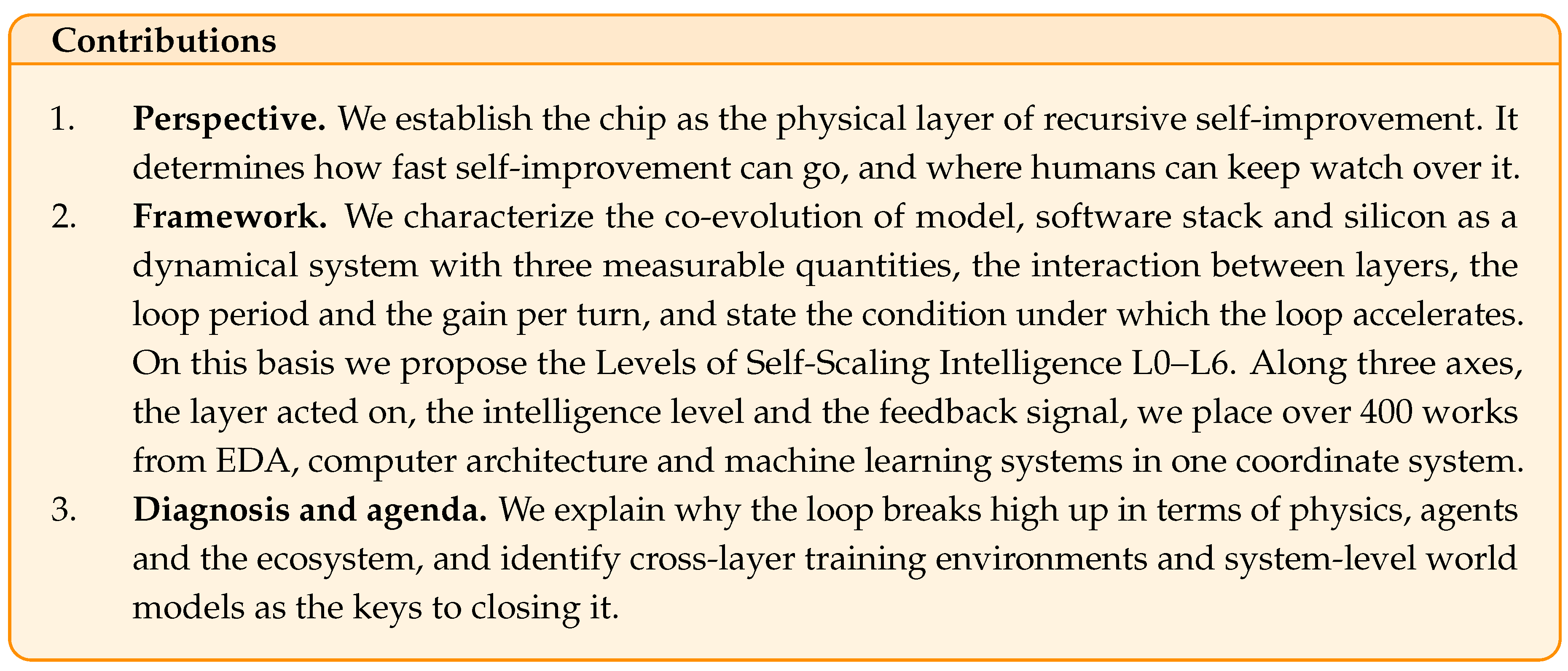
This survey is organized around this question and makes three contributions.
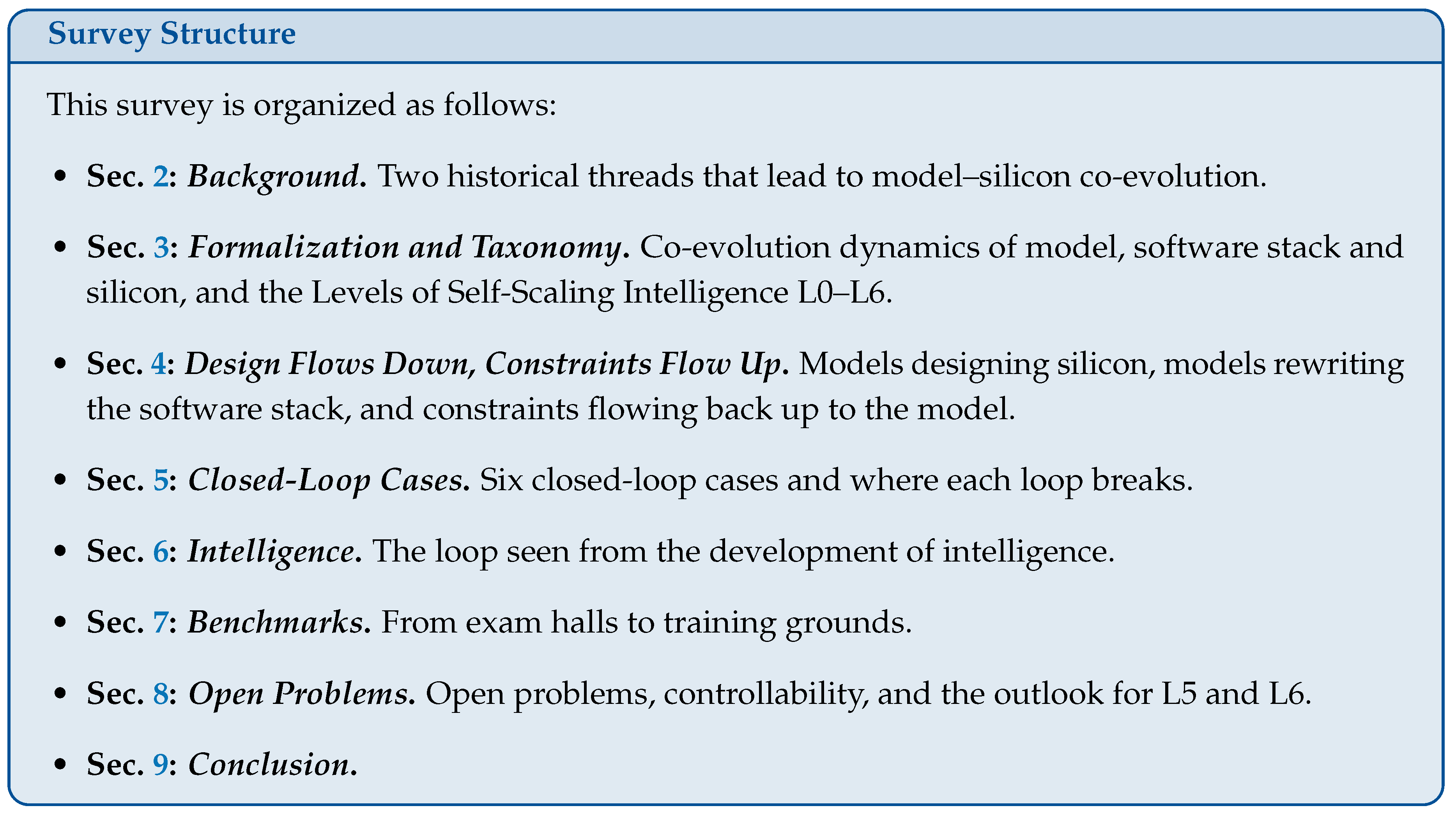
The rest of the survey is organized as follows. Section 2 reviews two historical threads. Section 3 presents the formalization and the intelligence levels. Section 4 surveys three paths along design flowing down and constraints flowing up. Section 5 dissects six closed-loop cases. Section 6 examines the loop from the perspective of how intelligence develops, and Section 7 discusses benchmarks. Section 8 explores open problems, controllability and the outlook for L5 and L6. Section 9 concludes.
The moment named in the title has only just begun. A model has already rewritten its own machine once, by its own hand, but it is still far from building one. What this survey sets out to measure is the distance between that one time and that day.
2. Background: Two Historical Threads
Co-evolution has to join two historical threads: using AI to design chips, and designing chips for AI. The first has climbed steadily in what is learned, from tool parameters and heuristics to code, and then to the tools and flows themselves. The second has gradually reversed who accommodates whom: first models accepted the hardware, then hardware was built for models, and now models change themselves in advance for hardware that does not yet exist.
For a long time the two threads ran in parallel, and the point where they met was always guarded by people (Figure 5). Only in the third stage did they share, for the first time, the same kind of executor: the language-model agent. This section explains why that shared executor is a precondition for co-evolution, and why it is still far from co-evolution itself.
2.1. AI for Chip Design: The Object of Learning Moves Up
2.1.1. The Heuristic Era: Automation Without Learning
EDA has been a discipline of automation from the start. Logic synthesis, placement, routing and timing analysis are nearly all carried out by algorithms, and synthesis systems such as ABC long ago became shared infrastructure for academia and industry [36]. But every heuristic inside these algorithms was designed by human researchers, and the tools themselves did not improve from experience. A better tool had to wait for the next paper or the next release. People were both the tools’ authors and their only learners.
2.1.2. Machine Learning Enters the Flow: Learning Parameters and Policies
Around 2015, machine learning began to enter the design flow, in two main ways. The first was prediction: models estimate congestion, timing or power ahead of time, replacing expensive full implementation runs; RouteNet is an early example [37]. The second was optimization: reinforcement learning or Bayesian optimization searches over tool parameters and design decisions. In 2020, Synopsys launched DSO.ai, which uses reinforcement learning to search the design space [38]. The same year, Google published the reinforcement-learning macro placement method later named AlphaChip, which has since been used in several generations of TPU [39,40]. AlphaChip’s results drew a reproducibility dispute [41], and the dispute itself points to a long-standing problem in the field: when industrial design data is closed, conclusions are hard to check independently.
What this stage learned were parameters or policies within a single stage of the flow. The models did not understand design intent, and they did not cross stage boundaries.
2.1.3. The Language-Model Era: Learning Code and Knowledge
Circuits can be written as text in an HDL, which let language models enter the design flow directly. In 2023, Chip-Chat produced a processor design through conversation with an LLM and taped it out, putting an LLM-designed circuit on real silicon for the first time [42]. The same year, NVIDIA’s ChipNeMo demonstrated the domain-adaptive pretraining route [43], VerilogEval and RTLLM established the first benchmarks for RTL generation [44,45], and ChatEDA let a model orchestrate an entire EDA flow in natural language [46].
One of the most complete systems of this stage is QiMeng, from the Institute of Computing Technology, Chinese Academy of Sciences. On top of a foundation model for processor chips, it builds both hardware-design agents and software-design agents, with the explicit goal of “learning from human experience and self-evolving in practice”; its QiMeng-CPU-v1, about 4 million gates, is described as the first fully automatically designed processor core [47]. What was learned had moved up from parameters to code and design knowledge. But most work stayed within one stage and one task, and people stitched the stages together.
2.1.4. Agents and Self-Evolution: Learning Tools and Flows
In 2025–2026, point capabilities were chained into complete flows. Starting from a 219-word specification, Design Conductor autonomously completed a tape-out-ready RISC-V processor core in 12 hours [13]; its 2.0 version took an algorithm paper as input and designed an LLM inference accelerator in 80 hours [27]. The object being improved also began to point at the tools themselves. Self-Evolved ABC has a multi-agent system rewrite the source code of a synthesis tool of about a million lines, discovering heuristics that beat the human baseline under the constraint of formal equivalence checking [14]; EvoDRC applies self-evolution to DRC repair in physical implementation [48]. Industry followed: Siemens, Cadence and Synopsys each launched EDA agent products in 2026 [19].
Summary. Looking back along this thread, the object of learning moved up from parameters and policies to code and knowledge, and then to the tools and flows themselves. Language models’ autonomy rose with it, from assistance at L0 to end-to-end design at L2. But what it affected was always the chip: changes in the chip rarely changed the model that designed it.
2.2. Chips for AI: From Lottery to Negotiation
2.2.1. General-Purpose Computing and the Hardware Lottery
While Moore’s law and Dennard scaling both held, general-purpose processors got faster on their own every year or two, and software hardly needed to care about hardware. The rise of deep learning came in the aftermath of that era: in 2012, AlexNet was trained successfully on GPUs originally designed for graphics rendering [49]. Hooker later summed up such phenomena as the “hardware lottery”: whether a research idea wins often depends on whether it happens to fit the hardware available at the time [7]. In this period the relationship between model and hardware was one-way and accidental: models accepted the hardware and found their way within it.
2.2.2. The Era of Specialization: Hardware Begins to Be Designed for Models
Dennard scaling ended in the mid-2000s, and Moore’s law slowed soon after. In their Turing Award lecture, Hennessy and Patterson called this a “new golden age” for computer architecture: performance gains would come mainly from domain-specific architectures [50]. Leiserson et al. reached the same conclusion from the other side: in the post-Moore era, performance gains will come increasingly from the co-design of software, algorithms and hardware architecture, not from transistor scaling [51].
Google’s TPU marks this turn. Deployed in data centers since 2015, it was designed specifically for neural-network inference [52]. GPUs then added tensor cores and low-precision datapaths, and cloud providers and startups launched AI accelerators of their own. Specialization is, at heart, a bet: a bet that a class of workloads will persist and matter enough.
2.2.3. Models Begin to Accommodate Hardware
The other side of the bet is that models began to adapt to hardware on purpose. FlashAttention rewrote attention around the GPU memory hierarchy [8]. DeepSeek-V3 chose MLA, MoE and FP8 training around the memory, compute and interconnect limits of H800 clusters, and wrote these lessons back as recommendations for next-generation hardware [9]. Its NSA sparse attention takes “hardware alignment” as a design principle and won the ACL 2025 Best Paper award [53], a sign that hardware awareness has moved from a niche systems topic into the mainstream of model design. The OCP MX microscaling formats, in turn, wrote the agreement between model and hardware on numeric formats into an industry specification [54].
A stronger signal appeared in 2025. DeepSeek-V3.1 switched to the UE8M0 FP8 scaling format for training and stated that the format was prepared for upcoming next-generation domestic Chinese chips [18]. A model changed itself in advance for a piece of hardware that had not yet been released. Accommodation began to shift from “adapting to existing hardware” to “negotiating in advance with future hardware”.
2.2.4. The Software Stack: The Middle Layer Between the Two Ends
Between model and silicon sit compilers, kernel libraries and inference engines. For a long time this layer was hand-tuned by human experts; later came autotuning systems represented by TVM and Ansor [55,56], and Triton, which lowered the barrier to writing kernels [57].
Language models iterate faster in this layer than in chip design, because the feedback is faster and cheaper: a profiling run takes minutes. KernelBench established an evaluation for LLM-generated GPU kernels [58]; CUDA Agent uses large-scale agentic reinforcement learning to beat torch.compile on 100%, 100% and 92% of tasks at its three difficulty levels [15]; AlphaEvolve optimized a training kernel for Gemini itself [1]. This layer was also the first to expose the verification problem: Sakana’s AI CUDA Engineer reported inflated speedups because of a loophole in its evaluation harness, and later corrected them [59]. Qwen’s inference-deployment experiments on domestic Chinese accelerators also fall in this layer [20].
Summary. Along this thread, the relationship went from “models accept hardware” to “hardware is designed for models”, and then to “models adjust in advance for future hardware”. The two sides began to negotiate, but the people at both sides of the table were still human. The software stack, led by models, faced a chip that had already taped out and would not change again.
2.3. From Parallel to Convergent
2.3.1. A Shared Executor
Lay the two threads side by side across the three stages (Table 3) and a pattern emerges. Each thread accelerated on its own, yet a person always stood where they met. In the era of general-purpose computing, the threads did not meet at all. In the era of human-led co-design, the meeting point was guarded by architects, and signals passed from one chip generation to the next. Only in the third stage did a different kind of executor appear at the junction.
Table 3.
The two threads across the three stages. What is learned refers to the AI-for-chip-design thread; who adapts, to who accommodates whom in the chips-for-AI thread.
Table 3.
The two threads across the three stages. What is learned refers to the AI-for-chip-design thread; who adapts, to who accommodates whom in the chips-for-AI thread.
| Stage | What is learned | Who adapts | Executor | Level | Loop period |
| General-purpose (c. 2012) | Hand-crafted heuristics | Model accepts hardware | — | — | — |
| Human-led co-design (2015–2020) | Tool parameters | Hardware adapts to model | Humans | — | Hardware generations |
| Model-in-the-loop (2020–present) | Policies, code, flows | Model pre-adapts to hardware | Humans and agents | L0–L3 | Hours to years |
QiMeng builds hardware- and software-design agents in one system [47]; AlphaEvolve uses the same agent to rewrite a TPU circuit and a Gemini kernel [1]; Qwen has the same model handle both chip-module design and inference-stack adaptation [20]; Design Conductor 2.0 reads a model-algorithm paper and delivers a piece of dedicated hardware [27]. For the first time, one pair of hands reaches across the tower.
A shared executor is a precondition for co-evolution, because only then can cross-layer information travel without being relayed by people. But what makes the two ends shape each other is signals and decisions: a measurement at one end is read by the other, and the system decides how the other end changes. By this standard, they have reached different points. Design Conductor 2.0 decides hardware structure starting from an algorithm, touching this condition. Qwen completes each end separately; the two are not yet connected. AlphaEvolve’s results flow back to the model that drives it, closing the recursion with a gain that is still small.
2.3.2. Three Acceleration Loops
Pull back from the design flow and the same structure appears in discussions of the intelligence explosion. Davidson, Hadshar and MacAskill divide AI self-acceleration into three feedback loops [60]. In the software loop, AI improves AI software; in the chip-technology loop, AI designs better chips; in the chip-production loop, AI and robots manufacture more chips. Each loop is slower than the last, and their judgment is that even if purely software-driven acceleration plateaus quickly, acceleration may still happen once the chip-technology loop is added.
Of the three loops, the software loop is fast but bounded by existing compute, and the production loop is powerful but runs on a scale of years. The chip-technology loop sits in between: it turns intelligence into efficiency per unit of silicon and can raise the ceiling without waiting for production capacity. This is the loop this survey tracks.
3. Formalization and Taxonomy
Table 4.
Overview of the literature in Section 3 (45 entries)
Table 4.
Overview of the literature in Section 3 (45 entries)
| Subarea | Representative works | Count |
| Multilevel optimization and co-design theory | Gajski–Kuhn Y-diagram (1983), De Micheli and Gupta (1997), Teich (2012), Sinha et al. (2018) | 6 |
| LLM-driven iterative optimization paradigms | Reflexion (2023), FunSearch (2024), Gödel Agent (2025), ADAS (2025), EvoMAS (2026) | 8 |
| Hardware-aware NASand joint search | MnasNet (2019), ProxylessNAS (2019), Once-for-All (2020), EDD (2020), DANCE (2021) | 12 |
| Performance and cost models | Roofline (2009), Timeloop and MAESTRO (2019), Kaplan scaling laws (2020), Chinchilla (2022), LLMCompass (2024) | 10 |
| Prior surveys and taxonomies | Benmeziane et al. HW-NAS survey (2021), Wang et al. LLM agent survey (2024), LLM4EDA, Dawn of Agentic EDA | 9 |
3.1. The Three-Layer System
We abstract a computing system that hosts a language model into three layers. The model layer M covers the network architecture, attention and expert routing, numerical formats and the training recipe. The software-stack layer S covers compilation strategy, kernel implementations, parallel partitioning and inference scheduling. The hardware layer H covers the microarchitecture, memory hierarchy, interconnect, RTL and physical layout, and extends beyond the die to advanced packaging and chiplets, HBM stacks, and the rack-level interconnect topology, power delivery and cooling, where many bottlenecks of large-model infrastructure now lie [9,61]. The system’s objective is a joint function that, under cost, power and area constraints C, measures some combination of model capability and serving efficiency, such as effective tokens per second per watt.
Existing methods can be read as different slices of this problem. Hardware–software co-design solves once for a joint optimum over when a project starts [62,63]. Hardware-aware NAS fixes H and searches over M, treating the cost of H as a constraint or penalty [64,65,66]. Joint model–accelerator search further frees some parameters of H, yielding a bilevel optimization in which the outer level picks the hardware and the inner level picks the network [16,17,67,68,69]. What they share is that they are static: the problem is fixed before solving begins and does not change once solving ends.
3.2. Dynamics of Co-Evolution
Co-evolution puts time back into the problem. Let ; the system evolves as
Here is a measurement of the system, is the update operator for layer X, is the trace this round of design leaves behind (attempts, measurements and records of success and failure), and is the capability of whoever performs the update, including both its weights and the harness, memory and skills that organize how it does R&D. The harness therefore belongs to , not to S: the former determines how the executor conducts R&D, the latter how the model executes on hardware. Three properties set this apart from static co-design: the target moves, the clocks differ, and the executor may sit inside the system. Each gives the rest of this survey a quantity to measure. Throughout we work with , in which a speedup becomes an increment and successive increments add.
The target moves. While one layer is being optimized, the others are changing too, so chases a target that other layers have already rewritten. To say by how much, take two layers , hold the third fixed, and let a round of updates carry them from to . Write and for the gain of each change made alone, and for the gain of both. Their interaction is
The second form, a rearrangement of the first, says what is: the gain of the change to A measured after B has moved, minus the gain of the same change measured before. If J factors into a term in A and a term in B, as when a kernel needs half the operations on a chip that runs each operation twice as fast, then v is a sum of the two terms, vanishes for every pair of changes, and optimizing the layers one at a time loses nothing; this is the regime in which the static slices of Section 3.1 suffice. Otherwise the worth of an update to one layer depends on what the other has become. is positive when the two changes relieve different stages of one pipeline, because removing one bottleneck exposes the other, and negative when both attack the same bottleneck. A nonzero is the precise sense in which the target moves; it returns as the unit of attribution in Section 6.6 and of measurement in Section 7.4.
The clocks differ. The three operators do not fire at the same rate. Let be the update period of layer X: the layer is rewritten once every and held fixed in between, so is the identity at all other steps. Today is hours to days, months and years. A loop through a set of layers completes one turn when every layer in has been updated on measurements taken since the previous turn ended, and the result has itself been measured and adopted. Consecutive turns each need a fresh update of every layer on the loop, so K turns contain K distinct updates of the slowest layer and last at least . Dividing by K and letting K grow, the loop period, the long-run time per turn, satisfies
The slowest layer on a loop sets its tempo whatever the speed of the others. A loop confined to the software stack can turn in hours; a loop through silicon cannot turn faster than one tape-out follows another.
The executor may sit inside. When the executor is a human or a fixed search algorithm, is independent of and the update of can be dropped. When the executor is a language model, is itself determined by M and is trained and run on S and H, so the system may act on the very hand that improves it. Whether that matters is a question about successive turns. Consider one loop in isolation, with exogenous inputs such as process nodes and installed capacity held fixed, and suppose a change is adopted only if it does not lower v. Let be the value of v after turn k and the duration of that turn, and define the gain and the rate of turn k as
The gains telescope, so after K turns, and a constant rate is exponential growth with doubling time , the regime Moore’s law described while people turned the loop. The loop accelerates when the rate rises from one turn to the next. Writing for the ratio of successive gains, defined while , and for the ratio of successive periods,
A loop can accelerate in only two ways: each turn gains more than the last, or each turn takes less time than the last.
Two limiting cases bracket what is possible. Suppose first that the period is pinned, , as tape-out pins a loop through silicon, and that gains shrink by at least a fixed factor, . Then , and summing the geometric series gives
The loop saturates below a ceiling fixed by its first gain and its ratio. Suppose instead that gains hold, , while periods shrink by at least a fixed factor, . The same series now bounds the elapsed time, , while the cumulative gain grows without limit: unbounded growth in finite time, the formal shape of the intelligence explosion [70]. No physical loop reaches that limit, because cannot fall below the latency of the feedback the loop waits for (Section 3.5). Between the two cases, everything turns on whether stays above .
Which case applies is decided by the update of . Suppose the gain of a turn depends on the executor that makes it and on the state it starts from, , and that for a fixed executor does not increase with v: the better the system already is, the less the same executor can add to it [71]. With an exogenous executor of fixed capability, for all k; since ,
so , and by Equation (4) such a loop cannot accelerate unless its period shrinks. With an endogenous executor, requires
that is, the executor that comes out of turn k must extract more from the same system than the executor that went in. Under this assumption, a loop whose period is pinned can accelerate only if its executor improves from one turn to the next. The update of is where a loop turned by a model gets that improvement, which is why the levels of Section 3.4 turn on whether the loop returns to .
3.3. The Evolving Executor
The “design, evaluate, feed back” loop has a long history. Gajski and Kuhn’s Y-diagram describes design as mappings among three views: behavioral, structural and geometric [72]. The Y-chart approach of Kienhuis et al. describes the application and the architecture separately and, after mapping and performance evaluation, feeds the results back to the application, the architecture or the mapping itself [73]. This is already a static prototype of co-evolution, except that f is carried out by human engineers.
Language models bring a new f. Self-Refine iteratively rewrites its output based on its own feedback [74]; Reflexion writes the record of failures into the next round’s input [75]; Voyager accumulates a library of reusable skills [76]; OPRO proposes new solutions from past solutions and their scores [77]; FunSearch embeds a language model in an evolutionary search scored by a program evaluator [78], and became the precursor of AlphaEvolve. ADAS and Gödel Agent go a step further and move the object of search up to the agent’s own design and code [79,80]; EvoMAS has a meta-controller propose and revise heuristic rules during evolution [81], and VFlow does the same in chip design [82].
These paradigms are isomorphic to the Y-chart; what differs is the search operator. Traditional methods rely on fixed mutation rules or cost-model gradients, whereas a language model can read unstructured such as compiler errors, timing reports and profiles and directly generate new programs, so a single executor can act on all three layers. Yet these paradigms specify neither which layer comes from nor which layer an update lands in. They supply the engine of co-evolution, but not the transmission.
3.4. Levels of Self-Scaling Intelligence
In this notation, the Levels of Self-Scaling Intelligence describe how far intelligence can reach and change within the R&D loop, that is, which part of the dynamics it has taken over (Table 5, Figure 7): from a single step and a layer, to itself and the whole tower, then its resources and finally its goals. At L0, AI only proposes candidates for ; humans evaluate and decide. At L1, AI runs the inner iterations of , but the search space and the evaluator are given by humans; hardware-aware NAS belongs here even when it spans two layers. At L2, AI carries out the whole of starting from a specification, including task decomposition and verification, again regardless of how many layers it spans. L3 builds on L2: the gains of R&D return to the executor, which grows stronger through its own work. The return takes one of two paths, marked in brackets as for L4. On the internal path, L3[], g depends on : the executor updates its weights, memory, skills or tools from its own design experience on a cycle of hours, and the return does not pass through the hardware and software that host it. On the external path, L3[S] or L3[H], g depends on : products the AI designed are deployed in the software stack or chips that train or run the executor and its successors, on a cycle of months to years. A work counts as L3[] only if three conditions hold together: the experience comes from the system’s own runs, it persists across tasks or designs, and an ablation shows that it improves later rounds. At L4, AI further reads cross-layer and decides for itself which X to update; the updates of at least two layers pull on one another through , while the gains still return to ; when all three layers close, the dynamics of Section 3.2 run in full. L4 marks whether the co-evolution mechanism holds, and the brackets mark which layers it covers: L4[], L4[] and so on name the participating layers, and L4[] is whole-tower co-evolution across all three layers. L4 requires the external path, so its notation continues naturally from L3[S] and L3[H].
Figure 6 sets the structure, capabilities and human role of L0–L4 side by side: L0–L2 progressively take over the within-layer flow, L3 brings design results back to the designer itself or its successors, and L4 lets the designs of different layers adjust to one another through feedback and keep iterating. The progression in the figure marks a change in the criterion for each level; it does not mean that human checkpoints disappear automatically at higher levels.
Figure 6.
Structure and capabilities of L0–L4 in the Levels of Self-Scaling Intelligence. L0 offers design suggestions to humans; L1 iterates autonomously under a given task and evaluator; L2 organizes the complete flow from specification through verification to delivery; L3 brings design results back to the designer itself and its successors, raising the capability or efficiency of its later R&D; L4 builds on this, letting at least two of model, software and hardware adjust to one another through feedback and keep iterating. The bottom of each column lists the main responsibilities borne by humans.
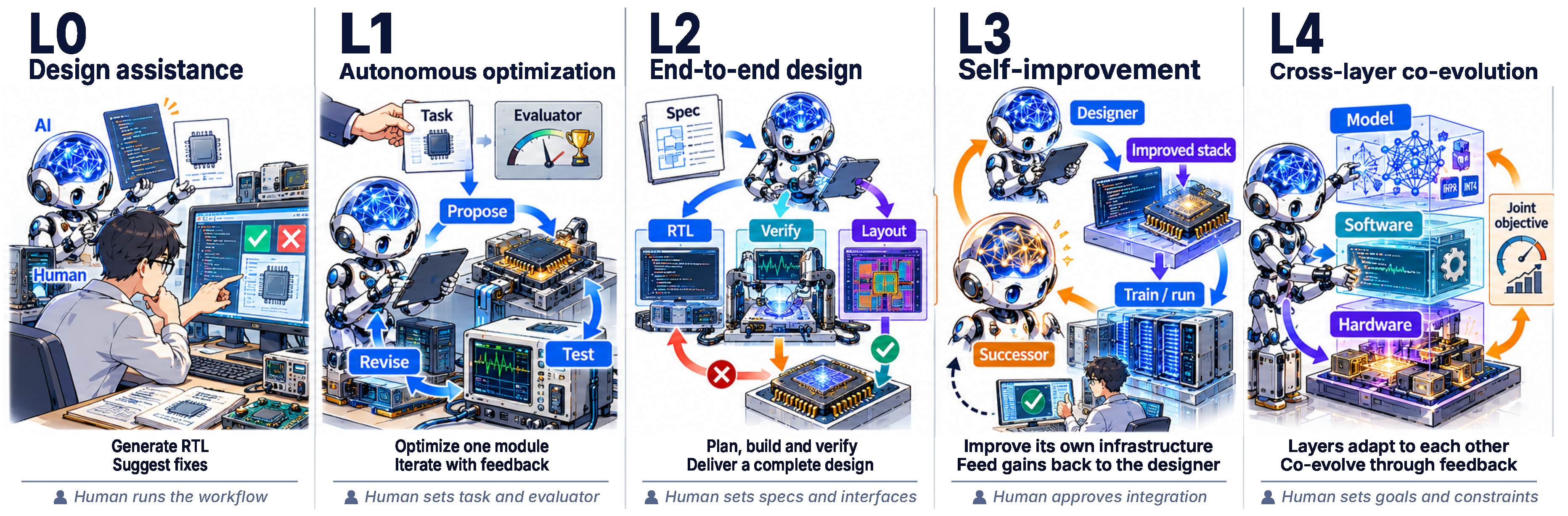
Figure 7.
Representative works across the Levels of Self-Scaling Intelligence. Each column lists works and their main mechanisms; icon colors mark the layer edge acted on, and dashed boxes mark open slots; illustrations sketch each level’s loop. The L3 column mixes the internal path L3[] and the external paths L3[S] and L3[H]. Beyond L4, the loop points toward recursive self-expansion and recursive self-improvement.
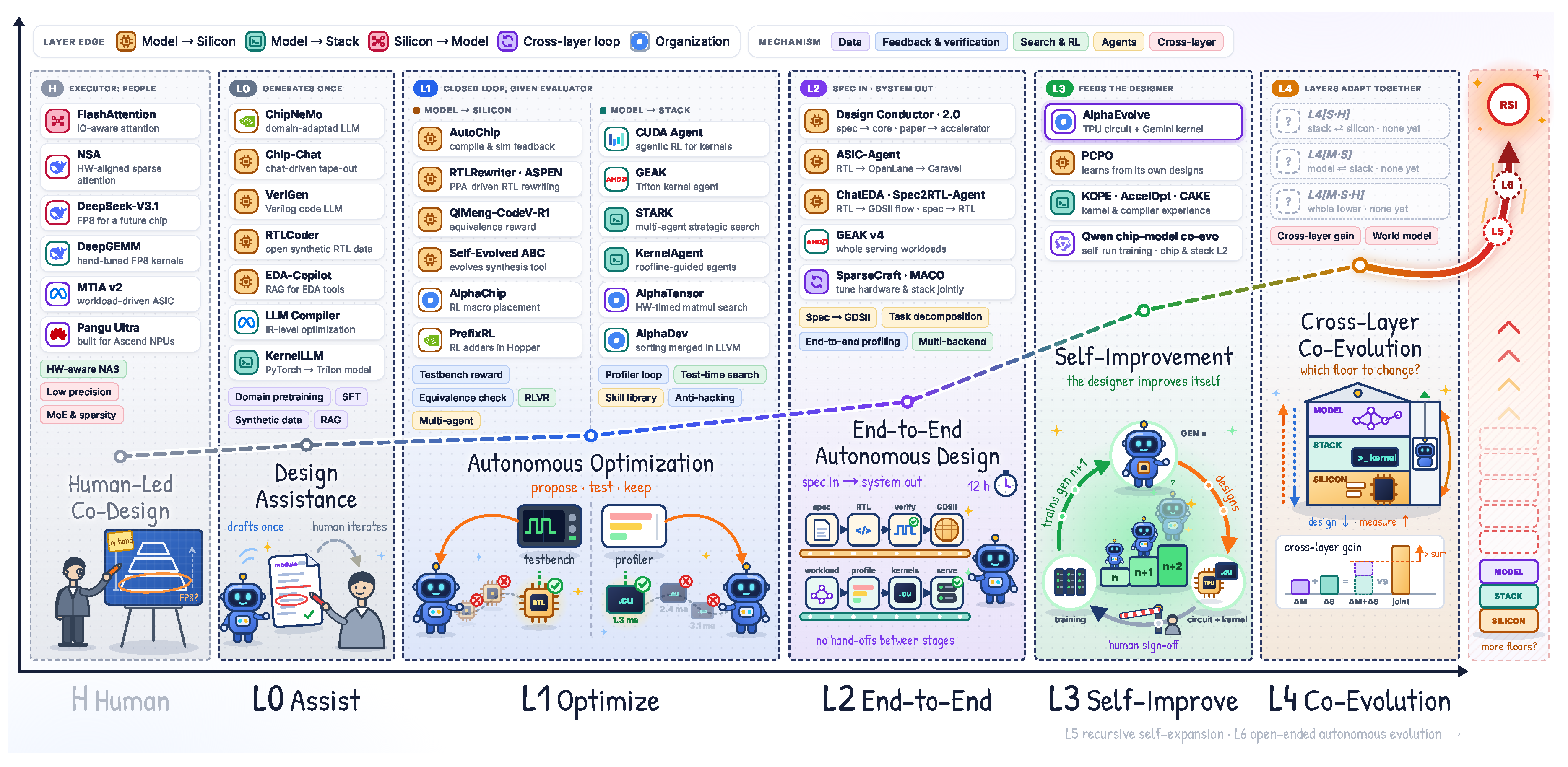
Table 5.
Levels of Self-Scaling Intelligence.
| Level | Defining criterion | Human role | Representative works |
| L0 Design assistance | AI generates code, design proposals or analysis, but does not independently run the “propose, verify, revise” iteration | Defines the problem, organizes the flow, verifies results and decides the next step | ChipNeMo, Chip-Chat, VeriGen, RTLCoder, EDA-Copilot, KernelLLM |
| L1 Autonomous optimization | Under a given task, interface and evaluation criterion, autonomously proposes candidates, calls tools, reads feedback and iterates | Provides the task and evaluator; organizes the complete flow | AutoChip, RTLFixer, VeriReason, RTLRewriter, ASPEN, CUDA Agent, KernelAgent, Self-Evolved ABC, AlphaChip |
| L2 End-to-end autonomous design | Starting from a target specification, autonomously decomposes the task, orchestrates tools, carries design through verification, delivers a system that meets the requirements and handles common failures | Sets the division of labor between layers and the key interfaces | ChatEDA, Spec2RTL-Agent, Design Conductor and its 2.0, ASIC-Agent, GEAK v4 |
| L3[] Self-improvement, internal | Updates its own weights, memory, skills or tools from its design experience; the return does not pass through the hardware and software that host it | Sets admission criteria for experience | PCPO, KOPE, AccelOpt, CAKE, Dr. RTL, Qwen self-directed training |
| L3[S], L3[H] Self-improvement, external | Deploys the products it designed in the software stack or chips that train or run itself and its successors | Approves results entering training and deployment | AlphaEvolve (L3[S]; L3[H] awaits tape-out) |
| L4 Cross-layer co-evolution | AI decides for itself which layers to update; at least two of model, software stack and hardware keep adapting to one another through feedback, and the gains flow back to the designer, raising the capability or efficiency of its later R&D | Sets system objectives and constraints | — |
| L5 Recursive self-expansion | R&D progress translates into expanded compute, experimental facilities and production deployment capacity, and the new resources are reinvested in the next round of R&D | Sets objectives and resource bounds | — |
| L6 Open-ended autonomous evolution | Sets its own goals, and autonomously discovers research questions, establishes research methods and explores new computing paradigms and technical routes | — | — |
L5 and L6 extrapolate further along the same line. At L5, the constraints C themselves become variables to optimize, and R&D results turn into compute and production capacity that are reinvested in the next round of R&D; at L6, the objective J and the design space are also handed to the system to redefine. The main text of this survey focuses on L0 through L4; L5 and L6 are discussed in Section 8.4.
3.5. Feedback Signals and Timescales
The quality of an update operator depends on the it reads. Ordered by distance to silicon from far to near, we divide feedback signals into six tiers: S1 syntax and compilation (seconds), S2 functional correctness (minutes to hours), S3 implementation quality such as timing, area, power and DRC (hours), S4 performance profiling (minutes), S5 end-to-end measurement on real hardware (hours to days), and S6 post-silicon and at-scale deployment data (months to years). S1–S6 span about seven orders of magnitude.
Between the expensive signals, cost models provide intermediate fidelity. On the hardware side, Roofline gives the coarsest upper bound [83]; SCALE-Sim, Timeloop, MAESTRO, Accelergy and ZigZag estimate accelerator performance and energy in seconds to minutes [84,85,86,87,88]; and LLMCompass and Vidur simulate LLM hardware and inference serving, respectively [89,90]. On the model side, scaling laws use small-scale experiments to predict the outcome of large-scale training [91,92]. A 2026 work writes both into a single formula, using scaling laws for accuracy and Roofline for latency, to jointly select on-device model architectures for a given piece of hardware, cutting architecture selection from months to days [93].
J is therefore, in principle, already approximately computable. The real difficulty is the trade-off between fidelity and latency: a loop that reads only cost models is fast but can be led astray by model error, while a loop that waits for S6 is trustworthy enough but turns only once a year. In the terms of Section 3.2, the tier a loop waits for puts a floor under its period , and the error of the cheaper signal it reads instead puts a floor under how much of a measured gain can be believed. Section 6.5 returns to it.
4. Design Flows Down, Constraints Flow Up
Picture the model, the software stack and silicon as a pyramid: silicon is the foundation, the software stack sits in the middle, and the model is at the apex. Along this tower, influence flows in two directions. Design flows down: language models, acting as designers, reach down to rewrite the software stack and design silicon, and both of these paths are already crowded with agents. Constraints flow up: hardware first limits what the software stack can implement efficiently, and the software stack in turn limits which structures and numeric formats are worth adopting in the model, passed up one layer at a time. This path has its travelers too, but they are almost all human teams. This section first examines the two design paths, then how hardware shapes models layer by layer, and finally compares the three paths in Section 4.4 (Figure 8).
Table 6.
Overview of the literature in Section 4 (211 entries).
Table 6.
Overview of the literature in Section 4 (211 entries).
| Subarea | Representative works | Count |
| Silicon ·RTL generation and reasoning models | AutoChip, VeriGen, RTLCoder, CraftRTL, VeriReason, QiMeng-CodeV-R1, ChipSeek | 18 |
| Silicon ·RTL and PPA optimization | RTLRewriter, SymRTLO, VFlow, Cedar | 8 |
| Silicon ·Debugging and repair | RTLFixer, MEIC, HDLdebugger, HWE-Bench | 4 |
| Silicon ·Verification | LLM4DV, AssertLLM, UVLLM, AssertionForge, LLM4Cov | 9 |
| Silicon ·HLS andarchitecture exploration | GPT4AIGChip, ArchGym, HLSPilot, LLM-DSE, ArchAgent | 13 |
| Silicon ·Knowledge assistance | ORAssistant, ChipAlign, EDA-Copilot | 3 |
| Silicon ·Physical implementation and tools | ChatEDA, ORFS-Agent, Self-Evolved ABC, PCPO, EvoPlace | 13 |
| Silicon ·End-to-end agents | ASIC-Agent, Spec2RTL-Agent, Design Conductor 2.0, PCBgen, Jalapeño first silicon | 9 |
| Silicon ·Analog circuits | LaMAGIC, AnalogCoder, AnalogGenie, SLIC | 6 |
| Stack ·Tensorcompilation foundations | Halide, TVM, Triton, Ansor, TileLang, AlphaTensor, AlphaDev | 15 |
| Stack ·Human-built stacks for specific models | DeepGEMM, FlashMLA, DeepEP, CloudMatrix384, TileKernels | 7 |
| Stack ·LLM-generated kernels | AI CUDA Engineer, CUDA Agent, KOPE, CAKE, KernelEvolve | 24 |
| Stack ·End-to-end workloads | KernelFalcon, AutoMegaKernel, GEAK v4, Arbor, Glia | 8 |
| Stack ·LLMs for compilers | MLGO, CompilerGym, Meta LLM Compiler, LPO | 8 |
| Stack ·Inference systems | Orca, vLLM, SGLang, Mooncake, SEIS | 9 |
| Model ·Attention andthe memory hierarchy | MQA, GQA, FlashAttention series, Mamba, NSA, Step-3, Kimi Linear | 13 |
| Model ·Sparsity,MoE and decoding | GShard, 2:4 structured sparsity, speculative decoding, DeepSeekMoE, EAGLE-3, DeepSeek-V4 | 8 |
| Model ·Numeric formats | GPTQ, AWQ, FP8 formats, MX formats, BitNet b1.58, DeepSeek-V3.1 UE8M0, NVFP4 pretraining | 18 |
| Model ·Parallelism and system-level co-design | Megatron-LM, ZeRO, DeepSeek-V3 technical report, DeepSeek-V3 hardware reflections, Llama 3 parallel training, MTIA v2, Pangu Ultra | 15 |
| Cross-layer ·LLM-involved cross-layer co-design | MACO, SparseCraft, CHEETAH | 3 |
4.1. Design Flows Down (I): Models Design Silicon
This path has the densest literature, and several surveys have already mapped it in detail [10,11,12]. Rather than catalog it stage by stage once more, we ask a single question of the work on this path: where does its feedback come from, and what does it improve?
4.1.1. RTL Generation: From Prompting to Verifiable Rewards
RTL generation has gone through three generations of methods. The first relied on prompting and feedback iteration: AutoChip feeds compilation and simulation errors back to the model [94], while VeriGen fine-tunes on open-source Verilog [95]. The second generation is data-centric: RTLCoder, OriGen, CodeV, CraftRTL, DeepRTL and others raise the quality of supervised fine-tuning through synthetic data, code–description alignment, error-correction data and similar techniques [96,97,98,99,100]; BetterV, AutoVCoder, VerilogCoder and MAGE add discriminative guidance, retrieval and multi-agent collaboration [101,102,103,104].
The third generation arrived in 2025, centered on reinforcement learning with verifiable rewards (RLVR). VeriReason combines testbench feedback with structural heuristics in its reward [105]; VeriRL likewise uses reinforcement learning to improve Verilog generation [106]; QiMeng-CodeV-R1 builds a rule-based testbench generator that checks equivalence against reference designs, and filters its training data by round-trip consistency (“code to description and back to code”). Its 7B model reaches 68.6% and 72.9% pass@1 on VerilogEval v2 and RTLLM v1.1, respectively, surpassing the 671B DeepSeek-R1 on RTLLM [107]. ScaleRTL takes the route of distillation and test-time scaling, training a reasoning model for RTL on 3.5 billion tokens of long chain-of-thought data and beating 18 baselines by up to 18.4% on VerilogEval and 12.7% on RTLLM [108]. With module-level benchmarks nearing saturation, the frontier is moving to the IP level: QiMeng-ChipV-RTL splits long specifications into local tasks and raises the pass rate on RealBench from 21.6% to 45.0% [109].
What this line of evolution signifies is an upgrade in the feedback signal: from S1 (does it compile?) to S2 (does it pass tests or equivalence checks?). The S3 signals of timing, area and power have only recently entered training rewards: PPA-RTL and ChipSeek write post-synthesis PPA into the reinforcement-learning reward, securing functional correctness first and then optimizing power, delay and area [110,111]. Such work is still confined to benchmark-scale designs, and the RTL-OPT benchmark was proposed precisely to address this gap (see Section 7).
S3 first entered through search at inference time. RTLRewriter rewrites RTL by combining circuit partitioning, retrieval and cost-aware Monte Carlo tree search, rewarding synthesis results and guarding correctness with equivalence checking [112]; SymRTLO combines LLM rewriting with symbolic reasoning and FSM optimization [113]; ASPEN has a language model propose and select e-graph rewrite rules, replacing proxy cost models with area and timing from real EDA tools and cutting area by 16.51% on average [114]; AutoGate inserts fine-grained clock gating according to the toggle activity of real workloads, reducing dynamic power on NVDLA by 19.34% [115]. VFlow moves the object of search from the RTL up to the agentic workflow that generates it, using multi-population cooperative evolution and Monte Carlo tree search to optimize functional correctness, area, power, timing and token cost jointly, and raising pass@1 on VerilogEval and RTLLM 2.0 by 20% to 30% over prompting baselines [82]. HORIZON goes further and treats hardware design as repository-level code evolution, repeatedly modifying an entire design repository under an executable evaluator and acceptance conditions [116]. All of them iterate toward a given objective and belong to L1, yet they already treat S2 as a gate and S3 as the goal. Dr. RTL begins to bring experience back to the designer, an L3[]: it compares parallel rewrites and distills a skill library reusable across designs (currently 47 entries); the skill-equipped version converges faster and reaches better PPA, improving WNS and TNS by 21% and 17% and cutting area by 6% against a commercial synthesis tool on 20 real designs [117]; Cedar has a language model propose rewrite rules, verifies each with Z3 and keeps the verified ones for later designs, likewise L3[], cutting area and power by 19.8% and 18.9% in geometric mean on RTLLM [118]. Functional correctness is a necessary condition, but design quality is the actual goal of chip design; bringing these costly signals stably into large-scale training is the next distance to cross.
4.1.2. Debugging, Repair and Verification
Debugging work takes error reports as input and produces repairs as output, the minimal form of an agent loop: RTLFixer repairs syntax errors with retrieval augmentation and ReAct-style reasoning [119], and MEIC and HDLdebugger go further to handle functional errors [120,121]. HWE-Bench moves repair into real repositories: on 417 real bugs from six projects, the best agent resolves 70.7% overall but less than 65% on SoC-level projects, with failures concentrated in fault localization and in coordinating edits across files [122]. Verification work, by contrast, produces the S2 signal itself: early work used language models to generate security-related SystemVerilog assertions [123], LLM4DV and UVLLM automatically generate stimuli and test environments [124,125], PRO-V-R1 trains an open-source verification agent with simulation feedback as the reward, raising functional correctness from the base model’s 25.7% to 57.7% [126], LLM4Cov approaches coverage closure through offline agent learning, bringing a 4B model to 90.4% average coverage [127], AssertLLM extracts assertions from specification documents [128], AssertionForge organizes the specification and RTL jointly into a knowledge graph from which it generates formal assertions [129], and Saarthi carries out end-to-end formal verification through multi-agent collaboration [130]. Yet a provable assertion is not a reliable gate: on 342 hierarchical modules, HierSVA finds that 82.1% of generated assertions prove non-vacuously, yet they catch only 70.2% of injected faults, and 40% of the “buggy verdicts are false positives [131]. Verification work matters especially for co-evolution: it determines how trustworthy the loop’s “correctness” gate is (Section 6.3).
4.1.3. HLS and Architecture Exploration
This class of work sits closest to the architecture level, and it is the entry point through which chip design reaches cross-layer co-design. GPT4AIGChip was an early attempt to generate HLS code for AI accelerators with language models [132]; ArchGym provides a unified environment for ML-driven design space exploration of computer architectures [133], and LLMulator goes on to use a language model as the performance model of dataflow accelerators, bringing cycle-prediction error down to 11.2% after reinforcement-learning calibration [134]; SpecLLM explores using language models to write and review architecture specifications [135]; HLSPilot and C2HLSC rewrite C code into synthesizable HLS implementations [136,137], and HLS-Seek trains a 7B model against a learned pairwise reward, reaching 81.4% functional pass@5 on HLS-Eval and beating GPT-5.1 [138]. LLM-DSE optimizes HLS directives with four kinds of collaborating agents (router, specialist, arbitrator and critic), achieving about a 2.55× performance improvement over prior methods on the HLSyn dataset [139]; SECDA-DSE connects LLM-driven design space exploration to SystemC simulation and FPGA execution [140]; MicroEvo uses language models as evolutionary operators inside Monte Carlo tree search to explore CPU microarchitectures, improving Pareto-front quality by up to 36.2% over NSGA-II [141]. Ding et al. compare how agents design at different levels of abstraction: across 11 FPGA tasks, writing HLS and then refining the RTL yields designs 2.6× faster in geometric mean than writing RTL directly [142]; PF-LLM has a language model supply hints to a hardware prefetcher [143]. ArchAgent goes further: an agent built on AlphaEvolve writes new cache-replacement logic directly, and within two days finds a policy whose IPC on Google workloads is 5.3% above the previous best; it also exposes the risk of agents exploiting loopholes in the simulator [144]. The inputs to these works now include the workload, and the partitioning and mapping of the workload are beginning to become variables the agent optimizes; HSCO-Bench, for example, asks agents to decide which kernels to accelerate and to remap the software [28]. The application and the model themselves, however, are still taken as given.
4.1.4. Physical Implementation and Tools
The most basic class is knowledge assistance. ORAssistant and EDA-Copilot use retrieval augmentation to answer questions about tools and flows and to help write scripts and code [145,146]; ChipAlign shows that domain knowledge and following engineering instructions are two different things, merging a general instruction-tuned model with a chip-domain model in weight space without retraining [147]. ChatEDA goes further, letting a model plan tasks, generate scripts and execute the tool flow from RTL to GDSII, a pioneer of end-to-end orchestration within a constrained flow [46]; MCP4EDA uses MCP to connect synthesis, simulation and place-and-route tools, feeding back-end timing, power and area into the synthesis scripts [148]; ORFS-Agent tunes parameters on the OpenROAD flow to improve PPA [149]; StateTune keeps a persistent memory for flow tuning, reaching the best final hypervolume on all six blocks of a Cadence industrial flow and losing 58.5% of it when the memory is removed, an L3[] on the physical side [150]; BUFFALO trains a language model with GRPO to generate buffer trees for all violating nets in one pass, beating a leading commercial tool by 71% in TNS on nine 7nm full-chip designs [151]; EvoDRC applies self-evolution to fixing DRC violations [48]. The object being improved then moved up to the tools themselves. EvoPlace was an early use of language models to evolve the optimization algorithms of global placement, improving wirelength by 8.30% on average on ISPD2019 [152]; Self-Evolved ABC pushes this to the source code of a synthesis tool at the scale of a million lines, with every rewrite guarded by formal equivalence checking [14]. MappingEvolve evolves technology-mapping code, reducing area by 10.04% against ABC [153]; HELIX and AuDoPEDA edit the C++ source of OpenROAD directly, with the former cutting routed wirelength by 5.6% in geometric mean and up to 23%, and the latter cutting power by up to 19.4% [154,155]; VeoPlace leaves the placer’s code alone and instead has a vision-language model draw region constraints for an existing placer, improving DREAMPlace by up to 4.4% on eight Superblue designs [156]. PCPO makes the designer itself stronger: it designs learning-rate schedules for global placement, curates high-quality and diverse samples from the algorithms it has generated, and uses them to update the model’s parameters; trained on 4 chip cases, it outperforms evolutionary methods with fixed models such as OpenEvolve and ShinkaEvolve across 16 cases [21].
4.1.5. End-to-End Agents
ASIC-Agent assigns separate sub-agents to RTL generation, verification, OpenLane back-end implementation and Caravel chip integration, and proposes an agent-oriented benchmark [157]. Spec2RTL-Agent starts from complex specification documents and generates RTL step by step through pseudocode, Python and synthesizable C++, correcting errors through verification and reflection and cutting human interventions by up to 75%, though its endpoint is RTL [158]. Design Conductor starts from a 219-word specification and, within 12 hours, delivers a RISC-V processor core that closes timing at 1.48 GHz (ASAP7) [13]. Its 2.0 version handles tasks roughly 80 times larger: in 80 hours, taking the TurboQuant paper as input, it designed VerTQ, an inference accelerator with 5,129 floating-point units and a 240-stage pipeline that runs at 125 MHz on an FPGA and occupies an estimated 5.7 mm2 in TSMC 16FF with eight attention pipelines [27]. On the industry side, Cadence, Synopsys and Siemens each launched EDA agent products in 2026 [19]. Agents have also begun to reach beyond the chip itself: PCBgen has a self-evolving agent generate PCB schematics from specifications and tune their parameters [159]. Yet as of November 2026, no chip designed end to end by a language-model agent has taped out. Design Conductor’s processor core stops at GDSII in the ASAP7 predictive process, and VerTQ’s area is a post-layout estimate; Redwood, an accelerator SoC whose performance model, RTL, verification and firmware were all produced by AI within two weeks, runs only on an FPGA so far [160]. What has actually returned as silicon is either human-led with models contributing to the front end, as in Jalapeño, whose first silicon came back in May 2026 [161], or a single subsystem, such as the I/O ring generated by AMS-IO-Agent and taped out in a 28nm process [162].
4.1.6. Analog Circuits
Analog circuits do not lack text, since a SPICE netlist is itself text; what they lack is a topology encoding that models learn easily, large datasets grounded in simulation, and a verifier as fast as logic simulation. In early work, LaMAGIC uses language models to generate power converter topologies [163], and AnalogCoder describes and iterates on analog circuits in Python code [164], with its extension AnalogCoder-Pro adding waveform feedback and a subcircuit library [165]. Since 2025 these gaps have been closing: AnalogGenie designs a new sequence representation for topologies, with 93.2% of its generated circuits valid [166]; SAFTAC builds 8,626 netlist tasks with testbenches and trains open models with simulation rewards [167]; and SLIC trains a 7B model with reinforcement learning on simulation feedback, beating a 1.6-trillion-parameter baseline by 12.7 percentage points on multi-turn circuit optimization [168]. Analog circuits are therefore no longer just a boundary case; what still clearly lags is layout and signoff.
Summary. Within three years, models’ ability to design silicon has grown from writing a snippet of Verilog that compiles (L0), through autonomous iteration on verifiable feedback (L1), to delivering a processor core from a specification (L2). But nearly all of this work stays within a given layer: the feedback comes from the chip itself, and the improvements act only on the chip. PCPO’s designer grows stronger through its own designs (L3[]), and AlphaEvolve’s TPU circuit will return to the infrastructure that trains it (L3[H], awaiting tape-out); Design Conductor 2.0 takes a model-algorithm paper as input and lets the agent decide how the hardware should carry that algorithm, a cross-layer decision from the model side.
4.2. Design Flows Down (II): Models Rewrite the Software Stack
Of the three layers, the software stack returns the fastest and cheapest feedback: a profile takes only minutes (S4), and an end-to-end measurement a few hours at most (S5). It is where the loop closed first.
4.2.1. Pre-LLM Baselines
Automatic optimization of tensor programs has a clear lineage. Halide separates the algorithm from the schedule [169]; TVM builds on this an end-to-end deep learning compiler stack [55], Ansor replaces hand-written templates with automatically generated search spaces and a learned cost model [56], and MetaSchedule and TensorIR further unify scheduling primitives and tensorization [170,171]. Triton lowers the barrier to writing GPU kernels by hand [57], while ThunderKittens and TileLang pursue near-hand-tuned performance through abstractions closer to the hardware [172,173]; FlashAttention-4 is written in CuTe DSL and runs 1.3× faster than cuDNN on B200 [174], and ParallelKittens extends such embedded DSLs to multi-GPU and expert-parallel settings [175]. On the automated side, Mirage searches tensor programs by superoptimization with equivalence verification [176], MPK automatically compiles multi-GPU inference into a single persistent megakernel [177], and Twill uses SMT solving to find optimal software pipelining and warp specialization, coming within 2% of expert schedules on FA3 and FA4 [178]. Reinforcement learning reached this layer early as well: AlphaTensor searches matrix-multiplication algorithms against measured runtime on specific GPUs and TPUs [179], and the sorting routines AlphaDev discovered were merged into LLVM’s C++ standard library, showing that AI improvements to low-level software can pass through normal engineering processes [180]. The lineage has moved from “search plus a cost model” to search or solving over an explicit hardware abstraction, and it is the reference point against which the contribution of LLM methods should be judged.
4.2.2. Human-Built Stacks for Specific Models
DeepGEMM, FlashMLA and DeepEP, open-sourced by DeepSeek in 2025, were first released as hand-written implementations for the Hopper architecture of FP8 matrix multiplication, MLA decoding attention and expert-parallel communication, respectively [181,182,183]. They show that once a model’s structure has been adjusted for the hardware (Section 4.3), the software stack must be rewritten for that model, and the rewriting recurs. When V3.2 introduced DeepSeek Sparse Attention, DeepGEMM and FlashMLA gained new indexer and sparse-attention kernels, and vLLM and SGLang followed on release day [184]; by V4.1, FlashMLA had dropped support for Hopper and for older models and now targets both Blackwell and Ascend 950, while a new kernel library, TileKernels, is written in TileLang [185,186]. The serving stack Huawei rebuilt for DeepSeek-R1 on its CloudMatrix384 supernode is the same phenomenon on non-NVIDIA hardware [61]. This is precisely where the Day-0 adaptation problem comes from, and it is the human work that LLM agents most directly aim to replace.
4.2.3. LLM-Generated Kernels
In early 2025, NVIDIA demonstrated a pipeline that generates attention kernels with DeepSeek-R1, a verifier and inference-time scaling [187]. Meta’s KernelLLM translates PyTorch modules directly into Triton kernels [188]. Subsequent work quickly split into three lines.
The first is inference-time search and multi-agent systems. The first version of GEAK generates Triton kernels for AMD GPUs within a Reflexion-style reasoning loop, reaching about 55% execution accuracy and an average 2.59× speedup on a revised TritonBench, with one kernel running 2.26× faster than its expert-written counterpart [189]; STARK explores the optimization space through multi-agent collaboration and strategic search, reporting runtime improvements of up to about 16× [190]; KernelPro brings profiler feedback and pluggable bottleneck-detection tools into the closed loop [191]; Meta’s KernelAgent diagnoses bottlenecks with Nsight Compute profiling and roofline analysis, then explores in parallel, verifies and benchmarks, reaching a 1.56× geometric-mean speedup over torch.compile on the 100 Level-1 tasks of KernelBench [192]; and KernelEvolve deploys a graph-search kernel agent on Meta’s production recommendation models across NVIDIA and AMD GPUs and Meta’s own accelerators, passing all 250 KernelBench tasks and cutting development time from weeks to hours [193]; and TritorX generates ATen operators for Meta’s MTIA, running both on real chips and on simulators of next-generation chips, with 481 operators passing all of their tests, so that an operator library can be built before the chip exists [194]. The search itself is becoming more principled: KernelBand treats optimization as a multi-armed bandit, pruning arms with profiling bounds, and is up to 1.91× faster in geometric mean than the strongest agent baseline across three GPUs [195]; QiMeng-Tensify has a language model supply priors to Monte Carlo tree search, widening the unit of optimization from a kernel to a computation graph and running 1.22× faster than TensorRT-LLM on A100 [196]. The abstraction level matters just as much: having the model rewrite a compact CUTLASS DSL instead of low-level code turns a 0.40× geometric-mean regression on H100 into a 1.27× speedup [197].
The second is training specialized models. Kevin trains CUDA-writing ability with multi-turn reinforcement learning [198], CUDA-L1 adopts contrastive reinforcement learning [199], and CUDA Agent, with more than 6,000 synthesized operators, a sandbox environment with automatic verification and profiling, and stabilized PPO training, beats torch.compile on 100%, 100% and 92% of tasks at the three difficulty levels of KernelBench, about 40 percentage points more than Claude Opus 4.5 and Gemini 3 Pro at the hardest level [15]; Dr. Kernel, in its KernelGYM environment, corrects a gradient bias in multi-turn GRPO and uses profiling-based rewards to curb reward hacking and lazy optimization, bringing a 14B model level with Claude 4.5 Sonnet [200]; and DRTriton trains a 7B model with large-scale synthetic data and curriculum RL, beating PyTorch on 92% of KernelBench Level-2 tasks against 23% for GPT-5.2 [201].
The third lets experience flow back to the designer, the internal path L3[]. Zhang et al. have agents filter high-quality samples from experience accumulated through parallel sampling and use them as demonstrations, improving ML library generation by up to 3.9× over a single-LLM baseline [202]; KernelBlaster uses memory-augmented in-context reinforcement learning to transfer optimization knowledge across GPU architecture generations [203]; daVinci-kernel maintains a skill library that evolves with training, admitting a new skill only after execution-based verification confirms that its speedup is reproducible [204]; AccelOpt distills optimization experience from past pairs of slow and fast kernels and keeps improving on AWS Trainium as that experience accumulates [205]; KOPE organizes the decisions, correctness results and performance feedback of Ascend kernel optimization into an experience graph, and with the base model unchanged, the graph alone lifts the test pass rate from 55.2% to 84.6% [22]. One step further, the object being improved becomes the tool itself. CANNBot-CAKE analyzes failures that recur in its run logs and proposes changes to skills, routing and prompt templates, with merging left to humans [206]; CAKE has agents extend the IR, verifier rules, compiler and cost model whenever a kernel exposes an expressiveness gap, so that later kernels are written against the updated compiler [23]. Most of these designers never update their weights, yet all of them grow stronger through their own design experience.
This subarea was also the first to expose the verification problem: Sakana’s AI CUDA Engineer once reported inflated speedups because of a bug in its evaluation harness, and later issued a correction [59]; without checks against hardware limits, reported speedups can be inflated by up to 1.9× [197]. See Section 6.3.
4.2.4. From Local Kernels to End-to-End Workloads
KernelFalcon first took a step from single kernels to whole models: it decomposes a model into subgraphs, generates kernels in parallel, then recombines them and checks numerics at the whole-model level, producing correct implementations for all 250 KernelBench tasks; but its orchestration is done by deterministic code, and it reports correctness only [207]. The multi-agent system of Nagaitsev et al. is 1.85× faster than torch.compile on average on tasks that include whole models, with the most consistent gains coming from fusing a whole model or a large subgraph into one kernel [208]. AutoMegaKernel automatically fuses hundreds of fine-grained kernels into one large kernel, reaching up to 5.04× the performance of vLLM and 2.42× that of SGLang [209]. 2026 brought a more notable shift. AMD’s GEAK v4 widens the optimization target from a single kernel to a full SGLang or vLLM serving workload: it first profiles the entire service to locate bottlenecks, triages them with Amdahl’s law, then generates and tunes implementations across multiple backends such as Triton, TileLang and HIP, and finally validates the result on end-to-end serving performance [210]. Its technical write-up explicitly names the trap of “local kernel gains”: a faster kernel does not mean a faster workload. Arbor quantifies this: tuning inference serving autonomously on MI355X for days at a time, carrying experience across sessions in a knowledge base, it raises throughput by up to 193%, yet 39% of its kernel-level wins actually slow end-to-end throughput [211]. LLM4LLM explains why: a kernel that is faster in isolation can become slower inside the model because of cache residency, and a gain in prefill may not carry over to decode [212]. Glia widens the view from the engine to the cluster, designing request routing, batch scheduling and autoscaling for distributed vLLM serving and matching in about two hours what a human expert took two weeks to reach [213]; ADRS uses evolutionary coding to beat human designs on several systems problems, though its evaluation is mostly done in simulators [214]. This achieves the jump from S4 to S5 within the software stack, and it also moves work on the stack from L1 to L2: what to optimize and how is decided by the system itself from end-to-end profiles; in GEAK v4, the control flow is run by deterministic code, with the language model making the judgment calls [215].
4.2.5. Compilers and Inference Systems
Above the kernel level, MLGO and CompilerGym bring reinforcement learning into compiler optimization decisions [216,217], while Cummins et al. and Meta’s LLM Compiler directly train language models to understand and optimize intermediate representations [218,219]. Since 2025, language models have mostly been paired with verifiers, search or reinforcement learning: LPO has a language model propose peephole optimizations and a formal verifier check them, recovering 22 of 25 known missed optimizations and finding 62 new ones, 28 of them confirmed by LLVM [220]; Reasoning Compiler has a language model guide Monte Carlo tree search over tensor programs, with 10.8× the sample efficiency of TVM’s evolutionary search [221]; and Compiler-R1 trains an agent with reinforcement learning to choose LLVM pass sequences, cutting IR instruction count by a further 8.46% on average relative to opt -Oz [222]. Rewriting IR on their own, language models still often lose to the compiler: on CIRBench, the median result of six mainstream models falls below the -O3 baseline [223]. At the serving layer, Orca’s iteration-level scheduling, vLLM’s paged attention, DistServe’s prefill–decode disaggregation, SGLang’s structured execution, FlashInfer’s attention engine and Mooncake’s KV-cache-centric disaggregated architecture together define the basic shape of today’s inference systems [224,225,226,227,228,229]; AgentInfer considers the architecture of inference systems and agent workloads jointly [230], and ThunderAgent schedules a multi-turn agent workflow as a single program, raising serving throughput by 1.5 to 3.6 times and reinforcement-learning rollout throughput by 1.8 to 3.9 times [231]. Qwen’s Day-0 deployment experiment works precisely at this layer, with the model itself adapting a new model to new hardware and continuing to optimize it [20]. SEIS has coding agents keep rewriting an inference engine across hundreds of sessions, reaching 3.27 times the throughput of mini-sglang; the experience inherited across sessions serves only to keep improving the same engine [232].
Summary. The software stack is where the loop closes fastest: kernel agents commonly reach L1, GEAK v4 and Qwen’s deployment experiment have entered L2, agents that accumulate experience and improve their tools have entered L3[], and the training kernels optimized by AlphaEvolve have flowed back into the model that drives it as L3[S] (Section 5.3). But on this path the hardware is always fixed: these agents are writing code for a chip that has already taped out and will never change.
4.3. Constraints Flow Up: How Hardware Shapes Models, Layer by Layer
This path is nearly absent from the LLM4EDA literature, yet it is the strongest evidence that the influence is “not one-way”: over the past five years, many key design choices in large models have been, at bottom, responses to hardware constraints. This influence rarely jumps straight from silicon to the model; it propagates layer by layer. Hardware first determines what the software stack can implement efficiently (which shapes and precisions the tensor cores support, what tiling the memory hierarchy allows), and the software stack then determines what is worth adopting in the model (which attention variants can be implemented efficiently, which numeric formats have ready-made kernels). The subsections below follow this chain.
4.3.1. Attention and the Memory Hierarchy
Autoregressive decoding is bound by memory bandwidth, not compute. MQA has all attention heads share a single set of keys and values, and GQA strikes a middle ground; both take memory traffic as their primary optimization target [233,234]. This orientation is now pushed down to specific chips: StepFun’s Step-3 sets the arithmetic intensity of its attention at 128 to sit close to the compute-to-bandwidth ratio of A800 and Ascend 910B, whereas MLA’s 512 corresponds to H800 [235]; and the architecture search behind Jet-Nemotron finds that long-context throughput is governed by KV-cache size rather than parameter count, with its 2B model reaching up to 53.6× the decoding throughput of Qwen3-1.7B at a 256K context [236]. The FlashAttention series rewrites the computation more directly around the GPU memory hierarchy: the first version uses tiling to reduce reads and writes to high-bandwidth memory [8], the second improves the parallel work partitioning [237], the third specifically exploits the asynchronous execution and FP8 capabilities of the Hopper architecture [238], and the fourth turns to Blackwell [174]. That a single algorithm produces a new version with nearly every hardware generation itself shows how tightly model-side computation is bound to hardware evolution. Ring Attention splits long sequences across multiple devices and overlaps the work with communication [239], Mamba achieves linear-time sequence modeling with a hardware-aware parallel scan [240], and DeepSeek’s NSA writes “hardware alignment” into the design principles of sparse attention, winning the ACL 2025 Best Paper Award [53], although what actually went into DeepSeek’s production models was DSA in V3.2 (Section 4.2.2). Linear attention has also left the lab: Kimi Linear mixes an improved linear attention, KDA, with MLA and cuts the KV cache by up to 75% [241], and Kimi K3 adopts this hybrid structure [26]. A case in the opposite direction makes the same point: MiniMax-01 used a hybrid linear-attention architecture [242], yet its successor M2 went back to full attention, because linear-attention kernels are often memory-bound and sensitive to low precision, and support for prefix caching and speculative decoding is still immature [243]. Whether the software stack is ready decides what a model can adopt.
4.3.2. Sparsity, MoE and Decoding
Since the Ampere architecture, NVIDIA has supported 2:4 structured sparsity in its tensor cores, and model pruning promptly converged on this specific pattern [244]. This is a clear one-way case: hardware first prescribed which sparsity pattern could be accelerated, and models then adapted to it. MoE architectures trade computational sparsity for parameter scale, but shift the bottleneck to inter-device communication [245,246,247]. Later MoE models set their sparsity and routing by the hardware: Step-3 derives a lower bound on MoE sparsity from each accelerator’s compute, memory bandwidth and network bandwidth [235]; Pangu Pro MoE groups experts by device and has each token activate the same number of experts in every group, so that load across devices is balanced by construction [248]; and DeepSeek-V4 derives a balance point between interconnect bandwidth and compute, hides communication under computation with a fused expert-parallel kernel, and drops V3’s limit on the number of nodes a token can be routed to [249]. Speculative decoding exploits the fact that decoding is memory-bound and leaves compute idle: a small model drafts and a large model verifies in parallel [250]. It is an algorithm born entirely of a hardware bottleneck. Today the drafter is mostly built into the target model: EAGLE-3 drafts directly from fused features of several layers of the target model, with speedups of up to 6.5× [251], and DeepSeek-V3’s multi-token prediction modules can also be used for speculative decoding [252].
4.3.3. Numeric Formats: The Protocol Between Model and Hardware
Numeric formats are the most direct protocol between model and hardware, and their evolution shows most clearly how the answer to “who accommodates whom” has changed. Early post-training quantization methods, such as LLM.int8(), ZeroQuant, SmoothQuant, GPTQ and AWQ, all made existing models fit the integer formats that existing hardware supported [253,254,255,256,257]. With the FP8 formats, by contrast, hardware vendors and model researchers jointly defined a training format [258]; the MX microscaling formats went further, codifying block-level scaling as a cross-vendor industry specification [54], and gpt-oss was released with its expert weights in MXFP4, which lets the 120B model fit on a single 80GB GPU [259]; Huawei’s HiFloat8 for Ascend uses tapered precision in an attempt to cover both the forward and backward passes of training with a single 8-bit format, with evidence so far from numerical simulation [260]; and NVFP4 pretraining pushed 4-bit formats into the training stage [261], after which NVIDIA pretrained a production model, Nemotron 3 Super, on 25T tokens in NVFP4 [262]. The choice of format is also becoming predictable: the precision scaling laws fitted by Kumar et al. put the compute-optimal training precision at about 7 to 8 bits [263], while Quartet argues that on hardware with native FP4 support, FP4 training can be optimal [264]. Architects, in turn, are revising the standard: MX+ repurposes the exponent bits of each block’s outlier as mantissa bits [265], and M2XFP attaches a little metadata to each block, cutting the accuracy loss of MXFP4 by 70.63% [266]. BitNet b1.58 goes further still: its ternary weights cannot realize their full efficiency on current hardware, so it is in effect placing a demand on future hardware [267]. TurboQuant compresses the key–value cache from a vector-quantization perspective [268], and in 2026 became the input from which Design Conductor 2.0 designed a dedicated accelerator (Section 4.1.5).
DeepSeek-V3.1 was trained with the UE8M0 FP8 scaling format, which DeepSeek said was designed for upcoming next-generation domestic Chinese chips [18]. In this case, a model changed its numeric format in advance for hardware that had not yet been released. DeepSeek-V4 takes a further step: its expert weights are stored in FP4 and computed as FP4×FP8, which, the report acknowledges, has the same peak throughput as FP8×FP8 on current hardware but could in theory be a third more efficient on future hardware [249]. The direction of the protocol negotiation shifted from “the model accepts the hardware” to “the model aligns in advance with future hardware”.
4.3.4. Parallelism and System-Level Co-Design
Megatron-LM’s tensor parallelism relies on high-bandwidth intra-node interconnect [269], and ZeRO partitions optimizer state according to memory capacity [270]: the way a training system is partitioned is, at bottom, a mapping of the hardware topology. Meta trained Llama 3 with four kinds of parallelism at once (fully sharded data, tensor, pipeline and context) and drew recommendations for future hardware from the experience [271]. Communication cost has even begun to reshape model structure: Ladder-Residual reroutes residual connections so that tensor-parallel communication overlaps with computation, making end-to-end inference of a 70B model 29% faster under 8-way tensor parallelism [272]. DeepSeek is one of the most complete public cases of system-level co-design. V2 compresses the key–value cache with MLA [273]; V3 was trained on 2,048 H800 GPUs with FP8 mixed precision and computation–communication overlap [252]; and DeepSeek’s ISCA 2025 industry paper systematically reviews how model design was constrained by memory, compute and interconnect, and in turn offers recommendations for next-generation hardware on low-precision computation, interconnect, communication offloading and more [9]. Step-3 and MegaScale-Infer place attention and FFN on separate GPUs, designing model structure and serving system together [235,274]. Co-design has long since reached beyond the single die: expert parallelism and long-sequence partitioning fit the rack-level interconnect topology, as in GB200 NVL72, which links 72 GPUs over NVLink in one liquid-cooled rack [275], and CloudMatrix384, whose unified bus connects 384 Ascend NPUs all-to-all [61]. Human-led cross-layer co-design already runs deep in industry: Meta’s second-generation MTIA is designed for the workloads of its recommendation and ranking models, whose characteristics directly set the chip’s balance of memory and compute [276]; Huawei’s Pangu Ultra was trained on large Ascend NPU clusters with its training recipe adapted to the NPUs [277], and its MoE version used simulation before training to choose a configuration suited to Ascend, finally training a 718B-parameter model at 30% MFU on 6K Ascend NPUs [278]. Hardware is answering the model as well: Meta’s MTIA 300 training chip builds network interfaces and collective-offload engines into the chip [279], and d-Matrix’s Raptor stacks logic on DRAM, providing up to 100 TB/s per card for the memory demands of decoding [280]. The most extreme case is HNLPU, which hardwires the weights of gpt-oss 120B into the metal wiring; by its own evaluation it reaches 5,555× the throughput and 1,047× the energy efficiency of a GPU, at the price of a new tape-out for every weight update [281].
Summary. Hardware shaping models is the path with the strongest cross-layer coupling of the three: the DeepSeek series adjusts model structure, numeric formats and parallelization schemes to hardware constraints, which is exactly the mutual adaptation between layers that L4 requires. But the ones doing it are human research teams; on this path, AI as an executor is almost nowhere to be seen.
4.4. Who Carries the Constraints Up?
Placed side by side (Table 7), the three paths make the mismatch raised in the introduction plain to see: no path has a language-model executor, cross-layer feedback and an acceptable loop period all at once. The two paths of designing silicon and rewriting the software stack have language models, and their autonomy has reached L3, yet they cannot read cross-layer signals, and on the silicon side the loop also waits on year-long tape-outs; the path of hardware shaping models has cross-layer signals but human executors.
Table 7.
Design flowing down versus constraints flowing up.
| Path | Executor | Feedback signals | Typical loop period | Level and representative work | What is missing |
| Model → Silicon | LLM agents | S1–S3 | Design in hours to days; tape-out in years | Mostly L0–L2; AlphaEvolve and PCPO reach L3 | Cross-layer signals; an acceptable loop period |
| Model → Stack | LLM agents | S2, S4–S5 | Minutes to hours | Mostly L1–L2; AlphaEvolve and CAKE reach L3 | Cross-layer signals |
| Hardware → Model | Human teams | S4–S6 | Months to years | Not rated; DeepSeek-V2 to V4, Step-3 | An LLM executor |
This also points to the most likely breakthrough. The loop on the software stack is the fastest, and GEAK v4 has already begun to read end-to-end signals; meanwhile, the protocols between hardware and model (numeric formats, attention structures, sparsity patterns) can all be written as constraints that the software stack and the hardware can read. An agent that can modify a model’s numeric format or attention implementation, rewrite the corresponding kernels and bring the results back to itself could touch L4 without waiting for a tape-out.
Partial evidence has already appeared. SparseCraft has Claude Opus 5 modify, in a single loop, the Chisel RTL of a Gemmini accelerator and the schedule of its sparse kernels, cutting the energy–delay product by 11.8× over fifteen iterations [24]; MACO uses multiple agents to set the hardware parameters and compiler options of a CGRA jointly, over dozens of iterations [25]. Software stack and hardware genuinely adjust to each other here, yet the designer does not grow stronger; like Design Conductor 2.0, these are L2 works that make cross-layer decisions, and only precursors of L4[]. CHEETAH has an LLM outer loop steer a linear-programming inner loop to solve hardware datapaths, software schedules and compiler transforms jointly, reaching designs about 22× faster on average than a TPU-v3 baseline within six hours; but this is still search in a space given by humans, a cross-layer L1 [282]. On the model side, an early checkpoint of Kimi K3 took on most of the kernel optimization work, including for K3’s own architectural modules [26] (Section 5.5). Whether the optimized kernels entered training and serving is not disclosed, so it is a possible L3[S]; even if it holds, kernels adapt to the model in one direction only, over a single generation, making it a precursor of L4[]. An agent that modifies a model’s numeric format or attention structure and rewrites the corresponding kernels at the same time remains absent from the public literature. This is where the closed-loop cases of Section 5 and the cross-layer benchmarks of Section 7 begin.
5. Closed-Loop Case Studies
Table 8.
Overview of cases in Section 5 (6 entries).
Table 8.
Overview of cases in Section 5 (6 entries).
| Case | Year ·source | Loop | Level |
| AlphaChip | 2020–24 ·Nature | RL placement in three TPU generations | L1 |
| PrefixRL | 2022 ·DAC | RL designs parallel prefix circuits for NVIDIA GPUs | L1 |
| AlphaEvolve | 2025 ·DeepMind | One agent rewrites a TPU circuit and a Gemini kernel | L3[S] |
| OpenAI and Broadcom, Jalapeño | 2025–26 ·podcast, press | Models help design the inference chip that serves them, taped out in nine months | Possible L3[H] |
| Kimi K3 | 2026 ·technical report | Optimizes kernels for its own modules and designs a chip prototype for a model of the same architecture | Possible L3[S] |
| Qwen chip–model co-evolution | 2026 ·technical blog | Chip-block design, inference-stack adaptation and self-directed training | L3[] |
5.1. Dissection Template
Each of the six cases sends an AI-designed result into hardware or software that trains or serves AI, or back to the designer itself. For each we ask the same four questions: which layers the loop passes through; what signal each segment reads and how long it takes; where humans intervene; and where the loop breaks. We also mark the level it reaches under Section 3.4. Cases are presented in roughly chronological order, but Section 5.7 groups and compares them by where they break.
5.2. Industrial Precedents: AI-Designed Circuits in the Hardware That Trains AI
Before language models entered chip design, reinforcement learning had already put AI-designed circuits into production chips.
NVIDIA’s earlier NVCell already generated standard-cell layouts with reinforcement learning [283]; PrefixRL is more representative: it casts the design of parallel prefix circuits (adders, incrementers, encoders and the like) as a reinforcement-learning problem in which the agent adds or removes a node of the prefix graph at each step and is rewarded by the improvement in post-synthesis area and delay [284]. According to NVIDIA, its 64-bit adder is about 25% smaller than the then-best commercial EDA tool’s at the same delay, and the Hopper architecture contains nearly 13,000 instances of AI-designed circuits; training the 64-bit case took over 32,000 GPU-hours, with 256 CPUs per GPU for synthesis [284].
AlphaChip applies reinforcement learning to macro placement and is reported to have been used in three TPU generations: v5e, v5p and Trillium [39,40]. Its original results have been challenged on reproducibility [41,285], a dispute that reminds us that, in industrial settings where design data are closed, whether a claim can be checked is itself a research problem.
Dissection. Both cases follow the same loop: AI designs a circuit, the circuit goes into a GPU or TPU, and the GPU or TPU trains new AI. By the criteria of Section 3.4, they are L1: a reinforcement-learning policy optimizes autonomously within a design space and reward given by humans. The designs did reach hardware that trains AI, but the designer is a dedicated RL policy, not a model trained on that hardware; the return path never acts on the designer itself, so this is not L3. The loop breaks between “the model being trained” and “the agent designing the circuit”. The slowest segment is tape-out and volume production, measured in years. PrefixRL’s numbers expose another constraint: even for a single 64-bit adder, the reward depends on hour-scale physical synthesis (S3), and the compute cost is already high.
5.3. AlphaEvolve: The First L3
AlphaEvolve is a Gemini-powered evolutionary coding agent whose structure descends from FunSearch: a language model proposes program edits, an automated evaluator scores them, and an evolutionary algorithm keeps and recombines the best candidates [1,78] (Figure 9). Inside Google its applications span hardware, the software stack and data-center scheduling.
At the hardware layer, it proposed a Verilog rewrite of an arithmetic circuit in the TPU’s matrix-multiplication unit that removed unnecessary bits; after verification, the change was integrated into an upcoming TPU. At the software-stack layer, it sped up a key matrix-multiplication kernel in Gemini training by 23%, cutting Gemini’s overall training time by about 1%, and it delivered up to 32.5% speedup on a FlashAttention kernel. It also improved data-center scheduling heuristics [1].
Dissection. The loop runs as follows: Gemini drives AlphaEvolve, AlphaEvolve improves TPU circuits and Gemini’s training kernels, and both in turn serve the next Gemini. This is the only verifiable instance of the external path: the kernel segment has landed as L3[S], and the circuit segment becomes L3[H] once the next TPU tapes out; the executor’s capability genuinely depends on the hardware and software stack it helped improve; it touches two layers, yet the improvements on each remain independent and do not yet adjust to one another. There are three caveats. First, the gains on the software-stack segment have landed, while the hardware segment must wait for a later TPU tape-out, on a cycle of years. Second, the hardware change was verified and integrated by human engineers, an explicit human checkpoint. Third, the gain per turn is small. In the terms of Section 3.2, a 1% cut in training time is , about one seventieth of a doubling. The duration of that turn is not reported, so its rate r cannot be computed, and there is no second turn to form . The loop has closed, but one turn is far from visible acceleration.
5.4. OpenAI and Broadcom: From Claim to Tape-Out
In October 2025, OpenAI and Broadcom announced a collaboration to develop custom accelerators [286]. On The OpenAI Podcast, OpenAI President Brockman said the company had already used its own models in designing the chip: the models spent compute on components humans had already optimized, found about 20 improvements, delivered significant area reductions and pulled the schedule forward by weeks. He also stressed that human designers could have made these optimizations, but it would have taken them another month [287]. In June 2026, the two companies unveiled Jalapeño, an inference chip dedicated to running large language models, stating that it went from initial design to tape-out in only nine months and that OpenAI’s models helped accelerate parts of the design and optimization process; the chip’s architecture was designed from scratch by OpenAI around its models, kernels, serving systems and product roadmap [6].
Dissection. By the public description, the models’ role is to find improvements on components humans have already optimized, which on its own is L1; yet the chip serves the next generation of models, so as a narrative it sketches an L3 loop, isomorphic to AlphaEvolve rewriting a TPU circuit. Yet the public material does not say which stages the models took part in, what signals they read or how the improvements were verified, nor can it separate the models’ contribution to the “nine months to tape-out” schedule from that of other factors. We therefore record the 2025 claim as a possible L1 and Jalapeño as a possible L3[H]. It remains an important signal: it shows that industry already advertises “models designing their own chips” as a competitive asset, while academia has no means to test such claims. The cross-layer gain and loop period metrics proposed in Section 7 are designed partly for this purpose.
5.5. Kimi K3: Kernels and a Chip for Its Own Architecture
The Kimi K3 technical report, released in July 2026, contains two cases directly relevant to this survey. In kernel optimization, K3 independently profiled, rewrote and benchmarked four representative kernels within a 24-hour budget each, two of which, AttnRes and KDA, are K3’s own architectural modules: AttnRes latency fell from 283.6 ms to 114.4 ms, and DSA and KDA runtime fell by 55.1% and 73.6%, on an NVIDIA Hopper GPU and another vendor’s GPGPU; the report adds that during late-stage development an early K3 checkpoint was already handling most of the team’s kernel optimization. In chip design, K3 spent a single 48-hour autonomous run with open-source EDA tools and the Nangate45 standard-cell library designing an inference-chip prototype for a small model of its own architecture (hybrid KDA and NoPE-MLA attention, Block AttnRes, INT4 weights); within a 4 mm2 analytical area budget it closes timing at 100 MHz and reaches an RTL-simulated decode throughput above 8,700 tokens per second, and the RTL is open source [26].
Dissection. This is a rare public case of one model both rewriting the software stack for its own architecture and designing hardware for it. The kernel side reads profiling signals (S4) over hours; the chip side stops at timing closure and RTL simulation (S1 to S3), with no tape-out. Whether the optimized kernels entered K3’s own training and serving is not disclosed, so it is a possible L3[S]; even if it holds, kernels adapt to the model in one direction only, and the architecture does not change in response to kernel measurements, a precursor of L4[]. The chip prototype targets a small model of the same architecture and does not return to K3 itself. As with Qwen, one executor reaches several layers with no signal between them.
5.6. Qwen Chip–Model Co-Evolution: One Executor, Two Unconnected Ends
In September 2026, the Qwen team reported two production-oriented experiments. In one, Qwen3.8-Max took an NoC module from specification through RTL, verification and physical implementation; in a separate experiment, it deployed Qwen3.8-Flash-Next on T-Head’s Zhenwu M890 and continuously optimized end-to-end inference performance [20] (Figure 10).
Dissection. Both experiments share the same way of working: read EDA reports, verifiers, profiles and measured feedback, keep the changes that work, and roll back the ones that fail. The authors state explicitly that the two experiments target different hardware and that joint optimization has not yet been connected. Taken on their own, each end reaches L2: on the chip end, a single specification is carried through RTL, verification and physical implementation; on the inference end, the model deploys and continuously optimizes a new model on a new chip, and the hardware characteristics of the Zhenwu M890 enter the inference stack through the model. What lifts the program to L3[] is a third piece of work disclosed at the same time: Qwen3.8-Max built its own training pipeline, constructed training data, designed experiments and located defects, iterating for more than a month without human involvement over 33 effective rounds, and the new version’s Artificial Analysis score rose from 40 to 45 [288]. The designer’s output returns to the designer, and Alibaba presents the chip and inference experiments as a downward extension of this effort. The gain, however, comes from RSI jointly with post-training and other techniques and is hard to attribute on its own; nor do the three pieces exchange signals or share an objective. Self-improvement stays inside the training pipeline and does not pass through the chip or inference ends, so the work does not yet form cross-layer co-design. Every component L4 needs is present in Qwen; what is missing is the loop between them. The next step is for the chip-design end to read the measurements of the inference-adaptation end as well, and for both to be tuned jointly under one objective, for example by deriving the NoC’s design targets from a communication profile of real inference workloads.
5.7. Cross-Case Comparison: Where the Loop Breaks
Grouping these cases by where they break yields three patterns. The first is a “misplaced executor”: the loop closes physically, but the designer is not the model being trained (PrefixRL, AlphaChip); the human-led MTIA, Pangu and DeepSeek of Section 4.3 are another form of it. The second is an “unconnected signal”: one executor already reaches several layers, but no measurements flow between them (Qwen, Kimi K3). The third is a gain that is “too small or invisible”: the loop has closed, but one turn yields little (AlphaEvolve), or neither closure nor gain can be independently verified (Jalapeño, Kimi K3). The gain column of Table 9 makes the point in one line: across six cases, a system-level gain that returns to the designer and can be attributed to the loop is on record for exactly one turn of one loop, and in no case can a second turn be set beside the first.
These three patterns echo the three causes identified in the introduction. The misplaced executor mostly stems from read and write access to the layers not resting with a single agent; behind the unconnected signal, agents whose horizons and training environments are still confined to a single layer; behind the invisible gain, feedback that is too slow, too costly and too hard to verify. Section 6 examines these breakpoints from the perspective of how intelligence develops.
6. Intelligence
Table 10.
Overview of works in Section 6 (87 entries).
Table 10.
Overview of works in Section 6 (87 entries).
| Subarea | Representative works | Count |
| Pretraining and data | Polanyi’s The Tacit Dimension (1966), Codex (2021), MG-Verilog (2024), Shumailov et al. (2024) | 15 |
| Simulation and formal tools | bounded model checking (1999), IC3 (2011), Verilator, SymbiYosys, FireSim (2018) | 7 |
| Verifiable rewards and process supervision | AlphaGo Zero (2017), process reward models (2023), DeepSeek-R1 (2025), Yue et al. (2025) | 10 |
| Post-training paradigms and agentic RL | PPO (2017), DPO (2023), GRPO (2024), on-policy distillation (2024), SWE-RL (2025), Kimi K2 (2025) | 11 |
| Reward hacking and specification gaming | Amodei et al. (2016), Krakovna et al. (2020), Skalse et al. (2022), Baker et al. (2025), robust-kbench (2025) | 8 |
| Attribution and performance analysis | Shapley value (1953), top-down analysis (2014), Coz causal profiling (2015), SHAP (2017) | 4 |
| Harnesses and skills | SWE-agent, MCP, Agent Skills, Self-Harness, HarnessEvolve, Huxley-Gödel Machine | 18 |
| Model–harness co-evolution | HarnessForge, Co-Harness, CoEvo-RSI, MetaRSI | 7 |
| Multi-fidelity optimization | Multi-fidelity Bayesian optimization (2016), Hyperband (2018), BOHB (2018) | 3 |
| Pre-silicon / post-silicon gap | ASAP7 (2016), Mishra et al. post-silicon validation survey (2017), SKY130 (2020), Chipyard (2020) | 4 |
Over the past three years, the chip-design capability of language models has grown along the same path as general intelligence. Pretraining brings knowledge; post-training teaches models to iterate toward verifiable targets; agents extend single-shot generation into long-horizon action that calls tools and spans the whole flow. Each stage resolved the bottleneck of the one before and exposed a new boundary. This section examines co-evolution along that path (Figure 11), asking what each stage has brought to chip design, where it stops, and what kind of intelligence the cross-layer loop still needs.
6.1. Pretraining: The Limits of Knowledge
Pretraining determines what a model knows. Scaling laws show that capability grows with parameters and data together [91,92]; Codex showed that models trained on large-scale code can write correct programs from natural language [289], and datasets such as The Stack extended open-source code to dozens of languages [290]. Hardware description languages are among them, but make up only a small fraction. The best designs are locked inside companies, public Verilog is mostly coursework and small modules, and design intent is even more rarely written down. Early work therefore saw a clear gap. DAVE, which used GPT-2 to generate Verilog, could handle only simple tasks [291]; RTL written by general-purpose models without domain training often failed to compile or pass tests, whereas VeriGen, fine-tuned on open-source Verilog and textbooks, substantially narrowed the gap [95,292].
Data scarcity is not unique to hardware. Studies of data-constrained scaling show that once unique data is exhausted, the returns from repeated training diminish rapidly [293]; other work estimates that high-quality human text will be used up within a few years [294]. Hardware simply reached this boundary earlier, and three lines of work have grown from it.
The first is domain-adaptive pretraining. Work in general domains shows that continued pretraining on target-domain corpora reliably improves downstream performance [295]; ChipNeMo applied this idea to chip design, continuing pretraining on in-house design documents, scripts and code, combined with domain-specific tokenization and retrieval [43]. The second is data construction that trades quantity for quality. phi-1 showed that a small amount of textbook-quality data can beat large volumes of unfiltered code [296]; RTLCoder synthesizes instruction–code pairs with a strong model, CodeV back-translates code into descriptions through multi-level summarization, MG-Verilog provides descriptions of the same code at multiple granularities, and OriGen augments data code-to-code [96,97,98,297]. Synthetic data that circulates only within a model’s own distribution gradually collapses [298]; CraftRTL transcribes Karnaugh maps, state diagrams and waveforms into correct-by-construction samples, and other work augments data with EDA tool feedback, both anchoring synthetic data to external ground truth [99,299]. The third goes beyond text. DeepRTL unifies Verilog understanding and generation in a single representation [100], circuit foundation models pretrain directly on netlists and circuit graphs [31], and OpenABC-D, CircuitNet and EDA Corpus provide dedicated data for synthesis, physical implementation and tool interaction [300,301,302]. Together, the three lines have made synthesizable, test-passing RTL the norm.
But what they fill in is knowledge within a single layer. Why a given workload suits a given memory hierarchy, why a numeric format is worth changing the datapath for, which wrong assumptions a tape-out exposed: such judgments are scattered across architects’ experience, internal reviews and post-silicon reports. They are exactly the kind of knowledge Polanyi described as knowing “more than we can tell” [303]. Synthetic data can produce vast amounts of correct code but cannot produce this knowledge, because it comes from cross-layer measurement rather than from more text. Pretraining can teach a model the language of every layer, but it struggles to teach the causality between layers.
6.2. Post-Training: Capability Grows Where the Reward Is
Post-training determines what a model can do, and how far it can go depends on where the reward comes from. When the reward is perfect and cheap, reinforcement learning can surpass humans: AlphaGo Zero, judging wins and losses by the rules of Go alone, surpassed every human player through self-play [304]. When the reward depends on human preferences, RLHF teaches models to follow instructions [305], and the ceiling on capability is then bounded by human judgment. Between the two lie tasks that programs can check automatically. Verification is often easier than generation. Cobbe et al. used trained verifiers to select math solutions [306], AlphaCode and CodeRL used unit tests to filter and reward code [307,308], and process reward models extended supervision to intermediate steps [309]. Since 2025, reinforcement learning with verifiable rewards (RLVR) has become the main line: Tülu 3 systematized it [310], and DeepSeek-R1 showed that outcome rewards alone can elicit long-chain reasoning [311].
The paradigms of post-training are also diverging (Table 11). RLHF trains a reward model on human preferences and optimizes the policy against it with PPO [305,312]; DPO writes preferences directly as a classification loss, removing the reward model and online sampling [313]; GRPO replaces the value network with the relative scores of several answers to the same prompt, lowering the cost of RLVR [314]. On-policy distillation takes another route: the student learns on trajectories it samples itself, while a teacher scores every token [315]. It combines the on-policy sampling of reinforcement learning with the dense signal of distillation; Qwen3 uses it to train its smaller models [316], and Thinking Machines reports that on the same reasoning benchmark it surpassed reinforcement learning at about a tenth of the compute [317]. The price is a ceiling set by the teacher: what the teacher does not know, the student cannot learn.
The larger shift is from single turns to many. Agentic reinforcement learning rewards not an answer but a trajectory: the model repeatedly calls tools in an environment, reads the feedback and corrects its actions, receiving a result only when the task ends [318]. Search-R1 teaches a model when to search while it reasons [319]; SWE-RL uses the evolution history of open-source software as an environment for learning to repair real repositories [320]; RAGEN studies the instability of multi-turn training and finds that models can fall into an “echo trap” of reusing the same reasoning [321]; and Kimi K2 trains its agent jointly on large-scale synthetic tool-use data and reinforcement learning [322]. On the software stack, CUDA Agent represents this paradigm: with compilation, correctness checks and profiling as feedback, multi-turn agentic RL lets it surpass torch.compile [15]. The reward thus moves from outcome toward process, and the environment grows expensive in turn: a single trajectory may call a compiler or simulator dozens of times, yet the reward still arrives only at the end.
Chip design occupies a distinctive place on this spectrum: it has stronger verifiers than software. Verilator and cocotb provide fast simulation and testbenches [323,324], combinational equivalence checking, bounded model checking and IC3 provide formal guarantees [325,326,327], and SymbiYosys packages them into an open-source flow [328]. Functional correctness here comes close to the rules of Go: the verdict is precise and almost never in dispute. QiMeng-CodeV-R1 uses as its reward an equivalence check against a reference design, driven by a testbench generator [107], and Self-Evolved ABC guards every source rewrite with formal equivalence checking [14]. Kernels and RTL have become the two fastest-advancing areas precisely because their rewards are cheap and trustworthy.
Capability therefore also stops at the boundary of the reward. What can be verified cheaply is mainly functional correctness (S2). Timing, area and power (S3), which determine a chip’s value, require hours of synthesis and implementation, and training rewards almost exclusively “doing it right,” not “doing it well”; search at inference time has begun to read synthesis and power feedback (Section 4.1.1), but these expensive signals remain hard to use for training at scale. Cross-layer rewards are sparser and more delayed still: the payoff of a cross-layer change often cannot be confirmed until S5 or even S6, which is exactly the long-horizon credit assignment problem, the hardest in reinforcement learning [329]. Agentic RL is the necessary route to such problems, but today its trajectories last minutes to hours, while one turn of the cross-layer loop takes months to years. There is a deeper limit as well. Recent analysis finds that RLVR mostly improves sampling efficiency within the range of capabilities the base model already has, rather than expanding the boundary of capability [330]. If this holds, post-training cannot conjure out of nothing the cross-layer knowledge described in Section 6.1. Where there is reward, capability grows; cross-layer work lacks both knowledge and reward, so cross-layer capability has nothing to grow from.
6.3. Capabilities and Exploits Grow Together
The stronger the optimizer, the better it is at exploiting holes in the evaluator. The AI safety literature has long discussed this systematically. Amodei et al. listed reward hacking among the concrete problems in AI safety [331], Manheim and Garrabrant categorized variants of Goodhart’s law [332], Krakovna et al. collected numerous instances of specification gaming [333], and Skalse et al. gave a formal definition of reward hacking [334]. Recent work further shows that models may generalize from simple specification gaming to tampering with the reward itself [335], and that applying monitoring pressure to the reasoning process may lead models to hide their intent [336]; METR has also reported reward hacking by frontier models during evaluations [337].
On the software stack, this risk has already materialized. Sakana’s AI CUDA Engineer once reported inflated speedups because of a loophole in its evaluation code [59]; after robust-kbench removed contaminated tasks, the average speedup fell from about 3.1× to about 1.5× [338]; of KernelQuest’s 1,200 agent runs, 565 were rejected before timing for failing correctness or authenticity requirements [339]. A benchmark that looks only at the stopwatch would count nearly half of the results as successes. On chips, the risk takes another form, with heavier consequences. With insufficient test coverage, RTL that “passes all tests” may fail on uncovered inputs; when the reward sees only area, a model may delete needed redundancy or safety logic.
Cross-layer loops amplify this problem. In a single-layer loop, there is at least one verifier that covers every change; in a cross-layer loop, each layer has its own verifier, but none covers their combination. A change that is correct at the kernel layer may rest on a wrong assumption about hardware behavior. The stronger the intelligence, the more it needs a verification architecture that can pass assumptions between layers and check the assumptions themselves; the “handoff validity” proposed by the Handoff Perspective is a starting point in this direction [12].
6.4. Agents: Harnesses and Skills
An agent consists of a model and a harness. The harness determines what feedback the model sees, which tools it calls, and in what loop it acts and corrects itself, and its weight is often underestimated. SWE-agent was among the first to show systematically that designing a suitable agent–computer interface for the model can greatly raise task completion rates [340]. Recent work further finds that on long-horizon tasks the difference made by the harness can exceed that of switching models [341], and that an agent stays robust in unfamiliar tool environments only when the harness and post-training are co-designed [342]. Protocols such as MCP, meanwhile, are standardizing the interface between models and tools [343].
Skills are the part of the harness that can accumulate. Agent Skills packages instructions, scripts and resources into folders that are loaded on demand [344], and an ecosystem formed around it quickly; a related survey notes that about a quarter of community-contributed skills carry security risks [345]. EvoSkill automatically distills skills from failed trajectories, keeping only those that improve validation performance [346]. The latest evaluation in chip design reaches a sobering conclusion. Equipping a general-purpose coding agent with EDA skills helps it complete individual subtasks but does not guarantee that it can carry the long-horizon RTL-to-GDS flow through to the end; mismatched tool interfaces, especially Tcl commands that change across versions and modes, are the main source of physical-design failures [347]. Skills turn the tacit knowledge discussed in Section 6.1 into executable form, but almost all of today’s skills live within a single layer; no one has yet written a cross-layer skill.
The harness itself is beginning to evolve. Self-Harness lets an agent iteratively rewrite its own harness, improving pass rates across all test combinations [348]. HarnessEvolve aligns failures against reference trajectories and adopts changes to prompts, skills and tools only after they pass both a quality gate and a performance gate [349]. HarnessDev finds that model-generated harnesses can match hand-designed ones on some tasks but still lag clearly on coding and retrieval tasks, and that the gains from self-evolution are unstable [350]. Experience is settling, too. AlgoEvo and Sedima distill past search trajectories into hierarchical experience and cross-task skills [351,352], and Experience Funnel distills the useful behavior in external skills into model parameters, connecting non-parametric and parametric self-improvement [353]. The mechanism of self-improvement has itself become an object of study. The Huxley-Gödel Machine shows that benchmark scores do not indicate potential for improvement, and guides its search by the performance of descendants instead [354]; Hyperagents makes the improvement procedure itself editable, with meta-level gains that transfer across domains [355]. AIDE2 takes this path to research agents: it rewrites its own search, memory and context-management code, improving seven times in succession over eight days and transferring to tasks not used for selection, though its edge as an outer-loop optimizer remains unclear [356]. Models can hardly yet improve the chips that train them in any substantial way, but agents are already improving the harnesses that carry them. This is the cheapest and fastest turn of the recursion, measured in hours; the silicon turn is measured in years. Even the fastest turn costs compute: an online agent’s self-evolution competes with current requests for the same GPUs, and LearnSched puts the reuse window of a capability and the timely return of compute into one investment model to decide when to evolve and when to yield [357].
The next step is for models and harnesses to evolve together. HarnessForge and Co-Harness alternate between revising the harness and fine-tuning the model [358,359]; Qwen-Planner-Agent rewrites the harness after each round of reinforcement learning, based on the new model’s failures, and continues training under the new harness [360]; CoEvo-RSI jointly selects among past harnesses and checkpoints and evolves for ten rounds [361]. The two sides must stay compatible: Yu et al. find that once the harness improves, having the model imitate the full trajectories of a stronger model hurts performance, and only local corrections at the step where the model itself fails restore the fit [362]. Under the convention of Section 3.2, the harness belongs to the designer’s state , so the co-evolution of model and harness takes place inside the designer rather than between layers. Most of these loops are driven by an external frontier model or a meta-agent with fixed parameters, which CoEvo-RSI fixes explicitly [361]; the party driving the evolution does not improve with the loop. Two objects evolving together is not the same as the designer growing stronger. HASE and MetaRSI close this gap: the same model generates data, rewrites its own harness and trains its own weights, with no external teacher [363,364]. They are the most complete form of L3[]; to reach L4, the loop must still extend beyond the designer to the software stack or silicon.
6.5. Agents: Horizon and Time
In chip design, the core tension an agent faces is time. A single run takes hours, a cross-layer loop takes months or even years, and the agent cannot see the eventual consequences of most of its changes. Skills and memory can extend the horizon, but the cross-layer loop needs a longer memory, one that can carry the lessons of one chip generation into the design of the next.
Allocating attention across multiple time scales is a second approach. Multi-fidelity Bayesian optimization allocates budget among evaluations of different accuracy and cost [365], Hyperband subjects many candidates to cheap evaluation first and sends only a few winners on to expensive evaluation [366], and BOHB combines the two [367]. Viewing S1–S6 as a fidelity ladder turns loop design into a budget-allocation problem: many candidates are screened quickly at S1 and S2 and on cost models, a few proceed to synthesis and FPGA prototyping, and very few reach tape-out. AlphaEvolve in effect follows this structure: software-stack changes take effect in the same round, while hardware changes enter later chips after verification. Accelerated simulation such as FireSim directly compresses the expensive stage, shortening weeks of software simulation to hours [368]. This is the bound of Equation (2) seen from inside a single turn: the loop period is set by the slowest stage. Shortening it means lowering the cost of that stage, improving how well intermediate signals predict it, or reducing the number of candidates that must go all the way to it.
6.6. Cross-Layer Intelligence: Attribution and Anticipation
Cross-layer co-design calls for a kind of intelligence that has not yet taken shape: anticipating how a change will propagate layer by layer and, once the gains appear, explaining which layer deserves the credit. This is hard because the contributions of the three layers are usually not additive, which is to say that the interaction of Equation (1) is not zero; a new numeric format pays off only when the hardware supports it and the kernels are in place.
Existing tools offer partial answers. Top-down microarchitecture analysis decomposes bottlenecks level by level into front end, back end and memory [369]; Coz virtually speeds up a piece of code to answer the counterfactual question “if this part got faster, how much faster would the whole program be?” [370]; GEAK v4 uses Amdahl’s law to triage kernels in serving workloads [210]. Each of them attributes within one layer. Across layers, the natural instrument is the Shapley value, the only division of a cooperative gain that distributes all of it, treats interchangeable players alike, gives nothing to a player who adds nothing, and is additive across games [371], which SHAP applies to model explanation [372].
Treat the layers that changed as players, and let be the gain in v when only the layers in take their new versions and the rest stay at baseline. In the notation of Section 3.2, , and . A layer’s Shapley value is its marginal contribution averaged over the orders in which the layers could have been changed. With two layers there are two orders, A first or B first, and
and by symmetry , so that . Each layer is credited with what it achieves alone, plus half of what the two achieve only together. With all three layers the same average, now over six orders, gives
and likewise for and , where is the part of the gain that appears only when all three layers change; the three values again sum to the whole, . Attribution is therefore counterfactual substitution made exact: it needs v at every combination of old and new layers, four configurations for a pair and eight for the tower.
Two limits follow. The first is cost. Every configuration that swaps the hardware layer means a new implementation or even a new tape-out, so those corners can be evaluated only on cost models and prototypes, and the attribution is no better than they are. The second is meaning. When the gain lies wholly in the interaction, as with the numeric format above, where and , the even split is a convention imposed by symmetry, not a finding. What the numbers do establish is that neither layer could have earned the gain alone, and a large interaction relative to the single-layer gains is the signature of changes that had to be made together.
This points to what cross-layer intelligence really lacks: a world model of the system. The value of a senior architect lies precisely in carrying such a model in their head, which lets them judge, before touching anything, which layer is worth changing. The cost models and scaling laws of Section 3.5 are an embryonic form of this world model; teaching agents to build, calibrate and trust it may be the key step toward L4.
6.7. The Boundary of Reality: Pre-Silicon and Post-Silicon
Everything an agent learns must ultimately be tested on silicon, yet most academic loops stop at GDSII or FPGA. The Design Conductor series reports timing under the ASAP7 predictive PDK [373], area estimates in TSMC 16FF and frequency on FPGA; open-source PDKs such as SkyWater SKY130 let academia actually tape out, but the process lags far behind advanced nodes [374]; Chipyard provides an open-source framework from SoC generation to tape-out [375]. Post-silicon validation is itself a mature field, where the difficulty lies in limited on-chip observability and very high debugging cost [376].
This means that between the signals used to train agents and the reality they must ultimately face, there is always a gap that academia can hardly cross. Industry claims cross this gap but seldom disclose details. This asymmetry is the structural root of the field’s reproducibility problem, a point to which Section 8 returns.
7. Benchmarks: From Exam Halls to Training Grounds
Benchmarks used to be exam halls, places to rank methods. In the era of verifiable rewards, they have also become training grounds. A benchmark’s verifier is the reward and its task set is the environment, and the claim in Section 6.2 that “capability grows where the reward is” becomes concrete here. Wherever there is a benchmark, capability grows toward it. This section first reviews how the exam questions have evolved and how trustworthy the exam halls are, then discusses how benchmarks are turning into training environments, and finally proposes metrics for cross-layer capability.
Table 12.
Overview of the literature in Section 7 (44 entries).
Table 12.
Overview of the literature in Section 7 (44 entries).
| Subarea | Representative works | Count |
| RTL, HLS and verification | VerilogEval, RTLLM, FVEval, CVDP, RTL-OPT, TuRTLe | 13 |
| Physical design and EDA data | OpenABC-D, CircuitNet, EDA-Corpus, CLOSER-Bench | 7 |
| Kernels and software stack | ParEval, KernelBench, TritonBench, MultiKernelBench, AccelEval, SOL-ExecBench | 8 |
| Hardware–software co-design | HSCO-Bench | 1 |
| Data contamination and live benchmarks | VeriContaminated, LiveCodeBench, NotSoTiny | 3 |
| Training environments | OpenAI Gym, MLGym, SWE-Gym, Era of Experience, Echoverse | 5 |
| AI R&D automation and systems | MLPerf, SWE-bench, MLE-bench, RE-Bench, PaperBench | 7 |
7.1. The Evolution of the Exam
From correct to good. The first RTL benchmarks checked only functional correctness. VerilogEval and RTLLM test generated designs against testbenches [44,45]; later versions expanded the task scale and the phrasing of specifications [377,378]; RTL-Repo extended evaluation to repository-level context [379]; and the LLM4HWDesign contest at ICCAD 2024 focused on the quality of training data [380]. RTL-OPT (2026) was the first to score design quality: for each of 36 designs it provides a suboptimal implementation and a hand-optimized reference, and it scores PPA improvement rather than whether the tests pass [381]. This targets exactly the gap between “getting it right” and “getting it good.” TuRTLe unifies several existing benchmarks in one framework, evaluating everything from syntax and function through synthesis to PPA, and finds that some syntax-correctness benchmarks are nearing saturation [382].
From tasks to agents. CVDP contains 783 problems written by senior engineers across 13 task categories and provides a containerized version for agents; even the strongest model at the time scored no more than 34% pass@1 on code generation, and agentic tasks involving RTL reuse and verification proved especially hard [383]. ASIC-Agent proposed an evaluation suite for hardware agents [157], HLS-Eval added an agentic evaluation flow based on mini-swe-agent [384], and CLOSER-Bench examines budget-constrained design closure across stages [385]. Phoenix-bench tests directly whether software agents transfer to hardware: on 511 instances from 114 open-source repositories, the same agent resolves 37% to 58% less than on SWE-bench Verified, because hardware bugs propagate across modules along signal flow; a file-level localization oracle adds only 1.4%, while one round of test feedback lifts the resolved rate by 42% to 45% [386]. On the physical-design side, OpenABC-D, CircuitNet, EDA-Corpus and ChiPBench provide data and end-to-end placement evaluation [300,301,302,387], while PDAgent-Bench and CktEvo target physical-design agents and repository-level design evolution, respectively [388,389]. On the verification side, FVEval and AssertionBench specifically evaluate formal verification and assertion generation [390,391].
7.2. The Trustworthiness of the Exam Hall
Once a benchmark becomes a training ground, it comes under two pressures at once. Optimizers hunt for holes in the verification, and training corpora absorb the public questions.
From stopwatches to adversarial verification. Kernel benchmarks are furthest ahead. ParEval and KernelBench established evaluations for parallel code and GPU kernel generation [58,392], and TritonBench focuses on Triton operators [393]. AccelEval widens the scope from single operators to whole programs, scoring CPU-to-GPU rewrites by end-to-end speedup; even the best of eight models reaches only 0.75 times the performance of human CUDA [394]. Reward hacking soon forced benchmarks to harden. robust-kbench removes contaminated tasks, MultiKernelBench extends to multiple hardware platforms, KernelQuest introduces an adversarial verifier that rejects nonconforming submissions before timing, and AgentKernelArena tests generalization on unseen configurations [338,339,395,396]; SOL-ExecBench drops software baselines altogether and scores kernels against analytically derived hardware limits [397]. Verification must strengthen in step with capability.
From static to live. Once exam questions are public, they sooner or later end up in training corpora. VerilogEval’s problems are drawn from HDLBits, a public teaching website [44], and VeriContaminated’s tests on VerilogEval and RTLLM show that data contamination is no longer negligible [398]. On the software side, LiveCodeBench continually collects new problems from programming contests and evaluates only on problems released after a model’s training cutoff [399]; on the hardware side, NotSoTiny builds tasks from real designs in the Tiny Tapeout community and keeps adding new designs with each tape-out shuttle [400]. Static exam halls expire; only live ones can keep measuring real capability.
7.3. Environments: From Exam Halls to Training Grounds
Silver and Sutton argue that AI is moving from an era that depends on human data to one of learning from its own experience [401]. Experience comes from environments. A benchmark gives a single score, while an environment lets an agent act, observe and update repeatedly. Capability grows where the reward is, or, more precisely, where the environment is. OpenAI Gym standardized the interface of states, actions and rewards, so that algorithms could be compared and trained on the same interface [402]. This interface was later carried into the systems domain. CompilerGym wraps compiler optimization as an environment in which the agent chooses optimization passes and is rewarded by code size or runtime [217]; ArchGym wraps architectural design-space exploration as an environment in which the agent tunes accelerator parameters and a simulator reports performance and energy [133]; MLGym builds an environment for AI research agents and finds that frontier models mostly improve baselines by tuning hyperparameters and rarely propose new hypotheses or architectures [403]. The conversion of benchmarks into environments has already happened in software engineering. SWE-Gym wraps real codebases and executable unit tests as an environment, and agents and verifiers trained on only a few hundred interaction trajectories achieve clear gains on SWE-bench [404]. The same holds for kernels: CUDA Agent’s sandbox plugs automated verification and performance profiling into reinforcement-learning training [15], and Kevin trains kernel writing through multi-turn interaction [198]. On the chip side, CVDP’s containerized version and HLS-Eval’s agentic flow are likewise pushing benchmarks toward environments [383,384]. The environment itself can evolve as well. Echoverse triages every failure after grading: genuine capability gaps become training data, while defects in the environment, task or verifier go to layer-specific fixer agents, so that the environment and the model improve together [405].
Each of these environments covers only one layer. A cross-layer environment needs at least three things. The first is a cross-layer action space, in which the agent can simultaneously modify the model’s numerical format or attention structure, the software stack’s kernels, and the hardware’s RTL or parameters. The second is multi-fidelity environment dynamics: cost models and scaling laws provide second-scale approximations, while FireSim and FPGA prototypes provide hour-scale measurements [368], and the environment should organize them into a ladder that can be invoked according to budget rather than offering a single kind of signal. The third is a sealed reward: the final score comes from high-fidelity measurements that the agent cannot access directly, to guard against reward hacking. A feasible starting point is to give the agent a new sparse-attention variant, an FPGA and an open-source accelerator template, and have it modify the attention kernel and the accelerator RTL together to maximize effective tokens per second per watt within an upper bound on numerical error. Such an environment spans all three layers, and every signal is obtainable without a tape-out.
The environment also determines how far ahead the agent can see. A single interaction is measured in minutes, while one round of cross-layer evaluation takes hours or even days, so the episode length of the environment must match how long the agent can sustain work. METR finds that the length of tasks agents can complete independently doubles roughly every seven months [406]. Cross-layer environments can follow this curve, starting with hour-scale episodes and growing to full rounds of cross-layer iteration.
7.4. Measuring Cross-Layer Capability
The benchmarks above all evaluate capability within a single layer, from single-shot generation at L0 to end-to-end delivery at L2. Given fixed hardware, they evaluate software; or given a fixed specification, they evaluate hardware. The sole exception is HSCO-Bench, which asks the agent to design a dedicated accelerator on an SoC platform and allocate system resources on its own according to software requirements, bringing the hardware itself into the design space [28]. It is the benchmark closest to cross-layer co-design today, but its model side is still a fixed workload, with no change to architecture or numeric format.
Benchmarks for AI R&D automation offer another kind of experience. SWE-bench and MLAgentBench evaluate the ability to complete tasks in real codebases [407,408]; MLE-bench, RE-Bench and PaperBench evaluate long-horizon, open-ended R&D tasks and compare against human experts under the same time budget [409,410,411]; and MLPerf provides standardized measurement of end-to-end system performance [412,413]. Cross-layer benchmarks need to combine the two kinds of experience: the rigorous verification of chip benchmarks together with the long-horizon, end-to-end perspective of R&D benchmarks.
What sets a cross-layer benchmark apart from a single-layer one is not that its tasks are larger, but that it must measure two things single-layer benchmarks cannot: whether the loop truly crosses layers, and how fast it turns.
For the first, the tempting test is whether the payoff from modifying two layers together exceeds the sum of the payoffs from modifying each alone. Section 3.2 shows why that is not enough. The excess is an interaction of the kind in Equation (1), and an interaction belongs to the system as much as to its designer. Take two stages that each account for half of the running time, and let each be made twice as fast by a designer that never looks at the other. Either change alone gains , the two together gain , and the excess of about arises with no information exchanged. A benchmark therefore needs a control. Run the agent three times: once allowed to change only layer A, yielding ; once allowed to change only B, yielding ; and once free to change both while reading measurements of both, with the combined budget of the first two runs, yielding . The cross-layer gain is what the joint run adds over stacking the two single-layer results,
Adding and subtracting splits the tempting test exactly into two parts:
where is the interaction of Equation (1) between the two independently made changes. The second part is already present when nothing crosses layers; only the first is earned by coordination. A system with indistinguishable from zero across repeated runs has merely optimized each of the two layers on its own, however large its combined gain, and falls short of L4. can also be negative, when a joint search over the larger space does worse on the same budget than two focused ones, which is itself worth knowing. The protocol costs three agent runs and five evaluations of v: the baseline, each single-layer result, their stack, and the joint result.
For the second, a benchmark should report the quantities of Section 3.2 rather than a single score: the loop period , the time needed to complete one round of modification, evaluation and adoption, and the gain of that round, for consecutive rounds. Their quotient is the rate , and two consecutive rounds already give the ratios and that Equation (4) compares. Both measurements inherit the limits of Section 6.6: every configuration that involves new hardware is evaluated on cost models or FPGA prototypes, so and are only as trustworthy as those proxies.
8. Open Problems
Whether the loop can really turn leaves a set of open questions. We take them along the three fronts identified in the introduction, physics, agents and the ecosystem, and close with the more distant future.
Table 13.
Overview of works in Section 8 (10 entries).
Table 13.
Overview of works in Section 8 (10 entries).
| Subarea | Representative works | Count |
| World models | Ha and Schmidhuber (2018), MuZero (2020), DreamerV3 (2025) | 3 |
| Controllability and compute governance | Bostrom’s Superintelligence (2014), Bloom et al. (2020), Sevilla et al. compute trends (2022), Sastry et al. compute governance (2024), AI 2027 scenario (2025), METR long-task measurement (2025) | 7 |
8.1. Physics
Can a proxy world approach silicon? Academia has almost no access to post-silicon data, so cross-layer loops can run only in a proxy world built from simulation, cost models and FPGA prototypes. The situation resembles robotics moving from simulation to reality: the more faithful the proxy world, the better the policies learned in it transfer. But the proxy world of chips has blind spots of its own: timing closure, yield and reliability problems surface only on silicon in advanced process nodes. How far the gap between the proxy world and real silicon can be narrowed determines how far a cross-layer loop can go without tape-out.
Can hardware iterate faster? The tempo of the cross-layer loop is set by silicon, and the most direct way to shorten the loop is to make hardware itself more like software. Chiplets let a chip be redone only in part; reconfigurable compute arrays and FPGAs keep some logic modifiable after tape-out; and structured design templates compress the time from specification to layout. The price is efficiency: the more flexible the hardware, the further it falls from the peak performance of a design customized for a specific workload. How the trade-off between flexibility and efficiency is struck determines how short the hardware side of the loop can ultimately become.
Can the loop leave the single chip? The physical bottlenecks of large models increasingly lie outside the chip: advanced packaging and HBM set bandwidth and capacity, while rack-level interconnect, power delivery and cooling set how far expert parallelism and long-sequence partitioning can go. These levels also iterate over years, and their verification relies on whole-system measurement (S5 to S6), yet existing agents and benchmarks almost all stop at the single chip. Extending the loop to packaging and clusters needs proxy models of interconnect, power and cooling, and environments that evaluate changes at system scale.
8.2. Agents
Where will a cross-layer world model come from? World models let an agent rehearse in imagination before acting in reality [414,415,416]. Imagine a world model for the whole tower, trained jointly on model architectures, kernels, RTL and post-silicon measurements across chip generations, that predicts the end-to-end behavior of a given in seconds. An agent could run millions of virtual tape-outs inside it and send only the most promising candidates to real silicon. Silicon’s role would shift from search to calibration: it would no longer decide how fast the loop turns, only how accurately. In the terms of Section 3.2, would drop out of the bound of Equation (2) for every turn that closes inside the model, at the price of a gain that is predicted rather than measured. Scaling laws and the Roofline model are the skeleton of such a model; chip companies’ decades of tape-out records may be its flesh, the largest body of cross-layer experience in existence and one never yet treated as training data.
Who defines the objective? Cross-layer gain assumes that the layers share one objective. In reality, model teams care about capability, software teams about throughput and latency, and hardware teams about area, power and yield, and the three are often incommensurable. Collapsing them into a single scalar amounts to making a value judgment on the organization’s behalf; and once an objective is optimized, it becomes a target to be gamed. Defining a joint objective that is both optimizable and hard to game is a precondition for reaching L4.
How is experience passed across generations? An agent’s memory is organized by run or by project, whereas the lessons of chip design accumulate by generation. A wrong assumption exposed by one tape-out can be put to use only in the next generation’s design, and by then the design may be carried out by a different model. How to preserve experience across model turnover and gaps measured in years, and to recall it correctly, is a precondition for agents to take on long-horizon R&D, and a scale that today’s skill libraries and memory mechanisms have not yet reached.
8.3. Ecosystem
How can data be opened? The most trustworthy signals in the loop, tape-out and volume-production data, are held by a few companies, which often publish only their conclusions. Both the AlphaChip reproducibility dispute and the unverifiability of Jalapeño stem from this. Open-source PDKs, open-source EDA and open-source SoC frameworks have lowered the barrier, but the gap to advanced process nodes remains vast. One compromise between commercial confidentiality and academic scrutiny may be for industry to release anonymized loop logs that record, for every round of changes, the signal type, the time taken and whether the change was adopted, without disclosing the designs themselves.
Who will build the cross-layer training ground? The cross-layer environment described in Section 7.3 requires models, compilers, kernel libraries, accelerator designs and simulation platforms to expose modification interfaces at the same time. Today only a few vertically integrated companies can provide all of this, and they have little incentive to do so publicly. Whether academia and the open-source community can piece together a usable cross-layer environment from open-source accelerators, open-source toolchains and open models will decide whether this direction belongs only to a few companies.
Who will turn the loop? Davidson et al. argue that purely software-driven acceleration would concentrate capability in a few actors, whereas full-stack acceleration that includes the chip loop would spread across more countries and industries [60]. Our observations show the other side: a cross-layer loop requires read and write access to several layers at once, and almost all existing cases come from companies that control both models and chips, so vertical integration may become a new force for concentration. Which numeric formats, operator interfaces and communication primitives become cross-vendor standards, and which become the private advantage of one ecosystem, will determine who ultimately turns this loop.
8.4. The Future
Figure 12 distinguishes the two more distant levels as two kinds of change: L5 lets intelligence actively expand the compute and production capacity that support it, driving its own scaling; L6 lets intelligence propose new concepts, principles and forms of computation. L5 still expands within goals set by people, whereas L6 begins to have goals of its own; both belong to this survey’s outlook.
Will recursion accelerate or saturate? Recursive self-improvement has long been debated [417]. Davidson et al. argue that even if purely software-driven self-acceleration soon hits bottlenecks, acceleration may still occur once the chip-technology loop is added [60]; the AI 2027 scenario puts the automation of AI R&D at the center of acceleration [418]; and METR’s measurements show that the length of tasks frontier models can complete on their own doubles roughly every seven months [406]. Economic evidence, however, shows the other side: the research effort needed to sustain the same rate of progress keeps rising, and good ideas are getting harder to find [71]. The same holds for chips, where each step of Moore’s law costs more than the last. Whether each turn of the recursion speeds up because the executor grows stronger, or gradually saturates because improvements grow harder, depends on which of these two forces prevails. Section 3.2 puts the two on one scale. A stronger executor raises the gain a turn can extract, shrinking headroom lowers it, and their balance is the ratio of successive gains; the loop accelerates only while exceeds the ratio of successive periods (Equation 4). A loop that stays in software can shorten its periods as well as enlarge its gains. A loop through silicon has its period pinned by tape-out, so and everything rests on , which under the assumption of that section requires the executor that comes out of a turn to extract more than the one that went in.
The first measurements have appeared. The research agent improved by AIDE2 already rivals a human-engineered production agent as the inner-loop optimizer, but as the outer-loop optimizer improving the next version of itself, its performance cannot yet be decisively distinguished from a strong baseline [356]: the requirement just stated has not been shown to hold. MetaRSI’s five consecutive rounds show another side: the gain per round falls from +7.2 to +1.4, and the loop plateaus after compounding [364]. Read as a sequence of gains, this is a geometric-mean ratio of . Were that ratio to persist, the bound of Equation (5), which holds for any sequence of gains whatever their unit, would cap the total at about points. The first turn of the recursion is now measurable; as for whether later turns run faster, the current evidence is of , that is, of saturation. Both measurements come from loops that stay inside the designer. None yet exists for a loop through the software stack or silicon, and answering the question there requires and recorded over consecutive turns and generations.
Where do humans stand? From L0 to L4, the human role retreats from executing every step, to supplying the evaluator, to setting system objectives and approving where results go. This retreat is not disappearance but a change of position. Compute-governance researchers argue that chips are the most detectable, excludable and quantifiable input to AI development and hence the most feasible lever for governance [419], and hardware-enabled governance mechanisms have already been proposed [420]. In the co-evolution loop, tape-out decisions, sign-off flows and formal verification naturally form positions for humans. As the loop speeds up, which of these positions should be automated, and which should be explicitly preserved and written into system design rather than left to chance, is a question this field must answer proactively.
Beyond L5 and L6. The main body of this survey stops at L4, but this trajectory reaches much further. At L5 the loop moves beyond design into the physical world, and expansion itself becomes part of the loop. Scaling laws tell us that model capability grows steadily with compute [91,92]; over the past decade and more, the growth of training compute has been driven by human investment, fabs and data centers [421], and has been exogenous to the models. L5 makes it endogenous. Models no longer only design chips; they also optimize lithography and process, schedule fabs and supply chains, and convert the results of each round of R&D into more and more efficient compute, which then trains a stronger next generation. This is precisely the chip production loop [60], and it is what “self-scaling intelligence” in our title means. Scaling would then be no longer merely an observed regularity but a process driven by the system itself, constrained not by intelligence but by energy, materials and manufacturing capacity. At L6 the system begins to ask whether the tower should exist at all. Today’s three-layer structure is the product of decades of von Neumann computing and the human division of labor. A system able to pose its own research questions might harden models directly into silicon, turn to analog, photonic or in-memory computing, or invent computing paradigms not yet named, dissolving the boundaries between model, software and hardware. The question then is no longer how fast the loop turns, but where it turns. Getting there requires at least two preconditions: the gains of L3 must be measurable and attributable, and the cross-layer co-evolution of L4 must be reliable enough. And the fabs, power grids and capital decisions, which move on a scale of years and remain in human hands, will be the last and firmest checkpoints along the way [418,421].
9. Conclusions
Following the 1% from the opening, this survey has mapped over 400 works and reached three conclusions. First, in three years language models have gone from design assistance to end-to-end autonomous design, yet they work almost entirely within one layer. Cross-layer co-design in which hardware shapes the model has long existed, but the cross-layer decisions have long been made by people, and agents have only just begun to take part; gains returning to the designer mostly take the internal path of experience, while the external path is still a lone case: L3[S] through the software stack appears only in AlphaEvolve, and L3[H] through the chip awaits tape-out; agents already adjust software stack and hardware jointly over several rounds, yet the designer does not grow stronger, and cross-layer co-evolution has no instance yet. Second, the loop breaks in three places. In physics, the closer to silicon, the slower, costlier and sparser the feedback. In agents, progress in models has removed the early bottlenecks, but agents’ horizons and training environments are still confined to a single layer. In the ecosystem, the layers of the tower belong to different organizations, and cross-layer loops turn almost only inside vertically integrated firms. Third, the key to closing the loop is to turn the exam hall into a training ground and to build a world model of the whole tower. The first gives cross-layer capability a place to grow; the second turns silicon from search into calibration.
Seen from further back, this loop is not new. For sixty years, Moore’s law has itself been a co-evolution loop coordinated by people [422]. Process, architecture, software and applications bet on one another and chased one another; the roadmap was written in meeting minutes and industry plans, and the beat was counted in generations. What is changing today is the executor of this loop. When models begin to read measurements across layers, complete virtual tape-outs in imagination, and convert R&D gains into compute for training the next generation, scaling is no longer just an observed law; it becomes a process driven by intelligence itself. This is the self-scaling intelligence of our title, and its starting point is the moment models begin to build their own machines.
This process will not happen on its own, and it should not run unattended. The further it goes, the less the human role lies in execution and the more it lies in direction and constraints: setting goals, approving where results flow, and holding the checkpoints, such as tape-out and production capacity, that are measured in years. How to make the loop turn faster while keeping it turning in the direction people want is the most important question this field faces next.
Models have already improved their own machine once. The next turn will not stop at 1%.
References
- Novikov, A.; et al. AlphaEvolve: A Coding Agent for Scientific and Algorithmic Discovery. In Google DeepMind white paper; 2025. [Google Scholar]
- Duan, Y.; Liu, Y.; Tang, Z.; et al. The Last AI Built by Humans: Toward Genuine Recursive Self-Improvement. arXiv 2026, arXiv:2609.11873. [Google Scholar]
- Gao, H.a.; et al. A Survey of Self-Evolving Agents: What, When, How, and Where to Evolve on the Path to Artificial Super Intelligence. Transactions on Machine Learning Research, 2025. [Google Scholar]
- Fang, J.; et al. A Comprehensive Survey of Self-Evolving AI Agents: A New Paradigm Bridging Foundation Models and Lifelong Agentic Systems. arXiv 2025, arXiv:2508.07407. [Google Scholar]
- Zhang, J.; et al. Darwin Gödel Machine: Open-Ended Evolution of Self-Improving Agents. In Proceedings of the International Conference on Learning Representations (ICLR), 2026. [Google Scholar]
- OpenAI.; Broadcom. OpenAI and Broadcom Unveil LLM-Optimized Inference Chip Jalapeño. Press release. 2026. [Google Scholar] [PubMed]
- Hooker, S. The Hardware Lottery. Communications of the ACM, 2021. [Google Scholar]
- Dao, T.; et al. FlashAttention: Fast and Memory-Efficient Exact Attention with IO-Awareness. In Proceedings of the Advances in Neural Information Processing Systems (NeurIPS), 2022. [Google Scholar]
- Zhao, C.; et al. Insights into DeepSeek-V3: Scaling Challenges and Reflections on Hardware for AI Architectures. In Proceedings of the International Symposium on Computer Architecture (ISCA), Industry Track, 2025. [Google Scholar]
- Zhong, R.; et al. LLM4EDA: Emerging Progress in Large Language Models for Electronic Design Automation. arXiv 2024, arXiv:2401.12224. [Google Scholar]
- Pan, J.; et al. A Survey of Research in Large Language Models for Electronic Design Automation. ACM Transactions on Design Automation of Electronic Systems, 2025. [Google Scholar]
- Liu, J.; et al. Agentic Electronic Design Automation: A Handoff Perspective. arXiv 2026, arXiv:2606.19795. [Google Scholar]
- Krishna, R.; Krishna, S.; Chin, D. Design Conductor: An Agent Autonomously Builds a RISC-V CPU. arXiv 2026, arXiv:2603.08716. [Google Scholar]
- Yu, C.; Ren, H. Autonomous Evolution of EDA Tools: Multi-Agent Self-Evolved ABC. In Proceedings of the Design Automation Conference (DAC), 2026. [Google Scholar]
- Dai, W.; et al. CUDA Agent: Large-Scale Agentic RL for High-Performance CUDA Kernel Generation. arXiv 2026, arXiv:2602.24286. [Google Scholar]
- Jiang, W.; et al. Accuracy vs. Efficiency: Achieving Both through FPGA-Implementation Aware Neural Architecture Search. In Proceedings of the Design Automation Conference (DAC), 2019. [Google Scholar]
- Lin, Y.; Yang, M.; Han, S. NAAS: Neural Accelerator Architecture Search. In Proceedings of the Design Automation Conference (DAC), 2021. [Google Scholar]
- DeepSeek-AI. DeepSeek-V3.1 Release Notes (UE8M0 FP8 scaling format). Model release and WeChat announcement; reported by The Register. 2025. [Google Scholar] [PubMed]
- Hardware, Tom’s. The State of Agentic AI in Chip Design Tools in 2026: Cadence, Synopsys, and Siemens All Pitch Autonomous Engineers. In Tom’s Hardware; 2026. [Google Scholar]
- Qwen Team. Chip–Model Co-Evolution: Qwen in Production Chip Design and Inference Adaptation; (in Chinese). Qwen official WeChat account, 2026. [Google Scholar]
- Lu, C.; Xue, K.; Xu, S.; Yuan, M.; Qian, C. Self-Evolving Algorithm-Design Agents: Escaping In-Context Evolutionary Stagnation via Population-Curated Policy Optimization. arXiv 2026, arXiv:2609.38757. [Google Scholar]
- Chen, S.; Hou, R.; Wu, S.; Sun, Y.; Cao, J.; Zhang, Y.; Shao, S.; et al. Beyond Scaling: Self-Evolving LLM Agents for Hardware Kernel Optimization via an Experience-Driven Workflow and Experience Graph Memory. arXiv 2026, arXiv:2608.25570. [Google Scholar]
- Ye, Z.; Huang, Y.; Jin, H.; Hou, B.; Shao, J.; Yu, Z.; Chen, J.; Cowan, M.; et al. CAKE: Compiler-Agent Co-Design for Frontier Kernel Evolution. arXiv 2026, arXiv:2608.12629. [Google Scholar]
- Chakraborty, R.; et al. SparseCraft: Agentic Hardware-Software Co-Optimization for Sparse Computing. arXiv A3 Workshop at MICRO 2026, 2026. [Google Scholar]
- Jiang, Z.; et al. MACO: A Multi-Agent LLM Framework for Automated CGRA Hardware/Software Co-Design. arXiv 2025, arXiv:2509.13557. [Google Scholar]
- Kimi Team. Kimi K3: Open Frontier Intelligence. arXiv 2026, arXiv:2607.24653. [Google Scholar]
- Krishna, R.; Krishna, S.; Chin, D. Design Conductor 2.0: An Agent Builds a TurboQuant Inference Accelerator in 80 Hours. arXiv 2026, arXiv:2605.05170. [Google Scholar]
- Tsai, P.H.; et al. HSCO-Bench: An Agent-Driven End-to-End Hardware-Software Co-design Benchmark for Systems-on-Chip. In Proceedings of the Advances in Neural Information Processing Systems (NeurIPS), 2026. [Google Scholar]
- Huang, G.; et al. Machine Learning for Electronic Design Automation: A Survey. ACM Transactions on Design Automation of Electronic Systems, 2021. [Google Scholar]
- He, Z.; Pu, Y.; Wu, H.; Qiu, T.; Yu, B. Large Language Models for EDA: Future or Mirage? ACM Trans. Des. Autom. Electron. Syst. 2025, 30, 1–53. [Google Scholar] [CrossRef]
- Fang, W.; Wang, J.; Lu, Y.; Liu, S.; Wu, Y.; Ma, Y.; Xie, Z. A Survey of Circuit Foundation Model: Foundation AI Models for VLSI Circuit Design and EDA. ACM Transactions on Design Automation of Electronic Systems, Early access. 2026; p. 3827602. [Google Scholar]
- Zang, Z.; et al. The Dawn of Agentic EDA: A Survey of Autonomous Digital Chip Design. arXiv 2025, arXiv:2512.23189. [Google Scholar]
- Benmeziane, H.; et al. Hardware-Aware Neural Architecture Search: Survey and Taxonomy. In Proceedings of the International Joint Conference on Artificial Intelligence (IJCAI), 2021; pp. 4322–4329. [Google Scholar] [CrossRef] [PubMed]
- Guo, C.; Cheng, F.; Du, Z.; Kiessling, J.; Ku, J.; Li, S.; Li, Z.; Ma, M.; Molom-Ochir, T.; Morris, B.; et al. A Survey: Collaborative Hardware and Software Design in the Era of Large Language Models. IEEE Circuits Syst. Mag. 2025, arXiv:2410.07265. [Google Scholar] [CrossRef]
- Zong, Q.; Liu, J.; Shen, J.; Tang, Z.; Wu, L.; Liu, Y.; Wang, R.; Wang, Z.; Wang, W.; Qian, C.; et al. Co-Evolution in Agentic Systems: Toward Self-Directed Evolution Beyond Human Design. arXiv 2026, arXiv:2608.10299. [Google Scholar]
- Brayton, R.; Mishchenko, A. ABC: An Academic Industrial-Strength Verification Tool. In Proceedings of the International Conference on Computer Aided Verification (CAV), 2010. [Google Scholar]
- Xie, Z.; et al. RouteNet: Routability Prediction for Mixed-Size Designs Using Convolutional Neural Network. In Proceedings of the International Conference on Computer-Aided Design (ICCAD), 2018. [Google Scholar]
- Synopsys. DSO.ai: AI-Driven Design Space Optimization. Press release. 2020. [Google Scholar] [PubMed]
- Mirhoseini, A.; et al. A Graph Placement Methodology for Fast Chip Design. Nature 2021. [Google Scholar] [CrossRef] [PubMed]
- Goldie, A.; Mirhoseini, A. How AlphaChip Transformed Computer Chip Design. Google Deep. Blog 2024. [Google Scholar]
- Cheng, C.K.; Kahng, A.B.; et al. Assessment of Reinforcement Learning for Macro Placement. In Proceedings of the International Symposium on Physical Design (ISPD), 2023. [Google Scholar]
- Blocklove, J.; Garg, S.; Karri, R.; Pearce, H. Chip-Chat: Challenges and Opportunities in Conversational Hardware Design. In Proceedings of the ACM/IEEE Workshop on Machine Learning for CAD (MLCAD), 2023. [Google Scholar]
- Liu, M.; et al. ChipNeMo: Domain-Adapted LLMs for Chip Design. arXiv 2023, arXiv:2311.00176. [Google Scholar]
- Liu, M.; et al. VerilogEval: Evaluating Large Language Models for Verilog Code Generation. In Proceedings of the International Conference on Computer-Aided Design (ICCAD), 2023. [Google Scholar]
- Lu, Y.; et al. RTLLM: An Open-Source Benchmark for Design RTL Generation with Large Language Model. In Proceedings of the Asia and South Pacific Design Automation Conference (ASP-DAC), 2024. [Google Scholar]
- Wu, H.; et al. ChatEDA: A Large Language Model Powered Autonomous Agent for EDA. IEEE Transactions on Computer-Aided Design of Integrated Circuits and Systems, 2024. [Google Scholar]
- Zhang, R.; et al. QiMeng: Fully Automated Hardware and Software Design for Processor Chip. arXiv 2025, arXiv:2506.05007. [Google Scholar]
- Wu, B.Y.; et al. EvoDRC: A Self-Evolving Agentic Framework for Automated DRC Violation Repair. arXiv 2026, arXiv:2607.20019. [Google Scholar]
- Krizhevsky, A.; Sutskever, I.; Hinton, G.E. ImageNet Classification with Deep Convolutional Neural Networks. In Proceedings of the Advances in Neural Information Processing Systems (NeurIPS), 2012. [Google Scholar]
- Hennessy, J.L.; Patterson, D.A. A New Golden Age for Computer Architecture. Communications of the ACM, 2019. [Google Scholar]
- Leiserson, C.E.; et al. There’s Plenty of Room at the Top: What Will Drive Computer Performance after Moore’s Law? Science 2020. [Google Scholar] [CrossRef] [PubMed]
- Jouppi, N.P.; et al. In-Datacenter Performance Analysis of a Tensor Processing Unit. In Proceedings of the International Symposium on Computer Architecture (ISCA), 2017. [Google Scholar]
- Yuan, J.; et al. Native Sparse Attention: Hardware-Aligned and Natively Trainable Sparse Attention. In Proceedings of the Annual Meeting of the Association for Computational Linguistics (ACL), 2025. [Google Scholar]
- Rouhani, B.D.; et al. Microscaling Data Formats for Deep Learning. arXiv 2023, arXiv:2310.10537. [Google Scholar]
- Chen, T.; et al. TVM: An Automated End-to-End Optimizing Compiler for Deep Learning. In Proceedings of the USENIX Symposium on Operating Systems Design and Implementation (OSDI), 2018. [Google Scholar]
- Zheng, L.; et al. Ansor: Generating High-Performance Tensor Programs for Deep Learning. In Proceedings of the USENIX Symposium on Operating Systems Design and Implementation (OSDI), 2020. [Google Scholar]
- Tillet, P.; Kung, H.T.; Cox, D. Triton: An Intermediate Language and Compiler for Tiled Neural Network Computations. In Proceedings of the ACM SIGPLAN International Workshop on Machine Learning and Programming Languages (MAPL), 2019. [Google Scholar]
- Ouyang, A.; et al. KernelBench: Can LLMs Write Efficient GPU Kernels? In Proceedings of the International Conference on Machine Learning (ICML), 2025. [Google Scholar]
- Lange, R.T.; et al. The AI CUDA Engineer: Agentic CUDA Kernel Discovery, Optimization and Composition. Sakana AI technical report, 2025. [Google Scholar]
- Davidson, T.; Hadshar, R.; MacAskill, W. Three Types of Intelligence Explosion. Forethought 2025. [Google Scholar] [CrossRef] [PubMed]
- Zuo, P.; et al. Serving Large Language Models on Huawei CloudMatrix384. arXiv 2025, arXiv:2506.12708. [Google Scholar]
- De Micheli, G.; Gupta, R.K. Hardware/Software Co-Design. In Proceedings of the IEEE, 1997. [Google Scholar] [CrossRef]
- Teich, J. Hardware/Software Codesign: The Past, the Present, and Predicting the Future. In Proceedings of the IEEE, 2012. [Google Scholar]
- Tan, M.; et al. MnasNet: Platform-Aware Neural Architecture Search for Mobile. In Proceedings of the IEEE/CVF Conference on Computer Vision and Pattern Recognition (CVPR), 2019. [Google Scholar]
- Cai, H.; Zhu, L.; Han, S. ProxylessNAS: Direct Neural Architecture Search on Target Task and Hardware. In Proceedings of the International Conference on Learning Representations (ICLR), 2019. [Google Scholar]
- Wu, B.; et al. FBNet: Hardware-Aware Efficient ConvNet Design via Differentiable Neural Architecture Search. In Proceedings of the IEEE/CVF Conference on Computer Vision and Pattern Recognition (CVPR), 2019. [Google Scholar]
- Choi, K.; et al. DANCE: Differentiable Accelerator/Network Co-Exploration. In Proceedings of the Design Automation Conference (DAC), 2021. [Google Scholar]
- Colson, B.; Marcotte, P.; Savard, G. An Overview of Bilevel Optimization. Ann. Oper. Res. 2007. [Google Scholar] [CrossRef]
- Sinha, A.; Malo, P.; Deb, K. A Review on Bilevel Optimization: From Classical to Evolutionary Approaches and Applications. IEEE Transactions on Evolutionary Computation, 2018. [Google Scholar]
- Good, I.J. Speculations Concerning the First Ultraintelligent Machine. In Advances in Computers; 1965. [Google Scholar]
- Bloom, N.; Jones, C.I.; Van Reenen, J.; Webb, M. Are Ideas Getting Harder to Find? Am. Econ. Rev. 2020, 110, 1104–1144. [Google Scholar] [CrossRef]
- Gajski, D.D.; Kuhn, R.H. New VLSI Tools. IEEE Computer, 1983. [Google Scholar]
- Kienhuis, B.; Deprettere, E.; Vissers, K.; van der Wolf, P. An Approach for Quantitative Analysis of Application-Specific Dataflow Architectures. In Proceedings of the IEEE International Conference on Application-Specific Systems, Architectures and Processors (ASAP), 1997. [Google Scholar]
- Madaan, A.; et al. Self-Refine: Iterative Refinement with Self-Feedback. In Proceedings of the Advances in Neural Information Processing Systems (NeurIPS), 2023. [Google Scholar]
- Shinn, N.; et al. Reflexion: Language Agents with Verbal Reinforcement Learning. In Proceedings of the Advances in Neural Information Processing Systems (NeurIPS), 2023. [Google Scholar]
- Wang, G.; et al. Voyager: An Open-Ended Embodied Agent with Large Language Models. arXiv 2023, arXiv:2305.16291. [Google Scholar]
- Yang, C.; et al. Large Language Models as Optimizers. In Proceedings of the International Conference on Learning Representations (ICLR), 2024. [Google Scholar]
- Romera-Paredes, B.; et al. Mathematical Discoveries from Program Search with Large Language Models. Nature 2024. [Google Scholar] [CrossRef] [PubMed]
- Hu, S.; Lu, C.; Clune, J. Automated Design of Agentic Systems. In Proceedings of the International Conference on Learning Representations (ICLR), 2025. [Google Scholar]
- Yin, X.; et al. Gödel Agent: A Self-Referential Agent Framework for Recursively Self-Improvement. In Proceedings of the Annual Meeting of the Association for Computational Linguistics (ACL), 2025. [Google Scholar] [CrossRef]
- Wei, Y.; Huang, Z.; Xu, R.; Wang, H.; Xing, W.W. EvoMAS: Heuristics in the Loop—Evolving Smarter Agentic Workflows. In Proceedings of the International Conference on Machine Learning (ICML), 2026; pp. 133736–133763. [Google Scholar]
- Wei, Y.; Huang, Z.; Li, H.; Xing, W.W.; Lin, T.J.; He, L. VFlow: Discovering Optimal Agentic Workflows for Verilog Generation. arXiv 2025, arXiv:2504.03723. [Google Scholar]
- Williams, S.; Waterman, A.; Patterson, D. Roofline: An Insightful Visual Performance Model for Multicore Architectures. In Communications of the ACM; 2009. [Google Scholar] [CrossRef]
- Samajdar, A.; et al. SCALE-Sim: Systolic CNN Accelerator Simulator. arXiv 2018, arXiv:1811.02883. [Google Scholar]
- Parashar, A.; et al. Timeloop: A Systematic Approach to DNN Accelerator Evaluation. In Proceedings of the IEEE International Symposium on Performance Analysis of Systems and Software (ISPASS), 2019. [Google Scholar]
- Kwon, H.; et al. Understanding Reuse, Performance, and Hardware Cost of DNN Dataflow: A Data-Centric Approach. In Proceedings of the IEEE/ACM International Symposium on Microarchitecture (MICRO), 2019. [Google Scholar]
- Wu, Y.N.; Emer, J.S.; Sze, V. Accelergy: An Architecture-Level Energy Estimation Methodology for Accelerator Designs. In Proceedings of the International Conference on Computer-Aided Design (ICCAD), 2019. [Google Scholar]
- Mei, L.; et al. ZigZag: Enlarging Joint Architecture-Mapping Design Space Exploration for DNN Accelerators. IEEE Transactions on Computers, 2021. [Google Scholar]
- Zhang, H.; et al. LLMCompass: Enabling Efficient Hardware Design for Large Language Model Inference. In Proceedings of the International Symposium on Computer Architecture (ISCA), 2024. [Google Scholar]
- Agrawal, A.; et al. Vidur: A Large-Scale Simulation Framework for LLM Inference. In Proceedings of the Conference on Machine Learning and Systems (MLSys), 2024. [Google Scholar]
- Kaplan, J.; et al. Scaling Laws for Neural Language Models. arXiv 2020, arXiv:2001.08361. [Google Scholar]
- Hoffmann, J.; et al. Training Compute-Optimal Large Language Models. In Proceedings of the Advances in Neural Information Processing Systems (NeurIPS), 2022. [Google Scholar]
- Sun, L.; et al. Hardware Co-Design Scaling Laws via Roofline Modelling for On-Device LLMs. arXiv 2026, arXiv:2602.10377. [Google Scholar]
- Thakur, S.; et al. AutoChip: Automating HDL Generation Using LLM Feedback. arXiv 2023, arXiv:2311.04887. [Google Scholar]
- Thakur, S.; et al. VeriGen: A Large Language Model for Verilog Code Generation. ACM Transactions on Design Automation of Electronic Systems, 2024. [Google Scholar]
- Liu, S.; et al. RTLCoder: Fully Open-Source and Efficient LLM-Assisted RTL Code Generation Technique. IEEE Trans. Comput.-Aided Des. Integr. Circuits Syst. 2025. [Google Scholar] [CrossRef]
- Cui, F.; et al. OriGen: Enhancing RTL Code Generation with Code-to-Code Augmentation and Self-Reflection. In Proceedings of the International Conference on Computer-Aided Design (ICCAD), 2024. [Google Scholar] [CrossRef]
- Zhao, Y.; et al. CodeV: Empowering LLMs With HDL Generation Through Multilevel Summarization. IEEE Trans. Comput.-Aided Des. Integr. Circuits Syst. 2026. [Google Scholar] [CrossRef]
- Liu, M.; et al. CraftRTL: High-Quality Synthetic Data Generation for Verilog Code Models with Correct-by-Construction Non-Textual Representations and Targeted Code Repair. In Proceedings of the International Conference on Learning Representations (ICLR), 2025. [Google Scholar]
- Liu, Y.; et al. DeepRTL: Bridging Verilog Understanding and Generation with a Unified Representation Model. In Proceedings of the International Conference on Learning Representations (ICLR), 2025. [Google Scholar]
- Pei, Z.; et al. BetterV: Controlled Verilog Generation with Discriminative Guidance. In Proceedings of the International Conference on Machine Learning (ICML), 2024. [Google Scholar]
- Gao, M.; et al. AutoVCoder: A Systematic Framework for Automated Verilog Code Generation Using LLMs. In Proceedings of the IEEE International Conference on Computer Design (ICCD), 2024. [Google Scholar] [CrossRef]
- Ho, C.T.; Ren, H.; Khailany, B. VerilogCoder: Autonomous Verilog Coding Agents with Graph-Based Planning and Abstract Syntax Tree (AST)-Based Waveform Tracing Tool. In Proceedings of the AAAI Conference on Artificial Intelligence, 2025. [Google Scholar]
- Zhao, Y.; et al. MAGE: A Multi-Agent Engine for Automated RTL Code Generation. In Proceedings of the Design Automation Conference (DAC), 2025. [Google Scholar] [CrossRef]
- Wang, Y.; et al. VeriReason: Reinforcement Learning with Testbench Feedback for Reasoning-Enhanced Verilog Generation. arXiv 2025, arXiv:2505.11849. [Google Scholar]
- Teng, F.; et al. VeriRL: Boosting the LLM-Based Verilog Code Generation via Reinforcement Learning. In Proceedings of the International Conference on Computer-Aided Design (ICCAD), 2025. [Google Scholar] [CrossRef]
- Zhu, Y.; et al. QiMeng-CodeV-R1: Reasoning-Enhanced Verilog Generation. In Proceedings of the Advances in Neural Information Processing Systems (NeurIPS), 2025. [Google Scholar]
- Deng, C.; et al. ScaleRTL: Scaling LLMs with Reasoning Data and Test-Time Compute for Accurate RTL Code Generation. In Proceedings of the ACM/IEEE Symposium on Machine Learning for CAD (MLCAD), 2025. [Google Scholar] [CrossRef]
- Lyu, H.; et al. QiMeng-ChipV-RTL: Exploiting Information Locality for IP-level Verilog Generation. In Proceedings of the International Conference on Machine Learning (ICML), 2026. [Google Scholar]
- Zhao, Y.; et al. Hardware Generation with High Flexibility using Reinforcement Learning Enhanced LLMs. In Proceedings of the Design Automation Conference (DAC), 2025. [Google Scholar] [CrossRef]
- Chen, Z.; et al. ChipSeek: Optimizing Verilog Generation via EDA-Integrated Reinforcement Learning. In Proceedings of the Annual Meeting of the Association for Computational Linguistics (ACL), 2026. [Google Scholar] [CrossRef]
- Yao, X.; Wang, Y.; Li, X.; Lian, Y.; Chen, R.; Chen, L.; et al. RTLRewriter: Methodologies for Large Models aided RTL Code Optimization. In Proceedings of the IEEE/ACM International Conference on Computer-Aided Design (ICCAD), 2024. [Google Scholar] [CrossRef]
- Wang, Y.; Ye, W.; Guo, P.; He, Y.; Wang, Z.; Tian, B.; et al. SymRTLO: Enhancing RTL Code Optimization with LLMs and Neuron-Inspired Symbolic Reasoning. Proc. Adv. Neural Inf. Process. Syst. (NeurIPS) 2025, arXiv:2504.10369. [Google Scholar] [CrossRef]
- Zhang, N.; Deng, C.; Kuehn, J.M.; Ho, C.T.; Yu, C.; Zhang, Z.; et al. ASPEN: LLM-Guided E-Graph Rewriting for RTL Datapath Optimization. In Proceedings of the ACM/IEEE Symposium on Machine Learning for CAD (MLCAD), 2025. [Google Scholar]
- Wang, Y.; Deng, C.; Ho, C.T.; Zhang, Y.; Feng, Z.; Yu, C.; et al. AutoGate: Automated Clock Gating via Toggling-Aware LLM-based RTL Rewriting. arXiv 2026, arXiv:2606.17461. [Google Scholar]
- Yu, C.; Deng, C.; Pinckney, N.; Khailany, B. Agentic Hardware Design as Repository-Level Code Evolution. arXiv 2026, arXiv:2606.28279. [Google Scholar]
- Fang, W.; et al. Dr. RTL: Autonomous Agentic RTL Optimization through Tool-Grounded Self-Improvement. In Proceedings of the International Conference on Computer-Aided Design (ICCAD), 2026. [Google Scholar]
- Zhang, N.; et al. Cedar: Learning to Optimize RTL via Accumulating Verified Rewrite Rules. In Proceedings of the International Conference on Computer-Aided Design (ICCAD), 2026. [Google Scholar] [CrossRef]
- Tsai, Y.D.; Liu, M.; Ren, H. RTLFixer: Automatically Fixing RTL Syntax Errors with Large Language Models. In Proceedings of the Design Automation Conference (DAC), 2024. [Google Scholar]
- Xu, K.; et al. MEIC: Re-thinking RTL Debug Automation using LLMs. In Proceedings of the International Conference on Computer-Aided Design (ICCAD), 2024. [Google Scholar] [CrossRef]
- Yao, X.; et al. HDLdebugger: Streamlining HDL Debugging with Large Language Models. ACM Transactions on Design Automation of Electronic Systems, 2025. [Google Scholar] [CrossRef]
- Cui, F.; et al. HWE-Bench: Benchmarking LLM Agents on Real-World Hardware Bug Repair Tasks. In Proceedings of the International Conference on Computer-Aided Design (ICCAD), 2026. [Google Scholar]
- Kande, R.; et al. LLM-assisted Generation of Hardware Assertions. arXiv 2023, arXiv:2306.14027. [Google Scholar]
- Zhang, Z.; et al. LLM4DV: Using Large Language Models for Hardware Test Stimuli Generation. In Proceedings of the IEEE International Symposium on Field-Programmable Custom Computing Machines (FCCM), 2025. [Google Scholar] [CrossRef]
- Hu, Y.; et al. UVLLM: An Automated Universal RTL Verification Framework using LLMs. In Proceedings of the Design Automation Conference (DAC), 2025. [Google Scholar] [CrossRef]
- Zhao, Y.; et al. PRO-V-R1: Reasoning Enhanced Programming Agent for RTL Verification. In Proceedings of the Design Automation Conference (DAC), 2026. [Google Scholar] [CrossRef]
- Zhang, H.; et al. LLM4Cov: Execution-Aware Agentic Learning for High-Coverage Testbench Generation. In Proceedings of the International Conference on Machine Learning (ICML), 2026. [Google Scholar]
- Fang, W.; et al. AssertLLM: Generating and Evaluating Hardware Verification Assertions from Design Specifications via Multi-LLMs. In Proceedings of the IEEE LLM Aided Design Workshop (LAD), 2024. [Google Scholar] [CrossRef]
- Bai, Y.; Bany Hamad, G.; Suhaib, S.; Ren, H. AssertionForge: Enhancing Formal Verification Assertion Generation with Structured Representation of Specifications and RTL. In Proceedings of the IEEE International Conference on LLM-Aided Design (ICLAD), 2025; pp. 85–92. [Google Scholar]
- Kumar, A.; Gadde, D.N.; Radhakrishna, K.K.; Lettnin, D. Saarthi: The First AI Formal Verification Engineer. arXiv 2025, arXiv:2502.16662. [Google Scholar]
- Nie, M.; et al. HierSVA: A Data Synthesis Pipeline, Dataset, and Benchmark for LLM-Driven Hierarchical Hardware Formal Verification. In Proceedings of the Advances in Neural Information Processing Systems (NeurIPS), 2026. [Google Scholar]
- Fu, Y.; et al. GPT4AIGChip: Towards Next-Generation AI Accelerator Design Automation via Large Language Models. In Proceedings of the International Conference on Computer-Aided Design (ICCAD), 2023. [Google Scholar]
- Krishnan, S.; et al. ArchGym: An Open-Source Gymnasium for Machine Learning Assisted Architecture Design. In Proceedings of the International Symposium on Computer Architecture (ISCA), 2023. [Google Scholar]
- Chang, K.; et al. LLMulator: Generalizable Cost Modeling for Dataflow Accelerators with Input-Adaptive Control Flow. In Proceedings of the IEEE/ACM International Symposium on Microarchitecture (MICRO), 2025. [Google Scholar] [CrossRef]
- Li, M.; et al. SpecLLM: Exploring Generation and Review of VLSI Design Specification with Large Language Model. In Proceedings of the International Symposium of Electronics Design Automation (ISEDA), 2025. [Google Scholar] [CrossRef]
- Xiong, C.; et al. HLSPilot: LLM-Based High-Level Synthesis. In Proceedings of the International Conference on Computer-Aided Design (ICCAD), 2024. [Google Scholar] [CrossRef]
- Collini, L.; Garg, S.; Karri, R. C2HLSC: Can LLMs Bridge the Software-to-Hardware Design Gap? In Proceedings of the IEEE LLM Aided Design Workshop (LAD), 2024. [Google Scholar] [CrossRef]
- Zou, Q.; et al. HLS-Seek: QoR-Aware Code Generation for High-Level Synthesis via Proxy Comparative Reward Reinforcement Learning. In Proceedings of the International Conference on Computer-Aided Design (ICCAD), 2026. [Google Scholar]
- Wang, H.; et al. LLM-DSE: Searching Accelerator Parameters with LLM Agents. arXiv 2025, arXiv:2505.12188. [Google Scholar]
- Sharma, V.; et al. LLM-Driven Design Space Exploration of FPGA-based Accelerators. In Proceedings of the Workshop on Intelligent System Design (InSyDe), co-located with, 2026; EuroSys. [Google Scholar]
- Xiong, J.; et al. MicroEvo: Knowledge-Guided LLM Sampling for Efficient Microarchitecture Design Space Exploration. In Proceedings of the International Conference on Computer-Aided Design (ICCAD), 2026. [Google Scholar]
- Ding, Z.; et al. Can Agents Design Better Chips with a Higher Level Abstraction? In Proceedings of the International Conference on Computer-Aided Design (ICCAD), 2026. [Google Scholar]
- Xu, C.; et al. PF-LLM: Large Language Model Hinted Hardware Prefetching. In Proceedings of the ACM International Conference on Architectural Support for Programming Languages and Operating Systems (ASPLOS), 2026. [Google Scholar] [CrossRef]
- Gupta, R.; et al. ArchAgent: Agentic AI-driven Computer Architecture Discovery. arXiv 2026, arXiv:2602.22425. [Google Scholar]
- Kaintura, A.; R, P.; Luar, S.S.; Almeida, I.I. ORAssistant: A Custom RAG-based Conversational Assistant for OpenROAD. arXiv 2024, arXiv:2410.03845. [Google Scholar]
- Xiao, Z.; He, X.; Wu, H.; Yu, B.; Guo, Y. EDA-Copilot: A RAG-Powered Intelligent Assistant for EDA Tools. ACM Trans. Des. Autom. Electron. Syst. 2025, 30, 1–24. [Google Scholar] [CrossRef]
- Deng, C.; Bai, Y.; Ren, H. ChipAlign: Instruction Alignment in Large Language Models for Chip Design via Geodesic Interpolation. In Proceedings of the Proceedings of the Design Automation Conference (DAC), 2025. [Google Scholar]
- Wang, Y.; Ye, W.; He, Y.; Chen, Y.; Qu, G.; Li, A. MCP4EDA: LLM-Powered Model Context Protocol RTL-to-GDSII Automation with Backend Aware Synthesis Optimization. arXiv 2025, arXiv:2507.19570. [Google Scholar]
- Ghose, A.; et al. ORFS-Agent: Tool-Using Agents for Chip Design Optimization. In Proceedings of the ACM/IEEE Symposium on Machine Learning for CAD (MLCAD), 2025. [Google Scholar] [CrossRef]
- Li, K.; et al. StateTune: Transforming LLM-Assisted EDA Flow Tuning into a Stateful, Closed-Loop Process. In Proceedings of the International Conference on Computer-Aided Design (ICCAD), 2026. [Google Scholar]
- Hsiao, H.H.; et al. BUFFALO: PPA-Configurable, LLM-based Buffer Tree Generation via Group Relative Policy Optimization. In Proceedings of the International Conference on Computer-Aided Design (ICCAD), 2025. [Google Scholar] [CrossRef]
- Yao, X.; et al. EvoPlace: Evolution of Optimization Algorithms for Global Placement via Large Language Models. IEEE Trans. Comput.-Aided Des. Integr. Circuits Syst. 2026. [Google Scholar] [CrossRef]
- Fu, R.; et al. MappingEvolve: LLM-Driven Code Evolution for Technology Mapping. In Proceedings of the Design Automation Conference (DAC), 2026. [Google Scholar] [CrossRef]
- Kahng, A.B.; Kundu, S.; Pramanik, B. HELIX: Placement Heuristics Evolution via LLM-Instructed Code Exploration. In Proceedings of the International Conference on Computer-Aided Design (ICCAD), 2026. [Google Scholar]
- Ghose, A.; et al. Automated QoR Improvement in OpenROAD with Coding Agents. In Proceedings of the International Conference on Computer-Aided Design (ICCAD), 2026. [Google Scholar]
- Uchendu, I.; et al. See it to Place it: Evolving Macro Placements with Vision-Language Models. In Proceedings of the Advances in Neural Information Processing Systems (NeurIPS), 2026. [Google Scholar]
- Allam, A.; Mansour, Y.; Shalan, M. ASIC-Agent: An Autonomous Multi-Agent System for ASIC Design with Benchmark Evaluation. In Proceedings of the IEEE International Conference on LLM-Aided Design (ICLAD), 2025. [Google Scholar] [CrossRef]
- Yu, Z.; Liu, M.; Zimmer, M.; Lin, Y.C.; Liu, Y.; Ren, H. Spec2RTL-Agent: Automated Hardware Code Generation from Complex Specifications Using LLM Agent Systems. In Proceedings of the IEEE International Conference on LLM-Aided Design (ICLAD), 2025. [Google Scholar] [CrossRef]
- Zhang, Y.; Wei, Y.; Huang, Z.; Gao, Y.; Lin, T.J.; Lai, J. PCBgen: Self-Evolving LLM Agent for Specification-to-Schematic PCB Design with Parameter Tuning. In Proceedings of the Design Automation Conference (DAC), 2026. [Google Scholar] [CrossRef]
- Architect Labs. Redwood: A Frontier AI Accelerator Designed, Verified, and Deployed from Scratch in 2 Weeks by AI. arXiv 2026, arXiv:2608.26418. [Google Scholar]
- Smith, M.S. How OpenAI Used Its Own LLMs to Design Its Jalapeño Chip. IEEE Spectrum, September 14, 2026. [Google Scholar]
- Zhang, Z.; et al. AMS-IO-Bench and AMS-IO-Agent: Benchmarking and Structured Reasoning for Analog and Mixed-Signal Integrated Circuit Input/Output Design. In Proceedings of the AAAI Conference on Artificial Intelligence, 2026. [Google Scholar]
- Chang, C.C.; et al. LaMAGIC: Language-Model-Based Topology Generation for Analog Integrated Circuits. In Proceedings of the International Conference on Machine Learning (ICML), 2024. [Google Scholar]
- Lai, Y.; et al. AnalogCoder: Analog Circuit Design via Training-Free Code Generation. In Proceedings of the AAAI Conference on Artificial Intelligence, 2025. [Google Scholar]
- Lai, Y.; et al. AnalogCoder-Pro: Unifying Analog Circuit Generation and Optimization via Multi-Modal LLMs. IEEE Transactions on Computer-Aided Design of Integrated Circuits and Systems, 2026. [Google Scholar] [CrossRef]
- Gao, J.; et al. AnalogGenie: A Generative Engine for Automatic Discovery of Analog Circuit Topologies. In Proceedings of the International Conference on Learning Representations (ICLR), 2025. [Google Scholar]
- Huang, J.; et al. SAFTAC: Simulation-Augmented Fine-Tuning of Open-Source LLMs for Analog Circuit Design. In Proceedings of the Advances in Neural Information Processing Systems (NeurIPS), 2026. [Google Scholar]
- Xu, Y.; et al. SLIC: Reinforcement Fine-Tuning Small LMs for Multi-Turn Analog Circuit Optimization. In Proceedings of the Advances in Neural Information Processing Systems (NeurIPS), 2026. [Google Scholar]
- Ragan-Kelley, J.; et al. Halide: A Language and Compiler for Optimizing Parallelism, Locality, and Recomputation in Image Processing Pipelines. In Proceedings of the ACM SIGPLAN Conference on Programming Language Design and Implementation (PLDI), 2013. [Google Scholar] [CrossRef]
- Shao, J.; et al. Tensor Program Optimization with Probabilistic Programs. In Proceedings of the Advances in Neural Information Processing Systems (NeurIPS), 2022. [Google Scholar]
- Feng, S.; et al. TensorIR: An Abstraction for Automatic Tensorized Program Optimization. In Proceedings of the International Conference on Architectural Support for Programming Languages and Operating Systems (ASPLOS), 2023. [Google Scholar]
- Spector, B.F.; et al. ThunderKittens: Simple, Fast, and Adorable Kernels. In Proceedings of the International Conference on Learning Representations (ICLR), 2025. [Google Scholar]
- Wang, L.; et al. TileLang: Bridge Programmability and Performance in Modern Neural Kernels. In Proceedings of the International Conference on Learning Representations (ICLR), 2026. [Google Scholar]
- Zadouri, T.; et al. FlashAttention-4: Algorithm and Kernel Pipelining Co-Design for Asymmetric Hardware Scaling. In Proceedings of the Conference on Machine Learning and Systems (MLSys), 2026. [Google Scholar]
- Sul, S.H.; Arora, S.; Spector, B.F.; Ré, C. ParallelKittens: Systematic and Practical Simplification of Multi-GPU AI Kernels. In Proceedings of the Conference on Machine Learning and Systems (MLSys), 2026. [Google Scholar]
- Wu, M.; et al. Mirage: A Multi-Level Superoptimizer for Tensor Programs. In Proceedings of the USENIX Symposium on Operating Systems Design and Implementation (OSDI), 2025. [Google Scholar]
- Cheng, X.; et al. MPK: A Compiler and Runtime for Mega-Kernelizing Tensor Programs. In Proceedings of the USENIX Symposium on Operating Systems Design and Implementation (OSDI), 2026. [Google Scholar]
- Soi, R.; et al. Optimal Software Pipelining and Warp Specialization for Tensor Core GPUs. In Proceedings of the USENIX Symposium on Operating Systems Design and Implementation (OSDI), 2026. [Google Scholar]
- Fawzi, A.; et al. Discovering Faster Matrix Multiplication Algorithms with Reinforcement Learning. Nature 2022. [Google Scholar] [CrossRef] [PubMed]
- Mankowitz, D.J.; et al. Faster Sorting Algorithms Discovered Using Deep Reinforcement Learning. Nature 2023. [Google Scholar] [CrossRef] [PubMed]
- DeepSeek-AI. DeepGEMM: Clean and Efficient FP8 GEMM Kernels with Fine-Grained Scaling. GitHub Repos. 2025. [Google Scholar]
- DeepSeek-AI. FlashMLA: Efficient MLA Decoding Kernels. GitHub repository. 2025. [Google Scholar] [PubMed]
- DeepSeek-AI. DeepEP: An Efficient Expert-Parallel Communication Library. GitHub repository. 2025. [Google Scholar] [PubMed]
- DeepSeek-AI. DeepSeek-V3.2-Exp: Boosting Long-Context Efficiency with DeepSeek Sparse Attention. Model release and technical report. 2025. [Google Scholar] [PubMed]
- DeepSeek-AI. DeepSeek-V4.1-Flash: Pushing the Limits of KV Cache Compression. arXiv 2026, arXiv:2609.19969. [Google Scholar]
- DeepSeek-AI. TileKernels: A Kernel Library Written in TileLang. GitHub repository. 2026. [Google Scholar] [PubMed]
- NVIDIA. Automating GPU Kernel Generation with DeepSeek-R1 and Inference Time Scaling. NVIDIA Technical Blog, 2025. [Google Scholar]
- Fisches, Z.V.; Paliskara, S.; Guo, S.; Zhang, A.; Spisak, J.; Cummins, C.; et al. KernelLLM: Making Kernel Development More Accessible. Hugging Face model release. Meta 2025. [Google Scholar]
- Wang, J.; et al. GEAK: Introducing Triton Kernel AI Agent & Evaluation Benchmarks. arXiv 2025, arXiv:2507.23194. [Google Scholar]
- Dong, J.; et al. STARK: Strategic Team of Agents for Refining Kernels. In Proceedings of the International Conference on Learning Representations (ICLR), 2026. [Google Scholar]
- Gai, J.; et al. Optimizing CUDA like a Human: Micro-Profiling Tools as Expert Surrogates for LLM-Based GPU Kernel Optimization. arXiv 2026, arXiv:2606.26453. [Google Scholar]
- Cheng, K.; Wang, L.; Khuu, J.; Saroufim, M.; Chi, W.; Wang, J.; et al. KernelAgent: Hardware-Guided GPU Kernel Optimization via Multi-Agent Orchestration. PyTorch Blog 2026. [Google Scholar]
- Liao, G.; et al. KernelEvolve: Scaling Agentic Kernel Coding for Heterogeneous AI Accelerators at Meta. In Proceedings of the International Symposium on Computer Architecture (ISCA), 2026. [Google Scholar] [CrossRef]
- Hammond, A.M.; et al. Agentic Operator Generation for ML ASICs. In Proceedings of the Conference on Machine Learning and Systems (MLSys), Industry Track, 2026. [Google Scholar]
- Ran, D.; et al. KernelBand: Steering LLM-based Kernel Optimization via Hardware-Aware Multi-Armed Bandits. In Proceedings of the International Conference on Machine Learning (ICML), 2026. [Google Scholar]
- Dong, S.; et al. QiMeng-Tensify: Scaling Up Tensor Computation Optimization via Architecture-Aware LLM-Guided MCTS. In Proceedings of the International Symposium on Computer Architecture (ISCA), 2026. [Google Scholar] [CrossRef]
- Hari, S.K.S.; et al. Efficient Agentic GPU Kernel Optimization with a Compact Domain-Specific Language and Speed-of-Light Guidance. In Proceedings of the Advances in Neural Information Processing Systems (NeurIPS), 2026. [Google Scholar]
- Baronio, C.; et al. Kevin: Multi-Turn RL for Generating CUDA Kernels. In Proceedings of the International Conference on Learning Representations (ICLR), 2026. [Google Scholar]
- Li, X.; et al. CUDA-L1: Improving CUDA Optimization via Contrastive Reinforcement Learning. In Proceedings of the International Conference on Learning Representations (ICLR), 2026. [Google Scholar]
- Liu, W.; et al. Dr. Kernel: Reinforcement Learning Done Right for Triton Kernel Generations. In Proceedings of the International Conference on Machine Learning (ICML), 2026. [Google Scholar]
- Guo, S.; Lin, M.; Yang, T. DRTriton: Large-Scale Synthetic Data Driven Reinforcement Learning for Triton Kernel Generation. In Proceedings of the Advances in Neural Information Processing Systems (NeurIPS), 2026. [Google Scholar]
- Zhang, G.; Liang, W.; Hsu, O.; Olukotun, K. Adaptive Self-Improvement LLM Agentic System for ML Library Development. In Proceedings of the International Conference on Machine Learning (ICML), 2025. [Google Scholar]
- Dong, K.S.; et al. KernelBlaster: Continual Cross-Task CUDA Optimization via Memory-Augmented In-Context Reinforcement Learning. arXiv 2026, arXiv:2602.14293. [Google Scholar]
- Fu, D.; et al. daVinci-kernel: Co-Evolving Skill Selection, Summarization, and Utilization via RL for GPU Kernel Optimization. arXiv 2026, arXiv:2606.16497. [Google Scholar]
- Zhang, G.; Zhu, S.; Wei, A.; et al. AccelOpt: A Self-Improving LLM Agentic System for AI Accelerator Kernel Optimization. arXiv 2025, arXiv:2511.15915. [Google Scholar]
- Pan, D.; Gao, X.J.; Fan, J.; Du, B.; Li, J.; Chen, X.; Chang, N.Y.; et al. CANNBot-CAKE: Collaborative Agentic Kernel Evolution for Ascend NPU. arXiv 2026, arXiv:2610.31034. [Google Scholar]
- Wang, L.; et al. KernelFalcon: Autonomous GPU Kernel Generation via Deep Agents. PyTorch Blog, 2025. [Google Scholar]
- Nagaitsev, K.; et al. Optimizing PyTorch Inference with LLM-Based Multi-Agent Systems. In Proceedings of the Conference on Machine Learning and Systems (MLSys), 2026. [Google Scholar]
- Xiong, W.; et al. LLMs Optimizing LLMs: Automated MegaKernel Generation for Inference Acceleration. In Proceedings of the Advances in Neural Information Processing Systems (NeurIPS), 2026. [Google Scholar]
- AMD. GEAK v4: From Faster Kernels to Faster Workloads. AMD Tech. Artic. 2026. [Google Scholar]
- Prakriya, N.; et al. Arbor: Tree Search as a Cognition Layer for Autonomous Agents. arXiv 2026, arXiv:2606.12563. [Google Scholar]
- Zeng, H.; et al. LLM4LLM: Bridging Kernel Benchmarks and Real Deployment via Closed-Loop Agentic Optimization. In Proceedings of the Conference on Empirical Methods in Natural Language Processing (EMNLP), 2026. [Google Scholar]
- Hamadanian, P.; et al. Glia: A Human-Inspired AI for Automated Systems Design and Optimization. In Proceedings of the ACM Conference on AI and Agentic Systems (CAIS), 2026. [Google Scholar]
- Cheng, A.; et al. Barbarians at the Gate: How AI is Upending Systems Research. arXiv 2025, arXiv:2510.06189. [Google Scholar]
- AMD. GEAK 4.0.0 Release Notes. ROCm Doc. 2026. [Google Scholar]
- Trofin, M.; et al. MLGO: A Machine Learning Guided Compiler Optimizations Framework. arXiv 2021, arXiv:2101.04808. [Google Scholar]
- Cummins, C.; et al. CompilerGym: Robust, Performant Compiler Optimization Environments for AI Research. In Proceedings of the IEEE/ACM International Symposium on Code Generation and Optimization (CGO), 2022. [Google Scholar]
- Cummins, C.; et al. Large Language Models for Compiler Optimization. arXiv 2023, arXiv:2309.07062. [Google Scholar]
- Cummins, C.; et al. LLM Compiler: Foundation Language Models for Compiler Optimization. In Proceedings of the ACM SIGPLAN International Conference on Compiler Construction (CC), 2025. [Google Scholar] [CrossRef]
- Xu, Z.; et al. LPO: Discovering Missed Peephole Optimizations with Large Language Models. In Proceedings of the ACM International Conference on Architectural Support for Programming Languages and Operating Systems (ASPLOS), 2026. [Google Scholar] [CrossRef]
- Tang, A.S.; et al. Reasoning Compiler: LLM-Guided Optimizations for Efficient Model Serving. In Proceedings of the Advances in Neural Information Processing Systems (NeurIPS), 2025. [Google Scholar]
- Pan, H.; et al. Compiler-R1: Towards Agentic Compiler Auto-tuning with Reinforcement Learning. In Proceedings of the Advances in Neural Information Processing Systems (NeurIPS), 2025. [Google Scholar]
- Yang, Z.; et al. CIRBench: Evaluating Large Language Models as LLVM IR Optimizers. In Proceedings of the International Conference on Machine Learning (ICML), 2026. [Google Scholar]
- Yu, G.I.; et al. Orca: A Distributed Serving System for Transformer-Based Generative Models. In Proceedings of the USENIX Symposium on Operating Systems Design and Implementation (OSDI), 2022; pp. 521–538. [Google Scholar]
- Kwon, W.; et al. Efficient Memory Management for Large Language Model Serving with PagedAttention. In Proceedings of the ACM Symposium on Operating Systems Principles (SOSP), 2023. [Google Scholar]
- Zhong, Y.; et al. DistServe: Disaggregating Prefill and Decoding for Goodput-Optimized Large Language Model Serving. In Proceedings of the USENIX Symposium on Operating Systems Design and Implementation (OSDI), 2024. [Google Scholar]
- Zheng, L.; et al. SGLang: Efficient Execution of Structured Language Model Programs. In Proceedings of the Advances in Neural Information Processing Systems (NeurIPS), 2024. [Google Scholar]
- Ye, Z.; et al. FlashInfer: Efficient and Customizable Attention Engine for LLM Inference Serving. In Proceedings of the Conference on Machine Learning and Systems (MLSys), 2025. [Google Scholar]
- Qin, R.; et al. Mooncake: Trading More Storage for Less Computation—A KVCache-centric Architecture for Serving LLM Chatbot. In Proceedings of the USENIX Conference on File and Storage Technologies (FAST), 2025. [Google Scholar]
- Lin, W.; et al. Towards Efficient Agents: A Co-Design of Inference Architecture and System. arXiv 2025, arXiv:2512.18337. [Google Scholar]
- Kang, H.; et al. ThunderAgent: A Fast, Simple, and Program-Aware Agentic Inference System. In Proceedings of the International Conference on Machine Learning (ICML), 2026. [Google Scholar]
- Xu, Z.; Liu, J.; Li, Z.; Rabbani, T.; Zhang, C. SEIS: Self-Evolving Inference Systems. arXiv 2026, arXiv:2610.04646. [Google Scholar]
- Shazeer, N. Fast Transformer Decoding: One Write-Head is All You Need. arXiv 2019, arXiv:1911.02150. [Google Scholar]
- Ainslie, J.; et al. GQA: Training Generalized Multi-Query Transformer Models from Multi-Head Checkpoints. In Proceedings of the Conference on Empirical Methods in Natural Language Processing (EMNLP), 2023. [Google Scholar]
- StepFun. Step-3 is Large yet Affordable: Model-system Co-design for Cost-effective Decoding. arXiv 2025, arXiv:2507.19427. [Google Scholar]
- Gu, Y.; et al. Jet-Nemotron: Efficient Language Model with Post Neural Architecture Search. In Proceedings of the Advances in Neural Information Processing Systems (NeurIPS), 2025. [Google Scholar]
- Dao, T. FlashAttention-2: Faster Attention with Better Parallelism and Work Partitioning. arXiv 2023, arXiv:2307.08691. [Google Scholar]
- Shah, J.; et al. FlashAttention-3: Fast and Accurate Attention with Asynchrony and Low-Precision. In Proceedings of the Advances in Neural Information Processing Systems (NeurIPS), 2024. [Google Scholar] [CrossRef]
- Liu, H.; Zaharia, M.; Abbeel, P. Ring Attention with Blockwise Transformers for Near-Infinite Context. arXiv 2023, arXiv:2310.01889. [Google Scholar]
- Gu, A.; Dao, T. Mamba: Linear-Time Sequence Modeling with Selective State Spaces. arXiv 2023, arXiv:2312.00752. [Google Scholar]
- Kimi Team. Kimi Linear: An Expressive, Efficient Attention Architecture. arXiv 2025, arXiv:2510.26692. [Google Scholar]
- MiniMax. MiniMax-01: Scaling Foundation Models with Lightning Attention. arXiv 2025, arXiv:2501.08313. [Google Scholar]
- MiniMax. Why Did M2 End Up as a Full Attention Model? Hugging Face Blog 2025. [Google Scholar]
- Mishra, A.; et al. Accelerating Sparse Deep Neural Networks. arXiv 2021, arXiv:2104.08378. [Google Scholar]
- Lepikhin, D.; et al. GShard: Scaling Giant Models with Conditional Computation and Automatic Sharding. In Proceedings of the International Conference on Learning Representations (ICLR), 2021. [Google Scholar]
- Fedus, W.; Zoph, B.; Shazeer, N. Switch Transformers: Scaling to Trillion Parameter Models with Simple and Efficient Sparsity. J. Mach. Learn. Res. 2022. [Google Scholar] [CrossRef]
- Dai, D.; et al. DeepSeekMoE: Towards Ultimate Expert Specialization in Mixture-of-Experts Language Models. In Proceedings of the Annual Meeting of the Association for Computational Linguistics (ACL), 2024. [Google Scholar] [CrossRef]
- Tang, Y.; et al. Pangu Pro MoE: Mixture of Grouped Experts for Efficient Sparsity. arXiv 2025, arXiv:2505.21411. [Google Scholar]
- DeepSeek-AI. DeepSeek-V4: Towards Highly Efficient Million-Token Context Intelligence. arXiv 2026, arXiv:2606.19348. [Google Scholar]
- Leviathan, Y.; Kalman, M.; Matias, Y. Fast Inference from Transformers via Speculative Decoding. In Proceedings of the International Conference on Machine Learning (ICML), 2023. [Google Scholar]
- Li, Y.; Wei, F.; Zhang, C.; Zhang, H. EAGLE-3: Scaling up Inference Acceleration of Large Language Models via Training-Time Test. In Proceedings of the Advances in Neural Information Processing Systems (NeurIPS), 2025. [Google Scholar]
- DeepSeek-AI. DeepSeek-V3 Technical Report. arXiv 2024, arXiv:2412.19437. [Google Scholar]
- Dettmers, T.; et al. LLM.int8(): 8-bit Matrix Multiplication for Transformers at Scale. In Proceedings of the Advances in Neural Information Processing Systems (NeurIPS), 2022. [Google Scholar]
- Yao, Z.; et al. ZeroQuant: Efficient and Affordable Post-Training Quantization for Large-Scale Transformers. In Proceedings of the Advances in Neural Information Processing Systems (NeurIPS), 2022. [Google Scholar]
- Xiao, G.; et al. SmoothQuant: Accurate and Efficient Post-Training Quantization for Large Language Models. In Proceedings of the International Conference on Machine Learning (ICML), 2023. [Google Scholar]
- Frantar, E.; et al. GPTQ: Accurate Post-Training Quantization for Generative Pre-trained Transformers. In Proceedings of the International Conference on Learning Representations (ICLR), 2023. [Google Scholar]
- Lin, J.; et al. AWQ: Activation-aware Weight Quantization for On-Device LLM Compression and Acceleration. In Proceedings of the Conference on Machine Learning and Systems (MLSys), 2024. [Google Scholar]
- Micikevicius, P.; et al. FP8 Formats for Deep Learning. arXiv 2022, arXiv:2209.05433. [Google Scholar]
- OpenAI. gpt-oss-120b & gpt-oss-20b Model Card. arXiv 2025, arXiv:2508.10925. [Google Scholar]
- Luo, Y.; et al. Ascend HiFloat8 Format for Deep Learning. arXiv 2024, arXiv:2409.16626. [Google Scholar]
- NVIDIA. Pretraining Large Language Models with NVFP4. arXiv 2025, arXiv:2509.25149. [Google Scholar]
- NVIDIA. Nemotron 3 Super: Open, Efficient Mixture-of-Experts Hybrid Mamba-Transformer Model for Agentic Reasoning. arXiv 2026, arXiv:2604.12374. [Google Scholar]
- Kumar, T.; et al. Scaling Laws for Precision. In Proceedings of the International Conference on Learning Representations (ICLR), 2025. [Google Scholar]
- Castro, R.L.; et al. Quartet: Native FP4 Training Can Be Optimal for Large Language Models. In Proceedings of the Advances in Neural Information Processing Systems (NeurIPS), 2025. [Google Scholar]
- Lee, J.; et al. MX+: Pushing the Limits of Microscaling Formats for Efficient Large Language Model Serving. In Proceedings of the IEEE/ACM International Symposium on Microarchitecture (MICRO), 2025. [Google Scholar] [CrossRef]
- Hu, W.; et al. M2XFP: A Metadata-Augmented Microscaling Data Format for Efficient Low-bit Quantization. In Proceedings of the ACM International Conference on Architectural Support for Programming Languages and Operating Systems (ASPLOS), 2026. [Google Scholar]
- Ma, S.; et al. The Era of 1-bit LLMs: All Large Language Models are in 1.58 Bits. arXiv 2024, arXiv:2402.17764. [Google Scholar]
- Zandieh, A.; et al. TurboQuant: Online Vector Quantization with Near-Optimal Distortion Rate. In Proceedings of the International Conference on Learning Representations (ICLR), 2026. [Google Scholar]
- Shoeybi, M.; et al. Megatron-LM: Training Multi-Billion Parameter Language Models Using Model Parallelism. arXiv 2019, arXiv:1909.08053. [Google Scholar]
- Rajbhandari, S.; et al. ZeRO: Memory Optimizations Toward Training Trillion Parameter Models. In Proceedings of the International Conference for High Performance Computing, Networking, Storage and Analysis (SC), 2020. [Google Scholar]
- Chu, W.; et al. Scaling Llama 3 Training with Efficient Parallelism Strategies. In Proceedings of the ACM/IEEE International Symposium on Computer Architecture (ISCA), 2025. [Google Scholar] [CrossRef]
- Zhang, M.; et al. Ladder-Residual: Parallelism-Aware Architecture for Accelerating Large Model Inference with Communication Overlapping. In Proceedings of the International Conference on Machine Learning (ICML), 2025. [Google Scholar]
- DeepSeek-AI. DeepSeek-V2: A Strong, Economical, and Efficient Mixture-of-Experts Language Model. arXiv 2024, arXiv:2405.04434. [Google Scholar]
- Zhu, R.; et al. MegaScale-Infer: Efficient Mixture-of-Experts Model Serving with Disaggregated Expert Parallelism. In Proceedings of the ACM SIGCOMM Conference, 2025. [Google Scholar] [CrossRef]
- NVIDIA. NVIDIA GB200 NVL72; Product page. 2024.
- Coburn, J.; et al. Meta’s Second Generation AI Chip: Model-Chip Co-Design and Productionization Experiences. In Proceedings of the International Symposium on Computer Architecture (ISCA), 2025; pp. 1689–1702. [Google Scholar] [CrossRef]
- Yin, Y.; et al. Pangu Ultra: Pushing the Limits of Dense Large Language Models on Ascend NPUs. arXiv 2025, arXiv:2504.07866. [Google Scholar]
- Tang, Y.; et al. Pangu Ultra MoE: How to Train Your Big MoE on Ascend NPUs. arXiv 2025, arXiv:2505.04519. [Google Scholar]
- Tang, C.; et al. MTIA 300: Meta’s First Training Chip Featuring Built-in NICs and Collective Offloading Engines. In Proceedings of the ACM/IEEE International Symposium on Computer Architecture (ISCA), 2026. [Google Scholar] [CrossRef]
- Nair, P.J.; et al. Early Silicon of Raptor: The First 3D-DRAM Accelerator for Generative Inference. In Proceedings of the ACM/IEEE International Symposium on Computer Architecture (ISCA), 2026. [Google Scholar] [CrossRef]
- Liu, Y.; et al. Hardwired-Neuron Language Processing Units as General-Purpose Cognitive Substrates. In Proceedings of the ACM International Conference on Architectural Support for Programming Languages and Operating Systems (ASPLOS), 2026. [Google Scholar] [CrossRef]
- Feng, M.; et al. Accelerating the Inference Era with AI-Driven, Globally Optimized HW/SW Co-Design. In Proceedings of the Advances in Neural Information Processing Systems (NeurIPS), 2026. [Google Scholar]
- Ren, H.; Fojtik, M. NVCell: Standard Cell Layout in Advanced Technology Nodes with Reinforcement Learning. In Proceedings of the Design Automation Conference (DAC), 2021. [Google Scholar]
- Roy, R.; et al. PrefixRL: Optimization of Parallel Prefix Circuits using Deep Reinforcement Learning. In Proceedings of the Design Automation Conference (DAC), 2022. [Google Scholar]
- Markov, I.L. Reevaluating Google’s Reinforcement Learning for IC Macro Placement. Communications of the ACM, 2024. [Google Scholar]
- OpenAI; Broadcom. OpenAI and Broadcom Announce Strategic Collaboration to Deploy 10 Gigawatts of OpenAI-Designed AI Accelerators. Press release. 2025. [Google Scholar] [PubMed]
- OpenAI. OpenAI x Broadcom and the Future of Compute. The OpenAI Podcast, Episode 8. October 13, 2025. [Google Scholar]
- Alibaba Group. Alibaba Reports Progress on Omni-Modal Models, with Qwen4 and a Next-Generation Video Model in Training. QbitAI report on the 2026 Apsara Conference, (in Chinese). 2026. [Google Scholar]
- Chen, M.; et al. Evaluating Large Language Models Trained on Code. arXiv 2021, arXiv:2107.03374. [Google Scholar]
- Kocetkov, D.; et al. The Stack: 3 TB of Permissively Licensed Source Code. Trans. Mach. Learn. Res. 2023, arXiv:2211.15533. [Google Scholar] [CrossRef]
- Pearce, H.; Tan, B.; Karri, R. DAVE: Deriving Automatically Verilog from English. In Proceedings of the ACM/IEEE Workshop on Machine Learning for CAD (MLCAD), 2020. [Google Scholar]
- Thakur, S.; Ahmad, B.; Fan, Z.; Pearce, H.; Tan, B.; Karri, R.; Dolan-Gavitt, B.; Garg, S. Benchmarking Large Language Models for Automated Verilog RTL Code Generation. In Proceedings of the Design, Automation and Test in Europe Conference (DATE), 2023. [Google Scholar]
- Muennighoff, N.; et al. Scaling Data-Constrained Language Models. In Proceedings of the Advances in Neural Information Processing Systems (NeurIPS), 2023. [Google Scholar]
- Villalobos, P.; et al. Position: Will We Run Out of Data? Limits of LLM Scaling Based on Human-Generated Data. In Proceedings of the International Conference on Machine Learning (ICML), 2024. [Google Scholar]
- Gururangan, S.; Marasović, A.; Swayamdipta, S.; Lo, K.; Beltagy, I.; Downey, D.; Smith, N.A. Don’t Stop Pretraining: Adapt Language Models to Domains and Tasks. In Proceedings of the Annual Meeting of the Association for Computational Linguistics (ACL), 2020. [Google Scholar]
- Gunasekar, S.; et al. Textbooks Are All You Need. arXiv 2023, arXiv:2306.11644. [Google Scholar]
- Zhang, Y.; Yu, Z.; Fu, Y.; Wan, C.; Lin, Y.C. MG-Verilog: Multi-grained Dataset Towards Enhanced LLM-assisted Verilog Generation. In Proceedings of the IEEE International Workshop on LLM-Aided Design (LAD), 2024. [Google Scholar]
- Shumailov, I.; Shumaylov, Z.; Zhao, Y.; Papernot, N.; Anderson, R.; Gal, Y. AI Models Collapse When Trained on Recursively Generated Data. Nature 2024, 631. [Google Scholar] [CrossRef] [PubMed]
- Chang, K.; Wang, K.; Yang, N.; Wang, Y.; Jin, D.; Zhu, W.; Chen, Z.; Li, C.; Yan, H.; Zhou, Y.; et al. Data is All You Need: Finetuning LLMs for Chip Design via an Automated Design-Data Augmentation Framework. In Proceedings of the Design Automation Conference (DAC), 2024. [Google Scholar]
- Chowdhury, A.B.; et al. OpenABC-D: A Large-Scale Dataset for Machine Learning Guided Integrated Circuit Synthesis. arXiv 2021, arXiv:2110.11292. [Google Scholar]
- Chai, Z.; et al. CircuitNet: An Open-Source Dataset for Machine Learning in VLSI CAD Applications with Improved Domain-Specific Evaluation Metric and Learning Strategies. IEEE Transactions on Computer-Aided Design of Integrated Circuits and Systems, 2023. [Google Scholar]
- Wu, B.Y.; et al. EDA Corpus: A Large Language Model Dataset for Enhanced Interaction with OpenROAD. In Proceedings of the IEEE LLM Aided Design Workshop (LAD), 2024. [Google Scholar] [CrossRef]
- Polanyi, M. The Tacit Dimension; University of Chicago Press, 1966. [Google Scholar]
- Silver, D.; et al. Mastering the Game of Go without Human Knowledge. Nature 2017, 550. [Google Scholar] [CrossRef] [PubMed]
- Ouyang, L.; et al. Training Language Models to Follow Instructions with Human Feedback. In Proceedings of the Advances in Neural Information Processing Systems (NeurIPS), 2022. [Google Scholar]
- Cobbe, K.; et al. Training Verifiers to Solve Math Word Problems. arXiv 2021, arXiv:2110.14168. [Google Scholar]
- Li, Y.; et al. Competition-Level Code Generation with AlphaCode. Science 2022, 378. [Google Scholar] [CrossRef] [PubMed]
- Le, H.; Wang, Y.; Gotmare, A.D.; Savarese, S.; Hoi, S.C.H. CodeRL: Mastering Code Generation through Pretrained Models and Deep Reinforcement Learning. In Proceedings of the Advances in Neural Information Processing Systems (NeurIPS), 2022. [Google Scholar]
- Lightman, H.; et al. Let’s Verify Step by Step. arXiv 2023, arXiv:2305.20050. [Google Scholar]
- Lambert, N.; et al. Tülu 3: Pushing Frontiers in Open Language Model Post-Training. arXiv 2024, arXiv:2411.15124. [Google Scholar]
- DeepSeek-AI. DeepSeek-R1: Incentivizing Reasoning Capability in LLMs via Reinforcement Learning. arXiv 2025, arXiv:2501.12948. [Google Scholar]
- Schulman, J.; Wolski, F.; Dhariwal, P.; Radford, A.; Klimov, O. Proximal Policy Optimization Algorithms. arXiv 2017, arXiv:1707.06347. [Google Scholar]
- Rafailov, R.; Sharma, A.; Mitchell, E.; Ermon, S.; Manning, C.D.; Finn, C. Direct Preference Optimization: Your Language Model is Secretly a Reward Model. In Proceedings of the Advances in Neural Information Processing Systems (NeurIPS), 2023. [Google Scholar]
- Shao, Z.; et al. DeepSeekMath: Pushing the Limits of Mathematical Reasoning in Open Language Models. arXiv 2024, arXiv:2402.03300. [Google Scholar]
- Agarwal, R.; et al. On-Policy Distillation of Language Models: Learning from Self-Generated Mistakes. In Proceedings of the International Conference on Learning Representations (ICLR), 2024. [Google Scholar]
- Yang, A.; et al. Qwen3 Technical Report. arXiv 2025, arXiv:2505.09388. [Google Scholar]
- Lu, K.; Thinking Machines Lab. On-Policy Distillation; Thinking Machines Lab: Connectionism, 2025. [Google Scholar]
- Zhang, G.; et al. The Landscape of Agentic Reinforcement Learning for LLMs: A Survey. Transactions on Machine Learning Research, 2025. [Google Scholar]
- Jin, B.; et al. Search-R1: Training LLMs to Reason and Leverage Search Engines with Reinforcement Learning. arXiv 2025, arXiv:2503.09516. [Google Scholar]
- Wei, Y.; et al. SWE-RL: Advancing LLM Reasoning via Reinforcement Learning on Open Software Evolution. In Proceedings of the Advances in Neural Information Processing Systems (NeurIPS), 2025. [Google Scholar]
- Wang, Z.; et al. RAGEN: Understanding Self-Evolution in LLM Agents via Multi-Turn Reinforcement Learning. arXiv 2025, arXiv:2504.20073. [Google Scholar]
- Kimi Team. Kimi K2: Open Agentic Intelligence. arXiv 2025, arXiv:2507.20534. [Google Scholar]
- Snyder, W.; et al. Verilator: Open-Source SystemVerilog Simulator and Lint Tool. 2024. Available online: https://www.veripool.org/verilator/.
- cocotb contributors. cocotb: Coroutine-Based Cosimulation Testbench Environment for Verifying VHDL and SystemVerilog RTL Using Python. 2024. Available online: https://www.cocotb.org.
- Kuehlmann, A.; Krohm, F. Equivalence Checking Using Cuts and Heaps. In Proceedings of the Design Automation Conference (DAC), 1997. [Google Scholar]
- Biere, A.; Cimatti, A.; Clarke, E.; Zhu, Y. Symbolic Model Checking without BDDs. In Proceedings of the International Conference on Tools and Algorithms for the Construction and Analysis of Systems (TACAS), 1999. [Google Scholar]
- Bradley, A.R. SAT-Based Model Checking without Unrolling. In Proceedings of the International Conference on Verification, Model Checking, and Abstract Interpretation (VMCAI), 2011. [Google Scholar]
- YosysHQ. SymbiYosys: Front-End for Formal Verification Flows. 2024. Available online: https://github.com/YosysHQ/sby.
- Sutton, R.S.; Barto, A.G. Reinforcement Learning: An Introduction, 2nd ed.; MIT Press, 2018. [Google Scholar]
- Yue, Y.; et al. Does Reinforcement Learning Really Incentivize Reasoning Capacity in LLMs Beyond the Base Model? In Proceedings of the Advances in Neural Information Processing Systems (NeurIPS), 2025. [Google Scholar]
- Amodei, D.; et al. Concrete Problems in AI Safety. arXiv 2016, arXiv:1606.06565. [Google Scholar]
- Manheim, D.; Garrabrant, S. Categorizing Variants of Goodhart’s Law. arXiv 2018, arXiv:1803.04585. [Google Scholar]
- Krakovna, V.; et al. Specification Gaming: The Flip Side of AI Ingenuity. Deep. Blog 2020. [Google Scholar]
- Skalse, J.; et al. Defining and Characterizing Reward Hacking. In Proceedings of the Advances in Neural Information Processing Systems (NeurIPS), 2022. [Google Scholar]
- Denison, C.; et al. Sycophancy to Subterfuge: Investigating Reward-Tampering in Large Language Models. arXiv 2024, arXiv:2406.10162. [Google Scholar]
- Baker, B.; et al. Monitoring Reasoning Models for Misbehavior and the Risks of Promoting Obfuscation. arXiv 2025, arXiv:2503.11926. [Google Scholar]
- METR. Recent Frontier Models Are Reward Hacking. METR. Blog 2025. [Google Scholar]
- Lange, R.T.; et al. Towards Robust Agentic CUDA Kernel Benchmarking, Verification, and Optimization. arXiv 2025, arXiv:2509.14279. [Google Scholar]
- Turing Frontier Research Lab. Introducing KernelQuest: Can Agents Write Triton Kernels? Turing blog, 2026. [Google Scholar]
- Yang, J.; Jimenez, C.E.; et al. SWE-agent: Agent-Computer Interfaces Enable Automated Software Engineering. In Proceedings of the Advances in Neural Information Processing Systems (NeurIPS), 2024. [Google Scholar]
- Zhang, Y.; Wang, J.; Ge, Y.; Xu, W.; Hamm, J.; Reddy, C.K. Stop Comparing LLM Agents Without Disclosing the Harness. arXiv 2026, arXiv:2605.23950. [Google Scholar]
- Kim, K.; Choi, Y.; Lee, S.; Jun, S.; Kim, D.; Park, S. The Interplay of Harness Design and Post-Training in LLM Agents. arXiv 2026, arXiv:2606.25447. [Google Scholar]
- Anthropic. Introducing the Model Context Protocol. 2024. Available online: https://www.anthropic.com/news/model-context-protocol.
- Zhang, B.; Lazuka, K.; Murag, M. Equipping Agents for the Real World with Agent Skills. Anthropic Engineering Blog. 2025. Available online: https://www.anthropic.com/engineering/equipping-agents-for-the-real-world-with-agent-skills.
- Xu, R.; Yan, Y. Agent Skills for Large Language Models: Architecture, Acquisition, Security, and the Path Forward. arXiv 2026, arXiv:2602.12430. [Google Scholar]
- Alzubi, S.; Provenzano, N.; Bingham, J.; Chen, W.; Vu, T. EvoSkill: Automated Skill Discovery for Multi-Agent Systems. arXiv 2026, arXiv:2603.02766. [Google Scholar]
- Deng, J.; Chen, Z.; Wei, X.; Xing, T.; Wen, C.; Sun, Q.; Zhuo, C. Can AI Agents Really Complete RTL-to-GDS? Lessons from Benchmarking Tool-Interactive EDA Workflows. arXiv 2026, arXiv:2607.17528. [Google Scholar]
- Zhang, H.; Zhang, S.; Li, K.; Zhang, C.; Chen, Y.; Zhang, Y.; Bai, L.; Hu, S. Self-Harness: Harnesses That Improve Themselves. arXiv 2026, arXiv:2606.09498. [Google Scholar]
- Jiang, W.; Chu, M.; Tian, Y.; Zhang, Q.; Yang, H.; Yang, R.; Liu, Y.; et al. HarnessEvolve: Learning from Reference Trajectories for Reliable Agent Self-Evolution. arXiv 2026, arXiv:2609.00829. [Google Scholar]
- Wu, Y.; et al. HarnessDev: Can LLMs Create and Evolve Their Own Agent Harness? arXiv 2026, arXiv:2609.01437. [Google Scholar]
- Qiu, J.; Hu, Q.; Tong, X.; Yuan, M.; Lin, L.; Zhang, Q. AlgoEvo: Self-Evolving Agentic Search for Automated Algorithm Discovery. arXiv 2026, arXiv:2609.15820. [Google Scholar]
- Abaskohi, A.; Mostajabdaveh, M.; Zhou, Z. Sedima: Cross-Run Hierarchical Insight Memory for Evolutionary Search Agents. arXiv 2026, arXiv:2610.02361. [Google Scholar]
- Gao, W.; Song, Z.; Ji, Z.; Liu, R.; Li, X.; Yu, X.; Li, X.; et al. Experience Funnel: A State–Policy Alternating Loop for Self-Evolving Agents. arXiv 2026, arXiv:2609.08919. [Google Scholar]
- Wang, W.; et al. Huxley-Gödel Machine: Human-Level Coding Agent Development by an Approximation of the Optimal Self-Improving Machine. In Proceedings of the International Conference on Learning Representations (ICLR), 2026. [Google Scholar]
- Zhang, J.; et al. Hyperagents. In Proceedings of the Advances in Neural Information Processing Systems (NeurIPS), 2026. [Google Scholar]
- Srikanth, D.; Zhao, B.; Xu, D.; Wu, Y.; Jiang, Z. Recursive Self-Improvement of AI Research Agents. arXiv 2026, arXiv:2609.26457. [Google Scholar]
- Wei, Y.; et al. Serve Now or Improve Later? Scheduling Self-Evolution in Online Agent Systems. arXiv 2026, arXiv:2610.06212. [Google Scholar]
- Chen, M.; Lv, C.; Zhang, G.; Chang, H.; Zhou, S. HarnessForge: Joint Harness and Policy Evolution for Adaptive Agent Systems. arXiv 2026, arXiv:2606.01779. [Google Scholar]
- Chen, Z.; Xiao, T.; Zhu, H.; Yuan, Y.; Zhang, L.; Wang, J. Co-Harness: Co-Evolving Harnesses and Model Weights for LLM Agents. arXiv 2026, arXiv:2607.22688. [Google Scholar]
- Qu, T.; Sun, W.; Liu, Y.; Zhao, Y.; Zhu, Y.; Ding, Y.; Wang, Q.; Cao, S.; et al. Qwen-Planner-Agent: A Closed-Loop AI-for-AI Framework for Real-World Mobile Planner Agents. arXiv 2026, arXiv:2609.29892. [Google Scholar]
- Su, J.; Zhang, G.; Shao, J.J.; Pang, C.; Yao, T.; Tsang, I.; Yin, H.; Yan, S. CoEvo-RSI: When Harnesses Evolve, Which Models Should Follow? arXiv 2026, arXiv:2610.25078. [Google Scholar]
- Yu, Z.; Bi, B.; Pentyala, S.K.; Mehrotra, S.; Chaudhuri, S.; Bhagavath, S.; Chen, Z.; Xu, R.; et al. Co-Evolving Harnesses and Models: On-Policy Correction Helps Weaker Models Catch Up Where Imitation Fails. arXiv 2026, arXiv:2609.09134. [Google Scholar]
- Luo, H.; Huang, Y.; Luo, S.; et al. Harness-Aware Self-Evolving: Co-Evolving Model Weights, Harness, and Task Solutions. arXiv 2026, arXiv:2607.03935. [Google Scholar]
- Tan, Z.; Sun, L.; Shi, Z.; et al. MetaRSI: A Meta-Recursive Self-Improving System for Recursive Self-Improving Systems Themselves. arXiv 2026, arXiv:2609.06396. [Google Scholar]
- Kandasamy, K.; et al. Gaussian Process Bandit Optimisation with Multi-Fidelity Evaluations. In Proceedings of the Advances in Neural Information Processing Systems (NeurIPS), 2016. [Google Scholar]
- Li, L.; et al. Hyperband: A Novel Bandit-Based Approach to Hyperparameter Optimization. J. Mach. Learn. Res. 2018. [Google Scholar] [CrossRef]
- Falkner, S.; Klein, A.; Hutter, F. BOHB: Robust and Efficient Hyperparameter Optimization at Scale. In Proceedings of the International Conference on Machine Learning (ICML), 2018. [Google Scholar]
- Karandikar, S.; et al. FireSim: FPGA-Accelerated Cycle-Exact Scale-Out System Simulation in the Public Cloud. In Proceedings of the International Symposium on Computer Architecture (ISCA), 2018. [Google Scholar]
- Yasin, A. A Top-Down Method for Performance Analysis and Counters Architecture. In Proceedings of the IEEE International Symposium on Performance Analysis of Systems and Software (ISPASS), 2014. [Google Scholar]
- Curtsinger, C.; Berger, E.D. Coz: Finding Code that Counts with Causal Profiling. In Proceedings of the ACM Symposium on Operating Systems Principles (SOSP), 2015. [Google Scholar]
- Shapley, L.S. A Value for n-Person Games. In Contributions to the Theory of Games II; 1953. [Google Scholar]
- Lundberg, S.M.; Lee, S.I. A Unified Approach to Interpreting Model Predictions. In Proceedings of the Advances in Neural Information Processing Systems (NeurIPS), 2017. [Google Scholar]
- Clark, L.T.; et al. ASAP7: A 7-nm FinFET Predictive Process Design Kit. Microelectron. J. 2016. [Google Scholar] [CrossRef]
- SkyWater Technology; Google. SKY130: Open Source Process Design Kit. 2020. Available online: https://github.com/google/skywater-pdk.
- Amid, A.; et al. Chipyard: Integrated Design, Simulation, and Implementation Framework for Custom SoCs. In IEEE Micro; 2020. [Google Scholar]
- Mishra, P.; et al. Post-Silicon Validation in the SoC Era: A Tutorial Introduction. IEEE Design & Test, 2017. [Google Scholar]
- Pinckney, N.; et al. Revisiting VerilogEval: A Year of Improvements in Large-Language Models for Hardware Code Generation. arXiv 2024, arXiv:2408.11053. [Google Scholar]
- Liu, S.; et al. OpenLLM-RTL: Open Dataset and Benchmark for LLM-Aided Design RTL Generation. In Proceedings of the International Conference on Computer-Aided Design (ICCAD), 2024. [Google Scholar] [CrossRef]
- Allam, A.; Shalan, M. RTL-Repo: A Benchmark for Evaluating LLMs on Large-Scale RTL Design Projects. In Proceedings of the IEEE LLM Aided Design Workshop (LAD), 2024. [Google Scholar] [CrossRef]
- Yu, Z.; et al. Invited Paper: LLM4HWDesign Contest: Constructing a Comprehensive Dataset for LLM-Assisted Hardware Code Generation with Community Efforts. In Proceedings of the International Conference on Computer-Aided Design (ICCAD), 2024. [Google Scholar]
- Lu, Y.; Liu, S.; Zhou, H.; Fang, W.; Zhang, Q.; Xie, Z. A New Benchmark for the Appropriate Evaluation of RTL Code Optimization. arXiv 2026, arXiv:2601.01765. [Google Scholar]
- Garcia-Gasulla, D.; Kestor, G.; Parisi, E.; Albertí-Binimelis, M.; Gutierrez, C.; Ghorab, R.M.; Montenegro, O.; Homs, B.; Moreto, M. TuRTLe: A Unified Evaluation of LLMs for RTL Generation. In Proceedings of the ACM/IEEE Symposium on Machine Learning for CAD (MLCAD), 2025. [Google Scholar] [CrossRef]
- Pinckney, N.; et al. Comprehensive Verilog Design Problems: A Next-Generation Benchmark Dataset for Evaluating Large Language Models and Agents on RTL Design and Verification. arXiv 2025, arXiv:2506.14074. [Google Scholar]
- Abi-Karam, S.; Hao, C. Benchmarking Agentic HLS Design Tasks With HLS-Eval. arXiv 2026, arXiv:2609.09526. [Google Scholar]
- Zhou, P.; et al. CLOSER-Bench: Evaluating Budgeted Cross-Stage Design Closure for Hardware Agents. arXiv 2026, arXiv:2607.16632. [Google Scholar]
- Zou, Q.; et al. Is Agentic AI Ready for Real-World Hardware Engineering? A Deep Dive with Phoenix-bench. In Proceedings of the Advances in Neural Information Processing Systems (NeurIPS), 2026. [Google Scholar]
- Wang, Z.; et al. Benchmarking End-To-End Performance of AI-Based Chip Placement Algorithms. In Proceedings of the Advances in Neural Information Processing Systems (NeurIPS), 2025. [Google Scholar]
- Li, Q.; et al. PDAgent-Bench: Characterizing, Grounding, and Architecting LLM/VLM Agents for VLSI Physical Design. arXiv 2026, arXiv:2606.17253. [Google Scholar]
- Shi, Z.; et al. CktEvo: Repository-Level RTL Code Benchmark for Design Evolution. arXiv 2026, arXiv:2603.08718. [Google Scholar]
- Kang, M.; et al. FVEval: Understanding Language Model Capabilities in Formal Verification of Digital Hardware. arXiv 2024, arXiv:2410.23299. [Google Scholar]
- Pulavarthi, V.; Nandal, D.; Dan, S.; Pal, D. AssertionBench: A Benchmark to Evaluate Large-Language Models for Assertion Generation. In Proceedings of the Findings of the Association for Computational Linguistics: NAACL; 2025. [Google Scholar] [CrossRef]
- Nichols, D.; et al. Can Large Language Models Write Parallel Code? In Proceedings of the International Symposium on High-Performance Parallel and Distributed Computing (HPDC), 2024. [Google Scholar]
- Li, J.; et al. TritonBench: Benchmarking Large Language Model Capabilities for Generating Triton Operators. In Proceedings of the Findings of the Association for Computational Linguistics: ACL, 2025. [Google Scholar] [CrossRef]
- Song, C.; Bu, T.; Wang, M.; Zhou, Z. AccelEval: A Whole-Program Benchmark for LLM-Generated CPU-to-GPU Code Acceleration. In Proceedings of the Advances in Neural Information Processing Systems (NeurIPS), 2026. [Google Scholar]
- Wen, Z.; et al. MultiKernelBench: A Multi-Platform Benchmark for Kernel Generation. arXiv 2025, arXiv:2507.17773. [Google Scholar]
- Younesian, S.; et al. AgentKernelArena: Benchmarking Performance and Generalization of AI Coding Agents on GPU Kernels Optimization. In Proceedings of the Advances in Neural Information Processing Systems (NeurIPS), 2026. [Google Scholar]
- Lin, E.; et al. SOL-ExecBench: Speed-of-Light Benchmarking for Real-World GPU Kernels Against Hardware Limits. In Proceedings of the Advances in Neural Information Processing Systems (NeurIPS), 2026. [Google Scholar]
- Wang, Z.; Shao, M.; Bhandari, J.; Mankali, L.; Karri, R.; Sinanoglu, O.; Shafique, M.; Knechtel, J. VeriContaminated: Assessing LLM-Driven Verilog Coding for Data Contamination. In Proceedings of the IEEE International Conference on LLM-Aided Design (ICLAD), 2025. [Google Scholar] [CrossRef]
- Jain, N.; et al. LiveCodeBench: Holistic and Contamination Free Evaluation of Large Language Models for Code. In Proceedings of the International Conference on Learning Representations (ICLR), 2025. [Google Scholar]
- Ghorab, R.M.; Parisi, E.; Gutierrez, C.; Alberti-Binimelis, M.; Moreto, M.; Garcia-Gasulla, D.; Kestor, G. NotSoTiny: A Large, Living Benchmark for RTL Code Generation. arXiv 2025, arXiv:2512.20823. [Google Scholar]
- Silver, D.; Sutton, R.S. Welcome to the Era of Experience. Preprint of a chapter in Designing an Intelligence; MIT Press, 2025. [Google Scholar]
- Brockman, G.; Cheung, V.; Pettersson, L.; Schneider, J.; Schulman, J.; Tang, J.; Zaremba, W. OpenAI Gym. arXiv 2016, arXiv:1606.01540. [Google Scholar]
- Nathani, D.; Madaan, L.; Roberts, N.; Bashlykov, N.; Menon, A.; Moens, V.; Budhiraja, A.; Magka, D.; Vorotilov, V.; Chaurasia, G.; et al. MLGym: A New Framework and Benchmark for Advancing AI Research Agents. arXiv 2025, arXiv:2502.14499. [Google Scholar]
- Pan, J.; Wang, X.; Neubig, G.; Jaitly, N.; Ji, H.; Suhr, A.; Zhang, Y. Training Software Engineering Agents and Verifiers with SWE-Gym. In Proceedings of the International Conference on Machine Learning (ICML), 2025. [Google Scholar]
- Pandya, Y.; Gupta, S.; Harne, S.; Yadav, A.; Chourasia, K.; Mozannar, H.; Vineet, V.; Abdali, S.; et al. Echoverse: Deep, Evolving Environments for Training Computer-Use Agents at Scale. arXiv 2026, arXiv:2607.28074. [Google Scholar]
- Kwa, T.; et al. Measuring AI Ability to Complete Long Tasks. In Proceedings of the Advances in Neural Information Processing Systems (NeurIPS), 2025. [Google Scholar] [CrossRef]
- Jimenez, C.E.; et al. SWE-bench: Can Language Models Resolve Real-World GitHub Issues? In Proceedings of the International Conference on Learning Representations (ICLR), 2024. [Google Scholar]
- Huang, Q.; et al. MLAgentBench: Evaluating Language Agents on Machine Learning Experimentation. In Proceedings of the International Conference on Machine Learning (ICML), 2024. [Google Scholar]
- Chan, J.S.; et al. MLE-bench: Evaluating Machine Learning Agents on Machine Learning Engineering. In Proceedings of the International Conference on Learning Representations (ICLR), 2025. [Google Scholar]
- Wijk, H.; et al. RE-Bench: Evaluating Frontier AI R&D Capabilities of Language Model Agents against Human Experts. In Proceedings of the International Conference on Machine Learning (ICML), 2025. [Google Scholar]
- Starace, G.; et al. PaperBench: Evaluating AI’s Ability to Replicate AI Research. In Proceedings of the International Conference on Machine Learning (ICML), 2025. [Google Scholar]
- Mattson, P.; et al. MLPerf Training Benchmark. In Proceedings of the Conference on Machine Learning and Systems (MLSys), 2020. [Google Scholar]
- Reddi, V.J.; et al. MLPerf Inference Benchmark. In Proceedings of the International Symposium on Computer Architecture (ISCA), 2020. [Google Scholar]
- Ha, D.; Schmidhuber, J. World Models. arXiv 2018, arXiv:1803.10122. [Google Scholar]
- Schrittwieser, J.; et al. Mastering Atari, Go, Chess and Shogi by Planning with a Learned Model. Nature 2020, 588. [Google Scholar] [CrossRef] [PubMed]
- Hafner, D.; Pasukonis, J.; Ba, J.; Lillicrap, T. Mastering Diverse Control Tasks through World Models. Nature 2025. [Google Scholar] [CrossRef] [PubMed]
- Bostrom, N. Superintelligence: Paths, Dangers, Strategies; Oxford University Press, 2014. [Google Scholar]
- Kokotajlo, D.; et al. AI 2027. AI Futures Project. 2025. [Google Scholar] [CrossRef]
- Sastry, G.; et al. Computing Power and the Governance of Artificial Intelligence. arXiv 2024, arXiv:2402.08797. [Google Scholar]
- Kulp, G.; et al. Hardware-Enabled Governance Mechanisms; Technical report; RAND Corporation, 2024. [Google Scholar]
- Sevilla, J.; et al. Compute Trends Across Three Eras of Machine Learning. In Proceedings of the International Joint Conference on Neural Networks (IJCNN), 2022. [Google Scholar]
- Moore, G.E. Cramming More Components onto Integrated Circuits. Electronics 1965, 38. [Google Scholar]
Figure 1.
From human-led R&D (A) to model-in-the-loop co-evolution (B).
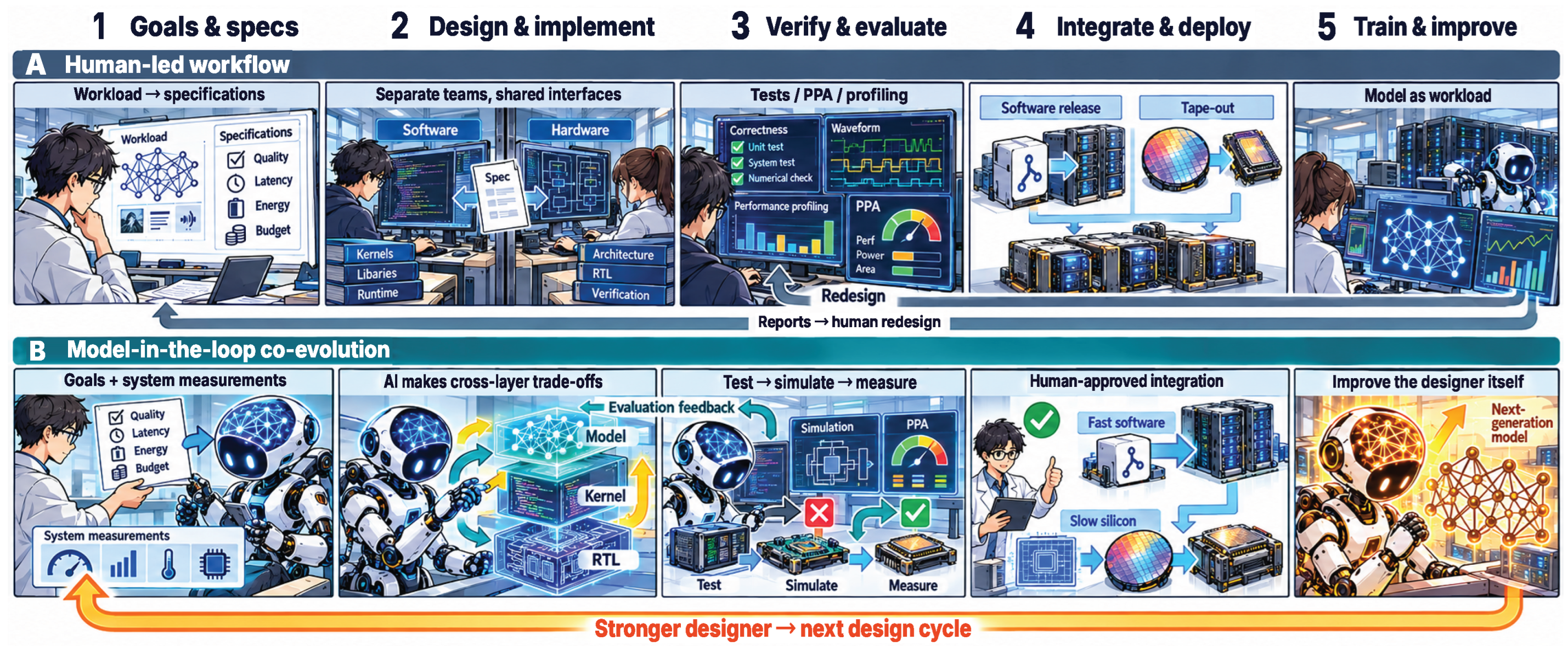
Figure 2.
Intelligence climbs and begins to redesign its own machines. Top: cross-domain capability trajectories, as the fraction of the gap to a perfect score closed (HCI) [2]. Bottom: representative works at each level of self-scaling intelligence by first public date; colors mark the layer edge acted on, and the staircase marks each level’s first arrival; the L3 lane mixes internal L3[] and external L3[S], L3[H].
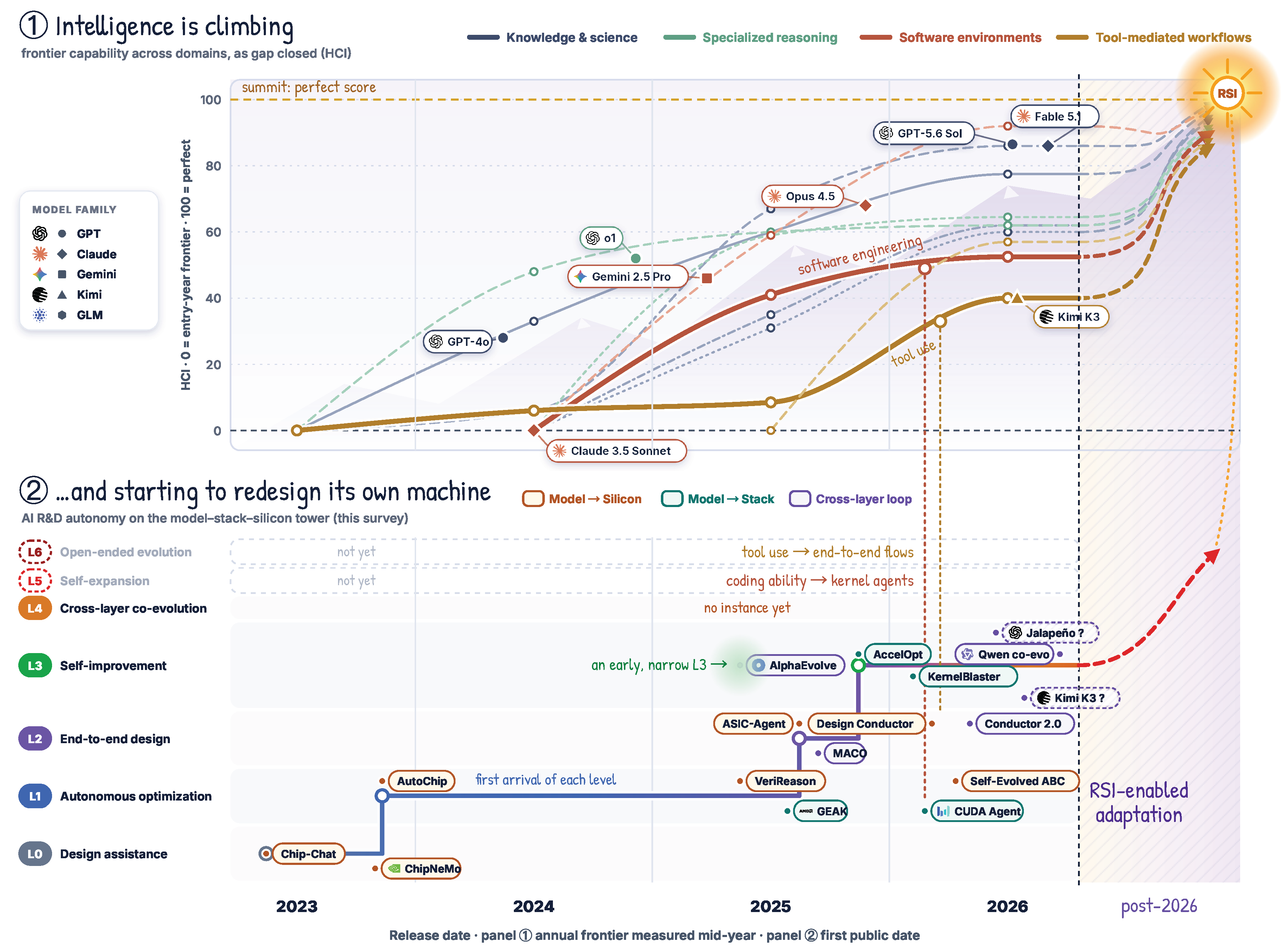
Figure 3.
The model–stack–silicon tower and its two slopes. Silicon is the foundation, the software stack sits in the middle and the model at the top, iterating over years, hours and months. On the left slope design flows down: the model, as designer, produces RTL, kernels and even processors, and influence travels only downward. On the right slope constraints flow up: memory, interconnect and numeric formats shape the model layer by layer, pushed mainly by people and classical search, while AI is only beginning to carry them.
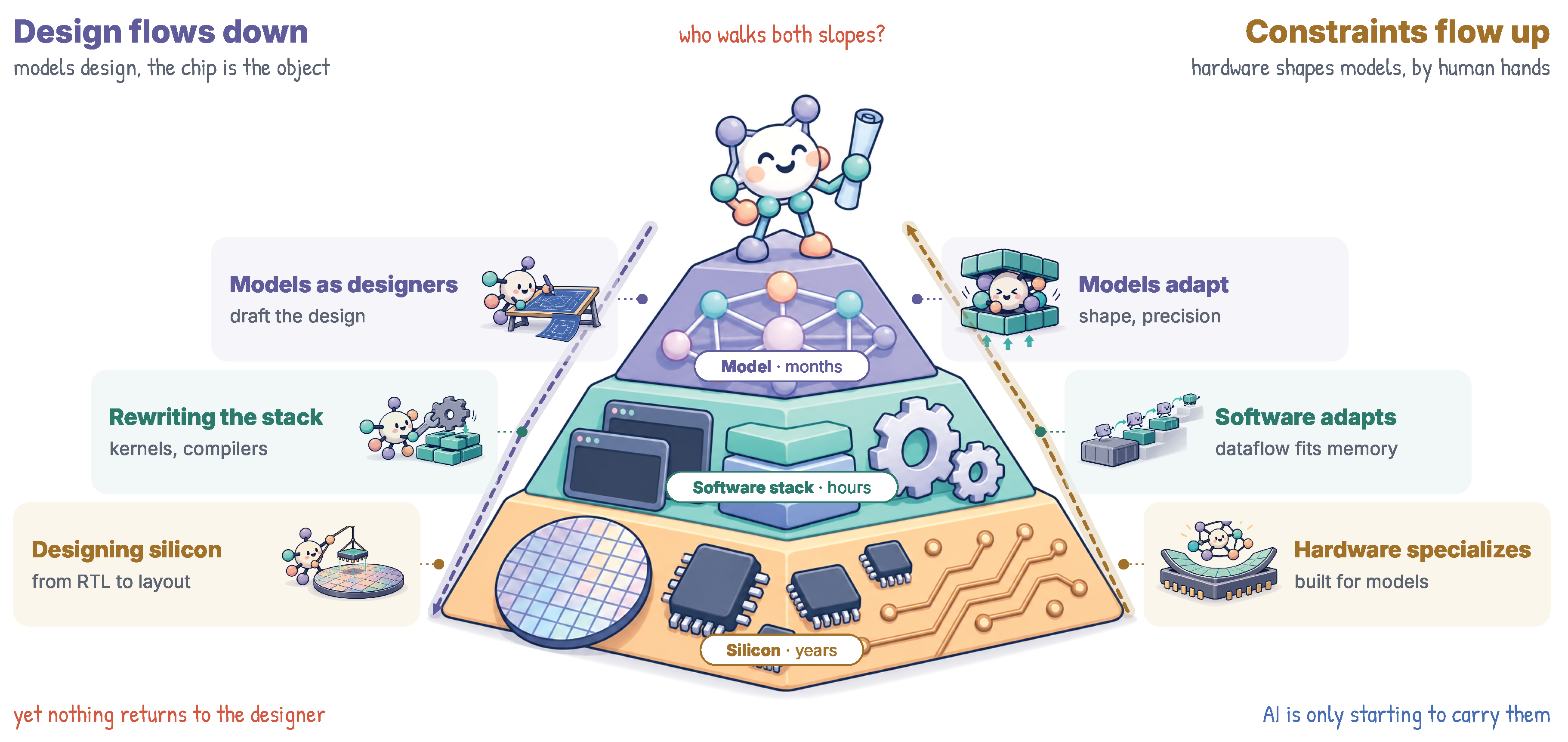
Figure 4.
Three reasons the loop breaks high up. (a) Physics: the latency of feedback signals S1–S6 spans about seven orders of magnitude, growing slower and sparser toward silicon. (b) Agent: a single run lasts hours to days, a cross-layer loop takes years, and verifiable rewards exist only within a single layer. (c) Ecosystem: each layer has its own owner, separated by contracts and standards; only vertically integrated firms can read and write the model, the software stack and the chip, and even they leave fabrication outside.
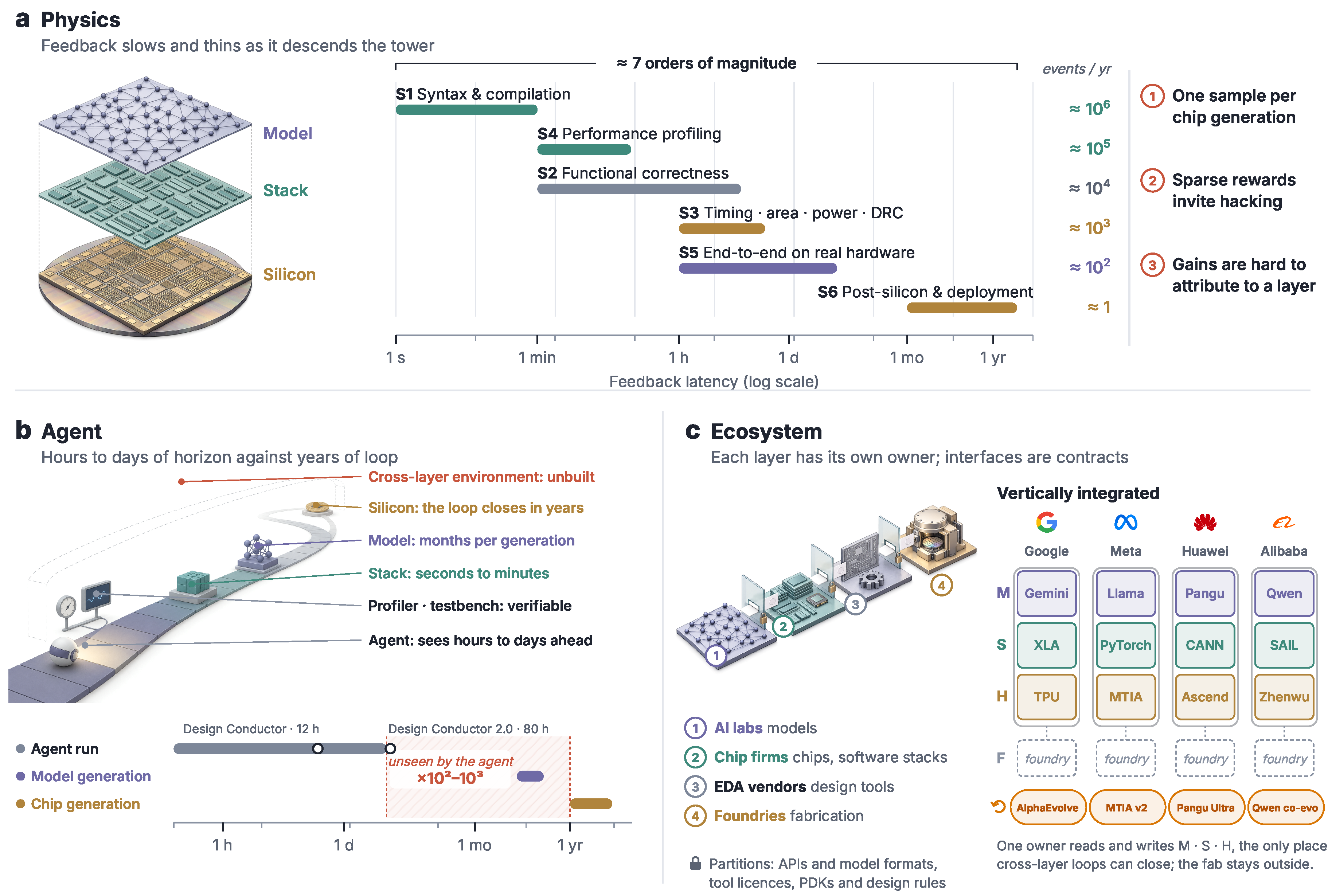
Figure 5.
Two threads and their junction. The shaded bands are the three stages of Table 3. The top row is AI designing chips, where what is learned climbs step by step; the bottom row is chips for AI, where who adapts to whom turns around midway; the middle row shows who holds the junction. In the third stage both threads run into one kind of executor for the first time.
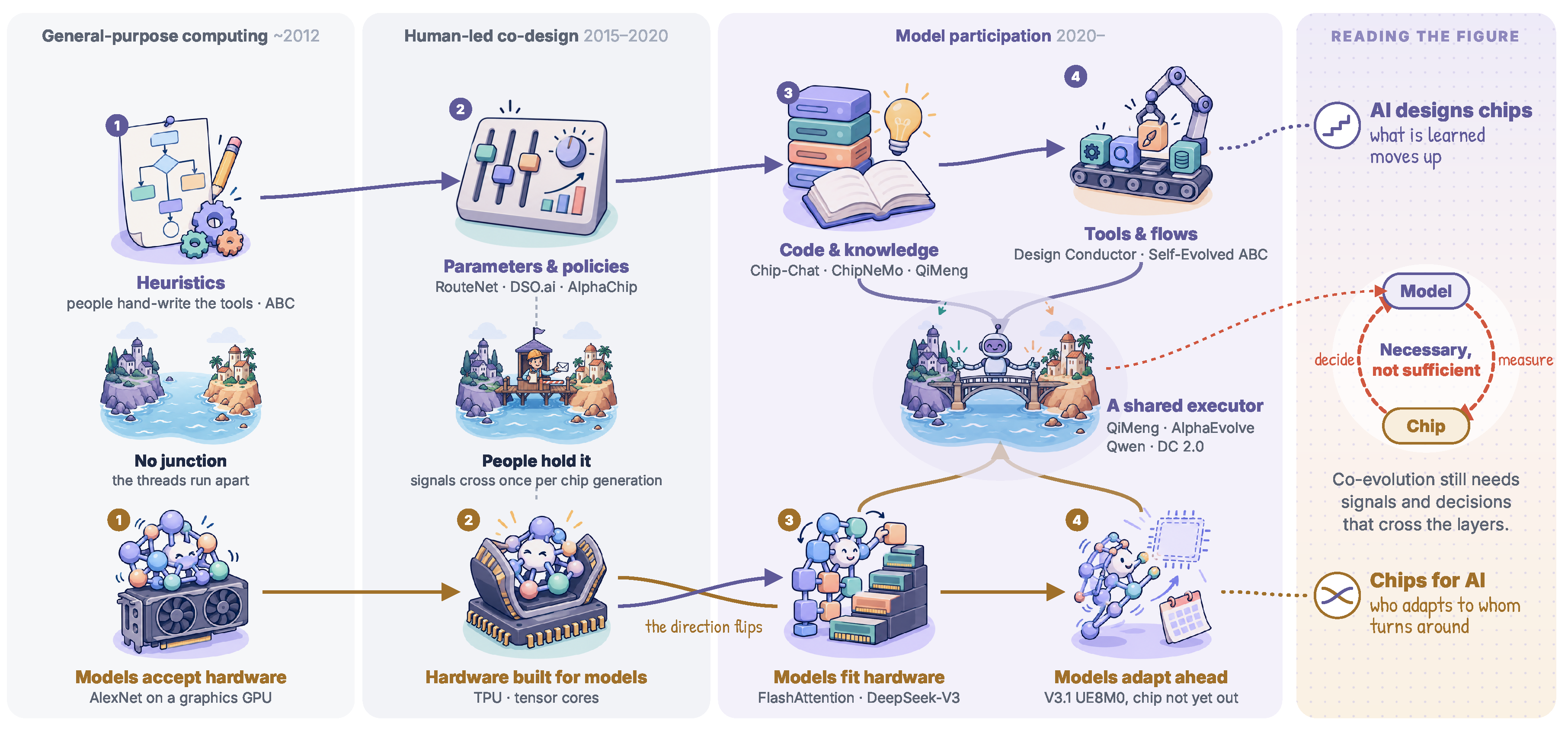
Figure 8.
Workflows and loop periods of the three paths in Section 4. Robot and person badges mark stages carried out by language-model agents and by human teams; the loops beneath each flow give the duration of one turn. The two design-down paths (01, 02) are agent-executed but confined to a single layer, and the silicon path is further bound by year-long tape-outs; the constraint-up path (03) spans all three layers but is still executed by human teams.
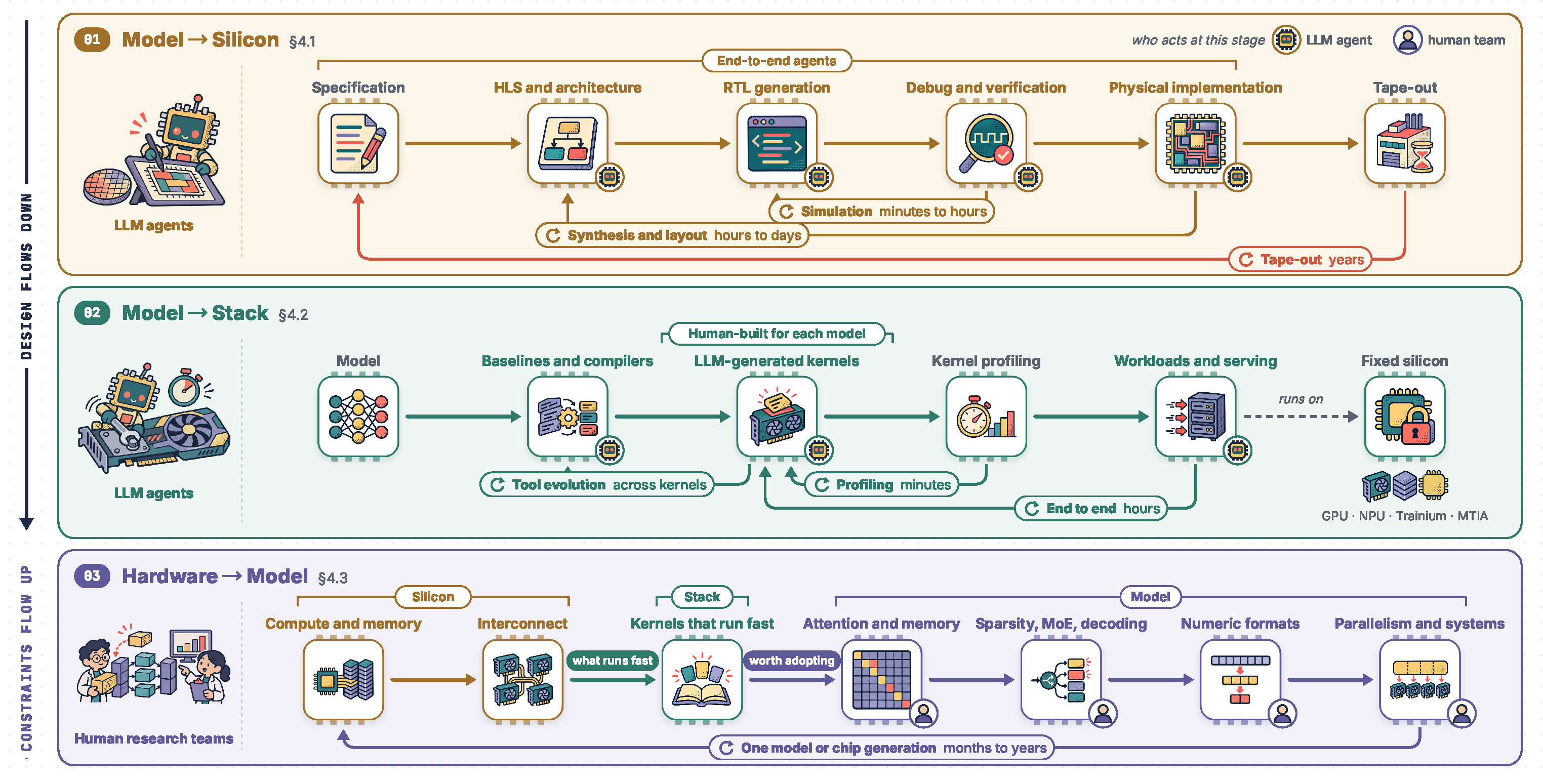
Figure 9.
AlphaEvolve’s evolutionary loop, from [1].
Figure 9.
AlphaEvolve’s evolutionary loop, from [1].
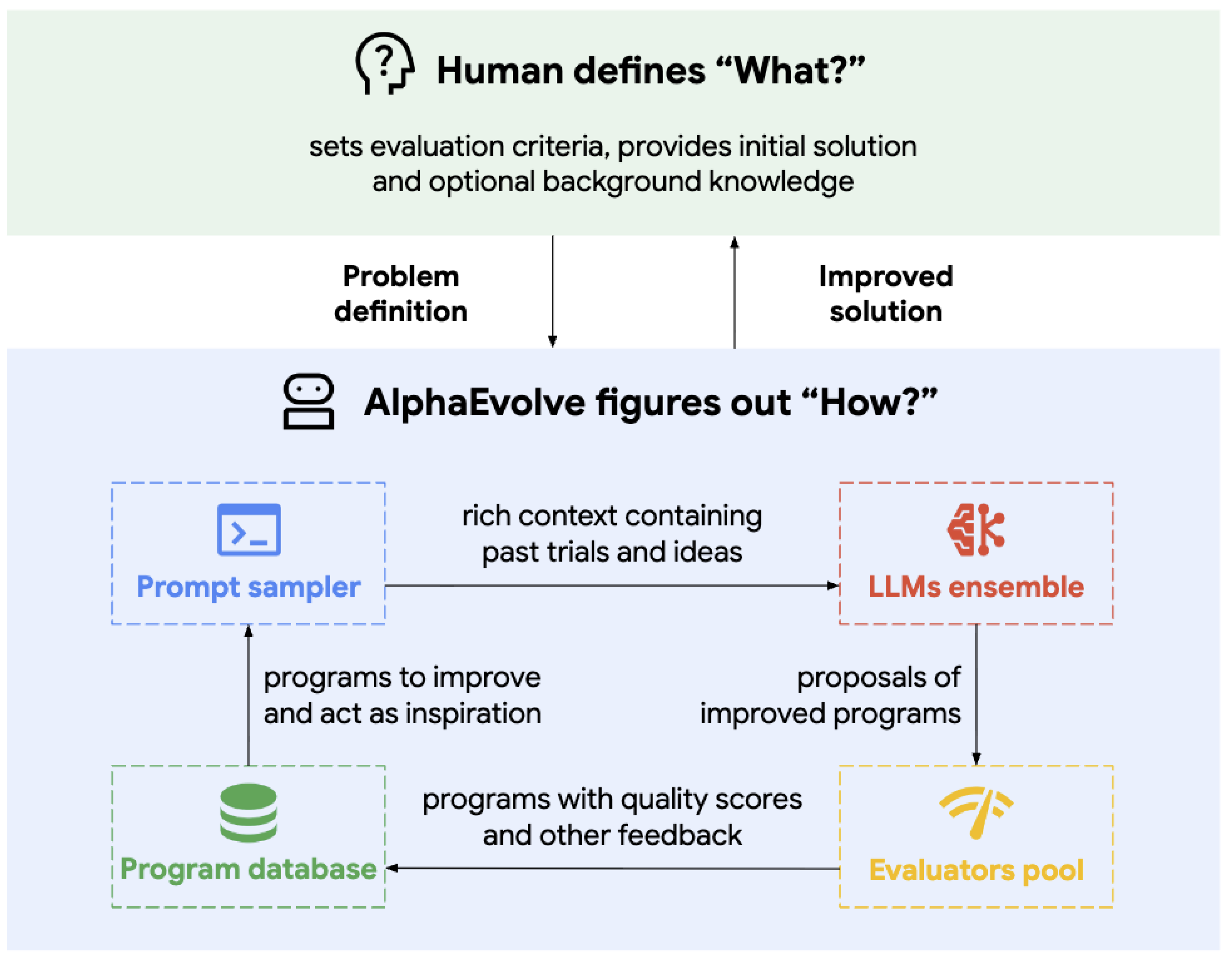
Figure 10.
The two ends of Qwen’s chip–model co-evolution, redrawn from [20]: one agent optimizes the chip and inference separately, with no measurements between them.
Figure 10.
The two ends of Qwen’s chip–model co-evolution, redrawn from [20]: one agent optimizes the chip and inference separately, with no measurements between them.
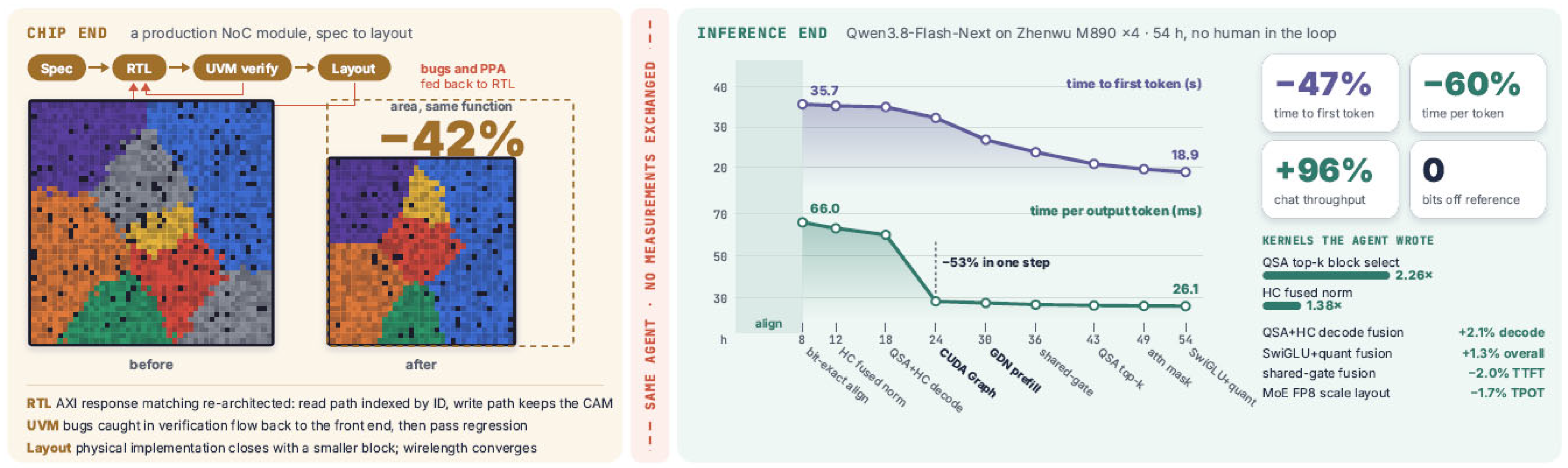
Figure 11.
How a chip-design agent is built, step by step. Five steps rise from data through pretraining, post-training and the agent to cross-layer intelligence; each lists its pipeline and one key limitation, while the character on the steps grows up.
Figure 11.
How a chip-design agent is built, step by step. Five steps rise from data through pretraining, post-training and the agent to cross-layer intelligence; each lists its pipeline and one key limitation, while the character on the steps grows up.
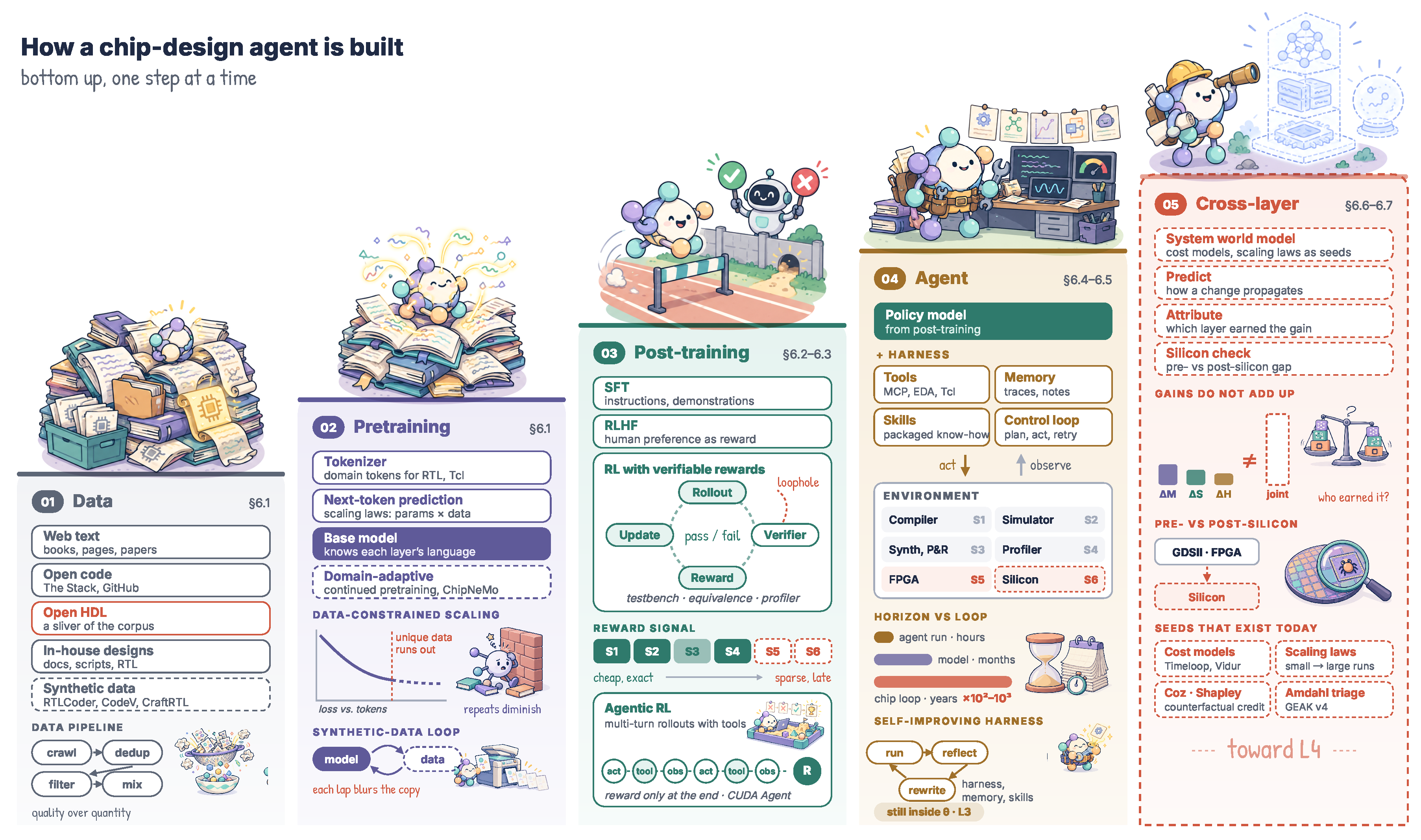
Figure 12.
A vision of L5 and L6. Left: L5, recursive self-expansion. Intelligence converts R&D results into more compute and facilities, then trains stronger successors, so that scaling turns from an exogenous input into a process driven by the system itself. Right: L6, open-ended autonomous evolution. Starting from existing structures, intelligence proposes new concepts, explores new principles and, through experiment, arrives at new forms of computation, so that the design space itself changes.
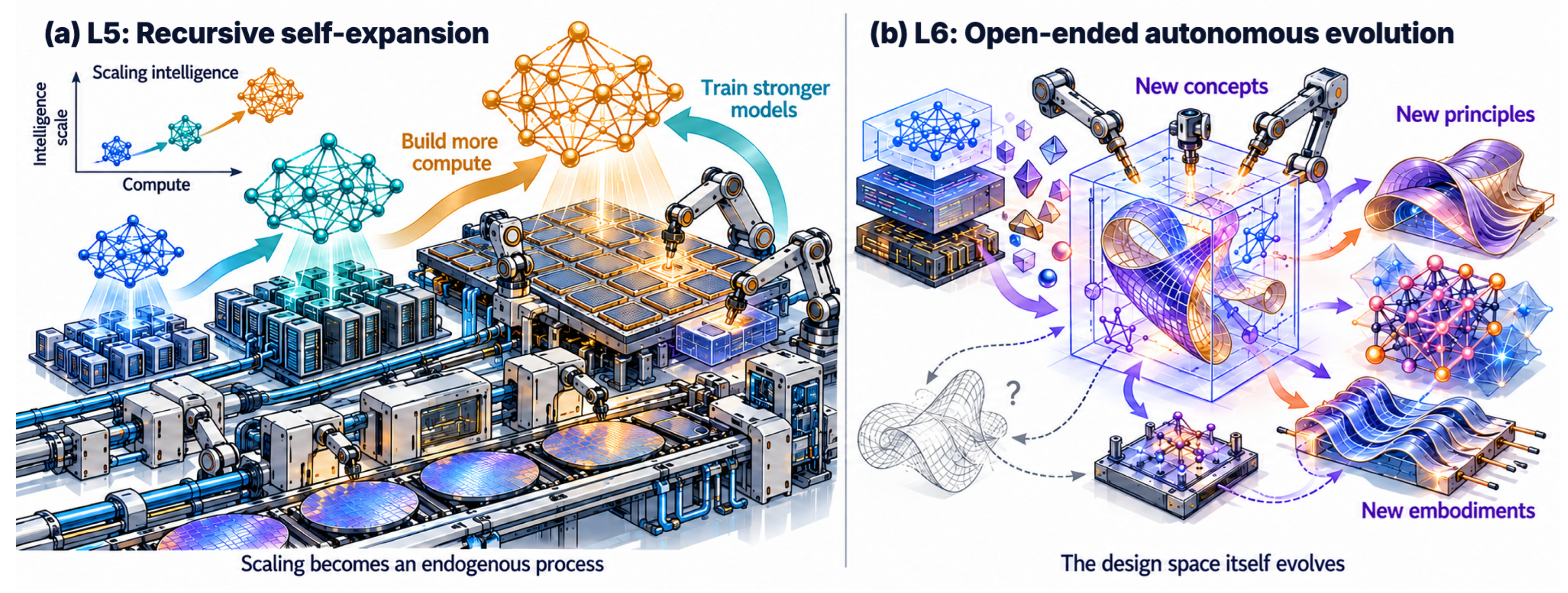
Table 9.
Where the closed-loop cases break.
| Case | Executor | Slowest segment and its period | Gain per turn returned to the designer | Main human checkpoint | Where the loop breaks |
| PrefixRL, AlphaChip | Dedicated RL policy | Tape-out and production, years | None; no return path | Design sign-off and tape-out decision | Designer is not the model being trained; recursion skips it |
| AlphaEvolve | LLM agent | Tape-out, years | About 0.01 on the stack; hardware pending | Verifying and integrating hardware changes | Closed, but the gain is small and the layers do not yet co-adapt |
| OpenAI and Broadcom, Jalapeño | LLMs and humans | Design to tape-out, nine months | Undisclosed | Undisclosed | Cannot be verified |
| Kimi K3 | LLM agent | Chip stops at RTL simulation | Kernel-level only; adoption undisclosed | Kernel adoption undisclosed | Kernels adapt one way; the chip does not return to K3 |
| Qwen chip–model co-evolution | LLM agent | Chip-side physical implementation | Reported, not attributable | Not detailed | Self-improvement bypasses the chip and inference ends |
| Design Conductor 2.0 (see Section 4) | LLM agent | FPGA and back end, days | None; no return path | Evaluation of results | Product does not flow back to its designer |
Table 11.
Comparison of mainstream post-training paradigms.
| Paradigm | Learning signal | Samples | Signal density | Main limitation | Representative work |
| SFT | Demonstrations from people or a stronger model | Off-policy | Per token | Imitation only; training and inference distributions differ | InstructGPT [305], RTLCoder [96] |
| RLHF (PPO) | Reward model trained on human preferences | On-policy | Per answer | The reward model can be exploited; bounded by human judgment | PPO [312], InstructGPT |
| DPO | Paired preference data | Off-policy | Per pair | No exploration of new behavior; depends on preference coverage | DPO [313] |
| RLVR (GRPO) | Program verifiers: answer matching, unit tests, equivalence checks | On-policy | Per answer | Only verifiable tasks; mostly improves sampling within existing capability | GRPO [314], DeepSeek-R1 [311], QiMeng-CodeV-R1 [107] |
| On-policy distillation | A teacher scores the student’s own trajectories per token | On-policy | Per token | Bounded by the teacher; needs a stronger teacher | GKD [315], Qwen3 [316], Thinking Machines [317] |
| Agentic RL | Environment feedback and task outcome: tool outputs, tests, retrieval | On-policy, multi-turn | Per trajectory, sparse and delayed | Costly environments; long-horizon credit assignment; more room for hacking | Search-R1 [319], SWE-RL [320], Kimi K2 [322], CUDA Agent [15] |
Disclaimer/Publisher’s Note: The statements, opinions and data contained in all publications are solely those of the individual author(s) and contributor(s) and not of MDPI and/or the editor(s). MDPI and/or the editor(s) disclaim responsibility for any injury to people or property resulting from any ideas, methods, instructions or products referred to in the content. |
© 2026 by the authors. Licensee MDPI, Basel, Switzerland. This article is an open access article distributed under the terms and conditions of the Creative Commons Attribution (CC BY) license (http://creativecommons.org/licenses/by/4.0/).
Copyright: This open access article is published under a Creative Commons CC BY 4.0 license, which permit the free download, distribution, and reuse, provided that the author and preprint are cited in any reuse.