
Submitted:
20 November 2026
Posted:
24 November 2026
You are already at the latest version
Abstract
King V, published on 31 October 2025, applies to financial years beginning on or after 1 January 2026 and substantially revises the technology and risk governance requirements of King IV. This study assesses the readiness of the 100 largest JSE-listed companies for these requirements before King V takes effect. Using content analysis, the 2025 financial year reports of 98 companies were coded against a 35-item King V readiness checklist covering risk governance, data and information governance, technology governance, and oversight and transition. Each item was classified as carried forward, extended or new relative to King IV. Coding reliability was tested by two independent coders on 31% of the sample. Mean readiness was 59.7%; 68 companies scored between 50% and 79%, and no company met all requirements in full. Readiness fell from 66.6% on carried-forward requirements to 57.5% on extended and 38.5% on new requirements, a gradient observed in 90 of the 98 companies. Risk governance was strongest (77.1%), while data, technology, and oversight and transition governance were close to 54%. Artificial intelligence was described more often than governed, and only 11.2% of companies fully disclosed their plans for the transition to King V. This is the first assessment of readiness for King V. It shifts governance disclosure research from retrospective compliance to forward-looking readiness, and contributes a reusable readiness instrument and a pre-implementation baseline against which compliance under King V can be measured.
Keywords:
King V
; corporate governance
; technology governance
; risk disclosure
; readiness
; Johannesburg Stock Exchange
1. Introduction
Corporate governance remains central to how organisations are directed, controlled and held accountable to stakeholders. In South Africa, the King Reports have played an important role in shaping governance, corporate reporting and board accountability. King IV represented a significant shift towards an outcomes-based approach, emphasising ethical and effective leadership, performance, conformance and legitimacy through an “apply and explain” philosophy (IoDSA, 2016; Janse Van Vuuren, 2020). However, the corporate environment has continued to evolve, with increasing expectations regarding transparency, stakeholder accountability, sustainability, technology, risk and the quality of corporate disclosures.
The release of King V on 31 October 2025 represents the latest development in this evolution. King V replaces King IV and applies to financial years beginning on or after 1 January 2026. Although retaining an outcomes-based philosophy, King V restructures the governance principles and introduces a dedicated disclosure framework intended to enhance the consistency and comparability of governance reporting (IoDSA, 2025). This transition raises an important question concerning whether South Africa’s major listed companies are adequately prepared for the new governance regime.
This question is particularly relevant to the 100 largest JSE-listed companies by market capitalisation. Earlier King IV studies of technology governance confined their samples to the Top 40 (Moolman, 2019; Nyagope, Rajaram & Obagbuwa, 2023). Widening the sample to the Top 100 keeps the companies whose reporting matters most to investors and regulators, and adds mid-sized companies with fewer governance resources, for which readiness for a new code is less certain. Lunga and Kirsten (2026) used the same sample frame to study cybersecurity disclosure and reported that, in 2020, these 100 companies represented approximately 97% of the market capitalisation of the JSE’s equity segments. Their governance and reporting practices therefore have implications for investors, regulators and other stakeholders.
Existing literature demonstrates the importance of corporate governance disclosure in communicating accountability, risks and governance quality to stakeholders. From a stakeholder perspective, corporate disclosures provide information that assists investors and other stakeholders in evaluating organisational performance and risks (Abraham & Shrives, 2014). However, the presence of disclosure does not necessarily indicate substantive governance, as disclosures may vary in quality and may sometimes become symbolic or compliance-oriented (Abraham & Shrives, 2014; Janse Van Vuuren, 2020).
South African research has examined governance disclosure across successive King Codes. For instance, Janse Van Vuuren (2020) questioned whether corporate governance disclosure represents substantive governance or a “tick-box” exercise. Similarly, Marx, Moolman and Ngwenya (2016) found incomplete compliance with King III requirements relating to IT governance among JSE listed companies, with 55% of companies complying fully and 21% partially. Research on integrated reporting has also identified inconsistencies in the content, format and value of reporting among the Top 40 listed companies (Marx & Mohammadali-Haji, 2014).
Following King IV, research continued to identify substantial but incomplete compliance. Moolman (2019) examined technology and information governance among JSE listed companies and reported considerable compliance but identified areas requiring improvement. Nyagope, Rajaram and Obagbuwa (2023) subsequently assessed IT risk and governance disclosures among the Top 40 listed companies and found that 32 companies (80%) completely complied with the assessed King IV requirements, while eight (20%) partially complied. Their study extended earlier King III research and highlighted the continuing importance of governance disclosure.
More recent studies reinforce the persistence of disclosure challenges. Sithole and Lotter (2024) found that a South African public pension fund fully disclosed the majority of King IV principles, while identifying room for improvement. Dippenaar and Klopper (2025) similarly identified continuing shortcomings in compliance with King IV’s share-based directors’ remuneration disclosure requirements. More recently, Duve and Marx (2026) found relatively high King IV compliance among the top 22 JSE-listed companies but reported that full disclosure had not been achieved. Likewise, Ecim and Maroun (2026) found variation in integrated reporting practices among the 60 largest JSE-listed entities. Lunga and Kirsten (2026), examining the 2020 annual reports of the 100 largest JSE-listed companies, found that most companies acknowledged cybersecurity as a material risk, but that the extent and quality of cybersecurity disclosure remained low and varied widely across companies and industries.
Despite this growing literature, a significant gap remains. Previous research has predominantly assessed compliance with King II, King III and King IV, or examined specific areas such as IT governance, risk disclosure, integrated reporting, sustainability and remuneration. However, the literature has not established an empirical baseline of the readiness of major JSE-listed companies for the transition from King IV to King V.
This distinction is important as companies need to show compliance in light of the new King V. Compliance research evaluates whether companies meet the requirements of an existing framework, whereas readiness research considers whether existing governance structures, practices and disclosures provide a sufficient foundation for meeting a newly introduced framework. King V creates a particularly important opportunity for such an assessment because it introduces a revised governance structure and a dedicated disclosure framework while retaining the outcomes-based philosophy of King IV (IoDSA, 2025).
The gap is not merely the absence of King V studies; limited evidence exists on whether companies’ governance arrangements and disclosures adequately position them for King V. This study addresses this gap by assessing how the Top 100 JSE-listed companies’ existing disclosures and practices correspond with King V requirements, shifting research from retrospective King IV compliance towards governance preparedness, particularly given concerns that formal disclosure may not reflect substantive governance (Abraham & Shrives, 2014; Janse Van Vuuren, 2020).
Accordingly, the study aims to assess the readiness of the 100 largest JSE-listed companies for King V, based on the technology and risk governance disclosures in their reports for the 2025 financial year, the last full reporting cycle under King IV.
The research question guiding this study is:
To what extent are the 100 largest JSE-listed companies ready for the technology and risk governance requirements of King V?
The study contributes to corporate governance and reporting literature by providing an early assessment of King V readiness and examining whether existing disclosures demonstrate preparedness for the new framework (Abraham & Shrives, 2014; Janse Van Vuuren, 2020). Methodologically, it develops a King V readiness framework/checklist that can establish a baseline for future longitudinal research. Practically, it identifies areas of strong and weak readiness for boards, governance professionals, investors, regulators and the JSE.
Finally, the study extends Nyagope, Rajaram and Obagbuwa (2023), who examined IT risk and governance disclosure under King IV among the Top 40 JSE-listed companies. Building on their finding of substantial but incomplete compliance, this study widens the sample to the Top 100 and examines whether the governance foundation established under King IV adequately positions these companies for King V. The article proceeds with the literature review and theoretical foundation, followed by the methodology, the results and discussion, and the conclusion.
2. Literature review
2.1. Theoretical foundation
This study is framed by stakeholder theory, supported by agency theory. Stakeholder theory holds that an organisation is accountable to the range of parties affected by its activities, and not only to the providers of financial capital (Freeman, 1984). Applied to corporate reporting, the theory explains disclosure as a means through which an organisation communicates with those parties and shapes their assessment of it. Where stakeholders cannot observe internal governance arrangements directly, the disclosures made in integrated and governance reports become the primary evidence available to them.
Technology and risk disclosures are a clear instance. A stakeholder cannot observe whether a board sets direction on technology, approves a technology policy, or oversees cyber security arrangements. The stakeholder observes only what the organisation reports. The quality of that reporting therefore determines whether stakeholders can assess the organisation's exposure to technology risk at all.
Agency theory adds the second element. Where ownership is separated from control, the board and management hold information that shareholders do not, and disclosure operates as a mechanism for reducing that asymmetry (Jensen & Meckling, 1976). Technology governance is an area of pronounced asymmetry: management understands the organisation's systems, dependencies and vulnerabilities in a way external parties cannot. Codes of governance respond by prescribing what must be disclosed, on the premise that mandated disclosure constrains the agent.
Both theories, however, assume that disclosure carries information. That assumption is contestable. Abraham and Shrives (2014) show that risk disclosures in corporate reports often become generic and repetitive, persisting across reporting periods without reflecting changes in the underlying risk. Janse Van Vuuren (2020) reaches a comparable conclusion for South African governance reporting, finding that Top 40 JSE-listed companies disclosed all seventeen King IV principles but appeared to do so principally to satisfy JSE listing requirements rather than to demonstrate value creation and good governance. Disclosure and governance are therefore not equivalent, and a study of disclosure must be explicit that it measures reporting rather than practice. This study adopts that position throughout.
2.2. The King Codes and the evolution of governance disclosure in South Africa
South Africa's corporate governance framework has developed through successive reports of the King Committee, convened by the Institute of Directors in South Africa. King I (1994), King II (2002), King III (2009) and King IV (2016) each responded to changes in the governance environment, and each revised both the substance of the recommended practices and the regime under which organisations report against them.
The shift from King III to King IV is instructive for the present study because it was a change in reporting regime rather than only in content. King III operated on an "apply or explain" basis, under which an organisation could decline to apply a recommended practice provided it explained why. King IV replaced this with "apply and explain", under which the principles are to be applied and the organisation explains how the supporting practices were implemented (IoDSA, 2016). Empirical work suggests the change mattered. Marx, Moolman and Ngwenya (2016) found that 55% of JSE-listed companies fully complied with King III's information technology governance disclosure requirements and 21% partially complied. Following the introduction of King IV, Moolman (2019) examined technology and information governance among Top 40 JSE-listed companies and found considerably higher compliance, while identifying areas requiring improvement.
King V continues this pattern of regime change. Published on 31 October 2025 and effective for financial years beginning on or after 1 January 2026, it retains the outcomes-based philosophy and the apply-and-explain regime, but restructures how organisations report. The single King IV document is replaced by four: the Foundational Concepts, the Code, the Glossary and the Disclosure Framework. The seventeen principles of King IV are consolidated into thirteen. Most consequentially for reporting, the King V Disclosure Framework is stated to be an inextricable part of giving effect to the Code and a requirement for any organisation that wishes to claim application of King V (IoDSA, 2025). Where King IV embedded disclosure recommendations within each principle, King V removes them to a separate mandatory instrument.
2.3. Technology and risk governance disclosure: the empirical record
Information technology has become integral to organisational operations, reporting and control, and with that integration has come exposure. The risks arising from reliance on technology systems include failures and disruption, data security and access failures, loss of integrity, cyber attack, and risks arising from outsourced arrangements. Where these risks are not governed, they threaten the continued operation of the organisation, which is why successive King Codes have treated technology governance as a board responsibility rather than a management one.
South African evidence on how well this is reported has accumulated across the King Codes. Marx, Moolman and Ngwenya (2016) established the King III baseline described above. Moolman (2019) extended the analysis to King IV's technology and information governance principle among the Top 40, finding considerable but incomplete compliance. Nyagope, Rajaram and Obagbuwa (2023) conducted the most directly relevant study: using qualitative content analysis of 2021 integrated, sustainability and corporate governance reports of the Top 40 JSE-listed companies, assessed against a 22-item checklist derived from King IV Principles 11 and 12, they found that 32 companies (80%) fully complied with the assessed requirements and eight (20%) partially complied. They further compared King IV's provisions with COBIT 5, ISO 27002 and 38500, the Sarbanes-Oxley Act and ISA 315, finding that 79% of the King IV provisions examined aligned with international standards while 21% differed. Lunga and Kirsten (2026) widened the frame to the 100 largest JSE-listed companies and developed a multi-level cybersecurity disclosure index drawing on King IV and international guidance. They found that disclosure concentrated on cybersecurity governance rather than on potential impacts or mitigation measures, and that disclosure improved little after cyber incidents.
Three features of this literature bear on the present study. First, it is uniformly retrospective: each study assesses compliance with a code already in force, which necessarily means the evidence arrives after companies have had years to adapt. Second, the finding is consistently one of substantial but incomplete compliance, with a persistent minority of companies disclosing partially or obscurely. Third, the studies are methodologically consistent, using content analysis against a checklist derived from the code itself, which makes their instruments adaptable to a new code.
The wider South African governance disclosure literature reports the same pattern outside technology. Sithole and Lotter (2024), examining a public pension fund's annual reports for 2017 to 2021, found that the fund fully disclosed the majority of King IV principles with room for improvement. Dippenaar and Klopper (2025) examined compliance with King IV's share-based directors' remuneration disclosure requirements across the first four years of the Code and identified continuing shortcomings. Duve and Marx (2026), analysing the integrated reports of the top 22 JSE-listed companies, reported high compliance with King IV principles, particularly on performance, legitimacy and effective control, while concluding that full disclosure had not been achieved. Ecim and Maroun (2026), reviewing integrated reporting practices across the 60 largest JSE-listed entities, found variation in the extent to which integrated thinking was evidenced. Across sectors, disclosure regimes and reporting types, the finding recurs: high but incomplete compliance, with the residual concentrated in the more demanding requirements. International studies report that cybersecurity disclosure has become more common but often lacks detail (Gao et al., 2020; Héroux & Fortin, 2020). Mandating disclosure does not by itself resolve this: after the United States Securities and Exchange Commission required annual disclosure of cybersecurity risk management and governance, disclosure quality still varied with firm characteristics, and investors and analysts showed minimal response (Haapamäki & Sihvonen, 2026).
2.4. What King V changes for technology and risk governance
King V does not merely renumber King IV's technology provisions. Table 1 sets out the comparison in full; four changes are material to disclosure.
First, the subject matter is widened and reordered. King IV Principle 12 addressed technology and information governance. King V Principle 10 addresses data, information and technology, and separates the recommended practices into a data and information stream (practices 100 to 104) and a technology stream (practices 105 to 110). Data is elevated from an element of information governance to a governed subject in its own right, with the full lifecycle named: acquisition, creation, use, dissemination and disposal (IoDSA, 2025).
Second, artificial intelligence is addressed explicitly for the first time. King V practice 109(c) requires that the organisation's use of artificial intelligence adhere to the values of ethics, human centricity, accountability, transparency, explainability, security, privacy, fairness and trustworthiness, and requires clear accountability for decisions, actions, outputs and outcomes, including subjecting the processes, data, models, algorithms, resources and tools used in automated technologies to human oversight and override mechanisms commensurate with the level of risk. King IV, drafted in 2016, contains no equivalent. For a company that has adopted artificial intelligence and not previously reported on its governance, this is a disclosure requirement with no King IV antecedent. Evidence on artificial intelligence disclosure in annual reports is only now emerging, and comes mainly from the United States, covering its prevalence, determinants and market consequences (Anantharaman et al., 2026) and its alignment with accounting and regulatory expectations (Juma’h, 2026). No comparable evidence exists for South African companies.
Third, several oversight requirements are sharpened in ways that change what must be reported rather than merely how it is described. Practice 108(b) requires arrangements for organisational resilience and disaster recovery planning and testing, adding testing to a requirement previously expressed as planning. Practice 108(d) requires responsible disposal of obsolete technology having regard to environmental impact as well as data and information security, which has no King IV counterpart. Practice 108(f) requires minimum requirements for assurance to be provided by outsourced service providers with respect to the effectiveness of controls over significant risks, which goes beyond King IV's requirement to manage third-party risk. Practices 104 and 110 require the governing body to consider periodic assurance on the effectiveness, compliance and ethics of the organisation's data and information management and of its technology, which makes assurance over technology governance an explicit expectation rather than an inference from the combined assurance principle.
Fourth, the reporting architecture changes. Recommended practices in King V are organised under the governing body's cyclical functions of steering and setting direction, policy and planning, oversight and monitoring, and accountability, with the accountability element in each case referring the reader to the King V Disclosure Framework. A company whose current disclosures are organised as a narrative against King IV principles will need to restructure them to demonstrate application under this architecture, irrespective of whether the underlying governance arrangements change at all.
Taken together, these changes mean that a company fully compliant with King IV's technology and risk provisions is not thereby ready for King V. Some King V requirements are new in substance; others are new only in the form in which they must be reported. Distinguishing between the two is what a readiness assessment does and a compliance assessment cannot.
2.5. The gap: from compliance to readiness
The literature reviewed above assesses compliance with codes already operative. No published study assesses readiness for a code about to become operative, and for King V none could yet exist: the Code was published on 31 October 2025 and applies to financial years beginning on or after 1 January 2026, so no JSE-listed company has yet published a report prepared under it.
This is not merely a gap in coverage. Compliance research and readiness research answer different questions. Compliance research asks whether an organisation met the requirements of a framework it was subject to, and can only be conducted after the fact. Readiness research asks whether an organisation's existing arrangements and disclosures provide a sufficient foundation for a framework it is about to become subject to, and is only useful before the fact. The first informs regulators assessing past conduct; the second informs boards and governance professionals deciding what to change, and it must be conducted in the window between publication and effective date.
A readiness assessment is possible because King V's technology and risk requirements are not wholly new. Where a King V practice restates a King IV practice, existing disclosure is evidence of readiness. Where a King V practice extends a King IV practice, existing disclosure is partial evidence. Where a King V practice has no King IV antecedent, existing disclosure is silent and the requirement represents an unmet obligation. Mapping the two codes against each other, as Table 1 does, therefore yields a readiness instrument directly: each King V requirement can be classified by its relationship to King IV, and each company's existing disclosure assessed against it.
This study accordingly extends Nyagope, Rajaram and Obagbuwa (2023) by conceptual replication. The data sources and the content-analytic approach are retained, so the findings are comparable with theirs, while the sample is widened from the Top 40 to the Top 100. The assessment criterion changes: where they assessed compliance with an operative King IV, this study assesses readiness for an incoming King V. The contribution is threefold. Methodologically, the study develops and reports a King V technology and risk readiness instrument that establishes a baseline against which post-implementation compliance can later be measured. Empirically, it provides the first evidence on where South Africa's largest listed companies stand relative to a governance framework none has yet reported under. Theoretically, it distinguishes readiness from compliance as separate constructs in governance disclosure research, and shows that the distinction is measurable.
3. Methodology
3.1. Research approach and design
The study adopted a qualitative, interpretive approach using content analysis of publicly available corporate reports. The approach follows Nyagope, Rajaram and Obagbuwa (2023), who assessed King IV technology and risk disclosure among the Top 40 JSE-listed companies using the same technique. The design is deliberately retained so that the findings of the two studies are comparable, and the sample is widened to the Top 100, following Lunga and Kirsten (2026).
Content analysis is appropriate because the requirements against which disclosure is assessed exist in advance, in the text of the King V Code, and can be rendered as a coding instrument before data collection begins. The reasoning is therefore deductive: categories are derived from the Code rather than induced from the reports. Interpretation nevertheless remains necessary, because a company may address a requirement without using the Code's language, and the coder must judge whether what is disclosed satisfies the requirement in substance.
The study assesses readiness rather than compliance. Because King V applies to financial years beginning on or after 1 January 2026, no report prepared under King V was available at the time of data collection, and compliance could not be assessed. Readiness is defined here as the extent to which a company's existing disclosures and governance arrangements, prepared under King IV, already satisfy the corresponding King V requirement. This definition is operationalised in section 3.4.
3.2. Population and sample
The population comprises companies listed on the Johannesburg Stock Exchange. Companies with a primary JSE listing are required by the JSE Listings Requirements to report on their application of the King Code; companies with a secondary (inward) JSE listing generally report against the governance code of their primary exchange, such as the UK Corporate Governance Code or the ASX Corporate Governance Principles. The sample comprises the 100 largest JSE-listed companies by market capitalisation on 10 July 2026, obtained from JSE market data. Market capitalisation in the sample ranges from approximately R3.4 trillion (BHP Group Limited) to R13.0 billion (Sun International Ltd).
The Top 100 was selected for three reasons. First, it contains the companies whose reporting matters most to investors and regulators; Lunga and Kirsten (2026) used the same frame for cybersecurity disclosure. Second, it contains the 40 largest companies studied by Marx, Moolman and Ngwenya (2016), Moolman (2019) and Nyagope, Rajaram and Obagbuwa (2023), so the results for those companies can be read against theirs. Third, it adds 60 mid-sized companies with fewer governance resources, which allows the study to test whether readiness differs between the largest companies and the rest of the Top 100.
The list was screened before coding. Companies with a secondary JSE listing were retained rather than excluded. They are listed on the JSE, are among the largest companies in the market, and King V is designed to apply proportionately to all organisations; excluding them would remove more than a fifth of the Top 100 by number and much of its market value. Because they do not report against King IV, they were coded on the same instrument but reported as a separate group, so that results are given for King IV reporters, for secondary-listed companies, and for both together. Two further rules were applied. Where two listed entities form one dual-listed company and publish one set of reports (Investec plc and Investec Ltd; Ninety One plc and Ninety One Ltd), the group was counted once. Companies with no usable 2025 financial year report at the date of collection, or whose only available document fell outside the 2025 financial year window, were to be excluded; none was. The final sample comprised 98 companies, of which 76 were King IV reporters and 22 had a secondary JSE listing (Table 2).
3.3. Data sources
Data were extracted from the integrated reports, corporate governance reports, sustainability reports and King IV application registers for the 2025 financial year, obtained from the companies’ own websites between 12 August 2026 and 02 September 2026. These are secondary data, already in the public domain, and are the documents through which JSE-listed companies discharge their governance reporting obligations. The King IV application register was included wherever published, since it is the document most directly comparable with the King V Disclosure Framework.
The reporting period analysed is the 2025 financial year, defined as financial years ending between 1 January 2025 and 31 December 2025. This is the last full reporting cycle completed under King IV, since King V applies to financial years beginning on or after 1 January 2026, and it therefore represents the governance disclosure position from which each company enters the King V regime.
3.4. Research instrument: the King V readiness checklist
A disclosure checklist was developed as the measuring instrument, following the approach of Nyagope, Rajaram and Obagbuwa (2023), whose 22-item King IV instrument covered Principles 11 and 12. The present instrument is derived from King V Principle 8 (risk, practices 91 to 94) and Principle 10 (data, information and technology, practices 100 to 110), with two oversight practices (66 and 68). It comprises 35 items in four categories: risk governance (9 items), data and information governance (8), technology governance (15), and oversight and transition (3). The full instrument is set out in Appendix A.
Each item was first classified according to its relationship to King IV, as set out in Table 1, using three categories. Carried forward items restate a King IV requirement in substance. Extended items address a subject King IV addressed, but impose an additional or more specific obligation — for example the addition of testing to disaster recovery planning under practice 108(b). New items have no King IV antecedent, including the artificial intelligence requirements of practice 109(c) and the responsible technology disposal requirement of practice 108(d). This classification is what allows readiness to be distinguished from compliance: a company may score fully on carried-forward items while scoring nil on new ones, and only the disaggregated result reveals this. Of the 35 items, 17 are carried forward, 14 are extended and 4 are new.
Each item was then coded on a three-point scale applied to the company's existing disclosures. Full readiness was recorded where the disclosure addresses the King V requirement explicitly and in sufficient detail to satisfy it as stated. Partial readiness was recorded where the disclosure addresses the subject matter but does not meet the full requirement, including cases where the matter is mentioned without the specificity King V calls for. Not evidenced was recorded where the reports contain no disclosure addressing the requirement. A codebook was prepared before coding began, setting out for each item the decision rule, the treatment of borderline cases and worked examples drawn from companies outside the sample. The decision rules for each item are provided with the instrument in Appendix A.
Two decisions about the instrument warrant note. First, readiness is assessed against the Code's recommended practices rather than against the King V Disclosure Framework's required disclosures, because the Framework prescribes the form of reporting under King V and cannot meaningfully be applied to reports prepared before it existed. Second, the instrument measures what is disclosed and not what is practised. Where a company has an arrangement in place but does not report it, the instrument records the absence of disclosure, which is the correct treatment for a study of disclosure readiness and is stated as a limitation in section 3.7.
3.5. Data analysis
Each company’s reports were read in full and coded against every item of the instrument. A readiness index was calculated for each company as the score achieved divided by the maximum possible score (two points per item), expressed as a percentage, overall and for each category. Results are reported at three levels. At item level, the proportion of companies achieving full, partial and no readiness is reported for each King V requirement, identifying the requirements the sample as a whole is least prepared for. At company level, the distribution of readiness is reported, and the 40 largest companies are compared with those ranked 41 to 100. At category level, results are aggregated separately for carried-forward, extended and new requirements, which separates readiness that comes from existing King IV compliance from anticipation of King V’s new demands. Readiness bands (high, at least 80%; moderate, 50% to 79%; low, below 50%) are used only to summarise the distribution and carry no normative weight; continuous scores are reported alongside them.
Findings are reported descriptively, using frequencies and percentages supported by verbatim extracts from the reports. Because the sample is the screened Top 100 rather than a probability sample, no inferential claims are made; where the two reporting groups are compared, a Mann–Whitney U statistic is reported only to describe the size of the difference.
3.6. Coding reliability
Because the instrument requires the coder to judge whether a disclosure satisfies a requirement, coding reliability was assessed formally. Coding was performed by two coders. Coder 1 (the first author); Coder 2 an independent coder with a background in corporate governance / accounting who had no role in developing the instrument. Both were trained on the codebook using the reports of three companies outside the sample, and the codebook was refined before coding of the sample began.
31 of the companies were coded independently by both coders, representing 31% of the sample. This exceeds the 10% to 20% subsample commonly recommended for reliability testing in content analysis (Lombard et al., 2002). Coder 2 was blind to Coder 1's decisions throughout. Because the readiness scale is ordered rather than nominal, agreement is reported as exact agreement together with a weighted kappa for each category, interpreted against the conventional benchmarks (Landis & Koch, 1977). Disagreements were reconciled against the codebook rather than averaged, and where a disagreement revealed an ambiguous decision rule the rule was clarified and applied consistently across the sample by re-checking affected items.
3.7. Boundaries in which the study should be read
Four limitations are acknowledged. The instrument measures disclosure rather than governance practice, and a company may be better prepared than its reports suggest. Readiness is assessed against the King V Code’s recommended practices rather than against reporting actually produced under King V, so the study establishes a baseline rather than an outcome; the extent to which readiness predicts subsequent compliance is an empirical question for future research using the same instrument. The study is confined to the 100 largest JSE-listed companies, which are better resourced than most organisations to prepare for a new code, so the findings should not be generalised to smaller listed or unlisted entities. Finally, secondary-listed companies report against other governance codes and are not required to apply King IV; their scores indicate how far their existing disclosures would meet King V, not a failure to comply with King IV, and differences between the two groups partly reflect the codes they follow.
4. Results and discussion
4.1. Sample
Table 2 reports the screening of the Top 100. Investec plc and Ninety One plc were excluded as the second entities of dual-listed companies: each group publishes one set of reports, which was coded once, under Investec Ltd and Ninety One Limited. Every other company had a usable 2025 financial year report, giving a final sample of 98 companies. Of these, 76 report against King IV and 22 have a secondary JSE listing and report against the governance code of their primary exchange. Twelve of the 22 have their primary listing on the London Stock Exchange, two on the Australian Securities Exchange (BHP Group and South32), and one each on Euronext Brussels (Anheuser-Busch InBev), Euronext Amsterdam (Prosus), Euronext Dublin (Greencoat Renewables), the Luxembourg Stock Exchange (Reinet), the Warsaw Stock Exchange (Globe Trade Centre), the New York Stock Exchange (AngloGold Ashanti), Nasdaq (Karooooo) and the TSX Venture Exchange (Alphamin Resources). Because the Investec group is coded under Investec Ltd, which ranks 55th, the size comparison that follows covers 39 of the 40 largest companies and 59 companies ranked 41 to 100.
4.2. Overall readiness
The mean readiness index was 59.7% (median 57.1%), and scores ranged from 28.6% (The Foschini Group) to 85.7% (Canal+). Most companies sit in a broad middle band: 68 of the 98 (69.4%) scored between 50% and 79%, 11 (11.2%) reached the high band of 80% or more, and 19 (19.4%) scored below 50% (Table 3; Figure 1). No company met all 35 requirements in full. On average, the 2025 disclosures of the largest JSE-listed companies therefore already satisfy a little over half of what King V will require on technology and risk governance.
Size is only weakly associated with readiness. The 39 largest companies had a higher mean (62.0% against 58.2%) and a much narrower range (44.3% to 82.9%, against 28.6% to 85.7%), but the difference in central tendency is small (Mann–Whitney U = 901, z = -1.81, r = 0.18). The largest companies are more consistent rather than more ready: only 3 of the 39 fell below 50%, against 16 of the 59, yet the 59 included 8 of the 11 companies in the high band. Among the largest companies, Pepkor (82.9%), MTN (81.4%) and Sanlam (81.4%) scored highest, and Bidvest (44.3%), Valterra Platinum (45.7%) and Reinet (48.6%) lowest.
4.3. Readiness by category and by relationship to King IV
Table 4 confirms the pattern anticipated in section 2.5. Readiness falls in steps with the relationship of the requirement to King IV: 66.6% on carried-forward requirements, 57.5% on extended requirements and 38.5% on new requirements (Figure 2). The gradient holds within companies as well as across them: 90 of the 98 companies scored lower on the new requirements than on the carried-forward ones, 5 scored nil on all four new requirements, and only 1 met all four in full. Existing King IV disclosure therefore takes companies about two-thirds of the way on requirements that King V restates, but little more than a third of the way on those it introduces.
By category, risk governance is strongest (77.1%), reflecting a requirement that has been part of every King Code. Data and information governance (53.5%), technology governance (53.9%) and oversight and transition (53.6%) all sit close to half. Size makes the largest difference to data and information governance, where the 39 largest companies scored 62.0% against 47.9%, and to extended requirements (63.4% against 53.6%). On carried-forward and new requirements, the two size groups are almost identical (66.3% against 66.7%, and 39.1% against 38.1%). The difference between the largest companies and the rest therefore lies in how far they have already gone beyond King IV, not in their King IV compliance.
4.4. Companies with a secondary JSE listing
Table 5 compares the two reporting groups. Secondary-listed companies scored slightly lower overall (mean 57.5% against 60.4%; median 54.3% against 57.9%), but the difference is small (Mann–Whitney U = 713.5, z = -1.04, r = 0.11), and no secondary-listed company scored below 42.9%. The difference is concentrated where readiness depends on the governance code a company follows. On oversight and transition the gap is wide (41.7% against 57.0%), largely because these companies publish no King IV application register and few refer to King V. Risk governance is also lower (70.5% against 79.0%), as are carried-forward requirements generally (58.7% against 68.8%), which is to be expected where a requirement is carried forward from a code the company does not apply.
On data and information governance and on extended requirements, by contrast, secondary-listed companies scored higher (56.5% against 52.6%, and 62.0% against 56.2%), consistent with the data protection and cyber reporting expectations of their home markets. On new requirements the two groups are close (36.4% against 39.1%). The highest-scoring secondary-listed companies were Canal+ (85.7%), Alphamin Resources (82.9%) and Prosus (65.7%); the lowest were Sirius Real Estate (44.3%), Greencoat Renewables (42.9%) and Globe Trade Centre (42.9%). Because these companies are not required to apply King IV, their scores indicate how far their existing disclosures would meet King V, not a shortfall in King IV compliance.
4.5. Item-level results
Table 6 lists the five requirements with the highest and the five with the lowest share of companies at full readiness; Appendix B reports all 35. The strongest requirements are those that King IV and its predecessors have long required in the risk report: risk assessment that covers opportunities as well as risks (R4, 86.7% full), technology and cyber risk identified as a specific risk (R9, 84.7%), board responsibility for the governance of risk (R1, 81.6%) and key risks disclosed with the responses to each (R5, 79.6%). A cyber security strategy (T8, 70.4%) is the only technology requirement among the five strongest.
The weakest requirements are all new or extended. Only 11.2% of companies referred in full to King V and their plans for the transition (O3, new), and 50.0% made no reference to it at all, although King V had been published before many of these reports were issued. Minimum assurance requirements for outsourced service providers (T11, extended) were met in full by 12.2% of companies and not evidenced by 76.5%, the highest non-disclosure rate of any item. Responsible disposal of obsolete technology (T7, new; 13.3% full), accountability with human oversight and override for artificial intelligence (T13, new; 15.3% full and 58.2% not evidenced) and direction-setting on data as a governed subject in its own right (D1, extended; 19.4% full) complete the weakest group.
Three contrasts within the item results stand out. First, artificial intelligence is described more often than it is governed: 89.8% of companies at least partly described the values that guide their use of artificial intelligence (T12), but only 15.3% fully disclosed who is accountable for it and how humans can oversee or override it (T13). Second, plans are disclosed more often than tests: 38.8% fully disclosed resilience and disaster recovery planning (T4), but only 24.5% disclosed that the plans had been tested (T5). Third, cyber security is reported as an arrangement rather than as an experience: 70.4% fully disclosed a cyber security strategy (T8), but only 32.7% fully disclosed how incidents are monitored and how the company responded to them (T9). Assurance follows the same pattern. Periodic assurance over data and information management (D7, 25.5% full) and over technology (T15, 36.7%) lags behind independent assurance over risk management generally (R7, 35.7%), and approval of a technology policy (T2), although carried forward from King IV, was not evidenced by 51.0% of companies.
4.6. Comparison with earlier studies
The results for the largest companies are not directly comparable with those of Nyagope, Rajaram and Obagbuwa (2023), whose instrument measured compliance with 22 King IV items in 2021 reports; this study measures readiness against 35 King V items in 2025 reports. The comparison is nevertheless instructive. Nyagope et al. found that 32 of the Top 40 (80%) fully complied with the King IV requirements they assessed. In this study, only 3 of the 39 largest companies reached the high readiness band, and their mean score on carried-forward requirements, the items closest to those Nyagope et al. assessed, was 66.3%. Two explanations are consistent with this difference. The present instrument is stricter, because a requirement is met in full only where the disclosure addresses the King V wording explicitly. And the carried-forward items include requirements, such as approval of a technology policy (T2), that King IV recommended but that half of the companies did not disclose at all. Full King IV compliance as measured in earlier studies therefore does not translate into readiness for King V, which supports the distinction between compliance and readiness drawn in section 2.5.
The cyber security results agree with Lunga and Kirsten (2026), who found, in the 2020 reports of the same Top 100 frame, that cybersecurity disclosure concentrated on governance arrangements rather than on impacts or mitigation. Five years later, the same imbalance persists: governance arrangements (T8, 70.4% full) are disclosed far more often than incidents and responses (T9, 32.7%). The finding also matches international evidence that cybersecurity disclosure has become common but remains thin on specifics (Gao et al., 2020; Héroux & Fortin, 2020), and that mandating disclosure does not by itself make it informative (Haapamäki & Sihvonen, 2026).
4.7. Discussion
From an agency perspective, the results show that disclosure narrows the information gap where governance codes have required it for longest, and leaves it open where King V breaks new ground. Shareholders can observe that boards govern risk and that technology risk is recognised as a principal risk. In most reports they cannot observe whether the board has approved a technology policy, whether disaster recovery plans work when tested, what assurance is obtained from outsourced providers, or who is accountable when an automated system or artificial intelligence model fails. These are the areas in which management’s information advantage is greatest (Jensen & Meckling, 1976), and King V’s new and extended requirements target them directly. The low scores on T11, T13 and T5 therefore mark the widest remaining agency gaps in technology governance reporting.
From a stakeholder perspective, the question is whether a stakeholder could assess a company’s technology exposure from what it reports (Freeman, 1984). For risk governance, generally yes; for data and technology, only in part. The concentration of companies in the moderate band, 68 of 98, shows that most companies address most subjects but without the specificity King V calls for. This is consistent with the concern of Abraham and Shrives (2014) and Janse Van Vuuren (2020) that disclosure can satisfy a requirement in form without informing its reader. The high scores on R1, R4 and R9 may partly reflect this. Identifying cyber risk as a principal risk is now standard practice, but the contrasts in section 4.5 show that identification is not routinely followed by disclosure of how the risk is managed, tested or assured.
The relationship gradient is the study’s central finding. Readiness falls from 66.6% on carried-forward requirements to 38.5% on new ones, and the pattern holds for 90 of the 98 companies. A company that complied fully with King IV is therefore not thereby ready for King V. Two qualifications apply. Part of the shortfall on carried-forward items reflects the more specific King V wording rather than weaker practice. And because the instrument measures disclosure, some companies will already have arrangements in place, particularly for oversight of artificial intelligence and disposal of technology, that they have not yet had reason to report. The King V Disclosure Framework removes that reason. The first reports prepared under King V will therefore show whether the gap identified here is a gap in governance or only in reporting.
5. Conclusions
The purpose of this study was to assess the readiness of the 100 largest JSE-listed companies for the technology and risk governance requirements of King V, using the disclosures in their 2025 financial year reports, the last full cycle under King IV. Overall readiness was moderate: the mean readiness index across the 98 companies was 59.7%, and 68 companies scored between 50% and 79%. Readiness fell in steps from the requirements King V carries forward from King IV (66.6%) to those it extends (57.5%) and those it introduces (38.5%), and the weakest requirements were reference to King V itself, assurance from outsourced service providers, responsible disposal of technology and human oversight of artificial intelligence. The 39 largest companies were more consistent than those ranked 41 to 100, but only slightly more ready, and secondary-listed companies scored close to King IV reporters overall.
The study makes three contributions. Methodologically, it provides a 35-item King V readiness instrument that classifies each requirement by its relationship to King IV and can be reused to measure compliance once reports under King V are published. Empirically, it provides the first evidence on where South Africa’s largest listed companies stand relative to King V’s technology and risk requirements. Lastly, theoretically, it treats readiness and compliance as separate constructs in governance disclosure research and shows how the difference can be measured.
Like any study, the study has limitations. It measures disclosure rather than practice, it assesses readiness before King V takes effect rather than compliance under it, and it is confined to the 100 largest JSE-listed companies. Future research could apply the same instrument to the first reports prepared under King V, from financial years beginning in 2026, to test whether readiness predicts compliance; extend it to smaller listed companies and the public sector; and examine whether the new artificial intelligence and assurance requirements lead to substantive or generic disclosure. The study has the following implication: First, boards should give priority to the King V requirements that have no King IV antecedent, namely accountability and human oversight for artificial intelligence (T13) and responsible disposal of technology (T7), and to the extended requirement for minimum assurance from outsourced service providers (T11), on which most companies made no disclosure. Second, governance professionals preparing the first King V reports should map existing King IV disclosures to the King V Disclosure Framework now: most companies already disclose the substance of the carried-forward requirements, so the gap there is largely one of specificity. Third, the JSE and the IoDSA could support the transition by issuing guidance for secondary-listed companies on how their home-market reporting maps to King V, and by encouraging all companies to state in their next reports how they intend to apply King V, which half of the sample did not mention.
Conflict: of interest: No conflict of interest to declare.
Funding:
No funding received for this research.
Declaration of generative AI and AI-assisted technologies in the research and writing process: The authors used Claude (Anthropic) to assist with data extraction, drafting and language editing, verified all content, and take full responsibility for the publication.
Author Contributions
[redated]: Conceptualization, Data curation, Formal analysis, investigation, Methodology, project administration, resources, software, validation, visualization, Writing – original draft, Writing – review & editing; [redacted]: Conceptualization, Data curation, Formal analysis, investigation, Methodology, project administration, resources, software, validation, visualization, Writing – original draft, Writing – review & editing;.
Data availability and ethics: All financial information analyzed in this study was sourced from publicly available integrated reports published on the official websites of JSE-listed companies. No data is collected on any identifiable human being. The processed datasets used in this study are available from the authors upon reasonable request.
Appendix A. King V readiness checklist
Each item is scored 2 (full readiness), 1 (partial) or 0 (not evidenced). Relationship to King IV: C = carried forward, E = extended, N = new. Decision rules for full and partial scores are in the Checklist sheet of the workbook. Where only a practice range is given, the exact practice number is to be confirmed against the King V Code.
| ID | King V reference | Requirement | Relationship |
| R1 | P8 (91–94) | The governing body takes responsibility for the governance of risk. | Carried forward |
| R2 | P8 (91–94) | The governing body sets direction on risk and approves a risk policy or framework. | Carried forward |
| R3 | P8 (91–94) | Risk appetite and tolerance levels are set and disclosed. | Carried forward |
| R4 | P8 (91–94) | Risk assessment covers both risks and opportunities. | Extended |
| R5 | P8 (91–94) | The key risks are disclosed with the responses to each. | Carried forward |
| R6 | P8 (91–94) | Responsibility for implementing risk management is delegated to management. | Carried forward |
| R7 | P8 (91–94) | Independent assurance is obtained on the effectiveness of risk management. | Carried forward |
| R8 | Practice 68 | The risk committee (or equivalent) mandate and composition are disclosed, with at least one independent member. | Extended |
| R9 | P8 (91–94) | Technology and cyber risk is identified as a specific risk. | Carried forward |
| D1 | P10 (100–104) | The governing body sets direction on data and information as a governed subject in its own right. | Extended |
| D2 | P10 (100–104) | A data and information policy or framework is approved. | Extended |
| D3 | Practices 100–103 | The data lifecycle is addressed: acquisition, creation, use, dissemination and disposal. | Extended |
| D4 | Practice 103(d) | Sensitive data resources and information assets are identified and classified. | Extended |
| D5 | P10 (100–104) | Personal information is protected and privacy law (POPIA) is complied with. | Carried forward |
| D6 | Practice 103(h) | Data risks across jurisdictions are identified and managed. | Extended |
| D7 | Practice 104 | Periodic assurance is considered on the effectiveness, compliance and ethics of data and information management. | Extended |
| D8 | P10 (100–104) | Data and information are used to support strategy and decision-making. | Carried forward |
| T1 | P10 (105–110) | The governing body sets direction on technology. | Carried forward |
| T2 | P10 (105–110) | A technology policy or framework is approved. | Carried forward |
| T3 | P10 (105–110) | Technology is aligned with strategy and integrated into risk management. | Carried forward |
| T4 | Practice 108(b) | Organisational resilience and disaster recovery planning are in place. | Carried forward |
| T5 | Practice 108(b) | Disaster recovery plans are tested. | Extended |
| T6 | Practice 108(c) | The benefit of significant technology investments is evidenced. | Extended |
| T7 | Practice 108(d) | Obsolete technology is disposed of responsibly, with regard to environmental impact and data security. | New |
| T8 | Practice 108(e) | A cyber security strategy and practices protect technology assets, products and services. | Extended |
| T9 | P10 (105–110) | Cyber incidents are monitored and the response to incidents is disclosed. | Carried forward |
| T10 | Practices 103(h), 108(f) | Risks from third-party and outsourced technology services are managed. | Carried forward |
| T11 | Practice 108(f) | Minimum assurance requirements are set for outsourced service providers on controls over significant risks. | Extended |
| T12 | Practice 109(c) | Use of artificial intelligence is governed by stated values (ethics, transparency, explainability, fairness, privacy, security). | New |
| T13 | Practice 109(c) | There is clear accountability and human oversight and override for AI and automated technology. | New |
| T14 | P10 (105–110) | Emerging technologies and innovation opportunities are considered. | Carried forward |
| T15 | Practice 110 | Periodic assurance is considered on the effectiveness, compliance and ethics of technology. | Extended |
| O1 | Practice 66 | Oversight of data, information and technology is delegated to a named committee. | Extended |
| O2 | King IV application register | A King IV application register explains how Principles 11 and 12 were applied. | Carried forward |
| O3 | Transition to King V | The report refers to King V and the company's plan for transition. | New |
Appendix B. Item-level results
The table reports, for each of the 35 requirements, the share of the 98 companies at full readiness, partial readiness and not evidenced, and the mean item score on the 0–2 scale.
| ID | Requirement | Relationship | Full (%) | Partial (%) | Not (%) | Mean |
| R1 | The governing body takes responsibility for the governance of risk. | Carried forward | 81.6 | 11.2 | 7.1 | 1.74 |
| R2 | The governing body sets direction on risk and approves a risk policy or framework. | Carried forward | 22.4 | 71.4 | 6.1 | 1.16 |
| R3 | Risk appetite and tolerance levels are set and disclosed. | Carried forward | 64.3 | 25.5 | 10.2 | 1.54 |
| R4 | Risk assessment covers both risks and opportunities. | Extended | 86.7 | 11.2 | 2.0 | 1.85 |
| R5 | The key risks are disclosed with the responses to each. | Carried forward | 79.6 | 18.4 | 2.0 | 1.78 |
| R6 | Responsibility for implementing risk management is delegated to management. | Carried forward | 48.0 | 30.6 | 21.4 | 1.27 |
| R7 | Independent assurance is obtained on the effectiveness of risk management. | Carried forward | 35.7 | 42.9 | 21.4 | 1.14 |
| R8 | The risk committee (or equivalent) mandate and composition are disclosed, with at least one independent member. | Extended | 66.3 | 27.6 | 6.1 | 1.60 |
| R9 | Technology and cyber risk is identified as a specific risk. | Carried forward | 84.7 | 10.2 | 5.1 | 1.80 |
| D1 | The governing body sets direction on data and information as a governed subject in its own right. | Extended | 19.4 | 68.4 | 12.2 | 1.07 |
| D2 | A data and information policy or framework is approved. | Extended | 29.6 | 49.0 | 21.4 | 1.08 |
| D3 | The data lifecycle is addressed: acquisition, creation, use, dissemination and disposal. | Extended | 36.7 | 37.8 | 25.5 | 1.11 |
| D4 | Sensitive data resources and information assets are identified and classified. | Extended | 42.9 | 31.6 | 25.5 | 1.17 |
| D5 | Personal information is protected and privacy law (POPIA) is complied with. | Carried forward | 30.6 | 64.3 | 5.1 | 1.26 |
| D6 | Data risks across jurisdictions are identified and managed. | Extended | 23.5 | 27.6 | 49.0 | 0.74 |
| D7 | Periodic assurance is considered on the effectiveness, compliance and ethics of data and information management. | Extended | 25.5 | 29.6 | 44.9 | 0.81 |
| D8 | Data and information are used to support strategy and decision-making. | Carried forward | 49.0 | 33.7 | 17.3 | 1.32 |
| T1 | The governing body sets direction on technology. | Carried forward | 53.1 | 36.7 | 10.2 | 1.43 |
| T2 | A technology policy or framework is approved. | Carried forward | 22.4 | 26.5 | 51.0 | 0.71 |
| T3 | Technology is aligned with strategy and integrated into risk management. | Carried forward | 40.8 | 50.0 | 9.2 | 1.32 |
| T4 | Organisational resilience and disaster recovery planning are in place. | Carried forward | 38.8 | 51.0 | 10.2 | 1.29 |
| T5 | Disaster recovery plans are tested. | Extended | 24.5 | 34.7 | 40.8 | 0.84 |
| T6 | The benefit of significant technology investments is evidenced. | Extended | 63.3 | 23.5 | 13.3 | 1.50 |
| T7 | Obsolete technology is disposed of responsibly, with regard to environmental impact and data security. | New | 13.3 | 39.8 | 46.9 | 0.66 |
| T8 | A cyber security strategy and practices protect technology assets, products and services. | Extended | 70.4 | 22.4 | 7.1 | 1.63 |
| T9 | Cyber incidents are monitored and the response to incidents is disclosed. | Carried forward | 32.7 | 43.9 | 23.5 | 1.09 |
| T10 | Risks from third-party and outsourced technology services are managed. | Carried forward | 36.7 | 56.1 | 7.1 | 1.30 |
| T11 | Minimum assurance requirements are set for outsourced service providers on controls over significant risks. | Extended | 12.2 | 11.2 | 76.5 | 0.36 |
| T12 | Use of artificial intelligence is governed by stated values (ethics, transparency, explainability, fairness, privacy, security). | New | 33.7 | 56.1 | 10.2 | 1.23 |
| T13 | There is clear accountability and human oversight and override for AI and automated technology. | New | 15.3 | 26.5 | 58.2 | 0.57 |
| T14 | Emerging technologies and innovation opportunities are considered. | Carried forward | 29.6 | 66.3 | 4.1 | 1.26 |
| T15 | Periodic assurance is considered on the effectiveness, compliance and ethics of technology. | Extended | 36.7 | 24.5 | 38.8 | 0.98 |
| O1 | Oversight of data, information and technology is delegated to a named committee. | Extended | 53.1 | 29.6 | 17.3 | 1.36 |
| O2 | A King IV application register explains how Principles 11 and 12 were applied. | Carried forward | 37.1 | 49.5 | 13.4 | 1.24 |
| O3 | The report refers to King V and the company's plan for transition. | New | 11.2 | 38.8 | 50.0 | 0.61 |
Note. O2 was coded for 97 companies; the King IV application register of JSE Ltd could not be assessed. All other items were coded for all 98 companies. Source: Results sheet, section D.
References
- Abraham, S.; Shrives, P. J. Improving the relevance of risk factor disclosure in corporate annual reports. Br. Account. Rev. 2014, 46(1), 91–107. [Google Scholar] [CrossRef]
- Anantharaman, D.; Parker, C.; Rozario, A. M. AI disclosure in annual reports: Evolution, determinants, and capital market participants’ perceptions. J. Inf. Syst. 2026. [Google Scholar] [CrossRef]
- Dippenaar, M.; Klopper, N. Share-based directors' remuneration: King IV disclosure practices in South Africa. Manag. Dyn. 2025, 34(1), 42–59. [Google Scholar]
- Duve, M.; Marx, B. Analysing South Africa's King IV Report on achieving Sustainable Development Goals through enhanced transparency and sustainability practices. J. Risk Financ. Manag. 2026, 19(2), 137. [Google Scholar] [CrossRef]
- Ecim, D.; Maroun, W. A review of integrated reporting practices of JSE-listed companies: Evidence of integrated thinking. J. Account. Emerg. Econ. 2026, 16(3), 522. [Google Scholar] [CrossRef]
- Freeman, R. E. Strategic management: A stakeholder approach; Pitman, 1984. [Google Scholar]
- Gao, L.; Calderon, T. G.; Tang, F. Public companies’ cybersecurity risk disclosures. Int. J. Account. Inf. Syst. 2020, 38, 100468. [Google Scholar] [CrossRef]
- Haapamäki, E.; Sihvonen, J. Mandatory cybersecurity disclosure: Early evidence from 10-K reports. Int. J. Account. Inf. Syst. 2026, 57, 100775. [Google Scholar] [CrossRef]
- Héroux, S.; Fortin, A. Cybersecurity disclosure by the companies on the S&P/TSX 60 Index. Account. Perspect. 2020, 19(2), 73–100. [Google Scholar] [CrossRef]
- Institute of Directors in South Africa. King IV Report on Corporate Governance for South Africa 2016; IoDSA, 2016. [Google Scholar]
- Institute of Directors in South Africa. King V Code on Corporate Governance for South Africa 2025; IoDSA, 2025. [Google Scholar]
- Institute of Directors in South Africa. King V Disclosure Framework; IoDSA, 2025. [Google Scholar]
- Janse Van Vuuren, H. The disclosure of corporate governance: A tick-box exercise or not? Int. J. Bus. Manag. Stud. 2020, 12(1), 50–74. [Google Scholar]
- Jensen, M. C.; Meckling, W. H. Theory of the firm: Managerial behavior, agency costs and ownership structure. J. Financ. Econ. 1976, 3(4), 305–360. [Google Scholar] [CrossRef]
- Juma’h, A. H. Artificial intelligence disclosure practices in US 10-K filings: Accounting standards, signalling incentives and reporting quality. J. Appl. Account. Res. 2026. [Google Scholar] [CrossRef]
- Landis, J. R.; Koch, G. G. The measurement of observer agreement for categorical data. Biometrics 1977, 33(1), 159–174. [Google Scholar] [CrossRef]
- Lombard, M.; Snyder-Duch, J.; Bracken, C. C. Content analysis in mass communication: Assessment and reporting of intercoder reliability. Hum. Commun. Res. 2002, 28(4), 587–604. [Google Scholar] [CrossRef]
- Lunga, T.; Kirsten, E. Cybersecurity risk disclosure practices of Johannesburg Stock Exchange-listed companies. Int. J. Discl. Gov. 2026. [Google Scholar] [CrossRef]
- Marx, A.; Moolman, A. M.; Ngwenya, M. Information technology governance disclosure compliance of JSE-listed companies. Int. J. eBusiness eGovernment Stud. 2016, 8(1), 57–70. [Google Scholar]
- Moolman, A. King IV technology and information governance: JSE-listed companies' compliance. Proceedings of the 5th International Conference on New Directions in Multidisciplinary Research and Practice 2019, 5, 59–81. [Google Scholar]
- Nyagope, T. S.; Rajaram, R.; Obagbuwa, O. Information technology risks and governance disclosure: Evidence from top 40 JSE listed companies. J. Environ. Sustain. Soc. Sci. 2023, 4(5), 1378–1397. [Google Scholar] [CrossRef]
- Sithole, A.; Lotter, M. Corporate governance disclosure in a South African public pension fund. Acta Commer. 2024, 24(1), 1–11. [Google Scholar] [CrossRef]
Figure 1.
Distribution of the King V readiness index (n = 98).
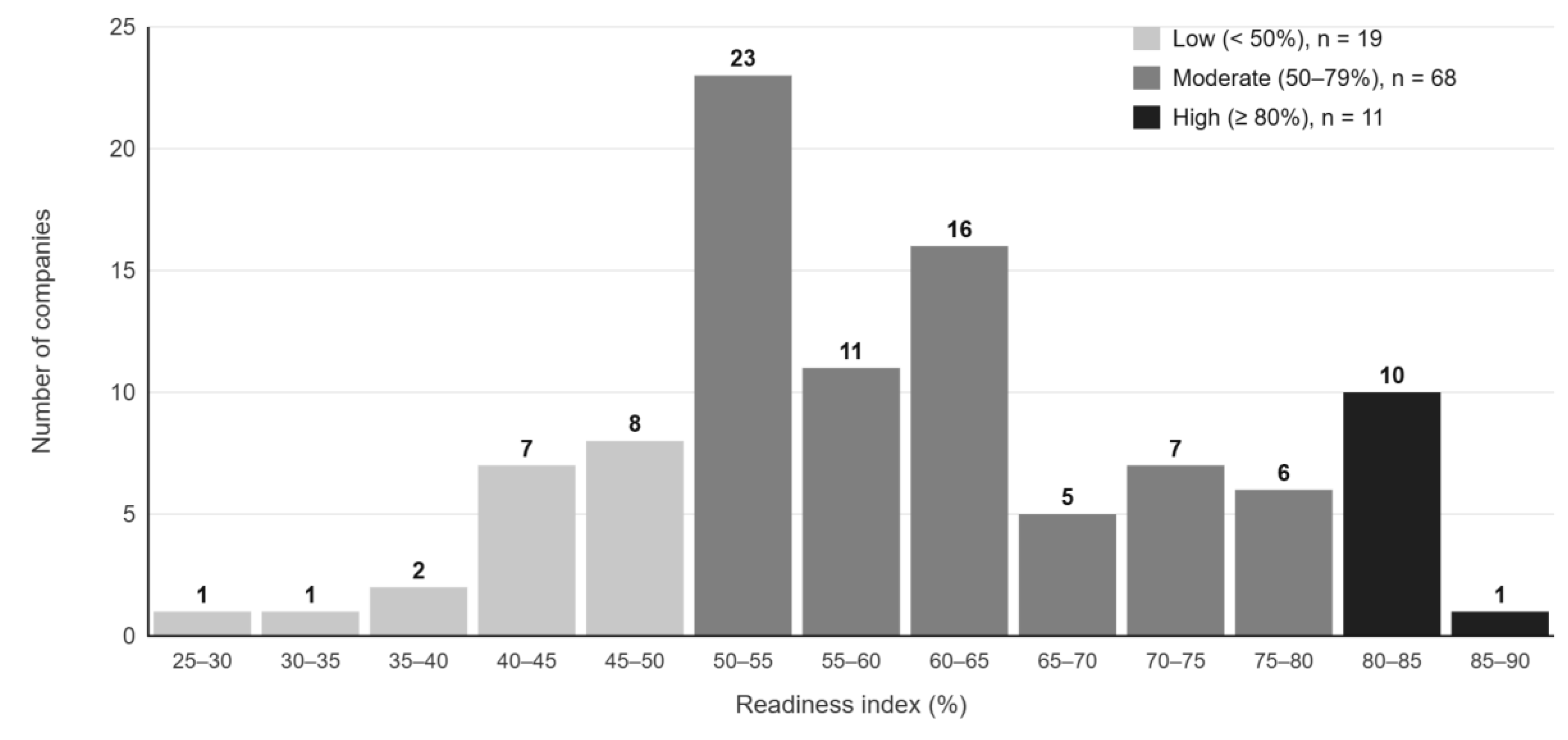
Figure 2.
Mean readiness by relationship to King IV and by category, 40 largest companies and ranks 41–100. Note. The 40 largest group contains 39 companies (see Table 3). Source: Results sheet, section C.
Figure 2.
Mean readiness by relationship to King IV and by category, 40 largest companies and ranks 41–100. Note. The 40 largest group contains 39 companies (see Table 3). Source: Results sheet, section C.
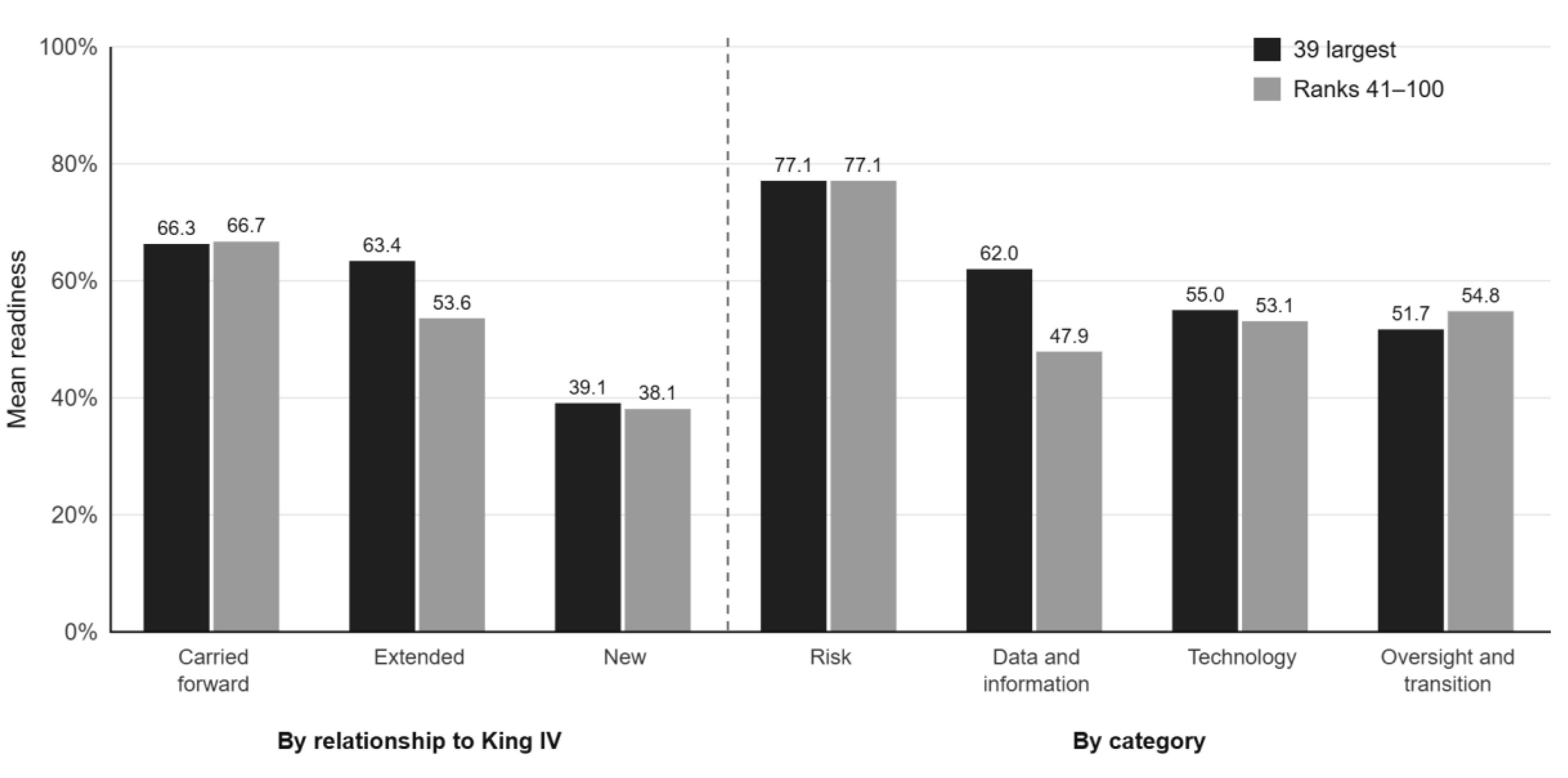

Table 1.
King IV and King V compared on technology and risk governance.
| Dimension | King IV (2016) | King V (2025) | Readiness implication |
|---|---|---|---|
| Principles | 17 principles | 13 principles; King IV Principle 17 on institutional investors removed | Renumbering alone forces every governance register to be rebuilt |
| Technology principle | Principle 12: Technology and information governance | Principle 10: Data, information and technology, split into a data and information stream and a technology stream | Data becomes a governed subject in its own right |
| Risk principle | Principle 11: Risk and opportunity governance | Principle 8: Risk (practices 91–94) | Opportunity framing folded into the risk assessment practice |
| Document structure | Single report | Four documents: Foundational Concepts, Code, Glossary, Disclosure Framework | Preparers must work across four sources |
| Disclosure regime | Apply and explain; disclosure recommendations embedded in each principle | Apply and explain; all disclosure requirements moved to a mandatory King V Disclosure Framework | The largest single change: the Framework is a requirement for claiming application |
| Practice architecture | Practices listed per principle | Practices grouped under steering and setting direction, policy and planning, oversight and monitoring, and accountability | Existing narrative disclosures must be restructured |
| Artificial intelligence | Not addressed | Practice 109(c): ethics, human centricity, accountability, transparency, explainability, security, privacy, fairness, trustworthiness; human oversight and override mechanisms | New requirement with no King IV antecedent |
| Data lifecycle | Information governance in general terms | Practices 100–103: acquisition, creation, use, dissemination and disposal, named throughout | Lifecycle coverage must be evidenced, not assumed |
| Data classification | Protection of privacy and security of information | Practice 103(d): identification and classification of sensitive data resources and information assets | More specific than King IV |
| Business continuity | Risk governance and continuity generally | Practice 108(b): organisational resilience and disaster recovery planning and testing | Testing added to planning |
| Cyber security | Proactive monitoring for incidents including cyberattacks | Practice 108(e): effective cyber security strategies and practices to protect technology assets, resources, products and services | Broadened from incident response to strategy |
| Third parties | Management of performance and risks of third-party outsourced services | Practices 103(h) and 108(f): risks across jurisdictions, and minimum assurance requirements from the service provider on controls over significant risks | Assurance from providers is now expected |
| Technology disposal | Not addressed | Practice 108(d): responsible disposal of obsolete technology, having regard to environmental impact and data security | New requirement |
| Assurance over IT | Inferred from the combined assurance principle | Practices 104 and 110: periodic assurance on effectiveness, compliance and ethics of data and information, and of technology | Explicit expectation of assurance |
| Committee oversight | Audit or risk committee as appropriate | Practice 66: the risk committee may be delegated oversight of compliance and of data, information and technology; practice 68 requires at least one independent member | Committee composition and mandate must be disclosed |
| Investment oversight | Monitor and evaluate significant IT investments and expenditure | Practice 108(c): benefit commensurate with significant investments in technology | Reframed from monitoring spend to evidencing benefit |
Table 2.
Sample screening.
| Stage | Companies |
| Top 100 JSE-listed companies by market capitalisation, 10 July 2026 | 100 |
| Less: second entity of a dual-listed company (Investec plc; Ninety One plc) | 2 |
| Less: no usable 2025 financial year report available | 0 |
| Final sample | 98 |
| of which: report against King IV (primary JSE listing) | 76 |
| of which: secondary JSE listing, other governance code | 22 |
| of which: among the 40 largest companies | 39 |
| of which: ranked 41 to 100 | 59 |
Note. Source: Sample sheet of the checklist workbook.
Table 3.
Readiness index for King V technology and risk governance.
| Statistic | All companies | 40 largest | Ranks 41–100 |
|---|---|---|---|
| Companies (n) | 98 | 39 | 59 |
| Mean | 59.7% | 62.0% | 58.2% |
| Median | 57.1% | 60.0% | 54.3% |
| Minimum | 28.6% | 44.3% | 28.6% |
| Maximum | 85.7% | 82.9% | 85.7% |
| High readiness (≥ 80%), n | 11 | 3 | 8 |
| Moderate readiness (50–79%), n | 68 | 33 | 35 |
| Low readiness (< 50%), n | 19 | 3 | 16 |
Note. Readiness index = score achieved ÷ maximum possible score (2 × items coded). The Investec group is coded under Investec Ltd (rank 55), so the 40 largest group contains 39 companies. Source: Results sheet, sections B and C.
Table 4.
Mean readiness by category and by relationship to King IV.
| Group | Items | All companies | 40 largest | Ranks 41–100 |
|---|---|---|---|---|
| Risk governance | 9 | 77.1% | 77.1% | 77.1% |
| Data and information governance | 8 | 53.5% | 62.0% | 47.9% |
| Technology governance | 15 | 53.9% | 55.0% | 53.1% |
| Oversight and transition | 3 | 53.6% | 51.7% | 54.8% |
| Carried forward from King IV | 17 | 66.6% | 66.3% | 66.7% |
| Extended from King IV | 14 | 57.5% | 63.4% | 53.6% |
| New in King V | 4 | 38.5% | 39.1% | 38.1% |
Note. Each figure is the mean, across companies, of the score achieved as a percentage of the maximum for that group of items. Source: Results sheet, section C.
Table 5.
Readiness by reporting group.
| Measure | King IV reporters | Secondary listings | All |
|---|---|---|---|
| Companies (n) | 76 | 22 | 98 |
| Mean readiness index | 60.4% | 57.5% | 59.7% |
| Median readiness index | 57.9% | 54.3% | 57.1% |
| Risk governance | 79.0% | 70.5% | 77.1% |
| Data and information | 52.6% | 56.5% | 53.5% |
| Technology | 54.0% | 53.3% | 53.9% |
| Oversight and transition | 57.0% | 41.7% | 53.6% |
| Carried forward | 68.8% | 58.7% | 66.6% |
| Extended | 56.2% | 62.0% | 57.5% |
| New | 39.1% | 36.4% | 38.5% |
| High / moderate / low readiness, n | 9 / 52 / 15 | 2 / 16 / 4 | 11 / 68 / 19 |
Note. Readiness index = score achieved ÷ maximum possible score. Secondary-listed companies report against their home-market code, not King IV; their scores indicate readiness for King V, not King IV compliance. The Mann–Whitney U test is reported for description only, because the sample is not a probability sample. Source: Results sheet, section E.
Table 6.
Requirements with the highest and lowest share of companies at full readiness.
| ID | Requirement | Relationship | Full (%) | Partial (%) | Not (%) |
|---|---|---|---|---|---|
| R4 | Risk assessment covers both risks and opportunities. | Extended | 86.7 | 11.2 | 2.0 |
| R9 | Technology and cyber risk is identified as a specific risk. | Carried forward | 84.7 | 10.2 | 5.1 |
| R1 | The governing body takes responsibility for the governance of risk. | Carried forward | 81.6 | 11.2 | 7.1 |
| R5 | The key risks are disclosed with the responses to each. | Carried forward | 79.6 | 18.4 | 2.0 |
| T8 | A cyber security strategy and practices protect technology assets, products and services. | Extended | 70.4 | 22.4 | 7.1 |
| D1 | The governing body sets direction on data and information as a governed subject in its own right. | Extended | 19.4 | 68.4 | 12.2 |
| T13 | There is clear accountability and human oversight and override for AI and automated technology. | New | 15.3 | 26.5 | 58.2 |
| T7 | Obsolete technology is disposed of responsibly, with regard to environmental impact and data security. | New | 13.3 | 39.8 | 46.9 |
| T11 | Minimum assurance requirements are set for outsourced service providers on controls over significant risks. | Extended | 12.2 | 11.2 | 76.5 |
| O3 | The report refers to King V and the company's plan for transition. | New | 11.2 | 38.8 | 50.0 |
Note. The first five rows are the requirements with the highest share of companies at full readiness; the last five, those with the lowest. Percentages are of the 98 companies coded. Source: Results sheet, section D.
Disclaimer/Publisher’s Note: The statements, opinions and data contained in all publications are solely those of the individual author(s) and contributor(s) and not of MDPI and/or the editor(s). MDPI and/or the editor(s) disclaim responsibility for any injury to people or property resulting from any ideas, methods, instructions or products referred to in the content. |
© 2026 by the authors. Licensee MDPI, Basel, Switzerland. This article is an open access article distributed under the terms and conditions of the Creative Commons Attribution (CC BY) license (http://creativecommons.org/licenses/by/4.0/).
Copyright: This open access article is published under a Creative Commons CC BY 4.0 license, which permit the free download, distribution, and reuse, provided that the author and preprint are cited in any reuse.