

Submitted:
21 November 2026
Posted:
24 November 2026
You are already at the latest version
Abstract
While Boolean algebra is conventionally formalised as an axiomatic system, this paper develops a sensory-motivated interpretation of it, grounded in an informal model of sensory experience: the sensory schema. More broadly, the paper contributes to the philosophy of logic and mathematics by offering an account of the cognitive origin of Boolean structure, locating it within an independently motivated model of embodied sensory cognition rather than treating it as a mind-independent given. The schema describes experience as the product of two orthogonal aspects: an intensive aspect (private, qualitative, inexpressible) and an extensive aspect (private, spatial, measurable, yet publicly expressible). When the intensive aspect of the product is bracketed, the remaining public domain consists of a complete tiling of locations, each either occupied by a column of discrete units or bare. Three operations defined on this domain (pattern-union, pattern-overlap, pattern-inversion) coincide exactly with Boolean union, intersection, and complement, and each Boolean law holds as a direct structural fact about tile occupancy. The post-reduction domain is isomorphic to the Boolean algebra P(T), the power set of the set of tiles T, with the isomorphism mediated by spatial structure alone rather than prior logical axioms. The paper’s contribution is this precise, non-metaphorical correspondence between a specific experiential reduction and a specific formal system; Section 4 extends the picture, showing the same public domain also supports fuzzy sets and multisets under different selections, situating Boolean algebra as one motivated projection among several rather than a unique terminus. Read against embodied-cognition accounts of mathematics, which explain where mathematical ideas come from but not why their laws must hold, this bracketing-and-verification strategy makes a stronger claim: embodied cognition can ground logical necessity itself, not only its psychological origin.
Keywords:
Boolean algebra
; sensory schema
; philosophy of mathematics
; formal reduction
; philosophy of logic
; embodied cognition
Introduction
Boolean algebra is conventionally formalised as an axiomatic system, where operations satisfy specified formal properties. This paper develops a sensory-motivated interpretation of that structure: when the qualitative, intensive aspect of the product is deliberately bracketed, the remaining public domain exhibits precisely the structure of Boolean algebra. This paper’s aim is not to apply an existing logical system to a new domain, but to explain why that system has the structure it does: it locates Boolean algebra’s origin within an independently motivated account of embodied sensory cognition. In this respect the project belongs to the philosophy of logic and mathematics — addressing the cognitive grounding of logical structure — using a method, phenomenological and psychophysical analysis, that differs from the axiomatic constructions more typical of work in formal logic.
The starting point is the sensory schema [20-24] — a framework describing all sensory experience as the product of two orthogonal aspects within a single modality: intensity (private, qualitative how much) and extent (private, spatial, yet publicly expressible how many locations). The schema is not a theory of mathematics but a description of experiential structure prior to formal abstraction. This paper examines what emerges when that abstraction occurs — specifically, when the intensive aspect of the product is bracketed.
Thesis. Bracketing the intensive aspect of the product reveals a domain whose occupancy patterns are isomorphic to the Boolean algebra (T), with pattern-union, pattern-overlap, and pattern-inversion corresponding exactly to Boolean union, intersection, and complement — each law holding as a structural fact about tile occupancy.
The operation is simple. Set aside the private universe of levels and attend to the public domain alone: layers (vertical, additive units) and containers (horizontal, spatial locations). What remains is a field of tiles, each either occupied by a column of layers or bare. Three operations, defined directly on this domain, are then shown to coincide with the familiar Boolean operations:
– Pattern-union: occupied if either input occupies the tile
– Pattern-overlap: occupied only if both inputs occupy the tile
– Pattern-inversion: occupied becomes bare, and bare becomes occupied
These coincide exactly with Boolean union, intersection, and complement. Each Boolean law — closure, commutativity, associativity, identity, complements, idempotence, distributivity — then holds as a direct structural observation about tile occupancy (Section 3).
This gives a precise correspondence: the reduced sensory domain — occupancy patterns on tiled fields — is isomorphic to Boolean algebra, with the isomorphism mediated by spatial structure alone rather than by prior logical axioms. The paper thus contributes to the tradition grounding mathematics in human experience [10, 3, 11], offering Boolean algebra as one motivated interpretation of this domain among the several developed in Section 4. The schema’s relationship to these traditions is discussed in Appendix B.
Anticipating an objection. Since pattern-union, pattern-overlap, and pattern-inversion are defined to mirror ∪, ∩, and complement, a natural worry is that this is Boolean algebra merely relabelled in psychophysical vocabulary. The claim is not that these operations were discovered independently of Boolean algebra — their names disclose the correspondence rather than concealing it — but that the domain on which they act is independently motivated: the tiles, their binary occupancy, and their individuation follow from the sensory schema’s own structure (§1–§2), not from set theory. What is non-trivial is that this independently-motivated domain admits operations satisfying exactly the Boolean laws, not that the operations were invented from scratch. Section 2 develops this distinction in full.
Philosophical stakes. The contribution is best read against embodied-cognition accounts of mathematics, rather than against Platonism directly. Embodied cognition is itself a psychological thesis — thought, including mathematical thought, is grounded in bodily sensorimotor structure rather than amodal symbol-manipulation — and Lakoff and Núñez [11] put it to genetic use: bodily metaphor explains where mathematical ideas come from, not why their laws must hold. Genesis is not validity, the same gap Frege pressed against psychologism (§5.3): a psychological account of how minds arrive at a structure does not show that the structure holds independently of any mind representing it — the gap rival views (Platonism, structuralism, formalism) exploit to claim that necessity requires abstract objects, structures, or rules psychology cannot supply. The mechanism developed here changes what does that work: bracketing an independently-motivated sensory domain, then formally verifying (Appendix A) that its structure satisfies every Boolean axiom for any such domain, regardless of who perceives it. Embodiment motivates which domain to examine; the proof carries the necessity. If the strategy generalises (Section 4), embodied cognition can claim to explain logical necessity itself, not only its psychological origin — a stronger claim than the metaphor-based literature has offered, and one worth weighing against structuralism’s own claim to ground necessity in structure rather than substance.
Structure. Part 1 (Section 1, Section 2 and Section 3) establishes the sensory schema (§1), reduction (§2), and Boolean derivation (§3). Part 2 (§4) shows the public domain supports richer structures (multisets, fuzzy sets) beyond the binary case, framing these as a research programme. Section 5 discusses implications. Appendix A gives formal verification that the post-reduction domain satisfies all Boolean algebra axioms. Appendix B relates the schema to the mathematical tradition — Kant, Brouwer, Lakoff and Núñez — and how it differs structurally from the metaphor-based approach. Appendix C summarises the paper’s key terminological dualities, to guard against their conflation.
1. The Sensory Schema
1.1. Private Sensation: Expressible and Inexpressible
The schema begins with a basic fact: sensation is private. The vividness of a red, the intensity of a pain, the force of a conviction — these are real and immediate but locked inside the individual’s experience. Communication succeeds because the body can produce structured modifications of public space — sounds, written marks, gestures, and constructed objects — that activate another body’s sensory system (its receptors) closely enough to evoke a private sensation in turn. This is not a two-way arrow between private and public, but a closed loop, not a line, in which the body appears at both turns: a private sensation drives the body to act, producing a public modification; that modification is then sensed, evoking a private sensation once again. The loop closes on another body in communication, and on the same body in self-regulation (§1.2’s chair example, where the body senses, modifies, and re-senses its own environment). The schema formalises the structure of this loop — not a direct private-to-private link, and not a public fact standing apart from the body’s sensing at either end.
The schema is organised around properties — colour, warmth, pain, comfort, sweetness — each experienced through a sensory modality. Every property has two aspects: how intense it is, and how extensive it is. These two aspects stand in a precise relationship to public space:
Both aspects begin as private sensation, felt before either is expressed. What differs is whether that privacy can complete the loop described above — whether the body’s public modification is capable of evoking the sensation in turn, in another body or the same one. This — not privacy against publicness, since both start private — is what divides the two aspects that follow:
A property is private (expressible) if it is privately felt but corresponds to things in public space that can be pointed to, or constructed and measured. Extent quantifies: the size of a surface, the duration of a sound, the number of locations in an array.
A property is private (inexpressible) if it has no correspondent in public space: there is nothing in the shared world that is the vividness of a red or the intensity of a pain.
The test is simple: can you point to it? Extent yes; intensity no.
The linguistic consequences of this distinction are explored in [22].
1.2. Levels, Layers, Containers, and the Sensory Product
The schema describes experience through three structural components, each with a specific notation.
Levels — nested brackets (( )) — are the private (inexpressible) aspect of sensation: the qualitative how vivid, how deep, how loud. Levels exist in a structurally independent universe — private, inexpressible, non-spatial — that no public operation can reach. Four properties of levels are essential to the argument:
– Nested: a higher level subsumes all levels below it simultaneously. Higher always means more intense, not merely later or further along.
– Static and co-present: nesting is a state, not an event — all lower levels are present whenever a higher level is reached.
– Idempotent: level (a) + level (a) = level (a). A position on a range, reached twice, is still the same position.
– Private (inexpressible): levels have no correspondent in public space. They cannot be pointed to, measured, or directly expressed.
Layers — vertical lines | — are the private (expressible) aspect: spatial, additive, and publicly correspondent. Adding a layer always increases the count. Layers and levels co-occur in every sensory event — two aspects of the same act of sensing, experienced simultaneously. A thermometer illustrates their relationship precisely: the scale markings represent the boundaries of layers — discrete public units that can differ (Celsius, Fahrenheit, Kelvin) without changing the levels of warmth they indicate. The warmth itself — private, intensive, inexpressible — is what the layers indicate without constituting or describing. Neither can be derived from the other: they are orthogonal.
The relationship between levels and layers operates through the sensing body. Consider adjusting a chair for comfort. The body senses a level of comfort — intensive, private — across an extent of contact — extensive, public — and compares it against a target level from previous experience, entirely within the private universe. The discrepancy drives a change in public space: the chair is modified, sensed again, and compared again, until the felt level matches the target. At no point do levels and layers interact directly: they exist in different universes and cannot be substituted for each other. The body uses them alternately — layers to evoke levels, level comparisons to drive layer modifications. This is what orthogonality means in practice: not isolation, but the impossibility of direct comparison between the two universes.
The container [ ] is the bounding structure that holds layers within a sensory modality — a metaphor for the sensory cell defined by its anatomy. This is not a bare formal stipulation: the array T of discrete, individuated locations reflects the anatomical architecture of sensory receptor populations — photoreceptors, hair cells, mechanoreceptors — which are anatomically discrete objects, bounded by their own cell membranes, prior to and independent of any activation.1 Within an array, each container is both sensor and location: as a location it occupies a position in the sensory field and tiles the field alongside adjacent containers; as a sensor it experiences a property at a level. At zero level the container — experienced as an empty vessel — is a sensor active at its minimum, the ground state from which higher levels are differentiated.
Layers and containers are both extensive — both public, both countable — but they answer different questions. A layer’s count answers how intense a single unit is. A container’s count answers how many times that same unit repeats: each additional container carries the same level, extended across one more location. Layer-count and container-count are therefore both extensive, in the sense of being public and countable — but one measures the value of a unit, the other measures how many times that unit is repeated. Neither can substitute for the other.
The array { } is the complete tiling of containers across the sensory field. Every location has a container — no location is absent from the field. A single container, and its concatenation into such an array, are illustrated in Figure 1.
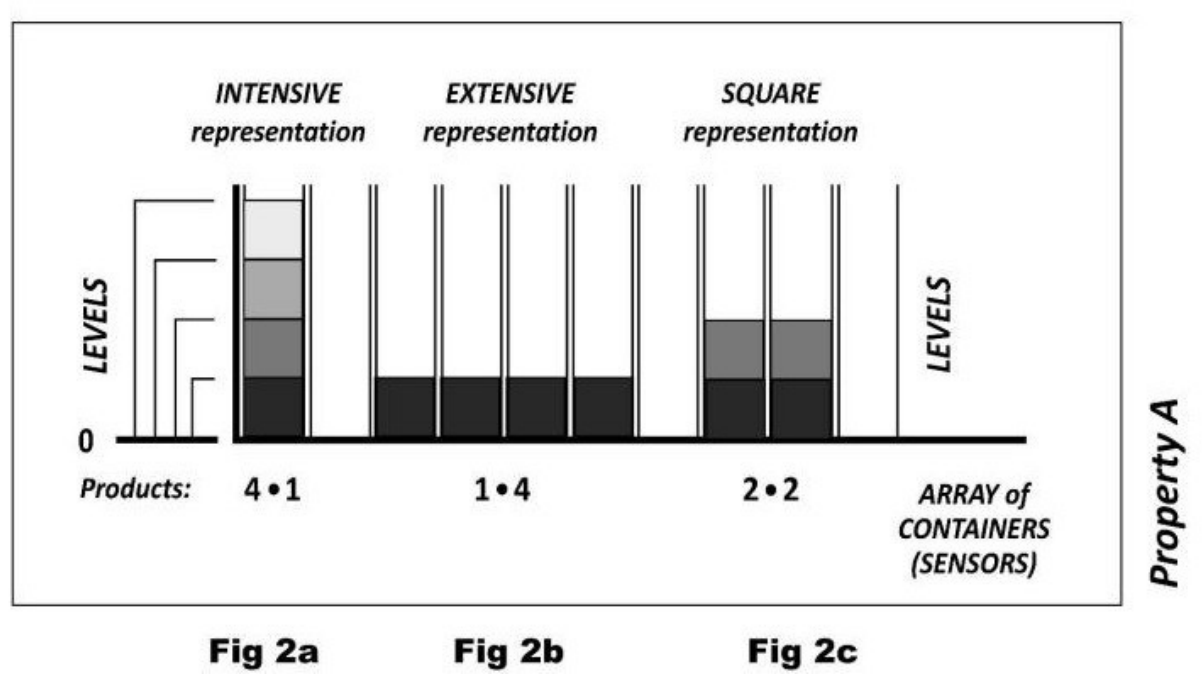
A sensory product — illustrated in Figure 2 — is the association of a level and an extent: how intense a property is, experienced across how many locations. Every experience is a sensory product. In the case of a burn, the intensity of pain (level) and the area affected (extent) vary independently. A ten-second silence versus a one-second silence: both are zero sound intensity, but the extent — duration — differs, and the experiences are not the same. Neither factor alone constitutes a product: without extent there is no location to experience; without intensity there is nothing to experience.
Figure 1.
Sensory schema: single container and a product. (a) A single container: layers accumulate vertically, each coinciding with a level on the adjacent ladder. (b) The container from (a) concatenated with two further containers, each independently bearing its own four layers and levels: a 4∙3 product. Layers accumulate vertically, within a container; containers accumulate horizontally, across the field — the two are perpendicular to one another. Both are orthogonal to levels, nested and idempotent (a state) rather than additive (a process). Property A denotes any sensory (e.g. colour) or general (e.g. importance) property; intensity and extent are not properties but two aspects of one — red, for instance, differs from its shades and tints (dark red, burgundy) along intensity alone. Concatenated containers constitute the array (field) established in §1.2; (b) is the same 4∙3 field reduced in Figure 3. Source: [24].
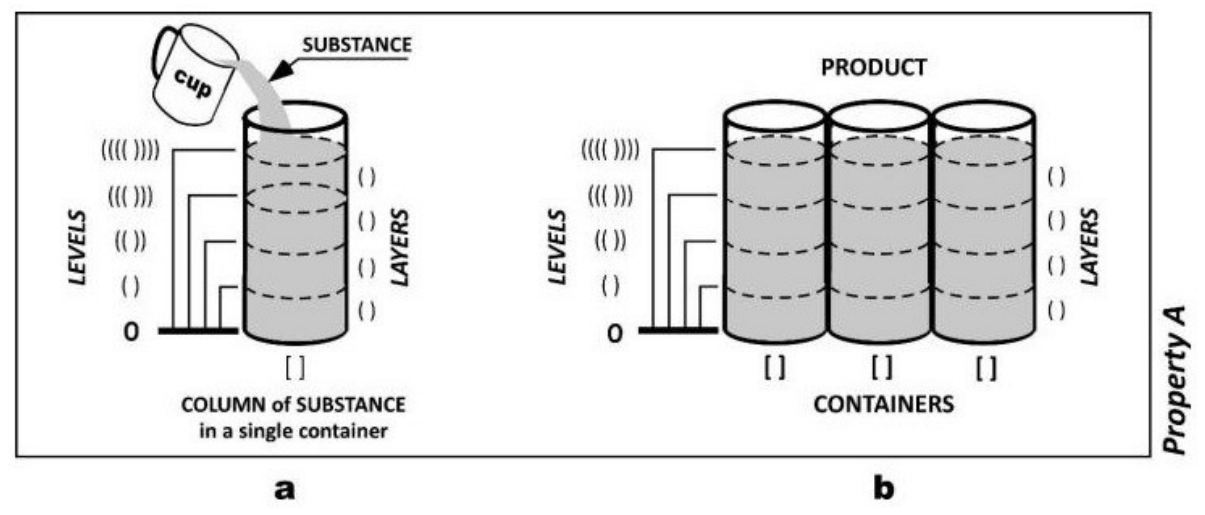
Figure 2.
Sensory products as paint mixtures. Three configurations of the product of levels and containers. Fig 2a: intensive product (4∙1) — four levels in one container. Fig 2b: extensive product (1∙4) — one level across four containers. Fig 2c: square product (2∙2) — two levels in two containers. Adapted from [24].
1.3. Notation
The notation used throughout the paper is summarised in Table 1.
Examples:
– (( )) two levels — the outer contains the inner
– [|||] container with three layers
– { [( )] [( )] [( )] } array of three containers, each with one level
– { [|||] [|||] [|||] } array of three containers, each with three layers
– { [ ] } empty container — zero level, sensor at minimum
1.4. Orthogonality
The three components stand in a precise structural relationship, where ⊥ stands for structural independence and ‖ stands for structural kinship:
– Levels ⊥ Layers — intensity is orthogonal to extent (vertical). The intensity of burn pain is orthogonal to the area of skin affected.
– Levels ⊥ Containers — intensity is orthogonal to extent (horizontal) — the same structural independence at the scale of the full sensory field.
– Layers ‖ Containers — both extensive, both spatial, both subject to concatenation: complementary orientations only (vertical/horizontal).
In summary: the schema has three aspects — one inexpressible (levels) orthogonal to two expressible (layers vertical, containers horizontal). This three-aspect structure is what the reduction collapses.
The linguistic expression of orthogonal relationships between levels and layers is examined in [21].
1.5. Zero
Zero level occupies a unique position in the schema: it is the origin from which all higher levels are measured and the ground against which all intensities are felt.
Zero level and the empty container [ ] are the same thing viewed from two perspectives. From inside — privately — the empty container is experienced as a genuine sensation at zero intensity: a real felt state on the intensive scale, against which higher levels are compared. From outside — publicly — it is a sensor active at its lowest point, the ground state of the system.
Zero level is a genuine experience with extent — blackness is colour at zero level, silence is sound at zero level, the untouched skin between two points of contact is touch at zero level. Because zero-level experiences are commensurable with positive-level experiences of the same modality, they create contrast: the silence makes the note audible; the untouched skin makes the touched area felt. In the schema, 0∙10 and 0∙1 are different products: a ten-second silence and a one-second silence are both zero intensity but are not the same experience.
This also marks the limit of the zero-level product: 0∙0 is not a further case of zero intensity across some extent, but the absence of extent altogether — no container, no location, nothing in which even a zero reading could occur. 0∙10 and 0∙1 are both genuine sensory ground states, differing only in how far they extend; 0∙0 names no experience at all, because no sensor is present to register even the minimum, whatever the level factor — 6∙0 and 10000∙0 are equally void, for the same reason. It is the extent factor going to zero, not the level factor, that empties the product, and this is a hard constraint rather than an asymptotic limit: positive magnitude is preserved at every stage of differentiation, so a product with zero extent is not a smaller experience but no experience at all ([24], §6.2).
The 0∙10 versus 0∙0 distinction is not limited to a single modality, and separating the two cases sharpens rather than weakens with further examples. Silence experienced through an intact auditory system is a 0∙10 case: a genuine, felt zero-level product, extended across ten seconds. Deafness — the absence of the auditory apparatus itself, not merely of a stimulus — is the corresponding 0∙0 case: no sensor is present to register even a minimum, so nothing is experienced, not even silence. The same structure appears across species boundaries with a categorical starkness no within-species example can match: magnetoreception, mediated by cryptochrome- or magnetite-based receptors, gives some birds genuine 0∙10-type access to the Earth’s magnetic field, while humans, categorically lacking any such receptor, are not merely insensitive but occupy the 0∙0 case with respect to the entire modality — not a faint or degraded magnetic sense, but none at all. Homeostatic drives extend the same distinction to interoception: hunger following a meal is a 0∙10 product — zero drive intensity, with the regulatory apparatus (glucose sensors, hypothalamic signalling) intact and active — whereas the rare clinical loss of that apparatus itself (certain hypothalamic lesions eliminating hunger and satiety signalling entirely) is the 0∙0 case, structurally identical to deafness and to human magnetoreception. Interoceptive states are increasingly treated as a dedicated sensory system in their own right, on a footing with the exteroceptive modalities already discussed [5, 6].
This distinguishes zero level from mathematical zero. In mathematics, zero signals absence — of quantity, of membership, of property, of object. In the schema, zero is a product: zero intensity across some extent — a real, felt position on the intensive scale. Mathematical zero, then, is not the formal trace of schema’s zero; it is the formal trace of the extent-zero case above — absence of a sensor to register anything. The distinction matters for Section 2: it is what produces the zero reversal when the intensive aspect of the product is bracketed — what was a genuine sensory ground state becomes absence in the formal domain.
2. The Reduction
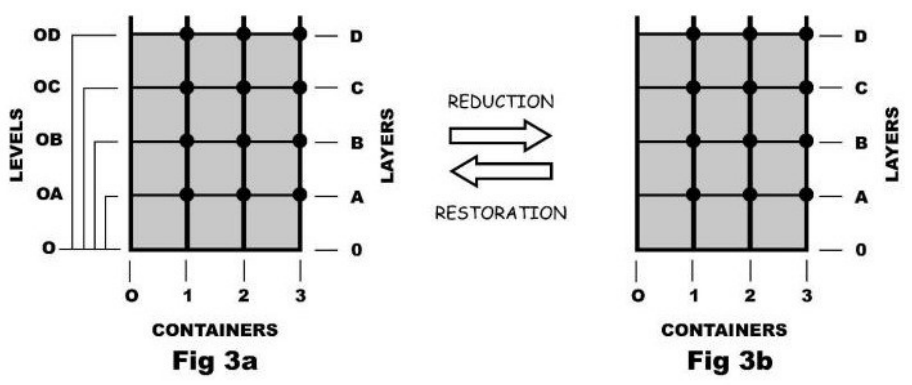
The reduction is a single analytical operation: set aside the private, inexpressible universe of levels and attend to the public domain alone. It is not an ontological claim — levels continue to exist and can be restored at any point. It is a change of what counts. The operation is illustrated in Figure 3.
Figure 3.
The reduction of the sensory schema. Left panel: the pre-reduction schema — 4 levels associated with each of 3 containers: 4∙3 = 12 associations of two orthogonal factors. Right panel: the post-reduction domain — 3 containers each bearing a column of 4 layers: 4 + 4 + 4 = 12. The orthogonal association has become perpendicular addition. The number is preserved; what has changed is what that number means. Adapted from [20].
Public domain revealed. The reduction brackets the private universe (in Husserl’s sense: setting aside without denying). Levels are set aside. What remains is the public domain alone. In the public domain, each container location holds layers — discrete, additive, countable units arranged vertically. When attention is restricted to the public domain, what is visible at each location is a column: a self-supporting vertical structure defined by its presence and its height. The column was always there. The reduction does not produce it — it reveals it. The container walls are no longer needed: the column stands on its own on the tile that was the container’s base. The complete tiling of container bases becomes a flat grid of tiles, each either bearing a column or bare.
Zero reversal. Column height was significant before the reduction: it indicated a level. In the public domain alone, no level remains to be indicated. Height is still present — still countable — but irrelevant. A column of height 4 and a column of height 6 are identical in the one respect that now matters: both are present. A tile with no column — height = 0 — is bare. This is the zero reversal. Before the reduction, height = 0 indicated the sensory ground state: a genuine, felt minimum, the origin from which higher levels were measured. This is consistent with a finding from vision science: complete absence of light input is not perceived as true black but as Eigengrau, a uniform dark grey produced by intrinsic retinal noise indistinguishable from real photon capture, which sets a biological floor beneath which visual intensity cannot fall [1] — illustrating, in one modality, that zero level can be a genuine, actively-registered floor state rather than perceptual absence. After the reduction, height = 0 means no column stands on the tile. The tile is bare — genuinely empty, nothing there. What was a positive sensory ground state has become absence. The empty set ∅ in set theory is the formal trace of this reversal.
Definition 1
(Zero Reversal). In the pre-reduction schema, height = 0 corresponds to a genuine sensory ground state — the empty container [ ] at minimum intensity. After bracketing, height = 0 corresponds to a bare tile — genuine absence. The formal residue of this reversal is ∅ ∈ (T).
Column domain and Boolean domain. The post-reduction domain contains columns of varying height at tiles. The full column domain — where height is preserved — supports richer structures: multisets when height is counted, fuzzy sets when fractional heights are admitted. Classical Boolean algebra is the minimal case: the domain produced when height is not merely irrelevant but informally set aside — the pre-formal act that makes axiomatisation possible.
Once height is set aside, the only distinction the domain supports is: column present (height ≥ 1) or bare (height = 0). This binary coarse-graining follows directly from bracketing.
– Column present (height ≥ 1): tile occupied — recorded as 1
– No column (height = 0): tile bare — recorded as 0
The power set (T). Let T be the set of tiles produced by the complete tiling — the array { }. Each occupancy pattern on T assigns 1 (occupied) or 0 (bare) to each tile. Each such pattern corresponds exactly to a subset S ⊆ T: the occupied tiles. The collection of all occupancy patterns is therefore the power set (T).
Three operations are defined on this domain, chosen to mirror the classical set-theoretic operations of union, intersection, and complement:
– Pattern-union: at each tile, occupied if either input pattern is occupied
– Pattern-overlap: at each tile, occupied only if both input patterns are occupied
– Pattern-inversion: at each tile, flip occupied to bare and bare to occupied
Under this identification, (T) equipped with these three operations is the Boolean algebra of subsets of T — not by imposition but by structural correspondence. For the classical representation theory see Stone [16]; for a standard modern treatment see van Dalen [17]. Section 3 derives each Boolean law as a direct structural observation about how these operations behave on tiles and columns.
Non-circularity. The identification of the post-reduction domain with (T) is not circular. Three potential circularities require explicit response.
First, the tiles of T are not set-theoretic primitives — they are the square bases of containers, individuated by their spatial positions in the complete tiling established in Section 1. The grid is derived from the schema’s spatial structure, not assumed from set theory.
Second, the binary distinction occupied/bare is not assumed — it follows from the zero reversal. Bracketing a continuous intensive scale that had a genuine zero ground state produces exactly two distinguishable states: column present (any height ≥ 1) and bare (height = 0, now genuine absence). This binary structure is derived from the schema’s intensive scale, not imported from classical logic.
Third, extensionality — two patterns identical if and only if they agree at every tile — follows from the spatial individuation of tiles. Tiles are locations; locations are individuated by their positions in the array. This is a spatial fact about the array, not a set-theoretic axiom.
This non-circularity claim has a specific scope, already flagged in the Introduction: it is the domain — tiles, binary occupancy, individuation — that is derived from the schema, not the three operations, which are defined to correspond to ∪, ∩, and complement. (T) is not the origin of Boolean logic; it is the formal description of what the schema’s public domain looks like once the intensive aspect of the product is set aside.
Theorem 1
(Non-circularity). The identification of (T) with the post-reduction domain is not circular: (i) tiles are the bases of containers, not set-theoretic primitives; (ii) the binary distinction occupied/bare follows from the zero reversal, not from assumed bivalence; (iii) extensionality follows from spatial individuation of tile positions, not from a set-theoretic axiom.
3. Boolean Algebra as Structural Residue
The domain established in Section 2 — a complete grid of tiles, each occupied or bare, with three defined operations — is the domain of this section. Let A, B, C denote occupancy patterns — subsets of T. Each Boolean law is derived as a direct structural observation. No axioms are imported from set theory or logic.
The correspondence is exact in the following precise sense: there is a bijection between occupancy patterns on T and subsets of T, under which the three operations correspond exactly to Boolean union, intersection, and complement, and under which each Boolean law holds as a direct structural consequence. The verification is given in Table 3 (Appendix A).
Theorem 2
(Correspondence). The post-reduction domain with pattern-union, pattern-overlap, and pattern-inversion is isomorphic to the Boolean algebra (T). Each law is verified in the derivations that follow and formally in Table 3 (Appendix A). The mathematical content here is standard: a powerset under union, intersection, and complement is a Boolean algebra [16].
What this paper contributes is the identification of the post-reduction sensory domain as an instance of that standard structure.
Presence and absence. Every tile is either occupied or bare — no third state exists. Whether a location belongs to a pattern can be determined by inspection alone. This binary testability corresponds to the membership relation (∈) of classical set theory.
Closure. Pattern-union, pattern-overlap, and pattern-inversion always produce another occupancy pattern over the same tiling T. No operation produces something outside this class. This corresponds to the closure property of Boolean algebra.
Commutativity. At each tile, pattern-union asks: is either A or B occupied? Swapping A and B produces the same answer at every tile. Similarly for pattern-overlap. This corresponds to A ∪ B = B ∪ A and A ∩ B = B ∩ A.
Associativity. A tile is occupied in (A ∪ B) ∪ C if and only if it is occupied in at least one of A, B, C — regardless of grouping order. This corresponds to (A ∪ B) ∪ C = A ∪ (B ∪ C) and (A ∩ B) ∩ C = A ∩ (B ∩ C).
Identity elements. The zero pattern ∅ — all tiles bare — leaves pattern-union unchanged. The full pattern U — all tiles occupied — leaves pattern-overlap unchanged. The zero reversal (§2) grounds ∅: it is the formal trace of the sensory ground state after bracketing. This corresponds to A ∪ ∅ = A and A ∩ U = A.
Complements. For any pattern A, its inversion Aᶜ occupies exactly the tiles A does not. Pattern-union of A and Aᶜ gives U; pattern-overlap gives ∅. This corresponds to A ∪ Aᶜ = U and A ∩ Aᶜ = ∅.
Idempotence. Pattern-union of A with itself: at each tile, occupied if A is occupied — which is simply A. An occupied tile cannot become more occupied by union with itself. This corresponds to A ∪ A = A and A ∩ A = A. It echoes level-idempotence: a level reached twice is still the same level.
Distributivity. To see distributivity as a structural observation, consider three patterns on a tiling of three tiles:
A = {1, 2} → { [|] [|] [ ] }
B = {2, 3} → { [ ] [|] [|] }
C = {1} → { [|] [ ] [ ] }
Left side: A ∩ (B ∪ C)
B ∪ C = {1, 2, 3} → { [|] [|] [|] }
A ∩ (B ∪ C) = {1, 2} → { [|] [|] [ ] } ✓
Right side: (A ∩ B) ∪ (A ∩ C)
A ∩ B = {2} → { [ ] [|] [ ] }
A ∩ C = {1} → { [|] [ ] [ ] }
(A ∩ B) ∪ (A ∩ C) = {1, 2} → { [|] [|] [ ] } ✓
Both sides yield the same pattern. This concrete case illustrates distributivity as a structural fact about tilewise occupancy; it is one instance, not a general proof, which is given in Table 3 (Appendix A). This corresponds to A ∩ (B ∪ C) = (A ∩ B) ∪ (A ∩ C).
Propositional logic. Binary occupancy corresponds to bivalence. Every combination of presence-claims is expressible using the three operations — expressive completeness. Results depend only on input occupancy states — truth-functionality. The connection to truth tables is direct: reading “occupied” as true and “bare” as false, pattern-union, pattern-overlap, and pattern-inversion at a single tile reproduce exactly the truth tables for ∨, ∧, and ¬. Pattern-overlap, for instance, is occupied only when both inputs are occupied: (T,T)→T, (T,F)→F, (F,T)→F, (F,F)→F — the truth table for conjunction, read tile by tile rather than row by row. Since {∨, ∧, ¬} is functionally complete, every truth-functional propositional formula corresponds to some pattern built from these three operations.
These laws hold as direct structural observations about occupancy patterns on a tiled field. The correspondence to Boolean algebra rests on the non-circularity established in §2: the tiles, the binary distinction, and the extensionality of patterns are all derived from the schema’s pre-formal structure, not imported from set theory or logic — though, as noted there, the three operations themselves are defined to mirror the Boolean ones, so the correspondence is best read as a motivated interpretation of the domain rather than an independent derivation of it. What classical logic cannot express is precisely what the reduction set aside. The structure of that remainder — and what it points toward in richer formal systems — is the subject of Section 4.
4. The Public Space and Its Formal Structures
Section 2 and Section 3 demonstrated that attending to one property — binary presence/absence at each tile — produces Boolean algebra. But the public space is not exhausted by this selection. Different properties, or different combinations of properties, yield different formal systems. Boolean algebra is one projection from a common source. This section identifies that source, shows how two closely related systems — fuzzy logic and multisets — arise from different selections of the same post-reduction domain, and outlines what a complete mapping of public space properties to formal systems would require.
The correspondences in §4.2 and §4.3 are structural observations, not completed proofs. They are offered as heuristic demonstrations of the selection principle: the same domain, attended to differently, produces different formal systems.
4.1. The Public Space — Structural Properties
The properties below were already present in the public universe of the sensory schema as established in Section 1 — the domain of layers, containers, and the array: spatial, additive, and sequential. The reduction does not create them; it reveals them as a standalone domain by setting aside the private universe alongside which they always existed. The list is illustrative rather than exhaustive: a more complete inventory can be derived by examining Section 1 and identifying each structural property of the public universe the schema describes. The structural properties of the post-reduction domain are listed in Table 2.
Boolean algebra selects superposition, boundary, zero ground state, and binary presence/absence — and ignores all other properties. §4.2 and §4.3 show this selection principle through fuzzy logic and multisets.
4.2. Fuzzy Logic — Preserving Column Height
Classical Boolean algebra collapses column height to binary presence: height ≥ 1 maps to 1 (present), height = 0 maps to 0 (bare). The membership function is binary: μA(x) ∈ {0, 1} — either fully in the set or fully out, with no intermediate values. Fuzzy logic [19] replaces this with a graded membership function: μA(x) ∈ [0, 1], where any value between 0 and 1 is permitted. From the schema’s perspective, this is precisely the decision not to apply binary coarse-graining: column height (layer count) is preserved as the degree of membership, normalised to [0, 1]. The degree is extensive, not intensive — a public, measurable quantity, not a felt quality. Levels remain set aside; fuzzy logic does not recover the private intensive scale. It is a less coarse-grained version of the same post-reduction domain, not an extension of Boolean algebra.
4.3. Multisets — Preserving Column Multiplicity
Boolean algebra imposes idempotence: A ∪ A = A — an element is either present or not, however many times it appears. This reflects Boolean algebra’s binary coarse-graining, not a feature of layers themselves, which were never idempotent in the schema — adding a layer was always a genuine increase. Multiset theory [2] instead counts how many times an element appears: the multiset {a, a, b} is distinct from {a, b}. From the schema’s perspective, multisets select the additive accumulation and layer count properties that Boolean algebra’s binary projection sets aside. Column height is preserved as a genuine integer count. Multiset union takes the maximum multiplicity at each tile, intersection the minimum; Boolean algebra is the special case where all multiplicities are 0 or 1. Multisets are faithful to the height-preserving column domain; Boolean algebra to the binary presence/absence projection.
4.4. The Public Space as Research Programme
The two examples above demonstrate the selection principle: the same post-reduction domain, attended to through different property selections, yields different formal systems. Boolean algebra, fuzzy logic, and multisets are three projections from the same source — the public space revealed by the reduction of the sensory schema.
The public space contains more properties than these three selections use. The full table in §4.1 points toward ordinal arithmetic (sequential ordering), set theory (superposition), combinatorics, topology, and more. Each correspondence is a structural observation, not a completed proof, and establishing each formally — mapping domain properties onto target axioms without importing external structure — constitutes an open research programme to which this work provides both the framework and the invitation. The Boolean case provides both the method and the precedent.
5. Discussion
5.1. What the Finding Means
Section 2 and Section 3 establish a precise structural result, verified in full in Table 3 (Appendix A): when the private intensive aspect of the product is bracketed, the remaining public domain is isomorphic to the Boolean algebra of the power set (T), with each Boolean law holding as a direct structural consequence of tile occupancy.
Boolean algebra is conventionally formalised as an axiomatic system, with no further story told about its relationship to experience. The schema offers such a story: a public domain — occupancy patterns on tiled fields — is isomorphic to Boolean algebra, with the isomorphism mediated by spatial structure rather than prior logical axioms. Its apparent limitations — bivalence, extensionality, truth-functionality — are the precise formal residue of bracketing the intensive aspect of the product, not deficiencies. Section 4 shows how the same domain supports richer structures beyond the binary case; Appendix B discusses its relationship to the broader tradition grounding mathematics in human experience.
5.2. The Comparison Asymmetry
One consequence of the bracketing deserves special attention. In the full schema, genuine comparison — ratio, proportion, degree — belongs to the private universe. Levels are nested positions on the intensive scale — each higher level subsuming all those below it — and can be related multiplicatively: this level is twice that one, this pain is half as intense. Layers indicate levels but cannot compare them directly — they are the medium, not what is compared. After the reduction, layers are cut off from levels. The post-reduction domain retains ordinal and cardinal comparison — grounded in count comparisons and inequalities (§4.1) — but ratio and proportion in their full sense require invoking levels that are no longer present.
Classical mathematics constructs rationals as equivalence classes of integer pairs — representing ratios as formal relationships between integers. This preserves the arithmetic of ratios but not their experiential ground: the felt sense that one intensity is twice another requires a continuous intensive scale with a genuine zero, which the reduction sets aside. “Twice as intense” uses an adverbial multiplier — twice, thrice, five-times — an abstract scaling command with no unit of its own, applied to an unlabelled position on the level scale. “Two-plus-one” uses cardinal numbers already bound to a concrete unit — two layers, one layer — added as labelled, countable quantities. The two are not the same arithmetic form: one is a unit-less operator applied to a felt position; the other is a sum of unit-bearing counts. The asymmetry is not incidental to language — it tracks the schema directly: levels carry no unit, so comparison can only be stated multiplicatively, by an operator; layers carry a unit, so accumulation is stated additively, by a count (see Appendix B).
Cardinal number can now be located precisely within this structure. Counting “five objects” fixes the level factor at its minimum — each object treated as a bare unit — and lets only the container factor vary: 1∙5. A felt magnitude such as “level five” inverts this: the container factor is fixed at one, and the level factor varies: 5∙1. Cardinal number is therefore not a primitive alongside level and extent, but what a sensory product looks like once level is fixed at the unit and only container-count is free to vary.
The formal treatment of how the schema grounds zero, negatives, and the boundary cases of arithmetic is developed in [23].
A parallel asymmetry governs differentiation. Levels can be differentiated arbitrarily finely — the private universe imposes no lower bound on how fine a distinction can become ([24], §6.2). Layers must follow, but cannot reach zero thickness. The private universe differentiates without limit; the public universe can only follow finitely. The inexpressible is always richer than what can be indicated through it.
5.3. Methodological Status
The bracketing is methodological, not ontological. It does not claim that experience is purely extensive or that the intensive aspect of the product does not exist. It is an analytical operation — analogous to ignoring time in statics or depth in planar analysis — valid within its scope and fully reversible.
The schema’s private/public distinction connects to several active debates in philosophy of mind and psychophysics.
Two psychophysical phenomena bear on the orthogonality claimed in §1.4, though neither undermines it. Spatial summation — increased perceived intensity with larger stimulated area — concerns how intensity aggregates across many sensory products, not the internal structure of any one product; the orthogonality claim is scoped to that internal structure alone, and this paper does not model the aggregation step. Stevens’ power law [15], by contrast, does concern a single product: it relates one physical magnitude to one felt magnitude, and its characteristic nonlinearity — compressive for some modalities, expansive for others — is compatible with the level/layer asymmetry of §5.2: a unit-less private scale has no reason to correspond linearly to a unit-bearing public one. The schema interprets this nonlinearity rather than deriving its specific form.
The private language objection (the claim that a purely private language — one with no public criteria for correct use — is incoherent [18]) is answered by §1.1: the schema requires only that private experiences be evocable through public modifications, not that they be directly expressible or verifiable.
Two further points of contact are worth noting briefly. Enactive and 4E accounts [8] are compatible with the schema: the private universe is the inaccessible aspect of the sensing body’s engagement with the world, characterised here by structural role rather than metaphysical commitment, leaving open whether it is irreducible qualia [12, 9], phenomenological givenness, or a functional role individuated by its place in the level-layer structure. And the intensity/extent duality is not organism-scale: it recurs one level below, in the graded activation of an individual cell (intensity) versus the count of cells sharing that activation (extent) — consistent with, though not dependent on, the dissociable magnitude systems documented at the organism scale elsewhere [13]. Neurons occupy a further, distinct scale: the mechanism by which a cell reaches its activation state, not the state itself.
A further objection concerns necessity itself. Publicity secures checkability, not truth: a room of observers can share a public, checkable belief and still be wrong together. Necessity instead comes from Appendix A’s deductive structure — given any set T, the tile-by-tile definitions necessarily satisfy every Boolean axiom, independent of who checks them. This separates genesis from validity: §2 explains how a sensing body arrives at bracketing, but the proof alone carries the necessity. That separation answers Frege’s [7] classical psychologism objection — that if arithmetic depended on how minds happen to work, its truths would be contingent facts about psychology, true only for minds built as ours are.
The schema’s relationship to the broader tradition grounding mathematics in human experience — Kant, Brouwer, and Lakoff and Núñez — is discussed in Appendix B. Full engagement with this literature remains an open direction.
Conclusion
The universe of discourse is not given. It is the public space revealed when the intensive aspect of the product is set aside — a domain rich enough to ground Boolean algebra and point toward arithmetic, multisets, and more. The act of abstraction that produces Boolean algebra can be undone — and when it is, the full sensory schema is restored: levels and layers, private and public, orthogonal and perpendicular. Boolean algebra asks: column here or not? Everything else is what you see when you look more carefully at the same space.
Funding
This research received no external funding.
Data Availability Statement
Not applicable.:
Conflicts of Interest
The author declares no conflict of interest.
APPENDIX A Verification that (T) Satisfies Boolean Algebra Axioms
Let T be a non-empty set of tile-locations. The Boolean-algebra construction below does not require T to be finite: (T) forms a Boolean algebra under ∪, ∩, and complement for any set T, and every derivation in Table 3 holds tile by tile regardless of cardinality. T is assumed non-empty only to avoid the degenerate one-element Boolean algebra (∅) = {∅}.
The finite diagrams used throughout this paper (Figure 1 and Figure 3) are for concreteness and readability, not a requirement of the proof: for the verification itself, a tile is simply an element of the abstract set T, with no further structure assumed.
For patterns A, B, C ⊆ T, the operations are defined tile by tile:
A ∪ B = { t : t ∈ A ∨ t ∈ B }
A ∩ B = { t : t ∈ A ∧ t ∈ B }
Aᶜ = T ∖ A
We verify against the standard characterisation of a Boolean algebra as a complemented distributive lattice: commutativity, associativity, and absorption jointly establish ((T), ∪, ∩) as a lattice; distributivity extends it to a distributive lattice; and complementation with identity elements makes it complemented, hence Boolean (cf. [17]). Idempotence follows from absorption but is verified separately for concreteness. The verification is as follows (Table 3):
Each axiom holds as a direct consequence of the tile-by-tile definition of the operations. The post-reduction domain (T) satisfies all Boolean algebra axioms. This is the structure obtained under binary coarse-graining specifically; Section 4 shows that the same domain, without that coarse-graining, supports richer structures such as multisets and fuzzy sets.

Table 3.
Verification that (T) Satisfies Boolean Algebra Axioms.
| Axiom | Statement | Verification |
|---|---|---|
| Commutativity (∪) | A ∪ B = B ∪ A | t ∈ A ∪ B ⇔ t ∈ A ∨ t ∈ B ⇔ t ∈ B ∨ t ∈ A ⇔ t ∈ B ∪ A. ✓ |
| Commutativity (∩) | A ∩ B = B ∩ A | t ∈ A ∩ B ⇔ t ∈ A ∧ t ∈ B ⇔ t ∈ B ∧ t ∈ A ⇔ t ∈ B ∩ A. ✓ |
| Associativity (∪) | (A ∪ B) ∪ C = A ∪ (B ∪ C) | t ∈ (A ∪ B) ∪ C ⇔ t ∈ A ∨ t ∈ B ∨ t ∈ C ⇔ t ∈ A ∪ (B ∪ C). ✓ |
| Associativity (∩) | (A ∩ B) ∩ C = A ∩ (B ∩ C) | t ∈ (A ∩ B) ∩ C ⇔ t ∈ A ∧ t ∈ B ∧ t ∈ C ⇔ t ∈ A ∩ (B ∩ C). ✓ |
| Absorption (∪) | A ∪ (A ∩ B) = A | t ∈ A ∪ (A ∩ B) ⇔ t ∈ A ∨ (t ∈ A ∧ t ∈ B) ⇔ t ∈ A (the disjunct t ∈ A ∧ t ∈ B adds nothing once t ∈ A holds). ✓ |
| Absorption (∩) | A ∩ (A ∪ B) = A | t ∈ A ∩ (A ∪ B) ⇔ t ∈ A ∧ (t ∈ A ∨ t ∈ B) ⇔ t ∈ A (the conjunct is satisfied by t ∈ A alone). ✓ |
| Identity (∪) | A ∪ ∅ = A | t ∈ A ∪ ∅ ⇔ t ∈ A ∨ t ∈ ∅ ⇔ t ∈ A (since ∅ is empty). ✓ |
| Identity (∩) | A ∩ T = A | t ∈ A ∩ T ⇔ t ∈ A ∧ t ∈ T ⇔ t ∈ A (every tile is in T). ✓ |
| Complement (∪) | A ∪ Aᶜ = T | For any tile t: either t ∈ A or t ∉ A, so t ∈ A ∪ Aᶜ. Thus A ∪ Aᶜ = T. ✓ |
| Complement (∩) | A ∩ Aᶜ = ∅ | No tile can be both in A and not in A. Thus A ∩ Aᶜ = ∅. ✓ |
| Idempotence (∪) | A ∪ A = A | t ∈ A ∪ A ⇔ t ∈ A ∨ t ∈ A ⇔ t ∈ A. ✓ |
| Idempotence (∩) | A ∩ A = A | t ∈ A ∩ A ⇔ t ∈ A ∧ t ∈ A ⇔ t ∈ A. ✓ |
| Distributivity (∩ over ∪) | A ∩ (B ∪ C) = (A ∩ B) ∪ (A ∩ C) | t ∈ A ∩ (B ∪ C) ⇔ t ∈ A ∧ (t ∈ B ∨ t ∈ C) ⇔ (t ∈ A ∧ t ∈ B) ∨ (t ∈ A ∧ t ∈ C) ⇔ t ∈ (A ∩ B) ∪ (A ∩ C). ✓ |
| Distributivity (∪ over ∩) | A ∪ (B ∩ C) = (A ∪ B) ∩ (A ∪ C) | t ∈ A ∪ (B ∩ C) ⇔ t ∈ A ∨ (t ∈ B ∧ t ∈ C) ⇔ (t ∈ A ∨ t ∈ B) ∧ (t ∈ A ∨ t ∈ C) ⇔ t ∈ (A ∪ B) ∩ (A ∪ C). ✓ |
APPENDIX B The Sensory Schema, Mathematical Tradition, and Conceptual Metaphor
The sensory schema’s relationship to the mathematical tradition is not one of correction. Kant, Brouwer, and Lakoff and Núñez each successfully describe the post-reduction public domain from a different vantage point — each selecting different structural properties from what the reduction reveals. The schema makes explicit what all three set aside: the private intensive aspect of the product. This is the key point: the same post-reduction domain, attended to through different selections, produces different formal accounts of mathematics.
The post-reduction domain and its interpreters. Kant [10] grounds mathematics in pure intuition — space and time as the a priori extensive forms of sensible experience. Space grounds geometry; time grounds arithmetic through the successive synthesis of identical units. Each counted object is treated as interchangeable with every other regardless of its actual qualities: a deliberate choice, setting aside intensive differences to attend only to extensive presence as a unit. What Kant selects from the post-reduction domain is its static extensive structure: space as horizontal tiling, time as sequential ordering — precisely the properties Section 1 establishes as the public domain of layers and containers. Kant’s own vocabulary anticipates the level side too: the Anticipations of Perception distinguish this same extensive magnitude from intensive magnitude — degree, apprehended instantaneously, non-additive [10, pp. 207–208] — corroborating the nesting and idempotence Figure 1 and §1.4 assert of levels.
Brouwer [3] holds that arithmetic is a private mental construction from temporal succession: natural numbers are built by the mind repeating the successor operation indefinitely. This privacy is essential for Brouwer — mathematics exists in the mind, not in formal symbols — but his private universe is constructive and formal, not sensory: a temporal act, not a felt intensity. What he selects from the post-reduction domain is its dynamic temporal character — sequential, discrete, additive ordering — described as mental construction rather than spatial form. Succession is a process unfolding one step at a time, which is exactly why it captures layers naturally and has no purchase on levels: levels are not built up through steps but are simply, statelessly, present.
Lakoff and Núñez [11] ground mathematics in the dynamic extensive activity of the body: public motor processes, movement schemas, embodied traversal of paths — more is up, counting is moving along a path. Starting and ending points are left undefined, because defining them would require specifying what is felt there, which falls outside their empirical, public-observability framework. Their account therefore has paths but no ground state, counting but no sensory zero. What they select from the post-reduction domain is its dynamic motor character — directional, sequential, traversal properties of extensive concatenation — described through embodied cognitive science.
All three accounts are right within the domain they deliberately inhabit. Mathematical structure is not incomplete from the mathematician’s point of view. It is perfect precisely because the intensive aspect of the product has been deliberately set aside. Mathematicians are not failing to engage with sensation. They are deliberately and correctly excluding it.
What the schema makes explicit. The schema makes explicit the intensive aspect all three set aside, and shows that each selects a different set of properties from the same post-reduction domain. Each selection is legitimate; the schema names their common source.
In the schema’s account, Lakoff and Núñez’s process-metaphors — movement along paths, traversal of sequences — are public traces of private level comparisons: the body compares a felt level against a target, and the discrepancy drives movement. Lakoff and Núñez describe the path; the schema describes what generates it.
Intensive and extensive language in mathematical discourse. Mathematical discourse consistently uses intensive language for ordering and comparison — greater, lesser, higher, lower, value, magnitude, maximum, minimum — and extensive language for arithmetic operations — adding, concatenating, counting, dividing. This distinction is not arbitrary. It follows directly from the schema and is inexplicable from within the metaphor-based framework alone.
Lakoff and Núñez treat “greater than” as a vertical spatial metaphor: more is up, less is down. But verticality alone does not capture the structural difference. “This mountain is 200 feet high” — foot by foot from the ground up — is also vertical, yet purely extensive: discrete, additive, concatenable. Horizontal and vertical are both extensive orientations in the schema — the perpendicular relation between layers and containers established in §1.4, distinct from the orthogonal relation that sets levels apart from extent altogether. What distinguishes intensive comparison from extensive concatenation is not direction but the absence of a unit: levels have no discrete unit, since their nested structure precludes counting.
Layers and containers have units — one layer, one tile, one foot. Levels have no unit. “Greater than” describes a position on a unitless nested scale, measured from a common zero — like resting sticks of different lengths on the same surface. The comparison is immediate and felt, not computed by counting units. Nesting is a state — all lower levels co-present at once — while counting is a process taken one unit at a time; comparison by nesting requires no traversal, comparison by counting does. Reaching level b means level a is already present within it — nesting, not addition.
The schema predicts exactly why mathematical discourse uses intensive language for ordering and extensive language for arithmetic: comparison is level-based; counting is extensive-based. Lakoff and Núñez’s account observes this distinction consistently but cannot explain it from within its own framework, because that framework makes no structural distinction between intensive and extensive — only between different public processes.
Consider counting: each unit added is a step — 1, then 1+1=2, and so on, Brouwer’s successor operation exactly. Ten such steps accumulate as ten ones; once reached, that accumulation is itself unitized as a single higher-level step — a “ten” — which now repeats at the next scale. Ten tens accumulate and unitize as a hundred, and so on indefinitely: step → accumulate → unitize → step again. Place-value notation formalizes this same recursion: “(100 × 4) ⊕ (10 × 3) ⊕ (1 × 8)” treats each digit position as a count of a unit ten times the size of the one to its right.
Psychology’s rating scales confirm this from the other direction: pain reported as 7 out of 10 uses a public extensive scale to indicate a private intensive level with no unit of its own. If intensity had genuine units, the same stimulus would produce the same rating in everyone, as a ruler gives the same reading for the same length — it does not: an identical, calibrated thermal stimulus produces markedly different pain ratings across individuals, because the number indicates a private level, not a public measure [4].
Closing. Kant selects the static extensive forms of the post-reduction domain — space and time. Brouwer selects its dynamic temporal construction. Lakoff and Núñez select its dynamic motor processes. Each selection is right within the domain it deliberately inhabits. The schema names that domain — the post-reduction public space produced by the single act of bracketing the intensive aspect of the product — and shows that what each account selects is a different combination of structural properties from the same common source. The schema does not correct these accounts. It shows where they all come from.
APPENDIX C A Note on the Paper’s Dualities
The paper draws several structural distinctions that share a common shape — levels against layers, or the intensive against the extensive — but are not restatements of one another. Because orthogonal, perpendicular, and other paired terms are easily conflated despite naming different relations, this appendix collects the paper’s structural distinctions for reference.
Table C1 concerns relations between the schema’s three primitives. Table C2 concerns properties that distinguish the intensive from the extensive, independent of any particular relation. The two tables answer different questions and should not be read as rows of a single list.
Table C1.
Relations Between the Primitives.
| Pair | Relation | What it means |
|---|---|---|
| Levels & Layers | Orthogonal (⊥) | Structural independence — one private/non-spatial, one public/spatial |
| Levels & Containers | Orthogonal (⊥) | Same independence, at the scale of the full field |
| Layers & Containers | Parallel (‖) | Two spatial orientations only — vertical vs. horizontal, both extensive |
Table C2.
Properties Distinguishing Levels from Layers.
| Structural feature | Levels (intensive aspect) | Layers (extensive aspect) |
|---|---|---|
| Example: colour | Shade — “dark red” | Extent — “the whole apple” |
| Example: pain | Severity felt | Area of skin affected |
| Modality | State (nesting) | Process (sequential) |
| Unit | Unit-less | Unit-bearing |
| Comparison | Immediate, felt | Computed, counted |
| Growth | Idempotent | Additive |
| Differentiation | Unbounded | Bounded |
| Combination | Multiplicative (“twice as”) | Additive (“one plus one”) |
References
- Barlow, H. B. Dark and light adaptation: Psychophysics. In Visual Psychophysics; Jameson, D., Hurvich, L. M., Eds.; Springer, 1972; pp. 1–28. [Google Scholar]
- Blizard, W. D. Multiset theory. Notre Dame J. Form. Log. 1989, 30(1), 36–66. [Google Scholar] [CrossRef]
- Brouwer, L. E. J. Intuitionism and formalism. Bull. Am. Math. Soc. 1913, 20(2), 81–96. [Google Scholar] [CrossRef]
- Coghill, R. C.; McHaffie, J. G.; Yen, Y.-F. Neural correlates of interindividual differences in the subjective experience of pain. Proc. Natl. Acad. Sci. 2003, 100(14), 8538–8542. [Google Scholar] [CrossRef] [PubMed]
- Craig, A. D. How do you feel? Interoception: The sense of the physiological condition of the body. Nat. Rev. Neurosci. 2002, 3(8), 655–666. [Google Scholar] [CrossRef] [PubMed]
- Craig, A. D. Interoception: The sense of the physiological condition of the body. Curr. Opin. Neurobiol. 2003, 13(4), 500–505. [Google Scholar] [CrossRef] [PubMed]
- Frege, G. Review of E. Husserl, Philosophie der Arithmetik I. Z. Für Philos. Und Philos. Krit. English translation by E. W. Kluge, 1972, Mind, 81(323), 321–337.). 1894, 103, 313–332. [Google Scholar]
- Gallagher, S. How the body shapes the mind; Oxford University Press, 2005. [Google Scholar]
- Jackson, F. Epiphenomenal qualia. Philos. Q. 1982, 32(127), 127–136. [Google Scholar] [CrossRef]
- Kant, I. Critique of pure reason; Smith, N. K., Translator; Macmillan, 1781/1787. [Google Scholar]
- Lakoff, G.; Núñez, R. E. Where mathematics comes from: How the embodied mind brings mathematics into being; Basic Books, 2000. [Google Scholar]
- Nagel, T. What is it like to be a bat? Philos. Rev. 1974, 83(4), 435–450. [Google Scholar] [CrossRef]
- Pantsar, M. Numerical cognition and the epistemology of arithmetic; Cambridge University Press, 2024. [Google Scholar] [CrossRef]
- Sereno, M. I.; Sood, M. R.; Huang, R.-S. Topological maps and brain computations from low to high. Front. Syst. Neurosci. 2022, 16, 787737. [Google Scholar] [CrossRef] [PubMed]
- Stevens, S. S. On the psychophysical law. Psychol. Rev. 1957, 64(3), 153–181. [Google Scholar] [CrossRef] [PubMed]
- Stone, M. H. The theory of representations for Boolean algebras. Trans. Am. Math. Soc. 1936, 40(1), 37–111. [Google Scholar] [CrossRef]
- van Dalen, D. Logic and structure, 4th ed.; Springer, 2008. [Google Scholar]
- Wittgenstein, L. Philosophical investigations; Anscombe, G. E. M., Translator; Blackwell, 1953. [Google Scholar]
- Zadeh, L. A. Fuzzy sets. Inf. Control 1965, 8(3), 338–353. [Google Scholar] [CrossRef]
- Raykowski, W. Layers and levels: What a column of water tells us about human cognition. Cogn. Semant. 2018, 4(1), 104–133. [Google Scholar] [CrossRef]
- Raykowski, W. Is there such a thing as orthogonyms? Cogn. Semant. 2019, 5(2), 201–223. [Google Scholar] [CrossRef]
- Raykowski, W. Sensory schema: From sensory contrasts to antonyms. Cogn. Semant. 2022, 8(2), 240–268. [Google Scholar] [CrossRef]
- Raykowski, W. From sensations to contrast, opposition and numbers. Forum Linguist. Stud. 2024, 6(4), 231–253. [Google Scholar] [CrossRef]
- Raykowski, W. Sensory schema: From sensation to knowledge. Forum Linguist. Stud. 2026, 8(1), 18–44. [Google Scholar] [CrossRef]
Table 1.
Notation.
| Symbol | Name | Aspect | Character |
|---|---|---|---|
| ( ) | one level | intensive (inexpressible) | nested, idempotent, static |
| │ | one layer | extensive (expressible, vertical) | additive, discrete, countable |
| [ ] | container | extensive (expressible, horizontal) | sensor and location, square base |
| { } | array / sensory field | extensive (expressible) | complete tiling, no gaps |
Table 2.
Structural Properties of the Public Domain.
| Property | Description | Formal system suggested |
|---|---|---|
| Discrete units | Layers are identical countable units, distinct only by position | Arithmetic, counting |
| Additive accumulation | Adding a layer always increases the count; commutative and associative | Natural number addition |
| Layer/tile count and comparisons | Column height and pattern cardinality are non-negative integers supporting <, >, = | Ordering, inequalities |
| Sequential ordering | Each layer follows the previous in strict discrete order; no gaps | Finite ordinal position (coincides with cardinal count here) |
| Concatenation | n layers followed by m layers gives n + m layers; since layers are identical (§1.2), the outcome is order-independent, unlike concatenation of distinguishable symbols | Unary numerals (collapses to natural number addition, above) |
| Perpendicularity | Columns vertical, tiles horizontal; neither derivable from the other | Two-dimensional structure |
| Adjacency and completeness | Every tile has neighbours; tiling has no gaps, every location accounted for | Graph theory, topology |
| Superposition of independent patterns | Two patterns defined independently on the same T; one does not constrain the other | Boolean operations, propositional logic |
| Boundary and zero ground state | Inside (T) vs outside (void); bare tile as formal trace of sensory ground state | Complement, ∅, additive zero |
| Height metric and inequalities | │hA − hB│ is a well-defined non-negative integer satisfying the triangle inequality — a difference, not a ratio: dividing two heights would cancel the layer unit, which §5.2 shows only levels can do | Metric structure (integers) |
| 1 | Receptor topography is preserved centrally, not merely at the periphery: retinotopic, tonotopic, and somatotopic organisation together account for roughly half of human neocortex, and this topological, neighbour-preserving mapping is a general computational strategy of the nervous system rather than a peculiarity of any one modality [14]. The clean, non-overlapping tiling used in the formal treatment below is accordingly an idealisation of this architecture — actual receptive fields overlap and vary in density by modality and body region — in the way physical theory idealises point masses or frictionless planes; the idealisation is stated here rather than left implicit. |
Disclaimer/Publisher’s Note: The statements, opinions and data contained in all publications are solely those of the individual author(s) and contributor(s) and not of MDPI and/or the editor(s). MDPI and/or the editor(s) disclaim responsibility for any injury to people or property resulting from any ideas, methods, instructions or products referred to in the content. |
© 2026 by the authors. Licensee MDPI, Basel, Switzerland. This article is an open access article distributed under the terms and conditions of the Creative Commons Attribution (CC BY) license (http://creativecommons.org/licenses/by/4.0/).
Copyright: This open access article is published under a Creative Commons CC BY 4.0 license, which permit the free download, distribution, and reuse, provided that the author and preprint are cited in any reuse.