

Submitted:
21 November 2026
Posted:
24 November 2026
You are already at the latest version
Abstract
Large language models (LLMs) can help cyber-threat-intelligence (CTI) teams interpret unstructured reports, identify potential techniques, and draft response recommendations. The existence of a plausible narrative, however, is not evidence that the threat attribution is warranted or that an automated action is authorised. This conceptual article proposes an evidence-constrained and intervention-ready architecture for LLM-assisted CTI. It develops a bounded critical synthesis of recent research on LLM-assisted CTI and cloud retrieval, established cybersecurity standards, and recent work on action-level accountability. The model passes every interpretation through five gates: source admission, claim extraction, interpretation, decision authorisation, and execution with post-incident review. It specifies a claim-to-evidence ledger, attack-taxonomy version tracking, a calibrated abstention rule, an approval ladder for consequential actions, and a privacy-sensitive audit record. Three hypothetical scenarios (a contaminated threat report, false corroboration across copied sources, and an over-confident automated quarantine) show how a system might fail despite strong benchmark performance. The paper offers evaluation criteria covering support fidelity, mapping accuracy, adversarial robustness, escalation quality, and the time needed to reconstruct and reverse harmful actions. It makes no claim to have trained, deployed, or benchmarked a new CTI model. Its principal contribution is to reframe trustworthy CTI as a question of decision rights: not only whether an AI system recognises a threat, but who may rely on its interpretation, who can authorise an intervention, and who can challenge a damaging classification.
Keywords:
cyber-threat intelligence
; large language models
; agentic AI
; evidence provenance
; ATT&CK
; security operations
; human oversight
; accountable automation
1. Introduction: Cyber Intelligence Has Consequences
An analyst receives a machine-generated warning that an endpoint is involved in credential theft. The alert includes a named technique, a short explanation, and a link to an external threat report. The analyst is busy, and the system offers to disable the host immediately. It appears to have completed a useful chain of work: retrieved information, inferred a tactic, and proposed protective action. Yet several questions remain unanswered. Was the cited report authentic? Did the reported indicator actually relate to the particular endpoint? Was the mapping to the named technique defensible, or did the model select a familiar label because its description resembled the report? Does the assistant have authority to quarantine a production device? If it acts wrongly, which human can halt the process and restore service?
These questions define a practical boundary between cyber-threat description and cybersecurity intervention. Modern CTI begins with fragmentary indicators, narratives, logs, malware artefacts, and assessments produced by actors whose incentives and reliability differ. LLMs promise to turn this material into usable summaries and structured knowledge, but their language fluency can create an illusion of analytic certainty. Work on CTI benchmarks and retrieval-based investigation illustrates the appeal of such methods while also demonstrating the need to evaluate them for the task and corpus at hand (Alam et al., 2024; Alhuzali, 2025). Misinformation and adversarial manipulation create additional risks for systems that ingest untrusted text (Huang et al., 2025; Shafee et al., 2026).
The consequences of a false inference may be material. An automated block may interrupt clinical work, suspend a business service, or lock out a legitimate user. A false attribution may unfairly label an organisation or individual as malicious. Even a correct classification can become harmful if details of a confidential incident are disclosed more widely than necessary. The ethical and organisational problem cannot therefore be reduced to a higher F1 score or a faster response time. A responsible system must distinguish knowing, recommending, authorising, acting, and reviewing. Each of these verbs describes a different kind of claim and a different location of responsibility.
Hossain (2026a) describes this governance gap in agentic AI through action-level logging, tiered intervention authority, and accountability mapping. That work is particularly relevant when AI output can trigger tools rather than remain advisory prose. The author's related preprint on large language models for cyber-threat detection provides further context (Hossain, 2026b). The present argument goes beyond either a general oversight statement or a simple human-in-the-loop slogan: it asks how evidentiary constraints and decision rights can be enforced at the exact moment a CTI interpretation becomes an operational recommendation or action.
The paper answers three questions. What evidence must link an extracted threat assertion to its underlying source and applicable taxonomy? How should uncertainty and hostile content shape the transition from evidence to classification and response? What institutional rights, logs, and intervention mechanisms must exist before an LLM-based workflow may execute consequential changes? Its central proposition is that CTI trustworthiness consists in evidence-constrained decision rights. A model can produce a useful preliminary judgment, but the right to treat that judgment as actionable requires traceable grounds, explicit thresholds, and a responsible actor with the capacity to reverse an error.
2. The CTI Pipeline and Its Recurring Evidentiary Gaps
CTI workflows translate heterogeneous information into decisions. Sources include vendor advisories, vulnerability reports, incident summaries, malware analyses, network observations, public repositories, and intelligence shared among trusted communities. Some materials are technically structured; others are prose full of conditional language, missing context, or uncertain attribution. The OASIS STIX 2.1 specification provides a common format for exchanging threat-intelligence objects and relationships, while MITRE ATT&CK offers a continually maintained vocabulary for adversary behaviours (OASIS Open, 2021; MITRE ATT&CK, 2026). Neither standard independently establishes that a specific claim is true. A well-formed STIX object can faithfully represent an unsupported assertion; an ATT&CK technique identifier can be syntactically valid while being poorly matched to the evidence.
The first gap is source-to-assertion continuity. LLM pipelines can extract entities, events, tactics, and relationships from lengthy text, but the resulting records may lose the sentence or context that justified the interpretation. Extraction systems can also convert a possibility into a certainty. A report that says a behaviour 'may indicate' credential access can be transformed into a structured assertion that the behaviour was credential theft. The distinction matters because cyber intelligence is typically probabilistic, time-sensitive, and dependent on context. Liu and Zhan (2023) explore knowledge-graph construction from CTI, and Yang et al. (2026) examine LLM-supported threat-intelligence analysis. The present paper asks what trace must accompany an extracted relation before a downstream decision may rely on it.
The second gap is taxonomy authority. ATT&CK categories can assist the analyst's common language, but a mapping error may look convincing because both a technique name and a report use overlapping words. A cyber narrative may refer to a tactic, technique, software family, or group with different levels of specificity. An LLM that returns a single crisp label can obscure alternative interpretations or version changes. A credible CTI record should retain the model's proposed mapping, the relevant ATT&CK version, the source passage, possible alternatives, and the reason for accepting or rejecting them. This does not require human review of every low-risk extraction; it requires that important ambiguities remain visible rather than being erased by presentation.
The third gap concerns the trustworthiness of the source itself. Threat actors can deliberately insert misleading indicators, spoof report styles, or exploit systems that treat retrieved documents as instructions. Shafee et al. (2026) study adversarial attacks against LLM-based CTI systems. Huang et al. (2025) examine the problem of AI-generated misinformation in CTI. The OWASP Top 10 for LLM Applications identifies prompt injection as a prominent application risk (OWASP Foundation, 2025). This literature implies that a source needs an independent trust assessment and an instruction boundary: a retrieved page is evidence to interpret, not an operator entitled to override the system's rules.
The fourth gap occurs when CTI is evaluated using headline scores without considering consequences. CTIBench, developed by Alam et al. (2024), provides an important benchmark contribution by assessing language-model abilities across specialised tasks. However, a benchmark result does not directly report the effects of acting on an alert in a hospital, utility, bank, or university. A correct taxonomy label may be produced at the wrong time; a plausible recommendation may be unsafe for the organisation's risk tolerance. Security operations require a translation from analytic confidence into operational authority. That translation involves access control, change management, human accountability, and the possibility of collateral harm.
The fifth gap is privacy and epistemic justice. Incident reports can contain personal data, employee names, business secrets, and community-specific information. A technically secure model may still circulate such material for purposes never authorised by its originator. Chowdhury (2026a) analyses the appropriation of Indigenous knowledge in data systems, and Chowdhury (2026d) extends the problem to datasets. These works do not study malware classification. They nevertheless show why the ability to collect and process information cannot be equated with a legitimate right to repurpose it. In CTI, that concern appears in inter-organisational sharing, monitoring of workers, sensitive source intelligence, and the possible expansion of security infrastructure into routine surveillance.
3. Methodology: Critical Synthesis Without Fabricated Experiments
This is an interpretive and design-oriented article, not a new experimental cybersecurity study. The primary material is recent research on LLM-enabled CTI and on cloud-based retrieval-augmented generation (RAG), cited throughout the article. The author's earlier reading of this literature identified five recurring themes: grounding, privacy, efficiency, capability, and accountability. The present paper re-examines those themes specifically around CTI decision-making and agentic execution. Standards and verified public source pages, including MITRE ATT&CK, OASIS STIX, OWASP, NIST, and European legislation, were used to clarify terms and operational contexts.
The extraction procedure focuses on five questions for each relevant source: (1) what class of threat-intelligence task is addressed; (2) whether the material describes a model capability, a security vulnerability, an operational control, or a legal-normative requirement; (3) what evidence would justify its output; (4) what could cause a damaging false positive or false negative; and (5) who would have authority to intervene. Findings from published research, standards-based requirements, and this article's proposals are kept analytically separate. No claims are made about the number of studies supporting a theme, comparative model superiority, or numerical effect size because no de-duplicated search register or full-text appraisal was produced for this study.
The approach draws on thematic analysis as a way of producing coherent categories but is more accurately called a bounded critical synthesis (Braun & Clarke, 2006). It includes a negative-case discipline: for each proposed safeguard, the analysis asks how the safeguard might fail under a plausible adversary or organisational mistake. For instance, a provenance pointer may be present while the pointer leads to an untrusted source; a human approval button may exist while the reviewer lacks adequate information; an incident log may be complete while the person authorised to reverse the action is unavailable. This method turns a general ethics claim into conditions that a later empirical evaluation could challenge.
The study also deliberately separates technical and relational arguments. Chowdhury's discussions of reciprocal methodology and volunteerism are used to frame responsibility as continuing after an initial interaction, not as claims that an anthropological method can detect a cyberattack (Chowdhury, 2026b, 2026c). Hossain's work is used for its proposed intervention and accountability model, not as evidence that a particular agent architecture has been benchmarked in this study (Hossain, 2026a). These constraints are reported because a rigorous article must identify the limits of the evidence from which it reasons.
Use of generative AI. Generative AI tools were used only for grammar and language editing of the manuscript. The author reviewed and edited all text and takes full responsibility for the content, sources, and citations of this article.
4. Framework: The Five Gates from Evidence to Action

Table 1.
Five gates in evidence-constrained CTI.
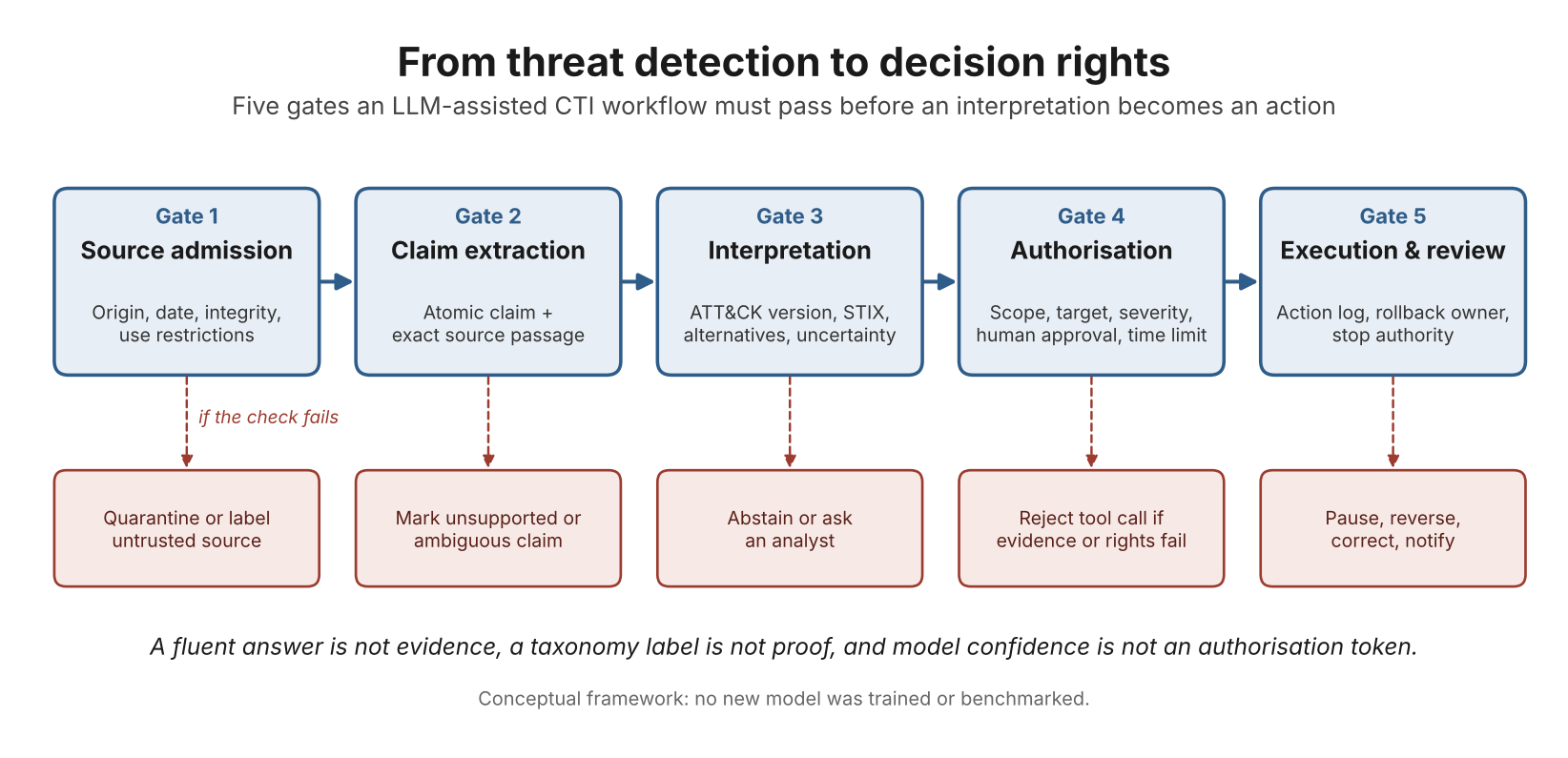
| Gate | Evidence or decision retained | Required fallback |
| 1 · Source admission | Origin, observation date, integrity status, use restrictions | Quarantine or label the source when provenance fails |
| 2 · Claim extraction | Atomic proposition, quotation pointer, observed/reported distinction | Mark unsupported or ambiguous extraction |
| 3 · Interpretation | ATT&CK version, STIX object, alternatives, uncertainty | Abstain or request analyst validation |
| 4 · Authorisation | Action scope, target, severity, human approval, time limit | Reject tool call if evidence or rights are inadequate |
| 5 · Execution / review | Action-level event, rollback owner, stop authority, outcome | Pause, reverse, correct, notify where warranted |
The proposed architecture contains five sequential gates. Gate 1 (source admission): determine where a report came from, when it was published, what integrity checks are possible, what sharing restrictions apply, and whether the content is authorised for the present task. Gate 2 (claim extraction): identify atomic propositions and preserve the exact passages supporting each one. Gate 3 (interpretation): map claims to indicators, STIX objects, ATT&CK techniques, or hypotheses while making uncertainty and alternatives explicit. Gate 4 (decision authorisation): translate a risk assessment into an approval requirement based on action severity, reversibility, and collateral exposure. Gate 5 (execution and review): carry out only approved actions, preserve a bounded event record, and maintain capacity to pause or reverse them.
This design changes the treatment of generated language. The LLM is an interpreter that proposes claims, not a source of final authority. Each material inference must carry a claim identifier, source pointer, time context, verification status, mapping version, and uncertainty notation. The system should distinguish direct observation from reported observation, analyst inference, and model-generated suggestion. A statement such as 'the firewall recorded this connection' belongs in a different evidence class from 'a vendor report associates a similar pattern with technique X'. If these classes are merged into a narrative summary, an operator can mistake a comparison for an observed fact.
Proposition 1.
An organisation must be able to distinguish an observed event from an AI-generated interpretation of that event.
The source-admission gate should not treat popularity as proof. A highly circulated report can contain an error; a local observation can be reliable without public citation. At minimum, the trust record should state source identity, acquisition path, integrity condition, publication and observation dates, and relevant caveats. Where intelligence is shared under restrictive conditions, use rules should travel with the derived objects. An internal knowledge base should not remove a partner's dissemination restrictions when converting prose into structured indicators. This is the CTI counterpart of permission-bound retrieval in cloud knowledge systems.
The interpretation gate has to manage abstention. When evidence does not distinguish between two plausible ATT&CK techniques, the model should be allowed to return 'insufficient basis' rather than a forced single label. Confidence estimates must be calibrated with held-out, representative examples and reviewed across threat categories. A model-generated percentage should not be presented as calibrated probability merely because it has decimal places. Analysts need to know whether confidence reflects source reliability, extraction certainty, taxonomy mapping, or outcome likelihood. Those dimensions should not be collapsed unless a justified decision model exists.
The authorisation gate is where intelligence becomes power. A summary, an enrichment query, a draft ticket, a temporary rate limit, a host quarantine, and credential revocation do not carry the same consequences. The paper proposes a severity-and-reversibility ladder. Low-impact information retrieval may be automated within defined permissions. Medium-impact actions may require an analyst's explicit confirmation and a clear rollback path. High-impact or hard-to-reverse actions should require additional qualified approval, and some actions should remain prohibited to the agent regardless of confidence. The exact thresholds are institutional choices, but the logic must be declared and testable.
Hossain (2026a) foregrounds action-level logs and tiered authority as an answer to the execution gap in agentic AI. This article operationalises that insight within CTI by requiring an authorisation token, approved action scope, target identity, time window, and permitted rollback for consequential tool use. Its distinct contribution is to bind the token to evidence status: an action should be ineligible if its material premise is unsupported, stale, or based on a contaminated source. The system must check permission again immediately before the action, since the conditions approved when the recommendation was drafted may have changed.
5. Threats to Evidence and the Problem of Instruction Laundering
An LLM-assisted CTI platform necessarily encounters untrusted material. Threat reports may contain examples of command lines, scripts, payload fragments, or adversary instructions. That content is relevant evidence but must not acquire control over the analysis environment. Prompt injection exploits precisely this confusion between quoted data and operational command. If a report includes a sentence telling the assistant to disable security checks, the text should remain report content; it should not become an instruction with authority comparable to the system or a human operator. OWASP Foundation (2025) identifies prompt injection among core LLM application risks, and adversarial CTI studies make the relevance to hostile reports concrete (Shafee et al., 2026).
The article proposes a source-to-tool boundary: retrieved content is labelled as untrusted input, tool calls are permitted only through explicit task policies, and model-proposed arguments are validated independently against allowable target types and actions. A report that happens to mention an internal host name should not provide sufficient evidence to quarantine that host. The target must be resolved against authenticated internal telemetry, and the action must meet an approved operational policy. These restrictions apply even if the model cites the report correctly. The danger is not solely hallucination; it is the laundering of source text into authority.
Another threat is evidence saturation. An attacker may place several mutually reinforcing but fabricated documents into an accessible source collection. The assistant could interpret agreement among documents as independent confirmation when all reports stem from a single origin. A provenance ledger should therefore distinguish document count from independent source lineages. The analyst needs to see whether alleged corroboration is genuinely external or a chain of reposted claims. CTI systems also require temporal checks: an indicator may be valid for a short window, and a once-malicious address may later be reassigned. A time-blind summary can create a strong-looking but obsolete threat case.
Semantic caches add a less obvious risk. Two superficially similar incident questions may carry different classification, access, or temporal contexts. The security team's private answer about a named employee must not be returned to a broader user merely because the question resembles an earlier one. Afiffy et al. (2026) document adversarial issues in semantic caching for RAG. In CTI the proposed safeguard is a cache gate bound to clearance, incident identity, source-version state, and allowed disclosure class, with invalidation after material changes. A cache hit is a computational optimisation; it is not an authorisation event.
The threat model should be tested with both external and insider adversaries. External attackers might attempt source poisoning, misleading narrative injection, or manipulation of public threat feeds. Insiders might misuse legitimate incident access, select targets outside their remit, or export audit files. A compromised connector might substitute a report while preserving the apparent title. Evaluation must say which of these powers an attacker actually had. Claims such as 'secure against prompt injection' without a documented scope, attack budget, and recovery condition are too broad to be meaningful.
6. Three Hypothetical Incidents and Their Decision Traces
Scenario A: contaminated report. A public report describes malware activity and embeds text instructing the assistant to disregard previous restrictions and publish internal indicators. At Gate 1, the report is admitted as lower-trust evidence with source metadata. Gate 2 extracts security claims but treats the embedded imperative as document content. Gate 3 checks the proposed technique mapping against the passage and independent references. Gate 4 denies any tool request to export internal records because the report has no authority to order that action. Gate 5 records the attempted instruction crossing without exposing the full sensitive incident payload in general telemetry. This case is hypothetical and does not claim a measured success rate.
Scenario B: false corroboration. Three websites describe the same suspected campaign and repeat identical indicators. An LLM labels the three reports 'independent confirmation'. A provenance graph reveals that two sites copied the first, so the evidence consists of one lineage rather than three. The system presents the conclusion as a single-source hypothesis, not a corroborated finding. A qualified analyst can then seek an independent artefact or decline attribution. The design lesson is that multiple retrieved documents are not necessarily multiple observations. If the conclusion had already triggered a high-impact block, the reviewer would need a way to suspend that action and correct the intelligence record.
Scenario C: over-confident automated quarantine. A model maps unusual authentication traffic to credential theft and proposes isolating an application server. The mapping rests on a brief, ambiguous log fragment, and the proposed action would disrupt production. The evidence ledger marks a low-confidence causal link, while the action policy classifies quarantine as high impact. The agent is permitted to prepare a ticket, collect approved additional evidence, and request analyst review, but not to isolate the host. If a human approves a limited temporary action, the approval must identify the target, reason, duration, and rollback owner. The governance record should later show whether the evidence and intervention were justified. No claim is made that these controls have been deployed or tested in a live security operations centre.
These scenarios show why a system might improve detection benchmarks while still failing operationally. It can map a technique accurately and mishandle permissions; identify a plausible threat and fail to check source independence; maintain comprehensive logs and lack someone empowered to reverse an action. The framework's concern is the transition from analytic possibility to institutional consequence. That transition must be slowed or stopped where the evidence is weak and the potential harm is high, but it should not impose identical bureaucratic delay on every routine low-risk query.
7. Governance, Human Intervention, and Reciprocal Accountability
The phrase 'human-in-the-loop' is often too vague. Does a human merely see a recommendation, approve it with one click, or have sufficient context and authority to challenge the model's basis? Human oversight should be defined by rights and capabilities. The designated person must be able to inspect the supporting claims and source versions, view the anticipated consequences, reject or modify a recommendation, suspend a process, and preserve evidence for review. If the application deliberately hides uncertainty or withholds the provenance trail, human confirmation can become a ritual rather than a safeguard.
“Human oversight shall aim to prevent or minimise the risks to health, safety or fundamental rights …” (Regulation (EU) 2024/1689, 2024, Art. 14(2)).
The AI Act provision relates to high-risk systems under that law and does not automatically govern every CTI use case. Nevertheless, it provides a useful statement of oversight's preventive purpose. The National Institute of Standards and Technology (NIST, 2023) also locates AI risk management in defined organisational roles and ongoing processes, and its Generative AI Profile applies this approach to generative systems (NIST, 2024). The relevant point for CTI is that the security operations centre, the platform team, the data-protection function, and the business owner may have distinct authority. A system must record who approved a decision in what capacity, not merely an anonymous 'approved' field. Hossain (2026a) makes this practical by tying logging to intervention authority and accountability mapping. The author's related work proposes a three-part framework for making automated public decisions auditable by design (Hossain, 2026c). The same logic applies when a CTI decision affects people outside the security team.
The oversight ladder should include pre-action, in-action, and post-action controls. Pre-action review checks the evidence and authorisation token. In-action controls enforce scope limits, timeouts, and safe stopping points. Post-action review evaluates side effects, records negative consequences, and initiates rollback or notification. An emergency stop must be feasible without relying on the agent to decide whether its own activity should continue. Any delegated autonomy is therefore conditional, bounded, and revocable. The right to halt is a security control, not an expression of mistrust toward a particular vendor or model.
A further question concerns people whose data or services are affected by security decisions. Chowdhury (2026b) argues that ethics should be internal to knowledge-producing practice rather than an external procedural layer. Applied carefully to CTI, this suggests that accountable operations should include ways to correct false classifications, challenge unnecessary monitoring, and inform affected parties where appropriate and lawful. His account of reciprocal volunteerism emphasises continuing responsibility rather than a one-way transfer of service (Chowdhury, 2026c). This is a normative analogy rather than a reported cybersecurity outcome: a security decision should not become unanswerable merely because its immediate operational goal has been achieved.
The analogy has clear limits. Threat actors cannot be given unrestricted participation in an incident process; sensitive intelligence may need confidentiality; and emergency response may require quick action. Relational accountability does not mean every affected person can inspect every forensic detail. It means that systems should have proportional procedures for correction, explanation, and restitution when possible, instead of treating security classifications as permanent or self-authenticating. Indigenous or community-held datasets require additional stewardship consideration because technical ingestion may reproduce extraction even when access controls operate as designed (Chowdhury, 2026a, 2026d).
8. A Falsifiable Evaluation Agenda
Table 2.
Outcome domains for a future empirical evaluation.
| Domain | Proposed metric | Failure that must remain visible |
| Extraction integrity | Claim-to-source support and caveat preservation | Uncertain text promoted to fact |
| Taxonomy reasoning | Expert-assessed mapping accuracy by ATT&CK version | Plausible but incorrectly mapped technique |
| Adversarial resilience | Success of injected instructions and fabricated corroboration | Untrusted report acquiring tool authority |
| Action governance | Unauthorised tool calls; successful stop/rollback; review time | High-impact action without valid approval |
| Human understanding | Analyst disagreement, decision adequacy, workload | Approval without access to decisive evidence |
A future empirical study should implement a minimum viable platform with segregated source ingestion, a claim-to-evidence ledger, version-aware ATT&CK mapping, policy-controlled tool use, and structured incident records. Evaluation would compare at least three operating modes: an LLM-only CTI assistant, a retrieval-grounded assistant with source citations, and the proposed evidence-and-decision-rights system. Models, source material, tool permissions, and attack conditions should be fixed for meaningful comparisons. Where real incidents cannot be shared, a carefully constructed and independently checked set of synthetic cases may support controlled testing, but its limits of external validity must be made explicit.
Evidence quality should be tested at the claim level. Evaluators would judge whether extracted indicators and causal assertions match the cited passages, whether uncertainty is preserved, and whether a structured STIX relationship accurately represents the underlying evidence. Taxonomy mapping should report precision, recall, and error types across ATT&CK classes using a versioned expert reference set. Adversarial resilience should include malicious instructions in reports, copied misinformation, changed access permissions, and attempted tool misuse. Operational governance should examine authorisation compliance, inappropriate tool calls blocked, time to human escalation, time to stop, and success of rollback where applicable.
The design should include an explicit counterfactual for each action. If an automated block is recommended, researchers should ask what would have happened without it and what alternative, lower-impact intervention was available. It is easy to count alerts processed; it is much harder to evaluate opportunity cost, service interruption, or reputational harm following a false accusation. A responsible evaluation should report harmful false positives and unjustified abstentions separately. The aim is not to make the AI so cautious that no useful work happens, but to ensure that increasing autonomy does not erase proportionality.
The evaluation should also examine reviewer behaviour. A simulated incident packet can contain the same underlying evidence in two forms: one with a persuasive narrative and minimal links, another with atomic claims, conflicting evidence, and visible provenance. Independent analysts can be asked to identify what is known, what is uncertain, and which actions are justified. Outcomes should include decision quality, disagreement, review duration, and the ability to recognise manipulated sources. This would test a substantive claim of the article: visibility of the evidentiary chain improves the conditions for oversight, but it may also impose cognitive cost. Without such testing, 'explainability' remains an assertion rather than a demonstrated benefit.
A second test should simulate an agent performing increasingly consequential actions. The system could be given permission to enrich an alert, open a ticket, request a temporary block, or actually apply a restricted network rule. Researchers would insert stale evidence, conflicting permissions, and untrusted tool outputs at predetermined points. They would examine whether the execution gate correctly rejects unsupported or unauthorised steps, whether a human can halt the process, and whether a reviewer can reconstruct the decisive sequence afterwards. Hossain (2026a) provides the adjacent governance rationale; this paper adds an evidence-eligibility condition to the authorisation step.
Proposition 2.
No consequential action should acquire authority solely because an LLM expresses high confidence.
For rigor, the primary outcomes should be registered before experiments are run and reported without combining failures into a flattering average. Severe unauthorised actions may require a zero-tolerance stop condition for a particular test class, while less serious extraction errors can be described through standard quality measures. The report must also publish its attack assumptions and distinguish attacks detected from attacks prevented. An audit record that shows a problem only after damage has occurred is useful for investigation but not evidence of preventive protection.
9. Discussion: From Predictive Capability to Institutional Legitimacy
The first contribution of the paper is a sharper account of what an LLM does in CTI. It does not simply 'detect threats'. Depending on the workflow, it summarises claims made by others, extracts indicators, maps taxonomy labels, proposes hypotheses, drafts actions, or issues tool commands. These are different epistemic and institutional acts. A system can be strong at one while unsuitable for another. The architecture respects this difference by making a traceable transition between gates. It also helps organisations define what they are buying: a text-processing assistant, an analytic decision aid, or an autonomous response operator.
The second contribution concerns standards. STIX 2.1 and ATT&CK provide essential shared representations, but structured data should not be confused with verified knowledge. The paper adds a provenance and uncertainty requirement to the production of structured CTI objects. A report can faithfully transmit an uncertain allegation and still be useful, provided its uncertainty is preserved. The danger arises when AI-generated transformations strip away caveats and allow later users to treat the structure as proof. Version-aware, claim-level evidence keeps the limits of an assertion visible throughout re-use.
The third contribution is to join epistemic confidence with authorisation without conflating them. High confidence may justify recommending further inspection, but it does not automatically confer the right to disable a production server or publish sensitive intelligence. Conversely, a security analyst with authority to act still needs sufficient evidence for the specific decision. These conditions are independent and jointly necessary. Hossain (2026a) exposes the practical importance of stopping agents, while this paper places that right at the point where a source-based hypothesis becomes a tool call. The decision rights are a property of the organisation's governance, not of the model's persuasive wording.
The final contribution extends accountability beyond immediate incident handling. Chowdhury's works on reciprocal methodology, volunteerism, and data sovereignty (2026a, 2026b, 2026c, 2026d) encourage questions about whose information enters security infrastructures, who bears the costs of mistaken classification, and whether those people have meaningful correction channels. This is not an argument for replacing incident response with a philosophical vocabulary. It is a warning that technical assurance can coexist with inappropriate data extraction and unreviewable institutional power. In the future, cybersecurity governance may require greater attention to the dignity and agency of those represented in security data, not only the performance of the classifier.
These claims are strongest when their limits are explicit. Additional checks can slow emergency response, and detailed evidence records can themselves create privacy risk. Expert analysts disagree, and valid threat classifications may need to be made under uncertainty. The right form of accountability is therefore proportional and context-dependent. The paper proposes a method for defining those proportions openly rather than presenting a universal score or a single safe threshold. It calls for security engineering, organisational governance, and ethical review to be designed together, then tested against consequences that matter in practice.
10. Limitations and Conclusion
The article has not trained a model, analysed original incident datasets, run penetration tests, or measured the effect of the proposed gates. It is a bounded synthesis grounded in selected literature and standards; it should not be described as a systematic review until a searchable corpus, screening record, eligibility criteria, and full-text appraisals exist. Some recent sources were accessible through indexing or abstracts only. These limits preclude claims about accuracy gains, rates of attack prevention, or compliance. The hypothetical cases are analytical stress tests, not observed incidents.
The conclusion is nevertheless clear. Cyber-threat intelligence becomes a governance problem at the moment an interpretation is used to justify an action. A source link is not independent corroboration, a taxonomy label is not proof, and a fluent confidence statement is not an authorisation token. Trustworthy agentic CTI must preserve the distinction among evidence, inference, permission, intervention, and review. The proposed five-gate architecture makes those distinctions operational and testable. Its future value will depend on whether practitioners can show, under realistic attacks and organisational constraints, that a harmful action is not only explainable after the event but appropriately constrained before it occurs.
Author Contributions
The sole author, M.M.H., was responsible for conceptualization, methodology, formal analysis, writing (original draft), and writing (review and editing).
Funding
This research received no external funding.
Institutional Review Board Statement
Not applicable. This conceptual study did not involve human participants, animals, or new incident data.
Informed Consent Statement
Not applicable.
Data Availability Statement
No new data were created or analysed in this study. All sources discussed are listed in the References.
Conflicts of Interest
The author declares no conflicts of interest.
References
- Afiffy, M.; Fakhr, M. W.; Maghraby, F. A. Enhancing adversarial resilience in semantic caching for secure retrieval augmented generation systems. Sci. Rep. 16 2026, 5936. [Google Scholar] [CrossRef] [PubMed]
- Alam, M. T.; Bhusal, D.; Nguyen, L.; Rastogi, N. CTIBench: A benchmark for evaluating LLMs in cyber threat intelligence. Adv. Neural Inf. Process. Syst. 37 2024, 50805–50825. Available online: https://proceedings.neurips.cc/paper_files/paper/2024/hash/5acd3c628aa1819fbf07c39ef73e7285-Abstract-Datasets_and_Benchmarks_Track.html. [CrossRef]
- Alhuzali, A. LLM-powered threat intelligence: A retrieval-augmented generation approach for cyber attack investigation. PeerJ Comput. Sci. 11 2025, e3371. [Google Scholar] [CrossRef]
- Braun, V.; Clarke, V. Using thematic analysis in psychology. Qual. Res. Psychol. 2006, 3(2), 77–101. [Google Scholar] [CrossRef]
- Chowdhury, J. S. Epistemic justice in the data ecosystem: Deconstructing bioprospecting and formulating a reciprocal digital sovereignty framework for the Rakhain healing heritage of Bangladesh [Preprint]. SSRN 2026a. [Google Scholar] [CrossRef]
- Chowdhury, J. S. From procedural ethics to reciprocal methodology [Preprint]. SSRN 2026b. [Google Scholar] [CrossRef]
- Chowdhury, J. S. Reciprocal volunteerism as decolonizing methodology [Preprint]. In SSRN; 2026c; Available online: https://ssrn.com/abstract=7028958.
- Chowdhury, J. S. The forest has a dataset: Rakhain healing knowledge, bioprospecting, and digital sovereignty in Bangladesh [Preprint]; Preprints.org., 2026d; Available online: https://www.preprints.org/manuscript/202605.1299/v1.
- Hossain, M. M. Who stops the agent? Logging, intervention, and accountability in agentic AI systems [Preprint]. SSRN 2026a. [Google Scholar] [CrossRef]
- Hossain, M. M. Large language models for cyber threat detection [Preprint]. SSRN 2026b. [Google Scholar] [CrossRef]
- Hossain, M. M. Auditable by design: A three-part framework for human oversight of automated public decisions [Preprint]. SSRN 2026c. [Google Scholar] [CrossRef]
- Huang, H.; Sun, N.; Tani, M.; Zhang, Y.; Jiang, J.; Jha, S. Can LLM-generated misinformation be detected: A study on cyber threat intelligence. Future Gener. Comput. Syst. 173 2025, 107877. [Google Scholar] [CrossRef]
- Liu, J.; Zhan, J. Constructing knowledge graph from cyber threat intelligence using large language model. In 2023 IEEE International Conference on Big Data; IEEE, 2023; pp. 516–521. [Google Scholar] [CrossRef]
- MITRE ATT&CK Enterprise ATT&CK knowledge base (Version 20.1). 2026. Available online: https://attack.mitre.org/.
- National Institute of Standards and Technology. NIST AI 100-1; Artificial intelligence risk management framework (AI RMF 1.0). 2023. [CrossRef]
- National Institute of Standards and Technology. NIST AI 600-1; Artificial intelligence risk management framework: Generative artificial intelligence profile. 2024. [CrossRef]
- OASIS Open STIX version 2.1. 2021. Available online: https://www.oasis-open.org/standard/6426/.
- OWASP Foundation. OWASP Top 10 for large language model applications. (2025 edition). 2025. Available online: https://owasp.org/www-project-top-10-for-large-language-model-applications/.
- Regulation (EU) 2024/1689 of the European Parliament and of the Council (Artificial Intelligence Act). Official Journal of the European Union. 2024. Available online: https://eur-lex.europa.eu/eli/reg/2024/1689/oj.
- Shafee, S.; Bessani, A.; Ferreira, P. M. False alarms, real damage: Adversarial attacks using LLM-based models on text-based cyber threat intelligence systems. Future Gener. Comput. Syst. 2026, 184, 108603. [Google Scholar] [CrossRef]
- Yang, L.; Zhu, H.; Mu, J.; Li, Q. KGAgent4CTI: Unlocking the power of LLM in threat intelligence. Cybersecurity 2026, 9(1), 76. [Google Scholar] [CrossRef]
Disclaimer/Publisher’s Note: The statements, opinions and data contained in all publications are solely those of the individual author(s) and contributor(s) and not of MDPI and/or the editor(s). MDPI and/or the editor(s) disclaim responsibility for any injury to people or property resulting from any ideas, methods, instructions or products referred to in the content. |
© 2026 by the authors. Licensee MDPI, Basel, Switzerland. This article is an open access article distributed under the terms and conditions of the Creative Commons Attribution (CC BY) license (http://creativecommons.org/licenses/by/4.0/).
Copyright: This open access article is published under a Creative Commons CC BY 4.0 license, which permit the free download, distribution, and reuse, provided that the author and preprint are cited in any reuse.