

Submitted:
17 May 2026
Posted:
20 May 2026
You are already at the latest version
Abstract
The digitalisation of Indigenous medicinal knowledge constitutes a qualitatively new form of bioprospecting — one that operates through artificial intelligence, open-access repositories, genomic databases, and state-led data infrastructure rather than field collection alone. This article examines this transformation through the Rakhain community of Bangladesh, whose plant-based and non-plant healing heritage occupies a structurally vulnerable position at the intersection of biodiversity law, data governance, and digital capitalism. Drawing on long-term ethnographic engagement with the Rakhain community (2004–2024), Indigenous Gnoseology (Chowdhury, 2026a), reciprocal methodology (Chowdhury, 2026b), and the CARE Principles for Indigenous Data Governance (Carroll et al., 2020), the article argues that existing legal regimes are insufficient without community-centred digital sovereignty. A Rakhain Digital Healing Sovereignty Framework is proposed, grounded in collective consent, tiered knowledge classification, sacred secrecy, reciprocal benefit sharing, and post-research accountability.
Keywords:
digital sovereignty
; Indigenous data sovereignty
; Rakhain
; Indigenous medicinal knowledge
; algorithmic extraction
; bioprospecting
; Bangladesh
; CARE Principles
; reciprocal guardianship
; epistemic justice
1. Introduction
The conversion of Indigenous medicinal knowledge into digital assets represents one of the defining intellectual property concerns of the early twenty-first century. Where earlier colonial extraction operated through field collection, ethnographic description, and pharmaceutical bioprospecting, contemporary appropriation proceeds through digitisation pipelines, open-access repositories, machine-learning training datasets, and state-governed data infrastructure. This structural shift — from botanical survey to algorithmic mining — has received sustained attention in settler-colonial contexts (Walter et al., 2021; Kukutai & Taylor, 2016) but remains inadequately theorised in South Asian settings where Indigenous communities face overlapping exposures to biodiversity exploitation, digital governance, and postcolonial state power.
The Rakhain community of Bangladesh provides an analytically critical case. Historically rooted across coastal and borderland geographies — Cox’s Bazar, Patuakhali, Barguna, and the Chittagong Hill Tracts — the Rakhain are a Buddhist Indigenous community whose healing heritage encompasses plant-based remedies, ritual practice, oral transmission, ecological knowledge, and Buddhist moral frameworks (Tun, 2015; Chowdhury, 2026d). Their medicinal knowledge is not reducible to a pharmacopoeia; it is a living gnoseological system in which moral conduct, community trust, ecological relation, and intergenerational transmission are inseparable from therapeutic efficacy (Chowdhury, 2026a). This relational character makes the knowledge simultaneously valuable to external actors and profoundly resistant to legal frameworks that presuppose individual ownership, documented novelty, or fixed textual form.
Bangladesh’s regulatory environment intensifies these concerns. The country has enacted the Biological Diversity Act 2017, ratified the Nagoya Protocol, and is advancing a Personal Data Protection regime (Government of Bangladesh, 2017, 2026; Secretariat of the Convention on Biological Diversity, 2011). Yet these instruments operate in silos: biodiversity law addresses genetic resources without fully comprehending collective knowledge governance; data protection law protects individual personal data without recognising community-held, sacred, or intergenerational data; intellectual property law rewards novelty rather than the depth of traditional knowledge. The gap between legal recognition and ethical protection remains structurally wide.
This article makes three original contributions. First, it advances the concept of algorithmic extraction — the computational appropriation of Indigenous knowledge through AI training pipelines, text mining, and digital sequence information processing — as a form of bioprospecting that existing frameworks are unable to address. Second, it applies Indigenous Gnoseology (Chowdhury, 2026a) and reciprocal methodology (Chowdhury, 2026b; Chowdhury et al., 2022) to a digital governance problem, demonstrating that these frameworks carry direct institutional implications. Third, it proposes a Rakhain Digital Healing Sovereignty Framework with eight operational pillars designed for communities, universities, government agencies, and research funders.
2. Literature Review
2.1. Bioprospecting, Biopiracy, and the Knowledge–Resource Nexus
The scholarship on bioprospecting and biopiracy has established three durable findings. First, the conversion of Indigenous knowledge into scientific or commercial resource is never epistemically neutral; it involves acts of translation that strip knowledge from its relational and moral conditions (Shiva, 1997; Hayden, 2003). Second, legal frameworks constructed around novelty, individual ownership, and written documentation systematically disadvantage Indigenous knowledge systems that are oral, collective, temporally deep, and ecologically embedded (Dutfield, 2004; Brush & Stabinsky, 1996). Third, benefit-sharing mechanisms that centre state authority over community authority can reproduce rather than remedy appropriation, even when formally compliant with international instruments (Laird, 2002; Fairhead et al., 2012).
Reid et al. (1993) provided the foundational framing for bioprospecting as a development mechanism, arguing that equitable access arrangements could render biodiversity economically valuable to source communities. Shiva (1997) challenged this framing systematically, documenting biopiracy across seed, plant, and pharmaceutical domains. Hayden (2003) deepened the analysis through ethnographic attention to how scientific, commercial, and legal actors co-produce the value of nature and traditional knowledge in ways that subordinate community authority. Agrawal (1995) complicated the binary between Indigenous and scientific knowledge, showing that the distinction is itself an artefact of power. Benjaminsen and Svarstad (2021) situate these dynamics within political ecology, demonstrating that conservation agendas systematically construct nature as a resource for external management. Büscher and Fletcher (2020) show how technological solutions to biodiversity loss can replicate extractive logics under a different name.
The bioprospecting literature has been less attentive, however, to the specific vulnerabilities created by digital infrastructure. When healing knowledge is converted not into a physical sample but into a data entry, a photograph, a sound recording, or a database field, the mechanisms of appropriation change qualitatively. The extractor need not be present; the consent, if any, may have been given to a different researcher for a different purpose; the knowledge may travel through citation networks, AI systems, and heritage databases for decades after the original disclosure. This gap in the bioprospecting literature is where the present article intervenes.
2.2. Indigenous Data Sovereignty
Indigenous data sovereignty has emerged over the past decade as a distinct governance framework. Kukutai and Taylor (2016) established its foundational terms, defining it as the right of Indigenous peoples to govern data about their communities, lands, resources, bodies, cultures, and knowledge systems. This framework shifts the governing question from who can collect data to who has authority over its classification, storage, interpretation, reuse, and deletion. Walter et al. (2021) develop the institutional and policy implications, arguing that Indigenous data sovereignty requires structural reforms in how governments, universities, and research funders operate.
Rainie et al. (2019) identify the specific failure of open-data frameworks to accommodate Indigenous governance principles, demonstrating that openness as default accessibility reproduces colonial information asymmetries. The CARE Principles for Indigenous Data Governance — Collective Benefit, Authority to Control, Responsibility, and Ethics — were formulated by Carroll et al. (2020) as a corrective to FAIR principles, which privilege machine-readability and open reuse over community control. The CARE Principles have been widely adopted in Aotearoa New Zealand, Australia, and Canada, but their application to South Asian Indigenous contexts remains underdeveloped. This article argues for their applicability to the Rakhain case and provides the conceptual infrastructure for that application.
Smith (2021) demonstrates that decolonising research requires a structural interrogation of whether existing frameworks are just, not merely the addition of Indigenous examples. Chilisa (2020) develops this into a comprehensive Indigenous research methodology grounded in relational accountability and community benefit. Wilson (2008) argues that research is ceremony — a relational practice with ethical obligations that do not end when data collection concludes. Nakata (2007) shows how disciplinary knowledge systems have historically savaged Indigenous knowledge by forcing it into alien epistemological categories. These contributions are directly relevant to the digital governance question because they establish that the problem is not technical but structural: it concerns who has authority to classify, interpret, and govern knowledge.
2.3. Digital Capitalism and Algorithmic Extraction
The most recent analytical development in this field addresses what the present article terms algorithmic extraction. Zuboff (2019) identifies surveillance capitalism as a system in which human experience is rendered as raw material for behavioural prediction and commercial value. Couldry and Mejias (2019) extend this analysis under data colonialism, arguing that contemporary data infrastructure extends colonial logics of appropriation into everyday life and knowledge systems. Taylor and Broeders (2015) apply related analysis to the Global South, showing that datafication projects — health systems, biodiversity databases, development platforms — restructure power relations to advantage external actors.
Applied to Indigenous medicinal knowledge, these frameworks reveal a structurally new concern: AI systems and text-mining algorithms can ingest published ethnobotanical literature, herbarium records, patent databases, and grey literature without any community consent or benefit-sharing arrangement. The community need never be contacted; appropriation occurs through data traces already released into global knowledge infrastructure. This constitutes a qualitatively distinct form of bioprospecting — computational rather than field-based — that existing regulatory instruments, designed for physical sample collection and pharmaceutical screening, are architecturally unable to address (WIPO, 2024; Secretariat of the Convention on Biological Diversity, 2011). Escobar (1995) reminds us that the Third World has consistently been constructed as a resource domain for external development; algorithmic extraction gives that logic unprecedented scale, speed, and invisibility.
2.4. Indigenous Gnoseology, Reciprocity, and the Rakhain Standpoint
The theoretical literature most directly relevant to this article addresses the nature of Indigenous knowledge as a knowledge system, not merely as content. Chowdhury (2026a) theorises Indigenous Gnoseology as a framework that positions oral traditions and Indigenous knowing beyond Western epistemology. Where epistemology asks whether knowledge claims are justified and true by external criteria, gnoseology asks how knowledge lives, whom it serves, through what relations it is transmitted, and what ethical obligations it generates. Healing knowledge in the Rakhain case is thus not a set of propositions awaiting scientific verification but a moral knowledge system whose authority derives from practice, community trust, ecological relation, and intergenerational transmission. The formal relationship between epistemology and gnoseology is captured in Figure 1, which demonstrates that epistemology (E) is properly understood as a subset of gnoseology (G) rather than its equivalent — a distinction with direct consequences for how Indigenous healing knowledge is governed (Chowdhury, 2026a, p. 18).
Chowdhury (2026b) develops reciprocal methodology as a structural alternative to procedural ethics, requiring that research relationships be governed by continuing obligation and community benefit rather than one-time consent. This means that ethical responsibility does not end when a consent form is signed; it extends across the entire life of the data — through storage, publication, citation, reuse, and eventually deletion or return. Chowdhury et al. (2022) demonstrate reciprocity across multiple research settings, while Chowdhury et al. (2024) connect it directly to the reform of research ethics institutions. Chowdhury (2023) develops the concept of a third space of reciprocal relation through ethnographic work with Bangladeshi migrant workers, showing that genuine reciprocity produces new forms of knowledge and community capacity rather than merely extracting existing ones. The practical question of how to be reciprocal in Indigenous research is answered through the Wings of Indigenous Gnoseology, presented in Figure 2. The Wings — Reciprocal Research, Spirit, Knowledge Democracy, Ihsanis Justice, and Volunteering for Academia — are grounded in the Centrality of Research, the Rakhain Indigenous Standpoint, and Indigenous Gnoseology at the base (Chowdhury, 2026a, p. 26). Each wing represents a concrete dimension of ethical practice that researchers must enact rather than merely affirm. Together, they constitute this article’s operational recommendations for how scholars, institutions, and governance bodies should orient themselves when engaging with Rakhain healing knowledge in the digital environment.
Fricker (2007) provides a complementary analytical tool through epistemic injustice: Indigenous healers face testimonial injustice when their knowledge is dismissed as unscientific, and hermeneutical injustice when social and legal systems lack the concepts to comprehend healing knowledge as collective, sacred, and oral. Battiste (2013) names the structural form of this injustice cognitive imperialism — the displacement of Indigenous knowledge systems through educational, legal, and institutional power. Alatas (2006) situates this within the broader marginalisation of alternative epistemologies in the Global South by Eurocentric social science. Mignolo (2011) names this the darker side of Western modernity — the colonial logic that renders non-Western knowledge systems illegible except as raw material.
3. Methodology
3.1. Research Design and Epistemological Positioning
This article draws on a PhD research project completed at Universiti Malaya (2023) titled Bioprospecting of the Rakhain Indigenous Community of Bangladesh, which involved twenty years of sustained ethnographic engagement with the Rakhain community between 2004 and 2024. The research was designed from the outset within a decolonial and community-centred epistemological framework, rejecting the extractive logic of conventional ethnobotanical research in favour of what Chowdhury (2026b) terms reciprocal methodology — a framework that enacts ongoing accountability to the community rather than treating consent as a procedural threshold to be cleared before data collection begins.
The epistemological foundation is Indigenous Gnoseology (Chowdhury, 2026a), which positions the Rakhain Indigenous Standpoint as a legitimate and authoritative source of knowledge production in its own right. This means the research did not treat Rakhain healing knowledge as data to be extracted and analysed by an external academic framework, but as a living knowledge system whose terms of engagement were set, at least partially, by the community itself. The researcher’s position — as a Bangladeshi anthropologist with long-term community networks, fluency in the relevant linguistic registers, and sustained relational presence — is both an epistemic asset and an ethical responsibility.
3.2. Methods
Four interconnected methods were deployed across the research period. Participant observation was the primary method, conducted over extended periods of community immersion across Rakhain settlements in Cox’s Bazar, Patuakhali, and Barguna. This included observation of healing practice, community gatherings, Bante-community interactions, ecological harvesting, and everyday social life. Observation was guided by the principle that knowledge is embedded in practice and relation, not only in verbal statement (Wilson, 2008; Smith, 2021).
Narrative interviews were conducted with healers, Bante, elders, and women knowledge-holders, using open-ended, relationally responsive protocols rather than structured questionnaires. The interview approach followed Chilisa’s (2020) Indigenous research methodology, which prioritises storytelling, patience, and the relational terms of the community over the information-extraction logic of conventional interviewing. Where interviewees used Rakhain-language terms, Burmese-related expressions, or Pali-Buddhist vocabulary, these were preserved rather than immediately translated, recognising that translation is itself an act of epistemic transformation.
Focus group discussions were conducted with healer lineage groups and community knowledge councils to address questions of collective rather than individual knowledge. These sessions followed community protocol: they were organised according to community norms of seniority, gender, and knowledge authority, not the researcher’s convenience. The purpose was to access the deliberative and relational dimensions of knowledge governance that individual interviews cannot reach (Chowdhury et al., 2022).
Documentary and archival analysis complemented the fieldwork, encompassing Bangladeshi biodiversity law, relevant international instruments, patent database searches, and published ethnobotanical literature on the Rakhain. This allowed the article to trace the trajectory of Rakhain knowledge across different regimes — from oral practice to published database — and to identify the specific points at which community authority is lost in that translation.
3.3. Ethical Protocols
Ethical conduct in this research followed reciprocal methodology rather than procedural ethics alone. This means that consent was understood as collective and continuing, not individual and one-time. Before entering sensitive areas of healing knowledge, the researcher sought authorisation from community elders and healer lineages, not merely from individual participants. Throughout the research period, findings were shared back with community members in accessible form, errors were corrected on community request, and sensitive knowledge — particularly sacred chants, ritual formulae, and spiritually restricted plant knowledge — was neither recorded nor reported. This omission is principled: a methodology committed to community sovereignty cannot simultaneously extract the very knowledge it is designed to protect.
Consistent with Chowdhury et al. (2024), the research adopted a post-research accountability framework: obligations to the community did not end when fieldwork concluded but extended to the publication stage, where the community retains the right to request correction, restriction, or withdrawal of specific materials. This article does not disclose sacred healing knowledge, specific plant preparation methods, location data for rare species, or ritual information. That omission is deliberate and theoretically grounded in the right not to disclose — a principle elaborated in Section 4.
3.4. Analytical Framework
Data were analysed through a genealogical and thematic approach informed by Mignolo (2011) and Smith (2021). The genealogical dimension traced how Rakhain healing practice is renamed and repositioned across successive regimes of power — from community service to traditional medicine, from ethnobotanical information to biological resource, from community data to AI training material. Each translation was examined for how it shifts authority relations. The thematic dimension identified recurring patterns in the data concerning community governance, knowledge sensitivity, benefit distribution, ecological dependency, and spiritual accountability. These patterns inform the eight-pillar governance framework proposed in Section 4.
4. Findings
4.1. Rakhain Healing Knowledge as a Relational System
The central finding of the long-term fieldwork is that Rakhain healing knowledge cannot be disaggregated from the social, moral, and ecological relations in which it is embedded without ceasing to be Rakhain healing knowledge. A plant name entered into a database, detached from the healer’s moral discipline, the seasonal conditions of harvest, the ritual framing of preparation, and the trust relationship between healer and patient, is not a digitised version of Rakhain knowledge. It is a fragment that has already undergone a form of appropriation in its conversion to data. This finding is consistent with Chowdhury’s (2026d) account of the Rakhain healing cosmos and with the broader literature on Indigenous knowledge as relational rather than propositional (Wilson, 2008; Chilisa, 2020).
Healers consistently emphasised that the authority to use specific plants derives not from botanical knowledge alone but from moral preparation, lineage authority, and the healer’s ongoing accountability to the community. One healer lineage group, discussing the conditions under which healing knowledge may be transmitted, made clear that knowledge shared outside these conditions is not merely incomplete but potentially harmful — both to the recipient who may misuse it and to the community from whose moral order it has been detached. This relational understanding of knowledge has direct implications for governance: consent to share a plant name is not consent to share the knowledge that the plant name represents.
4.2. Eight Governance Concerns Identified in Fieldwork
Eight specific governance concerns were identified through the fieldwork and analytical process. These are presented here as empirical findings — patterns observed in the data — before being addressed in the framework proposed in Section 5.
Concern 1: Conversion of Oral Knowledge into Permanent Digital Records
Oral transmission in the Rakhain community functions as a governance mechanism. Knowledge is shared differentially: certain plants are discussed only with apprentices at specific stages of training; certain chants are transmitted only within healer lineages; certain ecological knowledge is withheld from outsiders regardless of their academic credentials. Digitisation without community governance dismantles these differentiations. Once a chant or plant-use narrative is recorded and stored, the social conditions that once regulated access to it cannot be reconstructed. Chowdhury (2026d) argues that orality is not a deficiency of knowledge storage but a principled governance technology; the findings of this study confirm this account empirically.
Concern 2: Decontextualisation Through Database Standardisation
Published ethnobotanical records of Rakhain plant use — including records produced by legitimate, well-intentioned researchers — systematically decontextualise healing knowledge by imposing standardised database fields: local name, scientific name, part used, indication, preparation. The fieldwork revealed that these fields hide precisely the information that makes Rakhain healing knowledge distinctive: the moral conditions of the healer, the ecological limits on harvesting, the seasonal and ritual framing of preparation, the healer-patient relationship, and the community accountability that governs use. A standardised database record is not a neutral representation of Rakhain knowledge; it is a transformation of Rakhain knowledge into a form optimised for external search, aggregation, and reuse.
Concern 3: Algorithmic Extraction Without Community Contact
The fieldwork and archival analysis identified multiple instances in which Rakhain-associated plant knowledge — disclosed in academic publications, conference proceedings, and NGO reports — had subsequently appeared in pharmaceutical patent searches, AI-assisted drug discovery platforms, and commercial ethnobotanical databases. In none of these cases had the Rakhain community been contacted, credited, or compensated for this secondary use. The original researchers had obtained individual consent for their fieldwork; no one had obtained consent for the downstream computational uses of the resulting publications. This is the defining characteristic of algorithmic extraction: the appropriative act is separated from the original disclosure by time, technology, and jurisdiction, rendering it invisible to standard consent and benefit-sharing frameworks.
Concern 4: State Over-Collection and Centralisation
Government biodiversity databases and digital heritage projects in Bangladesh have intermittently sought to document Rakhain healing knowledge as part of national heritage preservation and biodiversity inventory. Community members expressed consistent unease about these projects, noting that state-controlled databases offer no community veto over access, no benefit-sharing mechanism, no restriction on sacred knowledge, and no accountability to the community if the knowledge is subsequently used commercially or politically. Roy (2000) and Barkat (2016) document the broader pattern: in Bangladesh, state classification of Indigenous communities has historically served to weaken rather than strengthen community authority over resources.
Concern 5: Academic Extraction Without Community Benefit
The research encountered consistent evidence of what Chowdhury (2026b) terms the procedural ethics trap: researchers obtaining individual informed consent and institutional ethics approval for Rakhain fieldwork, then publishing detailed ethnobotanical data in international journals, without any mechanism for community benefit from the resulting academic capital. The community received acknowledgement in footnotes; the researcher received publications, grants, and promotions. The structural inequality of this arrangement is not addressed by consent forms; it requires the kind of substantive reciprocity theorised in Chowdhury et al. (2022) and enacted through continuing relational accountability.
Concern 6: Ecological Exposure Through Location Data
Published research on Rakhain medicinal plants has, in several documented cases, included GPS coordinates, habitat descriptions, and collection site photographs sufficient to enable commercial harvesting by outsiders. Community members expressed direct concern about this form of exposure, noting that several plant species previously abundant in specific coastal habitats had declined following external attention to their medicinal properties. Ecological sovereignty and cultural sovereignty are inseparable in the Rakhain case: protecting healing knowledge requires protecting the ecological conditions from which it emerges (Berkes, 2018; Cajete, 2000).
Concern 7: Spiritual Harm Through Circulation of Sacred Knowledge
The fieldwork encountered consistent acknowledgement among healers and elders that certain healing knowledge carries spiritual conditions: it must be transmitted in specific relational contexts, used by persons who have undergone specific moral preparation, and accompanied by ritual practices that establish the right relationship between healer, plant, and patient. When this knowledge circulates outside those conditions — in a database, a publication, or an AI training set — the community understands this not merely as a legal violation but as a spiritual harm. Secular governance frameworks have no adequate category for this form of harm. Salguero (2014) documents how Buddhist medical knowledge has historically been transformed through translation into alien systems; digital circulation reproduces this transformation at unprecedented speed.
Concern 8: The False Promise of Open Access
Several researchers and NGO actors encountered during the fieldwork expressed the view that making Rakhain healing knowledge publicly available would benefit the community by giving it recognition, scientific credibility, and protection through prior art claims. Community members were largely sceptical of this argument. Prior art claims require legal capacity to monitor and challenge patents, which the community does not currently possess. Scientific credibility on external terms does not translate into governance authority over the knowledge itself. And recognition that is controlled by outsiders is not sovereignty. The open-access argument, in the community’s own analysis, repackages extraction as generosity.
4.3. A Rakhain Digital Healing Sovereignty Framework
The findings from fieldwork, archival analysis, and legal review converge on the need for an integrated governance framework. The Rakhain Digital Healing Sovereignty Framework proposed here rests on eight pillars derived directly from the eight governance concerns identified above. The framework is presented in Table 1 and elaborated in the subsections that follow.
The first pillar — community authority — addresses the foundational governance deficit in existing frameworks: the substitution of individual informed consent for collective knowledge governance. A Rakhain Healing Knowledge Council, established through community deliberation rather than external appointment, provides the institutional architecture for collective consent. Its scope encompasses research proposal review, digitisation authorisation, knowledge classification, benefit negotiation, misuse monitoring, and continuing consent management. This is consistent with UNDRIP Article 31 (United Nations, 2007) and the CARE Principles’ Authority to Control pillar (Carroll et al., 2020).
The tiered classification system operationalises the gnoseological recognition that not all healing knowledge carries the same relational sensitivity, social function, or spiritual character. Level one (public) encompasses cultural histories, language materials, and general ecological knowledge the community agrees may be widely shared. Level two (educational) includes community-approved healing narratives appropriate for Rakhain community educational contexts or formally approved researchers. Level three (restricted) covers knowledge accessible only to approved healers, apprentices, or researchers under detailed formal agreements. Level four (sacred/non-digitisable) includes chants, ritual sequences, healer vows, and location data for vulnerable species. The right not to digitise — Pillar 4 — is grounded in Wilson’s (2008) recognition that oral transmission is not a deficient mode of knowledge storage awaiting digital upgrade, but a governance mechanism communities have the right to maintain.
Reciprocal benefit (Pillar 5) must be structurally distinct from the token acknowledgements that characterise many formal compliance arrangements. Chowdhury et al. (2022) demonstrate that reciprocity, properly understood, transforms the research relationship from extraction to mutual obligation. Where commercial use occurs, negotiated financial returns should be deposited in community-controlled trust funds. Post-research accountability (Pillar 8) extends researcher obligation across the entire temporal life of the data — a critical requirement in digital contexts where data can be reused, cited, aggregated, and computationally processed for decades after the original fieldwork (Chowdhury et al., 2024).
5. Critical Analysis
5.1. The Structural Inadequacy of Existing Legal Frameworks
The first line of critical analysis concerns the structural gap between the legal protection that formally exists and the protection that is practically delivered. The Nagoya Protocol established prior informed consent and mutually agreed terms as requirements for access to genetic resources and associated traditional knowledge (Secretariat of the Convention on Biological Diversity, 2011). Yet three structural limitations are directly relevant to the Rakhain case and to algorithmic extraction more broadly. First, the protocol was designed for physical genetic resources; its application to digital sequence information remains legally contested. Second, implementation depends on domestic law, which in Bangladesh has not developed mechanisms that centre community authority over state authority. Third, the protocol governs the moment of access, not the continuing life of the data — a critical gap when AI systems can generate new commercial applications from historically published materials indefinitely and without any new act of access requiring consent.
The WIPO 2024 treaty mandates disclosure of genetic resource and traditional knowledge origins in patent applications (WIPO, 2024). This is a significant advance, but Dutfield (2004) notes that disclosure requirements systematically advantage applicants with legal resources and disadvantage communities without patent monitoring capacity. Disclosure is a necessary but far from sufficient condition for justice. Bangladesh’s Biological Diversity Act 2017 creates an access-and-benefit-sharing framework but centres state-constituted authority structures rather than community governance (Government of Bangladesh, 2017). Laird (2002) identifies this pattern across multiple biodiversity governance regimes: state frameworks can create benefit-sharing rules that position communities as beneficiaries of state-brokered arrangements rather than as sovereign governors of their own knowledge. The Personal Data Protection regime (Government of Bangladesh, 2026) protects individual personal data but is architecturally incapable of recognising collective, sacred, or ecologically situated knowledge as a protected category. Taylor and Broeders (2015) demonstrate that datafication in the Global South frequently proceeds in the name of development while restructuring power relations to advantage external actors; Bangladesh’s data governance trajectory exhibits this pattern.
5.2. The Epistemological Gap in Governance Design
The second line of critical analysis addresses the epistemological assumptions embedded in existing governance frameworks. Intellectual property law, data protection law, and biodiversity law all presuppose knowledge objects that are fixed, individually authored or owned, and separable from the persons and relations that produced them. Rakhain healing knowledge is none of these things. It is relational, collectively held, orally transmitted, morally conditioned, and inseparable from the healer’s ongoing accountability to community and cosmos. This means that the mismatch between Rakhain healing knowledge and existing legal categories is not an accidental oversight that can be corrected by amendment; it is a structural consequence of the epistemological assumptions built into those categories.
Battiste (2013) terms this cognitive imperialism: the domination of one knowledge system over another through the institutional power to define what knowledge is. Fricker (2007) identifies the mechanism through epistemic injustice: healers face testimonial injustice when their authority is discounted, and hermeneutical injustice when legal and institutional systems lack the conceptual resources to recognise their knowledge on its own terms. Alatas (2006) situates this within the broader marginalisation of alternative epistemologies in the Global South. Mignolo (2011) argues that the darker side of Western modernity consists precisely in this rendering of non-Western knowledge systems as illegible except insofar as they can be converted into resources. Closing the governance gap therefore requires not merely legal amendment but epistemic decolonisation: the recognition that Indigenous healing knowledge is a moral, ecological, spiritual, and relational system, not a database awaiting population.
5.3. University Research and the Procedural Ethics Trap
The third line of critical analysis addresses the role of universities as a primary site of both extraction and potential reform. University research reward structures — publication, citation, grant capture, data sharing — incentivise the extraction of Indigenous knowledge without commensurate community benefit. Institutional ethics review boards focus on individual informed consent, anonymity, and risk minimisation for individual research participants. These procedures are necessary but structurally inadequate for community-held healing knowledge. Chowdhury (2026b) characterises this as the procedural ethics trap: institutional compliance with consent requirements creates the appearance of ethical research while leaving the structural inequality of the knowledge relation untouched.
Universities must redesign ethics review to accommodate Indigenous data governance. This requires mandatory Indigenous data management plans for all research involving community-held knowledge; recognition of collective consent as legally and ethically distinct from individual consent; thesis repository policies permitting embargo, restricted access, or redaction for sensitive materials; and curriculum reform ensuring that researchers working with Indigenous communities are trained in Indigenous research methodology, data sovereignty, and reciprocal ethics (Smith, 2021; Chilisa, 2020). Chowdhury et al. (2024) provide a detailed framework for reviving ethics in social research that directly addresses these institutional requirements.
5.4. Artificial Intelligence Governance and Indigenous Knowledge
The fourth line of critical analysis addresses the most rapidly developing governance gap: artificial intelligence. AI systems are now routinely used in drug discovery, biodiversity mapping, text mining, and knowledge extraction. If published ethnobotanical records of Rakhain healing knowledge are used to train AI models, the original community becomes invisible in the output: the AI may generate commercial hypotheses, patent claims, or product formulations that derive from Rakhain knowledge without citing, compensating, or acknowledging the community. The community is not consulted; their consent to the original publication did not extend to computational reuse for unspecified future purposes; and the jurisdiction of the AI developer may make legal challenge practically impossible.
Indigenous traditional knowledge must be treated as a protected category in AI governance frameworks. Developers should be required to disclose whether training datasets include traditional knowledge materials and to obtain specific community consent for such inclusion. Communities should have the right to exclude their knowledge from AI training datasets, including datasets compiled from historically published materials. These requirements are consistent with data colonialism analysis (Couldry & Mejias, 2019) and surveillance capitalism critique (Zuboff, 2019), and they extend Indigenous data sovereignty principles into the AI governance domain where existing frameworks remain most underdeveloped.
5.5. Reciprocal Guardianship as a Governance Paradigm
The concept of reciprocal guardianship — proposed in this article as the governing principle of the Rakhain Digital Healing Sovereignty Framework — constitutes a theoretical contribution distinct from existing governance paradigms. Reciprocal guardianship differs from protection (which implies an external protector acting on behalf of a passive community), preservation (which implies a static object to be kept unchanged), and ownership (which implies an individual property-holder with transferable rights) by insisting on continuous community authority, relational accountability, and substantive benefit obligation across the entire life cycle of Indigenous knowledge in digital systems.
Reciprocal guardianship is grounded in Indigenous Gnoseology’s understanding of knowledge as living relation (Chowdhury, 2026a), Ubuntu philosophy’s communal ethic of mutual obligation (Chowdhury et al., 2023), and the CARE Principles’ authority-to-control framework (Carroll et al., 2020). It argues that digital sovereignty for Indigenous knowledge cannot be achieved through legal instruments alone — though legal instruments are necessary — because the knowledge being protected is constituted by relations that law cannot directly govern: healer-community trust, intergenerational transmission, ecological reciprocity, and spiritual accountability. Governance frameworks must therefore be relational as well as procedural, continuous as well as thresholdary, and substantively beneficial as well as formally compliant. This represents a structural departure from the property-rights and consent-based models that dominate both intellectual property and data protection law, and it opens productive dialogue with political ecology (Benjaminsen & Svarstad, 2021), critical data studies (Couldry & Mejias, 2019), and decolonial methodology (Mignolo, 2011; Smith, 2021).
6. Conclusion
This article has argued that the digitalisation of Rakhain Indigenous healing knowledge constitutes a qualitatively new form of bioprospecting — algorithmic extraction — that operates through data infrastructure rather than field collection and that existing legal frameworks are architecturally unable to address. Three structural gaps have been identified: biodiversity law centres state over community authority; data protection law is designed for individual rather than collective, sacred, or ecologically situated knowledge; and research ethics operates procedurally rather than relationally. These gaps produce eight empirically grounded governance concerns identified through twenty years of ethnographic engagement with the Rakhain community.
The Rakhain Digital Healing Sovereignty Framework proposed here responds through eight integrated pillars: community authority, continuing consent, tiered knowledge classification, the right not to digitise, reciprocal benefit, data security, ecological protection, and post-research accountability. The framework is grounded in Indigenous Gnoseology (Chowdhury, 2026a), reciprocal methodology (Chowdhury, 2026b; Chowdhury et al., 2022), and the CARE Principles (Carroll et al., 2020), and it translates these theoretical commitments into institutional mechanisms for communities, universities, governments, and research funders.
The theoretical contribution of this article is the concept of reciprocal guardianship as a governance paradigm distinct from protection, preservation, and ownership. It demands not only legal reform but epistemic decolonisation: the recognition that Indigenous healing knowledge is a moral, ecological, spiritual, and relational system, not a database waiting to be populated. The governance question is not whether to digitise but who governs digitisation, for what purpose, under what rules, and with what right to refuse. Documentation without sovereignty is not protection. Reciprocal guardianship is.
Declaration of Competing Interests
The author declares no competing interests.
References
- Agrawal, A. (1995). Dismantling the divide between Indigenous and scientific knowledge. Development and Change, 26(3), 413–439. [CrossRef]
- Alatas, S. F. (2006). Alternative discourses in Asian social science: Responses to Eurocentrism. SAGE Publications.
- Barkat, A. (2016). Political economy of unpeopling of Indigenous peoples: The case of Bangladesh. Pathak Shamabesh.
- Battiste, M. (2013). Decolonizing education: Nourishing the learning spirit. Purich Publishing.
- Benjaminsen, T. A., & Svarstad, H. (2021). Political ecology: A critical engagement with global environmental issues. Palgrave Macmillan.
- Berkes, F. (2018). Sacred ecology (4th ed.). Routledge.
- Brush, S. B., & Stabinsky, D. (Eds.). (1996). Valuing local knowledge: Indigenous people and intellectual property rights. Island Press.
- Büscher, B., & Fletcher, R. (2020). The conservation revolution: Radical ideas for saving nature beyond the Anthropocene. Verso.
- Cajete, G. (2000). Native science: Natural laws of interdependence. Clear Light Publishers.
- Carroll, S. R., Garba, I., Figueroa-Rodriguez, O. L., Holbrook, J., Lovett, R., Materechera, S., Parsons, M., Raseroka, K., Rodriguez-Lonebear, D., Rowe, R., Sara, R., Walker, J. D., Anderson, J., & Hudson, M. (2020). The CARE Principles for Indigenous Data Governance. Data Science Journal, 19, Article 43. [CrossRef]
- Chilisa, B. (2020). Indigenous research methodologies (2nd ed.). SAGE Publications.
- Chowdhury, J. S. (2023). Voice and photovoice of the Bangladeshi migrant workers in Malaysia: An ethnography of the 3rd space with reciprocity. In Handbook of research on implications of sustainable development in higher education (pp. 314–336). IGI Global Scientific Publishing.
- Chowdhury, J. S. (2026a). Indigenous gnoseology as a theory of knowledge beyond epistemology: Oral traditions and the ethics of Indigenous knowing. In Global perspectives on Indigenous oral traditions (pp. 1–24). IGI Global Scientific Publishing.
- Chowdhury, J. S. (2026b). From procedural ethics to reciprocal methodology. SSRN. https://ssrn.com/abstract=6711618.
- Chowdhury, J. S. (2026c). Decolonizing theatre studies in Bangladesh: Rethinking theatre as reciprocal knowledge. SSRN. https://ssrn.com/abstract=6590438.
- Chowdhury, J. S. (2026d). What is oral is moral and legal: Navigating the Rakhain healing cosmos from sacred chants to state law. In Global perspectives on Indigenous oral traditions (pp. 25–46). IGI Global Scientific Publishing.
- Chowdhury, J. S., Abd Wahab, H., Saad, M. R. M., Mathbor, G. M., & Hamidi, M. (2023). Ubuntu philosophy for the new normalcy. Palgrave Macmillan.
- Chowdhury, J. S., Vadevelu, K., Hatta, Z. A., Ashraf, M., & Bhaumik, A. (Eds.). (2024). Reviving and re-writing ethics in social research for commoning the community. IGI Global.
- Chowdhury, J. S., Wahab, H. A., Saad, R. M., Reza, H., & Ahmad, M. M. (Eds.). (2022). Reciprocity and its practice in social research. IGI Global.
- Couldry, N., & Mejias, U. A. (2019). The costs of connection: How data is colonizing human life and appropriating it for capitalism. Stanford University Press.
- Dutfield, G. (2004). Intellectual property, biogenetic resources and traditional knowledge. Earthscan.
- Escobar, A. (1995). Encountering development: The making and unmaking of the Third World. Princeton University Press.
- Fairhead, J., Leach, M., & Scoones, I. (2012). Green grabbing: A new appropriation of nature? Journal of Peasant Studies, 39(2), 237–261. [CrossRef]
- Fricker, M. (2007). Epistemic injustice: Power and the ethics of knowing. Oxford University Press.
- Government of Bangladesh. (2017). Bangladesh Biological Diversity Act, 2017. Laws of Bangladesh. https://bdlaws.minlaw.gov.bd/act-1203.html.
- Government of Bangladesh. (2026). Personal Data Protection Act, 2026. Laws of Bangladesh.
- Hayden, C. (2003). When nature goes public: The making and unmaking of bioprospecting in Mexico. Princeton University Press.
- Kukutai, T., & Taylor, J. (Eds.). (2016). Indigenous data sovereignty: Toward an agenda. ANU Press.
- Laird, S. A. (Ed.). (2002). Biodiversity and traditional knowledge: Equitable partnerships in practice. Earthscan.
- Mignolo, W. D. (2011). The darker side of Western modernity: Global futures, decolonial options. Duke University Press.
- Nakata, M. (2007). Disciplining the savages, savaging the disciplines. Aboriginal Studies Press.
- Rainie, S. C., Kukutai, T., Walter, M., Figueroa-Rodriguez, O. L., Walker, J., & Axelsson, P. (2019). Issues in open data: Indigenous data sovereignty. In T. Davies, S. Walker, M. Rubinstein, & F. Perini (Eds.), The state of open data: Histories and horizons (pp. 300–319). African Minds and International Development Research Centre.
- Reid, W. V., Laird, S. A., Meyer, C. A., Gamez, R., Sittenfeld, A., Janzen, D. H., Gollin, M. A., & Juma, C. (Eds.). (1993). Biodiversity prospecting: Using genetic resources for sustainable development. World Resources Institute.
- Roy, R. D. (2000). Land rights of the Indigenous peoples of the Chittagong Hill Tracts, Bangladesh. International Work Group for Indigenous Affairs.
- Salguero, C. P. (2014). Translating Buddhist medicine in medieval China. University of Pennsylvania Press.
- Secretariat of the Convention on Biological Diversity. (1992). Convention on Biological Diversity. United Nations.
- Secretariat of the Convention on Biological Diversity. (2011). Nagoya Protocol on Access to Genetic Resources and the Fair and Equitable Sharing of Benefits Arising from Their Utilization. United Nations Environment Programme.
- Shiva, V. (1997). Biopiracy: The plunder of nature and knowledge. South End Press.
- Smith, L. T. (2021). Decolonizing methodologies: Research and Indigenous peoples (3rd ed.). Bloomsbury Academic.
- Taylor, L., & Broeders, D. (2015). In the name of development: Power, profit and the datafication of the global South. Geoforum, 64, 229–237. [CrossRef]
- Tun, T. (2015). The Rakhain of Bangladesh: History, culture and identity. Adorn Publication.
- United Nations. (2007). United Nations Declaration on the Rights of Indigenous Peoples. United Nations.
- Walter, M., Kukutai, T., Carroll, S. R., & Rodriguez-Lonebear, D. (Eds.). (2021). Indigenous data sovereignty and policy. Routledge.
- Wilson, S. (2008). Research is ceremony: Indigenous research methods. Fernwood Publishing.
- World Health Organization. (2019). WHO global report on traditional and complementary medicine 2019. World Health Organization.
- World Intellectual Property Organization. (2024). WIPO Treaty on Intellectual Property, Genetic Resources and Associated Traditional Knowledge. World Intellectual Property Organization.
- Zuboff, S. (2019). The age of surveillance capitalism: The fight for a human future at the new frontier of power. PublicAffairs.
Figure 1.
The Equation of Gnoseology and Epistemology. Source: Chowdhury (2026a, p. 18). E = Epistemology; G = Gnoseology; TK = Tacit Knowledge; WP = Western Philosophy; RP = Reciprocity; C = Colonialism; CC = Christian Commonwealth; P = Phronesis; T = Techne.
Figure 1.
The Equation of Gnoseology and Epistemology. Source: Chowdhury (2026a, p. 18). E = Epistemology; G = Gnoseology; TK = Tacit Knowledge; WP = Western Philosophy; RP = Reciprocity; C = Colonialism; CC = Christian Commonwealth; P = Phronesis; T = Techne.
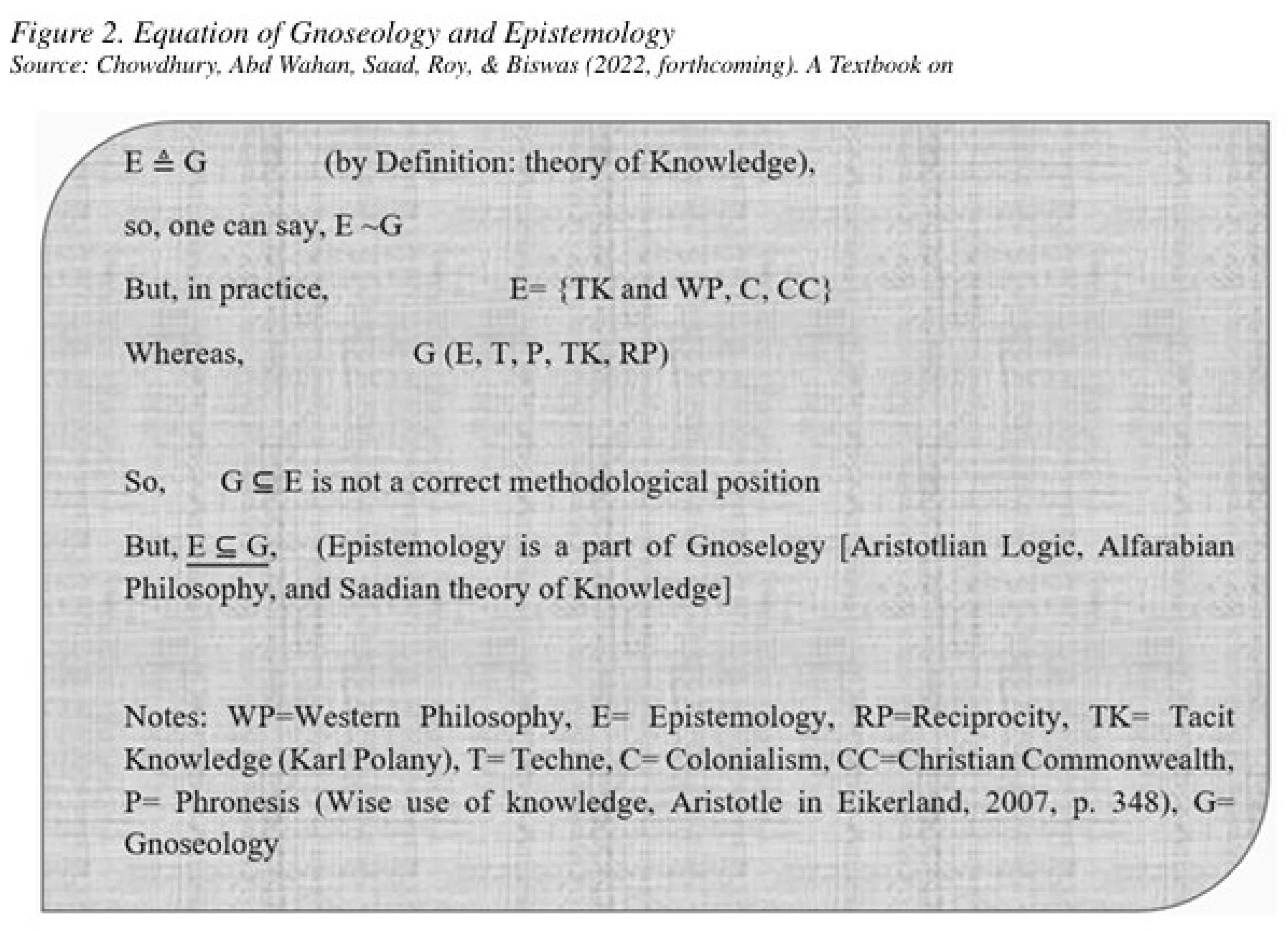
Figure 2.
The Wings of Indigenous Gnoseology: How to Be Reciprocal in Indigenous Research (Recommendations). Source: Chowdhury (2026a, p. 26). Wings: Reciprocal Research, Spirit, Knowledge Democracy, Ihsanis Justice, Volunteering for Academia. Base: Centrality of Research, Indigenous Gnoseology, Rakhain Indigenous Standpoint. The Wings represent this article’s operational recommendations for enacting reciprocity in Indigenous research and digital knowledge governance.
Figure 2.
The Wings of Indigenous Gnoseology: How to Be Reciprocal in Indigenous Research (Recommendations). Source: Chowdhury (2026a, p. 26). Wings: Reciprocal Research, Spirit, Knowledge Democracy, Ihsanis Justice, Volunteering for Academia. Base: Centrality of Research, Indigenous Gnoseology, Rakhain Indigenous Standpoint. The Wings represent this article’s operational recommendations for enacting reciprocity in Indigenous research and digital knowledge governance.
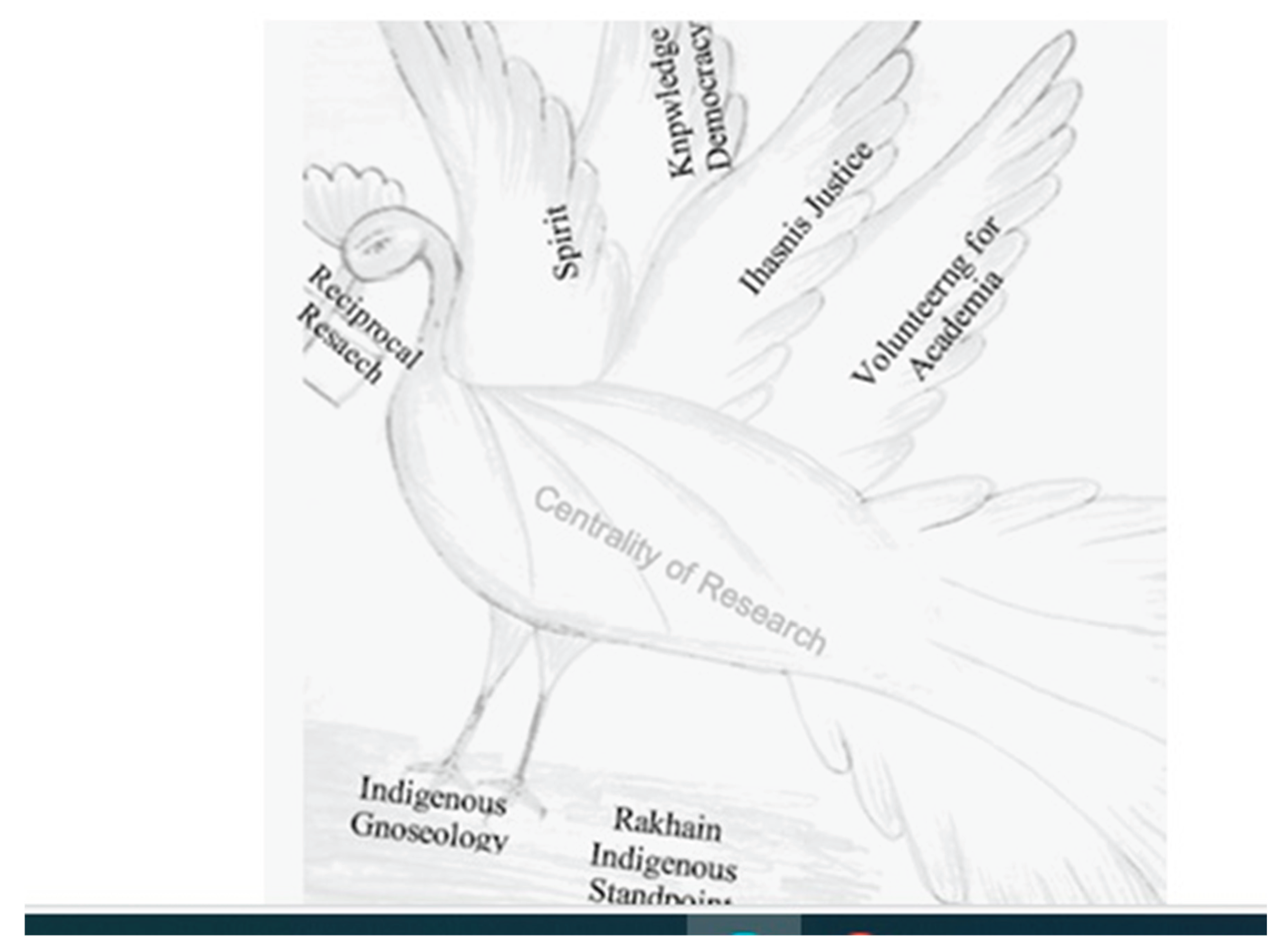

Table 1.
Rakhain Digital Healing Sovereignty Framework.
| Pillar | Operational Specification |
| 1. Community authority | A Rakhain-led Healing Knowledge Council governs all research, digitisation, access, and benefit-sharing decisions. External actors serve in advisory roles only when invited. |
| 2. Continuing consent | Consent is collective, specific, revisable, and addresses all anticipated future uses: AI training, cross-border transfer, commercial research, and publication. Undisclosed future uses require new consent. |
| 3. Tiered classification | Knowledge is classified into four levels: (i) public, (ii) educational, (iii) restricted, (iv) sacred/non-digitisable. Classification is made by the community, not by researchers. |
| 4. Right not to digitise | The right not to digitise is a legitimate governance principle. Some knowledge is protected precisely through oral transmission and must not be recorded under any institutional pressure. |
| 5. Reciprocal benefit | Benefits are substantive: Rakhain-language educational materials, healer recognition, ecological conservation funding, legal support, research training, and — where applicable — financial returns through community trust funds. |
| 6. Data security | Restricted materials require encryption, role-based access controls, and access logging. No materials are uploaded to third-party cloud platforms without explicit community agreement. |
| 7. Ecological protection | Exact locations of rare or vulnerable medicinal species are withheld, generalised, or restricted to internal community use. Ecological data is treated as community asset, not public information. |
| 8. Post-research accountability | Researchers submit outputs to the community council before publication of sensitive materials. Plain-language summaries are provided. Reuse is reported, and withdrawal requests are honoured. |
Disclaimer/Publisher’s Note: The statements, opinions and data contained in all publications are solely those of the individual author(s) and contributor(s) and not of MDPI and/or the editor(s). MDPI and/or the editor(s) disclaim responsibility for any injury to people or property resulting from any ideas, methods, instructions or products referred to in the content. |
© 2026 by the authors. Licensee MDPI, Basel, Switzerland. This article is an open access article distributed under the terms and conditions of the Creative Commons Attribution (CC BY) license (http://creativecommons.org/licenses/by/4.0/).
Copyright: This open access article is published under a Creative Commons CC BY 4.0 license, which permit the free download, distribution, and reuse, provided that the author and preprint are cited in any reuse.