
Submitted:
26 November 2026
Posted:
27 November 2026
You are already at the latest version
Abstract
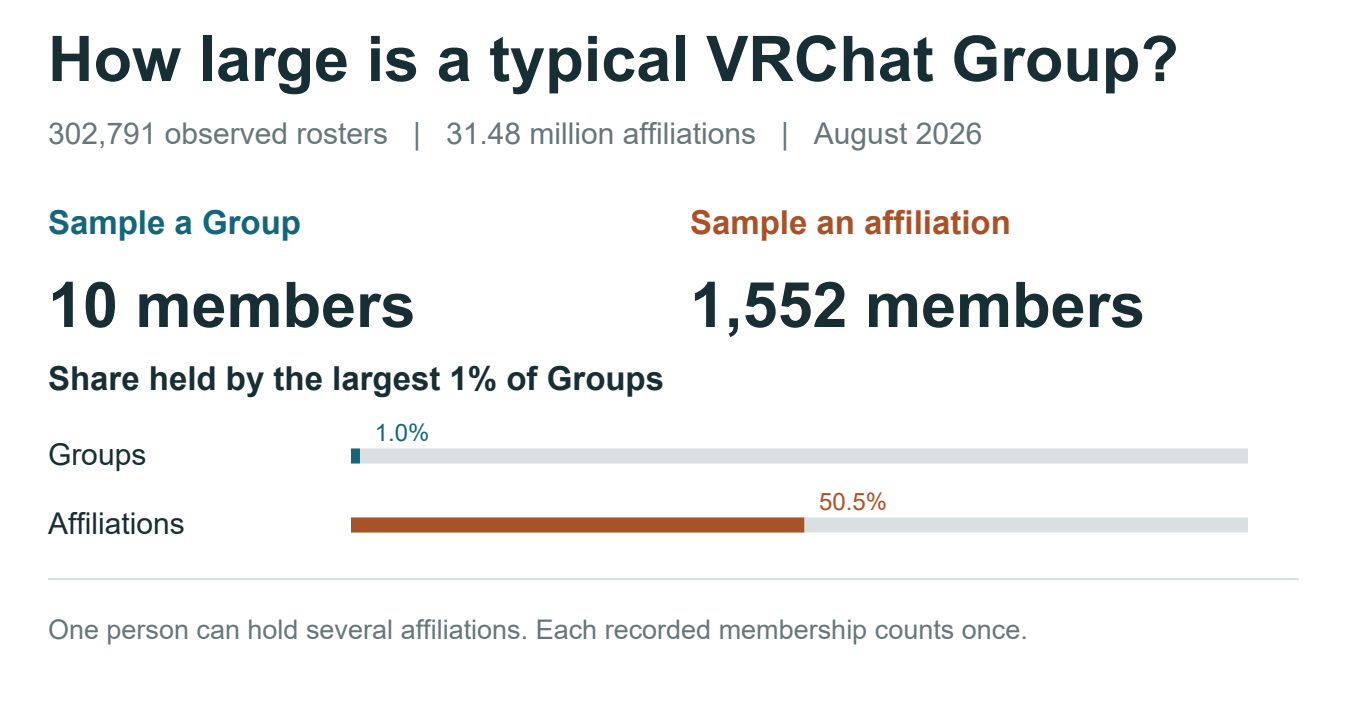
Formal Groups provide a persistent organizational layer in social virtual reality. Its scale depends on whether one counts Groups or the affiliations linking accounts to them. Using an August 2026 archive of 302,968 VRChat Groups, we compare these perspectives for the 302,791 Groups with recorded rosters. The median Group has 10 members, whereas the median of the 31,479,407 recorded affiliations lies in a roster of 1,552 members. The largest 1% of Groups hold 50.53% of affiliations. This share varies from 49.75% to 50.83% across seven overlapping combinations of search rounds, although removing the largest 100 rosters lowers the affiliation-weighted median to 1,006. Nearly four-fifths of roster inequality occurs within creation years. Two further analyses delimit what can be inferred from these traces. Changing a word-boundary rule reassigns about one-quarter of profile labels, and 3,785 paired counts record members’ platform-wide online status without establishing Group attendance. A proportional-presence simulation also produces a markedly sublinear slope on the log-plus-one scale. The archive therefore characterizes the organization of formal affiliations. Establishing Group purpose or participation requires separate observations.
Keywords:
social virtual reality
; online communities
; formal affiliation
; organizational scale
; membership concentration
; digital trace data
; VRChat
Copyright: This open access article is published under a Creative Commons CC BY 4.0 license, which permit the free download, distribution, and reuse, provided that the author and preprint are cited in any reuse.