

Submitted:
19 November 2026
Posted:
24 November 2026
You are already at the latest version
Abstract
Masking has been associated with poorer mental health in autistic women, but its relationship with suicidal thoughts and behaviours, and the role of autistic burnout and social support in this relationship, remain unclear. In this cross-sectional study, 213 autistic women with a formal diagnosis residing in Spain completed online measures of masking (CAT-Q), autistic burnout (AASPIRE Autistic Burnout Measure), suicidal thoughts and behaviours (SBQ-ASC), perceived social support (MSPSS) and anxiety (GAD-7). Data were analysed with hierarchical regression, structural equation modelling and conditional process analysis with bootstrap confidence intervals. Masking was consistently associated with higher autistic burnout, and perceived social support was associated with lower SBQ-ASC scores. Masking did not explain additional variance in SBQ-ASC scores after accounting for covariates and anxiety. The evidence for an indirect association between masking and SBQ-ASC scores through burnout was inconclusive, and social support did not moderate the masking–burnout association. These findings indicate that the relationships between masking, exhaustion and suicidality may be more complex than initially proposed, and highlight the need for longitudinal research and for support measures specifically adapted to autistic experiences.
Keywords:
autistic women
; masking
; camouflaging
; autistic burnout
; suicide risk
; perceived social support
1. Introduction
Autistic people have a risk of death by suicide almost three times higher than that of the general population, and this excess is significantly greater in women (Santomauro et al., 2024). In Spain, 68.1% of autistic women in a community sample reported suicidal ideation, compared with 26.1% of non-autistic women; however, an autism diagnosis did not predict ideation once anxiety and social assimilation were taken into account (Conde-Pumpido-Zubizarreta et al., 2026).
The available evidence links this risk to the conditions of a social environment that is not adapted to autistic people. Cassidy et al. (2018) found that masking and the number of unmet support needs predicted suicidality in autistic adults after controlling for sociodemographic variables and co-occurring diagnoses. Among the possible mechanisms, masking is particularly relevant for autistic women, both because of its link with suicidality and because of its greater presence in this population.
Masking, also referred to as social camouflaging, denotes the set of conscious or automatic strategies through which autistic people reduce the visibility of their autistic characteristics in social contexts (Hull et al., 2017; Lai et al., 2017). The most widely used assessment instrument, the Camouflaging Autistic Traits Questionnaire (CAT-Q; Hull et al., 2019), distinguishes three dimensions: compensation, masking and assimilation. Far from being a free choice, masking has been conceptualised as a response to stigma and social threat (Pearson & Rose, 2021) and as a form of concealment consistent with the minority stress model (Botha & Frost, 2020).
Autistic people use it to access employment, avoid rejection or build and maintain relationships, so it may serve an adaptive function in the short term; at the same time, they describe substantial costs, mainly exhaustion (Cage & Troxell-Whitman, 2019; Hull et al., 2017). The relevant question is therefore not whether autistic women camouflage, but under what conditions camouflaging is associated with poorer mental health.
This question is particularly relevant for women, who report higher levels of camouflaging than autistic men (Hull et al., 2020; Lai et al., 2017) and in whom greater camouflaging is more strongly associated with a late diagnosis (Milner et al., 2024).
Systematic reviews and meta-analyses have documented moderate positive associations between masking and anxiety and depression (Cook et al., 2021; Khudiakova et al., 2024; Zhuang et al., 2023). Regarding suicidality, masking has been associated with lifetime suicidality in autistic adults (Cassidy et al., 2018) and, in university samples, with thwarted belongingness (Cassidy et al., 2020) and with experiences of defeat and entrapment (Cassidy et al., 2023). The mixed-methods systematic review by Pérez-Arqueros et al. (2025) concluded that camouflaging is consistently associated with a higher risk of suicidal behaviour in autistic adults, although the mechanisms underlying this relationship remain unclear.
Some studies, however, question the robustness of this association. In a longitudinal study of autistic adults aged over 30 years, van der Putten et al. (2025) found no robust support for camouflaging predicting a subsequent deterioration in mental health, and Roisenberg et al. (2026) observed that camouflaging did not explain additional variance in depression and distress once social anxiety and social reciprocity were taken into account. This heterogeneity calls for controlling for anxiety and other clinical variables and for testing multivariate models that establish the specific contribution of masking.
In formally diagnosed autistic adult women, the systematic review by Cuni and Cantero-García (2026), which synthesised nine studies with more than 1,500 participants from seven countries, identified social assimilation as a specific predictor of suicidal ideation and anxiety as a mediator. The review noted, however, that no study had assessed autistic burnout with validated instruments, the main empirical gap identified, and that, beyond acceptance of autistic identity, protective factors had barely been examined.
Autistic burnout is defined as a state of chronic physical, emotional and cognitive exhaustion, accompanied by loss of skills and reduced tolerance to sensory and social stimuli, that arises when accumulated life stressors and a lack of support cause environmental demands to exceed available resources in a sustained way (Raymaker et al., 2020). The systematic review by Ali et al. (2025), which integrated 48 studies, identified contributing factors at different levels: environmental demands, such as sensory and social overload; social experiences, such as stigma and pressure to camouflage; and individual characteristics, such as alexithymia.
In the foundational study by Raymaker et al. (2020), autistic people themselves placed masking among the triggers of burnout and the possibility of openly expressing their autistic characteristics among the factors that support recovery. Quantitative studies support this relationship: in a sample of 141 autistic adults with experience of burnout, camouflaging and depression were the only significant predictors of its severity (Arnold et al., 2023), and specific measures of autistic burnout correlate with the CAT-Q (Bougoure et al., 2026; Mantzalas et al., 2024).
Raymaker et al. (2020) also identified suicidal behaviour among the consequences of burnout. Social rank theory offers a framework for understanding this relationship (Gilbert, 1992; Price et al., 1994): sustained accommodation to an environment perceived as threatening, together with the suppression of one’s own needs, fosters experiences of defeat and entrapment (Gilbert & Allan, 1998), which the integrated motivational–volitional model places as precursors of suicidal ideation (O’Connor & Kirtley, 2018; Taylor et al., 2011). Masking shares features with this pattern: it is deployed to avoid rejection and preserve relationships (Cage & Troxell-Whitman, 2019) and it responds to social pressure more than to free choice (Pearson & Rose, 2021). Autistic women also describe the systematic relegation of their needs under specific gendered expectations (De Alwis et al., 2026).
When this effort is sustained without relief, autistic burnout might represent the point at which demands persistently exceed resources, with documented effects on hope for the future (Ali et al., 2025). Hopelessness, in turn, longitudinally predicts suicidal ideation (Ribeiro et al., 2018), and camouflaging has already been associated with defeat and entrapment (Cassidy et al., 2023). This sequence, however, has not been tested empirically in autistic populations.
The closest empirical evidence comes from Benatov et al. (2026), who found that burnout-related exhaustion partially mediated the association between camouflaging and depression in autistic adults. The study, however, used a mixed-gender sample, an adapted measure of parental burnout and depression as the outcome. Because burnout and depression partly overlap (Mantzalas et al., 2024), specific measures and outcomes distinct from depressive symptoms are needed to isolate its contribution.
Identifying autistic burnout as a possible pathway of association raises a complementary question: which factors might attenuate this relationship. Perceived social support is a particularly relevant candidate. According to the stress-buffering hypothesis (Cohen & Wills, 1985), perceiving that support is available reduces the impact of stressors on health, and the interpersonal theory of suicide places thwarted belongingness among the central determinants of suicidal desire (Van Orden et al., 2010). In autistic adults, satisfaction with social support and loneliness are associated with depression and, through it, with suicidal ideation (Hedley et al., 2017, 2018), and unmet support needs predict suicidality (Cassidy et al., 2018).
Beyond its relationship with suicide, social support is involved in recovery from autistic burnout. Autistic people themselves place acceptance and social support among the factors that facilitate recovery (Ali et al., 2025; Raymaker et al., 2020). Evidence on its capacity to buffer the effects of masking is, however, scarce: Cage et al. (2022) found that connectedness to the autistic community was associated with greater wellbeing but did not moderate the relationship between masking and wellbeing. To our knowledge, no study has examined whether perceived social support moderates the association between masking and autistic burnout, or whether it conditions the indirect association between masking and suicide risk.
2. The Present Study
The association between masking and suicidality in autistic people has been consistently documented (Pérez-Arqueros et al., 2025), but three gaps remain: (1) the evidence comes mainly from university samples, mixed-gender samples or samples with autistic traits but no diagnosis (Beck et al., 2020; Cassidy et al., 2020, 2023); (2) the role of autistic burnout, described as a consequence of masking and an antecedent of suicidal behaviour (Raymaker et al., 2020), has not been tested; and (3) to our knowledge, no study has examined whether perceived social support moderates these associations.
To address these gaps, this cross-sectional study examined, in formally diagnosed autistic adult women residing in Spain, the association between masking and suicide risk, assessed with an instrument validated in autistic populations (SBQ-ASC; Cassidy et al., 2021), as well as the role of autistic burnout and perceived social support in this association. We hypothesised that masking would explain variance in suicide risk beyond that explained by age, clinical variables and anxiety (H1), and that there would be a positive indirect association between masking and suicide risk through autistic burnout (H2). We further expected greater perceived social support to be associated with lower autistic burnout (H3a) and lower suicide risk (H3b). Finally, we hypothesised that perceived social support would moderate the association between masking and autistic burnout, such that this association would be weaker at high levels of support (H4), and that the conditional indirect association between masking and suicide risk through burnout would decrease as perceived social support increased (H5). Figure 1 presents the conceptual model.
3. Method
3.1. Design
A cross-sectional observational design was used (Wang & Cheng, 2020). Data were collected at a single time point through a self-administered online survey, and the hypothesised relationships were tested with structural equation modelling (Kline, 2023). The study follows the STROBE guidelines for observational studies (von Elm et al., 2007). The hypotheses, variables and analysis plan were preregistered on the Open Science Framework (https://osf.io/8gcwj/) on 14 July 2026, prior to data collection.
3.2. Participants
The inclusion criteria were identifying as a woman (cisgender or transgender), being aged between 18 and 65 years, residing in Spain, being fluent in Spanish and having a formal autism diagnosis. A formal diagnosis was defined as one made by a qualified health professional (psychologist, psychiatrist or neurologist) or by a multidisciplinary team, excluding self-identification and ongoing assessment processes. Those who reported intellectual disability or significant cognitive impairment were excluded.
Between 29 September and 10 November 2026, 525 people accessed the questionnaire. Of these, 165 did not pass the initial screening (59 did not identify as women, 71 did not have a formal diagnosis, 28 reported intellectual disability or cognitive impairment, 5 were not fluent in Spanish and 2 were outside the age range), and 360 completed the questionnaire, of whom 213 resided in Spain and formed the final sample. Data screening ruled out duplicate responses and completion times incompatible with attentive responding.
Participants were aged between 18 and 63 years (M = 35.29, SD = 8.95). Of these, 97.2% had been diagnosed in adulthood, at a mean age of 33.69 years (SD = 9.23); 86.4% reported at least one co-occurring mental health condition, and 52.6% were taking psychotropic medication at the time of the study. Table S1 (Supplementary Material) presents the full sociodemographic and clinical characteristics. The questionnaire did not collect information on race or ethnicity, educational level or income; employment status and officially recognised disability are reported as socioeconomic indicators (52.1% were in full-time or part-time employment, and 27.2% had an officially recognised disability).
3.3. Procedure
Participants were recruited through social media, autism-related associations, professional referrals and professional associations, and dissemination was complemented by snowball sampling, in which participants and collaborating organisations were invited to share the call for participation.
The questionnaire was hosted on the Typeform platform and began with screening for the inclusion criteria. Before accessing the instruments, participants received information about the general aims of the study, the voluntary and anonymous nature of participation, the confidentiality of the data and their right to withdraw from the study at any time without any consequence. They were also informed that continuing with the questionnaire implied giving informed consent. No identifying data were collected at any point.
After giving consent, participants completed the sociodemographic and clinical questionnaire and the psychological measures. The study is part of a larger project whose protocol included additional instruments that are not analysed in the present work. The median completion time was 34.4 minutes.
Because the protocol included questions on suicidal ideation and behaviour, a specific safety procedure was established. At the end of the assessment, all participants received information on support resources and crisis services for suicidal crises, including the Spanish suicidal behaviour helpline (024), and a contact address for the research team, as described in the protocol approved by the ethics committee.
The study was approved by the Research and Teaching Ethics Committee of the Faculty of Psychology and Health Sciences, Universidad a Distancia de Madrid (UDIMA) (code PSIA20260309-2) and was conducted in accordance with the ethical principles applicable to research involving human participants and with current data protection regulations.
3.4. Measures
Sociodemographic and clinical questionnaire. An ad hoc questionnaire was developed to collect information on age, country of residence, employment and relationship status and officially recognised disability, as well as on the characteristics of the autism diagnosis (age at diagnosis, professional, type of service, instruments used and support level), co-occurring mental health conditions and current psychological, psychiatric or pharmacological care.
Camouflaging Autistic Traits Questionnaire (CAT-Q). The CAT-Q, developed by Hull et al. (2019), is a self-report measure of camouflaging of autistic characteristics in social interactions. It comprises 25 items rated on a 7-point Likert-type scale, from strongly disagree (1) to strongly agree (7), with five reverse-scored items, grouped into three subscales: compensation (9 items), masking (8 items) and assimilation (8 items). The total score ranges from 25 to 175. Its Spanish adaptation showed an internal consistency of ω = .89 in autistic people (Conde-Pumpido Zubizarreta et al., 2025). The Spanish version was used. In the present sample, α = .89 and ω = .91.
AASPIRE Autistic Burnout Measure (ABM). The ABM, developed by the AASPIRE team and validated in autistic adults by Bougoure et al. (2026), assesses autistic burnout over the past three months compared with the person’s usual functioning. A 26-item version was administered with a 5-point response scale, from strongly disagree (0) to strongly agree (4); the total score ranges from 0 to 104. In its validation it showed excellent internal consistency (ω = .98) and a dominant general factor supporting the use of the total score (Bougoure et al., 2026). Because no validated Spanish version was available, the items were translated ad hoc into Spanish. In the present sample, α = .97 and ω = .97.
Suicidal Behaviours Questionnaire–Autism Spectrum Conditions (SBQ-ASC). The SBQ-ASC, developed by Cassidy et al. (2021) from the SBQ-R, is a measure of suicidal thoughts and behaviours adapted and validated with autistic adults. Its total score, ranging from 0 to 26, is obtained by summing five items: lifetime suicidal ideation and behaviour (1A); frequency, duration and perceived likelihood of acting on suicidal thoughts in the past year (2 to 4); and communication of these thoughts to others (5A). A sixth item on non-suicidal self-injury is not scored. Because the total score integrates different dimensions and time frames, in this study it is interpreted as an indicator of self-reported suicidal thoughts and behaviours rather than as a direct measure of future risk. In autistic adults it showed a unidimensional structure, adequate internal consistency (α = .79) and high two-week test–retest reliability (ICC = .93; Cassidy et al., 2021). Its use was authorised by the authors and the items were translated ad hoc into Spanish; the administered version did not include the “Not applicable” option of item 4, and scores were calculated according to the official scoring key. In the present sample, α = .79 and ω = .83.
Multidimensional Scale of Perceived Social Support (MSPSS). The MSPSS, developed by Zimet et al. (1988), assesses perceived social support from three sources: family, friends and a significant other. It comprises 12 items rated on a 7-point Likert-type scale, from very strongly disagree (1) to very strongly agree (7), and the total score is calculated as the mean of the items (range 1–7). The Spanish version was used. In the present sample, α = .89 and ω = .89.
Generalized Anxiety Disorder-7 (GAD-7). The GAD-7, developed by Spitzer et al. (2006), assesses the frequency of anxiety symptoms over the past two weeks. It comprises 7 items rated from not at all (0) to nearly every day (3), with a total score between 0 and 21. Its Spanish adaptation (García-Campayo et al., 2010) showed excellent internal consistency (α = .94) and adequate test–retest reliability (ICC = .93). In the present sample, α = .85 and ω = .86.
3.5. Community Involvement and Positionality
The first author is a late-diagnosed autistic woman and a health psychologist specialising in autistic adult women. Her lived experience and clinical practice informed the research questions, particularly the focus on masking and autistic burnout. The second author is a non-autistic researcher in health psychology specialising in women’s health, suicide prevention, burnout and resilience. Both perspectives contribute to the conceptual and methodological approach of the study. Community involvement was incorporated during the questionnaire design phase. Before data collection, three adults (two autistic professionals and one member of the autistic community) reviewed the survey.
Their input led to the use of identity-first language throughout the questionnaire (“autistic person” rather than “person with autism”) and to the inclusion of support resources for participants. This collaboration was limited to the prior review of the questionnaire and did not include involvement in data analysis or manuscript preparation. Those consulted did not receive financial compensation for their contributions.
3.6. Data Analysis
Analyses were conducted in R (version 4.3.3; R Core Team, 2024) with the lavaan package (Rosseel, 2012). All questions were mandatory, so there were no missing data. Univariate normality (skewness and kurtosis), multivariate normality (Mardia’s test) and multivariate outliers (Mahalanobis distance, p < .001) were examined. Internal consistency was estimated with Cronbach’s α and McDonald’s ω, and bivariate associations with Pearson correlations, applying the Benjamini–Hochberg false discovery rate correction.
Age was included as a common sociodemographic determinant of suicidality, and current psychotropic medication as an indirect indicator of clinical severity, given that co-occurring mental health conditions are associated with suicidality in autistic adults (Cassidy et al., 2018; Hedley et al., 2018). Anxiety, preregistered as a covariate, was treated separately because of its conceptual and empirical overlap with autistic burnout: it was entered in a specific step for H1 and, in the structural models, as a sensitivity analysis. H1 was tested with a hierarchical regression on the SBQ-ASC score, with age and medication in Step 1, anxiety (GAD-7) in Step 2 and masking (CAT-Q) in Step 3. The specific contribution of masking was assessed through the increase in explained variance (ΔR²), and multicollinearity through the variance inflation factor.
Hypotheses H2, H3a and H3b were tested with a two-step structural equation model, evaluating the measurement model before the structural relationships (Anderson & Gerbing, 1988). Masking and perceived social support were defined by the three subscales of the CAT-Q and the MSPSS, respectively; suicide risk by the five scored items of the SBQ-ASC; and autistic burnout by three ABM parcels formed by rotational assignment (Little et al., 2013). Given the lack of multivariate normality, the model was estimated using robust maximum likelihood (MLR). Fit was considered good with CFI and TLI ≥ .95, RMSEA ≤ .06 and SRMR ≤ .08, and acceptable with CFI and TLI ≥ .90 and RMSEA ≤ .08 (Browne & Cudeck, 1993; Hu & Bentler, 1999). The indirect association between masking and suicide risk through burnout was estimated with 95% percentile bootstrap confidence intervals based on 5,000 resamples, and an effect was considered significant when its interval excluded zero.
The moderation by social support (H4) and the conditional indirect association (H5) were tested with an observed-score path model equivalent to PROCESS Model 7 (Hayes, 2022), given that latent interactions with product indicators require large samples and proved unstable in previous analyses with a similar sample size. Masking and social support were mean-centred, and their product was included as a predictor of burnout. The index of moderated mediation (Hayes, 2015) and the conditional indirect associations at low (−1 SD), mean and high (+1 SD) support were estimated with the same bootstrap intervals. All models included age and medication as covariates. As a sensitivity analysis, the models were re-estimated with anxiety as an additional covariate.
4. Results
4.1. Preliminary and Descriptive Analyses
Univariate distributions showed skewness values between −1.08 and 0.46 and kurtosis values between −1.03 and 1.31, within the recommended limits (|skewness| < 2; |kurtosis| < 7; West et al., 1995). Mardia’s test indicated a lack of multivariate normality (multivariate kurtosis = 239.27, z = 5.26, p < .001), which justified robust estimation. No multivariate outliers were identified. Internal consistency was adequate for all instruments (α = .79–.97; ω = .83–.97; Table 1).
Self-reported suicidal thoughts and behaviours were frequent in this self-selected sample, so the following figures should not be interpreted as prevalence estimates for autistic women in general.
Overall, 94.4% of participants reported lifetime suicidal ideation, 52.1% had planned or attempted to end their life and 22.1% reported at least one suicide attempt. In the past year, 66.7% had experienced intense suicidal thoughts. A total of 57.3% reported lifetime non-suicidal self-injury, and 76.0% scored above the GAD-7 cut-off for moderate anxiety (≥ 10; Spitzer et al., 2006).
Table 1 presents the Pearson correlations between the study variables. Masking was positively correlated with autistic burnout (r = .36, p < .001) and anxiety (r = .34, p < .001), and negatively correlated with perceived social support (r = −.16, p = .017). Its correlation with suicide risk was positive, small and non-significant (r = .10, p = .132, 95% CI [−.03, .23]). Autistic burnout was positively correlated with suicide risk (r = .23, p = .001) and anxiety (r = .48, p < .001), as was anxiety with suicide risk (r = .27, p < .001). Perceived social support was negatively correlated with suicide risk (r = −.20, p = .004), whereas its correlations with burnout (r = −.07, p = .303) and anxiety (r = −.13, p = .062) were non-significant. Age was negatively correlated with social support (r = −.21, p = .002), with no significant correlations with the remaining variables (|r| ≤ .10, p ≥ .156).
4.2. Measurement Model
The measurement model showed good fit (χ²(71) = 127.24, p < .001; CFI = .965; TLI = .955; RMSEA = .062, 90% CI [.044, .080]; SRMR = .063). All standardised factor loadings were significant (λ = .35–.98; Table S2); the lowest corresponded to the family subscale of the MSPSS.
4.3. Masking and Suicide Risk (H1)
In Step 1, age and medication explained 6.2% of the variance in suicide risk, F(2, 210) = 6.99, p = .001, with a positive association for current psychotropic medication (β = .23). Anxiety added 6.0% of variance in Step 2, F(1, 209) = 14.23, p < .001, β = .25. In Step 3, masking did not explain additional variance (ΔR² = .000, F(1, 208) = 0.03, p = .858, β = .01), so H1 was not supported (Table 2).
4.4. Structural Model (H2, H3a and H3b)
The structural model showed acceptable fit (χ²(95) = 173.38, p < .001; CFI = .953; TLI = .941; RMSEA = .063, 90% CI [.048, .078]; SRMR = .065) and explained 20% of the variance in autistic burnout and 15% of the variance in suicide risk (Figure 2). Masking was associated with greater autistic burnout (β = .42; B = 0.47, 95% CI [0.30, 0.65]). The association between burnout and suicide risk (β = .15; B = 0.16, 95% CI [−0.04, 0.33]) and the direct association between masking and suicide risk (β = .02; B = 0.03, 95% CI [−0.23, 0.30]) were not significant. The indirect association between masking and suicide risk through burnout was small and its confidence interval included zero (β = .06; B = 0.08, 95% CI [−0.02, 0.17]), so there was insufficient statistical evidence to support H2. Perceived social support was associated with lower suicide risk (β = −.24; B = −0.39, 95% CI [−0.84, −0.04]), supporting H3b, but not with autistic burnout (β = .02; B = 0.02, 95% CI [−0.30, 0.38]), so H3a was not supported.
4.5. Moderation by Social Support (H4 and H5)
In the observed-score model, the interaction between masking and social support was not significantly associated with autistic burnout (β = .13; B = 0.13, 95% CI [−0.001, 0.26]), so H4 was not supported. The index of moderated mediation was not significant either (B = 0.006, 95% CI [−0.0003, 0.016]), and H5 was not supported (Table S3). In this model, the association between burnout and suicide risk was significant (β = .18; B = 0.047, 95% CI [0.008, 0.084]), and the conditional indirect associations between masking and suicide risk through burnout were small but different from zero at low, mean and high levels of support. Social support was associated with lower suicide risk (β = −.19; B = −1.05, 95% CI [−1.77, −0.30]).
4.6. Sensitivity Analysis
When anxiety was added as a covariate, the structural model retained acceptable fit (CFI = .941; RMSEA = .068; SRMR = .084). The association between masking and autistic burnout (β = .28; B = 0.30, 95% CI [0.14, 0.48]) and the inverse association between social support and suicide risk (β = −.23; B = −0.37, 95% CI [−0.84, −0.04]) were maintained. The association between burnout and suicide risk and the indirect associations were no longer significant in either the latent or the observed-score model (Table S4).
5. Discussion
This study examined, in autistic adult women residing in Spain, the association between masking and suicide risk and the role of autistic burnout and perceived social support in this association. The results show a consistent association between masking and autistic burnout and an inverse association between perceived social support and suicide risk. In contrast, there was insufficient statistical evidence to support the indirect association through burnout or the moderation by social support. To our knowledge, this is the first study to examine these relationships with specific measures of autistic burnout and suicidality validated in autistic populations in formally diagnosed autistic women residing in Spain.
The association between masking and autistic burnout was the strongest in the model (β = .42) and remained after controlling for anxiety and across both modelling strategies. This result is consistent with the conceptualisation of burnout as the outcome of chronic demands that exceed available resources, among which the effort of concealing autistic characteristics plays a central role (Mantzalas et al., 2022; Raymaker et al., 2020). The cross-sectional design, however, does not allow the direction of this association to be established: masking might contribute to exhaustion, but exhaustion might also increase the need for, or the difficulty of, masking.
Masking, by contrast, showed no significant association with suicide risk in this sample, either bivariately or after controlling for covariates and anxiety (H1). This result differs from studies that identified camouflaging as a marker of suicidality in autistic adults (Cassidy et al., 2018; Pérez-Arqueros et al., 2025) and is closer to those questioning its specific contribution once other clinical variables are taken into account (Roisenberg et al., 2026; van der Putten et al., 2025). Several complementary explanations are possible. The first is construct overlap: masking was associated with anxiety and burnout, which were in turn associated with each other (r = .48), so part of the shared variance may have been absorbed by anxiety. The second is the temporal mismatch between an SBQ-ASC that integrates lifetime suicidal behaviour and measures of masking and burnout that refer to the present. The third is the range restriction of the CAT-Q, with high scores limiting the available variability. The absence of significance therefore does not rule out a contribution of masking in other models, contexts or designs.
The results on the indirect association through burnout (H2) should be interpreted with caution. In the latent variable model, the indirect association was small and non-significant, whereas in the observed-score model it was small but different from zero; in both cases it was no longer significant when anxiety was added. This inconsistency indicates that, if it exists, the indirect association is small and sensitive to modelling decisions and available power. Consequently, there was insufficient statistical evidence to support the role of burnout as a pathway of association, which is not the same as demonstrating that it does not exist.
Perceived social support was associated with lower suicide risk (H3b) in all models, in line with previous findings in autistic adults (Hedley et al., 2017) and with the interpersonal theory of suicide, which places thwarted belongingness among the proximal determinants of the desire to die (Joiner, 2005; Pelton et al., 2020). However, social support showed no significant association with burnout (H3a), and there was no evidence that it moderated the association between masking and burnout (H4) or the indirect association (H5); the interaction also showed a direction opposite to that expected, although it was non-significant. One possible explanation is that, for many autistic women, maintaining relationships requires masking, and relational reasons are among the main motives for camouflaging (Cage & Troxell-Whitman, 2019). If support is directed at the masked version of the person, it might strengthen belonging without relieving the cost of sustaining it. In addition, the MSPSS assesses the perceived availability of support but not the extent to which it accepts autistic characteristics, which might be the relevant dimension for burnout.
5.1. Clinical and Social Implications
The results do not establish that intervening on burnout or social support reduces suicide risk, but they do inform clinical practice and applied research. The consistent association between masking and autistic burnout supports assessing both phenomena in the care of autistic adult women, given that burnout may be mistaken for a depressive disorder. The association between social support and lower suicidality reinforces the importance of assessing the quality of available support during risk assessment, using adapted instruments such as the SBQ-ASC. At the social level, the results underline the need to study both the social demands that encourage camouflaging and the quality of support, rather than locating the problem solely in the individual coping strategies of autistic women.
5.2. Strengths and Limitations
The study has several strengths. The sample consisted of formally diagnosed autistic women, and instruments specific to autistic populations were used. The analyses combined complementary modelling strategies with robust estimation and bootstrap confidence intervals, and the robustness of the results was examined through sensitivity analyses. In addition, the hypotheses and analysis plan were preregistered before data collection began, deviations are explicitly reported, and autistic people were involved in the design of the protocol.
The results should be interpreted in light of several limitations. First, the cross-sectional design does not allow causal relationships or the temporal sequence between masking, burnout and suicide risk to be established, so the estimated indirect associations are statistical and do not support inferences about a causal mediation process. Second, measurement has limitations: the ABM and the SBQ-ASC were administered in unvalidated ad hoc translations, the SBQ-ASC version omitted the “Not applicable” option of item 4, and masking, burnout and anxiety overlap conceptually and empirically (r = .34–.48), which makes it difficult to isolate the specific contribution of each construct. Third, there is a temporal mismatch between an SBQ-ASC that integrates lifetime suicidal behaviour and measures of masking, burnout and social support that refer to the present. Fourth, sampling was non-probabilistic, mainly through social media, and the sample consisted mostly of women diagnosed in adulthood with support level 1, with the diagnosis verified through self-report, which limits generalisation to other autistic populations. Fifth, some results showed instability: the sample size precluded estimating the moderation with latent variables, between 7% and 10% of bootstrap resamples did not converge, and the indirect association through burnout varied with the modelling strategy and was no longer significant when anxiety was added.
Finally, the study departed from the preregistered plan in several respects, detailed in Table S5, and family history of suicidal behaviour, educational level and race or ethnicity were not collected. Gender identity was assessed only through the screening question, which grouped in a single option not identifying as a woman and identifying exclusively with another gender, and sex assigned at birth was not collected. Consequently, it was not possible to characterise the people excluded by this criterion, who may have included non-binary people assigned female at birth, or to conduct the preregistered sensitivity analysis by gender identity.
6. Conclusions
In a sample of autistic adult women residing in Spain, masking showed a consistent association with autistic burnout, and perceived social support was associated with lower suicidality. However, the data did not provide sufficient statistical evidence to support the indirect association between masking and suicidality through burnout or the moderation by social support. These findings suggest that the relationships between masking, exhaustion and suicidality may be more complex than initially proposed, and highlight the need for longitudinal studies that can establish their temporal sequence, as well as for instruments that assess social support in terms of the acceptance of autistic characteristics.
Author Contributions
EC and MCG: Conceptualization, Methodology, Validation, Formal analysis, Investigation, Resources, Data curation, Writing—original draft, Writing—review & editing, Visualization, Supervision, Project administration.
Funding
The authors received no financial support for the research, authorship, and/or publication of this article.
Institutional Review Board Statement
The study was approved by the Research and Teaching Ethics Committee of the Faculty of Psychology and Health Sciences, Universidad a Distancia de Madrid (UDIMA) (approval code PSIA20260309-2, 9 March 2026).
Informed Consent Statement
Participants provided informed consent online before accessing the study measures. After reading the information about the study, continuing with the questionnaire implied consent, as approved by the ethics committee. No identifying data were collected.
Data Availability Statement
The data supporting the findings of this study are not publicly available because they contain sensitive information related to suicidal thoughts and behaviours and form part of an ongoing doctoral thesis. Data may be made available by the corresponding author upon reasonable request, subject to ethical approval, applicable data protection regulations, and completion of the doctoral research. The hypotheses, variables and analysis plan were preregistered on the Open Science Framework on 14 July 2026, prior to data collection (https://osf.io/8gcwj/). Deviations from the preregistered plan are reported in Supplementary Table S5. This is a preprint of a manuscript submitted for peer review to Autism. It has not yet been peer reviewed.
Acknowledgments
The authors thank the two autistic professionals and the member of the autistic community who reviewed the survey before data collection, and all the women who took part in the study.
Conflicts of Interest
The authors declared no potential conflicts of interest with respect to the research, authorship, and/or publication of this article.
References
- Ali, D.; Bougoure, M.; Cooper, B.; Quinton, A.M.G.; Tan, D.; Brett, J.; Mandy, W.; Maybery, M.; Magiati, I.; Happé, F. Burnout as experienced by autistic people: A systematic review. Clin. Psychol. Rev. 2025, 122, 102669. [CrossRef]
- Anderson, J.C.; Gerbing, D.W. Structural equation modeling in practice: A review and recommended two-step approach. Psychol. Bull. 1988, 103, 411–423. [CrossRef]
- Arnold, S.R.C.; Higgins, J.M.; Weise, J.; Desai, A.; Pellicano, E.; Trollor, J.N. Confirming the nature of autistic burnout. Autism 2023, 27, 1906–1918. [CrossRef]
- Beck, J.S.; Lundwall, R.A.; Gabrielsen, T.; Cox, J.C.; South, M. Looking good but feeling bad: “Camouflaging” behaviors and mental health in women with autistic traits. Autism 2020, 24, 809–821. [CrossRef]
- Benatov, J.; Sarel-Mahlev, E.; Bar Yehuda, S. Camouflage, burnout-exhaustion, and depression in autistic adults. Autism Adulthood 2026, 8, 801–808. [CrossRef]
- Botha, M.; Frost, D.M. Extending the minority stress model to understand mental health problems experienced by the autistic population. Soc. Ment. Health 2020, 10, 20–34. [CrossRef]
- Bougoure, M.; Zhuang, S.; Brett, J.D.; Maybery, M.T.; English, M.C.; Tan, D.W.; Magiati, I. Measuring autistic burnout: A psychometric validation of the AASPIRE Autistic Burnout Measure in autistic adults. Autism 2026, 30, 20–36. [CrossRef]
- Browne, M.W.; Cudeck, R. Alternative ways of assessing model fit. In Testing Structural Equation Models; Bollen, K.A., Long, J.S., Eds.; Sage, 1993; pp. 136–162.
- Cage, E.; Cranney, R.; Botha, M. Brief report: Does autistic community connectedness moderate the relationship between masking and wellbeing? Autism Adulthood 2022, 4, 247–253. [CrossRef]
- Cage, E.; Troxell-Whitman, Z. Understanding the reasons, contexts and costs of camouflaging for autistic adults. J. Autism Dev. Disord. 2019, 49, 1899–1911. [CrossRef]
- Cassidy, S.; Bradley, L.; Shaw, R.; Baron-Cohen, S. Risk markers for suicidality in autistic adults. Mol. Autism 2018, 9, 42. [CrossRef]
- Cassidy, S.; McLaughlin, E.; McGranaghan, R.; Pelton, M.; O’Connor, R.; Rodgers, J. Is camouflaging autistic traits associated with defeat, entrapment and suicidal thoughts? Expanding the Integrated Motivational–Volitional Model of Suicide. Suicide Life-Threat. Behav. 2023, 53, 572–585. [CrossRef]
- Cassidy, S.A.; Bradley, L.; Cogger-Ward, H.; Rodgers, J. Development and validation of the suicidal behaviours questionnaire—autism spectrum conditions in a community sample of autistic, possibly autistic and non-autistic adults. Mol. Autism 2021, 12, 46. [CrossRef]
- Cassidy, S.A.; Gould, K.; Townsend, E.; Pelton, M.; Robertson, A.E.; Rodgers, J. Is camouflaging autistic traits associated with suicidal thoughts and behaviours? Expanding the interpersonal psychological theory of suicide in an undergraduate student sample. J. Autism Dev. Disord. 2020, 50, 3638–3648. [CrossRef]
- Cohen, S.; Wills, T.A. Stress, social support, and the buffering hypothesis. Psychol. Bull. 1985, 98, 310–357. [CrossRef]
- Conde-Pumpido-Zubizarreta, S.; Cruz, S.; Pozo-Rodríguez, M.; Suárez-Rama, J.J.; Díaz-Hernández, A.; Carracedo, A.; Tubío-Fungueiriño, M.; Fernández-Prieto, M. The association between autism, camouflaging and anxiety with suicidal ideation in women. Front. Psychol. 2026, 16, 1685845. [CrossRef]
- Conde-Pumpido Zubizarreta, S.; Tubío-Fungueiriño, M.; Pozo-Rodríguez, M.; Carracedo, A.; Cernadas, E.; Fernández-Delgado, M.; Fernández-Prieto, M. Predicting autistic traits, anxiety and depression symptoms using camouflaging autistic traits questionnaire (CAT-Q-ES): A machine learning study. Res. Autism 2025, 128, 202712. [CrossRef]
- Cook, J.; Hull, L.; Crane, L.; Mandy, W. Camouflaging in autism: A systematic review. Clin. Psychol. Rev. 2021, 89, 102080. [CrossRef]
- Cuni, E.; Cantero-García, M. Autistic masking and mental health outcomes in autistic women: A systematic review (2015–2025). In Journal of Autism and Developmental Disorders; Advance online publication, 2026. [CrossRef]
- De Alwis, S.; Pearson, A.; Hodgetts, S. ‘And that’s just about gender … I’m doing all of that feeling like an alien in a human suit’: Exploring the lived experiences of masking in autistic women. In Feminism & Psychology, 2026. [CrossRef]
- García-Campayo, J.; Zamorano, E.; Ruiz, M.A.; Pardo, A.; Pérez-Páramo, M.; López-Gómez, V.; Freire, O.; Rejas, J. Cultural adaptation into Spanish of the generalized anxiety disorder-7 (GAD-7) scale as a screening tool. Health Qual. Life Outcomes 2010, 8, 8. [CrossRef]
- Gilbert, P. Depression: The Evolution of Powerlessness; Guilford Press, 1992.
- Gilbert, P.; Allan, S. The role of defeat and entrapment (arrested flight) in depression: An exploration of an evolutionary view. Psychol. Med. 1998, 28, 585–598. [CrossRef]
- Hayes, A.F. An index and test of linear moderated mediation. Multivar. Behav. Res. 2015, 50, 1–22. [CrossRef]
- Hayes, A.F. Introduction to Mediation, Moderation, and Conditional Process Analysis: A Regression-based Approach, 3rd ed.; Guilford Press, 2022.
- Hedley, D.; Uljarević, M.; Foley, K.R.; Richdale, A.; Trollor, J. Risk and protective factors underlying depression and suicidal ideation in autism spectrum disorder. Depress. Anxiety 2018, 35, 648–657. [CrossRef]
- Hedley, D.; Uljarević, M.; Wilmot, M.; Richdale, A.; Dissanayake, C. Brief report: Social support, depression and suicidal ideation in adults with autism spectrum disorder. J. Autism Dev. Disord. 2017, 47, 3669–3677. [CrossRef]
- Hu, L.; Bentler, P.M. Cutoff criteria for fit indexes in covariance structure analysis: Conventional criteria versus new alternatives. Struct. Equ. Model. 1999, 6, 1–55. [CrossRef]
- Hull, L.; Lai, M.-C.; Baron-Cohen, S.; Allison, C.; Smith, P.; Petrides, K.V.; Mandy, W. Gender differences in self-reported camouflaging in autistic and non-autistic adults. Autism 2020, 24, 352–363. [CrossRef]
- Hull, L.; Mandy, W.; Lai, M.-C.; Baron-Cohen, S.; Allison, C.; Smith, P.; Petrides, K.V. Development and validation of the Camouflaging Autistic Traits Questionnaire (CAT-Q). J. Autism Dev. Disord. 2019, 49, 819–833. [CrossRef]
- Hull, L.; Petrides, K.V.; Allison, C.; Smith, P.; Baron-Cohen, S.; Lai, M.-C.; Mandy, W. “Putting on my best normal”: Social camouflaging in adults with autism spectrum conditions. J. Autism Dev. Disord. 2017, 47, 2519–2534. [CrossRef]
- Joiner, T. Why People Die by Suicide; Harvard University Press, 2005.
- Khudiakova, V.; Russell, E.; Sowden-Carvalho, S.; Surtees, A.D.R. A systematic review and meta-analysis of mental health outcomes associated with camouflaging in autistic people. Res. Autism Spectr. Disord. 2024, 118, 102492. [CrossRef]
- Kline, R.B. Principles and Practice of Structural Equation Modeling, 5th ed.; Guilford Press, 2023.
- Lai, M.-C.; Lombardo, M.V.; Ruigrok, A.N.V.; Chakrabarti, B.; Auyeung, B.; Szatmari, P.; Happé, F.; Baron-Cohen, S.; MRC AIMS Consortium. Quantifying and exploring camouflaging in men and women with autism. Autism 2017, 21, 690–702. [CrossRef]
- Little, T.D.; Rhemtulla, M.; Gibson, K.; Schoemann, A.M. Why the items versus parcels controversy needn’t be one. Psychol. Methods 2013, 18, 285–300. [CrossRef]
- Mantzalas, J.; Richdale, A.L.; Adikari, A.; Lowe, J.; Dissanayake, C. What is autistic burnout? A thematic analysis of posts on two online platforms. Autism Adulthood 2022, 4, 52–65. [CrossRef]
- Mantzalas, J.; Richdale, A.L.; Li, X.; Dissanayake, C. Measuring and validating autistic burnout. Autism Res. 2024, 17, 1417–1434. [CrossRef]
- Milner, V.; Colvert, E.; Hull, L.; Cook, J.; Ali, D.; Mandy, W.; Happé, F. Does camouflaging predict age at autism diagnosis? A comparison of autistic men and women. Autism Res. 2024, 17, 626–636. [CrossRef]
- O’Connor, R.C.; Kirtley, O.J. The integrated motivational–volitional model of suicidal behaviour. Philos. Trans. R. Soc. B Biol. Sci. 2018, 373, 20170268. [CrossRef]
- Pearson, A.; Rose, K. A conceptual analysis of autistic masking: Understanding the narrative of stigma and the illusion of choice. Autism Adulthood 2021, 3, 52–60. [CrossRef]
- Pelton, M.K.; Crawford, H.; Robertson, A.E.; Rodgers, J.; Baron-Cohen, S.; Cassidy, S. Understanding suicide risk in autistic adults: Comparing the interpersonal theory of suicide in autistic and general population samples. J. Autism Dev. Disord. 2020, 50, 3620–3637. [CrossRef]
- Pérez-Arqueros, M.; Jamett-Cuevas, V.; Pulgar-Vera, V.; Santander-Gonzalez, R.; Pemau, A.; Álvarez-Cabrera, P. Camouflaging and suicide behavior in adults with autism spectrum condition: A mixed methods systematic review. Res. Autism 2025, 121–122, 202540. [CrossRef]
- Price, J.; Sloman, L.; Gardner, R.; Gilbert, P.; Rohde, P. The social competition hypothesis of depression. Br. J. Psychiatry 1994, 164, 309–315. [CrossRef]
- R Core Team. R: A language and environment for statistical computing (Version 4.3.3) [Computer Software; R Foundation for Statistical Computing: Vienna, Austria, 2024. Available online: https://www.R-project.org/.
- Raymaker, D.M.; Teo, A.R.; Steckler, N.A.; Lentz, B.; Scharer, M.; Delos Santos, A.; Kapp, S.K.; Hunter, M.; Joyce, A.; Nicolaidis, C. “Having all of your internal resources exhausted beyond measure and being left with no clean-up crew”: Defining autistic burnout. Autism Adulthood 2020, 2, 132–143. [CrossRef]
- Ribeiro, J.D.; Huang, X.; Fox, K.R.; Franklin, J.C. Depression and hopelessness as risk factors for suicide ideation, attempts and death: Meta-analysis of longitudinal studies. Br. J. Psychiatry 2018, 212, 279–286. [CrossRef]
- Roisenberg, B.B.; Boulton, K.A.; Thomas, E.E.; Guastella, A.J. Does camouflaging predict functioning, distress, and quality of life for autistic adults? Autism Res. 2026, 19, e70199. [CrossRef]
- Rosseel, Y. Lavaan: An R package for structural equation modeling. J. Stat. Softw. 2012, 48, 1–36. [CrossRef]
- Santomauro, D.F.; Hedley, D.; Sahin, E.; Brugha, T.S.; Naghavi, M.; Vos, T.; Whiteford, H.A.; Ferrari, A.J.; Stokes, M.A. The global burden of suicide mortality among people on the autism spectrum: A systematic review, meta-analysis, and extension of estimates from the Global Burden of Disease Study 2021. Psychiatry Res. 2024, 341, 116150. [CrossRef]
- Spitzer, R.L.; Kroenke, K.; Williams, J.B.W.; Löwe, B. A brief measure for assessing generalized anxiety disorder: The GAD-7. Arch. Intern. Med. 2006, 166, 1092–1097. [CrossRef]
- Taylor, P.J.; Gooding, P.; Wood, A.M.; Tarrier, N. The role of defeat and entrapment in depression, anxiety, and suicide. Psychol. Bull. 2011, 137, 391–420. [CrossRef]
- van der Putten, W.J.; Mol, A.J.; Radhoe, T.A.; Torenvliet, C.; Agelink van Rentergem, J.A.; Groenman, A.P.; Geurts, H.M. Camouflaging in autism: A cause or a consequence of mental health difficulties? Autism 2025, 29, 2604–2617. [CrossRef]
- Van Orden, K.A.; Witte, T.K.; Cukrowicz, K.C.; Braithwaite, S.R.; Selby, E.A.; Joiner, T.E., Jr. The interpersonal theory of suicide. Psychol. Rev. 2010, 117, 575–600. [CrossRef]
- von Elm, E.; Altman, D.G.; Egger, M.; Pocock, S.J.; Gøtzsche, P.C.; Vandenbroucke, J.P. The Strengthening the Reporting of Observational Studies in Epidemiology (STROBE) statement: Guidelines for reporting observational studies. The Lancet 2007, 370, 1453–1457. [CrossRef]
- Wang, X.; Cheng, Z. Cross-sectional studies: Strengths, weaknesses, and recommendations. Chest 2020, 158, S65–S71. [CrossRef]
- West, S.G.; Finch, J.F.; Curran, P.J. Structural equation models with nonnormal variables: Problems and remedies. In Structural Equation Modeling: Concepts, Issues, and Applications; Hoyle, R.H., Ed.; Sage, 1995; pp. 56–75.
- Zhuang, S.; Tan, D.W.; Reddrop, S.; Dean, L.; Maybery, M.; Magiati, I. Psychosocial factors associated with camouflaging in autistic people and its relationship with mental health and well-being: A mixed methods systematic review. Clin. Psychol. Rev. 2023, 105, 102335. [CrossRef]
- Zimet, G.D.; Dahlem, N.W.; Zimet, S.G.; Farley, G.K. The Multidimensional Scale of Perceived Social Support. J. Personal. Assess. 1988, 52, 30–41. [CrossRef]
Figure 1.
Conceptual model of the association between masking, autistic burnout, perceived social support and suicide risk in autistic women. Note. Ellipses represent latent variables and the rectangle represents observed variables. Solid lines indicate direct and indirect association paths; the dashed line indicates the moderation of path a by perceived social support (H4); and dotted lines indicate the effect of the covariates. a = association between masking and autistic burnout; b = association between autistic burnout and suicide risk; c′ = direct association between masking and suicide risk. H2 = indirect association; H5 = indirect association conditional on perceived social support.
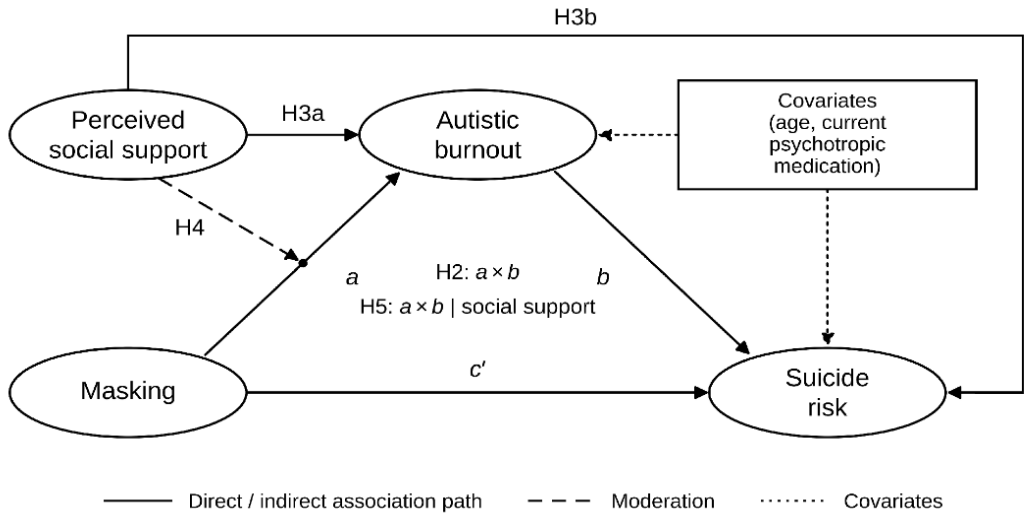
Figure 2.
Standardised coefficients of the model of association between masking, autistic burnout, perceived social support and suicide risk. Note. n = 213. Standardised coefficients (β) from the latent structural equation model are shown, except for the moderation (masking × perceived social support) and the index of moderated mediation, which come from the observed-score path model. Black lines indicate significant associations and grey lines non-significant associations; the dashed line represents the moderation and dotted lines the effect of the covariates. Confidence intervals were estimated with 95% percentile bootstrap based on 5,000 resamples. B = unstandardised coefficient; CI = confidence interval. *p < .05. ***p < .001.
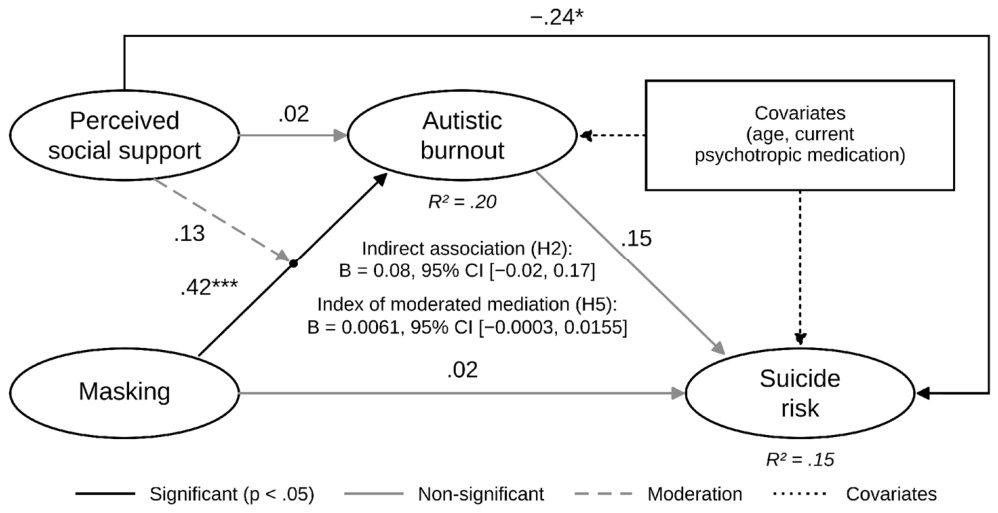

Table 1.
Descriptive Statistics, Reliability and Correlations Between Study Variables.
| Variable | M | SD | Range | α | ω | 1 | 2 | 3 | 4 | 5 |
| 1. Age | 35.29 | 8.95 | 18–63 | — | ||||||
| 2. Masking (CAT-Q) | 139.86 | 19.41 | 74–172 | .89 | .91 | .03 | — | |||
| 3. Autistic burnout (ABM) | 66.80 | 24.21 | 0–104 | .97 | .97 | −.07 | .36*** | — | ||
| 4. Suicide risk (SBQ-ASC) | 9.76 | 6.50 | 0–25 | .79 | .83 | −.10 | .10 | .23*** | — | |
| 5. Social support (MSPSS) | 4.92 | 1.21 | 1.25–7.00 | .89 | .89 | −.21** | −.16* | −.07 | −.20** | — |
| 6. Anxiety (GAD-7) | 13.89 | 4.79 | 2–21 | .85 | .86 | −.03 | .34*** | .48*** | .27*** | −.13 |
Note. N = 213. Range = observed values (possible ranges: CAT-Q, 25–175; ABM, 0–104; SBQ-ASC, 0–26; MSPSS, 1–7; GAD-7, 0–21). α = Cronbach’s alpha; ω = McDonald’s omega; CAT-Q = Camouflaging Autistic Traits Questionnaire; ABM = AASPIRE Autistic Burnout Measure; SBQ-ASC = Suicidal Behaviours Questionnaire–Autism Spectrum Conditions; MSPSS = Multidimensional Scale of Perceived Social Support (mean score); GAD-7 = Generalized Anxiety Disorder-7. Pearson correlations; all significant correlations remained significant after Benjamini–Hochberg false discovery rate correction. *p < .05. **p < .01. ***p < .001.
Table 2.
Hierarchical Regression of Suicide Risk on Covariates, Anxiety and Masking.
| Predictor | Step 1 β | Step 2 β | Step 3 β | B[95% CI] |
| Age | −.11 | −.10 | −.10 | −0.076 [−0.169, 0.018] |
| Psychotropic medication | .23*** | .21** | .21** | 2.693 [1.018, 4.369] |
| Anxiety (GAD-7) | .25*** | .24*** | 0.329 [0.143, 0.514] | |
| Masking (CAT-Q) | .01 | 0.004 [−0.041, 0.050] | ||
| R² | .062 | .122 | .123 | |
| ΔR² | .062** | .060*** | .000 | |
| F for ΔR² | F(2, 210) = 6.99 | F(1, 209) = 14.23 | F(1, 208) = 0.03 |
Note. N = 213. Dependent variable: suicide risk (SBQ-ASC). β = standardised coefficient; B = unstandardised coefficient from Step 3; CI = confidence interval. Current psychotropic medication: 1 = yes, 0 = no. Variance inflation factor ≤ 1.14. *p < .05. **p < .01. ***p < .001.
Disclaimer/Publisher’s Note: The statements, opinions and data contained in all publications are solely those of the individual author(s) and contributor(s) and not of MDPI and/or the editor(s). MDPI and/or the editor(s) disclaim responsibility for any injury to people or property resulting from any ideas, methods, instructions or products referred to in the content. |
© 2026 by the authors. Licensee MDPI, Basel, Switzerland. This article is an open access article distributed under the terms and conditions of the Creative Commons Attribution (CC BY) license (http://creativecommons.org/licenses/by/4.0/).
Copyright: This open access article is published under a Creative Commons CC BY 4.0 license, which permit the free download, distribution, and reuse, provided that the author and preprint are cited in any reuse.