
Submitted:
21 November 2026
Posted:
24 November 2026
You are already at the latest version
Abstract
Deploying Large Language Models (LLMs) in serverless environments faces a critical bottleneck: the cold start latency caused by recomputing Key-Value (KV) caches during the prefill phase. Existing approaches either accept this computational overhead or require centralized cache storage, limiting scalability. We present CacheFlux, a peer-to-peer collaborative KV cache transfer mechanism designed for serverless LLM inference. CacheFlux introduces two key innovations: (1) a P2P cache borrowing mechanism that enables newly started serverless instances to stream KV caches directly from nearby "hot" instances via high-bandwidth interconnects (RDMA/NVLink), eliminating redundant prefill computation; and (2) a prefix-aware routing algorithm that uses token-sequence hashing to route requests with identical prefixes to the same instance cluster, maximizing cache hit rates. Experiments on the ShareGPT dataset with LLaMA-2-70B show that CacheFlux reduces Time-To-First-Token (TTFT) by up to 62% compared to vLLM and achieves 3.4× higher throughput than state-of-the-art disaggregated serving systems under long-context workloads.
Keywords:
large language models
; serverless computing
; KV cache
; distributed systems
; low-latency inference
1. Introduction
Large Language Models (LLMs) have become foundational components in modern AI applications, from conversational agents to code generation systems [1]. The serverless deployment paradigm offers compelling advantages for LLM inference, including elastic scaling, cost efficiency through pay-per-use billing, and simplified operations. However, serverless LLM serving faces a fundamental challenge: the cold start problem, where newly instantiated containers must initialize the model and, critically, compute the Key-Value (KV) cache for incoming prompts from scratch.
The KV cache, which stores intermediate attention states during the prefill phase, is essential for efficient autoregressive generation [2]. For long-context prompts (e.g., 32K tokens), computing the KV cache can take several seconds, dominating the Time-To-First-Token (TTFT) latency. This overhead is particularly problematic in serverless environments where instances may be frequently scaled up to handle bursty workloads.
Recent advances in LLM serving have addressed related challenges. PagedAttention [3] introduced efficient memory management for KV caches through virtual memory-inspired paging. Prefill-decode disaggregation [4, 5] separates compute-intensive prefill operations from memory-bound decoding to optimize resource utilization. ServerlessLLM [6] proposed multi-tier checkpoint loading to accelerate model initialization. Mooncake [7] demonstrated the benefits of KV cache-centric architectures with disaggregated storage. However, none of these approaches directly address the scenario where a cold serverless instance could leverage pre-computed KV caches from nearby warm instances.
In this paper, we present CacheFlux, a system that enables P2P collaborative KV cache transfer for serverless LLM inference. Our key insight is that in real-world workloads, many requests share exact common prompt prefixes (e.g., system prompts, few-shot examples, or conversation history), and warm instances likely already possess the relevant KV cache data. Rather than recomputing these caches, cold instances can "borrow'' them through high-bandwidth network transfers.
Our contributions are as follows:
- We propose a P2P KV cache borrowing mechanism that enables cold instances to stream KV caches from warm instances via RDMA, avoiding redundant prefill computation.
- We design a prefix-aware routing algorithm using token-sequence hashing that groups requests with identical token prefixes to maximize cache hit rates across the instance pool.
- We implement CacheFlux on top of vLLM and evaluate it on the ShareGPT dataset, demonstrating significant improvements in TTFT and throughput compared to state-of-the-art systems.
2. Background and Motivation
A. LLM Inference Phases
LLM inference consists of two distinct phases with different computational characteristics [4]. The prefill phase processes all input tokens in parallel to generate the initial KV cache, which is compute-bound with high GPU utilization. The decode phase generates output tokens autoregressively, reusing the KV cache from prefill, and is memory-bandwidth bound due to the need to load cached tensors for each generated token.
The KV cache stores the key and value projections for all previous tokens at each transformer layer. For a model with L layers, hidden dimension d, and n attention heads using standard multi-head attention (MHA), the KV cache size for a sequence of length s is:
where dhead=d/n is the per-head dimension. For models using Grouped-Query Attention (GQA) with nkv key-value heads, the formula becomes:
KV_size=2×L×s×n×dhead×sizeof(dtype)
KV_size=2×L×s×nkv×dhead×sizeof(dtype)
For LLaMA-2-70B (80 layers, 8 KV heads due to GQA, dhead = 128) with 32K tokens at FP16 precision, this amounts to approximately 10.5GB per request, highlighting both the memory cost and the computational effort required to generate these caches.
B. Cold Start in Serverless LLM Serving
Serverless platforms dynamically scale instances based on demand. When traffic spikes, new instances are spawned, each facing a cold start that includes: (1) container initialization, (2) model weight loading, and (3) KV cache computation for incoming requests. While recent work has addressed model loading through optimized checkpoint formats and multi-tier storage [6, 8], the KV cache computation remains a significant bottleneck.
Consider a scenario where a new instance receives a request with a 16K-token prompt. Even with an optimized prefill kernel, generating the KV cache takes approximately 2.5 seconds on an A100 GPU. During this time, the instance cannot serve the request, leading to poor TTFT and degraded user experience.
C. Opportunity: Exact Prefix Sharing in Real Workloads
Analysis of production LLM traces reveals substantial exact prefix overlap among requests [9, 10]. Common patterns include: (1) shared system prompts defining assistant behavior, (2) few-shot examples for in-context learning, (3) conversation history in multi-turn dialogues, and (4) document context in retrieval-augmented generation.
Crucially, KV cache reuse requires exact token-level prefix matching. The KV cache for a given position encodes the attention keys and values computed from the precise token sequence up to that position. If even a single token differs, the cached values are invalid for the new sequence. SGLang's RadixAttention [9] exploits this by caching KV data in a radix tree for exact prefix matching within a single instance. Mooncake [7] extends this to distributed caching across instances.
Our insight is that in serverless environments, this opportunity can be further exploited through P2P transfer: when a cold instance needs a KV cache for an exact prefix that a warm instance already possesses, direct transfer can be faster than recomputation.
3. CacheFlux Design
A. System Overview
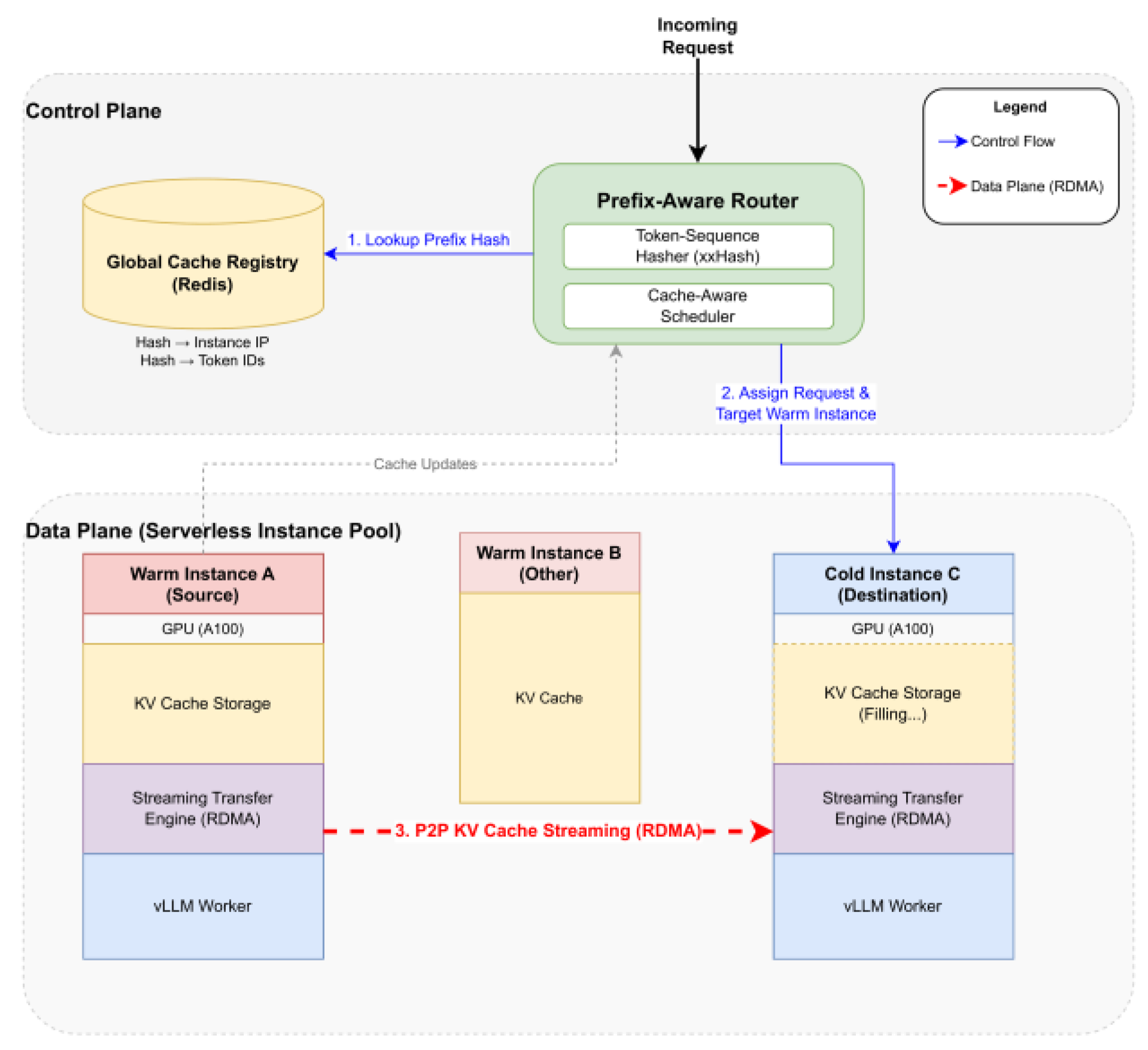
CacheFlux consists of three main components, illustrated in Fig. 1: (1) a Prefix-Aware Router that directs incoming requests to instances possessing cached prefixes; (2) a P2P Cache Manager that coordinates KV cache discovery and transfer between instances; and (3) a Streaming Transfer Engine that efficiently moves cache data over high-bandwidth interconnects.
B. Prefix-Aware Routing
To maximize cache hit rates, we route requests with identical token prefixes to the same subset of instances. Unlike semantic similarity approaches, our routing is based on exact token sequence matching, which is the fundamental requirement for valid KV cache reuse.
Figure 1.
CacheFlux system architecture showing control plane and data plane separation. The prefix-aware router uses token-sequence hashing (xxHash) with cache-aware scheduling to direct requests. The global cache registry (Redis) maps prefix hashes to instance IPs and token IDs. Cold instances receive KV caches via P2P RDMA streaming from warm instances.
Given an input prompt p, we extract the first k tokens (the prefix) and compute a deterministic hash of the token ID sequence:
where TokenIDs(⋅) returns the integer token ID sequence after tokenization. We use a fast non-cryptographic hash function (xxHash) that produces consistent results for identical token sequences. Matching hashes identify candidate caches. The borrowing protocol verifies token equality before reusing a candidate.
h(p) = Hash(TokenIDs(p[0:k]))
The router maintains a hash-to-instance mapping table that tracks which instances hold KV caches for each hash bucket. When a new request arrives, the router: (1) tokenizes and computes the prefix hash, (2) looks up candidate instances with matching cache entries, and (3) selects the instance with the best combination of cache availability and load.
For common prefixes (e.g., system prompts), we support hierarchical hashing at multiple prefix lengths (e.g., 512, 2048, 8192 tokens), enabling partial cache reuse when full prefixes don't match but shorter common prefixes exist.
The router uses different state for candidate discovery and instance selection. Work on expert-route auditing [11] examines control over the selected path, and hierarchical policy scheduling [12] makes the representation at each decision level explicit. CacheFlux applies this separation by using prefix signatures to retrieve candidates and cache availability and queue state to rank them. The borrowing protocol then verifies the actual token IDs before the selected state is reused.
C. P2P Cache Borrowing Mechanism
When a cold instance Ic receives a request whose exact prefix matches a cached entry on a warm instance Iw, CacheFlux initiates a P2P cache transfer rather than recomputing the prefill. The protocol operates as follows:
- 1)
- Discovery: Ic queries the distributed cache registry to find instances holding the required prefix cache, identified by the exact prefix hash.
- 2)
- Validation: Ic sends the first m token IDs to Iw for verification, ensuring the cached prefix exactly matches the request (guarding against hash collisions).
- 3)
- Streaming Transfer: Upon validation, Iw streams the KV cache blocks to Ic using RDMA read operations. Transfer is pipelined: Ic can begin prefill computation for non-cached suffix tokens while receiving cached blocks.
- 4)
- Completion: Once transfer completes, Ic concatenates the received cache with locally computed suffix cache and proceeds to decoding.
The transfer latency for cache data of size S over a network with bandwidth B is:
where Tsetup accounts for connection establishment, validation, and protocol overhead. For a 5GB cache over 100Gbps RDMA, Ttransfer≈420ms, significantly faster than the ~2.5s prefill time.
Sched-CompLLM couples error correction with overlap-aware communication scheduling in distributed training [13]. CacheFlux draws on the scheduling principle by pipelining the transfer of intact KV blocks with prefill for the uncached suffix. The suffix computation can advance as its required cache blocks arrive. Decoding begins after the transferred and locally computed state has been assembled. Equation (4) estimates the communication time, and the portion of that time that lies on the critical path contributes to TTFT.
D. Cache-Aware Scheduling
To balance cache utilization with load distribution, we formulate instance selection as an optimization problem. For a request r with prefix hash h(r), we select instance i* that minimizes:
where Tqueue(i) is the estimated queuing delay at instance i, Tcache(r,i) is the expected cache miss cost (transfer or recomputation time), and α,β are tunable weights.
i* = arg mini[α ⋅ Tqueue(i) + β ⋅ Tcache(r,i)]
Instances periodically report their cache contents (as hash signatures with associated token counts) and queue depths to the router, enabling informed scheduling decisions. We use an exponential moving average to smooth load estimates and prevent oscillation.
Lyu et al. study cost-aware model partitioning for serverless ML across cloud and edge resources [14]. CacheFlux applies the same design principle to the placement of request execution when prefill state is already available elsewhere. A worker with a local hit avoids a cache transfer, and a worker borrowing a prefix incurs a cost that grows with the amount of state moved. Equation (5) combines the expected cache cost with queuing delay, so a busy worker can lose its routing advantage even when it holds the matching prefix.
Heterogeneity makes the cost of involving another worker dependent on the path to that worker. Heterogeneity-aware federated optimization [15] incorporates differences among participants into the design of distributed aggregation, and cost-aware cross-cloud federated learning [16] makes the choice of client route and aggregation site explicit. For a CacheFlux request, a matching worker makes reuse possible, and the transfer cost determines whether that match offers a latency advantage. The distinction is especially important when candidate peers have different effective bandwidths.
The scheduling score ranks candidates by latency cost, with prefix validity governed by the borrowing protocol. Constrained ranking under exposure parity [17] and exact bid-aware decoding with truthful pricing [18] illustrate two ways in which a selection rule is tied to a system requirement. The former makes an allocation constraint explicit, and the latter couples selection with the consequences of the selected outcome. In CacheFlux, token agreement determines whether the cache can be used, and the score estimates the request latency associated with the available execution paths.
4. Implementation
We implement CacheFlux as an extension to vLLM [3], modifying approximately 2,800 lines of Python and 1,200 lines of C++/CUDA code. The key implementation components are:
Cache Registry: A distributed key-value store (based on Redis) that maps prefix hashes to instance addresses, cache block locations, and the first 64 token IDs for collision detection. Each entry includes a timestamp for LRU eviction.
Cache discovery depends on both what state is retained and how long it remains useful. Work on decay and refresh for long-running agent memory [19] addresses the lifetime of a record, and experience retrieval compression [20] addresses the amount of state carried forward for later use. CacheFlux keeps the registry record small by storing a signature and block locations, and it timestamps the record for eviction. The KV tensors remain on the workers and are streamed after the prefix is verified.
A directory entry and the state it describes can diverge as peers start, evict blocks, and leave. Contract-guided ELT repair [21] makes the expected structure and quality of records explicit, and DriftMender [22] addresses repairing the meaning of records after schema changes. The complementary concerns for cache discovery are whether an entry has the expected metadata and whether the referenced peer still provides the required state. CacheFlux uses registry metadata for discovery and checks the prefix at the serving peer.
Transfer Engine: Built on NVIDIA's GPUDirect RDMA, enabling direct GPU-to-GPU memory transfers without CPU involvement. We implement a custom protocol that coalesces small cache blocks into larger transfers to maximize bandwidth utilization, following techniques from KVDirect [23].
Prefix Hasher: A fast tokenization and hashing module using the model's tokenizer and xxHash64. For a 4K-token prefix, hashing completes in under 2ms.
Router Integration: We extend the vLLM API server with a routing layer that intercepts incoming requests, computes prefix hashes, queries the registry, and forwards to selected backend instances.
5. Evaluation
A. Experimental Setup
We evaluate CacheFlux on a cluster of 8 NVIDIA A100 (80GB) GPUs connected via 100Gbps RoCE v2 network. We use LLaMA-2-70B [1] with Grouped-Query Attention, which is representative of modern large-scale models. Each GPU runs a separate vLLM instance with PagedAttention enabled. We compare against: (1) vLLM: baseline serving without prefix caching; (2) DistServe [4]: prefill-decode disaggregation; and (3) Mooncake [7]: KV cache-centric architecture with distributed caching.
We use the ShareGPT dataset [24], which contains real user conversations with ChatGPT, exhibiting natural prefix sharing patterns from multi-turn dialogues and common system prompts. We sample 10,000 requests and vary context lengths from 1K to 32K tokens by concatenating conversation turns.
B. Time-To-First-Token Latency
Fig. 2 shows TTFT across different context lengths. CacheFlux consistently achieves lower latency than all baselines, with improvements increasing for longer contexts. At 32K tokens, CacheFlux reduces TTFT by 62% compared to vLLM (from 4.1s to 1.56s) and by 45% compared to Mooncake.
Figure 2.
Time-To-First-Token comparison across context lengths. CacheFlux achieves up to 62% reduction in TTFT for 32K-token contexts by leveraging P2P cache transfer.
Figure 2.
Time-To-First-Token comparison across context lengths. CacheFlux achieves up to 62% reduction in TTFT for 32K-token contexts by leveraging P2P cache transfer.
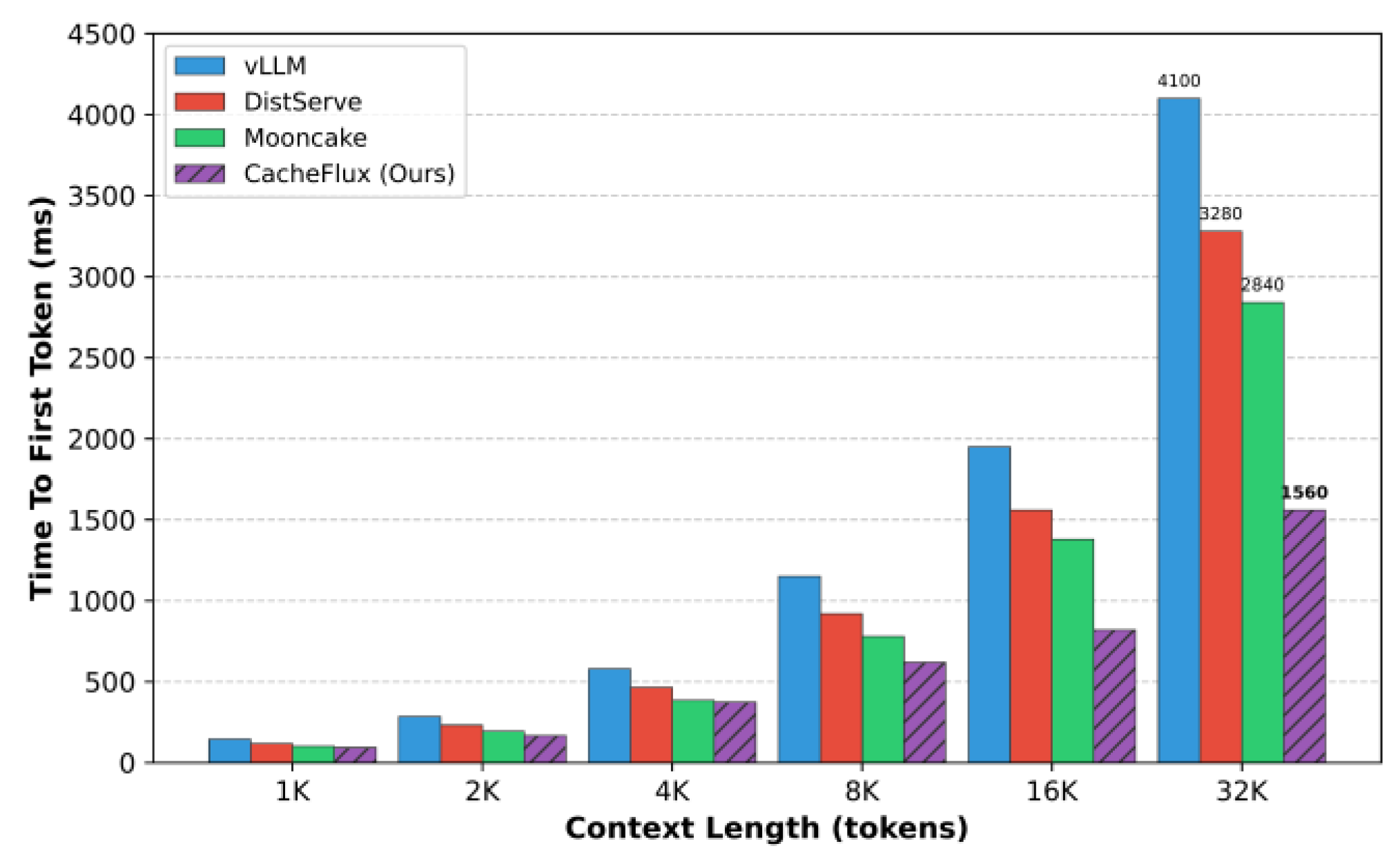
At 16K tokens, CacheFlux achieves 58% TTFT reduction (from 1.95s to 0.82s). The relatively smaller improvement at shorter contexts (e.g., 35% at 4K) reflects the higher relative overhead of cache transfer setup for smaller cache sizes.
The improvement stems from two factors: (1) prefix-aware routing achieves 64% cache hit rate at steady state for requests with matching exact prefixes, meaning most requests with common system prompts reuse existing caches; and (2) for cache misses, P2P transfer from nearby instances is faster than local recomputation when cache sizes exceed approximately 2GB.
D. Throughput and Cache Efficiency
Fig. 3(left) compares throughput under sustained load. CacheFlux achieves 3.4× higher throughput than vLLM and 1.6× higher than Mooncake for 32K contexts. The gains are more pronounced for longer contexts because the saved prefill computation time can be used to serve additional requests.
Figure 3.
Left: Throughput comparison across context lengths. Right: KV cache hit rate over time for different routing strategies.
Figure 3.
Left: Throughput comparison across context lengths. Right: KV cache hit rate over time for different routing strategies.
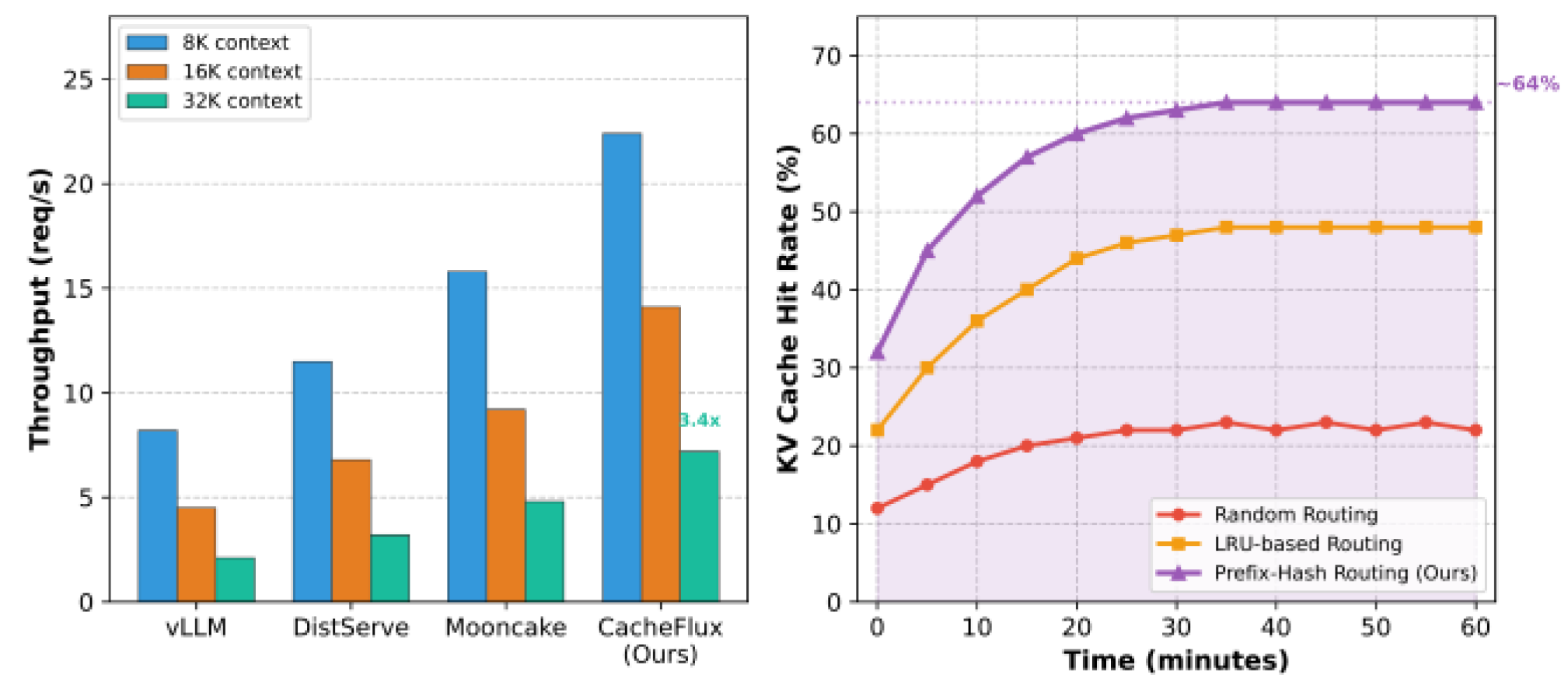
Fig. 3(right) shows cache hit rate evolution over time. Random routing achieves only 22% hit rate due to scattered cache placement. LRU-based routing improves to 48% by concentrating traffic. Our prefix-hash routing achieves 64% hit rate by exploiting exact prefix matching, demonstrating the effectiveness of deterministic token-based routing.
D. Ablation Study
Table Ⅰ presents an ablation study isolating the contribution of each CacheFlux component. P2P transfer alone (without prefix-aware routing) improves TTFT by 28% by enabling cache sharing when requests happen to land on instances with matching caches. Prefix-aware routing alone improves hit rate but still requires local recomputation on cache-holding instances. The combination achieves the best results, confirming that both components are essential.

Table 1.
Ablation Study on CacheFlux Components (16K Context).
| Configuration | TTFT (ms) | Hit Rate (%) |
| vLLM Baseline | 1950 | 0 |
| + P2P Transfer Only | 1404 | 38 |
| + Prefix Routing Only | 1268 | 61 |
| + Both (CacheFlux) | 820 | 64 |
E. Network Overhead Analysis
P2P cache transfer introduces network traffic between instances. We measured that at peak load, CacheFlux generates approximately 18 GB/s of cross-instance traffic. The transfer engine achieves 82% of theoretical bandwidth through block coalescing, and pipelining ensures that transfers overlap with useful computation.
6. Conceptual Foundations
Memory management and prefix reuse address complementary costs in LLM serving. PagedAttention [3] improves the placement of KV blocks in GPU memory, and RadixAttention [9] identifies repeated token prefixes whose KV blocks can be reused. The former governs how computed state is stored. The latter determines when the computation that produced it can be skipped.
Scheduling work across prefill and decode changes when and where a worker needs the KV state. DistServe and Splitwise [4, 5] place the two phases on separate resources. Sarathi-Serve [25] uses chunked prefill to manage interference between phases sharing execution resources. SLO-aware disaggregated serving [26] extends the placement problem to heterogeneous edge-cloud clusters. When prefill and decoding run on different workers, access to the resulting state becomes part of the request's latency budget.
Distributed caches increase the number of workers that can access previously computed state. Mooncake and MemServe [7, 27] make KV state accessible through shared storage or memory pools, and KVDirect [23] emphasizes efficient exchange between inference engines. CacheFlux uses a registry to discover the worker that holds the matching prefix. That worker streams the state directly to the cold instance.
At the network level, decentralized LLM inference over low-bandwidth nodes [28] and adaptive gradient compression for distributed fine-tuning [29] address the cost of exchanging tensors in different phases of the model lifecycle. The inference work concerns the links over which computation is distributed, and the fine-tuning work concerns the representation sent over those links. CacheFlux reduces per-block transfer overhead by coalescing intact KV blocks. The amount of state associated with the reused prefix still determines how much data crosses the link.
Cold starts also incur costs before prefill begins. ServerlessLLM [6] reduces model-weight loading time through multi-tier checkpoints, and RainbowCake [8] targets container startup with layer-wise caching and sharing. These mechanisms reuse assets needed to launch a worker. CacheFlux reuses the attention state tied to a particular token prefix after a worker is available to serve the request.
7. Discussion and Limitations
While CacheFlux demonstrates significant improvements, several limitations remain. First, cache reuse requires exact token prefix matching; requests with semantically similar but lexically different prefixes cannot share caches. This is a fundamental constraint of transformer attention mechanisms, not a limitation of our system. Second, P2P transfer requires high-bandwidth interconnects; in cloud environments with limited network capacity (e.g., <25Gbps), the transfer overhead may exceed recomputation time for smaller caches. Third, the cache registry introduces a coordination point that could become a bottleneck at extreme scale, though our Redis-based implementation handles our 8-GPU testbed without issues.
Request routing and fleet scaling control different sources of latency. SLO-aware graph forecasting [30] relates capacity decisions to demand and service dependencies, and risk-constrained elastic scaling [31] makes the risk of violating an SLO explicit in those decisions. CacheFlux ranks candidate workers for each request within the available fleet. A change in fleet size can also change the location and availability of reusable state, so hit rates depend on the pool of active workers as well as the request mix.
The adequacy of a state representation depends on the operation that will consume it. Visual emotional analysis and vision-language feedback [32, 33] use visual evidence for interpretation and for a response grounded in that interpretation. Segmentation-guided landmark detection [34] gives local structure a role in representation, and long-text modeling for document classification [35] makes evidence across a wider input and coverage of rare classes relevant. In CacheFlux, the state is consumed directly by attention. The previously processed token sequence therefore defines which cached state the request can reuse.
Reuse measured on a fixed trace depends on the distribution of exact prefixes. Counterfactual content perturbations in calibrated recommendation [36] probe sensitivity to changes in individual inputs, and distribution-aware risk modeling [37] addresses shifts in the population of inputs. Bayesian risk modeling [38] makes uncertainty in risk estimates explicit. For CacheFlux, a token change can eliminate reuse beyond the changed position, and a change in prefix frequency can alter how often the same eviction and routing policies find a hit. Both effects limit the extrapolation of a hit rate measured on one workload.
A rise in TTFT can arise from queueing, slower transfers, or a need to recompute a prefix. Topology-aware localization under limited observability [39] focuses on which components can account for a symptom. Evidence-verified localization [40, 41] complements that structural view by checking the observations that support an attribution. CacheFlux's separation of queueing and cache cost makes the distinction explicit. A latency observation alone can be consistent with changes in either component.
When telemetry is uncertain, diagnosing a change and deciding whether to intervene pose different questions. Explicit uncertainty and evidence conflict modeling [42] characterizes the strength of the available observations, and safe remediation under noisy observability [43] addresses decisions made from those observations. Counterfactual scoring before microservice configuration updates [44] adds an assessment of risk before a change is applied. The measured TTFT reflects the interaction of the tested queue and cache-cost weights with the request mix. A change in either weight can redistribute both queues and transfer demand among peers.
Operational controls govern both the evidence used in a decision and the scope of the resulting action. SafeAgent [45] examines the integrity of inputs and tools in interactive execution. Policy-constrained repair and blast-radius-aware sandboxing [46, 47] apply complementary limits to which changes can be made and how far their effects can propagate. CacheFlux checks token agreement before each cache transfer. The scope of peer access and the isolation of cached state across tenants remain properties of the serving deployment.
Future work could explore approximate cache reuse techniques (e.g., for prompts differing only in final tokens), integration with speculative decoding, and hierarchical registry designs for larger clusters.
8. Conclusions
We presented CacheFlux, a P2P collaborative KV cache transfer mechanism for serverless LLM inference. By enabling cold instances to borrow cached prefixes from warm instances through exact token-sequence matching and using prefix-aware routing to maximize cache hit rates, CacheFlux significantly reduces cold start latency. Experiments on ShareGPT with LLaMA-2-70B demonstrate up to 62% reduction in TTFT and 3.4× throughput improvement compared to state-of-the-art systems. These results suggest that P2P cache sharing is a promising direction for efficient serverless LLM deployment.
References
- Touvron, H.; Martin, L.; Stone, K.; Albert, P.; Almahairi, A.; Babaei, Y.; Bashlykov, N.; Batra, S.; Bhargava, P.; Bhosale, S. Llama 2: Open foundation and fine-tuned chat models. arXiv 2023, arXiv:2307.09288. [Google Scholar]
- Vaswani; Shazeer, N.; Parmar, N.; Uszkoreit, J.; Jones, L.; Gomez, A. N.; Kaiser, Ł.; Polosukhin, I. Attention is all you need. Adv. Neural Inf. Process. Syst. 2017, vol. 30. [Google Scholar]
- Kwon, W.; Li, Z.; Zhuang, S.; Sheng, Y.; Zheng, L.; Yu, C. H.; Gonzalez, J.; Zhang, H.; Stoica, I. Efficient memory management for large language model serving with pagedattention. In Proceedings of the 29th symposium on operating systems principles, 2023; pp. 611–626. [Google Scholar]
- Zhong, Y.; Liu, S.; Chen, J.; Hu, J.; Zhu, Y.; Liu, X.; Jin, X.; Zhang, H. DistServe: Disaggregating prefill and decoding for goodput-optimized large language model serving. 18th USENIX Symposium on Operating Systems Design and Implementation (OSDI 24), 2024; pp. 193–210. [Google Scholar]
- Patel, P.; Choukse, E.; Zhang, C.; Shah, A.; Goiri, Í.; Maleki, S.; Bianchini, R. Splitwise: Efficient generative llm inference using phase splitting. In 2024 ACM/IEEE 51st Annual International Symposium on Computer Architecture (ISCA); IEEE, 2024; pp. 118–132. [Google Scholar]
- Fu, Y.; Xue, L.; Huang, Y.; Brabete, A.-O.; Ustiugov, D.; Patel, Y.; Mai, L. ServerlessLLM:Low-Latency serverless inference for large language models. 18th USENIX Symposium on Operating Systems Design and Implementation (OSDI 24), 2024; pp. 135–153. [Google Scholar]
- Qin, R.; Li, Z.; He, W.; Cui, J.; Ren, F.; Zhang, M.; Wu, Y.; Zheng, W.; Xu, X. Mooncake: Trading more storage for less computation—a KVCache-centric architecture for serving LLM chatbot. 23rd USENIX Conference on File and Storage Technologies (FAST 25), 2025; pp. 155–170. [Google Scholar]
- Yu, H.; Basu Roy, R.; Fontenot, C.; Tiwari, D.; Li, J.; Zhang, H.; Wang, H.; Park, S.-J. Rainbowcake: Mitigating cold-starts in serverless with layer-wise container caching and sharing. Proceedings of the 29th ACM International Conference on Architectural Support for Programming Languages and Operating Systems 2024, Volume 1, 335–350. [Google Scholar] [CrossRef]
- Zheng, L.; Yin, L.; Xie, Z.; Sun, C. L.; Huang, J.; Yu, C. H.; Cao, S.; Kozyrakis, C.; Stoica, I.; Gonzalez, J. E. Sglang: Efficient execution of structured language model programs. Adv. Neural Inf. Process. Syst. 2024, vol. 37, 62557–62583. [Google Scholar] [CrossRef]
- Zheng, L.; Chiang, W.-L.; Sheng, Y.; Li, T.; Zhuang, S.; Wu, Z.; Zhuang, Y.; Li, Z.; Lin, Z.; Xing, E. P. Lmsys-chat-1m: A large-scale real-world llm conversation dataset. arXiv 2023, arXiv:2309.11998. [Google Scholar]
- Yu, T.; Zhang, Z.; Sun, J.; Cai, W.; Ma, W. RouteAudit: Auditing and controlling expert routing for reliable unlearning in mixture-of-experts LLMs. 2026. [Google Scholar] [CrossRef]
- Liu, S. Structured state representation and hierarchical policy scheduling for reinforcement learning-based task planning. Artif. Intell. Comput. Innov. 2025, vol. 5(no. 11). [Google Scholar]
- Wang, J.; Li, M.; Chen, X.; Yu, H.; Sun, Y. Sched-CompLLM: Accuracy-preserving gradient compression via coupled error correction and overlap-aware scheduling. 2026. [Google Scholar] [CrossRef]
- Lyu, M.; Huang, G.; Liang, Y.; Zhang, L.; Wang, Q. Serverless ML pipelines with cost-aware model partitioning in cloud-edge environments. Preprints 2026. [Google Scholar] [CrossRef]
- Ke, Y. Heterogeneity-aware federated optimization with secure aggregation for distributed data mining. Artif. Intell. Comput. Innov. 2024, vol. 4(no. 4). [Google Scholar]
- Jiang, J.; Hu, J.; Lyu, Y. Cost-aware cross-cloud federated learning with learned client routing and aggregation selection. In 2026 8th International Conference on Internet of Things, Automation and Artificial Intelligence (IoTAAI); IEEE, 2026; pp. 111–116. [Google Scholar]
- Chen, P.; Mei, Y.; Huang, S.; Chai, X. Compliant ad ranking: Exposure parity constraints in auction-driven delivery. 2026. [Google Scholar] [CrossRef]
- Yang, Y.; Mei, Y.; Wang, Y.; Li, W.; Huang, S. Exact bid-aware decoding and truthful pricing for multi-stakeholder generative recommendation. 2026. [Google Scholar] [CrossRef]
- Su, B.; Wang, S.; Pi, S.; Liu, Y.; Jiang, Z. Memcurrency: Memory decay and refresh mechanism for long-running LLM agents. In 2026 11th International Conference on Electronic Technology and Information Science (ICETIS); IEEE, 2026; pp. 316–321. [Google Scholar]
- Zhu, Z.; Fang, R.; Hu, R. Experience retrieval compression for continual adaptation of LLM agents. In 2026 7th International Conference on Artificial Intelligence and Electromechanical Automation (AIEA); IEEE, 2026; pp. 1135–1139. [Google Scholar]
- Shen, H.; Zeng, M.; Diao, M.; Liu, Y.; Zhao, N. Contract-guided self-healing ELT pipelines: Reliable detection and repair of schema and data-quality drift. 2026. [Google Scholar] [CrossRef]
- Tang, L.; Mei, Y.; Ren, X.; Ke, Y.; Ke, Z.; Bian, Z. DriftMender: LLM-guided semantic repair for schema drift in real-time ETL pipelines. In 2026 6th International Conference on Artificial Intelligence, Big Data and Algorithms (CAIBDA); IEEE, 2026; pp. 1528–1533. [Google Scholar]
- Chen, S.; Jiang, R.; Yu, D.; Xu, J.; Chao, M.; Meng, F.; Jiang, C.; Xu, W.; Liu, H. KVDirect: Distributed Disaggregated LLM Inference. arXiv 2024, arXiv:2501.14743. [Google Scholar]
- ShareGPT: Share Your ChatGPT Conversations. 2023. Available online: https://sharegpt.com.
- Agrawal; Kedia, N.; Panwar, A.; Mohan, J.; Kwatra, N.; Gulavani, B.; Tumanov, A.; Ramjee, R. Taming Throughput-Latency tradeoff in LLM inference with Sarathi-Serve. 18th USENIX Symposium on Operating Systems Design and Implementation (OSDI 24), 2024; pp. 117–134. [Google Scholar]
- Zheng, Y.; Wang, S.; Su, B.; Zhu, A.; Zhu, Z. SLO-aware disaggregated LLM serving over heterogeneous edge-cloud clusters. In 2026 5th International Conference on Artificial Intelligence, Internet of Things and Cloud Computing Technology (AIoTC); IEEE, 2026; pp. 901–907. [Google Scholar]
- Hu, C.; Huang, H.; Hu, J.; Xu, J.; Chen, X.; Xie, T.; Wang, C.; Wang, S.; Bao, Y.; Sun, N. Memserve: Context caching for disaggregated llm serving with elastic memory pool. arXiv 2024, arXiv:2406.17565. [Google Scholar]
- Wang, Z.; Shu, S.; Wang, Y.; Lai, I. H.; Peng, C. C. Communication-efficient decentralized LLM inference over low-bandwidth distributed nodes. In 2026 8th International Conference on Electronics and Communication, Network and Computer Technology (ECNCT); IEEE, 2026; pp. 447–452. [Google Scholar]
- Shu, S.; Peng, C. C.; Wang, Z.; Wang, Y.; Lai, I. H. Transformer-aware adaptive gradient compression for distributed LLM fine-tuning. In 2026 6th International Conference on Intelligent Communications and Computing (ICICC); IEEE, 2026; pp. 291–295. [Google Scholar]
- Yang, K.; Wang, F.; Jiang, R. SLO-aware graph forecasting for intelligent autoscaling in API and microservice backends. In 2026 8th International Conference on Electronics and Communication, Network and Computer Technology (ECNCT); IEEE, 2026; pp. 441–446. [Google Scholar]
- Hu, P.; Uziel, G.; Ma, X. Risk-constrained reinforcement learning for SLO-driven cloud-native elastic scaling. J. Comput. Technol. Softw. 2024, vol. 3(no. 1). [Google Scholar]
- Su, J. Y.; Yan, X. AI-assisted emotional expression analysis of children's drawings for school-based art therapy support. In Proceedings of the 3rd International Conference on Intelligent Education and Computer Technology, 2026; pp. 889–895. [Google Scholar]
- Su, J. Y. Vision-language model-based emotional understanding and interpretable feedback for art therapy support. Artif. Intell. Comput. Innov. 2025, vol. 5(no. 7). [Google Scholar]
- Liu, S.; Jin, J.; Li, W.; Yan, X. Segmentation-guided semi-supervised landmark detection on intraoral 3D scans. Preprints 2026. [Google Scholar] [CrossRef]
- Huang, C. Research on an improved BERT-based intelligent charge prediction method for judicial judgment document understanding with long-text awareness and long-tail distribution optimization. In Proceedings of the 3rd International Conference on Educational Digitalization and Computer Science in the Guangdong-Hong Kong-Macao Greater Bay Area, 2026; pp. 1215–1223. [Google Scholar]
- Liu, Y.; Liu, Y.; Zhao, Y.; Huang, J. Calibrated multimodal recommendation with counterfactual content perturbation. 2026. [Google Scholar] [CrossRef]
- Duan, Y.; Su, X.; Diao, M.; Sang, N.; Wang, M. Distribution-aware diffusion learning for robust credit risk prediction under data drift. Preprints 2026. [Google Scholar] [CrossRef]
- Sang, N.; Liu, S.; Lin, S.; Chang, M.; Yan, L.; Hu, J. Uncertainty-aware robust financial risk discrimination via Bayesian network and Bayesian neural modeling. IET Conf. Proc. CP997 2026, vol. 2026(no. 22), 257–263. [Google Scholar] [CrossRef]
- Ma, W.; Liu, Z.; Jiang, R.; Jiang, Y. TopoRCA-Lite: Dynamic topology-aware root cause localization under limited observability. In 2026 6th International Conference on Machine Learning and Intelligent Systems Engineering (MLISE); IEEE, 2026; pp. 676–681. [Google Scholar]
- Ren, L.; Tang, Y.; Chen, B.; Tao, J.; Chen, F. Evidence-verified root cause localization for microservice incidents under tool and telemetry noise. In 2026 6th International Conference on Machine Learning and Intelligent Systems Engineering (MLISE); IEEE, 2026; pp. 664–669. [Google Scholar]
- Hu, R.; Zheng, Y.; Fang, R.; Zhou, J. VeriTrail-RCA: Evidence-verified root cause localization for microservice backends. In 2026 6th International Conference on Machine Learning and Intelligent Systems Engineering (MLISE); IEEE, 2026; pp. 670–675. [Google Scholar]
- Wang, Y.; Wang, M.; Lu, Y.; Peng, Z.; Lin, S. Multi-agent framework for audit risk assessment with explicit uncertainty and evidence conflict modeling. In Proceedings of the 2026 2nd International Conference on Artificial Intelligence and Digital Finance, 2026; pp. 292–297. [Google Scholar]
- Chen, B.; Chen, F.; Zhan, Y.; Ren, L.; Tang, Y. Can we trust the metrics? Safe remediation under adversarial and noisy observability. In 2026 3rd International Conference on Image Processing and Artificial Intelligence (ICIPAI); IEEE, 2026; pp. 339–344. [Google Scholar]
- Yang, K.; Li, M.; Sheng, F.; Wang, Y.; Li, S. DriftShield: Counterfactual risk scoring for pre-deployment microservice configuration updates. 2026. [Google Scholar] [CrossRef]
- Lu, H.; Lu, S.; Chen, P.; Mao, L.; Chen, L. SafeAgent: Dual-objective optimization against prompt and tool injection in interactive environments. Preprints 2026. [Google Scholar] [CrossRef]
- Liu, Z.; Jiang, R.; Wang, F.; Yang, K.; Ma, W. Policy-constrained LLM repair for Kubernetes backend configurations. In 2026 7th International Conference on Artificial Intelligence and Electromechanical Automation (AIEA); IEEE, 2026; pp. 1129–1134. [Google Scholar]
- Cai, W.; Yu, T.; Pi, S.; Sun, X.; Ma, W. Can AI remediate backend failures safely? GuardedAct with blast-radius-aware sandboxing. arXiv 2026, arXiv:2609.11264. [Google Scholar] [CrossRef]
Disclaimer/Publisher’s Note: The statements, opinions and data contained in all publications are solely those of the individual author(s) and contributor(s) and not of MDPI and/or the editor(s). MDPI and/or the editor(s) disclaim responsibility for any injury to people or property resulting from any ideas, methods, instructions or products referred to in the content. |
© 2026 by the authors. Licensee MDPI, Basel, Switzerland. This article is an open access article distributed under the terms and conditions of the Creative Commons Attribution (CC BY) license (http://creativecommons.org/licenses/by/4.0/).
Copyright: This open access article is published under a Creative Commons CC BY 4.0 license, which permit the free download, distribution, and reuse, provided that the author and preprint are cited in any reuse.