

Submitted:
20 November 2026
Posted:
24 November 2026
You are already at the latest version
Abstract
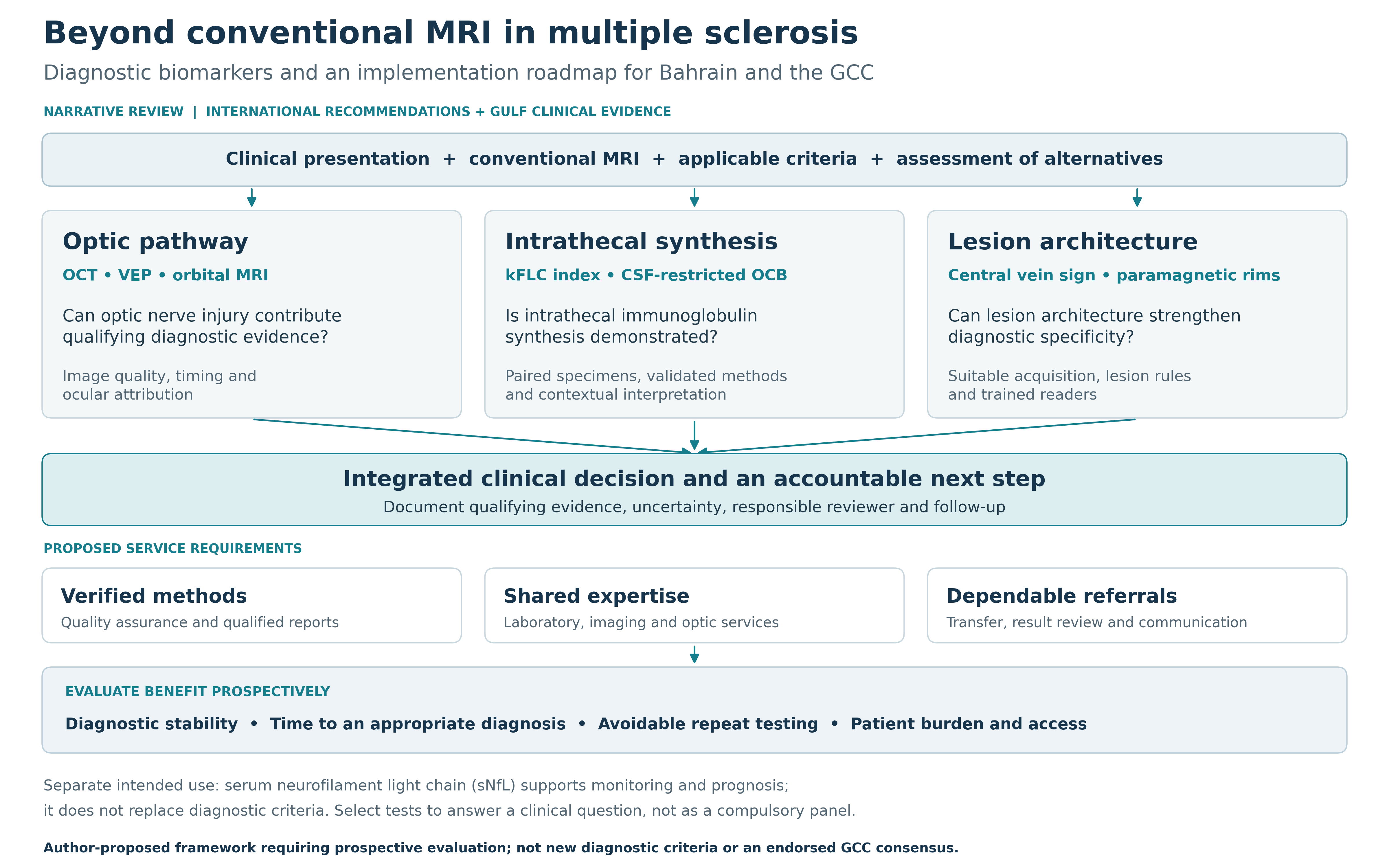
The 2024 McDonald revisions place optic nerve assessment, cerebrospinal fluid kappa free light chains and selected advanced MRI biomarkers within contemporary multiple sclerosis diagnosis. Their clinical value depends on reliable acquisition, interpretation and integration into care. This narrative review translates international evidence into an implementation roadmap for Bahrain, Kuwait, Oman, Qatar, Saudi Arabia and the United Arab Emirates. A targeted update through November 2026 incorporates diagnostic consensus documents, biomarker studies, Gulf patient-based research and regional policy sources. Saudi central vein sign and misdiagnosis studies, Kuwaiti and Omani optic pathway studies, Qatari retinal biomarker research and Arabian Gulf inflammatory-disease cohorts provide a regional foundation, although they do not establish the performance of a complete diagnostic pathway across all six countries. Cardiometabolic and ocular comorbidity, heterogeneous referral populations and continuity across public and private services require explicit attention. We propose service-level readiness assessment, shared specimen and image referral networks, validated laboratory reporting, multidisciplinary optic nerve assessment and selective access to susceptibility-sensitive MRI. Adoption should follow demonstrated capability rather than a fixed sequence of equipment purchases. A Bahrain feasibility programme could test these arrangements before wider collaborative evaluation. Implementation should measure diagnostic stability, time to an appropriate diagnosis, technical failures, patient costs and access, alongside test uptake. Kappa free light chains should be distinguished from serum free light-chain testing, and diagnostic markers from blood biomarkers used for monitoring. The regional objective is to make advanced diagnostic evidence dependable and accessible while preserving timely care for patients who can be diagnosed through established pathways. The proposed framework requires prospective evaluation and is not a GCC consensus or a replacement for formal diagnostic criteria.
Keywords:
multiple sclerosis
; Gulf Cooperation Council
; Bahrain
; diagnostic implementation
; kappa free light chains
; central vein sign
; paramagnetic rim lesions
; optical coherence tomography
; diagnostic safety
; access to care
Copyright: This open access article is published under a Creative Commons CC BY 4.0 license, which permit the free download, distribution, and reuse, provided that the author and preprint are cited in any reuse.