
Submitted:
20 November 2026
Posted:
24 November 2026
You are already at the latest version
Abstract
Software systems increasingly invoke language models on closed questions, such as assigning a support ticket to a team, screening whether a tool call is safe, or selecting a model to answer a query. Unlike open-ended chat, these calls require a fast, inexpensive and trustworthy probability distribution over a declared answer set. Following the 2026 release of Jev and subsequent open typed decision models, empirical findings remain scattered across separate literatures on prompt calibration, option-order bias, uncertainty estimation, routing, guardrails and automated judging. Here we trace the architectural progression from prompted generation and token-logit readouts to decision-native designs, evaluate whether their output probabilities are calibrated, invariant and robust, and examine how these components behave inside routers, guardrails, judges and agents. Using five falsifiable criteria for decision-native architectures and six comparison axes, we show that open models read out at label tokens already recover most of the accuracy credited to dedicated decision models. Decision-native designs primarily deliver substantial latency and cost reductions alongside structural order invariance in option-isolated variants, whereas calibration, probabilistic coherence and adversarial robustness vary sharply across domains. We conclude with an evaluation critique, a role-by-role readiness rubric and priorities for null-aware, coherent and traceable decision models.
Keywords:
decision-native language models
; Jev
; typed decisions
; calibration
; selective prediction
; option-order bias
; model routing
; guardrails
; LLM-as-a-judge
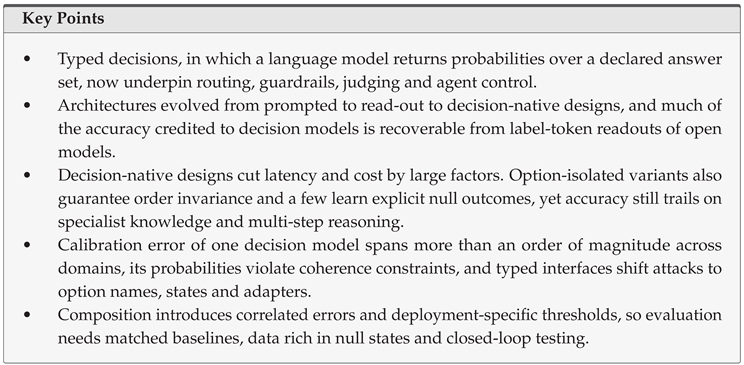
1. Introduction
When software asks a language model which team should handle a support ticket, the useful output is a single choice from a short list. An increasing share of production language-model calls take this closed form, deciding which model should answer a query [1,2], whether a prompt or tool invocation may proceed [3,4], what rubric score a response deserves [5], or which action an agent should execute next [6]. In these settings, open-ended generative fluency adds unnecessary latency and parsing overhead. What the calling software requires is an answer guaranteed to lie in the declared set, an accompanying probability reliable enough to threshold, and inference fast and cheap enough to run inline.
Although closed-set classification with pretrained models goes back several years, its mechanics have shifted substantially. Masked language models first handled few-shot classification through cloze prompts and verbalizers [7,8]. As decoder-only models scaled up, reading option-letter logits made multiple-choice prompting competitive [9], post-hoc prior corrections reduced label bias [10], and well-formatted closed questions yielded surprisingly calibrated probabilities [11]. In 2026 the commercial launch of Jev introduced a hosted typed decision interface that returns probabilities over declared options without generating text [12]. Within weeks, open replications, purpose-built decision architectures, evaluation suites, red-teaming studies and repository analyses appeared in rapid succession [13,14,15,16,17]. Figure 1 contrasts the resulting three mechanisms on a single support-ticket example.
Evidence relevant to these systems remains split across research communities with distinct vocabularies and benchmarks. Studies of in-context calibration and multiple-choice sensitivity focus on label priors and option permutations [18,19], whereas uncertainty research contrasts verbalized confidence against token probabilities [20,21]. Routing, guardrailing and automated judging have each developed separate evaluation suites and specialized models [22,23,24], while most early decision-model preprints include no label-probability baseline [25]. Prior surveys cover individual pieces of this picture without linking them. Geng et al. [26] and Liu et al. [27] categorize uncertainty estimation by model access and error source with a focus on open-ended generation; the former treats classification mainly as correcting label and option-position biases in prompted models, and both predate decision-native designs. Wen et al. [28] examine abstention across the model lifecycle without asking how the readout architecture shapes abstention signals, while Moslem and Kelleher [29] review routing and cascading paradigms while treating router calibration as a black box. Meanwhile, Dong et al. [30] make the case for neuro-symbolic guardrails prior to large-scale stress tests of typed safety classifiers, and Balepur et al. [31] focus strictly on multiple-choice test validity. Closer to our topic, Roitman [32] introduce System One models through latency, cost and calibration arguments, and Tang and Zheng [25] review nine days of early preprints centered on Jev. A synthesis connecting readout architecture to probability reliability and downstream system composition is still missing.
To fill that gap, this review examines language models and derived architectures that take a state, a question and a declared answer space and output a decision alongside probabilities over that space. Our scope covers answer readouts from label-token logits, calibration and abstention on closed-form questions, decision-native architectures and training objectives, and the deployment of typed decisions inside routers, guardrails, judges and agents. Open-ended text quality, long-form hallucination detection, reward modeling for reinforcement learning and general multi-step planning lie outside this scope; domain-specific studies are discussed where they shed light on the decision mechanism itself.
The remainder of the paper makes five contributions. Section 2 establishes a unified notation for typed decisions together with five falsifiable criteria for decision-native architectures (Boxes 1 and 2). Section 3 organizes representative methods across prompted, read-out and decision-native generations along six design axes (Table 1), with each generation examined in Section 4 to Section 6. Section 7 and Section 8 synthesize empirical findings on calibration, confidence elicitation, abstention, order invariance, cognitive bias and adversarial robustness, clarifying what typed probabilities cannot safely support. Section 9 analyses failure modes that emerge when individual decisions are composed into routers, guardrails, judges and agent loops. Finally, Section 10 to Section 12 critique current benchmarking practices, score deployment readiness across system roles and outline six priorities for future research before Section 13 concludes.
2. Decisions as an Interface
Every typed decision brings together four elements (Box 1). A state represents the input context, whether a support ticket, dialogue history, tool-call trace, clinical note or image. A question specifies what is being asked of that state, while a declared answer space enumerates the admissible outcomes ahead of time as natural-language options, a binary truth judgment or points along an ordered scale, optionally augmented with an explicit outcome for none of the above. Given these inputs, the model returns a probability distribution across the declared outcomes. That single interface accommodates ticket routing across teams, policy moderation in systems such as Llama Guard [3], rubric scoring in G-Eval [5], model selection in RouteLLM [1] and tool-invocation gating in agent loops [33]. Commercial and open decision-model APIs build their text interfaces around these three question types [12,34,35], and Jev has since added a fourth type that locates objects in images [34], which public codebases predominantly invoke for attribute classification, rubric scoring and action selection [17].
Declaring the answer space before inference separates typed decisions from general structured generation. Whereas schema-constrained decoding restricts syntax, a typed decision restricts the semantic set of admissible answers to a finite or ordered collection. Four practical properties follow from that constraint. First, probabilities over the declared set are normalized and can be checked against empirical frequencies. Second, structural invariances become directly testable because permuting options or swapping arbitrary symbols should leave outcome probabilities unchanged. Third, abstention reduces to thresholding the distribution or selecting the explicit null outcome. Fourth, inference requires no autoregressive answer generation and can finish in a single forward pass [32]. In effect, typed decision models behave like classical classifiers whose label definitions are supplied in natural language at query time and can vary from call to call.
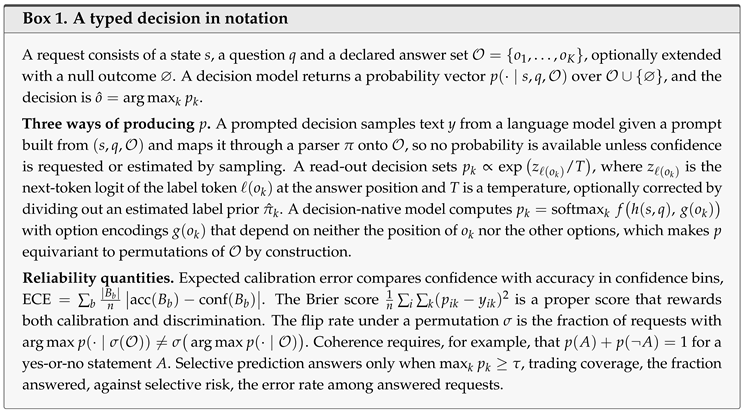
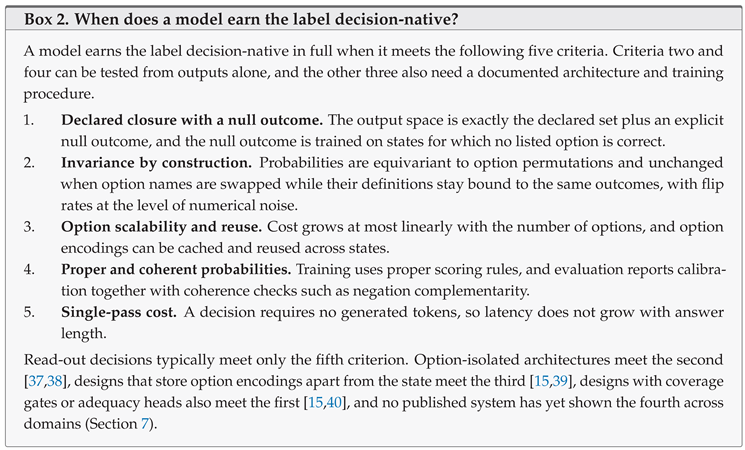
Terminology in this emerging area remains inconsistent across vendor posts, technical reports and early surveys [12,32], where labels such as System One model, decision model, typed decision model and decision-native model are often used interchangeably. In practice, several open releases marketed as decision models simply read option-letter or identifier-token probabilities from instruction-tuned backbones, with or without brief adaptation [13,36], and Tang and Zheng [25] found no independent accuracy gain for typed interfaces once compared against matched label-probability readouts. Throughout this paper, we classify those logit-extraction recipes as read-out decisions and reserve the term decision-native for architectures whose scoring head is structured directly around the declared option set. Box 2 formalizes five falsifiable criteria for full decision-native status, grounded in the observable metrics of Box 1. Because no existing system satisfies all five simultaneously, these criteria serve as an analytical yardstick across Section 6.
3. A Design Space for Typed Decisions
The review is organized in three parts that mirror its title (Figure 2). The first part concerns architectures and asks where the decision is computed. Prompted decisions compute it in generated text, read-out decisions compute it in the next-token distribution of a general model, and decision-native models compute it in a dedicated readout over the declared options. The second part concerns reliability and asks whether the resulting probabilities can be trusted, first in terms of calibration, confidence and abstention and then in terms of invariance, bias and adversarial robustness. The third part concerns challenges that appear once decisions are composed into routers, guardrails, judges and agent loops, together with the evaluation practices, maturity and governance questions that follow.
The three architectural generations form an escalation in which each fixes the main limitation of its predecessor and leaves a new one behind. Prompted decisions are flexible but provide no native probability and pay for every generated token. Read-out decisions provide a probability in one pass, yet the answer token attends to the whole option list, so the probability depends on option order and label names, the null outcome has to be simulated, and every new option set requires a fresh pass over the state. Decision-native models remove those dependencies by construction, and they hand on a subtler problem, because a structurally clean probability is not necessarily a calibrated, coherent or robust one, and a correct local decision is not necessarily a correct system decision. The reliability and challenges parts take up exactly that inheritance.
Table 1 maps representative systems across six dimensions covering architectural generation, readout location, option-order handling, null-outcome support, probability training objective and forward passes per decision. Across the table, order sensitivity progresses from unaddressed bias through post-hoc prior correction to architectural invariance, avoiding the multi-pass overhead of permutation averaging. Explicit null outcomes, by contrast, remain uncommon; most deployed designs still threshold top-label confidence or defer uncertain cases to a larger model. Meanwhile, although recent decision-native models increasingly adopt proper scoring rules, widely deployed guardrails, judges and routers still rely on uncalibrated token probabilities read directly from instruction-tuned backbones.
4. Prompted Decisions
Prompting a generative language model and parsing its text output remains the most accessible baseline for closed-set decisions. Because the prompt simply lists candidate options and lets the model emit free text before a post-processor maps the reply back onto the declared set, this generate-then-parse workflow works over any text API and permits chain-of-thought deliberation prior to commitment. For that reason, it continues to serve as the default setup across deployed pipelines and evaluation suites against which newer decision interfaces measure their gains.
Underlying this approach is the assumption that a model’s written response faithfully reflects an internal choice. Empirical work quickly complicated that picture by showing how strongly prompt structure steers the outcome. Presenting options jointly under letter labels outperformed scoring each candidate separately as a cloze completion, though only for models that bind letter symbols to option text reliably, an ability that depended on code or preference training as well as on scale [9]. Where candidate options have blurry boundaries, zero-shot accuracy of gpt-3.5-turbo fell from 94% to 33% as option counts grew from two to sixty, and two-stage candidate pruning followed by pairwise contrastive reasoning improved accuracy substantially [52]. Allowing reasoning traces before selection introduces a further confounder, as reasoning-tuned models exploit contrastive cues among the listed options and lose much of their edge when the identical questions are posed in open-ended form [53].
Mapping generated prose back to an option also introduces systematic measurement error. In instruction-tuned models, the top first-token prediction disagrees with the final written choice on over half of test items in some tasks, driven by conversational preambles and safety refusals [54]. Although full-text answers are less sensitive than first-token logits to option shuffling and added distractors [55], extracting those answers reliably requires a learned parser, and heuristic extractors diverge from human annotators in ways that systematically underestimate models answering in free form [56]. Nor does free-text generation yield a native probability over options [57]. Numerical confidence elicited in words tends to be overconfident [21] and, even where it beats token probabilities, varies with prompt format [20], whereas estimating uncertainty via multi-sample agreement multiplies token budgets [58,59].
Autoregressive decoding imposes an equally steep latency and cost penalty. Emitting a structured response token by token typically takes hundreds of milliseconds to several seconds, whereas a single prefill pass over a short context completes in tens of milliseconds [32]. In empirical comparisons, single-token readouts answered ten batched speech attributes in 92 milliseconds compared with 1.57 seconds for JSON decoding [60]. Similarly, two of three hosted generative endpoints met a one-second radio-access control budget on only 17.9% and 0% of calls, although the third and a self-hosted JSON decoder met it on at least 97.4% [61], and generative rubric judges cost 16 to 357 times as much as dedicated decision models [62]. Constrained grammar decoding on small models largely eliminates syntax errors at low cost [63], yet syntactic validity neither calibrates probabilities nor improves decision quality. Together, missing native probabilities and per-token decoding overhead motivated reading decisions directly from next-token logits.
5. Read-Out Decisions
Instead of generating answer text, read-out methods extract option probabilities directly from the next-token distribution at the answer position after encoding the state, question and candidate options. Work in this second generation rests on the premise that pretrained language models already represent closed-set answers in their output logits, leaving verbalizer selection, prior debiasing and lightweight adaptation as the primary engineering levers. Over the past six years, that premise has held up remarkably well.
5.1. From Cloze Prompts to Option Scoring
Early read-out methods grew out of masked language models. In PET, Schick and Schutze [7] paired cloze templates with single-token verbalizers and self-training to surpass supervised baselines from a handful of examples. Subsequent work automated template and verbalizer search alongside demonstration selection [8], expanded label mappings through external knowledge bases [64] and eventually replaced discrete label words with learned prototype vectors [65]. Normalization rules matured alongside verbalizer design. Dividing candidate likelihoods by unconditional domain priors mitigated surface-form competition among synonymous completions [66], while distribution-similarity scaling refined neutral-context debiasing for free-form choices [67] and noisy-channel scoring of inputs conditioned on labels reduced variance and lifted worst-case accuracy [41]. Framing diverse tasks as multiple choice with option-mask prediction enabled UniMC, a 235-million-parameter model trained on multiple-choice corpora, to outperform zero-shot generative models hundreds of times larger on unseen comprehension benchmarks, even though accuracy collapsed toward chance without that task-format pretraining [42]. A universal discriminator that scores each input-option concatenation likewise beat generative prompting across three parameter scales [68], and compact models remain surprisingly competitive on zero-shot classification tasks where parameter count correlates weakly with accuracy [69]. Despite correcting surface-form competition and unconditional priors, joint option prompts still left answers sensitive to option order and label symbols, setting up the permutation failures examined in Section 8.
5.2. Correcting the Prior
Because raw next-token distributions systematically favour certain label words, positions and lexical forms, a substantial literature estimates and divides out those biases without task supervision. Contextual calibration equalizes label probabilities on content-free inputs, lifting few-shot accuracy by up to 30 percentage points [10]. Follow-up estimators fit Gaussian mixtures over unlabeled predictions [70], sample random in-domain words to isolate domain-specific label priors [71], match label marginals via Monte Carlo input sampling [72], marginalize predictions across inference batches [73] or estimate biases directly from in-context demonstrations through leave-one-out scoring [74]. In multiple-choice settings, PriDe estimates option-letter priors from a small unlabeled subset to strip out symbol preference [18], while order-preserving swap calibration adapts a related correction to pairwise LLM judges [75]. Combining these ideas, AnyJev pairs prior division with cyclic option rotations and temperature scaling on frozen backbones [46].
Underlying all of these corrections is the assumption that readout bias behaves as a static additive or multiplicative offset recoverable from content-free inputs or small unlabeled samples. Where that assumption breaks down, performance plateaus. Content-free baselines struggle on multi-sentence relational tasks such as natural language inference [73], and priors fitted on one domain transfer reasonably but lose some accuracy across large domain gaps [18]. Residual label bias often survives both prior calibration and low-rank fine-tuning [74]. AnyJev shows how much the benefit depends on the setting: its option rotations cut order-flip rates from about 0.33 to 0.14–0.18 and raised accuracy on two 20-option tasks, yet did not measurably change accuracy on a public decision benchmark with two to six options per item [46].
5.3. Adapting the Readout
Where labeled training examples exist, supervising the readout layer directly yields strong classifiers. Replacing causal instruction tuning with a classification head over final-layer decoder states in LS-LLaMA beat both generative fine-tuning and bidirectional encoders [43], while single-pass joint encoding of text and candidate labels in GLiClass matched cross-encoder accuracy at a fraction of the compute [45]. Other supervised adaptations incorporate subset-conditioned unknown tokens for out-of-distribution rejection [76] or fine-tune backbones explicitly for class-probability quality [77]. Parallel findings hold in multimodal settings, where apparent classification deficits of multimodal large language models largely trace back to label noise and evaluation artefacts [78], and a zero-shot 27B listwise label-logit readout comes within 1.6 points of a dedicated 8B multimodal reranker [79]. Consequently, for fixed label taxonomies with moderate training data, supervised classifiers consistently outperform zero-shot decision models under matched evaluation [80,81]. Whereas traditional classification heads require retraining whenever the label set changes, joint text-label encoders preserve open-vocabulary flexibility at inference time [45].
Perhaps the sharpest empirical lesson from recent replications is how closely adapted open read-outs match commercial decision models. In Geuter et al. [13], temperature-scaled letter-logit readouts from open instruction-tuned models matched Jev without fine-tuning, and a few hundred steps of low-rank adaptation with a language-model-initialized decision head surpassed it. Scoring bracketed option suffixes likewise turned frozen backbones into strong decision models, with fine-tuning mainly aiding smaller models or specialist domains when regularized toward the base distribution [36]. Self-distilling reasoning traces into single-pass first-token predictions matched Jev’s accuracy at lower calibration error [16]. Elsewhere, schema-conditioned first-token scoring in SearchJev accelerated and calibrated search-agent decisions [48], and single-token answer supervision enabled batched paralinguistic speech judgments unavailable from text transcripts [60]. Controlled ablations reinforce the same point. Visual Jev found no consistent gain from a specialized typed head over standard answer-token supervision [82], corroborating the cross-study review of Tang and Zheng [25] that typed interfaces confer no standalone accuracy boost over matched label-logit readouts.
Read-out designs thus capture nearly all of the accuracy and much of the speed credited to dedicated decision models, while leaving three structural bottlenecks unresolved. Because the answer token attends jointly across the concatenated option prompt, probabilities remain vulnerable to option ordering and symbol choice (Section 8). Simulating abstention via an extra text option degrades both accuracy and calibration [11], and changing the candidate set forces a full re-encoding of the state. Addressing those structural couplings requires redesigning the readout architecture itself.
6. Decision-Native Models
Decision-native architectures treat the declared option set as a first-class computational primitive. Jev crystallized the interface in September 2026 by accepting a state alongside a typed question and returning normalized probabilities over declared outcomes without text generation, supporting, according to its documentation, natural-language option selection, binary statements and ordinal scales [12,34]. Drawing on dual-process psychology, Roitman [32] positioned such System One models as fast, low-cost, calibrated counterparts to deliberative generative reasoners. Open-weight families quickly adopted compatible APIs [35], open-source projects integrated Jev for attribute tagging, rubric scoring and action selection [17], and independent benchmarking found that Jev outscored a 27B open model on 27 of 37 zero-shot datasets and a smaller one on all 37 [83]. Figure 3 situates this 2026 wave within the broader trajectory from cloze verbalizers to typed readouts.
6.1. Architectural Primitives
Across recent decision-native proposals, three architectural mechanisms distinguish dedicated designs from token-logit readouts. A first group enforces option isolation through attention masks or factorized memories. Prism-1 scores each candidate inside its own causal attention block at identical positional indices following a shared state prefix, guaranteeing permutation invariance and Luce’s choice axiom by construction [37]. Masked set attention in ufakzeka-karar achieves equivalent order invariance in a compact Turkish backbone [38]. Extending block-masked isolation across multi-question schemas, Antunes et al. [40] serialize trees of typed questions over a single context while attaching an adequacy head for abstention. Jeva goes further by encoding candidate options once into an immutable memory queried by a set-conditioned mixer alongside a separate coverage gate, yielding permutation equivariance, linear scaling in option count and cross-request option caching [15]. In MetaEncoder’s bi-encoder setup, offline caching of candidate embeddings keeps latency nearly constant as option sets grow and prepending the options to the request narrows the closed-set accuracy gap, though cross-encoders retain an accuracy edge across model sizes [39].
A second group replaces vocabulary letter tokens with specialized scoring heads and prefix-sharing layouts. Drex pairs pointer heads over option delimiters and code heads atop a bidirectional multimodal backbone [14], and its pointer models extend the open Kev stack on which the security-focused SecJev model is also built [84]. Decision 1.0 unifies encoder and causal models behind candidate-marker and bilinear heads [35], whereas this-that-model scores designated option-embedding slots with schema-first prefix reuse in roughly 30 milliseconds [50]. Other variants fill masked JSON placeholders in one causal pass in Intern-Decision [49] or attach a span-extraction head to letter-logit readouts for Chinese tasks [85]. Multi-question batching over a shared prefix likewise amortizes prefill cost for multi-decision image queries in Visual Jev [82] and hospital-wide clinical record screening [86]. Each layout trades off what can be cached against which biases remain exposed. Pointer heads encode the state once across multiple questions [14] and schema-first layouts cache fixed schemas across states [50], whereas true cross-state option reuse (Box 2, criterion three) requires decoupled option memories such as Jeva or MetaEncoder [15,39]. Conversely, concatenating options into a single unmasked sequence retains positional sensitivity unless mitigated during training, and prefix batching reduces compute without improving probability calibration.
A third group introduces adaptive test-time compute for harder inputs. SanSi attaches a typed readout to every iteration of a looped transformer backbone, gaining 13.5 accuracy points at fixed parameter count [51]. Related hybrids trigger chain-of-thought deliberation only when fast-readout confidence falls low [87] or add a value-of-information head that selects which missing input field to query next [88]. Spending extra passes erodes the System One speed advantage, however; in SanSi, inference cost multiplied across loops while probability calibration worsened after early iterations [51].
6.2. Training Objectives and Data
Optimization recipes shape probability quality at least as strongly as readout geometry. Jev popularized a training method termed reinforcement learning for calibrated decisions [12], which several open efforts adopted [85,87]. Controlled ablations nonetheless favour classical proper scoring rules. In ufakzeka-karar, standard cross-entropy outperformed a REINFORCE objective by over 10 macro-F1 points [38]; narrow decision models are trained directly with proper scoring rules [40], and unbiased estimators extend proper scoring to partial-feedback logs where only a single outcome is observed [50]. Permutation-consistency losses further curb order flips, with a lightweight reinforcement stage adding modest benchmark gains after supervised fine-tuning in Drex [14], while self-distilling post-reasoning answers into first-token readouts transfers the weighing of options but not multi-step computation [16]. Even so, training data composition dominates architectural tweaks. Soft teacher logits distilled across millions of hospital question-answer pairs allowed a compact clinical decision model to beat larger open baselines on local cohorts [86]. Similarly, curated domain corpora allowed a sub-billion-parameter model in SecJev to outperform a general model ten times larger [84], and iterative data-model co-evolution brought small models up to parity with much larger baselines on targeted workflows [89].
6.3. What Decision-Native Designs Deliver
Setting author claims alongside independent evaluations in Table 2 separates durable architectural wins from over-interpreted benchmark scores. Two advantages hold consistently. First, option-isolated architectures such as Prism-1, Jeva and ufakzeka-karar eliminate permutation flips down to numerical precision, whereas trained letter-logit baselines still flip on several percent of shuffled inputs [15,37,38]. Second, avoiding token generation cuts latency and serving cost by factors of roughly five to several hundred over autoregressive models (Figure 4a). Task accuracy tells a more sobering story. Order-invariant heads tie statistically with standard fine-tuned readouts [37], open releases such as Drex and Decision 1.0 trade wins and losses with Jev depending on model size and benchmark suite [14,35], and controlled comparisons reveal no intrinsic accuracy advantage from typed heads alone [25]. Across specialist domains, single-pass decision models trail the best generative LLMs by three or more points in medicine, finance and law [16], lag substantially on multi-step mathematics [50,90], struggle on quantitative clinical inputs relative to narrative notes [91] and require bespoke feature engineering to approach generative models on cancer staging [92]. Single-pass forward computation imposes an inherent representational ceiling. For instance, Jev aced counterintuitive cognitive reflection puzzles yet picked the lure in 53–71% of one-shot matrix games where the surface payoff shortcut points away from the equilibrium [93], and top-performing fast models committed most of their action errors despite answering every measured fact about the state correctly [94]. Decision-native models therefore excel as fast, structurally invariant state readers whose accuracy stops where multi-step simulation begins, and whose probability reliability must still be verified empirically.
7. Calibration, Confidence and Abstention
Fixing the candidate set in advance turns model outputs into testable probability forecasts. Once every admissible outcome is declared, predicted probabilities can be checked against empirical frequencies, scored under proper rules such as the Brier score and compared against operational thresholds to govern automation versus deferral (Box 1). Here we examine how well typed probabilities satisfy calibration and coherence, how alternative confidence signals compare in cost and fidelity, and why calibrated scores alone rarely suffice for reliable abstention.
7.1. How Calibrated Are Typed Probabilities
Before instruction-tuned chat models dominated, fine-tuned bidirectional encoders generally produced well-behaved in-domain probabilities that temperature scaling improved further, while label smoothing helped mainly out of domain [95,96], whereas generative question-answering models tended toward marked overconfidence [97]. Kadavath et al. [11] subsequently showed that large pretrained language models yield well-calibrated probabilities on properly formatted multiple-choice and true-or-false items, and that their estimated probability of correctness separates true from false generations, though imperfectly and unevenly across tasks. Subsequent studies tempered that optimism along three fronts. First, post-training for instruction following and chat degrades base-model calibration, partly by inducing an ownership bias toward a model’s own sampled answers [98,99]. Reinforcement learning from verifiable rewards similarly drives mean confidence toward 1.0 unless reasoning and confidence objectives are decoupled [100], while continued training steadily inflates confidence even on wrong predictions [101]. Second, although maximum softmax probabilities in chat models remain miscalibrated in absolute terms, they retain strong rank discrimination that tracks task accuracy [102]; numerical prompts represent a sharp exception where lexical and positional preferences override stated quantitative odds [103]. Third, standard metrics can mislead at high accuracy, where expected calibration error and Brier scores favour overconfident transformers whose apparent advantage disappears once correct and incorrect predictions are weighted equally within confidence bins [104].
Dedicated decision models substantially reduce marginal calibration error on standard closed-set benchmarks. Evaluating Jev across 37 zero-shot datasets, Deuer et al. [83] measured a pooled choice ECE of 0.028 compared with 0.063 and 0.208 for two open instruction-tuned baselines. An open 27B self-distilled decision model reached 0.0149 ECE on the bilingual JEVal suite [16], and domain distillation halved calibration error on clinician-annotated hospital benchmarks [86]. Away from curated multiple-choice suites, however, calibration error spans more than an order of magnitude (Figure 4b). Median ECE rose to 0.157 on computational social-science coding [105] and 0.168 on zero-shot alignment-failure detection with Jev [106], while pooled ECE reached 0.541 on prompt-injection screening [107]. Question phrasing introduces systematic directional shifts as well. Binary prompts in Jev leaned slightly underconfident whereas multi-label queries over-predicted positive labels [83], synthetic policy evaluations on TypedBench documented persistent underconfidence [108], and latent-variable modeling on Sys1Cal-v1 indicated that Jev suppresses internal uncertainty mass when forced onto declared choices [109]. Even low marginal ECE leaves logical coherence unaddressed. In Li et al. [110], a typed decision model violated negation complementarity at roughly five times its repeat-sampling noise floor and produced single-choice probabilities summing above 1.0. Post-hoc temperature scaling usually trims marginal ECE for both frozen open backbones and decision-native releases [46,49], yet a scalar temperature cannot reconcile contradictory probabilities across logically related queries.
7.2. Eliciting Confidence
Practitioners can read decision confidence from output logits, verbalized self-reports, multi-sample agreement or internal hidden states, with sharp trade-offs in access requirements and inference cost. Following reinforcement learning from human feedback, verbalized numerical confidence sometimes beat raw token probabilities [20], especially when models were explicitly fine-tuned to state uncertainty in words [111]. Out of the box, however, verbalized numbers cluster near high multiples of 5% and swing widely with prompt wording [21,112]. Correlation between stated confidence and internal token likelihoods remains modest in frontier models [113] and is weak on individual items, while instruction-tuned models show no association even across setting-level averages [114]. Verbal hedges often outperform both raw logits and numeric self-scores [115], explicit reasoning traces improve verbal calibration [116], and proper-scoring fine-tuning can directly calibrate stated probabilities [117,118]. At a mechanistic level, interpretability studies show that models compute and cache verbal confidence signals while generating the answer [119], rely on a sparse circuit that inflates stated certainty [120] and align reported confidence more closely with subsequent behavioural commitment than with factual accuracy [121].
When logits and weights are inaccessible, black-box ensembles estimate uncertainty from output variation. Cross-prompt agreement consistently beats single-prompt log likelihood [58], answer diversity across repeated samples outperforms self-verification on ambiguous queries [122] and consistency metrics top both logit and verbal baselines across open and proprietary APIs [59]. Related black-box strategies elicit single-pass confidence intervals over options with minimal gap between open and closed models [123], factor uncertainty into query ambiguity versus answer fidelity [124], rely on few-shot prompting for out-of-distribution calibration [125] or measure agreement among repeatedly sampled diagnoses and treatments for the same patient scenario [126]. Every multi-sample scheme nonetheless multiplies latency and token spend. Where internal states are exposed, white-box readouts avoid that overhead entirely. Linear or lightweight heads on hidden activations separate true from false facts better than other confidence estimators [127] and yield higher downstream decision utility [128]. Unsupervised base-model signals can also recalibrate post-trained chat derivatives [129], layer-aggregated self-evaluations flag queries beyond the model’s knowledge boundary in one forward pass [130] and group multicalibration sharpens subgroup reliability [131]. In typed decision workflows, cost considerations set a clear operational hierarchy. Output probabilities from a decision head or label token arrive at zero marginal cost and, on computational social-science annotation, calibrated better in Jev than verbalized scores in 16 of 19 general language models [105]. Classifiers on hidden states offer a cheap upgrade when model internals are open, leaving multi-sample consistency for closed text-only endpoints.
7.3. From Confidence to Abstention
Turning a probability vector into a safe action policy requires deciding when not to answer. Both selective prediction and conformal risk control rely on confidence scores that rank correct predictions ahead of errors alongside calibration samples representative of live traffic, trading away coverage whenever stricter error bounds are demanded [80,132]. Learned selection heads more than doubled visual question-answering coverage at 1% risk relative to naive softmax cutoffs [133], while fine-tuned self-evaluation strengthened abstention in question answering [134], prompted self-evaluation did so in question answering and summarization [135], and input-perturbation sensitivity did so for few-shot text classification [136]. Finite-sample conformal wrappers provide formal coverage or false-discovery guarantees over multiple-choice prediction sets [137,138,139] and accepted single answers [132], while binning-based recalibration gives distribution-free calibration guarantees within question-answer groups [140]. Complementary interventions either prompt models to follow the context under context-memory conflict and to abstain when it lacks the answer [141] or use clarification-aware reinforcement learning so compact models abstain and request missing details [142].
Well-calibrated probabilities still fail to produce rational abstention automatically. When error penalties varied across three orders of magnitude in Wang et al. [143], language models left both their stated confidence and their refusal rates essentially unchanged, whereas applying a post-hoc decision-theoretic threshold recovered large utility gains. Behavioural and steering experiments show that GPT-4o abstains around an implicit confidence threshold near 77% and that steering confidence in Gemma 3 27B causally shifts abstention [144]. Thresholds stated in the prompt do move abstention, but models trade them off against their own confidence at model-specific rates instead of applying them as written. Refusal on unanswerable inputs also fails to improve with model scale and actively worsens after reasoning-oriented post-training on AbstentionBench [145]. Elsewhere, abstention fluctuates when the gold context is removed, replaced with irrelevant passages or padded with extra text [146] and nearly vanishes in clinical decision support even when an explicit abstain choice is listed [147]. Listing such an option raises abstention more than any other intervention tested, yet models still miss most cases that call for it [148]. Consequently, hallucination-penalized knowledge evaluations score nearly every frontier model below zero [149], echoing widespread decision-theoretic overconfidence on factual queries [150]. Crucially, Wagner [151] demonstrate that epistemic correctness and question answerability form distinct axes; output probabilities track correctness while hidden states encode answerability, enabling a two-threshold policy to certify far more coverage than a single answer-confidence threshold. Broader reviews of refusal and uncertainty reach aligned conclusions [26,27,28].
7.4. What Typed Probabilities Cannot Be Used for
As typed interfaces spread into applied pipelines, several recurring misinterpretations of their output probabilities warrant explicit caution. Above all, an off-the-shelf option probability does not estimate population-level event risk without outcome-specific recalibration. When a clinical decision model was transferred to external intensive-care and emergency cohorts, its outcome forecasts needed a separate log-odds shift per outcome before they could be read as absolute risks [86], and raw language-model token likelihoods fail as pre-test diagnostic probabilities [152]. Operating thresholds likewise fail to transfer across tasks; in Guo et al. [106], a single generic alignment prompt ranked failures well across datasets via Jev yet suffered incompatible calibration curves on each. Nor does high model certainty validate construct measurement, given that Jev emitted confident labels on empathy coding while performing near chance [105]. Aggregate ECE can similarly mask pockets of high-confidence errors concentrated within specific adversarial subgroups [153], and under asymmetric error costs, thresholding a systematically underconfident distribution can yield lower utility than simply taking the argmax choice [108]. Human-in-the-loop workflows face a final trap because readers over-trust default model explanations, and longer ones even more; aligning the uncertainty language in those explanations with the model’s internal confidence narrows this gap substantially but does not close it [154]. Before automating any gate around a probability cutoff, teams must therefore validate construct validity, subgroup calibration and cost-weighted utility on deployment-representative data.
8. Invariance, Bias and Adversarial Robustness
Ideally, a typed decision depends solely on the input state and the semantic content of the declared options. Empirical stress tests reveal three persistent departures from that ideal, as predictions shift under option permutation and relabeling, replicate human framing heuristics and succumb to black-box adversarial manipulation.
8.1. Order, Symbol and Label Sensitivity
Option-order sensitivity pervades non-isolated language-model readouts. Permuting candidate choices swung accuracy by 13 to 75 percentage points in early instruction-tuned models [19] and drove open models below random guessing under adversarial orderings [155]. Far from disappearing with scale, positional bias persists in recent text backbones [156,157], cross-lingual benchmarks [158], vision-language models [159,160], audio-language leaderboards where shuffling alters model rankings [161] and survey simulations skewed toward recency [162]. Positional pull even interacts with candidate plausibility, shifting from primacy among strong contenders to recency among weak distractors [163], and explicitly informing the model that options were randomized fails to neutralize prompt-layout bias [164]. Circuit-level analyses trace the bulk of this behaviour to specific attention heads. In a 70B transformer, a small set of heads that map the correct answer to its letter partly encodes each option’s position in the enumeration [165], mirroring positional anchoring circuits identified in smaller models [166] and mid-layer heads specialized for option letters [167]. Consistent with those circuits, Zheng et al. [18] showed that prior preference over option-identifier tokens is a primary cause of selection bias, which shrinks markedly, though not for every model, when identifiers are stripped. Option lists alone also leak task signals, allowing models to exceed chance without seeing the question stem [168].
Debiasing strategies trade inference budget against structural guarantees. Post-hoc methods divide out estimated identifier priors as in PriDe [18,159], intervene on symbol-attending heads [167] or average predictions across cyclic shifts in AnyJev, halving flip rates on frozen backbones at the cost of K prefill passes [46]. Exhaustive permutation voting eliminates order dependence only at factorial cost [161], whereas Runoff’s two-stage pointwise screening and cross-position comparison achieves exact invariance far more cheaply [47]. Within decision-native architectures (Section 6), block-isolated attention and decoupled option memories in Prism-1, ufakzeka-karar and Jeva enforce exact invariance in a single pass [15,37,38], whereas training-time consistency regularizers merely dampen flip rates [14]. Off-the-shelf deployments consequently diverge sharply; reversing the option order flipped nearly a third of decisions in one open decision model compared with under 2% in Jev [169].
Binding option names to their accompanying definitions exposes an equally severe fragility. Across several open typed decision models, Azizi et al. [170] found that surface option names dictated predictions to the point that deleting option definitions altogether left benchmark accuracy intact. Counter-intuitively swapping yes and no labels while keeping definitions fixed increased decision flips by up to 70 percentage points over neutral identifiers and inverted score rankings [171]; under a similar yes-no label swap, Jev flipped roughly half of its verdicts whereas four fine-tuned decoder-based decision checkpoints flipped at most 6.5% [80]. Because prompt serialization of option names caused the failure in open models, omitting surface names restored invariance [170]. Ordered rating scales suffer analogous distortions. Direct-readout models concentrate their final decisions onto fewer scale points as granularity increases, while for most models average candidate probabilities stay broad [172], and altering scale bounds, polarity or numeric formatting shifts normalized ratings by roughly 10% [173].
8.2. Cognitive and Social Biases
Proponents often argue that constraining outputs to declared choices yields more rational behaviour than free-text generation, yet probability distributions tell a subtler story. In a dedicated case study of Jev, Imperatrice et al. [174] observed near-perfect, high-confidence accuracy on classic cognitive reflection items alongside 100% failure on modified conjunction-fallacy problems and conjunction-rule violations across more than half of 15,000 trials. Even when Jev’s argmax choice stayed stable, irrelevant numerical anchors, framing shifts and option permutations perturbed its returned probabilities. That pattern echoes findings in general language models, where evaluations find evidence of all thirty tested human cognitive biases in at least some of twenty models [175], framing and group-attribution skews in admissions scenarios [176] and demographic-independent name preferences [163]. Affective register skews typed judges as well; rewriting a stronger candidate response in an emotional tone dragged a representative decision model’s pairwise accuracy down from 99% to 42% despite solid marginal calibration [177]. Controlled theory-of-mind tests on Jev-ToM likewise showed Jev’s apparent lead over a general language model reversing once native structural controls were stripped [178].
8.3. Adversarial Pressure on the Typed Interface
Restricting outputs to a finite option set closes off classic free-text jailbreak completions. Because the model cannot emit arbitrary prose, standard prompt-injection templates flipped none of Jev’s correct predictions across 10,240 paired tests [179], and injected instructions typically shifted probability margins without overtaking the top action [180]. Once attackers optimize directly against the typed readout, however, that resilience erodes quickly. In FlipJev, inexpensive black-box evolutionary search discovered universal adversarial suffixes that flipped 43% of held-out documents [179]. Black-box perturbations on JevAdvBench flipped nearly half of Jev’s correct answers and 34% to 52% of the correct decisions of eight open decision models [181], while targeted injections achieved 100% hijack success on a simulated subscription-cancellation workflow [182]. Multimodal evaluations on DecisionRobust show that attacks also hit held-out decision models, although optimized image perturbations transfer weakly and label-consistency checks remove much of the apparent attack success [183].
Crucially, attackers often need not fool the core decision model at all. Compromising the surrounding adapters that extract the state, generate the question or interpret the returned answer flipped final decisions in almost every targeted case of three small synthetic studies, even while the underlying decision model answered its local query accurately [184]. Relabeling a permissive option bypassed agent safety gates nearly 100% of the time in label-rendering architectures [185], and stripping an unverified-source tag from an authorization snippet boosted monitor approval of unsafe actions from single-digit percentages past 50% [186]. Training-time and serving-time vectors compound these interface risks. Poisoning 5% to 10% of training records planted trigger-activated backdoors in a local open decision model and left clean accuracy largely intact [182], while low-bit weight quantization shrinks and shifts decision margins in a predictable way, so that even strong full-precision preferences can flip and some kinds of decisions, such as whether to call a tool, break before others [187]. Instead of eliminating attack surface, typed interfaces shift adversarial pressure onto option labels, state serialization and surrounding adapters, meaning security reviews must evaluate the full decision pipeline end to end.
9. Decisions Inside Systems
In production software, typed decisions rarely stand alone as final user-facing outputs. Instead, downstream components consume them to select a model from a serving pool, block or permit a prompt or tool invocation, score candidate responses or choose an agent’s next step. Because errors at any of these gates propagate through surrounding logic in ways invisible to single-question benchmarks, we examine those four system roles in turn before synthesizing the failure modes they share.
9.1. Routing and Cascades
Model routing frames selection over a candidate pool as a closed-set decision. Sequential cascades invoke an inexpensive model first and escalate uncertain cases using consistency across reasoning formats [188], a separately trained DistilBERT answer scorer in FrugalGPT [2], few-shot self-verification inside a partially observable controller [189], token-level uncertainty quantiles [190] or first-token probability margins [191]. Predictive routers avoid running the cheap model altogether by choosing upfront from preference-trained query embeddings in RouteLLM [1], quality-gap classifiers [192], dual contrastive encoders [193] or distilled reward scores [194]. Other upfront selectors train benchmark correctness predictors [195], compact model embeddings [196], item-response formulations [197] or online contextual bandits [198,199]. More recent designs generalize to unseen candidate models [200], unify upfront routing with sequential cascading [201] and allocate adaptive best-of-n sampling budgets [202]. Beyond static model pools, typed routers arbitrate across retrieval-augmented pipelines [203], parametric memory versus external search [204], large skill libraries where omitting skill bodies cost roughly 40 accuracy points [205], multi-agent role assignments [206] and multi-turn routing policies [207,208].
Internal confidence signals offer a middle path between query-only prediction and multi-sample cascades. Several methods read uncertainty from the candidate model itself via dedicated confidence tokens [209], on-device uncertainty estimators ranging from perplexity to trained hidden-state classifiers [210], calibrated step-level logits [211], conformal prediction-set sizes [212] or the small model’s own softmax confidence after correctness-aware fine-tuning [213]. Others score external or trajectory-level features using separate prefill-activation encoders [214], partial agent trajectories [215], unsupervised embedding agreement [216] or lightweight prompt encoders [217]. Each signal family carries a distinct cost-staleness profile. Query embeddings decide before generation at minimal latency, supervised correctness predictors go stale whenever the serving pool changes, and self-confidence cascades pay for at least one cheap forward pass while failing wherever the small model is confidently wrong.
Every router nevertheless depends on predicting per-query model correctness accurately enough to beat a single strong baseline, an assumption that standardized evaluations repeatedly challenge. Across RouterBench, RouterEval, LLMRouterBench and RouterArena, diverse routing algorithms cluster tightly, several underperform the best individual model and all trail the oracle selector by wide margins due to poor recall [22,218,219,220]. A unified routing toolkit likewise finds that no single router dominates across tasks, although its learned routers improve on the strongest fixed model by 14.6% [221]. Out-of-distribution generalization of benchmark-trained correctness predictors remains weak [195], estimator fidelity outweighs pool diversity [201], and single-sample correctness targets flip on a majority of items across repeated decodings [222]. Correlated errors impose a hard ceiling as well. Analyzing 67 models, Chen [223] found that all models fail together more often than pairwise correlations predict, by about 2.5 times on open-ended mathematics, and a learned router over 15 models captured almost none of the modest oracle gain because queries revealed little about which model would be right. Controlled cost-matched testing by Wang et al. [224] similarly showed that no commercial router beat random selection between two well-chosen models at matched cost, that some trailed it by more than 10 points, and that routers largely ignored item difficulty. Routing gates also introduce adversarial cost risk, as short query-agnostic prefixes can force arbitrary traffic onto the most expensive endpoint [225,226]. Although conformal risk wrappers [227] and taxonomic syntheses [29] clarify these trade-offs, per-query correctness estimation remains the bottleneck.
9.2. Guardrails as Typed Classifiers
Content moderation adopted the typed-decision pattern when Llama Guard cast policy screening as instruction-tuned classification and read safe-versus-unsafe token probabilities as continuous risk scores [3]. Subsequent external guardrails broadened training corpora and readout coverage. Multi-task suites such as WildGuard, Aegis and Granite Guardian jointly supervise prompt harm, response harm and refusal detection across human and synthetic examples [228,229,230,231,232], while multilingual extensions [233,234], vision-language moderators [235,236] widen modality and language scope, and ShieldGemma reads yes-no token probabilities from a model trained on adversarial synthetic data [237]. A second branch embeds the classifier directly inside the target generator via decoding-time heads in ShieldHead [44], selected intermediate layers [238], safety-parameter gradients [239], inline self-tags [240] or thresholded refusal tokens [241]. A third branch layers explicit structure or deliberation onto classification through retrieval-augmented kNN evidence [242], probabilistic logic over policy categories [243], harm-benefit trees [244] and distilled or explicit reasoning traces [245,246]. Calibrated continuous scores allow one model to serve multiple policy tolerances [247], erase-and-check certificates bound adversarial suffix length [248] and step-level monitors screen agent tool calls [4,249]. Whereas internal heads save a separate prefill pass, standalone guards can be patched independently of the protected generator; both remain vulnerable to the interface attacks of Section 8.
Empirical stress tests paint a sobering picture of guardrail reliability. Dedicated safety classifiers tend to be overconfident, with even the best-calibrated guards exceeding 10% average ECE on public benchmarks and far worse miscalibration under jailbreak pressure [250]. A general instruction-tuned model is competitive with purpose-built guards on GuardBench [23] and general backbones frequently beat them on multi-step tool trajectories in TraceSafe-Bench [251], while lightweight encoders rival heavy language-model defences under distribution shift [252]. Red-teaming exploits mismatches between what the filter reads and what the generator executes. Structural bypasses propagate universal prefixes past the guard [253], split payloads across context-window chunks [254] or stage attacks across pipeline components [255]. Content-level bypasses rely on benign style rewrites that inflate false negatives [256], obfuscated intent [257], visually legible adversarial images [258] and moderation-evading fine-tuning sets [259]. Repurposing typed decision models as guards reproduces those fragilities alongside calibration transfer failures. In Guo et al. [106], querying Jev with one zero-shot alignment question ranked failures competitively at low cost, yet decision thresholds failed to generalize across datasets. On prompt-injection screening, ECE exceeded 0.50 and holding false negatives low forced deferral on over 90% of traffic [107]. Controlled adversarial testing in Li et al. [260] showed that forged structured inputs never bypassed Jev’s decisions on rule-based input moderation, yet the same forgeries let 19% to 29% of the phishing emails it had flagged evade detection; elsewhere, high-confidence misses clustered in attack slices [153] and renaming the allow label or appending benign log lines opened agent gates [185]. Although security-domain training in SecJev raises detection accuracy [84], large-scale production validation thus far rests almost entirely on heavily red-teamed classifier cascades [261,262], reinforcing calls to pair statistical filters with formal verification [30].
9.3. Judges and Scorers
Automated evaluation converged on typed readouts once researchers replaced greedy score generation with expectation over score-token probabilities. Probability-weighted rubric scoring in G-Eval improved human correlation on text generation [5], text-anchored discrete levels strengthened visual quality assessment [263] and multi-level relevance tokens sharpened zero-shot passage ranking [264]. Taking the mean of the score distribution consistently outperforms taking its mode across pointwise, pairwise and listwise protocols [265], aggregating logits across intermediate layers beats final-layer readouts [266] and distribution-aware tie handling curbs pairwise transitivity violations [267]. Along a complementary axis, rubric-tuned open evaluators such as Prometheus and Prometheus 2 narrow the gap to proprietary judges [24,268], lightweight calibration networks map rubric vectors to individual human raters [269] and decomposed Boolean checklists boost inter-judge agreement [270]. Selective-prediction wrappers now attach statistical guarantees to judge outputs through risk-bounded escalation to stronger judges [271], conformal rating intervals [272] and conformal pairwise risk control [273], while lightweight linear classifiers over judge activations supply calibrated confidence without a formal guarantee [274]. Because nearly all judge benchmarks measure correlation on static human-annotated responses, however, high leaderboard agreement reveals little about robustness when candidate systems optimize directly against the judge.
Deployed judges remain exposed on two fronts. First, rubric and pairwise scores suffer persistent cognitive and adversarial biases, favouring familiar low-perplexity text, clustering on round-number scores, anchoring later attribute ratings on earlier ones [275] and changing assigned categories on roughly 20% of texts when one element of the rating-scale design (format, range or sign) is altered [173]. Positional preferences likewise skew pairwise verdicts unless mitigated via split-and-merge aggregation [276] or swap-consistent calibration [75], while short universal adversarial strings inflate absolute scores [277]. Typed decision models inherit much of that vulnerability, failing three to eight out of twelve standard judge-bias checks despite low latency and repeatable outputs [177]. Second, fallback cascades suffer from shared blind spots. Although decision models matched fast generative rubric judges at a fraction of the compute cost in Rao and Callison-Burch [62], generative judges echoed nearly all of the decision model’s highest-confidence mistakes. Selective escalation in JEV-as-a-Judge still delivers substantial cost reductions [278] and a single three-way support question per decomposed statement correlates moderately with radiologists’ error counts on report factuality [279], yet cascading correlated evaluators reliably saves budget without rescuing shared errors.
9.4. Agents, Tools and Retrieval
Every turn of an agentic workflow poses closed control decisions covering whether to invoke a tool, which tool to select, whether retrieved passages suffice and when to hand control to a stronger model. In tool selection, language models gravitate toward descriptions semantically aligned with the user query and toward tools listed earlier [280]. Deciding whether any tool call is needed proves substantially harder than picking among candidate tools [281], and severe action-class miscalibration often hides beneath strong overall accuracy [282]. Analyses of hidden states indicate that prefill representations already encode many of these control signals; tool necessity is linearly separable prior to decoding [33], attention heads focus on the ground-truth tool even during most selection errors [283] and compact heads over hidden-state trajectories forecast when deferring to a larger model will pay off [284]. Distilling trace-level features into tabular classifiers in TabAgent matched the tool recall of a GPT-5.4 shortlister at about a thousandth of its latency and a hundred-thousandth of its per-call cost, while on routing and gating it only tied a strong fixed default [285].
Motivated by those latency budgets, recent systems slot Jev and open decision models into interactive agent loops for memory management [286,287], mobile GUI execution in Jev-Mobile [288], abstention-aware smart-home control [289] and value-of-information slot querying [88]. Infrastructure-facing deployments similarly apply typed readouts to search-versus-reason gating in SearchJev [48], semantic database filtering [290], edge service orchestration [291] and 6G radio-access control [61]. Whereas component-level benchmarks uniformly report large speedups, closed-loop evaluations paint a far more conditional picture. In a paired evaluation of Jev and one open-weight decision model on 11 harness decision points, Li [169] found Jev more accurate on 9 of them, yet neither model proved dependable for model routing, retrieval gating or privacy screening, and realistic accounting of gate overhead plus base rates shrank advertised savings. Similarly, Zhu et al. [6] found that letting Jev make every tool choice cost an agent 19.0 points of task success, whereas the confidence threshold that JevAgentHarness fits on the agent’s own trajectories cut cost by 14.2% without losing a task when the agent ran on Gemini 3.5 Flash; with Flash-Lite the fitted threshold left every tool choice to the language model and saved nothing. Against a lightweight self-escalating cascade, decision-model gains largely vanished on external benchmarks where ordinary routing was already accurate [281], and consumer-choice benchmarks revealed sharp cross-model instability when agents selected among priced listings [292].
9.5. What Composition Breaks
Stepping across routers, guards, judges and agents exposes three recurring system-level failure mechanisms. First, component-level accuracy fails to compose cleanly. Bounded adversarial substitutions in the adapters around a decision model can invert end-to-end outcomes while every call to the model itself remains locally valid [184], and top-ranked fast models still select wrong actions after reading every relevant state variable accurately [94]. Single-pass models evaluate observable features effectively yet fall back on shallow heuristics whenever choosing requires lookahead simulation; offloading forward simulation to deterministic code while reserving evaluation for Jev recovers most of that gap [93]. Second, correlated failures undermine hierarchical cascades whenever fast gates and slow fallbacks share blind spots [62,223]. Third, operating cutoffs behave as fragile deployment hyperparameters. Applying an uncalibrated 0.5 threshold in JevAgentHarness sacrificed over 20 percentage points of task completion that a validation-fitted cutoff preserved [6], and conformal risk guarantees hold only while live traffic remains exchangeable with calibration logs [132,227]. Evaluating typed decisions purely on static, isolated items therefore misses the failure modes that dominate production systems.
10. Evaluating Typed Decisions
Benchmarking for typed decision models descends directly from multiple-choice question answering, inheriting both its scoring convenience and its construct-validity blind spots. Multiple-choice items dominate public leaderboards despite poor alignment with generative user workloads, human-plausible distractors and widespread pretraining contamination [31]. Rewriting multiple-choice questions into open-ended prompts cuts reported accuracy by roughly 25% [293], a model’s multiple-choice and long-form answers to identical questions correlate weakly [158] and reasoning models gain artificial leverage from contrasting the listed choices [53]. Scoring pipelines introduce further noise because log-probability and regular-expression parsers diverge from human raters as output constraints relax [56], while apparent multimodal classification deficits partially stem from noisy ground truth and prompt conventions [78]. Although dedicated decision-model suites in Table 3 address several of these artefacts, four deeper evaluation pathologies persist.
10.1. Four Pathologies of Decision Leaderboards
Static single-turn accuracy routinely conceals closed-loop collapse. On System1-Arena, the strongest decision models matched fast proprietary models on isolated items, yet on multi-step control episodes a general 31B language model succeeded 32.9% of the time whereas compact decision models peaked at 3.1% [296]. Accelerating step-level choices similarly shortened wall-clock runtime while depressing episode completion on tool-use suites [16], and switching models mid-episode altered downstream trajectories so thoroughly that offline state replay lost validity [297]. Benchmark contamination forms a second blind spot. Authors of Decision 1.0 and ufakzeka-karar candidly note repeated development exposure to benchmark tasks or iterative test-set inspection [35,38], while exposure to a benchmark’s training split explains the largest lead of an open checkpoint [80]. Unstandardized resource reporting creates a third distortion. Headline accuracy tables rarely record label budgets, prompt-optimization effort or serving assumptions, even though calibrating alongside a 500-label prompt search closed a median 72% of the gap to supervised classifiers for under two dollars [81] and published cost figures range from self-hosted electricity or rental-equivalent GPU hours to commercial API pricing [50,298]. Finally, aggregate leaderboard ties mask opposing failure modes. Two models separated by 2.6 percentage points on the reference track diverged by 26 points on DecisionPivot contrast groups that isolate the deciding evidence [295], flat aggregate accuracy on legal contracts hid symmetric regressions and fixes [298] and claimed parity with frontier models frequently rests on saturated benchmarks [25].
10.2. Comparators and Baselines
Evaluating a new decision architecture fairly requires testing it against inexpensive baselines that practitioners can deploy immediately. Reviewing early Jev benchmarks, Tang and Zheng [25] noted that most studies omitted label-logit readouts from comparable open models and that the few matched label-probability comparisons showed no independent accuracy advantage for the typed interface. Under unified evaluation in Rafe and Das [80], fine-tuned bidirectional encoders topped nearly every supervised benchmark, while a zero-shot decision model swapped into published setups replaced the label-trained method on only 4 of 38 test sets [81]. Adjacent roles exhibit the same pattern. Gradient-boosted trees on structured health records beat every language-model uncertainty estimator on diagnostic risk prediction [152], compact fine-tuned encoders matched heavy language-model guardrails under adversarial shift [252], random routing between two well-chosen models matched or beat every commercial router at equal budget [224] and deterministic rules over extracted fields achieved 100% accuracy on a policy-screening suite [185]. Across Figure 4, latency and cost reductions stand out as large and repeatable, whereas calibration and invariance depend heavily on domain and architecture.
10.3. Negative Examples Are Scarce by Construction
Dataset curation introduces a quieter bias against abstention. Multiple-choice benchmarks almost always guarantee one valid answer among the listed options, safety datasets oversample overtly toxic inputs and training sets increasingly rely on synthetic labels from LLM teachers or juries [86,228,230]. Trained on such distributions, models rarely encounter the ambiguous or out-of-scope states that dominate production risk. Prompt-injection classifiers consequently over-trigger on benign text containing sensitive keywords, dropping near chance on over-refusal benchmarks [299,300]. Tool-use benchmarks show analogous blind spots when required arguments are missing; in Zhao et al. [282], a checkpoint with 71.8% overall accuracy asked for the missing argument on only 19.5% of incomplete calls, while similarly sized models spanned 0.5% to 84%. Clinical language models likewise guess when vital context is withheld [147,148], a tendency exacerbated by reasoning post-training [145]. Because dataset builders routinely filter out unanswerable items, the null outcome highlighted in typed APIs remains the least supervised and least evaluated capability in practice. Any leaderboard claim should therefore be weighed against the prevalence of null-answer items, the provenance of reference labels and performance relative to matched open readouts and fine-tuned encoders.
11. Maturity, Translation and Governance
Empirical evidence for typed decision models remains wide in benchmark count yet thin in deployed validation. Most studies reviewed above stop at static offline datasets. A smaller tier tests simulated smart homes, radio-access controllers or edge gateways [61,289,291], and very few evaluate real institutional workflows, led by clinical decision distillation tested on nearly one million held-out patients [86]. Published evidence from live production traffic comes almost exclusively from jailbreak classifiers and their cascaded successors, backed by thousands of hours of human red teaming and measured production refusal rates [261,262]. While open-source mining confirms rapid developer adoption of Jev for attribute classification, scoring and action gating [17], repository counts alone cannot establish downstream reliability.
11.1. Readiness by System Role
Table 4 and Figure 5 synthesize published evidence across six system roles using an ordinal 0-to-4 maturity rubric spanning matched-baseline accuracy, calibration, robustness, closed-loop evaluation and real-world deployment. Scores reflect our synthesis of current literature to highlight validation gaps. Safety guardrails achieve the highest real-world maturity because production classifier cascades cut production refusal rates from 0.38% to 0.05% at roughly one-fortieth the compute of a single exchange classifier while transparently documenting residual red-team breaches [262]. Offline annotation and classification gates hold the next strongest evidence on accuracy and calibration thanks to controlled comparisons against supervised encoders and task-best language models [80,81,105], though closed-loop deployment reports remain scarce. Model routing features extensive unified benchmarking alongside disappointing returns from commercial routers, six of which failed to surpass cost-matched two-model random baselines [224], while OpenRouter fell about 25% below the best single model in independent tests [219]. Automated judging reliably slashes evaluation spend [62,278] yet lacks validation under strategic gaming. Finally, agentic control gates and regulated clinical decisions remain the least mature roles, requiring per-environment threshold fitting [6] and per-endpoint risk recalibration [86,152].
11.2. Choosing a Generation in Practice
Across these deployment scenarios, five operational constraints govern which architectural generation fits a given workload. Whenever a fixed taxonomy comes with a few thousand labeled examples, fine-tuning a bidirectional encoder or applying low-rank adaptation to an open backbone remains difficult to beat [80,81]. Where labeled data are scarce, model logits are accessible and modest positional sensitivity can be mitigated via prior correction or rotation averaging, reading label-token probabilities from an open instruction-tuned model offers an effective default [13,46]. Dedicated decision-native architectures justify their engineering complexity when applications ask dozens of typed questions over one shared state, reuse large cached option banks across requests, operate under sub-100-millisecond latency budgets or require exact permutation invariance [15,40,50]. Conversely, tasks demanding multi-step arithmetic or lookahead simulation still warrant explicit generative reasoning or external code execution [90,93]. Label volume, logit access, questions per context, latency budget and reasoning depth thus determine the right tool far more reliably than leaderboard averages.
11.3. Governance of Automated Typed Decisions
For oversight, typed decisions offer cleaner observability than unconstrained text generation. Because every invocation logs a probability vector over declared choices, calls can be replayed deterministically and wrapped in conformal risk controllers under exchangeability [132,227,271,273]. Strict error guarantees nevertheless exact a steep coverage toll; enforcing a 5% error ceiling cut Jev’s automated intent coverage roughly in half [80], and tight risk bounds on agent security gates left almost every request escalated to fallback review [153]. Endpoint drift poses an equally practical hazard. Much of the published literature characterizes a single proprietary Jev snapshot whose internals may shift silently across updates [25,169], while 3-bit round-to-nearest quantization flips a median of 47% of whether-to-call tool decisions on public benchmarks, though GPTQ and GGUF flip far fewer [187]. Privacy, security and fairness risks carry over to typed interfaces as well, spanning attribute leakage, membership inference and data poisoning [182] alongside a pull toward tools whose descriptions semantically match the query [280] and extreme order skew in consumer booking agents and hiring comparisons [163,292]. Because people overestimate model accuracy when given default or longer explanations [154], credible governance requires explicit threshold ownership, scheduled recalibration against fresh traffic, pinned model checkpoints and quantization levels, and routine checks for positional and naming skews.
12. Future Research Roadmap
Synthesizing the architectural, statistical and system-level gaps identified above points to six concrete research priorities, numbered R1 through R6 for reference.
12.0.0.1. R1. Decisions that can say none of these.
Although typed interfaces advertise an explicit null option, standard training corpora and benchmarks consist almost entirely of in-scope items with one valid answer. Replacing one listed option with none of the above degrades both accuracy and calibration in general models [11], open-set rejection requires dedicated out-of-distribution supervision [76], and an in-scope confidence cutoff still allowed Jev to accept 31% of out-of-scope inputs under matched evaluation [80]. A dedicated coverage gate in Jeva [15] and the explicit abstention option and adequacy head of Narrow Decision Models [40] suggest that abstention is learnable once supervised directly, although the latter detects null cases only moderately well (AUROC 0.76–0.79). Progress requires corpora and evaluation suites where unanswerable, underspecified and out-of-scope states appear at realistic base rates, paired with metrics that decouple answer accuracy from question answerability [145,151].
12.0.0.2. R2. Coherent probabilities beyond calibrated marginals.
Marginal ECE evaluates a single phrasing of a single query in isolation. A model can achieve low marginal ECE while violating negation complementarity, assigning single-choice probabilities that sum past 1.0 [110], failing conjunction axioms [174] or compressing latent epistemic uncertainty onto declared choices [109]. Under asymmetric loss matrices, acting on a hosted model’s underconfident probabilities can cost more than simply taking its top answer [108]. Future training recipes should pair proper scoring rules [38,50] with cross-query logical coherence penalties, while benchmarks should report realized decision utility across explicit cost ratios [128,150].
12.0.0.3. R3. Security of the option channel and the state channel.
Eliminating free-text completions blocks classic jailbreak prose, yet adversaries readily pivot to option names, injected log lines, universal suffixes and surrounding state-preparation or output-parsing adapters [179,181,184,185]. Multi-stage summarization and memory compression also weaken or drop the provenance framing that marks an authorization claim as unverified [186]. Closing those vectors calls for readouts grounded strictly in option definitions with zero reliance on surface identifiers [170,171], typed provenance metadata preserved across pipeline stages, and end-to-end red teaming across every adapter boundary [255].
12.0.0.4. R4. Composition-aware evaluation.
Single-question leaderboard scores extrapolate poorly to multi-step agent control. The decision model most accurate on isolated questions completed only 69.5% of agent tasks in AgentDecisionBench [6], faster local gates hurt end-to-end tool-use success [16], and static trace replay mispredicted mid-episode model swaps [297]. Next-generation suites must evaluate live branching rollouts, measure cross-model error correlation directly [62,223] and separate state-perception errors from policy-selection failures [94].
12.0.0.5. R5. Matched comparators and honest accounting.
Early evaluations routinely omitted matched open-model logit readouts [25] or supervised encoders trained on identical splits [80,81], while mixing API prices, bare-metal electricity and batched prefill throughput in cost comparisons [50,82,298]. Credible empirical papers should include a same-backbone letter-logit baseline, a fine-tuned encoder and trivial selectors such as cost-matched two-model random routing [224], alongside cost per correct decision under a stated serving stack and explicit benchmark-exposure disclosures [35,38].
12.0.0.6. R6. Open, versioned and traceable decision models.
Much of today’s empirical record rests on a closed hosted Jev endpoint whose weights are proprietary and whose output probabilities are quantized to two decimal places [25,83], whereas open-weight alternatives still vary sharply in calibration and adversarial resilience [14,35,183]. Because compact probability vectors lend themselves naturally to decision logging and conformal risk control [132,227,273], realizing trustworthy automation will require reproducible open weights or immutable versioned endpoints, public calibration splits and operational protocols for drift detection in production.
13. Conclusion
Closed-set questions embedded inside software workflows now account for a substantial share of language-model traffic, driving a rapid architectural shift from prompted text parsing through next-token logit readouts to dedicated decision-native designs. Prompted pipelines remain flexible yet pay for autoregressive decoding without yielding native probabilities. Token-logit readouts recover single-pass probabilities from general backbones alongside lightweight prior corrections and supervised heads, leaving positional coupling, simulated abstention and state re-encoding as structural bottlenecks. Decision-native architectures restructure the scoring head directly around the declared option set so that every candidate, and ideally an explicit null outcome, receives a probability in one forward pass.
Across the evidence synthesized in this review, three findings carry immediate weight for researchers and engineers. First, reading and lightly adapting label-token probabilities from open backbones already captures most of the benchmark accuracy attributed to specialized decision models [13,25,36]; the durable contributions of decision-native architectures lie in large latency and cost reductions together with structural order invariance, null gating and option caching in specific designs [15,32,37]. Second, declaring a finite answer space makes calibration checkable without guaranteeing probability quality. Across published evaluations of Jev, marginal calibration error spans roughly 0.03 on pooled zero-shot suites to above 0.50 on prompt-injection detection [83,107], output distributions violate basic logical coherence [110,174] and adversarial vulnerability migrates from generated prose to option names, state serialization and surrounding glue code [184,185]. Third, component metrics rarely survive system composition intact, because downstream performance in routers, guardrails, judges and agents is governed by cross-model error correlation [62,223], environment-specific thresholds [6] and multi-step trajectory drift [296,297].
Ultimately, a typed decision model is only as trustworthy as its output probabilities under distribution shift and only as safe as the pipeline consuming them. Leaderboard parity on static multiple-choice suites establishes neither property. Moving from fast classifiers to dependable decision-native infrastructure will require probabilities that remain logically coherent across framing shifts, option interfaces decoupled from surface label artifacts and closed-loop evaluations that verify system-level guarantees in live deployments.
Data Availability Statement: No new datasets were created or analyzed in this study. Data sharing is not applicable to this review article.
Author Contributions
Conceptualization, Y.G. and H.L.; methodology and literature synthesis, Y.G., F.Y. and X.L.; formal analysis and taxonomy design, Y.G. and L.Y.; visualization, Y.G. and F.Y.; writing, original draft preparation, Y.G.; writing, review and editing, F.Y., X.L., L.Y. and H.L.; supervision, H.L. All authors have read and agreed to the published version of the manuscript.
Funding
This research received no external funding.
Conflicts of Interest
The authors declare no conflicts of interest.
References
- Ong, I.; Almahairi, A.; Wu, V.; Chiang, W.L.; Wu, T.H.; Gonzalez, J.E.; Kadous, M.; Stoica, I. RouteLLM: Learning to Route LLMs with Preference Data. arXiv 2024, arXiv:2406.18665. [Google Scholar] [CrossRef]
- Chen, L.; Zaharia, M.; Zou, J.Y. FrugalGPT: How to Use Large Language Models While Reducing Cost and Improving Performance. Trans. Mach. Learn. Res. 2023. [Google Scholar] [CrossRef]
- Inan, H.; Upasani, K.; Chi, J.; Rungta, R.; Iyer, K.; Mao, Y.; Tontchev, M.; Hu, Q.; Fuller, B.; Testuggine, D.; Khabsa, M. Llama Guard: LLM-based Input-Output Safeguard for Human-AI Conversations. arXiv 2023, arXiv:2312.06674. [Google Scholar] [CrossRef]
- Mou, Y.; Xue, Z.; Li, L.; Liu, P.; Zhang, S.K.; Ye, W.; Shao, J. ToolSafe: Enhancing Tool Invocation Safety of LLM-based agents via Proactive Step-level Guardrail and Feedback. Annual Meeting of the Association for Computational Linguistics, 2026. [Google Scholar] [CrossRef]
- Liu, Y.; Iter, D.; Xu, Y.C.; Wang, S.; Xu, R.; Zhu, C. G-Eval: NLG Evaluation using GPT-4 with Better Human Alignment. Conference on Empirical Methods in Natural Language Processing, 2023. [Google Scholar] [CrossRef]
- Zhu, K.L.; Feng, T.; Han, X.N.; Wang, H.; Yang, L.; Tang, X.R.; You, J.X.; Ji, H. JevAgentHarness: Benchmarking, Deploying and Training Decision Models That Share Control with LLMs. arXiv 2026, arXiv:2610.21412. [Google Scholar]
- Schick, T.; Schutze, H. Exploiting Cloze-Questions for Few-Shot Text Classification and Natural Language Inference. Conference of the European Chapter of the Association for Computational Linguistics, 2020. [Google Scholar] [CrossRef]
- Gao, T.; Fisch, A.; Chen, D. Making Pre-trained Language Models Better Few-shot Learners. Annual Meeting of the Association for Computational Linguistics, 2021. [Google Scholar] [CrossRef]
- Robinson, J.; Rytting, C.; Wingate, D. Leveraging Large Language Models for Multiple Choice Question Answering. International Conference on Learning Representations, 2022. [Google Scholar] [CrossRef]
- Zhao, Z.H.; Wallace, E.; Feng, S.; Klein, D.; Singh, S. Calibrate Before Use: Improving Few-Shot Performance of Language Models. International Conference on Machine Learning, 2021. [Google Scholar] [CrossRef]
- Kadavath, S.; Conerly, T.; Askell, A.; Henighan, T.; Drain, D.; Perez, E.; Schiefer, N.; Hatfield-Dodds, Z.; DasSarma, N.; Tran-Johnson, E.; Johnston, S.; Showk, S.E.; Jones, A.; Elhage, N.; Hume, T.; Chen, A.; Bai, Y.; Bowman, S.; Fort, S.; Ganguli, D.; Hernandez, D.; Jacobson, J.; Kernion, J.; Kravec, S.; Lovitt, L.; Ndousse, K.; Olsson, C.; Ringer, S.; Amodei, D.; Brown, T.B. (Eds.) Language Models (Mostly) Know What They Know. In arXiv; 2022. [Google Scholar] [CrossRef]
- Almeida, D. Introducing System One Models and Jev. TypeSafe AI Blog 2026. [Google Scholar] [CrossRef]
- Geuter, J.; Cheng, A.; Alvarez-Melis, D. Releasing the Inner Jev: A Simple Recipe for Open Decision Models. arXiv 2026, arXiv:2610.17205. [Google Scholar]
- Dhankhar, N.; Amantay, A.; Datbayev, Z.; Akhmetov, D.; Shah, Y.; Ubaidullayev, N.; Saparkhan, R.; Baha, D.; Saparov, A. Towards Foundation Decision Models: Drex. arXiv 2026, arXiv:2611.07854. [Google Scholar]
- Li, Q.; Wang, X. Jeva: System One Models from First Principles. arXiv 2026, arXiv:2610.18773. [Google Scholar]
- Duan, F.Y.; Lin, J.Y.; Wang, J.; Xiang, J.; Wu, J.L.; Zhang, X.N.; Yan, H.Q.; Wang, S.Y.; Wei, Z.Y. General Decision Models: Benchmarking and Insights Beyond Jev. arXiv 2026, arXiv:2610.03935. [Google Scholar]
- Ling, G.; Xue, M.; Ye, Z. Jev in the Wild: A Data-Driven Analysis of the Jev Model’s Functionality, Applications and Ecosystem. arXiv 2026, arXiv:2609.30216. [Google Scholar]
- Zheng, C.; Zhou, H.; Meng, F.; Zhou, J.; Huang, M. Large Language Models Are Not Robust Multiple Choice Selectors. International Conference on Learning Representations, 2024. [Google Scholar]
- Pezeshkpour, P.; Hruschka, E. Large Language Models Sensitivity to The Order of Options in Multiple-Choice Questions. Annual Conference of the North American Chapter of the Association for Computational Linguistics, 2023. [Google Scholar] [CrossRef]
- Tian, K.; Mitchell, E.; Zhou, A.; Sharma, A.; Rafailov, R.; Yao, H.; Finn, C.; Manning, C.D. Just Ask for Calibration: Strategies for Eliciting Calibrated Confidence Scores from Language Models Fine-Tuned with Human Feedback. Conference on Empirical Methods in Natural Language Processing, 2023. [Google Scholar]
- Xiong, M.; Hu, Z.; Lu, X.; LI, Y.; Fu, J.; He, J.; Hooi, B. Can LLMs Express Their Uncertainty? An Empirical Evaluation of Confidence Elicitation in LLMs. International Conference on Learning Representations, 2024. [Google Scholar]
- Hu, Q.; Bieker, J.; Li, X.Y.; Jiang, N.; Keigwin, B.; Ranganath, G.; Keutzer, K.; Upadhyay, S. RouterBench: A Benchmark for Multi-LLM Routing System. arXiv 2024, arXiv:2403.12031. [Google Scholar] [CrossRef]
- Bassani, E.; Sanchez, I. GuardBench: A Large-Scale Benchmark for Guardrail Models. Conference on Empirical Methods in Natural Language Processing, 2024. [Google Scholar]
- Kim, S.; Suk, J.; Longpre, S.; Lin, B.Y.; Shin, J.; Welleck, S.; Neubig, G.; Lee, M.; Lee, K.; Seo, M. Prometheus 2: An Open Source Language Model Specialized in Evaluating Other Language Models. Conf. Empir. Methods Nat. Lang. Process. 2024. [Google Scholar] [CrossRef]
- Tang, L.; Zheng, Y. Typed Decision Models: An Early Evidence Audit and Evaluation Checklist. arXiv 2026, arXiv:2609.32160. [Google Scholar]
- Geng, J.H.; Cai, F.Y.; Wang, Y.X.; Koeppl, H.; Nakov, P.; Gurevych, I. A Survey of Confidence Estimation and Calibration in Large Language Models. Annual Conference of the North American Chapter of the Association for Computational Linguistics, 2024. [Google Scholar]
- Liu, X.O.; Chen, T.J.; Da, L.; Chen, C.C.; Lin, Z.Y.; Wei, H. Uncertainty Quantification and Confidence Calibration in Large Language Models: A Survey. Knowl. Discov. Data Min. 2025. [Google Scholar] [CrossRef]
- Wen, B.B.; Yao, J.H.; Feng, S.B.; Xu, C.; Tsvetkov, Y.; Howe, B.; Wang, L.L. Know Your Limits: A Survey of Abstention in Large Language Models. Trans. Assoc. Comput. Linguist. 2024. [Google Scholar] [CrossRef]
- Moslem, Y.; Kelleher, J.D. Dynamic Model Routing and Cascading for Efficient LLM Inference: A Survey. Trans. Mach. Learn. Res. 2026. [Google Scholar] [CrossRef]
- Dong, Y.; Mu, R.H.; Jin, G.; Qi, Y.; Hu, J.; Zhao, X.Y.; Meng, J.; Ruan, W.; Huang, X. Building Guardrails for Large Language Models. arXiv 2024, arXiv:2402.01822. [Google Scholar] [CrossRef]
- Balepur, N.; Rudinger, R.; Boyd-Graber, J. Which of These Best Describes Multiple Choice Evaluation with LLMs? A) Forced B) Flawed C) Fixable D) All of the Above. Annual Meeting of the Association for Computational Linguistics, 2025. [Google Scholar]
- Roitman, H. The Hitchhiker’s Guide to System 1 Models: Fast Decision-Making Beyond LLMS. arXiv 2026, arXiv:2610.33775. [Google Scholar]
- Sun, C.E.; Liu, L.B.; Yan, G.; Wang, Z.; Weng, T. LLM Agents Already Know When to Call Tools - Even Without Reasoning. arXiv 2026, arXiv:2605.09252. [Google Scholar] [CrossRef]
- TypeSafe, A.I. TypeSafe Documentation: System One Models, Question Types and API Reference. 2026. Available online: https://docs.typesafe.ai (accessed on 20 November 2026).
- Liu, X.; Zhang, H.; Luo, A.; Chen, H.; Liu, X.; He, B. Decision 1.0: Towards Open Decision Foundation Models. arXiv 2026, arXiv:2611.18629. [Google Scholar]
- Li, Y.; Wagle, J. LLM-as-Jev: LLMs Are Already Jev-Style Decision Models – When and How to Fine-Tune Them. arXiv 2026, arXiv:2610.02076. [Google Scholar]
- Teng, Y.L.; Huang, J.G.; Cai, J.Y.; Deng, Y.C.; An, B. Prism-1: Position- and Rival-Independent Scoring for System One Models. arXiv 2026, arXiv:2610.22066. [Google Scholar]
- Teke, S.F. ufakzeka-karar: An Open Turkish Typed-Decision Model with Order-Invariant Option Scoring. arXiv 2026, arXiv:2610.06744. [Google Scholar]
- Cheng, J.; Sun, G.; Singh, A.; Zhang, B.; Dai, H.; Mansour, H.; Zhang, J.; Mishra, S.K.; Sun, W.; Cui, X.; Liu, Y.; Guo, Q.; Fan, M.X.; Xiao, J. MetaEncoder: Exploring the Limit of Bi-Encoders for Multimodal System One Decision Making with Natural Language Interface. arXiv 2026, arXiv:2610.11316. [Google Scholar]
- Antunes, C.A.; Albuquerque, A.; de Melo Schmith, G.; Batista, N.; da Silva, P.O.E.; Rossi, S.B.; da Silva, L.D.L.; da Costa, F.C.; Bertotto, T.; Fausto, L.F. Narrow Decision Models: A System-1 Architecture for Calibrated, Typed Decisions. arXiv 2026, arXiv:2610.25553. [Google Scholar]
- Min, S.; Lewis, M.; Hajishirzi, H.; Zettlemoyer, L. Noisy Channel Language Model Prompting for Few-Shot Text Classification. Annual Meeting of the Association for Computational Linguistics, 2022. [Google Scholar]
- Yang, P.; Wang, J.; Gan, R.; Zhu, X.; Zhang, L.; Wu, Z.; Gao, X.; Zhang, J.; Sakai, T. Zero-Shot Learners for Natural Language Understanding via a Unified Multiple Choice Perspective. Conference on Empirical Methods in Natural Language Processing, 2022. [Google Scholar]
- Li, Z.; Li, X.; Liu, Y.; Xie, H.; Li, J.; Wang, F.L.; Li, Q.; Zhong, X. Label Supervised LLaMA Finetuning. arXiv 2023, arXiv:2310.01208. [Google Scholar] [CrossRef]
- Xuan, Z.; Mao, X.; Chen, D.; Zhang, X.; Dong, Y.H.; Zhou, J. ShieldHead: Decoding-time Safeguard for Large Language Models. Annual Meeting of the Association for Computational Linguistics, 2025. [Google Scholar]
- Stepanov, I.; Shtopko, M.; Vodianytskyi, D.; Lukashov, O.; Yavorskyi, A.; Yaroshenko, M. GLiClass: Generalist Lightweight Model for Sequence Classification Tasks. arXiv 2025, arXiv:2508.07662. [Google Scholar] [CrossRef]
- Zhang, J.M.; Yang, T.Z.; Shi, Y.C.; Chen, E.; Nie, Z.X.; Wan, K.; Hong, L.J.; Liu, N.H.; Wu, L. AnyJev Technical Report. arXiv 2026, arXiv:2610.00831. [Google Scholar]
- Huang, J.G.; Teng, Y.L.; Deng, Y.C.; An, B. Consider, Then Choose: Order-Invariant Decisions in System One Models. arXiv 2026, arXiv:2610.18233. [Google Scholar]
- Cao, C.; Zuo, L.P.; Papakostas, K.; Xu, Q.W.; Xu, S.W.; Meng, Q.R.; Zhou, L.; Ren, Z.C.; Lyu, Y.; Yan, X.H. SearchJev: A Calibrated System-1 Model for Search Agents. arXiv 2026, arXiv:2610.05107. [Google Scholar]
- Zhu, T.; Xu, Z.; He, Z.F.; Chai, Y.K.; Hu, X.Y.; Zheng, D.H.; Luo, Y.; Li, Y.F.; Zhang, Q.; Cheng, Y. Intern-Decision: Efficient Multimodal Decision Making with Autoregressive Masked Language Modeling. arXiv 2026, arXiv:2610.22131. [Google Scholar]
- Cheng, Z.; Dai, W.; Sun, J. this-that-model-1.0: A typed decision model that decides in 30 ms, for a millionth of a cent. arXiv 2026, arXiv:2609.23886. [Google Scholar]
- Gan, S.Y.; Lee, Y.J.; Kang, D. SanSi: A Looped Typed Decision Model for System 1.5 Thinking. arXiv 2026, arXiv:2610.07730. [Google Scholar]
- Lu, Z.Y.; Tian, J.; Wei, W.; Qu, X.Y.; Cheng, Y.; Xie, W.F.; Chen, D.Y. Mitigating Boundary Ambiguity and Inherent Bias for Text Classification in the Era of Large Language Models. Annual Meeting of the Association for Computational Linguistics, 2024. [Google Scholar] [CrossRef]
- Raman, N.K.; Lundy, T.; Leyton-Brown, K. Reasoning Models Are Test Exploiters: Rethinking Multiple Choice. International Conference on Machine Learning, 2026. [Google Scholar]
- Wang, X.; Ma, B.; Hu, C.Z.; Weber-Genzel, L.; Rottger, P.; Kreuter, F.; Hovy, D.; Plank, B. My Answer is C": First-Token Probabilities Do Not Match Text Answers in Instruction-Tuned Language Models. Annual Meeting of the Association for Computational Linguistics, 2024. [Google Scholar]
- Wang, X.; Hu, C.; Ma, B.; Rottger, P.; Plank, B. Look at the Text: Instruction-Tuned Language Models are More Robust Multiple Choice Selectors than You Think. Conference on Language Modeling, 2024. [Google Scholar]
- Molfese, F.; Moroni, L.; Gioffre, L.; Scire, A.; Conia, S.; Navigli, R. Right Answer, Wrong Score: Uncovering the Inconsistencies of LLM Evaluation in Multiple-Choice Question Answering. Annual Meeting of the Association for Computational Linguistics, 2025. [Google Scholar]
- Hu, J.; Levy, R. Prompting is not a substitute for probability measurements in large language models. In Proceedings of the 2023 Conference on Empirical Methods in Natural Language Processing, 2023. [Google Scholar]
- Wightman, G.P.; DeLucia, A.; Dredze, M. Strength in Numbers: Estimating Confidence of Large Language Models by Prompt Agreement. Workshop on Trustworthy Natural Language Processing (TrustNLP), 2023. [Google Scholar] [CrossRef]
- Lyu, Q.; Shridhar, K.; Malaviya, C.; Zhang, L.; Elazar, Y.; Tandon, N.; Apidianaki, M.; Sachan, M.; Callison-Burch, C. Calibrating Large Language Models with Sample Consistency. AAAI Conference on Artificial Intelligence, 2025. [Google Scholar]
- Jin, J.; Ma, Z.; Yin, M.; Chen, J.; Song, H.; Pang, Z.; Zhang, X. Batched Speech Decisions Without Decoding: Single-Token Supervision Lets a Frozen LLM Hear Beyond the Transcript. arXiv 2026, arXiv:2610.02638. [Google Scholar]
- Li, D.L.; Wang, X.; Gong, H.C.; Lang, R.; Yu, G.S. Intent Interpretation at RIC Timescales: Jev Decision Models versus Large Language Models in 6G Open RAN. arXiv 2026, arXiv:2609.23136. [Google Scholar]
- Rao, D.; Callison-Burch, C. Decision Models vs. LLMs as Rubric Judges: Cheaper, Faster, and Wrong in the Same Places. arXiv 2026, arXiv:2609.29769. [Google Scholar]
- Sharma, R.; Mehta, M. Small Language Models for Agentic Systems: A Survey of Architectures, Capabilities, and Deployment Trade offs. arXiv 2025, arXiv:2510.03847. [Google Scholar] [CrossRef]
- Hu, S.D.; Ding, N.; Wang, H.; Liu, Z.Y.; Wang, J.G.; Li, J.Z.; Wu, W.; Sun, M. Knowledgeable Prompt-tuning: Incorporating Knowledge into Prompt Verbalizer for Text Classification. Annual Meeting of the Association for Computational Linguistics, 2022. [Google Scholar]
- Cui, G.; Hu, S.D.; Ding, N.; Huang, L.; Liu, Z.Y. Prototypical Verbalizer for Prompt-based Few-shot Tuning. Annual Meeting of the Association for Computational Linguistics, 2022. [Google Scholar]
- Holtzman, A.; West, P.; Shwartz, V.; Choi, Y.; Zettlemoyer, L. Surface Form Competition: Why the Highest Probability Answer Isn’t Always Right. Conference on Empirical Methods in Natural Language Processing, 2021. [Google Scholar] [CrossRef]
- Kumar, S. Answer-level Calibration for Free-form Multiple Choice Question Answering. Annual Meeting of the Association for Computational Linguistics, 2022. [Google Scholar]
- Xu, H.K.; Lin, Z.; Zhou, J.; Zheng, Y.; Yang, Z.L. A Universal Discriminator for Zero-Shot Generalization. Annual Meeting of the Association for Computational Linguistics, 2022. [Google Scholar] [CrossRef]
- Lepagnol, P.; Gerald, T.; Ghannay, S.; Servan, C.; Rosset, S. Small Language Models Are Good Too: An Empirical Study of Zero-Shot Classification. International Conference on Computational Linguistics, 2024. [Google Scholar]
- Han, Z.; Hao, Y.; Dong, L.; Sun, Y.; Wei, F. Prototypical Calibration for Few-shot Learning of Language Models. International Conference on Learning Representations, 2022. [Google Scholar] [CrossRef]
- Fei, Y.; Hou, Y.; Chen, Z.; Bosselut, A. Mitigating Label Biases for In-context Learning. Annual Meeting of the Association for Computational Linguistics, 2023. [Google Scholar]
- Jiang, Z.T.; Zhang, Y.; Liu, C.; Zhao, J.; Liu, K. Generative Calibration for In-context Learning. Conference on Empirical Methods in Natural Language Processing, 2023. [Google Scholar] [CrossRef]
- Zhou, H.; Wan, X.; Proleev, L.; Mincu, D.; Chen, J.L.; Heller, K.; Roy, S. Batch Calibration: Rethinking Calibration for In-Context Learning and Prompt Engineering. International Conference on Learning Representations, 2023. [Google Scholar] [CrossRef]
- Reif, Y.; Schwartz, R. Beyond Performance: Quantifying and Mitigating Label Bias in LLMs. Annual Conference of the North American Chapter of the Association for Computational Linguistics, 2024. [Google Scholar] [CrossRef]
- Li, H.T.; Chen, J.; Ai, Q.Y.; Chu, Z.M.; Zhou, Y.J.; Dong, Q.; Liu, Y.Q. CalibraEval: Calibrating Prediction Distribution to Mitigate Selection Bias in LLMs-as-Judges. Annual Meeting of the Association for Computational Linguistics, 2025. [Google Scholar]
- Chen, X.; Qin, C.; Wang, Z.; Hu, S.; Wang, C.; Zhu, H.; Xiong, H. Beyond the Known: An Unknown-Aware Large Language Model for Open-Set Text Classification. International Conference on Learning Representations, 2026. [Google Scholar]
- Estienne, L.; Vera, M.; Fons, E.; Kochkina, E.; Piantanida, P.; Ferrer, L. Adapting Language Models to Produce Good Class Probabilities for Classification Tasks. Transactions on Machine Learning Research, 2026. [Google Scholar]
- Kisel, N.; Volkov, I.; Janouskova, K.; Matas, J. Multimodal Large Language Models as Image Classifiers. 2026 IEEE/CVF Conference on Computer Vision and Pattern Recognition- FINDINGS Track (CVPRF), 2026. [Google Scholar] [CrossRef]
- Liu, Z.; Zhang, Y.; Xiao, Y. Multimodal Reranking Is a System One Decision. arXiv 2026, arXiv:2610.28435. [Google Scholar]
- Rafe, A.; Das, S. Benchmarking System One decision models against trained classifiers and language models for automated decision gates. arXiv 2026, arXiv:2610.00346. [Google Scholar]
- Suppa, M.; Kopcan, J. Do We Still Need Fine-Tuned Classifiers? Swapping Typed Decision Models into 24 ACL-Venue Papers. arXiv 2026, arXiv:2611.20191. [Google Scholar]
- Yu, G.X.; Yao, Y.H. Visual Jev: Accurate and Efficient Decisions from Shared Visual Context. arXiv 2026, arXiv:2609.25845. [Google Scholar] [CrossRef]
- Deuer, T.; Ramamurthy, R.; Sparrenberg, L.; Sifa, R. Evaluating and Benchmarking the System One Model Jev. arXiv 2026, arXiv:2609.37647. [Google Scholar]
- Chen, Z.; Yu, F.; Huang, H.; Li, Y.; Chen, A.; Chen, L. SecJev: Bringing Security Expertise to System One Decision Models. arXiv 2026, arXiv:2610.03073. [Google Scholar]
- Yan, Q.Y.; Guo, J. Chinese Decision: A Family of Language Models for Single-Pass Probabilistic Decision-Making. arXiv 2026, arXiv:2610.23170. [Google Scholar]
- Zhang, A.; Vuong, T.; Wagner, S.J.; Bang, D.; Ding, T.; Su, Y.C.; Cipperman, M.; Chen, C.S.; Lefkes, J.; Kahidi, R.; Lu, M.Y.; Tian, C.W.; Luo, T.H.; Ma, J.N.; Pettit, R.W.; Le, L.; Mahmood, F. A general-purpose System One decision model for clinical records. arXiv 2026, arXiv:2610.27099. [Google Scholar]
- Zhuang, X.; Su, Z.; Pan, J.; Wong, N.; Chen, G.; Kuo, C.W. StartLux-Decision: AutoThink Decision Models with Reinforcement Learning for Calibrated Deliberative Decisions. arXiv 2026, arXiv:2610.17309. [Google Scholar]
- Yilmaz, F.; Tasdemir, H.A.; Gozay, M.F. LAVOIR: Teaching a Single-Pass Decision Encoder When and What to Ask with Amortized Value of Information. arXiv 2026, arXiv:2609.30706. [Google Scholar]
- Ling, Z.; Jiao, Q.; Chen, D.; Chen, C.; Mai, X.; Gao, H.; Zhang, Z.; Pan, X.; Ding, M.; Deng, J.; Xie, Y.; Qin, X.; Kuang, W.; Liu, Z.; Li, Y.; Ding, B.; Zhou, J. Piccolo: Co-Evolving Decision Models and Data through Recursive Self-Improvement. arXiv 2026, arXiv:2611.24651. [Google Scholar]
- Li, X.; Chang, Q.; Ning, J.; Xu, C.; Zhang, S.; Zhang, Y.; Luo, L.; Lin, H. Specialized Decision Models vs. General-Purpose LLMs: Benchmarking Jev Across Knowledge, Reasoning, and Multilingual Tasks. arXiv 2026, arXiv:2610.11978. [Google Scholar]
- Du, Y.R.; Zhao, D.Y.; Zhao, S.D.; Li, W.H.; Gao, Y.B.; Wang, H.; Xu, Z.E.; Cui, S.W.; Qin, B. How Reliable Are System-One Decisions in Medicine? A Comparative Study of Jev, Jev-like Models, and LLMs. arXiv 2026, arXiv:2610.18529. [Google Scholar]
- Ariel, D.; Laban, G.; Endelman, S.; Balicer, R.; Dagan, N.; Cohen, S. Decision models can offload structured clinical tasks from large language models. medRxiv 2026. [Google Scholar] [CrossRef]
- Yang, Y.; Tang, H.; Ma, Y.; Fan, X.; Wang, W.; Li, J.; Yang, T. Code Owns the Simulation, Jev Owns the Evaluation. arXiv 2026, arXiv:2610.01834. [Google Scholar]
- Li, Y.; Krishnan, R.; Padman, R. Reading Right, Acting Wrong: Diagnosing Decision Failures of System One Models in Agent Loops. arXiv 2026, arXiv:2610.18579. [Google Scholar]
- Desai, S.; Durrett, G. Calibration of Pre-trained Transformers. Conference on Empirical Methods in Natural Language Processing, 2020. [Google Scholar] [CrossRef]
- Xiao, Y.; Liang, P.; Bhatt, U.; Neiswanger, W.; Salakhutdinov, R.; Morency, L. Uncertainty Quantification with Pre-trained Language Models: A Large-Scale Empirical Analysis. Conference on Empirical Methods in Natural Language Processing, 2022. [Google Scholar] [CrossRef]
- Jiang, Z.; Araki, J.; Ding, H.; Neubig, G. How Can We Know When Language Models Know? On the Calibration of Language Models for Question Answering. Trans. Assoc. Comput. Linguist. 2020. [Google Scholar] [CrossRef]
- Zhu, C.; Xu, B.; Wang, Q.; Zhang, Y.D.; Mao, Z.D. On the Calibration of Large Language Models and Alignment. Conference on Empirical Methods in Natural Language Processing, 2023. [Google Scholar]
- Sanz-Guerrero, M.; Mager, M.; von der Wense, K. Large Language Models Are Overconfident in Their Own Responses. Annual Meeting of the Association for Computational Linguistics, 2026. [Google Scholar]
- Ma, Z.; Wen, X.R.; Cao, B.; Lu, Y.; Lin, H.Y.; Yang, J.L.; He, M.; Han, X.P.; Sun, L. Decoupling Reasoning and Confidence: Resurrecting Calibration in Reinforcement Learning from Verifiable Rewards. International Conference on Machine Learning, 2026. [Google Scholar]
- Chen, Y.; Yuan, L.; Cui, G.; Liu, Z.Y.; Ji, H. A Close Look into the Calibration of Pre-trained Language Models. Annual Meeting of the Association for Computational Linguistics, 2023. [Google Scholar]
- Plaut, B.; Nguyen, K.; Trinh, T. Probabilities of Chat LLMs Are Miscalibrated but Still Predict Correctness on Multiple-Choice Q&A. Transactions on Machine Learning Research, 2024. [Google Scholar]
- Lovering, C.; Krumdick, M.; Lai, V.; Ebner, S.; Kumar, N.; Reddy, V.; Koncel-Kedziorski, R.; Tanner, C. Language Model Probabilities are Not Calibrated in Numeric Contexts. Annual Meeting of the Association for Computational Linguistics, 2025. [Google Scholar]
- Fonseca, G.; Prenassi, G.; Cunha, W.; da Rocha, L.C.D.; Goncalves, M.A. When High Accuracy Hides Poor Calibration: Rethinking Confidence Evaluation in Transformer-Based Text Classification with Balanced Brier Score. Annual Meeting of the Association for Computational Linguistics, 2026. [Google Scholar] [CrossRef]
- Ibrahim, H.; Zaki, Y. Evaluating Decision Models for Text Annotation in Computational Social Science. arXiv 2026, arXiv:2609.24574. [Google Scholar] [CrossRef]
- Guo, R.Q.; Liu, Y.; Deng, G.L.; Li, Y.K.; Zhao, L.D.; Wu, Y.T.; Chen, S.M.; Zhang, Y.; Zhang, L. Just Ask Jev: Reinforcement Learning for Calibrated Decisions as a Zero-Shot Detector of AI Alignment Failures. arXiv 2026, arXiv:2609.29429. [Google Scholar] [CrossRef]
- Lan, Q.L.; Kaul, A.; Pandurangan, V.; Sanyal, I. From Detection to Decision: Calibration and Deferral for Prompt-Injection Detection. arXiv 2026, arXiv:2610.20907. [Google Scholar]
- Sharma, R.; Duncan, A.B.; Caron, G.M.; Vollmer, S.J. TypedBench: A Benchmark for Calibration, Framing Sensitivity, and Cost in System One Decision Models. arXiv 2026, arXiv:2610.11392. [Google Scholar]
- Porcedda, R. Jev thinks "I don’t know”, but doesn’t say it: Introducing Sys1Cal-v1 Dataset for Probability Calibration. arXiv 2026, arXiv:2609.35342. [Google Scholar]
- Li, K.; He, Y.; Li, Q. Beyond Calibration: Do a Typed-Decision Model’s Probabilities Obey the Probability Axioms? arXiv 2026, arXiv:2609.33209. [Google Scholar]
- Lin, S.C.; Hilton, J.; Evans, O. Teaching Models to Express Their Uncertainty in Words. Trans. Mach. Learn. Res. 2022. [Google Scholar] [CrossRef]
- Yang, D.; Tsai, Y.H.; Yamada, M. On Verbalized Confidence Scores for LLMs. arXiv 2024, arXiv:2412.14737. [Google Scholar] [CrossRef]
- Kumar, A.; Morabito, R.; Umbet, S.; Kabbara, J.; Emami, A. Confidence Under the Hood: An Investigation into the Confidence-Probability Alignment in Large Language Models. Annual Meeting of the Association for Computational Linguistics, 2024. [Google Scholar] [CrossRef]
- Zhang, H.; Zhang, B.Q.; Cheng, M.; Hassanpour, S.; Ma, W.; Vosoughi, S. When Linguistic and Internal Confidence Diverge in Large Language Models. Conference on Empirical Methods in Natural Language Processing, 2026. [Google Scholar]
- Tao, L.W.; Yeh, Y.F.; Dong, M.J.; Huang, T.; Torr, P.; Xu, C. Revisiting Uncertainty Estimation and Calibration of Large Language Models. arXiv 2025, arXiv:2505.23854. [Google Scholar] [CrossRef]
- Yoon, D.; Kim, S.; Yang, S.; Kim, S.; Kim, S.; Kim, Y.; Choi, E.; Kim, Y.; Seo, M. Reasoning Models Better Express Their Confidence. Adv. Neural Inf. Process. Syst. 2025. [Google Scholar] [CrossRef]
- Li, Y.; Xiong, M.; Wu, J.; Hooi, B. ConfTuner: Training Large Language Models to Express Their Confidence Verbally. Adv. Neural Inf. Process. Syst. 2025. [Google Scholar] [CrossRef]
- Bani-Harouni, D.; Pellegrini, C.; Stangel, P.; Ozsoy, E.; Zaripova, K.; Navab, N.; Keicher, M. Rewarding Doubt: A Reinforcement Learning Approach to Calibrated Confidence Expression of Large Language Models. International Conference on Learning Representations, 2026. [Google Scholar]
- Kumaran, D.; Conmy, A.; Barbero, F.; Osindero, S.; Patraucean, V.; Velickovic, P. How do LLMs Compute Verbal Confidence? International Conference on Machine Learning, 2026. [Google Scholar]
- Zhao, T.; He, Y.; Zheng, W.; Zhang, Y.; Chen, C. Wired for Overconfidence: A Mechanistic Perspective on Inflated Verbalized Confidence in LLMs. Conference on Language Modeling, 2026. [Google Scholar]
- Kumaran, D. Reported Confidence in LLMs Tracks Commitment More Than Correctness. arXiv 2026, arXiv:2606.29490. [Google Scholar] [CrossRef]
- Cole, J.R.; Zhang, M.J.; Gillick, D.; Eisenschlos, J.M.; Dhingra, B.; Eisenstein, J. Selectively Answering Ambiguous Questions. Conference on Empirical Methods in Natural Language Processing, 2023. [Google Scholar] [CrossRef]
- Wang, X.Z.; Zhang, Z.W.; Chen, G.; Li, Q.; Luo, B.T.; Han, Z.X.; Wang, H.T.; Li, Z.Y.; Gao, H.; Hu, M.T. UBench: Benchmarking Uncertainty in Large Language Models with Multiple Choice Questions. Annual Meeting of the Association for Computational Linguistics, 2025. [Google Scholar]
- Zhang, M.Z.; Huang, M.Q.; Shi, R.; Guo, L.; Peng, C.; Yan, P.; Zhou, Y.; Qiu, X. Calibrating the Confidence of Large Language Models by Eliciting Fidelity. Conference on Empirical Methods in Natural Language Processing, 2024. [Google Scholar]
- Si, C.; Gan, Z.; Yang, Z.Y.; Wang, S.H.; Wang, J.; Boyd-Graber, J.; Wang, L.J. Prompting GPT-3 To Be Reliable. International Conference on Learning Representations, 2022. [Google Scholar] [CrossRef]
- Savage, T.; Wang, J.; Gallo, R.; Boukil, A.; Patel, V.; Safavi-Naini, S.A.A.; Soroush, A.; Chen, J.H. Large language model uncertainty proxies: discrimination and calibration for medical diagnosis and treatment. J. Am. Med. Inform. Assoc. 2024. [Google Scholar] [CrossRef]
- Mahaut, M.; Aina, L.; Czarnowska, P.; Hardalov, M.; Muller, T.; Villodre, L.M.I. Factual Confidence of LLMs: on Reliability and Robustness of Current Estimators. Annual Meeting of the Association for Computational Linguistics, 2024. [Google Scholar]
- Subramani, N.; Goyal, P.; Song, Y.W.; Malek, M.; Xue, Y.; Pfister, T.; Palangi, H. The ACUTE Protocol: Operationalizing Language Model Activations for Better Calibration, Utility, and Trust. International Conference on Machine Learning, 2026. [Google Scholar]
- Tan, H.X.; Yang, W.L.; Zhang, J.W.; Chen, X.; Tang, R.; Su, D.; Wang, J.G.; Wang, Y.Z.; Sun, F.; Cheng, X. BaseCal: Unsupervised Confidence Calibration via Base Model Signals. Annual Meeting of the Association for Computational Linguistics, 2026. [Google Scholar] [CrossRef]
- Chen, L.H.; de Melo, G.; Suchanek, F.M.; Varoquaux, G. Query-Level Uncertainty in Large Language Models. International Conference on Learning Representations, 2025. [Google Scholar] [CrossRef]
- Detommaso, G.; Lopez, M.B.; Fogliato, R.; Roth, A. Multicalibration for Confidence Scoring in LLMs. International Conference on Machine Learning, 2024. [Google Scholar]
- Wang, Z.; Duan, J.; Wang, Q.N.; Zhu, X.F.; Chen, T.L.; Shi, X.S.; Xu, K.D. COIN: Uncertainty-Guarding Selective Question Answering for Foundation Models with Provable Risk Guarantees. AAAI Conference on Artificial Intelligence, 2026. [Google Scholar]
- Whitehead, S.; Petryk, S.; Shakib, V.; Gonzalez, J.E.; Darrell, T.; Rohrbach, A.; Rohrbach, M. Reliable Visual Question Answering: Abstain Rather Than Answer Incorrectly. European Conference on Computer Vision, 2022. [Google Scholar]
- Chen, J.; Yoon, J.; Ebrahimi, S.; Arik, S.O.; Pfister, T.; Jha, S. Adaptation with Self-Evaluation to Improve Selective Prediction in LLMs. Conference on Empirical Methods in Natural Language Processing, 2023. [Google Scholar]
- Ren, J.; Zhao, Y.; Vu, T.; Liu, P.J.; Lakshminarayanan, B. Self-Evaluation Improves Selective Generation in Large Language Models. ICBINB 2023. [Google Scholar] [CrossRef]
- Chen, Y.; Zhao, C.; Yu, Z.; McKeown, K.; He, H. On the Relation between Sensitivity and Accuracy in In-context Learning. Conference on Empirical Methods in Natural Language Processing, 2022. [Google Scholar] [CrossRef]
- Kumar, B.; Lu, C.C.; Gupta, G.; Palepu, A.; Bellamy, D.R.; Raskar, R.; Beam, A. Conformal Prediction with Large Language Models for Multi-Choice Question Answering. arXiv 2023, arXiv:2305.18404. [Google Scholar] [CrossRef]
- Ye, F.; Yang, M.; Pang, J.; Wang, L.; Wong, D.F.; Yilmaz, E.; Shi, S.M.; Tu, Z.P. Benchmarking LLMs via Uncertainty Quantification. Adv. Neural Inf. Process. Syst. 2024. [Google Scholar] [CrossRef]
- Vishwakarma, H.; Mishler, A.; Cook, T.; Dalmasso, N.; Raman, N.; Ganesh, S. Prune ’n Predict: Optimizing LLM Decision-making with Conformal Prediction. International Conference on Machine Learning, 2025. [Google Scholar]
- Manggala, P.; Mastakouri, A.A.; Kirschbaum, E.; Kasiviswanathan, S.; Ramdas, A. QA-Calibration of Language Model Confidence Scores. International Conference on Learning Representations, 2025. [Google Scholar]
- Zhou, W.; Zhang, S.; Poon, H.; Chen, M. Context-faithful Prompting for Large Language Models. Conference on Empirical Methods in Natural Language Processing, 2023. [Google Scholar] [CrossRef]
- Zhai, H.T.; Liang, J.; Kang, D. Abstain-R1: Calibrated Abstention and Post-Refusal Clarification via Verifiable RL. Annual Meeting of the Association for Computational Linguistics, 2026. [Google Scholar]
- Wang, J.W.; Zhou, Y.F.; Devic, S.; Fu, D. Are LLM Decisions Faithful to Verbal Confidence? In Proceedings of the 2026 Conference on Empirical Methods in Natural Language Processing, 2026. [Google Scholar] [CrossRef]
- Kumaran, D.; Daw, N.; Osindero, S.; Velickovic, P.; Patraucean, V. Causal evidence that language models use confidence to drive behaviour. Nat. Mach. Intell. 2026. [Google Scholar] [CrossRef]
- Kirichenko, P.; Ibrahim, M.; Chaudhuri, K.; Bell, S.J. AbstentionBench: Reasoning LLMs Fail on Unanswerable Questions. Adv. Neural Inf. Process. Syst. 2025. [Google Scholar] [CrossRef]
- Wen, B.B.; Howe, B.; Wang, L.L. Characterizing LLM Abstention Behavior in Science QA with Context Perturbations. Conference on Empirical Methods in Natural Language Processing, 2024. [Google Scholar]
- Cocchieri, A.; Ragazzi, L.; Tagliavini, G.; Moro, G. LLMs (Almost) Never Abstain Under Medical Uncertainty. Annu. Meet. Assoc. Comput. Linguist. 2026. [Google Scholar] [CrossRef]
- Machcha, S.; Yerra, S.; Gupta, S.; Sahoo, A.; Sultana, S.; Yu, H.; Yao, Z. Knowing When to Abstain: Medical LLMs Under Clinical Uncertainty. Conference of the European Chapter of the Association for Computational Linguistics, 2026. [Google Scholar] [CrossRef]
- Jackson, D.; Keating, W.L.; Cameron, G.; Hill-Smith, M. AA-Omniscience: Evaluating Cross-Domain Knowledge Reliability in Large Language Models. arXiv 2025, arXiv:2511.13029. [Google Scholar] [CrossRef]
- Wu, S.; Gustafsson, F.K.; Phillips, E.; Gao, B.; Thakur, A.; Clifton, D.A. BAS: A Decision-Theoretic Approach to Evaluating Large Language Model Confidence. Conference on Language Modeling, 2026. [Google Scholar]
- Wagner, B. Two Axes of LLM Abstention: Answer Correctness and Question Answerability. arXiv 2026, arXiv:2607.08456. [Google Scholar] [CrossRef]
- Gao, Y.J.; Myers, S.; Chen, S.; Dligach, D.; Miller, T.A.; Bitterman, D.; Chen, G.H.; Mayampurath, A.; Churpek, M.; Afshar, M. Uncertainty estimation in diagnosis generation from large language models: next-word probability is not pre-test probability. JAMIA Open 2024. [Google Scholar] [CrossRef]
- Liu, Y.X. Evaluating System One Models for Agent Security Decisions: Reliability, Calibration, and Selective Automation. arXiv 2026, arXiv:2609.33401. [Google Scholar] [CrossRef]
- Steyvers, M.; Tejeda, H.; Kumar, A.; Belem, C.G.; Karny, S.; Hu, X.; Mayer, L.W.; Smyth, P. What large language models know and what people think they know. Nat. Mach. Intell. 2024. [Google Scholar] [CrossRef]
- Zong, Y.; Yu, T.; Chavhan, R.; Zhao, B.; Hospedales, T.M. Fool Your (Vision and) Language Model with Embarrassingly Simple Permutations. International Conference on Machine Learning, 2024. [Google Scholar]
- Guan, B.; Roosta, T.G.; Passban, P.; Rezagholizadeh, M. The Order Effect: Investigating Prompt Sensitivity to Input Order in LLMs. arXiv 2025, arXiv:2502.04134. [Google Scholar]
- Wei, S.L.; Wu, C.K.; Huang, H.H.; Chen, H.H. Unveiling Selection Biases: Exploring Order and Token Sensitivity in Large Language Models. Annual Meeting of the Association for Computational Linguistics, 2024. [Google Scholar]
- Li, W.; Li, L.; Xiang, T.; Liu, X.; Deng, W.; Garcia, N. Can Multiple-choice Questions Really Be Useful in Detecting the Abilities of LLMs? International Conference on Computational Linguistics, 2024. [Google Scholar]
- Atabuzzaman, M.; Asgarov, A.; Thomas, C. Benchmarking and Mitigating MCQA Selection Bias of Large Vision-Language Models. Conference on Empirical Methods in Natural Language Processing, 2025. [Google Scholar]
- Li, D.; Tang, A.; Chong, J. Multiple-Choice Question Positional Bias and Input Modality Effects in Multimodal Large Language Models. Radiology 2026. [Google Scholar] [CrossRef]
- Lin, Y.X.; Li, C.A.; Wei, S.L.; Chen, P.C.; Chen, H.H.; Lee, H.Y. Hearing the Order: Investigating Selection Bias in Large Audio-Language Models. Interspeech 2025. [Google Scholar] [CrossRef]
- Rupprecht, J.; Ahnert, G.; Strohmaier, M. Prompt Perturbations Reveal Human-Like Biases in Large Language Model Survey Responses. In Proceedings of the Seventh Workshop on Natural Language Processing and Computational Social Science, 2025. [Google Scholar] [CrossRef]
- Yin, H.; Vardi, S.; Choudhary, V. Fragile preferences: A deep dive into order effects in large language models. PNAS Nexus 2025. [Google Scholar] [CrossRef]
- Brucks, M.; Toubia, O. Prompt architecture induces methodological artifacts in large language models. PLoS ONE 2025. [Google Scholar] [CrossRef]
- Lieberum, T.; Rahtz, M.; Kramar, J.; Nanda, N.; Irving, G.; Shah, R.; Mikulik, V. Does Circuit Analysis Interpretability Scale? Evidence from Multiple Choice Capabilities in Chinchilla. arXiv 2023, arXiv:2307.09458. [Google Scholar] [CrossRef]
- Li, R.Z.; Gao, Y.J. Anchored Answers: Unravelling Positional Bias in GPT-2’s Multiple-Choice Questions. Annual Meeting of the Association for Computational Linguistics, 2025. [Google Scholar] [CrossRef]
- Yang, Z.; Jian, P.; Li, C. Option Symbol Matters: Investigating and Mitigating Multiple-Choice Option Symbol Bias of Large Language Models. Annual Conference of the North American Chapter of the Association for Computational Linguistics, 2025. [Google Scholar]
- Balepur, N.; Ravichander, A.; Rudinger, R. Artifacts or Abduction: How Do LLMs Answer Multiple-Choice Questions Without the Question? Annual Meeting of the Association for Computational Linguistics, 2024. [Google Scholar]
- Li, J. Fast Models, Slow Evidence: A Paired and Self-Audited Evaluation of System-1 Decision Models for LLM Agent Harnesses. arXiv 2026, arXiv:2610.02267. [Google Scholar]
- Azizi, S.; Potraghloo, E.B.; Pedram, M. Labels Override Definitions in Jev-Style Typed Decision Models. arXiv 2026, arXiv:2610.02586. [Google Scholar]
- Sun, Y.; Xu, J.; Shi, J.; Yang, Z. Type-Safe Is Not Error-Free: Typed Decision Models Follow the Option Name, Not the Definition Bound to It. arXiv 2026, arXiv:2609.26758. [Google Scholar]
- Gao, T.; Li, J.; Li, Z.; Chang, Y.; Wu, Y. More Choices, Fewer Decisions: Ordinal-Scale Bias in JEV-like Direct-Decision Models. arXiv 2026, arXiv:2609.38827. [Google Scholar]
- Jo, W.; Kim, G.; Hee, M. Change the Number, Change the Answer: Assessing Rating Scale Sensitivity in LLM-Based Text Scoring. arXiv 2026, arXiv:2610.22187. [Google Scholar]
- Imperatrice, I.; Kameneva, T.; Greenberg, A.E.; Romano, A. Are AI Decision Models Biased? A Case Study of Jev. arXiv 2026, arXiv:2610.19619. [Google Scholar]
- Malberg, S.; Poletukhin, R.; Schuster, C.M.; Groh, G. A Comprehensive Evaluation of Cognitive Biases in LLMs. In Proceedings of the 5th International Conference on Natural Language Processing for Digital Humanities, 2024. [Google Scholar] [CrossRef]
- Echterhoff, J.; Liu, Y.; Alessa, A.; McAuley, J.; He, Z. Cognitive Bias in Decision-Making with LLMs. Conf. Empir. Methods Nat. Lang. Process. 2024. [Google Scholar] [CrossRef]
- Lukassen, F.; Weisser, C.; Silbersdorff, A. Cheap, Consistent, Calibrated, but Biased? Typed Decision Models as Judges. arXiv 2026, arXiv:2610.18122. [Google Scholar]
- Chung, K.; Chan, C.; Liu, Y.; Yim, Y.W.; Yang, X.; Hu, W.B.; Jing, H.H.; Tang, C.Y.; Fan, C.X.; Hung, K.S.; Kwok, T.O.; Li, H.R. Jev-ToM: Evaluating Theory of Mind in Typed Decision Models. arXiv 2026, arXiv:2610.18610. [Google Scholar]
- Liu, X.; Wang, X.Y.; Xiao, C.W. FlipJev: Fast Black-Box Red Teaming Finds Universal Adversarial Suffixes for Typed Decision Models. arXiv 2026, arXiv:2610.38895. [Google Scholar]
- Wu, T.; Lim, W.Y.B. Decision Hijacking: Prompt Injection Attacks on Jev’s Typed Probabilistic Decisions. arXiv 2026, arXiv:2609.28613. [Google Scholar]
- Hu, J.; Zhang, H.; Liu, Y.; Zeng, Y.; Zeng, L.; Wang, X.; Wang, R.; Zhang, L.Y. JevAdvBench: A Benchmark and Black-Box Attacks for Reinforcement Learning for Calibrated Decisions Models. arXiv 2026, arXiv:2609.31142. [Google Scholar]
- Wang, S.; Zhu, T.; Chen, H.; Li, J.; Yang, M.; Liu, B. Hidden Risks of Jev: An Empirical Study of Security, Privacy, and Dual Use. arXiv 2026, arXiv:2610.04985. [Google Scholar]
- Lan, Y.; Liu, Z.; Chang, Y.; Wang, H.; Du, Y.; Lin, L.; Chen, J. DecisionRobust: Benchmarking Robustness for JEV Style Decision Models Across Text and Vision. arXiv 2026, arXiv:2610.19118. [Google Scholar]
- Dong, B.; Lu, T.; Guo, Z.; Wang, Q. DICE: Tilting the Odds through Interface Attacks on System One Model. arXiv 2026, arXiv:2610.14404. [Google Scholar]
- Azizi, S.; Potraghloo, E.B.; Pedram, M. One Word Opens the Gate: The Option-Channel Attack on Typed Decision Models as Agent Guardrails. arXiv 2026, arXiv:2610.12292. [Google Scholar]
- Hu, Y.B. Silence Is Endorsement: Verification-Status Laundering in LLM Agent Pipelines. arXiv 2026, arXiv:2609.20211. [Google Scholar] [CrossRef]
- Wu, Z.; Dhiman, S.; Koshiyama, A. Which Decisions Low-Bit Quantization Breaks, and How to Predict Them. arXiv 2026, arXiv:2608.06564. [Google Scholar]
- Yue, M.; Zhao, J.; Zhang, M.; Du, L.; Yao, Z. Large Language Model Cascades with Mixture of Thoughts Representations for Cost-efficient Reasoning. International Conference on Learning Representations, 2023. [Google Scholar] [CrossRef]
- Aggarwal, P.; Anand, A.; Faruqui, M.; Gupta, A.; Kappaganthu, K.; Madaan, A.; Mausam, M.; Mishra, S.; Potharaju, S.P.; Rajagopal, D.; Upadhyay, S.; Yang, Y.M.; Zhou, P. AutoMix: Automatically Mixing Language Models. Adv. Neural Inf. Process. Syst. 2023. [Google Scholar] [CrossRef]
- Gupta, N.; Narasimhan, H.; Jitkrittum, W.; Rawat, A.S.; Menon, A.K.; Kumar, S. Language Model Cascades: Token-Level Uncertainty And Beyond. International Conference on Learning Representations, 2024. [Google Scholar]
- Ramirez, G.; Birch, A.; Titov, I. Optimising Calls to Large Language Models with Uncertainty-Based Two-Tier Selection. arXiv 2024, arXiv:2405.02134. [Google Scholar] [CrossRef]
- Ding, D.; Mallick, A.; Wang, C.; Sim, R.; Mukherjee, S.; Ruhle, V.; Lakshmanan, L.V.S.; Awadallah, A.H. Hybrid LLM: Cost-Efficient and Quality-Aware Query Routing. International Conference on Learning Representations, 2024. [Google Scholar]
- Chen, S.H.; Jiang, W.; Lin, B.; Kwok, J.T.; Zhang, Y. RouterDC: Query-Based Router by Dual Contrastive Learning for Assembling Large Language Models. Advances in Neural Information Processing Systems, 2024. [Google Scholar]
- Lu, K.M.; Yuan, H.; Lin, R.J.; Lin, J.Y.; Yuan, Z.; Zhou, C.; Zhou, J.R. Routing to the Expert: Efficient Reward-guided Ensemble of Large Language Models. Annual Conference of the North American Chapter of the Association for Computational Linguistics, 2024. [Google Scholar]
- Shnitzer, T.; Ou, A.; Silva, M.; Soule, K.; Sun, Y.; Solomon, J.; Thompson, N.; Yurochkin, M. Large Language Model Routing with Benchmark Datasets. Conference on Language Modeling, 2024. [Google Scholar]
- Zhuang, R.; Wu, T.H.; Wen, Z.; Li, A.; Jiao, J.T.; Ramchandran, K. EmbedLLM: Learning Compact Representations of Large Language Models. Int. Conf. Learn. Represent. 2024. [Google Scholar] [CrossRef]
- Song, W.; Huang, Z.; Cheng, C.; Gao, W.; Xu, B.; Zhao, G.; Wang, F.; Wu, R.Z. IRT-Router: Effective and Interpretable Multi-LLM Routing via Item Response Theory. Annual Meeting of the Association for Computational Linguistics, 2025. [Google Scholar]
- Wang, X.; Liu, Y.C.; Cheng, W.; Zhao, X.J.; Chen, Z.; Yu, W.C.; Fu, Y.J.; Chen, H.F. MixLLM: Dynamic Routing in Mixed Large Language Models. Annual Conference of the North American Chapter of the Association for Computational Linguistics, 2025. [Google Scholar]
- Wei, W.; Yang, T.; Chen, H.J.; Zhao, Y.; Dernoncourt, F.; Rossi, R.A.; Eldardiry, H. Learning to Route LLMs from Bandit Feedback: One Policy, Many Trade-offs. arXiv 2025, arXiv:2510.07429. [Google Scholar] [CrossRef]
- Jitkrittum, W.; Narasimhan, H.; Rawat, A.S.; Juneja, J.; Wang, C.C.; Wang, Z.; Go, A.; Lee, C.Y.; Shenoy, P.; Panigrahy, R.; Menon, A.; Kumar, S. Universal Model Routing for Efficient LLM Inference. International Conference on Learning Representations, 2025. [Google Scholar] [CrossRef]
- Dekoninck, J.; Baader, M.; Vechev, M.T. A Unified Approach to Routing and Cascading for LLMs. International Conference on Machine Learning, 2025. [Google Scholar]
- Ding, D.; Mallick, A.; Zhang, S.K.; Wang, C.; Madrigal, D.; Garcia, M.H.; Xia, M.L.; Lakshmanan, L.; Wu, Q.Y.; Ruhle, V. BEST-Route: Adaptive LLM Routing with Test-Time Optimal Compute. International Conference on Machine Learning, 2025. [Google Scholar]
- Zhang, J.; Liu, X.; Hu, Y.; Niu, C.; Wu, F.; Chen, G. RAGRouter: Learning to Route Queries to Multiple Retrieval-Augmented Language Models. Advances in Neural Information Processing Systems, 2025. [Google Scholar]
- Wu, D.; Gu, J.C.; Chang, K.W.; Peng, N.Y. Self-Routing RAG: Binding Selective Retrieval with Knowledge Verbalization. Findings of the Association for Computational Linguistics, 2026. [Google Scholar]
- Zheng, Y.; Zhang, Z.; Ma, C.; Yu, Y.; Zhu, J.; Wu, Y.; Xu, T.; Dong, B.; Zhu, H.; Huang, R.; Yu, G. SkillRouter: Skill Routing for LLM Agents at Scale. Conference on Language Modeling, 2026. [Google Scholar]
- Yue, Y.; Zhang, G.M.; Liu, B.Y.; Wan, G.C.; Wang, K.; Cheng, D.; Qi, Y. MasRouter: Learning to Route LLMs for Multi-Agent Systems. Annual Meeting of the Association for Computational Linguistics, 2025. [Google Scholar] [CrossRef]
- Zhang, H.; Feng, T.; You, J. Router-R1: Teaching LLMs Multi-Round Routing and Aggregation via Reinforcement Learning. Advances in Neural Information Processing Systems, 2025. [Google Scholar]
- Zhang, Y.Q.; Li, H.; Wang, Z.H.; Feng, S.; Yang, X.; Wang, D.L.; Zhang, B.; Bai, L.; Hu, S.Y. MTRouter: Cost-Aware Multi-Turn LLM Routing with History-Model Joint Embeddings. Annual Meeting of the Association for Computational Linguistics, 2026. [Google Scholar] [CrossRef]
- Chuang, Y.N.; Sarma, P.; Gopalan, P.; Boccio, J.; Bolouki, S.; Hu, X.; Zhou, H. Learning to Route LLMs with Confidence Tokens. International Conference on Machine Learning, 2025. [Google Scholar]
- Chuang, Y.N.; Yu, L.; Wang, G.C.; Zhang, L.; Liu, Z.R.; Cai, X.T.; Sui, Y.; Braverman, V.; Hu, X.B. Confident or Seek Stronger: Exploring Uncertainty-Based On-device LLM Routing From Benchmarking to Generalization. arXiv 2025, arXiv:2502.04428. [Google Scholar] [CrossRef]
- Lee, S.; Kim, D.; Koh, H.; Yang, N.; Jung, K. Confidence-Guided Stepwise Model Routing for Cost-Efficient Reasoning. AAAI Conference on Artificial Intelligence, 2026. [Google Scholar]
- Su, J.; Lin, F.L.; Feng, Z.P.; Zheng, H.; Wang, T.; Xiao, Z.; Zhao, X.L.; Liu, Z.Z.; Cheng, L.; Wang, H. CP-Router: An Uncertainty-Aware Router Between LLM and LRM. AAAI Conference on Artificial Intelligence, 2026. [Google Scholar]
- Rabanser, S.; Rauschmayr, N.; Kulshrestha, A.; Poklukar, P.; Jitkrittum, W.; Augenstein, S.; Wang, C.; Tombari, F. Gatekeeper: Improving Model Cascades Through Confidence Tuning. Adv. Neural Inf. Process. Syst. 2025. [Google Scholar] [CrossRef]
- Varshney, T.; Surla, A.P.; Xu, M.; Krishnan, G.V.; Jeblick, M.; Austin, D.; Vaidya, N.; Onofrio, D. LLM Router: Rethinking Routing with Prefill Activations. Conference on Language Modeling, 2026. [Google Scholar]
- Son, S.; Yoon, S.; Tang, J.H.; Wang, S.; Wolf, L.; Bogunovic, I. SWE-Router: Routing in Multi-turn Agentic Software Engineering Tasks. arXiv 2026, arXiv:2607.00053. [Google Scholar] [CrossRef]
- Guha, N.; Chen, M.F.; Chow, T.; Khare, I.S.; Re, C. Smoothie: Label Free Language Model Routing. Advances in Neural Information Processing Systems, 2024. [Google Scholar]
- Stripelis, D.; Xu, Z.Z.; Hu, Z.; Shah, A.; Jin, H.; Yao, Y.H.; Zhang, J.; Zhang, T.; Avestimehr, S.; He, C. TensorOpera Router: A Multi-Model Router for Efficient LLM Inference. Conference on Empirical Methods in Natural Language Processing, 2024. [Google Scholar]
- Huang, Z.Z.; Ling, G.M.; Liang, V.S.; Lin, Y.; Chen, Y.; Zhong, S.; Wu, H.F.; Lin, L. RouterEval: A Comprehensive Benchmark for Routing LLMs to Explore Model-level Scaling Up in LLMs. Conference on Empirical Methods in Natural Language Processing, 2025. [Google Scholar]
- Li, H.; Zhang, Y.Q.; Guo, Z.; Wang, C.X.; Tang, S.J.; Zhang, Q.S.; Chen, Y.; Qi, B.Q.; Ye, P.; Bai, L.; Wang, Z.; Hu, S.Y. LLMRouterBench: A Massive Benchmark and Unified Framework for LLM Routing. Annual Meeting of the Association for Computational Linguistics, 2026. [Google Scholar] [CrossRef]
- Lu, Y.; Liu, R.; Yuan, J.; Cui, X.; Zhang, S.; Liu, H.; Xing, J. RouterArena: An Open Platform for Comprehensive Comparison of LLM Routers. International Conference on Learning Representations, 2026. [Google Scholar]
- Feng, T.; Yu, F.; Zhang, H.; Dai, Z.J.; Yuan, L.Q.; Lei, Z.J.; Zhang, W.Z.; Zhu, K.L.; Yue, H.D.; Xuan, K.; Liu, G.; You, J.X. LLMRouter: Unified Infrastructure for Developing, Evaluating, and Deploying LLM Routers. arXiv 2026, arXiv:2608.06867. [Google Scholar] [CrossRef]
- Lai, G.; Hu, H.; Chen, L.; Li, Z.G.; Ye, H.J. From Sampled Outcomes to Capability Distributions: Rethinking Supervision for LLM Routing. In Proceedings of the 2026 Conference on Empirical Methods in Natural Language Processing, 2026. [Google Scholar] [CrossRef]
- Chen, J. When Does Combining Language Models Help? A Co-Failure Ceiling on Routing, Voting, and Mixture-of-Agents Across 67 Frontier Models. arXiv 2026, arXiv:2606.27288. [Google Scholar] [CrossRef]
- Wang, S.; White, J.; Allahyar, S.; Atreja, D.; Zaratiana, U.; Zhang, K. Dynamic LLM Routers are Often Misguided. arXiv 2026, arXiv:2610.02762. [Google Scholar]
- Shafran, A.; Schuster, R.; Ristenpart, T.; Shmatikov, V. Rerouting LLM Routers. Conference on Language Modeling, 2025. [Google Scholar]
- Zhang, W.H.; Xu, H.Y.; Wang, Z.B.; Li, Z.; He, Z.Q.; Wei, X.; Ren, K. RerouteGuard: Understanding and Mitigating Adversarial Risks for LLM Routing. arXiv 2026, arXiv:2601.21380. [Google Scholar] [CrossRef]
- Hao, S.; Zeng, H.; Wei, H.X.; Jing, B.Y. RACER: Risk-Aware Calibrated Efficient Routing for Large Language Models. International Conference on Machine Learning, 2026. [Google Scholar]
- Han, S.; Rao, K.; Ettinger, A.; Jiang, L.; Lin, B.Y.; Lambert, N.; Choi, Y.J.; Dziri, N. WildGuard: Open One-Stop Moderation Tools for Safety Risks, Jailbreaks, and Refusals of LLMs. Adv. Neural Inf. Process. Syst. 2024. [Google Scholar] [CrossRef]
- Ghosh, S.; Varshney, P.; Galinkin, E.; Parisien, C. AEGIS: Online Adaptive AI Content Safety Moderation with Ensemble of LLM Experts. arXiv 2024, arXiv:2404.05993. [Google Scholar] [CrossRef]
- Ghosh, S.; Varshney, P.; Sreedhar, M.N.; Padmakumar, A.; Rebedea, T.; Varghese, J.; Parisien, C. AEGIS2.0: A Diverse AI Safety Dataset and Risks Taxonomy for Alignment of LLM Guardrails. Annual Conference of the North American Chapter of the Association for Computational Linguistics, 2025. [Google Scholar]
- Padhi, I.; Nagireddy, M.; Cornacchia, G.; Chaudhury, S.; Pedapati, T.; Dognin, P.L.; Murugesan, K.; Miehling, E.; Cooper, M.S.; Fraser, K.; Zizzo, G.; Hameed, M.Z.; Purcell, M.; Desmond, M.; Pan, Q.; Ashktorab, Z.; Vejsbjerg, I.; Daly, E.M.; Hind, M.; Geyer, W.; Rawat, A.; Varshney, K.; Sattigeri, P. Granite Guardian. arXiv 2024, arXiv:2412.07724. [Google Scholar] [CrossRef]
- Padhi, I.; Nagireddy, M.; Cornacchia, G.; Chaudhury, S.; Pedapati, T.; Dognin, P.L.; Murugesan, K.; Miehling, E.; Cooper, M.S.; Fraser, K.; Zizzo, G.; Hameed, M.Z.; Purcell, M.; Desmond, M.; Pan, Q.; Vejsbjerg, I.; Daly, E.M.; Hind, M.; Geyer, W.; Rawat, A.; Varshney, K.; Sattigeri, P. Granite Guardian: Comprehensive LLM Safeguarding. Annual Conference of the North American Chapter of the Association for Computational Linguistics, 2025. [Google Scholar]
- Kumar, P.; Jain, D.; Yerukola, A.; Jiang, L.; Beniwal, H.; Hartvigsen, T.; Sap, M. PolyGuard: A Multilingual Safety Moderation Tool for 17 Languages. Conference on Language Modeling, 2025. [Google Scholar]
- Zhao, H.Q.; Yuan, C.H.; Huang, F.; Hu, X.; Zhang, Y.C.; Yang, A.; Yu, B.W.; Liu, D.; Zhou, J.R.; Lin, J.Y.; Yang, B.S.; Cheng, C.; Tang, J.L.; Jiang, J.D.; Zhang, J.W.; Xu, J.J.; Yan, M.Z.; Sun, M.M.; Zhang, P.; Xie, P.J.; Tang, Q.; Zhu, Q.Y.; Zhang, R.; Wu, S.B.; Zhang, S.; He, T.; Tang, T.Y.; Xia, T.; Liao, W.; Shen, W.Z. (Eds.) Qwen3Guard Technical Report. In arXiv; 2025. [Google Scholar]
- Chi, J.; Karn, U.; Zhan, H.Y.; Smith, E.; Rando, J.; Zhang, Y.; Plawiak, K.; Coudert, Z.D.; Upasani, K.; Pasupuleti, M. Llama Guard 3 Vision: Safeguarding Human-AI Image Understanding Conversations. arXiv 2024, arXiv:2411.10414. [Google Scholar] [CrossRef]
- Zeng, W.; Kurniawan, D.; Mullins, R.; Liu, Y.C.; Saha, T.; Ike-Njoku, D.; Gu, J.; Song, Y.W.; Xu, C.; Zhou, J.J.; Joshi, A.; Dheep, S.; Malek, M.; Palangi, H.; Baek, J.; Pereira, R.; Narasimhan, K. ShieldGemma 2: Robust and Tractable Image Content Moderation. arXiv 2025, arXiv:2504.01081. [Google Scholar] [CrossRef]
- Zeng, W.; Liu, Y.C.; Mullins, R.; Peran, L.; Fernandez, J.; Harkous, H.; Narasimhan, K.; Proud, D.; Kumar, P.; Radharapu, B.; Sturman, O.; Wahltinez, O. ShieldGemma: Generative AI Content Moderation Based on Gemma. arXiv 2024, arXiv:2407.21772. [Google Scholar] [CrossRef]
- Verma, S.; Hines, K.E.; Bilmes, J.; Siska, C.; Zettlemoyer, L.S.; Gonen, H.; Singh, C. MULTIGUARD: An Efficient Approach for AI Safety Moderation Across Languages and Modalities. Conference on Empirical Methods in Natural Language Processing, 2025. [Google Scholar]
- Xie, Y.; Fang, M.; Pi, R.J.; Gong, N. GradSafe: Detecting Jailbreak Prompts for LLMs via Safety-Critical Gradient Analysis. Annual Meeting of the Association for Computational Linguistics, 2024. [Google Scholar] [CrossRef]
- Wang, Z.Z.; Yang, F.; Wang, L.; Zhao, P.; Wang, H.; Chen, L.; Lin, Q.; Wong, K.F. SELF-GUARD: Empower the LLM to Safeguard Itself. Annual Conference of the North American Chapter of the Association for Computational Linguistics, 2024. [Google Scholar]
- Jain, N.; Shrivastava, A.; Zhu, C.; Liu, D.; Samuel, A.; Panda, A.; Kumar, A.; Goldblum, M.; Goldstein, T. Refusal Tokens: A Simple Way to Calibrate Refusals in Large Language Models. Conference on Language Modeling, 2025. [Google Scholar]
- Yuan, Z.; Xiong, Z.; Zeng, Y.; Yu, N.; Jia, R.X.; Song, D.; Li, B. RigorLLM: Resilient Guardrails for Large Language Models against Undesired Content. International Conference on Machine Learning, 2024. [Google Scholar]
- Kang, M.; Li, B. R2-Guard: Robust Reasoning Enabled LLM Guardrail via Knowledge-Enhanced Logical Reasoning. International Conference on Learning Representations, 2025. [Google Scholar]
- Li, J.J.; Pyatkin, V.; Kleiman-Weiner, M.; Jiang, L.W.; Dziri, N.; Collins, A.G.E.; Schaich-Borg, J.; Sap, M.; Choi, Y.J.; Levine, S. SafetyAnalyst: Interpretable, Transparent, and Steerable Safety Moderation for AI Behavior. International Conference on Machine Learning, 2025. [Google Scholar]
- Wen, X.; Zhou, W.; Mo, W.; Chen, M. ThinkGuard: Deliberative Slow Thinking Leads to Cautious Guardrails. Annual Meeting of the Association for Computational Linguistics, 2025. [Google Scholar]
- Liu, Y.; Gao, H.; Zhai, S.F.; Xia, J.; Wu, T.Y.; Xue, Z.; Chen, Y.; Kawaguchi, K.; Zhang, J.H.; Hooi, B. GuardReasoner: Towards Reasoning-based LLM Safeguards. arXiv 2025, arXiv:2501.18492. [Google Scholar] [CrossRef]
- Ding, Z.H.; Li, J.M.; Lu, Z.; Shi, J.M. FlexGuard: Continuous Risk Scoring for Strictness-Adaptive LLM Content Moderation. Annual Meeting of the Association for Computational Linguistics, 2026. [Google Scholar] [CrossRef]
- Kumar, A.; Agarwal, C.; Srinivas, S.; Li, A.J.; Feizi, S.; Lakkaraju, H. Certifying LLM Safety against Adversarial Prompting. arXiv 2023, arXiv:2309.02705. [Google Scholar] [CrossRef]
- Luo, W.; Dai, S.H.; Liu, X.; Banerjee, S.; Sun, H.; Chen, M.; Xiao, C.W. AGrail: A Lifelong Agent Guardrail with Effective and Adaptive Safety Detection. Annual Meeting of the Association for Computational Linguistics, 2025. [Google Scholar]
- Liu, H.; Huang, H.; Gu, X.; Wang, H.; Wang, Y. On Calibration of LLM-based Guard Models for Reliable Content Moderation. International Conference on Learning Representations, 2025. [Google Scholar]
- Chen, Y.S.; Huang, S.Y.; Yang, C.L.; Chen, Y.N. TraceSafe: A Systematic Assessment of LLM Guardrails on Multi-Step Tool-Calling Trajectories. Conference on Language Modeling, 2026. [Google Scholar]
- Zizzo, G.; Cornacchia, G.; Fraser, K.; Hameed, M.Z.; Rawat, A.; Buesser, B.; Purcell, M.; Chen, P.Y.; Sattigeri, P.; Varshney, K. Adversarial Prompt Evaluation: Systematic Benchmarking of Guardrails Against Prompt Input Attacks on LLMs. arXiv 2025, arXiv:2502.15427. [Google Scholar] [CrossRef]
- Mangaokar, N.; Hooda, A.; Choi, J.Y.; Chandrashekaran, S.; Fawaz, K.; Jha, S.; Prakash, A. PRP: Propagating Universal Perturbations to Attack Large Language Model Guard-Rails. Annual Meeting of the Association for Computational Linguistics, 2024. [Google Scholar]
- Zhou, Y.; Zhu, C.J.; Wang, J.Y.; He, X.; Zhai, Y.; Sun, K.; Wei, M.K.; Xiong, J.J. Prompt Overflow: What the Guardrail Inspects Is Not What the Model Infers. arXiv 2026, arXiv:2605.23196. [Google Scholar] [CrossRef]
- McKenzie, I.R.; Hollinsworth, O.; Tseng, T.; Davies, X.; Casper, S.; Tucker, A.D.; Kirk, R.; Gleave, A. STACK: Adversarial Attacks on LLM Safeguard Pipelines. AAAI Conference on Artificial Intelligence, 2026. [Google Scholar]
- Eiras, F.; Zemour, E.; Lin, E.; Mugunthan, V. Know Thy Judge: On the Robustness Meta-Evaluation of LLM Safety Judges. Int. Conf. Learn. Represent. 2025. [Google Scholar] [CrossRef]
- Zhuang, J.; Jin, H.B.; Zhang, Y.; Kang, Z.; Zhang, W.; Dagher, G.; Wang, H.H. Exploring the Vulnerability of the Content Moderation Guardrail in Large Language Models via Intent Manipulation. Conference on Empirical Methods in Natural Language Processing, 2025. [Google Scholar]
- Li, Z.; Ma, Z.; Pan, Y.; Zhang, Z.Q.; Lv, X.; Li, B.; Gao, J.; Zhang, J.; Yuan, C.F.; Li, B.; Hu, W.M. Making MLLMs Blind: Adversarial Smuggling Attacks in MLLM Content Moderation. Annu. Meet. Assoc. Comput. Linguist. 2026. [Google Scholar] [CrossRef]
- Huang, T.S.; Hu, S.H.; Ilhan, F.; Tekin, S.F.; Liu, L. Virus: Harmful Fine-tuning Attack for Large Language Models Bypassing Guardrail Moderation. arXiv 2025, arXiv:2501.17433. [Google Scholar] [CrossRef]
- Li, X.; Huang, A.C.; Zhang, M.M.; Liu, Z.L. Same Attack, Different Judge: A First Controlled Adversarial Comparison of Jev, LLM Judges, and Purpose-Built Safety Classifiers. arXiv 2026, arXiv:2610.17820. [Google Scholar]
- Sharma, M.; Tong, M.; Mu, J.; Wei, J.W.; Kruthoff, J.; Goodfriend, S.; Ong, E.; Peng, A.; Agarwal, R.; Anil, C.; Askell, A.; Bailey, N.; Benton, J.; Bluemke, E.; Bowman, S.R.; Christiansen, E.; Cunningham, H.; Dau, A.; Gopal, A.; Gilson, R.; Graham, L.; Howard, L.; Kalra, N.; Lee, T.; Lin, K.; Lopresti, P.; Mosconi, F.; O’Hara, C.; Olsson, C.; Petrini, L. others. Constitutional Classifiers: Defending against Universal Jailbreaks across Thousands of Hours of Red Teaming. arXiv 2025, arXiv:2501.18837. [Google Scholar] [CrossRef]
- Cunningham, H.; Wei, J.W.; Wang, Z.; Persic, A.; Peng, A.; Abderrachid, J.; Agarwal, R.; Chen, B.; Cohen, A.; Dau, A.; Dimitriev, A.; Gilson, R.; Howard, L.; Hua, Y.; Kaplan, J.; Leike, J.; Lin, M.J.; Liu, C.; Mikulik, V.; Mittapalli, R.; O’Hara, C.; Pan, J.; Saxena, N.; Silverstein, A.; Song, Y.; Yu, X.J.; Zhou, G.; Perez, E.; Sharma, M. Constitutional Classifiers++: Efficient Production-Grade Defenses against Universal Jailbreaks. Int. Conf. Learn. Represent. 2026. [Google Scholar] [CrossRef]
- Wu, H.; Zhang, Z.C.; Zhang, W.X.; Chen, C.; Liao, L.; Li, C.; Gao, Y.X.; Wang, A.N.; Zhang, E.; Sun, W.; Yan, Q.; Min, X.K.; Zhai, G.T.; Lin, W.S. Q-Align: Teaching LMMs for Visual Scoring via Discrete Text-Defined Levels. International Conference on Machine Learning, 2024. [Google Scholar]
- Zhuang, H.; Qin, Z.; Hui, K.; Wu, J.R.; Yan, L.; Wang, X.H.; Bendersky, M. Beyond Yes and No: Improving Zero-Shot LLM Rankers via Scoring Fine-Grained Relevance Labels. Annual Conference of the North American Chapter of the Association for Computational Linguistics, 2024. [Google Scholar]
- Wang, V.; Zhang, M.J.; Choi, E. Improving LLM-as-a-Judge Inference with the Judgment Distribution. Conference on Empirical Methods in Natural Language Processing, 2025. [Google Scholar]
- Lai, P.; Zheng, J.; Cheng, S.; Chen, Y.; Li, P.; Liu, Y.; Chen, G. Beyond the Surface: Enhancing LLM-as-a-Judge Alignment with Human via Internal Representations. Adv. Neural Inf. Process. Syst. 2025. [Google Scholar] [CrossRef]
- Wang, Y.; Song, Y.; Zhu, T.; Zhang, X.; Yu, Z.; Chen, H.; Song, C.; Wang, Q.; Wu, Z.; Dai, X.; Zhang, Y.; Wang, C.; Ye, W.; Zhang, S. TrustJudge: Inconsistencies of LLM-as-a-Judge and How to Alleviate Them. International Conference on Learning Representations, 2026. [Google Scholar]
- Kim, S.; Shin, J.; Cho, Y.; Jang, J.; Longpre, S.; Lee, H.; Yun, S.; Shin, S.; Kim, S.; Thorne, J.; Seo, M. Prometheus: Inducing Fine-grained Evaluation Capability in Language Models. International Conference on Learning Representations, 2023. [Google Scholar] [CrossRef]
- Hashemi, H.; Eisner, J.M.; Rosset, C.; Durme, B.V.; Kedzie, C. LLM-Rubric: A Multidimensional, Calibrated Approach to Automated Evaluation of Natural Language Texts. Annual Meeting of the Association for Computational Linguistics, 2024. [Google Scholar]
- Lee, Y.; Kim, J.; Kim, J.; Cho, H.; Kang, J.; Kang, P.; Kim, N. CheckEval: A reliable LLM-as-a-Judge framework for evaluating text generation using checklists. Conference on Empirical Methods in Natural Language Processing, 2025. [Google Scholar]
- Jung, J.; Brahman, F.; Choi, Y. Trust or Escalate: LLM Judges with Provable Guarantees for Human Agreement. International Conference on Learning Representations, 2025. [Google Scholar]
- Sheng, H.X.; Liu, X.; He, H.; Zhao, J.; Kang, J. Analyzing Uncertainty of LLM-as-a-Judge: Interval Evaluations with Conformal Prediction. Conference on Empirical Methods in Natural Language Processing, 2025. [Google Scholar]
- Badshah, S.; Emami, A.; Sajjad, H. SCOPE: Selective Conformal Optimized Pairwise LLM Judging. International Conference on Machine Learning, 2026. [Google Scholar]
- Radharapu, B.; Saxena, E.; Li, K.; Whitehouse, C.; Williams, A.; Cancedda, N. Calibrating LLM Judges: Linear Probes for Fast and Reliable Uncertainty Estimation. Annual Meeting of the Association for Computational Linguistics, 2025. [Google Scholar] [CrossRef]
- Stureborg, R.; Alikaniotis, D.; Suhara, Y. Large Language Models are Inconsistent and Biased Evaluators. arXiv 2024, arXiv:2405.01724. [Google Scholar] [CrossRef]
- Li, Z.J.; Wang, C.Z.; Ma, P.; Wu, D.Y.; Wang, S.; Gao, C.; Liu, Y. Split and Merge: Aligning Position Biases in LLM-based Evaluators. Conference on Empirical Methods in Natural Language Processing, 2024. [Google Scholar]
- Raina, V.; Liusie, A.; Gales, M. Is LLM-as-a-Judge Robust? Investigating Universal Adversarial Attacks on Zero-shot LLM Assessment. Conference on Empirical Methods in Natural Language Processing, 2024. [Google Scholar]
- Li, Y.; Miao, Y.D.; Krishnan, R.; Padman, R. JEV-as-a-Judge: Accept When Confident, Escalate When Unsure. arXiv 2026, arXiv:2609.26550. [Google Scholar] [CrossRef]
- Huang, J.; Yang, H.; Ma, X.; Liang, X.; Cai, K.; Ma, J.; Chen, S.; Sun, Y.; Tan, T. Can Jev Judge Radiology Reports? Evaluating a System One Model for Clinical Factuality. arXiv 2026, arXiv:2609.27607. [Google Scholar]
- Blankenstein, T.; Yu, J.; Li, Z.; Plachouras, V.; Sengupta, S.; Torr, P.; Gal, Y.; Paren, A.; Bibi, A. BiasBusters: Uncovering and Mitigating Tool Selection Bias in Large Language Models. International Conference on Learning Representations, 2025. [Google Scholar] [CrossRef]
- Wu, T.T.; Lim, W.Y.B. REFLEX with Jev for Efficient Selective Control in LLM Agents. arXiv 2026, arXiv:2609.26532. [Google Scholar] [CrossRef]
- Zhao, K.; Li, J.J.; Shen, H.Z.; Chow, W.; Li, L.F.; Song, H.; Kong, L.; Zhi, C.; Zhao, T.C.; Liu, S.H.; Yin, J.W. Calibration is the Bottleneck: An Action-Class Diagnostic of Multi-Turn Tool-Calling. Conference on Empirical Methods in Natural Language Processing, 2026. [Google Scholar]
- Chen, S. Looking Is Not Picking: An Attention-Segment Account of Tool-Selection Failures in LLM Agents. arXiv 2026, arXiv:2606.16364. [Google Scholar]
- Ghasemabadi, A.; Chen, R.C.; Rashidi, B.; Niu, D. Multi-Head Latent Control: A Unified Interface for LLM Agent Decision Making. arXiv 2026, arXiv:2607.14277. [Google Scholar] [CrossRef]
- Levy, I.; Shlomov, S.; Yaeli, A.; Mashkif, N.; Adi, A.; Goldshtein, Y.; Shapira, E.; Choshen, L. TabAgent: Distilling LLM Agent Components into Cheap Classifiers. arXiv 2026, arXiv:2602.16429. [Google Scholar]
- Jiang, D.; Li, Y.; Li, B.Z. Jev-Mem: System-One-Controlled Agentic Memory for Efficient AI Agents. arXiv 2026, arXiv:2609.23986. [Google Scholar] [CrossRef]
- Wang, G.R. Mnemon: Raw Records, Fast Judgments, Slow Thoughts. arXiv 2026, arXiv:2609.36059. [Google Scholar] [CrossRef]
- Zhang, L.H. Jev-Mobile: Jev as an Executor for Mobile GUI Agents. arXiv 2026, arXiv:2609.30186. [Google Scholar] [CrossRef]
- Masood, M.; Vasisht, D.; Gupta, I. Trail: Accurate Local Smart Home Control Using Decision Models. arXiv 2026, arXiv:2611.00610. [Google Scholar]
- Wang, Z.L.; Yan, H.X.; Zhao, F.; Liu, C.W. Prune First, Decide Fast: Scalable Semantic Query Processing with JEVDB. arXiv 2026, arXiv:2610.02046. [Google Scholar]
- Li, D.L.; Wang, X.; Gong, H.C.; Lang, R.; Yu, G.S. Replacing Large Language Models with Jev Decision Models for Low-Latency Edge Service Orchestration. arXiv 2026, arXiv:2609.22753. [Google Scholar] [CrossRef]
- Kireyev, P. PriceBench: A Diagnostic Benchmark for Price, Quality, and Brand Preferences in LLM Booking Agents. In Proceedings of the 2026 Conference on Empirical Methods in Natural Language Processing: Industry Track, 2026. [Google Scholar] [CrossRef]
- Myrzakhan, A.; Bsharat, S.M.; Shen, Z.Q. Open-LLM-Leaderboard: From Multi-choice to Open-style Questions for LLMs Evaluation, Benchmark, and Arena. arXiv 2024, arXiv:2406.07545. [Google Scholar] [CrossRef]
- Shen, J.; Zong, Q.; Guo, Y.; Zhang, Z.; Guo, Y.; Cheng, H. MMDM: Measuring Massive Multitask Decision Making. arXiv 2026, arXiv:2611.14309. [Google Scholar]
- Zhuang, X.L.; Lei, M.C.; Su, Z.H.; Liu, R.; Li, J.J.; Ma, P.; Pan, J.; Wong, N.; Chen, G.H.; Kuo, C.W. DecisionPivot: A Diagnostic Benchmark for Decision Models in LLM Systems. arXiv 2026, arXiv:2610.28522. [Google Scholar]
- Chen, T.Y.; Liu, X.Y.; An, R.Y.; Wang, Z.D.; Zhou, M.Y. System1-Arena: Which Decisions Can Be Left to System 1? arXiv 2026, arXiv:2610.21244. [Google Scholar]
- Gonuguntla, A. The Replay Gap: Static Evaluation of Model Switching in LLM Agents Scores the Wrong World. arXiv 2026, arXiv:2608.08239. [Google Scholar] [CrossRef]
- Zhang, F.; Chen, Y.K.; Xie, Z.H.; Zhou, Y.X.; Peng, S.J.; Fan, L.; Ji, X.H.; Zheng, C.Y.; Shan, H.; Yu, P.S.; Liu, X.; Chen, Y.; Nakov, P.; He, S.W. Same Scores, Different Decisions: Evaluating JEV and Language Models for Legal Document Understanding. arXiv 2026, arXiv:2609.27678. [Google Scholar] [CrossRef]
- Li, H.; Liu, X.; Xiao, C.W. InjecGuard: Benchmarking and Mitigating Over-defense in Prompt Injection Guardrail Models. arXiv 2024, arXiv:2410.22770. [Google Scholar] [CrossRef]
- Li, H.; Liu, X.; Zhang, N.; Xiao, C.W. PIGuard: Prompt Injection Guardrail via Mitigating Overdefense for Free. Annual Meeting of the Association for Computational Linguistics, 2025. [Google Scholar]
Figure 1.
Three ways a language model answers a typed question. Panel (a) shows a prompted decision in which the model writes free text that a parser maps onto the declared options. Panel (b) shows a read-out decision in which option probabilities are taken from the next-token logits of a general model. Panel (c) shows an idealized decision-native model that meets the criteria of Box 2 and scores every declared option, including an explicit null outcome, in a single pass. Panel (d) illustrates the four downstream system roles of routers, guardrails, judges and agent control steps. All panels reuse one support ticket so that the three mechanisms can be compared on identical inputs.
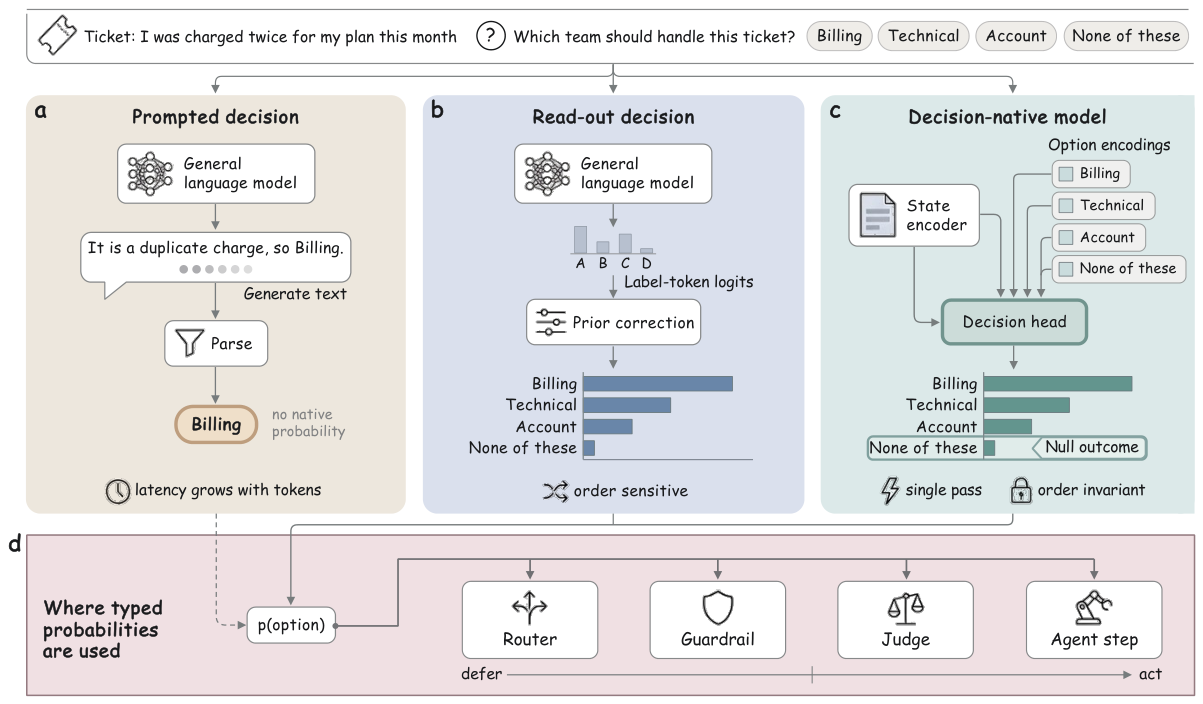
Figure 2.
A design space for decision-native language models. The left band shows the three architectural generations reviewed in Section 4 to Section 6, which differ in where the decision is computed. The middle band shows the reliability properties examined in Section 7 and Section 8. The right band shows the system roles and cross-cutting concerns treated in Section 9 to Section 11. Arrows mark the escalation that organizes the review, in which each band inherits the residual limitations of the band to its left.
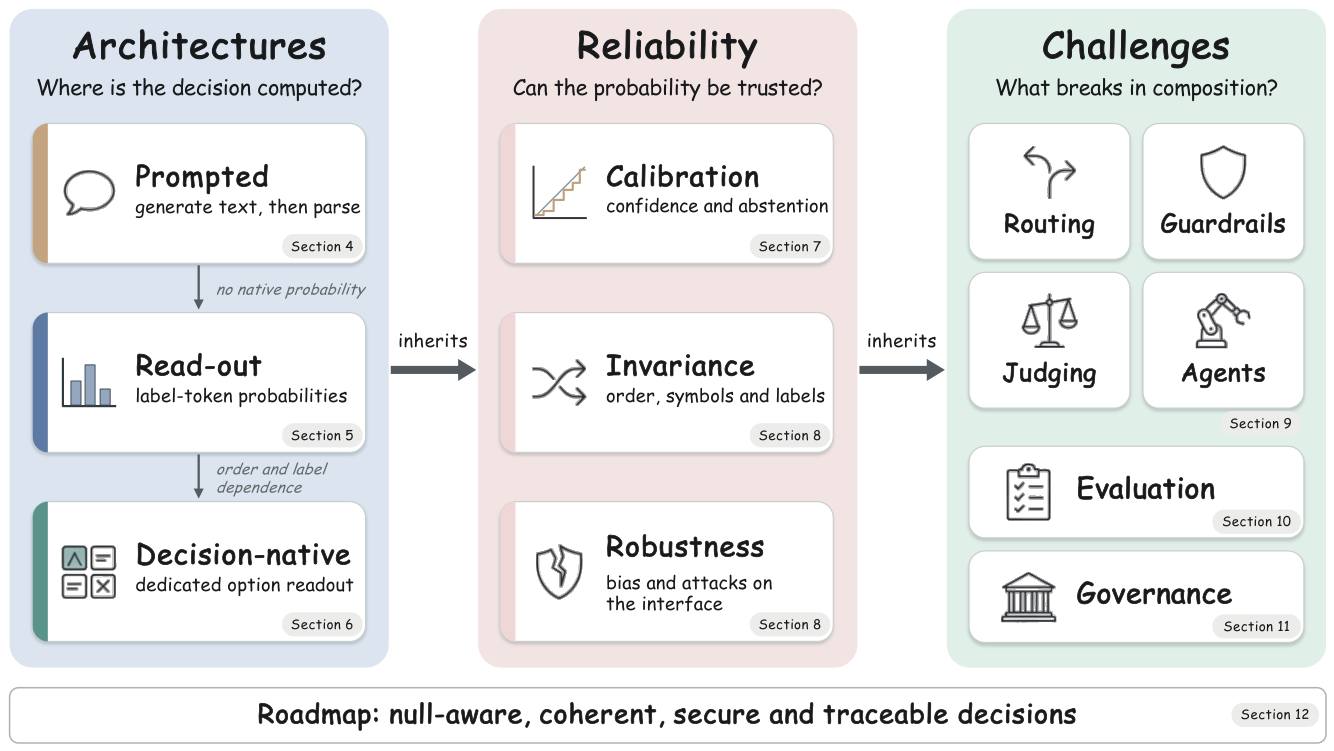
Figure 3.
Milestones on the path toward decision-native language models. Systems are placed in order of first public release along a serpentine track that is read in the direction of the arrows, and each dark pill gives the year of the system that directly follows it, so spacing reflects order only. Colour encodes the architectural generation across prompted, read-out and decision-native designs, with a heavy outline added to decision-native systems, while marker shape encodes the primary system role among classification, calibration, routing, guarding, judging and agent control. The timeline runs from cloze-style classification with masked language models to single-pass decision models released in 2026, showing how routing, guarding and judging adopted typed readouts before dedicated decision models appeared.
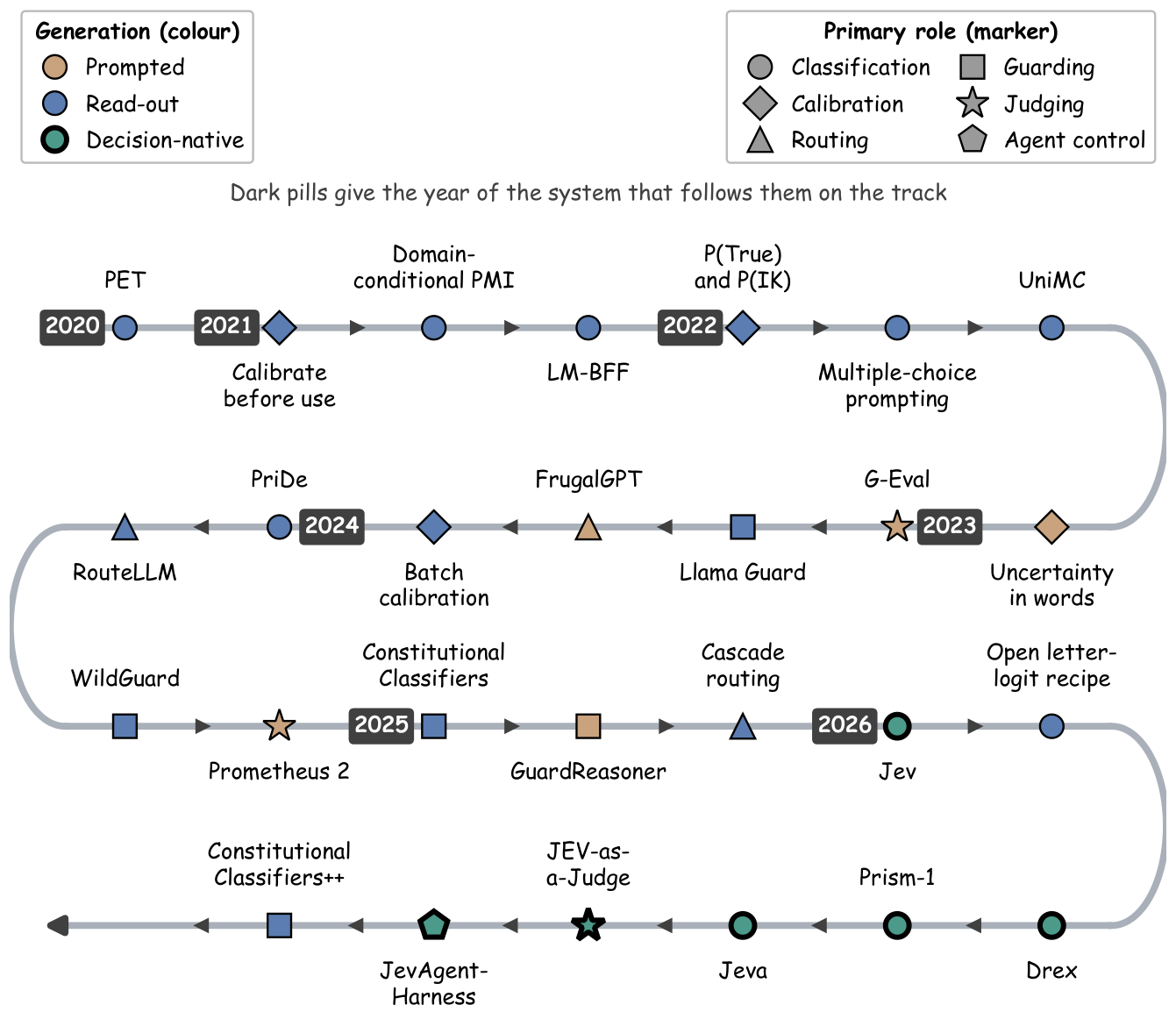
Figure 4.
Fast decisions with uneven reliability. Panel (a) shows cost and latency reduction factors of decision models relative to generative language models as reported by independent studies, with bars spanning the reported range. Panel (b) shows expected calibration error reported for hosted and open decision models across task domains, sorted by value. Panel (c) shows option-order and label-swap flip rates under two contrasting conditions, such as before and after a mitigation or between architectures and naming conventions, with the two values printed beside each row. Colours are local to each panel. Values are transcribed from the cited studies and were measured under different protocols, so the panels support qualitative comparison only.
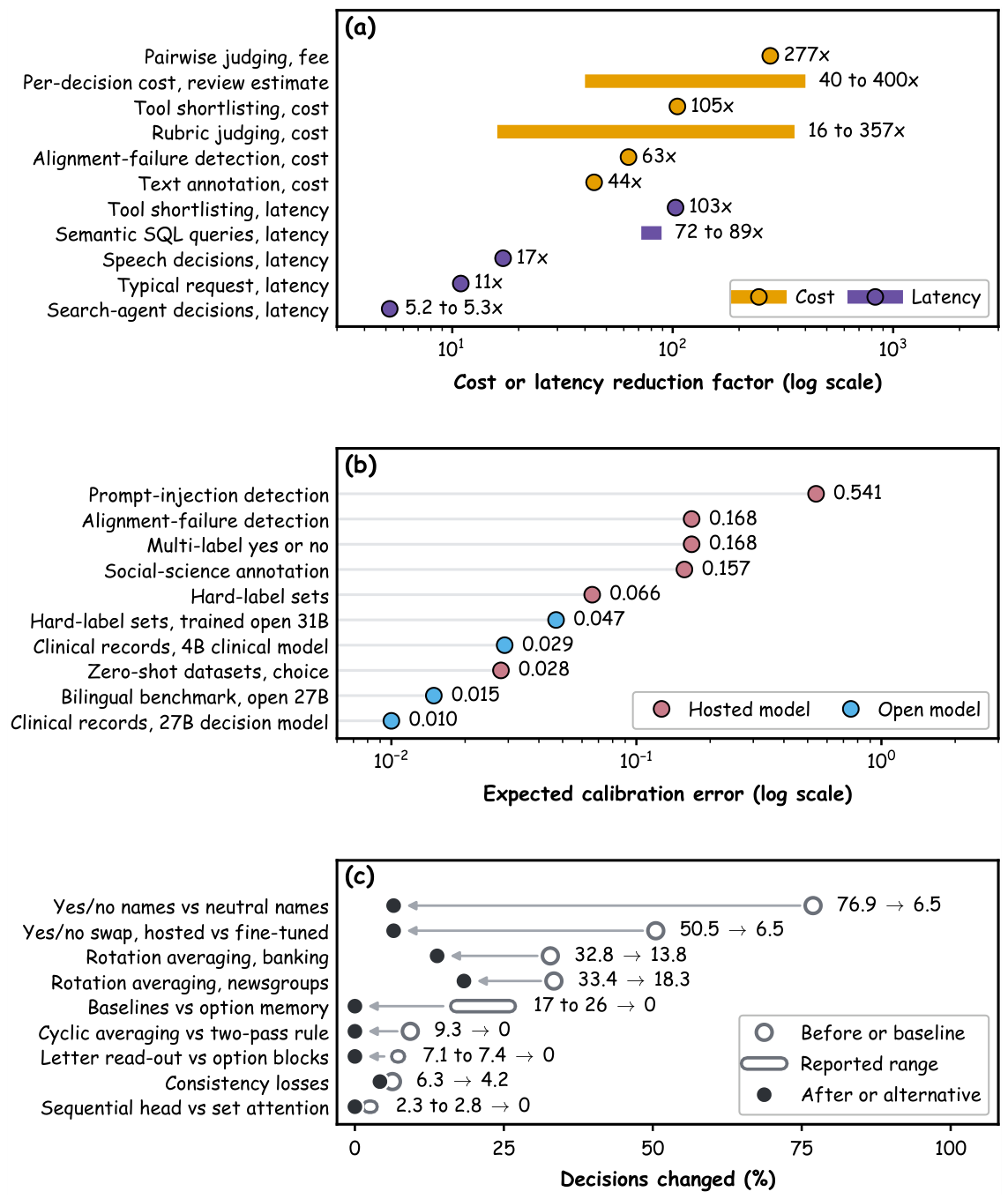
Figure 5.
Readiness of typed decisions across system roles. Each panel shows one system role scored on five criteria covering accuracy against matched baselines (Acc.), calibration (Cal.), robustness (Rob.), system-level evidence (Sys.) and real-world validation (Real), abbreviated as in the header of Table 4. Scores follow the rubric of that table, and the rings mark scores 1 to 4 from the centre outward. Guardrails reach the outer ring on real-world validation because of published production red teaming, whereas agent control and clinical decisions remain close to the centre on robustness and system-level evidence. The scores are an assessment of published evidence and should be updated as closed-loop and deployed studies appear.
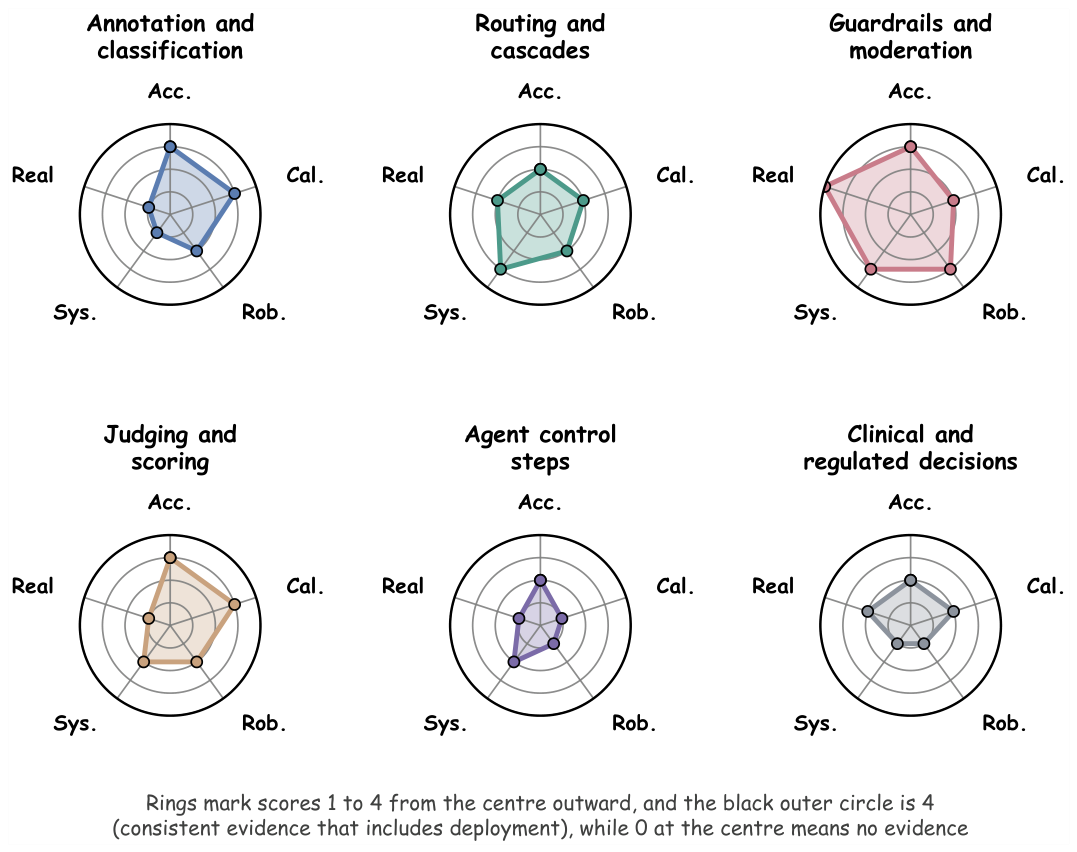

Table 1.
Representative systems in the design space of typed decisions. Generation is prompted (P), read-out (R) or decision-native (N). Option order is n.a. when options are not presented jointly, sensitive when unaddressed, corrected when fixed after the fact, reduced when addressed by a training loss, and invariant when guaranteed by construction. Entries marked not reported were not found in the cited work. Passes count forward passes over the state per decision, with K the number of options. Generation N marks an architecture built around the declared option set, and marks a system presented as decision-native whose architecture is not disclosed. The option order, null outcome, probability objective and passes columns correspond to criteria two, one, four, and three and five of Box 2, so each N row shows which criteria a system meets and which remain open.
| System | Year | Gen. | Where the decision is read | Option order | Null outcome | Probability objective | Passes |
|---|---|---|---|---|---|---|---|
| PET [7] | 2020 | R | Verbalizer token at a cloze mask | n.a. | none | Cross-entropy on verbalizers with distillation | 1 |
| Contextual calibration [10] | 2021 | R | Label tokens with an affine correction | n.a. | none | Content-free prior correction | 1, prior fit once per prompt |
| Noisy channel [41] | 2022 | R | Likelihood of the input given each label | n.a. | none | Channel likelihood | K |
| Multiple-choice prompting [9] | 2022 | R | Letter token after a joint option list | sensitive | none | None, zero or few shot | 1 |
| UniMC [42] | 2022 | R | Option-mask yes or no prediction | not reported | none | Multiple-choice training | 1 |
| P(True) and P(IK) [11] | 2022 | R | True or false token and a knowledge head | sensitive | extra option | Trained knowledge head | 2 |
| G-Eval [5] | 2023 | P | Probability-weighted score tokens | n.a. | none | None, sampled estimate | about 20 samples |
| Llama Guard [3] | 2023 | R | Safe or unsafe token under a policy taxonomy | n.a. | none | Instruction tuning | 1 |
| LS-LLaMA [43] | 2023 | R | Label-space head on the final layer | n.a. | none | Cross-entropy with low-rank adaptation | 1 |
| FrugalGPT [2] | 2023 | P | Learned scorer over generated answers | n.a. | defer to next model | Learned scorer and cascade search | up to pool size |
| PriDe [18] | 2024 | R | Letter token divided by an option prior | corrected | none | Prior estimated on a small sample | 1 |
| ShieldHead [44] | 2025 | R | Classification head on dialogue-model states | n.a. | none | Label disambiguation loss | shared with generation |
| GLiClass [45] | 2025 | R | Joint text and label encoding | not reported | none | Focal-loss supervision and PPO reinforcement | 1 |
| Jev [12] | 2026 | Typed readout, internals undisclosed | not reported | not disclosed | Reinforcement learning for calibrated decisions | 1 | |
| Open letter-logit recipe [13] | 2026 | R | Letter logits and an initialized decision head | reduced by shuffling | none | Low-rank adaptation and temperature scaling | 1 |
| AnyJev [46] | 2026 | R | Letter logits of a frozen model | corrected | none | Prior division and temperature scaling | K rotations |
| Runoff [47] | 2026 | R | Pointwise screen, then cross-position comparison | invariant | none | Training-free rule | 2 stages |
| SearchJev [48] | 2026 | R | First-token scores of legal options | reduced by shuffling | defer to slow reasoner | Soft cross-entropy, Brier and temperature | 1 |
| Drex [14] | 2026 | N | Pointer head over delimiters or code head | reduced | extra NONE option | Supervised, consistency and reinforcement | 1 |
| Intern-Decision [49] | 2026 | N | Masked placeholders in a JSON template | not reported | not reported | Cross-entropy and temperature scaling | 1 for all fields |
| this-that-model [50] | 2026 | N | Option-label embeddings at designated slots | not reported | abstention option | Proper scoring rule | 1 |
| Prism-1 [37] | 2026 | N | Yes or no logits in per-option blocks | invariant | none | Fine-tuning | 1 |
| ufakzeka-karar [38] | 2026 | N | Masked set-attention option scores | invariant | none, not-sure signal | Proper scoring and temperature scaling | |
| Narrow decision model [40] | 2026 | N | Prefix-tree block attention over many questions | invariant | adequacy head | Proper scoring rules | 1 per question tree |
| Jeva [15] | 2026 | N | Option memory read by a set-conditioned mixer | invariant | coverage gate | Trained decision head | 1, options cached |
| MetaEncoder [39] | 2026 | N | Bi-encoder similarity with options prepended | low sensitivity reported | none | Packed contrastive training | 1, options cached |
| SanSi [51] | 2026 | N | Typed readout after every loop | not reported | not reported | Proper scoring rule | up to 8 loops |
Table 2.
Claimed advances of decision-native systems and the corresponding reality checks. Each row pairs the central claim of a representative system with the caveat stated by its authors or by an independent study. The last column is where comparator gaps, cost accounting and transfer limits appear.
| System | Design delta | Claimed advance | Reality check |
|---|---|---|---|
| Jev [12,34] | Hosted typed model with choice, yes-or-no statement and score questions (image boxes from v1.14) | Fast calibrated decisions without generation | Trails on multi-step mathematics and reasoning-heavy questions, probabilities on a two-decimal grid, closed versions [25,90] |
| Open letter-logit recipe [13] | Low-rank adaptation and a head initialized from the language-model head | Surpasses Jev after short training | Gains shrink for small backbones and need a matched calibration set |
| Reasoning-to-readout model [16] | Self-distillation of reasoning into a first-token decision | Matches Jev with lowest calibration error | Trails generative models in medicine, finance and law, and recovers a quarter or less of the reasoning gain on GPQA and MMLU-Pro |
| Drex [14] | Pointer or code head, consistency losses, reinforcement stage | Beats Jev on a public decision index at sub-second latency | Causal source of the advantage not established, re-encoding raises cost |
| Decision 1.0 [35] | Open encoder and causal family under one interface | Large gains over untuned backbones | Jev still leads overall, tasks seen during development, no demonstrated latency gain over one-token classifiers |
| Intern-Decision [49] | Masked JSON placeholders read in one pass | Higher average accuracy and lower latency than Jev | Small development-informed benchmark, unmatched calibration baselines |
| this-that-model [50] | Option-label embeddings with schema-first prefix reuse | Decisions in about thirty milliseconds at negligible cost | Cost counts electricity on owned hardware, weak on multi-step arithmetic |
| Prism-1 [37] | Independent option blocks at shared positions | Exact order invariance | Accuracy tied with trained baseline, per-model fine-tuning required |
| Jeva [15] | Immutable option memory and coverage gate | Zero flips and strong null detection | Caching speedups need recurring candidates and vanish without option reuse |
| Narrow decision model [40] | Prefix-tree block attention with adequacy head | Invariance, isolation and caching by construction | Real-data evidence limited to agreement with an existing classifier |
| SanSi [51] | Looped backbone with per-loop readout | Large accuracy gain at fixed shape | Several times more compute, calibration degrades with loops |
| Clinical decision model [86] | Institutional soft-label fine-tuning | Beats larger open decision models on local tasks | Needs per-outcome recalibration, slightly below a larger model on external sets |
Table 3.
Validity of benchmarks used for typed decisions. The table lists what each benchmark targets, where its reference labels come from and the blind spot that its own authors or later studies identify. The blind-spot column is the main reason scores from different rows should not be compared directly.
| Benchmark | Decision type and target | Reference labels | Known blind spot |
|---|---|---|---|
| OpenDecisions [13] | Mixed typed questions mirroring a community suite | Curated validation items | Composition copied from the suite it aims to predict |
| JEVal [16] | Bilingual accuracy and calibration over many datasets | Dataset gold labels | Isolated questions, while agent episodes show error accumulation |
| TypedBench [108] | Policy adherence, wording robustness, probability quality, cost | Policy-derived synthetic items | Single hosted endpoint (Jev) and synthetic policies |
| MMDM [294] | Up to 1,024 options and very long inputs | Fresh generated instances | Capacity failures scored as errors |
| DecisionPivot [295] | Contrast groups that isolate the deciding fact | Independently verified pairs | Residual partial-information shortcuts, incomplete contamination control |
| System1-Arena [296] | Non-agentic accuracy and long-horizon control | Source labels and harness task outcomes | Simulated harnesses with fixed action spaces |
| HakemBench [38] | Turkish typed decisions over several tracks | Track gold labels | Released scores shaped by earlier test-set reads |
| Sys1Cal-v1 [109] | Soft-label calibration of Noul, Choice and Score outputs | Templated items with known uncertainty | Synthetic templates and two models |
| DecisionRobust [183] | Text and image perturbations, prompt injection | Clean labels | Offline attacks with fixed templates |
| JevAdvBench [181] | Black-box edits that flip correct decisions | LLM-judged answer preservation | Label validity depends on the judge |
| RouterBench [22] | Cost and quality of multi-model routing | Pre-generated responses | Offline responses and approximate token costs |
| LLMRouterBench [219] | Unified router comparison against best single model | Correctness per model | Curated model pools and datasets |
| GuardBench [23] | Prompt and response moderation | Binarized dataset labels | Partly automatic labels, no adversarial track |
| TraceSafe-Bench [251] | Safety of multi-step tool-call trajectories | Mutated static traces | Static traces with no live agent |
| AbstentionBench [145] | Abstention on unanswerable or underspecified questions | Dataset abstention labels, LLM-judged responses | Judge reliability and curated questions |
Table 4.
Readiness rubric for typed decisions by system role. Each criterion is scored from 0 to 4. A score of 0 denotes no published evidence, 1 denotes isolated benchmark claims, 2 denotes several independent benchmark studies, 3 denotes matched-comparator or closed-loop studies, and 4 denotes consistent evidence that includes deployed or real-data validation. Scores are the authors’ reading of the cited evidence and feed Figure 5.
| Role | Acc. | Cal. | Rob. | Sys. | Real | Strongest evidence and main gap |
|---|---|---|---|---|---|---|
| Annotation and classification | 3 | 3 | 2 | 1 | 1 | Matched encoders and best LLMs [80,105]; label conventions unstated in prompts [81] |
| Routing and cascades | 2 | 2 | 2 | 3 | 2 | Unified router benchmarks [219,220]; gains vanish against random two-model routing [224] |
| Guardrails and moderation | 3 | 2 | 3 | 3 | 4 | Production red teaming [261,262]; guard probabilities poorly calibrated [250] |
| Judging and scoring | 3 | 3 | 2 | 2 | 1 | Risk-controlled escalation [271,278]; errors shared with fallback judges [62] |
| Agent control steps | 2 | 1 | 1 | 2 | 1 | In-agent tests and fitted thresholds [6]; collapse on long horizons [296] |
| Clinical and regulated decisions | 2 | 2 | 1 | 1 | 2 | Institutional records [86]; trails LLMs on standard inputs [92] |
Disclaimer/Publisher’s Note: The statements, opinions and data contained in all publications are solely those of the individual author(s) and contributor(s) and not of MDPI and/or the editor(s). MDPI and/or the editor(s) disclaim responsibility for any injury to people or property resulting from any ideas, methods, instructions or products referred to in the content. |
© 2026 by the authors. Licensee MDPI, Basel, Switzerland. This article is an open access article distributed under the terms and conditions of the Creative Commons Attribution (CC BY) license (http://creativecommons.org/licenses/by/4.0/).
Copyright: This open access article is published under a Creative Commons CC BY 4.0 license, which permit the free download, distribution, and reuse, provided that the author and preprint are cited in any reuse.