

Submitted:
20 November 2026
Posted:
23 November 2026
You are already at the latest version
Abstract
High-resolution imagery from optical sensors aboard Earth-observation satellites has become a primary data source for monitoring ground-object changes. Remote sensing change captioning meets this demand by describing, in natural language, the changes between bitemporal remote sensing images. Existing methods either treat change detection and change captioning as two independent tasks, or adopt end-to-end joint training that suffers from inter-task gradient competition and optimization conflicts. We propose ProMT-CCap, a bitemporal change captioning method based on a progressive multi-task training framework. First, a three-stage progressive training strategy performs dedicated change detection training, change captioning branch pre-training, and multi-task joint fine-tuning, enabling structured knowledge transfer from change detection to change captioning and a balanced optimization trade-off between the two tasks. Second, a cross-modal feature extraction architecture couples a Swin Siamese encoder with a bidirectional xLSTM temporal modeling module, in which the ChangeLSTM module and cross-attention fusion inject change detection features into the captioning branch. Third, a dynamic gradient normalization strategy adaptively balances the gradient magnitudes of the two tasks during joint training. Experiments on the LEVIR-MCI benchmark of remote sensing images show that ProMT-CCap achieves a BLEU-4 score of 0.6020, a CIDEr-D score of 1.3403, and a ROUGE-L score of 0.7655 averaged over three paired random seeds, outperforming existing dual-task methods and translating bitemporal remote sensing images into interpretable change captions for Earth-observation applications.
Keywords:
bitemporal optical satellite imagery
; change detection
; dynamic gradient normalization
; progressive multi-task learning
; remote sensing change captioning
; Swin Transformer
1. Introduction
Earth observation remote sensing satellites such as Landsat, Sentinel, and WorldView continue to acquire massive volumes of multi-temporal imagery covering the global land surface [1], providing critical data support for land-cover change monitoring, ecological and environmental change assessment, and disaster emergency response [2,3]. Efficiently extracting and interpreting ground-object change information from massive bitemporal or multi-temporal images has thus become a key challenge to be addressed in the field of intelligent remote sensing interpretation.
Remote sensing image change captioning (RSICC) is a cross-modal task that integrates computer vision and natural language processing. It aims to describe surface change information in natural language by comparing bitemporal remote sensing images, thereby bridging the semantic gap in change detection [4]. Unlike remote sensing image change detection (CD), which outputs only binary change masks [5,6], RSICC reformulates change interpretation from a low-level pixel classification problem into a high-level cross-modal generation problem, enabling machines to generate natural-language descriptions that specify what has changed and where the change has occurred. This capability also underpins downstream applications such as automated change report generation [7] and multimodal geospatial intelligence systems [8].
Since Liu et al. formally defined the RSICC task and constructed the LEVIR-CC benchmark dataset [9], three typical technical paradigms have emerged in this field: three-stage encoder–fusion–decoder architectures, multi-task joint learning frameworks, and methods driven by large language models (LLMs) [4]. Among these, multi-task learning frameworks achieve the collaborative optimization of change detection and change captioning by sharing bitemporal feature representations, and thus represent one of the most promising research directions. However, existing multi-task methods still exhibit three major limitations. First, dense pixel-level classification and sequence-level generation differ fundamentally in gradient distributions and convergence rates, and direct joint training is prone to gradient competition between the two tasks and optimization conflicts. Second, the mechanism for fusing change detection features into the language decoder remains rather coarse, making it difficult to explicitly inject pixel-level change information into the semantic generation process. Third, multi-task loss weighting mostly relies on static strategies, which cannot adapt to the dynamic evolution of gradient magnitudes during joint training.
To address the aforementioned problems, this paper proposes ProMT-CCap, a progressive multi-task training framework for bitemporal remote sensing image change captioning, which advances multi-task collaborative modeling in three aspects: training strategy, feature fusion, and loss balancing. The main contributions are summarized as follows:
- A three-stage progressive training framework. Dedicated CD pre-training, CC branch pre-training, and multi-task joint fine-tuning transfer the change perception capability from CD to CC in an ordered manner, improving captioning quality while preserving detection accuracy.
- A change-aware cross-modal architecture based on bidirectional xLSTM. We propose a ChangeLSTM module, with a bidirectional xLSTM as its core temporal modeling component, that explicitly injects the pixel-level change features extracted by the Swin Siamese encoder into the captioning branch through a cross-attention fusion mechanism, decoupling visual feature extraction from change-aware encoding.
- An adaptive multi-task loss balancing strategy based on dynamic gradient normalization. A DGN strategy adaptively adjusts the loss weights of the CD and CC tasks, significantly improving the semantic coherence of the generated captions without compromising detection accuracy.
2. Related Work
Shi and Zou [10] first explored natural-language description of remote sensing images, and the survey by Zou et al. [4] categorizes existing RSICC methods into three paradigms. Following the encoder–fusion–decoder template established by RSICCformer and the LEVIR-CC benchmark [9], subsequent studies improved architectural components along multiple dimensions, including attentive Siamese networks (Chg2Cap [11]), progressive scale-aware difference encoding (PSNet [12]), interactive layer-wise enhancement (ICT-Net [13]), diffusion-based feature extraction (MADiffCC [14]), lightweight sparse attention (SFT [15]), and robust multi-modal captioning built on the SECOND-CC dataset (MModalCC [16]). These three-stage methods, however, generally treat captioning as a single task and leave the pixel-level localization cues of change detection unexploited.
Multi-task studies instead couple CD and CC within one network: CD4C [17] first introduced a CD module into RSICC, Change-Agent [7] built an interactive interpretation system and released the LEVIR-MCI dataset, and ChangeMinds [18] achieved complementary dual-task optimization through shared representations—but all still rely on statically weighted losses. LLM and vision-language-driven approaches, including EarthVL [19], UniTS [20], SkyMoE [21], Prompt-CC [22], and Change3D [23], offer open-vocabulary generality [24,25,26], yet their parameter counts inflate inference cost and their fine-grained performance on specific benchmarks is not necessarily superior to that of medium-scale task-specific models. This trade-off motivates lightweight, knowledge-enhanced, task-specific RSICC methods, which is the direction pursued in this work.
3. Methods
3.1. Model Framework
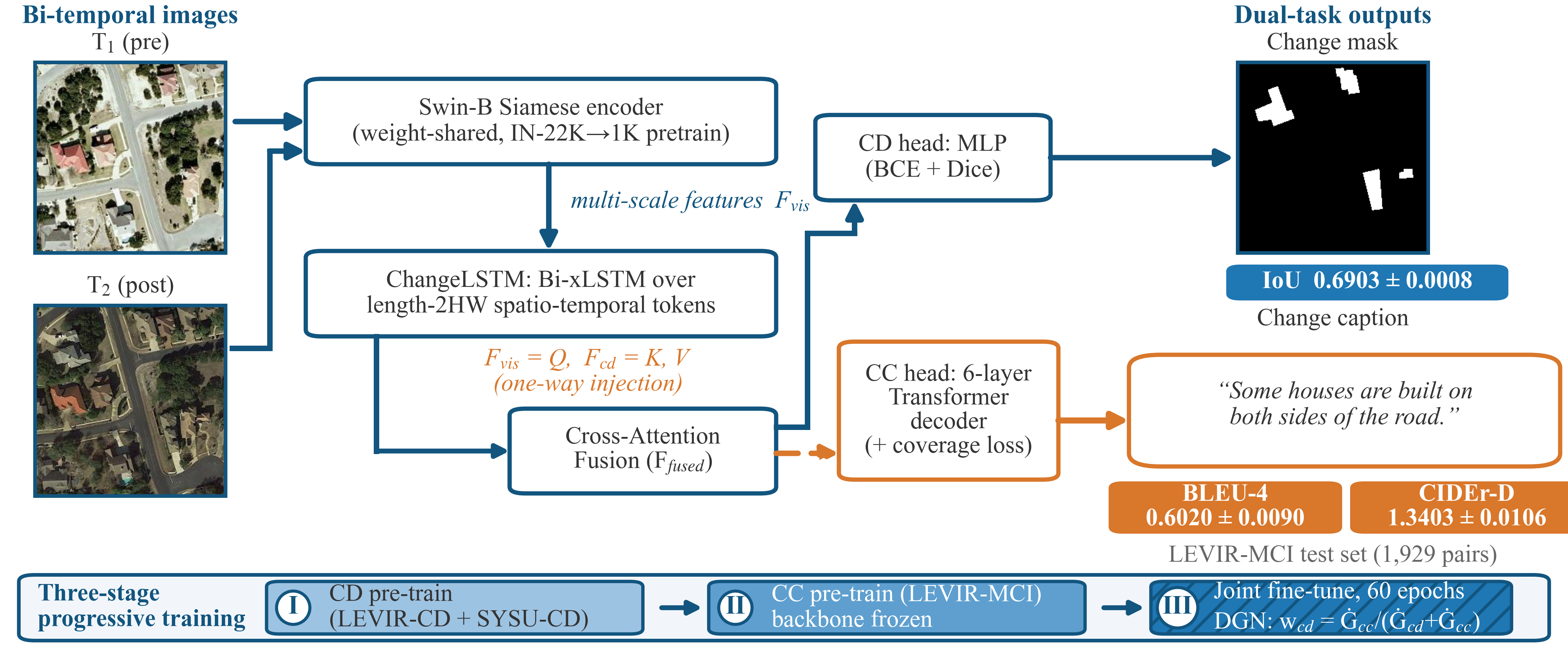
The proposed ProMT-CCap method, built upon the progressive multi-task training framework, consists of four core components: a Swin Siamese visual encoder, a ChangeLSTM change modeling module, a cross-attention fusion layer, and a dual-task decoder. These components jointly implement the change captioning pipeline for bitemporal remote sensing images. The overall architecture of ProMT-CCap is illustrated in Figure 1.
3.2. Three-Stage Progressive Training Strategy
To address the gradient conflicts arising from the coexistence of dense pixel-level classification and sequence-level cross-modal generation, we design a progressive multi-task training strategy that incorporates DGN. Specifically, a three-stage training scheme is adopted: the first stage focuses on dense pixel-level change detection; the second stage performs CC pre-training; and the third stage performs end-to-end joint fine-tuning under DGN adaptive loss balancing. In this design, each stage first concentrates on a dedicated subtask before complete end-to-end joint optimization, preventing either task from dominating the updates of the shared parameters and thereby achieving balanced synergy between the two tasks. The training parameters of the three stages are listed in Table 1.
3.2.1. Stage I: Change Detection Pre-Training
Accurate pixel-level change localization provides spatial constraints and content priors for semantic description generation. From the data perspective, the CD task benefits from change mask datasets with mature annotations and sufficient scale, including LEVIR-CD (8,188 pairs) and SYSU-CD (20,000 pairs), whereas large-scale CC annotations require labor-intensive natural language labeling and are considerably more expensive to obtain. In this stage, the shared backbone network is therefore pre-trained on large-scale CD annotations to establish robust bitemporal feature extraction and change localization capabilities. Specifically, the Swin Siamese encoder, the ChangeLSTM, the cross-attention fusion layer, and the CD decoder are trained while the CC decoder remains frozen. This dedicated pre-training enables rapid convergence to a discriminative bitemporal feature space, laying a high-quality visual representation foundation for subsequent language generation learning in the CC task. Training employs automatic mixed precision (AMP) with bfloat16 (BF16), and gradients are clipped when the global L2 norm exceeds 1.0.
3.2.2. Stage II: Change Captioning Pre-Training
The core objective of this stage is to independently train the language generation capability of the captioning branch while preserving the change detection ability acquired in Stage I. To this end, a parameter-freezing strategy is adopted: the encoder and ChangeLSTM parameters learned in Stage I are fixed, and only the learnable parameters of the captioning branch are updated. Through the cross-attention fusion layer, the branch takes the change-aware features output by the ChangeLSTM and implicitly learns the alignment between changed regions and their semantic captions during language decoding.
3.2.3. Stage III: Multi-Task Joint Fine-Tuning
This stage introduces the dynamic gradient normalization (DGN) strategy to address the significant discrepancy in gradient magnitudes between the CD and CC losses. DGN monitors the gradient statistics of both tasks at each training step and adaptively adjusts the loss weights, achieving balanced optimization of the two tasks. The strategy comprises three steps:
Gradient magnitude statistics: The L2 norms of the gradients of the CD and CC losses with respect to the shared parameters, denoted as and , are computed separately at each training step. These two quantities reflect the gradient influence of each task on the shared parameters.
EMA-based smoothing: An exponential moving average (EMA) is applied to the raw gradient norms to eliminate the stochastic noise of single-step gradients, as shown in (1):
where is updated analogously, and is the momentum coefficient that controls the memory length of the historical gradient information. We set in all experiments, where a larger yields smoother weight updates but slower responses, whereas a smaller provides faster responses but higher susceptibility to single-step noise.
Adaptive weight adjustment: The loss weights at step t are computed as
where and are the EMA-smoothed gradient magnitudes from (1).
3.3. Swin Siamese Visual Encoder
We employ a Swin Siamese visual encoder built upon Swin Transformer Base (Swin-B) as the shared visual backbone. Through the Siamese weight-sharing mechanism, features are extracted from the bitemporal remote sensing images with an identical set of parameters, ensuring the consistency of spatial alignment and the comparability of the feature space. The encoder is initialized with Swin-B weights pre-trained on ImageNet-22K and fine-tuned on ImageNet-1K. Compared with weights pre-trained on ImageNet-1K alone, this two-stage pre-training strategy yields a more generalizable visual representation, facilitating rapid convergence on remote sensing imagery, whose data distribution exhibits a domain shift from natural images. The resulting multi-scale feature pyramid supplies the downstream ChangeLSTM module with hierarchical inputs ranging from local textures to global semantics.
3.4. ChangeLSTM Module
The ChangeLSTM module explicitly models the difference information between the bitemporal multi-scale features. Its design comprises two components: spatiotemporal sequence construction and bidirectional xLSTM temporal modeling.
3.4.1. Spatiotemporal Sequence Construction
The bitemporal feature maps are flattened along the spatial dimension into sequences. Let the feature maps output by the encoder be , which are flattened into , respectively. Concatenation then yields the spatiotemporal sequence ; the first timesteps correspond to the spatial positions of the phase, and the remaining timesteps correspond to the phase. This arrangement enables the xLSTM to model the temporal dependencies of bitemporal features within a unified sequence framework.
3.4.2. Bidirectional xLSTM Temporal Modeling
Forward and backward xLSTM processing is performed on S to simultaneously capture change-aware patterns in both directions.
- Forward channel: ; the sequence is preprocessed in its original temporal order () through a causal convolution and then fed step by step into a two-layer sLSTM, capturing the evolution of spatial change patterns from the phase to the phase and producing the forward hidden states .
- Backward channel: ; the same sequence is flipped along the temporal dimension (), fed into an independent two-layer sLSTM to capture reverse dependencies from the phase to the phase, and flipped back to the original order for alignment, yielding the backward hidden states .
The two directions employ independent sLSTM parameters so that each captures complementary change information. The bidirectional hidden states are concatenated along the feature dimension and passed through a linear projection layer to generate the change-aware features, as shown in (3):
The xLSTM is adopted over the standard LSTM as the basic temporal modeling unit for its exponential gating that alleviates the vanishing-gradient problem in long sequences, its matrix memory that enhances the representation capacity for complex intra-sequence dependencies, and its support for batched parallel computation.
3.5. Cross-Attention Fusion
To enable the change detection and change captioning tasks to share change representations, we design a cross-attention fusion module that injects the change-aware features output by the ChangeLSTM into the visual feature representations of the captioning branch through a selective attention mechanism. Specifically, the visual features serve as the Query, while the change-aware features output by the ChangeLSTM serve as the Key and Value. The two feature streams are selectively fused through multi-head cross-attention, as shown in (4):
where MultiHeadCrossAttn denotes the standard multi-head cross-attention.
The fusion layer adopts a unidirectional injection design: the change-aware features are injected into the visual stream through cross-attention with as the queries and as the keys and values — rather than through bidirectional coupling between the two branches. The captioning pathway thereby receives explicit pixel-level change priors without entangling the dedicated representations of the two branches. The resulting fused features serve as the shared input to both downstream decoders:
- The CD decoder, implemented as an MLP head, maps directly to the pixel-level change mask.
- The CC decoder, a six-layer Transformer decoder, takes as the encoder memory and generates the description through encoder–decoder cross-attention. Accordingly, the fusion module is optimized by the CD loss in Stage I, by the CC loss in Stage II, and by both losses in Stage III, whereas the parameters of each decoder are updated only by its own task loss.
3.6. Dual-Task Decoder
The dual-task decoder consists of a CD decoder and a CC decoder, which are responsible for pixel-level change mask prediction and sequence-level change caption generation, respectively.
3.6.1. CD Decoder
The CD decoder adopts a lightweight multilayer perceptron (MLP) head that upsamples the fused features and performs per-pixel binary classification to output the change probability map: . The training loss is a weighted combination of binary cross-entropy (BCE) and Dice loss, which respectively optimize the pixel-level classification accuracy and the region-level overlap, jointly mitigating the class imbalance between changed regions and the background. During inference, the optimal classification threshold is selected via a search on the validation set (range 0.30–0.60, step 0.05) and applied to the test set; the search converges to 0.30 for all runs reported in this paper.
3.6.2. CC Decoder
The CC decoder employs a Transformer decoder equipped with an auxiliary coverage loss. Each decoder layer applies masked self-attention, cross-attention over , and a feed-forward network; to penalize the repeated concentration of attention on the same spatial locations during generation, a coverage loss accumulates the attention distributions over previous decoding steps.
4. Datasets and Evaluation
Unless otherwise specified, all experiments follow the three-stage protocol defined in Section 3.2. Given the differences among the training tasks, different datasets are adopted at each stage, and the correlations among the datasets across stages must be carefully maintained. We employ three datasets—LEVIR-CD [27], SYSU-CD [6], and LEVIR-MCI [7]—to jointly support the training and evaluation of ProMT-CCap. For Stage I, LEVIR-CD and SYSU-CD are integrated through data normalization and deduplication to form three integrated CD datasets, denoted integrated-CD train, integrated-CD val, and integrated-CD test, respectively. Stage II employs the LEVIR-MCI dataset for the training and evaluation of the CC task, and Stage III performs joint training and evaluation on the datasets used in Stages I and II. Specifically, the LEVIR-MCI dataset covers change scenarios such as building construction and demolition, road construction, vegetation change, and farmland development. It is extended from the public LEVIR-CC dataset: while retaining the original textual description annotations, it adds pixel-level binary change mask annotations, enabling it to serve both CD and CC tasks. Its validation set is used for hyperparameter tuning in Stages II and III; Stage III uses a fixed 60-epoch budget without early stopping; and the test set is reserved exclusively for the final evaluation and is excluded from all training and tuning decisions. The datasets used in the experiments are summarized in Table 2. All experiments, including training and inference, were conducted on a single NVIDIA GeForce RTX 4090 GPU (24 GB) with PyTorch 2.5.1 (Python 3.10, CUDA 12.1), running on Red Hat Enterprise Linux 8.4.
4.1. Data Processing
To accurately extract pixel-level change features from bitemporal images in Stage I, and to mitigate the geographical-scene and land-cover bias inherent in a single data source, we fuse two heterogeneous remote sensing change detection benchmarks, LEVIR-CD and SYSU-CD, to construct the integrated-CD train set. Both datasets provide bitemporal image pairs and pixel-level change masks . The samples from the two datasets are aggregated into a joint training set , and the source labels are retained to support subsequent ablation analysis. The main processing pipeline consists of five steps:
- perceptual-hash-based deduplication to prevent data leakage;
- global statistical normalization to harmonize the radiometric distributions across the two sources;
- synchronized cropping to ensure bitemporal alignment;
- auxiliary label generation to support multi-task learning;
- stratified oversampling to mitigate class imbalance.
4.1.1. Synchronized Geometric Cropping
All samples are cropped to the backbone input size, with the same coordinates applied to , , and the change mask M — random crops during training and center crops during validation and testing.
4.1.2. Change Mask Binarization
Threshold binarization unifies the mask encoding across datasets and yields binary masks compatible with the BCE loss.
4.1.3. Auxiliary Label Generation
To support multi-task learning, a set of auxiliary supervision signals is automatically generated from the change masks, comprising the changed-area ratio, the change location label, and the change type label. The changed-area ratio is defined as the ratio of the number of changed pixels to the total number of pixels, as shown in (5):
The change location label is obtained by computing the minimum bounding rectangle of the changed region to derive the center coordinates and the width and height, which are normalized to the interval. Specifically, each sample is discretized into one of ten auxiliary categories—nine grid-position labels plus a no-change label—based on the center coordinates of its changed pixels; its change density is graded into small (), medium (), or large (). During training, minority change types are oversampled by repetition up to the largest class size () to balance the type distribution.
4.2. Evaluation Metrics
5. Experiments and Analysis
In this section, we comprehensively evaluate ProMT-CCap on the LEVIR-MCI test set and analyze the model performance in terms of both CD and CC. This section first reports the main experimental results, then quantifies the contribution of each core module through ablation studies, and finally presents a comparative analysis with state-of-the-art methods.
5.1. Main Experimental Results
To comprehensively evaluate the model performance, we report the main experimental results of ProMT-CCap on the LEVIR-MCI test set, as shown in Table 3.
Change detection performance: The proposed method achieves an IoU of 0.6903±0.0008 and an F1-score of 0.8168±0.0005 under a unified threshold-search protocol (0.30–0.60, step 0.05); all Baseline and A1 runs converge to 0.30, demonstrating the effectiveness of the proposed feature extraction architecture. In the dual-task framework, the CD result influences the CC branch through the CD-guided sample re-weighting mechanism, in which the detected change regions and their type statistics are used to re-weight the captioning loss to mitigate class imbalance. To avoid propagating noisy weights into caption generation, a relatively conservative strategy is adopted for change region prediction, which is consistent with results in Table 3, where the recall (0.7963±0.0010) is lower than the precision (0.8384±0.0014).
Change captioning performance: With a beam size of 3 and a maximum caption length of 64, the model achieves competitive CC performance, as shown in Table 3. BLEU-1 reaches 0.8447, indicating strong word-level consistency with the reference captions, while BLEU-4 reaches 0.6020, reflecting the high precision of 4-gram matching. The 28.73% decay from BLEU-1 to BLEU-4 suggests that the model is accurate at word-level selection but degrades in multi-word phrase coherence, revealing limitations in long-range dependency modeling. CIDEr-D reaches 1.3403, showing that the model accurately captures the core semantics of the changes. As shown in Figure 2(a) and (b), the correctly predicted cases exhibit accurate spatial relations and complete coverage of the key change elements. ROUGE-L reaches 0.7655, which corresponds to strong sequence-level agreement with the reference descriptions as measured by the longest common subsequence. METEOR reaches 0.3981, which is relatively low among all the reported metrics; since METEOR relies on synonym and stem matching, this may be attributed to the limited coverage of synonym resources for remote sensing terminology. As shown in Figure 2(c), the model performs well on regions with clear change boundaries and high contrast, but tends to miss small changed regions or those with low background contrast, which is consistent with the conservative prediction strategy of the CD branch discussed above.
5.2. Analysis of the Progressive Training Strategy and Multi-Task Synergy
1) Effectiveness of the three-stage progressive training framework. Joint training maintains an IoU of 0.6903±0.0008 on the CD task, within 0.0051 of Stage I single-task training, while achieving competitive BLEU-4 and leading METEOR and ROUGE-L scores on the CC task. This result indicates that the three-stage strategy effectively mitigates the gradient conflict problem in multi-task learning.
2) Preservation of the CD performance. After joint training, the CD IoU reaches 0.6903±0.0008, which is 0.0051 below the best IoU of 0.6954 achieved by the Stage I single-task CD training. Pixel-wise paired ablation tests show that the captioning branch leaves detection performance statistically unchanged across three paired seeds. The result is attributed to the unidirectional injection design of the cross-attention mechanism: CD features are injected into the CC branch rather than being bidirectionally coupled, which prevents gradient noise from the CC branch from directly propagating into the CD decoding path.
3) Effectiveness of the DGN-based adaptive loss balancing strategy. The effect of the DGN strategy is reflected in the METEOR and ROUGE-L scores. The METEOR score of 0.3981 suggests that the DGN strategy successfully balances the optimization directions of the CD and CC tasks, enabling the CC branch to reach the semantic precision level of standalone CC methods. Moreover, the joint evolution of the CD and CC losses during training (Figure 3) indicates that the adaptive weight adjustment mechanism prevents either task from dominating the gradient updates. To further examine the effect of the number of joint training epochs, Table 4 compares the evaluation results on the validation set at epochs 44 and 55.
As shown in Figure 3 and Table 4, from epoch 44 to epoch 55, BLEU-4 exhibits an absolute gain of 0.0432, whereas CIDEr-D decreases by 0.0339, indicating that prolonged joint training continues to improve the n-gram precision of the model, possibly at the cost of semantic consensus. Meanwhile, the adaptive CC loss weight increases from 0.3 to 0.5, progressively up-weighting the CC task, while the DGN factors in (2) rebalance the two tasks at each step; this partially explains the continued improvement in BLEU-4.
5.3. Ablation Studies and Analysis
To quantify the contribution of each module to the RSICC performance, three ablation groups are constructed: A1 removes the entire ChangeLSTM module; A2 converts the bidirectional xLSTM to a unidirectional variant within the ChangeLSTM; and A3 removes the cross-attention injection from CD features to the CC branch. All ablation variants are initialized with the same Stage II weights and trained independently in Stage III under the unified protocol of Section 4 (early stopping disabled, fixed 60-epoch budget, paired seeds 42/1234/2026).
A1 is evaluated with three seeds, whereas A2 and A3 are single runs and are marked with † accordingly. All variants are reported at the fixed 60th epoch on the test set; the quantity of interest is the performance under matched compute. The change-detection and change-captioning results are presented in Table 5. It can be observed that on the change detection task, the paired IoU difference between the baseline and A1 is +0.0010±0.0011, and pixel-wise paired tests show no significant difference in 3/3 seeds; A2† and A3† are single runs retained from the preliminary single-run protocol and are shown for reference only; no cross-protocol comparison is made. These results indicate that the change detection performance is mainly determined by the Swin Siamese encoder and the CD decoder, whereas the temporal modeling and attention enhancement layers provide limited marginal contribution to the binary segmentation.
On the CC task, removing the ChangeLSTM (A1) consistently improves the captioning metrics: all 21 seed×metric paired differences are positive (BLEU-4 +0.0084±0.0019, ROUGE-L +0.0072±0.0018, CIDEr-D +0.0230±0.0135), reaching sample-level significance in at least 2/3 seeds for BLEU-1/2, ROUGE-L and CIDEr-D.
To examine why removing the ChangeLSTM leaves captioning metrics unchanged or improved, we consider the following three candidate explanations:
1) Compensatory effect of the external cross-attention fusion. Although A1 removes the internal structure of the ChangeLSTM, it retains the external cross-attention fusion mechanism, which operates directly on the encoder features and, in the absence of the ChangeLSTM, effectively performs attention interactions across all spatial positions, partially compensating for the loss of the internal cross-attention interaction.
2) Applicability issue of spatial sequence modeling. The difference features output by the encoder already contain multi-scale spatial information and bitemporal difference signals, and are therefore sufficiently informative. The ChangeLSTM flattens them into a sequence of length for sLSTM scanning, which is essentially sequence modeling over spatial positions. However, no causal temporal relationship exists between spatial positions; applying causal convolution and unidirectional scanning may therefore introduce redundancy or even noise interference. By performing a normalized attention entropy analysis on the attention weights of the ChangeLSTM, a normalized entropy of 0.9076 is obtained, indicating that the attention distribution is approximately uniform; the diagonal-to-off-diagonal ratio is 0.72, with self-attention lower than cross-position attention, indicating that no causal temporal preference exists among spatial positions.
3) Over-constraint effect. The bidirectional structure and the internal cross-attention of the ChangeLSTM may over-constrain caption diversity and may drive the generated captions toward homogenization, which would be consistent with the higher ROUGE-L and CIDEr-D observed when the module is removed. A post-hoc text-statistics comparison supports this interpretation: removing the module raises corpus-level distinct-2 from 0.0263 to 0.0311 and the unique-caption ratio from 0.123 to 0.155 on the test set, with all three seeds showing the same direction for every diversity indicator.
5.4. Comparison With State-of-the-Art Methods
Table 6 presents the comparison results between our method and the state-of-the-art methods on the Stage III evaluation sets defined in Table 2 (CD: integrated-CD test set, 4,128 pairs; CC: LEVIR-MCI test set, 1,929 pairs).
In terms of the change captioning task, our method achieves a BLEU-4 of 0.6020 and a CIDEr-D of 1.3403, which are competitive within dual-task joint optimization frameworks. Compared with the best-performing dual-task method ChangeMinds, BLEU-4 improves by 30.30% and CIDEr-D improves by 11.41%; the CIDEr-D is also close to that of the best-performing single-task method RSCaMa (1.366). In terms of the change detection task, our method still has a certain gap from dedicated change detection methods; compared with the best-performing dual-task method ChangeMinds, the IoU gap is approximately 0.093. Beyond that, this gap could be narrowed by enhancing the decoder capacity rather than by re-balancing the task weights.
In summary, the main conclusions are as follows:
1) The change captioning performance reaches the best level among dual-task methods. With a BLEU-4 of 0.6020 and a CIDEr-D of 1.3403, our method improves over the best dual-task method ChangeMinds by 30.30% and 11.41%, respectively. The design that decouples visual feature extraction from change-aware encoding enables the caption generation to attend to both the scene content and the changed regions.
2) The multi-task synergy effect is significant. As a dual-task framework, our method exceeds all compared dual-task methods in CC performance and approaches the best dedicated single-task method (RSCaMa, CIDEr-D of 1.366), showing that the multi-task framework does not sacrifice captioning quality.
3) The three-stage training and the DGN mechanism are effective. Stage II provides task-specific training for the CC task, and Stage III jointly fine-tunes the model with a gradually increased CC loss weight, further improving the CC metrics while maintaining the CD performance. Meanwhile, the test IoU (0.6903) exceeds the validation IoU (0.6837±0.0052) by 0.0066, indicating no obvious overfitting, and the joint evolution of the two losses is consistent with the DGN strategy balancing multi-task gradient updates.
4) The change detection performance still has room for improvement. The joint-training model trails the best-performing dual-task method ChangeMinds by an IoU gap of approximately 0.093 (0.783 versus 0.6903). This gap, however, is mainly attributable to the CD architecture itself rather than the multi-task trade-off: even the Stage I single-task model, which uses the same backbone and the same lightweight MLP decoder, attains only 0.6954 and thus trails ChangeMinds by approximately 0.088, whereas joint training further reduces the IoU by only 0.0051. The multi-task design therefore preserves detection accuracy almost fully, and the remaining gap reflects the capacity of the lightweight MLP decoder relative to dedicated CD architectures.
Overall, the experimental results validate the effectiveness of the core design of the ProMT-CCap framework, providing an effective multi-task learning solution for remote sensing change captioning.
6. Conclusions
In this paper, we proposed ProMT-CCap, a progressive multi-task training framework for remote sensing change captioning that integrates a Swin Siamese encoder, bidirectional-xLSTM-based change modeling, cross-attention fusion, and DGN-based adaptive loss balancing. Experiments on the LEVIR-MCI benchmark show state-of-the-art performance among dual-task methods, with a BLEU-4 of 0.6020±0.0090 and a CIDEr-D of 1.3403±0.0106, improving over the best dual-task method ChangeMinds by 30.30% and 11.41%, respectively, while the joint-training CD IoU (0.6903±0.0008) remains within 0.0051 of Stage I single-task training. Ablation studies under the unified fixed-epoch protocol show that removing the ChangeLSTM leaves detection performance unchanged (pixel-wise paired tests, 3/3 seeds ns) while captioning metrics improve consistently across all 21 seed×metric combinations, providing design insights for future multi-task RSICC frameworks. The remaining IoU gap of approximately 0.093 to the best dual-task CD performance mainly stems from the capacity of the lightweight MLP decoder, whereas the multi-task trade-off itself costs only 0.0051; future work will investigate the mechanisms underlying the limited marginal contribution of the change-aware encoding modules, enhance the CD decoder, and extend the framework to multi-temporal scenarios.
Author Contributions
Conceptualization, D.B. and G.W.; methodology, D.B.; software, D.B.; validation, D.B.; formal analysis, D.B. and Z.X.; investigation, D.B. and Z.X.; resources, G.W.; data curation, D.B.; writing—original draft preparation, D.B.; writing—review and editing, D.B., L.L. and Z.X.; visualization, D.B.; supervision, G.W. and L.L.; project administration, G.W. and L.L.; funding acquisition, G.W. All authors have read and agreed to the published version of the manuscript.
Funding
This research received no external funding.
Institutional Review Board Statement
Not applicable.
Informed Consent Statement
Not applicable.
Data Availability Statement
The data presented in this study are available on request from the corresponding author.
Acknowledgments
During the preparation of this work, the authors used Trae CN (3.4.15) to assist in debugging the experiment code, and Coze (ByteDance, 2024) to assist with language polishing and translation of the manuscript. After using these tools, the authors reviewed and edited all content as needed and take full responsibility for the content of the published article.
Conflicts of Interest
The authors declare no conflicts of interest.
Abbreviations
The following abbreviations are used in this manuscript:
| AMP | automatic mixed precision |
| BCE | binary cross-entropy |
| BF16 | bfloat16 |
| CC | change captioning |
| CD | change detection |
| DGN | dynamic gradient normalization |
| EMA | exponential moving average |
| IoU | intersection over union |
| LLM | large language model |
| MLP | multilayer perceptron |
| RSICC | remote sensing image change captioning |
References
- Wulder, M.A.; Loveland, T.R.; Roy, D.P.; Crawford, C.J.; Masek, J.G.; Woodcock, C.E.; Allen, R.G.; et al. Current status of Landsat program, science, and applications. Remote Sens. Environ. 2019, 225, 127–147. [Google Scholar] [CrossRef]
- Wang, X.; Fan, B.; Fan, Y.; Xu, R.; Feng, G.; Guan, Q. Method and spatiotemporal analysis for impervious surface extraction based on an improved DeepLabV3+ model. IEEE J. Sel. Top. Appl. Earth Obs. Remote Sens. 2025, 18, 2893–2907. [Google Scholar] [CrossRef]
- Russo, L.; Sorriso, A.; Ullo, S.L.; Gamba, P. A deep learning architecture for land cover mapping using spatio-temporal Sentinel-1 features. IEEE J. Sel. Top. Appl. Earth Obs. Remote Sens. 2025, 18, 10562–10581. [Google Scholar] [CrossRef]
- Zou, S.; Wei, Y.; Xie, Y.; Lao, M.; Luan, X. Remote sensing image change captioning: A comprehensive review. Int. J. Multimed. Inf. Retr. 2025, 14, 26. [Google Scholar] [CrossRef]
- Feng, Y.; Jiang, J.; Xu, H.; Zheng, J. Change detection on remote sensing images using dual-branch multilevel intertemporal network. IEEE Trans. Geosci. Remote Sens. 2023, 61, 1–15. [Google Scholar] [CrossRef]
- Shi, Q.; Liu, M.; Li, S.; Liu, X.; Wang, F.; Zhang, L. A deeply supervised attention metric-based network and an open aerial image dataset for remote sensing change detection. IEEE Trans. Geosci. Remote Sens. 2022, 60, 1–16. [Google Scholar] [CrossRef]
- Liu, C.; Chen, K.; Zhang, H.; Qi, Z.; Zou, Z.; Shi, Z. Change-Agent: Toward interactive comprehensive remote sensing change interpretation and analysis. IEEE Trans. Geosci. Remote Sens. 2024, 62, 1–16. [Google Scholar] [CrossRef]
- Zhang, W.; Cai, M.; Zhang, T.; Zhuang, Y.; Mao, X. EarthGPT: A universal multimodal large language model for multisensor image comprehension in remote sensing domain. IEEE Trans. Geosci. Remote Sens. 2024, 62, 1–20. [Google Scholar] [CrossRef]
- Liu, C.; Zhao, R.; Chen, H.; Zou, Z.; Shi, Z. Remote sensing image change captioning with dual-branch transformers: A new method and a large scale dataset. IEEE Trans. Geosci. Remote Sens. 2022, 60, 1–20. [Google Scholar] [CrossRef]
- Shi, Z.; Zou, Z. Can a machine generate humanlike language descriptions for a remote sensing image? IEEE Trans. Geosci. Remote Sens. 2017, 55, 3623–3634. [Google Scholar] [CrossRef]
- Chang, S.; Ghamisi, P. Changes to captions: An attentive network for remote sensing change captioning. IEEE Trans. Image Process. 2023, 32, 6047–6060. [Google Scholar] [CrossRef]
- Liu, C.; Yang, J.; Qi, Z.; Zou, Z.; Shi, Z. Progressive scale-aware network for remote sensing image change captioning. In Proceedings of the IGARSS 2023 - 2023 IEEE International Geoscience and Remote Sensing Symposium, 2023; pp. 6668–6671. [Google Scholar] [CrossRef]
- Chen, C.; Wang, Y.; Yap, K.H. Interactive change-aware transformer network for remote sensing image change captioning. Remote Sens. 2023, 15, 5611. [Google Scholar] [CrossRef]
- Yang, Y.; Liu, T.; Pu, Y.; Liu, L.; Zhao, Q.; Wan, Q. Remote sensing image change captioning using multi-attentive network with diffusion model. Remote Sens. 2024, 16, 4083. [Google Scholar] [CrossRef]
- Sun, D.; Bao, Y.; Liu, J.; Cao, X. A lightweight sparse focus transformer for remote sensing image change captioning. IEEE J. Sel. Top. Appl. Earth Obs. Remote Sens. 2024, 17, 18727–18738. [Google Scholar] [CrossRef]
- Karaca, A.C.; Ozelbas, E.; Berber, S.; Karimli, O.; Yildirim, T.; Amasyali, M.F. Robust change captioning in remote sensing: SECOND-CC dataset and MModalCC framework. IEEE J. Sel. Top. Appl. Earth Obs. Remote Sens. 2025, 18, 21494–21513. [Google Scholar] [CrossRef]
- Li, X.; Sun, B.; Wu, Z.; Li, S.; Guo, H. CD4C: Change detection for remote sensing image change captioning. IEEE J. Sel. Top. Appl. Earth Obs. Remote Sens. 2025, 18, 9181–9194. [Google Scholar] [CrossRef]
- Wang, Y.; Yu, W.; Kopp, M.; Ghamisi, P. ChangeMinds: Multi-task framework for detecting and describing changes in remote sensing. arXiv 2024, arXiv:2410.10047. [Google Scholar]
- Wang, J.; Zhong, Y.; Chen, Z.; Zheng, Z.; Ma, A.; Zhang, L. EarthVL: A progressive earth vision-language understanding and generation framework. arXiv 2026, arXiv:2601.02783. [Google Scholar]
- Zhang, Y.; Liang, S.; Li, W.; Ma, H.; Xu, J.; Ma, Y.; Xie, J.; Li, W.; Zhang, M.; Tao, R.; et al. UniTS: Unified spatio-temporal generative model for remote sensing. arXiv 2025, arXiv:2512.04461. [Google Scholar]
- Liu, J.; Fu, R.; Sun, L.; Liu, H.; Yang, X.; Zhang, W.; Na, X.; Duan, Z.; Yang, B. SkyMoE: A vision-language foundation model for enhancing geospatial interpretation with mixture of experts. arXiv 2025, arXiv:2512.02517. [Google Scholar]
- Liu, C.; Zhao, R.; Chen, J.; Qi, Z.; Zou, Z.; Shi, Z. A decoupling paradigm with prompt learning for remote sensing image change captioning. IEEE Trans. Geosci. Remote Sens. 2023, 61, 1–18. [Google Scholar] [CrossRef]
- Zhu, D.; Huang, X.; Huang, H.; Zhou, H.; Shao, Z. Change3D: Revisiting change detection and captioning from a video modeling perspective. In Proceedings of the 2025 IEEE/CVF Conference on Computer Vision and Pattern Recognition (CVPR), 2025; pp. 24011–24022. [Google Scholar] [CrossRef]
- Zhou, Y.; Zhong, Z.; Feng, L.; Zhang, W.; Jiang, X.; Yan, J.; Yang, X. Towards vision-language geo-foundation model: A survey. arXiv 2024, arXiv:2406.09385. [Google Scholar]
- Talemi, N.A.; Boone, J.; Afghah, F. Agentic AI in Remote Sensing: Foundations, Taxonomy, and Emerging Systems. In Proceedings of the 2026 IEEE/CVF Winter Conference on Applications of Computer Vision Workshops (WACVW), 2026; pp. 786–799. [Google Scholar] [CrossRef]
- Liu, C.; Zhang, J.; Chen, K.; Wang, M.; Zou, Z.; Shi, Z. Remote sensing spatiotemporal vision-language models: A comprehensive survey. IEEE Geosci. Remote Sens. Mag. 2026, 14, 383–423. [Google Scholar] [CrossRef]
- Chen, H.; Shi, Z. A spatial-temporal attention-based method and a new dataset for remote sensing image change detection. Remote Sens. 2020, 12, 1662. [Google Scholar] [CrossRef]
- Papineni, K.; Roukos, S.; Ward, T.; Zhu, W.J. BLEU: a method for automatic evaluation of machine translation. In Proceedings of the Proceedings of the 40th Annual Meeting of the Association for Computational Linguistics, 2002; pp. 311–318. [Google Scholar]
- Banerjee, S.; Lavie, A. METEOR: An automatic metric for MT evaluation with improved correlation with human judgments. In Proceedings of the Proceedings of the ACL Workshop on Intrinsic and Extrinsic Evaluation Measures for Machine Translation and/or Summarization, 2005; pp. 65–72. [Google Scholar]
- Lin, C. ROUGE: A package for automatic evaluation of summaries. In Proceedings of the Proceedings of the 42nd Annual Meeting of the Association for Computational Linguistics, 2004; pp. 74–81. [Google Scholar]
- Vedantam, R.; Zitnick, C.L.; Parikh, D. CIDEr: Consensus-based image description evaluation. In Proceedings of the Proceedings of the IEEE Conference on Computer Vision and Pattern Recognition, 2015; pp. 4566–4575. [Google Scholar]
- Tu, Y.; Li, L.; Su, L.; Zha, Z.J.; Yan, C.; Huang, Q. Self-Supervised Cross-View Representation Reconstruction for Change Captioning. In Proceedings of the 2023 IEEE/CVF International Conference on Computer Vision (ICCV), 2023; pp. 2793–2803. [Google Scholar] [CrossRef]
- Liu, C.; Chen, K.; Chen, B.; Zhang, H.; Zou, Z.; Shi, Z. RSCaMa: Remote Sensing Image Change Captioning With State Space Model. IEEE Geosci. Remote Sens. Lett. 2024, 21, 1–5. [Google Scholar] [CrossRef]
Figure 1.
Overall architecture of the ProMT-CCap framework. The framework consists of a Swin Siamese visual encoder for weight-shared multi-scale feature extraction from bitemporal images, a bidirectional-xLSTM-based ChangeLSTM module for spatiotemporal change modeling, a cross-attention fusion layer injecting change-detection features into the captioning branch, and a dual-task decoder with an MLP detection head and a Transformer captioning head with coverage loss.
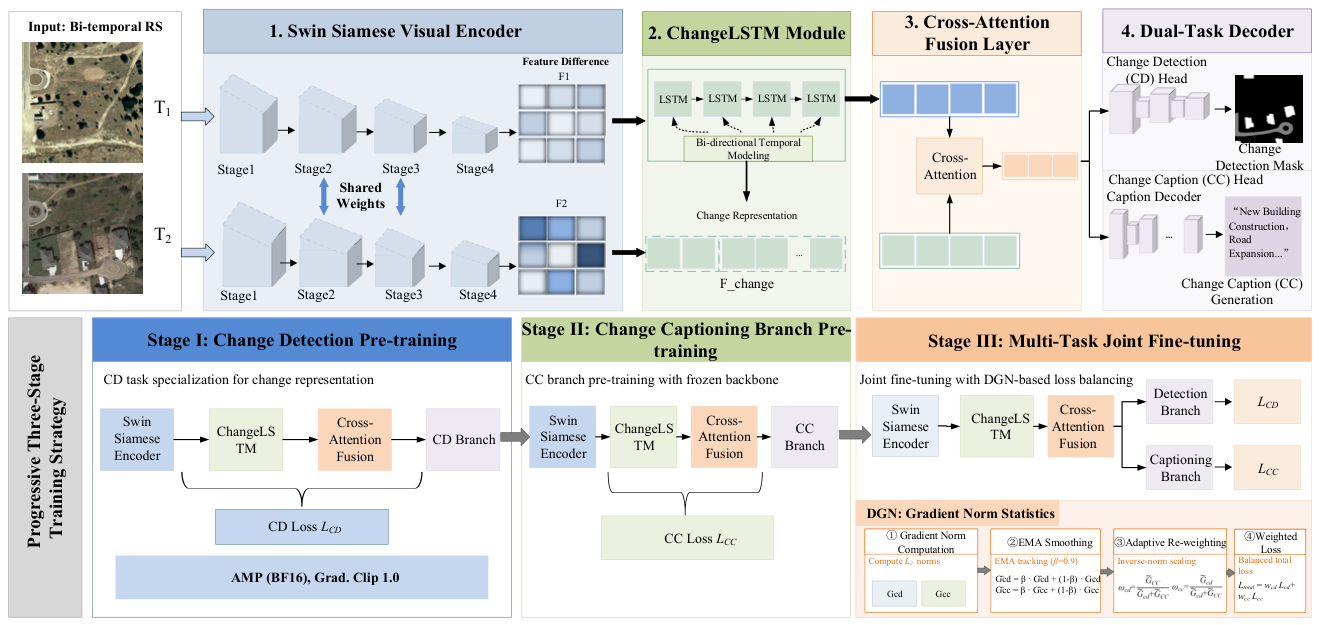
Figure 2.
Qualitative examples of the prediction results, showing three groups of bitemporal images together with the corresponding change detection and change captioning results: (a) and (b) correctly predicted cases; (c) an incorrectly predicted case.
Figure 2.
Qualitative examples of the prediction results, showing three groups of bitemporal images together with the corresponding change detection and change captioning results: (a) and (b) correctly predicted cases; (c) an incorrectly predicted case.
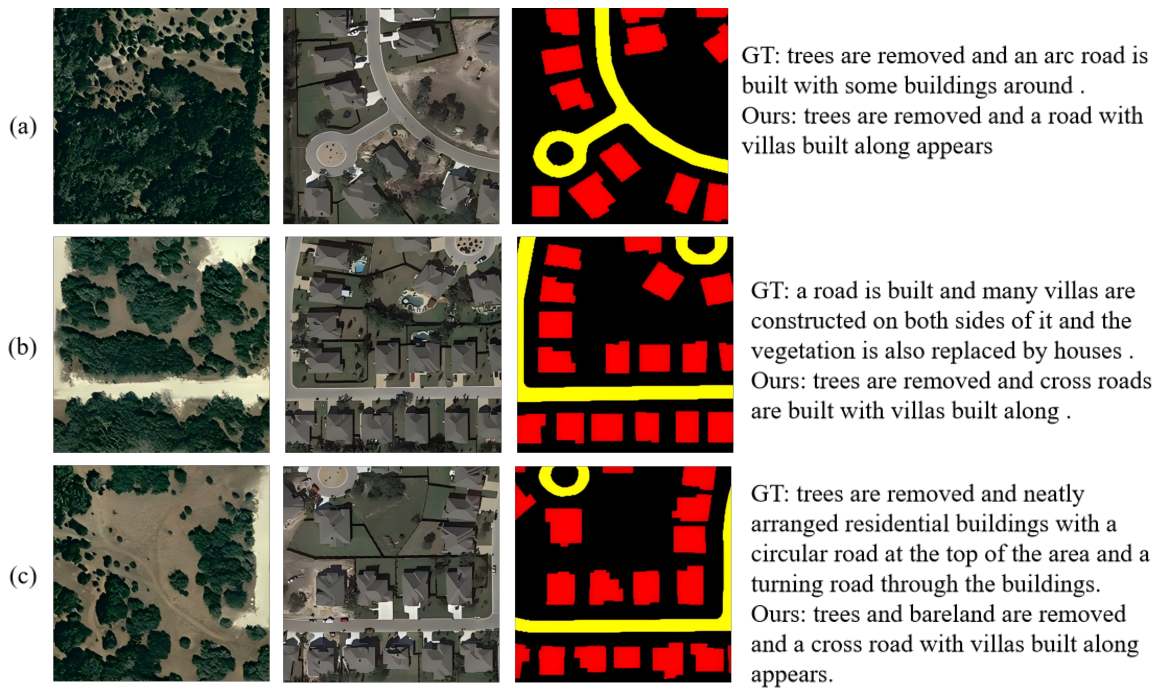
Figure 3.
Stage III joint-training dynamics of the baseline (B, solid) and the A1 ablation (dashed), shown as mean ± std over three paired seeds (42/1234/2026) under the fixed-epoch protocol (early stopping disabled). (a) Validation IoU; dotted horizontal lines mark the test-set epoch-60 means (B: 0.6903, A1: 0.6914) for reference. (b) Validation CC loss. (c) Training CC loss. (d) Training CD loss. Marked points denote evaluation epochs; epoch 60 is the predefined reporting endpoint. (e) Per-epoch normalized trends (metrics scaled to [0,1]; losses shown as 1-loss so that ↑ = better; min–max normalization over both arms; thick curves show 5-epoch moving averages, thin curves raw per-epoch values).
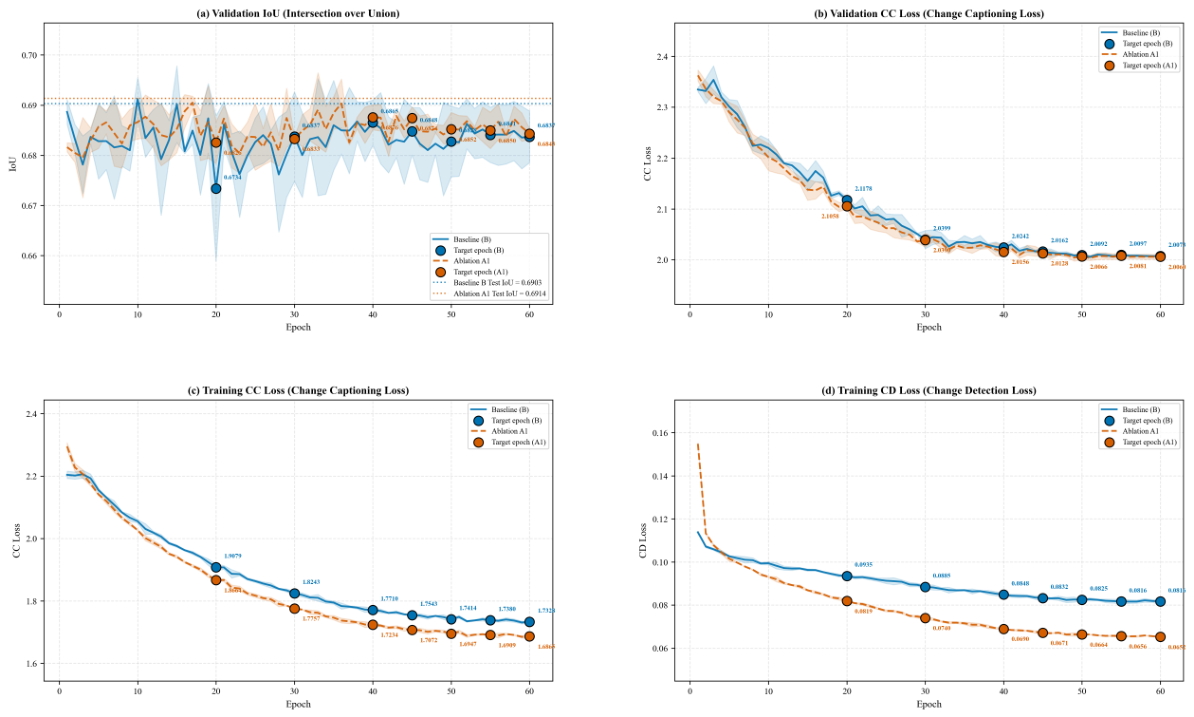

Table 1.
Parameter Settings of the Three-Stage Progressive Training Strategy.
| Stage | Task | Epochs | Learning Rate |
Batch Size |
Loss Setting |
|---|---|---|---|---|---|
| Stage I | CD pre-training | 50 | 16 | CD loss only | |
| Stage II | CC pre-training | 80 | 8 | CC loss only | |
| Stage III | Joint fine-tuning | 60 | 12 | CD+CC loss (: 0.7→0.5; : 0.3→0.5; DGN) |
Early stopping is disabled in Stage III; the Baseline and A1 runs use a fixed 60-epoch budget.
Table 2.
Dataset Configurations Across the Training Stages
| Stage | Training Set | Validation Set | Test Set |
|---|---|---|---|
| Stage I | integrated-CD train (13,665) | integrated-CD val (4,064) | integrated-CD test (4,128) |
| Stage II | LEVIR-MCI (6,815) | LEVIR-MCI (1,333) | LEVIR-MCI (1,929) |
| Stage III | integrated-CD train+LEVIR-MCI (20,480) | integrated-CD val+LEVIR-MCI (5,397) | integrated-CD test+LEVIR-MCI (6,057) |
Note: The counts denote the number of bitemporal image pairs. The integrated-CD datasets are constructed by merging LEVIR-CD and SYSU-CD with perceptual-hash-based deduplication; the sample counts differ from the direct sums of the official splits of the two source datasets.
Table 3.
Main Results on the LEVIR-MCI Test Set
| Task | Metric | mean±std |
|---|---|---|
| CD | IoU | |
| F1 | ||
| Precision | ||
| Recall | ||
| CC | BLEU-1 | |
| BLEU-2 | ||
| BLEU-3 | ||
| BLEU-4 | ||
| METEOR | ||
| ROUGE-L | ||
| CIDEr-D |
CD metrics are evaluated on the integrated CD test set (4,128 pairs); CC metrics are evaluated on the LEVIR-MCI test set (1,929 pairs). Each value is the mean ± standard deviation over three paired random seeds (42/1234/2026) at the fixed 60th epoch.
Table 4.
Comparison of Evaluation Results With Different Numbers of Joint Training Epochs
| Metric | Epoch 44 | Epoch 55 | (Epoch 44→55) |
|---|---|---|---|
| IoU | 0.6895 | 0.6908 | |
| Val. CC loss | 2.0211 | 2.0163 | |
| CC BLEU-4 | 0.5658 | 0.6090 | |
| CC CIDEr-D | 1.3367 | 1.3028 |
All results are evaluated on the validation set, under an identical decoding configuration at both checkpoints. This single-run comparison motivated the fixed-epoch, three-seed reporting protocol adopted in this paper.
Table 5.
Ablation Results on the LEVIR-MCI Test Set (Fixed 60th Epoch; Mean ± Std Over Three Paired Seeds Where Applicable)
Table 5.
Ablation Results on the LEVIR-MCI Test Set (Fixed 60th Epoch; Mean ± Std Over Three Paired Seeds Where Applicable)
| Metric | Baseline () | A1 () | (A1−B) | A2† | A3† | |
|---|---|---|---|---|---|---|
| CD | IoU | 0.6903±0.0008 | 0.6914±0.0015 | +0.0010±0.0011ns | 0.6983 | 0.6963 |
| F1 | 0.8168±0.0005 | 0.8175±0.0010 | +0.0007±0.0008ns | 0.8223 | 0.8210 | |
| Recall | 0.7963±0.0010 | 0.7844±0.0026 | −0.0119±0.0025ns | 0.8144 | 0.8056 | |
| Precision | 0.8384±0.0014 | 0.8536±0.0025 | +0.0152±0.0026ns | 0.8304 | 0.8370 | |
| CC | BLEU-1 | 0.8447±0.0043 | 0.8535±0.0035 | +0.0087±0.0023a | 0.8298 | 0.8400 |
| BLEU-2 | 0.7411±0.0060 | 0.7520±0.0047 | +0.0109±0.0027a | 0.7276 | 0.7343 | |
| BLEU-3 | 0.6646±0.0074 | 0.6746±0.0057 | +0.0100±0.0025b | 0.6510 | 0.6556 | |
| BLEU-4 | 0.6020±0.0090 | 0.6104±0.0072 | +0.0084±0.0019c | 0.5855 | 0.5890 | |
| METEOR | 0.3981±0.0040 | 0.4022±0.0043 | +0.0040±0.0004c | 0.3917 | 0.3917 | |
| ROUGE-L | 0.7655±0.0019 | 0.7727±0.0022 | +0.0072±0.0018a | 0.7639 | 0.7683 | |
| CIDEr-D | 1.3403±0.0106 | 1.3633±0.0065 | +0.0230±0.0135a | 1.3278 | 1.3473 | |
ns Pixel-wise paired test, ns in 3/3 seeds. aSample-level significant in 2/3 seeds. bSample-level significant in 1/3 seeds. c0/3 not significant, direction-consistent (–). †A2 and A3 are single runs retained from the preliminary single-run protocol (A2 CD threshold 0.30, A3 CD threshold 0.35); shown for completeness and not directly comparable with seed-averaged columns. CD thresholds of Baseline/A1 follow unified search protocol (0.30–0.60, step 0.05; all converge to 0.30); METEOR computed in a unified environment.
Table 6.
Quantitative Comparison Between Our Model and State-of-the-Art Methods
| Method | Task Type | CD IoU | CD F1- score |
CC BLEU-4 |
CC CIDEr-D |
|---|---|---|---|---|---|
| MCINet [7] | Dual-task | 0.749 | 0.856 | 0.414 | 1.049 |
| ChangeMinds [18] | Dual-task | 0.783 | 0.878 | 0.462 | 1.203 |
| SCORER [32] | Single-task (CC) |
– | – | 0.461 | 1.245 |
| RSCaMa [33] | Single-task (CC) |
– | – | 0.459 | 1.366 |
| Ours | Dual-task | 0.690 | 0.817 | 0.602 | 1.340 |
Disclaimer/Publisher’s Note: The statements, opinions and data contained in all publications are solely those of the individual author(s) and contributor(s) and not of MDPI and/or the editor(s). MDPI and/or the editor(s) disclaim responsibility for any injury to people or property resulting from any ideas, methods, instructions or products referred to in the content. |
© 2026 by the authors. Licensee MDPI, Basel, Switzerland. This article is an open access article distributed under the terms and conditions of the Creative Commons Attribution (CC BY) license.
Copyright: This open access article is published under a Creative Commons CC BY 4.0 license, which permit the free download, distribution, and reuse, provided that the author and preprint are cited in any reuse.