
Submitted:
20 November 2026
Posted:
23 November 2026
You are already at the latest version
Abstract
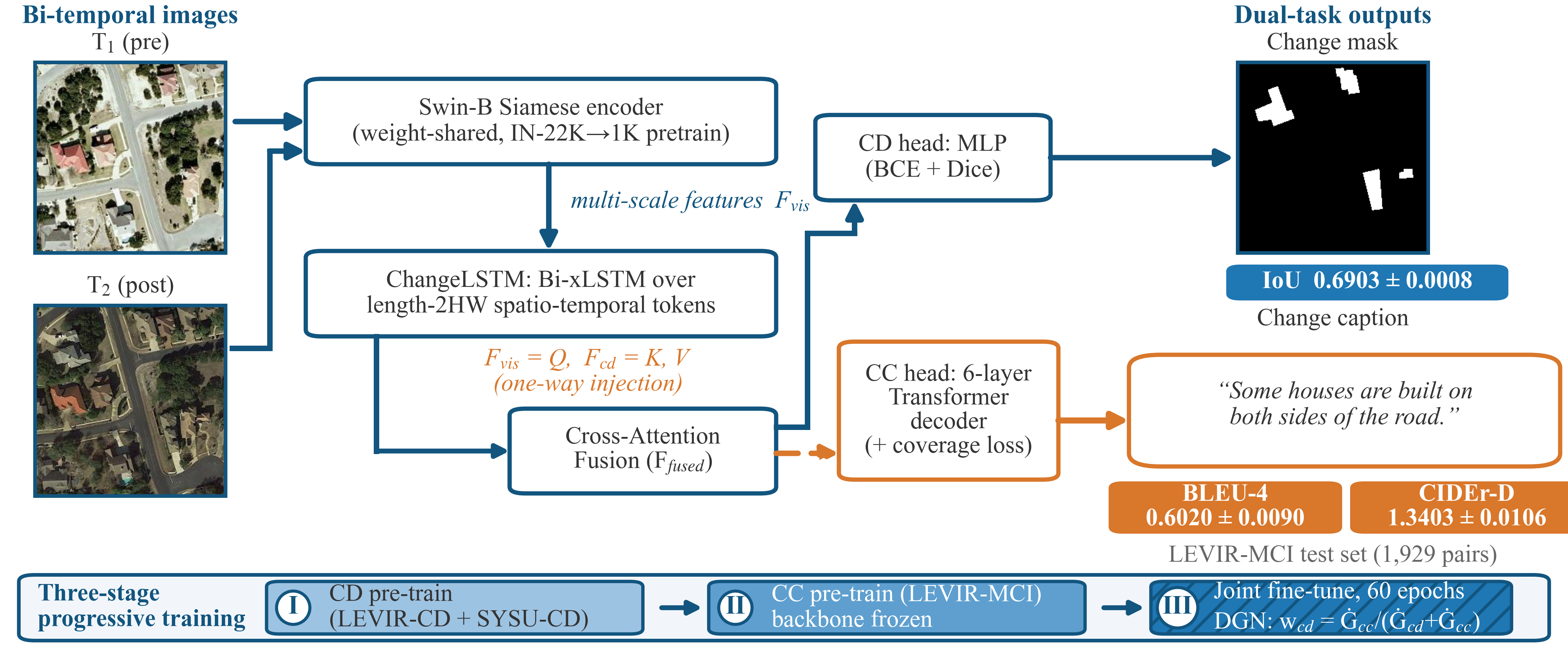
High-resolution imagery from optical sensors aboard Earth-observation satellites has become a primary data source for monitoring ground-object changes. Remote sensing change captioning meets this demand by describing, in natural language, the changes between bitemporal remote sensing images. Existing methods either treat change detection and change captioning as two independent tasks, or adopt end-to-end joint training that suffers from inter-task gradient competition and optimization conflicts. We propose ProMT-CCap, a bitemporal change captioning method based on a progressive multi-task training framework. First, a three-stage progressive training strategy performs dedicated change detection training, change captioning branch pre-training, and multi-task joint fine-tuning, enabling structured knowledge transfer from change detection to change captioning and a balanced optimization trade-off between the two tasks. Second, a cross-modal feature extraction architecture couples a Swin Siamese encoder with a bidirectional xLSTM temporal modeling module, in which the ChangeLSTM module and cross-attention fusion inject change detection features into the captioning branch. Third, a dynamic gradient normalization strategy adaptively balances the gradient magnitudes of the two tasks during joint training. Experiments on the LEVIR-MCI benchmark of remote sensing images show that ProMT-CCap achieves a BLEU-4 score of 0.6020, a CIDEr-D score of 1.3403, and a ROUGE-L score of 0.7655 averaged over three paired random seeds, outperforming existing dual-task methods and translating bitemporal remote sensing images into interpretable change captions for Earth-observation applications.
Keywords:
bitemporal optical satellite imagery
; change detection
; dynamic gradient normalization
; progressive multi-task learning
; remote sensing change captioning
; Swin Transformer
Copyright: This open access article is published under a Creative Commons CC BY 4.0 license, which permit the free download, distribution, and reuse, provided that the author and preprint are cited in any reuse.