

Submitted:
20 November 2026
Posted:
23 November 2026
You are already at the latest version
Abstract
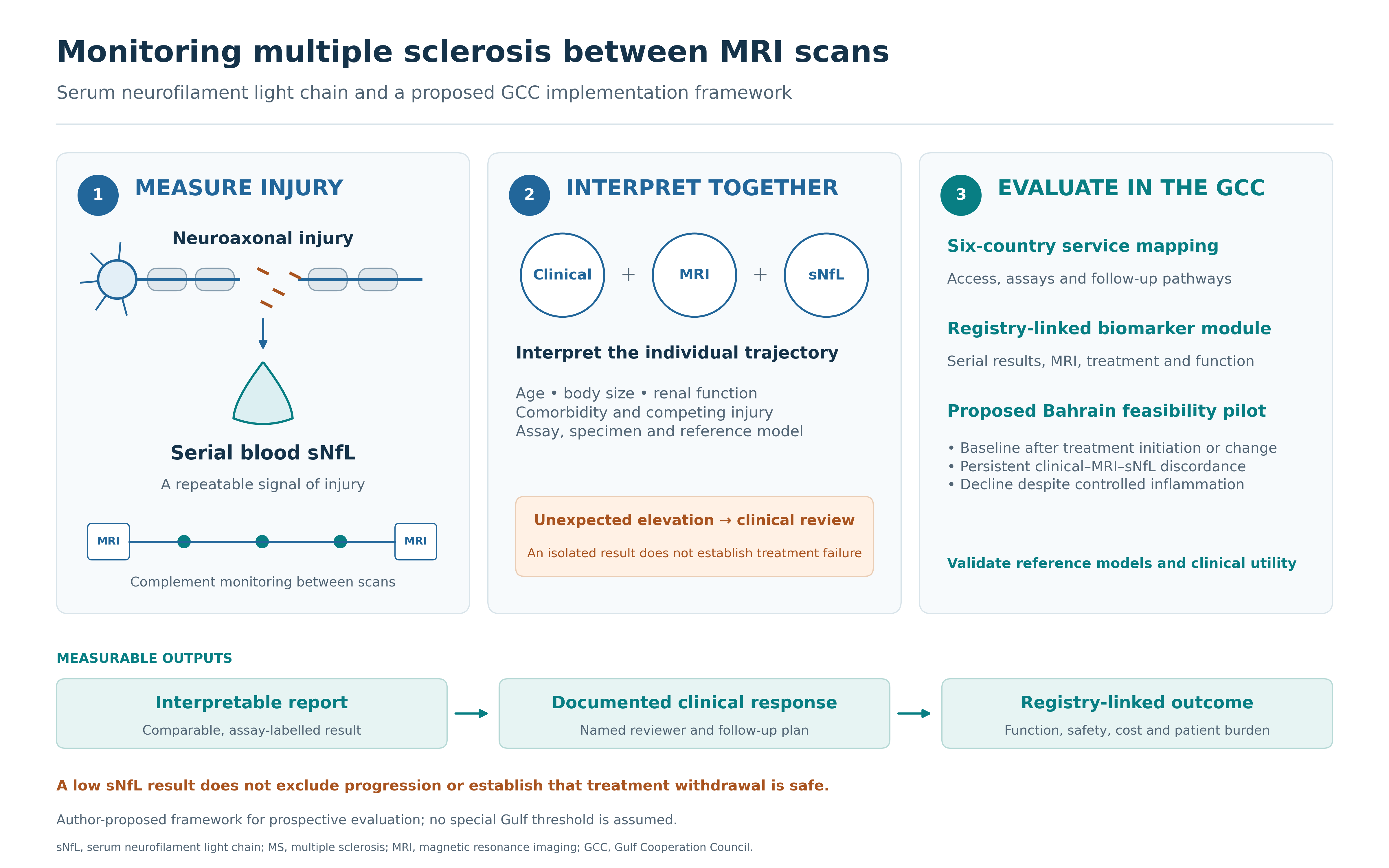
Background: Clinical assessment and magnetic resonance imaging (MRI) remain central to multiple sclerosis (MS) monitoring, but their sampling intervals and biological coverage leave uncertainty about ongoing tissue injury. Serum neurofilament light chain (sNfL) offers a repeatable measure of neuroaxonal injury that may provide complementary information between scans. Its interpretation, however, depends on clinical context, assay methodology and patient characteristics. Objective: To evaluate the clinical role of sNfL and connect international evidence with documented Gulf Cooperation Council (GCC) MS populations, treatment pathways and a testable regional implementation framework. Approach: A critical narrative synthesis distinguished direct biomarker evidence from GCC epidemiological and treatment studies, regional expert opinion and author-proposed applications. National survey reports and registry information informed the implementation context. Synthesis: sNfL provides complementary information on neuroaxonal injury, particularly in relapsing MS, but neither an isolated elevation nor a low result establishes treatment failure or excludes progression. Interpretation requires assay-compatible reference values, longitudinal comparability and assessment of age, body size, renal function and competing injury. An early Kuwaiti blood-NfL study and later Gulf epidemiological and treatment cohorts provide regional foundations; they do not validate contemporary NfL-guided decisions. After disease-modifying therapy (DMT) withdrawal, serial sNfL may support surveillance, but a low baseline does not establish that stopping treatment is safe. The proposed framework combines a six-country service inventory, a registry-linked biomarker module and a Bahrain feasibility pilot addressing treatment baselines, persistent clinical–MRI–biomarker discordance and functional deterioration despite controlled inflammatory activity. Evaluation links interpretable reports to documented clinical responses and follow-up outcomes, including unnecessary investigations, costs, patient burden and equitable access. Conclusions: GCC implementation should test whether adding sNfL supports better-informed care within existing treatment and research pathways. Local validation should evaluate reference-model transportability and clinical utility without presuming special Gulf thresholds or replacing MRI and functional assessment.
Keywords:
multiple sclerosis
; neurofilament light chain
; disease monitoring
; magnetic resonance imaging
; Gulf Cooperation Council
; bahrain
; glial fibrillary acidic protein
; implementation
; precision neurology
1. Introduction
Preventing irreversible disability in multiple sclerosis (MS) requires recognition of disease activity before its consequences become clinically unmistakable. Yet clinicians frequently face an unresolved question: how confidently can apparent stability between consultations and magnetic resonance imaging (MRI) examinations be interpreted as adequate disease control? Relapse history, neurological examination and conventional MRI remain essential, but provide an incomplete account of ongoing tissue injury. A patient may report worsening function without a recognised relapse, while stable lesion counts do not comprehensively exclude neuroaxonal damage. This gap creates a compelling rationale for a repeatable biological measure that can complement established monitoring and help determine when further assessment is warranted.[1,2,3,4]
Serum neurofilament light chain (sNfL) offers a practical opportunity to address this uncertainty. Released following neuroaxonal injury and measurable using sensitive blood assays, sNfL provides information associated with inflammatory activity, treatment response and subsequent disease outcomes.[1,2,3] Serial sampling can extend biological assessment into the intervals between MRI examinations and support interpretation of an individual patient’s trajectory. International guidance consequently positions sNfL alongside clinical assessment and MRI in MS management.[4] However, its value depends on the context in which it is measured: an elevated concentration identifies an injury signal without establishing its cause, anatomical location or appropriate therapeutic response. The clinical challenge is therefore to translate a measurable signal into a defensible decision.
This distinction is particularly important as biomarkers assume different roles across the MS care pathway. The 2024 revisions of the McDonald criteria incorporate additional diagnostic evidence, including cerebrospinal fluid kappa free light chains and selected imaging features.[5] By comparison, the principal clinical opportunity for sNfL concerns longitudinal monitoring and risk assessment. Evidence that a biomarker predicts subsequent activity does not, by itself, demonstrate that acting on its result improves patient outcomes. An unexpected elevation during otherwise stable follow-up, or a low concentration despite functional deterioration, requires an explicit approach to uncertainty rather than an automatic treatment decision.
For the Gulf Cooperation Council (GCC)—Bahrain, Kuwait, Oman, Qatar, Saudi Arabia and the United Arab Emirates—this challenge has direct clinical and organisational relevance. Regional epidemiological studies and treatment cohorts document MS populations in whom longitudinal monitoring, high-efficacy therapy and treatment transitions are already important components of care.[19,20,28] An early Kuwaiti study also provides direct regional blood-NfL evidence, although it does not establish the validity of contemporary assay-specific reference models or biomarker-guided treatment decisions.[29] These studies provide a foundation for regional implementation research, while requiring a clear distinction between evidence describing Gulf patients and evidence validating a particular biomarker application.
Successful implementation also requires attention to the populations and services in which testing will operate. National health surveys provide relevant cardiometabolic context, but individual interpretation must depend on measured body size, renal function and neurological comorbidity rather than assumptions based on nationality.[12,13,31,32] Similarly, existing registry infrastructure offers potential routes for longitudinal evaluation without establishing that participating centres already collect harmonised NfL measurements.[33] Regional professional engagement and recent reviews support the timeliness of this work.[6,7] The remaining task is to specify how a result should be interpreted, who should respond, what follow-up should occur and how its contribution to care should be assessed.
The distinctive contribution of this review is an integrated GCC implementation framework connecting the evidence for sNfL with documented regional treatment settings and a prospectively testable service proposal. Its novelty lies in bringing together population-specific evidence mapping, treatment-related clinical questions, individual assessment of confounding, laboratory comparability and measurable patient outcomes. The framework makes this translation concrete through a six-country service-mapping template, a registry-linked biomarker module and a proposed Bahrain feasibility pilot. It also places emerging applications in ageing MS and treatment withdrawal within a framework that distinguishes detection of recurrent activity from prediction of safe discontinuation.
Accordingly, this critical narrative review has four objectives: to appraise the clinical capabilities and limitations of sNfL; to distinguish direct GCC biomarker evidence from regional contextual studies and international findings requiring local evaluation; to define its potential contribution during treatment initiation, switching, clinical–MRI discordance and treatment de-escalation or discontinuation; and to propose an implementation pathway evaluated through interpretable reports, documented clinical responses and longitudinal outcomes. The central question is whether adding sNfL to existing GCC care pathways can improve clinical decisions and follow-up at an acceptable cost and patient burden. The proposed framework is intended for prospective evaluation and does not constitute a validated treatment algorithm or an endorsed regional guideline.
2. Scope and Evidence Approach
This article is a critical narrative review with a proposed regional implementation framework. Targeted web-based searches of PubMed-indexed records, PubMed Central and publisher websites were undertaken on 11 November 2026, with focused GCC evidence, national-survey, registry and figure updates on 12 November 2026. A focused treatment-exit update and reference checks were completed on 20 November 2026; this was not a comprehensive rerun of the regional search. Searches addressed MS and NfL monitoring, adjusted reference values, assay comparison, comorbidity, treatment response, GFAP, pregnancy, treatment discontinuation and GCC applicability. Original human studies and professional guidance relevant to interpretation or implementation were prioritised. An educational transcript was used to identify questions requiring scrutiny, rather than as primary evidence for clinical recommendations.
The synthesis distinguished four evidential questions: whether a measurement reflects injury, whether it is associated with later outcomes, whether it changes during treatment, and whether acting on it improves care. The last question requires evaluation beyond biomarker association. Regional service proposals were developed from these distinctions and from practical requirements for measurement, interpretation and follow-up. Supplementary Section S1 describes the retrieval approach and its limits; the remaining supplementary material provides proposed data and evaluation structures.
Regional evidence was classified by the population and question actually studied. A GCC validation study would need to measure NfL in participants recruited in one or more GCC states and evaluate analytical, reference-model, prognostic or decision-related performance. Epidemiological and treatment cohorts without that evaluation support clinical context only. Studies from other MENA countries were not reclassified as GCC evidence. Ministry reports were interpreted using their stated survey year, age coverage, sampling population and measurement definitions. Public registry listings established documented infrastructure, not assay availability or willingness to collaborate.
Selection was purposive rather than exhaustive. No independent duplicate screening, formal risk-of-bias instrument, certainty grading or quantitative pooling was undertaken. The work should therefore not be described as a systematic or scoping review. Where only an abstract or accessible indexed record was available, interpretation was restricted to reported information. The search cannot establish the absence of unpublished GCC programmes, laboratory services or relevant studies. Quantitative results remain study-specific; illustrative figures are conceptual schematics, not newly analysed patient data.
ChatGPT (OpenAI) assisted literature retrieval, substantive drafting and revision, language editing, and programming of the schematic figures from author-supplied source material. Its contribution and the authors’ responsibility are disclosed in the declarations. No patient-level data were generated.
3. Clinical Evidence for sNfL Monitoring
3.1. Disease Activity and Prognosis
NfL is a component of the neuronal cytoskeleton. Injury can release NfL into extracellular compartments, with subsequent detection in cerebrospinal fluid (CSF) and blood. In an inflammatory MS lesion, demyelination and neuroaxonal injury may coexist; myelin loss alone should not be equated with release of an axonal protein. Blood concentrations are substantially lower than CSF concentrations, but a fixed CSF-to-blood conversion ratio or transit time should not be assumed.[8] Figure 1 illustrates the biological rationale without prescribing a transport model.
Blood measurement captures an injury signal rather than its precise anatomical source or cause. In established MS, an elevated value may support concern about disease-related injury while requiring consideration of alternative explanations. The same principle limits diagnostic specificity: NfL cannot determine whether injury arises from MS, another central nervous system disorder or peripheral nervous system pathology.
Disanto and colleagues demonstrated associations between sNfL, inflammatory MRI findings, relapse activity, disability and treatment exposure.[1] Barro and colleagues subsequently linked serum neurofilament measurements with future disease worsening and brain and spinal cord atrophy.[2] These observations support biological and prognostic relevance, but population-level associations do not provide a deterministic forecast for an individual.
Benkert and colleagues advanced individual interpretation using adjusted reference distributions.[3] In their modelling and validation study, a Z score above 1.5 was associated with subsequent clinical or MRI disease activity (odds ratio 3.15, 95% confidence interval 2.35–4.23). The finding supports contextual interpretation, not a universal treatment threshold. A percentile expresses position in a reference distribution; it is not the probability of an impending relapse. Prognostic performance also depends on treatment exposure, the population's event frequency and the outcome being predicted.
3.2. Treatment Response and Longitudinal Trajectories
A fall in sNfL after treatment may provide evidence consistent with reduced neuroaxonal injury. Interpretation must account for pretreatment activity and the natural resolution of recent injury: a decline after a relapse cannot be attributed exclusively to treatment. Conversely, a patient whose baseline concentration is already low need not show a large further reduction for treatment to be clinically effective.
In a 2025 study of 447 patients who had started fingolimod, Einsiedler and colleagues evaluated an index sample obtained approximately one year after treatment initiation. Higher age- and body-mass-index (BMI)-adjusted Z scores were associated with subsequent relapses, whereas the corresponding absolute-concentration categorisation was not.[9] This was an on-treatment observational comparison; its study-derived threshold should not be repurposed as a universal pretreatment selection rule.
A 2026 prospective cohort from Catalonia examined changes over the first treatment year in 329 patients initiating 352 treatment courses. Failure to reduce the NfL Z score was associated with subsequent disease activity, but only 182 of the 342 courses continuing for at least one year had complete second-year outcome data.[10] Data-derived thresholds, incomplete outcomes and observational treatment selection limit translation into a stand-alone clinical rule. The practical inference is that trajectories can prompt a more informed review, while the benefit of treatment escalation triggered by an isolated biomarker change remains to be demonstrated.
3.3. Interpreting the Gap Between Scans
An abnormal blood result during an MRI interval may justify reassessment of the timing and coverage of imaging. However, “MRI stable, sNfL elevated” describes discordance; it does not identify its cause. Possibilities include injury outside the imaged region, different temporal windows, technical variation, non-MS neurological disease or physiological and comorbid influences.
The purpose of adding sNfL is therefore to reduce unresolved uncertainty. A test that produces an abnormal flag without an agreed review pathway may instead increase unnecessary investigations, patient anxiety and treatment exposure. Conversely, a low result can create false reassurance if clinicians stop investigating documented functional decline. Table 1 summarises the evidence relevant to these competing possibilities, separating useful associations from the remaining implementation questions.
4. Interpretation Before Intervention
4.1. Age, Body Size and Reference Populations
Age affects sNfL across adulthood, with a steeper rise later in life; it is not a confounder that begins only at age 60. Body size also matters, with higher BMI often associated with lower blood concentrations.[3,12] An apparently reassuring raw value in a younger person with obesity can therefore be misleading.
Reports should retain the measured concentration while adding a validated percentile or Z score where available. The reference model, specimen and assay must be identified. Z scores are model-derived standardised deviations and should not be assumed to follow a simple calculation using the untransformed concentration. There is no universal conversion by which a concentration such as 28 pg/mL always becomes the same Z score. Nor does converting two assay results into Z scores automatically remove platform differences. Figure 2 illustrates the interpretive principle; its curves are not a reference calculator.[3,9]
Regional validation should test whether existing models perform adequately across the populations served by GCC clinics. It should not presume that all Gulf residents share a biological baseline, or that a different reference interval is required solely because of nationality.
4.2. Renal Function and Comorbidity
In the MS PATHS study, which measured sNfL in 6,974 people with MS, elevated values were associated with diabetes, impaired renal function and smoking; higher BMI was associated with lower odds of elevation.[12] A separate study analysing 2,933 measurements from 800 patients also demonstrated the importance of renal function.[13]
These associations should not be reduced to a simple rule that every renal-associated elevation reflects impaired clearance. Comorbidity can affect biomarker handling, contribute neurological injury, or coexist with MS activity. Similarly, diabetic peripheral neuropathy may contribute an injury signal that is biologically real but not evidence of inflammatory breakthrough in the central nervous system (CNS).
A result should therefore be interpreted with the patient's renal trajectory, neurological comorbidities and recent events. Statistical adjustment cannot establish the cause of an individual abnormality, and there is no universally validated renal correction that makes clinical review unnecessary. Figure 3 summarises the principal biological, clinical and analytical influences that require consideration before attributing an abnormal result to MS activity.[11,12,13]
4.3. Assays, Specimens and Longitudinal Continuity
Dargvainiene and colleagues compared three assays in 303 healthy donors and 181 patients with MS. Correlations were strong, but Elecsys absolute concentrations were approximately sixfold lower than those from the other assays; about 3% of samples showed substantial platform-specific deviations.[11] This illustrates why association between methods is insufficient for serial clinical interchangeability.
A GCC monitoring service should preferentially maintain the same specimen type, assay and laboratory for each patient. If a laboratory changes platform, overlapping measurements and an evaluated bridging procedure should be considered. Historical results should retain their original method labels; they should not be silently relabelled onto a new scale. Serum and plasma results likewise require method-specific interpretation.
The proposed laboratory report should include units, assay, specimen, collection date, reference model and the preceding comparable result. Laboratory verification should address precision, sample handling and relevant interference. A verified analytical change warrants clinical review; it is not automatically a treatment threshold. Results near the lower quantification limit require particular care when expressing percentage change, because a small absolute difference can produce a large percentage difference.
Supplementary Figure S1 illustrates the immunoassay principle and the three assays included in the cited comparison; it is neither an exhaustive platform inventory nor a statement of regulatory availability in individual GCC countries.[11] Supplementary Section S3 proposes a reporting template that makes longitudinal comparability explicit.
5. A Proposed Clinical Workflow
5.1. Baseline and Follow-Up
International guidance supports follow-up assessment at approximately three-to-six-month intervals in relevant monitoring contexts, including reassessment after recent inflammatory activity and after disease-modifying therapy (DMT) initiation.[4] A pretreatment sample can provide useful context, but urgent treatment should not be delayed to obtain it. Sampling near a relapse must be labelled accordingly. A later on-treatment measurement should establish a comparable reference point without erasing the historical trajectory. Re-baselining is a clinical interpretation of a dated result, not a reason to reset or discard every preceding value.
For an initial GCC pilot, six-monthly sampling could be the default for selected clinically stable participants, with more frequent measurements when a defined clinical question justifies them. This is a service proposal, not an established optimum schedule. It should be evaluated against patient burden, turnaround time and useful clinical actions.
MRI should continue according to the patient's clinical and treatment context.[18] Blood testing should not lengthen imaging intervals automatically. Results suggesting urgent neurological disease require prompt assessment rather than waiting for a planned repeat sample.
5.2. Responding to Discordance
The initial response to an unexpected elevation should be to verify comparability and review alternative explanations. Clinicians should establish whether the specimen or platform changed, whether renal function deteriorated, and whether recent neurological injury or other relevant events occurred. Adherence, treatment duration and expected onset of efficacy also require review.
Persistent, unexplained elevation can justify closer follow-up, reassessment of MRI quality and coverage, and multidisciplinary discussion. Treatment escalation becomes more persuasive when the biomarker trajectory is accompanied by clinical or radiological evidence, but the decision remains individualised. An isolated biomarker result should not become a mandatory switch instruction. The proposed review should distinguish analytical non-comparability, a plausible competing injury source, unresolved discordance and corroborated MS activity. The clinician should document which category best explains the result, what action was taken and whether subsequent evidence resolved the uncertainty.
Figure 4 summarises common MRI–sNfL combinations, while Table 2 extends the proposed framework to clinical deterioration and atypical presentations. Neither is a validated treatment algorithm. An elevation or meaningful rise must be defined using the applicable assay, reference model and longitudinal context, rather than a universal Z-score threshold.
5.3. Connecting Monitoring to Gulf Treatment Pathways
The relevance of sNfL should be framed around decisions arising in established Gulf services. A Kuwaiti national-registry study evaluated 1,408 patients with relapsing-remitting MS receiving therapies classified by its authors as high efficacy, including anti-CD20 agents, natalizumab, cladribine, alemtuzumab and fingolimod.[19] That classification should not be treated as universal. Treatment and discontinuation findings identify settings in which serial biomarker evaluation could be embedded; they do not demonstrate benefit from NfL-guided management.
At DMT initiation or switching, the proposed question is whether a comparable on-treatment trajectory emerges after sufficient exposure. A sample obtained during recent inflammatory activity provides a different starting point from one taken during stability. Record treatment and relapse dates, retain the pretreatment result, and reassess in a clinically appropriate three-to-six-month context rather than declaring failure from an early residual elevation.[4] During a transition, record the outgoing and incoming treatment, last administration, interruption interval, adherence and safety considerations. NfL should neither determine the transition interval by itself nor delay an otherwise indicated treatment change.
For an unexpected rise during high-efficacy therapy, first verify the assay, reference model, sampling context and possible competing injury. Reassess symptoms, function and MRI according to the clinical question; an apparently suppressed relapse rate does not make every rise MS-related. Conversely, low sNfL must not overrule objective deterioration. The expanded Qatar Q-OCRE study included 451 ocrelizumab-treated patients and reported differing disability trajectories across phenotypes.[20] It provides a setting for testing whether biomarkers add information beyond relapse suppression and conventional follow-up. This is a proposed application, not a biomarker finding of that cohort. Functional decline should still prompt assessment for progression, incompletely captured disease activity and non-MS contributors. A research GFAP component could be evaluated separately, without making dual testing a prerequisite for care.
5.4. Disability, Cognition and Patient Communication
A low sNfL result should not close the assessment of cognitive complaints, fatigue or progressive functional loss. Monitoring should include appropriate measures of walking, dexterity, cognition and patient-reported impact, rather than relying on the Expanded Disability Status Scale alone. Mood, sleep, medication effects and vascular or metabolic disease may also contribute.
The appropriate patient message is that the test provides additional information about nerve-fibre injury. A low or falling value can be encouraging, but it is not proof that every disease process has stopped. Conversely, an unexpected increase is a reason for investigation, not by itself a diagnosis of treatment failure.
Patient relevance should be measured as part of implementation. Record the preferred language and whether an explanation was provided in that language, using an interpreter where needed. A brief teach-back can assess whether the patient understands that a high result requires interpretation and a low result does not exclude every cause of worsening. Record test-related travel time, time away from paid work or usual activities, out-of-pocket expenditure and additional visits, distinguishing blood tests combined with scheduled care from visits generated solely by the pathway. These measures can identify burdens obscured by a low laboratory price.
Continuity should also be observable. When patients change institution, their portable summary should include dated concentrations, specimen and platform, reference-model version, the clinician's interpretation and the follow-up plan. The receiving service should acknowledge review rather than merely record that a document was sent. Supplementary Table S2 specifies patient and continuity measures, including missing responses, without imposing unvalidated performance targets.
6. Applications That Require Additional Caution
6.1. Progression and GFAP
NfL and glial fibrillary acidic protein (GFAP) reflect different cellular sources, but they should not be presented as exclusive markers of inflammation and progression respectively. GFAP is an astroglial intermediate filament protein; its blood concentration can provide information about astroglial injury or reactivity. In a prospective study of 104 patients with early relapsing-remitting MS followed for five years, Rosenstein and colleagues found an association between sGFAP and progression independent of relapse activity (PIRA).[14] This also demonstrates why progression-related biology should not be illustrated as confined to a late, inevitably progressive stage of MS.
Meier and colleagues directly compared the biomarkers in Swiss cohorts and found stronger associations between GFAP and progression, while NfL was more closely related to acute inflammatory activity in the studied settings.[15] These relative associations do not establish that GFAP is unaffected by inflammation in every patient or that an elevated value diagnoses PIRA. PIRA remains a longitudinal clinical outcome requiring explicit definitions and exclusion of relapse-associated worsening.
A 2026 observational analysis extended the evidence to 2,329 participants across the Swiss MS and EPIC cohorts. Higher GFAP was associated with subsequent PIRA, and treatment-associated reductions were associated with lower later PIRA risk.[16] This strengthens the rationale for complementary longitudinal measurement but does not demonstrate that changing treatment to achieve a GFAP target improves outcomes. Differences in outcome definitions, case mix and treatment exposure also matter when comparing cohorts.
Supplementary Figure S2 therefore compares cellular sources, clinical associations and interpretive limitations without depicting a universal biomarker trajectory or an inevitable sequence of disease stages. A regional research panel could pair NfL and GFAP with functional outcomes and imaging. Compulsory routine dual testing remains premature without evidence of incremental clinical utility, and neither marker should be used alone to label symptoms as “smouldering MS”.
6.2. Pregnancy and Postpartum
Pregnancy is a potential setting for complementary blood monitoring. It should not, however, be treated as a setting in which MRI is categorically unavailable. Non-contrast MRI can be used when clinically indicated; gadolinium requires a separate and more restrictive benefit–risk assessment.[18,21]
The Swiss MS cohort has evaluated treatment strategies, clinical and MRI activity, and sNfL during pregnancy and postpartum.[22] Such work supports continued research, while physiological changes and sampling timing complicate attribution. An increase should not automatically be interpreted as relapse, and a low result should not delay assessment of new neurological symptoms.
6.3. PML, Pseudorelapse and Asymptomatic Screening
NfL has been investigated in natalizumab-associated PML.[23] However, an injury biomarker cannot identify the underlying virus or reliably replace established risk assessment and MRI surveillance. Suspected PML requires the appropriate clinical, imaging and virological pathway.
Similarly, sNfL is not a validated immediate bedside discriminator between relapse and pseudorelapse. The temporal relationship between injury, blood elevation and sampling limits that use. Clinical assessment of infection, temperature-related symptom worsening and new neurological deficits remains necessary.
Routine NfL screening of asymptomatic relatives is outside the proposed clinical pathway. A family history does not make a nonspecific injury biomarker diagnostic. Predicting future MS in an asymptomatic person requires evidence and safeguards different from monitoring established disease.
6.4. Serum NfL in Ageing MS: Treatment De-Escalation, Discontinuation and Post-Withdrawal Surveillance
Treatment exit strategies in ageing MS require an individualised assessment of disease activity, disability trajectory, treatment-related risks and patient preferences. Three potential biomarker applications should be distinguished: selecting candidates before withdrawal, detecting recurrent activity after withdrawal, and determining whether biomarker-guided treatment reintroduction improves outcomes. Evidence for one does not establish the others. Dose-spacing, switching to a lower-efficacy therapy and complete discontinuation also represent different transitions and should be analysed separately.
DISCOMS provides an important clinical context. It enrolled 259 participants aged at least 55 years who had experienced no relapse for five years and no new MRI lesion for three years while receiving DMT. Over two years, a relapse or new or expanding brain MRI lesion occurred in 12.2% of discontinuers and 4.7% of continuers. Non-inferiority of discontinuation was not established. The trial did not establish an NfL criterion for selecting patients who could safely stop treatment.[24]
In an observational cohort of 78 clinically stable patients who discontinued treatment, Bose and colleagues found that higher post-withdrawal sNfL was associated with subsequent confirmed disability worsening and new MRI activity, whereas the pre-withdrawal measurement was not predictive. Median age at discontinuation was 48.5 years, limiting direct extrapolation to people in their sixties and seventies; median follow-up was 6.3 years. An increase exceeding 100% was associated with disability worsening (hazard ratio 3.87; 95% confidence interval 1.40–10.70) and new MRI activity (hazard ratio 4.02; 95% confidence interval 1.51–10.70). GFAP changes also carried prognostic information. These exploratory associations support longitudinal surveillance research, not a validated restart threshold.[25]
The DOT-MS biomarker analysis further distinguishes detection from prediction. Among 89 randomised participants, eight developed significant disease activity, all in the discontinuation group. Changes in sNfL helped detect activity but did not reliably predict it before withdrawal. A study-derived increase of 46.4% had sensitivity of 57% and specificity of 96% for significant activity; a result below this change threshold therefore could not exclude activity. GFAP did not discriminate activity reliably in this setting. Neither this percentage nor the 100% increase in the preceding cohort is a universal clinical threshold.[17]
A 2026 retrospective case-control study of 118 patients found greater confirmed disability progression, including PIRA, after discontinuation of moderate-efficacy therapies, without significant between-group differences in sNfL, relapse activity or MRI activity over two years. Baseline group differences and residual confounding limit causal interpretation, and the study was not a formal diagnostic-accuracy validation. Nevertheless, it reinforces the need to retain longitudinal functional assessment even when inflammatory and injury markers appear reassuring.[26]
Interpretation in older adults must account for age, body size, renal function and competing neurological injury, with assay continuity and a suitable reference model.[4] A low on-treatment concentration may reflect effective suppression rather than safety without treatment. Treatment class also matters: an observational study of nonactive MS in people aged at least 50 years found different recurrence patterns after stopping natalizumab or fingolimod compared with anti-CD20 therapy.[27] Biomarkers should not override class-specific transition planning or established surveillance.
For GCC research, an optional ageing-MS treatment-exit module could record clinical function, MRI and assay-labelled sNfL before a planned transition and during follow-up. Sampling before withdrawal and at three, six and twelve months is a proposed research schedule, not a validated standard, and would require adaptation to treatment class, clinical risk and service capacity. An unexplained rise should prompt assessment of competing causes and timely clinical/MRI review; a low result must not negate new symptoms or functional deterioration. Supplementary Section S7 specifies the additional fields and outcomes. The testable question is whether biomarker-supported surveillance improves proportionate investigation and treatment decisions without increasing unnecessary testing, treatment exposure or patient burden.
Box 1. consolidates the interpretive boundaries that should remain explicit throughout monitoring.
| Box 1. Boundaries for responsible clinical use |
| 1. Use sNfL to complement an established clinical assessment; do not use it to diagnose MS independently. 2. Preserve assay and specimen continuity, and identify the reference model. 3. Interpret the trajectory alongside timing, age, body size, renal function and competing injury. 4. Treat an unexplained elevation as a question requiring resolution, not an automatic treatment instruction. 5. Do not allow low sNfL to negate new MRI activity or documented functional decline. 6. Do not use normal sNfL to certify safe DMT withdrawal or exclude PML. 7. Explain uncertainty to patients and agree who will review an unexpected result. 8. Evaluate downstream decisions, outcomes, access and costs rather than counting tests alone. |
7. GCC Implementation Priorities
The Gulf rationale rests on documented MS populations and service questions, rather than an assumed regional biomarker phenotype. In Qatar, a population-based registry study identified 1,017 incident cases during 2016–2024 and estimated minimum prevalence among Qatari nationals at 118.29 per 100,000 in 2024.[28] The estimate applies to nationals, not all residents, and does not establish a Qatari NfL reference interval. Citizenship and residency denominators also matter when evaluating access and follow-up. Early regional biomarker evidence must also be recognised. Al-Temaimi and colleagues recruited 100 Kuwaiti patients and 77 Kuwaiti controls, measured circulating NfL by ELISA and reported higher levels in the MS group.[29] This establishes direct Gulf-participant NfL research. It does not validate contemporary serum assays, adjusted reference models or treatment-switch thresholds. Table 3 separates exploratory biomarker findings, modern validation questions, contextual studies and proposed applications.
7.1. Cardiometabolic Context Anchored in National Data
Bahrain's National Health Survey 2018 included adults aged 18 years and above from Bahraini and non-Bahraini households. Its BMI table reported weighted obesity prevalence of 36.9% (BMI ≥30 kg/m²) and overweight prevalence of 35.5% (BMI 25–29.9 kg/m²), with 2,948 unweighted observations in that analysis. Pregnant women were excluded from anthropometric assessment. Separately, 10.8% reported a previous formal diabetes diagnosis, based on 3,020 respondents; this is not total diabetes prevalence determined by biochemical screening.[31] These definitions prevent inappropriate comparison of unlike estimates.
The UAE National Health Survey 2017–2018 STEPS fact sheet reported obesity prevalence of 27.8% (95% confidence interval 26.1–29.4) among adults aged 18–69 years.[32] Earlier Saudi national studies describe diabetes and obesity in 2013.[34,35] Their different dates, age coverage and ascertainment preclude a single pooled “Gulf prevalence” or a ranking of countries. None directly estimates comorbidity among people with MS.
The clinical implication is patient-level assessment. Higher body size may lower measured blood NfL, whereas reduced renal function or diabetes-associated neurological injury may contribute to an elevated result.[4,12,13] These influences need not operate in the same direction. Measure body size, review renal status when clinically appropriate, and consider neuropathy, cerebrovascular injury and other plausible neurological causes. Do not assign an individual's risk from national prevalence or treat diabetes alone as proof of the source of an elevation. Glycated haemoglobin (HbA1c), where relevant to clinical care, provides context; it is not a validated Z-score correction or a mandatory investigation at every sample.
Reference-model evaluation should therefore include both a neurologically healthy reference sample and a separately defined clinical cohort with relevant comorbidity. Local recalibration should follow demonstrated miscalibration, not nationality alone. Consanguinity, vitamin D status, Ramadan fasting and heat exposure should not be presented as established NfL correction factors or reasons for a special Gulf threshold. Symptoms occurring in those contexts still require ordinary clinical assessment.
7.2. Service Access, Research Infrastructure and Continuity
The six GCC states should not be treated as a single laboratory or reimbursement system. A centre-level inventory should document local versus referral testing, specimen and platform, reference interpretation, transport, turnaround, coverage and patient payment, access to follow-up MRI and the clinician responsible for results. Supplementary Table S3 supplies a six-country template with all unverified service fields labelled explicitly. It is an instrument for collecting evidence, not a completed national readiness audit.
Existing infrastructure can provide a starting point. MENACTRIMS publicly lists registry centres in Kuwait, Oman, Saudi Arabia and the UAE.[33] This supports exploring collaboration through established clinical networks. It does not demonstrate harmonised NfL sampling, shared assay platforms, data-transfer permissions or consent to participate. Absence of a country from that public list must not be equated with absence of an MS registry or research programme. Country-specific treatment cohorts also demonstrate experience with longitudinal clinical data, although access and linkage require separate agreement.[19,20,28]
A referral-laboratory model may permit participation without an analyser at every centre, provided transport and reporting are validated. The complete route from sampling to clinical action matters: a test is not operationally accessible if an abnormal result cannot be reviewed or appropriate imaging cannot be obtained. Biomarker availability must not become a barrier to otherwise indicated DMT. Public/private care, insurance coverage, residency and geographical travel should be examined as access variables, without treating any as a biological proxy. Transferable assay-labelled summaries and acknowledgement by the receiving clinician are essential when care moves between institutions.
7.3. A Proposed Bahrain Feasibility Pilot
Earlier Bahraini work on interleukin-1 receptor antagonist (IL-1RA) and 2′-5′-oligoadenylate synthetase-like protein (OASL) demonstrates a precedent for linking clinical MS cohorts with molecular and protein biomarker research.[30] This research provides a local foundation for clinical–laboratory collaboration, but does not validate NfL or establish institutional participation in a new study.
A Bahrain pilot could test whether adding sNfL to ordinary clinical and MRI assessment produces interpretable information, better-supported decisions and completed follow-up at acceptable burden. The proposed service configuration comprises an MS clinical team, a verified local or referral laboratory, radiology, an MS nurse or care coordinator, a data custodian and a clinical evaluation group. Institutional participation, access to records and funding would require explicit agreement before recruitment. No service is enrolled in the present proposal.
Three entry scenarios are proposed: establishment of a comparable baseline after DMT initiation or change; investigation of persistent clinical–MRI–NfL discordance; and assessment of functional deterioration despite apparently controlled inflammatory activity. The latter scenario should be eligible irrespective of whether NfL is elevated. Eligibility, adult age range, clinical stability definitions, assay-specific flags, recruitment target and follow-up period must be prespecified with participating services. The pilot should not recruit merely to derive a local cut-off from a small convenience sample.
At entry, the treating clinician records the clinical question and intended management before viewing the new biomarker result. The laboratory verifies analytical suitability and issues an interpretable report. The named treating clinician retains responsibility for integrating the result, deciding whether reassessment is needed and recording a plan; the coordinator tracks review and follow-up completion. A backup clinician and escalation route are required when the primary reviewer is unavailable. Urgent neurological symptoms follow the usual clinical pathway immediately, irrespective of sampling or result availability.
Sampling is linked to the question and timing of recent activity or treatment. Three-to-six-month reassessment contexts follow international guidance; a six-monthly default for selected stable pilot participants would be a service-design choice, not a proven optimum.[4] Figure 5 links this pathway to three auditable outputs: an interpretable report, a documented clinical response and a registry-linked outcome. Table 4 describes progression from preparation to broader clinical-utility evaluation.
The initial evaluation should report the proportion of eligible episodes completing all three outputs, alongside each component, turnaround and unresolved discordance. Recording intended management before result release allows description of what changed; a change alone is not evidence of benefit. A separate clinical review group should assess whether investigations and treatment decisions were proportionate to the total evidence, while disease-activity and functional outcomes are adjudicated independently of NfL where feasible. Unnecessary scans, repeat sampling, uncorroborated escalation, adverse events, delayed action and false reassurance are as relevant as earlier detection.
Expansion should depend on prospectively agreed standards for analytical validity, reporting completeness, timely clinical response, follow-up retention, equitable access and acceptable burden and cost. Persistent unreviewed abnormalities, non-comparable serial results or excessive investigations without useful resolution should trigger pathway revision or a pause. Recruitment targets and numerical progression criteria should follow protocol development and service capacity assessment. Supplementary Section S6 and Table S4 specify roles and protocol decisions; no arbitrary performance threshold is asserted here.
8. A Regional Validation and Clinical-Utility Agenda
8.1. A Registry-Linked Biomarker Module
The proposed module should extend existing clinical records where feasible, avoiding a disconnected spreadsheet of concentrations. It requires linked patient, monitoring-episode, specimen/assay, MRI, treatment-exposure, clinical-action and outcome records. A stable pseudonymous patient identifier links episodes; specimen and report identifiers preserve repeat assays and corrected results. Date and time fields distinguish sample collection, release, clinician review, imaging and follow-up. An apparent change should remain traceable to its source measurement and reference-model version.
Supplementary Table S1 sets out the core data structure, timing and interpretation. Store raw concentrations and units alongside any validated Z score or percentile, with assay and specimen identity. Capture DMT start/stop and administration dates, recent relapse or corticosteroids, measured body size, dated renal information and relevant neurological comorbidity. Link MRI dates and findings to protocol-selected functional outcomes rather than reducing follow-up to relapse counts. Code “not measured”, “unavailable”, “not applicable” and “unknown” separately; do not silently convert missing data to normal findings.
Governance requires institutional permission, defined custodianship, access control, an audit trail and lawful linkage/transfer arrangements. A federated design could retain identifiable records locally while sharing an agreed pseudonymised dataset or aggregate analyses, subject to each jurisdiction's requirements. Nationality and residency, if justified and permitted, support representativeness and equity analysis; they do not substitute for ancestry. Registry listing, clinical authorship and research approval are separate matters. The proposed module does not imply that existing MENACTRIMS or national records already contain these fields.[33]
8.2. Reference-Model and Clinical-Performance Evaluation
The first analytical question is transportability: do existing assay-compatible reference models perform adequately in the populations seen by GCC services? Recruitment should include citizens and expatriate residents across relevant age and body-size ranges. A neurologically healthy reference sample and a separate clinically representative comorbidity cohort would answer different questions. Combining them indiscriminately could obscure the distinction between physiological variation and disease-related injury.
Prospective clinical cohorts should retain dated information on symptoms, relapse, corticosteroids, DMT exposure, renal function, specimen and platform, MRI findings and functional outcomes. Outcome adjudicators should be blinded to biomarker results where feasible, and biomarker elevation should not itself define the disease-activity endpoint. Otherwise, the evaluation risks circularity.
Analyses should examine calibration, sensitivity, specificity and predictive values at the observed event frequency, together with within-person changes. Missing follow-up, informative testing, centre effects and treatment changes require explicit handling. A locally derived model should undergo independent validation. Recalibration should follow evidence of inadequate transportability; geographical location alone is not a reason to replace an adequately performing model.
8.3. Clinical Utility, Economics and Patient Relevance
The decisive question is whether adding sNfL improves care. A pragmatic comparison of biomarker-supported monitoring with standard clinical/MRI follow-up could assess time to confirmed activity, appropriate and unnecessary escalation, functional outcomes, adverse events and patient-reported burden. Sample size should follow a prespecified primary outcome and anticipated event rate rather than a convenient recruitment target.
Economic evaluation must include the full pathway: laboratory infrastructure, sample transport, repeat tests, extra consultations, additional imaging and treatment consequences. There is no basis in this review for assuming that blood testing will replace MRI or save money. A less expensive individual test can still increase total expenditure if its downstream consequences are not beneficial.
Patient outcomes should include preferred-language communication, understanding of result limitations, time away from work or usual activity, travel, additional visits and continuity after institutional transfer. Describe both absolute burdens and differences from the comparator pathway. Report respondents and missing responses for patient measures; low burden among respondents can coexist with substantial loss to follow-up. Stratified assessment should consider clinical case mix and service coverage, protect small groups from identification and avoid attributing access differences to nationality itself.
Supplementary Table S2 defines candidate process, decision, safety, patient and continuity indicators with explicit denominators or measures. Targets should be agreed prospectively with clinicians, laboratories and patients. Supplementary Section S4 distinguishes feasibility and association studies from evaluations capable of testing whether biomarker-supported care improves outcomes.
9. Limitations
The evidence base is heterogeneous in assay methodology, specimen, treatment exposure, follow-up and outcome definitions. Some recent findings remain observational or are available as conference abstracts. Prognostic associations and pharmacodynamic changes do not establish that a particular management algorithm improves outcomes. The targeted search does not support an exhaustive inventory of GCC evidence or services.
The exploratory Kuwaiti NfL study used an earlier assay approach; the selected Gulf epidemiological and treatment cohorts answer different clinical questions. Together they do not establish contemporary NfL reference thresholds or the effectiveness of biomarker-guided decisions. National health surveys describe general populations with differing ascertainment and cannot be used as MS-specific comorbidity estimates. Public registry information is dynamic and does not constitute a service audit. The Bahrain proposal has no enrolled institutions or participants, and its economic consequences have not been measured.
The regional framework is an author-developed proposal derived from international evidence and implementation reasoning. Its clinical thresholds, sampling intensity, resource requirements and cost consequences require prospective evaluation. This limitation defines the intended next step: testing the pathway rather than presenting it as established practice.
10. Conclusion
sNfL can add a repeatable measure of neuroaxonal injury to MS monitoring, particularly when a defined question arises between clinical and MRI assessments. Its value depends on the interpretability of the measurement: a result must retain its assay and specimen identity, reference-model context and relationship to the patient's previous trajectory. An elevated value requires explanation, while a low value cannot establish absence of progression, negate new MRI activity or certify the safety of treatment withdrawal.
For GCC services, the substantive opportunity is to connect this information to documented populations, treatment pathways and research infrastructure. Regional epidemiological and treatment studies justify asking how NfL might improve care, while national health surveys explain why measured body size, renal status and relevant neuropathy deserve attention. They do not establish distinct Gulf thresholds. Testing existing reference models in representative populations, including citizens and expatriate residents, should precede assumptions that recalibration is necessary.
A Bahrain feasibility pilot can make this agenda testable through three clinical scenarios, accountable result review and linked follow-up. Its practical outputs are an interpretable report, a documented clinical response and an evaluable outcome. A six-country service inventory and a common biomarker module could support subsequent collaboration, provided institutions agree on governance and analytical comparability. The next evidential step is to establish whether the pathway works reliably; a controlled evaluation must then determine whether it improves outcomes.
Implementation is justified when added information supports proportionate decisions and benefits patients sufficiently to outweigh unnecessary investigations, treatment exposure, cost and burden. Preferred-language explanations, time away from work, travel and continuity between institutions belong within that assessment. Complementary biomarkers such as GFAP should enter on the same terms: demonstrated incremental value rather than novelty alone. The regional contribution is therefore a measurable programme linking injury detection to accountable care, with function and patient experience determining success.
Supplementary Materials
The following supporting information can be downloaded at the website of this paper posted on Preprints.org.
Author Contributions
Isa Ahmed Alsharoqi: conceptualisation, development of the GCC framework, literature synthesis, original drafting, and provision of source figure material. Abdulla I Salem Alsharoqi: evidence interpretation and critical manuscript revision. Bader Ali Mohamed: clinical and biomarker interpretation and critical manuscript revision. All authors are responsible for the accuracy and integrity of the work.
Funding
No funding was received for this work.
Use of Artificial Intelligence
ChatGPT (OpenAI) assisted literature retrieval, drafting and revision, organisation and language refinement, and executing of the schematic figures. The authors retain responsibility for the scientific content, references and final manuscript.
Ethics Approval and Consent to Participate
This literature-based review reports no newly collected participant data or identifiable clinical case material; ethics approval and participant consent were not required for the review. Proposed regional studies would require the approvals, consent arrangements and governance applicable to their eventual design and setting.
Consent for Publication
Not applicable.
Data Availability
No original patient dataset was generated or analysed. Supporting publications are cited, and the supplementary material provides the proposed reporting and evaluation structures. The figures are conceptual illustrations and do not depict patient-level observations.
Figure Preparation
Isa Ahmed Alsharoqi supplied source figures and conceptual material. These informed seven redrawn, editable schematic figures, with revisions to wording, layout and presentation and expansion of the GCC implementation figure. The diagrams illustrate concepts rather than patient data or simulated clinical images.
Conflicts of Interest
The authors declare no conflicts of interest.
References
- Disanto, G.; Barro, C.; Benkert, P.; et al. Serum neurofilament light: a biomarker of neuronal damage in multiple sclerosis. Ann. Neurol. 2017, 81, 857–870. [Google Scholar] [CrossRef]
- Barro, C.; Benkert, P.; Disanto, G.; et al. Serum neurofilament as a predictor of disease worsening and brain and spinal cord atrophy in multiple sclerosis. Brain 2018, 141, 2382–2391. [Google Scholar] [CrossRef]
- Benkert, P.; Meier, S.; Schaedelin, S.; et al. Serum neurofilament light chain for individual prognostication of disease activity in people with multiple sclerosis: a retrospective modelling and validation study. Lancet Neurol. 2022, 21, 246–257. [Google Scholar] [CrossRef]
- Freedman, M.S.; Gnanapavan, S.; Booth, R.A.; et al. Guidance for use of neurofilament light chain as a cerebrospinal fluid and blood biomarker in multiple sclerosis management. EBioMedicine 2024, 101, 104970. [Google Scholar] [CrossRef]
- Montalban, X.; Lebrun-Frénay, C.; Oh, J.; et al. Diagnosis of multiple sclerosis: 2024 revisions of the McDonald criteria. Lancet Neurol. 2025, 24, 850–865. [Google Scholar] [CrossRef]
- Freedman, M.; Linker, R.; Althobaiti, A.; et al. Neurofilament light chain as a key biomarker for guiding multiple sclerosis management: a consensus from Asia Pacific, Middle East, and Africa. Mult. Scler. Relat. Disord. 2026, 114 (Suppl 1), 107532. [Google Scholar] [CrossRef]
- Alashger, B.K.; Alnoiser, S.N.; Kaltham, A.H.; Ahmed, A.R.; Elkattawy, H.A. Serum neurofilament light chain in multiple sclerosis: promise, pitfalls, and the path to clinical implementation. Mult. Scler. Relat. Disord. 2026, 115, 107893. [Google Scholar] [CrossRef]
- Khalil, M.; Teunissen, C.E.; Lehmann, S.; et al. Neurofilaments as biomarkers in neurological disorders—towards clinical application. Nat. Rev. Neurol. 2024, 20, 269–287. [Google Scholar] [CrossRef]
- Einsiedler, M.; Maleska Maceski, A.; Sandgren, S.; et al. Serum neurofilament light chain in multiple sclerosis: superiority of age- and BMI-corrected Z scores/percentiles over absolute cutoff values for prediction of treatment response. Ann. Clin. Transl. Neurol. 2025, 12, 2214–2225. [Google Scholar] [CrossRef]
- Fernández, V.; Pappolla, A.; Carbonell-Mirabent, P.; et al. Refining treatment monitoring in patients with relapsing multiple sclerosis based on changes on neurofilament light chain Z-scores. Neurology 2026, 107, e218451. [Google Scholar] [CrossRef]
- Dargvainiene, J.; Torge, A.; Wandinger, K.P.; et al. Comparative analysis of three platforms for serum NfL quantification in healthy controls and MS patients. Clin. Chem. Lab Med. Published online. 2026, 64, 880–888. [Google Scholar] [CrossRef]
- Sotirchos, E.S.; Fitzgerald, K.C.; Singh, C.M.; et al. Associations of sNfL with clinico-radiological measures in a large MS population. Ann. Clin. Transl. Neurol. 2023, 10, 84–97. [Google Scholar] [CrossRef]
- Tortosa-Carreres, J.; Cubas-Núñez, L.; Sanz, M.T.; et al. Renal function's impact on serum neurofilament levels in patients with multiple sclerosis: an exploratory analysis. Neurol. Sci. Published online. 2025, 46, 845–853. [Google Scholar] [CrossRef]
- Rosenstein, I.; Nordin, A.; Sabir, H.; et al. Association of serum glial fibrillary acidic protein with progression independent of relapse activity in multiple sclerosis. J. Neurol. 2024, 271, 4412–4422. [Google Scholar] [CrossRef]
- Meier, S.; Willemse, E.A.J.; Schaedelin, S.; et al. Serum glial fibrillary acidic protein compared with neurofilament light chain as a biomarker for disease progression in multiple sclerosis. JAMA Neurol. 2023, 80, 287–297. [Google Scholar] [CrossRef]
- Einsiedler, M.; Sandgren, S.; Schaedelin, S.; et al. Serum glial fibrillary acidic protein dynamics, disease progression, and therapy response in multiple sclerosis. JAMA Neurol. 2026, 83, 894–905. [Google Scholar] [CrossRef]
- Fung, W.H.; Wessels, M.H.J.; Coerver, E.M.E.; et al. Reliability of serum neurofilament light and glial fibrillary acidic protein for detecting disease activity upon discontinuation of first-line disease-modifying therapy in stable multiple sclerosis (DOT-MS). J. Neurol. 2025, 272, 530. [Google Scholar] [CrossRef]
- Wattjes, M.P.; Ciccarelli, O.; Reich, D.S.; et al. 2021 MAGNIMS–CMSC–NAIMS consensus recommendations on the use of MRI in patients with multiple sclerosis. Lancet Neurol. 2021, 20, 653–670. [Google Scholar] [CrossRef]
- Alroughani, R.; Ahmed, S.F. Treatment outcomes of high-efficacy disease-modifying therapies in patients with relapsing-remitting multiple sclerosis: a longitudinal observational study. Mult. Scler. Relat. Disord. 2026, 108, 107024. [Google Scholar] [CrossRef]
- Zammar, K.; Abualrob, M.A.; Yasin, R.; et al. Real-world effectiveness and safety of ocrelizumab in a Gulf multiple sclerosis cohort: extension of the Q-OCRE study to 451 patients. Mult. Scler. Relat. Disord. 2026, 115, 107971. [Google Scholar] [CrossRef]
- American College of Obstetricians and Gynecologists. Guidelines for diagnostic imaging during pregnancy and lactation. 2017, Committee Opinion No. 723. Available online: https://www.acog.org/clinical/clinical-guidance/committee-opinion/articles/2017/10/guidelines-for-diagnostic-imaging-during-pregnancy-and-lactation.
- Einsiedler, M.; Zecca, C.; Hofer, L.; et al. Treatment strategies and disease activity during pregnancy and postpartum: real-world data from the Swiss Multiple Sclerosis Cohort. Neurol. Clin. Pract. 2025, 15, e200499. [Google Scholar] [CrossRef]
- Fissolo, N.; Pignolet, B.; Rio, J.; et al. Serum neurofilament levels and PML risk in patients with multiple sclerosis treated with natalizumab. Neurol. Neuroimmunol. Neuroinflamm 2021, 8, e1003. [Google Scholar] [CrossRef]
- Corboy, J.R.; Fox, R.J.; Kister, I.; et al. Risk of new disease activity in patients with multiple sclerosis who continue or discontinue disease-modifying therapies (DISCOMS): a multicentre, randomised, single-blind, phase 4, non-inferiority trial. Lancet Neurol. 2023, 22, 568–577. [Google Scholar] [CrossRef]
- Bose, G.; Healy, B.C.; Saxena, S.; et al. Increasing neurofilament and glial fibrillary acidic protein after treatment discontinuation predicts multiple sclerosis disease activity. Neurol. Neuroimmunol. Neuroinflamm 2023, 10, e200167. [Google Scholar] [CrossRef]
- Cabañas Engenios, G.; Mena García, N.; Garay Albízuri, P.; et al. Discontinuation of disease-modifying therapies in patients with multiple sclerosis: a retrospective case-control study. Mult. Scler. Relat. Disord. 2026, 112, 107343. [Google Scholar] [CrossRef]
- Jouvenot, G.; Courbon, G.; Lefort, M.; et al. High-efficacy therapy discontinuation vs continuation in patients 50 years and older with nonactive MS. JAMA Neurol. 2024, 81, 490–498. [Google Scholar] [CrossRef]
- AbuAlrob, M.A.; Khodair, R.; Ibrahim, F.; et al. Incidence and prevalence of multiple sclerosis in Qatar: a population-based study from 2016 to 2024. Mult. Scler. Relat. Disord. 2026, 113, 107415. [Google Scholar] [CrossRef]
- Al-Temaimi, R.; AbuBaker, J.; Al-Khairi, I.; Alroughani, R. Remyelination modulators in multiple sclerosis patients. Exp. Mol. Pathol. 2017, 103, 237–241. [Google Scholar] [CrossRef]
- Al-Nashmi, M.; Taha, S.; Alsharoqi, I.; Bakhiet, M. Interleukin 1 receptor antagonist and 2′-5′-oligoadenylate synthetase-like molecules as novel biomarkers for multiple sclerosis patients in Bahrain. Mult. Scler. Relat. Disord. 2017, 18, 1–7. [Google Scholar] [CrossRef]
- Ministry of Health and Information; eGovernment Authority; Kingdom of Bahrain. Bahrain National Health Survey 2018. Full report. Tables 3.5.1.6a and 3.6.1.1. Available online: https://extranet.who.int/fctcapps/sites/default/files/2024-02/318_Book%20final%29Bahrain%20National%20Health%20Survey%20-%20En%28%20web%20_23_09_2020.pdf (accessed on 12 November 2026).
- Ministry of Health and Prevention; United Arab Emirates. UAE National Health Survey 2017–2018: STEPS fact sheet. Results for adults aged 18–69 years. Available online: https://mohap.gov.ae/documents/20117/1315210/uae_nhs_2018-80.pdf/0f9a9131-076c-5c1e-d896-ea605b38e389 (accessed on 12 November 2026).
- Middle East North Africa Committee for Treatment and Research in Multiple Sclerosis (MENACTRIMS). MS Patient Registry. Available online: https://menactrims.org/ms-patient-registry/ (accessed on 12 November 2026).
- El Bcheraoui, C.; Basulaiman, M.; Tuffaha, M.; et al. Status of the diabetes epidemic in the Kingdom of Saudi Arabia, 2013. Int. J. Public Health 2014, 59, 1011–1021. [Google Scholar] [CrossRef]
- Memish, Z.A.; El Bcheraoui, C.; Tuffaha, M.; et al. Obesity and associated factors—Kingdom of Saudi Arabia, 2013. Prev. Chronic Dis. 2014, 11, E174. Available online: https://www.cdc.gov/pcd/issues/2014/14_0236.htm. [CrossRef]
Figure 1.
From neuroaxonal injury to a measurable blood NfL signal. Author-created schematic of the biological rationale for blood NfL measurement.[8] (A) Inflammatory demyelination with associated neuroaxonal injury can release NfL from the axonal cytoskeleton into extracellular fluid. Myelin loss alone is not equivalent to NfL release. (B) NfL is measurable in CSF and blood, with lower blood concentrations requiring sensitive assays. Arrows indicate simplified relationships, not an obligatory transport route, a fixed concentration ratio or a known transit time. The diagram is not to scale. NfL, neurofilament light chain; CSF, cerebrospinal fluid; MS, multiple sclerosis.
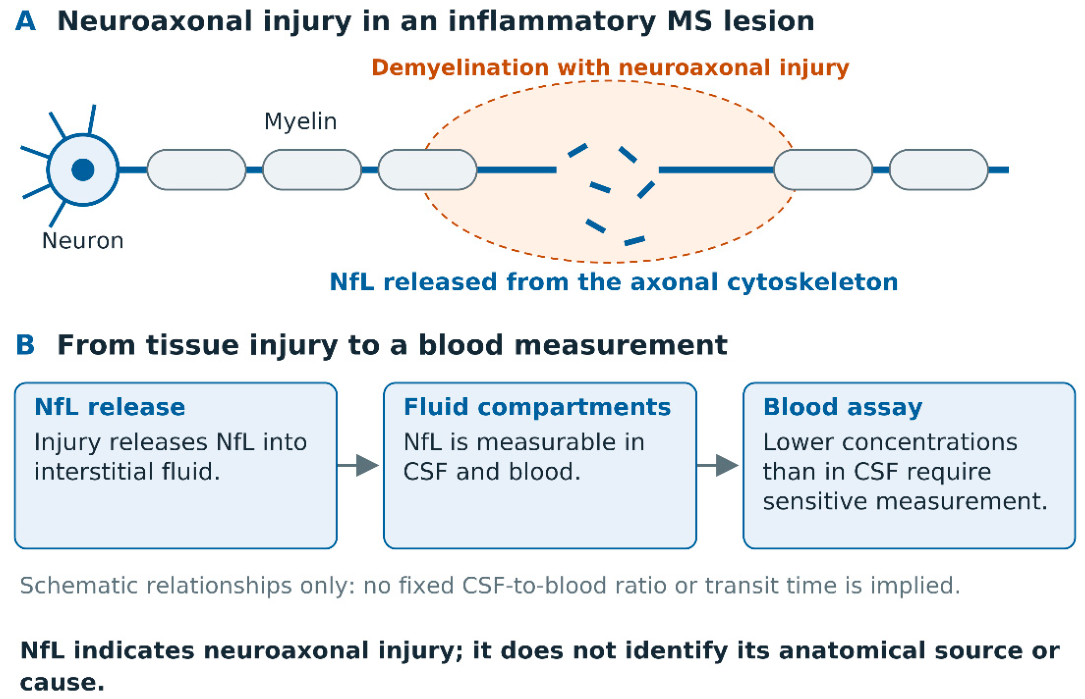
Figure 2.
Contextualising serum NfL using reference distributions and longitudinal measurements. Author-created conceptual illustration informed by reference-modelling and treatment-cohort studies.[3,9] (A) At constant BMI, the same concentration can occupy a different position in age-dependent reference distributions. Curves are illustrative and cannot be used to calculate a concentration, percentile or Z score. (B) Interpretation requires the applicable assay-compatible reference model and the patient’s comparable longitudinal measurements. Z = 1.5 is shown as a research example, not a universal abnormality or treatment threshold; approximately the 93rd percentile corresponds to Z = 1.5 on a standard-normal scale. BMI, body mass index; NfL, neurofilament light chain.
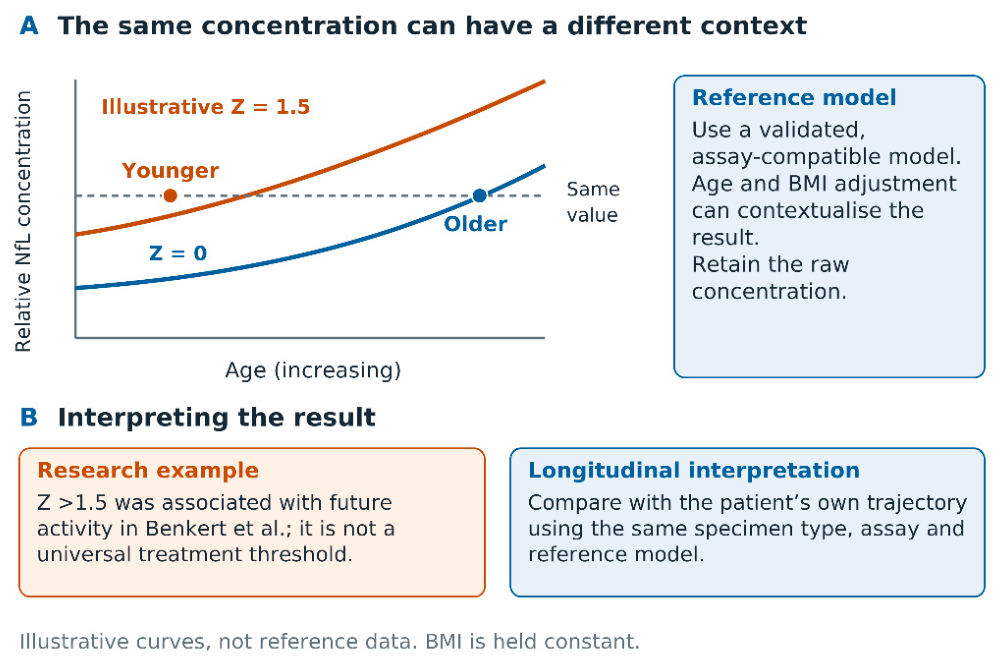
Figure 3.
Biological, clinical and analytical influences on blood NfL interpretation. Author-created synthesis of factors relevant to interpretation.[3,8,11,12,13] Biological and clinical considerations include age, body size, renal function, comorbidity and competing neurological injury. Analytical and temporal considerations include specimen and assay continuity, the reference model and timing relative to injury or treatment. Associations do not establish the cause of an individual elevation. A low result does not exclude progression. BMI, body mass index; NfL, neurofilament light chain.
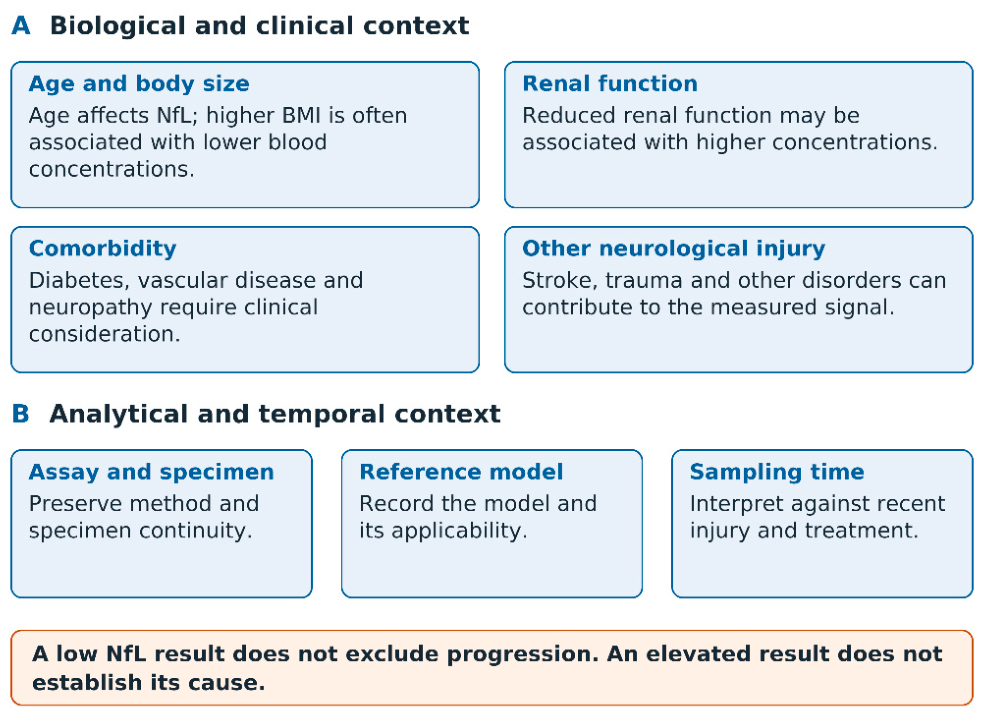
Figure 4.
Integrating MRI and serum NfL findings in clinical monitoring. Author-proposed interpretive matrix showing how MRI and sNfL may provide complementary information.[4,18] “Elevated or rising” requires assay- and reference-specific assessment and consideration of analytical and biological variation; no universal numerical threshold is specified. Reassuring concordance assumes clinical stability. New symptoms, functional deterioration or an atypical presentation require assessment regardless of the matrix. Targeted imaging and treatment decisions remain individualised. Table 2 expands the framework to additional clinical patterns. This is not a validated treatment algorithm. MRI, magnetic resonance imaging; sNfL, serum neurofilament light chain.
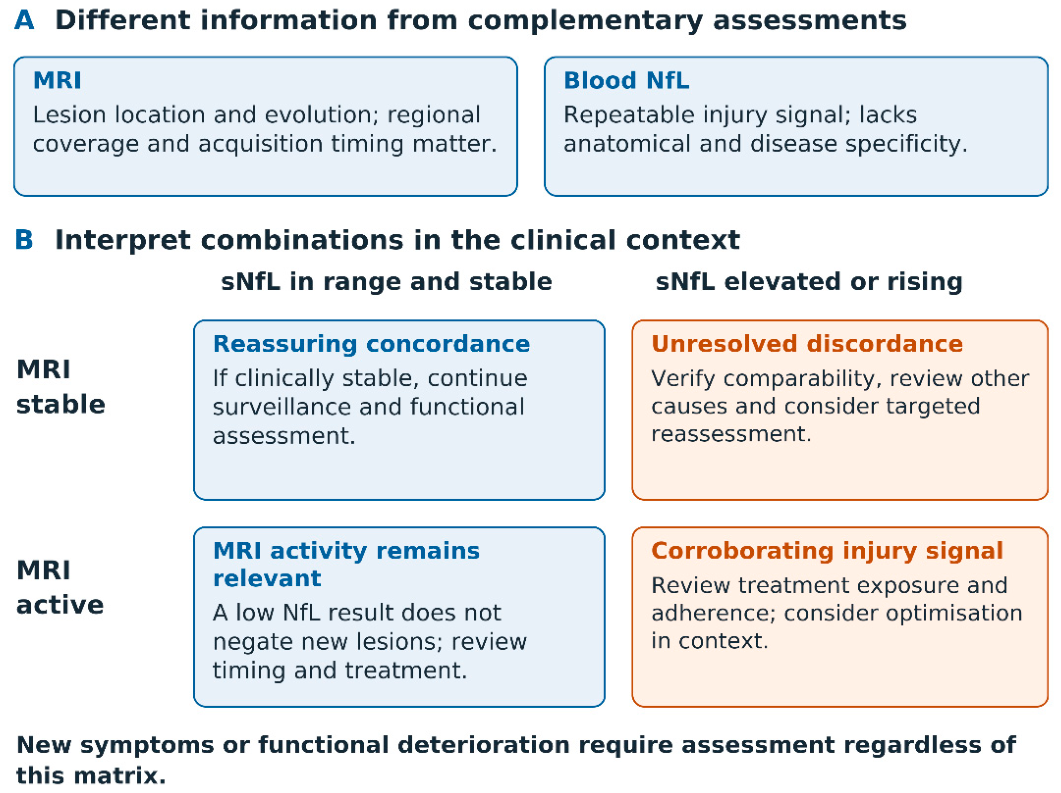
Figure 5.
Proposed framework for implementing serum NfL monitoring in GCC MS services. Author-proposed implementation framework. (A) Documented Gulf MS populations, treatment cohorts and national surveys provide context; they do not validate regional NfL thresholds.[19,20,28,31,32] (B) Service mapping, analytical verification and reference-model evaluation precede integrated interpretation. (C) Sampling contexts are informed by international guidance; intervals remain individualised.[4] (D) Three auditable outputs connect testing to accountable care: an interpretable report, a documented clinical response and a registry-linked outcome. The six-monthly default considered for selected stable pilot participants is a service-design choice, not a proven optimum. Urgent assessment must not await NfL testing. Institutional participation and data linkage require agreement. This framework is not an endorsed GCC guideline. GCC, Gulf Cooperation Council; DMT, disease-modifying therapy; MRI, magnetic resonance imaging; MS, multiple sclerosis; sNfL, serum neurofilament light chain.
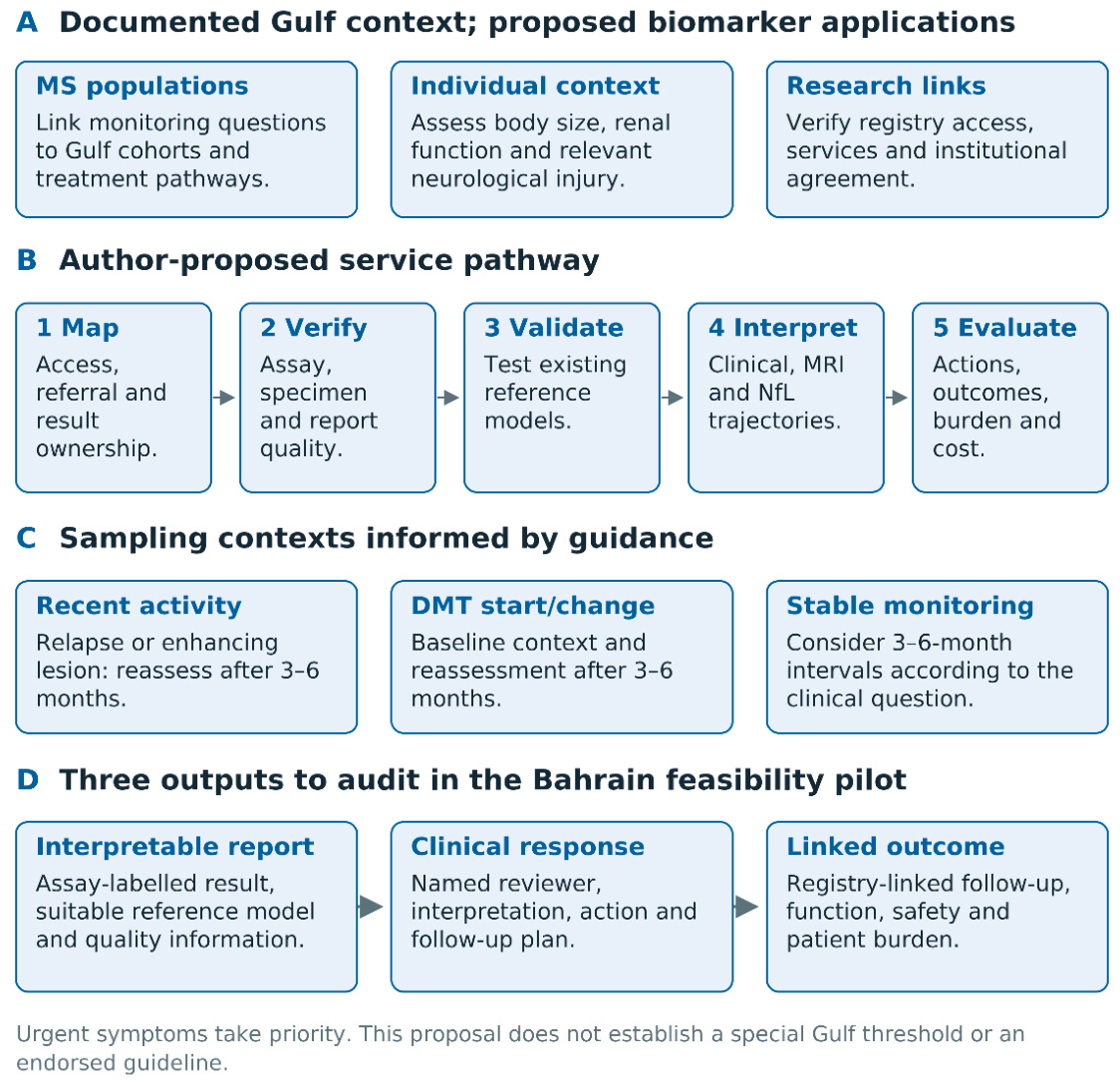

Table 1.
Evidence relevant to implementation.
| Domain | Representative evidence | Implication and boundary |
| Inflammatory activity and prognosis | Associations with relapses, MRI activity and subsequent tissue loss.[1,2,3] | Supports adjunctive risk assessment; does not identify the cause of injury independently. |
| Adjusted interpretation | Reference modelling and a 447-patient treatment cohort support adjusted interpretation.[3,9] | Use a validated assay-compatible reference model; do not universalise study-derived thresholds. |
| On-treatment trajectories | A 2026 cohort linked absent Z-score reduction with later activity.[10] | Trajectories may add information, but discrimination and missing follow-up limit individual prediction. |
| Assay comparability | Three-platform comparison found strong correlation despite substantial absolute differences.[11] | Correlation does not establish interchangeability. |
| Comorbidity | Large-cohort and renal-function studies identify important non-MS influences.[12,13] | Review renal function, body size and competing injury before attributing an elevation to MS. |
| Progression | Prospective studies link GFAP with progression independent of relapse activity.[14,15,16] | Complementary measurements merit evaluation; association does not establish an individual treatment rule. |
| DMT discontinuation | DOT-MS biomarker analysis supported detection rather than prediction of recurrent activity.[17] | Low baseline values cannot certify safe withdrawal. |
Footnote: This is an interpretive evidence summary, not a formal certainty-of-evidence grading. DMT, disease-modifying therapy; GFAP, glial fibrillary acidic protein; sNfL, serum neurofilament light chain.
Table 2.
Proposed interpretation of clinical–MRI–sNfL patterns.
| Pattern | Interpretation | Proposed response |
| Clinically stable; stable MRI; sNfL within reference range and stable | Reassuring concordance within the limitations of all three measures | Continue the agreed surveillance plan and assess disability and patient-reported symptoms. |
| Clinically stable; stable MRI; elevated/rising sNfL | Unresolved injury signal or confounding | Verify the result, review comorbidity and timing, and arrange proportionate repeat assessment or targeted imaging. |
| New MRI activity; low sNfL | Biomarker–imaging discordance | Evaluate MRI activity on its own merits; a low biomarker does not negate it. |
| Clinical deterioration; stable MRI; low sNfL | Progression, a missed lesion, comorbidity or another explanation remains possible | Examine the patient and measure function; investigate according to the syndrome. |
| Clinical/MRI activity with rising sNfL | Concordant evidence supporting active injury | Review adherence, treatment exposure and alternative causes, then consider treatment optimisation. |
| Abrupt major elevation with atypical symptoms | Potential non-MS neurological injury | Expedite syndrome-directed assessment, including consideration of stroke, infection or PML where relevant. |
Footnote: This matrix is proposed for prospective evaluation and is not a validated algorithm. “Elevated” requires a suitable assay-specific interpretation. Urgent symptoms take precedence over biomarker confirmation. PML, progressive multifocal leukoencephalopathy.
Table 3.
Selected evidence supporting a GCC NfL implementation agenda.
| Evidence category and source | Population or documented scope | What it supports and what it does not establish |
| Direct exploratory GCC NfL evidence: Kuwait [29] | Kuwaiti participants recruited at Dasman Diabetes Institute; blood NfL measured by ELISA | Regional association evidence; not validation of contemporary serum reference models or NfL-guided treatment decisions. |
| Contemporary GCC reference-model and clinical-utility validation | No qualifying study of these specific questions was identified in this targeted retrieval | A gap in retrieved evidence, not proof that no study or service exists; no claim of an absence of all GCC NfL research. |
| GCC epidemiology: Qatar [28] | Population-based MS registry, 2016–2024; national and resident denominators distinguished | A regional monitoring rationale and denominator discipline; not a biomarker reference model. |
| GCC treatment: Kuwait [19] | National-registry observational cohort of 1,408 patients; study-defined high-efficacy DMTs | Relevant initiation, response and discontinuation settings; not evidence that NfL-guided switching improves outcomes. |
| GCC treatment: Qatar Q-OCRE [20] | Retrospective ocrelizumab cohort, 451 patients across MS phenotypes | A setting for studying deterioration despite inflammatory control; no NfL validation is inferred. |
| Bahrain molecular-biomarker research [30] | Patient-based gene-expression and protein work involving IL-1RA and OASL | A precedent for clinical–laboratory collaboration; not NfL validation or proof of present service capacity. |
| National health surveys: Bahrain and UAE [31,32] | General adult populations; different age coverage, survey designs and definitions | Context for individual body-size and comorbidity assessment; not prevalence estimates for MS cohorts or mathematical correction factors. |
| Regional research infrastructure: MENACTRIMS [33] | Publicly listed centres in Kuwait, Oman, Saudi Arabia and the UAE | Existing contacts and registry experience; not harmonised NfL collection, service readiness or agreement to participate. |
| Regional expert and review literature [6,7] | Multiregional advisory-board abstract and Saudi-affiliated narrative review | Professional interest and synthesis; Gulf affiliations alone do not establish validation in Gulf participants. |
| International biomarker evidence [3,4,9,10,11,12,13] | Reference-model, treatment-monitoring, assay and comorbidity studies and guidance | The scientific foundation to evaluate locally; reference-model transportability and clinical utility remain distinct questions. |
Footnote: This is a selected evidence map, not an exhaustive inventory or a hierarchy implying that contextual studies validate a biomarker. Retrieval was updated on 12 November 2026. GCC means Bahrain, Kuwait, Oman, Qatar, Saudi Arabia and the United Arab Emirates (UAE). Population recruitment, not author affiliation, determines classification. DMT, disease-modifying therapy; MS, multiple sclerosis; NfL, neurofilament light chain.
Table 4.
Proposed GCC implementation stages.
| Stage | Core work | Evidence required before expansion |
| Service mapping | Verify assays, referral pathways, coverage, MRI access and result ownership | A dated centre-level inventory; unresolved fields remain explicit. |
| Analytical preparation | Assess precision, specimen handling, model compatibility and platform transitions | Acceptable laboratory performance and interpretable reporting under prospectively agreed standards. |
| Bahrain feasibility pilot | Apply the pathway in three defined clinical scenarios | Complete report–review–follow-up linkage, timely review, documented actions and measured patient burden. |
| Multicentre validation | Evaluate reference models and longitudinal performance in relevant populations | Calibration and performance estimates with uncertainty, comorbidity and centre effects considered. |
| Clinical-utility evaluation | Compare biomarker-supported care with standard monitoring | Evidence on supported decisions, unnecessary interventions, function, safety, equity and full pathway cost. |
Footnote: These are author-proposed stages, not funded or endorsed programmes. Expansion criteria and stopping rules require prospective agreement; feasibility does not itself establish clinical benefit.
Disclaimer/Publisher’s Note: The statements, opinions and data contained in all publications are solely those of the individual author(s) and contributor(s) and not of MDPI and/or the editor(s). MDPI and/or the editor(s) disclaim responsibility for any injury to people or property resulting from any ideas, methods, instructions or products referred to in the content. |
© 2026 by the author. Licensee MDPI, Basel, Switzerland. This article is an open access article distributed under the terms and conditions of the Creative Commons Attribution (CC BY) license.
Copyright: This open access article is published under a Creative Commons CC BY 4.0 license, which permit the free download, distribution, and reuse, provided that the author and preprint are cited in any reuse.