
Submitted:
20 November 2026
Posted:
23 November 2026
You are already at the latest version
Abstract
The paper demonstrates how multiple composition functions can be used as computational tools in developing different sieving algorithms in the context of figurate numbers. The algorithms include step-by-step eliminations of every other number from a given sequence, eliminations involving prime-indexed rules of selecting elements for sieves, and eliminations based on the behavior of triangular and other figurate numbers as internal multiple composition functions. The described activities represent general terms of figurate number sieves of different orders through Cullen-type numbers, through the sums of the first Cullen-type number of squares of odd integers, and eliminations in the context of Floyd’s triangle and its different extensions. Explorations are supported by Maple, Wolfram Alpha, and the On-line Encyclopedia of Integer Sequences.
Keywords:
figurate numbers
; prime numbers
; Cullen numbers
; sieve methods
; composition functions
; Floyd’s triangle
; Maple
; Wolfram Alpha
1. Introduction
Figurate numbers, known from mathematics of antiquity [1], are most notably associated with the theorem proved by Carl Friedrich Gauss that any natural number is a sum of at most three triangular numbers [2]. This theorem was generalized by Augustin-Louis Cauchy to m-gonal numbers [3]. Such representations are not unique. For example, 19 = 1 + 3 + 15 = 3 + 6 + 10, where 1, 3, 6, 10 and 15 are triangular numbers (m = 3). Likewise, 30 = 1 + 4 + 9 + 16 = 1 + 4 + 25, where 1, 4, 9, 16 and 25 are square numbers (m = 4). Figurate numbers can be mutually connected. For example, in the case of hexagonal numbers (m = 6) we have hn = tn + 3tn−1 = n2 + 2tn−1 = pn + tn−1, where hn, tn and pn are, respectively hexagonal, triangular and pentagonal numbers. In pre-college mathematics education, one is informed that “rising seventh-grade students were studying figurate numbers … to generate representations for the first five triangular numbers” [4, p. 262].
The sieving methods have their genesis in the sieve of Eratosthenes, named after a Greek scholar of the 3rd century B.C., as a step-by-step inclusion-exclusion algorithm [5] of developing prime numbers. As is known, this algorithm starts with eliminating all multiples of 2—the smallest prime number as having exactly two different divisors—and recognizing the first surviving number, 3, being the next prime number as having exactly two different divisors as well. The second step is to eliminate all multiples of 3. Although 6 is a multiple of 3, it was eliminated by 2, and therefore 9 is the first number to be eliminated by 3. This implies that numbers 5 and 7, being smaller than 9, that survived the eliminations by 2 and 3 are also prime numbers. The process continues by eliminating all multiples of 5 and 7, and so on.
Ankeny & Onishi [6, p. 31] define the sieve as “a method used to derive bounds on the number of elements in a set of integers which are not divisible by any prime number in another set”. For example, it takes this method four steps to derive numbers smaller than 121 that are not divisible by the first four primes. In the present paper, the definition of the sieve method is extended to be applicable not only in the classis meaning of the sieve as a way “of distinguishing prime numbers from composite numbers and of resolving the latter into their prime factors known to be one of the most important and useful in arithmetic” [7, p. 396], but to consider the sieve as a method used to derive formulas for integer sequences the terms of which belong to a set which consists of survivors of step-by-step eliminations of the terms of a larger set according to a certain rule. For example, the sequence o(n) = 2n—1 represents the terms of the subset of natural numbers from which every other number was eliminated. In other words, none of the integers of the form 2n—1 is divisible by the prime number 2. Another extension of the above definition of the sieve method to be used in this paper is to derive numerically figurate numbers the ranks of which are prime numbers. One can say that the ranks of the triangular numbers 6, 15, 66, 153 are the prime numbers 3, 5, 11, 17, the ranks of which, in turn, are the first four primes.
2. Material and Methods
Materials used by the author when working on this paper include a symbolic and numeric mathematics and engineering software program Maple [8] and the PRO for Educators version of the computational knowledge engine Wolfram Alpha produced by Wolfram Research (https://www.wolframalpha.com). The author also used the OEIS® (On-line Encyclopedia of Integer Sequences, https://www.oeis.com), a rich source of mathematical information, both numeric and symbolic. Methods specific for the topic of the paper include technology-immune/technology-enabled (TITE) problem-solving framework [9] and the methodology of computational triangulation [10]. The TITE framework of the digital era problem solving assumes that a mathematical problem cannot be automatically solved by software (thus, it is immune from the direct use of technology), yet the role of software in solving the problem is critical (thus, its solution is enabled by technology). Checking the result of a symbolic computation in a special case, the correctness of which is either semi-evident or can be confirmed by alternative sources of information, is a part of the TITE framework. The methodology of computational triangulation, in the digital era becomes integrated with advances in the development of digital instruments allowing for computational experiments in mathematics to be validated by more than one instrument, thus enhancing the credibility of problem solving [11,12]. The use of the OEIS® may be considered as a kind of computational triangulation because the results provided by a digital tool using a particular computational technique can be verified through a medium that, while not mentioning this technique, presents the same result obtained by others using alternative contexts, tools and computational techniques.
3. Sieving Algorithms and Composition Functions
Sieving algorithms in the extended meaning of the sieve method can be applied to a variety of numeric sequences, including figurate numbers. Consider the algorithm based on the rule of eliminating every other number from the sequences of triangular, square, pentagonal, and hexagonal numbers. Using such an algorithm, the following sequences can be developed, respectively: {1, 6, 15, 28, 45, 66, …}, {1, 9, 25, 49, 81, 121, …}, {1, 12, 35, 70, 117, 176, …}, {1, 15, 45, 91, 153, 231, …}. These sequences can be called, respectively, the sieves of triangular, square, pentagonal, and hexagonal numbers of order one. Note that eliminating (excluding) every other number is equivalent to selecting (including) numbers with odd ranks. Indeed, the ranks of the numbers as terms of the above four sequences are 2n – 1, n ≥ 1. This suggests that in the case of the m-gonal number P(n, m) = tn−1(m − 2) + n of rank n, replacing n by 2n – 1 yields P(2n − 1, m) = t2n−2(m − 2) + 2n − 1 – the sieve of m-gonal numbers of order one. When m = 6, the last formula yields (setting t0 = 0) the above-mentioned values of the sieve of hexagonal numbers of order one:
P(1, 6) = 1, P(3, 6) = 15, P(5, 6) = 45, P(7, 6) = 91,P(9, 6) = 153, P(11, 6) = 231.
Consider, once again, the function o(n) = 2n − 1 that generates odd numbers from the set of natural numbers. Then, the sieve of triangular numbers of order one can be presented as a composition function ={1, 6, 15, 28, 45, 66,…} – the set of hexagonal numbers. Using the function o(n) twice yields – the sieve of triangular numbers of order two or the sieve of hexagonal numbers of order one. Noting that coefficients in the product (4n − 2)(4n − 3) representing the application of the function o(n) to triangular numbers twice can be written as the powers of two so that t(o(o(n))) = (4n − 2)(4n − 3) = [22(n − 1) + 2][22(n − 1) + 1], suggests, in the spirit of the TITE framework, using a computer program capable of symbolic computations to develop general formulas for the figurate number sieves of order k. In particular, and, likewise, . The last two representations, the development of which was immune from the use of technology, might prompt the following generalization for the sieve of triangular numbers of order k in the form of the k-composition function
Note that More generally,
],
that is,
].
In particular, it follows from (2) that
That is, multiple composition functions involving the function o(n) can be used to generate sieves of different orders of figurate numbers without using step-by-step elimination algorithms that on step k exclude every other number from the sieve obtained on step k – 1. For example, using Wolfram Alpha and entering the numbers 1, 6, 15, 28, 45 (surviving the first step of elimination of every other triangular number – a technology-immune part of the activity) into its input box yields the formula an,1 = 2n2 − n (a technology-enabled part of the activity); entering 1, 15, 45, 91 (the survivors of the second elimination step) yields the formula an,2 = 8n2 − 10n + 3; entering 1, 45, 153, 325 (the survivors of the third elimination step) yields the formula an,3 = 32n2 − 52n + 21. Whereas the coefficients in n2 in the last three formulas can be recognized as the powers of two connected to the step number, to recognize a pattern in the other two coefficients of the quadratics, even using symbolic capabilities of Wolfram Alpha, requires at least four more elimination steps, to get an,4 = 128n2 − 232n + 105, an,5 = 512n2 − 976n + 465, an,6 = 2048n2 − 4000n + 1953, an,7 = 8192n2 − 16,192n + 8001, so that the patterns formed by the sequences 1, 10, 52, 232, 976, 4000, 16,192 and 0, 3, 21, 105, 465, 1953, 8001 can be digitally recognized by Wolfram Alpha (the latter sequence, having the form provided by Wolfram Alpha, can also be found in OEIS®, under the number A134057, that confirms that form). At the same time, after just two steps of using the function o(n), symbolic evidence provided by Maple was suffice for generalizing to formula (1).
The numbers 2k(n − 1) + 1, appearing in formulas (1) and (2), when n – 1 = k take the form k∙2k + 1 known as Cullen numbers [13], called after James Cullen (1867–1933), an Irish mathematician and Jesuit priest. The numbers of the form 2k(n − 1) + 1 are called Cullen-type numbers [14]. In other words, using multiple composition of the function o(n) as a step-by-step inclusion-exclusion algorithm, excludes every other number from the corresponding sieve and it can be called the Cullen-type elimination algorithm.
While formula (1) has yet to be proved, when k = 0 it yields triangular numbers and when k = 1 it yields hexagonal numbers hn = n(2n − 1) . Then, once again, h(o(n)) = h(2n − 1) = h2n−1 = (2n − 1)[2(2n − 1) − 1] = (2n − 1)(4n − 3) = {1, 15, 45, 91, 153, 231, …}. One can also prove that
In particular, in agreement with the TITE verification rule, when k = 1 and n = 3 formula (3) yields h(o(3)) = 45 – the third term of the hexagonal number sieve of order one.—
4. Using Maple as a Computational Tool
Multiple composition functions can be used as tools in developing figurate number sieves of an arbitrary order using different elimination rules. As was mentioned above, the use of o(n) as the internal element of a multiple composition function allows one to circumvent the step-by-step elimination method used by the author for tetrahedral numbers [14] and to generalize to a polynomial form of a figurate number sieve of order k from a single sieve of a relatively small order without developing a sequence of consecutive sieves to decide the polynomial form of the general sieve. The construction of the multiple composition function based on conceptual understanding of the elimination role of the function o(n) is a TI part of the TITE framework followed by a TE part enabling digital elimination.
Figure 1 shows the use of Maple in finding the following value of the multiple composition function that generates the triangular number sieve of order seven, the first five terms of which are 1, 8385, 33153, 74305, 131841. One can check to see that when n = 2, the Cullen-type number 27(n − 1) + 1 is equal to 129—the rank of 8385 as a triangular number. Likewise, the hexagonal number of the rank 129 is equal to 129∙(2∙129 − 1) = 33,153 – the third term of the triangular number sieve of order seven (Figure 1). Alternatively, the right-hand side of formula (3) is equal to 33,153 when n = 2 and k = 7. It will also be shown in section 7 that 129 is the rank of the number 366,145 among tetrahedral numbers.
5. Proving formulas (1)—(3)
Let Note that transition from the sequence tk(n) to that of tk+1(n) excludes every other number from the former sequence. In other words, applying the function o(n) to the sequence tk(n) excludes every other number from that sequence. Applying the method of mathematical induction by k to check the base clause yields the hexagonal number as an element of the triangular number sieve of order one. Assuming formula (1) is true, to make a transition from k to k + 1, one replaces o(n) by 2n − 1 to get
This completes the proof of formula (1).
To prove formula (2), let
Applying the method of mathematical induction by k to check the base clause yields Assuming formula (2) is true, to make a transition from k to k + 1 one replaces o(n) by 2n − 1 to get
This completes the proof of formula (2). Similarly, formula (3) can be proved by the method of mathematical induction.
6. Composition Functions Involving Prime Number Eliminations
Another sieving algorithm deals with prime numbers when, for example, using the primes from the set of prime numbers one selects the prime-indexed elements 3, 5, 11, 17, 31, that is, using the ranks of which are the first five primes [15,16,17]. The prime-indexed sieving algorithm can be applied to any numeric sequence. For example, let be a subsequence of triangular numbers the ranks of which are the prime numbers pi , i = 1, 2, 3, … . Using the list of the first prime numbers smaller than 200 generated by Wolfram Alpha (Figure 2), we haveand so on. In that way, the sequence the sequence 3, 6, 15, 28, 66 represents triangular numbers, the ranks of which are the first five prime numbers.
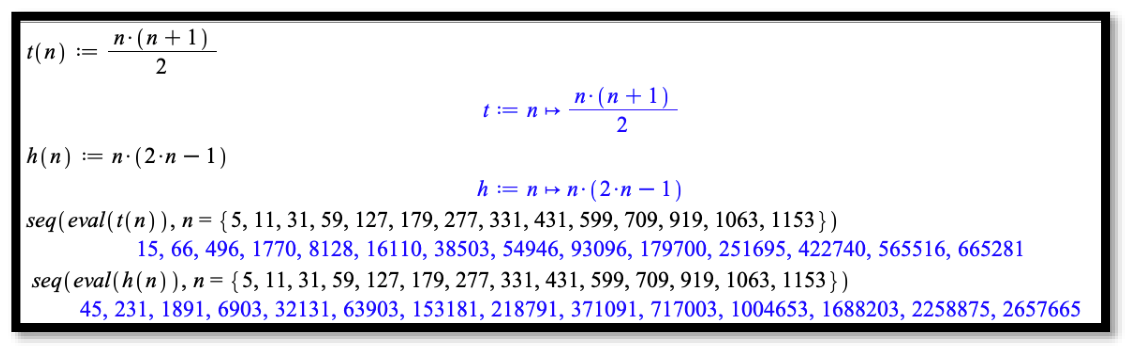
Likewise, let h(n) = n(2n − 1). Then, in the case of hexagonal numbers h(n) we have (using Figure 2, developed as a TE part of the TITE framework) The sequences and may be considered as composition functions t(p(i)) and h(p(i)) where p(i) is the i-th prime number. The sequences and may be considered as multiple composition functions t(p(p(i))) and h(p(p(i))) where p(i) is the i-th prime number. The primes of the forms p(p(i)) = {3, 5, 11, 17, 31, 41,…} and p(p(p(i))) = {3, 11, 31, 59, 127, 179, …} are called, respectively, prime-indexed primes (OEIS®, A006450) and primes with indices being prime-indexed primes (OEIS®, A038580). As was mentioned above, the joint use of Wolfram Alpha in generating prime numbers and the OEIS® may be considered as a kind of computational triangulation that enhances the credibility of problem solving.
Furthermore, The numbers are called prime-indexed primes. A large list of prime numbers can be found in the OEIS® under the number A006450 (Figure 3). One can use Maple (Figure 4) to compute triangular and hexagonal numbers the ranks of which are the first 15 prime-indexed primes.
Furthermore, one can develop another sequence of prime-indexed prime numbers, 11, 31, 127, 347, 709, using a four-multiple prime number composition function p(p(p(p(i)))) = {p(p(p(2))) = p(p(3)) = p(5) = 11;p(p(p(3))) = p(p(5)) = p(11) = 31; p(p(p(5))) = p(p(11)) = p(31) = 127; p(p(p(7))) = p(p(17)) = p(59) = 347; p(p(p(11))) = p(p(31)) = p(127) = 709}. The ranks of these primes are prime numbers 5, 11, 31, 59, 127 that appear in OEIS® under the number A038580 and are called primes with indices that are primes with prime indices. Therefore, the primes 11, 31, 127, 347, 709 may be called primes with indices that are primes with indices that are primes with prime indices.
Figure 2.
The first 46 prime numbers.
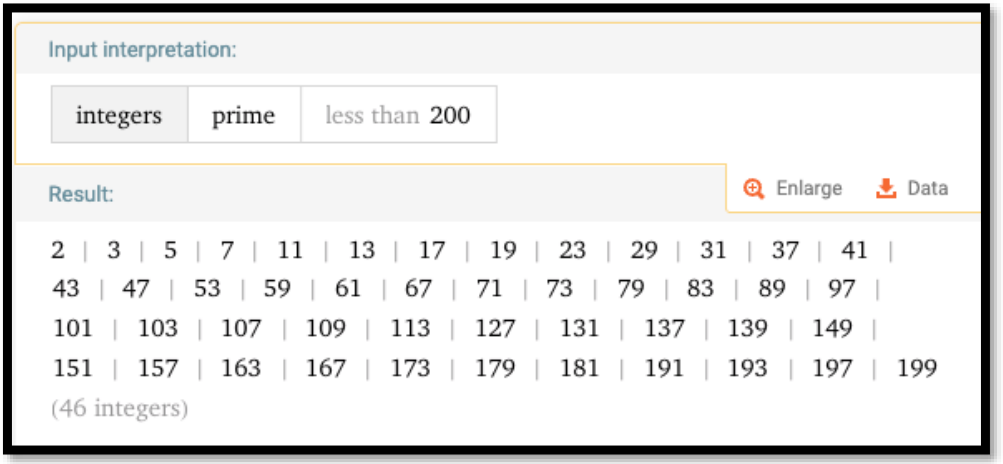
Figure 3.
Prime-indexed primes found in the OEIS®.
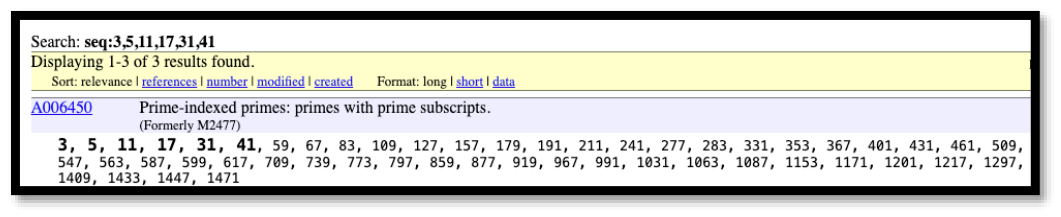
Figure 4.
Triangular and hexagonal numbers with prime-indexed primes as the ranks.
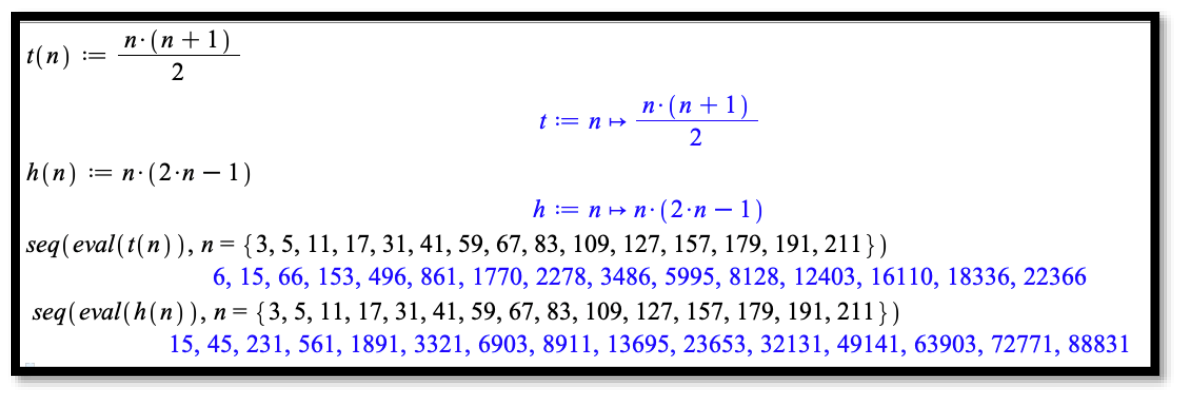
Figure 5.
Primes with indices that are prime-indexed primes.

Figure 6.
Triangular and hexagonal numbers the ranks of which are primes with indices that are prime-indexed primes.
Figure 6.
Triangular and hexagonal numbers the ranks of which are primes with indices that are prime-indexed primes.
7. Tetrahedral Number Sieves and Square Numbers
There is a famous identity
n2 = tn + tn−1
attributed [18] to a Greek scholar and historian of science Plutarch (c. 50–120 A. D.) connecting square and triangular numbers. This identity makes it possible to connect subsequences of tetrahedral numbers T(n)={1, 4, 10, 20, 35, 56, 84, …} – partial sums of triangular numbers – to the sums of squares of odd numbers. The formula
is reminiscent of the sum the first n square numbers, . Due to (4) and (5), one can write
Following the Cullen-type elimination, the composition function
84, …}
can be developed. One can check to see that 10 = 12 + 32 ,35 = 12 + 32 + 52, 84 = 12 + 32 + 52 + 72. That is,
One can use Wolfram Alpha or Maple to confirm formula (6) from which it follows that the n-th term of the tetrahedral number sieve of order one is equal to the sum of squares of the first n odd numbers. Furthermore, as shown in Figure 7,
That is, the n-th term of the tetrahedral number sieve of order two is equal to the sum of squares of the first 2n –1 (= 2(n – 1) + 1 – a Cullen-type number) odd numbers, where 2n − 1 = o(n). One can check to see that the third term, 165, of the tetrahedral number sieve of order two, {1, 35, 165, 455, 969, 1771, …} (see sequence A015219 in the OEIS®) is equal to the sum of the first five (=2∙3 − 1 = 2(3 − 1) + 1) squares of odd numbers, 12 + 32 + 52 + 72 + 92.
Using the rule of the Cullen-type elimination, the number 165 becomes the second term of the tetrahedral number sieve of order three {1, 165, 969, 2925, …} (see Figure 8) and, as we know, it is equal to the same sum of the first five squares of odd numbers. But this time, the number 5 comes from setting n = 2 in the expression 4n − 3 = o(o(n)), where 4n − 3 = 22(n − 1) + 1− a Cullen-type number. Likewise, one can check to see that the third term, 969, of that sieve is equal to the sum of the first nine squares of odd numbers as setting n = 3 in the expression 4n − 3 yields 9. That is, the n-th term of the tetrahedral number sieve of order three is equal to the sum of squares of the first 4n –3 odd numbers, where 4n − 3 = o(o(n)).
Using the rule of the Cullen-type elimination, the number 969 becomes the second term of the tetrahedral number sieve of order four {1, 969, 6545, 20,825, …} and it is equal to the same sum of nine squares of odd numbers where 9 is the result of setting n = 2 in the expression 8n − 7 = o(o(o(n))), where 8n − 7 = 23(n − 1) + 1. One can check to see that 20,825 – the fourth term of the tetrahedral number sieve of order four – is equal to the sum of the first 25 squares of odd numbers, where 25 = 8∙4 − 7 = o(o(o(4))). That is, the n-th term of the tetrahedral number sieve of order four is equal to the sum of squares of the first 8n –7 odd numbers, where 8n − 7 = 23(n − 1) + 1 = o(o(o(n))).
The above observations allow one to conjecture that the n-th term of the tetrahedral number sieve of order k is equal to the sum of the first 2k−1(n − 1) + 1 squares of odd numbers. One can check to see that when n = 2 and k = 7 we have 366, 145 = 12 + 32 + 52+…+1292 where is the second term of the tetrahedral number sieve of order seven (Figure 8) and 129 (=2∙65 − 1) is the rank of 366,145 among tetrahedral numbers. In general,
To prove identity (8), one can use Plutarch’s identity (4) to replace each square in the right-hand side of (8) with a sum of two triangular numbers that can be put together to form the sum of the first 2k(n − 1) + 1 triangular numbers or the tetrahedral number of the rank 2k(n − 1) + 1 (assuming t0 = 0):
This completes the proof of identity (8).
8. Triangular Composition Functions and Floyd’s Triangle
Triangular number function can be used to form multiple composition functions that create special sieves of triangular numbers. Consider the function that, using Maple, generates the so-called doubly triangular numbers (Figure 9). These numbers can be found in (or computationally triangulated by) the OEIS® under the number A002817, yet not having the double triangular number composition representation. Doubly triangular numbers are the partial sums of the numbers 1, 5, 15, 34, …, that are the sums of natural numbers put in groups as follows: 1, {2, 3}, {4, 5, 6}, {7, 8, 9, 10}, … . Indeed, 1 = 1, 1 + 5 = 6, 1+ 5 + 15 = 21, 1 + 5 + 15 + 34 = 55, and so on. Numbers in those groups can form rows of a triangle known as Floyd’s triangle named after Robert Floyd (1936-2001), an American computer scientist [19]. In terms of the sieve process, the function t(t(n)) applies the rule, according to which the internal function t(n) behaves, to the original sequence of triangular numbers. The difference between two consecutive triangular numbers, due to the recursive relationship tn = tn−1 + n, which shows that triangular numbers are partial sums of natural numbers, is equal to the rank of the larger number which is one greater than the number of integers between them. Indeed, the rank of the number 10 among triangular numbers is four and there are three integers between 6 and 10. Therefore, the application of t(n) to triangular numbers as the sieve process excludes one, two, three, four and so on integers, so that the sequence {1, 3, 6, 10, 15, 21, 28, 36, 45, 55, …} turns into {1, 6, 21, 55, …} – doubly triangular numbers.
Note that the sum of numbers in the n-th row of Floyd’s triangle, when augmented by the triangular number tn−1 , is n times the largest number in that row. For example, the sum 5 in the second row {2, 3}, when augmented by t1 = 1, yields 6 = 2∙3. In general, the smallest and the largest numbers in the n-th row are, respectively, tn−1 + 1 and tn, so that (tn−1 + 1) + (tn−1 + 2)+…+(tn−1 + n)+ . The same result can be obtained by entering the expression into the input box of Wolfram Alpha as a way of verifying accuracy of traditional algebraic transformations. A personal note regarding doubly triangular numbers is that the problem of arranging natural numbers in rows forming Floyd’s triangle and finding the sum of numbers in the n-th row appears in an advanced problem-solving book [20, p. 128] used by the author when preparing for university entrance mathematical examinations. Nowadays, in the digital era, such problem can be considered as a TITE problem by first collecting the sums of numbers in each group and then entering these sums into the input box of Wolfram Alpha to get the general expression .
As shown in Figure 9, in the context of Maple, the triple triangular composition function t(t(t(n))) generates the numbers {1, 21, 231, 1540, 7260, …} called triply triangular numbers. These numbers appear in the OEIS® under the number A064322 where no representation through multiple triangular composition function is mentioned. In terms of the sieve process, the function t(t(t(n))) applies the rule, according to which the function t(n) behaves, to doubly triangular numbers by excluding one, two, three, four and so on integers, so that the sequence {1, 6, 21, 55, 120, 231, 406, 666, 1035, 1540, …} turns into {1, 21, 231, 1540, …} – triply triangular numbers.
Figure 9 also shows the quadruple triangular composition function t(t(t(t(n)))) that generates numbers {1, 231, 26,796, 1,186,570, …} called quadruply triangular numbers. These numbers appear in the OEIS® under the number A066370. Once again, the OEIS® does not provide the multiple triangular composition function representation for those numbers. In terms of the sieve process, the same rule of excluding one, two, three, and so on integers from triply triangular numbers leads to quadruply triangular numbers. Note that whereas the quintuple multiple triangular composition function can be defined in Maple to generate the numbers {1, 26,796, 359,026,206 , …} , those numbers are not included in the OEIS® and, therefore, cannot be computationally triangulated by the OEIS®.
9. Figurate Composition Function and Extended Floyd’s Triangles
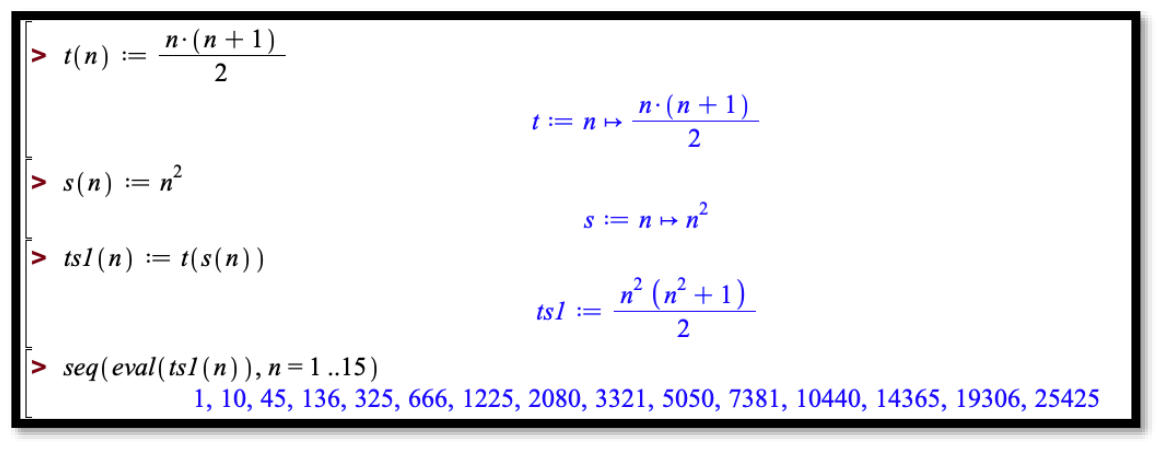
Consider another problem where natural numbers are put in groups 1, {2, 3, 4}, {5, 6, 7, 8, 9}, {10, 11, 12, 13, 14, 15, 16}, … , and the task is to find the sum of numbers in the n-th group [20, p. 129]. One can check to see that the sums in the first four groups are equal to 1, 9, 35, 91, respectively. Because the largest number in each group is the square of the group’s rank, consider the composition function t(s(n)) where s(n) = sn = n2. Partial sums of the numbers 1, 9, 35, 91 (see Figure 10) are one smaller than the corresponding values of the composition function t(s(n)). The groups 1, {2, 3, 4}, {5, 6, 7, 8, 9}, {10, 11, 12, 13, 14, 15, 16}, when written in triangular notation form, represent the rows of what may be called an extended Floyd’s triangle. Let S(n) be the sum of numbers in the n-th row which starts with sn−1 + 1 = (n − 1)2 + 1 and ends with sn = n2 = sn−1 + 2n − 1 = (n − 1)2 + 2n − 1. Therefore, S(n)=[ The same result can be obtained by entering the expression into the input box of Wolfram Alpha as a way of verifying accuracy of traditional algebraic transformations. Using either way of carrying out computations, one can check to see that ; that is,
In terms of the sieve process, the function t(s(n)) applies the rule, according to which the internal function s(n) behaves, to the original sequence of triangular numbers. The difference between two consecutive square numbers, due to the recursive relationship sn = sn−1 + 2n − 1 , which shows that square numbers are partial sums of odd numbers, is one smaller than twice the rank of the larger number that, in turn, is one greater than the number of integers between them. These differences are consecutive odd numbers – 3, 5, 7, 9, … – and the function s(n) eliminates two, four, six, eight and so on integers located between the corresponding triangular numbers. Therefore, as shown in Figure 10, the application of s(n) to triangular numbers as the sieve process turns the sequence {1, 3, 6, 10, 15, 21, 28, 36, 45, 55, …} into {1, 10, 45, …}.
Another extended Floyd’s triangle may have the rows associated with pentagonal numbers 1, 5, 12, 22, … , when natural numbers are put in groups 1, {2, 3, 4, 5}, {6, 7, 8, 9, 10, 11, 12}, {13,14, 15, 16, 17, 18, 19, 20, 21, 22}, … . Let p(n) = n(3n − 1)/2 and P(n) be, respectively, the n-th pentagonal number and the sum in the n-th row of such a triangle. Then the formula
t(p(n)) = P(n) + tn(3n−1)/2. (10)
holds true. The development of formula (10) is similar to the development of formula (9), requiring one to note that the smallest and the largest numbers in the n-th group of the latter extended Floyd’s triangle are p(n − 1) + 1 and p(n), respectively.
10. Conclusion
The paper was written to demonstrate the use of multiple composition functions as a possible computational technique in developing different sieving algorithms in the context of figurate numbers. A multiple use of the function o(n) = 2n − 1 as an internal composition function in developing sieves of triangular numbers led to Cullen-type numbers of the form 2k(n − 1) + 1 used as the ranks of the n-th terms of triangular number sieves of order k. Such kind of exclusions of the terms of sequences were referred to as Cullen-type eliminations. Sieving algorithms dealing with prime-indexed primes as the elements of internal multiple composition functions were also applied to triangular and hexagonal numbers.
Cullen-type numbers were found to be connected to representations of the elements of the tetrahedral number sieves as the sums of squares of odd integers. In particular, the n-th term of the tetrahedral number sieve of order k was expressed through the sum of squares of the first 2k(n − 1) + 1 odd numbers. This connection of tetrahedral numbers to squares of odd numbers was due to the well-known from ancient times representation of a square number as a sum of two consecutive triangular numbers.
The paper considered the joint use of Maple and the OEIS® as a kind of computational triangulation – the technique of using more than one digital tool towards the enhancement of the credibility of problem solving. On the one hand, as it turned out, many sequences obtained using multiple composition functions were found in the OEIS®. On the other hand, the use of such computational technique was not reported there, thereby serving as evidence of the novelty of he multiple composition functions approach to the development of sieve methods. It was demonstrated that using multiple composition functions allows one to avoid lengthy and computationally involved step-by-step process of modeling sieves of different orders.
Following the TITE framework, the paper distinguished between its two parts, both in terms of applications of mathematics and in terms the order the parts were used within the framework. The construction of multiple composition functions was immune from the use of technology and their implementation within Maple enabled digital elimination as the sieve process. That is, the TI preceded the TE. At the same time, in the context of composition functions involving prime numbers, the TE preceded the TI when Wolfram Alpha was used first to generate a large number of primes that were then used to develop values of a four-multiple composition function without using technology. Seeing the TITE framework through the lens of mathematics education, it was shown that uncomplicated symbolic computations can be carried out first in a TI way and then verified in a TE way.
Multiple figurate composition functions were used in the context of Maple leading to doubly, triply and quadruply triangular numbers. Whereas such numbers were present in the OEIS®, no use of multiple composition functions was reported there. The case of the doubly triangular numbers was connected to Floyd’s triangle appearing in a purely numeric form in an advanced mathematics teacher education problem-solving book. By turning the rows of Floyd’s triangle into groups of natural numbers prompted considering different extensions of the triangle. Finally, contexts through which extended Floyd’s triangles were considered to use sequences of square and pentagonal numbers as internal composition functions applied to triangular numbers.
Suggestions for further explorations may include the context of pentatope numbers – partial sums of tetrahedral numbers – to which the sieving algorithms of this paper can be applied. The joint use of Maple and the OEIS® can computationally triangulate the result of such activities. One can also consider the composition function s(t(n)) to see whether any interesting connections to summation formulas can be found. Moreover, other extensions of Floyd’s triangle and its suggested extensions can be considered. Such mathematical activities when enhanced by digital tools provide many opportunities for explorations that can demonstrate how uncomplicated algorithms and commonly available tools can achieve sophisticated computational results in the context of elementary theory of numbers.
References
- Beiler, A. H. Recreations in the Theory of Numbers; Dover: New York, NY, USA, 1966. [Google Scholar]
- Andrews, G. E. ! num = Δ + Δ + Δ. J. Number Theory 1986, 23, 285–293. [Google Scholar] [CrossRef]
- Nathanson, M. B. A short proof of Cauchy’s polygonal number theorem. Proc. Am. Math. Soc. 1987, 99, 22–24. [Google Scholar] [CrossRef]
- National Council of Teachers of Mathematics. Principles and Standards for School Mathematics; Reston: VA, USA, 2000. [Google Scholar]
- Friedlander, J.; Iwaniec, H. Opera de Cribro; The American Mathematical Society: Providence, RI, US, 2010. [Google Scholar]
- Ankeny, N. C.; Onishi, H. The general sieve. Acta Arith. 1965, 10, 31–62. [Google Scholar] [CrossRef]
- Gauss, C. F. Disquisitiones Arithmeticae (translated from Latin by A. A. Clarke); Yale University Press: New Haven, CT, USA, 1966. [Google Scholar]
- Char, B. W.; Geddes, K. O.; Gonnet, G. H.; Leong, B. L.; Monogan, M. B.; Watt, S. M. Maple V Language Reference Manual; Springer: Berlin/Heidelberg, Germany, 1991. [Google Scholar]
- Abramovich, S. Revisiting mathematical problem solving and posing in the digital era: Toward pedagogically sound uses of modern technology. Int. J. Math. Educ. Sci. Technol. 2014, 45, 1034–1052. [Google Scholar] [CrossRef]
- Abramovich, S. Computational Triangulation in Mathematics Teacher Education; Nova Science Publishers: New York, NY, USA, 2026. [Google Scholar]
- Freudenthal, H. Weeding and Sowing; Kluwer: Dordrecht, The Netherlands, 1978. [Google Scholar]
- Harrison, J. Formal proof – theory and practice. Not. Am. Math. Soc. 2008, 55, 1395–1406. [Google Scholar]
- Sloane, N. J. A.; Plouffe, J. The Encyclopedia of Integer Sequences; Academic Press: New York, NY, USA, 1965. [Google Scholar]
- Abramovich, S. Using Ancient Ideas and Digital Tools in Mathematics Teacher Education. Educ. Sci. (Special issue: Integrating Technology in Mathematics Teaching and Learning) 2026, 16(8), 1268. [Google Scholar] [CrossRef]
- Ares, S.; Castro, M. Hidden structure in the randomness of prime number sequence? Physica A Stat. Mech. Its Appl. 2006, 360, 285–296. [Google Scholar] [CrossRef]
- Broughan, K. A.; Barnett, A. R. On the subsequences of primes having prime subscripts. J. Integer Seq. Article 09.2.3. 2009, 12. [Google Scholar]
- May, M. P. Properties of higher-order prime number sequences. Mo. J. Math. Sci. 2020, 32, 1–13. [Google Scholar] [CrossRef]
- Burton, D. M. Elementary Number Theory, Revised ed.; Allyn and Bacon: Boston, MA, USA, 1980. [Google Scholar]
- Knuth, D. E. Robert W Floyd, In Memoriam. ACM SIGACT News 2003, 34, 3–13. [Google Scholar] [CrossRef]
- Modenov, P. S. Problem-Solving Book for a Special Course on Elementary Mathematics., Chapter X: Summation; Soviet Science: Moscow, USSR, 1957. (In Russian) [Google Scholar]
Figure 1.
Using multiple composition function as a sieve method.
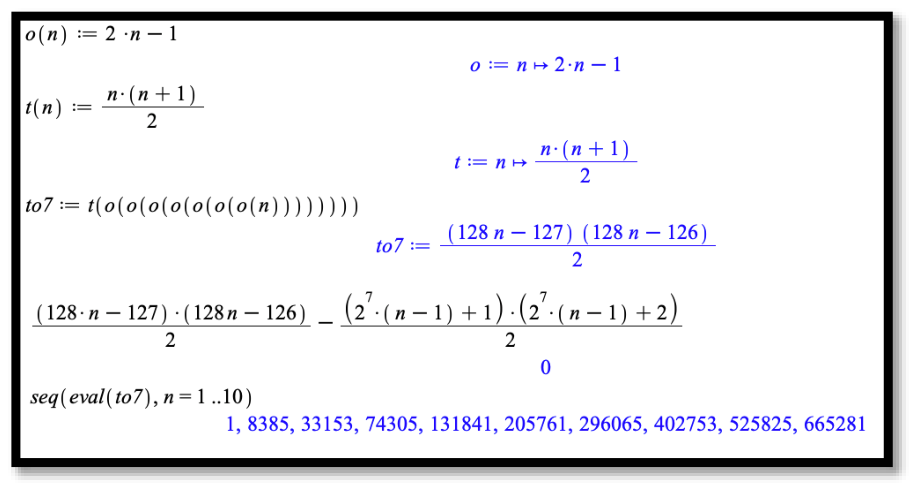
Figure 7.
Proving identity (7) using Wolfram Alpha.
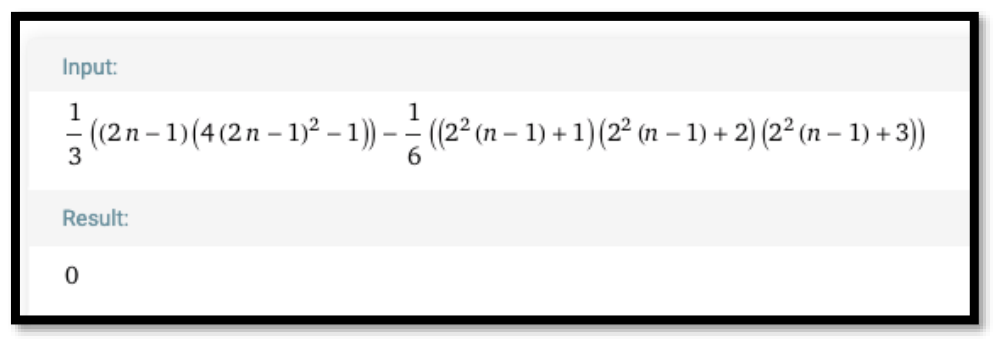
Figure 8.
Tetrahedral number sieves developed through the Cullen-type eliminations.
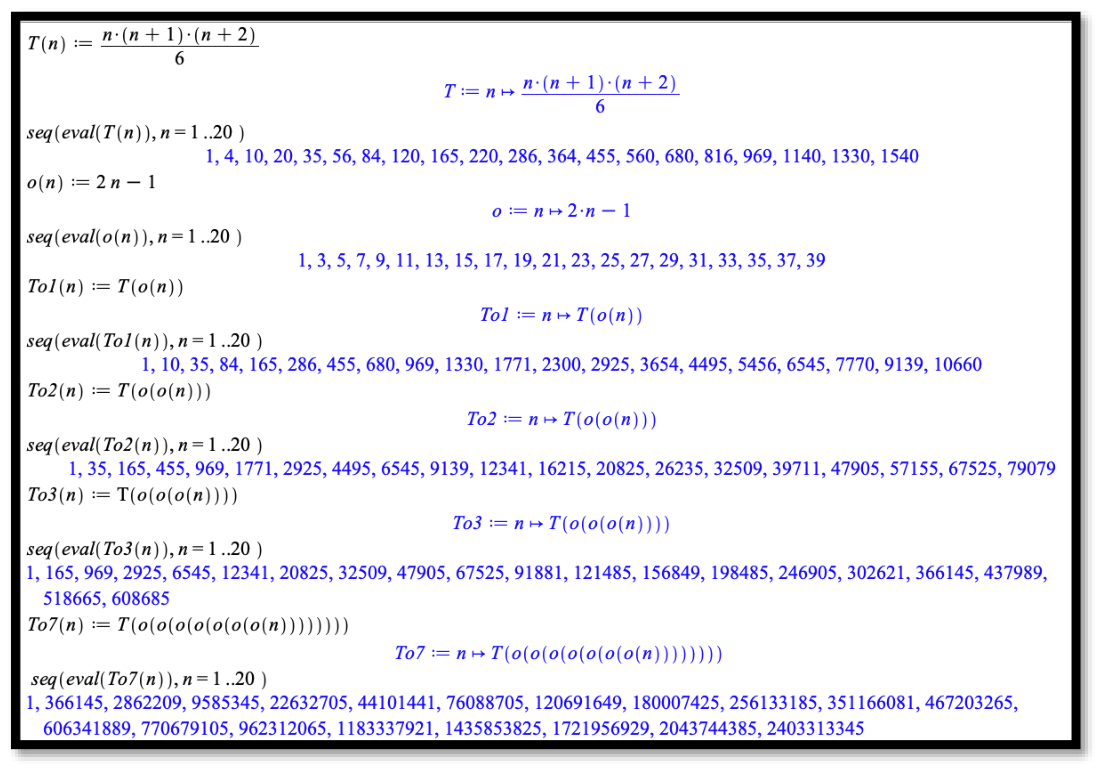
Figure 9.
Using Maple to generate doubly, triply, and quadruply triangular numbers.
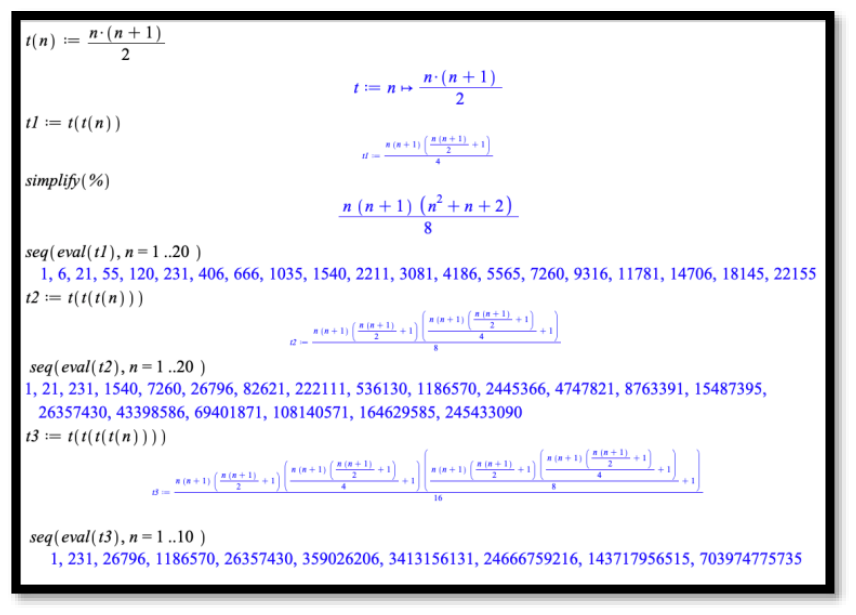
Figure 10.
Using Maple to generate the values of the function t(s(n)).
Disclaimer/Publisher’s Note: The statements, opinions and data contained in all publications are solely those of the individual author(s) and contributor(s) and not of MDPI and/or the editor(s). MDPI and/or the editor(s) disclaim responsibility for any injury to people or property resulting from any ideas, methods, instructions or products referred to in the content. |
© 2026 by the author. Licensee MDPI, Basel, Switzerland. This article is an open access article distributed under the terms and conditions of the Creative Commons Attribution (CC BY) license.
Copyright: This open access article is published under a Creative Commons CC BY 4.0 license, which permit the free download, distribution, and reuse, provided that the author and preprint are cited in any reuse.