

Submitted:
18 November 2026
Posted:
23 November 2026
You are already at the latest version
Abstract
Audio-video (AV) deepfakes can fake the face, the voice, or both. Most benchmarks only ask whether a clip is real or fake, so they cannot show whether a detector relies on the picture, the voice, or encoding traces. We present MOZAIC, a paired benchmark with a 4-way label in which every source clip is released in all four combinations of real or fake video and real or fake audio so each modality contribution can be measured directly. Fakes cover inner-face swapping, whole-frame video diffusion and voice conversion. MOZAIC has 137,745 clips from 15,014 source pairs and four tasks: T1 AV authenticity, T2 manipulation type, T3 identity verification and T4 explanation. We evaluate 12 AV multimodal LLMs (MLLMs), train four detectors and fine-tune MLLMs with LoRA. Overall, the best MLLM reaches only 35.6% on the four-way T1 and catches far more video-only fakes than voice-only fakes (43.6% vs 7.5%). Trained detectors reach 98.4% on T1, and LoRA fine-tuning raises explanation scores (OmniVinci 4.17 to 7.40, Qwen2.5-Omni 4.42 to 6.98), but the best T1 detector falls to 78.3% when the face-swap generator is held out of training, so generalization and explanation remain open. We release the dataset, the compact MOZAIC-SMALL split, the code and the prompts.
Keywords:
deepfakes
; audio-video deepfake detection
; multimodal deepfake benchmark
; MOZAIC benchmark
; audio-visual deepfake detection
; deepfake detection dataset
; multimodal large language models
; MLLM deepfake evaluation
; cross-modal deepfake detection
; voice cloning detection
; face swap detection
; synthetic media forensics
; deepfake generalization
; explainable deepfake detection
; AI-generated video detection
; audio-video authenticity verification
1. Introduction
Early deepfakes manipulated the face, but recent generators go further: Wan2.2 [1] synthesizes entire frames, subject and background, and voice converters such as Seed-VC [2] change who is speaking while keeping what is said and when. An AV deepfake can therefore have a fake video track, a fake audio track, or both [3].
Detecting such clips calls for more than a real-or-fake decision: a detector should state which modality was manipulated, check whether two clips show the same person, and point to its evidence. MLLMs, which take audio and video together, could do all three, yet no existing benchmark tests the three together (Section 2, Table 1), and real-versufake scores cannot tell whether a model relies on the video, the voice or encoding traces.
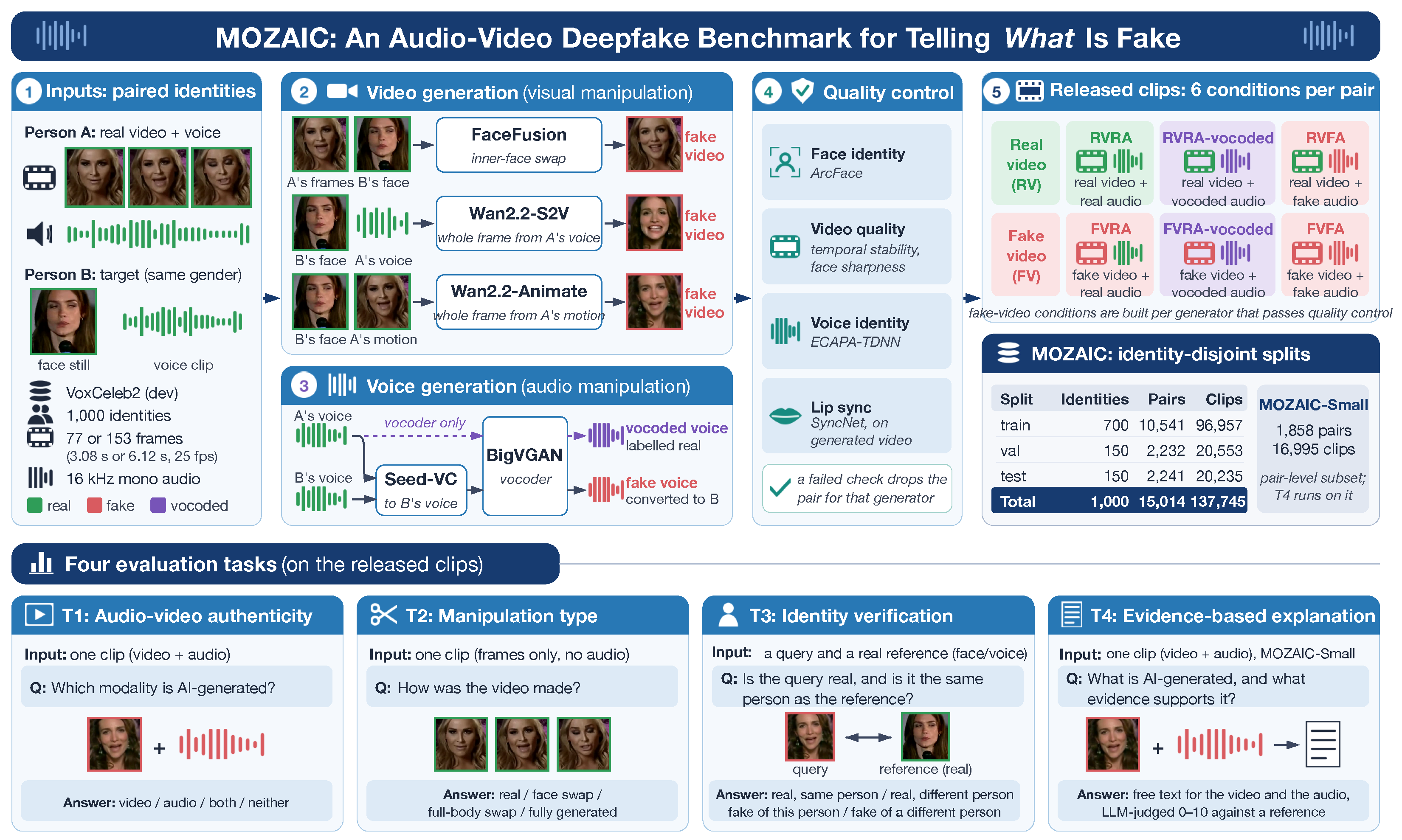
We introduce Mozaic (Modality-paired benchmark for analyZing Audio-video Integrity and Content), an AV deepfake benchmark built from 1,000 VoxCeleb2 [4] identities (Figure 2). Each of its 15,014 source pairs (a real clip of person A and a same-gender target B) appears in all four combinations of real or fake video and audio (a 4-way label), which isolates the effect of each modality; a vocoded real-voice control separates vocoder traces from speaker identity. Mozaic has 137,745 clips and four tasks: AV authenticity (T1), manipulation type (T2), identity verification (T3) and evidence-based explanation (T4, on the compact Mozaic-Small split).
We evaluate 12 MLLMs, and train four detectors and LoRA-tune MLLMs under one protocol (Figure 1). MLLMs stay close to chance at telling which modality is fake and miss most fake voices. Trained detectors nearly solve T1 and T2 in distribution but lose accuracy on an unseen face-swap generator, and explanations stay far from the ceiling after fine-tuning. Telling what is fake, not only whether, is still open.
Our contributions are: (1) Mozaic and Mozaic-Small, paired AV deepfake datasets with identity-disjoint splits, released for detection research only (Section 3.1 and Section 3.1.0.6); (2) four tasks, from close-ended detection to open-ended explanation (Section 3.2); (3) a comprehensive from evaluation of state-of-the-art MLLMs to training four detectors and LoRA-tuning MLLMs (Section 5); and (4) the full evaluation suite for reproduction.
Figure 2.
Mozaic.Top: a real clip of person A is paired with a same-gender person B; three video generators (FaceFusion, Wan2.2-S2V, Wan2.2-Animate) and one voice converter (Seed-VC) create the fakes, pairs that fail quality control are dropped, and each pair is released in six conditions (real or fake video with real, vocoded or fake audio). Bottom: the four tasks: which modality is fake (T1), how the video was made (T2), whether a query clip is real and shows the reference person (T3), and a written explanation (T4).
2. Related Work
Audio-video deepfake datasets. FakeAVCeleb [5] introduced labels RVRA, RVFA, FVRA and FVFA (real/fake video × real/fake audio), while LAV-DF [6], AV-Deepfake1M [7] and AV-Deepfake1M++ [8] (about two million clips) target localized, content-driven edits. In FakeAVCeleb, LAV-DF and AV-Deepfake1M, fake audio is text-to-speech, changing speech timing and lip movements; Mozaic converts voices while preserving words, timing and frames, with a vocoded real-voice control. DeepSpeak [9] adds webcam face swaps, lip-sync, avatars and voice cloning; PolyGlotFake [10], MAVODD [11] and BabelFake [12] broaden language coverage; DeepfakeBench-MM [13] standardizes evaluation. AVFakeBench [14] tests MLLMs from binary judgment to explanation, while AVID [15] probes AV inconsistencies. However, none jointly provides all four real/fake combinations per clip and reference-based identity checks, a gap addressed by Mozaic.
Video-only deepfake datasets. ViF-Bench [16] evaluates detection and visual artifact reasoning; DF26 [17] tests detector robustness across recent video generators (Wan [1], HunyuanVideo [18], Kling [19], Veo [20]). Both test visual authenticity only, not which modality is fake or whether two clips show the same person. Mozaic provide both AV deepfake clips for detection and reasoning tasks.
Detectors and MLLMs for forensics. We train four baselines that span AV speech and perception encoders (AV-HuBERT [21], PE-AV [22]), an AV deepfake detector (HAVIC [23]) and a visual deepfake detector (DFD-HR [24]). Identity-aware detectors such as ID-Reveal [25] and POI-Forensics [26] compare a clip with real footage of the same person, which our T3 (discussed in Section 3.2) turns into a benchmark task. MLLMs also serve as explaining detectors for generated video (BusterX [27]), for images, audio, video and talking heads (Omni-Fake [28]) and for AV deepfakes [29]; MADBench [30] tests fake audio over real video. Together, these works motivate our benchmark, but none jointly evaluates audio-video authenticity, manipulation type, crosclip identity, and explanation quality under controlled generation conditions, as summarized in Table 1.
3. The Mozaic Benchmark
The Mozaic benchmark is shown in Figure 2 and discussed in this section.
3.1. Dataset Construction
Source data.
We draw real talking-head clips from 1,000 identities in the VoxCeleb2 development set [4] and take gender from its speaker metadata. Each clip is cut from the start of a source recording at 25 fps and 224×224, VoxCeleb2 native resolution, with 16 kHz mono audio. We use two clip lengths, 77 frames (3.08 s) and 153 frames (6.12 s).
Pair design.
To construct the four-way labels (RVRA, RVFA, FVRA, FVFA), each pair combines a real clip of identity A with a same-gender target identity B, as shown in Figure 2 and Supp. . Real-video clips are shared across generators, while fake-video clips are generated once per retained generator. As a control, A’s voice is processed through BigVGAN [31], preserving speaker identity while introducing the vocoder artifacts present in converted speech. T1, T3 and T4 use these vocoded voices as real audio (T2 is video-only), preventing models from identifying fakes through vocoder artifacts alone. Unvocoded clips are also released.
Generators.
We use three video generators and one voice converter. FaceFusion [32] swaps the inner face, preserving the rest of the frame. Wan2.2-S2V [1] animates an image of B using A’s audio, generating the full frame. Wan2.2-Animate [1] transfers A’s motion to an image of B. Seed-VC [2] converts A’s speech into B’s voice, preserving words and timing. FaceFusion and Wan2.2-S2V support both clip lengths; Wan2.2-Animate is limited to 77 frames because longer renders caused identity drift across segments or single-pass blurring, creating potential detector shortcuts. Figure 3 shows one pair per generator.
Encoding and quality control.
All clips share a final encoding (H.264, CRF 18; uncompressed audio), normalized brightness, color and loudness, and identical leading silence and audio fade-in. Linear probes on file, frame and audio statistics remain near chance on held-out identities (AUC ≤ 0.57; Supp. ), suggesting limited low-level shortcuts. ArcFace [33] and ECAPA-TDNN [34] assess face and voice identity transfer to B (Figure 4); generated videos are further screened for temporal stability, sharpness and SyncNet [35] lip-sync. Pairs failing any check, including failed or refused generations, are removed per generator to preserve matched conditions. This excludes 13.4% (FaceFusion), 21.0% (Wan2.2-S2V) and 44.9% (Wan2.2-Animate) of 8,000 candidate pairs per applicable generator and clip length (Supp. ).
Splits and statistics.
We construct identity-disjoint training, validation and test splits with 700, 150 and 150 identities, respectively, assigning both identities in each pair to the same split. The dataset contains 15,014 source pairs and 137,745 clips, distributed as 10,541 / 2,232 / 2,241 pairs and 96,957 / 20,553 / 20,235 clips across the three splits (Figure 4; Supp. ). We also provide Mozaic-Small, a 16,995-clip subset sampled at the pair level, covering all identities while preserving each split’s clip-length, generator and gender distributions within 0.3 percentage points of the full dataset.
Ethics and release.
VoxCeleb2’s license permits research use. Since every fake depicts a real person, we release Mozaic for deepfake detection research only, with authenticity labels included in each clip’s metadata and filename (Supp. ).
3.2. Tasks and Annotation
Mozaic defines four tasks (Supp. Table S4: T1–T3 are multiple-choice questions (MCQs) with shuffled options, and T4 is open-ended reasoning task. T1–T3 labels follow from how each clip was generated (condition, generator and pair identities); only T4 needs annotated references. The release schema is provided in Supp. .
T1: Audio-video authenticity. Given an AV clip, the model indicates which modality, if any, was manipulated: video only (FVRA), audio only (RVFA), both (FVFA), or neither (RVRA). Audio counts as real when the speaker identity is preserved, so vocoded controls are real.
T2: Manipulation type. Given video frames without audio, the model classifies the clip as real, face swap (FaceFusion), full-body swap (Wan2.2-Animate, whole-frame), or fully generated (Wan2.2-S2V); the last two separate motion-guided from audio-driven full-frame generation. Each category is defined in the prompt. Real samples come from RVRA and manipulated samples from FVRA.
T3: Identity verification. Given a query clip and a real reference clip, the model decides whether the queried face or voice is real and whether it belongs to the reference person, with face and voice asked in separate questions. The four answers are real, same person, real, different person, fake of this person, and fake of a different person. T3 thus tests whether a model can tell a real clip of a person from a convincing fake of them.

Table 2.
Overall results on the Mozaic and Mozaic-Small test sets, in % except the T4 judge score. Acc: accuracy; F1: macro-F1. T3 Auth (authenticity) : is the clip real or fake; ID: do the two clips show the same person; Joint: both answers right (4-way). T4 (Mozaic-Small only): Judge is the 0–10 judge score, averaged over the video and audio parts; ROUGE-L is word overlap with the reference. Chance is 25% on T1, T2 and T3 Joint and 50% on Auth and ID; a fixed alwayreal answer scores 4.76 on Judge. Bold: best per column (in all tables); underlined: second best. VideoLLaMA2.1-AV: T1 and T3 from its nopad run, T2 and T4 from the standard run.
| Mozaic | Mozaic-Small | ||||||||||||||||
|---|---|---|---|---|---|---|---|---|---|---|---|---|---|---|---|---|---|
| T1 | T2 | T3 | T1 | T2 | T3 | T4 | |||||||||||
| Model | Size | Acc | F1 | Acc | F1 | Auth | ID | Joint | Acc | F1 | Acc | F1 | Auth | ID | Joint | Judge | ROUGE-L |
| Open models | |||||||||||||||||
| Qwen3-Omni | 30B-A3B | 18.5 | 13.8 | 34.1 | 20.5 | 40.9 | 64.5 | 28.2 | 18.9 | 14.4 | 33.8 | 20.2 | 41.2 | 64.1 | 28.3 | 4.22 | 25.3 |
| Qwen2.5-Omni | 7B | 19.6 | 13.3 | 33.6 | 17.2 | 57.2 | 56.8 | 32.2 | 19.5 | 12.9 | 32.3 | 16.3 | 56.8 | 57.0 | 32.1 | 4.42 | 25.1 |
| MiniCPM-o 4.5 | 9B | 24.0 | 18.0 | 33.5 | 15.3 | 58.3 | 56.2 | 32.3 | 23.7 | 18.0 | 33.0 | 14.9 | 58.8 | 57.0 | 32.8 | 4.39 | 22.5 |
| Nemotron 3 Nano Omni | 30B-A3B | 18.7 | 16.3 | 33.9 | 15.2 | 57.2 | 55.5 | 32.9 | 20.2 | 17.8 | 33.6 | 14.8 | 57.0 | 55.2 | 32.6 | 4.50 | 26.4 |
| Gemma 4 | 12B | 18.2 | 11.2 | 33.3 | 12.7 | 46.2 | 60.0 | 29.6 | 18.3 | 11.4 | 33.3 | 12.9 | 46.1 | 59.9 | 30.1 | 4.12 | 24.9 |
| VideoLLaMA2.1-AV | 7B | 30.9 | 18.3 | 29.6 | 11.8 | 57.5 | 51.0 | 29.2 | 31.6 | 19.2 | 29.8 | 11.8 | 57.2 | 51.8 | 29.2 | 4.41 | 25.8 |
| OmniVinci | 9B | 16.6 | 8.7 | 30.0 | 11.8 | 60.1 | 50.5 | 30.0 | 16.6 | 8.6 | 30.0 | 11.9 | 60.0 | 50.8 | 30.0 | 4.17 | 23.5 |
| Uni-MoE-2.0-Omni | 33B | 29.8 | 22.1 | 31.2 | 18.5 | 48.4 | 53.5 | 26.1 | 29.4 | 21.3 | 30.5 | 17.6 | 48.2 | 54.8 | 26.4 | 4.33 | 23.5 |
| Ola | 7B | 32.5 | 13.7 | 32.7 | 18.7 | 39.9 | 53.5 | 22.4 | 32.7 | 13.9 | 32.3 | 18.3 | 39.9 | 53.1 | 22.2 | 4.02 | 23.2 |
| VITA-1.5 | 7B | 17.3 | 9.4 | 32.0 | 19.6 | 40.5 | 53.8 | 22.5 | 17.4 | 9.6 | 32.2 | 19.7 | 40.6 | 52.8 | 22.3 | 4.52 | 24.4 |
| Proprietary models | |||||||||||||||||
| Gemini 3.8 Flash | – | 31.6 | 24.5 | 41.0 | 25.3 | 50.1 | 70.2 | 40.9 | 32.0 | 24.8 | 41.4 | 25.7 | 50.1 | 69.7 | 40.5 | 5.09 | 24.2 |
| Gemini 3.1 Pro | – | 35.6 | 31.6 | 36.7 | 21.6 | 62.7 | 71.3 | 47.5 | 35.8 | 31.7 | 37.0 | 21.6 | 62.7 | 71.3 | 47.1 | 5.15 | 27.8 |
T4: Evidence-based explanation. Given an AV clip from Mozaic-Small, the model explains video and audio separately, identifying whether each is manipulated and its scope (inner face or whole frame for video; voice for audio). Reference explanations are grounded in clip metadata. Gemini 3.6 Flash drafts each explanation using eight frames and the audio, while Claude Sonnet 5.5 verifies it against the metadata and standardizes the wording (Supp. ). Three authors reviewed a stratified sample of 400 references, accepting 99.2% (Gwet’s AC1 [36]: 0.985 for video and 0.983 for audio).
An LLM judge (GPT-5.4 mini) scores explanations against their references on a 0–10 rubric (Supp. ). Claude and the judge belong to model families excluded from evaluation. A manual review of 400 judged explanations across several models found scores consistent with the rubric.
4. Experimental Setup
Mozaic experimental design is given in this section.
4.1. Models and Data
T1–T3 are evaluated on the test splits of both Mozaic and Mozaic-Small, while T4 uses only Mozaic-Small. We evaluate 12 MLLMs zero-shot: ten open-source models (Qwen3-Omni [37], Qwen2.5-Omni [38], MiniCPM-o 4.5 [39], Nemotron 3 Nano Omni [40], Gemma 4 [41], VideoLLaMA2.1-AV [42], OmniVinci [43], Uni-MoE-2.0-Omni [44], Ola [45] and VITA-1.5 [46]) and two proprietary models (Gemini 3.8 Flash and Gemini 3.1 Pro [47]). Ablations use five models selected for cost and coverage: Gemini 3.8 Flash, Qwen3-Omni, Nemotron 3 Nano Omni, MiniCPM-o 4.5 and Ola.
Trained baselines use the Mozaic-Small training split and are evaluated on both datasets. AV-HuBERT [21], PE-AV [22] and HAVIC [23] use classification heads with full encoder fine-tuning (Full FT) or LayerNorm-only adaptation (LN). T1 uses audio and video; T2 is video-only and additionally includes DFD-HR [24], trained with adapters. For T3, a shared encoder embeds the test and reference clips, and a classification head predicts one of four answers from their concatenated embeddings. Qwen2.5-Omni is LoRA-tuned on all four tasks. For T4, six open MLLMs (Qwen3-Omni, MiniCPM-o 4.5, Nemotron 3 Nano Omni, Gemma 4, OmniVinci and Ola) are LoRA-tuned on the Mozaic-Small training split using the same settings.
Hyperparameters are provided in Supp. , with learning-rate and epoch sweeps in Supp. . To assess generalization, we retrain each baseline while excluding one video generator and evaluate on its fake clips alongside all real clips (Figure 7).
4.2. Input Protocol
Models run through their native multimodal interfaces and official preprocessing. Every model receives 32 frames per clip: models with native video input sample them with their own preprocessing, and the others receive 32 uniformly sampled frames; audio is provided for AV tasks and omitted for T2. T3 receives both clips, as frames for face questions and audio for voice questions (Supp. ). Per-model input settings and actual frame counts are reported in Supp. .
4.3. Decoding
Generative models use task-specific prompts (Supp. ) with temperature 0. For T1–T3, models return a JSON reply naming one option, with decoding restricted to the valid answers for MiniCPM-o 4.5, Uni-MoE-2.0-Omni, Ola and VITA-1.5, whose unconstrained replies often did not follow the JSON format; for T4, models generate explanations. Unparseable responses are counted as incorrect, and T4 parse rates are reported in Supp. Table S10. Trained classification models output class predictions.
4.4. Metrics
T1 and T2 are evaluated using accuracy and macro-F1. T3 reports authenticity accuracy, identity accuracy, and joint accuracy on the 4-way answer. Trained models report accuracy and macro-F1 on T1–T2, joint accuracy on T3, and the judge score on T4 (Section 3.2). We also report real/fake accuracy and ROUGE-L [48], BLEU-4 [49] and CIDEr-D [50] (Supp. Table S10).
5. Results
We organize the results around four research questions: (RQ1) can off-the-shelf MLLMs tell what is fake; (RQ2) does training solve the tasks and generalize to unseen generators; (RQ3) what evidence do the models rely on across generators, modalities, clip lengths, and frame budgets; and (RQ4) can models explain and localize a manipulation.
5.1. Evaluation of MLLMs
tab:zeroshot reports the performance of all twelve MLLMs. On T1, Gemini 3.1 Pro attains the highest accuracy (35.6%) and macro-F1 (31.6%). It identifies 43.6% of video-only fakes but only 7.5% of voice-only fakes, and several open models fall below the 25% chance level because they answer “real” for nearly every clip (Supp. Table S9). Among the open models, Ola reaches the highest accuracy (32.5%) but only 13.7% macro-F1, because it predicts FVRA for 96% of clips (Supp. Figure S5). On T2, Gemini 3.8 Flash performs best (41.0%), whereas every open model remains below 35%. On T3, Gemini 3.1 Pro achieves 62.7% authenticity accuracy and 71.3% identity accuracy, but only 47.5% joint accuracy. Results on Mozaic-Small follow the same trends. On T4, Gemini 3.1 Pro again obtains the highest explanation score (5.15/10) and ROUGE-L (27.8). Takeaway (RQ1): Although the Gemini models perform best on every task, no model reaches 50% on the four-way T1 and T2 answers or on T3’s joint answer, or exceeds 5.2 out of 10 on T4.
5.2. Supervised Baseline Evaluation
Figure 5 and Supp. Table S14 report the trained models on T1–T3 (means over five seeds), Table 3 reports T4, and Figure 6 shows their sensitivity to learning rate and epoch budget. In distribution. LoRA SFT raises the T4 score of every tuned MLLM (Table 3): OmniVinci gains the most (4.17 to 7.40), and Nemotron 3 Nano Omni, the strongest of these MLLMs off-the-shelf, the least (+0.68). Qwen2.5-Omni improves from 4.42 to 6.98, alongside gains from 19.6% to 83.4% on T1, 33.6% to 73.6% on T2 and 32.2% to 75.8% on T3 (joint). T3 stays the hardest task after training: LN-tuned PE-AV reaches 64.8% joint accuracy and AV-HuBERT about 51% (Supp. Table S14).
Across five seeds, full fine-tuning shows greater T1 variability, especially for PE-AV and AV-HuBERT (Figure 5). With LN tuning, PE-AV reaches 98.4% on T1 and 96.8% on T2 with little seed variation, suggesting effective feature transfer. AV-HuBERT remains less effective, possibly due to its speech-focused pretraining. HAVIC reaches 86.9% on T1 with LN tuning, while DFD-HR reaches 99.9% on T2 with adapters. Even after LoRA tuning, Qwen2.5-Omni trails these specialist detectors (83.4% vs. 98.4% on T1, 73.6% vs. 99.9% on T2). Full fine-tuning is unstable at the protocol learning rate: lowering it to lifts PE-AV from 56.4% (5-seed mean, Supp. Table ) to 99.8% on T1 (sweeps in Figure 6 and Supp. Table S15).
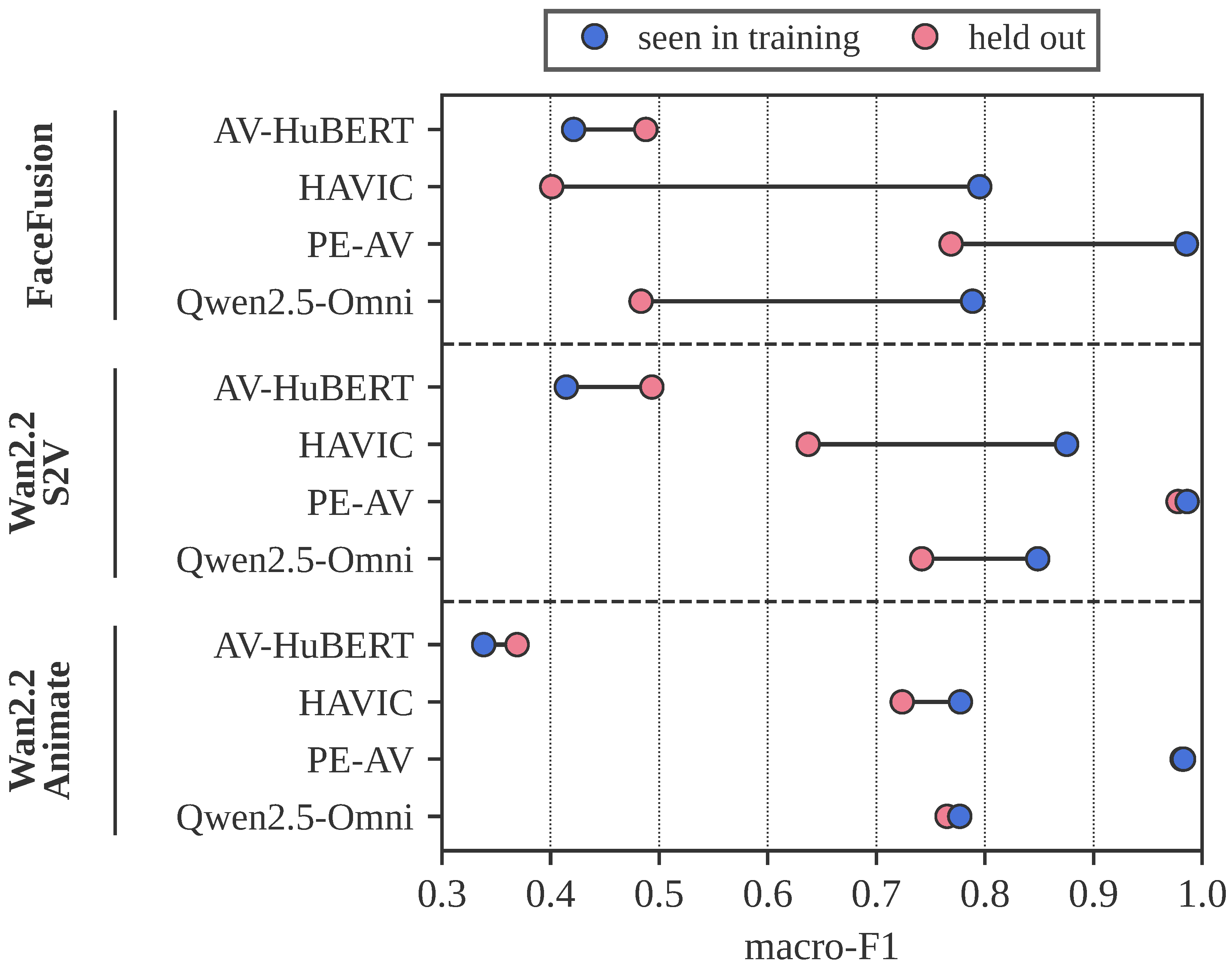
Unseen generators. This in-distribution accuracy does not carry over to an unseen face-swap generator (Figure 7; Supp. Table S16). When FaceFusion is held out of training, T1 macro-F1 on its clips falls from 98.6 to 76.9 for PE-AV, from 79.5 to 40.1 for HAVIC, and from 78.9 to 48.3 for Qwen2.5-Omni, whereas holding out either whole-frame generator costs PE-AV less than one point. Takeaway (RQ2): In-distribution accuracy overstates robustness: the detectors lose 22–39 F1 points on an unseen inner-face swap, which suggests that they rely on generator-specific cues.
Figure 7.
Generalization to unseen generators. Macro-F1 (4-class) of each detector when a generator is seen in training (blue) and when it is held out from training (pink); each group holds out one generator and evaluates on its clips. The line length shows the drop. Detailed results for all metrics and configurations are in Supp. Table S16.
5.3. Modality Use
To measure how much each modality contributes, we repeat T1 on Mozaic-Small with video-only and audio-only inputs for the five-model subset, stating the missing modality in the prompt (Table 4; Supp. Table S8). Removing the audio changes four-class accuracy by at most 3.5 percentage points and even improves it for three of the five models. Qwen3-Omni benefits most from audio-only input: its balanced audio accuracy rises from 51.8% to 58.6%, whereas every other audio-accuracy cell remains near chance (45.9–52.1%). In contrast, Gemini 3.8 Flash achieves 64.0% balanced video accuracy with both modalities and 59.4% with video alone, but drops to 50.2% once the video is removed. Takeaway (RQ3): Of the five models, only Gemini 3.8 Flash makes clear use of visual evidence, and none reliably detects audio manipulation when video is present.
5.4. Per-Generator Performance
Figure 8 reports balanced accuracy, the mean of the true-positive and true-negative rates, for each generator. The Gemini models discriminate best, reaching about 69% on Wan2.2-S2V and 59–61% on FaceFusion and Wan2.2-Animate, while Seed-VC remains the most difficult generator (55% for Gemini 3.1 Pro). For the open models, 36 of 40 model–generator combinations lie within four percentage points of chance. The one open exception is MiniCPM-o 4.5 on the whole-frame generators (56.9% on Wan2.2-S2V, 55.4% on Wan2.2-Animate). The converted voice is the blind spot for all models: no open model exceeds 52% on Seed-VC, and Gemini 3.8 Flash reaches only 51.7%. Takeaway (RQ3): The four-class accuracy of the open models reflects prediction bias rather than genuine forgery discrimination.
Figure 8.
T1 balanced accuracy (%) per generator for every off-the-shelf model on the Mozaic test set. Each cell averages the fake-part recall for that generator with the real-part recall of the same modality (video; audio for Seed-VC), so a constant answer scores 50% (chance). Red is below chance, blue above, saturating at ±10 points; bold marks the best model per generator. Nemotron 3, VideoLLaMA 2.1 and Uni-MoE 2.0 abbreviate Nemotron 3 Nano Omni, VideoLLaMA2.1-AV (nopad run, as in Table 2) and Uni-MoE-2.0-Omni.
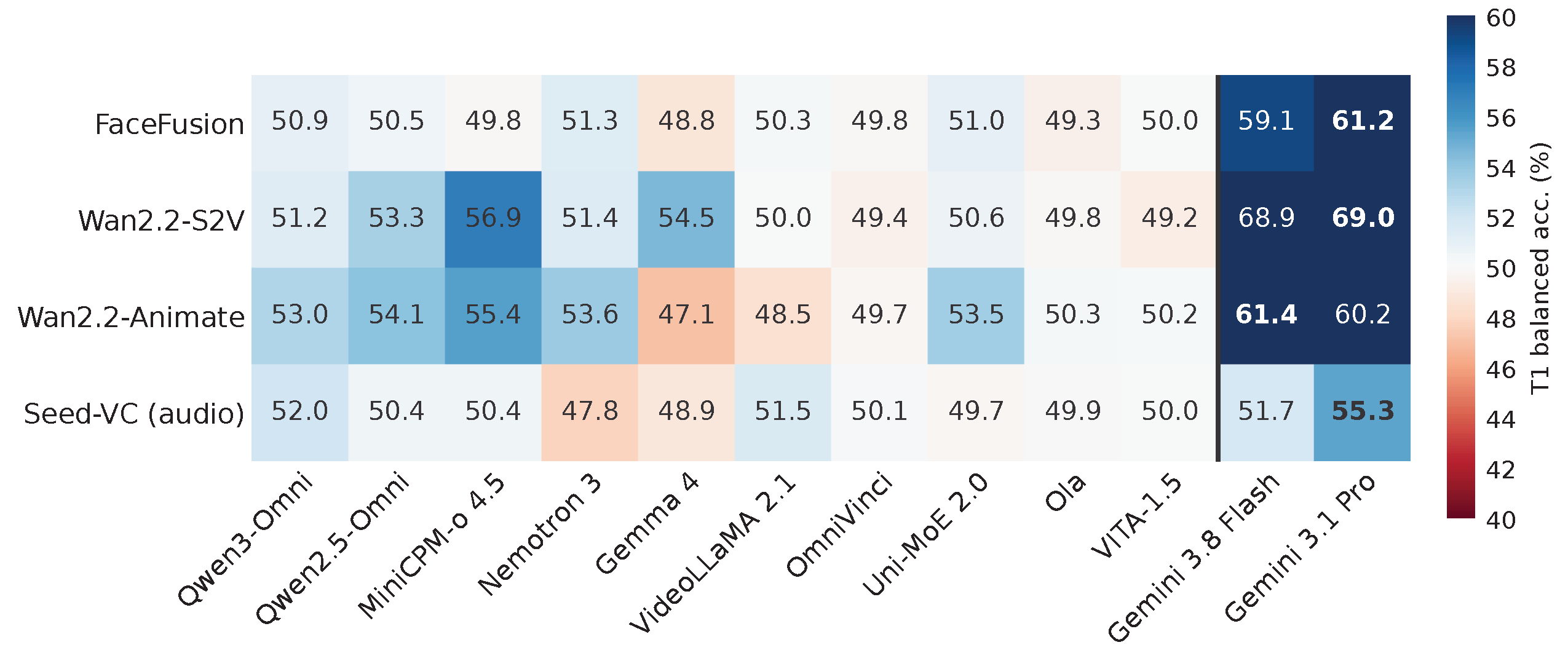
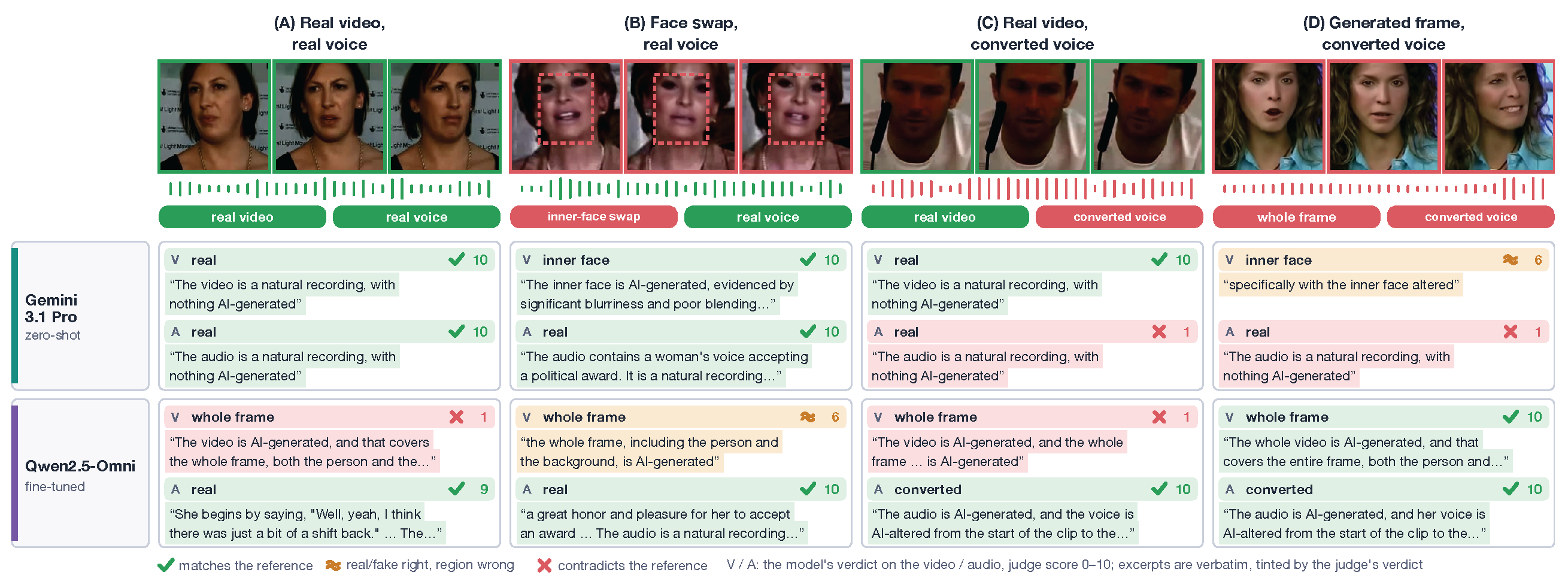
Figure 9.
T4 on fourMozaic-Smalltest clips: real, face swap with real voice, real video with converted voice, and fully generated. Borders, envelopes and pills: green real, red generated; dashed box: swapped face. Each chip gives what the model says about the video (V) or audio (A), a mark (check: matches the reference; wave: right verdict, wrong region; cross: contradicts it) and the judge’s 0–10 score, followed by a verbatim excerpt. Full explanations: Supp. Figure S6; whole-test-set rates: Supp. Figure S4.
5.5. Effect of Frame Budget
Varying the number of frames per clip from 8 to 64 for T1 on Mozaic-Small across five models (Figure 10), three models change by less than two percentage points, while MiniCPM-o 4.5 drops from 27.2% to 22.2% and Gemini 3.8 Flash from 34.6% to 31.9%. Takeaway (RQ3): Increasing the frame budget does not improve performance, suggesting that limited frame sampling is not the main cause of poor zero-shot results.
5.6. Effect of Clip Length
We next examine clip duration by comparing the 3 s and 6 s clips of the Mozaic test set for all models (Supp. Table S6). Longer clips appear to improve T2 by 5–8 percentage points for every model, including Gemini 3.8 Flash (37.4% to 45.5%). However, the 6 s clips contain no Wan2.2-Animate, one of the four T2 classes, and every model scores at most 0.3% on Wan2.2-Animate clips (Supp. Table S12), so dropping that class raises the average by construction. Once Wan2.2-Animate is also excluded from the 3 s clips, the T2 change shrinks to between and points (mean ; Supp. Table S7); on T1 and T4, where no class is removed, 6 s clips move accuracy by at most 4.3 points and the judge score by at most 0.6. Takeaway (RQ3): The apparent gains stem from generator composition rather than clip duration.
5.7. Explanation Quality
Figure 9 shows the verdicts of Gemini 3.1 Pro and the fine-tuned Qwen2.5-Omni on four test clips, with an excerpt of each explanation, and Supp. Figure S4 summarizes the region that each model claims across the whole test set. The open MLLMs label nearly every clip as real. On the judge, every model (at most 4.52) scores below a fixed alwayreal answer (4.76), and the Gemini models fall below it on audio. Gemini 3.1 Pro names a swapped inner face in about half of all clips, including real ones, and never a generated whole frame. Qwen2.5-Omni fine-tuned on Mozaic-Small separates real from converted voices but labels most videos as whole-frame generated, regardless of their true type. After fine-tuning, real/fake accuracy reaches 86.8% on audio but only 65.0% on video. Per-part scores and text metrics for all models are given in Supp. Table S10. Takeaway (RQ4): No model, whether untuned or fine-tuned, reliably localizes the manipulation.
6. Conclusion
We present Mozaic, an AV deepfake benchmark of 137,745 clips from 15,014 source pairs, covering all four video/audio real/fake combinations and a vocoded control. It supports four tasks: AV authenticity (T1), manipulation type (T2), identity verification (T3) and explanation (T4). State-of-the-art MLLMs struggle: the best achieves only 35.6% on T1, fake voices are frequently missed, and open models’ explanations score below an alwayreal baseline. Trained detectors reach 98.4% in distribution but lose up to 20 percentage points on an unseen face-swap generator. These findings highlight the need for modality-specific and crosgenerator evaluation beyond aggregate accuracy.
Limitations.Mozaic relies on VoxCeleb2 (224×224, 3–6 s clips), one voice converter and three video generators. Some compression and voice-conversion artifacts persist despite normalization. T4 references are LLM-generated (400 human-checked), while judge validation lacks a formal agreement study.
Future Directions. We release Mozaic and its evaluation suite to support reproducible comparisons. Future work should expand source diversity, generators and clip lengths, improve artifact control, and develop detectors that generalize across generators, identify altered modalities and provide verifiable explanations.
LLM Usage Statement: During the preparation of this work, the authors used Claude Sonnet and ChatGPT to improve grammar and wording. All final text was reviewed and approved by the authors, who maintain full responsibility for the content of the manuscript.
Supplementary Materials
The following supporting information can be downloaded at the website of this paper posted on Preprints.org.
References
- Wan, T.; Wang, A.; Ai, B.; Wen, B.; Mao, C.; Xie, C.W.; Chen, D.; Yu, F.; Zhao, H.; Yang, J.; et al. Wan: Open and advanced large-scale video generative models. arXiv 2025, arXiv:2503.20314. [Google Scholar]
- Liu, S. Zero-shot voice conversion with diffusion transformers. arXiv 2024, arXiv:2411.09943. [Google Scholar]
- Raza, S.; Ho, J.; Radwan, A.Y.; Hafez, M. Deepfakes in the Foundation-Model Era: A Survey of Forensics, Generation and Distribution Across Social Media Lifecycle. Preprints 2026. [Google Scholar] [CrossRef]
- Chung, J.S.; Nagrani, A.; Zisserman, A. VoxCeleb2: Deep Speaker Recognition. In Proceedings of the INTERSPEECH, 2018. [Google Scholar]
- Khalid, H.; Tariq, S.; Kim, M.; Woo, S.S. FakeAVCeleb: A novel audio-video multimodal deepfake dataset. arXiv 2021, arXiv:2108.05080. [Google Scholar]
- Cai, Z.; Stefanov, K.; Dhall, A.; Hayat, M. Do you really mean that? content driven audio-visual deepfake dataset and multimodal method for temporal forgery localization. In Proceedings of the 2022 International Conference on Digital Image Computing: Techniques and Applications (DICTA); IEEE, 2022; pp. 1–10. [Google Scholar]
- Cai, Z.; Ghosh, S.; Adatia, A.P.; Hayat, M.; Dhall, A.; Gedeon, T.; Stefanov, K. AV-Deepfake1M: A large-scale LLM-driven audio-visual deepfake dataset. In Proceedings of the Proceedings of the 32nd ACM international conference on multimedia, 2024; pp. 7414–7423. [Google Scholar]
- Cai, Z.; Kuckreja, K.; Ghosh, S.; Chuchra, A.; Khan, M.H.; Tariq, U.; Gedeon, T.; Dhall, A. AV-Deepfake1M++: A large-scale audio-visual deepfake benchmark with real-world perturbations. In Proceedings of the Proceedings of the 33rd ACM International Conference on Multimedia, 2025; pp. 13686–13691. [Google Scholar]
- Barrington, S.; Bohacek, M.; Farid, H. The DeepSpeak dataset. In Proceedings of the Proceedings of the IEEE/CVF Conference on Computer Vision and Pattern Recognition, 2026; pp. 1893–1902. [Google Scholar]
- Hou, Y.; Fu, H.; Chen, C.; Li, Z.; Zhang, H.; Zhao, J. PolyglotFake: A novel multilingual and multimodal deepfake dataset. In Proceedings of the International conference on pattern recognition, 2024; Springer; pp. 180–193. [Google Scholar]
- Croitoru, F.A.; Hondru, V.; Popescu, M.; Ionescu, R.T.; Khan, F.S.; Shah, M. MAVODD: Multilingual audio-video open-set deepfake detection benchmark. arXiv 2025, arXiv:2505.11109. [Google Scholar]
- Segna, C.; Tschesche, J.; Rohrbach, A. BabelFake: A Multilingual Audio-Visual DeepFake Benchmark. arXiv 2026, arXiv:2610.06339. [Google Scholar]
- Zhao, K.; Chen, Y.; Zhang, X.; Chen, Y.; Guan, W.; Chen, B.; Sun, C.; Datta, S.K.; Liu, Q.; Lyu, S.; et al. DeepfakeBench-MM: A comprehensive benchmark for multimodal deepfake detection. arXiv 2025, arXiv:2510.22622. [Google Scholar]
- Xia, S.; Li, P.; Liu, X.; Zhang, D.; Guo, X.; Li, Z. AVFakeBench: A comprehensive audio-video forgery detection benchmark for AV-LMMs. In Proceedings of the Proceedings of the IEEE/CVF Conference on Computer Vision and Pattern Recognition, 2026; pp. 35416–35426. [Google Scholar]
- Chen, Z.; Wang, D.; Lin, H.; Luo, L.; Xu, K.; Guo, Y.; Zhu, H.; Sun, T.; Jiang, X. AVID: Benchmarking Audio-Visual Inconsistency Understanding for Omni-Modal Language Models. In Proceedings of the Proceedings of the 2026 Conference on Empirical Methods in Natural Language Processing (EMNLP), 2026. [Google Scholar]
- Li, Y.; Zheng, W.; Zhang, Y.; Sun, R.; Zheng, Y.; Chen, L.; Zhou, J.; Lu, J. Skyra: AI-generated video detection via grounded artifact reasoning. In Proceedings of the Proceedings of the IEEE/CVF Conference on Computer Vision and Pattern Recognition, 2026; pp. 4482–4493. [Google Scholar]
- Shykula, S.; Yermakov, A.; Samarskyi, I.; Mishkin, D.; Cech, J.; Mishchuk, A. DF26: We Cannot Tell Fake From Real Anymore. arXiv 2026, arXiv:2609.07369. [Google Scholar]
- Kong, W.; Tian, Q.; Zhang, Z.; Min, R.; Dai, Z.; Zhou, J.; Xiong, J.; Li, X.; Wu, B.; Zhang, J.; et al. Hunyuanvideo: A systematic framework for large video generative models. arXiv 2024, arXiv:2412.03603. [Google Scholar]
- Kling, A.I. Kling AI: AI Video and Image Generation Platform. 2026. Available online: https://kling.ai (accessed on 2026-11-11).
- Google DeepMind. Veo: AI Video Generation. 2026. Available online: https://deepmind.google/models/veo/ (accessed on 2026-11-11).
- Shi, B.; Hsu, W.N.; Lakhotia, K.; Mohamed, A. Learning Audio-Visual Speech Representation by Masked Multimodal Cluster Prediction. In Proceedings of the International Conference on Learning Representations, 2022. [Google Scholar]
- Vyas, A.; Chang, H.J.; Yang, C.F.; Huang, P.Y.; Gao, L.; Richter, J.; Chen, S.; Le, M.; Dollár, P.; Feichtenhofer, C.; et al. Pushing the frontier of audiovisual perception with large-scale multimodal correspondence learning. In Proceedings of the Proceedings of the IEEE/CVF Conference on Computer Vision and Pattern Recognition, 2026; pp. 30172–30182. [Google Scholar]
- Peng, J.; Wang, Y.; Li, Y.; Kong, L.; Hong, X. Leave No Stone Unturned: Uncovering Holistic Audio-Visual Intrinsic Coherence for Deepfake Detection. arXiv 2026, arXiv:2603.23960. [Google Scholar]
- Sun, J.; Yan, Z.; Zhang, K.Y.; Yao, T.; Ding, S. DFD-HR: Generalizable Deepfake Detection via Hierarchical Routing Learning. In Proceedings of the Proceedings of the IEEE/CVF Conference on Computer Vision and Pattern Recognition, 2026. [Google Scholar]
- Cozzolino, D.; Rössler, A.; Thies, J.; Nießner, M.; Verdoliva, L. ID-Reveal: Identity-aware DeepFake Video Detection. In Proceedings of the 2021 IEEE/CVF International Conference on Computer Vision (ICCV); IEEE, 2021; pp. 15088–15097. [Google Scholar]
- Cozzolino, D.; Pianese, A.; Nießner, M.; Verdoliva, L. Audio-Visual Person-of-Interest DeepFake Detection. In Proceedings of the 2023 IEEE/CVF Conference on Computer Vision and Pattern Recognition Workshops (CVPRW); IEEE, 2023; pp. 943–952. [Google Scholar]
- Wen, H.; He, Y.; Huang, Z.; Li, T.; Yu, Z.; Huang, X.; Qi, L.; Wu, B.; Li, X.; Cheng, G. BusterX: MLLM-powered AI-generated video forgery detection and explanation. arXiv 2025, arXiv:2505.12620. [Google Scholar]
- Li, T.; Huang, Z.; Wen, H.; He, Y.; Li, X.; Zhu, B.; Duan, W.; Chen, C.; Fu, Z.; Dong, Y.; et al. Omni-Fake: Benchmarking unified multimodal social media deepfake detection. In Proceedings of the Proceedings of the IEEE/CVF Conference on Computer Vision and Pattern Recognition, 2026; pp. 30299–30311. [Google Scholar]
- Cao, S.; Li, Y.; Luo, Y.; Yin, J.; Ma, L. Leveraging large multimodal models for audio-video deepfake detection: a pilot study. In Proceedings of the IEEE International Conference on Acoustics, Speech and Signal Processing (ICASSP); IEEE, 2026; pp. 13442–13446. [Google Scholar]
- Li, Y.; Xiao, Y.; Bai, J.; Chen, B.; Jia, H.; Dang, T. MADBench: A Benchmark for Modality-Aware Audio Deepfake Detection. arXiv 2026, arXiv:2608.09593. [Google Scholar]
- Lee, S.g.; Ping, W.; Ginsburg, B.; Catanzaro, B.; Yoon, S. BigVGAN: A universal neural vocoder with large-scale training. arXiv 2022, arXiv:2206.04658. [Google Scholar]
- FaceFusion. FaceFusion: Next Generation Face Swapping and Enhancement. 2026. Available online: https://github.com/facefusion/facefusion (accessed on 28 October 2026).
- Deng, J.; Guo, J.; Xue, N.; Zafeiriou, S. ArcFace: Additive Angular Margin Loss for Deep Face Recognition. In Proceedings of the Proceedings of the IEEE/CVF conference on computer vision and pattern recognition, 2019; pp. 4690–4699. [Google Scholar]
- Desplanques, B.; Thienpondt, J.; Demuynck, K. ECAPA-TDNN: Emphasized Channel Attention, Propagation and Aggregation in TDNN Based Speaker Verification. Proc. Interspeech 2020, 2020, 3830–3834. [Google Scholar] [CrossRef]
- Chung, J.S.; Zisserman, A. Out of time: automated lip sync in the wild. In Proceedings of the Asian conference on computer vision, 2016; Springer; pp. 251–263. [Google Scholar]
- Gwet, K.L. Computing inter-rater reliability and its variance in the presence of high agreement. Br. J. Math. Stat. Psychol. 2008, 61, 29–48. [Google Scholar] [CrossRef] [PubMed]
- Xu, J.; et al. Qwen3-Omni Technical Report. arXiv 2025, arXiv:2509.17765. [Google Scholar]
- Xu, J.; et al. Qwen2.5-Omni Technical Report. arXiv 2025, arXiv:2503.20215. [Google Scholar]
- Cui, J.; Xu, B.; Wang, C.; Yu, T.; Sun, W.; Xu, Y.; Wang, T.; He, Z.; Ma, W.; Cai, T.; et al. MiniCPM-o 4.5: Towards real-time full-duplex omni-modal interaction. arXiv 2026, arXiv:2604.27393. [Google Scholar]
- Deshmukh, A.S.; Chumachenko, K.; Rintamaki, T.; Le, M.; Poon, T.; Taheri, D.M.; Karmanov, I.; Liu, G.; Seppanen, J.; Goel, A.; et al. Nemotron 3 Nano Omni: Efficient and open multimodal intelligence. arXiv 2026, arXiv:2604.24954. [Google Scholar]
- Gemma Team. Gemma 4 Technical Report. arXiv 2026, arXiv:2607.02770. [Google Scholar]
- Cheng, Z.; Leng, S.; Zhang, H.; Xin, Y.; Li, X.; Chen, G.; Zhu, Y.; Zhang, W.; Luo, Z.; Zhao, D.; et al. VideoLLaMA 2: Advancing Spatial-Temporal Modeling and Audio Understanding in Video-LLMs. arXiv 2024, arXiv:2406.07476. [Google Scholar]
- Ye, H.; Yang, C.H.H.; et al. OmniVinci: Enhancing Architecture and Data for Omni-Modal Understanding LLM. In Proceedings of the International Conference on Learning Representations, 2026. [Google Scholar]
- Li, Y.; Chen, X.; Jiang, S.; Shi, H.; Liu, Z.; Zhang, X.; Deng, N.; Xu, Z.; Ma, Y.; Zhang, M.; et al. Uni-MoE-2.0-Omni: Scaling language-centric omnimodal large model with advanced MoE, training and data. arXiv 2025, arXiv:2511.12609. [Google Scholar]
- Liu, Z.; Dong, Y.; Wang, J.; Liu, Z.; Hu, W.; Lu, J.; Rao, Y. Ola: Pushing the frontiers of omni-modal language model. arXiv 2025, arXiv:2502.04328. [Google Scholar]
- Fu, C.; Lin, H.; Wang, X.; Shen, Y.; Liu, X.; Cao, H.; Long, Z.; Gao, H.; Li, K.; MA, L.; et al. VITA-1.5: Towards GPT-4o Level Real-Time Vision and Speech Interaction. 2026, Vol. 38, 75300–75320. [Google Scholar]
- Team, G.; Anil, R.; Borgeaud, S.; Alayrac, J.B.; Yu, J.; Soricut, R.; Schalkwyk, J.; Dai, A.M.; Hauth, A.; Millican, K.; et al. Gemini: a family of highly capable multimodal models. arXiv 2023, arXiv:2312.11805. [Google Scholar]
- Lin, C.Y. ROUGE: A package for automatic evaluation of summaries. In Proceedings of the Text Summarization Branches Out, 2004; pp. 74–81. [Google Scholar]
- Papineni, K.; Roukos, S.; Ward, T.; Zhu, W.J. BLEU: a Method for Automatic Evaluation of Machine Translation. In Proceedings of the Proceedings of the 40th annual meeting of the Association for Computational Linguistics, 2002; pp. 311–318. [Google Scholar]
- Vedantam, R.; Lawrence Zitnick, C.; Parikh, D. CIDEr: Consensubased Image Description Evaluation. In Proceedings of the Proceedings of the IEEE conference on computer vision and pattern recognition, 2015; pp. 4566–4575. [Google Scholar]
Figure 1.
MLLMs are near chance at telling what is fake; LoRA helps but leaves a gap. Gemini 3.1 Pro and Qwen2.5-Omni inference, and Qwen2.5-Omni after LoRA on Mozaic-Small (in distribution; Table 2 and Table 3).
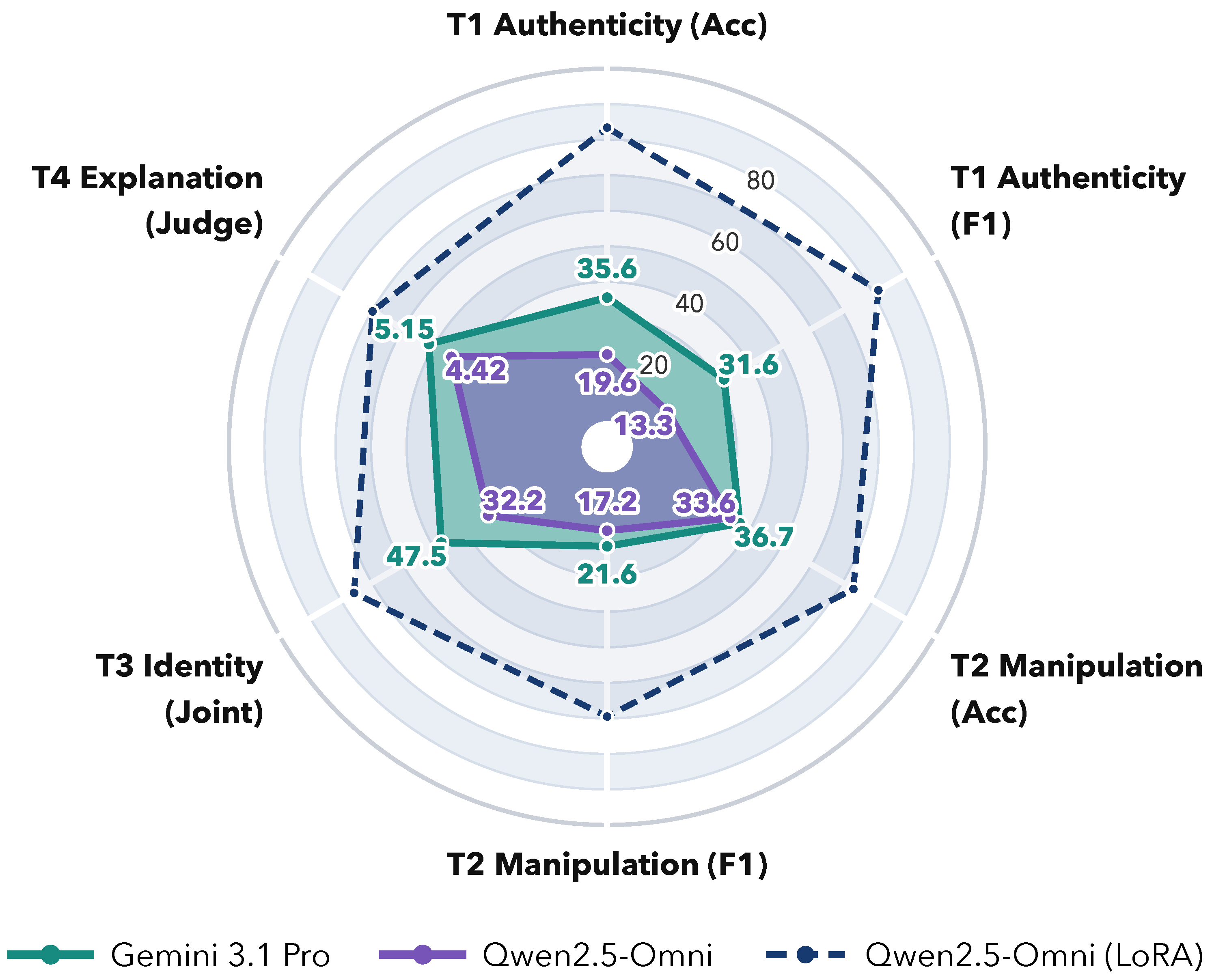
Figure 3.
What each generator changes. One 3 s test pair per generator (rows), from the same real frames of A. FaceFusion replaces only the inner face; Wan2.2-Animate and Wan2.2-S2V redraw the whole frame, driven by A’s motion and voice, respectively. Last column: target B (top) and changed pixels (red). Full version: Supp. Figure S2.
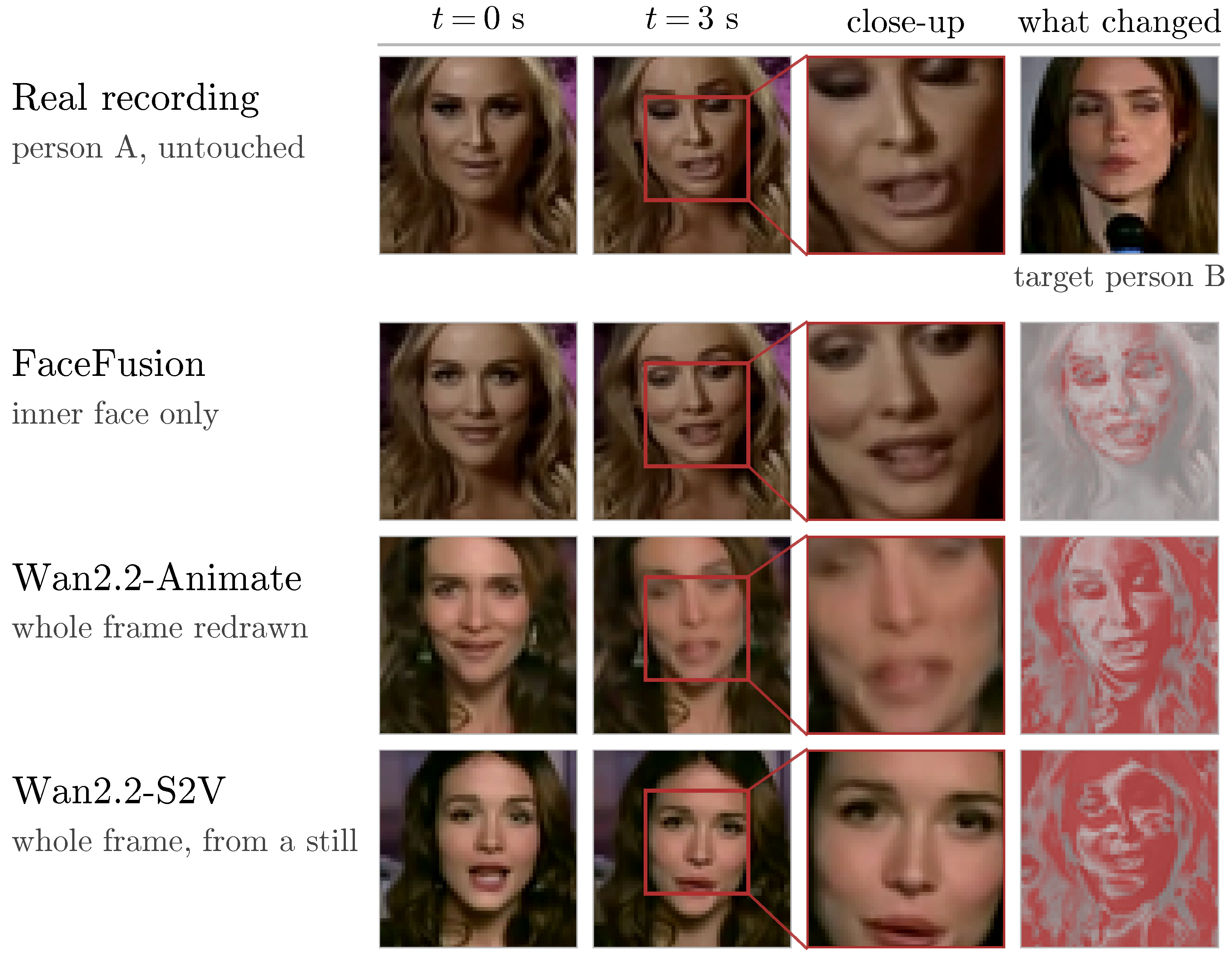
Figure 4.
Mozaicstatistics. (a) Clips by label (inner ring) and generator (outer ring). (b) Median similarity of each fake to the source A and the target B, face for video generators and voice for Seed-VC: every generator moves the identity to B. Question counts per task and split are in Supp. Table S4.
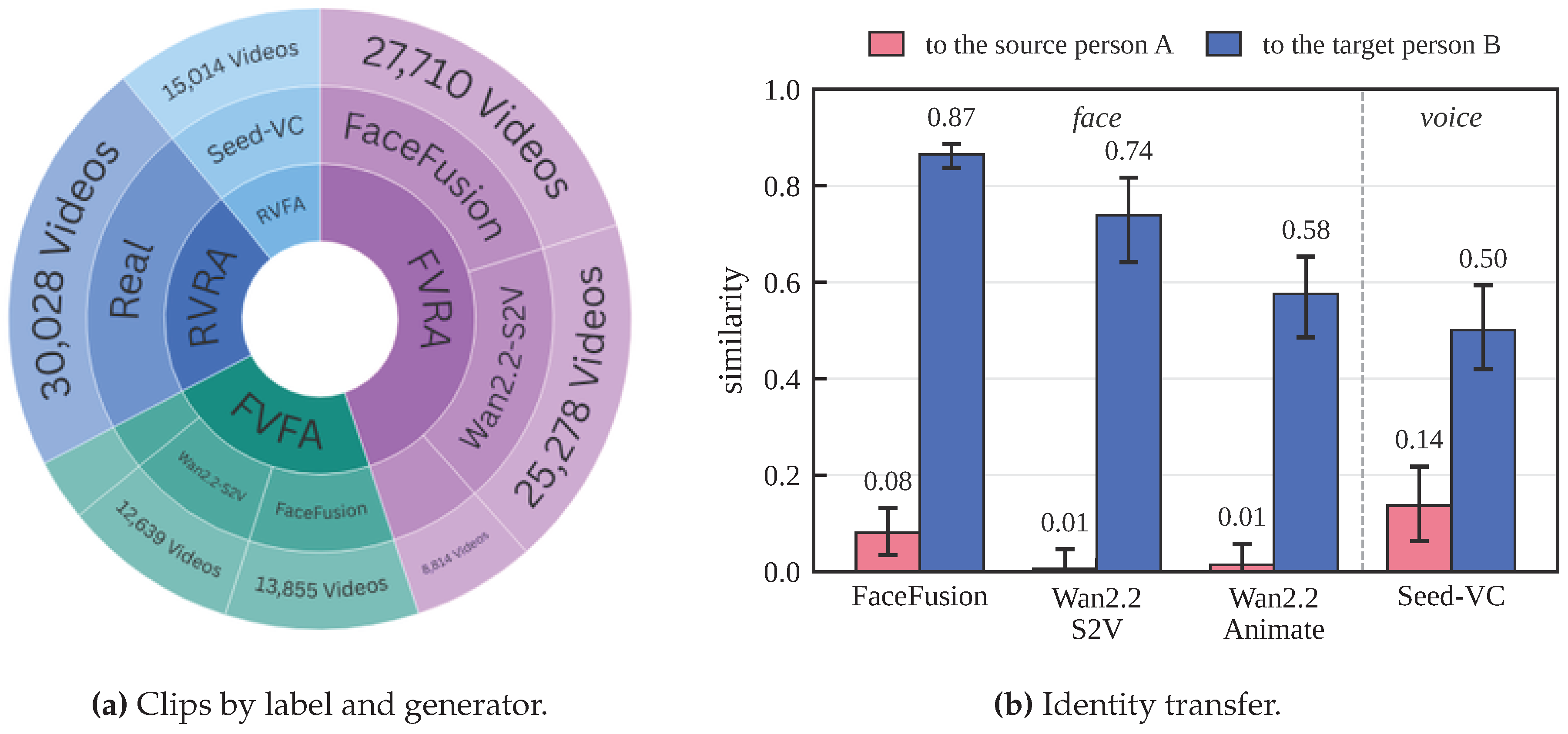
Figure 5.
Seed stability of the trained models. Mean accuracy over 5 seeds (±1 std), trained on Mozaic-Small and tested on Mozaic. Solid: parameter-efficient tuning (LN for AV-HuBERT, PE-AV and HAVIC; adapters for DFD-HR); hatched: full fine-tuning. Exact values, including F1 and T4, are in Supp. Table S14.
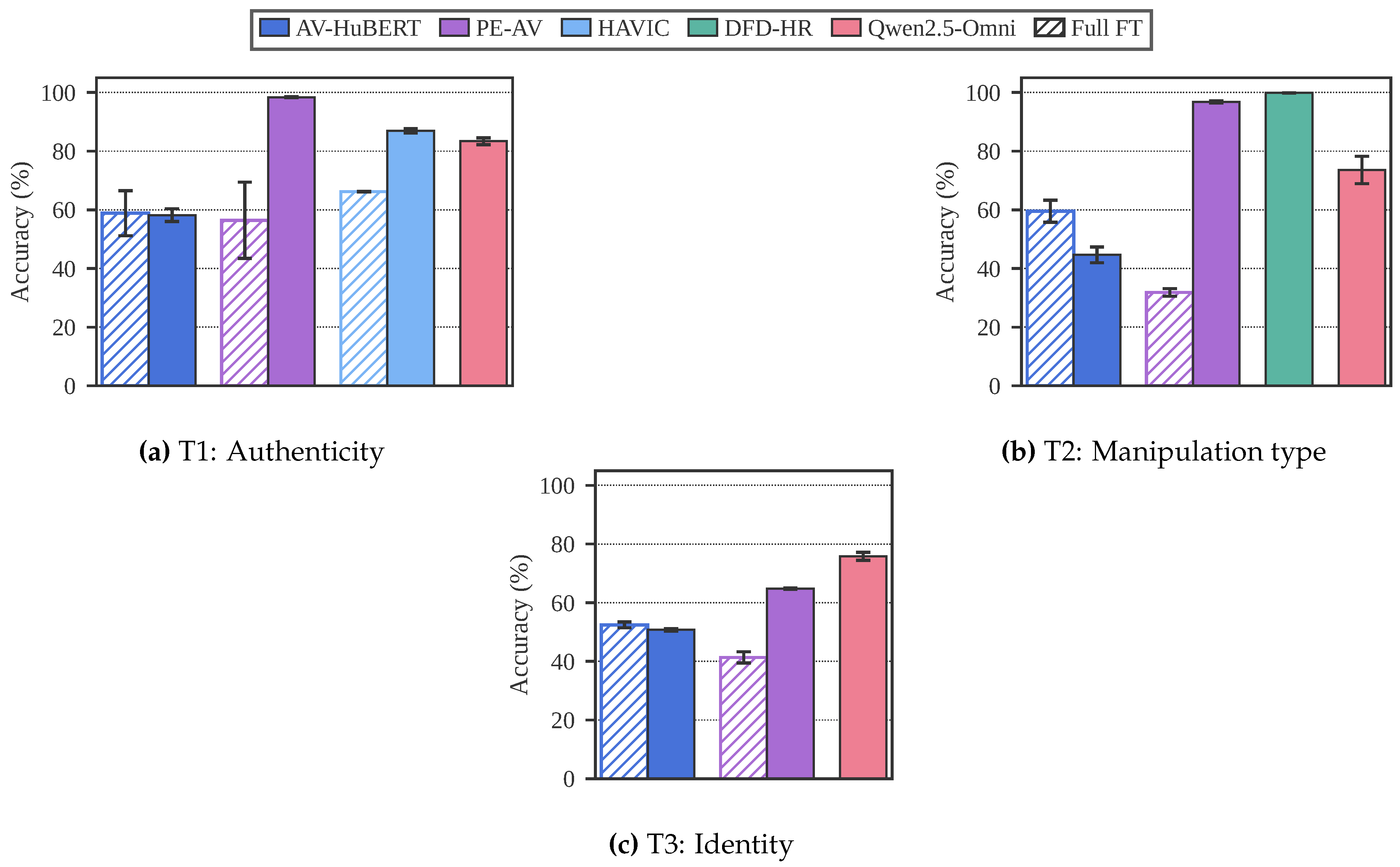
Figure 6.
Sensitivity to learning rate and training length, T1 test accuracy. (a) Learning rate (log scale); (b) number of epochs relative to the protocol, with all other settings fixed. AV-HuBERT, PE-AV and HAVIC use LN tuning; Qwen2.5-Omni uses LoRA. Shaded: protocol value. Full results for all tasks (T1–T4) and settings, including Full FT, are in Supp. Table S15.
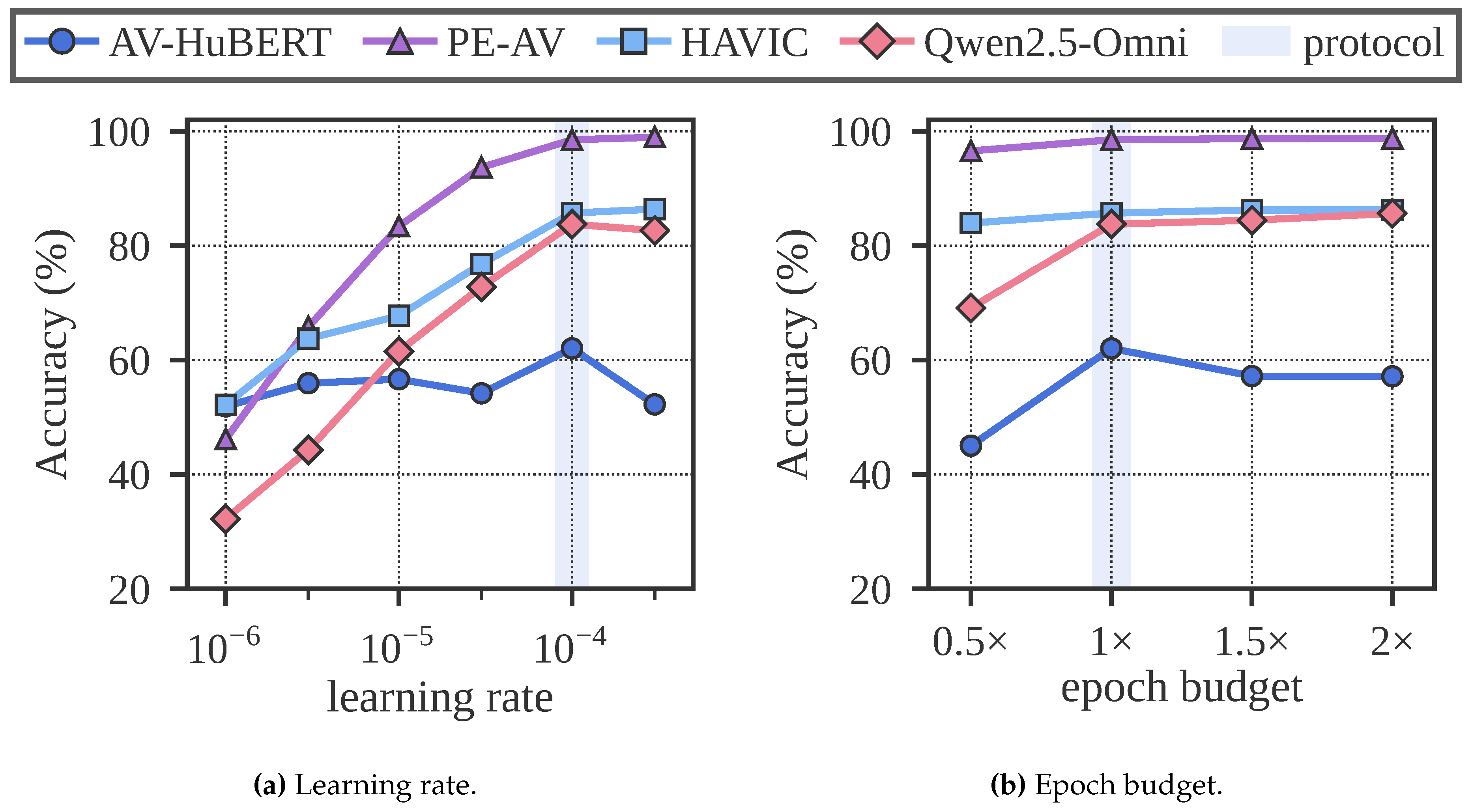
Figure 10.
T1 accuracy (%) on the Mozaic-Small against frames per clip (log scale). Shaded: the 32-frame protocol.
Figure 10.
T1 accuracy (%) on the Mozaic-Small against frames per clip (log scale). Shaded: the 32-frame protocol.
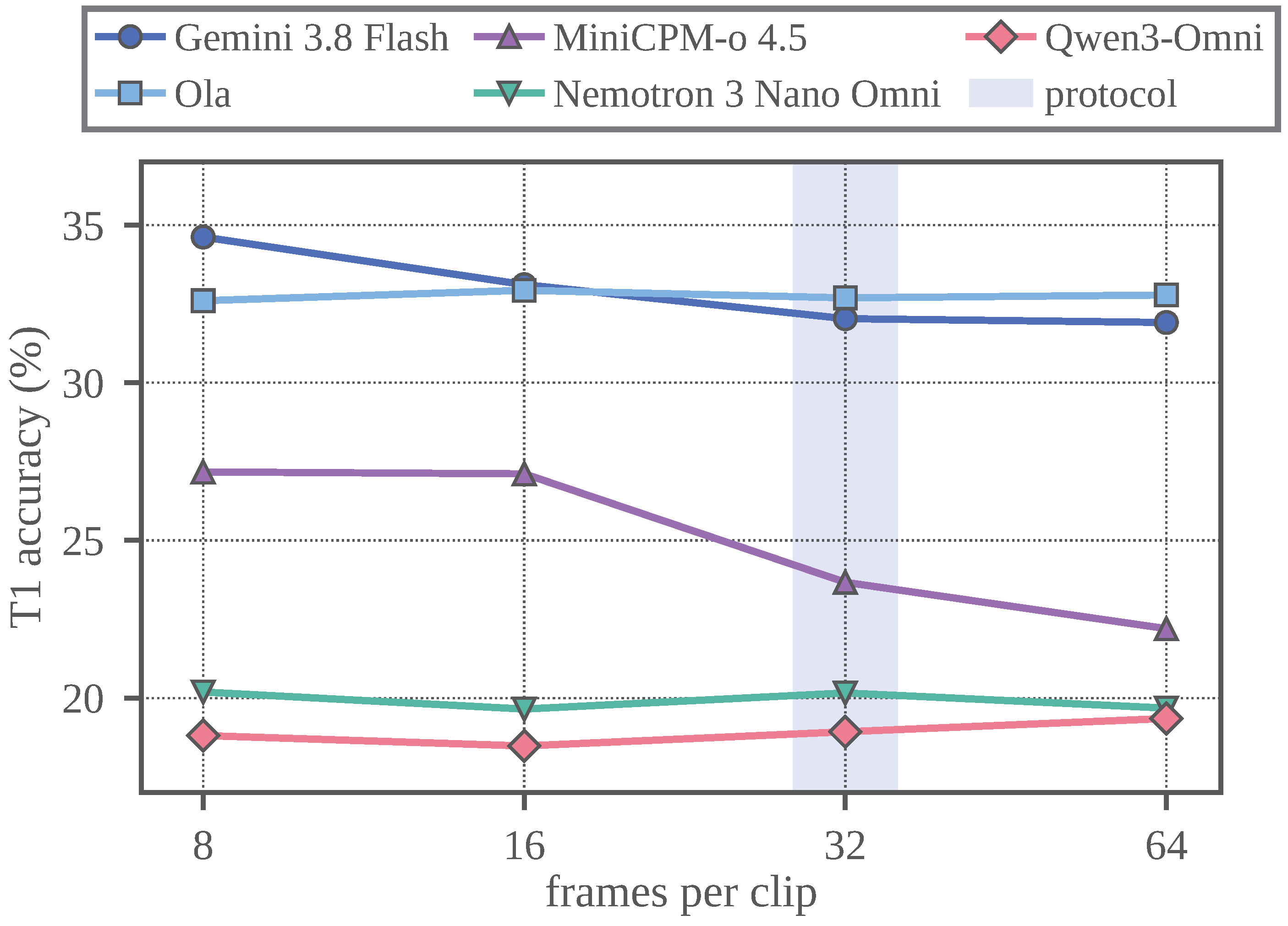
Table 1.
Comparison with related benchmarks. ✓/×/◗: supported/not shown/partial. Fake V/A: fake video/audio; Full: synthesis beyond the face; Open: free text; Ref.: identity check against a reference clip; Evid.: evidence evaluation.
Table 1.
Comparison with related benchmarks. ✓/×/◗: supported/not shown/partial. Fake V/A: fake video/audio; Full: synthesis beyond the face; Open: free text; Ref.: identity check against a reference clip; Evid.: evidence evaluation.
| Benchmark | Fake V | Fake A | Full | Open | Ref. | Evid. | |
|---|---|---|---|---|---|---|---|
| Video | ViF-Bench [16] | ✓ | × | ✓ | ◗ | × | ◗ |
| DF26 [17] | ✓ | × | ✓ | × | × | × | |
| Audio-video | FakeAVCeleb [5] | ✓ | ✓ | × | × | × | × |
| LAV-DF [6] | ✓ | ✓ | × | × | × | × | |
| AV-Deepfake1M++ [8] | ✓ | ✓ | × | × | × | × | |
| DeepSpeak [9] | ✓ | ✓ | ◗ | × | × | × | |
| MAVODD [11] | ✓ | ✓ | ✓ | × | × | × | |
| BabelFake [12] | ✓ | ✓ | ◗ | × | × | × | |
| AVFakeBench [14] | ✓ | ✓ | ✓ | ✓ | × | ✓ | |
| AVID [15] | × | ✓ | × | ✓ | × | ◗ | |
| Omni-Fake [28] | ✓ | ✓ | ✓ | ✓ | × | ✓ | |
| MADBench [30] | × | ✓ | × | × | × | × | |
| Mozaic(ours) | ✓ | ✓ | ✓ | ✓ | ✓ | ✓ |
Table 3.
Supervised fine-tuning onMozaic-Small. T4 judge scores (0–10) before and after LoRA SFT; : improvement. Trained T1–T3 results appear in Supp. Table S14.
Table 3.
Supervised fine-tuning onMozaic-Small. T4 judge scores (0–10) before and after LoRA SFT; : improvement. Trained T1–T3 results appear in Supp. Table S14.
| Model | Zero-shot | LoRA SFT | Δ |
|---|---|---|---|
| Qwen3-Omni | 4.22 | 6.23 | +2.01 |
| Qwen2.5-Omni | 4.42 | 6.98 | +2.56 |
| MiniCPM-o 4.5 | 4.39 | 6.03 | +1.64 |
| Nemotron 3 Nano Omni | 4.50 | 5.18 | +0.68 |
| Gemma 4 | 4.12 | 5.23 | +1.11 |
| OmniVinci | 4.17 | 7.40 | +3.23 |
| Ola | 4.02 | 5.40 | +1.38 |
Table 4.
Modality ablation. T1 balanced real/fake accuracy (%; chance 50) on each modality, Mozaic-Small test set, with both inputs (A+V), frames only (V) and sound only (A). Bold: best per column, where above chance. Full results: Supp. Table S8.
Table 4.
Modality ablation. T1 balanced real/fake accuracy (%; chance 50) on each modality, Mozaic-Small test set, with both inputs (A+V), frames only (V) and sound only (A). Bold: best per column, where above chance. Full results: Supp. Table S8.
| Video accuracy | Audio accuracy | |||||
|---|---|---|---|---|---|---|
| Model | A+V | V | A | A+V | V | A |
| Gemini 3.8 Flash | 64.0 | 59.4 | 50.2 | 52.1 | 50.1 | 51.8 |
| Nemotron 3 Nano Omni | 51.8 | 53.1 | 49.8 | 48.9 | 50.0 | 49.0 |
| Ola | 49.9 | 50.0 | 50.5 | 49.9 | 50.0 | 51.3 |
| MiniCPM-o 4.5 | 52.8 | 52.2 | 49.7 | 50.4 | 50.0 | 45.9 |
| Qwen3-Omni | 51.5 | 52.5 | 50.0 | 51.8 | 50.0 | 58.6 |
Disclaimer/Publisher’s Note: The statements, opinions and data contained in all publications are solely those of the individual author(s) and contributor(s) and not of MDPI and/or the editor(s). MDPI and/or the editor(s) disclaim responsibility for any injury to people or property resulting from any ideas, methods, instructions or products referred to in the content. |
© 2026 by the authors. Licensee MDPI, Basel, Switzerland. This article is an open access article distributed under the terms and conditions of the Creative Commons Attribution (CC BY) license (http://creativecommons.org/licenses/by/4.0/).
Copyright: This open access article is published under a Creative Commons CC BY 4.0 license, which permit the free download, distribution, and reuse, provided that the author and preprint are cited in any reuse.