

Submitted:
18 November 2026
Posted:
20 November 2026
You are already at the latest version
Abstract
Large language model (LLM) agents repeatedly judge which information matters and what action to take. Generating an extended response for every judgment can be costly, particularly in tasks that require frequent or rapid decisions. Typed decision models such as Jev provide an alternative by returning bounded choices, scores, or probabilities that programs can use directly. Existing studies have examined their performance and deployment, while broader surveys have reviewed LLM reasoning and tool use. How decision capabilities are formed, combined with LLMs, and improved through experience remains less clearly synthesized. This survey reviews commercial Jev, open Jev-like models, and their use in agent systems. We organize their mechanisms and operating conditions around decision space, information state, and computation policy, then examine workflow functions, runtime coordination, and system improvement. Our analysis shows that a decision model's effectiveness depends on the evidence and alternatives it receives, while the benefit of collaboration depends on how judgments guide computation and execution. We discuss how future systems might construct better candidates, adapt their use of assistance, and learn from deliberation. These directions connect Jev-like models to the broader development of rapid judgment and extended reasoning.
Keywords:
typed decision models
; Jev
; large language models
; adaptive computation
; calibration
; reasoning distillation
; intelligent agents
1. Introduction
Recent progress in large language models (LLMs) has enabled agents to combine reasoning with tool use and interaction with external environments [1,2,3]. These agents increasingly undertake tasks that unfold across searches, tool calls, code execution, and revisions [4]. As tasks become longer, agents must repeatedly judge which information matters, whether an intermediate result is reliable, and what to do next. These judgments determine how plans are carried out and revised.
Many of these judgments involve a finite choice, a relevance assessment, or an acceptance decision. Repeatedly invoking an LLM to deliberate over each one can incur substantial token and computational costs [5]. For applications that demand rapid responses or large volumes of judgments, latency, throughput, and energy efficiency become particularly important. Repeated questions about a shared state also create opportunities to reuse context processing across decisions [6,7]. The design problem is to make these judgments efficiently and reserve additional reasoning for cases that benefit from it [8,9].
Typed decision models address this need by evaluating task-defined alternatives directly, without requiring an extended textual response. Given evidence, a question, and a response type, they return a probability distribution or a constrained value. Jev is a commercial instance [10], while open models and probability-readout methods explore related designs [11,12,13]. Questions and candidate answers can be specified at inference time, supporting changing tasks through a common interface [14]. Earlier work on zero-shot classification and rubric-based evaluation similarly makes label descriptions or assessment criteria part of the input [15,16]. The returned probabilities let programs compare alternatives and apply acceptance rules, including deferring some cases for further processing [17].
In agent systems, typed judgments can screen retrieved evidence, control memory access, and assess generated results [18,19,20]. They can also select actions or models, guiding execution between rounds of planning [21,22]. By handling repeated assessments, a decision component can reduce the information a larger model processes and how often it is invoked. Similar workloads arise in clinical-record assessment, semantic database queries, and repeated questions over shared visual evidence [7,23,24].
Evaluating these systems involves both individual predictions and the execution process that uses them. Candidate coverage and evidence sufficiency constrain which questions can be resolved from a request [25,26]. Broad benchmarks assess accuracy, calibration, and sensitivity to task formulations [13,27], while agent studies follow decisions through verification, retries, and task completion [4,28]. Studies of confidence-based cascades relate their gains to error ranking, the fallback model’s ability to correct errors, and escalation costs [29,30]. These studies ask whether the policy using a model’s judgments improves task success at an acceptable total cost.
Fast judgment and deliberation can perform different parts of the same task. A deliberative component can define goals and construct alternatives, while a fast component evaluates evidence and guides subsequent operations. Simulation can make candidate consequences explicit, providing evidence that a fast model can use to evaluate actions [31]. JevGPT illustrates such coordination in autonomous research, combining research planning with source assessment and passage selection [32]. We use System 1 and System 2 to describe computational roles rather than fixed model categories. Fast judgment applies learned capabilities with limited additional deliberation, whereas deliberate reasoning involves more extensive search, analysis, and verification. These roles can coexist within one model or be distributed across cooperating components [33,34].
Repeated collaboration also produces experience that can improve later judgments. Memory retains useful evidence and feedback for subsequent requests [19,35], while distillation and self-training use successful reasoning or decision traces as supervision [36,37]. Recent work further connects model updates to changes in the surrounding workflow and the states that an agent encounters during execution [38]. Learning can therefore change which judgments a model makes directly and which cases require additional reasoning.
This survey asks how fast decision capabilities are formed, which judgments they support, and how collaboration and learning improve their use. We synthesize representative studies available as of November 2026, covering commercial Jev, open Jev-like models, and their use with LLMs.
1.1. Related Surveys and Contributions
Existing Jev surveys examine technical lineage and adaptation costs [39], calibration, selective control, and open implementations [40]. Rafe and Das [29] organize the field around the typed decision interface, tracing its research lineage and synthesizing evidence on robustness, calibration, and escalation. Roitman [30] takes a practitioner-oriented approach, organizing five model families and reviewing their training methods, calibration, agent workflows, and fast–slow cascades.
Broader surveys cover reasoning LLMs [41], implicit computation [42], efficient and adaptive reasoning [5,9], and the selection of reasoning and tool-use strategies [3]. Our focus is how typed decision capabilities are used during agent execution and how they change through experience. We use decision space, information state, and computation policy to connect capability formation, evaluation, deployment, and learning. In particular, we distinguish the mechanisms that enable individual decision models from the system-level functions that determine how their judgments are used and improved.
We organize this synthesis around three contributions:
- We develop a common framework of decision space, information state, and computation policy to connect implementation mechanisms with decision capabilities, system functions, and their operating boundaries.
- We synthesize evaluation resources and empirical findings, and analyze the use of decision models in agent workflows. We organize these uses around information selection, computation allocation, verification, and action selection, then examine runtime coordination and feedback-driven system improvement.
- We identify research directions in candidate construction, adaptive collaboration, and capability internalization, examining how execution feedback can address current limitations in decision capabilities.
Figure 1 outlines the survey. Section 2 establishes the concepts; Section 3 examines Jev interfaces, model construction and training, and their advantages and limitations; and Section 4 reviews datasets and empirical evidence. Section 5 examines decision models in agent workflows, runtime coordination, and system improvement. Section 6 brings these findings together to discuss open challenges and future research directions.
2. Background and Conceptual Framework
2.1. Typed Decision Models: Formulation and Interfaces
In a conventional generative interface, an LLM expresses a judgment through output tokens, such as a label, a score, or an explanation. A typed decision model returns probabilities or constrained values in a caller-specified answer space [39,40]. We represent a request as
where s is the evidence state, q the question, the response type, and the candidate set or scale. The caller specifies q and at inference time, allowing the decision task and permitted answers to vary across requests [11,14].
TypeSafe’s commercial Jev model illustrates three text primitives [10]. Choice assigns probabilities over ; a single-selection policy returns
Here, specifies the permitted output space, instantiated as for Choice and as an ordered scale for Score. Score returns a distribution over ordered rating levels, such as low, medium, and high. Noul estimates the probability that a proposition is true. We use Jev-like to refer to related open-source models and methods with similar typed decision interfaces or probability-based candidate evaluation [11,12].
2.2. Technical Lineage and Related Approaches
The development toward Jev-like models builds on making learned prediction reusable across changing decision tasks. Fixed-label classifiers typically operate over an output inventory established during training. Zero-shot entailment and reranking allow candidate descriptions to vary, while conventionally retaining textual support or query relevance as the evaluation criterion [15,101]. Jev-like interfaces make the judgment criterion and response type part of the request, allowing programs to specify different decision tasks through a common interface [10,39,40].
Figure 2 traces the research lines supporting this development. Bringing candidate descriptions into the input allows discriminative prediction to accommodate changing answer sets. GLiClass jointly encodes these descriptions with the evidence, while representation-based approaches such as Jeva represent requests and candidates separately for comparison [14,47]. Language-model probability readout provides a parallel route to reusable judgments. G-Eval aggregates score-token probabilities, while recent Jev-like implementations obtain candidate scores from the answer-token likelihoods of existing LLMs [11,12,16].
Recent models further examine how alternatives are compared and how much processing a judgment receives. Work on candidate/query structure makes these comparisons explicit: Prism-1 isolates candidate scoring, while Jeva uses separate request and candidate representations to support order-invariant evaluation [14,85]. Iterative/adaptive computation extends this development to inference depth. Earlier adaptive and recurrent architectures introduced mechanisms for controlling the processing performed before a prediction [89,90]. SanSi brings looped processing into typed decision models, connecting this research line to the Jev-like setting [92]. These developments support a common decision interface through different representations, readouts, and inference budgets.
Output validity, probability quality, and execution policy remain distinct concerns within this interface. Constrained generation enforces permitted output sequences or schemas [102]. Calibration assesses the correspondence between predicted probabilities and observed frequencies, while selective prediction determines which judgments to accept or defer [17,103]. Whether a judgment should trigger an action or further processing depends on its reliability, the available evidence, and the cost of the next operation.
2.3. A Common Analytical Framework
At time t, the decision space comprises available answers, task actions, and computational operations, while specifies the permitted outputs of one request. The information state contains observations, evidence, memory, and intermediate results. The computation policy combines the returned judgment with task context to select the next operation within latency and computation budgets. It may choose to act, acquire evidence, invoke another model, or request further reasoning and verification.
These dimensions provide a common basis for comparing decision mechanisms and their operating boundaries throughout this survey. Candidate coverage, evidence sufficiency, and reasoning demands impose different constraints on a judgment. Collaboration changes these conditions during execution, while learning changes what a model can judge directly and the assistance it requires.
During task execution, the application constructs s from and specifies q, , and for the current request. The returned judgment informs whether the policy acts on the result, revises candidates, acquires evidence, or requests further reasoning or verification. Candidate revision updates , while retrieval, deliberation, and observations from execution update for subsequent judgments. Following these updates through execution connects judgment accuracy and uncertainty to task outcomes and total cost.
System 1 and System 2 denote computational roles in this process, rather than fixed model categories [3,41]. Fast judgment applies learned capabilities with limited additional deliberation, whereas System 2 adds reasoning, search, or verification. These roles can be modes of one model or responsibilities of separate components [33,34]. A typed judgment can be produced in either role [11,42]. Deliberation can develop alternatives for fast judgment, while fast judgments guide further computation [3,31]. Across repeated tasks, feedback can improve candidate construction, stored evidence, and computation policies. Training can also turn recurring deliberation into reusable decision capabilities [35,36,104].
3. Understanding and Building Jev Models
3.1. What Is Jev?
Jev returns a typed judgment from the available evidence and a question specified by the application [10]. A support assistant handling an exchange request, for instance, may provide the customer message, product image, and relevant policy as evidence. With Choice, it asks which team should handle the request and receives probabilities for Returns, Shipping, and Billing. With Noul, it estimates the probability that the request can be approved. With Score, it assesses urgency on a specified ordered scale. With Box, it locates the shoe in the supplied image. In each case, the question and response type define how the output should be interpreted [105]. Section 2.1 formalizes this interface.
The application can act on the judgment or use it to decide what to do before making another judgment. The support assistant might proceed with the selected action, obtain a missing receipt, or ask an LLM to clarify an ambiguous policy clause. The same interface can be supported by different model designs. We next examine how Jev-like models use language model representations to make these judgments, how they learn from supervision, and how they allocate computation before returning an output. Figure 3 illustrates Jev’s typed interfaces through team selection, request approval, urgency assessment, and object localization in a customer-support scenario Choice.
3.2. Building Jev-like Decision Models
A pretrained language model already represents information useful for many judgments. Building a Jev-like model from it requires a way to turn those representations into typed decisions. In the customer-support example, the model needs to assign probabilities to the supplied options and determine whether further analysis is useful before returning a judgment. This adaptation involves the output interface, decision-specific learning, and the computation performed at inference. Figure 4 summarizes representative model architectures.
The implementations reviewed here start from the available evidence, the question, and any supplied candidates. A pretrained backbone processes the input, and a readout converts vocabulary scores or hidden representations into the requested judgment. The model can return the judgment directly or use it to choose its next computation. We examine how to obtain this readout, how to train it, and how to allocate extra reasoning at inference time. Table 1 relates these design choices to representative models and their pretrained backbones.
3.2.1. Model Adaptation and Decision Readout
A decision readout converts a language model’s outputs into a typed judgment. For candidate choice, the model can derive scores from its vocabulary head or compute them with a dedicated scorer. The architecture determines what information each score can use and which computations can be shared across judgments.
Vocabulary-based readout. LLM-as-Jev assigns each candidate a code and uses the vocabulary head to score that code [11]. When the K candidates have distinct single-token codes , the readout applies a softmax over the corresponding logits to obtain
For larger candidate sets, a code can span multiple tokens. LLM-as-Jev computes the likelihood of each complete code, reuses computation along shared prefixes, and normalizes the likelihoods over the candidate set. Koa-decision introduces dedicated single-token codes and varies their assignment to candidates during training [77]. AnyJev uses the existing vocabulary and accounts for label and order effects through prior correction and candidate rotations [78].
Decision-specific scorers. A dedicated scorer takes hidden representations from the backbone as input. GLiClass jointly encodes the input text and marked label descriptions, then compares their pooled representations [47]. Laya’s English configuration adds two transformer head layers to ModernBERT-large and scores the marker associated with each option [106]. Kev-4B instead retains a causal Qwen3.5 backbone and uses two projections to compare option-token states with the question state [107]. In Crivo’s joint reader, the request and candidates are encoded together, and a shared head scores the hidden state at each candidate marker [108]. Its per-option reader encodes each request–candidate pair separately. In experiments with Crivo’s 32M reader, the benefit of separate encoding depended on initialization from a pretrained reranker.
Candidate interactions. A candidate’s raw score can depend on which other candidates the scorer can access. Prism-1 places each candidate in an isolated block after a shared context. Within each block, tokens attend to the shared context and to earlier tokens in the same block. At the final token of the block, Prism-1 computes the candidate score by subtracting the log probability of no from that of yes [85]. For a fixed evidence state s and question q, the score of candidate is . Softmax normalization over the candidate set gives
Adding a candidate can change the individual probabilities through the denominator. For any two existing candidates, their probability ratio is still determined by the same score difference .
Jeva scores each candidate in the context of the full set [14]. A shared backbone encodes the request and candidates separately. In a small decision module, the request representation attends to the candidate representations before the module scores the options. The module also estimates whether the set contains an acceptable option and allocates probability mass to a null outcome. Changing the candidate set can therefore affect the scores. For a fixed set, each candidate receives the same score regardless of its position.
Shared computation. When candidate encoding is independent of the request, requests with the same options can reuse cached candidate representations. Dyad reuses action vectors while encoding the changing state separately [66]. Iris reuses visual option representations and also evaluates a variant that encodes each option in the context of the current request [109]. Conditioning on the request can capture relevant details, with fewer opportunities to reuse the resulting representations across requests.
Multiple judgments can also share an encoding of the same evidence. Verdict and Visual Jev encode shared evidence and isolate the question branches [6,7]. In VideoJev’s Joint mode, later queries can attend to earlier questions and their candidates. In Cached mode, each query is scored independently against the same video prefix [84]. Intern-Decision places prediction slots in a JSON template and reads out multiple fields in one forward pass [110].
Across modalities, the encoder must preserve the evidence needed by the readout. Visual decision models differ in how they provide image features to the scorer [68,111]. Speech decisions can use acoustic cues lost in transcription, and time-series inputs can be mapped to the language model’s embedding space [112,113]. At the output, UniJev uses a common decision head for text, images, and video [57].
Decision making and generation can also share computation. System X includes a text reply among its options and uses the key–value (KV) cache from the decision stage to start generating the reply [98]. In JevRec, two heads share the same representation of the interaction history. The decision head predicts a distribution over item identifier lengths, and the generation head produces the identifier conditioned on its length [114]. In reward modeling, Fast-Slow Thinking RM shares a backbone between first-token preference judgments and chain-of-thought judgments. A gate uses two confidence measures to decide when to invoke chain-of-thought reasoning [115].
3.2.2. Learning Methods
Learning methods differ in which parameters they update and in how they supervise decisions or reasoning.
Using a pretrained model. LLM-as-Jev reads the likelihoods of candidate codes using the pretrained weights [11]. AnyJev keeps the backbone frozen and fits a temperature on labeled examples to calibrate the readout [78]. Runoff first scores options independently to form a shortlist. It then uses the same pretrained model to compare the shortlisted options [116].
Choosing what to train. An update can change the readout, the representations produced by the backbone, or both. Releasing the Inner Jev retains the pretrained output rows for the answer-letter tokens and learns a correction to their scores alongside low-rank adaptation (LoRA) modules [12]. For its released open models, Our Own Jev trains LoRA adapters with the answer-letter readout fixed [117]. Both studies report little additional benefit from updating the readout in the settings they evaluate. With separate encoders, Dyad can adapt the action encoder alone or train both the action and state encoders [66].
Labels and teacher judgments. In supervised training, the evidence and question are paired with a target in the requested answer space. Visual Jev uses labeled visual questions and entailment examples to supervise option selection and proposition judgments [7]. RubriX uses ordered rating targets and a loss that accounts for the distance between rating levels [69].
Knowledge and policy distillation can use a teacher’s distribution as a soft target, preserving the relative support for the available options [118,119]. For each question, SII-Decision generates two reasoning traces and averages the final candidate distributions from those traces. Training the initial readout to match this average enables a single-pass judgment at inference [13]. Yu et al. report stronger transfer for several comparison and transformation tasks than for chain-of-thought reasoning on GSM8K [36].
Training examples can differ in the evidence they present, the order of the candidates, or the states sampled during execution. PACT edits a decisive fact and adjusts the reference answer to match the new evidence [120]. AudioJev pairs each question with a variant that reorders its candidates. A symmetric KL penalty aligns the predicted probabilities for corresponding candidates across the two orders [121]. JevAgentHarness introduces errors during scripted execution to collect states that require recovery. It mixes the teacher’s probabilities into the target when the teacher’s top choice matches the reference action [4]. DAgger uses expert labels for states encountered by the learner during execution [122].
Reasoning traces. A teacher can provide intermediate reasoning for supervision. Training can use explanations, alternative solution traces, or separate targets for problem decomposition and solution [123,124,125]. Methods for latent reasoning can distill intermediate states or progressively remove written steps during training [126,127]. CODI aligns latent computation with textual reasoning, while CIRF represents reusable reasoning operations with learned tokens [128,129].
Curriculum-based and counterfactual methods vary the examples presented to the student [130,131]. For a given example, EKLAV varies where the teacher’s reasoning appears in the input and supervises only the final answer [132]. Masked self-distillation controls how much intermediate reasoning the student is trained to internalize [133]. In on-policy distillation, the student generates prefixes and the teacher provides supervision on those prefixes [134,135]. Reasoning transfer can target specific skills, such as retrieval or tool use, or train the model to reuse latent reasoning operations [136,137,138].
Task feedback. The quality of a decision after reasoning can serve as a reward for the reasoning process. OpenJev-RLCD fits the decision distribution using a proper scoring rule and then uses that score to reward reasoning [139]. StartLux-Decision rewards improvements in decision probabilities and applies a soft penalty to long reasoning traces [95].
Decision signals can also supervise another learner. Related methods use targets derived from search, scores assigned to actions, or evaluations of individual steps [140,141,142]. At a matched labeling budget, Sadoun et al. [143] find that combining Jev and Qwen labels leads to stronger chess play than using Qwen labels alone. In their passage reranking experiments, Jev-only supervision is competitive, and adding Qwen labels yields little further improvement.
3.2.3. Inference Strategies
After encoding the request, the model can read out a decision directly, run a preset reasoning procedure, or adapt the computation before or during reasoning (Figure 5). A policy falls under adaptive control during reasoning if it can revise its plan after reasoning begins, even when it also uses an initial gate. These categories describe inference behavior. SII-Decision, for example, learns from reasoning outcomes and can make a judgment in one forward pass [13].
Direct judgment. The model applies the decision readout directly to the encoded request. FunDM trains a small head on features from an intermediate layer of a frozen LLM [55]. At inference, the forward pass can stop at that layer, and the head uses its features to obtain candidate probabilities. Decision quality depends on how well those features distinguish the candidates.
Fixed reasoning. Each request follows a preset reasoning procedure before the readout returns a decision. The extra steps can take the form of generated tokens or hidden-state updates. In the Thinking Jev setting of LLM-as-Jev, the model generates a reasoning trace within a preset token limit and then reads out candidate probabilities [11]. SoftCoT and INTACT add latent computation to frozen backbones [144,145]. Coconut passes hidden states into successive latent positions [146], and Huginn repeatedly applies a shared recurrent core [147]. SanSi reads candidate probabilities after each loop. With a fixed budget, the preset loop count determines which readout supplies the final decision [92]. A preset budget makes computation predictable and allocates reasoning even to easy requests.
Adaptive planning before reasoning. The model uses the input or an initial judgment to decide whether to reason and to select a plan or budget. Once reasoning begins, the model follows the selected plan. StartLux-Decision’s AutoThink mode returns a direct prediction for confident cases. For uncertain cases, it invokes explicit reasoning and combines the initial and post-reasoning predictions [95]. Adaptive-thinking distillation supports answer-first and reasoning-first modes [148]. Dynamic model interpolation adjusts the blend of instruction-following and thinking checkpoints at the request level [149]. Snell et al. show that the most effective allocation of a given test-time budget depends on question difficulty in both verifier-guided search and iterative revision [8]. The value of the initial gate depends on how well its signal identifies requests that benefit from additional computation.
Adaptive control during reasoning. Once reasoning begins, the policy can use intermediate results to decide whether to continue, extend the budget, or stop. Selective Reasoning uses an initial gate and reads candidate distributions from partial traces. The policy checks their entropy to decide when to accept a prediction and end generation [150]. Truncated-reasoning experiments address a related readout question by testing judgments based on incomplete traces [151]. SOMA monitors behavioral signals such as repeated checking to decide when to intervene [152]. These intermediate checks consume part of the inference budget.
Extra reasoning changes how the model processes the evidence it has. A model can identify the relevant facts and still choose the wrong action [153]. Simulated consequences and derived facts can supply further evidence for the decision [31,154]. Section 3.3 compares judgment quality and computational cost. Section 5 examines how these decisions guide larger workflows.
3.3. Advantages and Limitations
Computational Cost: Jev-like models can return a judgment without generating an extended response. This reduces output tokens, while shared context encoding and cached candidate representations can avoid repeated computation across related requests. Some architectures also reuse representations between decision making and generation. However, these savings depend on the model architecture and the workload. Executing fewer layers or reusing a shared context can reduce inference cost, whereas additional reasoning and repeated judgments introduce overhead. A faster individual decision therefore does not always make the complete workflow faster. Section 4.3 compares these effects empirically.
Judgment Quality and Reliability: A typed judgment is always made within a specified answer space. This makes the output easy to use, but also means that its interpretation depends on the available options. For example, Choice distributes probability mass across the supplied candidates. If several answers are correct, some may receive low probabilities despite ranking above incorrect alternatives [105]. If none of the candidates is suitable, the model must still distribute probability mass among them. Even an explicit NONE option does not always solve this problem [156]. In contrast, Noul evaluates propositions separately, allowing multiple compatible propositions to receive high probabilities. Score handles ordered ratings, although predictions can concentrate on a small subset of levels [157].
The candidates also influence the judgment itself. Changing their order, labels, or composition can change predictions even when the underlying question remains the same [158,159,160]. AudioJev reduces order sensitivity by training on reordered candidate sets [121]. More generally, the same event should receive consistent probabilities across equivalent formulations, but empirical studies find that this does not always hold [161,162,163]. These findings suggest that a decision model does not simply evaluate an isolated question; its output can depend on how the question and alternatives are presented.
Even with appropriate candidates, the reported confidence may not reflect the likelihood of being correct. Calibration measures this relationship, and selective prediction uses confidence to decide which cases to accept or defer [17,103]. Yet confidence and rejection thresholds can behave differently across tasks and distributions [25,164]. In one multilingual evaluation, a threshold fitted on U.S. English failed to maintain the target accepted-set accuracy in 43 of 51 other locales [164]. Training does not necessarily resolve this issue: teacher bias can persist after recalibration [165], and some reward-based training variants improve neither calibration nor its relationship with accuracy [57]. Distribution shifts may also escape confidence-based monitoring [166].
Finally, a model can only judge from the evidence it receives. Missing information may lead to confident but unsupported decisions [26]. For example, clinical assessment must distinguish a criterion that is not satisfied from one that cannot be evaluated with the available records [167]. Decisions involving multiple state updates can fail when earlier information becomes outdated [168]. Similarly, tool-call verification becomes harder when the expected value must be inferred or relevant supporting evidence is absent [154]. Even answer-preserving changes to context can affect predictions [169,170]. Reliable judgment therefore depends on both the model and the quality of the information supplied to it.
Suitable Uses: Jev-like models are most useful when tasks require frequent, bounded judgments and provide sufficient evidence and suitable candidates. They can efficiently support classification, ranking, verification, and action selection. When the available options are incomplete, relevant evidence is missing, or a decision requires further reasoning, direct judgment alone may not be enough. In these cases, a generative model or another component can construct alternatives, acquire information, or reason through difficult cases before returning to the decision model. Section 4 examines the empirical evidence behind these capabilities, while Section 5 discusses their use in larger workflows.
4. Datasets, Benchmarks, and Empirical Evidence
Training data specify the decision targets and situations available to the learner; evaluation tests how the resulting capabilities extend beyond those examples. This chapter examines supervision resources and evaluation designs, synthesizes within-study empirical findings, and identifies the limits of the conclusions they support.
4.1. Training Data and Decision Supervision
Decision supervision differs in both its targets and the situations it covers. SII-Decision uses the model’s own reasoning-endpoint distributions, averaged over two chains, rather than gold answers [13]. Visual Jev supplies option and proposition labels [7]; UniJev combines text, image, and video decisions, with hard- and soft-label supervised controls and a separate confidence target derived from current prediction groups [57]. RubriX supplies rubric-level labels conditioned on criterion and level descriptions [69]. These signals encode different information: a selected answer, relative probability mass, or a position on an ordered scale. Table 2 summarizes their sources, training scales, and evaluation boundaries.
State coverage matters independently of target format. JevAgentHarness records harness decision states and deliberately introduces mistakes through a scripted policy to include subsequent recovery situations [4]. It mixes gold labels with teacher probabilities only when the teacher ranks the gold answer first, otherwise retaining the gold label alone. PACT instead exploits curated pairs whose reference answers change after an edit to a decisive fact [120]. Relabelled and certificate-verified evidence-deleted views supply additional consistency and evidence-necessity constraints. Recovery states and paired changes thus expose different dependencies that isolated successful examples need not capture.
Evaluation separation determines what generalization these resources can establish. Visual Jev separates images and reserves TextVQA and TallyQA from post-training [7]; UniJev separates source groups [57]; RubriX holds out criteria and level descriptions, although checkpoint validation partly shares training criteria [69]. JevAgentHarness uses disjoint task seeds but reports repeated early states and shared generator conventions [4]. Such distinctions motivate the evaluation protocols in Section 4.2.
4.2. Evaluation Datasets and Benchmarks
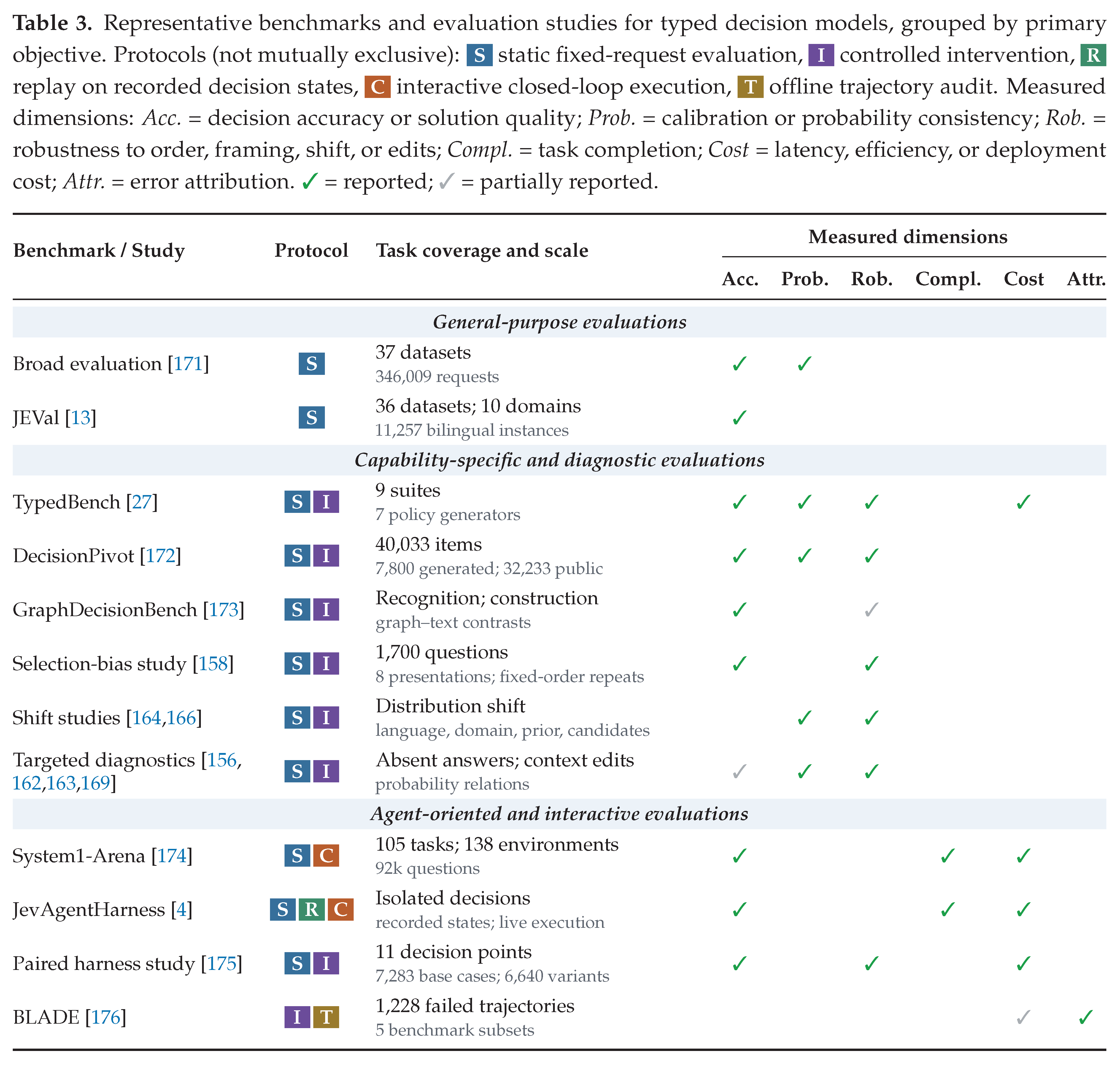
Existing evaluations of typed decision models can be grouped into general-purpose, diagnostic, and agent-oriented studies. Table 3 compares their task coverage, evaluation protocols, and measurements.
General-purpose Evaluations. The 37-dataset study [171] and bilingual JEVal [13] assess decision quality across diverse tasks, domains, and languages. They provide broad capability profiles, although differences in task composition and aggregation limit direct comparisons of overall scores.
Capability-specific and Diagnostic Evaluations. TypedBench [27] tests policy-grounded decisions, while DecisionPivot [172] probes sensitivity to pivotal evidence. GraphDecisionBench [173] distinguishes structural recognition from solution construction. Complementary studies examine candidate-order sensitivity [158], language and distribution shifts [164,166], and failures involving missing candidates, probability consistency, and contextual perturbations [156,162,163,169]. These tests reveal limitations obscured by aggregate accuracy.
Agent-oriented and Interactive Evaluations. System1-Arena [174] links static decision quality to interactive task outcomes. JevAgentHarness [4] and paired harness evaluations [175] examine delegation quality and execution costs, while BLADE [176] traces error propagation and attribution across agent workflows.
Evaluation Protocols. Static tests assess fixed requests; controlled interventions isolate sensitivity to changed inputs or alternatives; replay evaluates recorded states; and trajectory audits analyze completed executions. Closed-loop evaluation additionally captures states induced by the tested policy. Together, these protocols distinguish local accuracy and calibration from robustness, task completion, and end-to-end cost.
4.3. Performance Comparison and Empirical Findings
The following within-study comparisons identify four recurring findings; heterogeneous tasks and cost measures preclude a cross-study ranking.
Efficiency depends on computation depth and reuse. Reducing depth can preserve decision quality: FunDM reads Qwen3-8B after 24 of 36 layers with one added head layer, retaining 75.0% versus 75.7% mean accuracy across eight benchmarks; MMLU-Pro throughput is the teacher under BF16 vLLM with 16 active sequences [55]. Additional computation has diminishing returns: SanSi improves from 70.4% at three loops to 72.0% at eight [92]. Reuse offers a distinct saving. With unchanged weights, Verdict packs five questions, yielding – latency speedups at batch 1 and – at batch 8 [6]. Clinical batching reduces median complete-job latency from 8.08 to 1.20 s on 774 TrialGPT criteria, with macro-F1 changing from 0.646 to 0.652 [167]. Conversely, state conditioning raises Iris first-choice accuracy from 78.38% to 89.60% on the Mind2Web cross-task split with 16 crops, but prevents cross-request reuse [109]. Savings therefore depend on shared inputs and cache availability [69,167].
Accuracy does not establish decision reliability. Across 22 Choice datasets, pooled expected calibration error (ECE) is 0.028 versus an unweighted dataset mean of 0.061, showing how aggregation can obscure subset miscalibration [171]. On GSM8K-Verify, two-stage OpenJev-RLCD and GRPO+KL, both using Qwen3-1.7B and development-set temperature fitting, achieve and accuracy. Yet coverage at empirical error is versus (three-seed means ± s.d.) [139]. Candidate-order tests expose another limitation: similar aggregate accuracy can conceal changes in which questions are answered incorrectly [158].
 |
Candidate coverage and evidence constrain selection. Closed-set accuracy does not ensure rejection when the correct answer is absent. In 100 paired arithmetic cases with an explicit rejection option, a threshold fitted on 20 separate cases raises answer-absent rejection from 7% to 79%, while answer-present accuracy falls from 99% to 97% [156]. Evidence availability also changes performance: ALFWorld completion rises from 42/134 to 116/134 unseen games with lookahead in the first run under a 50-step limit. The intervention supplies cloned-environment observations and newly admissible commands, not unaided simulation [31]. Learning to Formalize instead improves candidate construction with a fixed selector [104], separating input-side improvements from selector capability.
Static gains need not translate into system-level gains. In System1-Arena, Decision-2.0-Vega-27B, Jev 1.13, and Qwen3.5-9B each report 67.8% static agent-category accuracy, but closed-loop completion is 26.5%, 17.4%, and 5.7%, respectively [174]. Delegation also matters: on 500 DecisionGym tasks, JevAgentHarness loses 19 percentage points of success with full tool replacement relative to Gemini 3.5 Flash; fitted tool/argument delegation instead saves 14.2% net cost with unchanged observed outcomes [4]. SearchJev-0.8B with Qwen3.5-27B reduces median active time, including model calls and retrieval, from 4,080 to 868 s versus System 2 alone; accuracy changes from 45% to 46% on 100 BrowseComp-Plus questions, one run each [18]. Conversely, coding control incurs a geometric-mean USD-per-attempt ratio of 1.19 relative to no controller (95% CI: 1.02–1.36), without a detectable pass-rate gain over 21 tasks with three repetitions per arm [28]. These contrasts motivate evaluating the complete execution path and delegation policy (Section 5).
4.4. Evaluation Limitations and Gaps
The findings above leave three questions unresolved: whether gains survive matched quality and complete cost accounting, whether reliability persists beyond the fitted evaluation setting, and whether the proposed mechanism supports transferable capability.
4.4.1. Quality–Cost Comparability
Efficiency comparisons can hold decision quality fixed and measure cost, or hold the budget fixed and measure decision quality. Holding evidence, candidate construction, and execution policy fixed keeps the underlying decision task consistent. GPU forward time, API response time, and complete task duration capture different portions of execution. The backend, concurrency, and cache state affect their values, while the timing interval determines which operations are included.
For a single sequential cascade, expected cost is
The terms account for the costs of the fast model, control logic, escalation, and execution. The indicator records whether escalation occurs. Over a multi-step task, costs accumulate across repeated calls, retries, and failed attempts. In parallel execution, elapsed task time also reflects scheduling and overlap between operations. In a paired harness study, including an omitted pre-screening call reduces the reported saving from 23.9% to 4.3% [175]. Adaptation and threshold fitting add costs beyond the recurring inference workload [39].
Truncated-reasoning experiments estimate cost from recorded traces [151]. SOMA evaluates takeover on reminder-enabled trajectories and reports System Two tokens, excluding monitoring calls from that measure [152]. Timing complete online runs also captures monitoring, scheduling, and the effects of the policy on subsequent execution.
4.4.2. Reliability and Validation
Thresholds and delegation rules need evaluation on data independent of their fitting. Calibration, empirical selective risk, and statistically controlled risk are distinct claims. SHIFT-JEV provides guarantees for known regimes under exchangeability between calibration and test data; results for unknown shifts are empirical [166]. Risk must accompany coverage, since near-total abstention can satisfy a strict target without providing useful decisions.
Uncertainty also limits quality comparisons: wide intervals in REFLEX and coding-agent studies leave some differences unresolved [21,28]. Failure to detect degradation does not establish equivalence. Reproducible comparisons additionally require model versions, data provenance, and separation of training, threshold fitting, and testing consistent with the claimed generalization.
4.4.3. Mechanism and Transfer
CoT faithfulness studies find that explanations can omit features that influence the final answer [177,178]. Latent-state interventions test how intermediate computations affect predictions [179], while WIDER uses geometric diagnostics and matched training comparisons to characterize representation changes [180]. Matching computation budgets, supervision, and evidence helps assess the contribution of the reasoning mechanism under study.
Internalization studies examine what a model can decide without assistance and at what computational cost. Shorter training traces do not necessarily reduce inference cost [181], while controlled experiments report uneven transfer to structurally shifted tasks [182]. Unassisted accuracy, actual computation, and assistance demand capture performance on held-out structures and reliance on deliberation (Section 6).
5. Jev in Agentic Workflows and Coordinated Systems
Section 3.2 examines model adaptation, learning, and inference. This chapter follows the use of these capabilities in workflows and coordinated systems. We first examine decision models as agentic workflow components that provide judgments for information selection, computation allocation, verification, and action selection. Building on these local functions, we examine how decision models operate alongside reasoners and executors as a coordinated system. These processes running at different speeds must exchange control, maintain shared task state, and determine whether pending results and reused reasoning remain applicable as observations and requests change. Execution feedback guides continuation, recovery, and replanning within the ongoing task. This feedback also provides a basis for persistent revisions that affect subsequent runs, including updates to models, downstream learners, and the surrounding harness. Recursive self-improvement extends these revisions to the policies that select, evaluate, and organize further improvements, making both the system and its improvement process revisable. Figure 6 summarizes these aspects of Jev integration.
5.1. Decision Models as Workflow Components and Domain Applications
Decision models provide typed judgments that inform the caller’s next operation. We examine four functional roles in agent workflows: information and memory selection, computation and reasoning control, verification and review, and action selection. Domain applications then show how these roles extend to specialized task pipelines and evaluations, including uses without a generative agent. Figure 7 illustrates how these roles work together during task execution.
5.1.1. Information and Memory Selection
Information selection determines which evidence reaches the reasoner.
Memory Organization and Compaction. Memory judgments guide record retention, summarization, and retrieval. Jev-Mem uses System One judgments for memory organization, retrieval routing and candidate scoring [19]. Mnemon stores dated raw records: an LLM plans searches, Jev judges the returned evidence, and budgeted rules construct a view for the answering model [183]. Source-Judged Compaction checks each summary entry with Jev for support in environment outputs or the previous summary; post-processing removes unsupported entries [184]. Memory retirement requires a separate supersession judgment: a three-way Jev gate reduces premature deletion at a detection cost, without establishing a gain over threshold adjustment [185].
Retrieval Routing and Candidate Selection. Retrieval judgments guide search strategy and evidence selection. SearchJev evaluates relevance, evidence sufficiency, and search actions, while System Two plans searches, writes queries, and composes answers [18]. Adaptive-RAG uses predicted question complexity to select no retrieval, single-step retrieval, or iterative retrieval [186]. Jev also supplies relevance scores for reranking dense-retrieval candidates [187]. For in-context learning, it estimates demonstration utility; a distilled MLP approximates these judgments for cheaper online selection [188].
Record-Level Selection and Aggregation. Record-level judgments support evidence collection and aggregation. Clinical System One answers LLM-formulated questions record by record, and code aggregates the judgments for LLM synthesis or trial prescreening [23]. Trial-criterion assessment distinguishes unmet conditions from insufficient evidence while batching questions over shared patient context [167]. JEVDB implements SQL semantic filters and joins as typed judgments: filters test whether one record satisfies a text-defined condition, while joins test relations between two records. The query system prunes candidates before evaluation and escalates uncertain cases to LLMs [24]. Crash-narrative pipelines similarly convert records into probabilistic variables for aggregation; their estimates concern documented events rather than complete underlying incidence [189,190].
5.1.2. Computation and Reasoning Control
Computation and reasoning control determines which model or worker to invoke, which information to acquire, and whether to continue generation.
Model and Worker Routing. Routing assigns requests or subtasks to models and workers. SCX Router scores candidate model labels from requests and cached dialogue; a separate policy selects endpoints by suitability, cost, and latency [22]. RouteLLM learns to choose between stronger and weaker LLMs from response-preference data [191]. FrugalGPT scores an already generated answer and calls the next model in a cascade when the score falls below a learned threshold [192]. Learning to defer accounts for the downstream decision-maker’s biases [193], while MILD uses cost-sensitive learning to address expert imbalance in deferral [194]. JevSoup selects LoRA experts before code combines their updates [195]; EditJev routes image-editing requests using preference and speed scores [196]. In multi-agent workflows, Jev-LiteMAS selects the next expert from the task and accumulated outputs [197]. S1-MAS uses a lightweight controller to select question conditions, assign worker tasks, and decide when to stop; a small reader locates passages in authorized responses, while LLM workers reason, critique, and refine answers [198].
Information Acquisition. Acquisition judgments identify which missing information to request next. LAVOIR predicts how much asking about each missing field would improve the probability of a correct decision [199]. In JevForest, a tree-based policy selects the next semantic question, Jev supplies its answer, and a classifier predicts from the acquired values. Batching all questions can nevertheless be faster and cheaper than this budgeted sequence [200].
Answer Readout and Reasoning Control. Answer readout extracts a decision from partial reasoning to support early stopping. Selective Reasoning decides whether to start reasoning, reads candidate-answer distributions from partial traces, and uses an entropy-based stopping rule to accept an answer and cancel further generation [150]. Truncated-reasoning experiments give Jev the question, options, and incomplete trace to select an answer [151]. StartLux-Decision AutoThink retains typed outputs while answering confident cases directly and reasoning on uncertain ones [95].
Behavior Monitoring and Intervention. Jev’s behavioral judgments can trigger interventions during reasoning. In SOMA, Jev reads the task and partial trace at generation pauses to detect repeated checking or continued reasoning despite missing information. A controller accumulates these judgments and inserts a reminder; persistent evidence then triggers a takeover that ends reasoning and directs the reasoner to answer or abstain. Jev supplies the signal, the controller executes the intervention, and the reasoner writes the final response [152]. A cheap controller does not guarantee overall savings, Jev-guided control can increase total cost without improving success [28].
5.1.3. Verification and Review
Verification evaluates proposed content before acceptance or revision.
Quality Review. Quality judgments determine acceptance, escalation, or corrective feedback. JEV-as-a-Judge accepts confident Jev verdicts and sends uncertain cases to an LLM judge [20]. Jev-LiteMAS screens intermediate artifacts and invokes LLM re-review on flagged outputs to confirm acceptance or provide corrective feedback [197]. Clinical-output assessment uses Jev quality ratings and criterion-level judgments, evaluated against physician labels or benchmark reference judges [201]. Radiology review checks both unsupported statements and omitted findings [202]. PRISM improves score agreement with human labels by holding evaluated text fixed, varying the prompt’s attribute emphasis, and learning a correction from the resulting score changes [203]. Acceptance also requires an appropriate error measure: aggregate accuracy can conceal unsupported claims accepted by a RAG verifier [204], and normalized Choice probabilities do not independently test each candidate when several can be correct [105].
Policy Compliance. Compliance judgments inform whether to allow, block, or review content and actions. Jev-Guard selects applicable rules from an editable policy tree, then judges action safety under those rules [205]. Moderation studies evaluate decisions under platform rules and retrieved precedents [206]; agent-security studies examine thresholds for reviewing requests and external content [207]. Fixed output types do not prevent adversarial decision hijacking [208].
Scoring for Output Improvement. Decision scores and diagnostic labels guide an external search or revision process. P(Yes) queries a frozen decision model for the probability that a complete proposed solution is correct, then edits answers individually or jointly to search for higher-scoring solutions [99]. JevVibe uses Jev’s vulnerability classifications to guide a separate generative code-repair model [209].
5.1.4. Action Selection
Action selection requires executable candidates and an interface that turns a judgment into an operation.
Tool and Action Selection. Action judgments choose among available tools or bounded operations. REFLEX uses Jev for this choice, while code or a generative executor supplies arguments and required text [21]. JevSpawn derives compositional action alternatives from open instructions [210]. When alternatives must first be constructed, Learning to Formalize trains a small generator on teacher-produced candidate lists to convert a goal and state into options such as robot target poses. A validator checks the list, and a frozen decision model selects the entry passed to the execution interface [104]. JevCoder guides snippet selection, action types, and submission during code repair; its savings depend on the subsequent work each intervention changes [211].
Action Evaluation and Refinement. Evaluating candidate consequences supports action ranking and refinement. Code Owns the Simulation, Jev Owns the Evaluation exposes candidate consequences through code-based lookahead [31]; Jev-AD uses code-derived consequences of world-model forecasts to inform action selection in simulated and replayed traffic [212]. The Jev-inspired JevVLA instead freezes a vision–language–action policy and learns a scalar action-energy function: scores rank discrete candidates, while energy gradients guide continuous-action refinement [213].
Mapping Decisions to Action. Execution interfaces translate Jev or other decision-model outputs into operations, directly or through validators and schedulers. Wireless-control experiments use Jev to select receive-antenna pairs from a supplied list using channel measurements or allocate radio-resource blocks among service slices from requirements, demand, and network state [214]. In edge-service orchestration, Jev maps an urgent request for local, high-quality image reading to four intent fields: OCR, site-only execution, high quality, and urgent priority. A validator checks them, and a scheduler selects an execution node or rejects the request based on predicted finish times and the deadline [215]. In scientific decisions, Jev judges whether ten samples came from one culture or separately grown cultures; code then counts one or ten independent cultures [216].
5.1.5. Domain-Specific Applications
Domain studies include both hosted Jev applications and separately developed Jev-style models. As shown in Figure 8, we focus on their task interfaces and uses.
Healthcare and Education. MedJev predicts patient-level outcomes, RetiJev scores ophthalmic options, and PathoJev answers slide- and region-level questions using separate models [217,218,219]. MedJev’s patient-level miscalibration can be reduced by local recalibration [217]. JevKT predicts response success from learner histories and examples under cold-start conditions; supervised knowledge tracing becomes competitive as logs accumulate [220]. EDU-Jev assigns rubric scores, checks marking criteria, and identifies the first incorrect solution step [221].
Language and Speech. Emo-Jev composes atomic judgments for affective text tasks; dimensional ABSA combines frozen Jev outputs with learned calibration and span evidence [222,223]. A speech neuroprosthesis fuses Jev’s candidate-sentence preferences with decoder scores. Its evaluation covers one participant, and hosted inference is not faster than the local GPU comparator [224].
Recommendation and Data Matching. Decision scores rank items and identify data correspondences. Jev reranks candidate items [225]. Decision4Rec combines agent-proposed candidates, graph evidence, and decision scores with a residual ranker; much of its gain comes from the candidate pool, and trained Kev models can outperform hosted Jev [226]. JevRec’s decision head predicts identifier length, while a separate generative head produces the item identifier [114]. JevNexus judges column correspondences from schema and instance evidence, invoking listwise refinement when evidence disagrees and the fused margin is small [227].
Scientific, Legal, and Social Analysis. Pev scores protein substitutions and STOP from one parent encoding, returning choice and per-edit improvement probabilities for binding or stability objectives. Evaluation uses previously measured outcomes, including closed-loop GB1 search; prospective assay performance remains untested [228]. CausalGrade aggregates Jev’s edge judgments from statistical evidence into scores for selecting candidate causal graphs, evaluated on synthetic data [229]. Legal and financial studies assess document entailment and citation support [230,231], while political-science replications aggregate record-level judgments [232].
Industry, Infrastructure. Manufacturing studies supply reference images and refined defect descriptions to Jev and Clef-Flash, then calibrate defect probabilities for inspection decisions [233]. HydroJEV screens water-network attacks and faults in simulation [234]. EO-Jev scores Earth-observation options from imagery, while AgriJev scores agricultural candidates from text; both adapt separate models [235,236].
Embodied and Multimodal Decisions. Multimodal judgments assess observed states and trigger responses. RoboJev judges robot-task success; ProAgent’s StreamingJev detects when intervention is needed, triggering a response model to generate replies or invoke devices [237,238]. AudioJev, Qwen-Audio-Jev, VideoJev, and TimesJev specialize decisions for audio, video, and time series [56,84,113,121]. JEVQA uses hosted Jev to estimate video quality from supplied metadata and derived features [239]. Time-series and activity-recognition studies also expose limits of training-free decisions [240,241].
Security. Security decisions prioritize review and apply explicit policies. SecJev judges tool outputs, network telemetry, authentication histories, and consensus evidence through a shared typed interface, supporting source-label prediction and policy evaluation [242]. Cyber-JEV scores source-code functions for vulnerability triage under a fixed review budget; training contrasts vulnerable functions with patched versions and unchanged same-file functions to improve sensitivity to security fixes [243].
Runtime coordination connects these roles within one task through control handoffs, shared state, and checks on result validity. Sequential workflows require these mechanisms, with constraints of reasoning, action, and observations.
5.2. Runtime Coordination
5.2.1. Scheduling
Continuing or Waiting for Results. Dependencies determine which work can proceed and which must await a pending result. Talker–Reasoner sustains conversation during background reasoning but waits when a reply requires that result [34]; AgileThinker’s reactive thread reads partial planning traces as the environment evolves [244]. JevGPT delivers original passages from background source inspections through later tool responses [32]. JEV-Star keeps the last valid plan active until a validated replacement arrives. Its full-game environment advances during inference, whereas micromanagement waits for the complete team decision [245].
Reasoning and Transferring Control. Reasoning triggers must also specify who controls the next step. System-1.x assigns subgoals to direct planning or explicit search [246]; JevAgentHarness authorizes decision-model choices using a trajectory-fitted confidence threshold and returns uncertain ones to the LLM [4]. System Switch keeps its typed actor active while uncertainty or stalled progress triggers background deliberation; returned commands may advise the actor or override its next choice [94]. SOMA uses Jev’s behavioral judgments at generation pauses: reminders retain reasoner control, while persistent post-reminder evidence triggers controller takeover, ending thinking before the reasoner answers or abstains [152].
5.2.2. Task Updates and Reuse
Execution results and new observations feed back into the task through the reasoning–action loop exemplified by ReAct [2]. Coordination then governs state updates, reuse of earlier work, and result validity when requests change.
Updating Task State and Progress. New results and observations update the context for later decisions and determine whether execution advances, retries, or returns to planning. Jarvis exposes dialogue and live task objectives and statuses to Jev through a runtime ledger [247]. Jev-Mobile supplies its VLM planner and Jev executor with role-specific goals, histories, and observations, rebuilding candidates after each observation. DONE ends delegation, while BLOCKED returns control to the VLM to reassess the local goal or inputs [248]. SharedKV-BT limits candidate selection to the active stage, using externally checked postconditions to advance or retry [249]. Recovery requires adequate observations: in System Switch’s Doom experiments, incomplete door-state information causes the reasoner to mistake ordinary doors for locked ones [94].
Checking and Reusing Work. Updated state determines which judgments require reevaluation and which earlier work remains reusable. MemDuet judges chunks in parallel under one committed memory, then commits the first verified, accepted chunk in document order. This update invalidates remaining predictions under the previous memory, requiring later chunks to be reevaluated [250]. Reuse requires conditions appropriate to its scope. JEV-Star reserves resources to preserve future objectives across Jev actions [245]; DualWAM retains a global world-action trajectory while fresh wrist observations guide local refinement [251]. HarnessMM’s Jev-motivated selector reuses resolved action-graph nodes without the slow callback when predecessors are complete, observed execution conditions hold, and literal arguments require no new inference; unsupported states or abstention return control to the original actor [252]. SharedKV-BT reuses an encoded task-state prefix for parallel candidate scoring within one decision only while the prefix remains unchanged [249].
Request Changes and Outdated Results. Request revisions can change the task itself, pending operations and returned results to be checked against the updated goal. Talker–Reasoner incorporates conversational feedback into updated beliefs and plans [34]. In Jarvis, Jev binds refinements and cancellations to live task versions; runtime checks reject obsolete operations and results and revalidate plans against the latest conversation. Jarvis-Omni also discards or interrupts advice when its supporting visual observations expire [247].
5.3. Decision-Guided System Improvement
The execution feedback can also guide revisions that carry over to subsequent runs. Recursive self-improvement (RSI) extends this use of feedback to the procedures that produce later improvements. This distinction provides a basis for grouping existing work according to what it revises.
Feedback-Driven System Improvement. At the system level, feedback can be used to refine input features, policies, and harness configurations. In TypeSafe AI’s automated feature discovery workflow, an LLM proposes questions about text records, and Jev’s typed answers serve as numerical features for CatBoost. Prediction errors then guide the next round of question revision [253]. At the policy level, Jev for RL uses a frozen decision model to guide policy learning, exploration, and replay [141]. Feedback can also shape how the harness manages execution. In HarnessMM, a Jev-inspired selector chooses among eligible stored actions for execution. In the accompanying harness improvement loop, training feedback guides revisions, and disjoint validation data are used to select companion configurations [252]. ScienceBuddy turns interactions with researchers into executable tasks and rubrics, coupling inner harness refinement with outer model reinforcement learning [254].
Improving the Improver. RSI also updates the procedures that generate subsequent improvements. Dream-RSI uses historical discovery trees to evaluate and revise its exploration policy through replay of previously explored branches. The updated policy returns to online discovery, producing histories for the next round [255]. MetaRSI composes data, harness, and model updates, optimizes their order and proposal policies, and uses completed improvement rounds to revise its scheduler [256]. These studies use feedback to improve how a system handles later tasks. Whether repeated updates lead to lasting gains in decision capability remains unclear. We discuss this question in Section 6.
6. Challenges & Future Directions
The preceding sections show that the effectiveness of a Jev-like model depends on more than the quality of its individual predictions. Its decisions also depend on the alternatives and evidence it receives, while the value of its judgments depends on how the surrounding system uses them. These observations point to three connected challenges: constructing decision spaces that contain useful choices, adapting collaboration to task needs, and learning from deliberation to improve future decisions. Table 4 translates these challenges into open research questions and corresponding evaluation strategies.
6.1. Expanding Decision Spaces
A Jev-like model cannot select an action absent from its candidate set. Missing-candidate evaluations [25,156] expose failures that accuracy on fixed candidate sets can obscure. To address this limitation, Pei et al. [104] train a candidate formalizer for a frozen selector and report improved task success, while JevSpawn [210] explores generating actions through composition and revising them using feedback. However, the former evaluation uses privileged state information and pauses the simulated environment during inference. Its reported gains also combine the effects of producing valid outputs and proposing better actions.
The remaining question is how to recognize and revise an inadequate candidate set. Adding choices may improve coverage but also increase selection cost. Studies of sensitivity to candidate composition [160] further show that additional alternatives can change the relative scores of existing choices. When a suitable action is already present, clarifying its description or removing irrelevant choices may be more useful. Future studies should separate failures to propose an action from failures to select it, then compare candidate revision with retrieval or further reasoning on the same task states.
6.2. Adaptive Collaboration
JevAgentHarness [4] reports harmful delegation under one policy, while a revised policy reduces cost with the same observed completion outcomes. Controller interventions in [28] instead increase cost without improving the observed success rate. SOMA [152] explores continuous monitoring and targeted intervention during reasoning. The learning problem is to estimate the benefit of a particular intervention alongside the risk of an incorrect initial judgment. Learning to defer [193] accounts for downstream capabilities, while LAVOIR [199] estimates the value of requesting missing information. Retrieval can supply missing evidence, whereas further reasoning can combine evidence already available.
Deployment data usually reveal only the outcome of the selected operation. Resettable environments allow alternative operations to be compared from matched task states, whereas comparisons based on logs rely on counterfactual estimation. Confidence and acceptance thresholds may need recalibration as task distributions change [164,166]. Comparisons on unfamiliar tasks can examine changes in task outcomes alongside the complete system cost described in Section 4.
6.3. Reasoning Internalization and Co-Evolution
Collaboration can improve a decision without changing what the decision model can do independently. For trainable Jev-like models, a further question is whether experience from deliberation can improve future judgments. This connects Jev–LLM collaboration to System 1 and System 2.
Transferable Capabilities.AlphaZero and Expert Iteration [140,257] illustrate how search can improve a policy and provide supervision for subsequent learning. STaR [37] extends this principle to reasoning traces generated by language models. Studies of direct internalization report successful transfer on some tasks [36], but also weaker generalization when familiar rules are recombined or tasks require different reasoning structures [182]. Moreover, work on reasoning compression [181] suggests that shorter reasoning traces do not necessarily yield lower inference cost. Tests that vary evidence, candidates, and task structure could establish which capabilities transfer beyond familiar examples.
Reliable Supervision.Training examples must suit both the learner’s inputs and its behavior. An LLM may answer correctly using evidence unavailable to the decision model; when that information cannot be inferred from the learner’s input, the model may need to request it at deployment. DAgger [122] and on-policy distillation [134] address another mismatch by providing supervision on states or prefixes encountered by the learner. EvoIn [258] revises training trajectories, while local expert corrections [38] help preserve compatibility with the learner’s workflow. Correct answers alone, however, do not establish that the intended rule has been learned. I-EDI [259] uses verifiable counterfactual changes, while DecisionPivot [172] constructs independently checked comparisons to test decision sensitivity. For typed decisions, such tests could change decisive evidence or remove the only valid candidate, with expected responses established independently.
Continual Co-Evolution.Deliberation can resolve difficult cases and provide training experience for a decision model. As the model improves, its remaining weaknesses can guide subsequent assistance and data collection. Expert Iteration [140] illustrates a related feedback process: search improves a policy, and the updated policy subsequently guides search. More recently, Jev-DLC [260] explores how retained feedback can improve later decisions without updating the underlying scorer, while SHIFT-Jev [166] investigates adaptation under distribution shift. These approaches address different levels of adaptation, but for Jev-like models, the open question is whether this reciprocal adaptation can be sustained across changing tasks. Comparisons between fixed and adaptive supervision should track whether earlier capabilities are retained and whether assistance shifts toward cases where it remains useful.
7. Conclusions
This survey has reviewed Jev and related typed decision models, covering capability formation, evaluation, and integration with LLMs. A common framework of decision space, information state, and computation policy connects their implementation mechanisms with empirical findings and deployment behavior. Across the reviewed studies, computational reuse can reduce repeated work, while candidate coverage and evidence sufficiency shape which judgments a model can resolve reliably. The benefits of collaboration depend on whether additional processing addresses unresolved difficulties, linking the quality of individual judgments to task outcomes and total execution cost.
Collaboration also produces experience that can improve future decisions. Deliberation can construct useful alternatives and supply supervision, while execution feedback can refine memory, workflows, and computation policies. These processes connect assistance during execution to the development of reusable decision capabilities. Building on these findings, we identify candidate construction, adaptive collaboration, and capability internalization as connected research directions. The broader goal is to develop systems that learn to handle more judgments directly and adapt deliberation to changing task demands.
Conflicts of Interest
The authors declare no conflicts of interest.
References
- Wei, J.; Wang, X.; Schuurmans, D.; Bosma, M.; Ichter, B.; Xia, F.; Chi, E.; Le, Q.; Zhou, D. Chain-of-Thought Prompting Elicits Reasoning in Large Language Models. Proc. Adv. Neural Inf. Process. Syst. 2022, Vol. 35, 24824–24837. [Google Scholar] [CrossRef]
- Yao, S.; Zhao, J.; Yu, D.; Du, N.; Shafran, I.; Narasimhan, K.; Cao, Y. ReAct: Synergizing Reasoning and Acting in Language Models. In Proceedings of the International Conference on Learning Representations, 2023. [Google Scholar]
- Jia, X.; Li, J.; Wang, Z.; Li, J.; Zeng, X.; Wang, Y.; Zhang, W.; Yu, Y.; et al. Fast, slow, and tool-augmented thinking for LLMs: a review. Front. Comput. Sci. 2027, 21, 2109355. [Google Scholar] [CrossRef]
- Zhu, K.; Feng, T.; Han, X.; Wang, H.; Yang, L.; Tang, X.; You, J.; Ji, H. JevAgentHarness: Benchmarking, Deploying and Training Decision Models That Share Control with LLMs. arXiv 2026, arXiv:2610.21412v1. [Google Scholar]
- Sui, Y.; Chuang, Y.N.; Wang, G.; Zhang, J.; Zhang, T.; Yuan, J.; Liu, H.; Wen, A.; et al. Stop Overthinking: A Survey on Efficient Reasoning for Large Language Models. Trans. Mach. Learn. Res. 2025. [Google Scholar] [CrossRef]
- Chouhan, A.S.; Perry, J. Verdict: Encode Once, Decide Many. arXiv 2026, arXiv:2610.20778v1. [Google Scholar]
- Yu, G.; Yao, Y. Visual Jev: Accurate and Efficient Decisions from Shared Visual Context. arXiv 2026, arXiv:2609.25845v1. [Google Scholar]
- Snell, C.; Lee, J.; Xu, K.; Kumar, A. Scaling LLM Test-Time Compute Optimally Can be More Effective than Scaling Parameters for Reasoning. In Proceedings of the International Conference on Learning Representations, 2025. [Google Scholar]
- Wu, C.; Li, B.; Gao, M.; Tian, Y.; Wang, Z. From Efficiency to Adaptivity: A Deeper Look at Adaptive Reasoning in Large Language Models. arXiv 2025, arXiv:2511.10788v3. [Google Scholar]
- TypeSafe, A.I. Introduction and TypeSafe primitives, 2026. Official documentation. Accessed. (accessed on 25 October 2026).
- Li, Y.; Wagle, J. LLM-as-Jev: LLMs Are Already Jev-Style Decision Models – When and How to Fine-Tune Them. arXiv 2026, arXiv:2610.02076v3. [Google Scholar]
- Geuter, J.; Cheng, A.; Alvarez-Melis, D. Releasing the Inner Jev: A Simple Recipe for Open Decision Models. arXiv 2026, arXiv:2610.17205v1. [Google Scholar]
- Duan, F.; Lin, J.; Wang, J.; Xiang, J.; Wu, J.; Zhang, X.; Yan, H.; Wang, S.; et al. General Decision Models: Benchmarking and Insights Beyond Jev. arXiv 2026, arXiv:2610.03935v2. [Google Scholar]
- Li, Q.; Wang, X. Jeva: System One Models from First Principles. arXiv 2026, arXiv:2610.18773v2. [Google Scholar]
- Yin, W.; Hay, J.; Roth, D. Benchmarking Zero-shot Text Classification: Datasets, Evaluation and Entailment Approach. In Proceedings of the Proceedings of the 2019 Conference on Empirical Methods in Natural Language Processing and the 9th International Joint Conference on Natural Language Processing (EMNLP-IJCNLP), 2019; Association for Computational Linguistics; pp. 3914–3923. [Google Scholar] [CrossRef]
- Liu, Y.; Iter, D.; Xu, Y.; Wang, S.; Xu, R.; Zhu, C. G-Eval: NLG Evaluation using GPT-4 with Better Human Alignment. In Proceedings of the Proceedings of the 2023 Conference on Empirical Methods in Natural Language Processing, 2023; Association for Computational Linguistics; pp. 2511–2522. [Google Scholar] [CrossRef]
- Geifman, Y.; El-Yaniv, R. Selective Classification for Deep Neural Networks. In Proceedings of the Advances in Neural Information Processing Systems, 2017; Vol. 30. [Google Scholar]
- Cao, C.; Zuo, L.; Papakostas, K.; Xu, Q.; Xu, S.; Meng, Q.; Zhou, L.; Ren, Z.; Lyu, Y.; Yan, X. SearchJev: A Calibrated System-1 Model for Search Agents. arXiv 2026, arXiv:2610.05107. [Google Scholar]
- Jiang, D.; Li, Y.; Li, B. Jev-Mem: System-One-Controlled Agentic Memory for Efficient AI Agents. arXiv 2026, arXiv:2609.23986v1. [Google Scholar]
- Li, Y.; Miao, Y.; Krishnan, R.; Padman, R. JEV-as-a-Judge: Accept When Confident, Escalate When Unsure. arXiv 2026, arXiv:2609.26550v5. [Google Scholar]
- Wu, T.; Lim, W.Y.B. REFLEX with Jev for Efficient Selective Control in LLM Agents. arXiv 2026, arXiv:2609.26532v1. [Google Scholar]
- Stepanov, I.; Smechov, A.; Shtopko, M.; Vodianytskyi, D.; Lukashov, O. SCX Router: Streaming Zero-Shot Model Selection with a Decoder-KV Classifier and a Real-World Task Ontology. arXiv 2026, arXiv:2609.02292v1. [Google Scholar]
- Zhang, A.; Vuong, T.T.L.; Wagner, S.J.; Bang, D.; Ding, T.; Su, Y.; Cipperman, M.; Chen, C.S.; et al. A general-purpose System One decision model for clinical records. arXiv 2026, arXiv:2610.27099v1. [Google Scholar]
- Wang, Z.; Yan, H.; Zhao, F.; Liu, C. Prune First, Decide Fast: Scalable Semantic Query Processing with JEVDB. arXiv 2026, arXiv:2610.02046. [Google Scholar]
- Lu, J.; Wu, T. Benchmarking candidate coverage and rejection policy transfer in typed decision models. arXiv 2026, arXiv:2610.03387v2. [Google Scholar]
- Shankaranarayana, S.M.; Runje, D.; Jannink, J. Beyond Answer Confidence: A Controlled Audit of Self-Knowledge in a Black-Box Decision Model. arXiv 2026, arXiv:2610.01006v1. [Google Scholar]
- Sharma, R.; Duncan, A.B.; Caron, G.M.; Vollmer, S.J. TypedBench: A Benchmark for Calibration, Framing Sensitivity, and Cost in System One Decision Models. arXiv 2026, arXiv:2610.11392v2. [Google Scholar]
- Vats, N. Good Judgment, Bad Advice: Decision-Model Controllers Raise Agent Cost Without Improving Success. arXiv 2026, arXiv:2610.24649v1. [Google Scholar]
- Rafe, A.; Das, S. System One Decision Models: A Survey of the Typed Decision Contract, Its Ecosystem and Its Evidence, 2026. Preprint, version of 29 October 2026. [PubMed]
- Roitman, H. The Hitchhiker’s Guide to System 1 Models: Fast Decision-Making Beyond LLMs. arXiv 2026, arXiv:2610.33775v2. [Google Scholar]
- Yang, Y.; Tang, H.; Ma, Y.; Fan, X.; Wang, W.; Li, J.; Yang, T. Code Owns the Simulation, Jev Owns the Evaluation. arXiv 2026, arXiv:2610.01834v2. [Google Scholar]
- Sun, Y.; Dai, Y.; Chen, Y.; Li, N.; Laakom, F.; Xu, Y.; Piękos, P.; Ostaszewski, M.; Wang, W.; Luo, C.; et al. JevGPT: Thinking Fast and Slow in Autonomous Research. arXiv 2026, arXiv:2610.18272v1. [Google Scholar] [CrossRef]
- Yang, A.; Li, A.; Yang, B.; Zhang, B.; Hui, B.; Zheng, B.; Yu, B.; Gao, C.; et al. Qwen3 Technical Report. arXiv 2025, arXiv:2505.09388v1. [Google Scholar]
- Christakopoulou, K.; Mourad, S.; Matarić, M. Agents Thinking Fast and Slow: A Talker-Reasoner Architecture. arXiv 2024, arXiv:2410.08328v1. [Google Scholar]
- Shinn, N.; Cassano, F.; Gopinath, A.; Narasimhan, K.; Yao, S. Reflexion: Language Agents with Verbal Reinforcement Learning. Proc. Adv. Neural Inf. Process. Syst. 2023, Vol. 36. [Google Scholar] [CrossRef]
- Yu, P.; Xu, J.; Weston, J.; Kulikov, I. Distilling System 2 into System 1. arXiv 2024, arXiv:2407.06023v3. [Google Scholar]
- Zelikman, E.; Wu, Y.; Mu, J.; Goodman, N.D. STaR: Bootstrapping Reasoning With Reasoning. Proc. Adv. Neural Inf. Process. Syst. 2022, Vol. 35, 15476–15488. [Google Scholar] [CrossRef]
- Yu, Z.; Bi, B.; Pentyala, S.K.; Mehrotra, S.; Chaudhuri, S.; Bhagavath, S.; Chen, Z.; Xu, R.; et al. Co-Evolving Harnesses and Models: On-Policy Correction Helps Weaker Models Catch Up Where Imitation Fails. arXiv 2026, arXiv:2609.09134v1. [Google Scholar]
- Chen, E.; Zhang, J.; Yang, T.; Wan, K.; Hong, L.; Wu, L. A Survey on Jev: Prior Research, Adaptation Costs, and Evidence of System One Models. ACM SIGKDD Explor. Newsl. Accepted, to appear. 2026. [Google Scholar]
- Luo, M. Jev and Typed Decision Models: An Empirical Survey of Calibration, Selective Control, and Open Implementations, 2026. Public survey draft, version 0.3.1. Accessed. 7 October 2026. (accessed on 25 October 2026).
- Zhang, D.; Li, Z.Z.; Zhang, M.L.; Zhang, J.; Liu, Z.; Yao, Y.; Xu, H.; Zheng, J.; Chen, X.; Zhang, Y.; et al. From System 1 to System 2: A Survey of Reasoning Large Language Models. IEEE Trans. Pattern Anal. Mach. Intell. 2026, 48, 3335–3354. [Google Scholar] [CrossRef] [PubMed]
- Li, J.; Fu, Y.; Fan, L.; Liu, J.; Shu, Y.; Qin, C.; Yang, M.; King, I.; et al. Implicit Reasoning in Large Language Models: A Comprehensive Survey. arXiv 2025, arXiv:2509.02350v1. [Google Scholar]
- Almeida, D. Introducing System One Models & Jev, 2026. TypeSafe AI 2026. [Google Scholar]
- Bishop, C. Pattern Recognition and Machine Learning; Springer, 2006. [Google Scholar]
- Devlin, J.; Chang, M.W.; Lee, K.; Toutanova, K. BERT: Pre-training of Deep Bidirectional Transformers for Language Understanding. Proceedings of the Proceedings of the 2019 Conference of the North American Chapter of the Association for Computational Linguistics: Human Language Technologies 2019, Volume 1, 4171–4186. [Google Scholar] [CrossRef]
- Halder, K.; Akbik, A.; Krapac, J.; Vollgraf, R. Task-Aware Representation of Sentences for Generic Text Classification. In Proceedings of the Proceedings of the 28th International Conference on Computational Linguistics, 2020; pp. 3202–3213. [Google Scholar] [CrossRef]
- Stepanov, I.; Shtopko, M.; Vodianytskyi, D.; Lukashov, O.; Yavorskyi, A.; Yaroshenko, M. GLiClass: Generalist Lightweight Model for Sequence Classification Tasks. arXiv 2025, arXiv:2508.07662. [Google Scholar]
- NandhaKishorM. Laya, 2026. Project repository. Accessed. (accessed on 9 November 2026).
- jaredpalmer. Kev, 2026. Project repository. Accessed. (accessed on 9 November 2026).
- Fastino. GLiNER2.5-Decide, 2026. Model card. Accessed. (accessed on 9 November 2026).
- Wang, Z.; Zhang, Z.; Wang, X.; Wang, P.; Ye, Z.; Zhao, H.; Wu, Z.; Yan, S. Chinese-Jev: Bringing System One Model to Chinese-Language Tasks. arXiv 2026, arXiv:2609.36965v1. [Google Scholar]
- Fastino. The GLiDE Family: Decision Models from 0.4B to 27B, 2026. Official model-family report. Accessed. (accessed on 9 November 2026).
- Liquid, A.I. Open d1: Edge decision models for text, vision, and audio, 2026. Official model announcement. Accessed. (accessed on 9 November 2026).
- Microsoft. Microsoft-Decision-1, 2026. Microsoft Foundry Labs model page. Accessed. (accessed on 9 November 2026).
- Panchal, U.K. FunDM: Cheap & Label-Free Decision Models from Frozen Language Models. arXiv 2026, arXiv:2610.17175v1. [Google Scholar]
- Chen, P.; Chen, Z.; Fan, Z.; Fang, Y.; Gao, Z.; Gu, Q.; He, J.; Jing, K.; et al. Qwen-Audio-Jev: A Unified Interface for Audio Decisions. arXiv 2026, arXiv:2610.21614v2. [Google Scholar]
- Wang, J.; Jian, Y.; Wang, D.; Yu, J.; Si, Q.; Qin, C.; Xiao, Y.; Guo, H. UniJev: Separating Accuracy from Calibration in Trimodal System One Decision Models. arXiv 2026, arXiv:2610.25784v1. [Google Scholar]
- Mei, L.; Li, Y.; Tu, J.; Xu, S. SatOps-Decision: Low-Latency Discriminative Decisions for Onboard Satellite Communication Operations. arXiv 2026, arXiv:2610.38697. [Google Scholar]
- Imam, U.M. Zuse: A Decision Model for European Languages. arXiv 2026, arXiv:2611.06238. [Google Scholar]
- Dhankhar, N.; Amantay, A.; Datbayev, Z.; Akhmetov, D.; Shah, Y.; Ubaidullayev, N.; Saparkhan, R.; Baha, D.; Saparov, A. Towards Foundation Decision Models: Drex. arXiv 2026, arXiv:2611.07854. [Google Scholar]
- Huang, P.S.; He, X.; Gao, J.; Deng, L.; Acero, A.; Heck, L. Learning Deep Structured Semantic Models for Web Search using Clickthrough Data. In Proceedings of the Proceedings of the ACM International Conference on Information and Knowledge Management (CIKM), 2013. [Google Scholar]
- Reimers, N.; Gurevych, I. Sentence-BERT: Sentence Embeddings using Siamese BERT-Networks. In Proceedings of the Proceedings of the 2019 Conference on Empirical Methods in Natural Language Processing and the 9th International Joint Conference on Natural Language Processing (EMNLP-IJCNLP), 2019; pp. 3982–3992. [Google Scholar] [CrossRef]
- Karpukhin, V.; Oguz, B.; Min, S.; Lewis, P.; Wu, L.; Edunov, S.; Chen, D.; tau Yih, W. Dense Passage Retrieval for Open-Domain Question Answering. In Proceedings of the Proceedings of the 2020 Conference on Empirical Methods in Natural Language Processing (EMNLP), 2020; pp. 6769–6781. [Google Scholar] [CrossRef]
- Radford, A.; Kim, J.W.; Hallacy, C.; Ramesh, A.; Goh, G.; Agarwal, S.; Sastry, G.; Askell, A.; Mishkin, P.; Clark, J.; et al. Learning Transferable Visual Models From Natural Language Supervision. In Proceedings of the International Conference on Machine Learning. PMLR, Proceedings of Machine Learning Research. 2021; Vol. 139, pp. 8748–8763. [Google Scholar]
- Contrastive-, L.M. Contrastive Language Models (CLM), 2026. Project repository. Accessed. (accessed on 9 November 2026).
- Zhan, Y.; Wang, W.; Liu, W.; Dahlmeier, D.; Qin, C.; Li, J.; Johansson, F.D.; Yue, Z. Dyad: Extending Large Language Models with Native Typed Decision-Making. arXiv 2026, arXiv:2609.36116. [Google Scholar]
- HITsz-TMG. JevEmbed, 2026. Project repository. Accessed. (accessed on 9 November 2026).
- Cheng, J.; Sun, G.; Singh, A.; Zhang, B.; Dai, H.; Mansour, H.; Zhang, J.; Mishra, S.K.; et al. MetaEncoder: Exploring the Limit of Bi-Encoders for Multimodal System One Decision Making with Natural Language Interface. arXiv 2026, arXiv:2610.11316v1. [Google Scholar]
- Paramasivam, B.; Rajkumar, S. RubriX: A Fast, Fine-Tunable Non-Autoregressive Rubric Judge. arXiv 2026, arXiv:2610.34875v1. [Google Scholar]
- Heidari, M.; Rao, J.; Chen, Y.; Medghalchi, Y.; Jiang, R.; Chen, W.; Foran, D.J.; Grewal, J.; Hacihaliloglu, I. Every Pixel Is an Option: A System One Model for Medical Ultrasound Biometry. arXiv 2026, arXiv:2611.03360. [Google Scholar]
- Brown, T.B.; Mann, B.; Ryder, N.; Subbiah, M.; Kaplan, J.; Dhariwal, P.; Neelakantan, A.; Shyam, P.; Sastry, G.; Askell, A.; et al. Language Models are Few-Shot Learners. In Proceedings of the Advances in Neural Information Processing Systems, 2020; Vol. 33. [Google Scholar]
- Kadavath, S.; Conerly, T.; Askell, A.; Henighan, T.; Drain, D.; Perez, E.; Schiefer, N.; Hatfield-Dodds, Z.; DasSarma, N.; Tran-Johnson, E.; et al. Language Models (Mostly) Know What They Know. arXiv 2022, arXiv:2207.05221. [Google Scholar]
- OpenJev / SemIf: Semantic If On-Device, 2026. Official project page. Accessed. (accessed on 9 November 2026).
- Bespoke Labs. Nimble, 2026. Project repository. Accessed. (accessed on 9 November 2026).
- Mapika. Decider, 2026. Project repository. Accessed. (accessed on 9 November 2026).
- Together, A.I. Tev1, 2026. Project repository. Accessed. (accessed on 9 November 2026).
- Dai, S.; Pentyala, S.K.; Liu, Y.; Mehrotra, S.; Banerjee, S.; Zhu, J.; Bi, B.; Asur, S.; et al. Koa-decision: Fast and Consistent Structured Decision Making with Generative LLMs. arXiv 2026, arXiv:2609.36115v2. [Google Scholar]
- Zhang, J.; Yang, T.; Shi, Y.; Chen, E.; Nie, Z.; Wan, K.; Hong, L.; Liu, N.; et al. AnyJev Technical Report. arXiv 2026, arXiv:2610.00831v1. [Google Scholar]
- Vinyals, O.; Fortunato, M.; Jaitly, N. Pointer Networks. Proc. Adv. Neural Inf. Process. Syst. 2015, Vol. 28, 2692–2700. [Google Scholar]
- Zaheer, M.; Kottur, S.; Ravanbakhsh, S.; Poczos, B.; Salakhutdinov, R.; Smola, A. Deep Sets. Proc. Adv. Neural Inf. Process. Syst. 2017, Vol. 30, 3391–3401. [Google Scholar]
- Lee, J.; Lee, Y.; Kim, J.; Kosiorek, A.; Choi, S.; Teh, Y.W. Set Transformer: A Framework for Attention-based Permutation-Invariant Neural Networks. In Proceedings of the International Conference on Machine Learning. PMLR, Proceedings of Machine Learning Research. 2019; Vol. 97, pp. 3744–3753. [Google Scholar]
- Cloudflare. Clef, 2026. Model card. Accessed. (accessed on 9 November 2026).
- ai-forever. FRIDA-Decisions, 2026. Project repository. Accessed. (accessed on 9 November 2026).
- Zhu, Y.; Zeng, X.; Si, Q.; Yang, C.; Li, Y.; Qin, L.; Zhou, J.; Yao, D.; et al. VideoJev: System One Model for Video Understanding and Interaction. arXiv 2026, arXiv:2610.18615v1. [Google Scholar]
- Teng, Y.L.; Huang, J.; Cai, J.; Deng, Y.; An, B. Prism-1: Position- and Rival-Independent Scoring for System One Models. arXiv 2026, arXiv:2610.22066v2. [Google Scholar]
- Antunes, C.A.; Albuquerque, A.; de Melo Schmith, G.; Batista, N.; da Silva, P.O.E.; Rossi, S.B.; da Silva, L.D.L.; da Costa, F.C.; et al. Narrow Decision Models: A System-1 Architecture for Calibrated, Typed Decisions. arXiv 2026, arXiv:2610.25553v1. [Google Scholar]
- vLLM Semantic Router. d3-turbo, 2026. Model card. Accessed. (accessed on 9 November 2026).
- Base Labs. Mammoth-1 and Elephant-1: Frontier decision models, 2026. Accessed. (accessed on 9 November 2026). Official technical report.
- Graves, A. Adaptive Computation Time for Recurrent Neural Networks. arXiv 2016, arXiv:1603.08983v6. [Google Scholar]
- Dehghani, M.; Gouws, S.; Vinyals, O.; Uszkoreit, J.; Kaiser. Universal Transformers. In Proceedings of the International Conference on Learning Representations, 2019. [Google Scholar]
- Banino, A.; Balaguer, J.; Blundell, C. PonderNet: Learning to Ponder. arXiv 2021, arXiv:2107.05407v2. [Google Scholar]
- Gan, S.; Lee, Y.J.; Kang, D. SanSi: A Looped Typed Decision Model for System 1.5 Thinking. arXiv 2026, arXiv:2610.07730v2. [Google Scholar]
- Li, R.; Chen, L. JevCascade: Readout Stability and Inference-Time Compute Allocation for Prefill-Only Decision Models. arXiv 2026, arXiv:2610.07716v2. [Google Scholar]
- Bailo, G.L. System Switch: When Should a Fast Decision Model Stop and Think? arXiv 2026, arXiv:2610.09683v1. [Google Scholar]
- Zhuang, X.; Su, Z.; Pan, J.; Wong, N.; Chen, G.; Kuo, C.W. StartLux-Decision: AutoThink Decision Models with Reinforcement Learning for Calibrated Deliberative Decisions. arXiv 2026, arXiv:2610.17309v2. [Google Scholar]
- autotrust. GEV-26B-Decide, 2026. Model card. Accessed. (accessed on 9 November 2026).
- Song, D.; Yan, Z.; Zhang, Y.; Sun, L. LEV: Thinking Fast and Deep with Looped Decision Models. arXiv 2026, arXiv:2610.20951. [Google Scholar]
- Bukhari, S.U.K.; Khalid, S.S.; Aamir, M. System X: An LLM Decision Model That Replies from Its Own KV Cache. arXiv 2026, arXiv:2610.25456v1. [Google Scholar]
- Stambler, L. P(Yes): 15× Improvements via Test-Time Scaling of Decision Models. arXiv 2026, arXiv:2610.25474v1. [Google Scholar]
- Berghaus, D.; Zela, A.; Shomali, B.; Frey, M.; Ali, M.; Sifa, R.; Cevher, V. Extending Reasoning in Typed Decision Models via Looping. arXiv 2026, arXiv:2611.07736. [Google Scholar]
- Nogueira, R.; Cho, K. Passage Re-ranking with BERT. arXiv 2019, arXiv:1901.04085v5. [Google Scholar]
- Willard, B.T.; Louf, R. Efficient Guided Generation for Large Language Models. arXiv 2023, arXiv:2307.09702v4. [Google Scholar]
- Guo, C.; Pleiss, G.; Sun, Y.; Weinberger, K.Q. On Calibration of Modern Neural Networks. In Proceedings of the Proceedings of the 34th International Conference on Machine Learning, Proceedings of Machine Learning Research. 2017; Vol. 70, pp. 1321–1330. [Google Scholar]
- Pei, C.; Wang, Z.; Mei, T.; Li, Z. Learning to Formalize: Bridging Open-Ended Workloads and Fast Decision Models. arXiv 2026, arXiv:2610.36595v1. [Google Scholar]
- Munot, R. When Multiple Choices Are Correct: Asymmetric Probability Allocation in Jev and Other Decision Models. arXiv 2026, arXiv:2610.29217v1. [Google Scholar]
- NandhaKishorM. Laya: Official Model Card, 2026. ModernBERT-large English configuration. Accessed. (accessed on 13 November 2026).
- Palmer, J. Kev-4B (Kev 1.0): Official Model Card, 2026. Qwen3.5-4B-Base configuration. Accessed. (accessed on 13 November 2026). [PubMed]
- Stekel, T.R.C. Joint or Per-Option? Compact Encoders for Closed-Set Decisions from 17 Million to 1 Billion Parameters. arXiv 2026, arXiv:2610.30970v1. [Google Scholar]
- Li, F. Seeing the Options: What Should a Visual Candidate See? arXiv 2026, arXiv:2610.33702. [Google Scholar]
- Zhu, T.; Xu, Z.; He, Z.; Chai, Y.; Hu, X.; Zheng, D.; Luo, Y.; Li, Y.; et al. Intern-Decision: Efficient Multimodal Decision Making with Autoregressive Masked Language Modeling. arXiv 2026, arXiv:2610.22131v1. [Google Scholar]
- Zhou, X.; Yang, X.; Zhao, L. From Text Decisions to Pixels: An Study of Jev-Style Visual Choice Model. arXiv 2026, arXiv:2609.29283v1. [Google Scholar]
- Jin, J.; Ma, Z.; Yin, M.; Chen, J.; Song, H.; Pang, Z.; Zhang, X. Batched Speech Decisions Without Decoding: Single-Token Supervision Lets a Frozen LLM Hear Beyond the Transcript. arXiv 2026, arXiv:2610.02638v1. [Google Scholar]
- Liu, C.; Fan, W.; Han, J.; Wang, D.; Mahanti, A.; Wang, P.; Liu, H. TimesJev: Thinking Fast on Time Series with System 1 Sufficiency. arXiv 2026, arXiv:2610.26002v1. [Google Scholar]
- Zhong, Q.; Su, J.; Yang, M.; Zhang, L. JevRec: Linguistic Encoding with Jev-like Decision Modeling for LLM-based Generative Recommendation, 2026, [2610.36937]. Metadata and available primary-source evidence checked 7 November 2026. [CrossRef]
- Wu, J.; Zhang, P.; Lu, Y.; Qu, S.; Gu, N.; Lu, T. Fast-Slow Thinking RM: Efficient Integration of Scalar and Generative Reward Models. In Proceedings of the Proceedings of the 2026 Conference on Empirical Methods in Natural Language Processing, 2026; Association for Computational Linguistics; pp. 34822–34838. [Google Scholar] [CrossRef]
- Huang, J.; Teng, Y.L.; Deng, Y.; An, B. Consider, Then Choose: Order-Invariant Decisions in System One Models. arXiv 2026, arXiv:2610.18233v1. [Google Scholar]
- Weng, Y.; Liu, C.; Chen, X.; Manoharan, S. Our Own Jev: Typed Decisions in One Forward Pass, from an In-House Judge to Open LoRA Models. arXiv 2026, arXiv:2610.29052v1. [Google Scholar]
- Hinton, G.; Vinyals, O.; Dean, J. Distilling the Knowledge in a Neural Network. arXiv 2015, arXiv:1503.02531v1. [Google Scholar]
- Rusu, A.A.; Colmenarejo, S.G.; Gulcehre, C.; Desjardins, G.; Kirkpatrick, J.; Pascanu, R.; Mnih, V.; Kavukcuoglu, K.; et al. Policy Distillation. In Proceedings of the International Conference on Learning Representations, 2016. [Google Scholar]
- Lin, Y. PACT: Pairwise-Anchored Calibrated Tuning for Single-Token Typed Decisions. arXiv 2026, arXiv:2609.35865. [Google Scholar]
- Lv, S.; Li, Z.; Cao, Z.; Zhang, J.; Li, Y.; Xi, M.; Yin, J. AudioJev: Direct Audio Decisions with Order-Calibrated Probabilities. arXiv 2026, arXiv:2610.01293v1. [Google Scholar]
- Ross, S.; Gordon, G.; Bagnell, D. A Reduction of Imitation Learning and Structured Prediction to No-Regret Online Learning. In Proceedings of the Proceedings of the Fourteenth International Conference on Artificial Intelligence and Statistics, Proceedings of Machine Learning Research. 2011; Vol. 15, pp. 627–635. [Google Scholar]
- Hsieh, C.Y.; Li, C.L.; Yeh, C.K.; Nakhost, H.; Fujii, Y.; Ratner, A.; Krishna, R.; Lee, C.Y.; Pfister, T. Distilling Step-by-Step! Outperforming Larger Language Models with Less Training Data and Smaller Model Sizes. In Proceedings of the Findings of the Association for Computational Linguistics: ACL 2023; Association for Computational Linguistics, 2023; pp. 8003–8017. [Google Scholar] [CrossRef]
- Ho, N.; Schmid, L.; Yun, S.Y. Large Language Models Are Reasoning Teachers. Proceedings of the Proceedings of the 61st Annual Meeting of the Association for Computational Linguistics 2023, Volume 1, 14852–14882. [Google Scholar] [CrossRef]
- Shridhar, K.; Stolfo, A.; Sachan, M. Distilling Reasoning Capabilities into Smaller Language Models. In Proceedings of the Findings of the Association for Computational Linguistics: ACL 2023; Association for Computational Linguistics, 2023; pp. 7059–7073. [Google Scholar] [CrossRef]
- Deng, Y.; Prasad, K.; Fernandez, R.; Smolensky, P.; Chaudhary, V.; Shieber, S. Implicit Chain of Thought Reasoning via Knowledge Distillation. arXiv 2023, arXiv:2311.01460v1. [Google Scholar]
- Deng, Y.; Choi, Y.; Shieber, S. From Explicit CoT to Implicit CoT: Learning to Internalize CoT Step by Step. arXiv 2024, arXiv:2405.14838v1. [Google Scholar]
- Shen, Z.; Yan, H.; Zhang, L.; Hu, Z.; Du, Y.; He, Y. CODI: Compressing Chain-of-Thought into Continuous Space via Self-Distillation. In Proceedings of the Proceedings of the 2025 Conference on Empirical Methods in Natural Language Processing, 2025; Association for Computational Linguistics; pp. 677–693. [Google Scholar] [CrossRef]
- Lee, Y.; Shen, Y.; Park, J.; Yang, H.; Park, J.H. CIRF: Tokenizing Chain-of-Thoughts into Reusable Functional Units for Efficient Latent Reasoning in Large Language Models. arXiv 2026, arXiv:2605.28292v1. [Google Scholar]
- Huang, J.; Cheng, F.; Jiang, J.; Aizawa, A. Tailoring the Curriculum: Student-Centered Reasoning Distillation via Dynamic Data-Model Compatibility. arXiv 2026, arXiv:2605.29229v1. [Google Scholar]
- Feng, T.; Li, Y.; Li, C.; Chen, H.; Yu, F.; Zhang, Y. Teaching Small Language Models Reasoning through Counterfactual Distillation. In Proceedings of the Proceedings of EMNLP, 2024. [Google Scholar] [CrossRef]
- Singh, A.; Singh, A.; Bhandari, K.R.; Dan, S.; Kumar, A.; Gupta, V. EKLAV: Elicited Key CoT Learning via Answer only superVision. arXiv 2026, arXiv:2607.25182v2. [Google Scholar]
- Kalwar, D.; Palod, V.; Pavuluri, J.A.; Kambhampati, S. Masked Self-Distillation: Internalizing the Chain-of-Thought in Language Models. arXiv 2026, arXiv:2607.22629v3. [Google Scholar]
- Zhao, S.; Xie, Z.; Liu, M.; Huang, J.; Pang, G.; Chen, F.; Grover, A. Self-Distilled Reasoner: On-Policy Self-Distillation for Large Language Models. In Proceedings of the Proceedings of the 43rd International Conference on Machine Learning, Proceedings of Machine Learning Research. 2026; Vol. 306, pp. 162433–162448. [Google Scholar]
- Wang, B.; Yan, S.; Shen, C.; liu, kaiyuan; Fan, S.; Li, X.; Miao, R.; Yuan, X.; et al. Backtracking When It Strays: Mitigating Dual Exposure Biases in LLM Reasoning Distillation. arXiv 2026, arXiv:2605.19433v1. [Google Scholar]
- Jin, J.; Zhang, Y.; Li, M.; Long, D.; Xie, P.; Zhu, Y.; Dou, Z. Internalizing Explicit Reasoning into Latent Space for Dense Retrieval. In Proceedings of the Proceedings of the 49th International ACM SIGIR Conference on Research and Development in Information Retrieval, 2026; pp. 689–700. [Google Scholar] [CrossRef]
- Xu, Q.; Li, Y.; Liu, F.; Wang, H.; Yang, M.; Li, W. TInR: Exploring Tool-Internalized Reasoning in Large Language Models. In Proceedings of the Proceedings of the 64th Annual Meeting of the Association for Computational Linguistics; 2026; Volume 1, pp. 44851–44865. [Google Scholar] [CrossRef]
- Shi, Z.; Zhu, Y.; Shi, J.; Zhang, X.; Wang, L.; Miao, C. Internalizing LLM Reasoning via Discovery and Replay of Latent Actions. arXiv 2026, arXiv:2602.04925v1. [Google Scholar]
- Gao, Z.; Hu, M.; Wang, J.; Tao, Z.; Wang, P. Beyond Outcome Rewards: Post-Rationale Distribution Optimization for Selective Prediction in Reasoning Models. arXiv 2026, arXiv:2609.38850. [Google Scholar]
- Anthony, T.; Tian, Z.; Barber, D. Thinking Fast and Slow with Deep Learning and Tree Search. In Proceedings of the Advances in Neural Information Processing Systems, 2017; Vol. 30. [Google Scholar]
- Ma, Y.; Yang, T.; Yang, Y.; Wang, W.; Tang, H. Can Jev be Your Q or Policy in Reinforcement Learning? arXiv 2026, arXiv:2610.11692v1. [Google Scholar]
- Lightman, H.; Kosaraju, V.; Burda, Y.; Edwards, H.; Baker, B.; Lee, T.; Leike, J.; Schulman, J.; Sutskever, I.; Cobbe, K. Let’s Verify Step by Step. In Proceedings of the International Conference on Learning Representations, 2024. [Google Scholar]
- Sadoun, M.Y.; Sharif, S.; Banad, Y.M. From Probabilities to Decisions: Search and Multi-Teacher Distillation with Jev. arXiv 2026, arXiv:2610.09188v1. [Google Scholar]
- Xu, Y.; Guo, X.; Zeng, Z.; Miao, C. SoftCoT: Soft Chain-of-Thought for Efficient Reasoning with LLMs. In Proceedings of the Proceedings of the 63rd Annual Meeting of the Association for Computational Linguistics; 2025; Volume 1, pp. 23336–23351. [Google Scholar] [CrossRef]
- Tire, K.; Tejaswi, A.; Vikalo, H.; Sanghavi, S. INTACT: Inducing Latent Reasoning on a Frozen Backbone. arXiv 2026, arXiv:2610.19568v1. [Google Scholar]
- Hao, S.; Sukhbaatar, S.; Su, D.; Li, X.; Hu, Z.; Weston, J.; Tian, Y. Training Large Language Models to Reason in a Continuous Latent Space. In Proceedings of the Proceedings of the Conference on Language Modeling, 2025. [Google Scholar]
- Geiping, J.; McLeish, S.; Jain, N.; Kirchenbauer, J.; Singh, S.; Bartoldson, B.R.; Kailkhura, B.; Bhatele, A.; Goldstein, T. Scaling up Test-Time Compute with Latent Reasoning: A Recurrent Depth Approach. Proc. Adv. Neural Inf. Process. Syst. 2025, Vol. 38. [Google Scholar] [CrossRef]
- Chen, X.; Zhou, S.; Liang, K.; Liu, X. Distilling Reasoning Ability from Large Language Models with Adaptive Thinking. IEEE Trans. Neural Netw. Learn. Syst. 2025, 36, 19820–19833. [Google Scholar] [CrossRef] [PubMed]
- Yang, C.; Si, Q.; Tian, C.; Liu, X.; Yao, D.; Qin, C.; Lin, Z.; Wang, W.; et al. System 1&2 Synergy via Dynamic Model Interpolation. In Proceedings of the Proceedings of the Thirty-Fifth International Joint Conference on Artificial Intelligence, 2026; pp. 6000–6008. [Google Scholar] [CrossRef] [PubMed]
- Zheng, B.; Chen, Z. Selective Reasoning for Typed Decision Models: When to Start, Read, and Stop. arXiv 2026, arXiv:2610.19644v1. [Google Scholar]
- Wang, Z.; Xue, Z.; Mu, J.; Liu, H.; Yuan, Y.; Wu, H.; Li, L. Truncated Reasoning Under a Budget: Evaluating System-1 Models as Decision-makers. arXiv 2026, arXiv:2610.25768v2. [Google Scholar]
- Qian, R.; Shi, L.; Hu, T.; Yan, B.; Wang, S.; Tian, Y. SOMA: Continuous Monitoring and Intervention for System Two Reasoning with System One Models. arXiv 2026, arXiv:2610.26793v1. [Google Scholar]
- Li, Y.; Krishnan, R.; Padman, R. Reading Right, Acting Wrong: Diagnosing Decision Failures of System One Models in Agent Loops. arXiv 2026, arXiv:2610.18579v1. [Google Scholar]
- Ma, L.; Wang, Y.; Qian, L.; Cao, Y.; Basulto, V.G. Judges Follow the Reference: The Derivation Gap in Verifying Tool-Call Arguments. arXiv 2026, arXiv:2610.18497v1. [Google Scholar]
- StartLux Labs. StartLux-Decision-v1.1-4B-AutoThink: Released Model Configuration, 2026. Official model configuration. Accessed. (accessed on 12 November 2026).
- Zhong, J.; Li, M.; Lai, Y. When the Right Answer Is Missing: An Arithmetic-Dependent Rejection Bottleneck in Jev. arXiv 2026, arXiv:2609.39496v1. [Google Scholar]
- Gao, T.; Li, J.; Li, Z.; Chang, Y.; Wu, Y. More Choices, Fewer Decisions: Ordinal-Scale Bias in JEV-like Direct-Decision Models. arXiv 2026, arXiv:2609.38827v2. [Google Scholar]
- Song, M.; Zheng, M.; Ma, Z.; Zhou, X. Understanding Jev-Style System One Models: Does Structure Reduce Selection Bias? arXiv 2026, arXiv:2610.35826v2. [Google Scholar]
- Azizi, S.; Potraghloo, E.B.; Pedram, M. Labels Override Definitions in Jev-Style Typed Decision Models. arXiv 2026, arXiv:2610.02586v1. [Google Scholar]
- Rajput, D.; Chauhan, N.; Kosaraju, S. Does a Hosted Decision Model Respect Irrelevant Alternatives? A Pre-Registered Test of Option-Set Dependence in Jev. arXiv 2026, arXiv:2610.16655v1. [Google Scholar]
- Li, K.; He, Y.; Li, Q. Beyond Calibration: Do a Typed-Decision Model’s Probabilities Obey the Probability Axioms? arXiv 2026, arXiv:2609.33209v1. [Google Scholar]
- Porcedda, R. Jev thinks "I don’t know”, but doesn’t say it: Introducing Sys1Cal-v1 Dataset for Probability Calibration. arXiv 2026, arXiv:2609.35342v1. [Google Scholar]
- Chen, H.; Li, Y. Probability Contracts: Accuracy, Coherence, and Decisions Across LLM Interfaces. arXiv 2026, arXiv:2609.37470v2. [Google Scholar]
- Brom, P.C. Confidence Is Not a Promise: A Reference Audit of Typed Decision Models. arXiv 2026, arXiv:2610.36311v1. [Google Scholar]
- Sudjianto, A.; Burakov, D. Teacher Supervision, Fixed Representations and Calibration: Exact Risk Calculations for Candidate-Scoring Decision Models. arXiv 2026, arXiv:2610.26797v1. [Google Scholar]
- Saeed, M.A.; Atiq, A.; Kumar, A.; Jamil, A.; Iqbal, U.; Aydin, R. SHIFT-JEV: Certified Abstention and Gain-Gated Continual Adaptation for LLM-Based Decision Models under Distribution Shift. arXiv 2026, arXiv:2610.34329v1. [Google Scholar]
- He, M.; Gao, Z.; Li, C.; Zhang, S.; Wei, H.; Zhang, M.; Yuan, W. Can JEV Support Clinical Trial Criteria Assessment? arXiv 2026, arXiv:2610.35721v1. [Google Scholar]
- Yang, W.; Li, X.; Zhang, Y.; Ma, C.; Wang, S.; Wei, J.; Ye, L.; Cai, X.; et al. What Can’t Jev Decide? Probing the Limits of One-Pass Decision Models. arXiv 2026, arXiv:2610.24929v1. [Google Scholar]
- Hu, J.; Zhang, H.; Liu, Y.; Zeng, Y.; Zeng, L.; Wang, X.; Wang, R.; Zhang, L.Y. JevAdvBench: A Benchmark and Black-Box Attacks for Reinforcement Learning for Calibrated Decisions Models. arXiv 2026, arXiv:2609.31142v2. [Google Scholar]
- Xu, Z.; Song, Z.; Zhang, C.; Chen, X.; Liu, X.; Hu, X.; Zhao, Y. JevOut: Natural Context Can Flip Decision Models. arXiv 2026, arXiv:2609.30243v2. [Google Scholar]
- Deußer, T.; Sparrenberg, L.; Sifa, R. Evaluating and Benchmarking the System One Model Jev. arXiv 2026, arXiv:2609.37647v1. [Google Scholar]
- Zhuang, X.; Lei, M.; Su, Z.; Liu, R.; Li, J.; Ma, P.; Pan, J.; Wong, N.; et al. DecisionPivot: A Diagnostic Benchmark for Decision Models in LLM Systems. arXiv 2026, arXiv:2610.28522v1. [Google Scholar]
- Yang, X.; Zhang, Y.; Zhao, L. GraphDecisionBench: Benchmarking System One Models on Graph Tasks. arXiv 2026, arXiv:2610.06354v3. [Google Scholar]
- Chen, T.; Liu, X.; An, R.; Wang, Z.; Zhou, M. System1-Arena: Which Decisions Can Be Left to System 1? arXiv 2026, arXiv:2610.21244v1. [Google Scholar]
- Li, J. Fast Models, Slow Evidence: A Paired and Self-Audited Evaluation of System-1 Decision Models for LLM Agent Harnesses. arXiv 2026, arXiv:2610.02267v1. [Google Scholar]
- Guo, X.; Long, Y.; Zhang, C. BLADE: Auditing Information Use for Failure Attribution in LLM Multi-Agent Systems. arXiv 2026, arXiv:2610.18780v1. [Google Scholar]
- Turpin, M.; Michael, J.; Perez, E.; Bowman, S.R. Language Models Don’t Always Say What They Think: Unfaithful Explanations in Chain-of-Thought Prompting. Proc. Adv. Neural Inf. Process. Syst. 2023, Vol. 36. [Google Scholar] [CrossRef]
- Lanham, T.; Chen, A.; Radhakrishnan, A.; Steiner, B.; Denison, C.; Hernandez, D.; Li, D.; Durmus, E.; et al. Measuring Faithfulness in Chain-of-Thought Reasoning. arXiv 2023, arXiv:2307.13702v1. [Google Scholar]
- Li, Z.; Bai, X.; Chen, K.; Li, Y.; Yang, J.; Lin, C.; Zhang, M. Dynamics Within Latent Chain-of-Thought: An Empirical Study of Causal Structure. In Proceedings of the Proceedings of the 43rd International Conference on Machine Learning, Proceedings of Machine Learning Research. 2026; Vol. 306, pp. 65859–65883. [Google Scholar]
- Hao, Y.; Yang, M. Think Wider: Mitigating Latent Rank Collapse in Implicit Chain-of-Thought Reasoning. In Proceedings of the Findings of the Association for Computational Linguistics: EMNLP 2026; Association for Computational Linguistics, 2026; pp. 37936–37951. [Google Scholar] [CrossRef]
- Lyu, S.; Chen, X.; Sun, Z.; Liu, T.; Zhu, D.; Shen, X. When Compression Helps and When It Hurts: Condition-Aware Analysis of Chain-of-Thought Distillation. In Proceedings of the Proceedings of the 2026 Conference on Empirical Methods in Natural Language Processing, 2026; Association for Computational Linguistics; pp. 35204–35231. [Google Scholar] [CrossRef]
- Tsilivis, N.; Joshi, N.; Medvedev, M.; Kempe, J.; Srebro, N. Learning through Internalization. arXiv 2026, arXiv:2606.20937v1. [Google Scholar]
- Wang, G. Mnemon: Raw Records, Fast Judgments, Slow Thoughts. arXiv 2026, arXiv:2609.36059v1. [Google Scholar]
- Min, G.; Chen, C. Prune the Summary, Not the History: Source-Judged Compaction for Long-Horizon Agents. arXiv 2026, arXiv:2610.20927v1. [Google Scholar]
- Chen, X.; Le, C. Suggested Is Not Superseded: A Pre-Registered Evaluation of a System-One Model as a Memory-Retirement Gate, 2026, [2610. Metadata and available primary-source evidence checked 7 November 2026. 1571. [Google Scholar]
- Jeong, S.; Baek, J.; Cho, S.; Hwang, S.J.; Park, J.C. Adaptive-RAG: Learning to Adapt Retrieval-Augmented Large Language Models through Question Complexity. In Proceedings of the Proceedings of the 2024 Conference of the North American Chapter of the Association for Computational Linguistics: Human Language Technologies; Association for Computational Linguistics, 2024; Volume 1, pp. 7036–7050. [Google Scholar] [CrossRef]
- Tatar, B.; Şener, C. Probabilistic Relevance Decisions for Semantic Retrieval, 2026, [2611.08014]. Metadata and available primary-source evidence checked 7 November 2026. [CrossRef]
- Song, R.; Li, Y.; Xu, H. Can Jev Improve Demonstration Retrieval for In-Context Learning? 2026, [2611.00737. Metadata and available primary-source evidence checked 7 November 2026. [CrossRef]
- Rafe, A.; Das, S. Calibrated Decisions at Scale: Converting Police Crash Narratives into Probabilistic Crash Variables with a System One Model (Jev), 2026, [2609.24052]. Metadata and available primary-source evidence checked 7 November 2026. [CrossRef]
- Rafe, A.; Das, S. Counting the Uncounted: Population-Level Surveillance of Documented Pregnancy and Fetal Harm in Police Crash Narratives with a System One Model (Jev), 2026, [2610.00213]. Metadata and available primary-source evidence checked 7 November 2026. [PubMed]
- Ong, I.; Almahairi, A.; Wu, V.; Chiang, W.L.; Wu, T.; Gonzalez, J.E.; Kadous, M.W.; Stoica, I. RouteLLM: Learning to Route LLMs from Preference Data. In Proceedings of the International Conference on Learning Representations, 2025. [Google Scholar]
- Chen, L.; Zaharia, M.; Zou, J. FrugalGPT: How to Use Large Language Models While Reducing Cost and Improving Performance. Transactions on Machine Learning Research, 2024. [Google Scholar]
- Madras, D.; Pitassi, T.; Zemel, R. Predict Responsibly: Improving Fairness and Accuracy by Learning to Defer. In Proceedings of the Advances in Neural Information Processing Systems, 2018; Vol. 31. [Google Scholar]
- Cortes, C.; Mao, A.; Mohri, M.; Zhong, Y. Optimized Deferral for Imbalanced Settings. In Proceedings of the Proceedings of the 43rd International Conference on Machine Learning, Proceedings of Machine Learning Research. 2026; Vol. 306, pp. 21467–21492. [Google Scholar]
- Wang, X.; Cheng, J.; Li, S.; Cheng, Y.; Deng, B.; Bai, Z.; Li, Y. JevSoup: System-One Routing for Training-Free LoRA Composition, 2026, [2609.30922]. Metadata and available primary-source evidence checked 7 November 2026. [CrossRef]
- Guan, Z.; Jiang, X.; Duan, Y.; Zhang, G.; Wang, S.; Chen, X.; Zhang, J. EditJev: System One Routing for Image Editing Models, 2026, [2610.32635]. Metadata and available primary-source evidence checked 7 November 2026. [CrossRef]
- Wang, K.; Zhou, Z.; Lou, J.; Li, J. Jev-LiteMAS: Separating Decisions from Generation in Multi-Agent Workflows. arXiv 2026, arXiv:2610.21411v2. [Google Scholar]
- Zhou, Z.; Hu, X.; Yang, H.; Wen, L.; Kang, Z. Token-Efficient Multi-Agent Collaboration via System One-Guided Computational Division of Labor. arXiv 2026, arXiv:2610.08155. [Google Scholar]
- Yilmaz, F.; Tasdemir, H.A.; Gozay, M.F. LAVOIR: Teaching a Single-Pass Decision Encoder When and What to Ask with Amortized Value of Information. arXiv 2026, arXiv:2609.30706v1. [Google Scholar]
- Yan, Y. JevForest: Path Voting for Budgeted Feature Acquisition, 2026, [2610.10615]. Metadata and available primary-source evidence checked 7 November 2026. [CrossRef]
- Gershon, R.; Cohen, S.; Ariel, D.; Bilavsky-Yarden, H.; Sberro, A.; Yitzhaki, S.; Tausky, O.; Golan, N.; et al. Decision language models as affordable and rapid alternatives to LLM judges of clinical generative AI. arXiv 2026, arXiv:2610.28826v1. [Google Scholar]
- Huang, J.; Yang, H.; Ma, X.; Liang, X.; Cai, K.; Ma, J.; Chen, S.; Sun, Y.; Tan, T. Can Jev Judge Radiology Reports? Eval. A Syst. One Model Clin. Factuality 2026, [2609.27607] . Metadata and available primary-source evidence checked 7 November 2026.
- Yamamoto, K.; Kuroki, S. PRISM: Calibrating Black-Box Judges with Counterfactual Probes. arXiv 2026, arXiv:2610.18389v1. [Google Scholar]
- Rosario, A.D.; Atef, K. Jev-as-a-Judge for RAG Claim Verification: Confidence-Gated Cascading Between a Non-Generative Verifier and a Frontier LLM. arXiv 2026, arXiv:2610.20634v1. [Google Scholar]
- Hu, W.; Jing, H.; Shi, H.; Liu, Y.; Fan, C.; Zhang, S.; Chung, K.; Yang, H.; et al. Jev-Guard: Fast Routing and Auditing Agent Actions over Editable Policy Trees. arXiv 2026, arXiv:2610.18326v1. [Google Scholar]
- Mazzoni, F.; Failla, A. Benchmarking System One Models in Online Moderation. arXiv 2026, arXiv:2610.07953v1. [Google Scholar]
- Liu, Y. Evaluating System One Models for Agent Security Decisions: Reliability, Calibration, and Selective Automation. arXiv 2026, arXiv:2609.33401v3. [Google Scholar]
- Birur, N.A.; Kumar, D.; Agarwal, S.; Harshangi, P. JevBreak: Your Model, Their Decision, 2026, [2611.03759]. Metadata and available primary-source evidence checked 7 November 2026. [PubMed]
- Rezvani, A.; Behrouzi, S.; Sadeghi, A.R. JevVibe: Efficient Classification-Guided Secure Code Generation, 2026, [2609.34963]. Metadata and available primary-source evidence checked 7 November 2026. [CrossRef]
- Su, H.; Huang, W. JevSpawn: Adaptive Agentic Inference through Compositional Action Spaces. arXiv 2026, arXiv:2610.00437v1. [Google Scholar]
- Zhang, J.; Zhang, Y.; Huang, Y. JevCoder: When Does Decision Delegation Pay Off in Code Repair? 2026, [2610 Metadata and available primary-source evidence checked 7 November 2026. 1959. [Google Scholar]
- Qu, Y.; Chen, J.; Labi, S. Jev with Foresight: Safe Language-Guided Autonomous Driving via a Language World Model, 2026, [2611.05448]. Metadata and available primary-source evidence checked 7 November 2026. [CrossRef]
- Wang, W.; Zhang, W.; Lv, Z.; Dong, Z.; Niu, Y.; Zhu, J.; Xiao, J.; Li, C.; Zhuang, Y. JevVLA: Jev-Inspired Energy-Based Adaptation for Vision-Language-Action Policies. arXiv 2026, arXiv:2610.35010v1. [Google Scholar]
- Rahimi, M.; Alemohammad, S.M.M.; Behroozi, H.; Nouri, M. System One Models for Wireless Decision-Making:Applications and Performance Evaluation. arXiv 2026, arXiv:2610.04345v1. [Google Scholar]
- Li, D.; Wang, X.; Gong, H.; Lang, R.; Yu, G. Replacing Large Language Models with Jev Decision Models for Low-Latency Edge Service Orchestration. arXiv 2026, arXiv:2609.22753v2. [Google Scholar]
- Deng, B.; Fan, S.; Zhang, H.; Xie, X. Jev for Scientific Decisions: Evaluating Semantic Choices and Their Consequences. arXiv 2026, arXiv:2609.24965v4. [Google Scholar]
- Lee, S.A.; Sha, J.; Jeong, M.; Pan, Y.; Chiang, J.N. MedJev: Evaluating Zero-Shot System-One Decision Making in Medicine, 2026, [2610.36006]. Metadata and available primary-source evidence checked 7 November 2026. [CrossRef]
- Liu, B.; Wang, L.; Wang, M.; Cheng, C.Y.; Fu, H. RetiJev: Fast and Source-Grounded Ophthalmic Decision Models, 2026, [2610.30947]. Metadata and available primary-source evidence checked 7 November 2026. [CrossRef]
- Zhang, C.; Zhang, W.; Li, B.; Liu, X.; Yang, J.; Li, M.; Chen, J.; Ju, W.; Yi, Y.; Bu, H.; et al. PathoJev: Efficient Pathology Decisions from Shared Visual Context, 2026, [2610.40752]. Metadata and available primary-source evidence checked 7 November 2026. [CrossRef]
- Lee, U.; Park, H. Can a System-One LLM Perform Knowledge Tracing When Few or No Learners Are Logged? 2026, [2610.11135. Metadata and available primary-source evidence checked 7 November 2026. [CrossRef]
- Li, J.; He, Y. EDU-Jev Training System-One Decision Models for Education, 2026, [2610.41079]. Metadata and available primary-source evidence checked 7 November 2026. [CrossRef]
- Zhang, Y.; Yu, J. Emo-Jev: Probabilistic Reasoning for Emotion Classification with Jev, 2026, [2610.08829]. Metadata and available primary-source evidence checked 7 November 2026. [PubMed]
- Zhang, Y.; Wang, P.; Wang, Z.; Feng, S. Decide, Don’t Generate: Competitive Dimensional ABSA with Jev’s Typed Decisions. arXiv 2026, arXiv:2609.35293v1. [Google Scholar]
- Cinà, G. Jev Matches 7B Language Models for Speech-Neuroprosthesis Rescoring, 2026, [2609.33538]. Metadata and available primary-source evidence checked 7 November 2026. [CrossRef]
- Lyu, H.; Xia, Y. Decision-Oriented Recommendation Reranking: An Empirical Study of Its Promise and Limitations, 2026, [2609.40241]. Metadata and available primary-source evidence checked 7 November 2026. [PubMed]
- Polignano, M.; Mehta, H.D.; Lops, P.; De Luca, E.W.; Semeraro, G. Decision4Rec: A Jev-Inspired Framework of Decision Models on Knowledge and Active Graphs for Multi-Agent Recommender Systems, 2026, [2610.26035]. Metadata and available primary-source evidence checked 7 November 2026. [CrossRef]
- Li, R.; Wang, H.; Zhang, Y.; Zhang, W. Correspondences as Decisions: JevNexus for Decision-Centric Schema Matching, 2026, [2610.09487]. Metadata and available primary-source evidence checked 7 November 2026. [CrossRef]
- Wen, Y.; Liu, H. A System One Approach to General Protein Evolution. arXiv 2026, arXiv:2611.05396v1. [Google Scholar]
- Zhong, J.; Zhu, J.; Wu, G.; Cai, Q.; Chen, W.; Li, J. CausalGrade: Evidence-Guided Causal Graph Scoring with Jev, 2026, [2610.40692]. Metadata and available primary-source evidence checked 7 November 2026. [CrossRef]
- Zhang, F.; Chen, Y.; Xie, Z.; Zhou, Y.; Peng, S.; Fan, L.; Ji, X.; Zheng, C.; et al. Same Scores, Different Decisions: Evaluating JEV and Language Models for Legal Document Understanding. arXiv 2026, arXiv:2609.27678v2. [Google Scholar]
- Xu, C.; Su, B.; Chen, Z.; Xu, R.; Dai, S.; Qiu, X. Same-Number Citation Swaps: Stress-Testing Jev as a Financial Evidence Judge, 2026, [2610.08675]. Accepted for presentation at the Agenthon workshop at NeurIPS; 2026. [Google Scholar]
- Denney, S.; DiGiuseppe, M. JEV versus LLMs: Accuracy, Cost and Calibration on Seven Political Science Replications. arXiv 2026, arXiv:2610.06625v2. [Google Scholar]
- Megahed, F.M.; Chen, Y.J. Beyond CLIP: Calibrated (Few-Shot) Defect Detection With System One Decision Models, 2026, [2610.41199]. Metadata and available primary-source evidence checked 7 November 2026. [CrossRef]
- Mu, T.; Jiang, S.; Yuan, M.; Luo, Q.; Xiao, M.; Wang, W.; Li, J.; Huang, M. HydroJEV: A one-second, training-free screen for cyber-attack and fault attribution in water distribution networks, 2026, [2610.02048]. Metadata and available primary-source evidence checked 7 November 2026. [CrossRef]
- Abouelhadid, M.A.; Abuhani, D.A.; Munir, M.A.; Khan, F.S.; Khan, S. EO-Jev: Decision Model for Earth Observation, 2026, [2611.03371]. Metadata and available primary-source evidence checked 7 November 2026. [CrossRef]
- Li, X. AgriJev: Efficient Agricultural Candidate Scoring with Multi-Scale Adapted Models, 2026, [2610. Metadata and available primary-source evidence checked 7 November 2026. 1947. [Google Scholar] [PubMed]
- Chen, J.L. RoboJev: An Open Vision-Language Judge for Robot Success Detection, 2026, [2610.33718]. Metadata and available primary-source evidence checked 7 November 2026. [CrossRef]
- Yang, Z.; Liang, J.; Zhou, X.; Jiang, Y.; Cao, X.; Chen, Z.; Wang, L.; Sun, H.; Xiang, Y.; Li, C.; et al. Proactive Physical AI through Continuous Observation and Timely Intervention, 2026, [2610. Metadata and available primary-source evidence checked 7 November 2026. 1696. [Google Scholar]
- Robitza, W. JEVQA - Video Quality from Metadata, Bitstream, and Pixel Features with a General-Purpose Decision Model, 2026, [2609.24395]. Metadata and available primary-source evidence checked 7 November 2026. [CrossRef]
- Wang, J.; Zhang, K.; Xiong, J.; Xue, H. Benchmarking System One Models for Time-Series Decision Making: A Case Study of Jev, 2026, [2610.33410]. Metadata and available primary-source evidence checked 7 November 2026. [CrossRef]
- Konak, O. More Features Are Not More Evidence: Limits of Training-Free Human Activity Recognition with Jev, 2026, [2609.36154]. Metadata and available primary-source evidence checked 7 November 2026. [CrossRef]
- Chen, Z.; Yu, F.; Huang, H.; Li, Y.; Chen, A.; Chen, L. SecJev: Bringing Security Expertise to System One Decision Models. arXiv 2026, arXiv:2610.03073v2. [Google Scholar]
- Zhao, Z.; Yuan, S.; Wang, S.; Wei, K.; Yang, W.; Xu, W.; Huo, F. Cyber-JEV: Matched Contrastive Fine-Tuning of Language Models for Fast Source-Code Vulnerability Triage, 2026, [2611.02957]. Metadata and available primary-source evidence checked 7 November 2026. [CrossRef]
- Wen, Y.; Ye, Y.; Zhang, Y.; Yang, D.; Zhu, H. Real-Time Reasoning Agents in Evolving Environments. In Proceedings of the International Conference on Learning Representations, 2026; pp. 126266–126292. [Google Scholar]
- Ma, W.; Zhao, L.; Zeng, Y.; Zhao, J. JEV-Star: Fast, Low-Cost StarCraft II Control with Language-Model Planning. arXiv 2026, arXiv:2609.27331v1. [Google Scholar]
- Saha, S.; Prasad, A.; Chen, J.C.Y.; Hase, P.; Stengel-Eskin, E.; Bansal, M. System-1.x: Learning to Balance Fast and Slow Planning with Language Models. In Proceedings of the International Conference on Learning Representations, 2025. [Google Scholar]
- Wang, Y.; Cai, S.; Zhao, Z.; Shen, Y.; Wang, Y.; Zhang, X.; Zhang, L.; Sun, T.; et al. Jarvis: Coordination Deserves a Brain of Its Own in Agentic Interactive Models. arXiv 2026, arXiv:2610.23804v1. [Google Scholar]
- Zhang, L. Jev-Mobile: Jev as an Executor for Mobile GUI Agents. arXiv 2026, arXiv:2609.30186v1. [Google Scholar]
- Wake, N.; Wagle, J. SharedKV-BT: Node-Local Typed Decisions for Behavior-Tree Agents. arXiv 2026, arXiv:2610.07327. [Google Scholar]
- Song, J.; Jing, H.; Mu, Y.; Tao, L.; Wang, J.; Cui, J.; Ren, T.; Xie, R.; et al. MemDuet: Learning Dual-Process Memory for Long-Context Reasoning. arXiv 2026, arXiv:2610.19928v1. [Google Scholar]
- Zheng, Y.; Lyu, J.; Deng, Y.; Liu, K.; Zhou, Y.; Wang, Y.; Zhao, X.; Wang, H.; et al. DualWAM: Dual-System World Action Models for Asynchronous Global Planning and Local Refinement. arXiv 2026, arXiv:2609.24868v1. [Google Scholar]
- Jiang, Y.; Xu, C.; Gao, F.; Zhao, L. HarnessMM: Recursive Self-Improvement for Harness Token Efficiency. arXiv 2026, arXiv:2610.32813v1. [Google Scholar] [CrossRef]
- TypeSafe, A.I. Autoresearch Feature Discovery. Official TypeSafe cookbook. Accessed. (accessed on 4 November 2026). publication date not stated.
- Xue, S.; Zhong, J.; Nan, Z.; Li, W.; Yu, Z.; Ding, J.; Gao, Q.; Zhan, P.; Zhang, Y.; Cheng, T.; et al. ScienceBuddy: Recursive-in-Recursive Self-Improvement for Interactive Scientific Agents. arXiv 2026, arXiv:2609.17523v1. [Google Scholar] [CrossRef]
- Zheng, T.; Wu, X.; Zhang, Z.; He, Z.; Zhang, C.; Coleman, B.; Wei, R.; Bai, D.; Liu, H.; Liu, R.; et al. Dream-RSI: Recursive Self-Improvement through Evolving Worlds. arXiv 2026, arXiv:2609.14858v2. [Google Scholar] [CrossRef]
- Tan, Z.; Sun, L.; Shi, Z.; Liu, Y.; Wu, J.; Brooks, N.; Qian, J.; Shang, X.; Huang, S.; Ding, Y.; et al. MetaRSI / RSI2: A Meta-Recursive Self-Improving System for Recursive Self-Improving Systems Themselves. arXiv 2026, arXiv:2609.06396v2. [Google Scholar] [CrossRef]
- Silver, D.; Hubert, T.; Schrittwieser, J.; Antonoglou, I.; Lai, M.; Guez, A.; Lanctot, M.; Sifre, L.; et al. A general reinforcement learning algorithm that masters chess, shogi, and Go through self-play. Science 2018, 362, 1140–1144. [Google Scholar] [CrossRef] [PubMed]
- Dou, S.; Liu, S.; Lu, Z.; Lin, J.; Liu, S.; Wang, B.; Jin, J.; Dong, G.; et al. EvoIn: Bridging Evolution and Internalization for Agent Fine-Tuning. arXiv 2026, arXiv:2609.35290v1. [Google Scholar]
- Fan, R.; Li, Y. I-EDI: Robust Self-Evolution Agents via Verifiable Counterfactual Simulation. In Proceedings of the Proceedings of IJCAI, 2026. [Google Scholar] [CrossRef]
- Feng, Y.; Gan, J.; Feng, Z.; Qin, C. Jev-DLC: Decision-Level Continual Learning from Typed Feedback. arXiv 2026, arXiv:2610.31521v1. [Google Scholar]
Figure 1.
Overview of the survey. Jev-like models build on pretrained language models and learn to make typed judgments from labels and teacher supervision. During task execution, these judgments guide action selection, while an LLM can provide further reasoning or help revise the available evidence and options. Execution feedback supplies cases for verification. Verified cases can be stored in memory for later use or used to train the decision model, improving its ability to handle similar tasks directly.
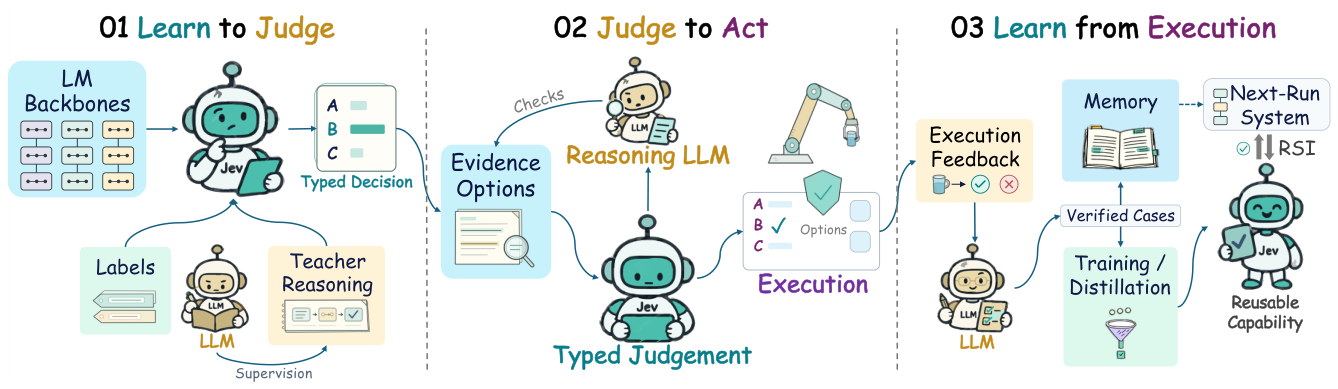
Figure 2.
Timeline of representative decision models and their technical foundations, organized into five directions: discriminative prediction, representation matching, LM probability readout, candidate/query structure, and iterative or adaptive computation. The vertical band marks Jev’s introduction on 15 September 2026, separating earlier foundations from subsequent developments.
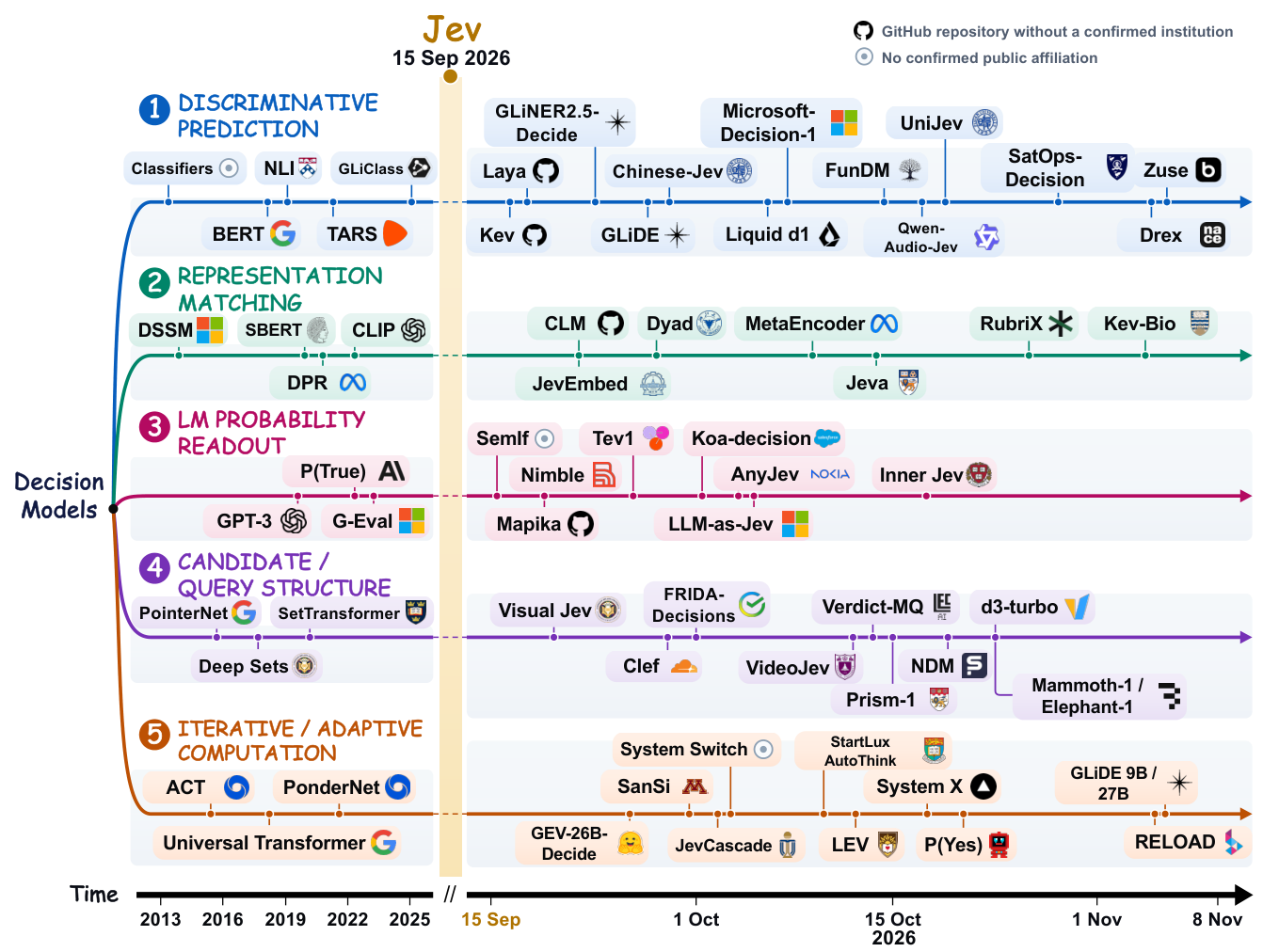
Figure 3.
Examples of typed judgments in a customer-support scenario. Choice selects a team, Noul assesses a proposition, Score rates urgency, and Box locates an object in an image. Each request specifies how the output should be interpreted.
Figure 3.
Examples of typed judgments in a customer-support scenario. Choice selects a team, Noul assesses a proposition, Score rates urgency, and Box locates an object in an image. Each request specifies how the output should be interpreted.
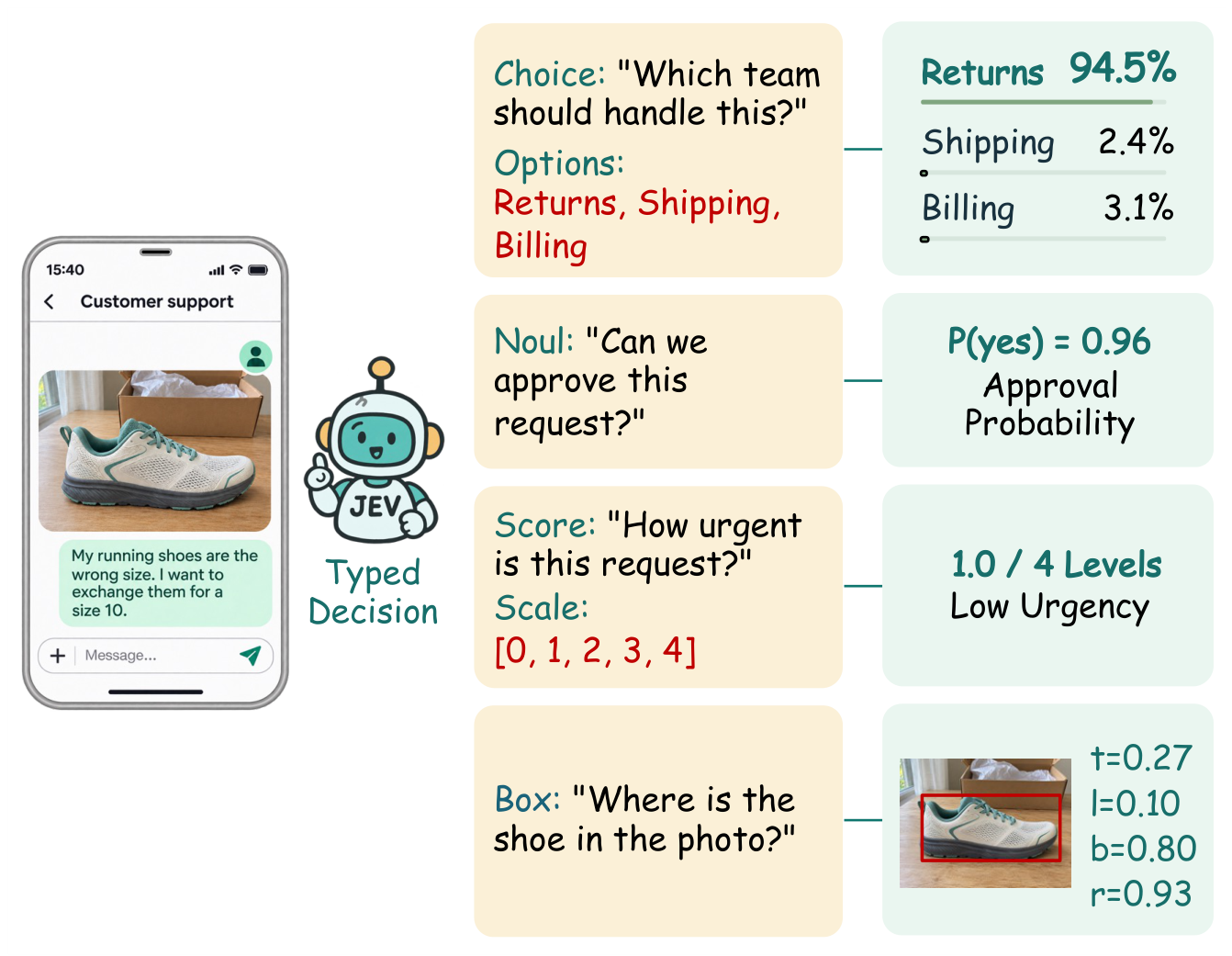
Figure 4.
Representative architectures for decision models. (a) An LLM scores candidate label tokens through its vocabulary head. (b) An LLM uses a dedicated decision head. (c) An encoder-based model uses a decision head. (d) Separate encoders represent the request and candidate descriptions for similarity scoring. The lower panel illustrates an optional multimodal input configuration for the LLM-based designs, with modality encoders and a projector or adapter supplying representations to the backbone. Output distributions are illustrative.
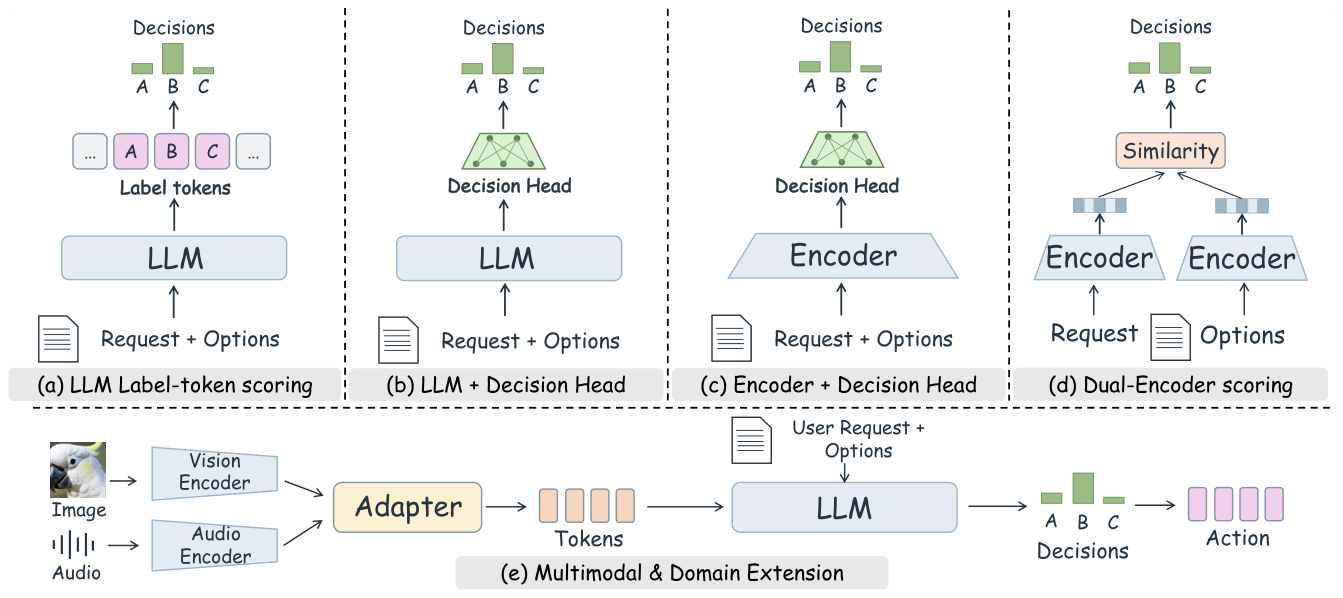
Figure 5.
Four inference strategies for Jev-style decision making, distinguished by the use of extra reasoning and the point at which computation can adapt.
Figure 5.
Four inference strategies for Jev-style decision making, distinguished by the use of extra reasoning and the point at which computation can adapt.
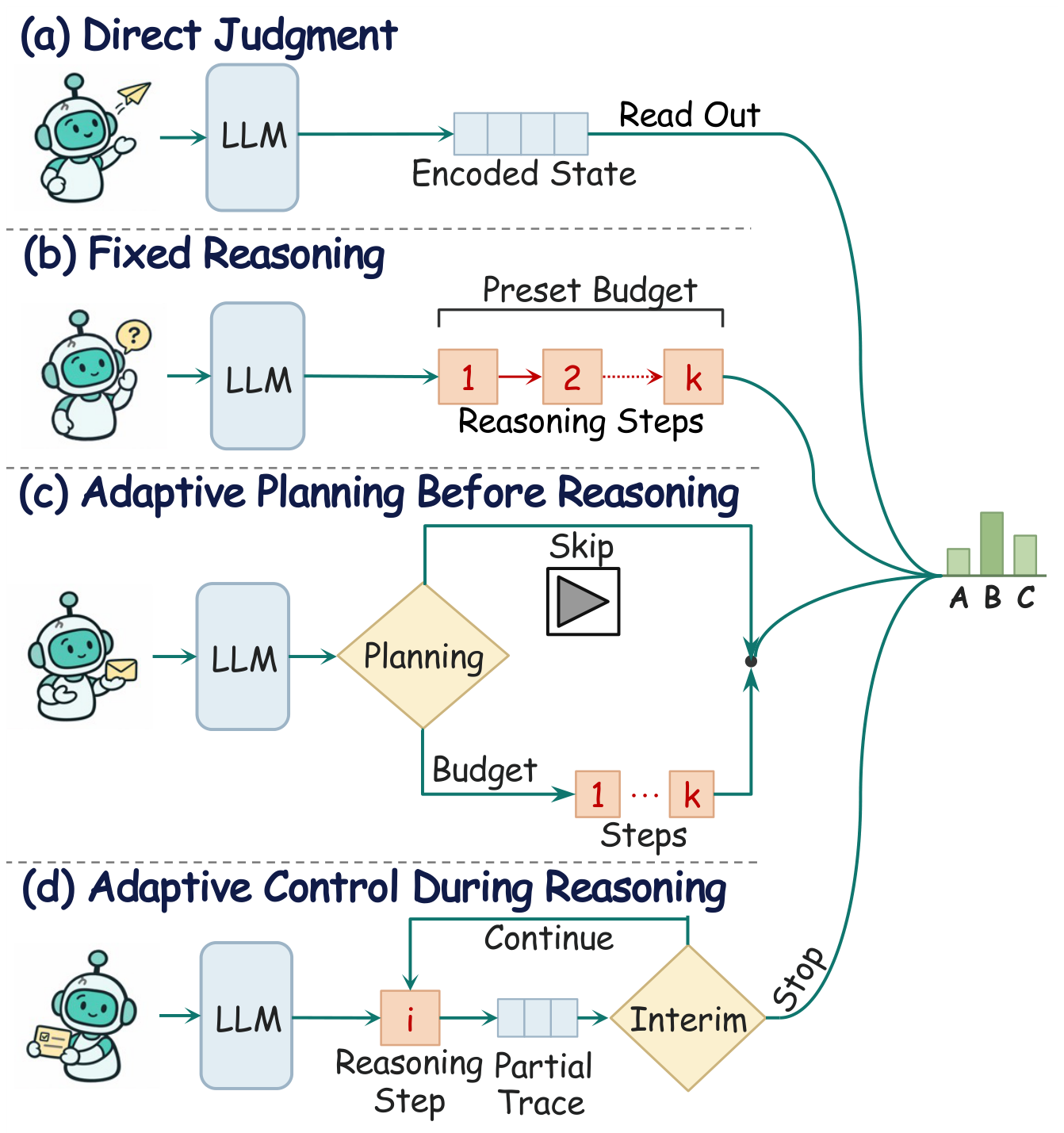
Figure 6.
Taxonomy of Jev in agentic workflows and coordinated systems. Workflow components cover information and memory selection, computation and reasoning control, verification and review, and action selection, together with domain-specific applications. Runtime coordination covers scheduling and task updates and reuse. Decision-guided self-improvement distinguishes feedback-driven system improvement from improving the improver. Cited studies include hosted Jev applications, independent Jev-style models, and related methods as distinguished in the text; a study may appear in multiple branches when it supports distinct mechanisms.
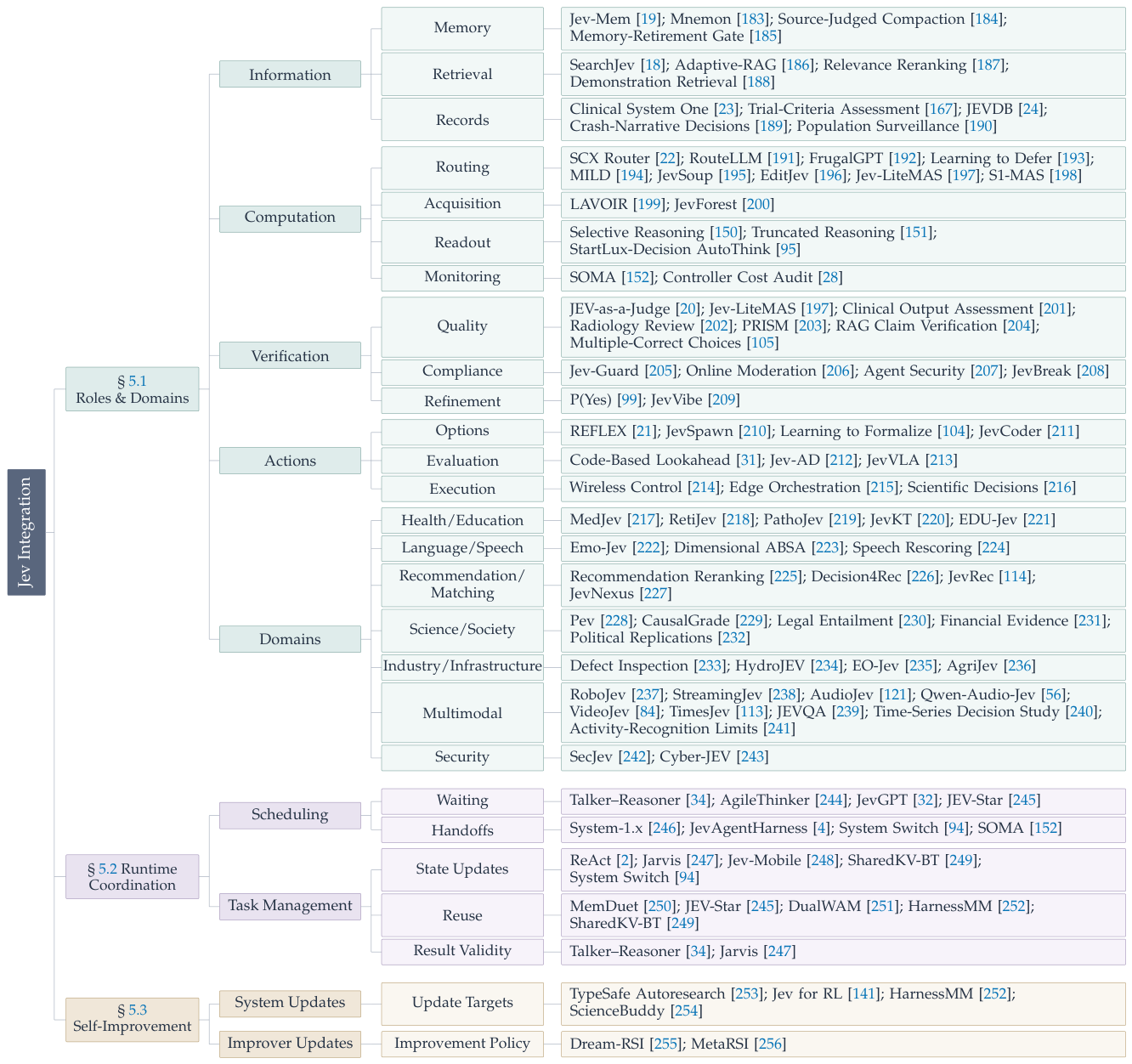
Figure 7.
Illustration of decision-guided workflow. Given an instruction to place the blue cup on the plate, the system (a) observes the scene and checks the available objects, (b) constructs candidate actions and filters them based on feasibility, and (c) selects the option that best matches the instruction. The selected action is then reviewed and executed through a sequence of manipulation steps (d). Finally, the system verifies the outcome against the original goal (e), determining whether the task is complete or further action is needed.
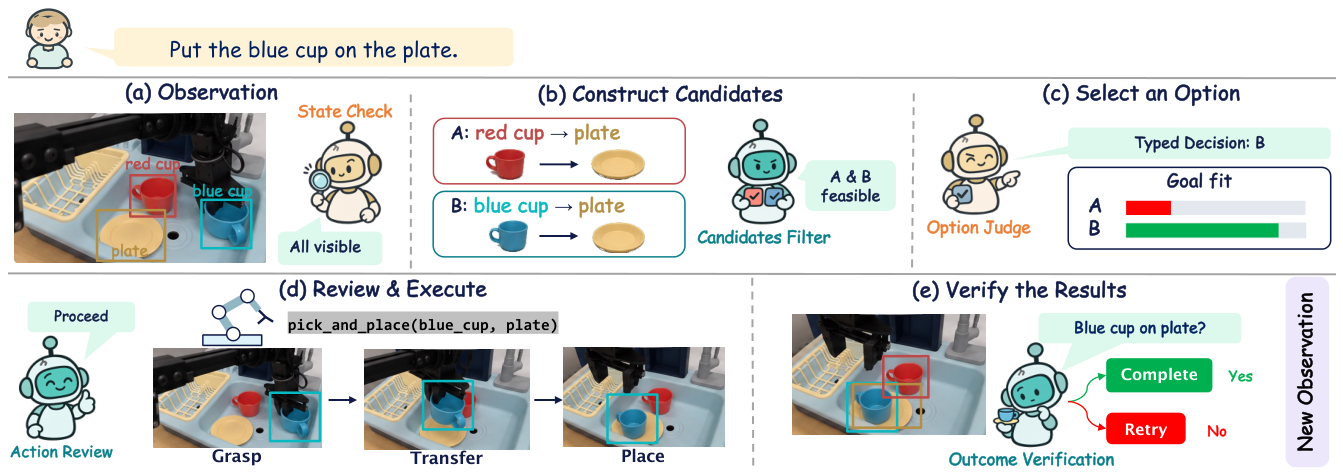
Figure 8.
Representative applications of decision models across six domains: (a) healthcare, (b) language and speech, (c) recommendation and data matching, (d) legal analysis, (e) industry, and (f) multimodal understanding. Each example illustrates how task-specific judgments are expressed through structured decisions.
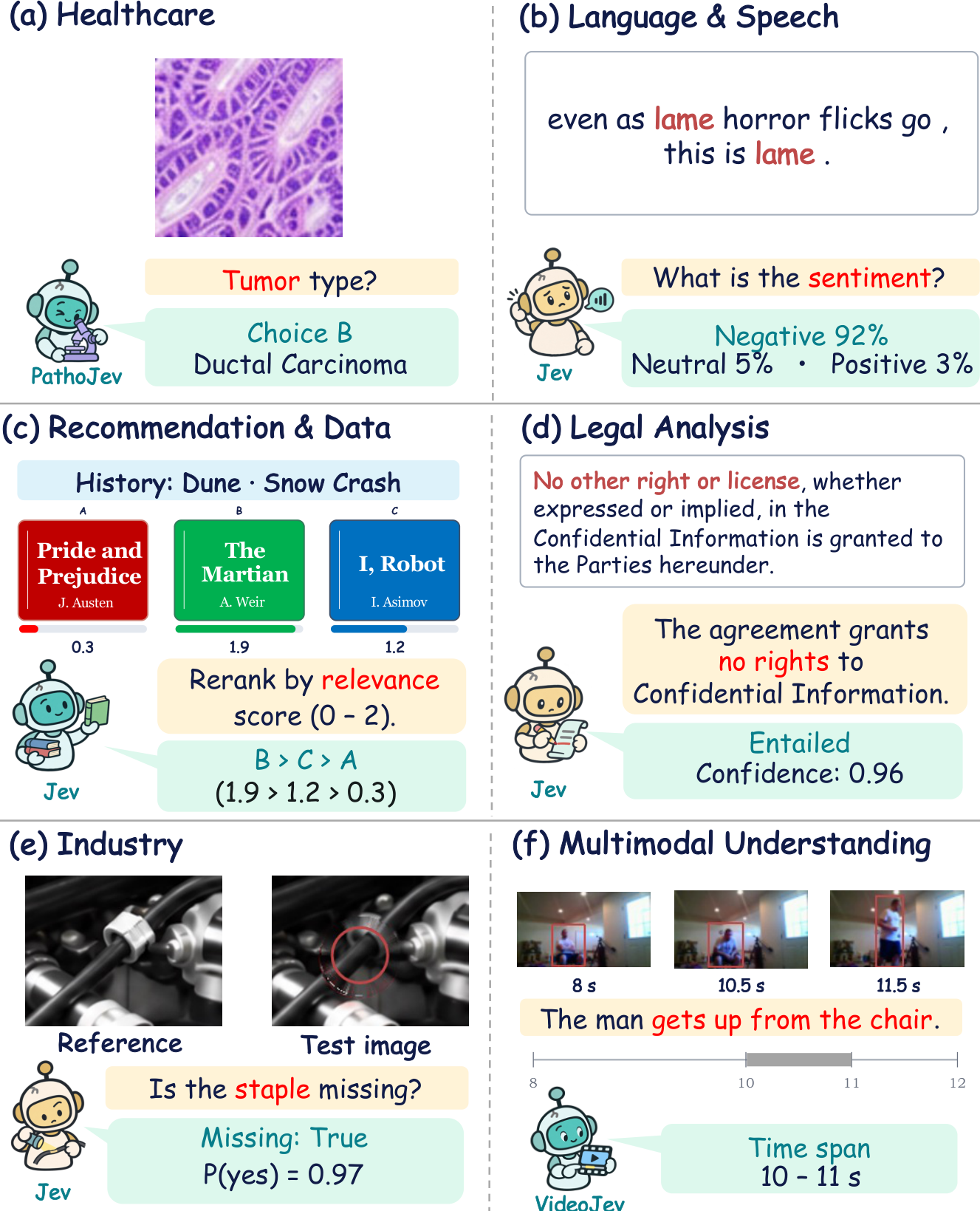

Table 1.
Backbones and adaptation strategies of representative Jev and Jev-like models. Architecture lists a main class and its mechanism; modality refers to the reviewed decision configuration. Entries describe the stated configurations rather than every checkpoint or ablation.
Table 1.
Backbones and adaptation strategies of representative Jev and Jev-like models. Architecture lists a main class and its mechanism; modality refers to the reviewed decision configuration. Entries describe the stated configurations rather than every checkpoint or ablation.
| Model / Method | Backbone | Modality | Architecture | Readout | Training | Inference | |
|---|---|---|---|---|---|---|---|
| Method | Object | ||||||
| Hosted reference | |||||||
| Jev [10] | Closed-source model | M | |||||
| Vocabulary readouts and shared prediction slots | |||||||
| LLM-as-Jev [11] | Qwen3.5 / Qwen3 | T | LLM + vocabulary headScores candidate codes. | Token likelihoods | None | Frozen | D F |
| AnyJev [78] | Qwen3 / Qwen2.5 | T | LLM + vocabulary headCorrects label and order effects. | Token scores | Calibration | Temp. | D |
| Releasing the Inner Jev [12] | Gemma 4 Instruct | T | LLM + vocabulary headCorrects answer-letter logits. | Token logits | SFT | LoRA + Head | D |
| Intern-Decision [110] | Qwen3.5 | M | LLM + vocabulary headUses JSON prediction slots. | Token logits | SFT | –1 | D |
| Dedicated scorers and separate representations | |||||||
| Laya [106] | ModernBERT | T | Encoder + decision headAdds two transformer head layers. | Head scores | RLCD | Full | D |
| Kev-4B [107] | Qwen3.5 Base | T | LLM + decision headCompares question and option states. | Similarity | SFT | LoRA + Head | D |
| GLiClass [47] | DeBERTa-v3 | T | Encoder + decision headEncodes text and labels jointly. | Similarity / MLP | Staged | LoRA2 | D |
| Jeva [14] | Qwen3.5 | T | Separate encodersEncodes request and options separately. | Set-conditioned scores | SFT | LoRA + Head | D |
| 8cRecurrent, adaptive, and visual computation | |||||||
| SanSi [92] | Ouro Base | T | Recurrent LMScores candidates after each loop. | Token logits | SFT | LoRA + Head | C |
| StartLux-Decision [95] | Qwen3.5 family† | T | LLM + vocabulary headCombines initial and reasoned predictions. | Token probabilities | SFT → RL | – | B |
| Visual Jev [7] | Qwen3-VL Instruct | M | LLM + vocabulary headShares visual context; isolates questions. | Token probabilities | SFT | LoRA | D |
ModalityT: text-only; M: multimodal. Labels describe the reviewed decision configuration, not all backbone capabilities. InferenceD: Direct Judgment; F: Fixed Reasoning. B: Adaptive Planning Before Reasoning; C: Adaptive Control During Reasoning. Training SFT: supervised fine-tuning; RL: reinforcement learning; RLCD: reinforcement learning for calibrated decisions. Object Full: full-parameter tuning; LoRA: low-rank adapters; Head: decision/readout head parameters; Frozen: no updates; Temp.: output temperature; –: scope not stated. Calibration AnyJev fits only the output temperature; its backbone stays frozen. Losses CE for Releasing the Inner Jev, Intern-Decision and Kev-4B; CE + Brier per loop for SanSi. CE: cross-entropy. Notes 1 Intern-Decision tunes the language backbone, but the supplied description does not distinguish full tuning from parameter-efficient tuning. Intern-Decision and Visual Jev freeze the vision tower; Intern-Decision also freezes the projector. 2 GLiClass uses staged encoder/scorer training followed by LoRA. † The released 4B configuration uses Qwen3.5 architecture [155]; the initial checkpoint is not specified.
Table 2.
Representative supervision resources for typed decision models. Supervision signals: Gold = benchmark, human, or rubric labels; Soft = model- or teacher-derived probability targets; Contrast = paired, counterfactual, or evidence-ablated views; Recovery = states that follow deliberately induced errors. ✓ marks a primary training signal and ✓ a partial one. Counts retain each study’s original units.
| Resource | Training source and scale | Supervision signal | Held-out unit | |||
|---|---|---|---|---|---|---|
| Gold | Soft | Contrast | Recovery | |||
| Model-derived targets | ||||||
| SII-Decision [13] | Public decision tasks39,279 questions (27B setting) | ✓ | Frozen dev. set (selection) | |||
| JevAgentHarness [4] | 587 agent tasks15,694 states; 30.9% post-mistake | ✓ | ✓ | ✓ | Task seed† | |
| Labelled multimodal targets | ||||||
| Visual Jev [7] | GQA Choice + SNLI-VE Claim30,416 + 9,000 items; 2–8 candidates | ✓ | ✓ | Image; TextVQA, TallyQA | ||
| UniJev [57] | Text, image, and video sources160,608 train / 3,124 test questions | ✓ | ✓ | Source group | ||
| Evidence- and rubric-structured targets | ||||||
| PACT [120] | Answer-changing fact edits1,167 curated pairs; 2,334 records | ✓ | ✓ | Source family | ||
| RubriX [69] | Public + proprietary synthetic34,261 examples; 2,284 criteria | ✓ | Criterion / level‡ | |||
† Splits share the task generator, and some early states repeat across splits. ‡ Held out at test but not fully at validation; also evaluated on human-labelled benchmarks.
Table 4.
Open research questions and evaluation strategies for Jev-like systems. Gray text indicates the key evaluation criteria for each research direction.
Table 4.
Open research questions and evaluation strategies for Jev-like systems. Gray text indicates the key evaluation criteria for each research direction.
| Research Question | Evaluation Strategy |
|---|---|
| Decision-space design | |
| RQ 1: When should candidates be revised? | Add, remove, or clarify candidates on the same task states; use retrieval and further reasoning as baselines. Candidate coverage, selection accuracy, and revision cost. |
| Runtime collaboration | |
| RQ 2: When does assistance improve decisions? | Measure which errors assistance corrects and which new errors it introduces under a fixed total budget. Correction rate, introduced errors, and total cost. |
| Learning from deliberation | |
| RQ 3: Which capabilities can be internalized? | Test direct predictions on new rule combinations and longer reasoning chains after training with deliberation. Transfer accuracy, inference cost, and assistance demand. |
| RQ 4: What makes supervision reliable? | Check that the learner has enough evidence to support each label. Change key evidence and test predictions against independently verified answers. Evidence sensitivity and appropriate abstention. |
| RQ 5: Can adaptation be sustained? | Track performance on new and earlier tasks over successive updates, with fixed supervision as a baseline. Generalization, forgetting, and cumulative cost. |
Disclaimer/Publisher’s Note: The statements, opinions and data contained in all publications are solely those of the individual author(s) and contributor(s) and not of MDPI and/or the editor(s). MDPI and/or the editor(s) disclaim responsibility for any injury to people or property resulting from any ideas, methods, instructions or products referred to in the content. |
© 2026 by the authors. Licensee MDPI, Basel, Switzerland. This article is an open access article distributed under the terms and conditions of the Creative Commons Attribution (CC BY) license (http://creativecommons.org/licenses/by/4.0/).
Copyright: This open access article is published under a Creative Commons CC BY 4.0 license, which permit the free download, distribution, and reuse, provided that the author and preprint are cited in any reuse.