

Submitted:
17 November 2026
Posted:
19 November 2026
You are already at the latest version
Abstract
Microplastics (MPs) and per- and polyfluoroalkyl substances (PFAS) increasingly co-occur across aquatic, terrestrial, and biological systems, yet single-pollutant frameworks poorly represent their interactions. This review resolves whether MPs function as carriers that enhance PFAS mobility and bioavailability or as competitors that reduce freely dissolved PFAS through sorption. The evidence reveals a dynamic, context-dependent continuum governed by polymer identity, PFAS chemistry, environmental aging, biofilm development, and water chemistry. Pristine MPs can promote PFAS transport through hydrophobic partitioning and colloid-mediated mobility, whereas oxidation and colonisation may increase surface functionality, strengthening sorption and temporary sequestration. Because sorption is reversible, environmental or biological changes can trigger desorption, remobilisation, and exposure. Machine-learning approaches could help predict these multidimensional interactions, but models coupling MP and PFAS properties remain scarce. The carrier–competitor paradigm further supports integrated remediation combining phase-resolved characterisation, simultaneous capture, contaminant recovery, media regeneration, and PFAS destruction. Overall, MPs should be treated as dynamic mediators of PFAS fate within transformation-aware, mixture-based frameworks for exposure assessment, risk prediction, and remediation design.
Keywords:
microplastics
; PFAS
; sorption–desorption dynamics
; environmental aging
; contaminant mobility and bioavailability
1. Introduction
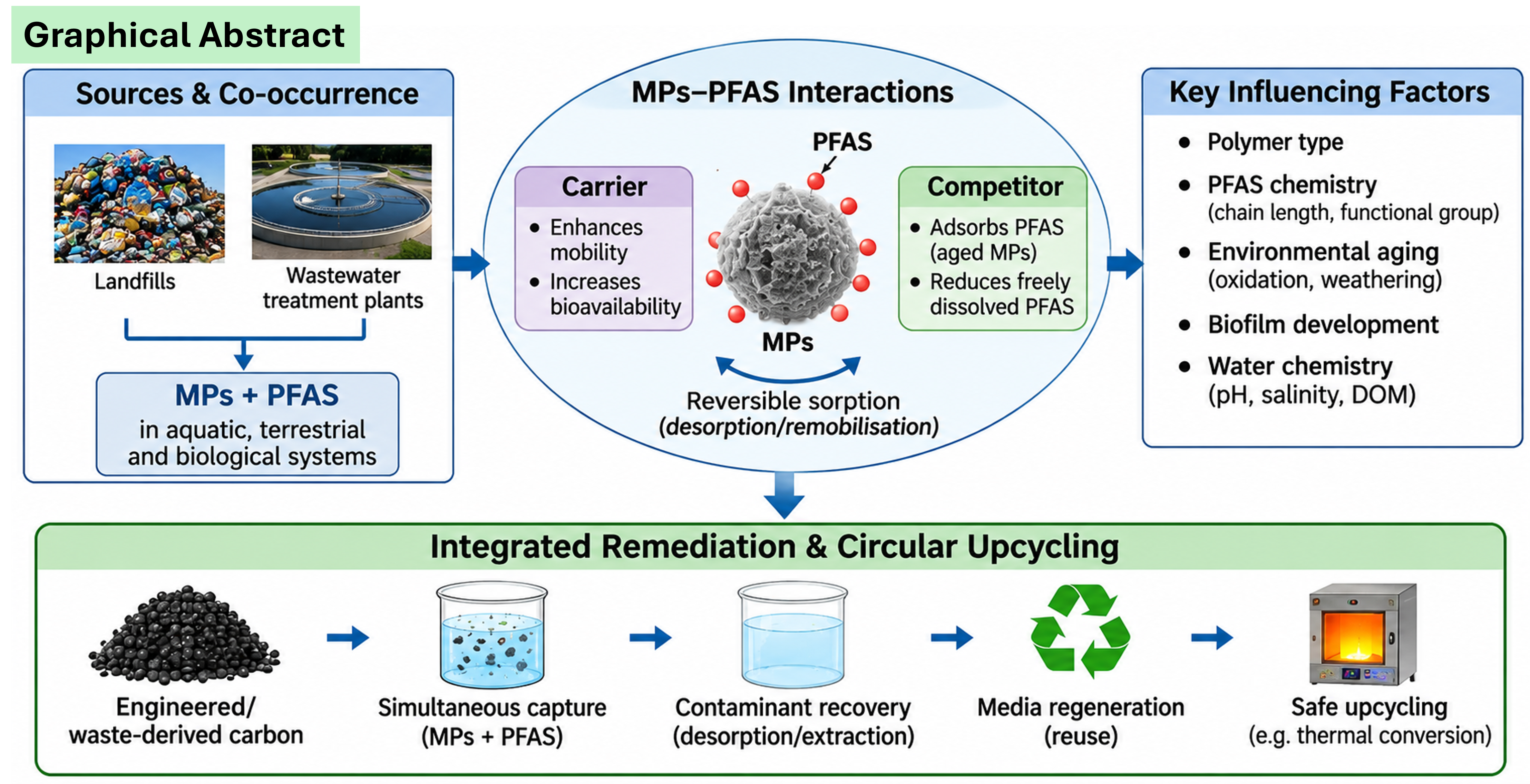
The abundant presence of both microplastics (MPs) and per- and polyfluoroalkyl substances (PFAS) across diverse environmental sectors, including aquatic and terrestrial ecosystems, represents a critical and deteriorating challenge of the Anthropocene [1,2]. Historically, various studies have investigated these contaminants individually. However, recently emerging studies have confirmed their frequent co-occurrence and complex interactions with adverse effects on both organisms and human health as a result of environmental degradation; therefore, there is a need to shift from single-pollutant risk assessment to a multi-pollutant systems approach in order to achieve a sustainable and cleaner environment [2,3,4]. Evidence suggests that the landfills dumped with plastic wastes are considered as one of the viable sources for generating MPs. It has been reported that plastic items can decompose into MPs in landfills. Furthermore, wastewater treatment plants (WWTPs) have also been identified as significant point sources for both MPs and PFAS [5]. These emerging contaminants encompass a wide range of man-made chemicals that pose significant environmental and human health risks as they are widely distributed across various ecosystems [5,6]. The interaction between MPs and PFAS has been attributed to their inherent complex chemical and physical characteristics. Such a phenomenon has been identified as factors that dictate the roles of MPs in PFAS mobility and bioavailability [6]. The deciding characteristic features, such as their large surface area-to-volume ratio, can facilitate enhanced bioavailability and subsequently aid their sorption ability to other existing contaminants in the environment, including PFAS [7]. This phenomenon defines the vector characteristic nature of MPs for other contaminants and can contribute to the transport of co-existing contaminants. In addition, it is important to emphasize that the process can also cause wide dispersion and distribution of PFAS in the environment, during the course by the organisms is inevitable [7,8]. For instance, published studies have indicated alteration in the cell membrane permeability of organisms, which was attributed to the vector role played by MPs for the increased bioavailability of perfluorooctanoic acid (PFOA) in the investigated organisms [1]. Therefore, the vector potential of MPs has been pinpointed as a major factor capable of enhancing the fate and transport of co-existing contaminants in the environment; thus, this subsequently facilitates the mobility of PFAS in water and soil sediments [9]. Furthermore, the affinity of MPs for other contaminants can be influenced by various factors such as pH, dissolved organic matter (DOM), and salinity. While these aforementioned factors contribute to the process, it is important to recognize that they influence the mechanistic interactions (such as hydrophobic, electrostatic and hydrogen interactions) between the co-existing contaminants during interactions. Thus, the debate of whether MPs act as competitors or sinks for PFAS is dependent of these factors, which can in turn determine their mobility and bioavailability status in the environment [9,10]. The sorption of PFAS onto MP surfaces is influenced by various factors, including the type and aging of the microplastic, PFAS chain length, pH, ionic strength, and dissolved organic matter [11,12]. For instance, polyamide microplastics have been shown to adsorb various PFAS, with the extent of adsorption being dependent on both sorbent characteristics and environmental conditions [10,13]. This adsorption can effectively reduce the concentration of dissolved PFAS in water, potentially limiting their uptake by organisms [14]. However, the dynamic nature of these interactions, particularly the influence of environmental transformations such as weathering and biofilm formation on MP surfaces, remains incompletely understood [3,15]. Aging processes can significantly alter the physicochemical properties of MPs, thereby enhancing their interaction with co-existing contaminants [16]. Furthermore, the formation of biofilms on MP surfaces can influence the sorption and bioavailability of co-contaminants, adding another layer of complexity to these interactions [17]. The overview of this study is presented in Figure 1.
The dual role of MPs as either carriers or competitors for PFAS highlights the complexity of their interactions and underscores the need for a comprehensive understanding that accounts for environmental dynamics. This review critically evaluates whether MPs act as carriers or competitors in PFAS dynamics, emphasizing the overlooked role of environmental transformations. The ongoing debate highlights the complexity of MP-PFAS interactions, where MPs can either exacerbate PFAS contamination by facilitating transport and uptake or alleviate it by acting as a sink, depending on specific environmental conditions and the physicochemical evolution of the microplastics themselves. Understanding the mechanisms governing these dual behaviors is crucial for accurate environmental risk assessment and the development of effective remediation strategies for these pervasive co-contaminants.
2. Methodology
This review was conducted using a structured thematic narrative approach to critically evaluate the emerging evidence on the interactions between microplastics (MPs) and per- and polyfluoroalkyl substances (PFAS). Unlike a systematic review or meta-analysis, the objective was not to identify every available publication or quantitatively synthesize evidence, but to critically integrate current knowledge, compare mechanistic findings, identify inconsistencies across studies, and highlight future research directions. The novelty of this review lies in its synthesis of the dual role of MPs as both carriers and competitors of PFAS within a unified conceptual framework that incorporates environmental aging as a central process governing these interactions. Because the available literature spans multiple environmental matrices, experimental conditions, polymer types, PFAS classes, and analytical approaches, a structured thematic review was considered more appropriate than a PRISMA-based systematic review, which is primarily intended for exhaustive evidence synthesis of studies with comparable designs.
2.1. Literature Search and Study Selection
Relevant literature was retrieved from Scopus, Web of Science, ScienceDirect, SpringerLink, Wiley Online Library, PubMed, and Google Scholar. Searches were conducted between June and September 2026 using combinations of keywords including microplastics, PFAS, per- and polyfluoroalkyl substances, adsorption, desorption, carrier, competitor, environmental aging, weathering, biofilms, transport, bioavailability, toxicity, and risk assessment. Boolean operators (AND and OR) were used to maximize search coverage, while backward and forward citation tracking of relevant publications was undertaken to identify additional studies.
Priority was given to peer-reviewed articles published between 2015 and 2026, reflecting the rapid growth of research on MP-PFAS interactions. Earlier publications were included where they established fundamental concepts relating to PFAS chemistry, microplastic behavior, adsorption mechanisms, contaminant transport, and environmental fate. Studies were selected based on scientific relevance, methodological quality, environmental significance, and their contribution to understanding the mechanisms governing MP-PFAS interactions.
2.2. Literature Synthesis
The selected studies were synthesized using a thematic framework rather than a PRISMA workflow. This approach was adopted because the objective of the review was to critically evaluate mechanistic evidence, compare findings obtained under diverse experimental conditions, identify knowledge gaps, and propose future research priorities, rather than quantitatively combine data from homogeneous studies. The substantial variability in polymer types, PFAS chemistries, environmental matrices, aging conditions, adsorption protocols, and analytical methods makes a conventional systematic review less suitable for addressing the objectives of this work.
To provide a logical synthesis, the literature was organized into major themes comprising: (i) the physicochemical basis of MP-PFAS interactions; (ii) MPs as vectors facilitating PFAS mobility; (iii) MPs as competitors or temporary sinks; (iv) environmental aging as the governing factor controlling the carrier-competitor transition; (v) environmental and biological implications; (vi) the emerging role of machine learning in MP-PFAS research; (vii) resolution of the carrier versus competitor debate; and (viii) knowledge gaps and future research priorities. Within each theme, studies were critically evaluated according to the investigated polymer type, PFAS class, environmental conditions, interaction mechanisms, adsorption and desorption behaviour, transport processes, biological implications, and reported limitations. This structured synthesis enabled the development of an integrated conceptual framework describing how environmental aging governs the dynamic transition of MPs between carrier and competitor roles, thereby providing a perspective that extends beyond previous reviews.
3. Physicochemical Basis of MP-PFAS Interactions
Microplastics act as both carriers and potential competitors in their interactions with PFAS, significantly influencing the mobility and bioavailability of these persistent contaminants in environmental systems [5,10]. The mechanistic basis of MP-PFAS interactions is complex, stemming from the unique physicochemical properties of both MP surfaces and PFAS molecular structures. PFAS typically consist of a hydrophobic fluorinated tail and a hydrophilic or ionic head group (e.g., -COO⁻ or -SO₃⁻) [18,19]. Microplastics, in turn, possess varied surface characteristics that dictate their interaction potential, ranging from highly hydrophobic in their pristine state to exhibiting diverse functional groups following environmental aging [15,20]. Hydrophobic partitioning is a primary interaction mechanism, particularly for pristine MPs [21,22]. The nonpolar fluorinated tail of PFAS molecules readily associates with the hydrophobic surfaces of MPs, driven by the tendency to minimize contact with water molecules (hydrophobic effect) [23,24]. Molecular dynamics simulations demonstrated that perfluorooctanoic acid (PFOA) strongly partitions into polyethylene (PE) matrices, with fluorocarbon-hydrocarbon affinity being a key driver [25]. This hydrophobic interaction is often correlated with the PFAS chain length, where longer fluorinated chains generally exhibit stronger partitioning [25,26]. For example, studies using Grand Canonical Monte Carlo and molecular dynamics simulations have explored the sorption process of polyethylene MPs for various PFAS compounds, including perfluorononanoic acid (PFNA), perfluorohexanesulphonic acid (PFHxS), and perfluorohexanoic acid (PFHxA), confirming the role of molecular structure in the sorption process [25]. However, environmental aging processes significantly alter the surface properties of MPs, leading to the formation of new functional groups, increased surface area, and changes in surface charge [15,20,27]. These modifications shift the dominant interaction mechanisms beyond simple hydrophobic partitioning. Electrostatic interactions become increasingly important on aged MP surfaces [28]. For instance, UV-oxidized PE microplastics can develop carboxyl groups, leading to pH-dependent adsorption where PFOA binding shifts towards outer-sphere electrostatic attraction [29,30]. This is evidenced by higher adsorption at lower pH values and suppressed uptake above the PFOA pKₐ [30]. Similarly, the presence of biofilms on MPs, a common occurrence in aquatic environments, can alter the physicochemical properties of the MP surface, impacting PFAS adsorption [20,31]. Biofilms can contain fixed charges that influence ion partitioning, directly implicating charge-charge coupling in PFAS adsorption mechanisms [31]. Hydrogen bonding also plays a selective role in MP-PFAS interactions [18]. Functional groups formed during MP aging, such as hydroxyl or carboxyl groups, can act as hydrogen bond donors or acceptors, facilitating interactions with the polar moieties of PFAS molecules [32].
While van der Waals forces are universally present between molecules and contribute to the overall attractive interactions, their role in MP-PFAS binding is generally considered secondary compared to hydrophobic partitioning and electrostatic forces, especially in aqueous environments [23]. For instance, the Lennard-Jones potential model is used to describe the balance between attractive and repulsive forces, which includes van der Waals forces [23]. The presence of co-occurring ions in the environment can further modulate these interaction mechanisms. For example, specific cations can induce bridging between anionic PFAS and carboxylated PE, leading to an increase in PFAS adsorption [12]. Solution chemistry factors such as pH, ionic strength, and the presence of dissolved organic matter (DOM) also significantly influence the extent and mechanism of PFAS adsorption onto MPs [12,34]. For example, a study investigating the adsorption of six PFAS compounds on polyamide MPs demonstrated the significant influence of pH and ionic strength on their adsorption behavior [10]. Therefore, the interaction between MPs and PFAS is not static but dynamically influenced by the polymer type, surface modification (aging), the chemical structure of the PFAS, and environmental conditions. Understanding these complex, context-dependent physicochemical interactions is crucial for predicting the environmental fate, transport, and bioavailability of PFAS in co-contaminated systems [3,35]. Figure 2 illustrates the multiple interaction mechanisms governing the adsorption of PFAS onto MP surfaces, including hydrophobic, electrostatic, and hydrogen bonding interactions, which collectively determine the fate of these co-contaminants in the environment [33].
4. Microplastics as Vectors for PFAS Mobility
Microplastics and nanoplastics (NPs) serve as significant mobile sorbents for PFAS across various environmental compartments, including water, sediments, soils, and biological systems [18,36]. This carrier function, however, is intrinsically transient, as PFAS sorption onto plastics is reversible, and desorption is often favored in biological contexts [14,36]. The complex interplay between MPs, NPs, and PFAS contributes to enhanced mobility, bioavailability, and potential toxicity of these persistent pollutants [12,36].
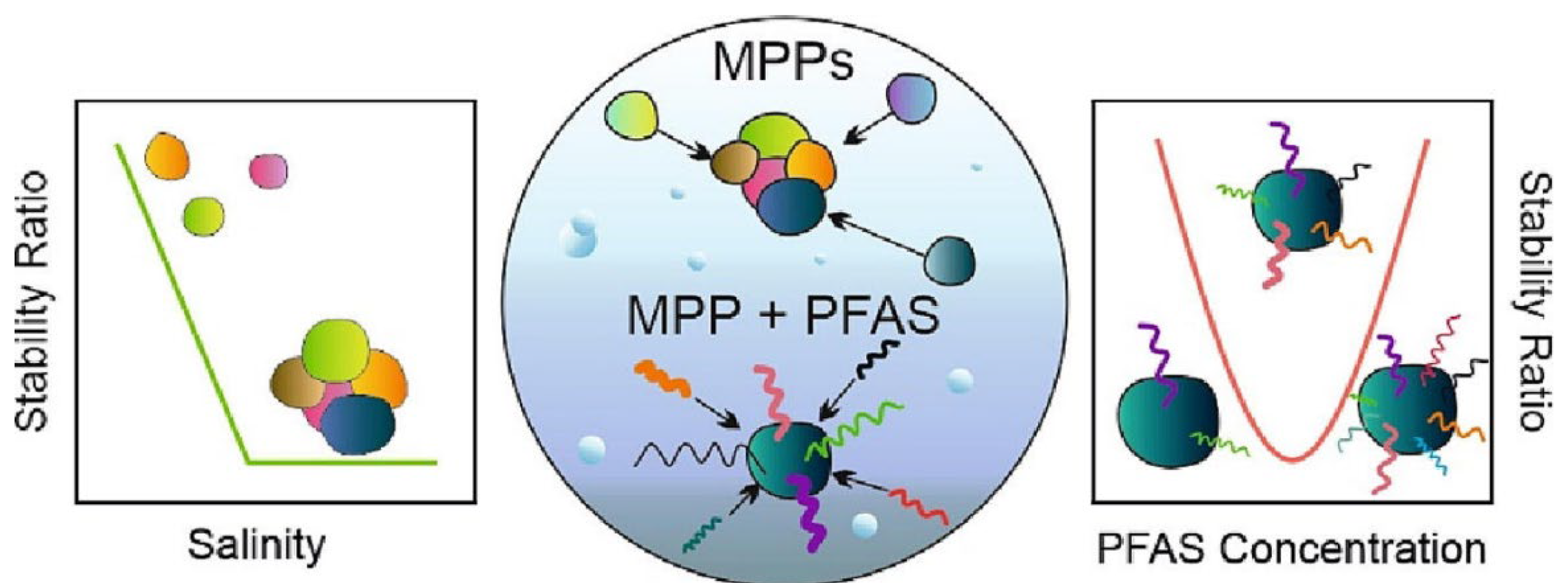
In aquatic environments, MPs offer additional hydrophobic surfaces where PFAS, particularly long-chain and sulfonated congeners, can accumulate significantly compared to the dissolved phase [6,37]. Experimental studies have demonstrated that virgin and weathered polyvinyl chloride (PVC) and other rough, hydrophobic polymers can remove substantial percentages of perfluorooctanesulfonic acid (PFOS) from artificial freshwater, illustrating significant sorptive enrichment. For instance, batch experiments show removal efficient PFOS by various MP [14]. This sorptive capacity is critical because buoyant or neutrally buoyant MPs, such as polyethylene (PE), polypropylene (PP), and polystyrene (PS), are readily transported by currents and turbulence [38]. This movement facilitates the horizontal and vertical redistribution of sorbed PFAS, promoting long-distance transport between surface waters, water-sediment interfaces, and depositional zones [39,40]. This is particularly relevant given that MPs can alter contaminant behavior and toxicity in natural waters [41]. In another study conducted where the interactions between PS microplastics and the C6 PFAS UFHA (UFHA: undecafluorohexanoic acid) in aqueous systems were investigated, it has been affirmed that UFHA adsorption modified surface charge, inducing neutralization, overcharging, and aggregation behavior which was said to have dependent on the electrolyte valence and concentration. Furthermore, the authors, established that the stability trends largely followed DLVO theory, with rapid aggregation near isoelectric points. The findings suggest MPs can act as conditional carriers of PFAS, yet electrolyte-controlled aggregation may limit co-transport, highlighting their dual role as carrier or competitor in PFAS mobility and bioavailability [42].
Figure 3.
Adsorption of UFHA on MPP and its effect on colloidal stability [42] with permission. Copyright 2023 Elsevier.
Figure 3.
Adsorption of UFHA on MPP and its effect on colloidal stability [42] with permission. Copyright 2023 Elsevier.
In sediments and soils, settling or density-modified MPs function as mobile solid phases that can shuttle PFAS between porewater and solid matrices, especially under fluctuating redox and hydrological conditions [28]. Studies involving secondary MPs derived from polyethylene terephthalate (PET) bottles indicate that PFAS adsorption is modulated by environmental factors such as pH, ionic strength, and the presence of natural organic matter [10]. These parameters influence the surface charge and aggregation of MPs, thereby altering PFAS partitioning among sediment, porewater, and the plastic itself [10,28]. Consequently, PFAS can be mobilized when MPs are resuspended or transported downstream, implying that MPs can temporarily sequester PFAS in depositional zones only to remobilize them during events like storms or bioturbation, ultimately enhancing large-scale PFAS fluxes through aquatic and soil systems [43,44].
The particle size of plastics significantly influences their role as PFAS vectors. Decreasing MP dimensions to the nano-range dramatically increases the specific surface area and alters diffusion pathways [44]. Nanoplastics (NPs, around 50 nm) exposed to emerging PFAS alternatives like F-53B exhibit higher sorption capacities [4]. This leads to a greater “bioavailable fraction” of sorbed PFAS in aquatic insect larvae, resulting in substantially higher PFAS body burdens and increased gut toxicity, even at constant dissolved PFAS levels [4,45]. Similarly, simulated human gastrointestinal digestion tests show that photoaged nanoplastics (ANPs) can markedly modify the bioaccessibility of short-chain PFAS, such as perfluorobutanoic acid (PFBA) [4]. For instance, PFBA bioaccessibility in oral and intestinal phases can increase by approximately 28–164%, indicating that nano-sized carriers are particularly effective at enhancing PFAS transfer into biological fluids [4,46]. The increased surface area of NPs allows for more efficient interaction with contaminants and organisms, further exacerbating their impact [39].
Polymer type also dictates PFAS sorption through properties such as hydrophobicity, crystallinity, surface roughness, and the presence of functional groups [10,25]. While some studies show negligible uptake of short-chain PFAS (PFBA, PFBS, PFOA) on polymers like low-density PE (LDPE), PET, PS, and polymethyl methacrylate (PMMA), PFOS sorption is notable on rough, hydrophobic PVC, and to a lesser extent on PE and PS, consistent with hydrophobic interaction-dominated mechanisms [37]. Environmental aging, including UV exposure and mechanical weathering, introduces oxygen-containing groups and modifies surface charge, which can either decrease or restructure sorption affinity depending on PFAS chemistry and solution conditions [47]. This highlights that the real-world carrier behavior of MPs is governed by both their polymer identity and their weathering history.
Differences in media, such as marine versus freshwater environments, also play a crucial role. Variations in ionic strength, cation composition, and dissolved organic matter alter electrostatic screening and competitive sorption [47]. As a result, PFAS-MP associations are often stronger in higher-salinity, dissolved organic carbon (DOC)-rich marine systems compared to dilute freshwaters [47]. This modulates the efficiency with which MPs transport PFAS between coastal and open-ocean compartments [4]. Upon ingestion, PFAS-laden MPs function as “Trojan horse” carriers, delivering both the plastic particles and their associated PFAS directly to digestive epithelia [4,39].
5. Microplastics as Competitors/Sinks
Microplastics are increasingly recognized as ubiquitous environmental contaminants, and their interaction with PFAS is a critical area of research due to the co-occurrence, persistence, and potential synergistic toxicity of these pollutants [4,36]. While MPs can act as carriers for various organic pollutants, facilitating their transport and bioaccumulation, recent evidence suggests a more nuanced role where MPs can also function as competitors or temporary sinks for PFAS, thereby influencing their mobility and bioavailability in diverse environmental compartments [17,36,44]. This perspective posits that MPs may reduce the freely dissolved concentration of PFAS and limit their immediate bioavailability, acting as a competitive sorbent against natural organic matter (NOM), sediments, and even biota surfaces [44,48].
The immobilization of PFAS by MPs is primarily driven by sorption processes. Microplastics possess significant surface area which can adsorb a range of organic contaminants, including PFAS [48]. This adsorption capacity can effectively reduce the concentration of freely dissolved PFAS in the aqueous phase [18,49]. For instance, studies have shown that various types of MP, including polyethylene (PE), polyamide (PA), polystyrene (PS), and polyvinyl chloride (PVC), can adsorb PFAS compounds, with the extent of adsorption influenced by factors such as the type of microplastic, the specific PFAS compound, pH, ionic strength, and the presence of dissolved organic matter [27,34,48]. This strong sorption means that a significant portion of PFAS can become associated with microplastic particles, rather than remaining in the dissolved phase, which is generally considered more bioavailable [34,48].
In aquatic environments, microplastics compete with NOM for PFAS binding sites [23,44,48]. NOM, a complex mixture of organic molecules derived from living organisms, can itself bind pollutants, influencing their fate [50]. However, MP, especially those that have undergone environmental aging, can develop a “plastisphere” biofilm that alters their surface properties and enhances their ability to sorb contaminants [51,52]. While some studies indicate that NOM can compete with PFAS for adsorption sites on MPs or form complexes with PFAS that reduce their binding to MPs, the overall effect is complex and depends on the specific characteristics of both the NOM and the microplastic [12,50]. For example, humic acid, a component of NOM, has been shown to interact with polylactic acid (PLA) MPs [53]. The interaction between MPs and NOM can lead to the formation of “eco-corona” or biogenic aggregates, further influencing the mobility and fate of associated contaminants [54].
Microplastics also compete with sediments and soils for PFAS adsorption [44]. Sediments are known to act as long-term sinks for PFAS, removing them from the water column [44,55]. However, the presence of MPs can alter the sorption behavior of PFAS in these matrices. Studies investigating PFAS adsorption onto polyamide MP in soil systems indicate that MP can influence the overall adsorption capacity of the soil [13]. In some cases, the presence of MP can reduce the mobility of PFAS in soil by providing additional sorption sites, thus acting as a sink [13]. Conversely, microplastics in sediments can influence the transport of PFOA, potentially modulating its environmental risks [44]. This indicates that MP can redistribute PFAS within sediment-water ecosystems [28]. The interaction is also dependent on the soil type, with different microplastic types (e.g., PE, PP, PS) exhibiting varied effects on the sorption of organic pollutants like phenanthrene in different soils [49]. Some studies further suggest that MPs can impact the dissipation of endocrine-disrupting chemicals in soil environments [56].
In biological systems, MPs can compete with biota surfaces for PFAS binding, potentially affecting the bioavailability and subsequent toxicity of PFAS to organisms [1,3,18]. For instance, studies on microalgae demonstrate that PS MPs can increase PFOA bioavailability by altering cell membranes [1]. However, other studies suggest that MPs can reduce the bioavailability of certain pollutants to plants or organisms [57]. For example, polystyrene micro- and nanoplastics were found to attenuate the bioavailability and toxic effects of PFOS on soybean sprouts [57]. The dynamic nature of sorption and desorption between MPs and PFAS is crucial; while strong sorption might initially reduce the freely dissolved concentration, the subsequent desorption of PFAS from ingested MPs in the gastrointestinal tracts of organisms could lead to localized exposure and uptake [36,58].
Therefore, while MPs can act as competitive sorbents, reducing the immediate bioavailability of PFAS in the aqueous phase by sequestering them onto their surfaces, this does not necessarily eliminate the risk. Instead, MPs may function as temporary sinks, redistributing rather than permanently eliminating PFAS from the environment [3,18]. This temporary sequestration can delay the environmental fate and transport of PFAS, but the eventual desorption of these contaminants from MPs, particularly under changing environmental conditions or within biological systems, means that the potential for ecotoxicological effects and human exposure remains [3,18]. The complex interplay of sorption-desorption kinetics, environmental factors, and the diverse properties of both MPs and PFAS compounds highlights the need for comprehensive research to fully understand their combined environmental impacts [31,32].
6. Environmental Aging as the Decisive Factor Governing MP–PFAS Interactions
The role of MPs in the environmental fate of per- and polyfluoroalkyl substances (PFAS) is critically influenced by the aging processes MPs undergo in various environmental compartments [27,32]. This aging transforms microplastics from relatively passive, predominantly hydrophobic carriers into complex, functionalized, and reactive surfaces, fundamentally altering their interactions with PFAS and other contaminants [32,59]. This shift in surface properties dictates whether MPs act as carriers, facilitating PFAS mobility and bioavailability, or as competitors, sequestering PFAS and potentially reducing their environmental movement and uptake [37]. Pristine microplastics, typically characterized by smooth surfaces and a high degree of hydrophobicity, primarily interact with organic pollutants through hydrophobic partitioning and van der Waals forces [18,60]. For instance, non-aged polyethylene (PE), polypropylene (PP), and polystyrene (PS) microplastics are inherently hydrophobic, which limits their environmental mobility and influences their initial interactions with substances [60]. This hydrophobic dominance often means that pristine MPs can act as carriers, adsorbing hydrophobic organic compounds and transporting them within aquatic or soil systems [18]. The adsorption of certain PFAS, such as long-chain PFAS, onto MPs/NPs, is primarily driven by strong hydrophobic attraction [28,60]. However, the initial sorption of pollutants like chlorpyrifos on pristine low-density polyethylene (LDPE) and biodegradable MPs is primarily governed by their pristine hydrophobic nature [61].
Environmental aging processes, such as UV irradiation, chemical oxidation, biodegradation, and mechanical abrasion, significantly alter the physicochemical properties of MPs [62,63]. These transformations include changes in surface roughness, crystallinity, surface area, and the formation of new oxygen-containing functional groups, such as hydroxyl (-OH), carboxyl (-COOH), and carbonyl (C=O) groups [59,60]. For example, UV aging of PE MPs leads to the formation of carbonyl, hydroxyl, and unsaturation groups, alongside changes in crystallinity and melting temperature [59]. Similarly, photo-oxidation induced by UV light on various commercial microplastics, including polyvinyl chloride (PVC) and polystyrene (PS), results in pronounced physicochemical changes, including increased surface roughness and oxygen content [64].
The formation of these oxygen-containing functional groups increases the surface polarity and negative charge density of aged MPs [60,65]. For example, aged PE MPs become more hydrophilic with oxygen-containing functional groups [66]. This enhanced polarity and surface charge lead to stronger electrostatic interactions with charged contaminants, such as certain PFAS [12,28]. This increased electrostatic attraction can significantly alter the sorption and desorption dynamics of PFAS on MPs [12,30].
It has been reported that aging generally enhances the adsorption capacity of MPs for various pollutants, including PFAS [32,67]. For instance, aged MPs have been observed to exhibit higher adsorption capacities for methylene blue compared to pristine MPs [66]. This is attributed to the increased surface area, enhanced polarity, and the presence of newly formed functional groups that provide additional binding sites [22,66]. The formation of a “plastisphere” or biofilm on aged MPs can further enhance contaminant adsorption due to the sticky extracellular polymeric substances (EPS) acting as an additional sorbent layer [68,69]. EPS adsorption is notably greater on UV-aged MPs than on pristine MPs [69]. While some studies suggest enhanced adsorption of PFOA on aged MPs [30], others indicate that aging can reduce the sorption capacity for certain contaminants like atrazine on biodegradable microplastics [70]. The decrease in hydrophobicity on oxidized MP surfaces due to aging can reduce the adsorption of certain substances while potentially enhancing MP mobility [60]. This highlights a complex interplay where aging can either increase or decrease the affinity for specific pollutants, depending on the chemical properties of both the MP surface and the contaminant. The implications of aging are critical for understanding the environmental fate, transport, and ecological impact of co-occurring MPs and PFAS in various environments, including aquatic systems, sediments, and soil [28,33].
7. Environmental and Biological Implications of Co-Existing MPs and PFAS
The intricate interactions between MPs and PFAS present a dual role for MPs as both carriers and competitors, significantly complicating their environmental fate, transport across compartments, and overall bioavailability and ecotoxicological impacts [5,18]. This carrier–competitor duality complicates risk assessment and challenges current regulatory assumptions, which often treat these contaminants in isolation [33]. Understanding this nexus is crucial due to the ubiquitous co-occurrence and persistence of MPs and PFAS in various environments, including aquatic, terrestrial, and biological systems [5,33].
(a) Transport Across Compartments
Microplastics can act as significant vectors, facilitating the long-range transport and altered distribution of PFAS across environmental compartments [36]. In aquatic environments, MPs, particularly aged ones with developed biofilms, can adsorb PFAS onto their surfaces [20,32]. This adsorption is influenced by factors such as the MPs’ physicochemical properties, including surface area, morphology, and crystallinity, as well as the solution chemistry (e.g., pH, salinity, and organic matter content) [10,22]. A recent work reported that MPs can concentrate PFAS at levels up to 106 times higher than ambient water concentrations, effectively increasing the localized concentration and potential exposure pathways [71]. For instance, the presence of PS-MPs has been shown to increase the bioavailability of PFOA to microalgae by altering cell membrane permeability [1].
Once PFAS are adsorbed onto MPs, their transport behavior changes. MPs can enhance the mobility of PFAS in water, allowing them to be transported over long distances [24,40]. This is particularly relevant for hydrophobic PFAS congeners, which have a strong affinity for MP surfaces [28,44]. However, the presence of MPs can also influence the partitioning of PFAS between water and sediment. In sediments, MPs can alter PFAS transport, potentially facilitating their leaching into porewater, although their role can also be complex, influenced by factors like bioturbation [44,72]. Polyamide microplastics (PAMPs), for example, have been observed to affect the adsorption behavior of PFAS in soil systems, highlighting the complexity of these interactions in terrestrial and sediment environments [13]. Field studies in lakes have observed the co-accumulation of MPs and PFAS in both water and sediment, with PVC and PE being predominant MP types [43].
The transfer of MPs and associated PFAS into biota is a critical pathway for combined exposure. Aquatic organisms can ingest MPs directly or indirectly through the food web [73,74]. Once ingested, MPs can release adsorbed PFAS within the organism, or the MP-PFAS complex itself can be taken up. This process can lead to bioaccumulation, where PFAS concentrations increase in organisms over time [45].
(b) Trophic Transfer Risks
The carrier effect of MPs can significantly enhance the trophic transfer of PFAS within food webs, leading to biomagnification [45,72]. Trophic transfer describes the movement of contaminants from one trophic level to the next, and MPs can act as a “Trojan horse,” delivering PFAS to higher trophic levels [39]. For instance, studies have demonstrated that MPs can alter the trophic transfer and biotoxicity of various contaminants, including fluoxetine, in aquatic food chains involving brine shrimp and zebrafish [75]. The ingestion of MP-PFAS complexes by organisms at lower trophic levels can result in increased PFAS accumulation in their tissues. As these organisms are consumed by predators, the PFAS, facilitated by MPs, can transfer and biomagnify up the food chain, ultimately posing risks to top predators and potentially human health [73,75,76]. Research on marine medaka has shown that polystyrene microplastics enhance environmentally relevant prometryn-induced developmental toxicity and gut microbiota dysbiosis, indicating a clear role for MPs in exacerbating contaminant effects within food webs [77].
(c) Combined Exposure Effects
The co-exposure to MPs and PFAS results in combined toxicological effects that are often more severe or complex than the sum of their individual impacts [3,18]. This can manifest as synergistic toxicity, where the combined effect is greater than additive [78,79]. Studies on human cell lines, for example, have demonstrated synergistic cytotoxic, oxidative, and genotoxic responses following combined exposure to PFAS and MPs [78].
The mechanisms underlying these combined toxicities are multifaceted. MPs can physically injure tissues, such as exacerbating intestinal injury in mice exposed to GenX-loaded polystyrene MPs through barrier impairment and microbial dysregulation [80]. They can also alter cellular processes, increasing the bioavailability of PFAS by modulating cell membrane permeability, as observed in Chlorella sorokiniana [1]. Furthermore, MPs can serve as a stressor that enhances the toxicity of co-occurring pollutants. For instance, combined exposure to MPs increased the toxic effects of PFOS and its alternative F-53B in adult zebrafish, impacting their physiology [81]. The presence of MPs can also disrupt gut microbiota, which in turn can influence the metabolism and toxicity of PFAS [77,80].
Conversely, MPs can also act as competitors under certain conditions, potentially reducing the bioavailability of PFAS. This competitive effect occurs when MPs bind PFAS, effectively sequestering them and making them less available for uptake by organisms [3]. However, the prevailing evidence from current research indicates that the carrier effect, leading to enhanced transport, bioavailability, and toxicity, is a dominant concern [24,71].
The complex interplay between MPs and PFAS, where MPs can simultaneously carry and compete for PFAS, underscores the challenge in accurately assessing their environmental risks [3]. Traditional risk assessment models that consider these pollutants in isolation are insufficient to capture the full scope of their combined impacts [3,4]. The aging of MPs in the environment, for example, can increase their interaction with dissolved organic matter, further influencing their capacity to carry or compete with PFAS [82]. The dynamic nature of these interactions, influenced by environmental factors and the specific properties of both MPs and PFAS, necessitates a more integrated approach to environmental monitoring, risk assessment, and regulatory frameworks [36,74].
8. Machine Learning Models in MPs, PFAS, and Co-Contaminant Dynamics
The current scientific literature, as reviewed, indicates a lack of peer-reviewed studies that specifically apply machine learning to model or predict the interaction mechanisms (e.g., adsorption, co-transport, synergistic toxicity) between MPs and PFAS with reported performance metrics. While machine learning has been widely employed in environmental science for microplastic detection [83,84], PFAS prediction [85,86], or general contaminant fate modeling [87], according to our search through various databases, it is evident that much effort has not been invested into application of ML in published work directly combines both as a coupled system to analyze their direct interactions with reported performance metrics for interaction modeling. We presented the predictive performance of machine learning models for MPs, PFAS, and only one combined environmental dynamic found in the database (see Table 1). Although experimental studies confirm the adsorption of PFAS onto MPs [10,12], computational approaches like molecular dynamics simulations have been used to analyze the effects of microplastic additives on PFAS toxicity and adsorption, finding that certain additive combinations can lead to synergistic toxicity effects [88]. However, as noted, specific machine learning models designed to predict and understand these direct, coupled interaction mechanisms between microplastics and PFAS are not yet prevalent in the provided literature. The lack of such dedicated ML models highlights a significant research gap that, once addressed, could provide deeper insights into the co-contaminant interactions and inform more effective mitigation strategies. The advancement of AI-based technologies, including ML, is crucial for improving PFAS monitoring, source identification, and management, especially given the persistence and widespread distribution of these contaminants [87,89]. The development of unified open-source databases and standardized methodologies will further accelerate the application of ML in predicting and mitigating the risks associated with PFAS and MPs [87,90].
9. Carrier or Competitor: Resolving the Debate
MPs act as dynamic mediators rather than simple carriers or competitors in influencing the mobility and bioavailability of PFAS in various environmental settings. This nuanced role is highly dependent on environmental conditions and the aging status of the microplastics [26,91]. Recognizing MPs as dynamic mediators, rather than passive carriers, is crucial for accurate prediction of PFAS fate and associated environmental risks [24,91].
The interaction between MPs and PFAS is complex, encompassing co-occurrence, physicochemical interactions, and combined toxicological effects [18,24]. Both MPs and PFAS are widespread, persistent, and share common sources and transport pathways, leading to their frequent co-occurrence in aquatic and terrestrial environments [73,79]. MPs are known to possess large sorption capacities and can serve as vectors for PFAS, facilitating their long-range transport in water and air through atmospheric deposition [40]. Studies have confirmed the presence of PFAS extracted from MPs found in natural waters [12]. Initially, pristine MPs can act as carriers for PFAS. The interaction mechanisms primarily involve hydrophobic interactions, electrostatic forces, hydrogen bonding, and van der Waals forces [28,36]. For instance, MPs can sorb long-chain PFAS largely through strong hydrophobic attraction [28].
However, the role of MPs is not static. Environmental aging significantly alters the physicochemical properties of MPs, which in turn influences their interactions with PFAS [12,30,51]. Aging processes, such as UV irradiation, chemical oxidation, and biological colonization, lead to changes in surface roughness, hydrophilicity, and the formation of oxygen-containing functional groups (e.g., carbonyl, hydroxyl groups) on the MP surface [60,64].
These aging-induced modifications can dramatically shift MPs’ behavior from carriers to competitors or even release vectors. For example, UV aging of PE MPS can create new functional groups, affecting their interaction with organic compounds [59]. Similarly, aging can increase the oxygen-containing functional groups on MPs, which reduces their hydrophobicity. This reduction can decrease the adsorption of substances that rely on hydrophobic interactions, potentially enhancing MP mobility [60]. Studies on the adsorption of PFOA on aged MPs indicate that aging influences these behaviors [30].
The presence of biofilms on MPs, a consequence of biotic aging, further complicates this dynamic. Biofilm formation modifies MPs’ physicochemical properties and their interactions with pollutants, impacting the transport and fate of coexisting contaminants like PFAS [4,98]. The “plastisphere,” the unique microbial community on plastic surfaces, can significantly enhance horizontal gene transfer and concentrate pollutants, making MPs hotspots for various environmental processes [98].
Moreover, MPs can influence the bioavailability of PFAS in organisms. While MPs can transport PFAS, studies in mice report varying effects on PFAS bioavailability depending on the type of MP (non-biodegradable vs. biodegradable) [58]. In soil, the co-presence of PFOA can alter the transport of microplastics, with smaller MPs exhibiting greater transport mobility [44]. The interaction and combined toxicity of MPs and PFAS are critical concerns in aquatic environments, where MPs can act as vectors for organic contaminants, exacerbating their adverse effects [99].
The complexity extends to environmental remediation strategies. When considering the transport of contaminants, the mobility of PFAS in groundwater can be high due to their specific chemical properties, making them travel far from source areas [100]. MPs can interact with these substances, forming complexes that dictate their transport and exposure pathways [36,79]. The influence of MPs on the mobility, bioavailability, and toxicity of other pollutants, such as heavy metals, has also been documented, highlighting their broad mediating role [101,102].
Therefore, understanding the role of MPs requires considering their dynamic nature, influenced by aging processes, polymer type, and environmental matrix [32,82]. The notion of MPs as strictly passive carriers or competitors oversimplifies their role. Instead, they function as active, dynamic mediators whose behavior shifts based on specific environmental contexts and transformations, making this comprehensive understanding vital for predicting the environmental fate and ecological impact of PFAS [32].
10. Translating the Carrier–Competitor Paradigm into Remediation Strategies
The carrier-competitor paradigm has direct implications for remediation because microplastics (MPs) can redistribute per- and polyfluoroalkyl substances (PFAS) between dissolved and particle-associated phases during treatment. Consequently, remediation systems should not treat MPs and PFAS as independent targets or interpret a reduction in dissolved PFAS as evidence of complete decontamination. PFAS adsorption onto secondary polyethylene terephthalate (PET) MPs reached equilibrium within approximately 7–9 h and was enhanced by ionic strength but suppressed by increasing pH and natural organic matter (NOM) [12]. In situ biofilm development on polypropylene and polystyrene MPs increased PFOA adsorption by 1.12–1.45 times and PFOS adsorption by 1.16–1.39 times, demonstrating that biological aging can strengthen PFAS retention on environmentally transformed particles [31]. These findings indicate that influent chemistry, polymer identity and environmental aging can determine whether MPs function as mobile PFAS carriers, competing sorbents or co-removable contaminant phases.
10.1. Simultaneous Capture of MPs and PFAS
A practical translation of the carrier–competitor paradigm is to prioritize treatment processes that capture both freely dissolved PFAS and PFAS-bearing MPs. In a coconut-shell biochar fixed-bed system, increasing the bed depth enhanced the removal of PFOA and polystyrene MPs to 96.43% and 61.72%, respectively, under the investigated conditions [103]. Importantly, low MP concentrations promoted PFOA retention, whereas higher MP concentrations inhibited PFOA adsorption through competition for available sorption sites. This concentration-dependent reversal provides direct evidence that MPs can shift from carrier-assisted retention to competitive inhibition during treatment. Therefore, fixed-bed breakthrough experiments should use mixed influents and environmentally realistic MP/PFAS ratios rather than relying exclusively on independently derived single-contaminant parameters.
Multifunctional charged and magnetic sorbents provide complementary routes for simultaneous capture. Cationic nanoparticle networks simultaneously adsorbed polystyrene MPs and PFOA, with Langmuir maximum adsorption capacities of 478.4 and 134.6 mg g⁻¹, respectively [104]. The treatment performance was attributed predominantly to electrostatic attraction and ion exchange involving the quaternary-ammonium sites of the cationic networks. Nevertheless, the adsorption capacities of the individual contaminants decreased during simultaneous exposure, indicating competition between PFOA and MPs for reactive sites. This result demonstrates why treatment materials should be evaluated under co-contaminant conditions rather than assuming that adsorption capacities obtained from separate PFAS and MP experiments are additive.
Magnetically recoverable materials may further improve co-contaminant removal by facilitating post-treatment separation. A room-temperature-synthesised Fe-imidazolate/magnetic-carbon material removed more than 95% of micro- and nanoplastics, including particles as small as 30 nm, within approximately 60 min and also demonstrated simultaneous removal of selected long-chain PFAS [105]. Its application in a 4-L magnetic-separation prototype provided an initial bridge between laboratory adsorption experiments and practically recoverable treatment systems. Magnetic retrieval is particularly valuable because it can limit the release of spent adsorbent particles while facilitating subsequent management of the PFAS-rich residual phase.
Interfacial separation provides another strategy by exploiting the shared surface activity of long-chain PFAS and fine MPs. Jet-drop enrichment generated through bubble bursting simultaneously removed up to 99% of long-chain PFAS and fine MPs measuring approximately 1–10 μm [106]. Short-chain PFAS were removed less efficiently because of their weaker surface activity; however, coupling jet-drop enrichment with an anion-exchange resin increased short-chain PFAS removal to above 90%. These findings indicate that staged treatment trains combining particle capture, interfacial concentration and selective ion exchange may be more effective than a universal adsorbent, particularly where short-chain PFAS coexist with heterogeneous, aged or biofilmed MPs.
10.2. Coupling Capture with Destruction
Simultaneous capture transfers MPs and PFAS from water into a concentrated solid, foam or regenerant stream but does not eliminate the contaminants. Consequently, treatment performance should be evaluated using PFAS mass balance and MP recovery rather than aqueous-phase removal alone. Experiments involving 17 waste-derived biochars showed that hydrophobic and electrostatic interactions, divalent-cation bridging, and micropore filling collectively controlled PFAS adsorption [107]. Micropore filling was particularly important for short-chain PFAS, although these compounds were susceptible to displacement by longer-chain PFAS. Spent wheat-straw biochar was regenerated through thermolysis at 900 °C under N₂, resulting in complete degradation of retained PFAS and improved short-chain PFAS adsorption over three cycles because additional micropores were formed. This approach demonstrates the possibility of combining contaminant capture, sorbent regeneration and PFAS destruction within the same material-management framework.
Waste-derived sorbents may also support circular remediation strategies. Sewage-sludge biochars produced at progressively higher pyrolysis temperatures exhibited increased surface area and porosity, and biochar produced at 1000 °C preferentially adsorbed longer-chain and sulfonated PFAS from an eight-compound mixture [108]. However, preferential adsorption of long-chain PFAS could allow more mobile short-chain compounds to remain in the treated water. Therefore, residual monitoring should include a broad PFAS spectrum instead of focusing exclusively on PFOA and PFOS. Feedstock-derived contaminants, material leaching, regeneration requirements, energy consumption and the fate of PFAS during pyrolysis must also be considered when assessing the sustainability of sludge-derived sorbents.
PFAS-rich concentrates generated during co-capture could subsequently be subjected to destructive treatment. Boron-doped diamond electrocatalysis achieved more than 99% PFOA degradation after 3 h and approximately 84% conversion of organic fluorine to fluoride [109]. The process also substantially reduced adsorbable organofluorine and lipid-bilayer partitioning potential, illustrating the importance of assessing treatment outcomes beyond disappearance of the original PFAS compound. Similarly, Fenton-assisted electrochemical oxidation with a Ti/BDD anode achieved approximately 96% overall removal of a mixture containing 29 PFAS under the investigated experimental conditions [110]. Nevertheless, reductions in target PFAS concentrations do not necessarily demonstrate complete mineralisation. Fluoride recovery, total or adsorbable organofluorine, transformation products, toxicity-related endpoints and energy consumption should therefore accompany concentration-based removal metrics.
The presence of MPs during destructive treatment should not be considered chemically irrelevant. In a pyrite-modified heterogeneous electro-Fenton system, PFOA inhibited the degradation of PET MPs through two sequential mechanisms: initial competition for reactive oxygen species and electrons, followed by the formation of a persistent fluorine-rich interfacial layer that shielded the plastic surface from further oxidative attack [111]. At 50 mg L⁻¹ PFOA, PET-MP degradation decreased by more than 50%, while measurable inhibition remained at PFOA concentrations of 1-10 μg L⁻¹. Thus, destructive technologies validated separately for PFAS or MPs cannot be assumed to perform similarly when both contaminant classes are present. Sequential treatment, first recovering MPs and concentrating PFAS, followed by destruction of the smaller PFAS-rich stream which may reduce interfacial inhibition, although this configuration requires validation in real wastewater and groundwater matrices.
10.3. Adaptive Process Selection
Because carrier-competitor behaviour varies with polymer type, particle size, aging state, PFAS chain length and functional group, pH, ionic strength, NOM and the relative concentrations of both contaminant classes, process selection should be based on influent-specific partitioning. At a minimum, treatability studies should quantify freely dissolved PFAS, MP-associated PFAS, recoverable MP number and mass, PFAS desorption after treatment, and residual short-chain PFAS. These measurements would distinguish genuine co-removal from temporary PFAS redistribution onto MPs or engineered treatment media.
Adsorbent selection should also reflect differences across the PFAS chemical space. An original comparative data analysis of 44 PFAS found that activated carbon and biochar generally produced higher partition coefficients for longer-chain PFAS, whereas cyclodextrin-based materials, polymeric adsorbents and resins performed comparatively better for shorter-chain compounds [112]. Random-forest prediction was feasible for activated carbon and biochar, demonstrating the potential value of data-driven adsorbent selection. Future models should incorporate MP-specific descriptors, including polymer composition, particle size, surface oxidation, biofilm coverage, and MP/PFAS concentration ratio to predict whether MPs will promote PFAS capture, compete with treatment media, or provide a source for subsequent release.
Overall, the carrier–competitor paradigm supports a four-stage remediation framework:
(i) characterisation of dissolved and MP-associated PFAS fractions;
(ii) simultaneous capture using fixed-bed sorption, charged networks, magnetic materials or interfacial separation;
(iii) recovery and concentration of contaminant-bearing phases; and
(iv) regeneration of treatment media or destruction of PFAS in the resulting concentrate. Therefore, treatment success should be assessed using PFAS mass closure, defluorination, transformation-product formation, MP recovery across different size classes, desorption potential, sorbent reusability and secondary-waste generation. This framework recognises that the same dynamic interfacial processes governing whether MPs act as PFAS carriers or competitors in the environment also determine whether remediation achieves contaminant elimination or merely transfers contamination between phases.
10.4. Real-World Validation and Scale-Up Considerations
Despite rapid advances in the simultaneous removal of MPs and PFAS, evidence of field readiness remains limited. Most proof-of-concept studies use selected polymers, uniform particle sizes, one or two PFAS, elevated contaminant concentrations and simplified aqueous matrices. Such designs are mechanistically informative but cannot reproduce the heterogeneity of wastewater, groundwater and surface water, where MPs comprise irregular fragments, fibres and films with diverse sizes, compositions, aging histories and biofilm coverage. PFAS occur concurrently as short- and long-chain compounds, precursors and transformation products, together with dissolved organic matter (DOM), inorganic ions, suspended solids, surfactants and competing organic contaminants. These matrix constituents may occupy reactive sites, modify surface charge, promote particle aggregation or alter PFAS partitioning between water, MPs and treatment media.
This chemical complexity is not a secondary consideration. Islam and Andaluri (2026) found that increasing pH and natural organic matter reduced PFOA and PFOS adsorption onto five common polymers by more than 65% and up to 76%, respectively, whereas increasing ionic strength enhanced adsorption. They also observed consistently greater adsorption of PFOS than PFOA and a polymer-affinity sequence of PVC < PA < PS < PP < PE [11]. These results demonstrate that treatment efficiencies obtained in ultrapure water cannot be transferred uncritically to saline, organic-rich or particle-rich matrices. Scale-up must therefore be preceded by matrix-specific testing that systematically varies DOM composition, ionic strength, pH, turbidity and co-contaminant loading.
Encouragingly, several recent studies have begun to move beyond idealised batch systems. Haris et al. (2026) developed a magnetically recoverable Fe-imidazolate/magnetic-carbon material that removed more than 95% of model micro- and nanoplastics ranging from approximately 30 nm to 8 μm within 60 min while also capturing selected long-chain PFAS [105]. When tested with industrial laundry wastewater, the material removed more than 88% of polyester microfibres in the presence of surfactants, dyes and organic matter, and its integration with magnetic separation enabled rapid recovery and reuse of the contaminant-loaded material. This progression from model particles to a complex industrial effluent is important because magnetic recovery addresses a practical limitation of powdered adsorbents: the potential release of the treatment material as a secondary particulate contaminant. Nevertheless, longer continuous-flow trials are required to establish hydraulic stability, treatment capacity before breakthrough, fouling susceptibility and performance after repeated regeneration cycles.
Interfacial technologies offer a complementary pathway. Ma et al. (2026) demonstrated that jet-drop enrichment generated by bubble bursting could simultaneously remove up to 99% of long-chain PFAS and fine MPs measuring 1–10 μm [106]. Short-chain PFAS were captured less effectively, but coupling the process with anion-exchange resin increased their removal to above 90%. This outcome illustrates a central scale-up principle: no single mechanism is likely to capture the complete PFAS spectrum while also recovering heterogeneous MPs. Hybrid treatment trains should therefore be designed around complementary mechanisms—for example, flotation or interfacial enrichment for MPs and surface-active PFAS, followed by ion exchange or another selective process for residual short-chain compounds.
Scale-up should also move beyond percentage removal as the principal performance indicator. Removal percentages are strongly affected by influent concentration and may overstate performance when laboratory tests employ concentrations substantially above those encountered environmentally. More informative engineering metrics include contaminant mass removed per unit mass of treatment medium, volume treated before breakthrough, empty-bed contact time, hydraulic loading, pressure loss, energy consumption, chemical demand, media-recovery efficiency and capacity retained after regeneration. Performance should be reported across a range of MP/PFAS ratios because MPs may enhance PFAS retention at low particle loadings but compete with PFAS for reactive sites when their concentration increases. Continuous-flow experiments should further incorporate intermittent loading and changing water chemistry to reproduce fluctuations encountered in full-scale systems.
Field validation must distinguish genuine contaminant removal from redistribution among aqueous, particulate and treatment-media phases. This requirement is reinforced by evidence from an operating wastewater treatment plant, where MPs carried 122–166 ng g⁻¹ of PFAS, predominantly PFOA and PFBA [113]. Laboratory verification further showed that PFAS could leach from the recovered MPs, while PFOS desorption exceeded 120% because the plastics themselves contributed additional PFOS. Therefore, a reduction in dissolved PFAS after treatment may represent temporary transfer to MPs or treatment media rather than irreversible removal. Similarly, MP capture without quantifying the associated PFAS burden may underestimate the hazard of the resulting residual solids.
Pilot and field studies should consequently establish a closed contaminant mass balance encompassing freely dissolved PFAS, MP-associated PFAS, PFAS retained by treatment media, transformation products and residual organofluorine. MP recovery should be resolved by particle size, morphology and polymer type because high removal of relatively large fragments may conceal poor capture of fibres and nanoplastics. Desorption tests under changes in pH, ionic strength and organic-matter content should determine whether recovered MPs or spent media remain stable during storage, regeneration and disposal. Where destructive treatment is incorporated, parent-compound disappearance should be accompanied by fluoride recovery, total or adsorbable organofluorine measurements and identification of persistent transformation products.
A tiered validation pathway would provide a more credible basis for implementation:
i. Mechanistic validation: determine adsorption, competition and desorption across representative polymers, PFAS classes and water chemistries.
ii. Complex-matrix validation: test environmentally aged MPs and PFAS mixtures in authentic wastewater, groundwater, surface water and drinking-water matrices.
iii. Continuous-flow validation: evaluate breakthrough, hydraulic performance, fouling, media loss and regeneration over multiple operating cycles.
iv. Pilot-scale validation: demonstrate stable performance under fluctuating influent composition, contaminant loads and environmental conditions.
v. System-level assessment: quantify energy and chemical demand, residual management, treatment cost, life-cycle impacts and risks of secondary contamination.
A co-remediation technology should be considered field-ready only when it demonstrates reproducible performance in realistic matrices, closes the contaminant mass balance, controls short-chain PFAS, recovers MPs across environmentally relevant size classes and provides a defensible pathway for managing or destroying the concentrated residuals. Real-world validation must therefore establish not merely whether MPs and PFAS disappear from the treated water, but whether the treatment system prevents their subsequent release, transformation or transfer to another environmental compartment.
11. Knowledge Gaps and Research Priorities
A. Knowledge Gaps
Several research gaps persist as identified and described below:
I. Sorption-Desorption Kinetics of Diverse PFAS Classes
A primary area requiring further research is the detailed understanding of sorption-desorption kinetics for various PFAS classes on environmentally aged MPs [7,48,79]. This includes different PFAS chemistries such as short-chain, ultrashort-chain, zwitterionic, and sulfonamide precursors. The influence of environmental conditions, including pH, salinity, the presence of organic matter, and biofilm formation, on these processes needs rigorous quantification [3,10,28]. While MPs are known to adsorb contaminants at concentrations significantly higher than ambient levels, sometimes up to 106 times, thereby influencing bioavailability [71], the dynamic interplay of these factors remains largely unresolved [12,114]. For instance, biofilm development significantly alters MP physicochemical properties and pollutant interactions, directly affecting PFAS adsorption characteristics [20,31]. The precise mechanisms involve hydrophobic forces, hydrogen bonding, and electrostatic interactions, which are governed by the functional groups, polarity, and surface characteristics of both MPs and PFAS, as well as environmental parameters like pH and ionic strength [10,12,36].
II. Co-Transport Efficiency
The efficiency of co-transport between MPs and PFAS is another critical area needing extensive investigation [3]. There is a lack of clarity regarding the specific physicochemical thresholds under which MPs either enhance PFAS delivery to ecological compartments such as benthic zones or gut epithelia, or, conversely, sequester PFAS [3]. MPs have been shown to act as vectors, facilitating the transport of adsorbed pollutants into organisms, potentially increasing exposure and health risks [71,76]. Conversely, the adsorption of PFAS onto MPs could aggravate and alter the environmental bioavailability in the ecological sphere [3].
III. Biological Relevance of MP-Bound PFAS
The biological implications of MP-bound PFAS are not yet fully understood [3]. Limited studies have adequately assessed the bioaccessibility of PFAS adsorbed onto MPs when ingested by sentinel organisms like Daphnia or mussels, or within human gut microbiota [58,115]. Research indicates that polystyrene microplastics can enhance the bioavailability of perfluorooctanoic acid (PFOA) in Chlorella sorokiniana by modifying cellular membrane properties [1]. Further research is warranted to explore the potential for MP-induced inflammation or disruption of biological barriers to synergistically increase PFAS uptake [1]. Studies in mice have also demonstrated that the presence of both non-biodegradable and biodegradable MPs can influence PFAS bioavailability [58].
IV. Analytical and Predictive Modeling Limitations
Persistent analytical challenges hinder the ability to distinguish between particle-bound and dissolved PFAS in complex environmental matrices and to detect low-abundance transformation products released from MPs under digestive or environmental stressors [3,91]. Furthermore, the development of predictive modeling frameworks that effectively integrate MP aging states, PFAS speciation, and biotic interfaces remains nascent [114]. Aging processes, such as weathering, significantly modify the surface properties of MPs, consequently impacting their adsorption capacity for various contaminants [29,61,70]. Such comprehensive models are indispensable for a thorough understanding of the combined risks posed by these co-contaminants [27,64].
V. Environmental Complexity and Integrated Risk Assessment
Environmental risk assessment of MP-PFAS interactions should shift from single-contaminant designs to integrated, multi-contaminant frameworks that more accurately reflect natural ecosystems. Future work should systematically evaluate how dissolved organic matter, inorganic ions, biofilms, and co-occurring pollutants jointly modulate the environmental fate, transport, bioavailability, and toxicity of MP-bound PFAS. Such assessments should integrate exposure, fate, and biological effects across multiple trophic levels to improve ecological relevance and predictive accuracy. Advanced, mixture-aware risk frameworks that explicitly incorporate environmental heterogeneity are therefore essential to support effective management strategies and regulatory decision-making for MP–PFAS co-contamination.
B. Research Priorities
Priority research efforts should focus on standardizing aging protocols for environmentally relevant MPs and conducting multi-species trophic transfer experiments utilizing isotopically labeled PFAS [75,76]. Investigating MP-PFAS interactions in human gut models is also essential to comprehensively assess potential human health implications [1,36,73]. Ultimately, establishing regulatory-relevant metrics for MP-mediated PFAS risk amplification will provide crucial information for targeted mitigation strategies, safeguarding both environmental and human health [26,40]. A conceptual framework illustrating summarized key knowledge gaps and research priorities in MP-PFAS interactions is presented in Figure 4.
12. Conclusion
The interaction between MPs and PFAS cannot be reduced to a simple binary classification of carrier or competitor. Rather, this review demonstrates that MPs function as dynamic mediators whose role shifts along a continuum governed by polymer type, particle size, environmental aging, and surrounding physicochemical conditions. Pristine MPs, dominated by hydrophobic partitioning and colloidal mobility, often enhance PFAS transport and facilitate redistribution across water, sediments, and biota. In contrast, environmentally aged MPs, modified by oxidation, surface functionalization, and biofilm formation, frequently display enhanced sorptive capacities, temporarily reducing freely dissolved PFAS concentrations and acting as competitive sinks.
However, this sequestration is rarely permanent. Sorption–desorption equilibria remain highly sensitive to changes in pH, ionic strength, redox conditions, digestive environments, and biological processes. Consequently, MP-bound PFAS may be remobilized, sustaining or even amplifying bioavailability and trophic transfer risks. The carrier–competitor paradigm is therefore context-dependent, temporally variable, and strongly influenced by aging-driven surface transformations. Significant knowledge gaps remain, particularly regarding aging-relevant sorption kinetics, in vivo desorption dynamics, co-transport thresholds, and predictive modeling frameworks that integrate polymer evolution with PFAS speciation. The limited application of machine learning to coupled MP–PFAS systems further constrains mechanistic forecasting and risk assessment. Resolving the debate requires moving beyond static classifications toward process-based, multi-pollutant frameworks. By integrating experimental standardization, environmentally realistic aging studies, trophic transfer assessments, and advanced predictive modeling, future research can better characterize how MPs regulate PFAS fate. Ultimately, understanding this dynamic interplay is essential for refining ecological risk assessment, informing regulatory strategies, and mitigating exposure in co-contaminated environments.
Author Contributions
Conceptualization, A.T.A.; methodology, A.T.A.; Investigation, A.T.A.; Formal analysis, A.T.A.; Data curation, A.T.A.; Visualization, A.T.A.; Writing–original draft, A.T.A.; Writing–review and editing; A.T.A., O.S.A K.I.J and MMR; Validation, A.T.A., O.S.A., K.I.J and M.M.R., Supervision, M.M.R. All authors have read and agreed to the published version of the manuscript.
Funding
This research received no external funding.
Declaration of Competing Interest
The authors declare that they have no known competing financial interests or personal relationships that could have appeared to influence the work reported in this paper.
Data Availability
No data were used for the research described in the article.
Funding
Not available.
Institutional Review Board Statement
Not applicable.
Informed Consent Statement
Not applicable.
Data Availability Statement
No new data were created or analyzed in this study.
Acknowledgments
Not applicable.
Conflicts of Interest
The authors declare no conflicts of interest.
References
- Zhao, Z.; Zheng, X.; Han, Z.; Li, Y.; He, H.; Lin, T.; Xu, H. Polystyrene microplastics enhanced the effect of PFOA on Chlorella sorokiniana: Perspective from the cellular and molecular levels. J. Hazard. Mater. 2024, 465, 133455. [Google Scholar] [CrossRef]
- Md, M.B.; Adeleye, A.T.; Megharaj, M.; Naidu, R. The Silent Threat of Perfluorooctane Sulfonate (PFOS): A Review of Its Global Impact on the Environment and Human Health. In Food Toxicity and Safety; Mondal, D., Rahman, M.M., Eds.; Springer Nature Singapore, Singapore, 2025; pp. 77–105. [Google Scholar]
- Brenckman, C.M.; Borgaonkar, A.D.; Pennock, W.H.; Meegoda, J.N. Combined Environmental Impacts and Toxicological Interactions of Per- and Polyfluoroalkyl Substances (PFAS) and Microplastics (MPs). Environments 2026, 13(1), 38. [Google Scholar] [CrossRef]
- Wang, P.; Shi, Y.-Z.; Guan, Q. The Microplastic–PFAS Nexus: From Co-Occurrence to Combined Toxicity in Aquatic Environments. Toxics 2025, 13(12), 1041. [Google Scholar] [CrossRef]
- Prada, A.F.; Scott, J.W.; Green, L.; Hoellein, T.J. Microplastics and per- and polyfluoroalkyl substances (PFAS) in landfill-wastewater treatment systems: A field study. Sci. Total Environ. 2024, 954, 176751. [Google Scholar] [CrossRef]
- Liu, Y.; Deng, X.; Sun, J.; Zhang, Z.; Cao, X.; Guo, L.; Dai, Y.; Wang, Z. The hidden threat from per- and polyfluoroalkyl substances and co-contaminants: Occurrence, bioaccumulation, and joint toxicity. Chem. Eng. J. 2026, 530, 172802. [Google Scholar] [CrossRef]
- Tumrani, S.H.; Sharma, B.P.; Otho, A.R.; Ayob, E.A.; Amin, M.A.; Soliman, M.M.; Soomro, R.A.; Karakuş, S. Biodegradation of PLA in surface water and its behavior towards PFOA: interactional characteristics and computational insights. Colloid Polym. Sci. 2025, 303(7), 1397–1408. [Google Scholar] [CrossRef]
- Zhi, Y.; Lu, X.; Munoz, G.; Yeung, L.W.; De Silva, A.O.; Hao, S.; He, H.; Jia, Y.; Higgins, C.P.; Zhang, C. Environmental occurrence and biotic concentrations of ultrashort-chain perfluoroalkyl acids: overlooked global organofluorine contaminants. Environ. Sci. Technol. 2024, 58(49), 21393–21410. [Google Scholar] [CrossRef]
- Bhagwat, G.; Tran, T.K.A.; Lamb, D.; Senathirajah, K.; Grainge, I.; O’Connor, W.; Juhasz, A.; Palanisami, T. Biofilms enhance the adsorption of toxic contaminants on plastic microfibers under environmentally relevant conditions. Environ. Sci. Technol. 2021, 55(13), 8877–8887. [Google Scholar] [CrossRef]
- Mejías, C.; Martín, J.; Santos, J.L.; Aparicio, I.; Alonso, E. Adsorption of perfluoroalkyl substances on polyamide microplastics: Effect of sorbent and influence of environmental factors. Environ. Res. 2023, 216, 114834. [Google Scholar] [CrossRef]
- Islam, M.S.; Andaluri, G. Mechanistic Insights into PFAS Adsorption on Microplastics: Effects of Contaminant Properties and Water Chemistry. Environ. Res. 2026, 297, 124161. [Google Scholar] [CrossRef]
- Salawu; Olivares, C.I.; Adeleye, A.S. Adsorption of PFAS onto secondary microplastics: A mechanistic study. J. Hazard. Mater. 2024, 470, 134185. [Google Scholar] [CrossRef]
- Sun, J.; Xiang, H.; Jiang, X.; Wang, X.; Luo, X.; Fu, J.; Fan, J. Effects of polyamide microplastics on the adsorption of perfluoroalkyl substances in soil. J. Hazard. Mater. Adv. 2024, 13, 100391. [Google Scholar] [CrossRef]
- Shi, Y.; Almuhtaram, H.; Andrews, R.C. Adsorption of Per- and Polyfluoroalkyl Substances (PFAS) and Microcystins by Virgin and Weathered Microplastics in Freshwater Matrices. Polymers 2023, 15(18), 3676. [Google Scholar] [CrossRef]
- Qin, Y.; Tu, Y.; Chen, C.; Wang, F.; Yang, Y.; Hu, Y. Biofilms on microplastic surfaces and their effect on pollutant adsorption in the aquatic environment. J. Mater. Cycles Waste Manag. 2024, 26(6), 3303–3323. [Google Scholar] [CrossRef]
- Tumrani, S.H.; Qi, R.; Lei, J.; Soomro, R.A.; He, X.; Feng, C. Aging-induced surface modifications in biodegradable microplastics and their influence on antibiotic interactions. J. Environ. Chem. Eng. 2025, 120115. [Google Scholar] [CrossRef]
- Di Natale, M.; Catarino, A.I.; Summers, S.; Boyle, D.; Torri, M.; Nicosia, A.; Musco, M.; Masullo, T.; Russo, S.; Bennici, C.D.; Mazzola, A.; Cuttitta, A.; Henry, T.B. Influence of microplastic-associated biofilms on the bioavailability of a mixture of cadmium and benzo[a]pyrene by the analysis of biomarker gene expression in larval zebrafish. Ecol. Indic. 2023, 152, 110369. [Google Scholar] [CrossRef]
- Parashar, N.; Mahanty, B.; Hait, S. Microplastics as carriers of per-and polyfluoroalkyl substances (PFAS) in aquatic environment: Interactions and ecotoxicological effects. Water Emerg. Contam. Nanoplastics 2023, 2(7), N/A–N/A. [Google Scholar] [CrossRef]
- Peng, M.; Xu, Y.; Wu, Y.; Cai, X.; Zhang, W.; Zheng, L.; Du, E.; Fu, J. Binding Affinity and Mechanism of Six PFAS with Human Serum Albumin: Insights from Multi-Spectroscopy, DFT and Molecular Dynamics Approaches. Toxics 2024, 12(1), 43. [Google Scholar] [CrossRef]
- Song, S.; Liao, P.; Liu, Z.; Yang, H.; Chen, Z. Adsorption performance and mechanism of perfluorooctanoic acid on biofilms-attached microplastics. J. Water Process Eng. 2025, 79, 108885. [Google Scholar] [CrossRef]
- Adeleye, A.T.; Bahar, M.M.; Megharaj, M.; Fang, C.; Rahman, M.M. The Unseen Threat of the Synergistic Effects of Microplastics and Heavy Metals in Aquatic Environments: A Critical Review. Curr. Pollut. Rep. 2024, 10(3), 478–497. [Google Scholar] [CrossRef]
- Upadhyay, R.; Singh, S.; Kaur, G. Sorption of pharmaceuticals over microplastics’ surfaces: interaction mechanisms and governing factors. Environ. Monit. Assess. 2022, 194(11), 803. [Google Scholar] [CrossRef]
- Gong, B.; Sun, X.-M.; Song, C.; Yuan, X.-Z. Molecular insight into the interaction mechanism between dissolved organic matters and per- and polyfluoroalkyl substances. Chem. Phys. Lett. 2025, 868, 142035. [Google Scholar] [CrossRef]
- Ding, X.; Liu, S.; Tang, S.; Qin, S.; Mei, W.; Ali, M.; Wang, J. The role of microplastics as carriers of per- and polyfluoroalkyl substances and their fate in the environment. TrAC Trends Anal. Chem. 2024, 181, 118003. [Google Scholar] [CrossRef]
- Enyoh, C.E.; Wang, Q.; Wang, W.; Chowdhury, T.; Rabin, M.H.; Islam, R.; Yue, G.; Yichun, L.; Xiao, K. Sorption of Per- and Polyfluoroalkyl Substances (PFAS) using Polyethylene (PE) microplastics as adsorbent: Grand Canonical Monte Carlo and Molecular Dynamics (GCMC-MD) studies. Int. J. Environ. Anal. Chem. 2022, 104(12), 2719–2735. [Google Scholar] [CrossRef]
- Brahana, P.J.; Al Harraq, A.; Saab, L.E.; Roberg, R.; Valsaraj, K.T.; Bharti, B. Uptake and release of perfluoroalkyl carboxylic acids (PFCAs) from macro and microplastics. Environ. Sci. Process. Amp Impacts 2023, 25(9), 1519–1531. [Google Scholar] [CrossRef]
- Zafar, R.; Bang, T.H.; Lee, Y.K.; Begum, M.S.; Rabani, I.; Hong, S.; Hur, J. Change in adsorption behavior of aquatic humic substances on microplastic through biotic and abiotic aging processes. Sci. Total Environ. 2022, 843, 157010. [Google Scholar] [CrossRef]
- Kumar, R.; Rose, P.K.; Sharma, P.K.; Lamba, J.; Kumar, M.; Bhattacharya, P. Micro(nano)plastic and per- and polyfluoroalkyl substances in soil/sediment–water ecosystems: sources, transport, interactions, and challenges. Curr. Opin. Chem. Eng. 2025, 48, 101125. [Google Scholar] [CrossRef]
- Ho, T.-B.-C.; Nguyen, T.B.; Chen, C.-W.; Huang, C.P.; Chen, W.-H.; Hsieh, S.; Nguyen, P.-T.; Dong, C.-D. Influence of aging processes on PE microplastics with various oxidants: Morphology, chemical structure, and adsorption behavior toward tetracycline. Environ. Technol. Amp Innov. 2023, 31, 103173. [Google Scholar] [CrossRef]
- Ning, Z.; Zhou, S.; Yang, Y.; Li, P.; Zhao, Z.; Zhang, W.; Lu, L.; Ren, N. Adsorption behaviors of perfluorooctanoic acid on aged microplastics. Water Environ. Res. 2024, 96(7). [Google Scholar] [CrossRef]
- Hou, G.; Zhang, R.; Zhao, T.; Fang, M.; Niu, L.; Lei, Q.; Li, Q.; Chen, N.; Tang, Z.; Zhao, X.; Wu, F. In situ biofilm development on microplastics and its impact on PFAS adsorption in aquatic environment. Water Res. 2026, 291, 125240. [Google Scholar] [CrossRef]
- Barhoumi, B.; Metian, M.; Alonso-Hernández, C.M.; Oberhaensli, F.; Mourgkogiannis, N.; Karapanagioti, H.K.; Bersuder, P.; Tolosa, I. Insight into the effect of natural aging of polystyrene microplastics on the sorption of legacy and emerging per-and polyfluorinated alkyl substances in seawater. Heliyon 2024, 10(23). [Google Scholar] [CrossRef]
- Kang, P.; Zhao, Y.; Wei, T.; Cai, Y.; B. Ji, O. Addo-Bankas, Interactions between MPs and PFASs in aquatic environments: A dual-character situation. J. Environ. Manag. 2024, 351, 119907. [Google Scholar] [CrossRef]
- Ding, L.; Luo, Y.; Yu, X.; Ouyang, Z.; Liu, P.; Guo, X. Insight into interactions of polystyrene microplastics with different types and compositions of dissolved organic matter. Sci. Total Environ. 2022, 824, 153883. [Google Scholar] [CrossRef]
- Freilinger, J.; Kappacher, C.; Huter, K.; Hofer, T.S.; Back, J.O.; Huck, C.W.; Bakry, R. Interactions between perfluorinated alkyl substances (PFAS) and microplastics (MPs): Findings from an extensive investigation. J. Hazard. Mater. Adv. 2025, 18, 100740. [Google Scholar] [CrossRef]
- Santhanam, S.D.; Ramamurthy, K.; Priya, P.S.; Sudhakaran, G.; Guru, A.; Arockiaraj, J. A combinational threat of micro-and nano-plastics (MNPs) as potential emerging vectors for per-and polyfluoroalkyl substances (PFAS) to human health. Environ. Monit. Assess. 2024, 196(12), 1182. [Google Scholar] [CrossRef]
- Llorca, M.; Schirinzi, G.; Martínez, M.; Barceló, D.; Farré, M. Adsorption of perfluoroalkyl substances on microplastics under environmental conditions. Environ. Pollut. 2018, 235, 680–691. [Google Scholar] [CrossRef]
- Ramesh, K.; Chellam, P.V.; Sundaram, B. Transport of layered and spherical microplastics in aqueous ecosystems: a review. Environ. Chem. Lett. 2024, 22(3), 1221–1255. [Google Scholar] [CrossRef]
- Zhang, M.; Xu, L. Transport of micro- and nanoplastics in the environment: Trojan-Horse effect for organic contaminants. Crit. Rev. Environ. Sci. Technol. 2020, 52(5), 810–846. [Google Scholar] [CrossRef]
- Wang, Y.; Good, K.D. Microplastics and PFAS air-water interaction and deposition. Sci. Total Environ. 2024, 954, 176247. [Google Scholar] [CrossRef]
- Ding, T.; Wei, L.; Hou, Z.; Li, J.; Zhang, C.; Lin, D. Microplastics altered contaminant behavior and toxicity in natural waters. J. Hazard. Mater. 2022, 425, 127908. [Google Scholar] [CrossRef]
- Bere, K.; Xiong, X.; Sáringer, S.; Douglas, G.; Szilagyi, I. Microplastics as an adsorption and transport medium for per- and polyfluoroalkyl substances in aquatic systems: Polystyrene and undecafluorohexanoic acid interactions. J. Mol. Liq. 2023, 384, 122285. [Google Scholar] [CrossRef]
- Liu, J.; Xie, Y.; Zhou, L.; Lu, G.; Li, Y.; Gao, P.; Hou, J. Co-accumulation characteristics and interaction mechanism of microplastics and PFASs in a large shallow lake. J. Hazard. Mater. 2024, 480, 135780. [Google Scholar] [CrossRef]
- Xu, Z.; Chen, Y.; Lyu, X. Particle size and co-presence of PFOA alter the transport of microplastics in saturated natural sediment. Environ. Pollut. Bioavailab. 2024, 36(1). [Google Scholar] [CrossRef]
- Chen, Z.-w.; Hua, Z.-l.; Guo, P. The bioaccumulation and ecotoxicity of co-exposure of per(poly)fluoroalkyl substances and polystyrene microplastics to Eichhornia crassipes. Water Res. 2024, 260, 121878. [Google Scholar] [CrossRef]
- Yang, Q.; Xu, L.; Yang, X.; Liu, Y.; Zhang, J.; Tao, M.; Chen, T.; Cao, X.; Wang, Z. Fate and enzymatic response of co-exposed photoaged nanoplastic and PFAS: Insights from a human gastrointestinal simulation. J. Hazard. Mater. 2025, 496, 139274. [Google Scholar] [CrossRef]
- Zhang, C.; Meng, Q.; Fan, Y.; Zhang, T.; Wang, Z.; Xu, K.; Du, C.; Su, X.; Sun, J.; Dong, S. Study on the photo-aging process and mechanism of polystyrene microplastics under different salinities mediated by humic acid. J. Environ. Manag. 2025, 391, 126520. [Google Scholar] [CrossRef]
- Łukasiewicz, E. Coagulation–Sedimentation in Water and Wastewater Treatment: Removal of Pesticides, Pharmaceuticals, PFAS, Microplastics, and Natural Organic Matter. Water 2025, 17(21), 3048. [Google Scholar] [CrossRef]
- Xu, B.; Huang, D.; Liu, F.; Alfaro, D.; Lu, Z.; Tang, C.; Gan, J.; Xu, J. Contrasting effects of microplastics on sorption of diazepam and phenanthrene in soil. J. Hazard. Mater. 2021, 406, 124312. [Google Scholar] [CrossRef]
- Al-Reasi, H.A.; Wood, C.M.; Smith, D.S. Physicochemical and spectroscopic properties of natural organic matter (NOM) from various sources and implications for ameliorative effects on metal toxicity to aquatic biota. Aquat. Toxicol. 2011, 103(3-4), 179–190. [Google Scholar] [CrossRef]
- Cui, W.; Hale, R.C.; Huang, Y.; Zhou, F.; Wu, Y.; Liang, X.; Liu, Y.; Tan, H.; Chen, D. Sorption of representative organic contaminants on microplastics: Effects of chemical physicochemical properties, particle size, and biofilm presence. Ecotoxicol. Environ. Saf. 2023, 251, 114533. [Google Scholar] [CrossRef]
- Rummel, C.D.; Jahnke, A.; Gorokhova, E.; Kühnel, D.; Schmitt-Jansen, M. Impacts of biofilm formation on the fate and potential effects of microplastic in the aquatic environment. Environ. Sci. Technol. Lett. 2017, 4(7), 258–267. [Google Scholar] [CrossRef]
- Pedroza, R.H.P.; David, C.; Lodeiro, P.; Rey-Castro, C. Interactions of humic acid with pristine poly (lactic acid) microplastics in aqueous solution. Sci. Total Environ. 2024, 908, 168366. [Google Scholar] [CrossRef]
- Saavedra, J.; Stoll, S.; Slaveykova, V.I. Influence of nanoplastic surface charge on eco-corona formation, aggregation and toxicity to freshwater zooplankton. Environ. Pollut. 2019, 252, 715–722. [Google Scholar] [CrossRef]
- Singh, N.; Askeland, M.P.J.; Coggan, T.L.; Jones, O.A.H. Sorption dynamics of six per- and polyfluoroalkyl substances in estuarine sediments: The role of particle size distribution and salinity in low organic carbon sediments. Environ. Pollut. 2025, 386, 127254. [Google Scholar] [CrossRef]
- Martín-Pozo, L.; Mejías, C.; Santos, J.L.; Martín, J.; Aparicio, I.; Alonso, E. Influence of microplastic contamination on the dissipation of endocrine disrupting chemicals in soil environment. Environ. Pollut. 2024, 349, 123919. [Google Scholar] [CrossRef]
- Liu, Y.; Jin, T.; Wang, L.; Tang, J. Polystyrene micro and nanoplastics attenuated the bioavailability and toxic effects of Perfluorooctane sulfonate (PFOS) on soybean (Glycine max) sprouts. J. Hazard. Mater. 2023, 448, 130911. [Google Scholar] [CrossRef]
- Zhou, P.; Kong, Y.; Zhang, D.; Juhasz, A.; Zhang, Q.; Cui, X. Influence of non-degradable and degradable microplastics on the bioavailability of per- and polyfluoroalkyl substance in mice: Mechanism exploration. Sci. Total Environ. 2025, 977, 179381. [Google Scholar] [CrossRef]
- Özen, E.Y.; Canbulat Özdemir, M.; Hatinoğlu, M.D.; Apul, O.G.; İmamoğlu, İ. Mechanistic inferences from empirical and LSER modeling approaches concerning sorption of organic compounds by pristine and aged PE microplastics. Chemosphere 2024, 368, 143695. [Google Scholar] [CrossRef]
- Luo, X.; Chen, L.; Jiang, Y. The influence of oxidation and hydrophobic coupling on the transport behavior of polyethylene microplastics: The synergistic effect of ultraviolet aging and surfactants. Environ. Pollut. 2026, 388, 127356. [Google Scholar] [CrossRef]
- Ju, H.; Yang, X.; Osman, R.; Geissen, V. The role of microplastic aging on chlorpyrifos adsorption-desorption and microplastic bioconcentration. Environ. Pollut. 2023, 331, 121910. [Google Scholar] [CrossRef]
- Sun, J.; Zheng, H.; Xiang, H.; Fan, J.; Jiang, H. The surface degradation and release of microplastics from plastic films studied by UV radiation and mechanical abrasion. Sci. Total Environ. 2022, 838, 156369. [Google Scholar] [CrossRef]
- Liu, X.; Sun, P.; Qu, G.; Jing, J.; Zhang, T.; Shi, H.; Zhao, Y. Insight into the characteristics and sorption behaviors of aged polystyrene microplastics through three type of accelerated oxidation processes. J. Hazard. Mater. 2021, 407, 124836. [Google Scholar] [CrossRef]
- Wang, H.; Zhu, J.; He, Y.; Wang, J.; Zeng, N.; Zhan, X. Photoaging process and mechanism of four commonly commercial microplastics. J. Hazard. Mater. 2023, 451, 131151. [Google Scholar] [CrossRef]
- Chang, B.; Huang, Z.; Yang, X.; Yang, T.; Fang, X.; Zhong, X.; Ding, W.; Cao, G.; Yang, Y.; Hu, F.; Xu, C.; Qiu, L.; Lv, J.; Du, W. Adsorption of Pb(II) by UV-aged microplastics and cotransport in homogeneous and heterogeneous porous media. J. Hazard. Mater. 2024, 465, 133413. [Google Scholar] [CrossRef]
- You, H.; Huang, B.; Cao, C.; Liu, X.; Sun, X.; Xiao, L.; Qiu, J.; Luo, Y.; Qian, Q.; Chen, Q. Adsorption–desorption behavior of methylene blue onto aged polyethylene microplastics in aqueous environments. Mar. Pollut. Bull. 2021, 167, 112287. [Google Scholar] [CrossRef]
- Moura, D.S.; Pestana, C.J.; Moffat, C.F.; Gkoulemani, N.; Hui, J.; Irvine, J.T.S.; Lawton, L.A. Aging microplastics enhances the adsorption of pharmaceuticals in freshwater. Sci. Total Environ. 2024, 912, 169467. [Google Scholar] [CrossRef]
- Liu, X.; Fang, L.; Yan, X.; Gardea-Torresdey, J.L.; Gao, Y.; Zhou, X.; Yan, B. Surface functional groups and biofilm formation on microplastics: Environmental implications. Sci. Total Environ. 2023, 903, 166585. [Google Scholar] [CrossRef]
- Zafar, R.; Arshad, Z.; Eun Choi, N.; Li, X.; Hur, J. Unravelling the complex adsorption behavior of extracellular polymeric substances onto pristine and UV-aged microplastics using two-dimensional correlation spectroscopy. Chem. Eng. J. 2023, 470, 144031. [Google Scholar] [CrossRef]
- Cao, H.; Yao, S.; Xu, L.; Bian, Y.; Jiang, X.; Ćwieląg-Piasecka, I.; Song, Y. Aging of biodegradable-mulch-derived microplastics reduces their sorption capacity of atrazine. Environ. Pollut. 2023, 331, 121877. [Google Scholar] [CrossRef]
- Sabri, N.A.A.; Razak, M.R.; Aris, A.Z. Fate of microplastics and emerging contaminants: Mechanisms of interactions, bioaccumulation and combined toxicity to aquatic organisms. Mar. Pollut. Bull. 2025, 214, 117822. [Google Scholar] [CrossRef]
- Gkika, I.S.; Kraak, M.H.S.; van Gestel, C.A.M.; ter Laak, T.L.; van Wezel, A.P.; Hardy, R.; Sadia, M.; Vonk, J.A. Bioturbation Affects Bioaccumulation: PFAS Uptake from Sediments by a Rooting Macrophyte and a Benthic Invertebrate. Environ. Sci. Amp Technol. 2024, 58(46), 20607–20618. [Google Scholar] [CrossRef]
- Huang, W.; Song, B.; Liang, J.; Niu, Q.; Zeng, G.; Shen, M.; Deng, J.; Luo, Y.; Wen, X.; Zhang, Y. Microplastics and associated contaminants in the aquatic environment: A review on their ecotoxicological effects, trophic transfer, and potential impacts to human health. J. Hazard. Mater. 2021, 405, 124187. [Google Scholar] [CrossRef]
- Zhen-hua, Y.A.N.; Pei-yuan, Z.H.U.; Guang-hua, L.U. Bioaccumulation,Removal and Trophic Transfer Effect of Microplastics in Typical Aquatic Organisms, The Administration and Technique of Environmental Monitoring; 2023. [Google Scholar]
- Yan, Z.; Zhao, H.; Zhu, P.; Wang, Y.; Hou, J.; Lu, G.; He, C. Polystyrene microplastics alter the trophic transfer and biotoxicity of fluoxetine in an aquatic food chain. J. Hazard. Mater. 2024, 470, 134179. [Google Scholar] [CrossRef]
- Junaid, M.; Liu, S.; Yue, Q.; Wei, M.; Wang, J. Trophic transfer and interfacial impacts of micro(nano)plastics and per-and polyfluoroalkyl substances in the environment. J. Hazard. Mater. 2024, 465, 133243. [Google Scholar] [CrossRef]
- Samreen, u.; Li, Y.; Li, X.; Zhang, Z.; Wang, J. Polystyrene microplastics enhance environmentally relevant prometryn-induced developmental toxicity, tissue damage, and gut microbiota dysbiosis in marine medaka (Oryzias melastigma). J. Hazard. Mater. 2025, 496, 139215. [Google Scholar] [CrossRef]
- Sands, M.; Sachdeva, A.; Bukavina, L.; Irudayaraj, J. Synergistic toxicity of PFAS and microplastic mixtures across five human cell lines. Environ. Pollut. 2025, 386, 127256. [Google Scholar] [CrossRef]
- Yan, Z.; Li, X.; Wu, T.; Yang, X. A tale of two emerging contaminants: Interfacial interactions, co-transport behaviors and ecotoxicological implications between per-and polyfluoroalkyl substances and micro(nano)plastics. Adv. Colloid Interface Sci. 2026, 349, 103759. [Google Scholar] [CrossRef]
- Xiao, S.; Liu, Y.; Ding, S.; Lu, D.; Yang, J.; Niu, X.; Qi, X.; Wei, J. GenX-loaded polystyrene microplastics exacerbate intestinal injury in mice via barrier impairment and microbial dysregulation. J. Environ. Chem. Eng. 2025, 13(6), 119812. [Google Scholar] [CrossRef]
- Jian, M.; Chen, X.; Liu, S.; Liu, Y.; Liu, Y.; Wang, Q.; Tu, W. Combined exposure with microplastics increases the toxic effects of PFOS and its alternative F-53B in adult zebrafish. Sci. Total Environ. 2024, 920, 170948. [Google Scholar] [CrossRef]
- Luo, H.; Liu, C.; He, D.; Sun, J.; Zhang, A.; Li, J.; Pan, X. Interactions between polypropylene microplastics (PP-MPs) and humic acid influenced by aging of MPs. Water Res. 2022, 222, 118921. [Google Scholar] [CrossRef]
- Su, J.; Zhang, F.; Yu, C.; Zhang, Y.; Wang, J.; Wang, C.; Wang, H.; Jiang, H. Machine learning: Next promising trend for microplastics study. J. Environ. Manag. 2023, 344, 118756. [Google Scholar] [CrossRef]
- Merlemis, N.; Drakaki, E.; Zekou, E.; Ninos, G.; Kesidis, A.L. Laser induced fluorescence and machine learning: a novel approach to microplastic identification. Appl. Phys. B 2024, 130(9). [Google Scholar] [CrossRef]
- Liu, X.; Liang, Y.; Yang, L.; Lin, K.; Zhou, X.; Zhang, Y. Dynamic analysis for PFAS removal from contaminated water by foam separation based on machine learning models. Environ. Res. 2025, 286, 122925. [Google Scholar] [CrossRef]
- Ye, C.; Liu, H.; Liu, J.; Wang, H.; Ge, R.; Chen, X.; Wang, Y.; Wang, C.; Zhu, J. Machine learning-driven quantitative modeling and mechanistic interpretation of per and poly-fluoroalkyl substances (PFAS) toxicity. J. Environ. Chem. Eng. 2026, 14(1), 121063. [Google Scholar] [CrossRef]
- Lei, L.; Pang, R.; Han, Z.; Wu, D.; Xie, B.; Su, Y. Current applications and future impact of machine learning in emerging contaminants: A review. Crit. Rev. Environ. Sci. Technol. 2023, 53(20), 1817–1835. [Google Scholar] [CrossRef]
- Du, M.; Pu, Q.; Li, X.; Yang, H.; Hao, N.; Li, Q.; Zhao, Y.; Li, Y. Perfluoroalkyl and polyfluoroalkyl substances (PFAS) adsorbed on microplastics in drinking water: Implications for female exposure, reproductive health risk and its mitigation strategies through in silico methods. J. Clean. Prod. 2023, 391, 136191. [Google Scholar] [CrossRef]
- He, J.; Xiong, B.; Ren, M.; Dang, Z.; Guo, C. Prediction of removal performance of per- and polyfluoroalkyl substances by biochar based on machine learning models. J. Environ. Chem. Eng. 2025, 13(6), 119989. [Google Scholar] [CrossRef]
- Liu, C.; Zong, C.; Chen, S.; Chu, J.; Yang, Y.; Pan, Y.; Yuan, B.; Zhang, H. Machine learning-driven QSAR models for predicting the cytotoxicity of five common microplastics. Toxicology 2024, 508, 153918. [Google Scholar] [CrossRef]
- Mallek, M.; Barcelo, D. Analysis and fate of per- and polyfluoroalkyl substances (PFAS) in the global aquatic environment: perspectives and combined risks with microplastics. Anal. Bioanal. Chem. 2025. [Google Scholar] [CrossRef]
- Li, H.; Pang, Y.; Ding, Y.; Fan, Z.; Xu, Y.; Liu, W. Data-driven machine learning modeling reveals the impact of micro/nanoplastics on microalgae and their key underlying mechanisms. J. Hazard. Mater. 2025, 496, 139338. [Google Scholar] [CrossRef]
- Jiang, J.; Zhou, H.; Zhang, T.; Yao, C.; Du, D.; Zhao, L.; Cai, W.; Che, L.; Cao, Z.; Wu, X.E. Machine learning to predict dynamic changes of pathogenic Vibrio spp. abundance on microplastics in marine environment. Environ. Pollut. 2022, 305, 119257. [Google Scholar] [CrossRef]
- Pei, C.; Qian, Y.; Shen, J.; Zhang, N.; Liu, Q.; Li, Z.; Pu, S.; Wu, T.; Wang, Y.; Liu, C. Using Machine Learning to Predict First-Order Reaction Rate Constants of PFAS Degradation. Bull. Environ. Contam. Toxicol. 2026, 116(2). [Google Scholar] [CrossRef]
- Yin, Z.; Zhang, M.; Liu, R.; Cai, Y. Explainable machine learning models enhance prediction of PFAS bioactivity using quantitative molecular surface analysis-derived representation. Water Res. 2025, 280, 123500. [Google Scholar] [CrossRef]
- Zhao, L.; Zhang, Z.; Su, H.; Zhang, W.; Sun, J.; Li, Y.; Teng, M. Molecular docking–QSAR–Kronecker-regularized least squares-based multiple machine learning for assessment and prediction of PFAS–protein binding interactions. J. Hazard. Mater. 2025, 492, 138069. [Google Scholar] [CrossRef]
- Zhang, J.; Li, X.; Chen, H.; Liu, G.; Yan, X.; Yan, B. Unraveling the ecotoxicity of micro(nano)plastics loaded with environmental pollutants using ensemble machine learning. J. Hazard. Mater. 2025, 495, 138911. [Google Scholar] [CrossRef]
- Yu, G.; Zhang, H.; Ying, K.; Liu, J.; Yu, H.; Zhang, X. From carrier to reactor: How microplastic as a mobile source of DOM reshapes soil carbon cycling and microbial communities. J. Environ. Sci. 2025. [Google Scholar] [CrossRef]
- Dai, Y.; Zhao, J.; Sun, C.; Li, D.; Liu, X.; Wang, Z.; Yue, T.; Xing, B. Interaction and combined toxicity of microplastics and per- and polyfluoroalkyl substances in aquatic environment. Front. Environ. Sci. Amp Eng. 2022, 16(10). [Google Scholar] [CrossRef]
- Bolan, N.; Sarkar, B.; Yan, Y.; Li, Q.; Wijesekara, H.; Kannan, K.; Tsang, D.C.W.; Schauerte, M.; Bosch, J.; Noll, H.; Ok, Y.S.; Scheckel, K.; Kumpiene, J.; Gobindlal, K.; Kah, M.; Sperry, J.; Kirkham, M.B.; Wang, H.; Tsang, Y.F.; Hou, D.; Rinklebe, J. Remediation of poly- and perfluoroalkyl substances (PFAS) contaminated soils – To mobilize or to immobilize or to degrade? J. Hazard. Mater. 2021, 401, 123892. [Google Scholar] [CrossRef]
- Liu, G.; Dave, P.H.; Kwong, R.W.M.; Wu, M.; Zhong, H. Influence of Microplastics on the Mobility, Bioavailability, and Toxicity of Heavy Metals: A Review. Bull. Environ. Contam. Toxicol. 2021, 107(4), 710–721. [Google Scholar] [CrossRef]
- Li, W.; Huangdeng, H.; Zhao, X.; Zu, B.; Li, J. Polylactic acid microplastics and polyhydroxyalkanoate microplastics affect cadmium mobility by regulating sediment geochemical properties. J. Soils Sediments 2024, 24(9), 3323–3331. [Google Scholar] [CrossRef]
- Han, X.; Xu, J.; Shi, Y.; Wu, L.; Fu, L.; Xue, W.; Zhang, Y.; Zhang, X.; Jing, X.; Zhang, Z. Coconut-shell biochar fixed-bed for groundwater remediation: Co-removal of microplastics and perfluorooctanoic acid. J. Environ. Chem. Eng. 2025, 13(6), 119244. [Google Scholar] [CrossRef]
- Tafazoli, S.; Shuster, D.B.; Shahrokhinia, A.; Rijal, S.; Ruhamya, D.M.; Dubray, K.A.; Morefield, D.J.; Reuther, J.F. Cationic Nanoparticle Networks (CNNs) with Remarkably Efficient, Simultaneous Adsorption of Microplastics and PFAS. ACS Appl. Mater. Interfaces 2025, 17(7), 10732–10744. [Google Scholar] [CrossRef]
- Haris, M.; Bibi, F.; Loomba, S.; Jain, K.; Mahmood, N.; Eshtiaghi, N. Scalable room-temperature synthesis of a MOF-based magnetic adsorbent for rapid simultaneous removal of PFAS and micro-nanoplastics. Chem. Eng. J. 2026, 542, 178141. [Google Scholar] [CrossRef]
- Ma, X.; Liu, X.; Chu, W.; Liu, M.; Jiang, X.; Lu, X.; Wang, Z.; Wang, X. Jet Drop Enrichment: A Low-Cost Method for Simultaneous PFAS and Microplastics Removal from Drinking Water. ACS ES&T Eng. 2026, 6(3), 1138–1147. [Google Scholar] [CrossRef]
- Christensen, C.S.Q.; Bai, L.; Wei, Z. Deciphering Physicochemical Principles Guiding PFAS Adsorption and Thermal Degradation on Regenerable Waste-Derived Biochar. Environ. Sci. Technol. 2026, 60(10), 8224–8237. [Google Scholar] [CrossRef]
- Meservey; Külaots, I.; Bryant, J.D.; Gray, C.; Wahl, J.; Manz, K.E.; Pennell, K.D. Adsorption of per- and polyfluoroalkyl substances on biochar derived from municipal sewage sludge. Chemosphere 2024, 365, 143331. [Google Scholar] [CrossRef]
- Lin, Z.; Ersan, M.S.; Garcia-Segura, S.; Perreault, F.; Westerhoff, P. Electrocatalytic water treatment of per- and polyfluoroalkyl substances reduces adsorbable organofluorine and bioaccumulation potential. RSC Adv. 2024, 14(22), 15627–15636. [Google Scholar] [CrossRef]
- Hieu Nhu, H.D.; Tri, D.V.; Luu, T.L.; Trippel, J.; Wagner, M. Degradation of 29 per- and poly-fluoroalkyl substances (PFAS) in water using fenton-assisted electrochemical oxidation process. Sep. Purif. Technol. 2025, 362, 131908. [Google Scholar] [CrossRef]
- Zhang, Y.; Yang, S.; Lin, Y.; Fan, X.; Yao, M.; Yin, S.; Shi, Y.; Yang, L.; Chen, Z.; Ni, B.-J.; Chen, X. From radical/electron competition to interfacial shielding: How PFOA and its derivatives obstruct electrochemical degradation of microplastics. J. Hazard. Mater. 2026, 514, 142556. [Google Scholar] [CrossRef]
- Saeidi, N.; Lai, A.; Harnisch, F.; Sigmund, G. A FAIR comparison of activated carbon, biochar, cyclodextrins, polymers, resins, and metal organic frameworks for the adsorption of per- and polyfluorinated substances. Chem. Eng. J. 2024, 498, 155456. [Google Scholar] [CrossRef]
- Ma, M.; Coulon, F.; Tang, Z.; Hu, Z.; Bi, Y.; Huo, M.; Song, X. Unveiling the Truth of Interactions between Microplastics and Per- and Polyfluoroalkyl Substances (PFASs) in Wastewater Treatment Plants: Microplastics as a Carrier of PFASs and Beyond. Environ. Sci. Technol. 2025, 59(4), 2211–2221. [Google Scholar] [CrossRef]
- Raschke; Nejadhashemi, A.P.; Rafiei, V. Overview of Modeling, Applications, and Knowledge Gaps for Integrated Large-Scale PFAS Modeling. J. Environ. Eng. 2022, 148(9). [Google Scholar] [CrossRef]
- Soltanighias, T.; Umar, A.; Abdullahi, M.; Abdallah, M.A.-E.; Orsini, L. Combined toxicity of perfluoroalkyl substances and microplastics on the sentinel species Daphnia magna: Implications for freshwater ecosystems. Environ. Pollut. 2024, 363, 125133. [Google Scholar] [CrossRef]
Figure 1.
Carrier vs. competitor paradigm of MPs in PFAS dynamics and environmental outcomes.
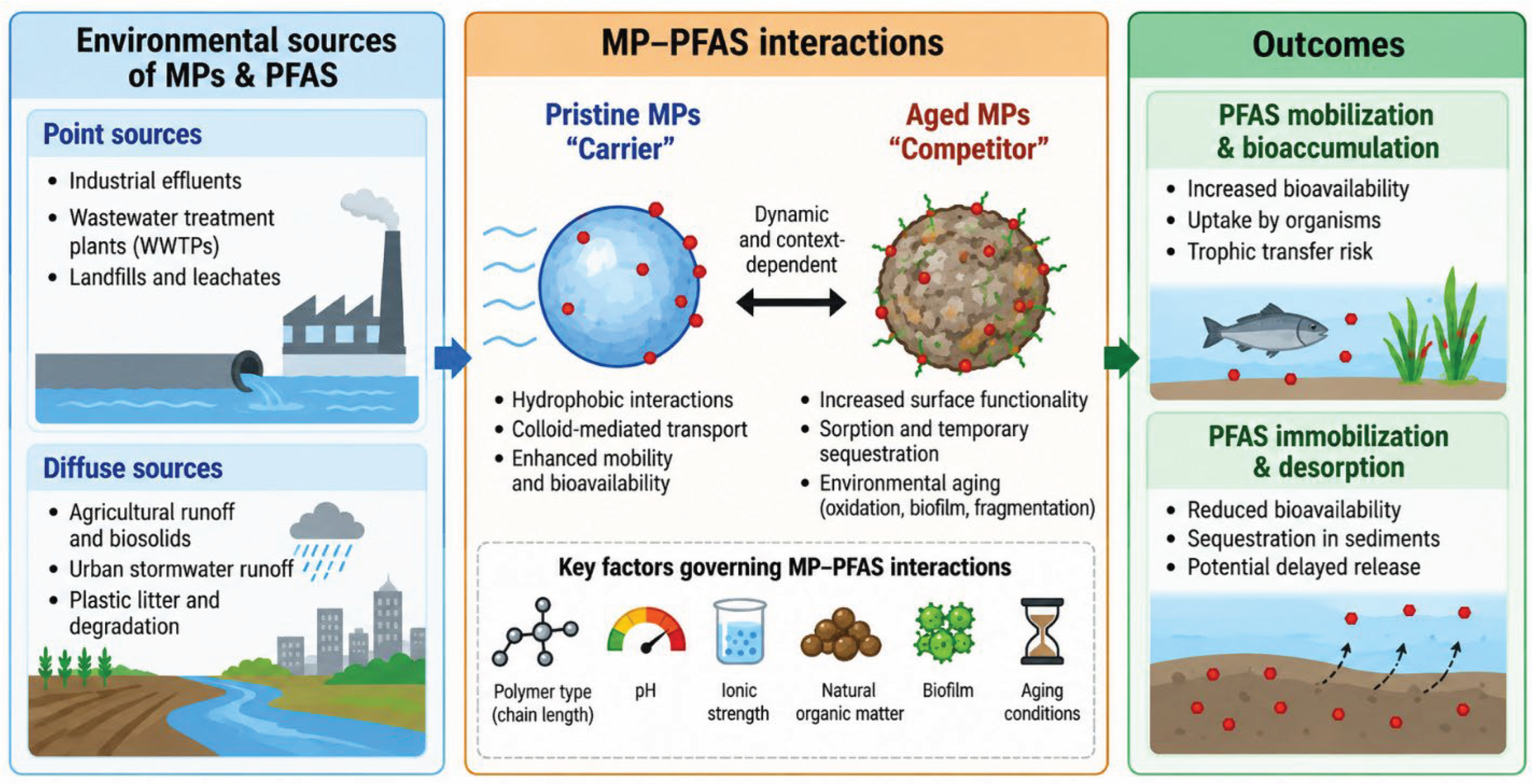
Figure 2.
Interaction Mechanisms of MP-PFAS and their influencing factors. [33] with permission. Copyright 2024 Elsevier.
Figure 2.
Interaction Mechanisms of MP-PFAS and their influencing factors. [33] with permission. Copyright 2024 Elsevier.
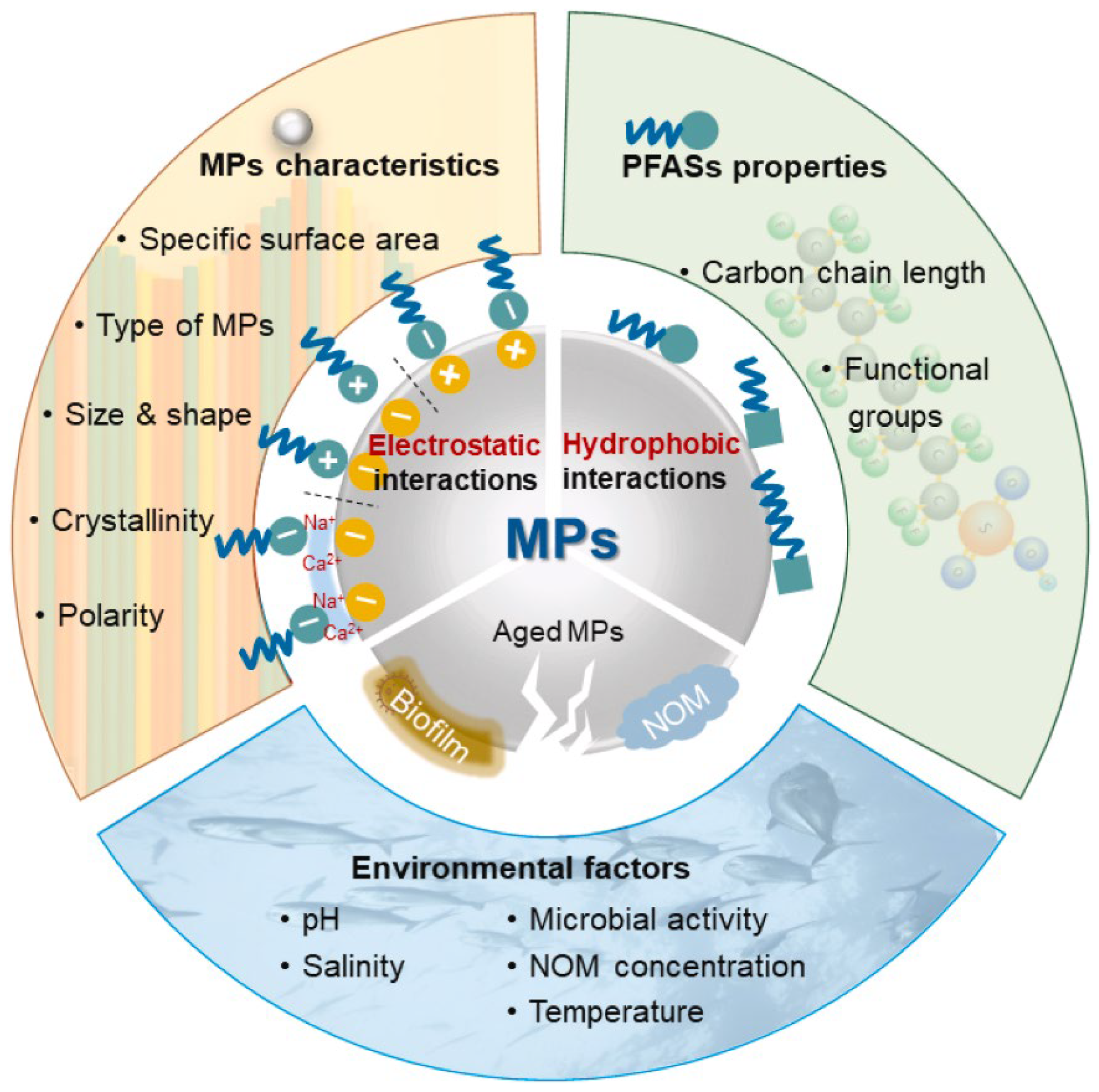
Figure 4.
Conceptual framework illustrating key knowledge gaps and research priorities in microplastic (MP)–PFAS interactions.
Figure 4.
Conceptual framework illustrating key knowledge gaps and research priorities in microplastic (MP)–PFAS interactions.
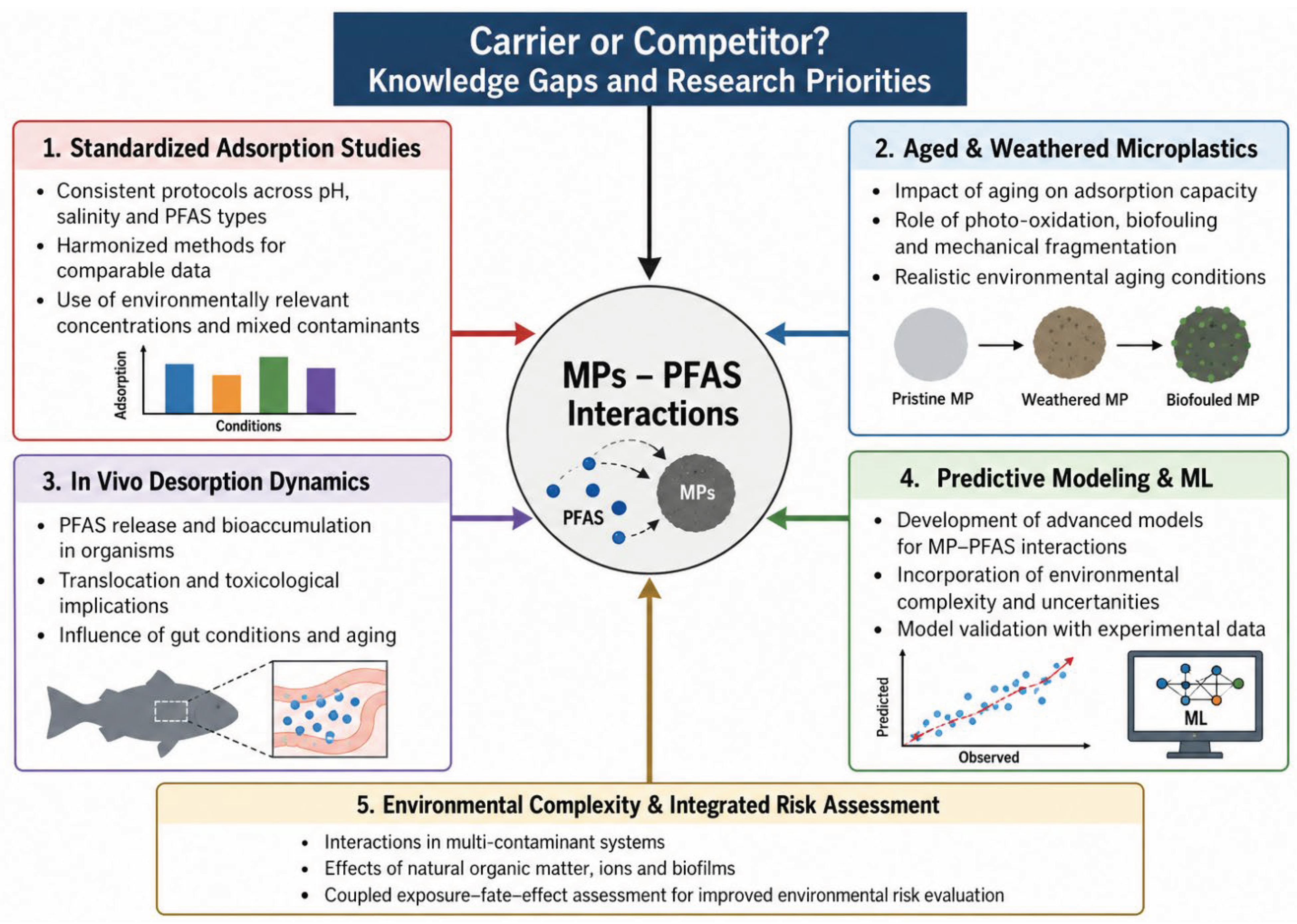

Table 1.
Predictive performance of machine learning models for microplastics, PFAS, and their combined environmental dynamics.
Table 1.
Predictive performance of machine learning models for microplastics, PFAS, and their combined environmental dynamics.
| System | Adopted Model Type | Key Input Features | Performance Metric | Ref. |
|---|---|---|---|---|
| MPs | XGBoost | Molecular descriptors | R² = 0.9876 (training), 0.8122 (testing) for cytotoxicity prediction | [90] |
| MPs | XGBoost | Literature data on MNPs effects on microalgae | R² = 0.957 for predicting microalgae activity | [92] |
| MPs | Random Forest | Environmental factors (e.g., DO, pH, salinity) | R² = 0.93 for predicting Vibrio spp. abundance on MPs | [93] |
| PFAS | XGBoost | Molecular descriptors, experimental conditions | R² = 0.568 for PFAS degradation rate constant prediction | [94] |
| PFAS | QSAR models, ML | Molecular descriptors | Predicting PFAS bioactivity and protein binding interactions | [95,96] |
| PFAS | GNNs, RF, XGBoost | Molecular descriptors, experimental conditions | Prediction of PFAS removal performance by biochar | [89] |
| MP-PFAS | Ensemble ML algorithm | Micro(nano)plastic properties, pollutant characteristics | Predicting combined toxicity (survival rate) of MNPs and pollutants | [97] |
Disclaimer/Publisher’s Note: The statements, opinions and data contained in all publications are solely those of the individual author(s) and contributor(s) and not of MDPI and/or the editor(s). MDPI and/or the editor(s) disclaim responsibility for any injury to people or property resulting from any ideas, methods, instructions or products referred to in the content. |
© 2026 by the authors. Licensee MDPI, Basel, Switzerland. This article is an open access article distributed under the terms and conditions of the Creative Commons Attribution (CC BY) license (http://creativecommons.org/licenses/by/4.0/).
Copyright: This open access article is published under a Creative Commons CC BY 4.0 license, which permit the free download, distribution, and reuse, provided that the author and preprint are cited in any reuse.