

Submitted:
19 November 2026
Posted:
23 November 2026
You are already at the latest version
Abstract
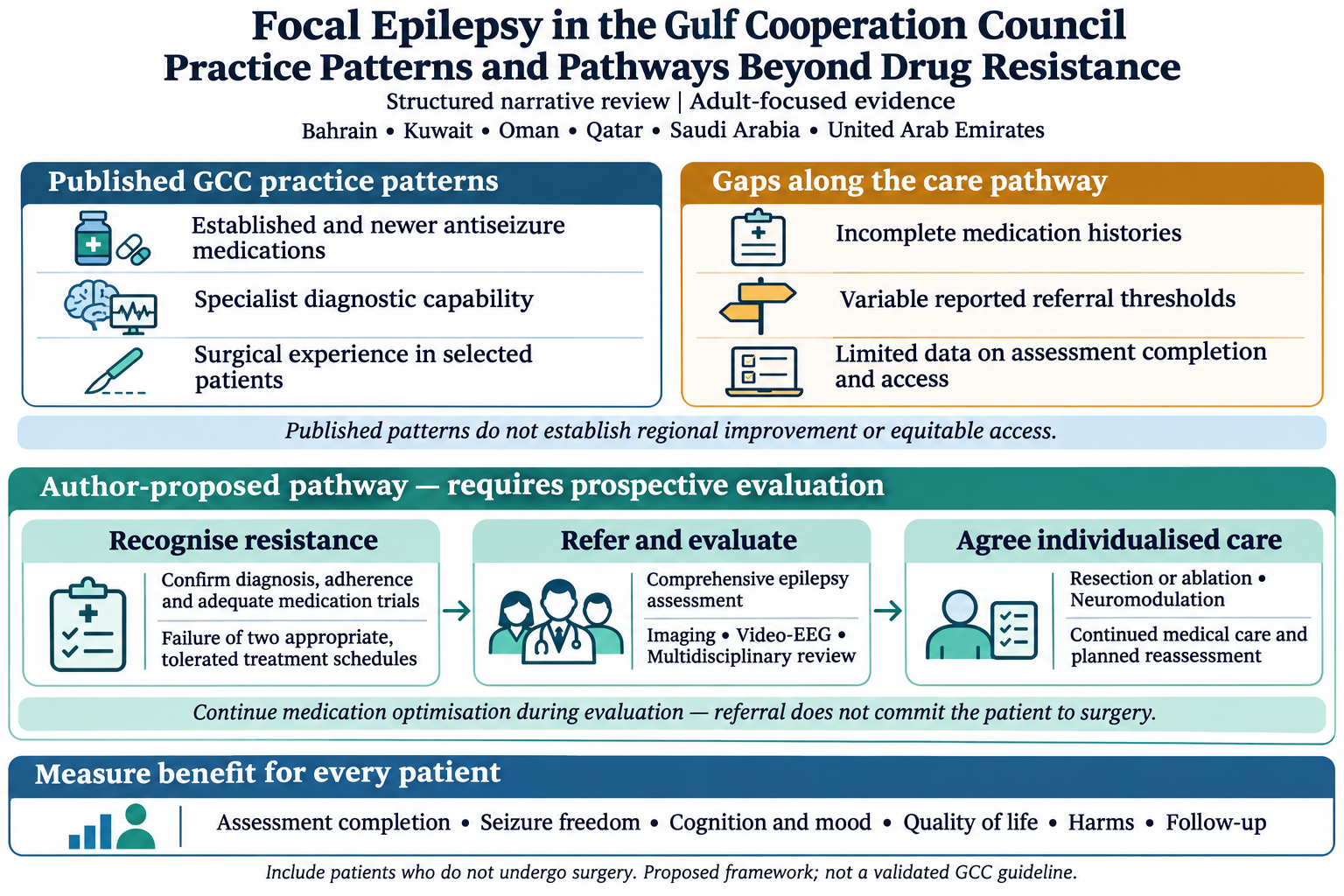
Background: Management of focal epilepsy requires appropriate medication selection, reliable recognition of drug resistance and access to comprehensive assessment. Gulf Cooperation Council (GCC) publications describe practice patterns in prescribing, specialist services and surgical outcomes, but the connections between these components remain incompletely characterised. Objective: To synthesise GCC practice patterns, evaluate pathways beyond recognised drug resistance and identify priorities for adult focal epilepsy care. Methods: This structured narrative review combined PubMed retrieval on 17 November 2026 with targeted searches through 19 November 2026. Purposive selection and qualitative appraisal distinguished GCC patient and service evidence from international treatment studies, guidance and proposed implementation measures. Findings: Regional cohorts document monotherapy in general epilepsy care and frequent levetiracetam prescribing. Drug-resistant cohorts demonstrate established and newer medication use without defining comparative effectiveness or treatment sequences. Incomplete treatment histories, adherence difficulties and variable referral thresholds identify potential weaknesses in recognising resistance and completing assessment. A survey of 17 GCC monitoring units demonstrates variation in diagnostic practice; surgical series document outcomes in selected patients, including MRI-negative adults. International evidence supports further pharmacological benefit after drug resistance, but short-term seizure freedom does not establish durable remission or justify routine postponement of evaluation. Regional longitudinal evidence remains insufficient to determine whether expanding treatment choice improves access or outcomes. Conclusions: GCC pathways should link documented medication trials to comprehensive assessment, multidisciplinary decisions and shared continuing-care responsibilities. Medication optimisation should proceed alongside evaluation. Proposed indicators distinguish treatment-responsive deferral from incomplete access and assess seizure control, tolerability, patient priorities and follow-up. Prospective testing is required before endorsement.
Keywords:
focal epilepsy
; drug-resistant epilepsy
; practice patterns
; antiseizure medications
; surgical referral
; Gulf Cooperation Council
; epilepsy services
1. Introduction
Focal epilepsy management extends from selecting an appropriate antiseizure medication (ASM) to determining when persistent seizures require comprehensive specialist assessment. The International League Against Epilepsy (ILAE) defines drug resistance as failure of adequate trials of two tolerated, appropriately chosen and used ASM schedules, alone or in combination, to achieve sustained seizure freedom.[1] This definition identifies a clinically important decision point. The 2022 ILAE expert consensus recommends offering surgical evaluation promptly once drug resistance is established, with individual consideration of age and clinical circumstances; evaluation can also improve care for patients who ultimately do not undergo an operation.[2]
Randomised trials demonstrated superior seizure outcomes with surgery compared with continued medical treatment in selected temporal lobe epilepsy populations.[3,4] These findings require appropriate localisation and patient selection. The October 2026 American Epilepsy Society/Congress of Neurological Surgeons (AES/CNS) guideline further addresses the benefits and harms of surgical approaches, including outcomes beyond seizure control.[5] For the practising neurologist, recognition of drug resistance should therefore prompt an assessment of available treatment options while medication management continues. Referral, procedural eligibility and the patient’s decision to proceed are separate stages.
The Gulf Cooperation Council (GCC) comprises Bahrain, Kuwait, Oman, Qatar, Saudi Arabia and the United Arab Emirates (UAE). Regional publications document clinical cohorts, surgical programmes and variation in service organisation, but these countries cannot be treated as a single healthcare system. Existing reviews have addressed broader epilepsy characteristics and management in Saudi Arabia.[6] The unresolved regional question concerns the connections between these observations: whether medication decisions and recognition of resistance lead to completed assessment, an informed treatment choice and reliable follow-up. Public and private care, eligibility arrangements and domestic or external referral may shape that pathway differently within each country; their effects require measurement rather than assumption.
Novelty and objectives: This review examines focal epilepsy care in the GCC as a connected clinical pathway, bringing together evidence that is usually reported separately: medication practice, ascertainment of drug resistance, diagnostic capability, referral decisions and outcomes after treatment. Its distinctive contribution is to locate the gaps between these stages and distinguish additional pharmacological opportunity from postponement of comprehensive assessment. Focusing primarily on adults with established or suspected drug-resistant focal epilepsy, the objectives are to characterise documented regional practice patterns; assess treatment-history quality, evaluation, referral and outcomes; critically appraise the implications of newer ASMs; and identify country-specific priorities for research and service evaluation. International evidence is used to interpret regional findings and inform an explicitly author-proposed pathway with measurable indicators of assessment completion, treatment decisions and continuing care. “Pathways beyond drug resistance” therefore describes an organised response to recognised resistance, encompassing individualised medication treatment, procedural assessment and informed reassessment; it does not imply that resistance has been overcome throughout the GCC.
2. Methods
2.1. Design and Scope
This structured narrative review used a population–concept–context framework: adults aged ≥18 years with focal epilepsy; practice patterns, recognition of drug resistance, comprehensive evaluation, referral and outcomes; and care delivered within GCC countries. Adult subgroup results were extracted where available. Inseparable mixed-age cohorts were retained as supporting evidence and identified explicitly. General epilepsy cohorts informed medication use or documentation practices but were not treated as focal-specific treatment-effect studies. Service surveys informed referral and diagnostic organisation. Paediatric-only studies were not used to establish adult treatment outcomes.
A complete, independently checked screening and extraction process was not undertaken. Accordingly, the manuscript is not labelled a scoping review, and no PRISMA inclusion flow or formal certainty assessment is presented. A prospective completion plan for a future PRISMA-ScR review is provided in Supplementary Appendix 2.[7]
2.2. Information Sources and Retrieval
A PubMed search was executed through the National Center for Biotechnology Information interface on 17 November 2026, with no lower publication-date restriction beyond the database query boundary and an upper publication date of 17 November 2026. It combined epilepsy, GCC geography, and focal epilepsy, resistance, surgery, referral, monitoring or service terminology. No age or language filter was applied at retrieval. The exact query is provided in Supplementary Appendix 1.
The search returned 892 identifiers, comprising 886 journal-article records and six book records in the downloaded XML. These are retrieval counts, not counts of screened or included studies. Targeted web searches supplemented retrieval, using country names, exact study titles, diagnostic terms and institutional or professional sources. Accessible references were followed selectively. Embase, Scopus and Web of Science were not directly searched. No claim of exhaustive citation chasing is made.
Targeted searches on 18 November 2026 examined medication utilisation, adherence, formulation switching and referral practice in GCC countries. A further targeted update on 19 November examined contemporary ASM efficacy, tolerability, presurgical optimisation, postoperative treatment and coordinated epilepsy services. Educational transcripts supplied as leads were traced to primary studies and formal guidance where identifiable; case vignettes and unsupported transcript statistics were not treated as study data. These updates did not rerun the structured PubMed query, and its original retrieval count remains unchanged. Supplementary Appendices 1 and 5 distinguish the search stages and evidence types.
2.3. Selection, Source Verification and Synthesis
Sources were selected purposively for relevance to the adult clinical pathway, regional service organisation or interpretation of outcomes. Recruitment setting, rather than author affiliation, determined geographical attribution. Bibliographic details and quantitative findings were checked against PubMed records and primary publisher or repository material. Full texts were examined where accessible; abstract-dependent findings and conference evidence are identified in the tables. Institutional announcements were considered evidence of reported service development only.
The synthesis distinguished direct GCC patient evidence, GCC service and stakeholder evidence, international interpretative evidence and author-proposed operational measures. Qualitative appraisal considered selection, retrospective documentation, outcome definitions, follow-up, age applicability, missing data and possible cohort overlap. Prescribing snapshots were distinguished from longitudinal trends, self-reported practice from documented care, and short maintenance-period seizure freedom from sustained remission. Potentially overlapping post hoc analyses were not counted as independent populations. Formal design-specific risk-of-bias scoring, independent duplicate extraction and a complete funding/conflict-of-interest audit were not performed. No pooled prevalence, comparative treatment effect or aggregate patient total was calculated.
3. Regional Clinical and Service Evidence
3.1. Clinical Spectrum and Identification of Drug Resistance
The selected clinical evidence is summarised in Table 1. A Qatari adult neurology cohort illustrates the importance of population composition: focal epilepsy accounted for 65.5% of 468 patients, and reported aetiologies differed between geographical-background groups.[8] These are clinic observations, not nationality-specific biological risks or population prevalence estimates. Clinical history should guide investigation without using migrant status as a substitute for diagnosis.
The Emirati cohort documented drug resistance in 36 of 150 patients with available prior treatment-failure information, within a total cohort of 204 adults.[9] The full-cohort denominator includes patients whose historical treatment response could not be assessed adequately. These general epilepsy proportions cannot be interpreted as focal-specific prevalence. Section 3.5 examines the extractable focal subgroup and the implications of incomplete treatment histories for clinical practice.
Saudi studies provide additional context. The Jeddah DRE cohort included adolescents as well as adults, whereas the Riyadh study included all ages.[10,11] Their findings should not be collapsed into an adult GCC estimate. Associations between particular medicines and drug resistance in observational records are especially vulnerable to confounding by indication: patients may receive those medicines because their epilepsy is difficult to control.

Table 1.
Selected GCC clinical cohorts and their applicability.
| Study | Setting and population | Relevant findings | Interpretation and access limitation |
| Haddad et al., 2016 [8] | Qatar; adult neurology clinic; 468 patients with epilepsy | Focal epilepsy: 65.5%; causes included vascular disease, hippocampal sclerosis, infections and trauma | General epilepsy cohort; not a DRE registry. Findings checked against the indexed abstract |
| Alhammadi et al., 2026 [9] | Al Ain, UAE; 2019–2024; 204 Emirati adults aged 18–65 | Focal epilepsy: 59/178 classified patients; DRE: 36/150 with evaluable failures, including 14/40 focal cases | Single centre; 26 unclassified epilepsy types; 54 without evaluable failure history. Full text examined |
| Alturaifi et al., 2024 [10] | Jeddah; 2019–2021; 299 patients with DRE aged ≥14; 15 were <18 | Focal epilepsy: 157/299 (52.5%); surgical referral: 43/299 (14.4%) | Mixed-age and mixed-epilepsy cohort; no focal-specific referral denominator or long-term video-EEG in the reported diagnostic assessment. Full text examined |
| Alghamdi et al., 2025 [11] | Riyadh; 2016–2023; 350 patients; includes patients <18, with inconsistent age counts across tables | DRE: 94/350; focal seizure type associated with DRE, adjusted OR 1.85 (95% CI 1.05–3.27) | Clinic proportion; age and other tabulated counts are inconsistent. Associations cannot establish causation. Full text examined |
| Al Za’abi et al., 2013 [12] | Oman; Sultan Qaboos University Hospital; 2006–2009; 372 adults >18 | Monotherapy accounted for 53% of prescriptions; historical medication-utilisation evidence | General epilepsy cohort, not focal DRE; historical prescribing cannot represent current provision. Abstract-dependent extraction |
Note: Values retain study-specific denominators; clinic proportions do not represent population prevalence. Mixed-age and general epilepsy cohorts inform adult focal epilepsy care only within the limitations indicated. Abbreviations: CI, confidence interval; DRE, drug-resistant epilepsy; EEG, electroencephalography; GCC, Gulf Cooperation Council; OR, odds ratio; UAE, United Arab Emirates.
3.2. Surgical Outcomes and Patient Selection
Saudi surgical reports demonstrate established capability but require careful handling of population and endpoint definitions. The 502-patient series included adults and children and combined ILAE classes 1–3 as a favourable outcome.[13] At one year, 172/295 patients in the temporal subgroup were free of seizures and auras, whereas the broader favourable proportion was 79.6%. Presenting the latter as complete seizure freedom would overstate the result. Follow-up denominators changed over time. Table 2 defines the categories used here; Supplementary Table S1 provides the full ILAE and Engel classifications. The systems describe different outcome constructs and should not be treated as interchangeable.[14,15]
The MRI-negative adult series offers a distinct message: selected patients can benefit despite the absence of an identified structural lesion.[16] It cannot estimate outcomes for every MRI-negative patient referred, because patients who did not proceed to surgery are outside the surgical denominator. The temporal/temporal-plus cohort similarly supports the relevance of detailed localisation, without proving that intracranial monitoring itself caused better outcomes.[17]
The 2025 electrocorticography report is mainly informative about mixed-age practice, given its mean surgical age of 13.7 years.[18] Its inclusion as adult effectiveness evidence would be inappropriate. Postoperative ASM management is another separate outcome: the Jeddah withdrawal study describes treatment decisions after temporal surgery, not a randomised comparison of withdrawal schedules.[19]
Table 2.
Selected surgical and postoperative studies.
| Study | Population and period | Outcome or contribution | Principal qualification |
| Alsemari et al., 2014 [13] | Riyadh; 502 patients; 1998–2012; reported 65.3% adults | Temporal surgery: favourable ILAE 1–3 outcomes at 1, 3 and 5 years; strict one-year seizure/auras-free result 172/295 | Mixed ages and procedures; changing follow-up denominators; internal count discrepancies preclude reconstructing a single pooled dataset. Full text examined |
| Alsumaili et al., 2021 [16] | Riyadh; 40 adults with MRI-negative focal epilepsy | Reported seizure freedom: 19/40 at one year; 17/40 at two years | Highly selected operated population; full recruitment period not established from retrieved abstract |
| Khoja et al., 2021 [17] | Riyadh; 2008–2018; 48 patients; mean age 27 years; 15 temporal-plus cases | Intracranial EEG, semiology and temporal-network localisation | Adult-only eligibility not established; possible overlap with other Riyadh series. Abstract-dependent extraction |
| Alshahrani et al., 2025 [18] | Dammam; 2013–2024; 30 patients; age 3–29 years | Engel I: 19/30; mean follow-up 45.9 months, range 7–120 | Predominantly young mixed-age cohort; no non-ECoG comparator; Engel I not automatically equivalent to ILAE 1. Full text examined |
| Albalawi et al., 2021 [19] | Jeddah; 2004–2017; 64 temporal lobectomy patients; ≥2 years follow-up | MRI and EEG findings associated with postoperative ASM tapering decisions | Observational prescribing decisions; age-stratified results not established in abstract-dependent extraction |
Note: ILAE class 1 denotes absence of seizures and auras during the assessment period; class 2 permits auras without other seizures; class 3 permits 1–3 seizure days annually. Engel class I denotes freedom from disabling seizures, whereas IA denotes complete seizure freedom since surgery, subject to the classification’s postoperative convention. Combined ILAE classes 1–3 and undifferentiated Engel I do not establish complete seizure freedom. Retain each study’s classification, denominator and follow-up interval; see Supplementary Table S1.[14,15] Abbreviations: ASM, antiseizure medication; ECoG, electrocorticography; EEG, electroencephalography; ILAE, International League Against Epilepsy; MRI, magnetic resonance imaging.
3.3. Service Organisation and Treatment Intervals
The 2024 report of a survey conducted in 2021 documented 17 participating epilepsy monitoring units (EMUs) across all six GCC countries.[20] This provides evidence of regional specialist infrastructure and a basis for examining differences in operating practice. It is not a contemporary census of service capacity. Reported adverse-event percentages describe units reporting events, rather than complication rates among monitored patients.
Earlier Saudi surveys examined hospitals without EMUs and the organisation of established monitoring units.[21,22] They documented specialist and referral limitations, waiting times and geographical concentration. A neurologist survey examined knowledge and self-reported referral behaviour; its demographic correction was checked.[23,24] Table 3 summarises these historical observations alongside more recent medication-practice evidence. Their age and sampling preclude using them as estimates of current national provision.
The UAE conference abstract reported a mean 17-year interval between epilepsy onset and surgery among 21 operated patients.[25] This is an important signal, but the interval can include drug-responsive years, recognition of resistance, referral, investigations and patient decisions. Without those component dates, the avoidable portion cannot be quantified. Restriction to operated patients also omits those awaiting evaluation or never referred.
Table 3.
Service, referral and medication-practice evidence.
| Source | Observation | Permissible conclusion |
| GCC EMU survey; 2021 data, published 2024 [20] | 17 units across six countries; 12 served adults and children, five adults only; 15 reported continuous observation | Regional infrastructure exists; practices varied. Not a contemporary census or patient-level safety comparison |
| Saudi hospitals without EMUs; 2013–2015 [21] | 43 respondents; 58.1% lacked adult epileptologists; 30.2% reported no EMU referral | Historical respondent-level service gaps; not all Saudi hospitals |
| Saudi EMU survey; 2013–2016 [22] | Reported mean wait 11 weeks, range 2–52 | Historical waiting-time evidence; present-day waiting cannot be inferred |
| Saudi neurologist survey; 2016–2017 [23,24] | 106 respondents; 53/106 selected two ASM failures as the referral threshold; 49/106 selected more than three | Historical self-reported referral thresholds; not verified patient-level practice or current GCC behaviour |
| UAE surgical series; 2015–2023 [25] | 21 patients; mean onset-to-surgery interval 17 years, range 2–43 | Conference evidence of long total intervals; no stage-specific delay estimates |
| Saudi generic-ASM survey; 2022–2024, published 2025 [26] | 114 respondents; mixed views on substitution; 110/114 practised in urban settings | Self-reported attitudes, not measured generic effectiveness or a nationally representative prescribing audit. Full text examined |
| Gulf ASM consensus commentary; 2022 panel, published 2023 [27] | Addresses medication selection, availability and formulation switching | Expert opinion, not a utilisation dataset. GSK funded editorial support and publication; not formal six-country endorsement. Full text examined |
| Saudi multicentre adherence study; 2023–2025, published 2026 [28] | 534 respondents, including 49 aged 16–17; 311/534 (58.2%) classified as highly adherent | Mixed-age, general epilepsy; self-report and voluntary participation; no adult focal-DRE treatment effect. Full text examined |
Note: Findings describe participating services or respondents during the stated periods. Self-reported practice and expert opinion do not establish current national provision or treatment effectiveness. Onset-to-surgery intervals cannot be interpreted wholly as avoidable referral delay. Abbreviations: ASM, antiseizure medication; DRE, drug-resistant epilepsy; EMU, epilepsy monitoring unit; GCC, Gulf Cooperation Council; UAE, United Arab Emirates.
3.4. Country Coverage and Evidence Gaps
An Omani clinic conference report described 109 focal epilepsies among 134 patients aged ≥13 years, including 91 temporal cases.[29] A five-patient eating-epilepsy series documented surgical treatment in one selected patient.[30] These observations demonstrate clinical experience; neither establishes national surgical demand or effectiveness.
The selected material did not establish robust adult focal-surgery outcome estimates for Bahrain or Kuwait. This statement concerns the reviewed publications, not the existence of local services. Their participation in the GCC EMU survey is particularly important when interpreting publication gaps.[20] Paediatric case reports, foreign affiliations and isolated service announcements cannot supply adult national denominators.
A Qatar publication modelled temporal lobe epilepsy burden using external estimates.[31] Such planning models should be kept separate from observed patient registries, with their assumptions stated. They cannot determine how many patients would meet contemporary surgical criteria.
3.5. Practice Patterns in Focal Epilepsy Management Across the GCC
Published GCC evidence describes medication selection, treatment-history documentation, diagnostic monitoring and surgical referral, but these components have rarely been examined together within a longitudinal adult focal-epilepsy cohort. The literature therefore supports a synthesis of practice patterns rather than a claim that regional management has improved or deteriorated over time. General epilepsy cohorts provide prescribing context; drug-resistant cohorts and service surveys more directly inform the transition from persistent seizures to comprehensive assessment. Their different populations and denominators remain explicit in the synthesis below.
3.5.1. Medication Selection and Treatment Escalation
Levetiracetam is frequently prescribed in several regional cohorts. In Qatar, a retrospective adult clinic study of 468 patients, 65.5% of whom had focal epilepsy, reported monotherapy in 66% and levetiracetam use in 41%.[8] The Al Ain study of 204 Emirati adults attending tertiary care during 2019–2024 recorded monotherapy in 136/204 (66.7%), levetiracetam in 102/204 (50.0%) and lacosamide in 13/204 (6.4%).[9] Historical Omani evidence, based on 372 adults treated during 2006–2009, reported monotherapy in 53% of prescriptions.[12] These findings establish substantial use of monotherapy in general epilepsy care, but do not identify a preferred first-line regimen specifically for focal epilepsy or a common GCC treatment sequence.
Treatment exposure differs in drug-resistant populations. Among 299 patients aged ≥14 years with drug-resistant epilepsy in Jeddah, 157 had focal epilepsy; levetiracetam was prescribed to 202 patients (67.6%), lacosamide to 73 (24.4%) and perampanel to two (0.7%). A total of 127/299 (42.5%) had discontinued or switched an ASM.[10] These overlapping exposures demonstrate use of established and newer agents, but provide neither focal-specific comparative effectiveness nor a reconstruction of successive treatment decisions. Prescribing frequency cannot establish whether selection reflected efficacy, tolerability, availability or previous treatment failure.
3.5.2. Recognition of Drug Resistance and Treatment Records
In the Emirati cohort, prior ASM-failure information was unavailable for 54 of 204 patients. Among the 40 patients with focal epilepsy and evaluable failure histories, 14 (35.0%) were classified as drug resistant.[9] This is a selected clinic subgroup, not a population prevalence estimate. The missing histories expose a practical limitation: current prescriptions cannot establish which previous regimens were adequate, why they were discontinued or when resistance became apparent. Absence of documentation must also be distinguished from absence of appropriate treatment.
The ILAE definition concerns failure of two appropriately selected, tolerated and adequately used schedules to achieve sustained seizure freedom, rather than the number of drugs currently prescribed.[1] A patient receiving monotherapy may have established drug resistance, while polytherapy alone does not prove it. An early discontinuation for intolerance may leave efficacy indeterminate; it should not automatically be counted as a qualifying efficacy failure. Recording adequacy, response and reasons for discontinuation would make referral decisions more transparent. This is a proposed documentation priority, not evidence of an existing GCC-wide standard.
3.5.3. Adherence and Medication Continuity
A Saudi multicentre study published in 2026 recruited 534 participants during January 2023–June 2025, including 49 aged 16–17 years. High adherence on the self-reported Medication Adherence Rating Scale was recorded in 311/534 (58.2%); forgetfulness and fear of adverse effects were reported by 57.3% and 27.9%, respectively.[28] These mixed-age, mixed-epilepsy findings identify issues relevant to treatment review, but cannot determine what proportion of uncontrolled focal epilepsy represents pharmacological resistance. Cross-sectional associations between adherence and seizures do not establish their direction of causation.
Medication substitution is another documented concern. A Saudi survey of 114 neurologists conducted during 2022–2024 found mixed perceptions concerning generic ASM substitution.[26] A Gulf expert commentary published in 2023 addressed availability and switching practices.[27] The survey measures professional perceptions and the commentary provides expert recommendations; neither establishes that approved generics are clinically inferior. For practice evaluation, dispensing changes, missed doses and adverse effects should be documented before recurrent seizures are attributed to pharmacological resistance or formulation changes.
3.5.4. Diagnostic Monitoring and Surgical Referral
The 2021 survey of 17 GCC EMUs found that 15 reported continuous observation and two daytime-only observation; seven reported a specific protocol for medication-withdrawal speed on admission.[20] These differences concern participating units’ operating practices, not comparative patient safety. They support examining how monitoring is organised and whether its findings lead to a documented treatment decision. The presence of an EMU alone does not establish timely access or completion of presurgical evaluation.
In the Saudi neurologist survey published in 2020, 53 of 106 respondents selected failure of two ASMs as the threshold for surgical referral.[23,24] This historical self-report suggests inconsistent application of the referral threshold, but cannot describe current GCC-wide behaviour. In the Jeddah drug-resistant cohort, 43/299 patients (14.4%) had been referred for surgical evaluation.[10] The cohort included different epilepsy types and lacked a focal-specific referral denominator. The proportion therefore cannot establish how many non-referred patients were suitable for an operation. It supports auditing whether evaluation was offered, why it was deferred and whether accepted referrals were completed.
3.5.5. Regional Interpretation and Implications for Practice
The central issue is the connection between medication management and comprehensive assessment. The evidence does not establish that repeated ASM trials cause regional referral delays. International recommendations nevertheless provide a clinical benchmark: surgical evaluation should be offered promptly once drug resistance is established, with individual consideration of age and clinical circumstances.[2] Medication optimisation can continue during evaluation. Referral provides access to diagnostic clarification and treatment assessment; it need not await exhaustion of every available medicine.
Contemporary adult focal-specific prescribing and referral data from Bahrain and Kuwait remain limited in this review. This publication gap should not be interpreted as absence of services. A GCC practice audit could link successive medication trials, adherence and tolerability, diagnostic findings, referral dates and treatment decisions within the same record. It should distinguish public and private pathways, document eligibility and treatment continuity where relevant, and retain patients who decline intervention or do not complete evaluation. The key unanswered question is whether a change in treatment produces sustained clinical benefit and a completed care decision. Prescribing volume, the availability of a newer ASM or the number of operations cannot answer that question alone.
4. Clinical Evaluation and Treatment Selection
4.1. Confirming Drug Resistance and Diagnostic Uncertainty
Treatment-history reconciliation should establish the indication, dose or tolerated exposure, duration, adherence, response and reason for stopping each regimen. Incomplete information should be recorded as indeterminate rather than automatically classified as treatment failure.[1] Adequacy is a clinical judgement about an appropriately used schedule; reaching a nominal maximum dose is not a universal requirement. The documentation problems described in Section 3.5 make this essential for interpreting resistance, although specialist referral may be appropriate before every historical detail has been recovered.
The proposed pathway allows provisional referral with explicit information gaps, followed by reconciliation at the epilepsy centre. This is an operational proposal, not an additional diagnostic definition. It avoids making a complete historical record an administrative condition for specialist assessment when seizures remain uncontrolled or diagnosis is uncertain.
Persistent events require reassessment of whether they are epileptic and whether more than one event type is present. Alternative or coexisting diagnoses include functional seizures and syncope. Medication selection, exposure, access, adherence and tolerability should be reviewed alongside semiology and investigation findings. Identified problems require treatment and support; they should not automatically exclude the patient from comprehensive assessment.[1,2]
4.2. Seizure Classification and Diagnostic Evaluation
Historical publications use “partial”, “complex partial” and the 2017 awareness terminology. The 2025 ILAE seizure classification uses consciousness, assessed through awareness and responsiveness, as a classifier.[32] We retain original study terminology where needed and avoid retrospective reclassification unsupported by the records. Focal seizures must be distinguished from an established diagnosis of focal epilepsy, and acute symptomatic seizures from epilepsy. A bilateral tonic–clonic event alone does not establish generalised epilepsy.
MRI should answer an epilepsy-specific question. The ILAE HARNESS recommendations provide a framework for structural imaging, with specialist interpretation and appropriate additional processing where indicated.[33] A negative routine report should prompt scrutiny of acquisition quality, sequences and electroclinical concordance before a patient is labelled definitively MRI-negative. This is particularly relevant when deciding whether additional investigations might change management.
Long-term video-EEG can clarify habitual events and their electroclinical localisation, provided staffing and safety procedures are appropriate.[34] A normal routine EEG does not exclude epilepsy; monitoring should answer a defined clinical question rather than serve as a mandatory positive test before further care.[35] The presence of a plausible MRI lesion likewise does not establish that every event arises from it. Recording the adequacy of monitoring and the remaining uncertainty helps the next clinician understand what has, and has not, been resolved. Table 4 links investigations to the decisions they inform.
4.3. Localisation, Function and Multidisciplinary Judgement
Neuropsychological assessment contributes baseline measurement, evaluation of cognitive vulnerability and postoperative interpretation.[36] Mood, behaviour and psychiatric support needs also belong within comprehensive care.[38] In GCC practice, language, education, literacy and familiarity with test materials should be documented; a translated instrument should not automatically be considered validated. Assessment should inform counselling and support without becoming an unnecessary administrative obstacle to referral. The practical proposal is to record the assessment language, normative reference and resulting care plan.
A Saudi report describes the development of stereo-EEG within local programmes.[37] This supports discussion of advanced regional expertise, but is not evidence that invasive recording is required for every candidate. Selection should follow a coherent localisation hypothesis. Apparent temporal semiology may reflect a broader network, and discordant findings require resolution rather than a predetermined operation.
Multidisciplinary review should document the proposed treatment, alternatives, expected benefit, uncertainty, functional risks and patient priorities. Eloquent cortex involvement, bilateral or multifocal findings and discordance between investigations may alter the investigation strategy or treatment choice. A decision not to proceed to surgery should carry a specific rationale, such as insufficient localisation, unacceptable functional risk, a preferred alternative or informed deferral. Eligibility may change as clinical information and treatment options evolve.[2,5]
4.4. Resection, Ablation and Neuromodulation
Resection or ablation requires an individual assessment of localisation, lesion extent, eloquent cortex, baseline function and procedural risk. The temporal-lobe trials provide causal evidence for selected populations, while the AES/CNS guideline considers surgical options and outcomes more broadly.[3,4,5] Their findings should not be reduced to a single success percentage applicable to every aetiology or procedure. Regional outcome reports are most useful when the selection process, endpoint and follow-up denominator are explicit.
Long-term international studies of responsive neurostimulation and anterior thalamic stimulation support sustained seizure reduction in selected focal epilepsy populations.[39,40] Their outcomes should not be ranked directly against resection cohorts with different eligibility, endpoints and follow-up. Patients should understand whether the principal goal is seizure freedom, reduction in disabling events or another meaningful improvement.
Saudi and UAE VNS consensus publications address patient selection, programming and follow-up.[41,42] These are regional practice resources, not comparative efficacy trials. The UAE study used a single-round modified Delphi process; consensus within its panel should not be relabelled as GCC-wide endorsement. Device treatment also creates continuing requirements for programming, maintenance and access to specialist advice.
Institutional reports describe continuing service development. Cleveland Clinic Abu Dhabi reported robotic stereo-EEG in February 2026 and introduction of laser interstitial thermal therapy in May 2026.[43,44] Hamad Medical Corporation reported an epilepsy operation using intraoperative EEG and mapping in July 2021.[45] These dated announcements establish reported activity, rather than audited effectiveness, universal eligibility or national coverage. Patient referral requires confirmation of the receiving centre’s current capabilities and access arrangements.
Medication treatment remains relevant after surgery or neuromodulation. In a post hoc analysis of an open-label cenobamate study, 26/85 patients with previous epilepsy-related procedures achieved 100% seizure reduction during at least one consecutive interval of ≥12 months.[46] The subgroup included different procedures and was not randomised against another treatment. Its interpretation is that additional medication benefit remains possible after a procedure; it does not establish a preferred sequence of medication, resection and neuromodulation. Regional follow-up should therefore record subsequent treatment changes and their outcomes, rather than end data collection at the operation.
Box 1 summarises the clinical principles and proposed GCC implementation measures that underpin the pathway in Section 5.
| Box 1. Contemporary management of adult drug-resistant focal epilepsy: priorities for GCC practice |
|
International clinical principles with author-proposed regional implementation measures; not a validated GCC guideline. 1. Confirm diagnosis and treatment adequacy. Review events, medication selection, exposure, tolerability, adherence and continuity before attributing persistent seizures to resistance.[1] 2. Document drug resistance. Record qualifying failure of two appropriate, tolerated and adequately used schedules; distinguish indeterminate histories and early intolerance.[1] 3. Refer while treating. Offer comprehensive epilepsy and surgical assessment promptly. Referral does not commit the patient to a procedure; MRI negativity, age and psychiatric comorbidity require individual assessment.[2] 4. Optimise medication in parallel. Consider accessible, authorised options and interactions. Reduce unnecessary burden when appropriate; further ASM trials should not routinely postpone assessment.[2,47,48] 5. Investigate to answer a question. Integrate expert MRI review, video-EEG and functional assessment; select advanced localisation tests according to the clinical hypothesis.[33,34,36] 6. Agree a decision and a review plan. Discuss benefit, harms and preferences. Distinguish seizure freedom from reduction; document reasons and reassessment criteria when intervention is deferred.[5,48] 7. Maintain GCC continuity. Name the referring and receiving teams’ responsibilities. Address language, access and medication supply; audit completed decisions, communicated plans and outcomes for all pathways.[38] ASM, antiseizure medication; EEG, electroencephalography; GCC, Gulf Cooperation Council; MRI, magnetic resonance imaging. |
5. Proposed GCC Pathway and Evaluation Framework
5.1. Referral and Continuing-Care Responsibilities
The proposed framework begins with persistent focal epilepsy and a structured review of diagnosis and medication trials. Established drug resistance should lead to an offer of comprehensive assessment; diagnostic uncertainty or indeterminate treatment histories may also warrant specialist review. Referral precedes the choice of intervention. Older age, psychiatric comorbidity and MRI negativity require individual assessment within the qualifications of the ILAE referral recommendations.[2] The functions of the receiving service matter more than adopting overseas centre labels: access to epilepsy expertise, appropriate monitoring and imaging, multidisciplinary treatment assessment and longitudinal care should be explicit.
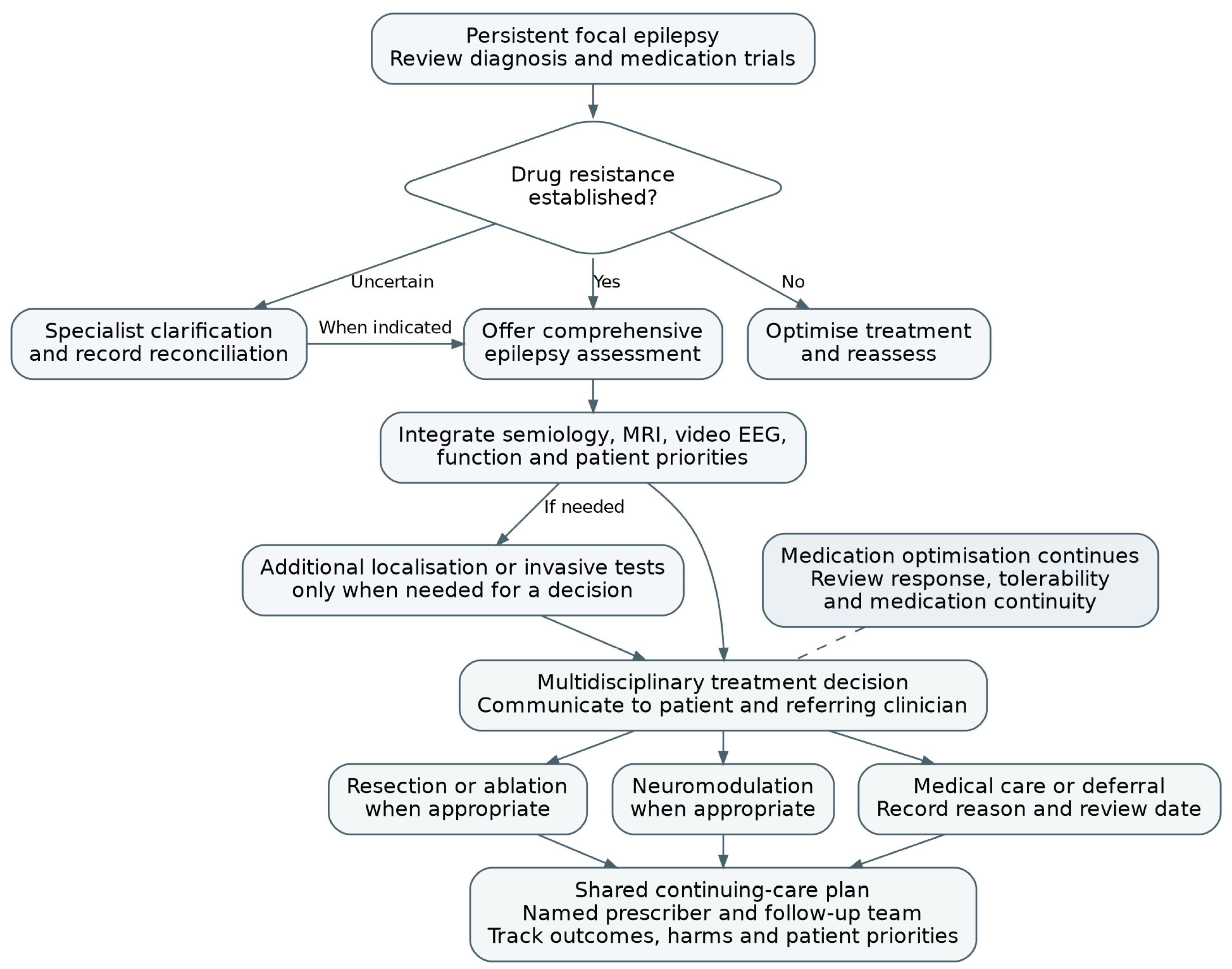
Referral should initiate coordinated care with defined responsibilities for both teams. International epilepsy-centre guidance emphasises coordination across inpatient, outpatient and referring services.[38] Within the proposed GCC pathway, the referring neurologist would continue medication review, assess interval seizures and adverse effects, and maintain patient contact while specialist assessment proceeds. The receiving service would acknowledge referral, identify outstanding information, communicate the assessment plan and return the multidisciplinary decision. Information from the referring clinician and the patient’s priorities should inform that decision (Figure 1).
Where available, trained nurses and pharmacists could support treatment-history reconciliation, interaction review, medication access and education in the patient’s preferred language, within locally authorised scopes of practice. A shared continuing-care plan should name the responsible prescriber, specify monitoring and counselling needs, and set the next review. This applies equally when intervention proceeds, is declined or is deferred. These operational arrangements require local feasibility testing; they are not evidence that a common multidisciplinary model is already implemented throughout the GCC.
Figure 1.
Author-proposed pathway for comprehensive assessment of drug-resistant focal epilepsy. Legend: Medication optimisation, diagnostic clarification and referral can proceed concurrently. Additional localisation tests are selected when they can resolve a treatment question; they are not obligatory for every patient. The continuing-care plan identifies responsibility for prescribing, monitoring and reassessment, including after treatment-responsive deferral. Treatment branches may be combined or revisited over time. This author-proposed framework addresses long-term care, does not replace urgent management of neurological deterioration or seizure emergencies, and requires prospective evaluation.
5.2. Country-Specific Priorities
Common definitions can support regional comparison while countries retain different delivery models. Advanced assessment may be provided locally, through a national network or through a formal cross-border arrangement. The proposed priorities in Table 5 follow the evidence available for each country; they are not a ranking of national performance. Initial collaboration could concentrate on interpretable referral records, access to multidisciplinary advice and an identified receiving team.
5.3. Candidate Quality Indicators
Table 6 proposes indicators for a pilot registry following patients from treatment review to outcomes. Denominators must include patients who have not reached assessment and those managed without intervention. A deferred procedure may reflect sustained medication benefit, informed preference or an access barrier; these have different clinical meanings. The audit should therefore record the reason, current seizure status and reassessment plan, rather than treating a lower or higher operation rate as evidence of better care. Communication of the continuing-care plan is a separate measurable step.
Calendar-quarter referral cohorts and annual outcome cohorts are suggested measurement units. These periods are operational proposals, not validated targets. Waiting-time analyses should retain pending patients as censored observations; completed-case medians alone can underestimate waits. For a small pilot, report the number waiting, elapsed time and reasons for delay alongside completed intervals.
Table 6.
Candidate quality indicators for prospective testing.
| Indicator | Numerator or measure | Denominator or cohort | Suggested measurement |
| Treatment-history completeness | Patients with enough information to assess relevant ASM trials; record explicitly indeterminate histories separately | Patients with persistent focal epilepsy reviewed during the quarter | Quarterly; indeterminate documentation does not count as complete evaluable history |
| Referral offer | Patients with newly established DRE offered comprehensive assessment | All patients with newly established focal DRE during the quarter | Record offer date, acceptance, deferral and reason for no offer |
| Referral interval | Days from the date DRE was established to referral submission | Newly established focal DRE cohort | Report distribution and patients not yet referred |
| Assessment access | Days from referral receipt to first comprehensive assessment | All referrals received during the quarter | Include pending, declined and redirected referrals |
| Investigation completion | Patients completing the investigations specified in their individual plan | Patients for whom each investigation was ordered | At a prespecified pilot checkpoint; record contraindications and non-completion reasons |
| Multidisciplinary decision | Patients with a recorded team decision and rationale | Patients reaching the decision stage | Quarterly; also track those still awaiting review |
| Informed choice | Patients with documented discussion of benefits, harms, alternatives and preferences | Patients offered an invasive intervention | Before intervention or recorded refusal |
| Outcome ascertainment | Patients with seizure, functional and adverse-event status recorded | All patients entering each intervention or non-intervention pathway | Proposed 12- and 24-month assessments; report missingness |
| Treatment outcome | ILAE/Engel class, complete seizure freedom, seizure burden and patient-reported change, reported separately | Relevant treatment cohort, with evaluable and original denominators shown | Fixed follow-up windows; retain baseline and treatment dates |
| Safety and continuity | EMU adverse events; procedural harms; unplanned admissions; medication or follow-up interruptions | EMU admissions or monitoring-days, procedures, and enrolled patients, as appropriate | Define each event and denominator separately before pilot launch |
| Communication of continuing-care plan | Patients whose decision and plan were documented and communicated to the patient and referring clinician | All patients with a multidisciplinary decision during the quarter | Record decision and communication dates, responsible clinician, outstanding actions and next review |
| Documented deferral and reassessment | Patients with a reason for deferral, current seizure status and reassessment plan | All patients whose intervention was deferred during the quarter | Separate sustained medication response, preference, clinical uncertainty and access barriers; no target deferral rate |
Note: These author-proposed indicators require feasibility testing; measurement periods are suggested, and no validated performance targets are asserted. Report proportions with explicit numerators, denominators and missingness, and intervals with pending cases retained. Distinguish informed deferral following medication benefit from refusal, incomplete evaluation and access barriers. Assess process measures alongside seizure outcomes, treatment burden and patient-reported benefit. Abbreviations: ASM, antiseizure medication; DRE, drug-resistant epilepsy; EMU, epilepsy monitoring unit; ILAE, International League Against Epilepsy.
5.4. Equity, Patient Priorities and Implementation
Potential determinants of access include travel, appointment availability, language, financing and changes in residence or insurance. Their comparative effects across GCC countries are not established by this review. Prospective audits should record these factors where relevant, alongside referral eligibility and the populations served, with adjustment for case mix where feasible.
Patients and caregivers should help define meaningful outcomes and acceptable burdens of assessment. Counselling should address seizure benefit, cognitive and psychiatric effects, occupational function and continued medication use. Discussing sudden unexpected death in epilepsy (SUDEP) should be individualised, including the importance of controlling tonic–clonic seizures and supporting adherence; the reviewed evidence does not establish a medication-specific mortality advantage.[49] Reproductive plans, contraception and pregnancy-related treatment risks also warrant review when relevant, informed by current guidance.[50] These discussions should support informed decisions and ongoing care without extending this review into rescue-treatment protocols.
Cross-border treatment requires an agreed transfer record specifying responsibility for medication supply and changes, postoperative concerns, device programming and follow-up. Public–private transfers need comparable clarity about authorisation, communication and ownership of pending results. Teleconferencing and shared case review are plausible implementation strategies; their acceptability and effect on completed assessment, safety and outcomes should be tested locally. Access to remote advice should complement, rather than substitute automatically for, investigations or examination that require attendance.
6. Discussion
The central finding is that published GCC practice can be described more readily than the complete course of care for an adult with drug-resistant focal epilepsy. Medication studies describe exposure, service surveys describe operating practice, and surgical series describe selected treated patients. Their value becomes greater when interpreted together, but their separate denominators cannot be assembled into a regional treatment cascade. The evidence therefore identifies questions about transition and continuity, rather than a single GCC estimate of adult drug resistance or surgical effectiveness.
Medication-history gaps, variable reported referral thresholds and limited patient-level follow-up make the decision at recognition of resistance particularly important. These findings do not establish that GCC clinicians routinely delay referral or that additional ASM trials cause delay. A prospective evaluation should begin before an operation, following consecutive patients through diagnostic clarification, treatment choice and continuing care. It should distinguish ongoing seizures despite adequate treatment from unresolved diagnosis, inadequate exposure and interruptions in access, and preserve the reasons for non-referral, incomplete assessment and informed refusal.
Diagnostic and procedural investment should be assessed through its contribution to decisions and outcomes. More advanced recording or imaging may resolve a localisation problem, but technical capability alone does not establish patient access or durable benefit. Relevant outcomes include complete seizure freedom, cognition, mood, quality of life, complications and retention in follow-up. Regional reports should distinguish these endpoints rather than using a favourable seizure classification as a substitute for overall recovery.
Changes in referral or treatment volume require careful interpretation. Shorter waits demonstrate process improvement but not necessarily better seizure control. More operations may reflect improved access, different case selection or both; fewer procedures may reflect treatment benefit or failure to reach care. A clinically informative regional evaluation must connect these measures to the reason for each decision and to subsequent outcomes. This is especially relevant as newer ASMs and advanced procedures become available within some GCC services before their uptake and continuity are documented across the wider population.
6.1. Newer ASMs, Sustained Seizure Freedom and Referral
Expansion of ASM options over the past two decades raises a central question: has greater choice materially changed sustained seizure freedom, particularly after drug resistance develops? In a Glasgow cohort of 1,795 patients newly treated between 1982 and 2012, 1,144 (63.7%) were seizure-free for at least the preceding year at final follow-up, without a substantial improvement across treatment eras.[51] This mixed-age, mixed-epilepsy cohort was not confined to adult drug-resistant focal epilepsy and predates cenobamate. It challenges the assumption that a larger formulary necessarily improves population outcomes, but cannot establish that subsequent advances have been ineffective.
Cenobamate provides evidence of additional pharmacological opportunity. In a randomised trial of 222 adults with uncontrolled focal seizures, 28/102 cenobamate-treated completers (27.5%) were seizure-free during six-week maintenance.[52] A later Asian trial randomised 519 adults; among 446 with maintenance-phase efficacy data, seizure freedom was reported in 52.4% of the 400-mg group (n=103), compared with 2.6% of placebo recipients (n=117), during the same six-week interval.[53] These findings should retain their analysis populations and short observation periods. They neither establish annual remission nor permit a head-to-head ranking against other ASMs or surgery. FREEDON adds observational evidence across treatment lines, but severity and treatment selection can confound comparisons of earlier and later use.[54]
Clinical benefit also depends on tolerability and treatment retention. SANAD II randomised 990 participants aged ≥5 years with newly diagnosed focal epilepsy and favoured lamotrigine over levetiracetam and zonisamide for time to treatment failure.[55] Psychiatric adverse reactions were reported in 43/328 lamotrigine-treated participants (13%), 98/330 receiving levetiracetam (30%) and 73/324 receiving zonisamide (23%); these were adverse-reaction proportions, not psychiatric discontinuation rates. This was not a trial in established adult drug resistance. For GCC cohorts reporting frequent levetiracetam use, it supports recording tolerability and reasons for switching, without implying that regional prescribing is inappropriate.
Therapeutic efficacy and GCC access require separate evidence. Cenobamate received European authorisation in March 2021, and its manufacturer announced a UAE commercial launch on 6 July 2026.[56,57] Neither event establishes regional uptake, reimbursement, uninterrupted supply or a reduction in drug resistance. GCC studies should link actual dispensing and successive medication trials to resistance and referral dates, evaluating sustained response and treatment burden alongside assessment completion. An additional appropriate ASM trial can proceed while comprehensive evaluation continues; exhausting every available medicine is not a prerequisite for referral.[2]
Optimisation includes reviewing existing treatment rather than automatically accumulating additional drugs. Expert recommendations for cenobamate describe individualised adjustment of interacting concomitant ASMs, including clobazam, phenytoin, phenobarbital and lacosamide, to improve tolerability.[47] The appropriate adjustment depends on the interaction, dose, response and adverse effect. Neither a fixed taper schedule nor an automatic rule to retain the newest drug is appropriate for every patient. Regional records should distinguish changes made for toxicity, interactions, insufficient efficacy and regimen simplification.
Psychiatric and cognitive outcomes deserve attention alongside seizure frequency. A retrospective study of 2,636 US veterans examined these adverse effects with several newer ASMs; its predominantly male population and unequal medication exposure limit direct application to GCC populations.[58] Older-adult cenobamate evidence is also exploratory: a post hoc analysis included 42 patients aged 65–70 years in the safety subgroup and only 15 in the maintenance-phase efficacy subgroup.[59] These data support careful assessment of falls, cognition and medication burden, but cannot establish comparative safety in frail older GCC adults.
Medication response can change procedural decisions without invalidating the original referral. A 2024 expert panel supported cenobamate optimisation during presurgical assessment while cautioning against delaying imminent surgery in clearly remediable epilepsy.[48] A 2026 single-centre retrospective study of 192 patients evaluated in 2018 or 2023 found an association between cenobamate use and lower likelihood of surgery within 12 months.[60] Treatment allocation was not randomised, and a difference in procedure use cannot itself establish superior long-term outcomes. Sustained seizure freedom may justify individualised deferral after specialist review and informed discussion, with a documented rationale and reassessment criteria. For GCC evaluation, treatment-responsive deferral should remain distinct from incomplete investigation, refusal and barriers to access.
6.2. Implementing Care Across GCC Health Systems
Implementation should begin with the functions required to complete care: a recognisable referral route, an interpretable treatment history, appropriate investigations and a named team responsible for follow-up. A current directory could document these functions for participating centres, including referral eligibility and arrangements for services provided elsewhere. General neurologists, epilepsy specialists, nurses and pharmacists should have explicit responsibilities suited to each service’s workforce and governance. The purpose is to make referrals and subsequent decisions actionable, rather than rely on a historical list of facilities.
International networks offer components for adaptation. The US Veterans Health Administration’s epilepsy programme reports tele-EEG and specialist teleconsultation linking facilities within a national system.[61] Earlier network research documented increasing connections among neurologists sharing patients, without establishing that connectivity itself improved seizure outcomes.[62] A GCC adaptation might link local follow-up to remote specialist review and a defined route to in-person comprehensive assessment. A model developed within one integrated US system cannot be assumed to transfer unchanged across GCC public, private or national boundaries; feasibility, data governance and clinical responsibility require local agreement.
Country priorities should reflect local organisation. Historical Saudi surveys justify examining links between catchment services and specialist centres.[21,22] In the UAE, reports of new technologies should be accompanied by audits of access, assessment completion and outcomes across participating providers.[43,44] For Bahrain, Kuwait and Oman, formal consultation or referral links to other centres could be evaluated when a local assessment leaves a clinical question unresolved. This is an option for service design, not an inference that domestic expertise is absent. Table 5 identifies questions for evaluation within each system.
Population coverage is equally important. The Qatari cohort described medication choice in a population with diverse geographical backgrounds and noted the relevance of availability in patients’ countries of origin.[8] The Emirati-only cohort cannot establish access among other UAE residents.[9] Audits should therefore specify the population served, referral eligibility and continuity when patients travel or relocate. Nationality should not be treated as a biological explanation or as a substitute for measuring access directly.
An initial GCC intervention could combine a structured medication history, an explicit referral decision and a shared continuing-care plan. Regional adherence and dispensing reports justify testing pharmacist support and counselling in the patient’s preferred language.[26,27,28] Patient participation should shape the outcomes and workload of that intervention. For example, improved seizure control accompanied by intolerable mood effects, loss of employment or interrupted follow-up would not represent satisfactory care solely because a seizure-frequency threshold was met. The pilot should assess whether each professional contribution resolves a documented need and whether the resulting plan reaches the patient and referring clinician.
6.3. Research Priorities
The first research priority is a prospective multicentre adult focal-epilepsy cohort beginning at recognition of possible drug resistance. Shared definitions should link adequate medication trials, adherence, tolerability, diagnostic uncertainty, referral milestones, treatment decisions and follow-up. Prespecified analyses should distinguish temporal from extratemporal epilepsy, lesional from MRI-negative disease, and intervention from non-intervention pathways. Medication changes during assessment and after procedures require dates and reasons. Patients who decline, defer or do not complete evaluation must remain in the denominator, with treatment-responsive deferral distinguished from access-related delay.
Repeated prescribing and referral audits with stable observation windows are needed to establish temporal trends. Formulary listing should be distinguished from dispensing, exposure and continuity. Surgical reports should separate complete seizure freedom from broader Engel or ILAE categories and report cognition, mood, quality of life and harms at defined time points. Studies of newer ASMs should include treatment retention, reasons for discontinuation, concomitant medication changes and sustained seizure outcomes. Patient and clinician research should examine non-referral without presuming that reluctance or knowledge deficits explain every delay. Implementation studies should establish feasibility, acceptability and safety before comparative or economic evaluation; this review supports no GCC cost-effectiveness conclusion.
6.4. Limitations
This structured narrative review used PubMed retrieval, targeted supplementary searches and purposive selection. A complete independently verified screening process was not performed. Database coverage, incomplete full-text access and selective publication may have affected the evidence map. The 19 November update added targeted international evidence rather than a new systematic search of all GCC literature. Qualitative appraisal did not include formal risk-of-bias scoring, certainty grading or comprehensive extraction of funding and conflicts. Several newer-ASM trials and expert publications have industry involvement, and post hoc or observational findings remain vulnerable to selection, attrition and confounding.
Adult focal-specific GCC evidence remains limited. General epilepsy prescribing studies and inseparable mixed-age cohorts cannot establish adult focal treatment effects, while inconsistent primary-study counts constrain some interpretations. Surgical reports may overlap, as may analyses drawn from the same international cenobamate programme; no aggregate patient total was calculated. Historical surveys cannot describe current provision, institutional announcements cannot establish equitable access, and cross-sectional observations cannot demonstrate change over time. International service models and treatment studies inform interpretation but do not establish GCC implementation or effectiveness. The proposed pathway and indicators require external review and prospective testing before regional endorsement.
7. Conclusions
Published GCC evidence documents established and newer ASM use, specialist diagnostic capability and surgical experience, alongside gaps in treatment-history documentation and knowledge of referral completion. These observations define practice patterns, but do not establish that expanding treatment choice has reduced adult focal drug resistance or improved access uniformly. Newer medications can provide further benefit after resistance is recognised, including during assessment and after procedural treatment. The clinical priority is to connect that opportunity with timely comprehensive evaluation, explicit treatment decisions and continuing care.
A regional pathway should make the next step clear for every patient: diagnostic clarification, an informed procedural decision or medical care with planned reassessment. Medication optimisation and surgical assessment should proceed in parallel when appropriate. Sustained response may support individualised deferral, but deferral requires a reason, a responsible clinician and follow-up. National, public–private and cross-border arrangements should preserve those responsibilities. Evaluation must include patients who do not undergo surgery and measure cognition, mood, quality of life, harms and treatment burden alongside seizure outcomes.
A prospective multicentre pilot linking medication histories, referral milestones and patient-centred outcomes would test whether available expertise translates into completed assessment and sustained benefit. Multidisciplinary and patient review should precede regional endorsement, with feasibility and prospective outcome evaluation determining subsequent expansion. Progress in GCC focal epilepsy care should ultimately be judged by whether recognised drug resistance leads to a timely, informed and documented treatment decision that remains connected to the patient’s continuing care.
Supplementary Materials
The following supporting information can be downloaded at the website of this paper posted on Preprints.org.
Author Contributions
Isa Ahmed Alsharoqi conceived the review, developed its methodological approach, undertook literature identification and evidence synthesis, drafted the manuscript and proposed regional pathway, and coordinated manuscript preparation. Abdulla I. Salem Alsharoqi contributed to evidence verification, interpretation and critical revision of the manuscript. Tariq Alafifi contributed to the review and interpretation of UAE evidence, assessment of regional clinical practice and critical revision of the manuscript.
Funding
This work received no funding from public, commercial or not-for-profit organisations.
Institutional Review Board Statement
This review used published literature and publicly available information and involved no recruitment of participants or access to identifiable patient-level data. Ethics approval and informed consent were therefore not required.
Informed Consent Statement
Not applicable.
Data Availability Statement
The evidence supporting this review is available in the cited publications and accompanying supplementary materials. No original patient-level dataset was generated.
AI Assistance
Generative AI (OpenAI ChatGPT) assisted with literature discovery, organisation, drafting and preparation of the proposed pathway diagram. The authors retain responsibility for source verification, interpretation and the final manuscript.
Conflicts of interest
The authors declare no conflicts of interest.
References
- Kwan P, Arzimanoglou A, Berg AT, Brodie MJ, Hauser WA, Mathern G, et al. Definition of drug resistant epilepsy: consensus proposal by the ad hoc Task Force of the ILAE Commission on Therapeutic Strategies. Epilepsia. 2010;51(6):1069-77. [CrossRef]
- Jehi L, Jette N, Kwon CS, Josephson CB, Burneo JG, Cendes F, et al. Timing of referral to evaluate for epilepsy surgery: Expert Consensus Recommendations from the Surgical Therapies Commission of the International League Against Epilepsy. Epilepsia. 2022;63(10):2491-2506. [CrossRef]
- Wiebe S, Blume WT, Girvin JP, Eliasziw M. A randomized, controlled trial of surgery for temporal-lobe epilepsy. N Engl J Med. 2001;345(5):311-8. [CrossRef]
- Engel J Jr, McDermott MP, Wiebe S, Langfitt JT, Stern JM, Dewar S, et al. Early surgical therapy for drug-resistant temporal lobe epilepsy: a randomized trial. JAMA. 2012;307(9):922-30. [CrossRef]
- Gonzalez-Martinez J, Bergey G, Roldán-Benítez YM, Hopp JL, Bauer D, Price AV, et al. American Epilepsy Society/Congress of Neurological Surgeons Epilepsy Surgery Clinical Practice Guideline. Neurosurgery. 2026 Oct 26 [online ahead of print]. [CrossRef]
- Almuqairsha SA, Al-Harbi FA, Alaidah AM, Al-Mutairi TA, Al-Oadah EK, Almatham AE, et al. Demographics, Clinical Characteristics, and Management Strategies of Epilepsy in Saudi Arabia: A Systematic Review. Cureus. 2024;16(6):e63436. [CrossRef]
- Tricco AC, Lillie E, Zarin W, O'Brien KK, Colquhoun H, Levac D, et al. PRISMA Extension for Scoping Reviews (PRISMA-ScR): Checklist and Explanation. Ann Intern Med. 2018;169(7):467-473. [CrossRef]
- Haddad N, Melikyan G, Al Hail H, Al Jurdi A, Aqeel F, Elzafarany A, et al. Epilepsy in Qatar: Causes, treatment, and outcome. Epilepsy Behav. 2016;63:98-102. [CrossRef]
- Alhammadi M, Alblooshi BK, Ahmed A, Alshaer M, Almazrouei R, Al-Shamsi S. Clinical Characteristics, Treatment Patterns, and Drug-Resistant Epilepsy Among Emirati Adults with Epilepsy. Neurol Ther. 2026;15(4):1863-1879. [CrossRef]
- Alturaifi A, Alshaikh H, Khojah O, Alqarni A, Albedaiwi T, Albluwi A, et al. Drug-Resistant Epilepsy: Experience From a Tertiary Care Center in Saudi Arabia. Cureus. 2024;16(6):e61913. [CrossRef]
- Alghamdi M, Alomari N, Alamri AF, Ghamdi R, Nazer R, Albloshi S. Drug-resistant epilepsy in Saudi Arabia: prevalence, predictive factors, and treatment outcomes. BMC Neurol. 2025;25(1):143. [CrossRef]
- Al Za’abi M, Ahmed R, Al Asmi A, Al-Zakwani I. Utilization patterns of antiepileptic drugs among adult epileptic patients at a tertiary hospital in Oman. Int J Pharm Pract. 2013;21(2):117–122. [CrossRef]
- Alsemari A, Al-Otaibi F, Baz S, Althubaiti I, Aldhalaan H, Macdonald D, et al. Epilepsy surgery series: a study of 502 consecutive patients from a developing country. Epilepsy Res Treat. 2014;2014:286801. [CrossRef]
- Wieser HG, Blume WT, Fish D, Goldensohn E, Hufnagel A, King D, et al. ILAE Commission Report. Proposal for a new classification of outcome with respect to epileptic seizures following epilepsy surgery. Epilepsia. 2001;42(2):282–286. [CrossRef]
- Engel J Jr, Van Ness PC, Rasmussen TB, Ojemann LM. Outcome with respect to epileptic seizures. In: Engel J Jr, editor. Surgical treatment of the epilepsies. 2nd ed. New York: Raven Press; 1993. p. 609–621.
- Alsumaili M, Alkhateeb M, Khoja A, Alkhaja M, Alsulami A, Alqadi K, et al. Seizure outcome after epilepsy surgery for patients with normal MRI: A Single center experience. Epilepsy Res. 2021;173:106620. [CrossRef]
- Khoja A, Albaradei O, Alsulami A, Alkhaja M, Alsumaili M, Khoja O, et al. Seizure semiology in temporal lobe vs. temporal plus epilepsy using intracranial EEG monitoring. Neurosciences (Riyadh). 2021;26(3):261-269. [CrossRef]
- Alshahrani A, Althani ZM, Al-Baradie R, Jallul T, Alotaibi F, Najjar A, et al. Intraoperative electrocorticography in focal drug-resistant epilepsy: A 10-year retrospective single-center study. Biomed Rep. 2025;23(5):171. [CrossRef]
- Albalawi M, Babtain F, Baeesa S, Al-Said Y, Alqadi K. The role of brain magnetic resonance imaging on the timing of antiepileptic drugs withdrawal following mesial temporal lobe epilepsy surgery. Neurosciences (Riyadh). 2021;26(3):270-276. [CrossRef]
- Aljafen BN, Alneseyan RA, Bahr MH, Muayqil TA, Al-Otaibi F. Current practice and safety measures in epilepsy monitoring units in the Gulf Cooperation Council Countries: A cross-sectional study. Epilepsy Res. 2024;202:107361. [CrossRef]
- Alfayez SM, Aljafen BN. Epilepsy services in Saudi Arabia. Quantitative assessment and identification of challenges. Neurosciences (Riyadh). 2016;21(4):326-330. [CrossRef]
- Aljafen BN, Alfayez SM, Alanazy MH, Alazwary N, Alohali SM, Muayqil T. Epilepsy monitoring units in Saudi Arabia: Where do we stand compared to developed countries? Neurosciences (Riyadh). 2018;23(3):244-249. [CrossRef]
- Aljafen B, Alomar M, Abohamra N, Alanazy M, Al-Hussain F, Alhumayyd Z, et al. Knowledge of and attitudes toward epilepsy surgery among neurologists in Saudi Arabia. Neurosciences (Riyadh). 2020;25(1):43-49. [CrossRef]
- Erratum: Knowledge of and attitudes toward epilepsy surgery among neurologists in Saudi Arabia. Neurosciences (Riyadh). 2022;27(3):204. [CrossRef]
- Alawadhi A, Achi E, Nair R, Soni H, Rabbani M, Hussain SI, et al. The epilepsy surgery treatment gap in the UAE: challenges and future prospects [conference abstract 3.45]. American Epilepsy Society Annual Meeting; 2024. Available from: https://aesnet.org/abstractslisting/the-epilepsy-surgery-treatment-gap-in-the-uae-challenges-and-future-prospects. Accessed 17 November 2026.
- Aljafen BN, Alqahtani RN, Algarni RS, Elmutawi H, Bahr MH. Neurologists’ insights and practices on generic antiepileptic medications in epilepsy management: A Saudi Arabian perspective. Pak J Med Sci. 2025;41(7):1930–1936. [CrossRef]
- Alsaadi T, Almadani A, Al-Hashel J, Al Salti A, Melikyan G, Khan RA. Commentary: Consensus Guidelines on the Appropriate Use of Brand-Name and Generic Anti-Seizure Medication for the Management of Epilepsy in the Gulf Region. Neurol Ther. 2023;12(4):1015–1031. [CrossRef]
- Alshehri AA, Khawagi WY, Alshahrani KI, Alshehri RA, Alhawsawi GA, Altowairqi DH, et al. Antiepileptic Drug Adherence in Patients with Epilepsy in Saudi Arabia: A Multicentre Cross-Sectional Study. Healthcare (Basel). 2026;14(15):2302. [CrossRef]
- Alrasbi S, Al-Asmi A, Al-Zakwani I, Gujjar A, Jacob P, Alobaidy A. Clinical characteristics, management and seizure control of epilepsy patients: an observational cross-sectional study in Oman [conference abstract]. American Epilepsy Society; 2008. Available from: https://aesnet.org/abstractslisting/clinical-characteristics--management-and-seizure-control-of-epilepsy-patients--an-observational-cross-sectional-study-in-oman. Accessed 17 November 2026.
- Gujjar AR, Jacob PC, Ramanchandiran N, Al-Asmi A. Eating Epilepsy in Oman: A case series and report on the efficacy of temporal lobectomy. Sultan Qaboos Univ Med J. 2013;13(1):156-61. [CrossRef]
- Mesraoua B, Deleu D, Al Hail HJ, Melikyan G, Abdalhalim Ali M, Haddad N, et al. Prevalence and Incidence of Drug-Resistant Temporal Lobe Epilepsy in Qatar. J Cent Nerv Syst Dis. 2020;12:1179573520935031. [CrossRef]
- Beniczky S, Trinka E, Wirrell E, Abdulla F, Al Baradie R, Alonso Vanegas M, et al. Updated classification of epileptic seizures: Position paper of the International League Against Epilepsy. Epilepsia. 2025;66(6):1804-1823. [CrossRef]
- Bernasconi A, Cendes F, Theodore WH, Gill RS, Koepp MJ, Hogan RE, et al. Recommendations for the use of structural magnetic resonance imaging in the care of patients with epilepsy: A consensus report from the International League Against Epilepsy Neuroimaging Task Force. Epilepsia. 2019;60(6):1054-1068. [CrossRef]
- Tatum WO, Mani J, Jin K, Halford JJ, Gloss D, Fahoum F, et al. Minimum standards for inpatient long-term video-electroencephalographic monitoring: A clinical practice guideline of the International League Against Epilepsy and International Federation of Clinical Neurophysiology. Epilepsia. 2022;63(2):290-315. [CrossRef]
- National Institute for Health and Care Excellence. Epilepsies in children, young people and adults. NICE guideline NG217 [Internet]. [cited 2026 Nov 19]. Available from: https://www.nice.org.uk/guidance/ng217.
- Baxendale S, Wilson SJ, Baker GA, Barr W, Helmstaedter C, Hermann BP, et al. Indications and expectations for neuropsychological assessment in epilepsy surgery in children and adults. Epileptic Disord. 2019;21(3):221-234. [CrossRef]
- Dionisio S, Althubaiti I, Aldosari M, Alsallom F, Alomar N, Babtain F, et al. Stereo electroencephalography in the kingdom of Saudi Arabia. Neurophysiol Clin. 2024;54(6):103007. [CrossRef]
- Lado FA, Ahrens SM, Riker E, Muh CR, Richardson RM, Gray J, et al. Guidelines for specialized epilepsy centers: executive summary of the report of the National Association of Epilepsy Centers guideline panel. Neurology. 2024;102(4):e208087. [CrossRef]
- Nair DR, Laxer KD, Weber PB, Murro AM, Park YD, Barkley GL, et al. Nine-year prospective efficacy and safety of brain-responsive neurostimulation for focal epilepsy. Neurology. 2020;95(9):e1244-e1256. [CrossRef]
- Salanova V, Witt T, Worth R, Henry TR, Gross RE, Nazzaro JM, et al. Long-term efficacy and safety of thalamic stimulation for drug-resistant partial epilepsy. Neurology. 2015;84(10):1017-25. [CrossRef]
- Alqadi K, Aldhalaan H, Alghamdi A, Bamgadam F, Abu-Jabber A, Baeesa S, et al. Saudi Arabian Consensus Statement on Vagus Nerve Stimulation for Refractory Epilepsy. Saudi J Med Med Sci. 2021;9(1):75-81. [CrossRef]
- Alawadhi A, Al-Kaylani M, Albastaki H, Asha Mohammed J, Aziz M, Haykal Mohamad A, et al. Expert consensus on the clinical and organizational use of VNS therapy for drug-resistant epilepsy in the United Arab Emirates: a single-round modified Delphi study. Epilepsy Behav. 2026 Oct 22 [online publication]. [CrossRef]
- Cleveland Clinic Abu Dhabi. UAE’s first robotic SEEG procedure performed at Cleveland Clinic Abu Dhabi [institutional report]. 4 February 2026. Available from: https://www.clevelandclinicabudhabi.ae/en/media-center/news/uaes-first-robotic-seeg-procedure-performed-at-cleveland-clinic-abu-dhabi. Accessed 17 November 2026.
- Cleveland Clinic. Cleveland Clinic Abu Dhabi becomes first in the Gulf region to offer advanced laser therapy for epilepsy and brain tumors [institutional report]. 22 May 2026. Available from: https://newsroom.clevelandclinic.org/2026/05/22/cleveland-clinic-abu-dhabi-becomes-first-in-the-gulf-region-to-offer-advanced-laser-therapy-for-epilepsy-and-brain-tumors. Accessed 17 November 2026.
- Hamad Medical Corporation. Hamad General Hospital neurosurgery team perform complex brain mapping with intra operative electroencephalography during brain surgery for the first time [institutional report]. 14 July 2021. Available from: https://hamad.qa/EN/news/2021/July/Pages/Hamad-General-Hospital-Neurosurgery-Team-Perform-Complex-Brain-Mapping-with-intra-operative-electroencephalography-during.aspx. Accessed 17 November 2026.
- Abou-Khalil B, Aboumatar S, Klein P, Krauss GL, Sperling MR, Rosenfeld WE. Efficacy of cenobamate for uncontrolled focal seizures in patients with previous epilepsy-related surgery: post hoc analysis of a phase 3, multicenter, open-label study. Epilepsy Res. 2022;184:106952. [CrossRef]
- Smith MC, Klein P, Krauss GL, Rashid S, Seiden LG, Stern JM, et al. Dose adjustment of concomitant antiseizure medications during cenobamate treatment: expert opinion consensus recommendations. Neurol Ther. 2022;11:1705–1720. [CrossRef]
- Laxer KD, Elder CJ, Di Gennaro G, Ferrari L, Krauss GL, Pellinen J, et al. Presurgical use of cenobamate for adult and pediatric patients referred for epilepsy surgery: expert panel recommendations. Neurol Ther. 2024;13(5):1337–1348. [CrossRef]
- Harden C, Tomson T, Gloss D, Buchhalter J, Cross JH, Donner E, et al. Practice guideline summary: sudden unexpected death in epilepsy incidence rates and risk factors: report of the Guideline Development, Dissemination, and Implementation Subcommittee of the American Academy of Neurology and the American Epilepsy Society. Neurology. 2017;88(17):1674–1680. [CrossRef]
- Pack AM, Oskoui M, Williams Roberson S, Donley DK, French J, Gerard EE, et al. Teratogenesis, perinatal, and neurodevelopmental outcomes after in utero exposure to antiseizure medication: practice guideline from the AAN, AES, and SMFM. Neurology. 2024;102(11):e209279. [CrossRef]
- Chen Z, Brodie MJ, Liew D, Kwan P. Treatment outcomes in patients with newly diagnosed epilepsy treated with established and new antiepileptic drugs: a 30-year longitudinal cohort study. JAMA Neurol. 2018;75(3):279–286. [CrossRef]
- Chung SS, French JA, Kowalski J, Krauss GL, Lee SK, Maciejowski M, et al. Randomized phase 2 study of adjunctive cenobamate in patients with uncontrolled focal seizures. Neurology. 2020;94(22):e2311–e2322. [CrossRef]
- Lee SK, Yu P, Choe E, Ferrari L, Heo K, Hong SB, et al. A randomized, double-blind, placebo-controlled, multicenter study to evaluate the efficacy and safety of adjunctive cenobamate in Asian patients with focal seizures. Epilepsia. 2026;67(2):660–672. [CrossRef]
- Villanueva V, Serratosa JM, Fernández-Cabrera A, Toledo M, González-Giráldez B, Estevez JC, et al. Freedon study: real-life outcomes of cenobamate in different lines of treatment. Epilepsia. 2026;67(5):2177–2189. [CrossRef]
- Marson A, Burnside G, Appleton R, Smith D, Leach JP, Sills G, et al. The SANAD II study of the effectiveness and cost-effectiveness of levetiracetam, zonisamide, or lamotrigine for newly diagnosed focal epilepsy: an open-label, non-inferiority, multicentre, phase 4, randomised controlled trial. Lancet. 2021;397(10282):1363–1374. [CrossRef]
- European Medicines Agency. Ontozry: European public assessment report. Available from: https://www.ema.europa.eu/en/medicines/human/EPAR/ontozry. Accessed 17 November 2026.
- Hikma Pharmaceuticals. Hikma launches XCOPRI (cenobamate tablets) in the UAE [manufacturer announcement]. 6 July 2026. Available from: https://www.hikma.com/news/hikma-launches-xcopri-cenobamate-tablets-in-the-uae/. Accessed 17 November 2026.
- Nuthalapati P, DeBonis D, Gopaul M, Okafor CM, Orner M, Jimenez AD, et al. Examining psychiatric and cognitive adverse effects of brivaracetam, clobazam, lacosamide, eslicarbazepine, and perampanel in a veteran population. Epilepsy Behav. 2025;172:110557. [CrossRef]
- O’Dwyer R, Stern S, Wade CT, Guggilam A, Rosenfeld WE. Safety and efficacy of cenobamate for the treatment of focal seizures in older patients: post hoc analysis of a phase III, multicenter, open-label study. Drugs Aging. 2024;41(3):251–260. [CrossRef]
- Pellinen J, Sillau S, Bui A, Danciutiu A, Kaye L, Sood A, et al. Delayed and deferred surgery associated with cenobamate use in people with drug-resistant focal epilepsy. Epilepsia. 2026;67(7):3410–3419. [CrossRef]
- US Department of Veterans Affairs, Epilepsy Centers of Excellence. Epilepsy Centers of Excellence annual report fiscal year 2024 [Internet]. [cited 2026 Nov 19]. Available from: https://www.epilepsy.va.gov/docs/ECoE_2024_Annual_Report.pdf.
- Altalib HH, Fenton BT, Cheung KH, Pugh MJV, Bates J, Valente TW, et al. Care coordination in epilepsy: measuring neurologists’ connectivity using social network analysis. Epilepsy Behav. 2017;73:31–35. [CrossRef]
Table 4.
Diagnostic questions and safeguards for the proposed pathway.
| Assessment | Decision it informs | Safeguard |
| Event history, witness account and available video | Are the habitual events epileptic, and are there different event types? | Do not assume all events share one diagnosis |
| ASM-history reconciliation | Is drug resistance established, possible or indeterminate? | Document adequacy and reasons for discontinuation; distinguish intolerance or indeterminate efficacy from qualifying failure |
| Epilepsy-protocol MRI and expert review | Is there a plausible structural substrate? | Distinguish an incidental lesion from an electroclinically concordant finding |
| Prolonged video-EEG | What is the electroclinical diagnosis and localisation? | Record adequacy and safety; normal routine EEG or an unrevealing admission does not exclude epilepsy |
| Neuropsychology and psychiatric assessment | What are baseline function, treatment risks and support needs? | Use culturally and linguistically appropriate interpretation; identify support needs without delaying referral unnecessarily |
| PET, ictal SPECT, source imaging or MEG, where indicated | Can additional localisation resolve a specific uncertainty? | Select by the clinical hypothesis; these are not universal prerequisites |
| Intracranial EEG and functional mapping, where indicated | Can competing localisation hypotheses and functional risks be resolved? | Balance the expected decision benefit against procedural risk |
Note: This author-proposed framework draws on references [1,2,33,34,35,36,37] and requires prospective evaluation. Investigations address individual diagnostic and treatment questions; advanced testing is not a universal prerequisite for referral. Abbreviations: ASM, antiseizure medication; EEG, electroencephalography; MEG, magnetoencephalography; MRI, magnetic resonance imaging; PET, positron emission tomography; SPECT, single-photon emission computed tomography.
Table 5.
Selected country-level evidence and proposed evaluation priorities.
| Country | Evidence represented in this review | Priority proposed for evaluation |
| Saudi Arabia | Clinical and surgical cohorts; referral, generic-ASM and adherence studies; advanced diagnostic experience [10,11,13,16,17,18,19,21,22,23,26,28,37] | Link prescribing and referral records across catchments; measure referral completion and adherence support, with attention to regional variation |
| UAE | Adult clinical cohort, surgical timing abstract, VNS consensus and institutional developments [9,25,42,43,44] | Link public/private referrals and treatment histories; audit eligibility, completion and outcomes after new procedures |
| Qatar | Adult clinical cohort, burden model and institutional surgical report [8,31,45] | Document treatment continuity when patients travel or relocate; establish observed adult referral and outcome denominators |
| Oman | Historical adult medication-utilisation cohort, clinic abstract and small focal epilepsy case series [12,29,30] | Update adult prescribing data and link them to referral pathways and standardised longitudinal outcomes |
| Bahrain | Country represented in the GCC EMU survey [20]; adult surgical outcome estimates not established here | Map the adult pathway, including domestic and external referrals and continuity of follow-up |
| Kuwait | Country represented in the GCC EMU survey [20]; adult surgical outcome estimates not established here | Publish adult prescribing and referral audits; distinguish service availability from completion of assessment and continuing care |
Note: Evidence reflects the populations, centres and periods studied; it does not constitute a contemporary national service inventory or permit ranking of GCC healthcare systems. Limited publication should not be interpreted as absent clinical capability. Proposed priorities translate documented findings and evidence gaps into country-specific questions for prospective evaluation, rather than established policy recommendations. Abbreviations: ASM, antiseizure medication; EMU, epilepsy monitoring unit; GCC, Gulf Cooperation Council; UAE, United Arab Emirates; VNS, vagus nerve stimulation.
Disclaimer/Publisher’s Note: The statements, opinions and data contained in all publications are solely those of the individual author(s) and contributor(s) and not of MDPI and/or the editor(s). MDPI and/or the editor(s) disclaim responsibility for any injury to people or property resulting from any ideas, methods, instructions or products referred to in the content. |
© 2026 by the authors. Licensee MDPI, Basel, Switzerland. This article is an open access article distributed under the terms and conditions of the Creative Commons Attribution (CC BY) license (http://creativecommons.org/licenses/by/4.0/).
Copyright: This open access article is published under a Creative Commons CC BY 4.0 license, which permit the free download, distribution, and reuse, provided that the author and preprint are cited in any reuse.