
Submitted:
18 November 2026
Posted:
19 November 2026
You are already at the latest version
Abstract
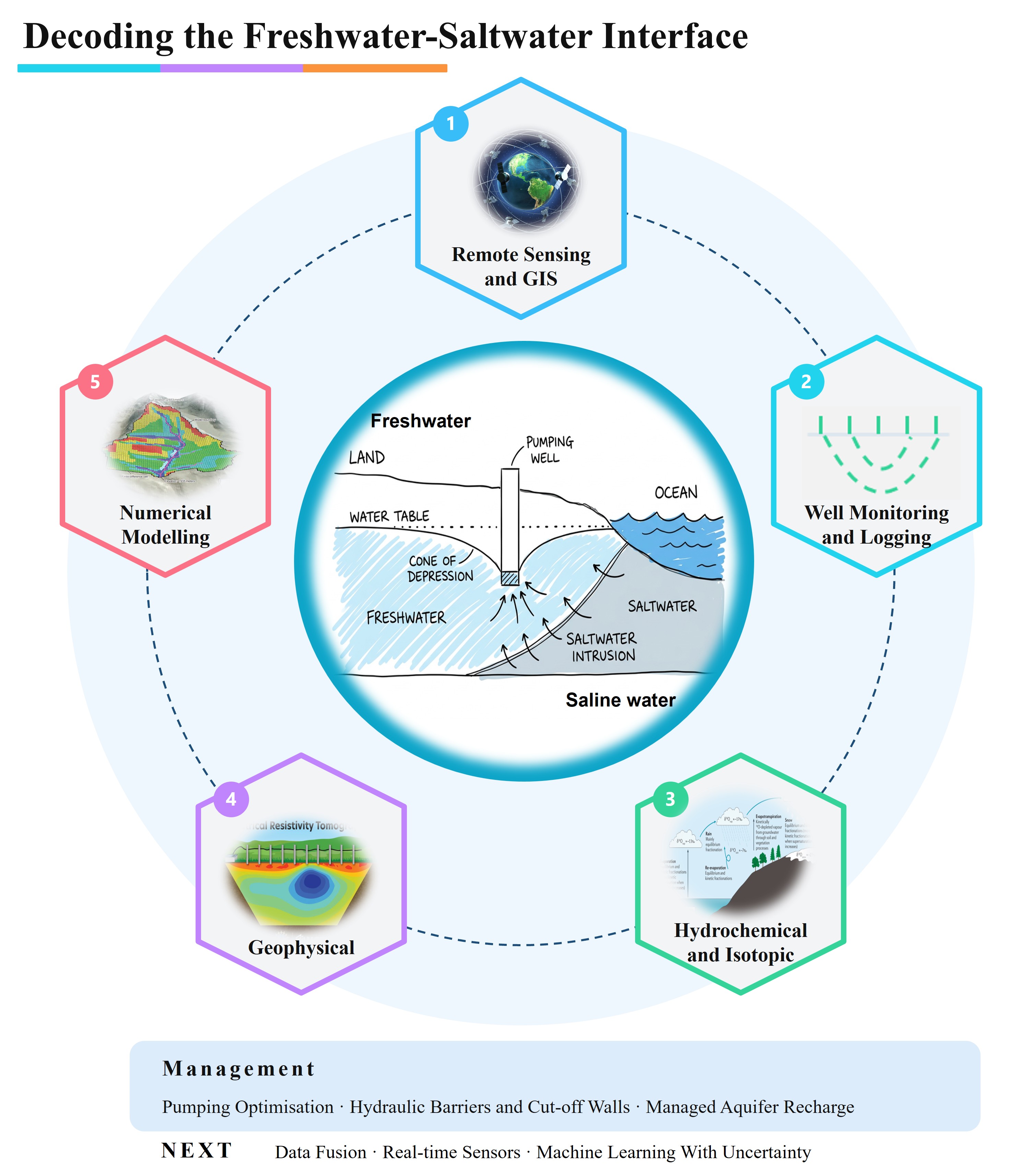
Groundwater salinization in terrestrial and coastal aquifers is a complex process governed by anthropogenic activities, marine influences, and natural hydrogeochemical processes. Previous studies indicate that freshwater-saltwater interaction (FSI) largely determines the long-term fate of freshwater aquifers. Yet choosing a suitable framework to investigate interactions between subsurface waters of contrasting density remains challenging. This review synthesises studies retrieved from Web of Science, Scopus, ScienceDirect and Google Scholar, using keywords on seawater intrusion, groundwater salinization, hydrochemistry, geophysics, remote sensing, numerical modelling and sandbox experiments. The studies were screened for methodological relevance to FSI and grouped by method and spatial scale. At the regional scale, remote sensing combined with GIS provides only surface proxies (e.g., vegetation and soil salinity indicators) for shallow saline groundwater and requires ground-truthing. At the local scale, geophysical methods are critically assessed for their ability to delineate salinity zones. The review also covers in-situ monitoring, hydrogeochemical analysis, and isotopic tracers, which identify salinity sources and characterise mixing processes. Analytical sharp-interface solutions and index-based vulnerability models serve rapid screening and theoretical benchmarking but are limited to idealised conditions. Numerical tools for predicting FSI behaviour under site-specific conditions are then examined, followed by laboratory-scale physical models, which offer a valuable means of studying seawater intrusion and saline plume migration under changing climate and land use. We compared the strengths, limitations, and combined use of these methods, identify research gaps, and proposed a decision framework that links method selection to the study.
Keywords:
groundwater salinization
; monitoring
; geochemical tools
; geophysical tools
; numerical modelling
Copyright: This open access article is published under a Creative Commons CC BY 4.0 license, which permit the free download, distribution, and reuse, provided that the author and preprint are cited in any reuse.