
Submitted:
18 November 2026
Posted:
19 November 2026
You are already at the latest version
Abstract
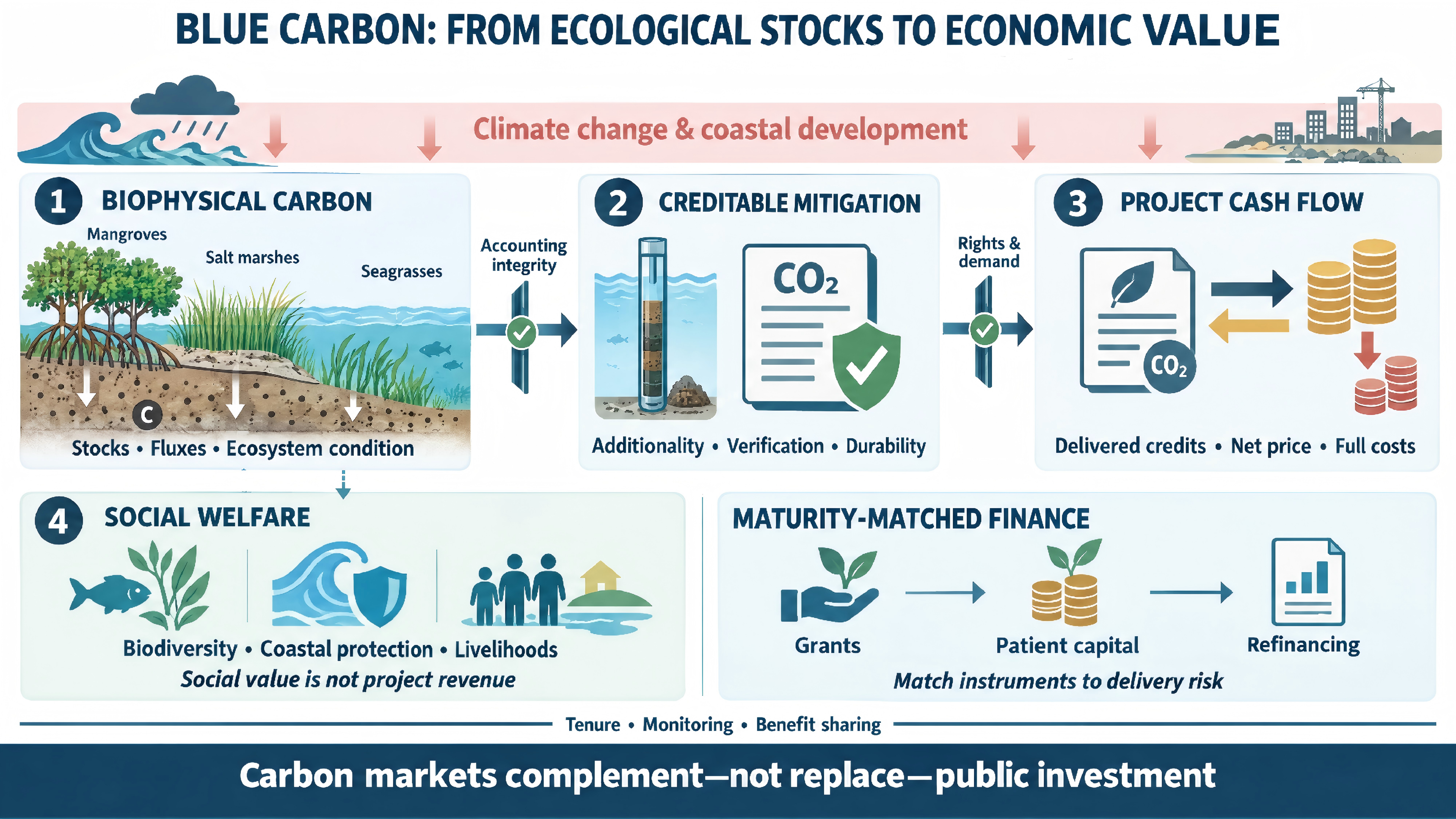
Blue carbon is increasingly presented as an investable climate solution, yet large coastal carbon stocks do not necessarily generate additional mitigation, saleable credits, or financially viable restoration. We develop a four-account framework that separates biophysical carbon, creditable mitigation, project cash flow, and social welfare, and apply it to the conversion of ecological value into credible and durable economic benefits. The synthesis connects carbon accounting, ecosystem-service valuation, trading incentives, restoration finance, and coastal governance. Four analytically distinct accounts are proposed: biophysical carbon, creditable mitigation, project cash flow, and social welfare. Their separation explains why high ecosystem values can coexist with weak commercial returns, and why low-cost credit supply is not sufficient evidence of environmental integrity. Comparative evidence indicates that project viability depends on counterfactual land use, sediment-carbon uncertainty, restoration trajectories, transaction costs, contractual demand, tenure, and the distribution of benefits. Game-theoretic studies identify plausible incentive mechanisms, but their equilibria should not be interpreted as observed market performance. Climate change and coastal development further affect the quantity, timing, and durability of prospective revenue. An integrated decision framework therefore prioritizes credible accounting and rights before financial structuring, matches financing instruments to project maturity, and evaluates portfolios against correlated ecological and institutional risks. The central policy implication is that carbon markets should complement, rather than substitute for, public investment in coastal protection, biodiversity, and community stewardship.
Keywords:
blue carbon
; ecosystem-service valuation
; carbon-credit integrity
; climate finance
; coastal restoration
; blended finance
; environmental governance
Copyright: This open access article is published under a Creative Commons CC BY 4.0 license, which permit the free download, distribution, and reuse, provided that the author and preprint are cited in any reuse.