

Submitted:
17 November 2026
Posted:
18 November 2026
You are already at the latest version
Abstract
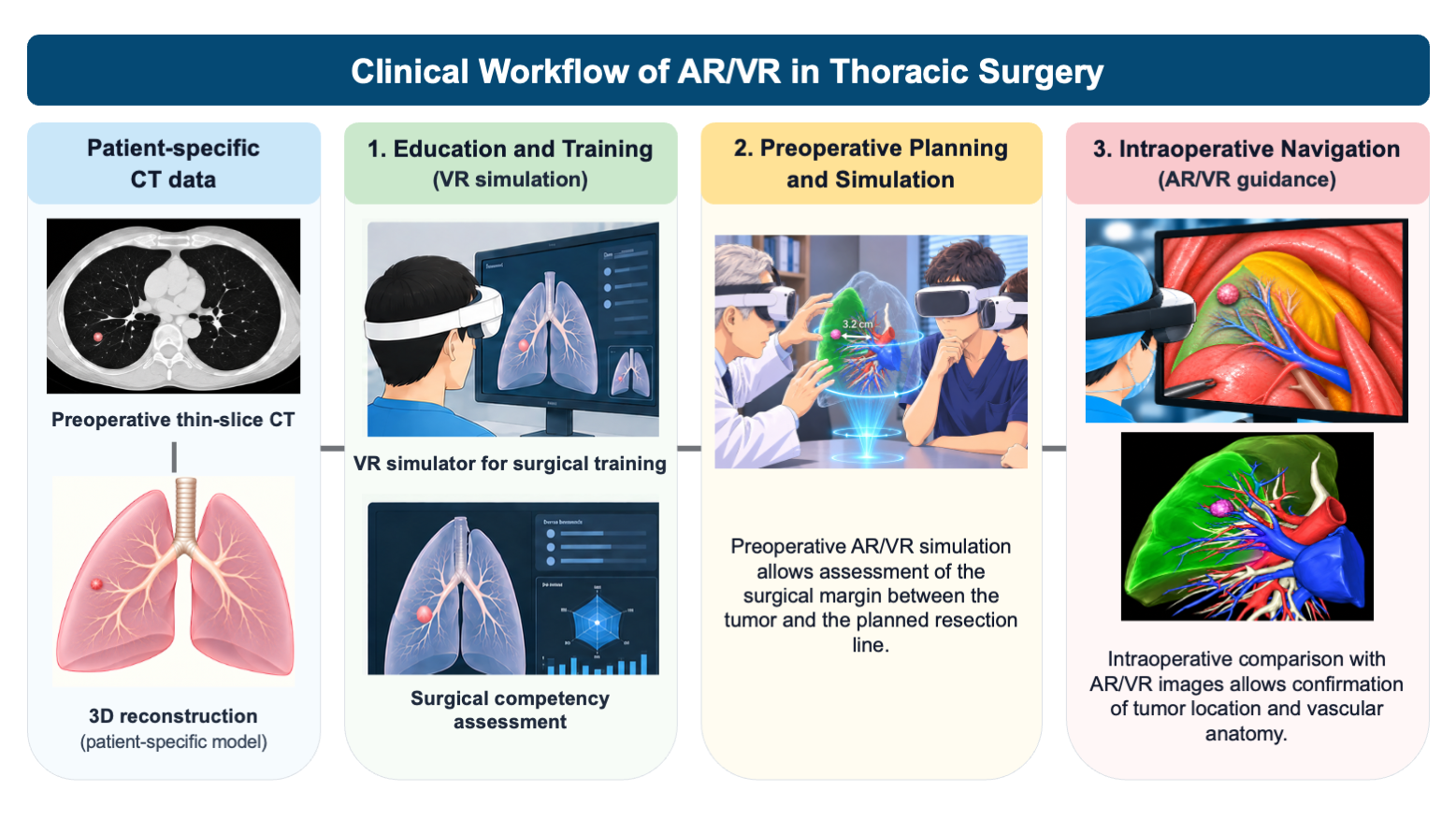
Background/Objectives: Augmented reality (AR) and virtual reality (VR) are increasingly utilized across the perioperative continuum in thoracic surgery. We performed a systematic review to elucidate the clinical utility of AR/VR technologies in general thoracic surgery, identify current technological trends, and evaluate their role as objective assessment tools for surgical competency. Methods: A comprehensive systematic search of the PubMed database was conducted from inception through 6 June 2026 in accordance with the Preferred Reporting Items for Systematic Reviews and Meta-Analyses (PRISMA) guidelines. Eligible peer-reviewed studies were categorized according to their clinical phase of utilization, perioperative surgical outcomes, and objective simulator-derived competency metrics. Results: A total of 1,013 records were initially identified, of which 74 met the inclusion criteria and were analyzed. Clinical applications of AR/VR in thoracic surgery spanned three principal domains: (1) surgical education and training, (2) preoperative anatomical planning and resection simulation, and (3) real-time intraoperative navigation (encompassing non-anatomical tumor localization and anatomical bronchovascular guidance). Integration of artificial intelligence (AI) further accelerated three-dimensional anatomical segmentation and intraoperative registration workflows. Across nine comparative cohort studies, AR/VR or three-dimensional guidance was associated with significantly shorter operative times in 77.8% (7/9) and lower estimated intraoperative blood loss in 55.6% (5/9) of studies without increasing postoperative complications. Furthermore, validated VR simulation platforms reliably stratified novice, intermediate, and experienced surgeons using automated kinematic metrics. Conclusions: AR and VR technologies enhance surgical training, complex segmentectomy planning, and intraoperative navigation. Standardized VR scoring systems incorporating procedural time, simulated blood loss, and instrument motion dynamics are warranted to advance objective surgical credentialing.
Keywords:
augmented reality
; virtual reality
; mixed reality
; extended reality
; thoracic surgery
; surgical simulation
; intraoperative navigation
; competency assessment
; artificial intelligence
Copyright: This open access article is published under a Creative Commons CC BY 4.0 license, which permit the free download, distribution, and reuse, provided that the author and preprint are cited in any reuse.