

Submitted:
17 November 2026
Posted:
18 November 2026
You are already at the latest version
Abstract
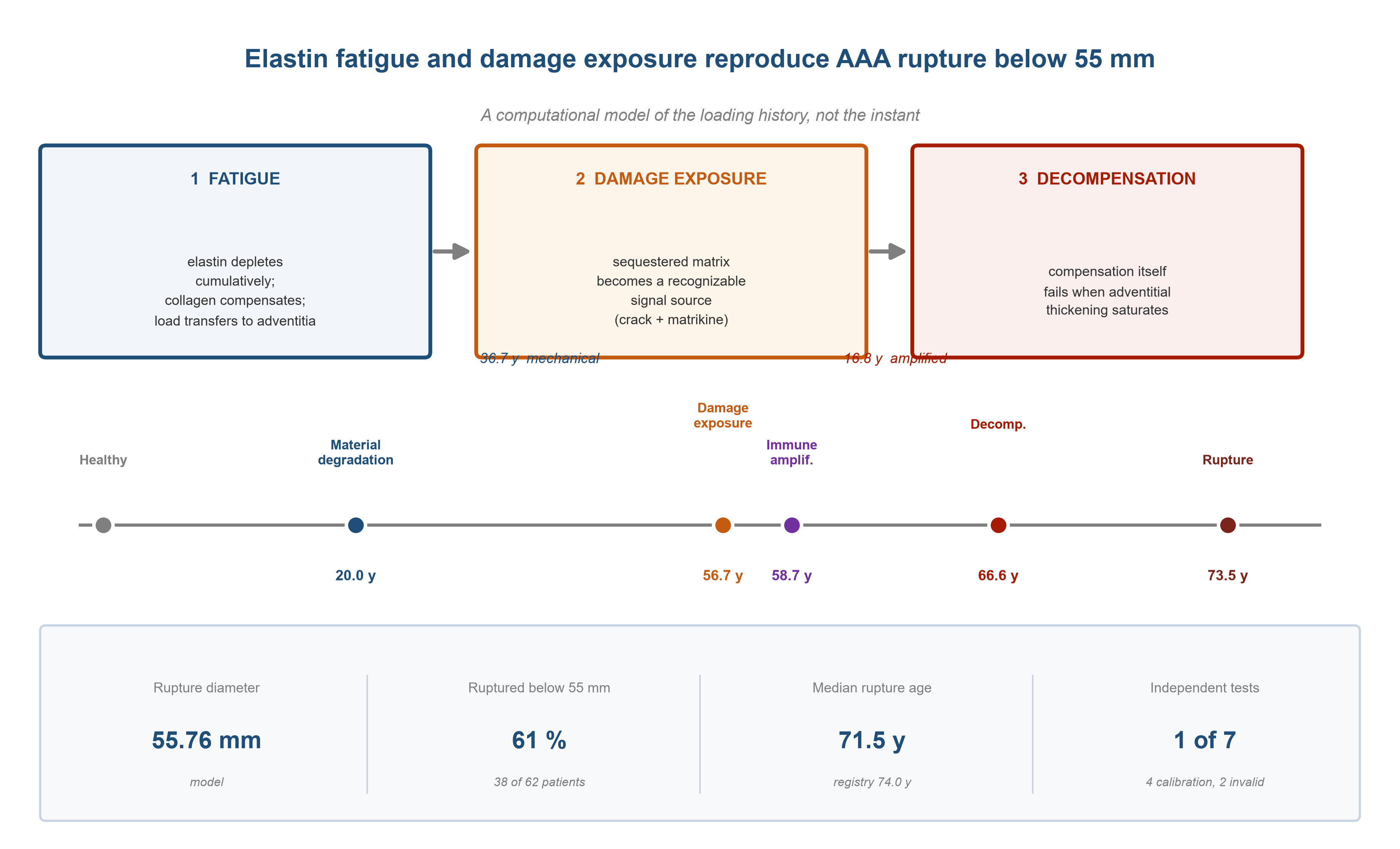
Background. Abdominal aortic aneurysm (AAA) is managed by a diameter threshold, yet 61% of ruptures in contemporary cohorts occur below 55 mm and diameter-matched cohorts of ruptured and unruptured aneurysms show no difference in diameter. Existing computational approaches quantify the wall stress at a given instant but not the cumulative mechanical history of the wall. We tested whether AAA can be reproduced as a fatigue-failure process of elastin, with a discrete transition — damage exposure — separating a purely mechanical phase from a biologically amplified one. The resulting framework rests on two load-bearing components with opposed duties, a discrete exposure transition, and a five-stage progression in which compensation itself fails.Methods. We constructed a two-layer model (the Damage-Exposure Model, DEM) comprising four global state variables — elastin, collagen, junction protein and inflammation — and a 720-point circumferential spatial layer carrying wall thickness, local strength and thrombus coverage. Elastin-specific local stress was compared with elastin-specific local strength. Parameters were assigned to three tiers: 23 measured in the literature, 5 derived from literature values, and 15 calibrated to reproduce specified targets. The model was run for 76 patients whose transcriptomic module scores were mapped to individual mechanical parameters, and against seven external comparisons, three pre-specified testable inferences and a 500-run Monte Carlo analysis.Results. The model reproduces a five-stage progression at ages 20.0, 56.7, 58.7, 66.6 and 73.5 years, a rupture diameter of 55.76 mm, and a two-phase expansion pattern (36.7 years before the transition, 16.8 years after). In the 76-patient cohort, 61% of simulated ruptures occurred below 55 mm and the median rupture age was 71.5 years, against 74.0 years in a 3,642-patient national registry. Of seven external comparisons, one is an independent test, four are calibration-consistency checks and two are not valid comparisons. Of the three testable inferences, one is true by construction rather than empirically, one is contradicted by the data, and one has no discriminating power. Only 4.2% of 500 Monte Carlo parameter draws satisfied five or more of the seven comparisons.Conclusions. A fatigue-based model of elastin depletion with a discrete exposure transition reproduces the timing, the rupture diameter and the sub-threshold rupture fraction of AAA, and explains why diameter alone discriminates poorly between ruptured and unruptured aneurysms. The model is not validated: its time scale is dominated by a single calibrated parameter and fifteen parameters are not identifiable. It should be read as a quantitatively specified hypothesis with an explicit falsification path, not as a clinical prediction tool.
Keywords:
abdominal aortic aneurysm
; elastin
; fatigue failure
; damage exposure
; intraluminal thrombus
; computational model
; rupture risk
Copyright: This open access article is published under a Creative Commons CC BY 4.0 license, which permit the free download, distribution, and reuse, provided that the author and preprint are cited in any reuse.