

Submitted:
17 November 2026
Posted:
18 November 2026
You are already at the latest version
Abstract
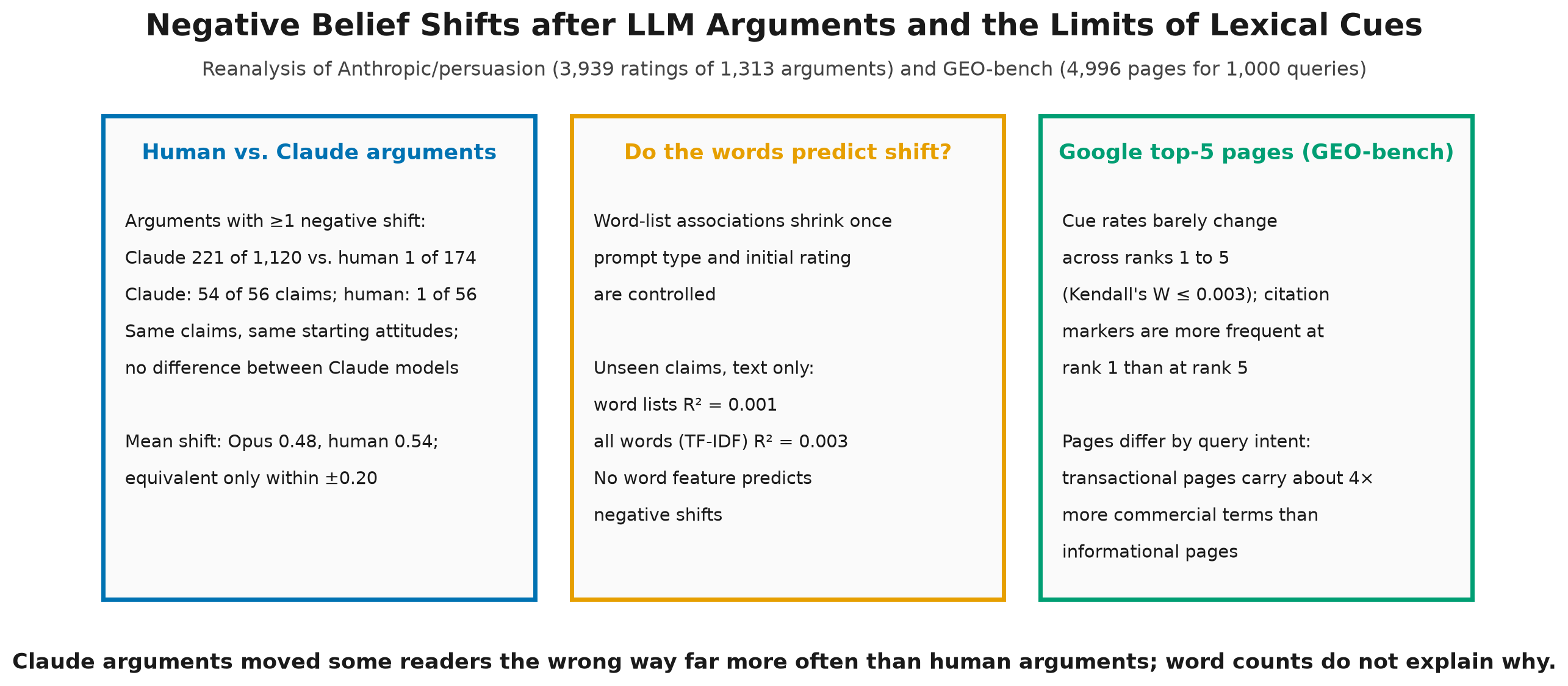
Comparisons of human and LLM persuasion usually report average attitude change. We reanalyse the Anthropic persuasion dataset (3,939 ratings of 1,313 arguments on 56 policy claims, written by people or by five Claude models) at the level of arguments, because each argument was rated three times. On average, Claude 3 Opus arguments shifted support by 0.48 Likert points and human arguments by 0.54; the difference was not significant (p = 0.37), and equivalence held only for a ±0.20 margin. The distributions differed sharply. Of 1,120 Claude arguments, 221 moved at least one reader away from the advocated position, against 1 of 174 human arguments. The gap appeared in 54 of the 56 claims (Cochran-Mantel-Haenszel p = 6 × 10⁻¹⁰), with matched starting attitudes and similar rates across all five models. We then asked whether word-level cues often recommended for persuasive and search-visible writing (statistics, research terms, certainty, inclusive language) explain either outcome. They did not predict negative shifts, their associations with average change largely disappeared once prompt type and initial attitude were controlled, and neither word lists nor a full bag-of-words model predicted change on unseen claims (out-of-fold R2 ≤ 0.003). In GEO-bench (4,996 Google top-five pages for 1,000 queries), the same cues varied little with rank and mainly reflected query intent. Average persuasion scores can hide frequent opposite-direction responses to LLM text, and these responses are not visible in simple word counts.
Keywords:
persuasion
; large language models
; negative attitude change
; belief change
; lexical features
; equivalence testing
; generative engine optimization
Copyright: This open access article is published under a Creative Commons CC BY 4.0 license, which permit the free download, distribution, and reuse, provided that the author and preprint are cited in any reuse.