
Submitted:
17 November 2026
Posted:
18 November 2026
You are already at the latest version
Abstract
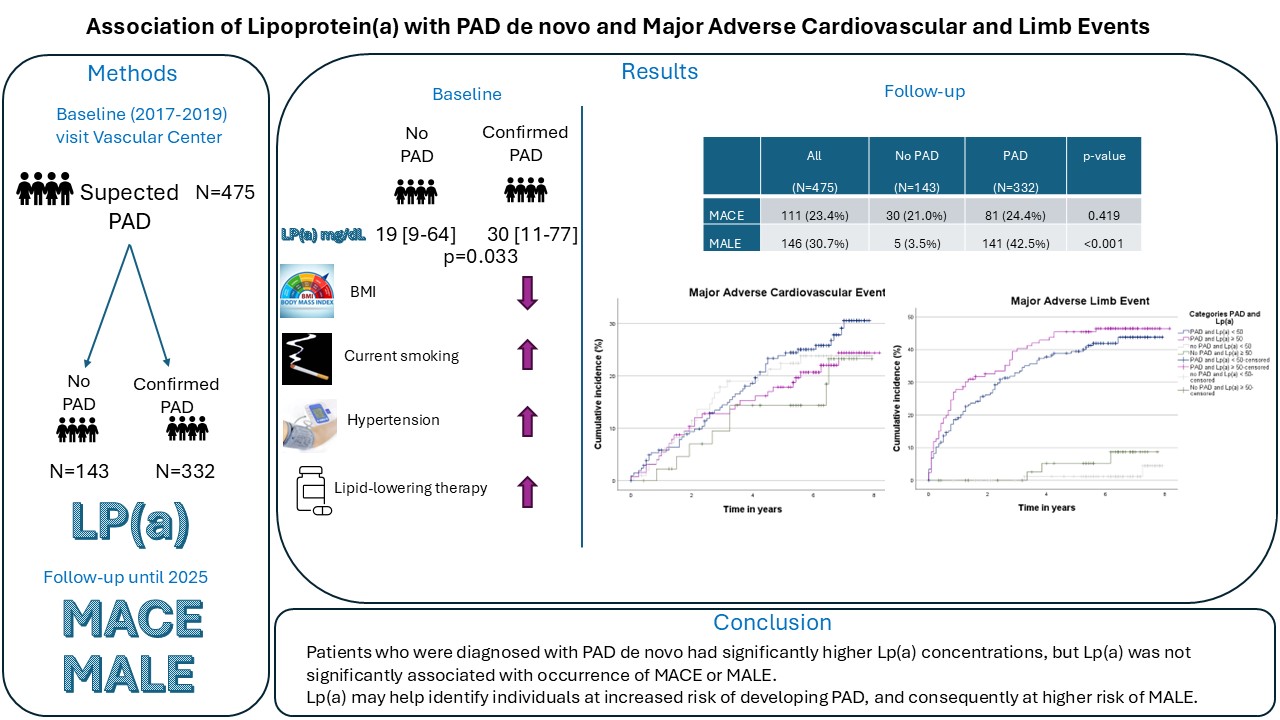
Background/objective: To investigate the association between lipoprotein(a) (Lp(a)) concentrations, peripheral arterial disease (PAD), and the occurrence of major adverse cardiovascular events (MACE), or major adverse limb events (MALE). Methods: This prospective single center cohort study included 475 patients referred to a vascular center with suspected PAD de novo between January 13th 2017 and December 27th 2019. Serum Lp(a) concentrations were measured at baseline, and electronic patients’ records were reviewed for diagnosis of PAD at baseline, and the occurrence of MACE or MALE during follow-up. MACE was defined as a composite of myocardial infarction, unplanned percutaneous coronary intervention, ischemic cerebrovascular accident, transient ischemic attack, and cardiovascular death. MALE was defined as any endovascular or open revascularization or limbrelated vascular intervention performed due to PAD. Results: Of the 475 patients, 332 patients (69.9%) were diagnosed with PAD. Patients with PAD had significantly higher median LP(a) concentrations compared to those in whom PAD was ruled out (30 [11-77] mg/dL versus 19 [9-64] mg/dL, p=0.033), without differences in other lipid parameters. During a median follow-up of 6 years, 81 patients with PAD (24.4%) experienced MACE, and 141 patients (42.5%) experienced MALE. Univariate cox regression analysis showed that serum Lp(a) concentration was not significantly associated with MACE (HR 0.909, p=0.206), nor MALE (HR 1.000, p=0.995) in patients with PAD. Multivariate cox regression showed similar results. Conclusion: Patients who were diagnosed with PAD de novo had significantly higher Lp(a) concentrations, but Lp(a) was not significantly associated with occurrence of MACE or MALE.
Keywords:
lipoprotein(a)
; peripheral arterial disease
; major adverse cardiovascular event
; major adverse limb event
Copyright: This open access article is published under a Creative Commons CC BY 4.0 license, which permit the free download, distribution, and reuse, provided that the author and preprint are cited in any reuse.