
Submitted:
18 November 2026
Posted:
18 November 2026
You are already at the latest version
Abstract
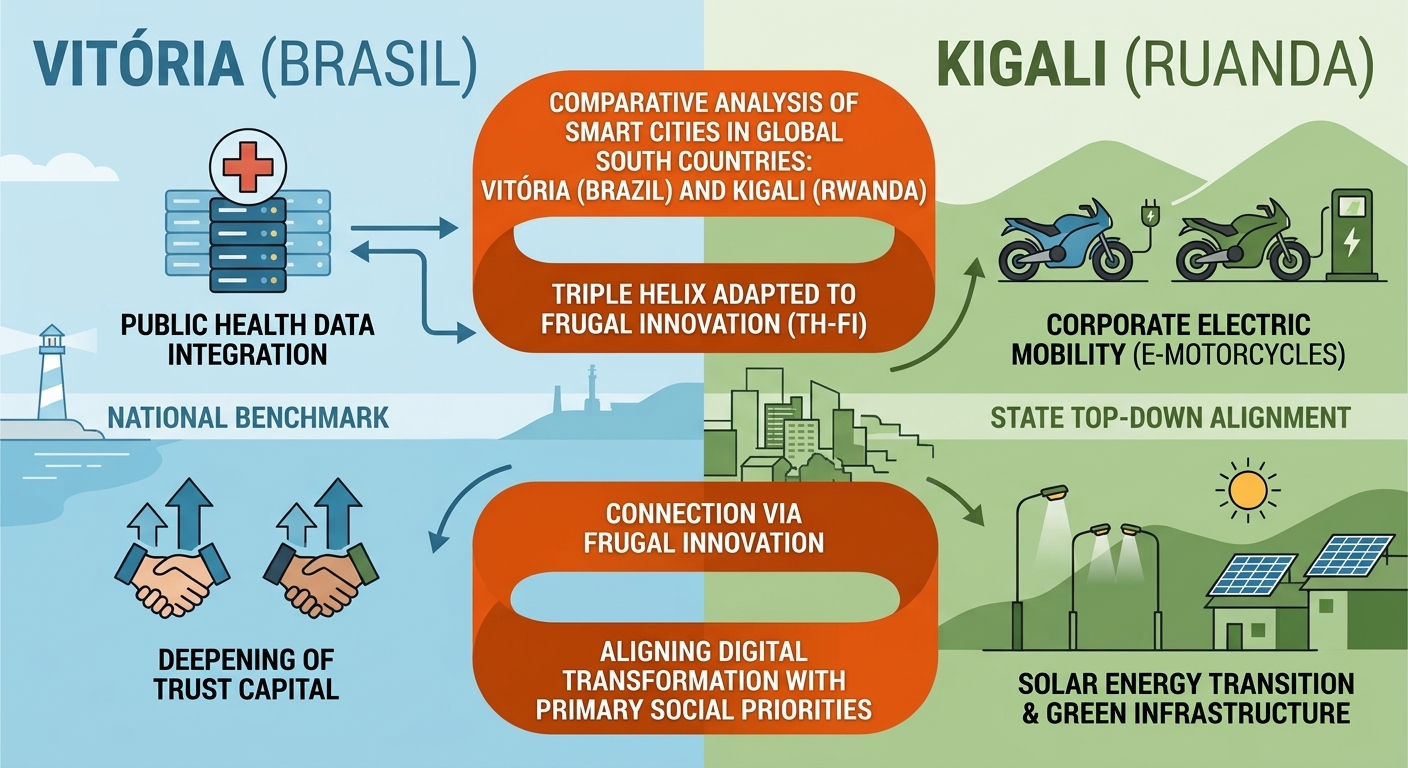
Traditionally dominated by technocentric paradigms formulated in Global North metropolises—characterized by high-cost infrastructures such as digital twins and dense IoT sensor networks—the discourse on smart urbanism frequently overlooks the budgetary constraints, distributive asymmetries, and structural bottlenecks ubiquitous in developing nations. To overcome this conceptual gap, this article investigates the constitutive frameworks of smart cities in the Global South through a comparative qualitative and epistemic analysis of two cities recognized for technological development aimed at improving citizens’ quality of life: Vitória (Brazil) and Kigali (Rwanda). Methodologically, the comparison is structured around two complementary dimensions: audited indicators and regional composite indices (e.g., Connected Smart Cities Ranking and Oxford Economics Global Cities Index) and the Triple Helix Model adapted to Frugal Innovation (TH-FI), tailored for urban ecosystems facing severe capital constraints. The analysis demonstrates that while Vitória has consolidated its status as a national benchmark through the deepening of institutional trust capital, public data integration in healthcare, and the debureaucratization of autonomous citizen services, Kigali has emerged on the African stage through top-down state alignment focused on fleet e-mobility, solar energy transition, and green urban infrastructure. The study concludes that urban smartness in the Global South does not stem from emulating futuristic skylines, but from the capacity to align digital transformation with primary social and infrastructural priorities.
Keywords:
smart cities
; global south
; Vitória
; Kigali
; frugal innovation
; urban governance
; triple helix
1. Introduction
In the twenty-first century, accelerated urbanization has placed metropolises at the center of the planet’s major economic, environmental, and social transformations. In response to the complex challenges posed by resource scarcity, population densification, and environmental degradation, the Smart Cities paradigm has consolidated itself as the primary guideline for modernizing public management on a global scale [1,2]. However, the dominant discourse surrounding smart cities was historically constructed under the influence of technocentric models conceived in the Global North [3,4]. Such models postulate that the optimization of urban life stems primarily from the mass deployment of cutting-edge technologies, including hyper-speed data transmission networks, real-time digital simulations via Digital Twins, pervasive sensing through the Internet of Things (IoT), and algorithmic automation of essential services [5,6].
Nevertheless, the direct transposition of these solutions to the reality of cities in the Global South has proven both theoretically and operationally inadequate [7,8]. In developing countries, urban contexts are markedly shaped by severe budgetary constraints, structural distributive asymmetries, labor and housing informality, and centuries-old deficits in basic infrastructure such as sanitation, healthcare, and public transportation [9,10]. When smart urbanism is imported uncritically and out of context, it risks deepening existing socio-spatial inequalities, generating insulated high-tech enclaves amidst marginalized territories and fostering corporate technological lock-in vis-à-vis transnational software and hardware vendors [11,12].
Faced with this scenario, contemporary academic literature calls for an epistemological renegotiation of “urban smartness” [13]. It becomes imperative to deconstruct the reductionist equation that equates a city’s intelligence with the volume of capital invested in luxury technological apparatus. Instead, a conceptualization is proposed based on the capacity of local institutions to align technological innovation with the population’s primary social and environmental priorities [14,15]. Within this horizon, the value of Information and Communication Technologies (ICT) resides in their instrumental role in strengthening trust capital, democratic digital inclusion, essential service efficiency, and ecological sustainability [16,17].
To address this theoretical and practical demand, this article investigates the constitutive arrangements of smart cities in the Global South through an in-depth comparative study of two localities that have stood out regionally and internationally for their innovative trajectories: Vitória (capital of the State of Espírito Santo, Brazil) and Kigali (capital of the Republic of Rwanda). Both cities face structural socioeconomic challenges typical of developing economies, yet they have adopted singular digital transformation strategies aimed at expanding social well-being and optimizing public management [18,19].
The central research question guiding this investigation unfolds as follows: How do cities located in the Global South, possessing different institutional arrangements and political dynamics, formulate urban smartness strategies capable of reconciling capital constraints, public governance, and the fulfillment of their citizens’ primary demands? To answer this problem, the article is organized into five main sections. Following this Introduction, Section 2 presents the Theoretical Framework, addressing smart urban governance, urban political ecology, and the concept of frugal innovation. Section 3 establishes the Methodological Design, detailing the epistemology of urban measurement and the Triple Helix Model adapted to Frugal Innovation (TH-FI). Section 4 develops the Empirical Comparative Analysis between Vitória and Kigali. Finally, Section 5 presents the Discussion and Conclusions of the study.
2. Theoretical Framework
2.1. From Technocentric Governance to Collaborative and Open Governance
The classical debate on smart cities frequently reduces innovation to the mere digitization of public administration [20]. However, leading authors in the field of public governance demonstrate that urban smartness is not a strictly technological property, but rather a socio-institutional and relational capability [21,22]. Smart governance refers to the ability of governmental institutions to reorganize their internal structures, integrate heterogeneous data flows, and coordinate collaborative arrangements among multiple social actors (governments, businesses, universities, and organized civil society) [16,23].
In this regard, Meijer and Bolívar [21] structure the evolution of smart urban governance into four gradual levels of institutional transformation:
- Smart City Government: A conservative focus centered on the traditional execution of public policies with peripheral support from IT tools;
- Smart Decision-Making: Incorporation of information systems and data intelligence to substantiate policy choices and optimize budget allocation;
- Smart Administration: Deep restructuring of administrative processes and interoperability of internal inter-agency data systems;
- Smart Urban Collaboration: Formation of open co-creation ecosystems in which citizens and community organizations act directly in the formulation, monitoring, and execution of public services.
Transitioning from the first to the fourth level requires overcoming the bureaucratic and centralizing paradigm in favor of open data platforms and integrated operation centers that operate transparently [24]. When digital governance remains restricted to the initial levels, the city risks becoming a mere consumer market for proprietary corporate technologies, without due return in social equity or active citizenship [3].
2.2. Urban Political Ecology and the Critique of Technological Solutionism
The Urban Political Ecology perspective provides decisive analytical tools to unveil the power asymmetries embedded in smart city discourse [25]. As critical scholars such as Hollands [3] and March [25] emphasize, technology is never a neutral intervention. The project of digitizing metropolises frequently serves capital accumulation interests, promoting city branding and real estate appreciation at the expense of the genuine needs of vulnerable populations [7,8].
Technological solutionism—the naive belief that complex social, political, and environmental problems can be solved exclusively through software solutions and optimization algorithms—tends to depoliticize urban space [5,26]. Structural issues such as unequal land distribution, decent housing deficits, racial segregation, and environmental injustice are reduced to technical problems of flow management. Thus, ecological critique underscores the necessity of subordinating digital transformation to the primacy of the right to the city, ensuring that investments in digital infrastructure prioritize distributive justice and the socio-environmental resilience of urban peripheries [12,27].
2.3. The Global South, Informality, and Frugal ICT Innovation
In the Global South, urban planning confronts territorial dynamics substantially distinct from those found in Northern cities [4,11]. Informality inhabits the core of the Southern urban experience, manifesting in the informal labor market, unregulated community transport, and self-built housing [10]. As Guma [10] argues, informality should not be interpreted merely as an anomaly or backwardness to be eradicated through the imposition of formal digital control norms. On the contrary, it constitutes a marker of diversity, adaptability, and the survival capacity of urban populations.
Faced with chronic financial resource scarcity and the urgency of meeting pressing demands, the concept of Frugal IT Innovation gains prominence. Developed in innovation management and ecosystem literature by authors such as Ahuja and Chan [28], Pansera [29], Bhattacharjya et al. [30], and Khan et al. [31], frugal innovation refers to the design and development of technological solutions characterized by four fundamental attributes: (a) low implementation and maintenance costs, (b) operational simplicity and robustness, (c) utilization of existing and accessible technological resources, and (d) high added social value.
Frugal innovation decouples urban smartness from the need for massive investments in state-of-the-art proprietary infrastructures. Instead of acquiring high-cost artificial intelligence systems or building hyper-complex road platforms, local governments in the Global South can leverage accessible tools—such as mobile telephony networks, messaging applications, open-source software, and low-complexity integrated databases—to resolve crucial bottlenecks in public health, security, and urban mobility [32,33]. Frugal innovation therefore represents a methodological and pragmatic pathway toward consolidating inclusive, sustainable urban smartness democratically anchored in the real possibilities of developing cities.
3. Materials and Methods
To conduct the comparative investigation between Vitória and Kigali, this article adopts a qualitative approach of a comparative and epistemic nature [34]. The selection of these two capitals is justified by the fact that they represent emblematic cases of success in urban innovation in the Global South while operating under profoundly distinct institutional, geopolitical, and sociocultural models.
The empirical comparison is methodologically structured around two mutually complementary dimensions:
- Dimension 1: Epistemology of Urban Measurement and Audited Regional Indicators. This dimension seeks to capture city performance through the analysis of data from audited indicators and consolidated regional rankings [35,36]. This enables an assessment of institutional maturity levels and the effectiveness of public policies in meeting human and technological development goals [37]. Specifically, documentary and secondary data from the 2025 Connected Smart Cities (CSC) Ranking [38], the 2026 Oxford Economics Global Cities Index [39], and official municipal and national strategic repositories [18,19] were examined.
-
Dimension 2: The Triple Helix Model Adapted to Frugal Innovation (TH-FI). The classical formulation of the Triple Helix Model [40] postulates that innovation results from the dynamic interaction among three spheres: University (Academia), Industry (Private Sector), and Government. However, in urban environments of the Global South facing severe capital constraints, this traditional model requires theoretical and conceptual adaptation [30,41]. The TH-FI Model proposed herein reconfigures the roles of these spheres:
- Government: Acts not merely as a regulator, but as the primary inductor and guarantor of social cohesion, strategically allocating limited public resources [42];
- Industry / Market: Incorporates local actors and informal/frugal economy networks, developing low-cost solutions tailored to local financial capacity [28];
- University / Civil Society: Functions as a hub for human capacity building and community co-creation, adapting open technologies and ensuring citizen participation [43].
No generative artificial intelligence tools were used in study design, data collection, formal analysis, or scientific interpretation. Generative Artificial Intelligence (GenAI) was used exclusively for superficial language translation and text editing, which was thoroughly reviewed and validated by the authors.
4. Results
4.1. Vitória: National Benchmark through Trust Capital and Data Integration
Vitória, capital of the State of Espírito Santo, has consolidated its position on the Brazilian stage as a prominent model of urban management [44]. In the 2025 Connected Smart Cities (CSC) Ranking, the city achieved 1st place overall among all 5,570 municipalities in Brazil, also standing out as the leader in the Southeast Region and in the category of cities with fewer than 500,000 inhabitants, accumulating an overall score of 61.27 points [38]. This result crowned a continuous process of administrative modernization, in which the city rose from 2nd place in 2024 to the top of the national ranking in 2025. According to the global index by Oxford Economics [39], which evaluates the world’s top 1,000 cities based on Economics, Human Capital, Quality of Life, Environment, and Governance data, Vitória (evaluated jointly with City of Vila Velha) ranks 659th globally, placing 738th in Economics, 559th in Human Capital, 863rd in Quality of Life, 232nd in Environment, and 554th in Governance.
Analyzing the thematic axes of Vitória’s performance in the 2025 CSC Ranking reveals a consistent distribution of scores reflecting clear priorities in public management: Telecommunications (79 points), Governance (71 points), Solid Waste, Sewage, and Water (68 points), Education (67 points), Security (63 points), and Mobility (58 points) [38]. The high scores in Telecommunications and Governance highlight the municipality’s strategic choice to invest in consolidating a robust and transparent digital infrastructure.
One of the central pillars of Vitória’s experience is the deepening of institutional “trust capital” [18]. Rather than channeling resources into ostentatious high-tech interventions lacking popular appeal, the municipality prioritized developing public platforms focused on debureaucratizing autonomous services and providing citizens with direct access to management information. The modernization of digital portals enabled the simplification of licensing processes, document issuance, and urban request tracking, drastically reducing transaction costs between the population and public authorities.
In the field of public health, Vitória’s major technological asset lies in the implementation and expansion of the Unified Electronic Health Record (Prontuário Eletrônico Unificado) within the Rede Bem Estar network [18]. This data integration solution interoperably connects Basic Health Units (UBS), specialty centers, and emergency care facilities across the capital. Through the electronic record, citizens’ medical histories are updated in real time, eliminating unnecessary duplication of medical tests, ensuring traceability in medication distribution, and optimizing appointment scheduling routines. Health data integration in Vitória precisely exemplifies the application of frugal innovation: a software- and database-driven solution that requires no astronomical road sensors yet generates a direct and profound impact on the quality of life and health of the low-income population.
4.2. Kigali: Top-Down State Alignment, E-Mobility, and Green Transition
Within a distinct geopolitical and socioeconomic context, Kigali, capital of Rwanda, has emerged on the African continent as one of the most innovative and organized metropolises in the field of green urban transition [45,46], frequently referred to as the “Singapore of Africa” [47]. Confronting the challenge of socio-institutional reconstruction over recent decades and operating within a foreign-exchange-constrained economy, Rwanda established a strongly centralized, state-structured governance model (top-down), guided by long-term targets consolidated in the Kigali Master Plan 2040 and the national ICT policy [19,47]. According to the Oxford Economics [39] global index, Kigali ranks 520th worldwide, placing 543rd in Economics, 184th in Human Capital, 895th in Quality of Life, 290th in Environment, and 553rd in Governance.
Unlike Western approaches based exclusively on market forces, urban smartness in Kigali is expressed through coordinated articulation among government agencies, multilateral organizations, and technology companies to implement affordable sustainable infrastructures [48]. The primary highlight of Kigali’s socio-technical transition resides in the green urban mobility sector. The city promoted a pioneering replacement of its individual passenger transport fleet through the massive introduction of e-motorcycles (electric motorcycles). This transition was enabled by frugal innovation ecosystems that installed rapid battery-swapping stations at strategic points throughout the city, allowing drivers to exchange depleted batteries for charged ones within minutes, thereby eliminating the prohibitive cost of individual ultra-fast chargers.
Additionally, Kigali implemented the SAFARI public bicycle-sharing program and modernized its public bus transit system through smart electronic ticketing and real-time fleet monitoring [19]. Concurrently with mobility innovations, the city actively invested in the transition to solar energy, installing photovoltaic panels on public buildings and street lighting networks, reducing fossil fuel dependency and cutting municipal operating expenses. This set of actions is propelled by the development of Kigali Innovation City (KIC), a planned district designed to attract international universities, technology startups, and R&D centers, operating as a living laboratory for technologies suited to the African reality [49].
4.3. Systematic Comparative Matrix between Vitória and Kigali
Table 1 systematizes the comparative analysis between the two capitals, highlighting their convergences within the Frugal Innovation paradigm and their structural divergences in governance arrangements and strategic focus.
5. Discussion and Conclusions
5.1. Limits of Northern Emulation and Lessons from Frugal Innovation
The analysis developed throughout this study reveals the theoretical and practical unsustainability of uncritically transplanting smart city models formulated in the Global North into the socioeconomic context of developing metropolises [7,8]. High-cost platforms such as complex Digital Twins and hyper-dense road sensor networks represent investment choices frequently incompatible with the budgetary constraints of Global South nations, while failing to address the most pressing structural problems of marginalized urban populations [9,11].
The trajectories of Vitória and Kigali demonstrate that genuine urban smartness is measured not by the complexity of the technological apparatus installed across the territory, but by the degree of strategic alignment between digital transformation and the priority demands of citizenry [14]. Both capitals adopted, within their respective spheres, the principles of Frugal IT Innovation [28,29]:
- In Vitória, smartness translated into deepening institutional trust capital, integrating the public healthcare network via the unified electronic health record, and debureaucratizing autonomous citizen services, culminating in the top position of Brazil’s 2025 Connected Smart Cities Ranking [18,38];
5.2. Urban Justice, Data Protection and Institutional Autonomy
Notwithstanding the expressive advances recorded in both cities, critical discussion requires acknowledging the bottlenecks and vulnerabilities that still threaten the sustainability of smart development models in the Global South. The first major challenge concerns dependence on private technology vendors and transnational software corporations. Cloud storage of public health and governance data demands rigorous regulatory safeguards to prevent technological lock-in and ensure compliance with personal data protection legislation, thereby safeguarding municipal digital sovereignty [5,12].
The second challenge pertains to the risk of exacerbating distributive asymmetries and digital exclusion [4]. Implementing autonomous public services via digital channels may segregate segments of the population lacking digital literacy or access to connected devices. Consequently, the advancement of digital governance must be compulsorily accompanied by universal policies for digital inclusion and community capacity building [17].
Finally, the necessity of integrating housing and economic informality into smart master plans must be underscored [10]. Rather than employing digital monitoring to enforce punitive surveillance and social control over urban peripheries, smart urban governance should leverage geotechnologies and participatory community mapping to extend basic sanitation, land regularization, and citizen security to informally consolidated areas [27,50].
5.3. Final Considerations
In conclusion, this study reaffirms that urban smartness in the Global South does not arise from emulating futuristic skylines or displaying state-of-the-art technologies, but rather from the capacity to align digital transformation with society’s primary social, economic, and infrastructural priorities [13]. The Triple Helix Model adapted to Frugal Innovation (TH-FI) and the continuous pursuit of collaborative, transparent governance constitute promising pathways for developing metropolises to build efficient, equitable, and socio-environmentally sustainable urban ecosystems in the twenty-first century [21,30].
Author Contributions
For research articles with several authors, a short paragraph specifying their individual contributions must be provided. Conceptualization, W.T.M. and F.C.B.; methodology, W.T.M., F.C.B. and M.F.P.; formal analysis, W.T.M. and F.C.B.; investigation, W.T.M. and F.C.B.; data curation, W.T.M. and F.C.B.; writing—original draft preparation, W.T.M. and F.C.B.; writing—review and editing, W.T.M., F.C.B. and M.F.P.; supervision, M.F.P.; project administration, M.F.P. All authors have read and agreed to the published version of the manuscript.
Funding
This research received no external funding.
Data Availability Statement
Publicly available datasets were analyzed in this study. These data can be found at: Connected Smart Cities Ranking (https://ranking.mysmartcity.scipopulis.com/ranking/2025), Oxford Economics Global Cities Index (https://www.oxfordeconomics.com/global-cities-index/), Observatório de Indicadores da Cidade de Vitória (https://observavix.vitoria.es.gov.br/), and Rwanda Ministry of ICT and Innovation (https://www.minict.gov.rw/fileadmin/user_upload/minict_user_upload/Documents/Strategies/Smart_City_Rwanda_Masterplan.pdf).
Acknowledgments
During the preparation of this manuscript, the authors used AI-assisted language tools for superficial English translation and grammatical editing. The authors have thoroughly reviewed and edited the output and take full responsibility for the content of this publication.
Conflicts of Interest
The authors declare no conflicts of interest.
Abbreviations
The following abbreviations are used in this manuscript:
| CSC | Connected Smart Cities |
| ICT | Information and Communication Technologies |
| IoT | Internet of Things |
| KIC | Kigali Innovation City |
| R&D | Research and Development |
| TH-FI | Triple Helix Model adapted to Frugal Innovation |
| UBS | Basic Health Units (Unidades Básicas de Saúde) |
References
- Albino, V.; Berardi, U.; Dangelico, R.M. Smart Cities: Definitions, Dimensions, Performance, and Initiatives. J. Urban Technol. 2015, 22, 3–21. [Google Scholar] [CrossRef]
- Appio, F.P.; Lima, M.; Paroutis, S. Understanding Smart Cities: Innovation ecosystems, technological advancements, and societal challenges. Technol. Forecast. Soc. Chang. 2019, 142, 1–14. [Google Scholar] [CrossRef]
- Hollands, R.G. Will the real smart city please stand up?: Intelligent, progressive or entrepreneurial? In The Routledge Companion to Smart Cities; Willis, K.S., Aurigi, A., Eds.; Routledge: London, UK, 2020; pp. 179–199. [Google Scholar]
- Datta, A. The digital turn in postcolonial urbanism: Smart citizenship in the making of India’s 100 smart cities. Trans. Inst. Br. Geogr. 2018, 43, 405–419. [Google Scholar] [CrossRef]
- Kitchin, R. Making sense of smart cities: Addressing present shortcomings. Camb. J. Reg. Econ. Soc. 2015, 8, 131–136. [Google Scholar] [CrossRef]
- Marr, B. Tech Trends in Practice: The 25 Technologies That Are Driving the 4th Industrial Revolution; John Wiley & Sons: Hoboken, NJ, USA, 2020. [Google Scholar]
- Gaffney, C.; Robertson, C. Smarter than Smart: Rio de Janeiro’s Flawed Emergence as a Smart City. J. Urban Technol. 2018, 25, 47–64. [Google Scholar] [CrossRef]
- Irazábal, C.; Jirón, P. Latin American smart cities: Between worlding infatuation and crawling provincialising. Urban Stud. 2021, 58, 507–534. [Google Scholar] [CrossRef]
- Nagendra, H.; Bai, X.; Brondízio, E.S.; Lwasa, S. The urban south and the predicament of global sustainability. Nat. Sustain. 2018, 1, 341–349. [Google Scholar] [CrossRef]
- Guma, P.K. Smart cities and their settings in the Global South: Informality as a marker. Dialogues Hum. Geogr. 2024, 14, 411–414. [Google Scholar] [CrossRef]
- Prasad, D.; Alizadeh, T. Cross examination of smart urbanism and Southern urbanism: A systematic literature review in search of ‘Southern smart urbanism’. Cities 2024, 155, 105459. [Google Scholar] [CrossRef]
- Alizadeh, T.; Prasad, D. The right to the smart city in the Global South: A research agenda. Urban Stud. 2024, 61, 426–444. [Google Scholar] [CrossRef]
- McFarlane, C.; Söderström, O. On alternative smart cities. City 2017, 21, 312–328. [Google Scholar] [CrossRef]
- Yigitcanlar, T.; Kamruzzaman, M.; Foth, M.; Sabatini-Marques, J.; da Costa, E.D.; Ioppolo, G. Can cities become smart without being sustainable? A systematic review of the literature. Sustain. Cities Soc. 2019, 45, 348–365. [Google Scholar] [CrossRef]
- Sharifi, A.; Allam, Z.; Bibri, S.E.; Khavarian-Garmsir, A.R. Smart cities and sustainable development goals (SDGs): A systematic literature review of co-benefits and trade-offs. Cities 2024, 146, 104659. [Google Scholar] [CrossRef]
- Pereira, G.V.; Cunha, M.; Lampoltshammer, T.J.; Parycek, P.; Testa, M.G. Increasing collaboration and participation in smart city governance: A cross-case analysis of smart city initiatives. Inf. Technol. Dev. 2017, 23, 526–553. [Google Scholar] [CrossRef]
- Lee, J.; Babcock, J.E.; Pham, T.; Bui, T.; Kang, M. Smart city as a social transition towards inclusive development through technology: A tale of four smart cities. Int. J. Urban Sci. 2023, 27, 75–100. [Google Scholar] [CrossRef]
- Prefeitura Municipal de Vitória. Portal do Observatório de Indicadores da Cidade de Vitória. Gerência do Observatório de Indicadores, Secretaria de Gestão e Planejamento. Available online: https://observavix.vitoria.es.gov.br/ (accessed on 5 October 2026).
- Republic of Rwanda; Ministry of Information and Communications Technology and Innovation (MINICT). Smart Rwanda Master Plan & Kigali Smart City Strategy; MINICT: Kigali, Rwanda, 2020; Available online: https://www.minict.gov.rw/fileadmin/user_upload/minict_user_upload/Documents/Strategies/Smart_City_Rwanda_Masterplan.pdf (accessed on 8 October 2026).
- Gil-Garcia, J.R.; Pardo, T.A.; Nam, T. What makes a city smart? Identifying core components and proposing an integrative and comprehensive conceptualization. Inf. Polity 2015, 20, 61–87. [Google Scholar] [CrossRef]
- Meijer, A.; Bolívar, M.P.R. Governing the smart city: A review of the literature on smart urban governance. Int. Rev. Adm. Sci. 2016, 82, 392–408. [Google Scholar] [CrossRef]
- Israilidis, J.; Odusanya, K.; Mazhar, M. Exploring knowledge management perspectives in smart city research: A review and future research agenda. Int. J. Inf. Manag. 2021, 56, 101989. [Google Scholar] [CrossRef]
- Tan, S.; Taeihagh, A. Smart City Governance in Developing Countries: A Systematic Literature Review. Sustainability 2020, 12, 899. [Google Scholar] [CrossRef]
- Townsend, A.M. Smart Cities: Big Data, Civic Hackers, and the Quest for a New Utopia; W.W. Norton & Company: New York, NY, USA, 2013. [Google Scholar]
- March, H. The Smart City and other ICT-led techno-imaginaries: Any room for dialogue with Degrowth? J. Clean. Prod. 2018, 197, 1694–1703. [Google Scholar] [CrossRef]
- Morozov, E. The Rise of Data and the Death of Politics. The Guardian, 20 July 2014.
- Appadurai, A. Deep democracy: Urban governmentality and the horizon of politics. Urbanisation 2019, 4, 29–47. [Google Scholar] [CrossRef]
- Ahuja, S.; Chan, Y.E. Digital Innovation in Frugal Ecosystems. In Proceedings of the 37th International Conference on Information Systems (ICIS), Dublin, Ireland, 11–14 December 2016; Association for Information Systems: Atlanta, GA, USA, 2016; pp. 1–17. [Google Scholar]
- Pansera, M. Frugal or Fair? The Unfulfilled Promises of Frugal Innovation. Technol. Innov. Manag. Rev. 2018, 8, 6–13. [Google Scholar] [CrossRef] [PubMed]
- Bhattacharjya, B.; Bhaduri, S.; Kakoty, S.K. Co-creating community-led frugal innovation: An adapted Quadruple Helix? Technovation 2023, 124, 102752. [Google Scholar] [CrossRef]
- Khan, H.H.; Malik, M.N.; Zafar, R.; Goni, F.A.; Chofreh, A.G.; Klemeš, J.J.; Alotaibi, Y. Challenges for sustainable smart city development: A conceptual framework. Sustain. Dev. 2020, 28, 1507–1518. [Google Scholar] [CrossRef]
- Vu, K.; Hartley, K. Promoting smart cities in developing countries: Policy insights from Vietnam. Telecommun. Policy 2018, 42, 845–859. [Google Scholar] [CrossRef]
- Praharaj, S.; Han, J.-H.; Hawken, S. Urban innovation through policy integration: Critical perspectives from 100 smart cities mission in India. City Cult. Soc. 2018, 12, 35–43. [Google Scholar] [CrossRef]
- Ketokivi, M.; Choi, T. Renaissance of case research as a scientific method. J. Oper. Manag. 2014, 32, 232–240. [Google Scholar] [CrossRef]
- Giffinger, R.; Fertner, C.; Kramar, H.; Meijers, E. City-Ranking of European Medium-Sized Cities; Centre of Regional Science, TU Wien: Vienna, Austria, 2007. [Google Scholar]
- Prevelianaki, K.; Sherratt, F.; Henjewele, C. ISO standards or global indices: Who decides if a city is smart? IOP Conf. Ser. Earth Environ. Sci. 2022, 1101, 022036. [Google Scholar] [CrossRef]
- De Almeida, G.G.F. The role of urban rankings in the construction of perception on innovation in smart cities. Int. J. Innov. 2019, 7, 119–134. [Google Scholar]
- Connected Smart Cities. Ranking Connected Smart Cities 2024/2025: Relatório Anual de Inteligência Urbana; Necta, SPIn, Scipopulis: São Paulo, Brazil, 2025; Available online: https://ranking.mysmartcity.scipopulis.com/ranking/2025 (accessed on 3 October 2026).
- Economics, Oxford. Global Cities Index 2026; Oxford Economics: Oxford, UK, 2026; Available online: https://www.oxfordeconomics.com/global-cities-index/ (accessed on 4 November 2026).
- Etzkowitz, H.; Leydesdorff, L. The dynamics of innovation: From National Systems and “Mode 2” to a Triple Helix of university–industry–government relations. Res. Policy 2000, 29, 109–123. [Google Scholar] [CrossRef]
- Pinto, H. Connecting the Triple Helix space: Actor-network creation and institutionalisation of knowledge transfer offices. Triple Helix 2017, 4, 2. [Google Scholar] [CrossRef]
- Daniels, C.U.; Ustyuzhantseva, O. Innovation for inclusive development, public policy support and triple helix: Perspectives from BRICS. In Science, Technology and Innovation in BRICS Countries; Cassiolato, J.E., Vitorino, V., Eds.; Routledge: London, UK, 2020; pp. 14–32. [Google Scholar]
- Brundenius, C.; Lundvall, B.-Å.; Sutz, J. The role of universities in innovation systems in developing countries: Developmental university systems—Empirical, analytical and normative perspectives. In Handbook of Innovation Systems and Developing Countries; Lundvall, B.-Å., Joseph, K.J., Chaminade, C., Vang, J., Eds.; Edward Elgar Publishing: Cheltenham, UK, 2009; pp. 311–336. [Google Scholar]
- De Sousa, J.C.; De Sousa, F.R. Modelos de smart city em perspectiva global: Uma análise comparativa entre Vitória (Brasil) e Busan (Coreia do Sul). Rev. Tópicos 2026, 4, 1–28. [Google Scholar] [CrossRef]
- Manirakiza, V.; Mugabe, L.; Nsabimana, A.; Nzayirambaho, M. City Profile: Kigali, Rwanda. Environ. Urban. ASIA 2019, 10, 290–307. [Google Scholar] [CrossRef]
- Bandauko, E.; Arku, R.N. A critical analysis of ‘smart cities’ as an urban development strategy in Africa. Int. Plan. Stud. 2023, 28, 69–86. [Google Scholar] [CrossRef]
- Hudani, S.E. The green masterplan: Crisis, state transition and urban transformation in post-genocide Rwanda. Int. J. Urban Reg. Res. 2020, 44, 673–690. [Google Scholar] [CrossRef]
- Burns, H. A Smart City Masterplan, Kigali. In Urban Planning for Transitions; Douay, N., Minja, M., Eds.; Wiley-ISTE: Hoboken, NJ, USA, 2021; pp. 195–215. [Google Scholar]
- Ransom, J.C. A ‘Local Turn’ for Africa’s Flagship Universities? A Comparative Case Study of the University of Rwanda and Universities in Nine African City Regions. Ph.D. Thesis, University College London (UCL), University of London, London, UK, 2023. [Google Scholar]
- Ash, J.; Kitchin, R.; Leszczynski, A. Digital turn, digital geographies? Prog. Hum. Geogr. 2018, 42, 25–43. [Google Scholar] [CrossRef]

Table 1.
Systematic comparative matrix between Vitória (Brazil) and Kigali (Rwanda).
| Dimension of Analysis | Vitória (Brazil) | Kigali (Rwanda) | Global South Comparative Synthesis |
| Primary Strategic Focus | Digital governance, integrated healthcare (unified electronic health record), and debureaucratization of public services. | Electric mobility, transition to renewable energy, and innovation district (KIC). | Both focus on resolving priority social and environmental bottlenecks rather than technological ostentation. |
| Governance Model | Decentralized / Democratic, focused on trust capital and institutional transparency. | Centralized / Top-down, guided by long-term national state targets. | Demonstrates that urban smartness can emerge from diverse institutional governance arrangements. |
| Vital Technological Breakthrough | Electronic Health Record (Rede Bem Estar) and autonomous citizen digital portals. | E-motorcycles with battery-swapping stations, SAFARI bike-sharing program, and solar street lighting. | Technologies centered on direct public utility, accessibility, and operational cost reduction. |
| Critical Structural Bottleneck | Reliance on private cloud vendors and localized deficits in basic sanitation. | Reliance on external capital for R&D and need to universalize digital literacy. | Evidences the common vulnerability of the Global South to financing and physical infrastructure constraints. |
| Innovation Mechanism | Triple Helix with strong municipal induction in urban public service management. | Adapted Triple Helix (TH-FI) anchored in investment attraction and frugal innovation. | Adoption of flexible collaborative arrangements tailored to severe budgetary restrictions. |
Table 2.
Global ranking positions in the Oxford Economics Global Cities Index 2026.
| Overall Rank | City | Economics | Human Capital | Quality of Life | Environment | Governance |
| 520 | Kigali | 543 | 184 | 895 | 290 | 553 |
| 659 | Vitória-Vila Velha | 738 | 559 | 863 | 232 | 554 |
Source: Oxford Economics [39].
Disclaimer/Publisher’s Note: The statements, opinions and data contained in all publications are solely those of the individual author(s) and contributor(s) and not of MDPI and/or the editor(s). MDPI and/or the editor(s) disclaim responsibility for any injury to people or property resulting from any ideas, methods, instructions or products referred to in the content. |
© 2026 by the authors. Licensee MDPI, Basel, Switzerland. This article is an open access article distributed under the terms and conditions of the Creative Commons Attribution (CC BY) license (http://creativecommons.org/licenses/by/4.0/).
Copyright: This open access article is published under a Creative Commons CC BY 4.0 license, which permit the free download, distribution, and reuse, provided that the author and preprint are cited in any reuse.